
A showroom is a considered-purchase business with a physical constraint: the customer researches for weeks online, decides in a ninety-minute visit, and then – if the dealership is run well – returns for years for service, parts, exchange and the next purchase. That shape produces three commercial facts that most showroom marketing ignores. First, the enquiry is not the sale: the sale is decided by how fast somebody responds and whether the visit is worth making. Second, the product on the floor carries the thinnest margin in the building, while finance, exchange, aftersales and value-added products carry the profit. Third, the customer who bought once is the cheapest customer you will ever acquire again, and almost nobody has their consent record or service history in a system that can contact them.
Unified Management Consulting works with automobile dealerships and multi-brand showroom groups, jewellery showrooms, electronics and appliance stores, furniture and interior showrooms, building materials dealers and franchise retail showrooms. Everything here is delivered remotely and written to be geography-neutral – festive calendars, financing regulation, hallmarking and warranty rules are handled per market inside the engagement. This is the vertical’s main page; the industries index lists every sector we cover, online-first and multi-channel retail is handled in the retail vertical alongside it, and supply-side work is covered in manufacturing and industrial.
What an engagement includes, at a glance
| Component | What We Deliver |
|---|---|
| Footfall and lead flow | Enquiries from search, social, listings and walk-ins, measured to a showroom visit rather than a form fill. |
| Lead response discipline | Contact within the hour, follow-up cadence, lost-deal reasons that mean something. |
| Inventory and model pages | Live stock, variants, on-road pricing logic, exchange and finance calculators. |
| Local search per branch | One profile per branch, accurate hours, services, photos and reviews. |
| Finance, insurance and exchange attach | The margin lines that decide whether a good sales month was a good month. |
| Aftersales retention | Service booking, warranty, recalls, renewal reminders and absorption of fixed costs. |
| Customer CRM with consent | One customer across sales, service and finance, with a lawful basis to contact them. |
| High-value inventory IT and security | DMS uptime, RFID or barcode control, vault and camera discipline, payment security. |
What showroom and dealership teams search for, and what it really means
Enquiries from this sector arrive with a volume complaint attached to a process problem. The mapping below is what we do in week one, and in most dealerships it saves money before any media is bought.
| What gets searched or asked | What is actually happening | What we do about it |
|---|---|---|
| “how to increase showroom footfall” | Enquiries exist but are answered late and followed up inconsistently | Response targets, follow-up cadence, lost-deal reasons |
| “car dealership marketing agency” | Campaigns measured on leads, not on deliveries and margin | Measurement rebuilt around visit, delivery and gross margin |
| “jewellery showroom advertising” | Festive spend with no inventory or making-charge story | Collection pages, occasion campaigns, transparency on charges |
| “automobile lead generation” | Lead volume is fine; conversion is the problem | Desk process, test-drive scheduling, exchange and finance attach |
| “showroom inventory management software” | Stock counts disagree between the floor, the DMS and the website | One inventory source with a reconciliation process |
| “increase aftersales revenue” | Service customers are never contacted between visits | Service retention programme with consent and reminders |
| “DMS reporting is useless” | Numbers argued about monthly across DMS, CRM and accounts | Metric dictionary, warehouse layer, margin dashboards |
Five of the seven are process and data problems. That is why the first deliverable in this vertical is usually a lead-response and margin-mix document rather than a campaign, and why cost rationalisation and margin recovery appears in these engagements as often as media planning does.
The showroom funnel: enquiry to delivery to service
Considered purchases have long funnels with a physical middle. The customer searches and compares online for days or weeks, then the decision moves to a visit – and the visit is decided by whether somebody responded quickly, whether the stock they came to see is actually there, whether the test drive or trial happened, and whether the offer was clear including everything that makes up the on-road or on-body price. After delivery the funnel continues for years in aftersales, which is where the margin lives.
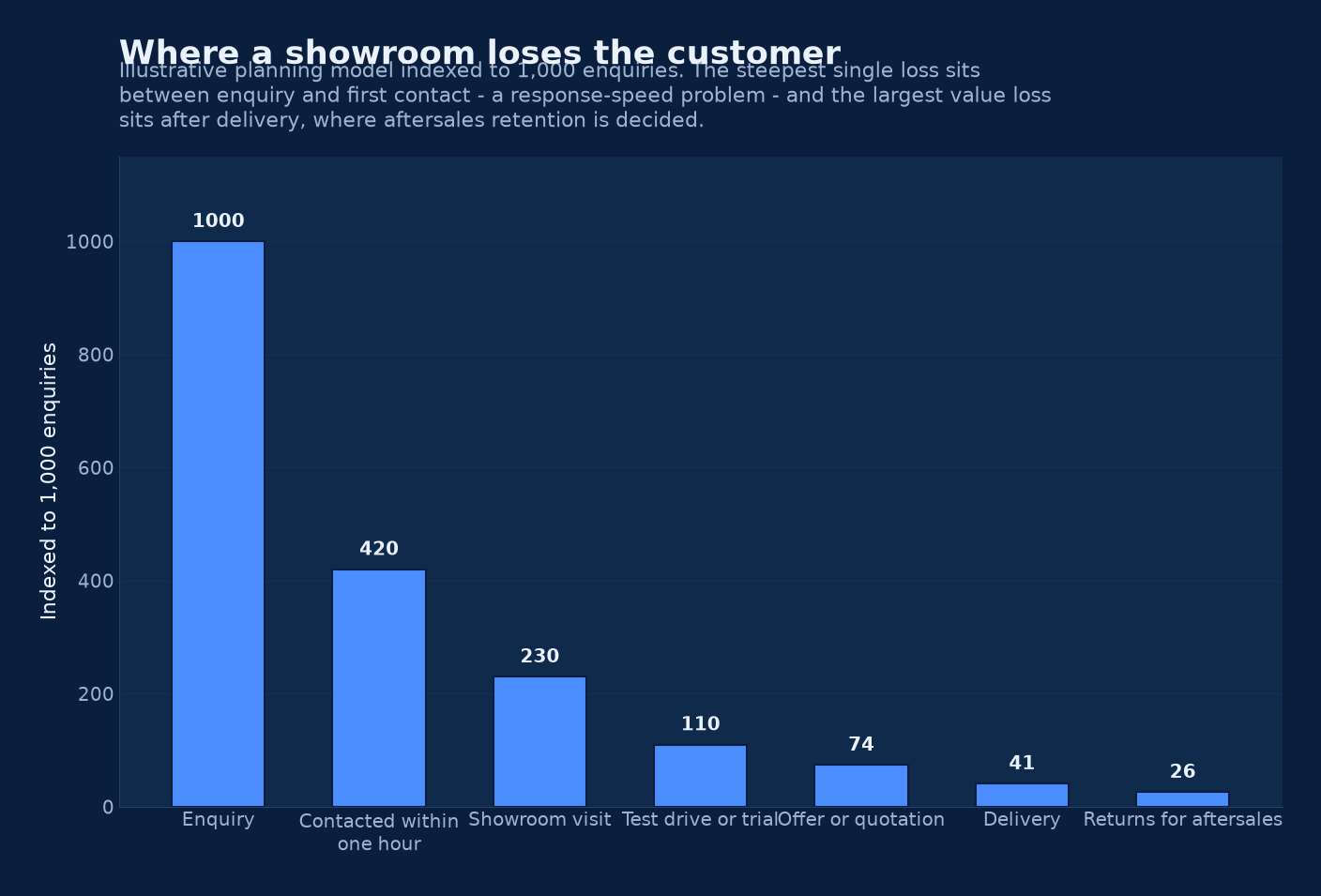
Chart values are an illustrative planning model based on typical UMC engagements and published industry benchmarks. They are not a guarantee of results on any specific project.
| Stage | Owner | What must exist | How it is measured |
|---|---|---|---|
| Enquiry | Marketing with the sales desk | Every channel captured in one queue with a source | Enquiries by source, branch and model |
| First contact | Sales desk | Response target, scripts, a named owner per enquiry | Time to first contact, contact rate |
| Showroom visit | Sales team | Appointment scheduling, stock availability, a reason to visit | Visits, visit-to-enquiry conversion |
| Test drive or trial | Sales team | Available units, licence and insurance checks, a route | Test drives per visit, trial-to-offer rate |
| Offer and negotiation | Sales manager | Transparent price build-up, exchange valuation, finance options | Offers issued, discount leakage |
| Delivery | Delivery and finance team | Paperwork, registration, handover experience | Deliveries, delivery cycle time |
| Aftersales and repeat | Service manager with CRM | Service booking, reminders, warranty, recall handling | Retention rate, service revenue per unit sold |
Each stage has a different owner, which is why a showroom programme is an operations project with marketing inside it. We report stage conversion weekly during the build, because that is where the recoverable volume sits.
Where the margin actually is
Dealership economics invert the intuition: the line that produces most of the revenue produces the least of the profit. New product sales carry single-digit gross margins once discounts and incentives are netted, while finance and insurance, exchange, aftersales labour, parts and value-added products carry multiples of that. A month with record deliveries can therefore be a poor month, and a month with flat deliveries can be excellent if attach rates and service retention held. Reporting revenue without the margin mix is how showroom groups misallocate effort for years.
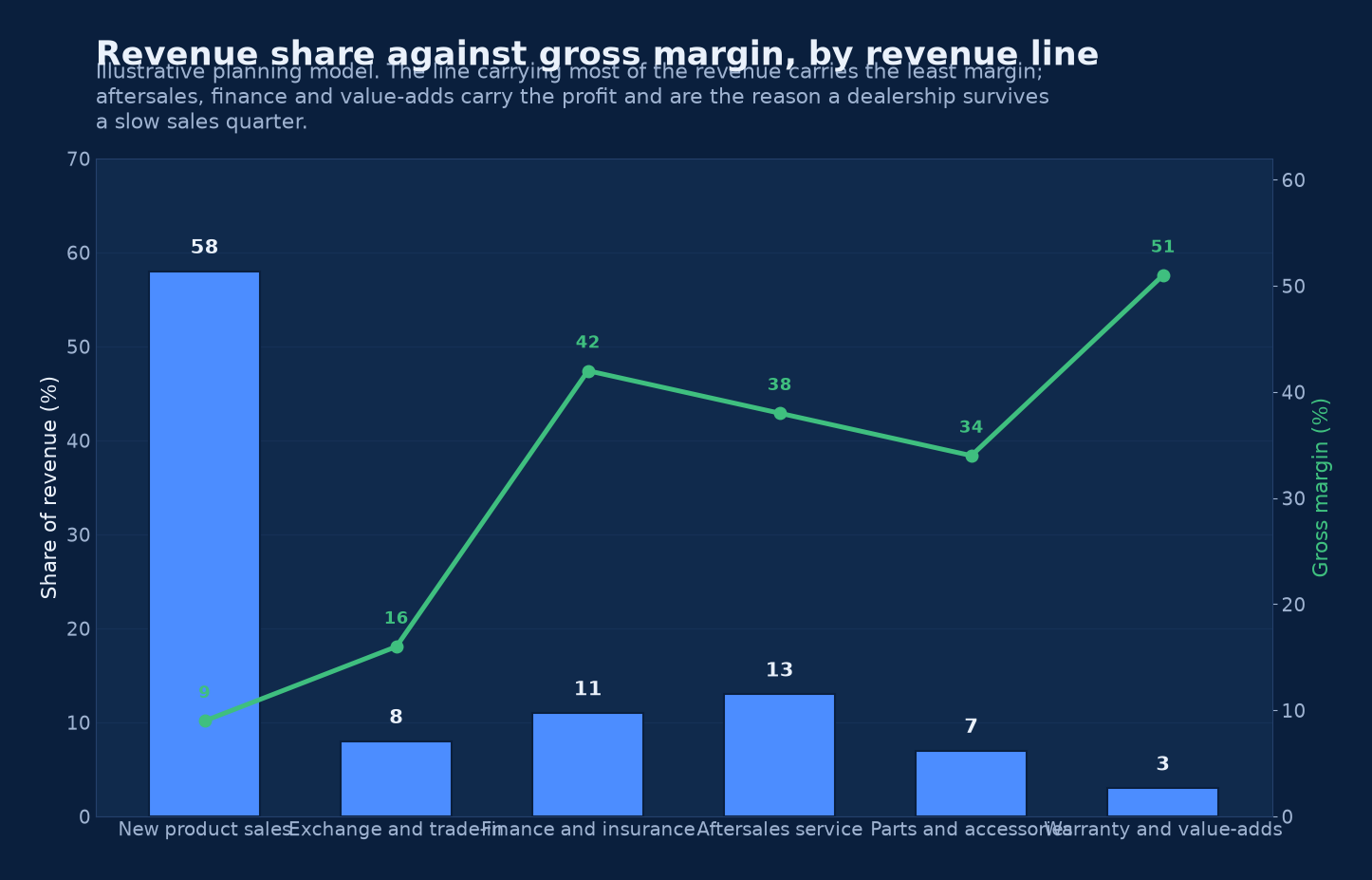
Chart values are an illustrative planning model based on typical UMC engagements and published industry benchmarks. They are not a guarantee of results on any specific project.
| Revenue line | Margin character | Growth lever | Measurement |
|---|---|---|---|
| New product sales | Thin, discount-sensitive, volume-driven | Mix towards higher-margin variants, reduce discount leakage | Gross margin per unit, discount per unit |
| Exchange and trade-in | Moderate, depends on valuation discipline | Valuation process, refurbishment cost control, resale route | Exchange attach rate, margin per exchange |
| Finance and insurance | High margin, regulation-sensitive | Lender panel breadth, transparent disclosure, attach process | Attach rate, income per unit, complaint rate |
| Aftersales service | High margin, retention-driven | Service booking ease, reminders, warranty and recall handling | Retention rate, revenue per unit in parc |
| Parts and accessories | High margin, availability-driven | Stock availability, accessory fitment at delivery | Parts attach, first-time fix rate |
| Extended warranty and value-adds | Very high margin, trust-driven | Explained at the right moment, not pushed at signing | Attach rate and claim experience |
This model is built with finance in week three and governs every later decision about campaigns, incentives and training. market research and competitive analysis and marketing mix modelling support the cases where the mix, not the volume, is the problem.
The showroom technology stack we integrate with
A dealership runs a commercial estate and a physical one: the dealer management system, the manufacturer’s portal, inventory and stock ageing, CRM, finance partner systems, service scheduling, parts catalogues, payment terminals, cameras, digital signage and – in jewellery – RFID, vault logs and hallmarking records. The audit below is week one.
| System | What it holds | What we need from it | Common blocker |
|---|---|---|---|
| Dealer management system (DMS) | Sales, deliveries, service jobs, parts, accounting | Unit, margin and service extracts per branch | Reporting locked to the vendor, no export |
| Manufacturer portal or OEM system | Allocations, incentives, schemes, warranty claims | Stock and incentive truth per model | Manual downloads into spreadsheets |
| Inventory and stock ageing | Units on floor, in transit, aged stock, RFID counts | Live stock for the website and the sales desk | Website stock maintained by hand |
| CRM and lead system | Enquiries, follow-ups, lost-deal reasons, consent | Stage-defined pipeline with source attribution | Leads in personal phones and WhatsApp threads |
| Finance and insurance partners | Applications, approvals, disbursals, policies | Attach rate and income per unit | Partner portals with no consolidated view |
| Service scheduling and workshop | Appointments, job cards, labour, parts, warranty | Retention, throughput and first-time fix | Paper job cards digitised late |
| Payments and POS | Card, wallet, UPI or bank paths, refunds | Reconciliation per branch and per line | Advance payments recorded off-system |
| Physical security systems | Cameras, access logs, vault records, RFID gates | Incident evidence and inventory control | Retention never specified, storage never checked |
Integration is delivered through enterprise systems integration, data warehouse and lakehouse where DMS, CRM and accounts must agree, and full-stack Java development or portal development for customer and branch portals. Where a manufacturer system cannot be integrated, we say so and price the manual reconciliation instead of promising a live view.
Service requirements by role
| Role | The question they ask | What we deliver | The number they watch |
|---|---|---|---|
| Principal or owner | Is the branch profitable after everything? | Margin-mix model, absorption reporting, expansion case | Gross margin per unit and aftersales absorption |
| General manager | Are the enquiries being converted? | Lead response process, visit scheduling, desk coaching data | Enquiry-to-visit and visit-to-delivery conversion |
| Sales manager | Which model and which source is worth pushing? | Model-level margin, source performance, test-drive availability | Deliveries, discount leakage, attach rates |
| Aftersales manager | Are the customers we sold to coming back? | Service retention programme, booking flow, reminders | Retention rate and revenue per unit in parc |
| Marketing lead | What do we run, and how do we prove it? | Branch campaigns, creative, festive calendar, measurement plan | Cost per visit and cost per delivery |
| Finance | Where did the discount go? | Discount and incentive reconciliation, payout tracking | Net margin per unit and per branch |
| IT or vendor | Who fixes the DMS or the network on a Saturday? | Managed IT, monitoring, inventory security, backups | Downtime minutes and audit findings |
Local search per branch, per brand and per service
Showroom demand is local and specific: a customer searches for a model, a brand, a service or a category within a distance they are willing to travel. That means one profile per branch – not one for the group – with the brand and services listed accurately, hours that include the weekend reality, photographs of the actual showroom, and reviews responded to by somebody who works there. Service departments need their own presence, because a customer searching for a service centre is a different customer from one searching for a purchase.
| Element | What good looks like | What usually goes wrong | Fix cadence |
|---|---|---|---|
| Branch profiles | One per location, brand and service accurately listed | One profile for four branches, or duplicate listings | Quarterly audit |
| Service centre presence | Separate listing for the workshop with its own hours | Service customers routed to the sales desk | Quarterly |
| Hours and holidays | True including festive extended hours | Festival hours never updated, customers turned away | Before every festival |
| Photos | Real showroom, real stock, real team, current collection | Manufacturer stock imagery only | Monthly additions |
| Reviews | Steady volume, responses from the branch, themes acted on | Responses from a central agency with no branch detail | Weekly ask, weekly responses |
| Model and stock pages | Live stock, variants, pricing logic, booking route | Static model pages with no availability | Weekly or live feed |
| Location and access | Parking, test-drive route, entrance, accessibility | No parking information for a purchase that takes ninety minutes | With any change |
| Structured data | Auto dealer or store, offers, opening hours, aggregate rating | No schema, so assistants cannot answer accurately | Each release |
Delivery runs through local SEO and Google Business Profile management, SEO for model, category and service queries, AI search optimisation because “which model suits this budget” questions are increasingly asked of assistants, and content marketing for the comparison and ownership-cost content that decides the shortlist.
Paid media: model demand, festive peaks and lead quality
Showroom paid media has three jobs with different economics. Capture: model, category and “near me” queries with high intent, bounded by branch radius and stock reality. Create: collection launches, festive campaigns and new-model arrivals through video and social, measured on visits rather than clicks. Retain: service, warranty and exchange campaigns aimed at customers who already exist, which is the cheapest media a dealership can buy and the most neglected. The control that matters is stock-aware advertising: never advertise a variant that is not available, or the visit becomes a complaint.
| Job | Channels | Budget logic | Measured by |
|---|---|---|---|
| Capture intent | Search on model, category, service and near-me queries | Bounded by branch radius and available stock | Cost per showroom visit, not per lead |
| Create demand | Instagram, Facebook, YouTube video, creators | Launch-led and festive-led, creative refreshed per collection | Visits, test drives, branded search lift |
| Retain customers | CRM journeys, service reminders, exchange offers | Small, always-on, aimed at the existing parc | Service retention and repeat purchase rate |
| Local inventory | Shopping and local inventory ads where the market has them | Feed quality first, budget second | Feed coverage, click-to-visit rate |
| Events and camps | Launch events, exchange camps, service camps | Calendar-led with a capacity plan | Attendees, on-site conversions, cost per delivery |
Execution runs through Google Ads management, Performance Max with strict inventory and exclusion control, Shopping and Merchant Centre feeds where local inventory advertising exists, local campaigns for service demand, Meta and Instagram for collections and launches, YouTube for model walkarounds and ownership content, creator and influencer work where the category supports it, and media planning and buying for multi-branch groups. Our full-service social advertising engagement for a Hyundai group showroom shows the method at dealership scale.
Inventory, model pages and the online-to-showroom path
The customer’s research happens on your inventory whether you publish it or not – they will call to ask if a variant is available, which costs a salesperson twenty minutes and produces no record. Publishing live stock with honest pricing logic turns that call into a visit: what is available, in which colour and variant, at what price built up transparently, with an exchange estimate and a finance illustration, and a booking slot for the visit or the test drive. In jewellery the equivalent is collection pages with metal, purity, weight ranges, making-charge logic and reservation for viewing, because high-value items are rarely sold from a web cart.
| Capability | What it does | Failure it replaces | Typical dependency |
|---|---|---|---|
| Live stock display | Shows what is actually available per branch | A salesperson answering the same question all day | DMS or inventory feed |
| Variant and model pages | Specifications, comparisons, ownership costs | Manufacturer pages with no local availability | Product data model |
| Price build-up | Ex-showroom, taxes, registration, insurance, accessories | “Call for on-road price” | Pricing rules agreed with finance |
| Exchange estimator | Indicative valuation with the assumptions stated | Valuations quoted inconsistently by phone | Valuation logic and condition grades |
| Finance illustration | EMI ranges, tenure, disclosure of terms | Numbers quoted from memory | Lender panel terms |
| Visit and test-drive booking | Slot booking with confirmation and reminders | Walk-in hope | Scheduling with the sales roster |
| Collection reservation (jewellery) | Reserve to view, not to buy online | Customers arriving to find the piece sold | Inventory lock logic |
| Branch stock search | Find it across branches in one view | Phone calls between branches | Consolidated inventory |
Delivery runs through website development, e-commerce and B2B ordering where accessories and parts sell online, UX and UI design for the price build-up and booking flows, Core Web Vitals because these pages are image-heavy, information architecture for multi-brand groups, mobile apps where a group justifies one, and maintenance and support so a price or stock change is live the same day. Our fashion retail showroom engagement and online mobile store build show catalogue-led work in this space.
Lead management: response speed, follow-up and lost-deal truth
Dealerships rarely have a lead-volume problem; they have a lead-handling problem. An enquiry answered after a day has usually already visited a competitor, a follow-up that stops after two attempts loses a customer who was still deciding, and a lost-deal reason recorded as “price” for every loss teaches management nothing. The fix is a process with numbers attached: one queue across channels, a response target measured rather than hoped for, a follow-up cadence with a defined number of attempts across two channels, a lost-deal taxonomy that is specific enough to act on, and a rule that no enquiry is closed without a reason.
| Component | Design decision | Failure mode | Measurement |
|---|---|---|---|
| One queue | All channels into one system with a source and an owner | Leads in personal phones, WhatsApp and paper | Share of enquiries captured in the system |
| Response target | Within the hour during working hours | End-of-day batch calling | Median time to first contact |
| Follow-up cadence | Defined attempts across two channels over a defined window | Two calls, then silence | Attempts per lead, contact rate |
| Visit scheduling | Appointment offered, not left to the customer | “Come whenever” | Visit rate per contacted lead |
| Lost-deal taxonomy | Specific reasons: stock, price, finance, timing, competitor, service attitude | “Price” recorded for everything | Reason distribution and trend |
| Test-drive discipline | Unit availability, documentation, route, feedback captured | Test drives that produce no record | Test drives per visit, feedback completion |
| Consent and contactability | Lawful basis captured at the enquiry | Marketing lists with no consent record | Consent coverage of the active base |
CRM development and integration provides the system, sales and pipeline analytics the reporting, WhatsApp and SMS the channels, and nurturing programmes the follow-up sequences for long-decision categories. The training matters more than the software: a CRM the sales desk does not believe in becomes a place where reasons go to die.
Social, creators and the considered purchase
Showroom categories are visually-led and socially-researched: customers watch walkarounds, compare collections, read comments about service experience and increasingly ask a creator’s audience rather than a salesperson. The content that works is specific and honest – the actual stock on the floor, the real price build-up, the delivery experience, the service process, the people who will look after the customer. The content that fails is manufacturer material reposted with a festive graphic, because it tells the customer nothing about why to buy here rather than two kilometres away.
| Content type | Purpose | Cadence | Measured by |
|---|---|---|---|
| Stock and collection showcases | Show what is actually available now | Weekly, shot in the showroom | Visits, enquiries mentioning the item |
| Model or product walkarounds | Answer the comparison questions | Per launch and per popular variant | Watch time, saves, test-drive requests |
| Price and finance explainers | Remove the fear of hidden costs | Monthly, updated with any change | Enquiry quality, offer acceptance |
| Delivery and handover moments | Proof of experience, with consent | As they happen | Reach, comments, referral enquiries |
| Service and aftersales stories | Sell the retention promise before the purchase | Monthly | Service bookings from social |
| Creator and community work | Reach into new audiences with credibility | Festive and launch-led | New-customer share, cost per visit |
| Review and comment handling | Reputation and recovery | Weekly | Response rate, sentiment trend |
Delivery runs through social media management, Instagram and Meta for collections, YouTube for walkarounds, creator and influencer marketing with briefs and disclosure handled properly, and brand performance and creative production for the shoot discipline that makes a showroom look like the place to buy.
Aftersales: the retention business inside the sales business
Aftersales is where a dealership earns its fixed costs and where the next sale is prepared. It is also the department most often excluded from marketing, which is a structural mistake: the customer who had a good service experience buys the next vehicle or the next set from the same place, and the customer who had a bad one tells everybody. The programme is simple – make booking effortless, remind at the right interval with consent, handle warranty and recalls proactively, keep the first-time fix rate high, and report retention per unit sold rather than per job card.
| Element | What good looks like | Common failure | Measured by |
|---|---|---|---|
| Service booking | Online, by phone and by message, with slot choice | Booking only by walking in | Booking channel mix and slot utilisation |
| Reminders | Interval-based, consented, with the reason stated | Bulk SMS to everybody regardless of history | Reminder response and booking rate |
| Warranty and recalls | Proactive contact, no cost surprise | Customer discovers a recall from a letter | Recall completion rate |
| First-time fix | Parts availability and technician scheduling aligned | Repeat visits for the same fault | First-time fix percentage |
| Pickup and drop | Where the market and margin support it | Offered inconsistently by branch | Uptake and cost per job |
| Estimates and approvals | Transparent, photographed where useful, approved before work | Bill surprises at collection | Approval rate and complaint count |
| Retention reporting | Per unit sold, over the ownership life | Revenue per job card only | Retention rate and revenue per unit in parc |
lifecycle and retention campaigns and marketing automation supply the journeys, WhatsApp the channel customers actually read, and predictive analytics and demand forecasting the workshop capacity planning behind it.
Customer CRM, consent and the ownership lifecycle
A dealership’s most valuable asset is the list of everybody who bought something, serviced something or enquired and did not buy – and it is usually spread across the DMS, the CRM, personal phones, finance partner systems and paper files. Consolidating it into one customer record with a consent basis turns every future transaction into a conversation rather than an advertisement: insurance renewal, warranty expiry, service interval, exchange timing, accessory suggestions and the next purchase window.
| Component | Design decision | Failure mode | Measurement |
|---|---|---|---|
| One customer record | Match across sales, service and finance with human review | The same customer four times | Match and duplicate rate |
| Consent | Purpose-specific, dated, withdrawable, captured at delivery | A tick box on the delivery form nobody remembers | Consent coverage of the active base |
| Ownership timeline | Purchase, services, claims, renewals, exchanges | History known only to the advisor who served them | Timeline completeness |
| Lifecycle journeys | Service interval, insurance renewal, warranty expiry, exchange window | One festive blast a year | Journey conversion by stage |
| Suppression | Complaints, disputes, opt-outs, deceased customers | A promotional message during a warranty dispute | Suppression coverage and audit |
| B2B and fleet | Company records, multiple drivers, contract terms | Fleet customers treated as retail | Contract value, renewal rate |
Build and run sit with CRM development and integration, lifecycle and retention campaigns, email for documents and renewals, SMS and WhatsApp for reminders, and marketing automation for the journeys. AI governance covers anything automated that touches a customer record.
Business intelligence: footfall, conversion and margin per unit
Showroom reporting arguments are about definitions: is a footfall a person or a group, does a test drive count as an enquiry, is gross margin measured before or after incentives and floor-plan interest, does service revenue count towards absorption with or without warranty labour. The dictionary comes first, then a branch page the general manager reads every Monday and a group page the principal reads every month.
| Metric | Definition that must be fixed | Why it is contested | Refresh |
|---|---|---|---|
| Footfall and enquiries | People or parties, by source and branch | Walk-ins counted for nobody’s benefit | Daily |
| Enquiry-to-visit | Contacted enquiries that reached the showroom | Contact attempts recorded as contacts | Weekly |
| Visit-to-delivery | By model, variant and salesperson | Deliveries attributed to the wrong source | Weekly |
| Gross margin per unit | Before and after incentives, with floor-plan cost stated | Incentives recorded as revenue | Monthly |
| Discount leakage | Discount per unit against the approved band | Accessories bundled to hide discount | Monthly |
| Attach rates | Finance, insurance, exchange, accessories, warranty per delivery | Attach counted at application, not approval | Weekly |
| Aftersales retention | Units serviced in the parc over the period | Parc definition changes to flatter the number | Monthly |
| Absorption | Aftersales gross profit over fixed costs | Fixed costs allocated differently by branch | Monthly |
| Stock ageing | Days on floor by unit and branch | In-transit stock counted as floor stock | Weekly |
The practices are BI dashboards and executive reporting, sales and pipeline analytics, demand forecasting for stock ordering and festive planning, data warehouse and lakehouse where DMS, CRM and accounts must agree, and cloud cost optimisation where the reporting estate is subscription-based.
Artificial intelligence in showrooms, sequenced by value against risk
The useful AI here is commercial and administrative: answering availability, price and booking questions instantly on WhatsApp and the website; scoring enquiries so the desk calls the likely buyer first; drafting follow-up messages for the salesperson to send; forecasting festive demand for stock ordering; detecting the aged unit that should be discounted this week; and reading service feedback themes. The AI that is not acceptable is anything that quotes a price or a finance term the business cannot honour, or that contacts a customer without a lawful basis.
| Use case | Value | Risk | Human in the loop |
|---|---|---|---|
| Enquiry copilot on WhatsApp and web | Answers availability, price logic, booking instantly | Low | Escalation for negotiation and complaints |
| Lead scoring | Desk calls the likely buyer first | Medium – a wrong score hides a real buyer | Salesperson owns the call |
| Follow-up drafting | Consistent, personalised, consent-aware | Low | Salesperson sends and records |
| Demand and festive forecasting | Better stock ordering and staffing | Medium – a wrong forecast costs floor-plan interest | GM confirms the order |
| Aged-stock and pricing triggers | Discount where it earns, not where it is easy | Medium – margin leakage if automated | Sales manager approves every change |
| Service feedback themes | Branch-level problems surfaced monthly | Low | Aftersales manager acts |
| Visual search for collections | Find similar designs from a photograph | Low-medium – expectation management | Sales advisor completes the sale |
The practice set is AI readiness assessment, AI agents and automation, AI integration with DMS and CRM, data engineering for AI and knowledge systems, AI governance, risk and compliance, enablement for the sales desk and ROI measurement.
IT, high-value inventory and physical security
Showroom IT includes a category most sectors do not have: high-value physical inventory that is also a data problem. A jewellery showroom’s stock is counted in grams and pieces, moved between the vault, the counter and the customer’s hand, and reconciled daily; a dealership’s stock is counted in units with keys, registration documents and floor-plan liability. The controls are therefore both digital and physical – RFID or barcode discipline, vault and access logs, camera retention that actually covers the period an insurer asks about, and payment security that keeps card data out of chat threads.
| Area | What we put in place | Why it matters here | Evidence produced |
|---|---|---|---|
| Asset and inventory register | Every device, system and inventory location with an owner | Stock moves between vault, floor and branch | Register with reconciliation cadence |
| RFID or barcode control | Scan discipline at every movement, exception alerts | Shrinkage is discovered at annual audit otherwise | Daily reconciliation and exception log |
| Camera retention and access | Retention period specified and verified monthly | The incident nobody can evidence | Retention verification records |
| Network segmentation | Sales, service, guest, payment and security separated | Guest Wi-Fi must not reach the DMS | Crossing-rules table |
| Payment security | Terminals on their own path, no card data in messages | Advances taken over WhatsApp | Process review and evidence |
| Backups and recovery | DMS, CRM and inventory backed up off-machine, tested | A branch cannot trade without its stock data | Timed restore records |
| Monitoring and on-call | Alerts on DMS, network and payment paths, weekend cover | Saturday is the busiest trading day | Alert catalogue and rota |
| Access control | Role-based, MFA on administrative accounts, leaver process | Sales staff turnover is high | Access review log |
The practices are managed IT and AMC, helpdesk and end-user support, network engineering, server and storage engineering, cybersecurity, backup and disaster recovery, IT audit and compliance readiness and cloud services where the estate is hosted.
Multi-brand, multi-branch and franchise groups
Groups need one standard and branch-level execution, and the standard worth centralising is narrower than head offices assume: the lead-response process, the margin and reporting definitions, the consent policy, the brand and creative system, and the security baseline. What belongs at the branch is the local profile, the stock, the community relationships, the festive execution and the people. Franchise groups add a third layer: co-marketing funds with attribution rules agreed before the first campaign, because the alternative is an argument during the first slow quarter.
| Layer | Central | Branch | Shared artefact |
|---|---|---|---|
| Lead process | Response targets, cadence, lost-deal taxonomy | Local desk execution and coaching | One process document |
| Brand and creative | Brand system, templates, shoot standards | Local stock photography, community content | Creative library |
| Inventory and pricing | Pricing governance, discount bands, aged-stock rules | Live stock, local offers within the band | Published price logic |
| Reporting | Metric dictionary and group view | Branch weekly page | One set of definitions |
| CRM and consent | Consent policy, journey templates, suppression rules | Capture at every touchpoint | Consent register |
| IT and security | Baseline, monitoring, vendor management | Branch devices, RFID discipline, spares | Asset register and evidence pack |
market expansion consulting covers new branch and new brand cases, unified top-level business management the group governance question, and business strategy consulting whether growth should come from branches, brands or aftersales capacity.
How an engagement runs: the first ninety days
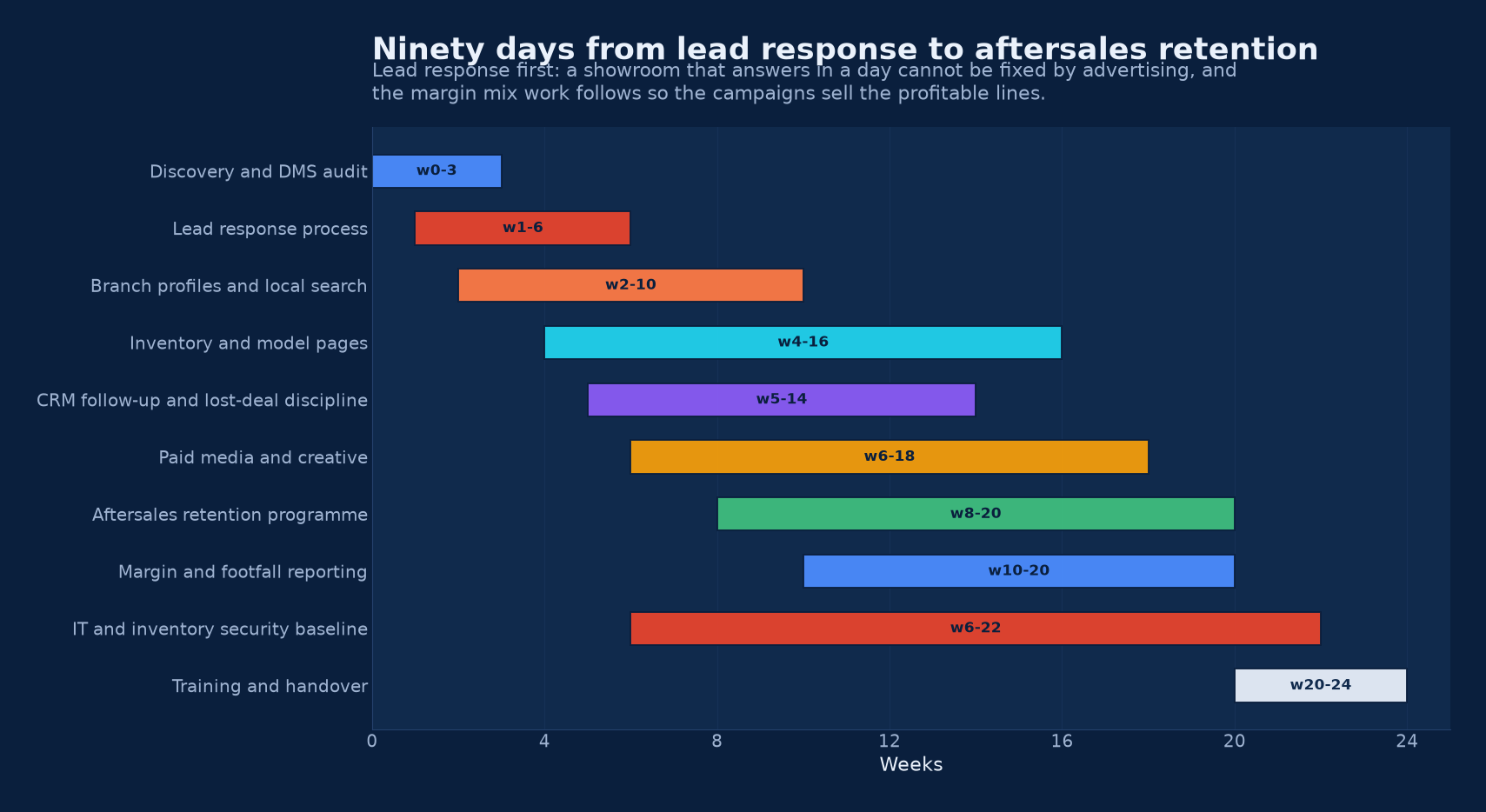
Chart values are an illustrative planning model based on typical UMC engagements and published industry benchmarks. They are not a guarantee of results on any specific project.
Weeks one to three are discovery: the DMS and systems audit, the margin-mix model by revenue line, the lead-response audit with real call data, and a written verdict including what we would not do. The lead response process lands by week six with response targets and a lost-deal taxonomy. Branch profiles and local search run to week ten. Inventory and model pages build from week four to sixteen. CRM follow-up discipline runs weeks five to fourteen. Paid media starts at week six – after the response process exists, because advertising into an unanswered phone buys complaints. The aftersales retention programme runs from week eight to twenty, margin and footfall reporting is live by week twenty, the IT and inventory security baseline by week twenty-two, and training and handover close the programme.
| Deliverable | Week | What the business keeps |
|---|---|---|
| DMS and systems audit | 3 | What can and cannot be exported, with options |
| Margin-mix model | 3 | Which lines earn, per unit and per branch |
| Lead-response process | 6 | Targets, cadence, lost-deal taxonomy |
| Branch profiles and local search | 10 | One accurate profile per branch and service |
| Inventory and model pages | 16 | Live stock, price build-up, booking |
| CRM follow-up discipline | 14 | One queue, one cadence, reasons that mean something |
| Paid media with stock controls | 18 | Campaign structure, radius, pause rules |
| Aftersales retention programme | 20 | Booking flow, reminders, retention reporting |
| Margin and footfall reporting | 20 | Branch and group pages on one dictionary |
| IT and inventory security baseline | 22 | RFID discipline, retention, evidence pack |
| Training and handover | 24 | Runbooks, recordings, named owners |
Pricing and engagement models
| Model | Best for | What it includes | Commercial shape |
|---|---|---|---|
| Assessment only | A principal who needs the truth before spending | DMS audit, margin-mix model, lead-response audit, written verdict | Fixed fee, three weeks |
| Programme build | A dealership or group fixing several workstreams | Lead process, profiles, inventory pages, CRM, aftersales, reporting, IT baseline | Fixed fee by workstream, ninety-day core |
| Managed retainer | A group that wants it run | Media, content, profile upkeep, reporting, IT support hours | Monthly, agreed scope, quarterly review |
| Fractional leadership | A group between hires | Marketing, aftersales or IT leadership part-time with the programme attached | Monthly, time-boxed with a handover plan |
Every model separates the assessment from the build, and every model assumes the manufacturer’s brand rules and the finance partner’s disclosure requirements are read before the first asset ships.
Compliance, pricing claims and customer data
Showroom advertising carries specific exposure: price claims that omit statutory costs, finance illustrations that understate the total, exchange valuations presented as offers, stock imagery for items that are not available, festive claims that cannot be honoured, and – in jewellery – purity, hallmarking and making-charge transparency. Customer data adds consent and retention obligations, and finance products add disclosure rules that differ by market and lender.
| Area | What we check | Where it shows up | Owner |
|---|---|---|---|
| Price advertising | On-road or on-body build-up stated, validity dated | Ads, model pages, festive campaigns | Sales manager with finance |
| Finance illustration | Total cost, rate, tenure, fees, disclosure wording | Calculators, ads, sales conversation | Finance with lender compliance |
| Exchange valuation | Indicative only, conditions stated | Estimators, campaigns, desk scripts | Sales manager |
| Stock availability | Never advertise what is not available | Campaigns, inventory pages, feeds | Inventory owner |
| Purity and hallmarking | Metal, purity, weight, charges stated correctly | Collection pages, tags, ads | Compliance with the workshop |
| Consent and data | Purpose-specific consent, retention, customer rights | CRM, WhatsApp, Wi-Fi, cameras | Named data owner |
| Warranty and recall claims | Scope, exclusions, duration stated accurately | Aftersales content, delivery paperwork | Aftersales manager |
| Review and complaint handling | Responses without customer detail, recovery first | Profiles, social, complaints | Branch manager |
AI governance applies to any copilot that quotes a price or a finance illustration – it must answer from your live data or escalate, because a confident wrong number becomes a complaint.
How we measure success
| Outcome | Metric | Baseline source | Review cadence |
|---|---|---|---|
| More deliveries from the same traffic | Visit-to-delivery conversion by model | DMS and CRM | Weekly during build |
| Faster response | Median time to first contact, contact rate | CRM and call logs | Weekly |
| Better margin mix | Gross margin per unit, attach rates, absorption | Finance and DMS | Monthly |
| Less discount leakage | Discount per unit against the approved band | DMS | Monthly |
| Stronger local presence | Branch visibility, profile actions, rating trend | Search and profile data | Monthly |
| Aftersales retention | Units serviced in the parc, retention rate | Workshop and CRM | Monthly |
| Healthier stock | Days on floor, aged-stock value | Inventory | Weekly |
| Honest spend | Cost per visit and cost per delivery by source | Finance and campaign data | Monthly |
We report the misses, including the weeks when response times slipped, because a dealership that cannot see its own handling losses will keep buying traffic to fill a leaky process.
Proof: showroom and dealership work we have delivered
Our published work in this space spans an automobile showroom group’s full-service social advertising, a fashion retail showroom, and catalogue-led commerce builds.
Related Services
Showroom, dealership and retail case studies:
- Hyundai group showroom – full-service social advertising
- A fashion retail showroom
- WordPress and WooCommerce online mobile store
- Manufacturing and industrial – the supply side of the same chain
Where manufacturer agreements restrict publication – as they usually do in automotive – we share method, numbers and constraints under a non-disclosure agreement.
Every capability a showroom or dealership can draw on
| Family | Capabilities | Typical showroom use |
|---|---|---|
| Demand capture | local SEO and profiles, SEO, AI search optimisation, content marketing | Branch visibility, model and collection pages, ownership-cost content |
| Paid media | Google Ads, Performance Max, Shopping feeds, local campaigns, Meta, Instagram, YouTube, media planning | Model and festive demand, service campaigns, launches |
| Brand and content | brand performance and creative production, social media management, creators | Stock showcases, walkarounds, delivery moments |
| Build | website development, commerce and parts, customer and branch portals, UX and UI, performance, apps, maintenance | Live inventory, price build-up, booking, service scheduling |
| Customer data | CRM development and integration, lifecycle campaigns, WhatsApp, SMS, email, automation | Lead queue, ownership timeline, renewals, recalls |
| Intelligence | dashboards, pipeline analytics, forecasting, mix modelling, warehouse and lakehouse, retail media | Footfall, conversion, margin mix, absorption, stock ageing |
| Consulting | strategy, market research, expansion, cost and margin, cash flow, unified management | New branch cases, margin recovery, working capital, group governance |
| Infrastructure | managed IT, helpdesk, networks, servers and storage, cybersecurity, backup and DR, audit, cloud | DMS uptime, RFID and vault discipline, payment security |
| Artificial intelligence | readiness, agents, integration, data engineering, governance, enablement, ROI | Enquiry copilots, lead scoring, demand forecasting, aged-stock triggers |
Local teams: showrooms in Lucknow and across India
These pages are written to be geography-neutral because the work is delivered remotely. For showrooms that want a provider in their own market, the local pages carry regional detail for automobile dealers and jewellery stores, including festive programmes.
- Digital marketing company for automobile dealers in Lucknow
- Website development company for automobile dealers in Lucknow
- Get more automobile sales leads in Lucknow
- Digital marketing company for jewellery stores in Lucknow
- Website development company for jewellery stores in Lucknow
- Get more jewellery customers in Lucknow
- Digital marketing and IT services across Indian cities
- Contact us
Related industry verticals
Showrooms and dealerships cover the physical, considered-purchase side of selling; the retail vertical covers online-first and multi-channel commerce. The two are usually read together, and the remaining verticals share one economics-first method.
Dedicated pages for showrooms, one per service
A vertical this broad cannot be answered by one page, so each service gets its own dedicated page for showrooms. This page is the vertical overview; the pages below carry the depth for one discipline each.
- Website development for showrooms and dealerships — Model and variant pages, test-drive and appointment booking, branch locators with real opening hours, dealer stock feeds, finance and EMI calculators, sub-second LCP on mobile, WCAG 2.2 AA.
- SEO for showrooms and dealerships — Branch-level local search and Google Business Profile discipline, model and variant page architecture, city and ‘near me’ intent, review velocity per branch, vehicle and offer structured data, launch digital PR, AI search visibility.
- Google Ads for showrooms and dealerships — Lead generation by model and branch, local goals and store-visit measurement, inventory ads from the stock feed, call and WhatsApp tracking, bidding to cost per qualified test drive rather than cost per lead.
- Social media marketing for showrooms and dealerships — Launch and festive campaign creative, branch-level content, delivery and testimonial production, owner communities and creator work, comment and DM handling as a sales channel, cost per qualified lead by platform.
- CRM and lead management for showrooms — DMS and lead-lifecycle integration: enquiry-to-delivery funnel, test-drive show rates, follow-up SLAs, service retention, referral and repeat-purchase programmes, consent and preference governance.
- Business intelligence for showrooms — One metric layer above DMS, website, ads and service data: cost per qualified lead, test-drive conversion, footfall-to-delivery, stock ageing, floor productivity, service absorption and branch contribution.
- IT support for showrooms and dealerships — DMS uptime and vendor management, branch network and Wi-Fi for sales desks, device management for tablets, access control and MFA, backups with timed restores, signage, CCTV and peripheral endpoints, peak-festive readiness.
- AI for showrooms and dealerships — Lead scoring and routing, enquiry-response assistants on live DMS data, service demand forecasting, stock and pricing intelligence, image-based damage assessment, virtual showroom and configurator assistance – sequenced by value against risk.
Frequently asked questions about showroom and dealership growth
Do we need more leads, or better handling?
Usually better handling. We audit real call and message data in week one; if response times and follow-up cadence are the problem, advertising more only increases the number of customers who visit a competitor first.
How do you measure marketing when the sale happens offline?
By measuring the stages that lead to it – contact rate, visit rate, test drives, offers, deliveries – with source attribution agreed up front and discount and margin reported alongside volume.
Our DMS reporting is weak. Can you still do this?
Yes. We build a warehouse layer over what the DMS can export and name which numbers stay manual until the vendor changes. We do not promise live dashboards we cannot feed.
Should we advertise a model that is out of stock?
No. Stock-aware advertising is a rule in every campaign we build, because an unavailable variant converts a visit into a complaint and a review.
How do we grow aftersales revenue?
With booking ease, consented interval reminders, proactive warranty and recall handling, first-time-fix discipline, and retention reported per unit sold rather than per job card.
Is a customer CRM worth it for a single branch?
Yes, at small scale: one queue for enquiries, one customer record across sales and service, and a consent field. Those three things pay for themselves in retention.
How do you handle festive season campaigns?
With capacity planning first – stock, staffing, delivery slots and finance processing – then creative and media on a calendar, with pause rules when capacity is reached.
Can you manage multiple brands and branches?
Yes, with central standards for process, reporting, consent and creative, and branch-level profiles, stock and local execution. Franchise co-marketing terms are written down before the first campaign.
What about jewellery-specific requirements?
Purity and hallmarking accuracy, making-charge transparency, collection reservation for viewing, RFID and vault discipline, and camera retention that satisfies your insurer.
Do you handle finance and insurance marketing?
Within the lender’s disclosure rules: transparent illustrations, attach process training, and reporting on approved attach rather than applications.
Can AI answer customer questions for us?
For availability, price logic, booking and service intervals – yes, from your live data with escalation rules. For negotiation, complaints or a finance commitment – no.
Do you work outside India?
Yes. Programmes are delivered remotely and written geography-neutral, with market rules on finance disclosure, consumer protection, data and festive calendars handled inside the engagement.
What if our problem is margin, not demand?
Then the verdict says so. Discount leakage, floor-plan cost, aged stock and weak attach rates are more common causes of a bad quarter than low footfall, and we would rather name that in week three.
Start with the margin mix and the lead-response audit
Give us three weeks with your DMS extracts, your finance detail and two days of real call and message data, and we will return the margin-mix model by revenue line, the lead-response audit with response times, the branch profile comparison against your nearest competitors, and a written verdict including what we would not start with – yours to keep either way.
Contact Unified Management Consulting to arrange a confidential first conversation.