
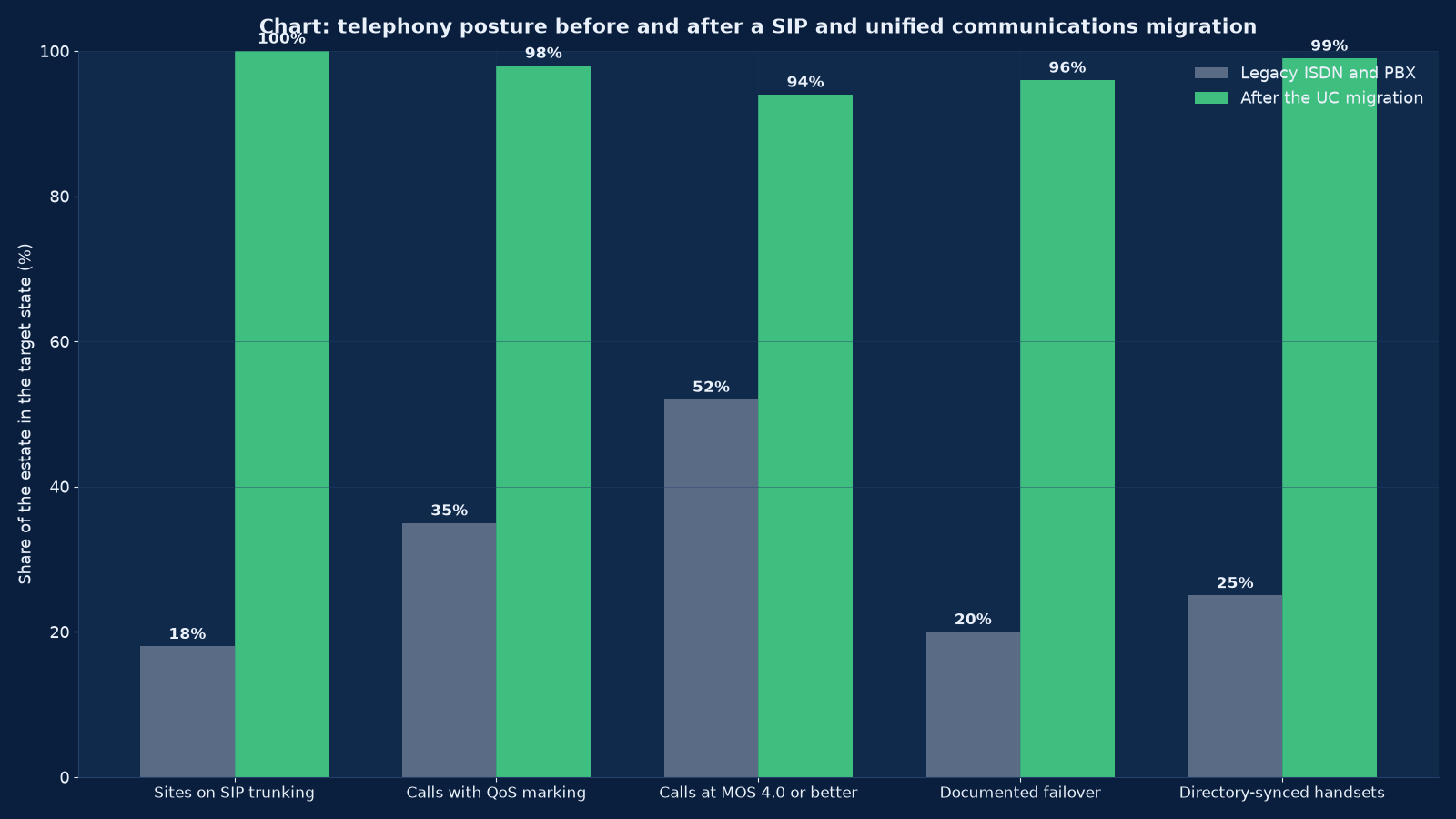
Chart values are an illustrative planning model based on typical UMC engagements and published industry benchmarks. They are not a guarantee of results on any specific project.
Voice is the only application on an enterprise network that users will not tolerate being merely adequate. A file that arrives slowly is an inconvenience; a call that breaks up is a failure of the business, reported immediately, by the most senior person in the room. It is also the only application whose quality depends on every layer simultaneously — the cable category, the switch power budget, the queueing discipline, the wide-area path and the carrier — which is why a telephony programme is a network programme whether it was commissioned as one or not.
Unified communications and VoIP engineering at Unified Management Consulting is the design and delivery of enterprise telephony as a network service: the session architecture and its boundary control, the SIP trunking and number strategy, the quality-of-service design end to end, the handset and endpoint estate, the directory integration that makes a thousand extensions administerable, the contact centre functions where they exist, the failover behaviour when a circuit or a platform fails, and the migration from whatever the estate runs today — which, for most organisations we are called to, is still partly legacy digital or analogue circuits with a retirement date that has already passed.
We deliver these programmes for distributed estates with real telephony dependency: healthcare groups with clinical handsets and paging, hospitality properties where the switchboard is a commercial function, retailers with branch phones and contact centres, manufacturers with plant and safety-critical calling, professional services firms whose billable work is interrupted by a bad call, and any organisation whose carrier has told it that its circuit technology is being withdrawn and has given it eighteen months to respond.
📞 Unified Communications & VoIP — Quick Summary
| Component | What We Deliver |
|---|---|
| Telephony estate audit | Every number, extension, circuit, platform, handset and call flow recorded — including the numbers nobody can explain and the circuits nobody remembers ordering. |
| Session architecture design | Where calls are processed, where they break out, and what the session boundary protects, including the resilience model for each site. |
| SIP trunking and carrier strategy | Trunk sizing against concurrent calls, carrier diversity, number portability and the handoff arrangement documented per site. |
| Session border control | Sizing, placement and the signalling and media security functions it performs, chosen against the concurrency the estate actually reaches at peak. |
| Quality of service end to end | Marking, queueing and prioritisation at the handset, the switch, the wide-area path and the breakout — because marking that stops being honoured at one hop does nothing. |
| Network readiness assessment | Cable category, power over Ethernet budget, uplink capacity, latency and jitter per path, verified by measurement before any platform is chosen. |
| Endpoint and handset strategy | Device selection per user class, provisioning, firmware baseline and the accessibility requirements that decide which handsets are usable by whom. |
| Directory integration and administration | Extensions, presence, call routing and voicemail driven from the directory, so a leaver’s number stops working when their account does. |
| Call flow and routing design | Hunt groups, queues, auto-attendants, time-based routing and out-of-hours behaviour, designed against how the business actually answers calls. |
| Contact centre functions | Queue design, agent routing, recording, reporting and the compliance obligations recording creates. |
| Failover and continuity | What happens to calls when a circuit, a platform, a site or a carrier fails, tested rather than assumed, with emergency calling handled explicitly. |
| Migration waves and cutover | Sites and number ranges migrated in dependency order, with per-cutover windows, verification and rollback. |
| Legacy retirement | Digital and analogue circuits surrendered with confirmation, and the dependencies they were silently carrying found before they are removed. |
Voice Is Not Like Other Traffic
Voice has a set of tolerances that no other enterprise application has, and they are not negotiable because they are physiological rather than technical. The design consequences follow directly from them.
| Parameter | The tolerance that matters | What produces a breach | How it sounds to the user |
|---|---|---|---|
| One-way latency | Roughly 150 milliseconds before conversation becomes effortful; beyond about 300 it becomes difficult | A hairpin path through a distant hub, satellite or wireless circuits, or a congested queue | Talking over each other, and pauses that feel like the call has dropped |
| Jitter | Small enough that the de-jitter buffer can absorb it without discarding | Contention on a path that does not prioritise voice, or variable queuing at a congested hop | Words missing, garbled audio, and robotic artefacts |
| Packet loss | A fraction of a per cent before it is audible, depending on the codec | Congestion drops, a failing circuit, or a wireless path with interference | Audio breaking out entirely in short bursts |
| Codec choice | A trade between bandwidth, quality and computational cost, with transcoding to be avoided | Mismatched codec negotiation between platforms or trunks | Quality that is inconsistent between internal and external calls, with no obvious cause |
| Mean opinion score | The composite measure users actually perceive; 4.0 or better is the design target for business calls | Any of the above, unaddressed | A call that is technically connected and practically unusable |
| Call setup time | Short enough that ringing behaviour feels normal | An undersized session border controller, or signalling taking a long path | Delays before ringing, which users report as the system being broken |
The reason these are engineering requirements rather than guidance is that they are measurable, and an estate that measures them can prove whether a complaint is a network problem or a platform problem. Most telephony disputes are unresolved because nobody has the per-path measurement to settle them. We deliver the measurement capability as part of the design, not as an optional extra.
Estate Audit: Numbers, Circuits and the Dependencies Nobody Documented
The estate audit is where these programmes are won or lost, because telephony accumulates decades of undocumented decisions: numbers bought for projects that ended, circuits retained because nobody was sure what they carried, and call flows that encode business rules nobody can now explain.
| What we audit | What it commonly reveals | Why it matters |
|---|---|---|
| Every number in the estate | Numbers nobody can account for, and numbers in service that the business believes were retired | Unaccounted numbers are a cost and a security exposure; retired-but-live numbers are a compliance problem |
| Every circuit and trunk | Legacy digital or analogue circuits still being paid for, sometimes carrying something unexpected | A circuit carrying a fax, an alarm, a lift phone or a payment terminal is a dependency that will break silently on retirement |
| Extensions and users | Extensions for leavers, duplicated numbers, and mailboxes nobody owns | A leaver’s extension still answering is both a cost and a risk |
| Call flows and routing | Rules that encode a business process nobody remembers designing, and out-of-hours behaviour that no longer matches the business | Migrating a call flow you do not understand means losing a process you cannot reconstruct |
| Handsets and endpoints | Device models past firmware support, and handsets whose features nobody uses | Unsupported endpoints constrain platform choice and become a replacement programme of their own |
| Recording and retention | What is recorded, where it is stored, for how long, and under what obligation | Recording creates a data protection obligation that is frequently unmanaged |
| Emergency calling | How emergency calls are routed per site, and what location information they carry | The one call flow with a safety consequence, and the one most often broken by a migration |
| Analogue and special dependencies | Fax, alarm, lift, door entry, payment terminals, point-of-sale devices and building systems that use a phone line | These are the dependencies that produce the outage nobody predicted, because they were never in the telephony inventory |
The analogue dependency problem
Every legacy retirement programme discovers the same thing: something in the building uses a phone line and nobody knew. Lift alarms, fire panels, intruder alarms, door entry, fax machines in a back office, payment terminals, and monitoring circuits installed by vendors who have since disappeared. They are found either by the audit or by the outage. We treat the analogue dependency sweep as a distinct deliverable with its own list, because it requires physically walking sites rather than reading platform configuration.
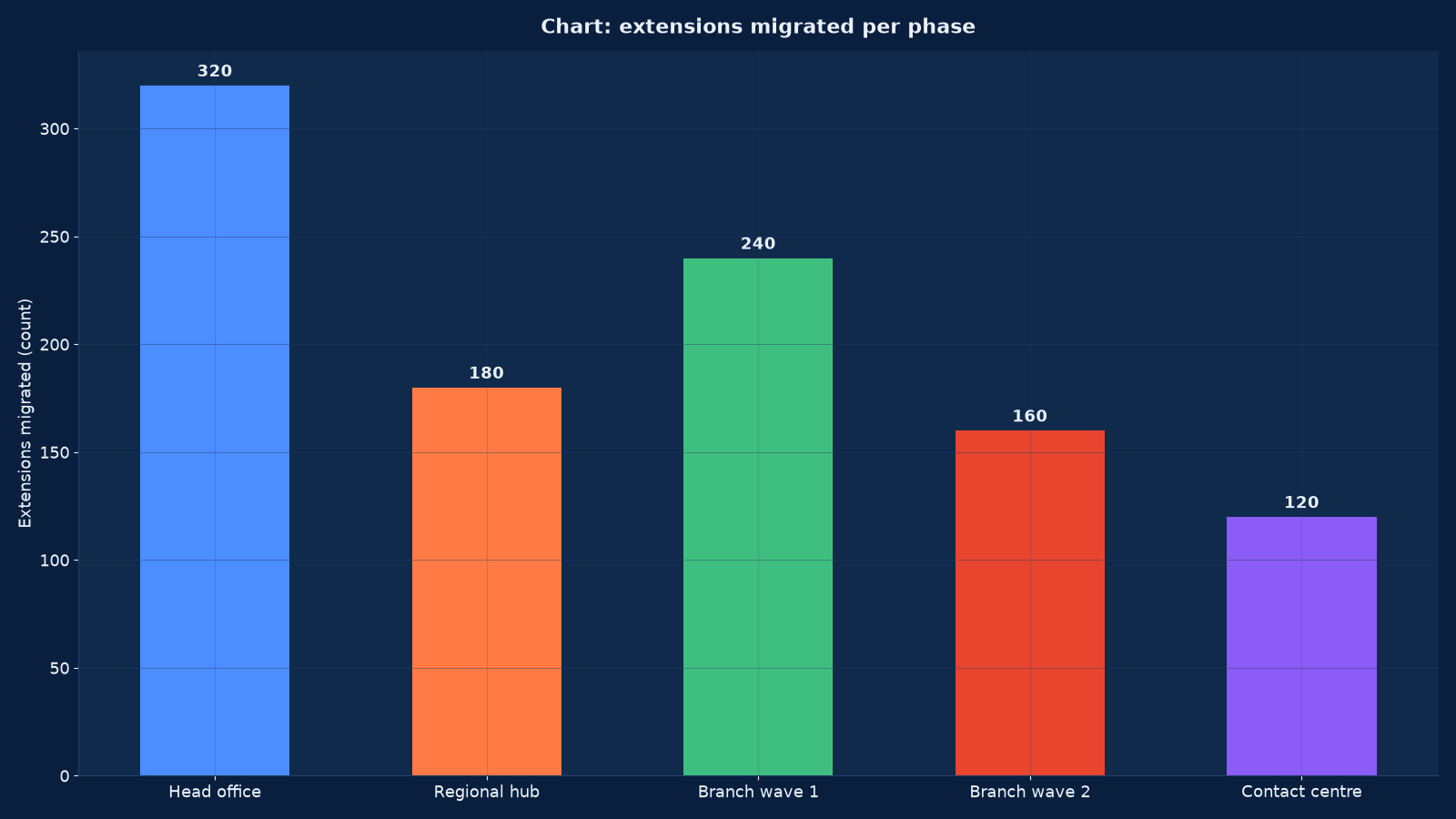
Chart values are an illustrative planning model based on typical UMC engagements and published industry benchmarks. They are not a guarantee of results on any specific project.
Session Architecture: Where Calls Are Processed and What Survives a Failure
Session architecture decides where calls are processed and what protects them. There are three common models, and the choice is driven by estate distribution, resilience requirements and how much of the telephony function the organisation wants to depend on connectivity.
| Model | How it works | Resilience behaviour | Suits |
|---|---|---|---|
| Centralised platform with local gateways | One platform processes calls for the whole estate; each site has a gateway or session border device for local survival | Site keeps internal and emergency calling if the platform or the wide-area path fails, at reduced functionality | Distributed estates that want central administration without a total dependency on connectivity — the commonest answer |
| Fully centralised with no local survival | All call processing in one place; sites are endpoints only | A wide-area failure ends telephony at the site | Estates with very reliable connectivity, few sites, and no safety-critical calling |
| Distributed platforms per site or region | Each site or region runs its own platform, federated for inter-site calling | Sites are independent, which is excellent for resilience and poor for consistency | Estates with strong regional autonomy, or with sites whose connectivity cannot be relied on |
| Cloud telephony service | The platform is a service; endpoints register to it | Depends on internet connectivity, so local survival has to be designed deliberately where it matters | Estates reducing on-premises platform ownership, with users distributed across sites and remote locations |
| Hybrid — cloud for users, on-premises for sites | Users on a cloud service; site telephony, contact centre or special dependencies on a local platform | Each component has its own failure mode, which has to be documented separately | The commonest real answer for estates mid-transition, and the one that needs the clearest documentation |
Whichever model is chosen, the session border controller’s role has to be defined explicitly: it protects the signalling and media boundary, normalises behaviour between platforms and carriers, applies topology hiding, and handles the media path in a way that the platform alone cannot. It is sized against concurrent calls at peak rather than against extension count, because a thousand extensions with fifty concurrent calls and a thousand with four hundred concurrent calls need entirely different equipment.
SIP Trunking, Carriers and Number Strategy
Trunking and carrier strategy is where the commercial and the technical decisions meet, and where most estates are paying for capacity they have not measured. The design starts from concurrency, not from extension count.
| Decision | How we determine it | The cost of getting it wrong |
|---|---|---|
| Concurrent call capacity | Measured peak concurrency per site and per number range, over a period that includes the busiest days | Trunks sized by extension count are routinely two to three times larger than needed, or too small at the one hour that matters |
| Number of carriers | At least two where telephony is business-critical, entering by diverse paths | A single carrier or a single entry route is a total telephony outage waiting for a digger |
| Number strategy | Which ranges move, which are ported, which are retired, and what happens to each | Porting errors cause the most visible migration failures, since a lost number is reported by customers rather than by staff |
| Geographic and regulatory constraints | Emergency calling location requirements, numbering rules and any sector obligations per jurisdiction | An emergency call that cannot provide a location, which is a safety and compliance failure |
| Handoff arrangement | Where the carrier’s responsibility ends and what the building’s plant must provide | An outage argued about for hours because neither side can prove whose segment failed |
| Codec and transcoding policy | What is negotiated on trunks and internally, with transcoding avoided wherever possible | Quality that differs between internal and external calls, and capacity consumed by transcoding |
| Capacity growth | Concurrency trended, with the trigger point for adding capacity defined | Trunk exhaustion appearing as call failures at peak, with no warning |
We publish the concurrency measurement as part of the design, because it is the number that justifies the trunk sizing and the number that reveals the saving. Estates retiring legacy circuits commonly find they were paying for capacity purchased when the business was twice its current call volume.
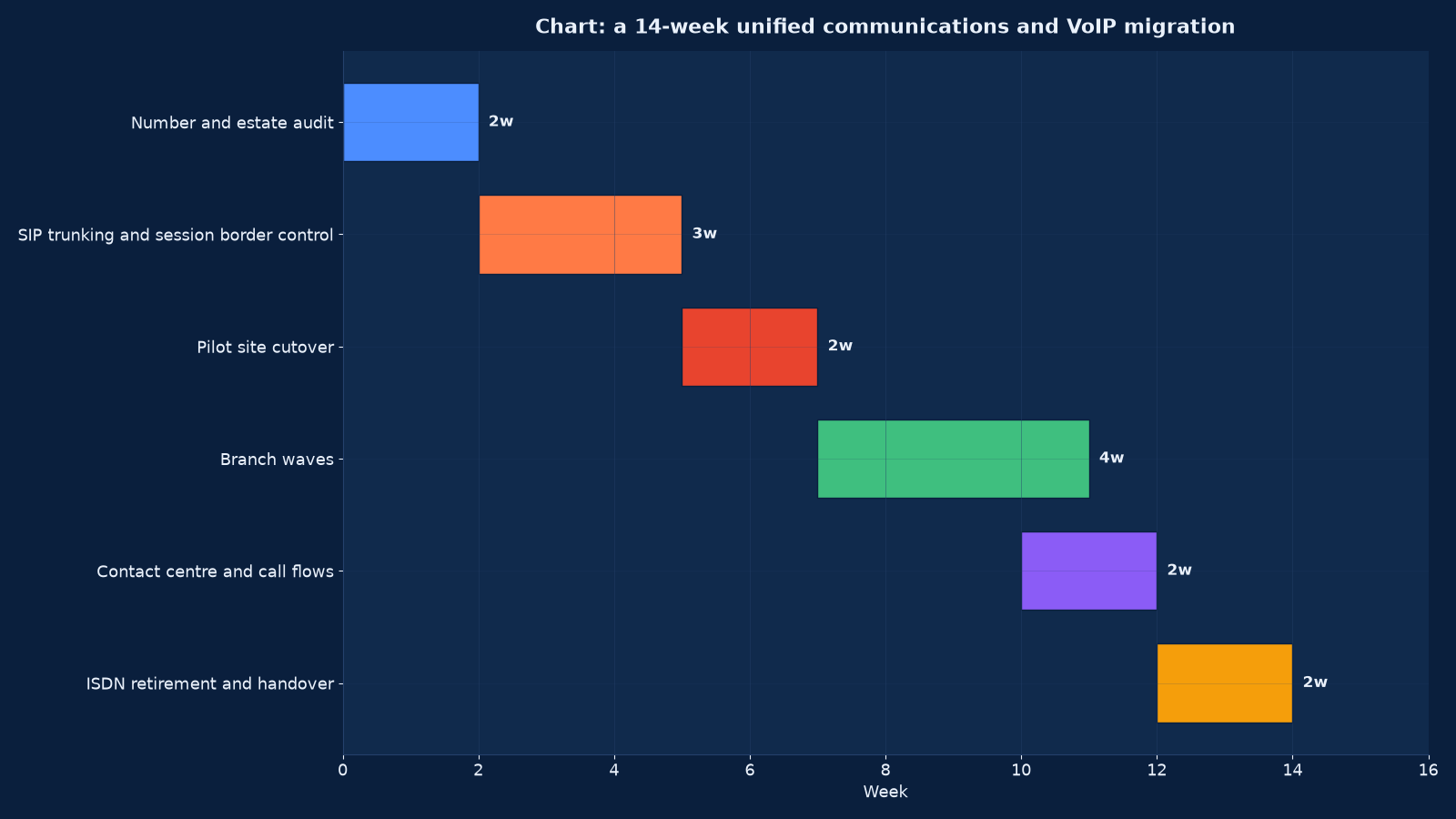
Chart values are an illustrative planning model based on typical UMC engagements and published industry benchmarks. They are not a guarantee of results on any specific project.
Quality of Service End to End, and Where It Silently Stops Working
Quality of service is the control that makes voice work on a network shared with everything else, and it fails silently and partially — which is worse than failing completely, because the estate believes it is protected.
| Layer | What has to be true | The common defect |
|---|---|---|
| Handset and endpoint | Voice media marked at the source with the appropriate differentiated services value | Endpoints left on default marking, so traffic enters the network unclassified |
| Access switch | A voice queue with guaranteed bandwidth, and trust configured so the marking is honoured rather than remarked | Trust boundary misconfigured, or a queue that exists but has no bandwidth allocation |
| Distribution and core | Prioritisation consistent across every hop, with the voice class policed so it cannot starve other traffic | One hop that does not honour the class, which is enough to undo the entire design |
| Wide-area path | Bandwidth reserved for voice on every circuit, and the overlay steering voice onto the path with measured low jitter | Voice following the data path by default, or a reservation sized for average rather than peak concurrency |
| Wireless | Prioritisation honoured on the radio side, with the access point’s own voice settings enabled | Voice on a wireless network designed for data, which produces quality that varies with client density |
| Breakout and trunk | Marking translated correctly at the carrier handoff, with the carrier’s own expectations documented | Marking stripped at the boundary, so the carrier path is unprioritised |
| Verification | Per-path latency, jitter, loss and mean opinion score measured, not inferred | A design that was configured and never tested, which is most designs |
Policing protects the design from itself
A voice class with guaranteed bandwidth and no policing is a class that can consume the whole link when something goes wrong — a misconfigured endpoint, a flood of registrations, or an application that happens to use the same marking. Policing the voice class to its designed capacity protects both the voice traffic and everything else, and it is the control most often omitted because it seems redundant until the day it is not.
Endpoints, Handsets and Directory Integration
Endpoints are where a telephony programme becomes visible to every user, and the estate decision is driven less by features than by who uses what, where, and what they need to be able to do.
| User class | Device pattern | The requirement that decides it | Administration consequence |
|---|---|---|---|
| Desk-based staff | Physical handset, or a soft client where the desk is not fixed | Whether the user has a fixed location and needs a physical device at all | Handsets need provisioning, firmware management and physical spares |
| Clinical and operational staff | Wireless handsets, badges or DECT-style devices | Roaming continuity across the whole site, and a device that can be cleaned | The wireless design has to be validated for these devices specifically, and roaming is the failure mode |
| Contact centre agents | Headset with a soft client, on a managed desktop | Audio quality, integration with the queueing platform and recording | Quality depends on the desktop, the headset and the network simultaneously |
| Executives and frequent travellers | Soft client across devices, with mobile integration | Presence, mobility and a single reachable number | The identity and directory integration has to be right, or the experience is worse than the system it replaced |
| Remote and hybrid workers | Soft client, with the call path from wherever they are | Whether calls traverse the estate or go directly to the carrier | Quality-of-service design has to account for a path the organisation does not control |
| Reception, switchboard and shared areas | Physical devices with the features those roles need — transfer, queue visibility, paging | The business process the role performs, not the device specification | These flows are the ones most likely to be undocumented and most disruptive to lose |
| Plant, warehouse and outdoor sites | Ruggedised or intrinsically safe devices where required | Environmental constraints and safety obligations | Replacement lead times are long, so spares holding matters more than usual |
| Accessibility requirements | Devices and clients with the necessary capabilities | What individual users need in order to work, which is an obligation and not a preference | Documented per user, with the requirement carried through any replacement |
Directory integration is the control that makes any of this administrable at scale. Extensions, presence, call routing and voicemail should be driven from the same directory that governs accounts, so that a joiner gets an extension as part of onboarding and a leaver’s number stops working when their account does. Figure 1’s movement from 25 to 99 per cent directory-synchronised handsets is the difference between a telephony estate that is administered and one that is maintained by hand.
Contact Centre Functions: Where Call Flows Encode Business Policy
A contact centre is a telephony programme with additional complexity in every dimension: queue behaviour encodes business policy, agent routing determines service levels, recording creates obligations, and the reporting is how the function is managed.
| Element | Design decision | What goes wrong when it is migrated carelessly |
|---|---|---|
| Queue structure | How calls are grouped, in what order they are offered, and what happens on overflow | A queue order that encoded an unwritten business rule, which is lost and noticed by customers before it is noticed internally |
| Agent routing and skills | Which agents receive which calls, and how availability is determined | Skills-based routing reduced to round-robin because the configuration was not understood |
| Service level targets | The answer-time and abandonment targets the routing is designed to meet | Targets that were being met by behaviour nobody documented, and stop being met after migration |
| Recording | What is recorded, whether all calls or selected ones, where it is stored and for how long | A recording obligation missed during migration, which is a compliance finding rather than a technical one |
| Reporting | The measures the function is managed on, and where they come from | Reports that cannot be reproduced on the new platform, so management loses visibility at the same moment as the migration |
| Overflow and out-of-hours | What happens when the queue is full or the centre is closed | Overflow behaviour that silently changes, sending calls somewhere nobody intended |
| Integration with other systems | Screen pops, case creation and customer records | Integrations that are the actual reason the centre functions, and are discovered only when they stop |
| Agent experience | Headset, soft client, desktop performance and the audio path | Quality that degrades on the desktop rather than the network, and is attributed to the wrong cause |
We migrate contact centres last in a phased programme, which is what Figure 2 and Figure 3 both show. By then the session architecture, the trunking model and the quality-of-service design have been proven at scale on less complex call flows, and the centre’s specific behaviours can be migrated against a known-good platform rather than used to discover the platform’s problems.
Failover, Local Survival and Emergency Calling
Failover in telephony has a dimension other applications do not: emergency calling. A design that keeps internal calls working while emergency calls fail is not a failover design, and it is a safety issue rather than an availability one.
| Failure | What has to keep working | How it is designed | How it is tested |
|---|---|---|---|
| Circuit failure at a site | Internal calling, emergency calling, and inbound to the site’s numbers where the carrier supports it | A second circuit from a diverse carrier, with automatic failover and the session border handling re-registration | A live failover during a maintenance window, with call completion verified on both paths |
| Platform failure | Site-local calling and emergency calling, with inbound diverted to an alternative destination | Local survival capability at each site, and a diversion arrangement with the carrier | Platform isolation during a window, with the survival behaviour observed rather than assumed |
| Site connectivity loss | Internal calling within the site and emergency calling from it | Local gateway or survival mode with the ability to place emergency calls over any available path | Disconnection of the wide-area path, with an emergency test call placed and its location information verified |
| Carrier failure | Outbound and inbound via the alternative carrier | Two carriers with automatic or documented manual failover, and number ranges reachable on both | Carrier-side diversion tested with the carrier, not only within the estate |
| Power failure at a site | Emergency calling at minimum, for a defined duration | Uninterruptible power for the network equipment and the survival gateway, sized for the required duration | A loaded power test, since an uninterruptible supply sized for idle load fails at peak |
| Endpoint or handset failure | The user’s ability to make and receive calls | Spares held per site class, with a replacement process that does not depend on one person | Spares availability audited rather than assumed |
Every row is tested during the migration, and the results are recorded as evidence. A failover design that has not been executed is a hypothesis, and telephony is the one place where an untested hypothesis has a safety consequence rather than a commercial one.
Legacy Retirement: Circuits, Numbers and the Data on the Old Platform
Retiring legacy telephony is the part of the programme with the least technical difficulty and the most discovered dependencies. It has to be sequenced last, and it has to be evidenced, because a circuit surrendered in error is expensive to restore and may not be restorable at all.
| Retirement step | What it involves | The control that makes it safe |
|---|---|---|
| Dependency confirmation | Every circuit, number and analogue line traced to what it actually carries | The analogue dependency sweep, done physically at each site rather than from configuration |
| Traffic observation | Confirming a circuit carries no traffic over a period including monthly and seasonal cycles | An observation window long enough to catch the annual process, which is the classic false negative |
| Diversion and forwarding | Numbers diverted to their replacement before surrender | Diversion verified by test call from outside the estate, not from within it |
| Surrender with confirmation | The carrier’s written confirmation that the circuit is disconnected and billing stopped | Confirmation retained as evidence, since a circuit believed surrendered and still billed is common |
| Equipment removal | Legacy platforms, handsets and cabling removed or repurposed | Data sanitisation for anything that stored voicemail, recording or configuration |
| Documentation update | The telephony inventory, call flows and site records updated to the post-retirement state | The updated inventory delivered as part of handover, not left as an internal note |
| Recording and voicemail disposition | Historical recordings and voicemail retained, migrated or disposed of according to obligation | An explicit decision per data class, since legacy platforms are often the only place old recordings exist |
The recording and voicemail row is the one most often missed. A legacy platform being decommissioned is frequently the sole repository of years of recorded calls, and the obligation to retain them does not end because the platform does. We establish the retention position before the equipment is removed, because afterwards the data is gone.
Operating Voice: The Measurements Users Will Ask About
Telephony quality degrades in ways users notice immediately and administrators cannot see without per-call measurement. The monitoring that matters is specific to voice, and general network monitoring will not catch most of it.
| What we monitor | What it detects | Threshold principle |
|---|---|---|
| Per-call quality — mean opinion score, loss, jitter | Degradation on specific paths or for specific user groups | Against the design target per call class, not against a platform default |
| Call completion and failure rates | Trunk exhaustion, signalling problems and platform faults | Any sustained rise investigated as a capacity or configuration issue |
| Trunk utilisation and concurrent calls | Capacity approaching its limit before calls start failing | Alerting at a forecast point, since exhaustion appears as failure with no warning |
| Session border controller health | Signalling load, media sessions and resource exhaustion | Sized against measured peak concurrency with headroom |
| Registration and endpoint health | Handsets failing to register, firmware problems, power issues | Any endpoint offline beyond a defined period, since users report it later than it happens |
| Failover events | Circuit, carrier or platform failures, including the ones that recovered automatically | Every event recorded, with repeats treated as a circuit problem |
| Emergency call path | That emergency calling works from every site, verified periodically | Tested on a defined cycle, since it is the one flow that cannot be allowed to fail silently |
| Quality of service marking verification | That voice traffic is still classified correctly after any network change | Checked after every significant network change, since a switch upgrade can silently reset trust settings |
| Recording integrity | That calls expected to be recorded are recorded, and the recordings are retrievable | Verified by sample, since a recording failure is discovered only when the recording is needed |
These measurements belong in the same operating model as the rest of the network, because most voice quality problems are network problems with a voice symptom. An estate where telephony is monitored by the phone team and the network by the infrastructure team will spend its time arguing about which of them owns the fault.
How This Differs From Our Neighbouring Pages
Telephony sits on the network and on the physical plant, and it serves every function in the business. These are the engagements it connects to.
| Your question | Right starting point | What it produces |
|---|---|---|
| Our carrier is retiring our circuit technology | This page | An estate audit, a session architecture, a trunk strategy and a migration plan with the legacy dependencies found before retirement |
| Who designs the network the voice runs on? | Routing, Switching, Firewall and Network Engineering | The routing, switching and quality-of-service design that voice quality depends on end to end |
| The plant cannot power the handsets or the access points | Our structured cabling and LAN/WAN engineering offering, built in this same programme | A cable category, power budget and uplink capacity the telephony design is built against |
| Calls degrade when sites use cloud applications | Our SD-WAN and SASE offering, built in this same programme | An overlay with voice as a separate policy class, steered onto the path with measured low jitter |
| Clinical and operational staff need to roam with voice | Our enterprise wireless offering, built in this same programme | A wireless design validated for roaming with the actual voice device models |
| Voice has to be segmented and admitted like everything else | Our network security and access control offering, built in this same programme | A zone design where voice devices are profiled, placed and prioritised deliberately |
| Nobody sees the degradation until users complain | Our network operations and monitoring offering, built in this same programme | A monitoring design using the per-call quality telemetry in this page |
| Users cannot get their phone problems fixed quickly | IT Help Desk & Remote Support Services | A support model that can see call quality, endpoint state and registration status rather than asking the user to describe the noise |
| The whole technology estate needs rationalising | Enterprise Systems Integration & Tech-Stack Consolidation | A consolidation view in which telephony is one platform rather than several, and the integrations around it are designed once |
| Call recording creates an obligation we have not assessed | IT Audit, Compliance & ISO 27001 / SOC 2 Readiness | The retention, access and disposition position for recordings and voicemail |
Evidence From Our Work
Telephony is the most user-visible infrastructure function in a hospitality or clinical estate, and the engagements below are environments where a switchboard, a clinical handset or a paging system is part of the service being sold or the care being delivered.
- Marriott Hotel Hyderabad — Case Study — managed services, monitoring and maintenance across multi-property hospitality operations, where the switchboard is a commercial function and a guest’s call is answered or not answered in a way that is immediately visible to the business.
- Fern Hotel Hyderabad — Case Study — hospitality infrastructure across properties, where each property has its own telephony behaviour, its own out-of-hours routing and its own set of analogue dependencies in a building not designed for them.
- Global Hospitals — Case Study — a multi-location healthcare network where clinical handsets, paging and emergency calling have to work across campuses, and where roaming continuity is a clinical requirement rather than a convenience.
- IT Infrastructure Management for an IT Company — Case Study — twenty-four-by-seven monitoring and support for a media and broadcasting company, where coordination traffic is continuous and a telephony failure interrupts production rather than administration.
- Suri Retail Group — Case Study — a distributed retail estate with branch telephony and customer-facing call handling, which is the pattern where trunk sizing by measured concurrency produces the largest saving.
- Enterprise Computer Networks: Trends, Operations, and Careers — the operations discipline that carries voice, and why quality of service is a design property rather than a configuration option.
- Tech Stack Consolidation: The Business Case for Unified Systems — the consolidation argument that usually prompts a telephony migration, and the integration dependencies it exposes.
- our Technology archive — further writing on network operations, platform consolidation and the engineering behind them.
Frequently Asked Questions About Unified Communications and VoIP
Our carrier says our circuit technology is being withdrawn. What do we do first?
Audit the estate before choosing a platform. Record every number, extension, circuit and call flow, and physically sweep each site for analogue dependencies — lift alarms, fire and intruder panels, door entry, fax, payment terminals, monitoring circuits installed by vendors who have since disappeared. Those dependencies are found either by the audit or by the outage, and they are the reason most retirement programmes overrun.
How many SIP trunks do we need?
By measured peak concurrent calls per site and per number range, over a period that includes your busiest days — not by extension count. Trunks sized from extensions are routinely two to three times larger than needed, or too small during the one hour that matters. We publish the concurrency measurement as part of the design, because it is also what reveals how much of your current capacity you were paying for unnecessarily.
What is a session border controller and do we need one?
It is the device that protects and normalises the boundary between your telephony platform and your carriers: signalling and media security, topology hiding, interoperability between platforms and carriers, and media handling the platform cannot do alone. Any estate with carrier trunks needs one. It is sized against concurrent calls at peak, not against extension count, which is the sizing error that produces call setup failures under load.
Will voice quality be worse than our old system?
Only if the network is not designed for it. Voice tolerances are physiological: roughly 150 milliseconds one-way latency before conversation becomes effortful, jitter small enough for the de-jitter buffer, and packet loss below a fraction of a per cent. Meeting them requires marking at the endpoint, a prioritised queue with guaranteed bandwidth at every switch hop, reservation on the wide-area path sized for peak concurrency, and per-path measurement to verify it. We target a mean opinion score of 4.0 or better and measure it rather than assert it.
What happens to our phones if the internet or the platform fails?
That is a design decision with a safety dimension, not a platform feature. Each site needs local survival capability so internal and emergency calling continue, a second circuit from a diverse carrier, uninterruptible power sized for the required duration at load rather than at idle, and a carrier diversion arrangement for inbound numbers. Every one of those is tested during the migration and recorded, because a failover that has not been executed is a hypothesis.
How does emergency calling work on a VoIP estate?
It has to be designed per site and verified, because the platform does not inherently know where a caller is physically located. Each site needs a defined emergency route, the location information the emergency service requires, a path that survives loss of the primary circuit or platform, and a periodic test. This is the one call flow with a safety consequence and the one most often broken by a migration, so we treat it as its own deliverable.
Can we keep some of our existing handsets?
Sometimes, and it depends on the platform and the device’s firmware support status rather than on its physical condition. Handsets past firmware support constrain platform choice and become a replacement programme of their own, so we audit device models and support status early. Where a partial reuse is viable it reduces cost materially; where it forces an older platform version it usually does not.
How do we migrate a contact centre without losing service?
Last, and against a platform already proven at scale. By the time a phased programme reaches the contact centre, the session architecture, trunking model and quality-of-service design have been validated on simpler call flows. The centre’s specific behaviours — queue order, skills-based routing, overflow, recording obligations and reporting — are documented before migration, because they encode business rules that are frequently unwritten and are noticed by customers before they are noticed internally.
What about recording and voicemail on the old platform?
Establish the retention position before the equipment is removed. A legacy platform is often the sole repository of years of recorded calls, and the obligation to retain them does not end because the platform does. We take an explicit decision per data class — retain, migrate or dispose — and record it, since after decommissioning the data is simply gone.
Should telephony be on-premises or in the cloud?
Against your distribution, connectivity reliability and appetite for platform ownership. Cloud telephony suits estates reducing on-premises ownership with users spread across sites and remote locations, but it makes connectivity a telephony dependency, so local survival has to be designed where calling matters. Many estates land on a hybrid — cloud for users, on-premises for contact centre functions or special dependencies — which is a legitimate answer that needs clearer documentation than either pure model.
How do remote and hybrid workers get good call quality?
They do not get it from your quality-of-service design, because their path is not yours to prioritise. What helps is a routing decision that sends their calls directly to the carrier rather than hairpinning through your estate, a soft client that adapts to available bandwidth, per-call quality measurement so problems are diagnosed from data rather than from the user’s description of the noise, and a headset standard, since most remote call quality complaints are the endpoint rather than the network.
What evidence do we get at the end of a programme?
The estate audit including numbers, circuits, call flows and the analogue dependency sweep, the session architecture and resilience model, the measured concurrency and trunk sizing, the quality-of-service design with per-hop verification, the endpoint and directory integration specification, per-wave migration and cutover records, failover and emergency calling test results, the legacy retirement confirmations, the recording and retention decision, and the monitoring thresholds and runbooks handed to operations.
Start With the Audit, Not the Platform
The platform choice is the easy part and it is the part everybody starts with, which is why these programmes overrun. We will audit every number, circuit and call flow, sweep your sites for the analogous dependencies nobody documented, measure your real call concurrency, and give you a session architecture with a wave plan and a retirement sequence. You will know what you have before deciding what to buy.
Contact Unified Management Consulting to arrange a confidential first conversation.
Related Services
Telephony depends on every layer beneath it. These are the engagements it most often runs alongside:
- Routing, Switching, Firewall and Network Engineering — the switching, routing and quality-of-service design that voice quality is built on, hop by hop.
- IT Help Desk & Remote Support Services — the first line that resolves call quality and endpoint issues, which is only fast when per-call telemetry is visible.
- Enterprise Systems Integration & Tech-Stack Consolidation — the consolidation programme a telephony migration usually belongs to, and the integrations around the contact centre.
- Managed IT Infrastructure & IT AMC Services — operating the estate afterwards, with the firmware baseline and monitoring thresholds this page specifies.
- IT Audit, Compliance & ISO 27001 / SOC 2 Readiness — the recording retention, access and disposition position, and the evidence trail for the migration.
- Backup, Disaster Recovery & Business Continuity Services — continuity for a function whose outage is immediately visible to customers and, in some estates, to emergency services.
- Computing, Server, Storage and Data Centre Engineering — the platform infrastructure a centralised or hybrid telephony architecture runs on.
- Enterprise Wireless & Wi-Fi 6 Design Services — predictive surveys, Wi-Fi 6 and 6E design, roaming and the coverage evidence taken on site
- Network Security, Segmentation & NAC Services — segmentation, NAC, firewall policy and the change control that keeps the boundary auditable
- NOC & Network Monitoring Services — 24×7 monitoring, alert thresholds, incident response and the reporting that turns uptime into a number
- SD-WAN & SASE Design and Rollout Services — SD-WAN and SASE rollout with application policy, transport independence and measurable failover behaviour
- Structured Cabling & LAN/WAN Design Services — structured cabling, containment, labelling, certification and the LAN and WAN design that runs over it