
Email marketing returns an average of $36–$42 for every $1 spent — the highest return of any channel a business can own. Yet most companies capture a fraction of that because their messages never reach the inbox, go to the wrong segment, or ask for the sale at the wrong moment. Our email marketing campaign services fix all three: deliverability engineering, behavioural segmentation and automated flows that convert subscribers while you sleep.
Unlike rented attention on ad platforms, your list is an asset. It cannot be switched off by an algorithm update or priced out by a bidding war. Done properly, email marketing campaign services compound: every new subscriber adds recurring revenue capacity, and every test makes the next send cheaper and sharper.
📋 Email Marketing Campaigns — Quick Summary
- Return: $36–$42 per $1 spent on average; automated flows typically out-earn one-off broadcasts 3–5x per recipient.
- Scope: deliverability and authentication, list growth, segmentation, automation, template design, copywriting, testing and revenue reporting.
- Flows we build: welcome series, cart and form abandonment, nurture tracks, win-back, post-purchase and newsletters.
- Platforms: Mailchimp, HubSpot, Klaviyo, Brevo, ActiveCampaign, Zoho Campaigns and custom SMTP.
- Timeline: audit in week 1, authentication and segmentation in weeks 2–3, first campaign live by week 4.
- Reporting: delivered rate, open rate, click-to-open, conversion and revenue per recipient — not vanity opens alone.
What Are Email Marketing Campaign Services?
An email marketing campaign is a coordinated sequence of messages sent to a defined segment to achieve one measurable outcome — a first purchase, a renewal, a booked call, a reactivation. Professional email marketing campaign services cover the strategy behind that sequence, the technical configuration that keeps you out of spam, the creative that earns the click, and the measurement that proves the return.
We treat email as revenue infrastructure. Every campaign starts with a segment, an offer, a send-time hypothesis and a success metric agreed in writing before a single message is designed. That discipline is why our programmes improve month over month instead of plateauing after the first blast.
Why Email Still Outperforms Rented Channels
Paid social and search rent attention at auction prices that rise every year. Email owns the relationship. The table below is the comparison we walk clients through when deciding where the next rupee or dollar of marketing budget goes.
| Factor | Email (owned) | Paid social / search (rented) | Organic social (borrowed) |
|---|---|---|---|
| Cost per reach | Near-zero after platform fee | Auction CPM/CPC, rising yearly | Free but algorithm-limited |
| Audience control | Full list ownership, exportable | Platform-owned audiences | Platform-owned followers |
| Message certainty | Delivered to inbox (if authenticated) | Served only while budget lasts | Shown to a small % of followers |
| Personalisation depth | Behavioural, transactional, lifecycle | Interest and lookalike proxies | Broad demographic |
| Attribution | Direct: click to purchase | Modelled, increasingly opaque | Weak, view-through guesswork |
| Compounding value | List grows and flows improve | Stops when spend stops | Decays without constant posting |
This is not an argument to abandon paid media — our Google Ads management team runs it for many clients. It is an argument that email should carry the retention and conversion layer that paid media is too expensive to perform, and that the two should feed each other: ads acquire, email converts and retains.
Email Marketing Benchmarks: What “Good” Actually Looks Like
Before optimising anything you need an honest baseline. Open rates vary materially by industry and by list hygiene, which is why we benchmark you against your sector rather than a global average.
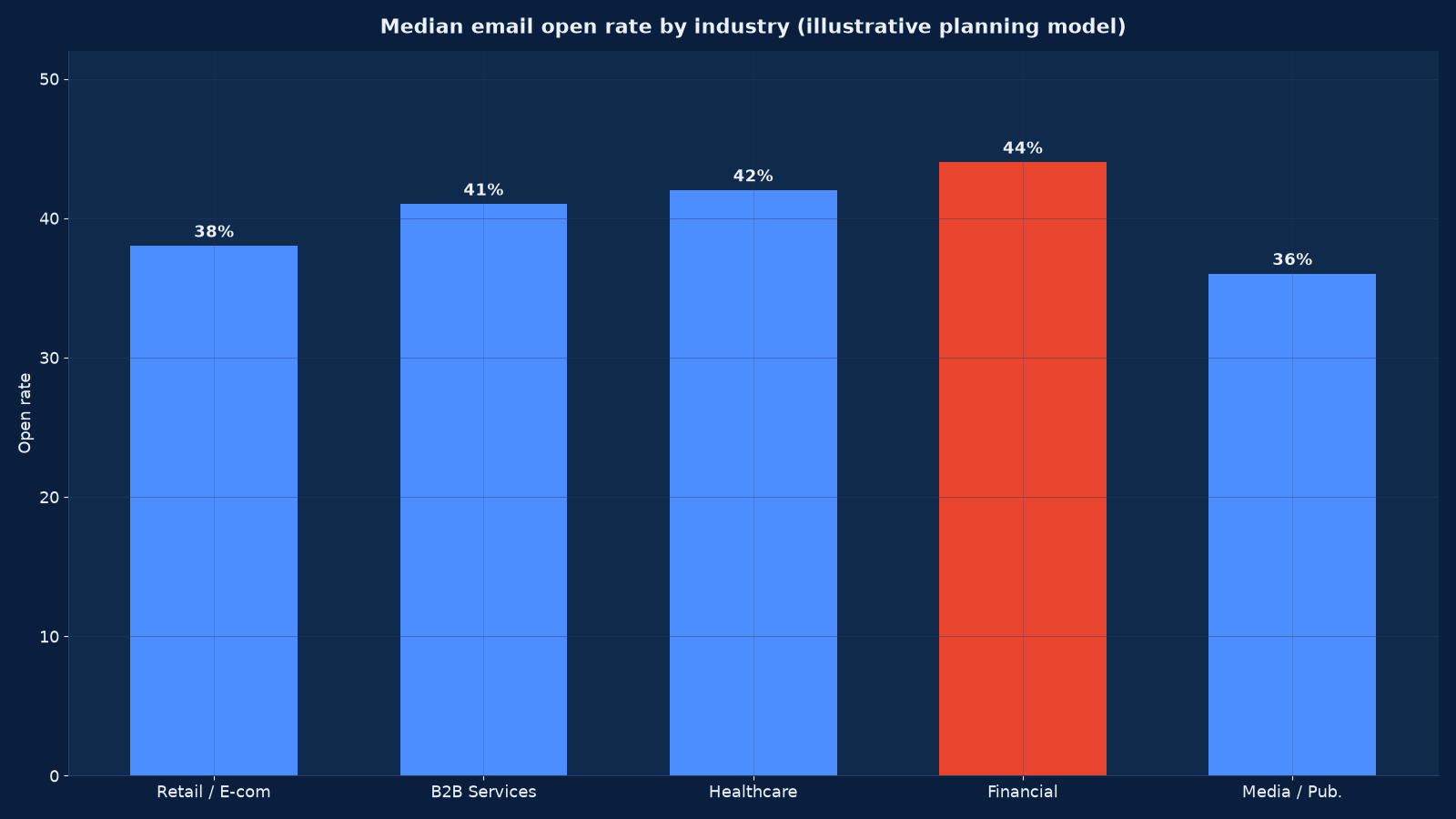
This chart is an illustrative planning model based on commonly published industry ranges, not a guarantee of performance. Actual results depend on list quality, offer, segmentation, creative and sending execution.
Across sectors we hold clients to these working ranges: click-through 2–5% of delivered mail, click-to-open 10–20%, conversion 1–3% of clicks for considered purchases and higher for ecommerce promotions, and a spam-complaint rate below 0.1%. If your current numbers sit under these, the gap is usually deliverability or segmentation — both fixable within one quarter.
Our Email Marketing Campaign Services
1. Deliverability & Authentication Engineering
SPF, DKIM and DMARC configuration, domain warming for new senders, bounce and complaint suppression, and inbox-placement monitoring across Gmail, Outlook and Yahoo. Nothing else matters if the message lands in spam.
2. List Growth & Hygiene
Signup-path audits, lead-magnet strategy, double opt-in where appropriate, and scheduled pruning of dead addresses so your sender reputation — and your open rate — reflect real humans.
3. Segmentation & Personalisation
Behavioural segments (browsed, abandoned, purchased, lapsed), lifecycle stages and value tiers, so each subscriber receives only messages relevant to where they are. This is the single largest lever on open and click rates.
4. Automation & Drip Campaigns
Welcome series, cart and form abandonment, nurture tracks, win-back and post-purchase flows — built once, triggered by behaviour, and integrated with your CRM so sales sees the same lifecycle you do.
5. Template Design & Copywriting
Mobile-first modular templates on your brand system — designed with the same conversion thinking as our UX/UI design services — plus subject lines, preheaders and body copy written for the click. We write to one reader and one action per message.
6. Testing & Revenue Reporting
A structured A/B programme on subject lines, send times, layout and offers, reported monthly against revenue per recipient and conversion — so decisions are made on money, not opens.
The Automated Flows That Generate Most Email Revenue
One-off broadcasts get the attention; automated flows earn the money. Because flows trigger on behaviour, they reach each subscriber at the moment of highest intent, which is why a small number of flows typically produce the majority of email revenue.
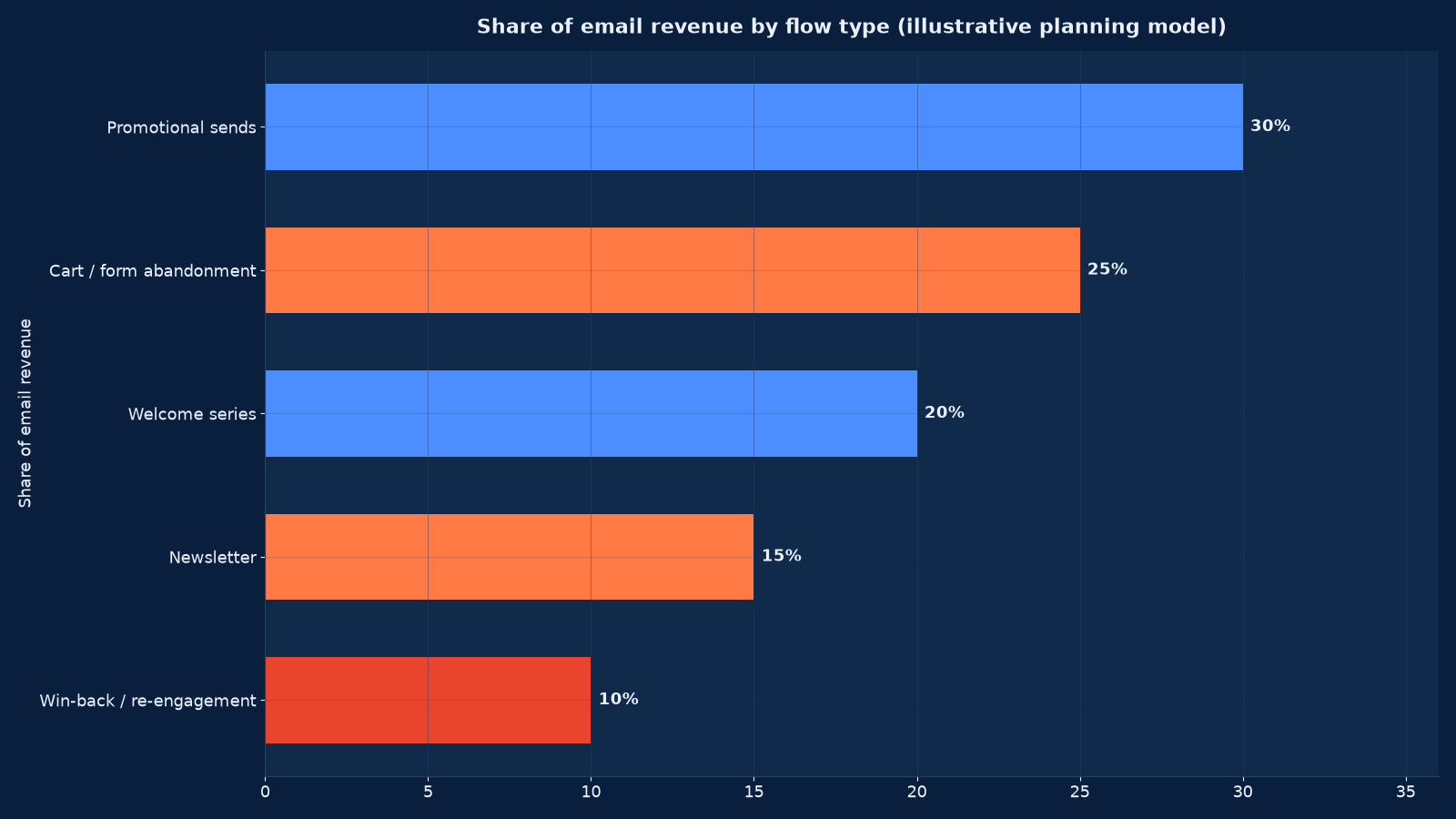
This chart is an illustrative planning model based on commonly published industry ranges, not a guarantee of performance. Actual results depend on list quality, offer, segmentation, creative and sending execution.
| Flow | Trigger | Goal | Typical cadence |
|---|---|---|---|
| Welcome series | Signup or first purchase | Set expectations, deliver value, first conversion | 4–6 emails over 14 days |
| Cart / form abandonment | Checkout or form left incomplete | Recover intent already expressed | 3 emails over 72 hours |
| Nurture track | Content engagement or lead score | Educate long-cycle buyers to sales-ready | 6–10 emails over 6–10 weeks |
| Win-back | No engagement for 60–120 days | Reactivate or prune safely | 3 emails over 3 weeks |
| Post-purchase | Order confirmed | Onboard, upsell, request review | 4–5 emails over 30 days |
Automation vs One-Off Campaigns: The Compounding Gap
A broadcast earns once. A flow earns every time its trigger fires. Over six months the difference is not marginal — it is structural, because flows keep working on every new subscriber while broadcasts must be rebuilt each time.
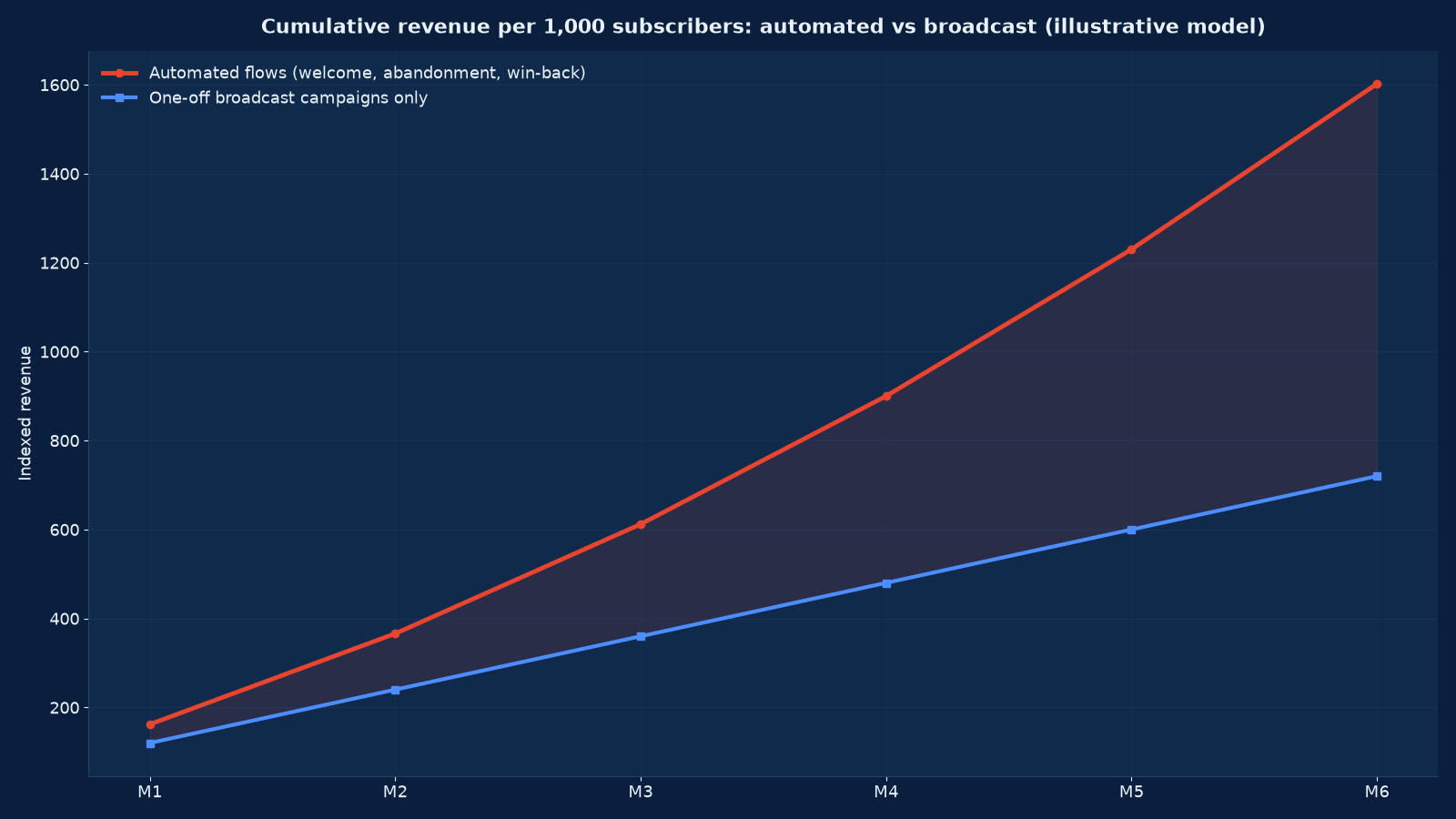
This chart is an illustrative planning model based on commonly published industry ranges, not a guarantee of performance. Actual results depend on list quality, offer, segmentation, creative and sending execution.
Our standard build order is therefore flows first, broadcasts second: stabilise the evergreen revenue, then use campaigns for launches, seasonality and announcements on top of it.
Deliverability: Getting Into the Inbox Is Half the Job
Roughly one in six legitimate emails never reaches the inbox, and since Gmail and Yahoo tightened bulk-sender rules the penalty for missing authentication is immediate and measurable.
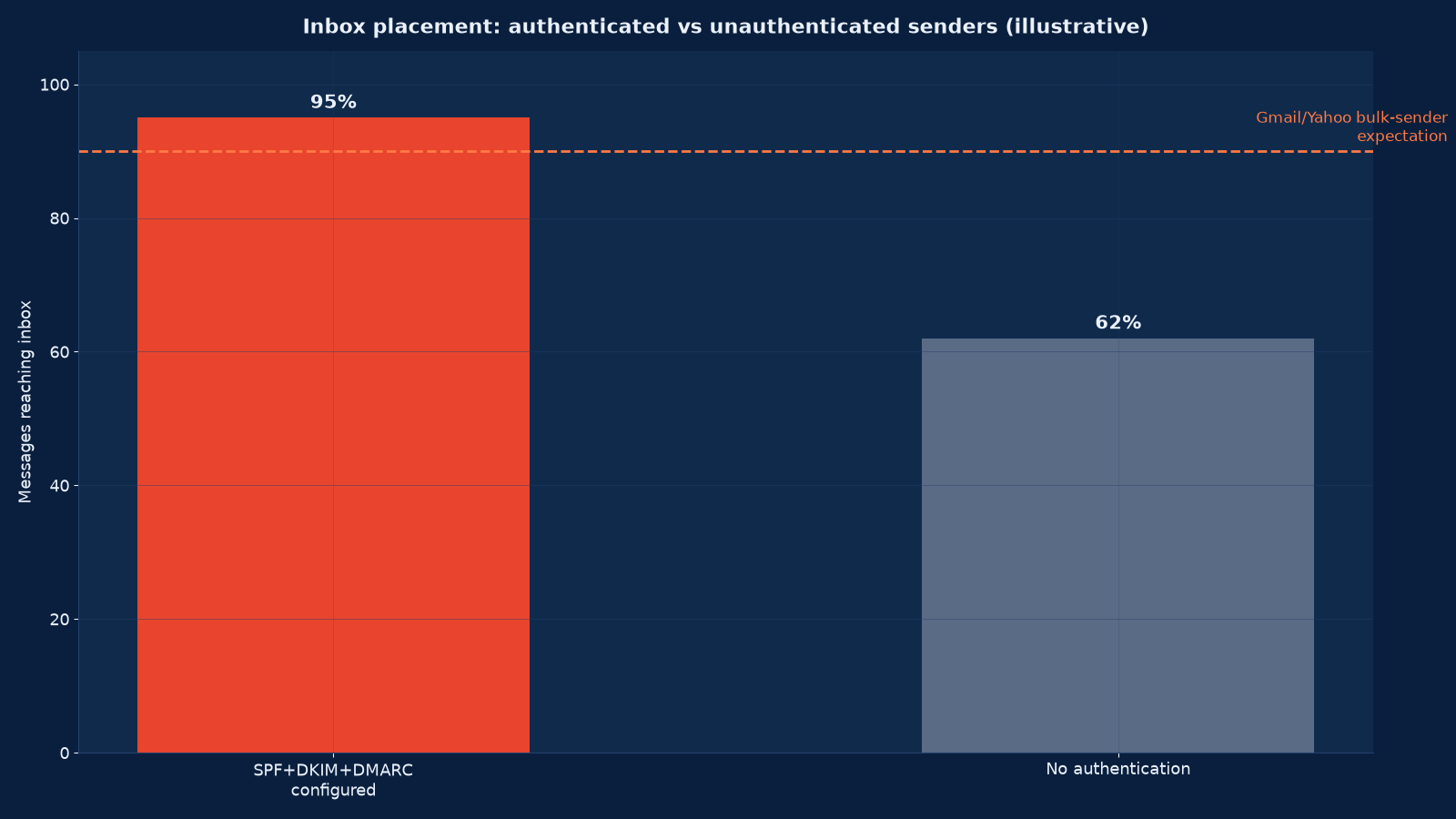
This chart is an illustrative planning model based on commonly published industry ranges, not a guarantee of performance. Actual results depend on list quality, offer, segmentation, creative and sending execution.
- SPF — publish which servers may send for your domain.
- DKIM — cryptographically sign messages so content cannot be altered in transit.
- DMARC — tell receivers how to treat mail that fails SPF or DKIM, and receive forensic reports.
- List hygiene — suppress hard bounces instantly, sunset the chronically dead, honour unsubscribes in one click.
- Compliance — CAN-SPAM and GDPR: clear identification, physical address, genuine consent and easy opt-out.
- Reputation monitoring — track spam-complaint rate, bounce rate and placement weekly, not quarterly.
Platform Comparison: Choosing the Right Tool for Your Stage
| Platform | Best for | Strength | Watch-out |
|---|---|---|---|
| Mailchimp | SMBs starting out | Ease of use, templates | Costs rise sharply with list size |
| Klaviyo | Ecommerce | Deep purchase behavioural data, flows | Overkill for pure B2B lead gen |
| HubSpot | B2B with CRM-centric sales | Unified lifecycle and sales handoff | Needs discipline to avoid bloat |
| Brevo | Cost-sensitive senders | Price per email, SMS add-on | Fewer advanced flow branches |
| ActiveCampaign | Complex automation logic | Visual builder, conditional paths | Steeper setup curve |
If your current platform is limiting growth we migrate lists, templates and automations with zero downtime — the same rigour we bring to marketing automation services engagements.
How We Launch: A 90-Day Plan
- Week 1 — Audit. Deliverability tests, list health, historical campaign analysis, tracking and attribution review. You receive a written gap list with projected impact.
- Weeks 2–3 — Foundation. SPF/DKIM/DMARC verified, segments defined, template system built, tracking and UTM conventions agreed.
- Weeks 3–4 — First flows live. Welcome and abandonment flows launched; first campaign designed, tested and sent.
- Months 2–3 — Expand & optimise. Nurture and win-back flows added, A/B programme running, monthly revenue report against baseline.
The KPIs We Report Every Month
- Delivered rate (>98% target) — the foundation every other metric sits on.
- Open rate — segment-level, because a blended number hides decay.
- Click-to-open (10–20%) — whether the message itself persuades.
- Conversion rate — clicks that become the agreed action.
- Revenue per recipient — the number that decides budget.
- List growth vs churn — whether the asset is appreciating.
- Spam-complaint rate (<0.1%) — the early-warning light for reputation.
Email Marketing by Industry
Ecommerce & Retail
Abandonment and post-purchase flows carry the load; promotional calendars drive peaks. Segment by purchase recency and value, not demographics.
B2B & SaaS
Longer nurture tracks, sales-handoff triggers and content-led sequences. Open rates matter less than pipeline created per send.
Healthcare & Education
Consent and data handling come first; then appointment, enrolment and retention sequences that reduce no-shows and drop-off.
Financial Services
Compliance-reviewed templates, lifecycle onboarding and cross-sell sequencing with strict suppression rules.
Send Frequency & Campaign Calendar: What to Send, and When
Frequency failures cut both ways: send too little and subscribers forget you; send too much and complaints erode the reputation you just repaired. The right cadence depends on purchase cycle and list temperature, so we set it per segment rather than per account.
| List type | Campaign cadence | Always-on flows | Fatigue guardrail |
|---|---|---|---|
| Ecommerce / retail | 1–2 promotional sends per week | Welcome, abandonment, post-purchase, win-back | Sunset after 90 days no engagement |
| B2B / SaaS | 1–2 value sends per month | Welcome, nurture, sales-handoff, win-back | Cap at 4 touches/month incl. sales email |
| Newsletter-led media | Daily or weekly edition | Welcome, digest preferences | Preference centre before suppression |
| Healthcare / education | Monthly plus lifecycle triggers | Onboarding, appointment, enrolment, retention | Strict consent logging per message |
| Financial services | Monthly plus product lifecycle | Onboarding, cross-sell, compliance notices | Suppression lists reviewed per send |
Every programme we run ships with a preference centre and a sunset policy. Subscribers who choose less frequency stay on the list; subscribers who never engage are removed before they damage deliverability.
Subject Lines & Preheaders That Earn the Open
The subject line and preheader are the only copy a subscriber sees before deciding. We keep subjects under roughly 45 characters, front-load the distinctive word, and pair every subject with a preheader that completes the thought instead of repeating it.
| Pattern | Subject line example | Preheader example | Why it works |
|---|---|---|---|
| Specificity | Your Q3 pipeline report is ready | Three numbers your board will ask about | Concrete beats clever |
| Open loop | The checkout step most stores miss | It costs you roughly 1 in 10 orders | Curiosity with a stated stake |
| Proof | How a 4-email flow added 22% revenue | The exact sequence, no gate | Evidence before ask |
| Personalisation | Your cart from Tuesday is still here | Free shipping ends tonight | Behavioural relevance |
| Question | Still paying £4 per lead? | There is a cheaper funnel step | Self-qualification |
| Deadline | Last call: audit slots close Friday | Two remaining this month | Scarcity that is true |
We avoid spam-trigger vocabulary, ALL-CAPS, and emoji stacks — not because they are banned, but because they correlate with the complaint behaviour that gets senders throttled.
The ROI Math: What Email Is Worth to Your Business
Email budgeting should start from revenue per recipient, not from platform fees. The model below is the one we use in proposals: take your deliverable list, apply a conservative revenue-per-recipient figure, and multiply by sends per month.
| Scenario | Deliverable list | Revenue per recipient / month | Sends / month | Indicative annual email revenue |
|---|---|---|---|---|
| Conservative | 5,000 | $0.40 | 6 | $24,000 |
| Segmented + flows | 5,000 | $0.90 | 6 | $54,000 |
| Mature programme | 5,000 | $1.60 | 8 | $96,000 |
The jump between rows is not list growth — it is segmentation, flows and testing on the same 5,000 people. That is the headroom our email marketing campaign services are hired to capture, and it is why we report revenue per recipient as the headline KPI.
Seven Mistakes That Quietly Kill Email Revenue
- Sending from a no-reply address on an unauthenticated domain — the fastest route to the spam folder.
- One giant list, one generic message — the root cause of low open rates almost everywhere we audit.
- No welcome flow — the highest-open email you will ever send, left unsent.
- Measuring opens after Apple Mail Privacy Protection — inflated opens hide decay; clicks and revenue do not lie.
- Buying or importing lists — complaint rates that can blacklist a domain for months.
- No sunset policy — dead addresses dragging down reputation and inflating costs.
- Redesigning instead of testing — quarterly guesswork replacing continuous A/B evidence.
Email vs SMS vs Push: Picking the Right Owned Channel
| Channel | Best for | Cost per message | Consent & fatigue | Role in the mix |
|---|---|---|---|---|
| Nurture, education, lifecycle, revenue flows | Lowest | Moderate, manageable | The backbone | |
| SMS | Time-critical alerts, OTPs, flash offers | Highest | Strict; fatigue is fast | Surgical interruptions |
| Push | App re-engagement, content drops | Low | App-install dependent | Retention for app owners |
Each owned channel earns a specific job: SMS marketing services for universal, time-critical alerts, WhatsApp marketing services for conversational selling and catalogue commerce, and email for depth and nurture. Most of our clients run all three from a single orchestrated lifecycle.
Most businesses need email first and SMS only for genuinely urgent moments. We will tell you when SMS is not worth the cost — it usually is not.
Key Terms, Plainly Explained
- CTOR (click-to-open rate) — clicks divided by opens; whether the message itself persuaded.
- Revenue per recipient — attributed revenue divided by delivered messages; the budgeting metric.
- Flow — an automated, behaviour-triggered sequence, as opposed to a one-off campaign.
- Sunset policy — the agreed rule for removing chronically inactive subscribers.
- Domain warming — gradually raising send volume on a new domain to build reputation.
- Double opt-in — confirming subscription by email; slower growth, far cleaner list.
- Suppression list — addresses permanently excluded (unsubscribes, hard bounces, complaints).
- MPP (Mail Privacy Protection) — Apple’s pre-fetching that inflates open rates; why we optimise on clicks and revenue.
Frequently Asked Questions
How quickly will we see results?
Automated flows usually pay for themselves inside the first month. Campaign-level lifts in open and click rate typically appear within two to four sends as segmentation and testing mature.
Do we need a large list for email to be worth it?
No. A small, permission-based, well-segmented list outperforms a large stale one. Our email marketing campaign services would rather grow 1,000 engaged subscribers than inherit 50,000 dead addresses.
Can you take over our existing Mailchimp or HubSpot account?
Yes. We audit, clean and restructure existing accounts, rebuild templates and flows, and hand over documented playbooks your team can operate.
Will email conflict with our ads or SEO work?
The opposite. Email converts the traffic your SEO services and paid campaigns generate, which lowers your blended cost per acquisition across every channel.
Is email still effective in 2026?
More than ever. As paid CPMs climb and AI search reshapes discovery, owned channels carry a growing share of attributable revenue for most of our clients. Compare your figures against published email benchmarks to see the headroom.
What happens to our data and automations if we stop working together?
Everything lives in your account, on your domain, with your list. We hand over documented flows, templates and reporting dashboards, and we export anything we built. You own the asset outright — that is the point of an owned channel.
Our list is old or was imported years ago. Can we still use it?
Sometimes. We run a re-permission campaign first: engaged subscribers stay, silent ones are sunset, and nobody who never consented is mailed. Mailing a stale imported list is the single most common way businesses get their domain blocklisted.
How do Apple’s privacy changes affect our reporting?
Open rates for Apple Mail users are inflated and unreliable. We therefore optimise and report on click-to-open, conversion and revenue per recipient, and we treat opens only as a directional signal for subject-line tests on non-Apple segments.
Start Your Email Marketing Campaign
Email is the one channel you own outright — no algorithm, no auction, no rising rent. If you want a programme that compounds instead of restarting every month, talk to our digital marketing team. We will audit your list, authentication and deliverability at no cost and show you precisely where the revenue is leaking — and what the first 90 days would recover.