
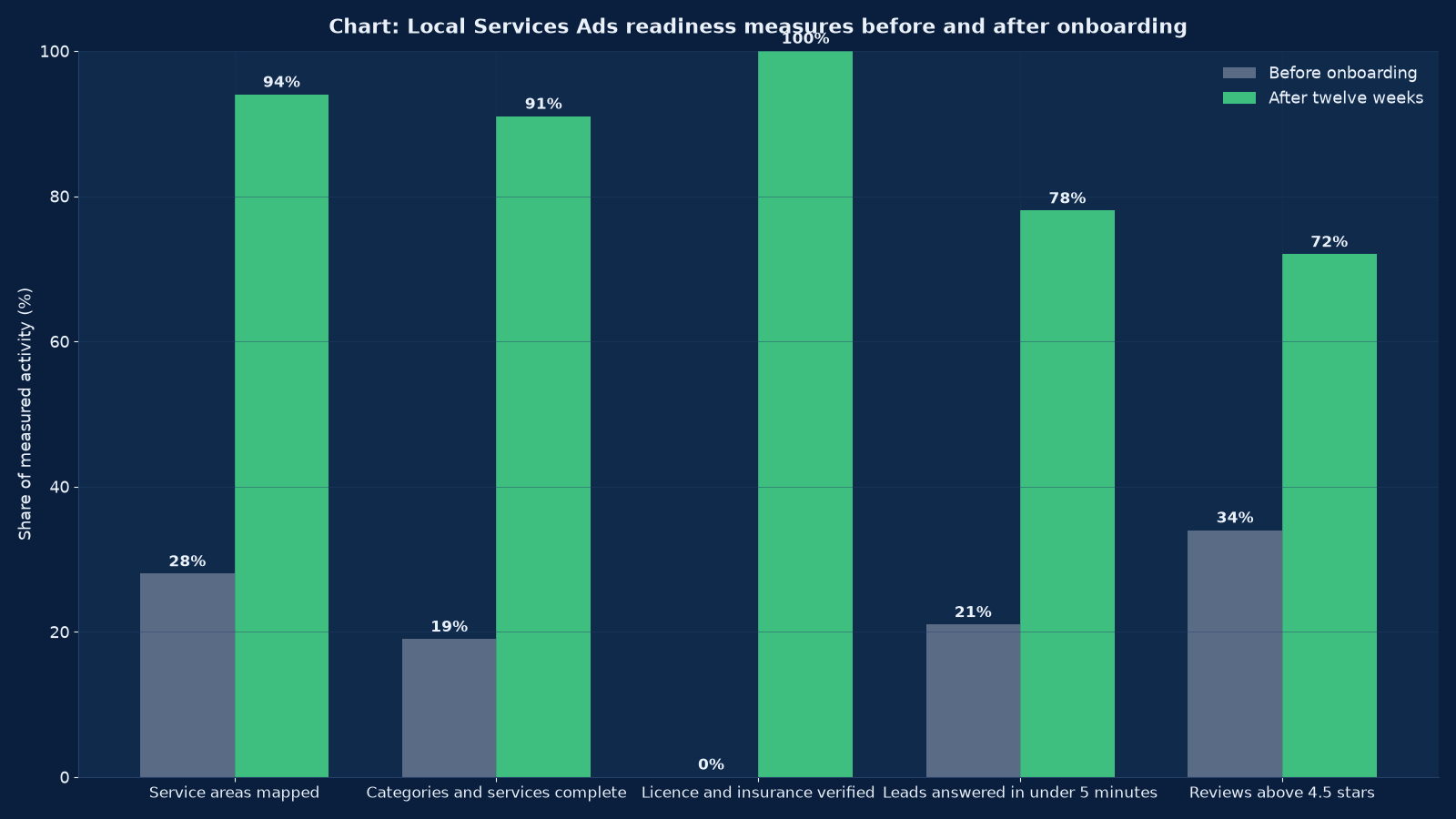
Chart values are an illustrative planning model based on typical UMC engagements and published industry benchmarks. They are not a guarantee of results on any specific project.
Local advertising is the one channel where the advertiser cannot buy their way past the evidence. The badge is verified, the reviews are attached to the profile, the phone is answered or it is not, and the lead is charged whether or not anybody picks up. Most of the work is therefore not media work. It is making the business capable of being advertised.
Local Services Ads and local campaign management at Unified Management Consulting covers the channels where a nearby customer searches for a service and expects to be able to call somebody today: Local Services Ads with its screening and badge requirements, local search campaigns built around service areas, local inventory and store-visit objectives, and the profile, review and call-handling infrastructure those channels depend on. The engagement starts with eligibility, because in these formats an unverifiable licence, an incomplete service list or a phone that rings out is not a performance problem to be optimised later — it is a reason the ads do not run.
We run this for trades and home services, clinics and practices, dealerships, hospitality venues, professional firms and multi-location businesses across India and for clients serving customers in Africa, the Gulf, Europe and North America. Where a business operates several locations, the work is per-location configuration with shared governance; where it operates one location with a wide service area, the work is area definition and capacity, because a campaign that generates more calls than the team can answer is worse than a smaller one.
📍 Local Services Ads & Local Campaigns — Quick Summary
| Component | What We Deliver |
|---|---|
| Eligibility and verification | Licence, insurance and background screening assembled, submitted and tracked to approval, with the categories the business is actually permitted to advertise. |
| Service and area configuration | Every service listed with its own eligibility, and service areas mapped to where the team can realistically attend. |
| Profile and content build | Business description, photos, service detail, opening hours, attributes and the local landing page the click arrives on. |
| Review engine | A request process tied to completed jobs, a response standard, and a route for disputed or inappropriate reviews. |
| Lead routing and response SLA | Calls and messages routed to whoever answers, with a response standard measured and enforced. |
| Budget, bid cap and pacing | A weekly budget, a per-lead ceiling, and pacing that matches capacity rather than ambition. |
| Disputed-lead process | Every invalid lead identified, categorised and disputed within the window, with the recovery rate tracked. |
| Local search campaigns | Search campaigns built around service-area intent, with local extensions, location assets and call-only formats where they suit. |
| Local inventory and store objectives | Where a business holds stock or physical locations, local inventory ads and store-visit or store-sale objectives configured and measured. |
| Measurement and reporting | Call, message, booking and revenue tracking per location, reported against cost per qualified lead rather than cost per lead. |
What This Service Actually Covers
The service covers the local formats and the operational readiness they require. It is delivered either as an onboarding-and-optimisation engagement or as a standing local management retainer that includes review governance and lead-quality review.
| Component | What we do | What you keep | Duration |
|---|---|---|---|
| Eligibility | Licence, insurance and screening assembled and submitted; categories confirmed | An approved profile with the documents on file | 1–3 weeks |
| Configuration | Services and areas mapped to real capacity | A configuration that reflects what the business can deliver | 1–2 weeks |
| Profile build | Description, photos, hours, attributes and the local landing page | A profile and page written for the local decision | 2–3 weeks |
| Review engine | Request process, response standard, dispute route | A review process that runs without the agency | 2 weeks |
| Lead handling | Routing, response SLA, missed-call recovery | A measured response standard and a routing rule | 1–2 weeks |
| Budget and bidding | Weekly budget, per-lead ceiling, pacing against capacity | A spend level the team can actually serve | 1 week |
| Local search campaigns | Service-area search campaigns with local assets and call formats | Campaigns structured by service and area | 2–3 weeks |
| Measurement | Call, message and booking tracking per location | Cost per qualified lead reported by service and area | 1–2 weeks |
| Governance | Weekly lead review, monthly review-profile and capacity review | A standing process with named owners | Ongoing |
The unusual feature of this service is how much of it is not advertising. Eligibility documents, a call-routing rule and a review request process are operational changes, and we implement them alongside the campaigns because the campaigns do not work without them.
Local Services Ads Against Ordinary Local Search
The two formats compete for the same searcher but behave differently, and running only one of them leaves either the top of the page or the intent-rich long tail unserved.
| Dimension | Local Services Ads | Local search campaigns |
|---|---|---|
| Placement | Above the organic results, with a verification badge | In the auction, alongside other advertisers |
| Billing | Per lead — per call or message that meets the format’s definition | Per click |
| Screening | Licence, insurance and background checks required in eligible categories | None; eligibility is a policy question, not a verification one |
| Creative control | Profile-driven: name, rating, reviews, services, hours | Full control of headline, description, extensions and landing page |
| Targeting | Service area and category, with limited query control | Keywords, match types, negatives, audiences and location targeting |
| What it rewards | A verified, well-reviewed, fast-responding business | A well-structured account with relevant copy and a converting page |
| Where it fails | Slow response, disputed leads, an incomplete profile | Broad terms, weak negatives, a landing page that does not match the area |
| Best used for | High-intent emergency and booking demand | Considered services, multiple offerings, and long-tail local intent |
We run both where the category allows, with the search campaign carrying the service and area combinations Local Services Ads cannot target precisely, and with the two budgets set against combined capacity rather than independently.
Eligibility and Verification: the Gate Before the Spend
In Figure 1, licence and insurance verification starts at nil. That is the norm for businesses that have never submitted to a screened format, and it is the reason an onboarding takes three weeks rather than three hours.
| Requirement | What must be produced | Common failure |
|---|---|---|
| Business registration | The legal entity name matching the profile and the bank details | A trading name submitted where the registered name is required |
| Licence | The current licence for each regulated trade or profession advertised | A licence held by an individual submitted for a company, or an expired document |
| Insurance | Public liability and, where required, professional indemnity at the stated cover | A certificate without the cover detail, or cover below the category threshold |
| Background screening | Screening for the owner and, where required, for staff who attend customers’ premises | Screening started late, which delays the whole onboarding |
| Category eligibility | The business’s services matched to categories that are open to screened formats | Advertising a service the category does not cover |
| Review standing | A profile with enough reviews to be credible, and no unresolved serious complaints | Launching with no reviews and expecting the badge to carry it |
| Contact and hours | A monitored phone number and accurate opening hours | A number that diverts to an unmonitored voicemail |
We assemble this as a checklist with an owner per document and a submission date, then track each item to approval. Where a category requires screening, that is started first because it has the longest lead time and nothing else can be verified until it clears.
Services and Areas: Configuration Against Real Capacity
The most common configuration error is listing every service the business could perform and every area it could reach. The result is leads the team cannot serve, calls outside the hours nobody covers, and a rising dispute rate.
| Decision | The right question | The consequence of getting it wrong |
|---|---|---|
| Which services to list | Which services does the team perform regularly, at a price that works, with the right people available? | Leads for work the business does badly or not at all, disputed or wasted |
| How far to extend the area | How far will the team travel, in what time, at what cost? | Calls from areas that cannot be served profitably, and longer response times |
| Hours of availability | Who answers outside office hours, and what do they promise? | After-hours leads charged and never returned |
| Emergency versus scheduled | Whether the business competes for immediate demand or booked work | Two very different lead streams treated as one budget |
| Team capacity | How many jobs per day can be delivered without quality falling? | A campaign that succeeds commercially and fails operationally |
| Multi-location coverage | Whether each location has its own profile, services and area | One profile serving several locations, with leads routed to the wrong one |
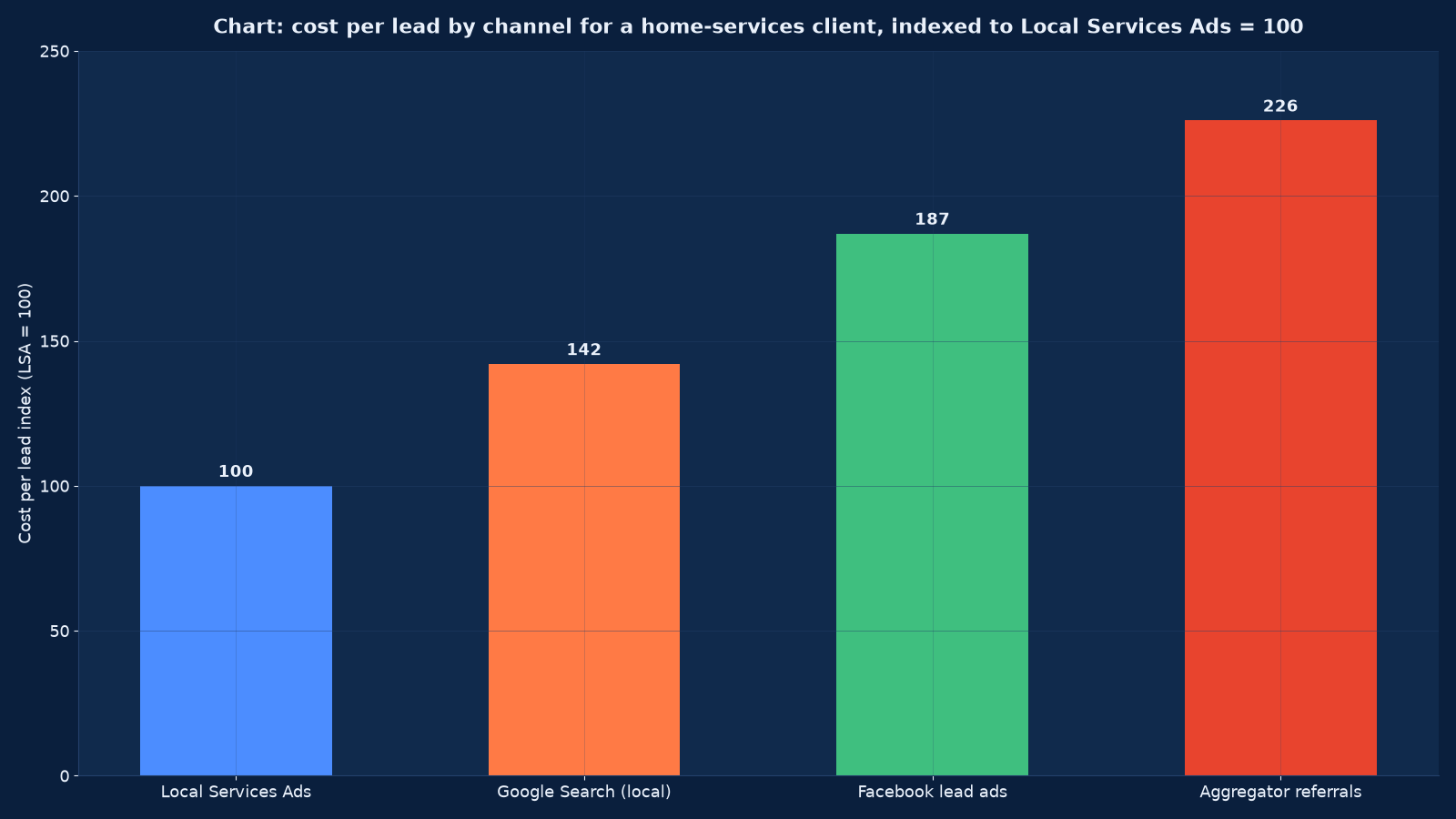
Chart values are an illustrative planning model based on typical UMC engagements and published industry benchmarks. They are not a guarantee of results on any specific project.
The Profile Is the Creative
There is no headline to write and no image to design. What the searcher sees is the business name, the rating, the review count, the services listed, the hours and the badge. Every one of those is a data field, and the fields that cannot be edited at will — rating and review count — are the ones that decide the click.
| Element | What it does | How it is improved |
|---|---|---|
| Business name | Recognition and category signal | The registered name; a keyword-stuffed name is a policy risk |
| Rating and review count | The dominant click factor | A request process tied to completed jobs, and responses to every review |
| Services listed | Whether the profile matches the search | Complete, accurate and limited to what the team actually does |
| Description | Reassurance and differentiation | Written for the local decision: who you are, what you do, where, and why you are trusted |
| Photos | Proof of a real, competent business | Real work, real team, real vehicles and premises rather than stock imagery |
| Opening hours | Whether a lead can be served | Accurate, including the hours somebody actually answers |
| Attributes and badges | Screening and verification signals | Completed wherever the business genuinely qualifies |
| Responses to reviews | How the business handles criticism | A response standard: acknowledge, correct where wrong, take it offline where personal |
We write the description and the service detail, specify the photo set, and build the review request process. Rating cannot be bought and should not be attempted; it can only be earned faster by asking at the right moment, which is the moment the job is finished and the customer is satisfied.
Lead Routing and the Response Standard
A lead in these formats is a call or a message, and its value decays in minutes. In Figure 1 the share answered within five minutes rises from 21 to 78 per cent, and that measure moves revenue more than any bid setting does.
| Failure | Cause | Control |
|---|---|---|
| Calls unanswered | One number, one person, no cover | Routing to a group or a service, with an overflow path and a monitored voicemail |
| Calls answered after hours by nobody | Hours published that the business does not cover | Published hours matched to real cover, or an answering service for the gap |
| Messages left for days | No owner for the inbox | A named owner, a response standard, and a daily review of unanswered messages |
| No record of the call | The lead exists only in the platform | Calls logged to the CRM or job system with the outcome recorded |
| No distinction between a quote and a spam call | Every lead treated identically | A lead-outcome taxonomy: booked, quoted, not served, invalid, wrong area |
| Disputes missed | The dispute window not tracked | A weekly review of leads marked invalid, disputed inside the window, with the recovery rate reported |
The lead-outcome taxonomy is the piece most businesses skip, and it is what makes the channel measurable. Without it, cost per lead is the only available number and it is the wrong number: it treats a wrong-area call and a booked job identically.
Budget, Bid Caps and the Dispute Economy
These formats are billed per lead, so the levers are the weekly budget, the service and area configuration that determines lead volume, and the dispute process that recovers the invalid share.
| Lever | How it is set | What it protects against |
|---|---|---|
| Weekly budget | From capacity: jobs per week the team can serve, times the acceptable cost per job, divided by the expected lead-to-job rate | A campaign that outperforms the business’s ability to deliver |
| Per-lead ceiling | From the margin on the average job and the conversion rate | Paying more for a lead than the job is worth |
| Pacing | Across the week and across the hours somebody answers | Budget exhausted before the working day ends |
| Service and area narrowing | Removing services and areas that produce unprofitable leads | Volume bought at the cost of quality |
| Dispute rate | Tracked weekly, with every invalid lead disputed inside the window | Paying for spam, wrong-area calls and recruitment enquiries |
| Seasonal adjustment | Raised for peak demand and lowered for periods the team cannot cover | A fixed budget through a season the business cannot serve |
In Figure 2 the screened format is the cheapest of four channels on cost per lead and cheaper again on cost per job, because a verified profile attracts customers who intend to book. That advantage disappears if the dispute rate is high and nobody is disputing, which is why the weekly review is part of the retainer rather than an extra.
Local Search Campaigns Alongside the Screened Format
Local search campaigns carry the intent the screened format cannot target precisely: service plus area combinations, long-tail problem descriptions, and the considered services where a customer researches before calling.
| Element | Design | The local-specific point |
|---|---|---|
| Keywords | Service plus area, service plus problem, and emergency variants | Area terms are qualifiers, not afterthoughts; they carry the intent |
| Location targeting | Radius or administrative areas matched to real coverage | A radius larger than the team will travel produces wasted calls |
| Location assets | The verified profile attached to the campaign | Without it, the ad has no address, no map entry and no call asset |
| Call assets and call-only ads | Enabled where the conversion is a phone call | Call tracking numbers must not replace the business’s published number in the profile |
| Ad copy | Service, area, response time, credentials, and what happens next | Response time and credentials are the differentiators in local demand |
| Landing page | A page for the service and the area, with the phone number prominent | A generic home page loses the local match the ad promised |
| Negatives | Recruitment, DIY, free, training, unrelated areas | Local campaigns attract job-seekers and out-of-area callers heavily |
| Ad schedule | Matched to when somebody answers | An ad running overnight with nobody to answer pays for missed calls |
Multi-Location: One Governance Model, Many Profiles
| Layer | Shared | Per location |
|---|---|---|
| Standards | Description pattern, photo specification, review response standard, lead taxonomy | The location’s own services, areas and hours |
| Verification | Corporate documents where the format allows it | Local licences, insurance and screening for the staff who attend |
| Campaigns | Structure, naming, negative lists, reporting format | Budget, area targeting and the location’s landing page |
| Reviews | The request process and the response template | The location’s own rating and its dispute handling |
| Measurement | One reporting model with cost per qualified lead | Call routing, capacity and outcomes for that location |
| Governance | One weekly review with a single owner | A named local owner responsible for answering and for review requests |
The failure mode in multi-location estates is centralisation of everything except answering. Standards should be shared; responsibility for the phone and for review requests must be local and named, because a central team cannot make a branch pick up.
Measurement: From Cost Per Lead to Cost Per Job
| Measure | Definition | Why it matters |
|---|---|---|
| Leads | Calls and messages the format counts | The billed unit, and the least informative one on its own |
| Valid leads | Leads that are a genuine enquiry for a service in the area | The denominator every other rate should use |
| Response time | Time from lead to first human contact | The strongest controllable driver of conversion in local demand |
| Quotes or bookings | Leads that reached a quote or a booking | The first measure of commercial value |
| Jobs won | Bookings that became revenue | What the business is actually buying |
| Cost per valid lead | Spend less recovered disputes, over valid leads | The honest unit cost |
| Cost per job | Spend less recoveries, over jobs won | The number the owner should manage to |
| Dispute recovery | Credit recovered as a share of disputed leads | Whether the process is being run at all |
| Review velocity and rating | New reviews per month and the moving average | The leading indicator of next quarter’s click rate |
| Share of answered calls | Calls answered within the standard | Whether capacity has fallen behind demand |
We report cost per valid lead and cost per job as the headline numbers, with response time and review velocity as the two operational measures that predict them. Channel comparison uses the same definitions across every local channel the business runs, which is the only way the index in Figure 2 means anything.
The Six-Week Onboarding
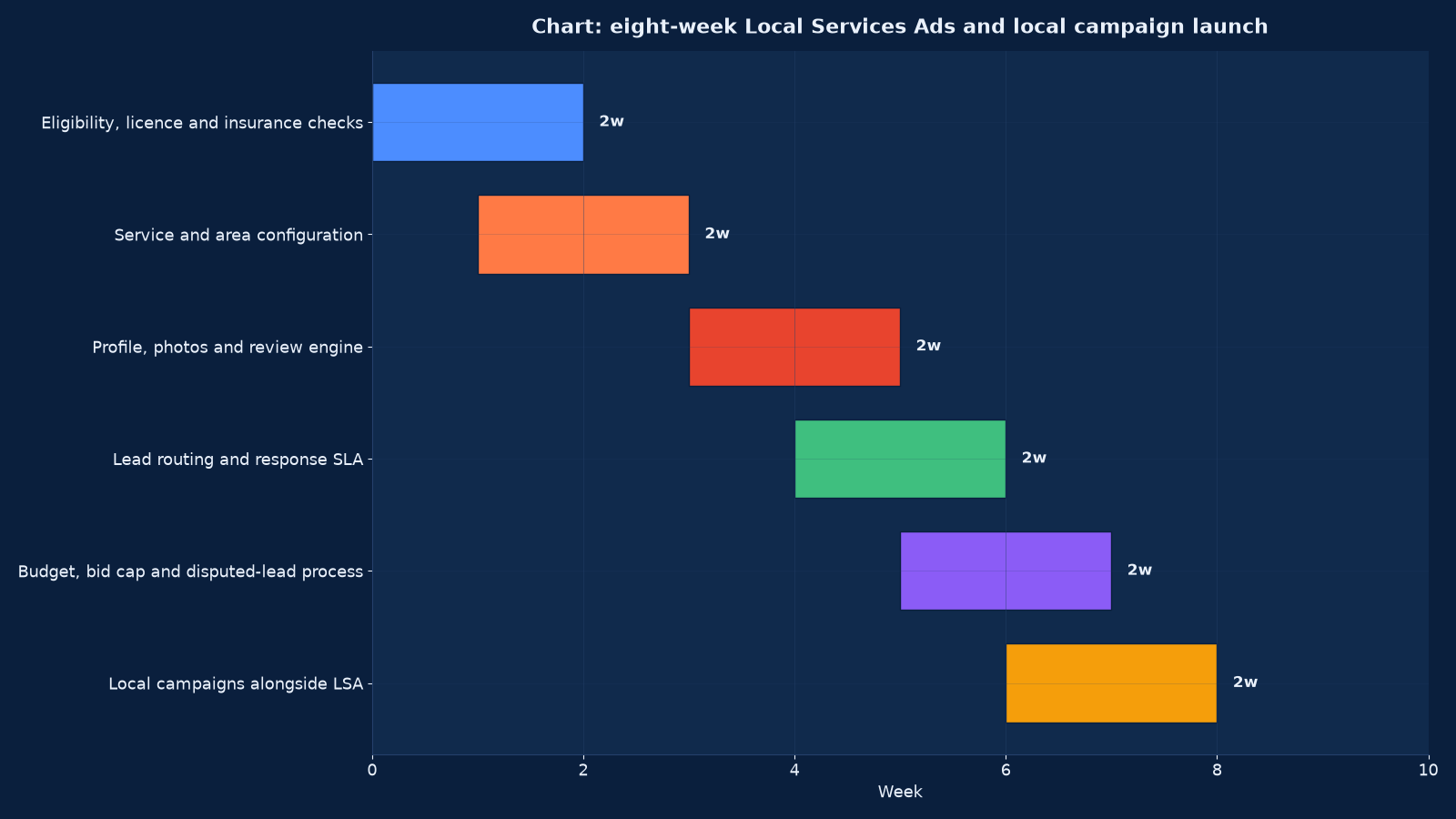
Chart values are an illustrative planning model based on typical UMC engagements and published industry benchmarks. They are not a guarantee of results on any specific project.
| Weeks | Workstream | Gate to pass |
|---|---|---|
| 1–2 | Eligibility, licence and insurance checks | Every document submitted, screening started, categories confirmed |
| 2–3 | Service and area configuration | Services and areas matched to real capacity, with hours agreed |
| 4–5 | Profile, photos and review engine | Description and photo set live, review request process running |
| 5–6 | Lead routing and response SLA | Routing tested, a named owner, and the response standard measured |
| 6–7 | Budget, bid cap and disputed-lead process | A capacity-based budget, a per-lead ceiling, and the dispute review scheduled |
| 7 onward | Local campaigns alongside | Search campaigns live by service and area, with negatives and a local landing page |
After onboarding the work is a weekly lead and dispute review, a monthly review-profile and capacity review, and a quarterly re-examination of areas and services. Local formats drift: teams change, areas become unprofitable, review velocity slows, and the profile that worked in spring does not work in autumn.
What Changes By Category
Local formats behave differently by vertical, and the settings that matter most are not the same ones. A plan copied from another category usually over-invests in the wrong lever.
| Category | The dominant lever | What to watch |
|---|---|---|
| Home services and trades | Response time and the review profile, because demand is immediate and trust-sensitive | After-hours cover, and a dispute process — this category attracts the most invalid leads |
| Clinics, dentists and practices | Service detail and the booking path, because the decision involves treatment and cost anxiety | Advertising claims; health categories carry restrictions on what a profile may promise |
| Dealerships and showrooms | Inventory and offer clarity, plus the walk-in attribution | Measuring calls rather than visits, which understates the channel’s value |
| Hospitality | The review rating above everything, and direct-booking economics | Aggregator comparison: a direct booking carries no commission, so the true cost per booking is lower than it looks |
| Professional firms | Credential detail and the considered-decision path | Volume expectations — fewer, larger enquiries, so a per-lead ceiling derived from consumer averages will starve the campaign |
| Multi-location retail | Per-location profiles and local inventory data | Stock accuracy, because a local inventory ad for an item that is not in the store is worse than no ad |
| Emergency services | Availability and the hours published | Capacity: a successful emergency campaign fails visibly at two in the morning |
The common thread is that in every category the operational measure — response time, stock accuracy, cover, credential completeness — explains more of the variance than the media setting does. We therefore start each engagement by identifying which operational measure dominates in that category, and fix it before scaling spend.
Review Governance and Reputation Repair
Rating is the asset these formats monetise, and it is the one asset that cannot be bought legitimately. It can only be earned faster, defended properly and repaired honestly.
| Practice | Standard | Why |
|---|---|---|
| Request timing | At the moment the job is completed and satisfaction is confirmed, not in a batch at month end | Recency and specificity drive both the number of reviews and their length |
| Request channel | A direct link sent by SMS or WhatsApp, plus a card for in-person businesses | Friction is the main reason satisfied customers do not review |
| Incentives | None. No discount, no entry to a draw, no selective asking | Incentivised and filtered reviews are a policy breach and a removal risk |
| Response coverage | Every review answered, positive and negative, within a stated period | Prospective customers read the responses to criticism more closely than the praise |
| Negative review handling | Acknowledge, state what was done, move detail offline, correct the record where it is wrong | An unanswered or defensive reply costs more than the review itself |
| Service failures behind reviews | Logged and routed to whoever can fix the cause | A pattern in the reviews is operational intelligence, not just a reputation problem |
| Policy-violating reviews | Flagged through the platform’s process with the specific policy cited | Fake, abusive or off-topic reviews can be removed when the flag is precise |
| Rating trajectory | Reviewed monthly as a moving average, not as a snapshot | Velocity matters more than the current figure: a rising 4.4 beats a decaying 4.7 |
Where a profile has been damaged, the repair is operational before it is reputational: find what the reviews describe, fix it, then earn new reviews at a rate that moves the average. Removal of policy-violating reviews helps at the margin; it never rescues a rating earned by a genuine service failure.
Seasonality, Capacity and the Local Calendar
Local demand is seasonal and operational at the same time, and a fixed budget through a variable year either starves the peak or pays for leads in the trough that nobody can serve.
| Period | Demand behaviour | Budget and configuration response |
|---|---|---|
| Peak season | Volume rises and response times lengthen as the team saturates | Raise the budget only as far as capacity allows, narrow the area to the most profitable zones, and shorten the response standard |
| Shoulder season | Volume moderate, conversion good | Hold the budget, invest in review velocity and profile improvements while leads are manageable |
| Trough | Volume low, cost per lead rises | Reduce the budget rather than widen the area; shift work to campaigns and content with a longer payback |
| Weather-driven spikes | Sudden demand for emergency and repair services | A pre-agreed surge rule so the budget can be raised the same day, with cover arranged for the phone |
| Holidays and closures | Demand continues while cover stops | Published hours adjusted, ads scheduled off, and an overflow number that is actually answered |
| Team changes | Capacity falls or rises with leavers and joiners | Areas and services re-checked against who is available, not against last year’s roster |
| Local events and permits | Access restrictions and temporary demand shifts | Areas adjusted for the duration, with the change logged |
We agree the surge rule and the closure procedure during onboarding rather than in the moment, because both are decisions about the phone and the rota, and neither can be made well at short notice by whoever happens to be managing the account.
Failure Modes We Are Called In To Fix
| What we find | Why it happened | What we do |
|---|---|---|
| A live campaign with no leads | Services or areas misconfigured, or eligibility incomplete | Rebuild the configuration against real capacity and finish verification |
| Leads from areas the team will not attend | An area set wider than the business serves | Narrow the area, add the exclusions, and re-baseline the budget |
| A high dispute rate with no disputes filed | No lead taxonomy and nobody owning the review | Introduce the taxonomy, a weekly review, and file everything inside the window |
| Calls answered after a day | One number and no cover | Group routing, an overflow path, and the response standard measured weekly |
| A 3.8-star profile being advertised heavily | No review process and no responses | Slow the spend, fix the service failures the reviews describe, and rebuild review velocity |
| One profile for four branches | A multi-location estate configured as a single business | A profile per location with shared standards and local owners |
| Local search campaigns on a generic home page | No local landing pages | A page per service and area with the phone number, coverage and credentials on it |
| Budget scaled before capacity | Success measured by lead volume | Re-derive the budget from jobs per week the team can serve |
Local Advertising and the Rest of the Stack
Local formats depend on the profile, the page, the phone and the reviews. We plan them together rather than optimising one and hoping the others follow.
- Local SEO Services in Lucknow — the profile, citation and map-pack work that determines whether the business is findable at all.
- Google Ads Management Services — the search campaigns that carry the local intent the screened format cannot target.
- Google Ads Services in Lucknow — the same discipline for clients whose customers are in this market.
- Search Engine Optimisation (SEO) Services — the service and area pages that local campaigns send traffic to.
- Conversion Rate Optimisation (CRO) Services — the local landing page, where the call button and the coverage statement decide the conversion.
- CRM Development & Integration — where leads are logged, attributed and moved to a job, which is what makes cost per job measurable.
- SMS Marketing Services and WhatsApp Business Marketing — the response channels customers in this market actually prefer.
- Analytics & Attribution (GA4) Services — call and booking tracking per location.
- Voice Search Optimisation Services — the spoken queries that drive a large share of local service demand.
Evidence From Our Work
The engagements and writing below are published on this site, each described by the subject its own page documents. They are listed because local advertising is usually commissioned by a business with several locations or a wide service area that has already discovered the profile and the phone matter more than the bid.
- Social media advertising for a Hyundai car dealership — a dealership’s local demand generation, where the offer, the location and the response handling decide the cost per walk-in.
- Social media advertising for Green Hotel & Resort — a hospitality venue’s paid campaigns, where direct booking beats the aggregators on margin and the review profile is part of the creative.
- Twelve months of social media management for a Maruti Suzuki showroom — a sustained local programme for a single showroom, showing what a year of consistent local presence produces.
- Local SEO strategies — the profile, citation and map-pack fundamentals that screened formats and local campaigns both depend on.
- Google Business Profile products and services — how the profile’s own service and product fields are completed, which is where most local profiles are weakest.
- Digital marketing cost in Lucknow — the local pricing context for businesses budgeting their first local campaigns.
- Landing page optimisation: how to convert more visitors into customers — the local landing page that a call-driven campaign sends traffic to.
- SEO versus PPC — how paid local demand and organic local visibility should be budgeted together rather than separately.
- The SEO insight archive — further writing on local search, profiles and rankings.
Engagement Models and Commercials
Local work is quoted per location and against the operational changes required, because a single-location trade business and a twelve-branch estate are not the same engagement even at the same media spend.
| Model | Best for | What you get | Indicative shape |
|---|---|---|---|
| Eligibility and onboarding, fixed fee | A business entering a screened local format | Documents assembled, screening submitted, services and areas configured, profile built | Three to six weeks, one fee |
| Local campaign build | A business with a profile but no campaigns, or the reverse | Local search campaigns by service and area, landing pages, negatives, call tracking | Three to four weeks, fixed fee |
| Local management retainer | An ongoing local operation | Weekly lead and dispute review, budget and area management, review governance, monthly reporting on cost per qualified lead | Monthly, per location band |
| Multi-location rollout | A branch or franchise estate | A profile, campaigns and owners per location under shared standards | Fixed fee per location, plus governance |
| Lead-handling rebuild | A business losing leads at the phone | Routing, response standard, lead taxonomy, CRM logging and missed-call recovery | Two to three weeks, fixed fee |
Media spend is the client’s and is quoted separately from the fee, with no percentage taken on it. We do not earn more by spending more, which matters in a channel where the easiest way to increase lead volume is to widen the area beyond what the team can serve.
Frequently Asked Questions About Local Services Ads & Local Campaigns
What is the difference between Local Services Ads and a local search campaign?
The screened format appears above the organic results with a verification badge and bills per lead, and it requires licence, insurance and background checks in eligible categories. A local search campaign is an ordinary auction campaign targeted at a service area, billed per click, with full control of copy and landing page. Most local businesses should run both, because they serve different intents.
Do I qualify?
It depends on your category and your documents. Regulated trades and professions generally require a current licence and adequate insurance, and the owner plus anyone attending customers’ premises may require screening. We assess eligibility before any spend is committed and tell you plainly if your category is not open to the format.
How long does onboarding take?
Three to six weeks in the programme in Figure 3, and the length is driven by verification rather than by setup. Screening has the longest lead time, so it is started first. Businesses with their documents in order can be live inside three weeks.
What does a lead cost?
It varies by category, city and season, and the format bills per lead rather than per click, so the relevant comparison is against your other channels. In Figure 2 one home-services client was indexed at 100 for the screened format, 142 for local search, 187 for Facebook lead ads and 226 for aggregator referrals. Cost per job is a better measure than cost per lead, and it widens the gap further.
Can I get charged for a bad lead?
You can be charged for a call the format counts as a lead, including spam, recruitment enquiries and calls from outside your area. The remedy is the dispute process: mark the lead, file inside the window, and track the recovery rate. Businesses that never dispute absorb that cost silently, which is why a weekly review is part of our retainer.
How important are reviews really?
They are the dominant click factor, because there is no headline or image to compete with. Rating cannot be bought and attempting it is a policy risk; it is earned faster by asking at the moment a job is completed and by responding to every review. In Figure 1 the share of profiles above 4.5 stars rose from 34 to 72 per cent in twelve weeks.
My team cannot answer calls quickly. Should I still run this?
Not at full budget. Response time is the strongest controllable driver of conversion in local demand, and a lead answered after a day is usually lost. We fix routing first — a group, an overflow path, a monitored voicemail, and a measured standard — then scale the budget. In Figure 1, five-minute response rose from 21 to 78 per cent.
What is the right weekly budget?
Derived from capacity, not from ambition: jobs per week the team can serve, times an acceptable cost per job, divided by the expected lead-to-job rate. A budget set the other way round produces a campaign that succeeds commercially and fails operationally.
Do I need a separate profile for each branch?
Yes, wherever the format and the locations are genuinely distinct. One profile for several branches routes leads to the wrong one, mixes reviews and makes per-location performance unmeasurable. Standards are shared; profiles, budgets, owners and review requests are local.
What about the local landing page?
It is part of the build. A local campaign that sends a searcher to a generic home page loses the match the ad promised. We build a page per service and area with the phone number prominent, the coverage area stated, credentials shown and the next step obvious.
Can this run alongside our existing Google Ads?
It should, with the two budgets set against combined capacity and the search campaign carrying the long-tail service-and-area combinations the screened format cannot target precisely. We check for overlap and set exclusions so the two are not competing for the same call.
What reporting will I see?
Weekly lead and dispute review, and a monthly report on leads, valid leads, response time, quotes, jobs won, cost per valid lead, cost per job, dispute recovery, review velocity and the share of calls answered inside the standard. Cost per job, not cost per lead, is the headline.
Commission a Local Eligibility and Configuration Review
Send us your category, your locations, your service list and the licences and insurance you hold. Within three weeks you will have a written eligibility assessment with every verification requirement listed and an owner per document, a service and area configuration matched to the capacity your team can actually serve, a profile specification including the description, photo set and review request process, a lead routing and response standard with the missed-call recovery path, a capacity-derived weekly budget and per-lead ceiling, a disputed-lead process, and a local search campaign plan by service and area.
Contact Unified Management Consulting to arrange a confidential first conversation.
Related Services
Local Services Ads and local campaign work is delivered with the profile, page and response infrastructure around it:
- Local SEO Services in Lucknow — the profile, citation and map-pack work local formats depend on
- Google Ads Management Services — the search campaigns carrying long-tail local intent
- Google Ads Services in Lucknow — the same discipline for this market
- Search Engine Optimisation (SEO) Services — the service and area pages local traffic lands on
- Conversion Rate Optimisation (CRO) Services — the local landing page and the call path
- CRM Development & Integration — lead logging, outcomes and cost per job
- SMS Marketing Services — the response channel customers prefer for bookings
- WhatsApp Business Marketing — the same, for the market where it dominates
- Analytics & Attribution (GA4) Services — call and booking tracking per location
- Voice Search Optimisation Services — spoken local queries
- Google Ads Audit: Fixed-Fee Account Review — A fixed-fee Google Ads audit: wasted spend by cause, tracking and conversion review, structure, negatives, bidding and a costed repair plan
- Performance Max (PMax) Management Services — Performance Max management: conversion values, asset groups, feed and audience signals, exclusions, incrementality tests and weekly governance
- Google Shopping & Merchant Centre Feed Services — Google Shopping and Merchant Centre feeds: disapproval repair, GTIN and identifier fixes, price sync, titles, labels and campaign wiring