
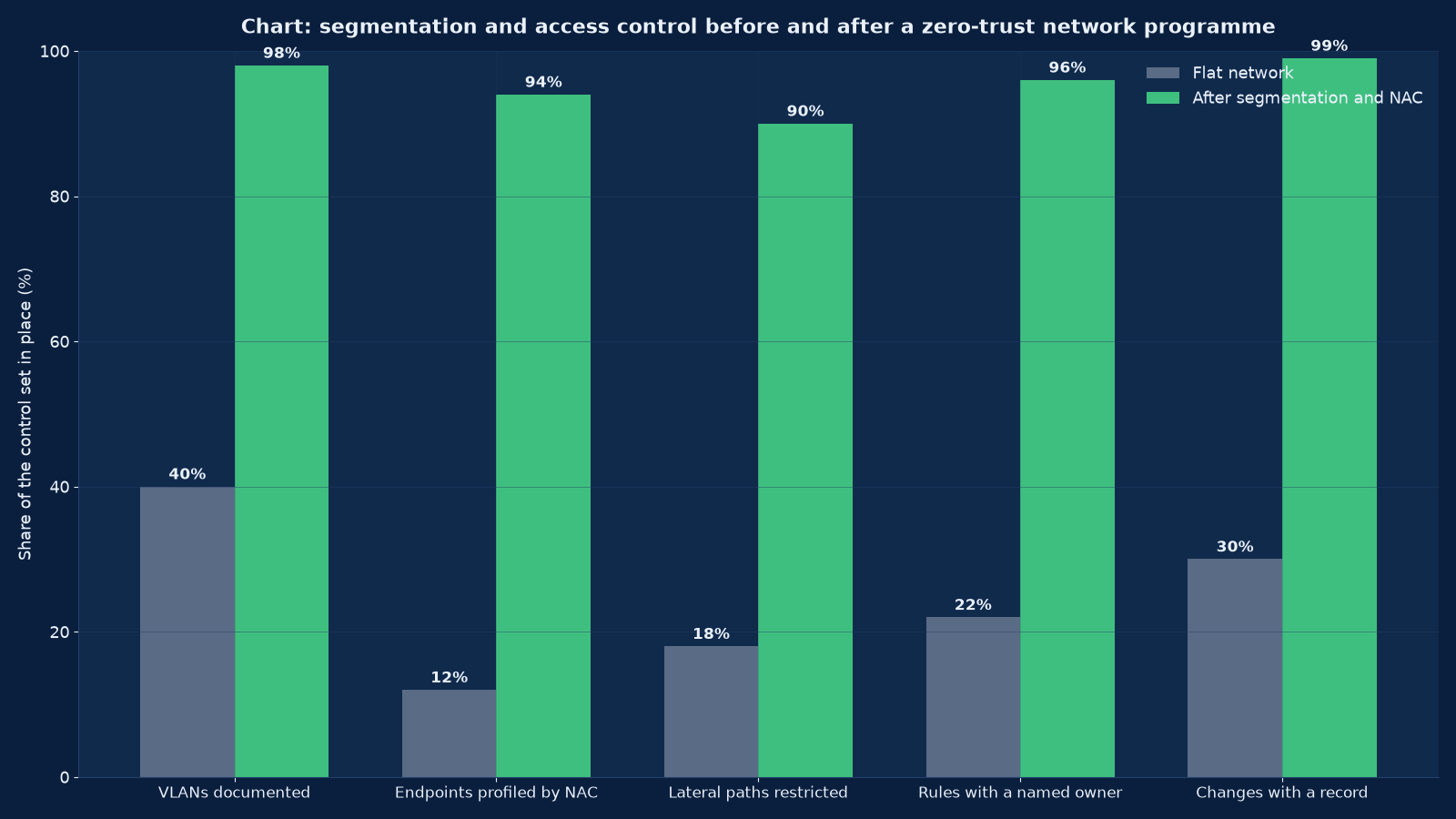
Chart values are an illustrative planning model based on typical UMC engagements and published industry benchmarks. They are not a guarantee of results on any specific project.
Most enterprise networks were designed on the assumption that the inside was trustworthy and the boundary was the control. That assumption failed quietly, over about fifteen years, as applications moved to cloud, users moved off site, and adversaries stopped attacking the boundary and started being invited through it with valid credentials. What replaces it is not a better wall. It is a network that restricts what any one compromised thing can reach — which is an engineering project, not a purchase.
Network security, segmentation and access control engineering at Unified Management Consulting is the discipline of making an enterprise network restrictive by design rather than permissive by accumulation. It covers the segmentation model — what zones exist, what may reach what, and how that is enforced across switching, routing, firewalling and the wireless estate; network access control, so that a device’s identity and posture decide what it may do rather than the socket it happens to be plugged into; firewall rule governance, which is where most estates have quietly lost control; and the change and evidence processes that make the whole thing auditable and defensible after an incident.
We deliver these programmes for organisations whose network has grown for a decade without a design: flat Layer 2 domains that now span buildings, firewall rule bases where nobody knows what a permission was for, device populations — printers, cameras, building management, plant controllers, medical equipment — that were admitted because there was no alternative, and remote access paths that predate the current threat model. The work is unglamorous and it is the highest leverage security investment most of these estates can make, because it reduces the consequence of every other control failing.
🔒 Network Security, Segmentation & NAC — Quick Summary
| Component | What We Deliver |
|---|---|
| Network security assessment | The current segmentation, rule base, admission model and lateral paths documented as they are — not as the architecture diagram claims — with a scored posture. |
| Segmentation architecture | Zones, boundaries and the enforcement points between them, designed against what the estate actually runs and what an adversary could reach from each zone. |
| Deny-by-default policy model | Explicit permissions with a named owner and a stated business reason, replacing the permissive rules that accumulated. |
| Network access control design | Device profiling, authentication where the device supports it, and posture-based placement for everything that does not. |
| Lateral movement restriction | Enumeration of east-west paths and their closure, which is the control that determines how far one compromised device reaches. |
| Firewall rule governance | Rationalisation, ownership, expiry, change control and the evidence trail, delivered as a maintainable process rather than a one-off cleanup. |
| Wireless and guest separation | Complete isolation of guest and unmanaged traffic from corporate and operational zones, with admission appropriate to each device class. |
| Operational technology and plant isolation | Segmentation for device populations that cannot authenticate, cannot be patched on a normal cycle, and whose compromise has physical consequences. |
| Remote access redesign | Identity-based access that no longer depends on where the user connected from, with inspection at the point the traffic enters rather than at a single concentrator. |
| Encryption and inspection strategy | What is inspected, where, what is exempted and why — stated explicitly, because “inspect everything” fails under load and “inspect nothing” fails silently. |
| Detection integration | Network telemetry — flows, session records, admission events, rule changes — delivered to the monitoring and detection functions in a usable form. |
| Evidence and audit readiness | The zone map, permission register, change records and test results assembled as evidence an auditor or an insurer can read. |
The Security Programme and the Network Architecture Are Different Work
There is a security programme and there is a network security architecture, and they are not the same engagement. The programme covers policy, identity, endpoint protection, application security, testing and governance across the whole estate. The network architecture is the specific set of controls that decide what may reach what — and it is the layer whose defects convert every other failure into a large one.
| Question | The wider security programme | Network security and segmentation |
|---|---|---|
| What is our overall risk position? | Yes — assessment, governance, policy | Contributes the network’s posture as one component |
| Are endpoints protected? | Yes | No — but decides what a compromised endpoint can reach |
| Is our identity estate sound? | Yes | Depends on it: identity is the input to admission and access decisions |
| What may a device on VLAN 40 reach? | Not in scope | Entirely in scope — this is the question the architecture answers |
| How many firewall rules exist and who owns them? | May identify it as a finding | Rationalises, assigns ownership, adds expiry and change control |
| Can a printer reach a server? | Would flag it if discovered | Prevents it by design, and profiles the printer so it lands in the right zone automatically |
| What happens after one device is compromised? | Incident response | Determines the blast radius, which is the difference between an incident and a catastrophe |
| Can we show an auditor our network controls? | Produces the control framework | Produces the zone map, permission register, change records and test evidence |
The two are delivered together in most engagements, and the sequence matters: a segmentation design without an identity model to admit devices against produces a architecture that cannot be enforced, while an identity programme without segmentation produces strong authentication into a flat network. Our Cybersecurity Services & Solutions is the wider programme; this page is the network layer beneath it, and the two share one policy artefact so they cannot drift apart.
Assessment: Documenting What the Network Actually Permits
An assessment has to establish what the network actually permits, which is rarely what the documentation says, because permissions accumulate through change requests that were each reasonable at the time. The four artefacts below are what we produce, and together they are the baseline every improvement is measured against.
| Artefact | What it contains | How it is produced | Why it matters |
|---|---|---|---|
| Zone map | Every logical zone, its purpose, its members and the boundaries between them | From switching configuration, routing design, firewall zones and the VLAN inventory, reconciled against each other | An estate that cannot draw its own zones cannot restrict anything deliberately |
| Reachability matrix | What may reach what, and on which ports and protocols — including what can reach what today that should not | From rule bases, access control lists and, where possible, observed traffic rather than configuration alone | Configuration states intent; observed traffic states reality, and they differ |
| Permission register | Every explicit permission with an owner, a business reason, an expiry review date and the date it was granted | By walking the rule base and asking who needed each permission and why | The permissions nobody can explain are the ones an adversary uses |
| Device population inventory | What is actually on the network, by class: managed endpoints, servers, printers, cameras, building management, plant, medical, guest | From network access control profiling, discovery scans and switch port records | You cannot segment a population you have not enumerated |
The scored posture
The assessment ends with a scored posture rather than a list of findings: VLANs documented, endpoints profiled, lateral paths restricted, rules with a named owner, changes with a record. Those are the five measures in Figure 1, and they are chosen because each one is measurable, each one predicts incident severity, and each one can be improved by a specific piece of work. A finding that says “segmentation is weak” cannot be scheduled; a baseline that says “18 per cent of lateral paths are restricted” can.
Segmentation Architecture: Zones, Boundaries and Where Enforcement Lives
Segmentation is the architecture that limits consequence. The design question is not how many zones to create but where the boundaries have to be, which follows from what the estate runs and what an adversary gaining a foothold in each zone could reach.
| Zone | Contains | Boundary rules | The failure it prevents |
|---|---|---|---|
| Corporate user | Managed endpoints used by staff | Reaches application zones on explicit permissions; no direct path to servers, plant or management planes | A compromised laptop becoming a route into everything |
| Server and application | The systems the business runs on | Reached only by named application flows, with administration on a separate path | Lateral movement from a user device into production |
| Management plane | Network, server and platform administration access | Isolated, authenticated separately, and unreachable from user and application zones | An adversary administering the estate with credentials harvested from a user device |
| Guest and unmanaged | Visitors, personal devices, contractors before onboarding | Egress only, no internal paths whatsoever, rate-limited and logged | An unauthenticated device reaching internal resources at all |
| Operational technology and plant | Industrial controllers, building management, sensors, plant networks | Heavily restricted, unidirectional where possible, with no general internet path | A plant compromise with physical consequences, and an internet-borne infection reaching devices that cannot be patched |
| Clinical and regulated | Medical devices, imaging, systems under specific regulatory constraints | Segmented by function and by the device’s ability to be secured, with documented compensating controls | An unpatchable medical device being the entry point to the wider estate |
| Wireless | Corporate, guest and device wireless networks | Each wireless network maps to a zone with that zone’s rules, not to a permissive default | A wireless network becoming the flat entry point that bypasses the wired segmentation |
| Internet edge and demilitarised zone | Publicly reachable services | No path from the demilitarised zone into internal zones except explicit, inspected application flows | A compromised public service becoming an internal foothold |
| Backup and recovery | The recovery estate | Isolated, with credential separation from primary administration | An adversary deleting the copies they were about to need you not to have |
| Development and test | Non-production environments | Separated from production, with no production data unless deliberately and controlledly placed | A development environment becoming the route into production |
The design is published as one document with three views: the zone map for architects, the reachability matrix for engineers implementing it, and the permission register for the people who have to approve and review it. An architecture that exists only as a diagram cannot be enforced, and one that exists only as configuration cannot be reviewed.
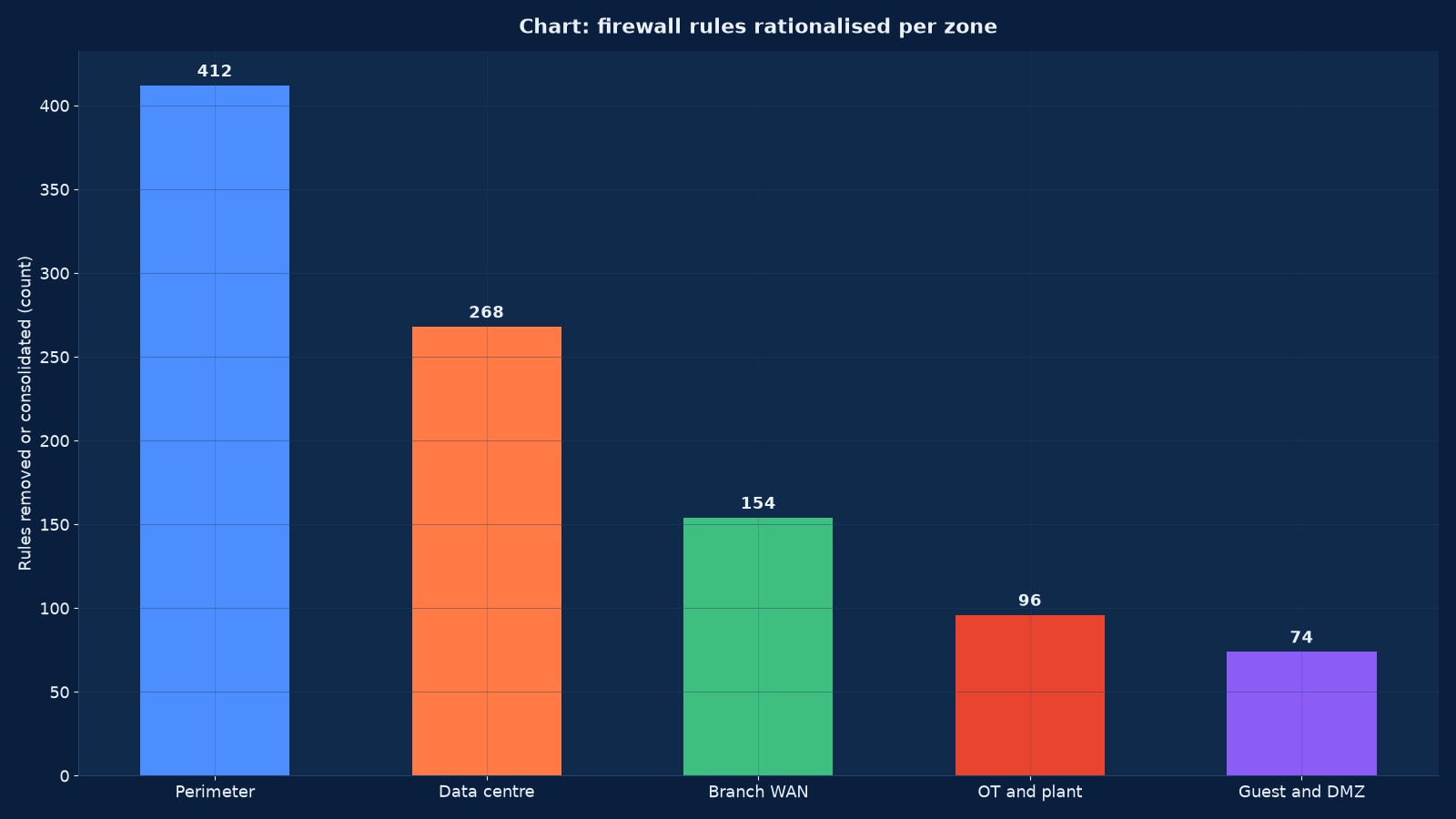
Chart values are an illustrative planning model based on typical UMC engagements and published industry benchmarks. They are not a guarantee of results on any specific project.
Firewall Rule Governance: The Process That Stops the Decay
Firewall rule bases degrade predictably: a request arrives with a deadline, a permissive rule is added because it is faster than the correct one, nobody removes it when the project ends, and after a decade the rule base no longer describes any architecture. The governance model below is what stops that cycle, and it is a process rather than a cleanup.
| Control | What it requires | What it prevents |
|---|---|---|
| Deny by default | No traffic permitted except by an explicit rule; the implicit permit is removed wherever it exists | The permissive default that makes every new device reachable |
| Named ownership per rule group | Every permission has a person and a business reason, recorded at creation | The unexplained permission nobody will authorise removing |
| Expiry and periodic review | Temporary permissions expire automatically; permanent ones are reviewed on a stated cycle | Project access that outlives the project by five years |
| Least privilege at the port level | Permissions specify protocol and port, not “any to any” | A permission granted for one service that silently allows everything between the two hosts |
| Rule ordering and shadowing analysis | Shadowed, redundant and conflicting rules identified and resolved | Rules that appear to control traffic but are never evaluated |
| Change control with a record | Every change requested, approved, implemented and verified, with the record retained | The inability to reconstruct what changed and when, which is the first question after an incident |
| Separation of duties | The person who requests a permission is not the only person who can approve it | An insider or a compromised account granting itself access |
| Automated compliance checking | The rule base tested continuously against the intended architecture | Drift between the documented design and the enforced reality |
| Decommissioning discipline | Permissions removed when the system, project or person they served is retired | Rule growth that is monotonic and therefore eventually unmanageable |
Rationalisation without an outage
Removing a thousand rules from a live estate cannot be done by deleting them. The process is to observe traffic against each candidate rule for a period long enough to include monthly and quarterly cycles, mark rules with no observed hits as candidates, place them in a disabled-but-present state where the platform allows it, and remove them after a defined period with a rollback available. Rules that show no traffic but are known to be seasonal — an annual audit process, a periodic batch — are handled explicitly, because that is exactly the case where an observation window produces a false negative.
Network Access Control: Making Segmentation Enforceable
Network access control is the mechanism that makes segmentation enforceable, because without it a zone is defined by which socket a device is plugged into — and sockets are in corridors. Access control decides placement from the device’s identity and posture, which means a device moved physically does not change what it can reach.
| Device class | Can it authenticate? | Admission mechanism | Placement and consequence |
|---|---|---|---|
| Managed corporate endpoints | Yes — certificate or identity-based | Authentication against the directory, with posture checked | Corporate zone, with access to the permissions that identity is entitled to |
| Servers and infrastructure | Yes, usually by certificate | Authentication plus device identity, with placement fixed by role | Their designed zone, and administration only from the management plane |
| Printers, cameras and building devices | Rarely — most support nothing modern | Profiling: identified by media access control address, protocol behaviour, fingerprint and observed traffic | A device zone with egress restricted to what the device genuinely needs, which for most is almost nothing |
| Operational technology and plant controllers | Generally no, and often cannot be patched either | Profiling plus port-level placement, with the switch port bound to the expected device | An isolated plant zone, with alerts on any change of device at that port |
| Medical and clinical devices | Mixed, and constrained by manufacturer support | Profiling, with compensating controls documented where authentication is impossible | A clinical zone segmented by function, with the risk of each placement stated explicitly |
| Internet of Things and sensors | Rarely | Profiling with a registered inventory | A device zone with no internet path unless a specific need is documented |
| Contractor and partner devices | Sometimes, against a federated identity | Time-bounded admission with a sponsor and an expiry | A restricted zone for the duration of the engagement, then removed automatically |
| Guest and personal devices | No, and they should not be trusted as though they could | Captive portal or voucher with an identity captured where possible | Guest network only: egress, filtered, rate-limited, logged, and no internal path at all |
| Unknown devices | By definition, no | Denied by default and quarantined for investigation | Nothing until somebody establishes what it is — which is the control most estates lack |
The unknown-device row is the one that matters. An estate without default-deny admission treats an unrecognised device as a guest with full network access until somebody notices it; an estate with default-deny treats it as nothing until somebody establishes what it is. That single difference is most of the value in network access control, and it is a configuration decision rather than a product decision.
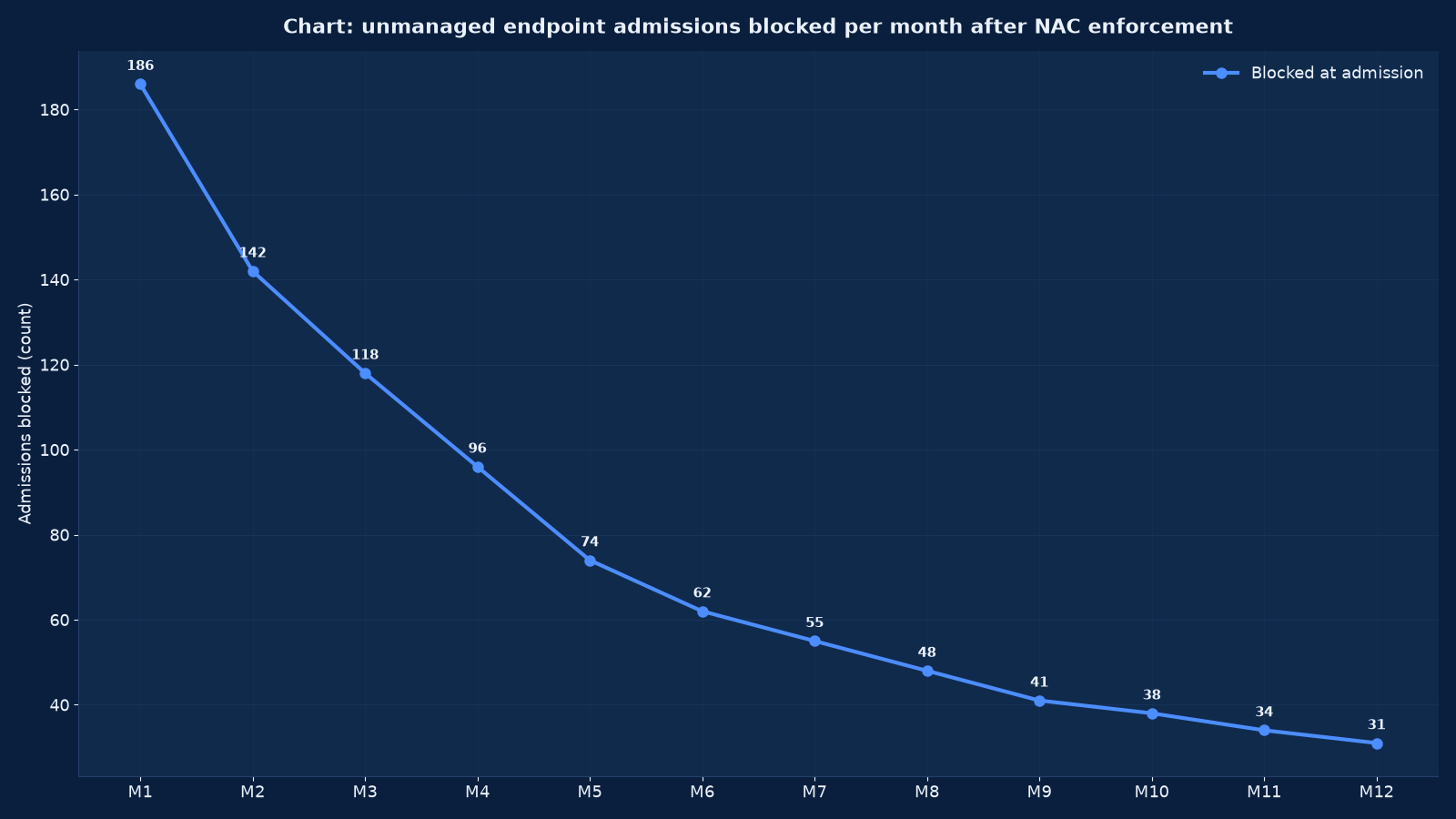
Chart values are an illustrative planning model based on typical UMC engagements and published industry benchmarks. They are not a guarantee of results on any specific project.
Lateral Movement: Enumerating the Paths and Closing Them
Lateral movement is how a single compromise becomes an estate-wide one, and restricting it is the control with the highest return of any in this page. The work is enumeration first: you cannot close paths nobody has listed.
| Path class | How it is discovered | How it is closed | What must be preserved |
|---|---|---|---|
| User device to server | Reachability matrix plus observed traffic | Explicit application-level permissions only, with the general path removed | The named application flows the business depends on |
| Server to server | Configuration review and observed east-west traffic | Segmentation within the server zone by application tier and by sensitivity | Clustering, replication and monitoring flows, which are easily broken by blanket rules |
| Device to management plane | Administration path review | A separate management zone reachable only from approved administrative hosts with strong authentication | Emergency access, which has to exist and has to be controlled rather than convenient |
| Wireless to wired | Wireless network mapping against zone boundaries | Each wireless network mapped to a zone with that zone’s rules | Roaming and voice behaviour, which segmentation changes can degrade |
| Plant and operational technology to corporate | Physical and logical connection review, including modems and remote maintenance paths nobody remembers | Unidirectional flow where possible, with remote vendor access brokered and logged | Legitimate vendor maintenance access, which has to work under supervision rather than be removed |
| Branch to data centre | Wide-area routing and rule review | Per-application permissions rather than site-to-site reachability | The specific application dependencies each site genuinely has |
| Backup estate to primary | Recovery architecture review | Credential separation and network isolation of the recovery estate | The backup data path, which is the one flow that must remain open |
The forgotten paths
Every estate has them: a remote maintenance modem installed by a vendor nine years ago, a test link left in place, a wireless network that was never mapped to a zone, a serial console server reachable from the user network, a site-to-site tunnel to a partner that still exists after the contract ended. They are found by enumeration rather than by architecture review, and they are almost always the path an actual intrusion used. We treat finding them as a deliverable with its own list, not as a side effect of the design.
Remote, Privileged and Vendor Access
Remote access is where the perimeter assumption fails most visibly, because the users are no longer inside it. The redesign is to make access depend on who the user is and what state their device is in, rather than on where they connected from.
| Element | The legacy model | The redesigned model | What it depends on |
|---|---|---|---|
| Access decision | Network position: inside is trusted, outside goes through a concentrator | Identity plus device posture, evaluated per session and per application | A reliable identity estate and device inventory |
| Concentration point | A gateway every remote user passes through | Access brokered per application, with no single internal entry point | Application inventory and per-application permission design |
| Inspection | At the gateway, on traffic entering the estate | At the point where traffic is admitted, including cloud-delivered inspection for users who never reach a site | A service edge or equivalent, with local fallback defined |
| Privileged access | Often the same path as general user access | A separate, isolated path with stronger authentication, session recording and time-bounded elevation | A management zone and a privileged access mechanism |
| Partner and vendor access | A site-to-site tunnel, frequently permanent and broad | Brokered, time-bounded, logged and restricted to the specific systems the engagement needs | A sponsor process and an expiry mechanism |
| Session visibility | Connection logs at the gateway | Session records tying identity, device, application, path and outcome | Telemetry integration with the monitoring and detection functions |
| Failure behaviour | Gateway outage ends remote access | Defined degraded mode, with the risk of it stated and accepted explicitly | A documented fallback rather than an assumed one |
Privileged access deserves separate treatment because it is the path whose compromise ends the estate. Administrative access should never share the user path, should require a second factor that is not the same mechanism as general authentication, should be elevated for a bounded period with a recorded reason, and should produce a session record that survives the compromise of the system being administered.
Encryption and Inspection: What, Where, and What Is Exempt
Inspection strategy is where security architecture meets physics. Decrypting and inspecting traffic consumes substantial resources, and an inspection design that exceeds the platform’s capacity produces either dropped sessions or silently bypassed inspection — the second being worse, because the estate believes it is protected.
| Decision | Options | What determines the answer |
|---|---|---|
| What is inspected | All decrypted traffic; selected zones; selected application classes; nothing beyond the perimeter | The threat model, the platform’s throughput at inspection load, and the privacy and legal position |
| Where inspection happens | At the site edge, at a central hub, or from a cloud service edge | Whether sites break out locally, where users are, and what latency is acceptable |
| What is exempted | Certificate-pinned applications, financial and healthcare traffic with specific constraints, high-volume flows that would exhaust capacity, and operational technology that cannot tolerate interception | An explicit list, owned and reviewed — because an exemption nobody wrote down is an exemption nobody can audit |
| Certificate handling | Who issues the internal certificate, how it is distributed, how it is rotated, and what happens when it expires | Certificate expiry during a holiday period is a real and common cause of an estate-wide outage |
| Capacity headroom | Inspection throughput at peak, with headroom for growth and for failover | Sizing at steady state produces a platform that fails its own inspection during the peak that matters |
| Failure behaviour | Fail open or fail closed when inspection cannot keep up | A deliberate decision with the consequence stated: fail open preserves availability and loses visibility, fail closed preserves control and stops the business |
| Privacy and legal position | What may be inspected, whose traffic, with what notice | Employment law, works councils, sector regulation and the jurisdictions the estate operates in |
We publish the inspection scope and the exemption list as documents with owners and review dates. An inspection strategy that exists only as configuration is unauditable, and an exemption list that exists only in an engineer’s memory is a gap that will be found by somebody else first.
Verification, Drift and the Evidence Trail
A restrictive network is only as good as the evidence that it is still restrictive. Estates drift because changes are made under pressure, and drift is invisible without continuous verification against the intended design.
| Verification activity | Cadence | What it proves |
|---|---|---|
| Automated rule base compliance check | Continuous, on every change | That the enforced policy still matches the intended architecture, with deviations raised as exceptions |
| Reachability testing | Periodic, from representative hosts in each zone | What can actually reach what, rather than what the configuration implies |
| Permission register review | Quarterly, with owners confirming each permission is still required | That permissions have not outlived their purpose |
| Unknown-device admission review | Continuous, with a periodic summary | That default-deny admission is operating and that quarantined devices are being resolved rather than accumulated |
| Rogue and unauthorised device detection | Continuous | That no unauthorised network device — access point, switch, router, bridge — has been introduced |
| Change record audit | Monthly sample | That changes were requested, approved, implemented and verified, with the record complete |
| Segmentation integrity test after change | On every significant change | That a change intended for one zone did not open a path into another |
| External and internal testing | Periodic, against the current threat model | Whether the architecture survives an adversary rather than a checklist |
The detection integration is the other half of this: flows, session records, admission events, rule changes and quarantine events have to reach whoever is watching, in a form they can query. Network telemetry that is generated and never collected is not a control, and an estate that cannot answer “what did this device reach in the last week” cannot scope an incident.
How This Differs From Our Neighbouring Pages
Network security controls sit on top of the physical plant and underneath the operations function, and they are one component of a wider security programme.
| Your question | Right starting point | What it produces |
|---|---|---|
| What may a device on our network actually reach? | This page | A zone map, a reachability matrix, a permission register and the design that restricts them |
| Who designs the routing, switching and firewall estate itself? | Routing, Switching, Firewall and Network Engineering | The Layer 3 architecture and firewall engineering that this page’s segmentation model is enforced through |
| What is our overall security risk position? | Cybersecurity Services & Solutions | The wider programme — identity, endpoint, application, testing and governance — that this page’s network controls sit inside |
| Devices we cannot authenticate are joining the network | Our wireless and access-control engineering, built in this same programme | Profiling-based admission across wireless and wired, with guest and device networks fully separated |
| Sites and remote users need access that does not depend on location | Our SD-WAN and SASE offering, built in this same programme | An overlay and service-edge design whose policy is one artefact with this page’s segmentation model |
| The physical plant and its documentation are the constraint | Our structured cabling and LAN/WAN engineering offering, built in this same programme | A documented VLAN, topology and asset register — without which segmentation cannot be implemented or audited |
| Voice and clinical devices have special requirements | Our unified communications and VoIP offering, built in this same programme | A voice design whose segmentation, prioritisation and admission are specified rather than inherited |
| Nobody sees the network events that matter | Our network operations and monitoring offering, built in this same programme | A monitoring design consuming the telemetry this page specifies, with alert ownership |
| An auditor or an insurer wants evidence | IT Audit, Compliance & ISO 27001 / SOC 2 Readiness | The zone map, permission register, change records and test evidence assembled for the audit |
| Our recovery copies must survive a compromise | Backup, Disaster Recovery & Business Continuity Services | A recovery design whose credential separation and network isolation this page’s segmentation makes possible |
Evidence From Our Work
Network restriction is confidential in detail, but the environments below show the estates whose segmentation carries the most consequence: multi-site clinical networks with unpatchable medical devices, hospitality properties with heavy guest traffic, and continuous operations where a compromised device reaching the wrong zone is a broadcast event.
- Global Hospitals — Case Study — switching and routing architecture across multiple locations with a server room build, delivered over a six-to-nine month implementation with twenty-four months of support. Multi-site clinical estates are the hardest segmentation case: medical devices that cannot authenticate, cannot be patched on a normal cycle, and whose compromise has clinical consequences.
- Apollo Hospitals — Case Study — a multi-campus wireless feasibility assessment, which is also an admission-control question: a clinical wireless estate has to separate corporate, clinical, device and guest traffic before any coverage design matters.
- IT Infrastructure Management for an IT Company — Case Study — twenty-four-by-seven monitoring, remote and on-site support, preventive maintenance and security management for a media and broadcasting company on a twenty-four month renewable contract, where security management and network operations are one function rather than two.
- Marriott Hotel Hyderabad — Case Study — managed services and monitoring across multi-property hospitality operations, where guest network isolation is both a security requirement and a commercial one, since guest traffic is the majority of the estate.
- Fern Hotel Hyderabad — Case Study — hospitality infrastructure across properties, where back-of-house systems and guest-facing networks have to be separated in buildings not designed for either.
- Shadow AI: Risks, Discovery, and Governance Without Killing Adoption — the pattern in which devices and services join an estate faster than governance follows, which is exactly what default-deny admission control exists to interrupt.
- Cybersecurity Career Roadmap: Skills and Certifications — the skills the operating side of this discipline requires, and why network security engineering is scarcer than tool administration.
- our Technology archive — further writing on network operations, security engineering and the discipline behind them.
Frequently Asked Questions About Network Security, Segmentation and Access Control
What is the single highest-value change we could make?
Default-deny admission for unknown devices. An estate without it treats an unrecognised device as a guest with network access until somebody notices; an estate with it treats an unrecognised device as nothing until somebody establishes what it is. It is a configuration decision rather than a product purchase, and it converts every unknown device from a potential entry point into an investigation.
How do we segment devices that cannot authenticate?
By profiling rather than by authentication. Network access control platforms identify devices by media access control address, protocol behaviour, fingerprint and observed traffic, then place them in a zone appropriate to their class with egress restricted to what the device genuinely needs — which for most printers, cameras and sensors is almost nothing. The port is bound to the expected device, so a change at that port alerts.
How many firewall rules is too many?
The count is not the measure; the proportion nobody can explain is. A hundred unowned permissive rules are worse than two thousand owned, specific, reviewed ones. What matters is whether every permission has an owner, a business reason, a review date and a change record — because a rule base that cannot be reasoned about cannot be defended or audited, regardless of its size.
Can we rationalise a live rule base without an outage?
Yes, but not by deleting rules. Observe traffic against each candidate over a period long enough to include monthly and quarterly cycles, mark no-hit rules as candidates, disable rather than remove where the platform allows it, and delete after a defined period with rollback available. Seasonal rules — an annual audit process, a periodic batch — are handled explicitly, because an observation window will otherwise produce a false negative and remove something needed once a year.
What is the difference between segmentation and microsegmentation?
Segmentation divides an estate into zones with controlled boundaries between them. Microsegmentation applies policy at the individual workload or device level, typically enforced in the hypervisor or by a host agent rather than in the network. Both are legitimate; the second is much harder to operate and is usually justified only for specific high-value workloads. Most estates need good zone segmentation first, because microsegmentation on a flat, undocumented network produces policy nobody can maintain.
How does zero trust change the network design?
It removes network position as a trust signal. Access decisions depend on identity and device posture, evaluated per session and per application, with explicit permissions and continuous verification. Practically it means deny-by-default rules, a management plane reachable only through a controlled path, privileged access separated from user access, and session records that tie identity to what was reached. It is an engineering programme, not a product.
Should operational technology be connected to the corporate network at all?
Only through a deliberately designed boundary, and often unidirectionally. Plant and building systems commonly cannot be patched on a normal cycle, cannot authenticate, and have physical consequences when compromised. They belong in an isolated zone with no general internet path, with vendor remote maintenance brokered, supervised and logged rather than permitted through a permanent tunnel. The forgotten maintenance modem is a real finding in almost every plant estate we survey.
How do we handle guest and bring-your-own-device traffic?
Complete isolation from internal resources, enforced at the network layer rather than by a firewall rule that could be misconfigured: a separate network with its own egress, filtered and rate-limited access, sessions logged with whatever identity was captured, and no internal path at all. Bring-your-own-device that has been authenticated is still treated as guest-class for internal access, because the device is not managed and its posture cannot be assured.
What should we inspect, and what should we exempt?
Publish both lists. Inspection consumes real throughput, so an estate that intends to inspect everything either exceeds its platform’s capacity or silently bypasses inspection under load. Exemptions are legitimate for certificate-pinned applications, certain financial and healthcare traffic, high-volume flows and operational technology that cannot tolerate interception — but they must be written down, owned and reviewed, because an exemption nobody documented is an exemption nobody can audit.
How do we know the network is still as restrictive as we designed it?
By continuous verification against the intended design rather than by periodic review alone: automated compliance checks on every rule change, reachability testing from representative hosts in each zone, quarterly permission register review with owners confirming each entry, unknown device admission review, rogue device detection, and a segmentation integrity test after every significant change. Estates drift under pressure; only continuous checking detects it.
What evidence do we get at the end of a programme?
The scored posture baseline and its re-measurement, the zone map and reachability matrix, the permission register with owners and review dates, the network access control design with the admission mechanism per device class, the enumeration of forgotten paths and their closure, the inspection scope and exemption lists, the change control process with its records, the verification cadence, and the telemetry integration specification for the monitoring and detection functions.
How does this relate to the recovery estate?
Segmentation is what makes recovery survivable. A recovery estate reachable by the same credentials and the same network paths as the primary one can be destroyed by the same adversary, which is why the backup zone exists in the architecture with credential separation and network isolation. An estate that has not segmented cannot guarantee that its copies will still exist when it needs them.
Ask What One Compromised Device Could Reach
That is the question this discipline exists to answer, and most estates cannot answer it. We will document the zones as they actually are, build the reachability matrix from observed traffic rather than from configuration, enumerate the lateral paths and the forgotten ones, and give you a scored posture with a remediation sequence that can be scheduled. The baseline is usually uncomfortable. It is also the point from which every improvement can be measured.
Contact Unified Management Consulting to arrange a confidential first conversation.
Related Services
Network security controls depend on the layers around them. These are the engagements they most often run alongside:
- Routing, Switching, Firewall and Network Engineering — the routing, switching and firewall estate the segmentation model is enforced through, and the topology it has to agree with.
- Cybersecurity Services & Solutions — the wider security programme: identity, endpoint, application, testing and governance, of which these network controls are one layer.
- Backup, Disaster Recovery & Business Continuity Services — the recovery estate whose credential separation and network isolation this architecture makes possible.
- IT Audit, Compliance & ISO 27001 / SOC 2 Readiness — the control framework the zone map, permission register and change records are assembled for.
- Managed IT Infrastructure & IT AMC Services — operating the controls afterwards, with the verification cadence and change process this page specifies.
- IT Help Desk & Remote Support Services — the first line that handles admission failures and access requests, which is where a restrictive network either works smoothly or generates tickets.
- DevOps & CI/CD Engineering Services — for application estates where permissions have to be delivered as code and reviewed in the same pipeline as the application.
- Enterprise Wireless & Wi-Fi 6 Design Services — predictive surveys, Wi-Fi 6 and 6E design, roaming and the coverage evidence taken on site
- NOC & Network Monitoring Services — 24×7 monitoring, alert thresholds, incident response and the reporting that turns uptime into a number
- SD-WAN & SASE Design and Rollout Services — SD-WAN and SASE rollout with application policy, transport independence and measurable failover behaviour
- Structured Cabling & LAN/WAN Design Services — structured cabling, containment, labelling, certification and the LAN and WAN design that runs over it
- Unified Communications & VoIP Services — unified communications and VoIP design, number planning, QoS, contact centre integration and call quality
- Computing, Server, Storage & Data Centre Engineering — the computing estate as a whole: inventory, sizing, consolidation, lifecycle, power, cooling and failover