
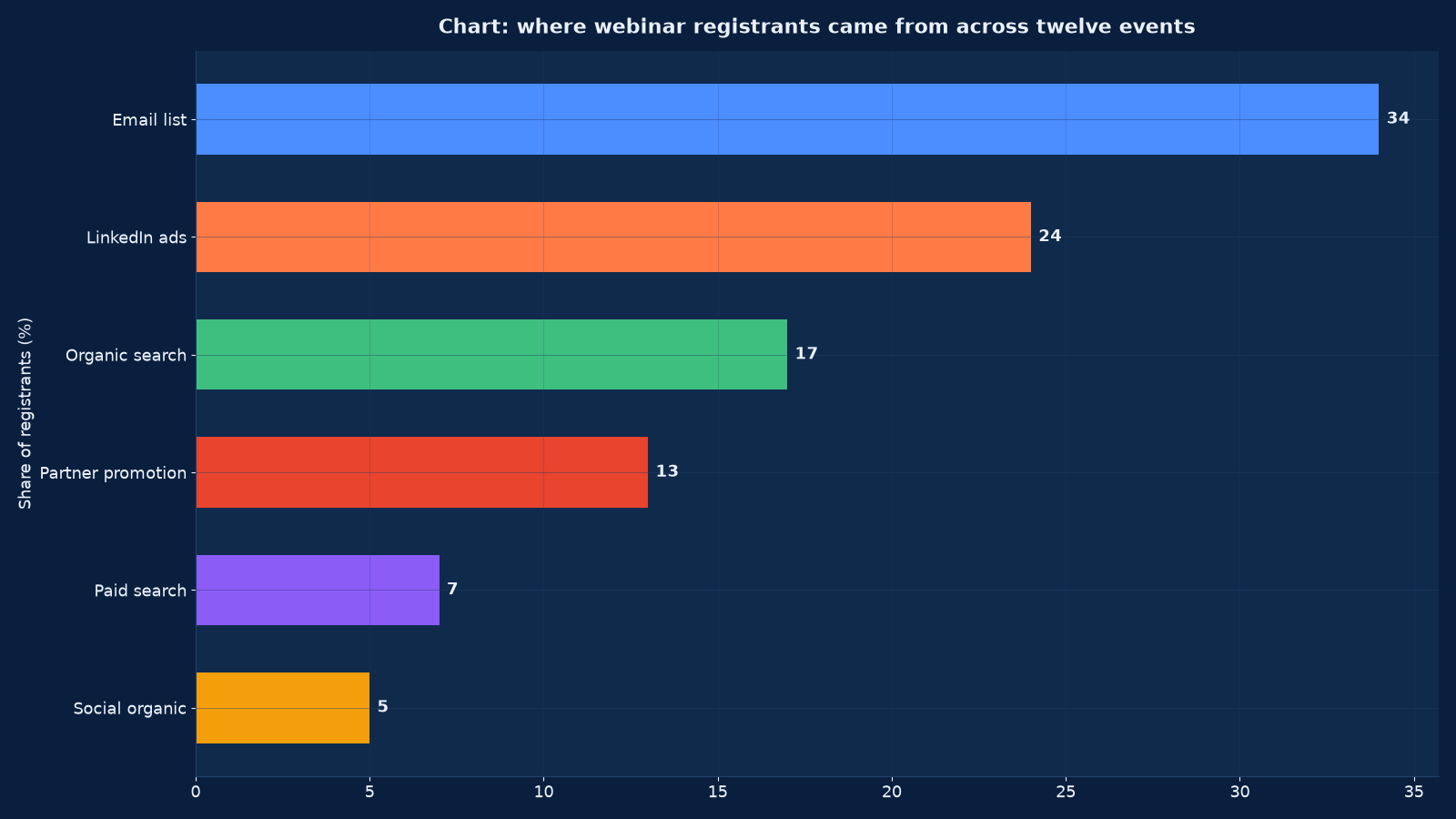
Chart values are an illustrative planning model based on typical UMC engagements and published industry benchmarks. They are not a guarantee of results on any specific project.
A webinar is not a content format. It is a mechanism for assembling several people from one account in one room, at a time you chose, to hear an argument you structured. Judged as content it is expensive. Judged as a pipeline mechanism with a repurposing tail, it is one of the most efficient things a B2B business does.
Webinar and event campaign management at Unified Management Consulting covers the whole event as a campaign: topic and offer selection, registration page and promise, promotion across email, LinkedIn, search, partners and social, the registration-to-attendance problem, production and run of show, live delivery and question handling, follow-up and the handover into a nurture path, and the repurposing tail that turns one hour into a quarter’s worth of assets. We run these for B2B industrial, technology and professional services sellers, for e-commerce and retail brands launching ranges, for clinics, education providers and hospitality groups, and for clients whose audiences sit in India, Africa, the Gulf, Europe and North America.
The engagement is per event or per series. A series is what we recommend, because a single webinar has to pay for its own promotion while a series compounds: the audience grows, the production becomes routine, the assets accumulate and the follow-up paths mature. In Figure 2 the measures that move most between a first event and a completed series are the ones that are process rather than performance — a defined offer, a repurposing tail and a nurture handoff.
🎤 Webinar & Event Campaigns — Quick Summary
| Component | What We Deliver |
|---|---|
| Event strategy and calendar | A year of events chosen against the buying cycle, with the format, the audience and the offer per event. |
| Topic and offer design | A topic the audience will register for and an offer that follows naturally from it, rather than a demonstration with a title disguised as education. |
| Registration page and form | A page that states the promise, the agenda and the timing, with a form that captures what the follow-up needs. |
| Promotion across sources | Email, LinkedIn, search, partners and social coordinated against one calendar, with the source of every registrant recorded. |
| Attendance programme | Confirmation, reminder and last-call sequences, plus the on-demand route for those who cannot attend. |
| Production and run of show | Rehearsal, technical check, roles, timing, slides and the contingency for everything that goes wrong. |
| Live delivery and Q&A | Moderation, question triage, polls and the handling of the questions you would rather not answer. |
| Follow-up and nurture handoff | Segmented follow-up for attendees, no-shows and engagers, each routed into the right path. |
| Repurposing | The recording cut into clips, transcripts into articles, questions into content and data into a report. |
| Measurement and reporting | Registrations, attendance, engagement, meetings and pipeline per event and per source, with the repurposing tail tracked. |
What This Service Actually Covers
The service covers the event as a campaign, from topic selection to the last repurposed asset. It is delivered per event, per series, or as a standing programme with a calendar we own.
| Component | What we do | What you keep | Duration |
|---|---|---|---|
| Strategy and calendar | A year of events chosen against the buying cycle | A calendar with a purpose per event, not a schedule of activity | 1–2 weeks |
| Topic and offer | A topic that earns registration and an offer that follows from it | A brief the speaker can deliver without improvising the commercial part | 1 week |
| Registration | Page, form, confirmation and the promise stated clearly | A page that converts visitors into registrants, measured | 1 week |
| Promotion | Coordinated across email, LinkedIn, search, partners and social | A source record per registrant, which is what makes the next event cheaper | 2–3 weeks |
| Attendance programme | Reminder sequences and the on-demand route | A registrant-to-attendee rate that is managed rather than hoped for | 1 week |
| Production | Rehearsal, technical check, roles, run of show, contingency | A run of show and a checklist that any team can execute | 1 week |
| Delivery | Moderation, question triage, polls, timing | An event that ends on time and answers the questions that matter | Event day |
| Follow-up | Segmented follow-up and the nurture handoff | Three paths rather than one, with the sales handover flagged | 1 week |
| Repurposing | Clips, transcripts, articles, question-led content and a data report | A quarter’s assets from one hour of delivery | 2–3 weeks |
| Reporting | Per event and per source, including the tail | A report that answers whether to run the event again | Per event |
The repurposing component is included by default rather than offered as an extra, because it is where most of an event’s value is realised. In Figure 2 the share of recordings repurposed into assets rises from 8 to 88 per cent between a first event and a completed series, and that measure determines whether the event’s cost is spread across one hour or across a quarter.
Why Events Are a Pipeline Mechanism
| Property | Content or advertising | An event |
|---|---|---|
| Attention | Borrowed for seconds, in a feed | Granted for an hour, at a scheduled time, by people who registered |
| Identity | Often anonymous, resolved later if at all | Named, with a role and an organisation, captured at registration |
| Committee visibility | One person at a time | Several people from one account in one room, which is the strongest buying signal there is |
| Argument | Made in fragments across many touches | Made in full, in an order you chose, with questions answered live |
| Trust | Built slowly through repetition | Advanced quickly by a speaker who is visibly competent and honest |
| Data | Clicks and impressions | Questions asked, polls answered, and who stayed to the end |
| Afterlife | A post that decays in days | A recording, a transcript, clips, articles and a lead list that keep working |
| Sales handover | A lead with a form fill attached | A lead with an hour of context attached, which is why the conversation starts further along |
This is why events are measured differently from campaigns. Registrations are a coverage measure; attendance and questions are engagement; meetings and pipeline are the output; and the repurposed assets are a second, slower return that most reporting ignores.
Event Portfolio: Formats and What Each Is For
| Format | Best for | Audience size | The commercial job |
|---|---|---|---|
| Educational webinar | Framing a problem and establishing the criteria to decide with | Fifty to several hundred | Move an early-stage audience to a buying-stage question |
| Product or capability demonstration | Evaluating buyers who need to see it work | Twenty to a hundred | Remove uncertainty about capability and implementation |
| Expert panel or roundtable | Sectors where peer validation outweighs supplier claims | Twenty to eighty | Borrow credibility and surface the objections honestly |
| Customer story session | Proof-led selling where the customer makes the argument | Thirty to a hundred and fifty | Convert scepticism into belief using a comparable peer |
| Workshop or clinic | Hands-on problems with a small, qualified audience | Ten to thirty | Produce a specific outcome for each attendee, and a reason to continue |
| Executive briefing | Tier-one accounts and senior buyers | Five to twenty | A peer conversation that advertising cannot substitute for |
| Conference talk or industry event | Presence in a sector conversation | As large as the event | Coverage and credibility, with follow-up doing the real work |
| Virtual summit or series | A quarter’s programme with several speakers and topics | Hundreds across sessions | Build an audience asset as well as a pipeline |
| In-person event or open day | Local businesses, dealerships, hospitality, facilities | Twenty to two hundred | A relationship that digital cannot create, at a real cost per attendee |
The portfolio question is which format serves which stage, and the answer is almost never “a webinar for everything”. A capability demonstration sent to an unaware audience produces registrations and no pipeline; an educational webinar sent to evaluating buyers produces attendance and no progress.
Topic and Offer: the Two Decisions That Determine Registration
| Decision | What makes it work | What makes it fail |
|---|---|---|
| The topic | A problem the audience recognises, stated in their language, with a promise of a usable answer | A topic chosen because it suits what you sell, phrased as a product category |
| The title | Specific, benefit-shaped and honest about the level | Vague superlatives, or a colon-separated phrase that could describe any event |
| The speaker | Somebody with visible authority on the topic, who can answer questions live | The most senior person available, who cannot answer anything |
| The agenda | Three or four segments, each with a stated outcome, and time for questions | Forty-five minutes of context and five minutes of substance |
| The offer | A natural next step that follows from the argument: an assessment, a diagnostic, a working session | A demonstration request appended to an educational promise, which the audience notices |
| The timing | A slot that suits the audience’s working day and time zones | A slot that suits the organiser, or one that collides with a sector event |
| The exclusivity | Something only attendees get: a template, a benchmark, a recording with the tools | Nothing that distinguishes attending from reading the article afterwards |
Registration: the Page, the Form and the Promise
| Element | Standard | Why |
|---|---|---|
| Above the fold | What the event is, who it is for, when it runs and what the attendee leaves with | A registrant who cannot answer those in five seconds does not register |
| The agenda | Published, with timings and a named speaker per segment | It is the evidence for the promise, and it reduces no-shows |
| The form | As short as the follow-up allows, with progressive profiling after registration | Long forms cut registration; no fields cut the usefulness of the follow-up |
| Role and organisation | Captured, because they decide the follow-up path and the sales handover | Without them, every registrant is treated identically |
| Confirmation | Immediate, with the calendar file and the joining link | A registrant without a calendar entry is a no-show in waiting |
| The on-demand option | Offered at registration, honestly labelled | It captures the registrants who will never attend live, who are still leads |
| Privacy and consent | Stated plainly, with the partner-sharing position explicit | Co-marketed events require consent that is real, not buried |
| Source capture | Every registrant tagged with the source that produced them | The single most valuable piece of event data, and the one most often missing |
Promotion: Coordinating the Sources
| Source | Share in Figure 1 | How it is used | The discipline |
|---|---|---|---|
| Email list | 34 per cent | A sequence to the relevant segments: three to four sends with different angles, not the same invitation repeated | Segmented by interest and role; an unsegmented blast burns the list for the next event |
| LinkedIn advertising | 24 per cent | Matched audiences, job titles and account lists, with the creative matched to the topic | Frequency capped, and creative refreshed rather than run to exhaustion |
| Organic search | 17 per cent | A registration page that ranks for the topic, plus supporting articles that link to it | The page written for the topic’s search demand, not only for the event |
| Partner promotion | 13 per cent | Co-marketed events where a partner invites their audience under an agreed consent position | The lead-sharing terms written before promotion begins |
| Paid search | 7 per cent | Topic and category terms, and competitor event terms where they are legitimately targetable | A cost-per-registration ceiling, because event terms can be expensive and thin |
| Organic social | 5 per cent | Speaker-led posts, behind-the-scenes content and the day-of reminders | The speaker’s own voice, which outperforms the brand account consistently |
| Sales outreach | Not counted as a registrant source | Personal invitations to named accounts, which produce the highest attendance rate of any source | Coordinated with the marketing sequence so nobody is invited twice in a week |
| Existing attendees | Compounding across a series | An invitation to the next event, sent to people who attended the last one | The cheapest source in a mature series, and the reason to run a series at all |
Promotion runs for three to four weeks with a peak in the final five days, when most registrations occur. A two-week window loses the early registrants who need to arrange cover; a six-week window loses momentum and costs more in frequency to sustain it.
The Registration-to-Attendance Problem
Attendance is the metric that determines everything downstream, and it is the one most programmes leave to chance. In Figure 2 the registrant-to-attendee rate rises from 22 to 58 per cent across a series, and almost all of that movement comes from process rather than from a better topic.
| Lever | What we do | Typical effect |
|---|---|---|
| Immediate confirmation with a calendar file | Sent at registration, with the event in the attendee’s own calendar | Removes the largest single cause of no-shows: forgetting |
| Reminder sequence | One week, one day, one hour and ten minutes before, each with a different line rather than the same message repeated | The one-hour and ten-minute reminders produce most of the attendance |
| Personal invitations | Sales invites named accounts directly, referencing the topic | The highest attendance rate of any source, and the best question quality |
| Exclusivity | Something only live attendees receive, stated at registration and delivered | Converts a proportion of on-demand registrants into live ones |
| Timing | A slot tested against the audience’s working day and time zones | A materially different rate for the same topic in a better slot |
| Length | Forty to fifty minutes including questions, not ninety | Completion rates rise sharply as length falls |
| On-demand honesty | The recording promised and delivered within a stated period | Protects the relationship with registrants who could not attend |
| Re-registration | No-shows invited to the next session rather than sent the recording cold | Recovers a share of the registrants who wanted to attend and could not |
Attendance is also where an event’s commercial value concentrates. A no-show has given you a name and an organisation; an attendee has given you an hour, asked questions and been observed by a speaker who can describe them to sales. Those are not comparable leads, and the follow-up should not treat them as if they were.
Production and Run of Show
| Item | Standard | The failure it prevents |
|---|---|---|
| Rehearsal | At least one full rehearsal, timed, with the technical setup as it will be on the day | A speaker who has never seen the slide deck on the platform being used |
| Technical check | Audio, video, screen share, polls, recording and the presenter’s connection tested separately | The first five minutes spent diagnosing a microphone |
| Roles | A presenter, a moderator, a producer and a question triager, each named | One person presenting, moderating, fixing audio and reading questions simultaneously |
| Run of show | A timed document: segment, speaker, duration, slide, poll, transition | An event that overruns and loses the questions at the end |
| Contingency | A backup presenter, a backup connection, a recorded fallback and a communication plan | An event cancelled live in front of two hundred registrants |
| Question handling | Triage rules: which are answered live, which are taken offline, which are declined and why | A hostile or off-topic question consuming the final ten minutes |
| Polls and interaction | Two or three, placed to re-engage attention and to produce data | An hour of one-way delivery with no signal about what the audience thinks |
| Accessibility | Live captions where available, a transcript afterwards, slides shared, and readable visuals | Exclusion of attendees who need them, and a recording that cannot be repurposed |
| Recording | Captured cleanly, with the slides separate from the video | A recording that cannot be cut into clips because everything is baked into one frame |
Follow-Up: Three Paths, Not One
| Segment | What they get | Timing | The route |
|---|---|---|---|
| Attendees who engaged | The recording, the slides, the promised exclusivity, and the offer referenced during the session | Within twenty-four hours | Sales handover where the account and role qualify; otherwise the buying-stage nurture path |
| Attendees who did not engage | The recording and one useful follow-up, without the offer | Within twenty-four hours | The education path, with progression on any later engagement |
| Registrants who did not attend | The recording, honestly labelled as on-demand, and an invitation to the next live session | Within forty-eight hours | The nurture path, with the no-show recorded so the next invitation is timed better |
| Question askers | A written answer to their specific question, from the person who can answer it | Within forty-eight hours | The highest-value follow-up there is; usually a sales conversation rather than a sequence |
| Poll respondents | The poll results with the interpretation, which they cannot get elsewhere | Within a week | A second touch that earns the first, and data for the next event’s topic |
| Partner-sourced registrants | Follow-up consistent with the consent position agreed before promotion | Per the agreement | Shared reporting with the partner, so neither party claims the same lead twice |
| Sales-invited accounts | A note from the inviter referencing what was discussed | Within twenty-four hours | The account-based path, with the event recorded as a touch against the account |
One follow-up email to every registrant is the most common failure in event marketing. It sends the offer to people who never attended, withholds it from the people who asked questions, and treats a partner-sourced lead as though the consent position were the same.
Repurposing: the Tail That Pays for the Event
| Asset | Source | Use | Timing |
|---|---|---|---|
| Full recording | The session | On-demand registration, the nurture path, and the site’s resource library | Within a week |
| Transcript | The recording | An article, a resource page, and the source for every other cut | Within a week |
| Short clips | The strongest two or three answers and the key argument | Social, paid amplification and the next event’s promotion | Within two weeks |
| Slide deck | The presentation | A downloadable resource behind a form, and sales collateral | Within a week |
| Question-led articles | The questions asked live, answered in full | Content that ranks for the questions buyers actually ask | Over the following quarter |
| Poll data report | The poll results | A benchmark piece, which earns links and registrations for the next event | Within a month |
| Quotable lines | The speaker’s best formulations | Social posts, the website and the sales narrative | Continuously |
| Speaker authority | The delivery itself | A profile asset: the speaker becomes the reason to register next time | Compounding across a series |
One hour of delivery should produce eight to twelve assets and a quarter of content. Where it produces a recording nobody watches, the event’s cost sits on one hour of attention, and the return can never justify it.
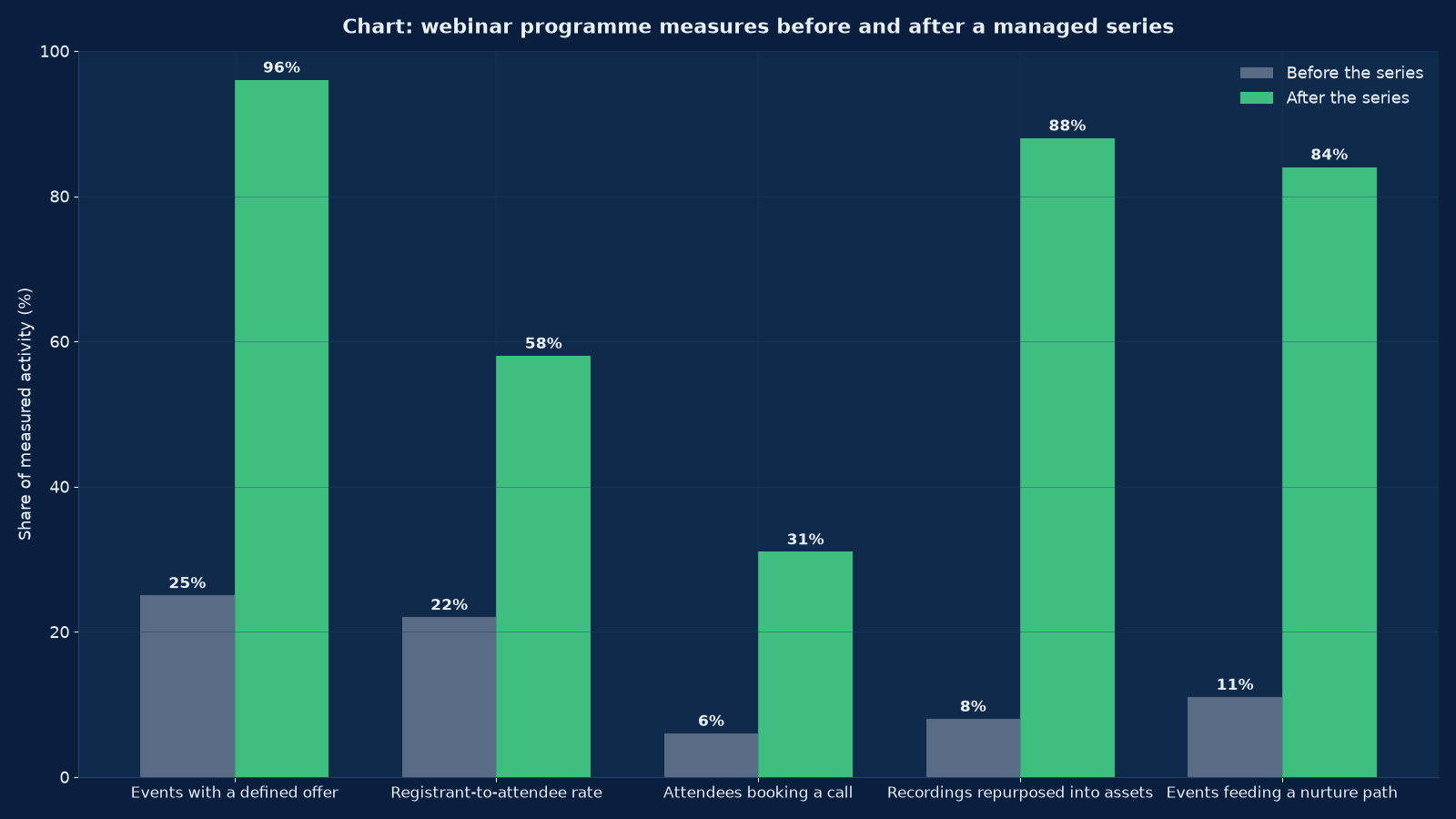
Chart values are an illustrative planning model based on typical UMC engagements and published industry benchmarks. They are not a guarantee of results on any specific project.
The Six-Week Event Cycle
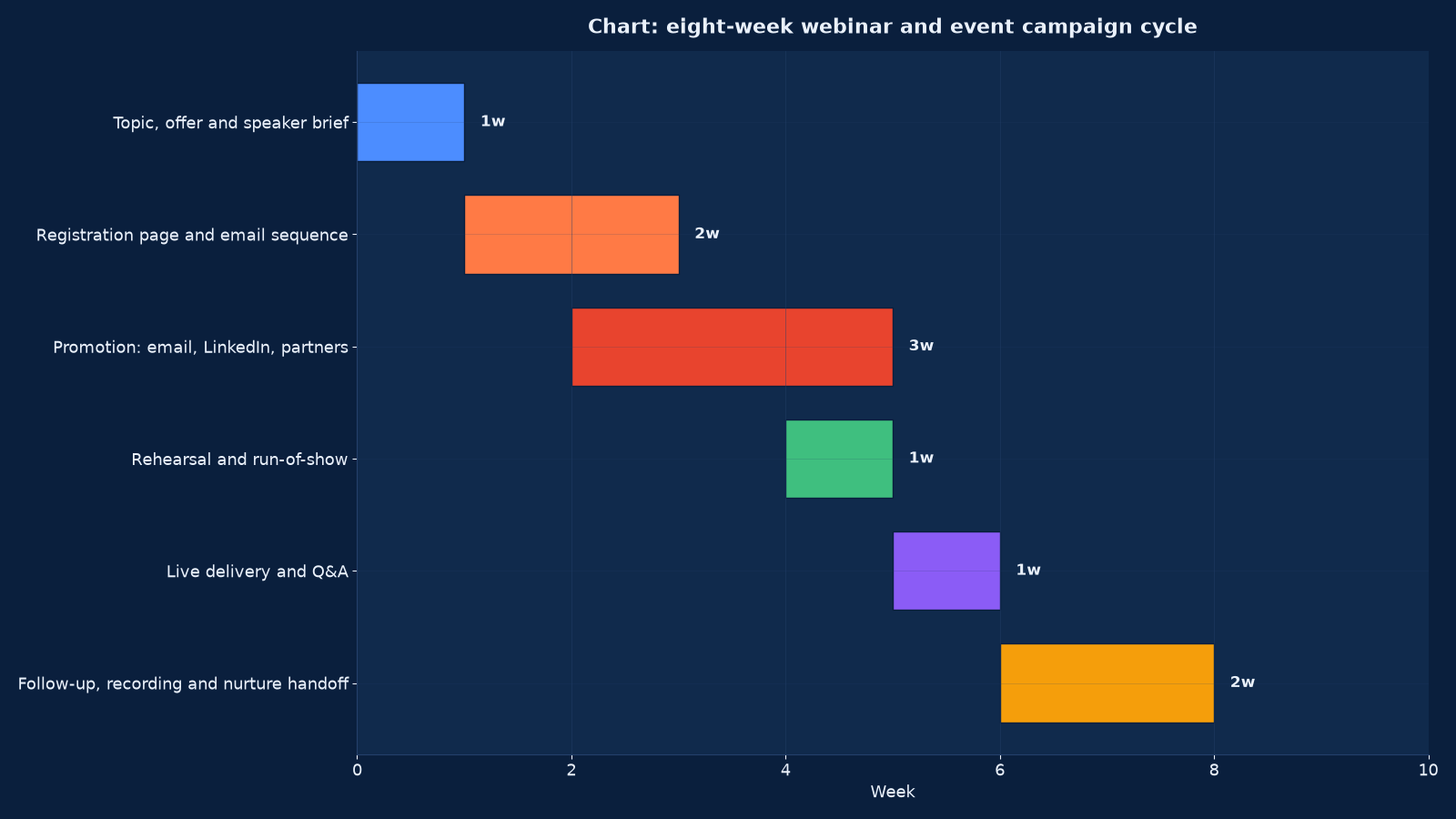
Chart values are an illustrative planning model based on typical UMC engagements and published industry benchmarks. They are not a guarantee of results on any specific project.
| Weeks | Workstream | Gate to pass |
|---|---|---|
| 1 | Topic, offer and speaker brief | A brief with the topic, the audience, the agenda, the offer and the speaker confirmed |
| 2–3 | Registration page and email sequence | The page live with source tagging, and the confirmation and reminder sequences built |
| 3–5 | Promotion across sources | Every source running with its own creative, and registrations tracked per source |
| 5 | Rehearsal and run of show | One full timed rehearsal completed, with the technical check signed off |
| 6 | Live delivery and Q&A | The event delivered on time, with questions triaged and polls captured |
| 7–8 | Follow-up, recording and nurture handoff | Three segmented follow-ups sent, the recording delivered, and the sales handovers made |
| Following quarter | Repurposing | Eight to twelve assets produced, and the question-led content published |
Six weeks per event, with events six weeks apart, gives a series of six to eight events a year with a continuous repurposing tail. That cadence is what allows the audience to compound: each event invites the last event’s attendees, and by the fourth event a meaningful share of registrations comes from people who have already attended one.
Measurement: From Registrations to Pipeline
| Measure | Definition | What it tells you |
|---|---|---|
| Registrations by source | Every registrant tagged with the source that produced them | Where the next event’s promotion budget should go |
| Cost per registration | Promotion cost per registrant, by source | Which sources are efficient and which are merely large |
| Registrant-to-attendee rate | Live attendees over registrations | Whether the attendance programme works, independent of the topic |
| Attendance duration | How long attendees stayed, and whether they reached the questions | Whether the content held attention or the audience left at the offer |
| Engagement | Polls answered, questions asked, chat participation | The quality of attention, which predicts the follow-up response |
| Accounts with multiple attendees | Registrations and attendance grouped by organisation | Whether a buying committee is forming — the strongest event signal there is |
| Follow-up response rate | Replies and clicks per segment | Whether the three-path follow-up is working better than one email |
| Meetings booked | Attendees booking a call, per event | The first commercial output, and the one to forecast against |
| Pipeline created | Opportunity value attributable to event engagement | The measure the revenue meeting cares about |
| Cost per meeting and per opportunity | Full event cost over meetings and opportunities | Comparability with other channels, including the repurposing tail |
| Asset productivity | Assets produced per event and their performance | Whether the tail is real or a claim |
| Series compounding | Share of registrations from previous attendees | Whether the series is building an audience asset |
We report the full cost of an event — production, speaker time, promotion and platform — against meetings and pipeline, and separately against the assets the tail produced. Reporting only the promotion cost makes every event look efficient, which is how a programme of unprofitable events survives review.
Attribution and the Honest Claim
| Question | The honest answer |
|---|---|
| Did the event create the opportunity? | Rarely on its own. Events accelerate and qualify; the opportunity usually involves other touches. We attribute with a multi-touch model and state the model. |
| What if an attendee was already in a sales conversation? | Then the event is a supporting touch, and it should be recorded as one rather than claimed as the source. Sales records the sequence; the report reflects it. |
| How is the repurposing tail attributed? | Separately, because a clip that produces a registration three months later is a content result with an event origin. We track it and label it. |
| Do on-demand viewers count? | As leads, with their engagement recorded, but not as attendees. Conflating the two inflates the attendance rate and hides the problem the reminders are meant to solve. |
| What about partner-sourced registrants? | Shared reporting under the agreed terms, so neither party claims the same lead twice. Where the agreement is unclear, we do not claim. |
| Is a small event with three target accounts worth running? | Often yes, and it should be measured on meetings and pipeline rather than on registrations. An executive briefing with five attendees can outperform a webinar with three hundred on every commercial measure. |
Platforms, Technology and the Practical Choices
| Consideration | What to decide | The consequence of deciding late |
|---|---|---|
| Platform type | A dedicated webinar platform, a meeting tool, or a streaming setup | Registration, reminders and reporting are all platform-dependent |
| Registration integration | Whether the platform syncs to the CRM and the marketing automation tool | Attendee data re-keyed by hand, and the follow-up segmented by guesswork |
| Recording and assets | Whether the platform produces a clean recording and a transcript | A repurposing tail that cannot be produced from the material captured |
| Polls and interaction | Whether the platform supports them and exports the data | The most useful event data never captured |
| Capacity and cost | Attendee limits and the cost per event or per month | A platform that becomes expensive exactly when the series succeeds |
| Time zones | Whether the platform displays and schedules in the attendee’s zone | A materially higher no-show rate for international audiences |
| Accessibility | Captions, transcripts, and readable shared material | Exclusion, and a recording that cannot be repurposed into text |
| Branding | Registration page, emails and the player | An event that looks like the platform’s marketing rather than yours |
Partner and Co-Marketed Events
| Stage | What must be agreed in writing | Why |
|---|---|---|
| Audience and consent | Whose list is used, what consent exists, and what may be shared afterwards | The most common source of a compliance problem and a damaged relationship |
| Topic and content ownership | Who writes what, who approves, and who may reuse it | An asset produced jointly and then used unilaterally |
| Speakers | Who presents, and in what proportion | An event that becomes one party’s demonstration |
| Promotion obligations | Sends, timing, creative approval and the reporting each party provides | One party promoting heavily and the other not at all |
| Lead handling | Who receives which registrants, and what each may contact them about | The same lead approached twice by two parties claiming it |
| Costs | Platform, promotion and production, and who bears them | A dispute after the event, when the relationship is worth more than the money |
| Reporting | A shared report with a shared definition of a lead and an opportunity | Two parties reporting different results from one event |
| Exclusivity and repeat | Whether the format may be repeated, and with whom | A partner running the same event with a competitor next quarter |
Partner events are the second-largest source in Figure 1 at 13 per cent, and they are the source with the highest variance in quality. The written agreement is what separates a co-marketed event that produces pipeline from one that produces a list nobody may legally contact.
Governance and the Annual Event Calendar
| Cadence | Activity | Owner | Output |
|---|---|---|---|
| Per event | Post-event review within a week: attendance, engagement, follow-up response, meetings, what to change | Event lead | A documented review that improves the next event |
| Monthly | Calendar check: topics, speakers, promotion windows and collisions with sector events | Programme owner | A calendar that survives contact with the quarter |
| Quarterly | Portfolio review: which formats and topics are producing pipeline, and which are producing registrations | Marketing with sales | Formats retired or added, and the offer design revised |
| Quarterly | Asset review: what the repurposing tail produced and how it performed | Marketing | A content pipeline fed by events rather than competing with them |
| Annually | Series review: audience compounding, cost per opportunity against other channels, speaker authority | Marketing with finance | A decision about the series, taken on evidence rather than habit |
Failure Modes We Are Called In To Fix
| What we find | Why it happened | What we do |
|---|---|---|
| Registrations are strong and nobody attends | No reminder sequence and no calendar file | An attendance programme with confirmations, four reminders and an exclusivity reason |
| Attendance is strong and no meetings follow | No defined offer, or an offer contradicted by the educational promise | A brief with an offer that follows from the argument, and a sales handover on engagement |
| One follow-up email to everyone | No segmentation of attendees, no-shows and question askers | Three paths, with question askers answered by somebody who can answer |
| A recording nobody repurposes | Repurposing not scheduled and not owned | A tail plan with eight to twelve assets, owners and dates, produced within the quarter |
| The same topic every quarter | No calendar and no portfolio review | A year of events chosen against the buying cycle, reviewed quarterly |
| Source of registrants unknown | No tagging at registration | Source capture on the form and per promotion link, reported per event |
| A partner event with no written terms | Agreement by goodwill | A written position on consent, leads, costs, reporting and reuse before promotion begins |
| Events run back to back with no time to follow up | A calendar built on delivery rather than on the whole cycle | Six weeks per event, with the repurposing tail scheduled into the following quarter |
Events and the Rest of the Stack
An event consumes an audience, produces leads, and feeds content and sales. We plan it with those functions rather than as a standalone item in the calendar.
- LinkedIn Marketing Services — the second-largest registration source in Figure 1, targeted by role, title and named account.
- Email Marketing Campaign Services — the largest source, and the channel that carries the confirmation, reminder and follow-up sequences.
- Email Marketing Automation Services — the automation that routes attendees, no-shows and question askers into different paths.
- Marketing Automation (HubSpot & Marketo) Services — the scoring and handover the event feeds into.
- Content Marketing Strategy Services — the question-led articles and the benchmark reports the tail produces.
- YouTube Advertising & Video Marketing Services — where the recording and its clips get a searchable second life.
- Conversion Rate Optimisation (CRO) Services — the registration page, whose conversion rate decides the cost of every registration.
- Analytics & Attribution (GA4) Services — source tagging, the attribution model and the pipeline reporting.
- Custom CRM Development & Integration Services — where attendance, engagement and the sales handover are recorded against the account.
- Google Ads Management Services — the paid search layer for topic and category terms.
- Influencer Marketing Services — guest speakers and creators whose audience registers for the event.
Evidence From Our Work
The engagements and writing below are published on this site, each described by the subject its own page documents. They are listed because event programmes are usually commissioned by a business that has run webinars for two years and cannot say what any of them produced.
- Video marketing for small businesses — how a recording and its clips are produced and distributed by a team without a studio, which is what the repurposing tail depends on.
- B2B marketing strategies for Lucknow businesses — the long-cycle, committee-based buying behaviour an event is designed to assemble in one room.
- Email marketing trends and tactics that drive revenue — the channel that produces the largest share of registrations and carries every reminder and follow-up.
- Content marketing execution plan — how the question-led articles and benchmark reports behind an event are actually produced rather than intended.
- Landing page optimisation: how to convert more visitors into customers — the registration page, whose conversion rate sets the cost of every registration.
- Social media marketing strategies and best practices — the speaker-led and organic social promotion that supports an event’s launch.
- Influencer marketing for small businesses in Lucknow — guest speakers and creators whose own audience registers, and how that collaboration is measured.
- Marketing attribution models: how to choose the right one for your business — how an event is credited when the opportunity involves several other touches.
- The digital marketing insight archive — further writing on campaigns, content and measurement.
Engagement Models and Commercials
Event work is quoted per event or per series, against the format, the promotion budget and the repurposing scope.
| Model | Best for | What you get | Indicative shape |
|---|---|---|---|
| Single event, fixed fee | A launch, an announcement or a test of the format | Topic and offer, registration page, promotion, production, delivery support, follow-up and a report | Six weeks, one fee plus promotion spend |
| Event series | A business building an audience asset | Six to eight events a year with a calendar, compounding promotion and a continuous repurposing tail | Monthly or per event, with an annual calendar |
| Repurposing only | A business with recordings and no assets | Transcripts, clips, articles, question-led content and a benchmark report from existing recordings | Per recording or monthly |
| Attendance rescue | A programme with registrations and no attendance | Confirmation, reminder and exclusivity programme, plus timing and length review | Two to three weeks, fixed fee |
| Partner event management | A co-marketed event | The written agreement, joint promotion, consent handling, shared reporting and lead routing | Per event |
| Executive briefings | Tier-one accounts | A small, researched, peer-level session with account briefs and a sales handover | Per briefing |
Promotion spend, platform costs and any speaker travel are the client’s and are quoted separately. We report the full cost per meeting and per opportunity including our fee, because an event measured only against its promotion budget always looks like a success.
Frequently Asked Questions About Webinar & Event Campaigns
Do webinars still work?
Yes, when they are run as campaigns rather than as content. The formats that fail are the ones with no defined offer, no attendance programme, one follow-up email to everybody and a recording nobody repurposes. In Figure 2 attendees booking a call rises from 6 to 31 per cent across a managed series, and every measure that moved was a process measure.
How many people do we need to register?
Fewer than most businesses assume, if the audience is right. An executive briefing with five target accounts can outperform a webinar with three hundred registrations on every commercial measure. Registrations are a coverage number; meetings and pipeline are the output.
What is a good attendance rate?
Between 35 and 50 per cent of registrations for a live B2B event is a healthy range, and it is almost entirely a function of process: an immediate confirmation with a calendar file, four reminders, a personal invitation from sales, a stated exclusivity, a sensible time slot and a length under an hour. Figure 2 shows 22 per cent rising to 58 per cent across a series.
How long should the promotion run?
Three to four weeks, with a peak in the final five days when most registrations occur. Two weeks loses the registrants who need to arrange cover; six loses momentum and costs more in frequency to sustain.
Where do most registrations come from?
In Figure 1, the existing email list at 34 per cent, then LinkedIn advertising at 24, organic search at 17, partner promotion at 13, paid search at 7 and organic social at 5. The list being largest is why an event programme without a maintained list starts from a much smaller base than its promotion budget implies.
How should we follow up?
In three paths at minimum. Attendees who engaged get the recording, the promised exclusivity and the offer within twenty-four hours, with a sales handover where the account qualifies. No-shows get the recording honestly labelled and an invitation to the next live session. Question askers get a written answer from somebody who can answer it, which is the highest-value follow-up there is.
What do we do with the recording?
Cut it. A full recording for on-demand registration and the resource library, a transcript, two or three short clips for social and the next event’s promotion, the slide deck as a gated download, question-led articles over the following quarter, and a poll-data benchmark report. One hour should produce eight to twelve assets; that is what makes the cost defensible.
Should we run a series or one-off events?
A series. A single event has to pay for its own promotion, while a series compounds: each event invites the last event’s attendees, production becomes routine, the assets accumulate and the speaker becomes a reason to register. Six to eight events a year, six weeks apart, is the cadence we plan to.
How do you handle a partner-co-marketed event?
With a written agreement before promotion begins: whose list is used and what consent exists, who receives which registrants, how costs are shared, what reporting each party provides, who owns the content, and whether the format may be repeated. Partner events were 13 per cent of registrations in Figure 1 and have the highest variance in lead quality of any source.
How do we attribute pipeline to an event?
With a multi-touch model, stated openly, because an event rarely creates an opportunity on its own — it accelerates and qualifies one. Where an attendee was already in a sales conversation, the event is recorded as a supporting touch. The repurposing tail is tracked separately and labelled, since a clip that produces a registration three months later is a content result with an event origin.
Can you take over our existing webinar programme?
Yes. We start with a review of the last few events against the measures in Figure 2, identify which process gaps explain the attendance and follow-up results, and rebuild from the topic and offer brief forward. The platform usually stays; the process is what changes.
What does it cost?
Per event or per series, against the format, the promotion budget and the repurposing scope, with promotion spend, platform costs and travel quoted separately. We report the full cost per meeting and per opportunity including our fee, because an event measured only against its media spend always looks like a success.
Commission an Event Programme Assessment
Send us your last three events with their registration, attendance and follow-up data if you have it, your topic ideas and your buying cycle. Within two weeks you will have an assessment against every measure in Figure 2, a diagnosis of whether your registration, attendance, offer, follow-up or repurposing stage is the binding constraint, a proposed annual calendar of six to eight events with a format and a commercial job per event, a source plan based on where your registrations actually come from, a three-path follow-up design with the sales handover threshold, a repurposing plan with the assets, owners and dates, and a costed first event with the reporting specified in advance.
Contact Unified Management Consulting to arrange a confidential first conversation.
Related Services
Webinar and event campaigns are delivered with the audience, automation, content and measurement practices around them:
- LinkedIn Marketing Services — the second-largest registration source, targeted by role and account
- Email Marketing Campaign Services — the largest source, and the channel carrying confirmations, reminders and follow-up
- Email Marketing Automation Services — routing attendees, no-shows and question askers into different paths
- Marketing Automation (HubSpot & Marketo) Services — the scoring and handover the event feeds
- Content Marketing Strategy Services — the question-led articles and benchmark reports the tail produces
- YouTube Advertising & Video Marketing Services — a searchable second life for the recording and its clips
- Conversion Rate Optimisation (CRO) Services — the registration page that sets the cost per registration
- Analytics & Attribution (GA4) Services — source tagging and the attribution model
- Custom CRM Development & Integration Services — attendance, engagement and the handover recorded against the account
- Google Ads Management Services — the paid search layer for topic and category terms
- Influencer Marketing Services — guest speakers whose own audience registers
- Lifecycle & Retention Campaign Services — Lifecycle and retention campaigns: deliverability, RFM segmentation, welcome, replenishment and win-back flows, offer guardrails and holdouts
- Account-Based Marketing (ABM) Services — Account-based marketing for B2B: ICP and tiering, named account lists, intent scoring, coordinated channels, sales handover and pipeline reporting
- Lead Nurturing & Drip Programme Services — Lead nurturing and drip programmes: stage definitions, lead scoring, sequences by buying stage, CRM handover, recycling rules and holdout testing