
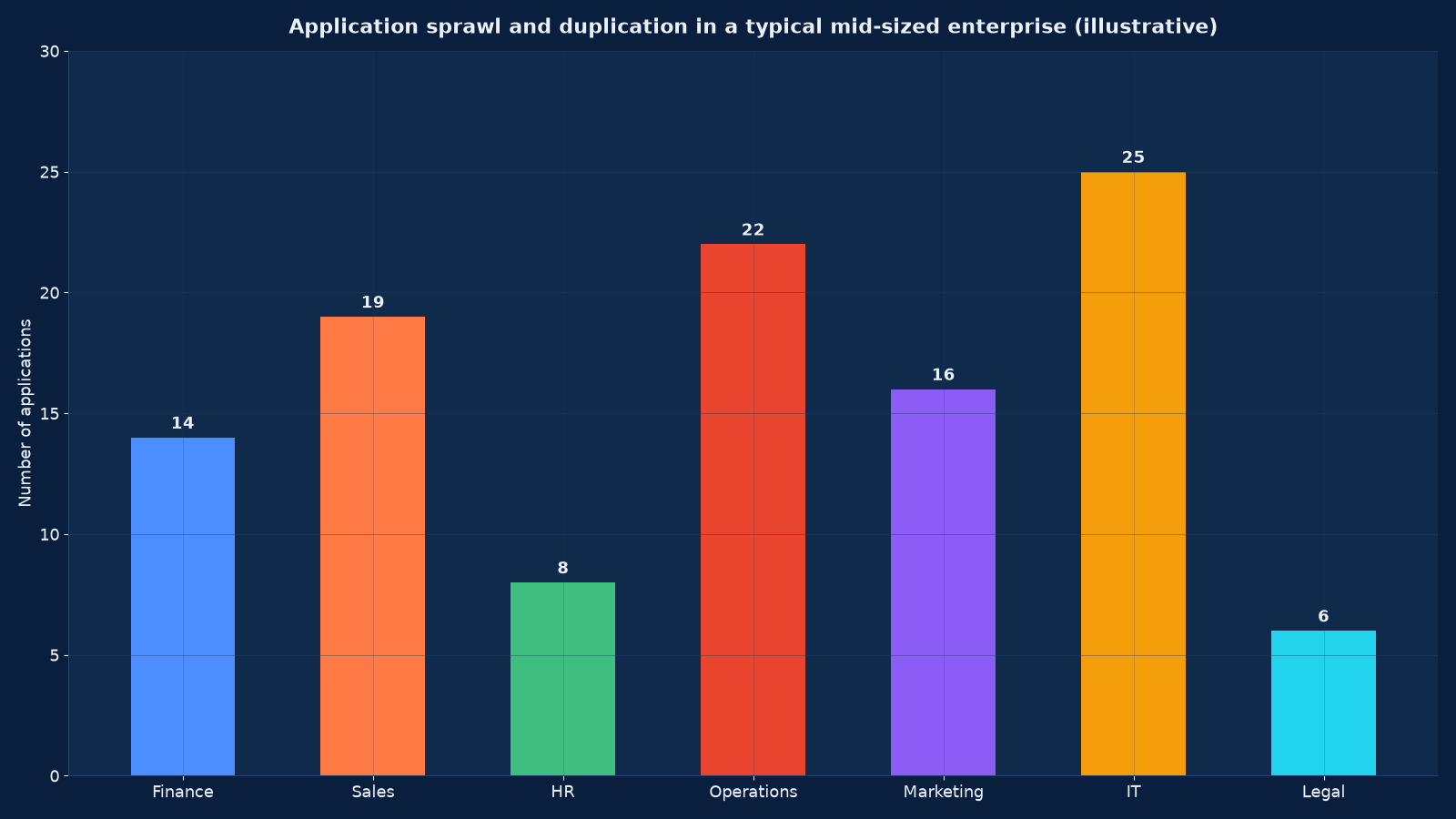
Chart values are an illustrative planning model based on typical UMC engagements and published industry benchmarks. They are not a guarantee of results on any specific project.
Integration debt is invisible on any single invoice. It appears as a spreadsheet that three departments maintain separately, a Friday afternoon spent reconciling two systems that should agree, and a licence renewal for software nobody can name a user of.
Enterprise systems integration is the work of making your applications exchange data reliably, and tech-stack consolidation is the decision work that reduces how many of them there are. The two belong together: integrating a sprawl preserves it, and consolidating without integration simply moves the manual re-keying to a new system. Unified Management Consulting runs both as one programme — inventory, rationalise, design, integrate, migrate, retire — with the savings measured rather than promised.
🕸️ Enterprise Systems Integration & Tech-Stack Consolidation — Quick Summary
| Component | What We Deliver |
|---|---|
| Application & data inventory | Every application, database, spreadsheet-of-record, integration and data flow catalogued with owner, cost, user count, criticality and the master data it holds. |
| Rationalisation decisions | An explicit keep / merge / replace / retire decision per application, with the business case and the dependency order written down. |
| Target architecture | Integration pattern selection per data flow — API, event-driven, batch, middleware or managed connector — with master data ownership defined per entity. |
| Integration build | Authenticated, versioned, monitored integrations with validation, retry, dead-letter handling and reconciliation, built in a non-production environment first. |
| Data migration & reconciliation | Field mapping, cleansing, historical migration, parallel running and signed-off reconciliation before any legacy system is switched off. |
| Legacy retirement | Controlled decommissioning with data archive, licence cancellation, access removal and a defined read-only retention period. |
| Operating model | Ownership, monitoring, change control and documentation for every integration that survives the programme. |
Where the integration target is an AI capability rather than another business system, the work is our AI Integration into ERP, CRM & Operations service. For background on the consolidation case itself see Tech Stack Consolidation: The Business Case for Unified Systems.
What Sprawl Actually Costs
Sprawl is not a tidiness problem. Each of the items below carries a real cost, and the reason it persists is that the cost lands in different budgets from the decision.
| Cost of the sprawl | How it shows up | Why it is rarely counted |
|---|---|---|
| Duplicate licensing | Two CRMs, three project tools, four ways of storing customer records | Renewals are handled by whoever holds the credit card, not centrally |
| Integration maintenance | Point-to-point links that break on every vendor release | Counted as support effort, not as architecture cost |
| Manual re-keying | The same data entered two or three times by different teams | Absorbed into existing salaries, so it never appears as a line item |
| Reconciliation failures | Month-end breaks between systems that should agree | Treated as a finance problem rather than a systems problem |
| Reporting inconsistency | Three dashboards, three different numbers for the same metric | Debated in meetings instead of being traced to a data source |
| Security surface | Every extra application is another identity store and another data copy | Not attributed to the application that created it |
| Onboarding friction | New staff need accounts, training and context across many tools | Counted as HR effort, spread thinly enough to be invisible |
The most expensive item is usually manual re-keying, because it is the only one that scales with volume. Two hundred hours a week across a team is a full-time equivalent consumed by data entry, and it never appears on any invoice. Figure 2 shows what happens to that number when the flows are integrated.
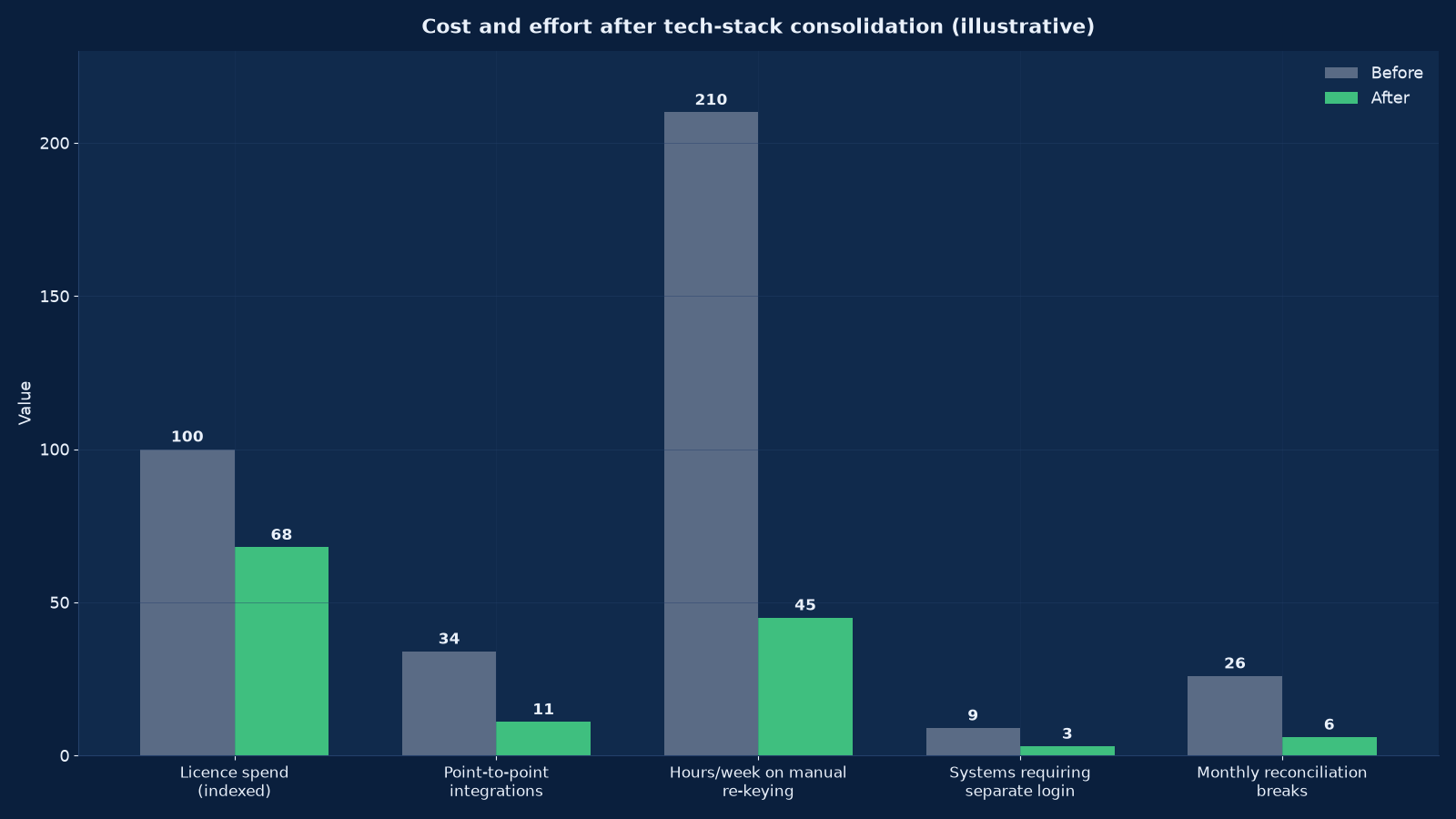
Chart values are an illustrative planning model based on typical UMC engagements and published industry benchmarks. They are not a guarantee of results on any specific project.
Integration Patterns and When Each One Is Right
There is no default architecture. The pattern follows from the number of systems, the freshness requirement, the volume and how much integration infrastructure you intend to operate.
| Pattern | How it works | Use it when | Avoid it when |
|---|---|---|---|
| Point-to-point API | System A calls system B directly, synchronously | Two systems, one flow, simple contract | More than three consumers of the same data — the link count grows combinatorially |
| Middleware / integration platform | All flows route through a central platform (MuleSoft, Boomi, Azure Integration Services, Workato) | Many systems, need for central monitoring and reuse | Small scope where the licence exceeds the benefit |
| Event-driven with a message bus | Systems publish events; consumers subscribe independently | Near-real-time needs, many consumers, high volume | Batch-shaped processes where ordering complexity buys nothing |
| Batch file exchange | Scheduled export and import with strict schemas | Legacy systems with no API, or partners who require it | Anything needing freshness better than the batch window |
| Reverse ETL / warehouse-centric | Data consolidated in a warehouse, pushed back to operational tools | Reporting-led consolidation across many SaaS tools | Transactional writes where latency matters |
| Embedded / iPaaS connectors | Vendor-provided prebuilt connectors between named products | Both systems are mainstream SaaS with a supported connector | Custom or on-premises systems; the connector will not exist |
| Shared database | Two applications read and write the same tables | Almost never | Almost always — it couples releases and defeats upgrade paths |
Two rules that hold across all of them. Reads and writes should be designed differently: reads can be broad, cached and tolerant of latency, while writes must be narrow, validated and idempotent. Every integration needs an owner and a test, because the failure mode of an unowned integration is silent data divergence discovered months later.
The Rationalisation Framework
Consolidation fails when it starts with a product preference rather than an inventory. The sequence below is what makes the decision defensible, and step 3 is the one most often skipped.
| Stage | Question answered | Evidence required | Decision owner |
|---|---|---|---|
| 1. Inventory | What do we actually run? | Application register with cost, users, owner, criticality, data held, integrations, contract end date | IT with finance |
| 2. Overlap analysis | Which applications do the same job? | Capability map showing duplication, plus user counts and utilisation data | Business unit heads |
| 3. Master data assignment | Which system owns each entity? | One named source of truth per entity — customer, product, employee, account, supplier | Data owner with IT |
| 4. Rationalisation decision | Keep, merge, replace or retire? | Costed options per application with migration effort and risk | Steering group |
| 5. Sequencing | In what order, given dependencies? | Dependency graph and a plan that retires leaf systems first | Programme lead |
| 6. Target architecture | Which integration pattern per flow? | Design document with data contracts, error handling and monitoring | Architecture with IT |
| 7. Exit criteria | How do we know it worked? | Baseline measures from Figure 2 plus a savings tracking method | Finance with programme lead |
Master data assignment is the pivot of the whole programme. Until one system is named as the source of truth for customers, products and accounts, every integration is a negotiation about whose value wins. Naming it converts an argument into a rule. Our practical overview of CRM data migration shows how that plays out when the customer entity is the one being consolidated.
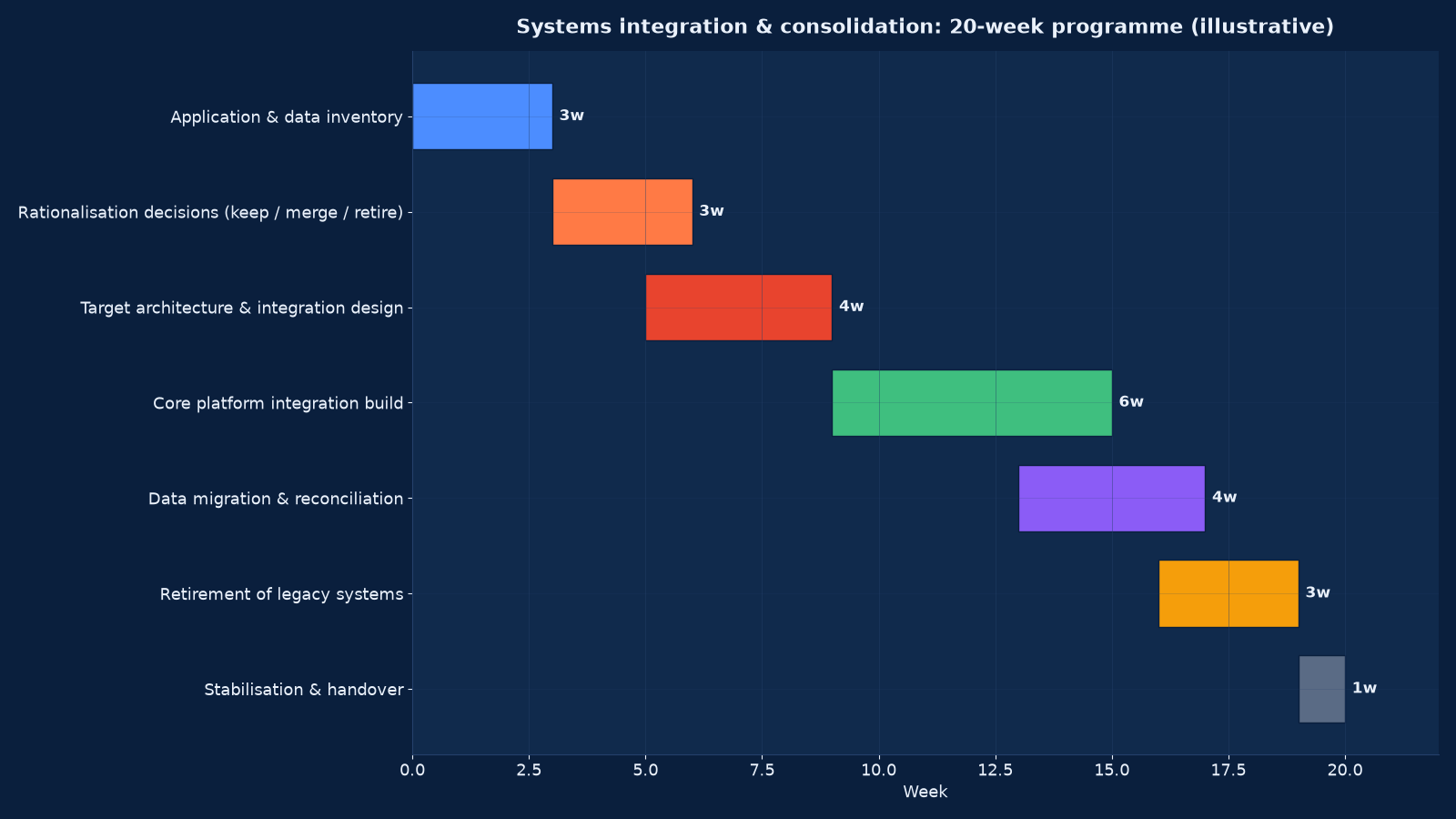
Chart values are an illustrative planning model based on typical UMC engagements and published industry benchmarks. They are not a guarantee of results on any specific project.
Delivery Programme: Twenty Weeks
| Phase | Weeks | Activities | Exit criteria |
|---|---|---|---|
| Discovery & inventory | 1–3 | Application and data inventory, cost and utilisation collection, integration mapping, stakeholder interviews | Signed-off application register with costs and owners |
| Rationalisation | 3–6 | Overlap analysis, master data assignment, costed keep/merge/replace/retire options | Decision per application recorded with rationale and owner |
| Architecture & design | 5–9 | Target architecture, integration pattern per flow, data contracts, error and monitoring design | Design approved by IT, security and the affected business units |
| Integration build | 9–15 | Connectors, transformations, validation, retry and dead-letter handling, reconciliation jobs, automated tests | End-to-end flows demonstrated in a non-production environment |
| Data migration | 13–17 | Field mapping, cleansing, historical migration, parallel running, reconciliation sign-off | Reconciliation agreed by finance with no unexplained variance |
| Legacy retirement | 16–19 | Archive, access removal, licence cancellation, read-only retention, user communication | Legacy systems inaccessible for writes with archive verified |
| Stabilisation & handover | 19–20 | Monitoring live, runbooks, ownership transfer, savings measurement started | Operating ownership transferred and savings tracked against baseline |
Why Consolidation Programmes Fail
The technology is rarely the reason. These are the failure modes we are usually called in to repair, and every one of them is preventable with a gate rather than a tool.
| Failure | How it happens | Prevention |
|---|---|---|
| Consolidating onto the wrong platform | The decision is made on licence price or on which vendor is already in the building | Cost the options including migration effort, integration count and five-year run cost |
| Retiring before reconciling | Schedule pressure; the legacy system is switched off while variances are still open | A hard gate: no retirement until finance signs the reconciliation |
| Master data left ambiguous | Two systems both hold customers and nobody is named as authoritative | Assign ownership per entity in week three, before any design work |
| Integrations built without contracts | Field meanings assumed rather than specified, discovered in production | Written data contract per flow, with a test that enforces it |
| Users not consulted on the losing tool | A team loses functionality they relied on and works around the new system | Capability gap analysis per team, with workarounds designed rather than discovered |
| No owner after go-live | The programme team disbands and the integrations decay | Named operational owner per flow, with monitoring and a change route |
| Savings never verified | The business case is filed and the licences keep renewing | Track licence cancellations and headcount redeployment as programme deliverables |
Data Migration: The Part That Determines Success
Migration is where consolidation programmes earn their reputation. Five disciplines matter more than the tooling.
- Map by meaning, not by name. A field called “status” in two systems almost certainly does not have the same value set. Build the mapping from the value distributions, and record every transformation rule.
- Cleanse before migrating. Duplicates, orphans and invalid values migrated faithfully become permanent. Deduplication rules need a business decision, not an algorithm guess.
- Migrate history deliberately. Not everything deserves to move. Define a retention window for transactional history and archive the rest in a queryable form rather than paying to host it in the new platform.
- Run in parallel. Both systems live for a defined period with a daily reconciliation, so variance is found while it can still be explained.
- Reconcile to a number finance agrees. Control totals per entity and per period, signed off, before the legacy system loses write access.
The archive decision is worth more attention than it gets. Retired systems are frequently kept alive for years solely because someone might need a seven-year-old invoice. Extracting that data to a cheap, queryable archive and switching the system off is usually a larger saving than any licence consolidation in the programme.
Measuring the Result
Consolidation should produce numbers, not adjectives. These are the measures we baseline in week two and report at handover — the same set shown in Figure 2.
| Measure | Definition | Baseline source | Target direction |
|---|---|---|---|
| Applications in production | Count of distinct business applications | Application register | Falling |
| Licence spend | Total annual licence and subscription cost | Finance ledger | Falling, tracked against cancellations |
| Point-to-point integrations | Count of direct system-to-system links | Integration map | Falling as middleware or events replace them |
| Manual re-keying hours | Hours per week spent entering the same data twice | Time study or process interviews | Falling sharply |
| Systems requiring separate login | Count of distinct identity stores a user touches daily | User survey | Falling; target single sign-on coverage |
| Monthly reconciliation breaks | Unexplained variances between systems at month end | Finance close pack | Falling to near zero |
| Reporting sources per metric | Distinct systems feeding one reported number | Report lineage review | One |
| Integration failure rate | Failed runs per hundred, with mean time to detect | Monitoring | Falling, with detection inside minutes |
Reporting them properly is the discipline in our AI ROI Measurement & Executive Scorecards service, applied to a systems programme rather than an AI one: baseline first, one owner per number, and realised savings separated from projected ones.
Consolidation and Security: The Overlooked Benefit
Every application is an identity store, a data copy, an attack surface and an audit scope. Retiring six of them removes six of each, and that is usually worth more than the licence saving.
- Identity. Fewer stores means single sign-on becomes achievable, de-provisioning becomes reliable, and privileged access review becomes finite.
- Data copies. Customer data held in nine systems is nine breach exposures and nine retention obligations. Consolidation reduces both.
- Patch and vulnerability surface. Fewer vendor relationships means fewer release cycles to track and fewer emergency patches to apply.
- Audit scope. If you hold or intend to hold ISO 27001 or SOC 2, every in-scope system adds evidence burden. Retiring systems before the audit is far cheaper than documenting them for it.
- Supplier assurance. Each SaaS vendor is a supplier to assess. Fewer vendors means the assessment you do can be done properly.
This is why the security and compliance function should sit in the steering group from week one rather than reviewing the design at the end. Our Cybersecurity Services and the IT audit and compliance offering in this category both feed the inventory stage: knowing what you run is the first control in either framework.
SaaS Sprawl: A Specific Problem
Cloud application sprawl behaves differently from on-premises sprawl because nobody had to approve it. A team signs up with a corporate card, the tool becomes load-bearing, and IT finds out during a licence audit or a security incident.
Three controls address it without becoming obstructive. Visibility: reconcile card spend and identity provider logs quarterly to find the tools you did not know about. An approved alternative: shadow IT persists when the sanctioned route is slower than the unsanctioned one, so the fix is a fast approval path with a curated catalogue, not a prohibition. Exit terms: know how data comes out of every tool before it becomes load-bearing, because a SaaS platform you cannot export from is a system you cannot retire.
Where the sprawl includes AI tools specifically, the same logic applies with an additional data-handling dimension — covered in AI Governance, Risk & Compliance.
Common Scenarios
| Situation | Recommended approach | Why |
|---|---|---|
| Merger or acquisition | Inventory both estates, consolidate onto one platform per capability, retire in dependency order | Two master data sets will diverge further every month; early assignment of ownership is the cheapest intervention available |
| ERP replacement | Integration-first: build the interfaces before migrating data | The new system has to coexist with everything else for months; parallel running needs working flows |
| SaaS-first consolidation | Reverse ETL or warehouse-centric with SSO across the estate | Lower integration build, but master data ownership still has to be named per entity |
| Legacy retirement with no budget for replacement | Archive to a queryable store, extract the reports, switch it off | Keeping a legacy system alive for historical access is usually more expensive than archiving it properly |
| Multi-site with per-site systems | Standardise on one platform, migrate site by site, retire as you go | A big-bang multi-site cutover has no fallback; staged migration does |
| Integration only, no consolidation | Middleware or event-driven with written data contracts | Preserving the sprawl is a legitimate choice, but it should be a decision rather than a default |
Operating the Integrated Estate Afterwards
The programme ends; the integrations do not. Four things keep them alive.
Contract tests on a schedule. Every integration has a test that runs against a non-production endpoint on a cadence, so a vendor change is detected before users report it.
A named owner per flow. Not a team — a person, with a deputy. Unowned integrations fail silently and are discovered through a finance variance.
Monitoring that alerts on data, not just on jobs. A job can complete successfully while transferring nothing. Alert on record counts, control totals and staleness.
An annual architecture review. Application count, integration count, licence spend and re-keying hours re-measured against the programme baseline. Sprawl returns without a review, because every individual addition looks reasonable.
The release discipline that keeps all of this deployable is the subject of DevOps & CI/CD Engineering Services, and the hosting decisions behind it belong with Cloud Services & Migration.
Engagement Models
| Model | Duration | Deliverables | Best when |
|---|---|---|---|
| Stack rationalisation assessment | 3–5 weeks | Application and data inventory, overlap analysis, master data assignment, costed options per application, sequenced plan | You suspect the sprawl but cannot yet quantify it |
| Integration design only | 3–4 weeks | Target architecture, pattern selection per flow, data contracts, error and monitoring design, build estimate | You have an in-house team that needs the architecture settled |
| Full consolidation programme | 16–24 weeks | Inventory through retirement, with migration, reconciliation, monitoring and savings measurement | A merger, an ERP replacement or a decision to reduce the estate materially |
| Integration build | 8–16 weeks | Connectors, transformations, validation, reconciliation and automated tests for named flows | Specific flows are manual or broken and the architecture is already agreed |
| Legacy retirement | 6–10 weeks | Archive design and extraction, access removal, licence cancellation, verified read-only retention | A system is out of support or uneconomic but still holds data someone might need |
The Decision Most Organisations Delay
Consolidation is uncomfortable because it produces visible losers: a team’s preferred tool disappears, and someone has to say so. The delay costs more than the conversation. Every month of postponement adds divergent customer records, more integrations to unwind, another licence renewal and a wider gap to close.
The way through is to make the decision on evidence rather than preference, and to fund the transition for the team that loses the most. Capability gaps surfaced in the rationalisation stage should be answered with a designed workaround, not left for users to invent one — because the workaround they invent is usually a spreadsheet, and the spreadsheet becomes next year’s sprawl.
Where the estate is being consolidated specifically to support AI, sequence matters: the knowledge and data layer has to be clean before retrieval quality is achievable, which is the scope of Data Engineering for AI: RAG & Knowledge Systems. The Nscale infrastructure story is a useful reminder of how quickly capacity and consolidation decisions become strategic rather than technical, and our technology consulting guide covers the selection questions from the buyer’s side.
Frequently Asked Questions About Systems Integration & Tech-Stack Consolidation
How do we know if we have a sprawl problem?
Count three things: distinct business applications in production, point-to-point integrations between them, and hours per week your staff spend entering the same data into more than one system. If the third number is above roughly a hundred hours a week, or if you cannot produce the first two numbers at all, you have a sprawl problem. The inventory stage of an assessment produces all three in two to three weeks.
Should we consolidate onto one ERP or integrate what we have?
It depends on how much of the estate the ERP would actually replace. A full ERP replacement is a two-to-three-year programme with real execution risk; integration preserves capability at a fraction of the cost but keeps the sprawl. The honest answer is usually in between — consolidate the overlapping point tools and integrate the systems that are genuinely distinct. The rationalisation framework produces that answer per application rather than as a single strategic choice.
How long does a consolidation programme take?
Sixteen to twenty-four weeks for a mid-sized estate, per Figure 3. The variable is not the integration build — it is the rationalisation decisions and the data reconciliation. Programmes that skip the decision stage and start building run longer, because the build gets redone when the decision eventually arrives.
What is master data management and do we need it?
It is the assignment of one authoritative source per business entity — customer, product, employee, supplier, account. You need at least the assignment, even if you never buy a master data platform. Without it every integration has to decide whose value wins, and that decision gets made differently by different developers, which is how two systems end up disagreeing about the same customer.
Can we consolidate without disrupting the business?
Not entirely, and any proposal that promises otherwise should be treated with suspicion. Disruption is managed rather than avoided: parallel running, staged migration, a hard reconciliation gate before retirement, and capability gap analysis per team so workarounds are designed instead of improvised. The teams that suffer most are the ones nobody asked.
What happens to the historical data in a retired system?
Extract it to a queryable archive with a defined retention period, verify the extraction by reconciling control totals, then remove access and cancel the licence. Keeping the old system alive purely for historical access is usually more expensive than archiving properly, and it keeps the security surface and the audit scope open for no benefit.
How do we stop the sprawl coming back?
With an annual architecture review that re-measures application count, integration count, licence spend and re-keying hours against the programme baseline, plus a fast approval route for new tools with a curated catalogue. Sprawl returns because every individual addition looks reasonable; only the aggregate is visible, and only if someone measures it.
Which integration platform should we choose?
Choose from the flows, not the brand. Two systems and one flow needs a point-to-point API. Many systems with reuse and central monitoring needs argues for a middleware platform. High-volume near-real-time with many consumers argues for event-driven. Existing SaaS-only estates often do well with a warehouse-centric reverse ETL approach. We recommend against deciding the platform before the flow inventory exists.
Does consolidation help with ISO 27001 or SOC 2?
Substantially, and it is often the strongest non-financial argument for doing it. Every in-scope application adds control implementation, evidence collection and supplier assessment. Retiring systems before the audit reduces all three. If certification is planned, sequence the consolidation ahead of it rather than running both at once.
How do we measure whether the programme saved money?
Baseline the measures in Figure 2 in week two, then track licence cancellations actually processed, re-keying hours actually removed and reconciliation breaks actually closed. Projected savings are not savings; a cancelled renewal with a date on it is. Assign one owner to the number and report it at handover and again at six months.
Can you work with our in-house developers?
Yes, and it is usually the better model for integration-only engagements. We settle the architecture, write the data contracts and build the difficult or high-risk flows; your team builds the rest against the contracts with review. That keeps capability internal and avoids creating a dependency on us for every future change.
Book a Stack Rationalisation Assessment
We will inventory every application, integration and data store you actually run, put a cost against each, identify the overlap and the manual re-keying, and give you a keep / merge / replace / retire decision per application with a sequenced plan and a savings estimate you can take to finance.
Contact Unified Management Consulting to arrange an initial assessment of your environment.
Related Services
Systems integration and consolidation connects to most of our technology and data work:
- Custom CRM Development & Integration Services — building or extending the platform you consolidate onto
- AI Integration into ERP, CRM & Operations — the same integration discipline applied to AI capability
- Data Engineering for AI: RAG & Knowledge Systems — clean, owned master data is the prerequisite for retrieval quality
- Data Science Services for Business Analytics — analytics on the consolidated data foundation
- DevOps & CI/CD Engineering Services — pipelines, contract tests and release discipline for the integrated estate
- Cloud Services & Migration (AWS, Azure, GCP) — hosting the integration layer and the consolidated platforms
- Cybersecurity Services & Solutions — the identity and data-copy reduction that consolidation delivers
- Tech Stack Consolidation: The Business Case for Unified Systems — the practitioner article behind this service
- Managed IT Infrastructure & IT AMC — 24×7 monitoring, patching, backup verification and monthly SLA reporting at a fixed cost
- IT Audit, Compliance & ISO 27001 / SOC 2 Readiness — Annex A gap analysis, control design, evidence automation and certification support
- Backup, Disaster Recovery & Business Continuity — business impact analysis, RTO and RPO tiering, immutable copies and tested runbooks
- Cloud Cost Optimisation & FinOps — tagging, allocation, showback, right-sizing, commitments and a monthly cadence
- IT Helpdesk & End-User Support — tiered service desk, published SLAs, knowledge management and shift-left automation
- Portal Development & Self-Service Platforms — entitlement modelling, single sign-on, source-system integration, self-service journeys and adoption instrumentation
- Headless & Composable Commerce — readiness assessment, capability mapping, storefront engineering, integration layer, migration rehearsals and cost governance