
A showroom does not have a customer-relationship problem in the way a subscription business does. It has a funnel problem with a long tail: a small number of high-value purchase decisions, each passing through several people and several systems over several weeks, followed by years of service, warranty and referral contact that most estates never connect back to the original enquiry. CRM in this sector is therefore less about relationship marketing and more about discipline – one record, one owner, one clock, and an outcome code at every step.
The commercial case is unusually direct. A digital enquiry that is answered in fifteen minutes converts at several times the rate of the same enquiry answered the next day, and a booked test drive that is reminded converts at a different rate again from one that is not. Neither improvement requires more traffic, more creative or more discount; both require a system that routes the lead, starts a timer, escalates when the timer expires and records what happened. That system is custom CRM development and integration built around a dealer management system rather than in competition with it.
What an engagement includes, at a glance
| Component | What We Deliver |
|---|---|
| Lead definition, stages and outcome codes | What counts as an enquiry, a qualified lead, a booking, a show-up, a quotation, an order and a delivery – written down with sales, and closed with a mandatory outcome code so losses are explained rather than assumed. |
| Capture from every route | Website forms, tracked calls, WhatsApp, social DMs, marketplace and portal leads, walk-ins and event registrations all landing in one record with a source, a model and a branch. |
| Routing, SLA and escalation | Assignment rules by branch, model and workload; a response target per source; automatic escalation when the timer expires; and a manager view that shows ageing leads before they die. |
| Test-drive and appointment operations | Slot booking against real capacity, confirmation and reminder flows, show and no-show recording, and rescheduling that does not lose the lead’s history. |
| Quotation, finance, exchange and documents | Quote versions, finance pre-approval status, exchange valuation, document checklists and the stall reasons that decide whether an order happens this month or never. |
| DMS and source-system integration | One identifier carried between the CRM, the DMS or ERP, the booking system, telephony and the marketing platforms, with retries, deduplication and a replay path. |
| Service retention and the owner lifecycle | First-service reminders, warranty and plan expiry, recall handling, trade-in-age conversations and ownership content – the second half of the record most estates never build. |
| Referral and repeat purchase | A referral route with a reward that is actually paid, owner communities, and repeat-purchase timing appropriate to a low-frequency category. |
| Consent, preferences and governance | Consent captured per channel with a date, preference management, retention rules, access control and an audit trail – the fields that decide whether the rest may be used at all. |
What showroom CRM is for: a funnel with a clock, not a contact list
Most dealership ‘CRM’ is a contact list with a notes field, and the funnel lives in three places at once – a spreadsheet at the branch, the DMS at delivery, and a marketing platform that only sees the form fill. The consequence is predictable: nobody can say how long a lead waited, which stage it died at, or what a delivered unit cost to acquire. What the business needs is a record that starts at the first enquiry and ends years later at the third service visit, with a clock running at every stage and a mandatory reason whenever the clock stops.
| The contact-list habit | What a showroom actually needs | Why it matters commercially |
|---|---|---|
| Leads captured in an inbox | Every route writing to one lead table with a source | An unrecorded enquiry cannot be followed up, reported or attributed |
| Notes as free text | Structured stage, owner, next action and outcome code | Free text cannot be aggregated, so losses stay invisible |
| Follow-up by memory | An SLA timer with escalation when it expires | Response time is the single largest controllable factor in conversion |
| One record per person | One record per household or customer, with vehicles attached | The same customer is contacted three times about the same purchase |
| Sales and service in separate systems | One customer with a purchase and an ownership history | Retention and referral demand is never connected to acquisition spend |
| Delivery as the end | Delivery as the start of the owner lifecycle | The cheapest future demand is the customer already in the record |
| Reports built monthly by hand | A funnel report refreshed daily from the record | Decisions taken on last month’s spreadsheet |
| Marketing and sales arguing about lead quality | A shared lead definition with outcome codes | The argument becomes arithmetic instead of opinion |
| Consent assumed | Consent captured per channel with a date and a source | Messaging that cannot lawfully be sent, and a fine-able exposure |
| Managers asking for updates | A manager view showing ageing leads and stalled quotes | Intervention happens after the lead is lost rather than before |
- The clock is the product. A stage timer, an owner and an escalation rule do more for conversion than any campaign, and they are the reason a CRM programme in this sector is a process project with software attached.
- Where the funnel spans branches, brands and cities, the record has to be one record with permissions rather than several systems with exports – an architecture question that belongs in business strategy before it belongs in a vendor comparison.
- Where the estate is being consolidated after expansion, the same discipline decides whether acquired branches inherit the funnel or keep their own spreadsheets – see market expansion consulting for the sequencing.
Lead definition, stages and the outcome codes that explain losses
Before any system is configured, the business has to agree what a lead is and what happened to it. This is the deliverable that everything else inherits: a written stage list, a rule for when a lead becomes qualified, a mandatory outcome code for every closed lead, and an owner per stage. Without it, the CRM will faithfully record ambiguity, and every subsequent report will be argued rather than read.
| Stage | Entry condition | Owner | Clock and target | Exit and outcome codes |
|---|---|---|---|---|
| New enquiry | Any inbound contact with a model, branch or service context | Duty executive or routing rule | Fifteen minutes to first contact in trading hours | Qualified, unreachable, duplicate, out of area, spam |
| Qualified | Reachable, in-market, right model band and locality | Sales executive | Twenty-four hours to a next step | Test drive booked, quotation requested, nurture, lost with a reason |
| Test drive booked | A slot confirmed against branch capacity | Sales executive | Reminder at twenty-four hours and two hours | Shown, no-show, rescheduled, cancelled |
| Test drive shown | The customer arrived and drove | Sales executive | Same-day follow-up | Quotation issued, comparison pending, lost with a reason |
| Quotation issued | A priced offer with finance or exchange detail | Sales executive or sales manager | Seventy-two hours to a response | Negotiation, finance applied, order, expired, lost with a reason |
| Finance in progress | Application submitted with documents | Finance officer | Per lender SLA, tracked daily | Approved, rejected, withdrawn, resubmitted |
| Order placed | Booking amount received and order recorded | Sales manager | To delivery date agreed with the customer | Delivered, cancelled with a reason, awaiting allocation |
| Delivered | Unit invoiced and handed over | Delivery executive | Delivery-day consent, thank-you and review request | Enters the owner lifecycle |
| Owner lifecycle | Post-delivery service, warranty and retention contact | Service adviser plus CRM journeys | By interval: first service, warranty expiry, trade-in age | Service booked, plan renewed, referral made, upgrade enquiry |
| Closed lost | Any stage exited without a purchase | Sales executive, reviewed by the manager | Reason recorded within twenty-four hours | Bought elsewhere, price, wait time, finance, service experience, not reachable |
- Outcome codes are what turn a funnel into a diagnosis. ‘Lost’ tells you nothing; ‘lost to a competitor on wait time’ tells you what to fix, and the aggregate is competitive insight you would otherwise pay for.
- The definition has to be shared with marketing, because it decides what a campaign is allowed to be judged on – the same chain the Google Ads programme for showrooms imports back into bidding.
- Stages should mirror how the branch actually works. A stage nobody uses is a stage that will be filled in retrospectively, which makes every timing figure fiction.
Capture and routing: one record from every route
Enquiries arrive from at least eight routes in a dealership, and in most estates each route behaves differently: the form fills an inbox, the call rings a landline, the WhatsApp message sits on a personal phone, the portal lead arrives in a vendor dashboard, and the walk-in is recorded in the DMS with no source. Capture is the work of making all of them write to the same record; routing is the work of making that record reach a named person inside a target. The record itself has to carry more than a name and a number – it needs the model, the branch, the source, the consent state and the context of what the customer was looking at.
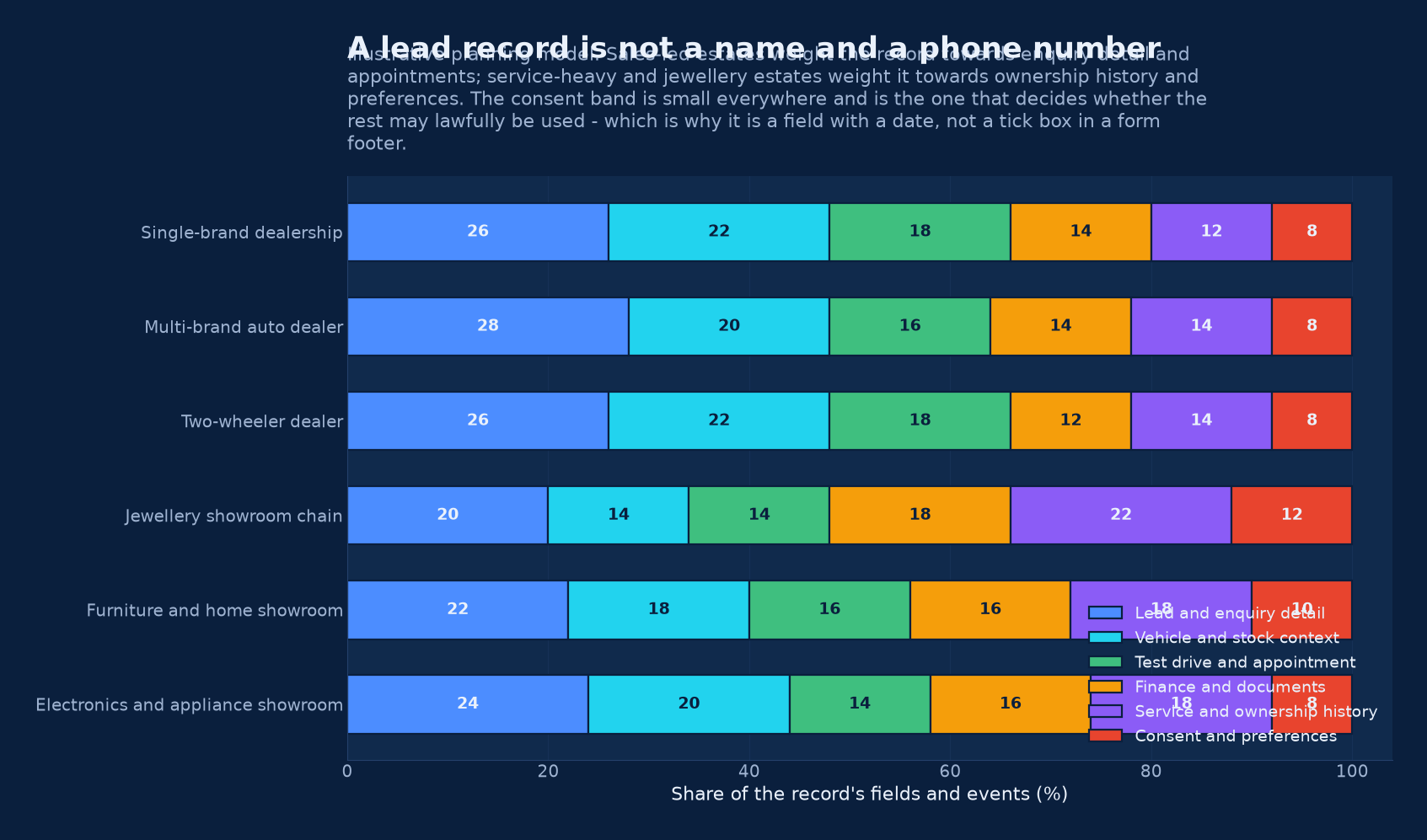
Chart values are an illustrative planning model based on typical UMC engagements and published industry benchmarks. They are not a guarantee of results on any specific project.
| Route | How it is captured | What must be attached | Routing rule | Typical failure |
|---|---|---|---|---|
| Website form | Direct write to the lead table with page and campaign context | Model, branch preference, source, consent | Nearest branch with capacity, then model specialist | Form stored in the website database only |
| Tracked call | Call event written to the lead record | Number, branch, campaign, duration, outcome | Answered by the duty executive; missed calls queued | A landline with no record of who called |
| WhatsApp and chat | Business API conversation with a source parameter | Conversation, consent, model mentioned | Assigned queue per branch with a response target | A personal phone that leaves with the executive |
| Social DM and comments | Inbox integrated to the lead table | Platform, post, conversation, outcome code | Same queue as chat, with escalation for complaints | Answered publicly and never recorded |
| Portal and marketplace leads | Automated import on a schedule | Portal identifier, listing, cost per lead | Round-robin within the branch, deduplicated | Imported nightly into a separate spreadsheet |
| Walk-in | Captured at reception on a tablet or desk terminal | Source question, branch, executive, model interest | Assigned immediately to an available executive | Recorded only if it becomes an order |
| Event and launch registration | Registration written to the lead table with the event tag | Event, branch, attendance status | Follow-up task the next working day | Attendance list lost in an email thread |
| Referral | Referral code or named referrer attached | Referrer, relationship, reward status | Priority routing with the referrer informed | Referral never credited, so referrals stop |
| Service and workshop enquiry | Written to the same customer record | Vehicle, service history, job type | Service adviser, with a sales flag if an upgrade is implied | Service contact kept out of the sales record |
| Old and dormant records | Imported with a consent check before any contact | Original source, last contact date, consent state | Re-engagement sequence, not a cold call list | Messaging a list with no lawful basis |
- Capture points have to be built, not assumed: forms, click-to-call and WhatsApp buttons are part of the showroom website build, and a capture route that is not wired to the lead table is a leak with a nice design.
- Deduplication is the discipline that keeps the record usable – one customer, one record, merged on phone plus model with an audit trail – and it is systems integration work before it is a CRM setting.
- Where a branch team works from a tablet on the floor, the capture surface has to be fast enough to use in front of a customer: mobile experience and interface design decide whether the record gets written at all.
- Social enquiries arrive outside office hours more than any other route, so the out-of-hours path matters: an AI assistant can capture and book, with a human following up in the morning.
Follow-up SLA, escalation and the manager view
Response time is the most controllable variable in a showroom funnel and the least managed. The decay is steep: an enquiry answered within fifteen minutes is several times more likely to reach a test drive than one answered after twenty-four hours, and by day three the lead has usually bought from somebody else or stopped answering. An SLA is therefore not a policy document; it is a timer attached to a record, with an escalation path when it expires and a view that lets a manager intervene while the lead is still alive.
| Control | What it does | How it is configured | What the manager sees |
|---|---|---|---|
| First-response timer | Starts a clock at capture and stops at first contact | Per source: fifteen minutes digital, same shift walk-in | Leads ageing past target, by executive and branch |
| Automatic escalation | Reassigns or alerts when the timer expires | Escalate to the sales manager, then to the branch head | Escalation count and reason per executive |
| Next-action discipline | No lead may sit without a dated next action | Mandatory next action and date at every stage change | Leads with no next action, or a date in the past |
| Call and message logging | Records every attempt, not just the successful ones | Click-to-dial and WhatsApp templates logged automatically | Attempts per lead, and unreachable patterns |
| Duty rota | Ensures somebody owns the queue at every trading hour | Rota by branch and shift, with out-of-hours cover | Queue depth per shift, and gaps in cover |
| Workload balancing | Prevents one executive holding every good lead | Round-robin with capacity and skill weighting | Leads per executive against conversion rate |
| Stall detection | Flags a quotation or finance stage that has not moved | Threshold per stage: seventy-two hours on a quote | Stalled deals with the reason and the age |
| Loss review | Requires a reason code and a manager review weekly | Mandatory outcome code plus a weekly review meeting | Loss reasons aggregated by branch and model |
| Coaching view | Shows behaviour rather than only outcomes | Response times, attempt counts, show rates per executive | Who needs coaching and on what |
| Customer-facing promises | Keeps what the website and ads implied | Callback windows and response claims matched to the SLA | Promise versus performance, per channel |
- The SLA has to be honest about capacity: a fifteen-minute target with two executives on a Saturday produces a queue, not a promise – staffing against predicted enquiry volume is forecasting applied to a rota.
- Escalation is a management act, not a software feature. Where a manager does not read the ageing view daily, the timer becomes decoration.
- The same queue discipline applies to service and support enquiries, which is why the CRM and the helpdesk workflow share owners and targets rather than running as two systems with two sets of promises.
Test drives, appointments and show rate
The test drive is the pivot of the showroom funnel: it is where a researcher becomes a buyer, and it is where most estates lose the most value. Two numbers govern it – bookings against real capacity, and the show rate. A booking system that accepts forty Saturday slots for three demonstrator vehicles produces no-shows and disappointed customers; a booking with no reminder produces the same result more quietly. Both are record problems, and both are fixed in the CRM rather than in the marketing.
| Element | What good looks like | Failure mode | Fix in the record |
|---|---|---|---|
| Capacity model | Slots held against demonstrator vehicles and consultant hours | Overbooking, then waiting customers | Capacity per branch per day, editable by the manager |
| Slot type | Branch drive, home test drive with a zone, video walkaround | One generic slot for three different operations | Slot type as a field, with its own capacity |
| Confirmation | Instant confirmation with date, time, branch, documents needed | A ‘we will call you’ response | Automated confirmation on booking, logged |
| Reminders | WhatsApp or SMS the evening before and two hours ahead | No reminder, or one generic email | Reminder state and delivery status per booking |
| Rescheduling | A self-service link that keeps the history | A new booking created, orphaning the old one | One booking record with a reschedule log |
| Show and no-show | Recorded at the slot by the executive | Never recorded, so show rate is guessed | Mandatory outcome at slot time |
| No-show recovery | One reschedule offer, then released capacity | The lead quietly closed as ‘not interested’ | No-show reason code plus a recovery task |
| Home test drive logistics | Route, driver, zone, fuel and insurance checked | Drives promised outside the feasible zone | Zone field validated at booking |
| Post-drive follow-up | Same-day contact with a quotation or a next step | Follow-up three days later | Task created automatically at show-up |
| Reporting | Bookings, show rate, conversion to order by source and branch | Bookings counted, nothing after | Funnel report from the same record |
- Reminders are the cheapest show-rate improvement available and they run on the same consent record as marketing: WhatsApp with a business API path, plus SMS fallback.
- Show rate by source is a media metric as much as an operations one – a campaign that books many drives nobody attends is expensive twice, and the paid programme should be judged on drives shown.
- Capacity data belongs in the warehouse with the funnel: pipeline and sales analytics answers whether a branch needs a fourth demonstrator or a fourth executive.
Quotation, finance, exchange and the documents that stall deals
Between a test drive and an order sits the slowest part of the funnel, and the part with the least visibility: a quotation negotiated over days, a finance application waiting on documents, an exchange valuation waiting on an inspection, and a customer waiting on somebody to call them back. Each of these is a stage with a clock, a document checklist and a stall reason, and each is usually managed on paper or in memory. Recording them is what allows a sales manager to see on Tuesday that eleven quotations are stalled on finance documents rather than discovering it at month end.
| Element | What must be recorded | Clock and target | Stall reason to capture | Who owns it |
|---|---|---|---|---|
| Quotation version | Price components, discount, validity date, who approved it | Seventy-two hours to a customer response | Price, wait time, comparison shopping, finance terms | Sales executive |
| Discount authority | What the executive may offer, and what needs approval | Approval within two hours in trading time | Approval delayed, authority exceeded | Sales manager |
| Finance pre-approval | Lender, tenure, EMI, documents requested, status | Per lender SLA, tracked daily | Documents pending, bureau issue, income proof | Finance officer |
| Document checklist | Identity, address, income, photos, signatures – per lender and state | Complete before submission | Missing document, mismatch, illegible scan | Finance officer |
| Exchange valuation | Vehicle, age, condition band, inspection date, agreed value | Inspection within forty-eight hours of request | Condition dispute, customer expectation, market movement | Used-vehicle manager |
| Insurance and registration | Quote, provider, RTO agent, timelines | Quoted with the offer, issued before delivery | Provider delay, document error | Delivery executive |
| Booking and payment | Amount, mode, date, refund terms | At order | Payment failure, refund dispute | Sales manager |
| Delivery scheduling | Date, bay, preparation status, customer documents | Agreed at order, confirmed weekly | Allocation delay, preparation, customer availability | Delivery executive |
| Cancellation | Stage, reason, refund processed, who approved | Refund within the promised window | Wait time, finance rejection, bought elsewhere | Sales manager |
| Post-order contact | Status updates to the customer between order and delivery | Weekly during the wait | No update given, customer chased instead | Sales executive |
- Finance and document stages are where a deal’s cash timing is decided, so they belong in the same record as the sale – a delayed disbursal is a working capital event as well as a customer experience one.
- Valuation and discount data accumulate into pricing intelligence: what the branch actually gives away per model is sales analytics that most groups have never measured.
- Where documents move between branch, finance and lender, the record has to show who holds what – a document workflow is a small portal problem with a large customer consequence.
DMS integration: the system of record and the system of work
Every dealership already has a system of record – the DMS or ERP that holds stock, orders, invoices, service jobs and often a customer table nobody trusts. A CRM programme that ignores it creates a second truth and a daily reconciliation argument; one that fights it creates two systems nobody uses. The workable pattern is to let the DMS own what it owns – vehicles, invoices, jobs, ledger – and let the CRM own the funnel: enquiry, conversation, appointment, quotation stage, outcome codes and consent, joined on one customer and one vehicle identifier.
| Data | System of record | Direction of flow | Sync pattern | Risk if designed badly |
|---|---|---|---|---|
| Customer identity | CRM, with the DMS as a consumer | CRM to DMS | On creation and on change | Two customer tables that never agree |
| Vehicle and stock | DMS or ERP | DMS to CRM | Hourly or event-driven | A CRM showing stock the yard sold yesterday |
| Enquiry and conversation | CRM | CRM only | Real time | Enquiries living in email and never reported |
| Appointment and test drive | CRM, with the branch calendar | Both ways where a DMS calendar exists | Real time | Double-booked demonstrators |
| Quotation | CRM for the process, DMS for the priced document | Both ways | On stage change | A quote in the CRM the finance team cannot see |
| Order and invoice | DMS | DMS to CRM | On creation and on status change | Sales reporting that disagrees with the ledger |
| Delivery | DMS | DMS to CRM | On completion | The owner lifecycle never starting |
| Service job and history | DMS | DMS to CRM | Nightly minimum | Retention journeys sent to the wrong intervals |
| Finance and lender status | Lender portal plus CRM | Portal to CRM where an API exists, otherwise manual with a log | Daily | Applications stuck with nobody accountable |
| Marketing outcomes | CRM to ad platforms | Outbound import | Daily | Bidding trained on form fills instead of deliveries |
- Integration is engineering with a dealership constraint: vendor-controlled schemas, batch windows that close at night, and rate limits – the pattern is ERP, CRM and operations integration with retries, idempotency and a replay path.
- One identifier has to survive the whole journey, from a click to a delivered unit to a third service visit, which is why the join is designed before the interfaces are built.
- Everything the integration produces should be queryable in one place for reporting: a warehouse with lead, appointment, order and service facts, so marketing and operations stop producing competing numbers.
- The interfaces need monitoring like any other production system – freshness, row counts, failures – which sits with managed IT services once the programme is running.
Service retention and the owner lifecycle
A dealership sells one vehicle every few years and sees the same customer many times in between – for services, insurance, warranty, recalls and parts – yet most estates run acquisition and retention as two unrelated businesses with two unrelated records. Connecting them is the highest return available in showroom CRM: a customer with a recorded first service, a plan expiry and a trade-in age can be contacted with a reason, at the right time, by the branch that already knows them. That is retention marketing with an operational spine.
| Journey | Trigger from the record | Channel and timing | Content | Measure |
|---|---|---|---|---|
| Delivery thank-you | Invoice created in the DMS | WhatsApp same day, email day two | Documents recap, first-week tips, service adviser contact | Delivery-day consent rate |
| First service | Delivery date plus the manufacturer interval | WhatsApp and SMS fourteen days before | What the first service covers, cost band, bookable slots | First-service capture rate |
| Regular service | Last service date plus interval, or kilometres where recorded | Reminder at minus fourteen, minus three and plus seven days | Package, pickup and drop option, courtesy vehicle | Service absorption and revenue per unit |
| Warranty expiry | Warranty end date minus ninety days | Email plus a call from the branch | Extended plan comparison with honest exclusions | Plan attach rate |
| Insurance renewal | Policy end date minus thirty days | WhatsApp and email with a quote route | Renewal quote, comparison, add-on guidance | Renewals retained in-house |
| Recall or campaign | VIN matched to a campaign list | SMS and a phone call, no marketing language | What is affected, what happens, a booked slot | Completion rate within the window |
| Trade-in age | Vehicle age and market value band | Email with a valuation tool, then a call | Valuation band, upgrade offers, inspection booking | Valuations completed and upgrades |
| Owner community | Consent to community contact | WhatsApp community or an owner group | Tips, events, early access to launches | Referral enquiries and event attendance |
| Dormant reactivation | No contact for the category-appropriate interval | One consent-checked sequence, then stop | A reason to return, not a discount | Reactivated enquiries per thousand contacted |
| Loss recovery | Closed lost within the last ninety days | One personalised follow-up by the original owner | Stock or offer that answers the recorded loss reason | Recovered orders per hundred contacted |
- Journeys run from the record, on consent, through the channels the customer chose: lifecycle and retention campaigns over WhatsApp, SMS and email, orchestrated in one marketing automation layer rather than three tools with three lists.
- Service reminders are the single most reliable retention revenue line in a dealership, and they depend entirely on the DMS-to-CRM service feed being fresh.
- Owner contact is also the best source of new demand: a referral route with a reward that is actually paid is a social programme asset before it is a CRM feature.
- Reactivation of old records needs a lawful basis check before anything is sent – a consent field with a date and a source, reviewed as part of IT audit and compliance work.
Consent, data governance and what the record may not do
A dealership record holds phone numbers, addresses, vehicle identifiers, finance documents and sometimes identity documents, which makes it personal and sensitive data on a commercial scale. Governance here is not a policy binder; it is fields and behaviour in the system – consent per channel with a date and a source, preference management the customer can change, retention rules that actually delete, role-based access so a branch executive cannot browse another branch’s customers, and an audit trail that answers ‘who saw this and why’. The operational consequence is simple: with governance, the retention journeys above can be sent; without it, they cannot.
| Requirement | How it is implemented in the record | Evidence | What breaks without it |
|---|---|---|---|
| Consent per channel | A consent object per channel with date, source and wording version | Consent log exportable per customer | Messaging with no lawful basis, and an unsubscribable list |
| Preference management | A customer-facing preference page plus capture at every touchpoint | Change history with timestamps | Customers who cannot opt out of one thing without opting out of everything |
| Retention and deletion | A retention rule per data class, applied by job | Deletion log and rule configuration | Dormant records accumulating indefinitely |
| Access control | Role-based permissions by branch, role and data class | Access matrix and review records | Customer lists visible to anyone with a login |
| Audit trail | Every read, export and change on sensitive fields logged | Immutable log with actor and reason | No answer to a data-leak or complaint question |
| Document storage | Identity and finance documents encrypted, access-limited, time-boxed | Encryption and access records | Documents sitting in email attachments and shared drives |
| Export and portability | A customer data export route with an SLA | Export requests and fulfilment times | A rights request handled by hand, late |
| Vendor and processor terms | Data processing terms with every platform touching the record | Contract register | Data leaving the estate under nobody’s responsibility |
| Consent in the branch | A one-line consent capture at the desk, trained and audited | Training record and spot checks | Consent recorded inconsistently or not at all |
| Security baseline | MFA, endpoint control, backup and incident response around the CRM | Security review and test results | A single compromised credential exposing the customer base |
- The security half of governance is infrastructure, not policy: access control, endpoint hardening and monitoring sit with cybersecurity services and IT audit and compliance, and the CRM record is the asset they protect.
- A record that cannot be restored is a business that cannot trade: backup and disaster recovery with tested restores covers the CRM and the DMS together.
- Governance is also a commercial asset – a customer who can change a preference in one tap stays reachable, whereas a customer who cannot usually stops answering.
- Where data moves between group entities or a new acquisition, the consent position has to move with it, which is a market expansion question with a legal answer.
Reporting: the funnel everybody argues with
Once the record is honest, reporting stops being a monthly reconciliation between marketing and sales and becomes a shared arithmetic. Two audiences need it, and they need different cuts from the same data: a branch manager wants today’s queue, ageing leads, bookings and show rate; a group head wants cost per delivered unit by source, branch and model, with the funnel conversion between them. Building both from one model is what prevents the argument, and it is cheap once the stages and outcome codes exist.
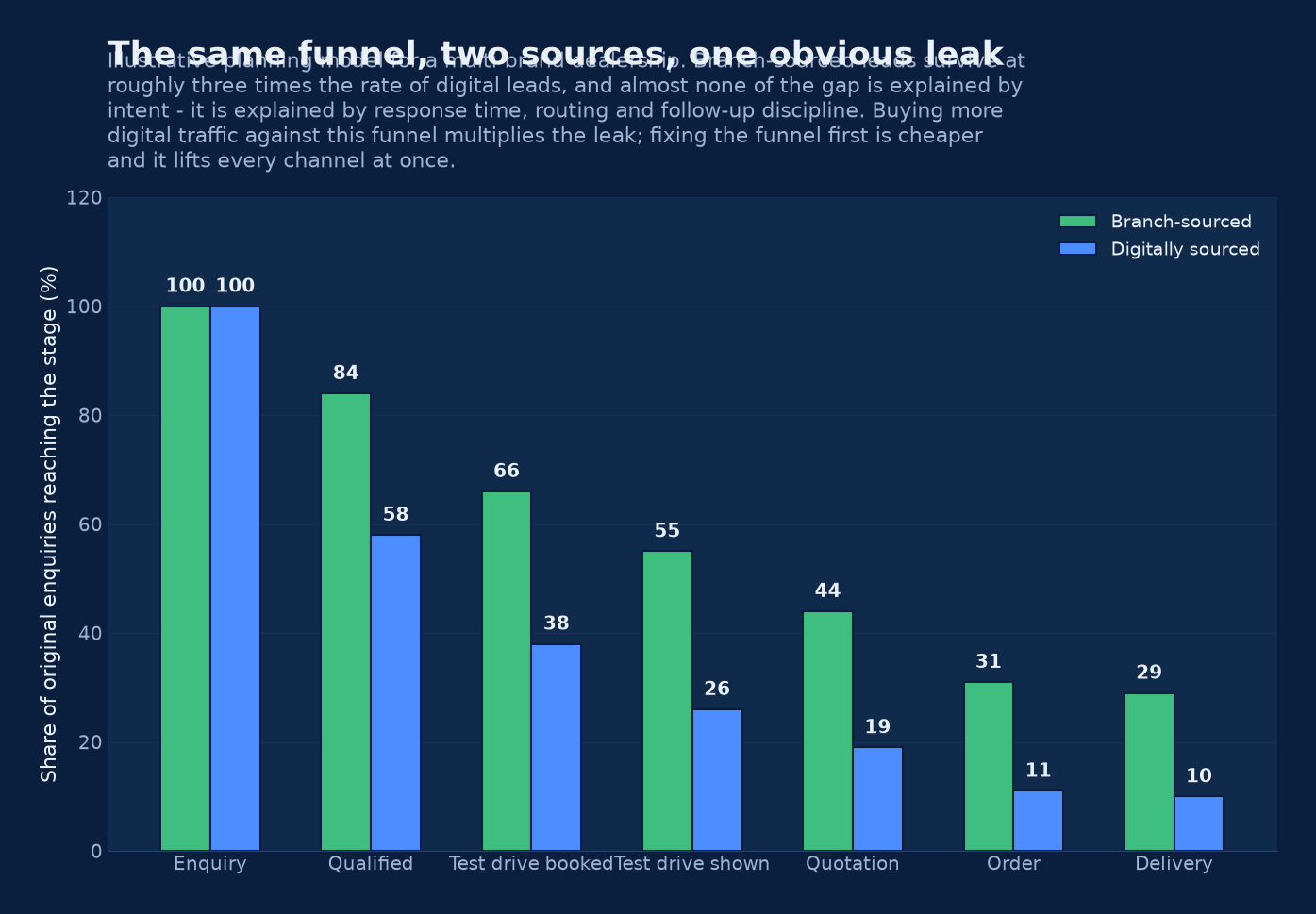
Chart values are an illustrative planning model based on typical UMC engagements and published industry benchmarks. They are not a guarantee of results on any specific project.
| Report | Question it answers | Cut | Refresh | Owner |
|---|---|---|---|---|
| Queue and ageing | What needs attention today? | Branch, executive, source, age band | Live | Branch sales manager |
| Response performance | Are we meeting the SLA? | Source, shift, executive | Daily | Branch sales manager |
| Funnel conversion | Where does the funnel lose value? | Stage-to-stage, by branch, model and source | Daily | Group sales head |
| Show rate | Are booked test drives turning up? | Branch, slot type, reminder state | Daily | Branch sales manager |
| Loss reasons | Why are we losing, and to whom? | Reason code, model, branch, competitor mentioned | Weekly | Group sales head |
| Cost per delivered unit | What did a delivery cost to acquire? | Source and channel, branch, model, month | Monthly | Marketing plus finance |
| Source quality | Which sources produce deliveries, not just leads? | Channel, campaign, branch | Monthly | Marketing lead |
| Service retention | Are delivered customers coming back? | Interval, branch, model, journey | Monthly | Service head |
| Referral performance | Is the referral route producing demand? | Referrer branch, reward paid, referred outcome | Monthly | Group marketing |
| Consent and data health | May we contact this base, and is the record clean? | Consent state, duplicates, dormant share | Monthly | Operations plus compliance |
| Forecast | What will this month deliver? | Open pipeline by stage, weighted by historical conversion | Weekly | Group sales head |
| Executive summary | Is the funnel improving? | Group, brand, city, month over month | Weekly | Leadership |
- One model, several renders: the same warehouse tables feed the branch queue view and the leadership pack, which is executive dashboards and reporting done once.
- Source quality only becomes visible when the outcome code exists, and it is the input that should decide media allocation – mix modelling and attribution with holdouts rather than platform self-reporting.
- Funnel timing predicts stock and staffing needs: predictive analytics and forecasting off the same record tells a branch how many executives a launch weekend needs.
- Where the group spans brands and cities, funnel comparison is the fastest route to a performance conversation – and the evidence base for cost rationalisation decisions about branches rather than campaigns.
The ninety-day showroom CRM programme, and what we need from you
The programme below is the shape we run for a dealership group, a showroom chain or a single-brand estate: three weeks to define the funnel and audit what exists, overlapping configuration and integration, capture and routing live by week nine, SLA and manager views by week eleven, retention journeys from week eight, referral mechanics from week ten, and reporting and handover at the end. The dependency that decides the timeline is DMS access and the willingness of branch managers to enforce an SLA – both management decisions, neither technical.
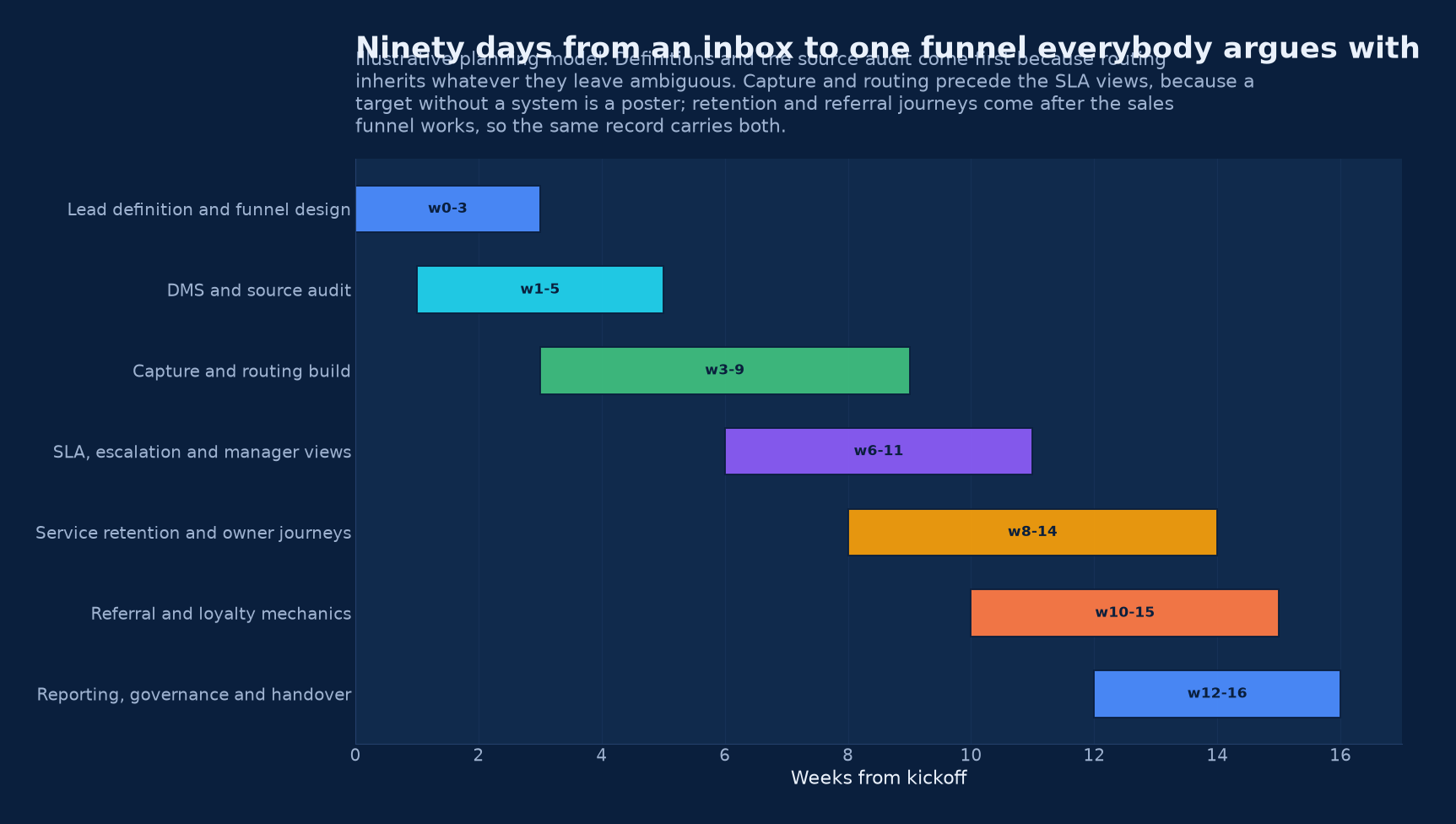
Chart values are an illustrative planning model based on typical UMC engagements and published industry benchmarks. They are not a guarantee of results on any specific project.
| Weeks | Workstream | Deliverable | Decision it enables |
|---|---|---|---|
| Zero to three | Lead definition and funnel design | Stage list, qualification rule, outcome codes, SLA targets, ownership map | What the business will measure and enforce |
| One to five | DMS and source audit | System inventory, data-quality assessment, integration feasibility, gap list | What is built versus configured, and what cannot be fixed |
| Three to nine | Capture and routing build | Forms, telephony, WhatsApp, portal imports, walk-in capture, deduplication, routing rules | Whether every route lands in one record with a source |
| Six to eleven | SLA, escalation and manager views | Timers, escalation paths, ageing and coaching views, training | Whether response time becomes managed behaviour |
| Eight to fourteen | Service retention and owner journeys | Journey set with triggers, consent checks, templates, branch scripts | Whether delivered customers generate repeat demand |
| Ten to fifteen | Referral and loyalty mechanics | Referral route, reward rules, owner community, event capture | Whether word of mouth becomes attributable |
| Twelve to sixteen | Reporting, governance and handover | Funnel and cost-per-delivery reports, consent and access controls, documentation, training | Who runs it, on what rules, and how it is reviewed |
- What we need: DMS or ERP access with a technical contact, the branch list with a named sales manager per branch, twelve months of enquiry, order and service volumes, current lead sources and their costs, any existing CRM export with its consent fields, and one decision-maker empowered to set and enforce the SLA.
- What you keep regardless: the funnel definition and outcome codes, the routing and SLA configuration, the integration design and monitoring, the journey set, the reporting model and the governance documentation. They are yours.
- What we will tell you plainly in week three: which routes cannot be captured without a vendor change, which stages your branches will not use, and whether the real constraint is the system or the follow-up habit – usually the second.
Showroom CRM by city, and worked examples
Showroom CRM is shaped by local operations rather than by software preference: branch density decides routing complexity, RTO and registration practice decides document workflows, lender panels decide finance stages, service culture decides retention interval, and language decides whether a reminder is read. The engagements below are dealership, showroom and store projects where the funnel, the record and the follow-up were built as one programme.
- Get more automobile sales leads in Lucknow
- Digital marketing company for automobile dealers in Lucknow
- Website development company for automobile dealers in Lucknow
- Get more jewellery customers in Lucknow
- Digital marketing company for jewellery stores in Lucknow
- Digital marketing and IT services in Lucknow
- Services across Indian cities
- Case study: Hyundai group showroom full-service social advertising contract
- Case study: a fashion retail showroom
- Case study: WordPress and WooCommerce online mobile store
- The showrooms and dealerships industry hub – all eight disciplines
- Retail and e-commerce: catalogue, carts and retention CRM
- Manufacturing: dealer networks and B2B pipeline management
- Hotels and hospitality: reservation-led CRM and guest records
- All industry verticals we build programmes for
- All digital marketing services
- About Unified Management Consulting
- Contact us about CRM and lead management for showrooms and dealerships
Thirteen more sources and systems that feed the same record
The capture table above covers the routes a dealership sees every day. Beyond those sit the channels and systems that either produce leads the funnel never receives, or quietly determine what arrives in the first place: the search programme, organic social, the local profile, event registrations, parts orders, content assets and nurture sequences on the demand side; website structure, maintenance, AI handling and group governance on the system side. Every one of them either writes to the record with a source, or it does not appear in any report you trust.
| Source or system | What it produces | How it enters the record | What decides its value |
|---|---|---|---|
| Organic search | Model, price, near-me and comparison enquiries | The SEO programme for showrooms landing on pages wired to the lead table | Whether the page carries a bookable next step and a source parameter |
| Organic social | Comments, DMs and community questions | A shared inbox in organic social management writing to the lead table | Response target and outcome coding, not follower count |
| Local profile | Calls, directions requests and profile messages | Tracked branch numbers plus Google Business Profile management | Whether the branch answers inside the SLA |
| Local Services Ads | Platform-supplied leads with a stated locality | Local Services Ads imported on a schedule and deduplicated | Dispute rate and cost per qualified enquiry |
| Events and launches | Registrations, walk-ins and owner-event attendance | Registration captured through webinar and event campaigns with an event tag | Whether a follow-up task exists the next working day |
| Parts and accessories online | Orders from existing owners | E-commerce development orders matched to the customer record | Whether the order updates ownership data and consent |
| Content assets | Guides, comparisons and calculators that pre-qualify | Content marketing pages attaching page context to the form | Whether the reader who downloads is treated as a lead with a stage |
| Nurture sequences | Hand-raises from people not yet buying | Nurture programmes promoting a reply into a qualified lead | Whether the promotion writes back to the CRM, not only to the platform |
| Website structure | Where capture routes sit and what they ask | Website strategy and information architecture deciding form placement | Whether the shortest path to a booking is the shortest path on the page |
| Uptime and maintenance | A form that works at eleven at night | Web application maintenance monitoring forms, imports and webhooks | Whether a broken capture route raises an alert or is found in a report |
| AI handling of leads | Out-of-hours capture, qualification and booking | An AI assistant writing to the record with a human handoff | Whether escalation, disclosure and logging are configured |
| AI governance | Rules for automated messaging and scoring | AI governance, risk and compliance over models touching customers | Whether a scoring decision can be explained to a customer or a regulator |
| Team adoption | Executives actually using the record at the desk | AI training, enablement and team adoption plus CRM training | Whether data entry is faster than the notebook it replaces |
| Group governance | One funnel definition across brands and cities | Unified top-level management owning the stage list and SLA | Whether a branch may redefine a stage, and who notices when it does |
- Every row is either wired or invisible. A source that cannot write to the record with a source parameter will never appear in cost per delivered unit, and it will be judged on the wrong number forever.
- Demand-side rows belong to the marketing disciplines – the sibling pages for websites, search, paid search and social each describe how their leads are captured here.
- System-side rows belong to the technology disciplines: capture reliability is maintenance work, AI handling needs governance and training, and one funnel definition across a group is a management decision that no software can make for you.
Where this page sits in our showrooms programme
CRM and lead management is the fifth discipline of our showrooms and dealerships programme. The hub page explains how the eight disciplines fit together, each discipline has its own page as it is published, and the generic service page for every discipline stays listed below alongside the vertical pages. A discipline that is not listed is not published yet – the list is generated from live pages and refreshes automatically as each spoke lands.
- Showrooms – the vertical main page
- Website development for showrooms and dealerships
- SEO for showrooms and dealerships
- Google Ads for showrooms and dealerships
- Social media marketing for showrooms and dealerships
- Business intelligence for showrooms
- IT support for showrooms and dealerships
- AI for showrooms and dealerships
- Website development services – the generic service page
- SEO services – the generic service page
- Google Ads management – the generic service page
- Social media management – the generic service page
- BI dashboards and executive reporting – the generic service page
- Managed IT infrastructure and AMC – the generic service page
- AI agent deployment and automation – the generic service page
Frequently asked questions about CRM and lead management for showrooms and dealerships
Do we need a CRM if we already have a DMS?
A DMS is the system of record for vehicles, invoices, jobs and the ledger; it is not built to run a funnel. You need the CRM to own enquiry, conversation, appointment, quotation stage, outcome codes and consent, joined to the DMS on one customer and vehicle identifier. Running both as separate truths is what produces the monthly argument.
How fast should we respond to a digital enquiry?
Within fifteen minutes during trading hours, with an escalation when the timer expires and an out-of-hours capture that books a morning callback. Response time is the largest controllable factor in conversion, and an SLA only works if a manager reads the ageing view daily.
Why do so many booked test drives not show up?
Usually because capacity was overbooked against too few demonstrator vehicles, or because there was no reminder. Fix both in the record: slots held against real capacity, a confirmation on booking, WhatsApp reminders the evening before and two hours ahead, and a mandatory show or no-show outcome.
How do we stop executives keeping leads on their personal phones?
By making the business channel easier than the personal one – WhatsApp Business API with routing and templates, click-to-dial that logs attempts automatically, and a rule that a lead not in the CRM does not count towards incentive. Then measure attempts and response times per executive.
Can we message our old customer list?
Only where a lawful basis exists and consent is recorded per channel. Old records need a consent field with a date and a source, a preference route and a retention rule. Without them, the list is an exposure rather than an asset, and reactivation should be reviewed as part of a compliance audit.
What should a lead record actually hold?
Contact identity and consent, model and branch context, source and campaign, stage with owner and dated next action, appointment and test-drive history, quotation and finance detail, exchange valuation, order and delivery, service and ownership history, and outcome codes. The sales-led weight sits in enquiry and appointment detail; jewellery and service-heavy estates weight it towards ownership history and preferences.
How do we attribute a delivered unit to marketing?
With one lead identifier carried from click or call to DMS delivery, imported back into the ad platforms, plus assistance modelling and periodic holdouts. Without the join, platforms optimise towards form fills and everybody argues about lead quality instead of cost per delivery.
Should the CRM cover service customers as well as sales leads?
Yes, in one customer record. A service customer is a future buyer and a referral source, and retention journeys – first service, warranty expiry, insurance renewal, recall, trade-in age – are the cheapest demand a dealership can generate. That only works if the service feed from the DMS is fresh.
How do we handle referrals so they are actually credited?
With a referral code or named referrer attached at capture, priority routing, a reward rule that is paid on delivery, and the referrer informed. An uncredited referral teaches customers not to refer, which is why the mechanic belongs in the record rather than in a poster.
Who owns the CRM – sales, marketing or IT?
Operations or sales, with marketing owning demand definition and IT owning integration, security and uptime. A CRM owned by nobody becomes a contact list; a CRM owned by IT becomes a system sales will not use. The stage list and outcome codes should be signed off by the people who work them.
What does a showroom CRM programme cost?
It scales with branch count, the number of source systems, DMS integration depth and whether retention journeys are included. A single-brand estate with one DMS is a configuration-led project; a multi-brand group with several DMS versions and a finance workflow is engineering. We quote after the DMS and source audit, so the price reflects the integration reality rather than a licence count.
How long until we see results?
Response-time and show-rate gains appear within weeks of routing and reminders going live, because they are behaviour changes with a system behind them. Retention and referral revenue shows over one to two quarters, and cost-per-delivery reporting becomes trustworthy once one full month of joined data has accumulated.
Start with the funnel definition and the DMS audit
Give us three weeks with DMS or ERP access and a technical contact, the branch list with a named sales manager per branch, twelve months of enquiry, order and service volumes, your current lead sources and their costs, any existing CRM export with its consent fields, and one decision-maker empowered to set the SLA, and we will return a stage list with qualification rules and mandatory outcome codes, an integration design that says what the DMS owns and what the CRM owns, a capture and routing map covering every enquiry route, SLA timers with escalation and manager views, a retention journey set with consent governance, and a reporting model that reports cost per delivered unit by source, branch and model – including which routes cannot be captured without a vendor change. Yours to keep either way.
Contact Unified Management Consulting to arrange a confidential first conversation.