
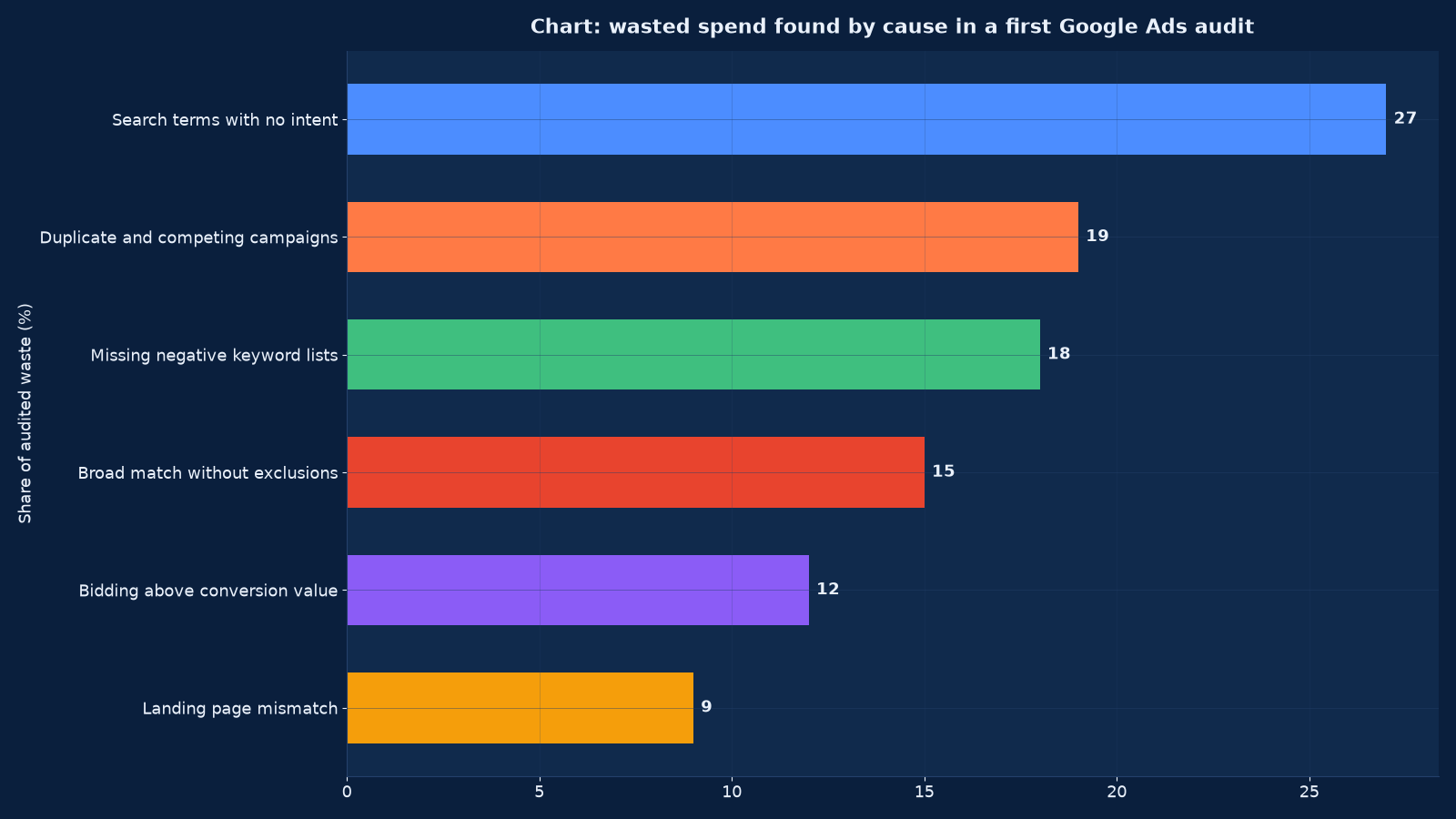
Chart values are an illustrative planning model based on typical UMC engagements and published industry benchmarks. They are not a guarantee of results on any specific project.
An account is rarely short of spend. It is short of decisions: which searches are worth buying, which are worth excluding, what a conversion is actually worth, and which campaign should have been paused a year ago. An audit is the exercise of making those decisions visible, priced and owned by somebody.
A Google Ads audit at Unified Management Consulting is a fixed-fee, six-week diagnostic of a live account. It is not a sales document for a retainer, and it is deliberately structured so that a client who never works with us again still has something worth the fee: a complete account assessment, a quantified waste figure with the evidence behind it, a remediation roadmap sequenced by return, and a forecast of what the account should produce once the roadmap is executed. Their team can implement it themselves. Several have.
We audit search, Performance Max, Shopping, Display, YouTube and Demand Gen accounts, for lead-generation businesses and for e-commerce, in India and in export markets. The method is the same in each case and it is boring in the way that good diagnostics are boring: read every search term that spent money, check that conversions are recorded where they actually happen, verify that each campaign has one job, confirm that the landing page says what the ad promised, and put a number on everything that is wrong. What follows is that method, published in full, because an audit you cannot inspect is an opinion.
🔍 Google Ads Audit — Quick Summary
| Component | What We Deliver |
|---|---|
| Account and structure review | Every campaign, ad group and asset group mapped to the intent it serves, with the duplicates, the overlaps and the campaigns that have no job identified. |
| Search term analysis | Every term that spent money reviewed and classified: converting, worth testing, or waste. The waste is quantified in currency, not in impressions. |
| Negative keyword architecture | Shared negative lists built and applied, with the exclusions that should already have existed and the ones that would break a working campaign if added blindly. |
| Match type and bidding review | Match types against the exclusions that support them, bid strategies against the conversion volume they need, and targets against real conversion value. |
| Conversion tracking, consent and attribution | What is being recorded, where it is recorded, whether the values are right, whether consent mode is configured, and how much of the picture is missing. |
| Ad assets and message match | Responsive search ads with every asset slot filled and distinct, extensions configured, and each ad compared against the page it sends traffic to. |
| Landing page assessment | Load performance, message match, form friction, proof, and the specific change most likely to move conversion rate on each money page. |
| Budget and forecast | Where budget is going, where it should go, and a forecast of volume and cost per acquisition after remediation, with the assumptions stated. |
| Competitor and auction context | Auction insights, the competitors actually present, and what their presence implies for bids and positioning. |
| Written deliverable and walkthrough | A findings document with a severity per finding, an owner, an effort estimate and an expected effect, plus a live walkthrough with whoever will implement it. |
What the Audit Covers
The scope is fixed and published before the engagement starts, so that neither side can redefine it halfway through. Everything below is included in the fee.
| Area | What we examine | What the finding looks like |
|---|---|---|
| Structure | Campaign inventory, ad group granularity, asset groups, naming, and which campaigns compete with each other | Two campaigns bidding on the same terms with different targets; a consolidated structure proposed |
| Search terms | Every term that spent money in the review period, classified and costed | A quantified waste figure with the term list attached |
| Negatives | Existing negative lists, shared lists, and the gaps | A shared negative architecture with the lists to create |
| Match types | Match type per ad group against the exclusions that make it safe | Broad match running with no negatives; the exclusions to add first |
| Bidding | Strategy per campaign, target values, conversion volume against the strategy’s requirements | A target ROAS above what the data supports; a staged target proposed |
| Budgets | Distribution against conversion value, capped campaigns, day-parting | A campaign losing impressions to budget while a lower-value one is unrestricted |
| Tracking | Conversions, values, primary and secondary actions, duplicate counting, server-side and consent mode | Two systems recording the same conversion; one value never set |
| Attribution | Model in use, lookback windows, cross-device behaviour | A model that flatters one channel; the model that fits the buying cycle |
| Ads and assets | Responsive search ad coverage, asset quality, pinning, extensions | Asset slots empty or duplicated; the assets to write |
| Landing pages | Message match, speed, form friction, proof, mobile behaviour | The specific change per page, with the reason |
| Auction context | Auction insights, competitor presence, impression share lost | Where share is lost to rank rather than budget, and what that costs to fix |
| Governance | Change history, who has access, what has been tested and recorded | No test record; a lightweight testing cadence proposed |
Why a Fixed-Fee Audit Is the Right First Purchase
Most businesses do not need a new agency in month one. They need to know what they have, what it is worth fixing, and what it would cost. A fixed-fee audit answers those three questions without the conflict of interest that comes from an assessment whose author wants the remediation contract.
| Question the audit answers | Why it matters | How we answer it |
|---|---|---|
| Is the spend producing anything? | Volume and cost per acquisition are visible; profitability usually is not | Conversions reconciled against revenue or lead value, not against the platform’s own count |
| How much is being wasted? | A percentage of waste is the only number that changes a budget conversation | Every wasted term, campaign and placement itemised and costed |
| What should be fixed first? | Remediation capacity is finite | Findings ranked by expected effect against effort, with dependencies stated |
| Is the problem the account or the landing page? | Half of all ‘Ads problems’ are conversion problems | Message match and page performance assessed per money page |
| Can our team do this themselves? | Often yes, and the honest answer saves both sides money | Every finding written with enough detail to implement without us |
| What should it produce afterwards? | A forecast is what makes the roadmap fundable | Volume, cost per acquisition and revenue per month, with the assumptions listed |
The audit is fixed-fee precisely so that its conclusions are not shaped by what we would like to sell next. Where the honest conclusion is that the account is well run and the constraint is elsewhere — offer, price, sales capacity, or a landing page nobody has tested — that is what the report says.
The Six-Week Audit
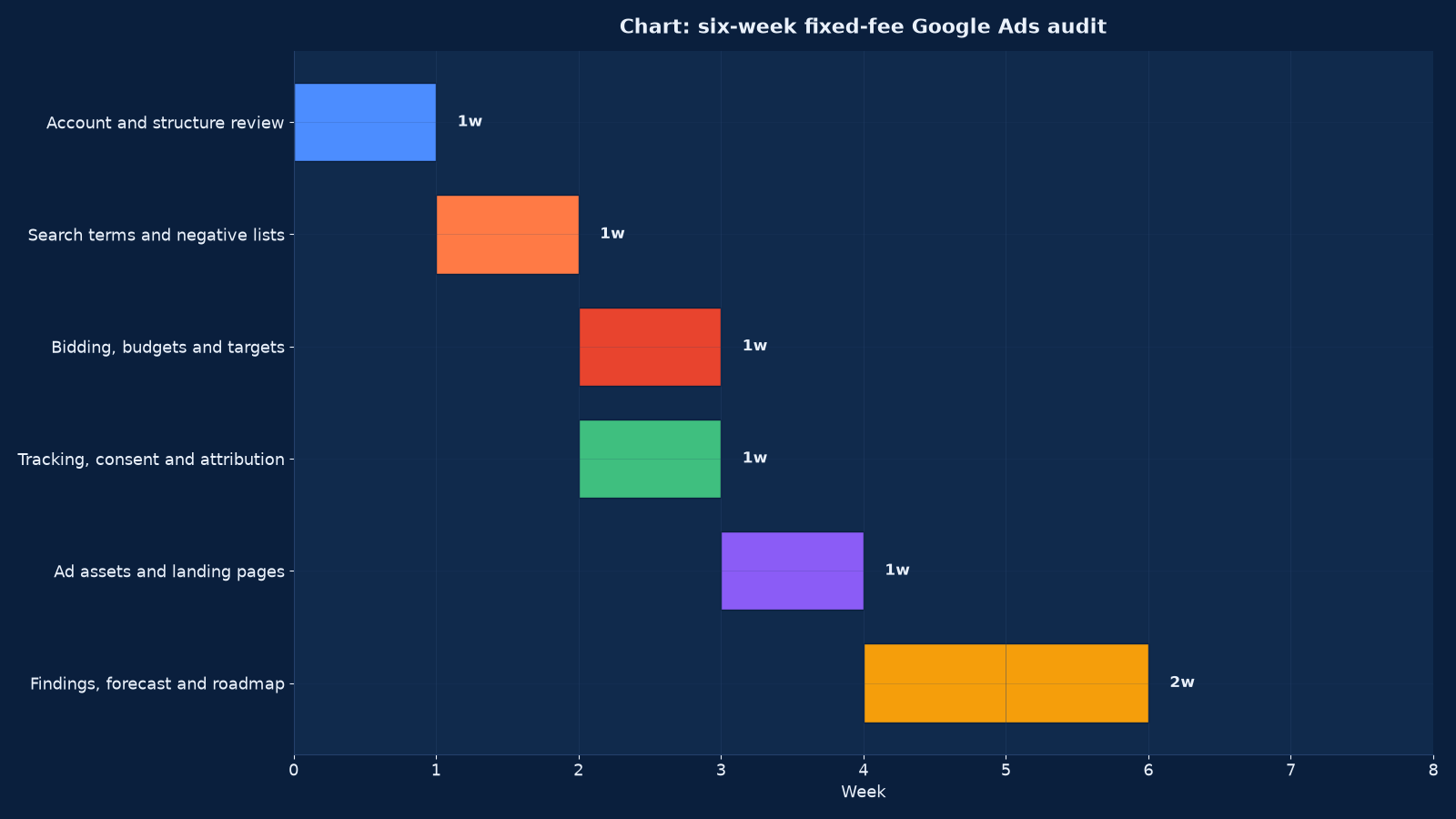
Chart values are an illustrative planning model based on typical UMC engagements and published industry benchmarks. They are not a guarantee of results on any specific project.
| Week | Workstream | Output | What we need from you |
|---|---|---|---|
| 1 | Account and structure review; access, history and change log | A campaign map with one stated job per campaign, and the list of overlaps | Read access to Ads, Analytics and Tag Manager |
| 2 | Search term review and negative keyword architecture | Classified term list, costed waste, and the shared negative lists to create | Nothing beyond access |
| 3 | Bidding, budgets, targets; tracking, consent and attribution | A bid and budget recommendation per campaign, and a tracking defect list with values | What a lead or an order is actually worth, and how that is decided |
| 4 | Ad assets, responsive search ads, extensions and landing pages | Asset gaps per ad group and a per-page landing assessment | The pages that matter, and anyone who owns them |
| 5–6 | Findings, forecast and roadmap; walkthrough | The audit document, the remediation roadmap with owners and effort, the forecast, and a live session | An hour with whoever will implement it |
Account Structure: One Job Per Campaign
Structure is the least exciting part of an account and the part that determines whether everything else can be measured. A campaign that serves two intents cannot have one target, one budget or one landing page, and the reporting will always be ambiguous.
| Structural problem | How it shows up | What we recommend |
|---|---|---|
| Campaigns competing with each other | Two campaigns appear for the same query with different bids and targets | One campaign per intent, with the other paused or restricted by negatives |
| Ad groups holding unrelated terms | One ad group covering thirty terms across four intents | Ad groups rebuilt around a single intent so the ad can match the search |
| Everything in one campaign | One campaign, one budget, one target, no ability to steer | Split by intent or margin, with budgets allocated by value |
| Brand and non-brand mixed | Brand spend inflating performance metrics | Brand separated, so non-brand efficiency can be judged honestly |
| No naming convention | Campaign names that mean nothing six months later | A convention encoding market, intent, match and target |
| Abandoned experiments | Paused campaigns nobody remembers, some still accruing impressions | A retire list, and a rule that pausing is documented |
| Asset groups without intent split | One Performance Max asset group for the whole catalogue | Asset groups by intent or margin band, with their own creative |
Search Terms, Match Types and Negative Lists
This is where the largest share of recoverable spend usually sits, and it is the work most often skipped because it does not scale to a spreadsheet glance. Every term that spent money in the review period is read, classified and costed.
| Classification | Definition | Action |
|---|---|---|
| Converting | Produced a recorded conversion at an acceptable cost | Protect: exact or phrase match in its own ad group, with a bid that reflects its value |
| Worth testing | Relevant intent, no conversion yet, spend below the decision threshold | Keep with a cap and a review date; decide on evidence rather than instinct |
| Waste, no intent | Irrelevant queries: jobs, free, definitions, competitor support pages, unrelated products | Negative, and usually in a shared list so every campaign benefits |
| Waste, wrong geography or language | Queries from markets you do not serve | Targeting correction, not just a negative |
| Waste, duplicate coverage | The same query bought by two campaigns at different prices | Structural fix: negatives to separate them, then one owner per intent |
| Broad match without exclusions | Broad or smart bidding expanding into irrelevant queries | Negative architecture first, then re-evaluate whether broad is worth its reach |
Negative lists are built as shared lists by theme — jobs and careers, free and DIY, definitions and education, competitor support, irrelevant product families — rather than as one long list per campaign. Shared lists are applied once and maintained in one place, which is the difference between a negative architecture that lasts and one that decays.
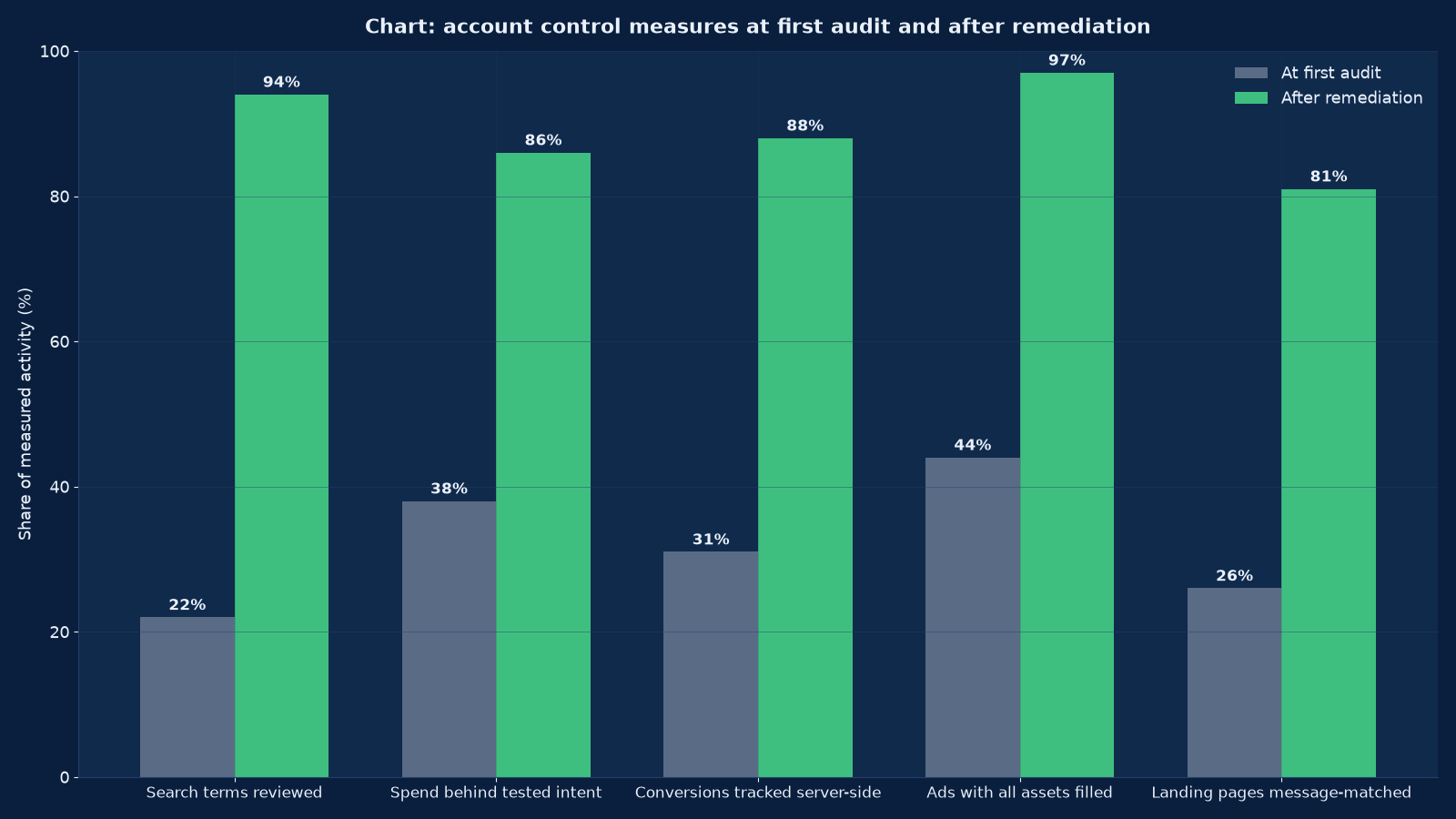
Chart values are an illustrative planning model based on typical UMC engagements and published industry benchmarks. They are not a guarantee of results on any specific project.
Bidding, Budgets and Targets
Smart bidding is not a substitute for a decision about value. Every automated strategy optimises towards whatever it is told to optimise towards, and most accounts we audit are telling it something inaccurate: a conversion worth nothing, a target ROAS the data cannot support, or a lead count that treats an enquiry and a closed deal as the same event.
| Element | What we check | The recommendation pattern |
|---|---|---|
| Conversion values | Whether values reflect margin or lifetime value rather than a uniform 1 | Stage the values: enquiry, qualified lead, closed deal — then bid to the one that matters |
| Bid strategy fit | Whether the strategy has the conversion volume it needs to learn | A strategy matched to volume: maximise clicks or manual where data is thin, target-based where it is not |
| Target realism | Target CPA or ROAS against the account’s actual history | A staged target: move it in steps rather than setting the ambition on day one |
| Budget distribution | Spend against conversion value per campaign, and impression share lost to budget | Move budget from capped low-value campaigns to constrained high-value ones, with a stated reason |
| Day-parting and geo | Whether performance differs enough by hour or region to justify adjustments | Adjustments only where the data volume supports them |
| Seasonality | Whether targets and budgets anticipate known peaks | A calendar of planned changes rather than reactive ones |
| Learning resets | How often edits have reset the strategy’s learning | A change cadence: fewer, larger, planned edits instead of daily tweaks |
Conversion Tracking, Consent and Attribution
Half of all account problems are measurement problems wearing a bidding costume. If conversions are double-counted, unrecorded, or attributed to the wrong channel, then every automated decision downstream is optimising towards a fiction.
| Defect | How we detect it | Why it matters |
|---|---|---|
| Duplicate conversion actions | The same event recorded by both a tag and an import | Volume is inflated and cost per acquisition looks better than it is |
| No conversion values | Lead accounts recording a count with no value differentiation | The strategy cannot distinguish a good lead from a form-fill |
| Client-side-only tracking | Conversions that disappear when consent is refused or a browser blocks the tag | Under-reporting that grows every year as blocking increases |
| Consent mode misconfigured | Consent state not passed, or default consent set to granted | Both a measurement gap and a compliance exposure |
| Wrong attribution model | A last-click model on a long buying cycle | Upper-funnel campaigns look worthless and get cut |
| Lookback windows mismatched | A window shorter than the real sales cycle | Conversions recorded as nothing; the campaign that started them is never credited |
| Offline conversions missing | Closed deals never imported back to the platform | The account optimises towards leads rather than revenue |
| Cross-device unmeasured | A phone-call or in-store path with no digital record | Real revenue invisible to every report |
We report the measurement gap as a number. If the audit believes thirty per cent of conversions are unrecorded, that figure appears in the forecast with its assumptions, because a remediation plan built on an unknown conversion rate is a guess with a spreadsheet.
Ad Assets, Responsive Search Ads and Message Match
Asset coverage is the cheapest improvement available in most accounts and the one most often left at three headlines and two descriptions. The other half of this work is message match: whether the page an ad sends traffic to says what the ad promised.
| Element | Standard | What we report |
|---|---|---|
| Headlines | Fifteen distinct headlines covering intent, offer, proof, geography and objection handling | Coverage gaps and the headlines to write |
| Descriptions | Four distinct descriptions, each with a reason to act | Duplicated or generic descriptions to replace |
| Pinning | Used only where a legal or brand requirement exists | Pinning that is suppressing combinations the system would perform better with |
| Extensions and assets | Sitelinks, callouts, structured snippets, call, location, image and promotion assets | Missing asset types and the copy for each |
| Landing page match | The page’s headline answers the query the ad targeted | Per-ad message-match failures, with the page and the change needed |
| Ad rotation and testing | A record of what has been tested and what it showed | A lightweight testing cadence where none exists |
Landing Pages: Where Most Audits Stop
An audit that stops at the platform boundary will conclude that the account is expensive when the real problem is a page that converts at a third of its potential. We assess the money pages as part of the audit, because the recommendation is different depending on which is broken.
| Page factor | What we look for | Typical finding |
|---|---|---|
| Load performance | Field performance on mobile, largest contentful paint, layout shift | A hero image and three tags costing two seconds on the page that carries the most spend |
| Message match | Headline, subhead and first screen against the ad and the query | A homepage receiving traffic from twelve different ads |
| Form friction | Field count, required fields, validation behaviour, mobile keyboard types | Eleven fields where four would produce more qualified enquiries |
| Proof | Testimonials, client names, numbers, accreditation, guarantees | No proof on the page, and plenty of it elsewhere on the site |
| Clarity of offer | Whether a first-time visitor can say what is being offered and what happens next | An offer expressed in internal vocabulary |
| Single action | One primary conversion path, with secondary paths de-emphasised | Three competing calls to action and a navigation menu leading away |
| Mobile behaviour | Whether the page works on the device most of the traffic arrives on | A desktop-designed page carrying a mobile-majority campaign |
How the Audit Differs by Account Type
The method is the same and the emphasis is not. A lead-generation account and an e-commerce account fail in different places, and an audit that applies one checklist to both produces findings that are true but useless. Before week one we agree which type the account is, because it decides what we read most carefully.
| Account type | Where the waste usually is | What the audit weights most heavily | The forecast is built from |
|---|---|---|---|
| B2B lead generation | Terms with informational rather than purchase intent, and lead values nobody agreed with sales | Search-term classification, offline conversion import, and the definition of a qualified lead | Qualified-lead volume against a staged value, not raw form fills |
| E-commerce and Shopping | The feed: disapprovals, missing identifiers, price and availability mismatches, and titles without the words shoppers type | Merchant Centre health, margin-weighted bidding, and asset groups by margin band | Revenue and return on ad spend against margin, not against gross sales |
| Local and service-area | Geo targeting wider than the service area, and call conversions unrecorded | Location targeting, call tracking, and the local landing pages the ads point at | Calls and booked jobs by area, with the profile and listings checked too |
| Long-cycle B2B with few conversions | Bid strategies that cannot learn on thin data, and attribution windows shorter than the sales cycle | Strategy fit against conversion volume, lookback windows, and the value of an assisted path | Pipeline influenced, stated with its uncertainty rather than claimed precisely |
| App and install campaigns | Install volume counted without downstream value, and fraud or incentivised installs | In-app event tracking, value per install cohort, and the quality of the install source | Retention and revenue per install, not installs |
| Multi-market or multi-language | One campaign serving several markets with one budget and one language | Market separation, currency and value handling, and per-market landing pages | Per-market volume and cost, so a subsidised market is visible |
Two account types deserve a warning rather than a weighting. An account whose primary objective is brand familiarity will always look inefficient on a conversion report, and the audit says so explicitly instead of recommending it be cut. An account whose only recorded conversion is a phone call made from a number that rotates will produce findings we cannot verify, and the first recommendation will be to fix the measurement before trusting anything else.
Auction Insights, Impression Share and the Competitive Read
Impression share lost is the number that decides whether a recommendation is about budget or about rank, and the two have completely different prices. We read the auction context rather than reporting it, because a competitor list without interpretation is just a source of anxiety.
| Signal | What it means | What we recommend |
|---|---|---|
| Impression share lost to budget | The campaign is capped and would serve more if funded | Move budget from a lower-value campaign, or accept the cap with the cost of it stated |
| Impression share lost to rank | Ad Rank is insufficient: bid, quality or asset coverage | Improve message match and asset coverage before raising bids, and price the bid option honestly |
| Overlap rate with a named competitor | How often you meet the same competitor for the same query | Whether the contest is worth having on those terms, and on which it is not |
| Outranking share | Where you already win positionally | Defend cheaply rather than over-bidding a term you already own |
| Top-of-page rate | Whether you appear above the organic results when you do appear | Whether the terms you buy are the terms worth appearing at the top of |
| Absolute top-of-page rate | The share of times you are the first ad | Whether the premium for first position is justified by its conversion difference |
| Competitor entry and exit | New entrants in the auction over the review period | Whether a price rise is structural or seasonal, and how to respond without a bidding war |
Auction insights are directional rather than exact, and we treat them that way. They are most useful for answering one question: if this campaign had more budget, would it produce more conversions at an acceptable cost, or would it simply buy worse positions on worse terms? The answer changes the recommendation completely, and it is the reason a budget increase is never the first finding in our reports.
What You Receive in Week Six
| Deliverable | Contents | Format |
|---|---|---|
| Findings register | Every finding with severity, evidence, the rule or logic broken, the fix, the effort and the expected effect | Your tracker’s format, plus a document |
| Waste quantification | Wasted spend by cause, in currency, for the review period, with the term and campaign lists attached | Spreadsheet and a summary chart |
| Structure recommendation | The target campaign and ad group structure, with the migration path from the current one | Diagram plus a mapping table |
| Negative architecture | Shared negative lists by theme, ready to import | Editor-importable lists |
| Tracking remediation | Every measurement defect with the fix, the owner and the verification step | Specification for a developer or marketer |
| Bid and budget plan | Strategy, target and budget per campaign, staged over ninety days | Table with the reasoning per row |
| Landing page plan | Per-page assessment with the highest-expected-value change first | Annotated page review |
| Forecast | Expected volume, cost per acquisition and revenue after remediation, with assumptions and a range | One page, with the arithmetic shown |
| Walkthrough | A live session with whoever will implement it, recorded | Ninety minutes, plus questions afterwards |
The register is written so that an in-house marketer or a different agency can implement it without calling us. That is a deliberate commercial choice: an audit that only its author can action is not a diagnostic, it is a dependency.
What an Audit Cannot Tell You
The limits are stated in the report rather than discovered later, because a client who over-trusts an audit makes worse decisions than one who understands it.
- It cannot tell you what the account will produce next quarter. The forecast is a range built on stated assumptions, and auction conditions, seasonality and competitor behaviour will move it.
- It cannot see conversions that are not recorded. Where tracking is broken, the audit quantifies the gap rather than guessing through it.
- It cannot judge an offer. If the product is mispriced or the sales team cannot follow up a lead in a day, no account change will fix the cost per acquisition, and the report will say so.
- It does not include implementation. Remediation is a separate engagement, whether we do it or somebody else does.
- It is a snapshot of the review period. An account audited in a quiet quarter and acted on in a peak quarter will not match the forecast exactly.
- It cannot evaluate brand effect. A campaign that builds familiarity and produces few recorded conversions may still be worth running, and we say which of your campaigns look like that rather than pretending the data settles it.
Governance After the Audit: the Monthly Review Cadence
An audit produces a snapshot and a plan. The plan decays unless somebody owns a cadence, and the most common reason a well-audited account deteriorates again within a year is that the findings were implemented once and never revisited. We therefore include a review cadence in the deliverable, whether or not we are the ones who run it afterwards.
| Frequency | Review | Who | Output |
|---|---|---|---|
| Weekly, fifteen minutes | Spend against budget, anomalies, any campaign paused or capped unexpectedly | Whoever operates the account | An exception note; nothing if nothing happened |
| Monthly | Search terms newly spending money, cost per acquisition by campaign, conversion values, landing-page conversion rate | Operator plus whoever owns revenue | A one-page review with the changes made and the reasons |
| Quarterly | Negative list refresh, structure review, forecast against actual, competitor movement, and the test record | Operator plus a senior reviewer | A re-forecast and a decision about budget |
| Annually | A full re-audit against this year’s baseline | External, so the conclusions are not the operator’s own | A new findings register and a comparison with the previous one |
The cadence is written into the deliverable with named roles rather than named people, so it survives a departure. It is also deliberately light: a weekly review that takes an hour will not happen, and a monthly review that produces one page will.
Failure Modes We Are Usually Called In To Fix
| What we find | Why it happened | What the audit recommends |
|---|---|---|
| Cost per acquisition tripled after a ‘restructure’ | Campaigns were rebuilt and the learning history was discarded in one step | Staged change: one campaign at a time, with the old one paused only when the new one is stable |
| Broad match expansion into irrelevant queries | A platform recommendation accepted without a negative architecture | Shared negative lists first, then re-test broad match with exclusions in place |
| Brand campaigns inflating overall performance | Brand and non-brand reported together | Separate them, and report non-brand efficiency as its own measure |
| Conversions counted twice | A tag and an import recording the same event | One source of truth per conversion, with the other demoted to observational |
| Every lead recorded as worth the same | Nobody defined lead value with sales | Staged values agreed with sales, then imported offline conversions |
| A target ROAS nobody can achieve | An ambition entered as a setting | A staged target based on the account’s own history |
| Traffic to a homepage from forty different ads | No landing page plan behind the campaign build | One message-matched page per intent, with the highest-spend intent first |
| An account nobody has looked at for two years | Set-and-forget management, often with nobody named as owner | A monthly review cadence with a named owner and a standing agenda |
Google Ads Audit and the Rest of the Stack
An audit is more useful when it is planned against the work around it, because most findings are not contained inside the platform. We will tell you which of your problems are Ads problems and which are not.
- Google Ads Management Services — the ongoing management this audit is a diagnostic entry point to.
- Conversion Rate Optimisation (CRO) Services — where the landing-page findings get tested rather than assumed.
- Analytics & Attribution (GA4) Services — the tracking and attribution remediation the audit specifies.
- Search Engine Optimisation (SEO) Services — the organic counterpart, which decides what you should stop paying for.
- Programmatic Advertising Services — display and video buying outside the Google ecosystem, where an account review finds the same class of defects.
- Facebook & Meta Advertising Services — the social counterpart, with its own tracking and creative discipline.
- Our Google Ads agency page for Lucknow — the local delivery of this work, with local auction context.
- Marketing Automation (HubSpot & Marketo) Services — where lead values and offline conversions come from.
Evidence From Our Work
The engagements and writing below are published on this site, each described by the subject its own page documents. They are listed because an audit is bought on method, and the method is visible in the work.
- B2B Google Ads campaign project summary — a live B2B paid-search engagement: campaign objectives, structure, budget allocation, implementation timeline and the performance indicators it was managed against, which is the same framework an audit assesses.
- Google Ads and Meta Ads strategy for a fashion retail showroom — a retail account where search, shopping and social were planned together, and where margin per product family drove the bid decisions.
- Google Ads guide to maximise ROI — this practice’s written guide to the platform, including the account settings and reporting habits an audit checks against.
- SEO versus PPC — how to decide what should be paid for at all, which is the first question an audit should answer honestly.
- Marketing attribution models: how to choose the right one for your business — the attribution section of the audit in full, including why last-click flatters the wrong campaigns.
- Digital marketing budgeting — the budget-distribution logic behind the forecast, and how a total is split across channels.
- Landing page optimisation: how to convert more visitors into customers — the page-level assessment method, from message match to form friction.
- Competitor analysis for businesses: how to research and outperform the market — how auction insights and competitor presence are read as evidence rather than as anxiety.
- Keyword research for businesses: how to find the right keywords — the intent classification used for every search term in the review period.
- Digital marketing cost in Lucknow — indicative local pricing for SEO, Ads and social, which is useful context for the commercials section of any audit.
- The digital marketing insight archive — further writing on paid media, measurement and channel strategy.
Engagement Models and Commercials
The audit itself is one fixed fee. Everything around it is optional and quoted separately, so that buying the diagnostic never obliges anybody to buy the treatment.
| Model | Best for | What you get | Indicative shape |
|---|---|---|---|
| Standard audit | A live account with unexplained cost or declining performance | The full six-week scope above, with the walkthrough | One fixed fee, six weeks |
| Pre-launch audit | An account about to be built or a budget about to be committed | Structure, tracking and landing-page specification before spend begins | One fixed fee, two to three weeks |
| Acquisition or investment due diligence | A purchase where the marketing numbers are part of the valuation | An independent assessment of what the account produces and what depends on one person | Fixed fee, confidential |
| Audit plus remediation | A client who wants the findings implemented | The audit, then a scoped remediation with a named owner per finding | Audit fee, then a monthly or fixed remediation fee |
| Second-opinion review | An account already managed by another agency | An independent read of the account and the management, delivered to you rather than to them | Fixed fee, three weeks |
Fees are quoted against the account’s size: the number of campaigns, the monthly spend, the number of markets and languages, and the volume of search terms to review. A single-market lead-generation account with four campaigns and a nine-market e-commerce estate with ninety are not the same engagement, and quoting them identically would mean under-serving one of them.
Frequently Asked Questions About Our Google Ads Audit
What does a Google Ads audit cost?
It is a fixed fee quoted against the account’s size: campaigns, monthly spend, markets and search-term volume. You receive the fee before any work starts and it does not change if the account turns out to be more complicated than expected. We do not discount the audit against a subsequent retainer, because that would make the audit a sales document.
How long does it take?
Six weeks from access being granted, with the walkthrough at the end. A pre-launch audit of a planned account takes two to three weeks, because there is no history to reconcile.
What access do you need?
Read access to the Google Ads account, to Analytics and to Tag Manager, plus whoever can tell you what a lead or an order is actually worth. We do not need admin rights and we do not change anything during the audit, which is why the findings are a snapshot you can trust.
Will you find things our current agency missed?
Usually, but not because they are careless. The common reasons are that nobody has read every search term in a year, that conversion values were never agreed with sales, and that the landing pages have never been assessed as part of the account. An external audit has no history to defend, which is most of its value.
Can our own team implement the findings?
Yes, and the deliverable is written for that. Every finding carries the fix, the effort and the verification step, and the negative lists are supplied in an importable format. A meaningful proportion of audit clients implement everything themselves and never buy a retainer.
Do you audit Performance Max accounts?
Yes. Performance Max is auditable despite its opacity: asset groups, audience signals, conversion values, brand exclusions, search-term and placement governance, and the network split of conversions can all be assessed. What cannot be audited is the internal auction, and we say so rather than inventing a finding about it.
What if the audit finds nothing wrong?
Then you have paid for evidence that the account is well run, and the report says where the constraint actually is — offer, price, sales capacity, landing pages or market saturation. It happens, and it is a useful result, though we will tell you during week one if the account looks healthy enough that a full audit is a poor use of your money.
How is waste quantified?
By attributing spend to classified search terms, placements and campaigns over the review period. Figure 1 shows the distribution by cause on one account: 27 per cent of the identified waste was spend on terms with no purchase intent, 19 per cent on campaigns competing with each other. The currency figure and the underlying term list are both in the deliverable.
Do you audit Shopping and Merchant Centre as well?
Yes, and for e-commerce clients the feed is usually where the largest defect sits: disapprovals, missing identifiers, price and availability mismatches and titles that do not contain the words shoppers type. Where the feed is the problem, the audit says so and scopes the feed work separately.
Will the forecast be accurate?
It is a range with stated assumptions, not a promise. It is built from your own history, the measured waste, the conversion-rate evidence and the auction context, and it is honest about what it cannot know: competitor behaviour, seasonality and how much of the roadmap actually gets implemented.
Can you audit an account in another country or language?
Yes. We audit accounts in India, and in export markets including the United Kingdom, the United States, the Gulf and Africa. Where a market’s language is not one we can read natively, we say so and either bring in a native reviewer or scope the audit to the structural and measurement work, which is language-independent.
What happens after the audit?
You decide. Some clients implement it in-house, some ask us to remediate, some use it to renegotiate with an existing agency, and some use it in an acquisition. We do not chase you for the retainer, and the report does not expire.
Book a Fixed-Fee Google Ads Audit
Send us read access to the account, your monthly spend, the number of campaigns and markets, and what a conversion is worth to you. Within two working days you will have a fixed fee and a start date. Six weeks later you will have a findings register with an owner and an effort estimate per finding, wasted spend quantified in currency with the term lists attached, a structure recommendation with its migration path, a tracking remediation specification, a staged bid and budget plan, a per-page landing assessment, a forecast with its assumptions shown, and a recorded walkthrough with whoever will implement it.
Contact Unified Management Consulting to arrange a confidential first conversation.
Related Services
The Google Ads audit is delivered alongside the paid and measurement practices it diagnoses:
- Google Ads Management Services — the ongoing management the audit is an entry point to
- Programmatic Advertising Services — display and video buying outside the Google ecosystem
- Facebook & Meta Advertising Services — the social counterpart and its own tracking discipline
- Conversion Rate Optimisation (CRO) Services — testing the landing-page findings rather than assuming them
- Analytics & Attribution (GA4) Services — implementing the tracking and attribution remediation
- Search Engine Optimisation (SEO) Services — deciding what should stop being paid for
- Marketing Automation (HubSpot & Marketo) Services — lead values and offline conversions
- Google Ads Agency in Lucknow — local delivery with local auction context
- Email Marketing Campaign Services — what happens to the leads the account produces after they arrive
- Performance Max (PMax) Management Services — Performance Max management: conversion values, asset groups, feed and audience signals, exclusions, incrementality tests and weekly governance
- Google Shopping & Merchant Centre Feed Services — Google Shopping and Merchant Centre feeds: disapproval repair, GTIN and identifier fixes, price sync, titles, labels and campaign wiring
- Local Services Ads & Local Campaign Management — Local Services Ads and local campaigns: eligibility and verification, service areas, profiles, reviews, lead routing, disputes and cost per job