
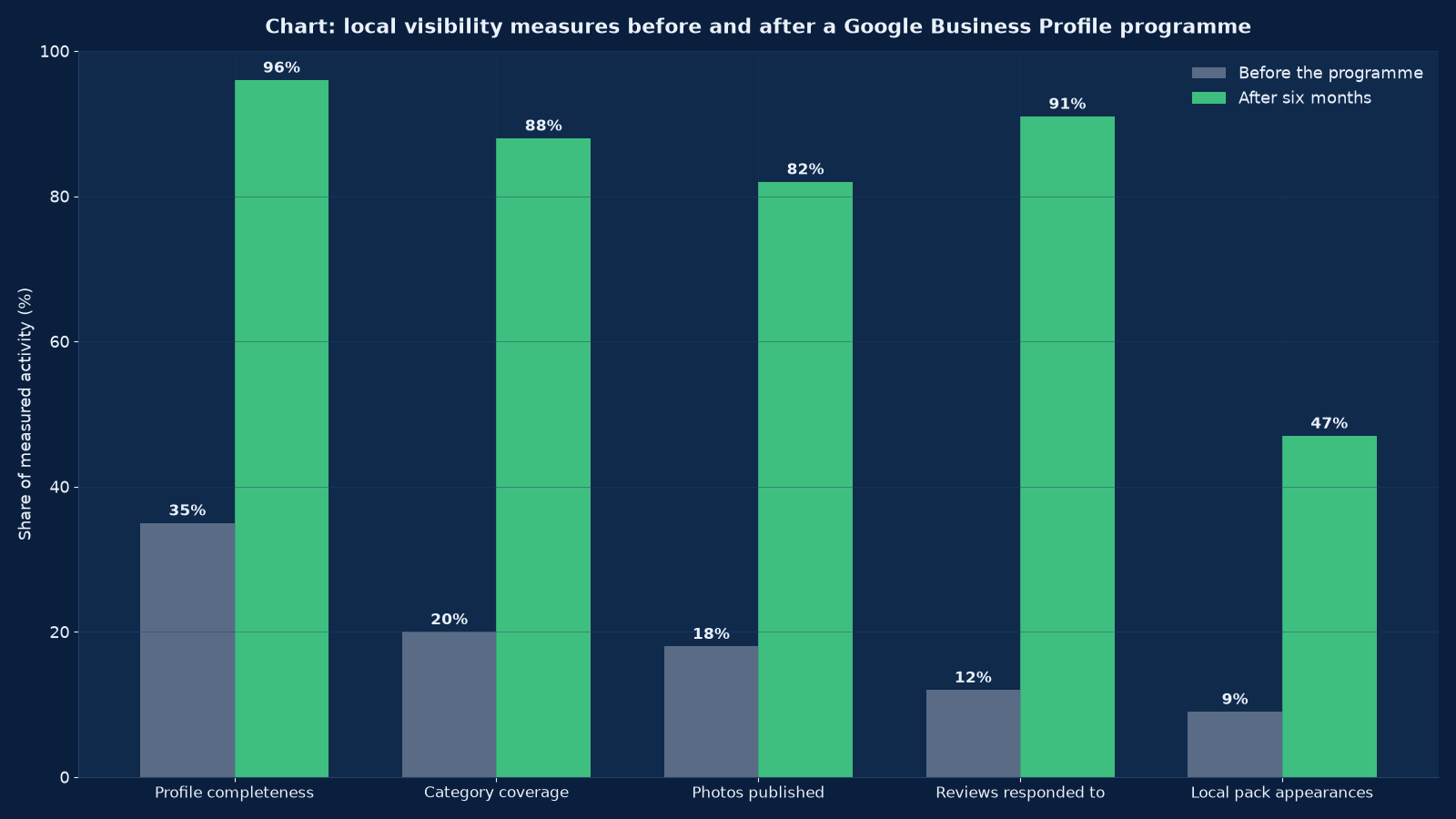
Chart values are an illustrative planning model based on typical UMC engagements and published industry benchmarks. They are not a guarantee of results on any specific project.
Most local businesses do not have a ranking problem. They have a profile that was claimed by an agency in 2016, a primary category chosen at random, four listings that disagree about the phone number, eleven reviews with no reply and a landing page that does not mention the town it is supposed to rank in. Local search punishes inconsistency harder than it rewards cleverness.
Local SEO and Google Business Profile management at Unified Management Consulting is the work of making one business legible to a map. That means a profile whose every field is deliberate rather than default, a category taxonomy that reflects what you actually sell, listings across the web that agree with each other down to the punctuation, a review engine that produces volume and responses without buying either, landing pages written for the place they target, and measurement granular enough to tell you which postcodes you have won and which you have not. Local is the highest-intent traffic on the internet: somebody searching for a service with a town attached is usually holding a phone and a wallet.
We run local programmes for single-site businesses, for multi-location estates with dozens or hundreds of profiles, and for service-area businesses that have no premises to show at all. The three need different designs. A single site is won by depth: one profile done properly, a handful of pages, and a review flow the front desk will actually operate. A multi-location estate is won by governance: a template, an owner per location, and a central report that shows which locations are drifting. A service-area business is won by discipline about what it claims to cover, because an area list that reaches three states is the fastest route to a suspension. Where a client also buys paid media, we align the two so that the same geography is not being paid for twice.
📍 Local SEO & Google Business Profile Management — Quick Summary
| Component | What We Deliver |
|---|---|
| Google Business Profile audit and rebuild | Every field reviewed against what the business actually does: name, categories, services, attributes, hours including special hours, service areas, description, opening date, appointments link and UTM-tagged website URL. |
| Category and service taxonomy | Primary category chosen from measured demand rather than habit, nine secondary categories ordered by relevance, and a services list with descriptions that map to real landing pages. |
| Reviews: generation and response | A request flow the business will operate, a response standard for positive and negative reviews, escalation rules, and a policy that never buys, gates or filters reviews. |
| Photos, posts and Q&A | An imagery-led content calendar: photography briefs for the premises and the work, weekly posts, seeded and answered questions, and product or service items where the category supports them. |
| Citations and NAP consistency | Audit of the listings that exist, correction of the ones that are wrong, suppression of duplicates, and submission to the aggregators and directories that matter for the market. |
| Local landing pages and schema | One page per location or service area, written for that place, with LocalBusiness or sub-type structured data, embedded map, and internal links from the pages that already rank. |
| Local link building and community signals | Sponsorships, chambers, local press, supplier and partner links, and the citations that come from being a real participant in a local economy rather than a directory entry. |
| Grid rank tracking by postcode | Visibility measured on a grid around each location for the keyword set that matters, so a programme is judged on where it wins rather than on one rank from one machine. |
| Suspension and reinstatement support | Diagnosis of why a profile was suspended or a listing duplicated, the evidence pack Google asks for, and the appeal sequence — including the honest answer when the profile is ineligible. |
| Reporting and handover | A monthly report covering pack visibility, calls, direction requests, website clicks, review velocity and sentiment, plus the documentation that lets your team keep it running. |
What This Service Actually Covers
Local SEO is often sold as a package of citations. It is not. Citations are the cheapest part and the part that decays fastest. The work that changes outcomes is the profile taxonomy, the review engine, the landing pages and the measurement — and the reason most local programmes stall is that nobody owns those four after month two.
| Area | What we do | What you keep | Typical duration |
|---|---|---|---|
| Profile audit | Field-by-field review of every claimed listing, with the eligibility and quality guidelines applied to each one | Written audit with severity ratings and the owner of each fix | 1–2 weeks |
| Profile rebuild | Categories, services, attributes, hours, description, photos, appointment links, UTM parameters | A profile whose every field has a documented reason | 1–2 weeks |
| Review engine | Request flow, response templates, escalation, sentiment tagging | A process your front desk operates without us | 2–3 weeks |
| Citation work | Audit, correction, duplicate suppression, aggregator submission | A listing inventory with statuses and a refresh schedule | 2–4 weeks |
| Local landing pages | One page per location or area, written from real local detail, with schema and internal links | Pages that can rank on their own merit | 2–4 weeks |
| Local link building | Community, sponsorship, partner, press and supplier links | A link record with source, date and the reason it was earned | Ongoing |
| Grid tracking | Postcode-level rank measurement across the keyword set that matters | Visibility maps by location and trend by month | Ongoing |
| Suspension support | Diagnosis, evidence pack, appeal sequence | The correspondence and the reasoning, whether or not the appeal succeeds | 1–6 weeks |
| Reporting | Pack visibility, calls, direction requests, clicks, review velocity and sentiment | A monthly report you can hand to a board or a franchisor | Monthly |
| Handover | Documentation, training and a runbook for your team | The ability to run the programme without an agency | At exit |
Two things are deliberately outside this service. We do not buy reviews, and we do not create listings for addresses where you do not have the staffed premises or the eligibility Google’s guidelines require. Both are common in this market, both work briefly, and both end with a suspension that takes longer to clear than the original programme took to build. Where a client wants coverage in a city they cannot legitimately claim, the honest design is a service-area profile, a landing page and paid media — and we will say so in writing.
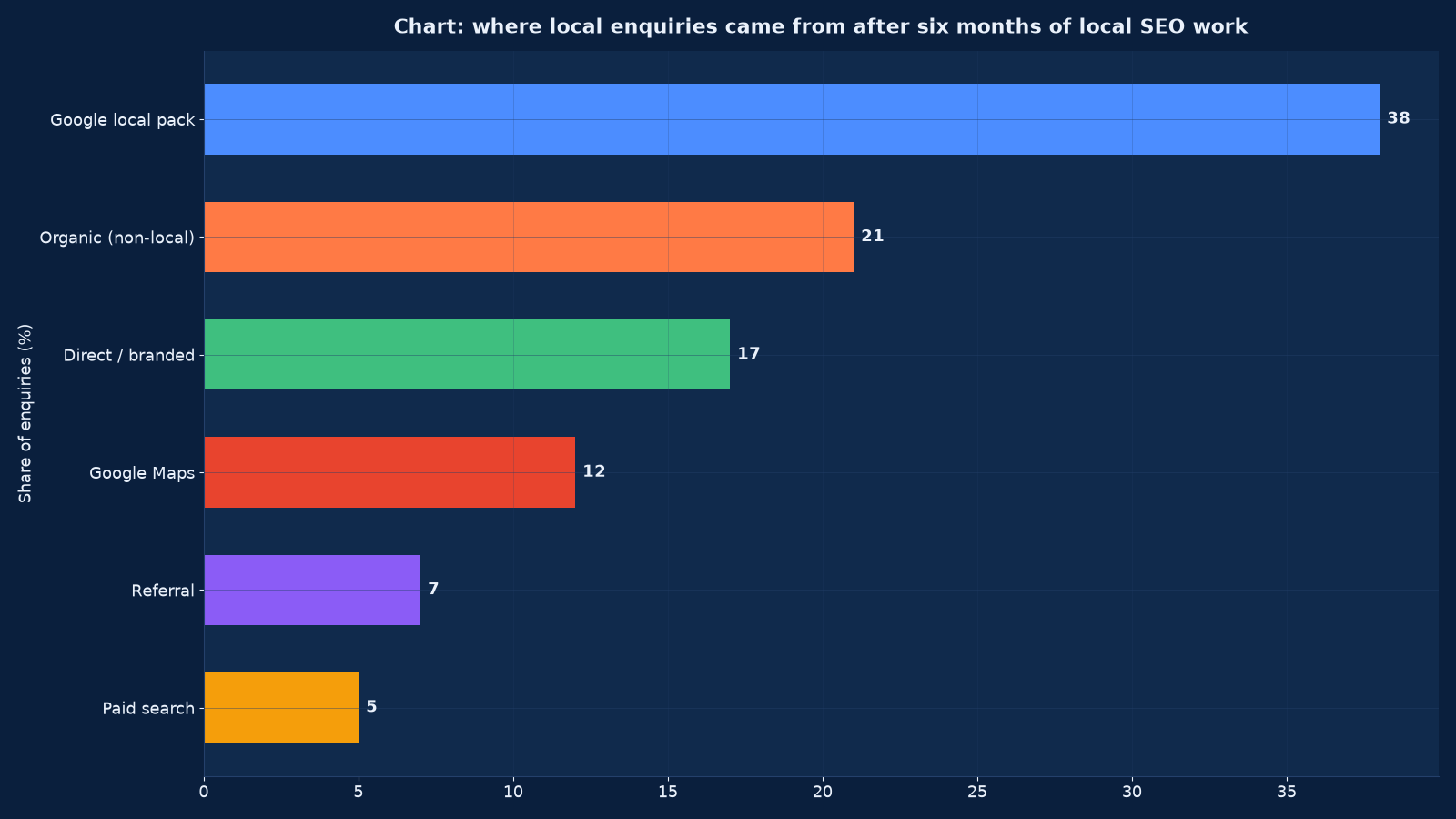
Chart values are an illustrative planning model based on typical UMC engagements and published industry benchmarks. They are not a guarantee of results on any specific project.
Why the Local Pack Is a Different Discipline From Organic Search
The three-pack above the organic results is decided by a different set of inputs, on a different index, with a different appeal process. Teams that run organic well and treat local as an afterthought consistently lose to competitors with weaker websites and better profiles.
| Input | How it behaves in local | What we do about it |
|---|---|---|
| Proximity | Weighted heavily and computed from the searcher’s location, not from a single city centroid; the same query returns different packs three kilometres apart | We track on a grid, not a point, and design landing pages for the areas that are commercially worth winning rather than the ones nearest the office |
| Relevance | Driven by categories, services, description, review text and on-page content — not by keyword density | Category taxonomy chosen from measured demand; services list mapped one-to-one to landing pages |
| Prominence | A function of reviews, links, citations and offline recognition; it accrues slowly and is the hardest input to fake | Review velocity, response rate and a community link programme with a twelve-month horizon |
| Consistency | Name, address and phone disagreements across listings suppress or split confidence in the entity | One canonical NAP record, then every listing corrected to match it, with duplicates merged or suppressed |
| Eligibility | Guidelines decide whether you may have a listing at all; staffed premises, in-person contact, one profile per location | Eligibility assessed before any expansion plan, and the answer recorded even when it is no |
| Behaviour | Calls, direction requests and website clicks are ranking inputs as well as outcomes | UTM-tagged URLs, call tracking where it is lawful and disclosed, and a profile whose hours and phone are always current |
| Appeals | A suspension is handled by a form and a human review, not by an algorithm update | Evidence pack prepared in advance: signage photos, utility documents, lease, staffing — so an appeal is a submission rather than an argument |
The practical consequence is that local work is mostly operational. The strategy fits on one page; the value is in whether reviews get answered on a Tuesday, whether special hours are updated before a holiday, and whether the phone number on the site matches the one on the profile. We build the operating rhythm first and treat the technical work as the thing that makes the rhythm measurable.
The Google Business Profile Audit We Run First
Nothing is changed until the estate is understood. Most audits find that the profile nobody has looked at since it was claimed is carrying a primary category chosen by a directory wizard, a website URL with no tracking, hours that have been wrong for two winters, and at least one duplicate.
| Audit area | What we check | The failure we most often find |
|---|---|---|
| Ownership and users | Who owns the profile, which accounts have manager access, whether a former agency is still the primary owner | An ex-agency is still owner and the business cannot edit its own listing |
| Business name | Exactly the real-world name, with no keywords, locations or legal suffixes added | “Brand | Best Plumber in City”, which is a suspension risk |
| Primary category | The single category that best describes the core service, chosen against measured demand | A generic category that puts the business in the wrong pack |
| Secondary categories | Up to nine, ordered by relevance, none contradicting the primary | Nine categories added by a wizard, several irrelevant |
| Services and products | Each service with a description and a link to a page that supports it | An empty services list, or one with no descriptions |
| Address and map pin | Whether the pin sits on the entrance, and whether the address format matches the postal standard | A pin in the middle of a block or a car park |
| Service areas | Which areas are claimed, whether they are plausible from the address, and whether they are hidden where they should be | Twenty cities claimed from one staffed address |
| Hours and special hours | Regular hours, holiday hours, and whether they match the website | Hours that changed eighteen months ago on the site only |
| Phone and URL | A local number where one exists, and a URL with UTM parameters pointing at the right landing page | A bare homepage URL with no tracking and no local page |
| Description and attributes | 750 characters of accurate description; attributes such as accessibility, payment methods and amenities | An empty description, or one pasted from the homepage |
| Photos and videos | Count, recency, geodata, whether interiors and signage are present | Four stock photos from the year the profile was claimed |
| Reviews | Volume, velocity, rating distribution, response rate, and whether any review pattern suggests filtering | Eleven reviews, none answered, two from 2017 |
| Duplicates and merges | Other profiles for the same entity, old addresses, and third-party duplicates | A duplicate at a former address outranking the live one |
| Listing and citation estate | Aggregators, directories, industry sites and the consistency of NAP across them | Three different phone numbers in circulation |
Categories, Services and the Taxonomy Decision
The primary category is the single highest-leverage field in the profile, and it is the one most often set by whoever claimed the listing first. It determines which pack a business is eligible to appear in, and no amount of review volume fixes a category that puts you in the wrong one.
We choose categories from measured demand rather than from the business’s own vocabulary. That means looking at what customers type, what the autocomplete suggests, which categories the businesses currently winning the pack use, and which category gives an honest match to the service actually delivered. Where a business does two things well, the answer is usually one profile with a primary category for the larger revenue line and secondary categories for the rest — not two profiles, which is a guideline breach and a split in prominence.
| Decision | Question we answer | Evidence used |
|---|---|---|
| Primary category | Which single category best describes the core service, and does the pack for it contain businesses like this one? | Category-level demand, competitor categories, revenue by service line |
| Secondary categories | Which additional categories are true, and in what order? | Service list, landing pages, historic enquiry mix |
| Services list | Which services get an entry, and what does each description say? | The pages that exist on the site, priced service list |
| Attributes | Which attributes are true and verifiable — accessibility, payment methods, amenities, service options? | Site visit or a photo-and-document review |
| Products | Whether the category supports products and whether the catalogue is worth publishing | Catalogue size, imagery availability, price volatility |
| Description | What does 750 characters of honest description say about scope, geography and differentiators? | Positioning work, the landing page, customer language |
| Naming | Whether the real-world name is used exactly, including punctuation and legal suffixes | Signage, registration documents, the website footer |
A taxonomy decision is documented because it will be revisited. Services change, a second location opens, a competitor re-categorises. The record of why the primary category was chosen is what makes the next change a decision rather than a guess.
Multi-Location and Service-Area Estates
Estates with more than a handful of locations fail for governance reasons, not technical ones. Somebody in marketing owns the template; two hundred branch managers own the content; nobody reconciles the two. Six months later, forty profiles have edited their own hours, eleven have added keywords to the business name, and the brand has a suspension problem in three cities.
| Estate type | Design | The control that keeps it honest |
|---|---|---|
| Single location | One profile, deep local pages, review flow run by the front desk | A monthly half-hour check with a written checklist |
| Multi-location, staffed premises | One profile per location, a central template, a named owner per location | Template versioning and a drift report that names the location and the field |
| Franchise | Brand-level governance with local autonomy bounded by rules | A franchisee handbook section, and edit rights that stop short of the business name |
| Service-area business | Address hidden, areas listed and plausible, landing pages per area | An area list reviewed against delivery data every quarter |
| Hybrid, premises plus home visits | One profile per staffed location; home visits described in services, not in extra listings | An eligibility note per location explaining the choice |
| Cross-border estate | Per-country profiles, local language, local phone formats, local directories | A market-by-market citation standard rather than one global list |
Bulk tools exist for a reason and we use them, but a spreadsheet upload is not a strategy. Bulk edits do not fix a wrong category, they propagate it two hundred times. We sequence estate work as: reconcile the canonical record, fix eligibility and duplicates, upload the template, then delegate bounded editing with a drift report behind it.
Reviews: Generation, Response and the Velocity That Matters
Reviews are the prominence input a business can actually control, and the one Google polices hardest. The rule we work to is simple: ask every customer, ask at the moment of satisfaction, make it take ten seconds, and never decide in advance which customers get asked.
| Component | What we build | Why it matters |
|---|---|---|
| Request flow | A short link or QR code to the review form, delivered by SMS, WhatsApp or email at the point of service completion | Friction is the main reason review volume stays low; a link that opens the form directly removes three steps |
| Timing | Triggered by job completion, delivery or discharge rather than by a monthly batch | Satisfaction decays fast; a batch email sent three weeks later converts a fraction as well |
| Staff prompts | A one-line script and a card or counter sign where the business is physical | The highest-volume review sources are asked in person by somebody who just helped the customer |
| Response standard | A response to every review, positive and negative, within two business days, written by a human from a template that is not obviously a template | Response rate is visible to customers and is a trust signal in the pack |
| Negative review handling | Acknowledge, take it offline, correct what is wrong, never argue in public, escalate threats or extortion | An unanswered one-star review costs more than the review itself |
| Sentiment and themes | Reviews tagged by theme so recurring complaints become an operations item | Review text is the cheapest customer research a local business has |
| Policy | No incentivised reviews, no gating, no filtering, no review-gate widgets, and no removal requests except for genuine guideline breaches | These are the practices that get review content stripped or a profile suspended |
| Velocity target | A monthly target set from the competitor set rather than from an absolute number | Prominence is relative; the target is to out-pace the businesses you compete with |
We also handle removal properly. A review that names a member of staff, contains a slur, describes a service never provided, or was posted by a competitor can be flagged under the guidelines, and we prepare the flag with the evidence attached. A review that is simply unfair but true cannot be removed, and the correct response is a professional public reply and a private correction. Telling a client otherwise is how agencies end up promising something Google does not sell.
Photos, Posts, Q&A and Profile Content
Profile content is the part of local SEO that most businesses abandon after the first month, and the part customers actually look at. A profile with nine hundred reviews and four blurry photos from 2016 loses the click to a profile with two hundred reviews and current imagery of the premises, the team and the work.
| Content type | Standard we work to | Notes |
|---|---|---|
| Exterior and signage | Photographed in daylight, showing the real signage that matches the business name | Doubles as suspension evidence |
| Interior and premises | Reception, work area, waiting or seating areas, accessibility features | The most-viewed category for service businesses |
| Team at work | Real staff, real jobs, no stock imagery | Stock photos are a guideline breach and read as such |
| Products or completed work | Before-and-after where appropriate, with captions | The strongest conversion content for trades and clinics |
| Posts | Weekly where the business has news: offers, events, seasonal hours, new services | Posts expire from view; cadence matters more than polish |
| Q&A | Seeded with the questions customers actually ask, and answered by the business | An unanswered question is answered publicly by a stranger |
| Special hours | Updated before every public holiday and every closure | Wrong hours on a holiday generates one-star reviews on their own |
| Booking and order links | Pointing at the right page, with UTM parameters | Untagged links make the profile’s contribution unmeasurable |
Citations, NAP Consistency and the Data That Feeds Them
Citations do not rank a business on their own, and inconsistent citations suppress one. The value of citation work is therefore mostly corrective: finding the listings that already exist with wrong data, fixing or suppressing them, and then maintaining a small number of sources that matter for the market the business operates in.
| Step | What we do | Output |
|---|---|---|
| Canonical NAP record | Agree one authoritative name, address and phone format, with the legal name and trading name recorded separately | A single record every listing is corrected to |
| Discovery | Search the aggregators, directories, industry sites, map services and social profiles for every variant of the business name and address | A listing inventory with URLs and current data |
| Correction | Claim and fix the listings that are wrong, in order of traffic and influence | A corrected-estates report |
| Duplicate suppression | Merge or close duplicates, including ones at former addresses, and document the reason for each | A duplicate register with outcomes |
| Aggregators | Submit or correct the data feeds that syndicate downstream | Feed submission records and the downstream listings they generate |
| Market directories | The directories that matter for the country and industry, not a generic five-hundred-site list | A prioritised list with statuses |
| Social profiles | Consistent name, address, phone and link across the platforms the business actually uses | Profile inventory with owner |
| Maintenance | A quarterly re-check of the top sources and an annual full sweep | A refresh schedule with named owners |
We are sceptical of citation-building packages that promise hundreds of submissions. Most of those directories have no traffic and no influence, several are link farms, and a large volume of low-value listings makes the estate harder to audit later. The measurable win is consistency across the sources that customers and Google actually use.
Local Landing Pages and LocalBusiness Schema
The profile points at a page. If that page is a homepage that never mentions the town, the profile’s relevance signal has nothing to land on. Local landing pages are where on-page and local work meet, and they are the part most often templated into meaninglessness — five hundred near-identical pages with the town name swapped, which Google treats as doorways and users treat as spam.
| Element | What a real local page contains | The doorway-page version to avoid |
|---|---|---|
| Title and headings | The service and the place, phrased the way customers in that place phrase it | Every page titled identically with one word changed |
| Local detail | Neighbourhoods served, landmarks, travel time, local regulation, parking, the team that works there | A paragraph about the city copied from a reference site |
| Evidence | Jobs completed, reviews from that area, photos of local work, local certifications | Stock testimonials with no location |
| NAP block | Address, phone, hours matching the profile exactly | A phone number that differs from the profile |
| Map | An embedded map of the location or service area | A map of a city centroid that is not the premises |
| Schema | LocalBusiness or the correct sub-type, with geo, openingHours, areaServed, sameAs and aggregateRating where reviews are on the page | Schema claiming reviews that are not visible on the page |
| Internal links | Links from the service pages and from other locations, with descriptive anchors | An orphan page reachable only from the sitemap |
| Contact path | One clear action: call, book, or request a visit | Three competing forms and a chatbot |
Structured data is written to match what is visibly on the page. Markup that claims a rating the page does not display, or an address the page does not show, is worse than no markup: it is a manual-action risk and it teaches Google to distrust the rest of the site. We validate every local page with the testing tools and keep the JSON in the repository so it does not drift when a template changes.
Local Link Building and Community Signals
Prominence is built offline as much as online. The links that move a local business are usually unglamorous: the chamber of commerce, a sponsorship of a youth team, a supplier’s partner page, a local newspaper’s coverage of a hiring round, a trade association’s member directory, and the occasional piece of research a journalist finds useful.
- Local press and hyperlocal sites: new premises, hiring, an anniversary, an award, a charitable initiative, a data story about the town.
- Chambers of commerce, business associations and trade bodies — membership listings that are cheap, legitimate and locally relevant.
- Sponsorships: sports clubs, schools, festivals and community events, with the link negotiated before the cheque is written.
- Suppliers, landlords, insurers and trade partners who already list the businesses they work with.
- Local directories that customers use, as opposed to directories that exist to sell links.
- Alumni and staff: people who have left and now run or work at local businesses.
- Original local data: a survey of the town’s high street, footfall, pricing or waiting times, published as a resource.
- Civic and charitable work with a real record, which earns links that no outreach email can buy.
| Tactic | Effort | Expected value | Risk if done badly |
|---|---|---|---|
| Local press story | Medium | High — authoritative, local, referral traffic | Pitching the same story to twenty outlets damages the relationship |
| Sponsorship | Low once agreed | Medium — stable link, community credibility | Sponsoring purely for the link is usually detectable and rarely renewed |
| Association membership | Low | Medium — relevant and durable | Membership of bodies with no local standing adds nothing |
| Partner and supplier pages | Low | Medium — highly relevant | Reciprocal link swaps at scale look exactly like swaps |
| Original local data | High | High — links without asking | Publishing weak data under the brand’s name |
| Directory packages | Low | Low | Adding hundreds of links nobody visits and every future audit has to unwind |
Grid Rank Tracking: Measuring Visibility by Postcode
A local rank checked from one machine in one place is a single data point about that machine. Local results vary by the searcher’s position, by device, by the presence of a service-area competitor, and by the time of day for businesses whose hours matter. We therefore measure on a grid: a set of points around each location, sampled on a schedule, for a keyword set chosen from real enquiry data.
| Measure | Definition | Why it is in the report |
|---|---|---|
| Grid visibility | Share of grid points where the business appears in the local pack for a keyword | Shows where you win, not just whether you win |
| Pack position | Position within the pack where present, averaged across grid points | First position and third position behave differently for calls |
| Organic local position | Position in the organic results below the pack | Separates map work from on-page work |
| Calls and clicks | Profile calls, website clicks and direction requests, with UTMs distinguishing surfaces | The commercial output of the profile |
| Review velocity and rating | New reviews per month, rolling average, response rate and response time | Prominence is a trend, not a snapshot |
| Citation consistency | Share of audited listings matching the canonical NAP record | The leading indicator of a split-entity problem |
| Competitor set | The three to five businesses that actually appear, tracked on the same grid | Explains movement that your own data cannot |
Reporting is monthly and it says what changed and what we are doing about it. A dashboard with forty metrics and no interpretation is not a report, and the reason local programmes lose budget is usually that nobody could explain the numbers to the person holding the budget.
The Twelve-Week Programme
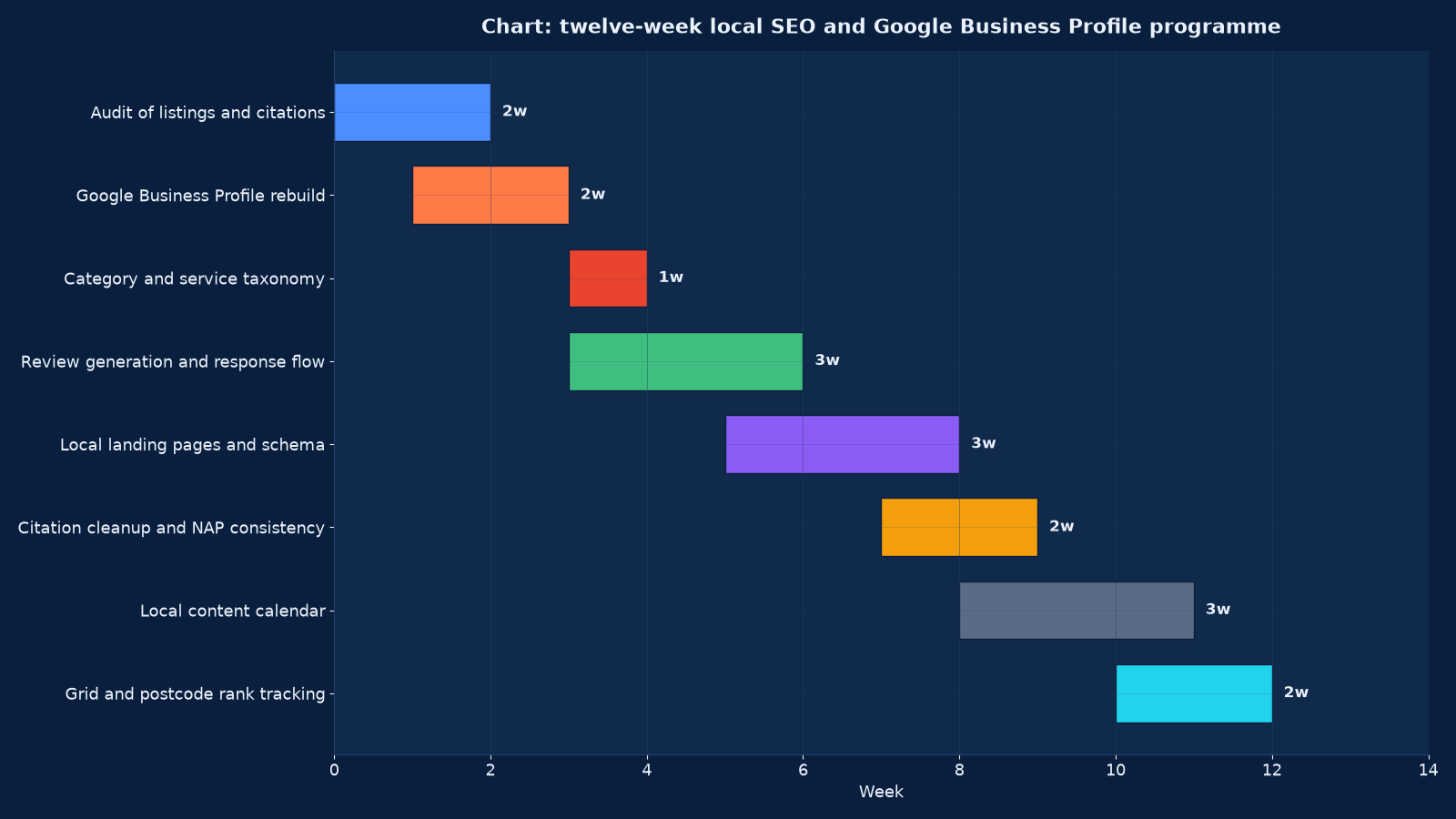
Chart values are an illustrative planning model based on typical UMC engagements and published industry benchmarks. They are not a guarantee of results on any specific project.
| Weeks | Workstream | Output | Owner |
|---|---|---|---|
| 1–2 | Audit of listings and citations; eligibility review; baseline grid capture | Audit report with severities and the canonical NAP record | Consultant plus client marketing lead |
| 2–3 | Profile rebuild: ownership transferred, categories, services, attributes, hours, description, photos | A rebuilt profile with a documented reason per field | Consultant |
| 4 | Category and service taxonomy agreed; landing-page mapping | Taxonomy note and a service-to-page map | Consultant plus service-line owner |
| 4–6 | Review generation and response flow built and trained | Request flow live, response standard published, staff trained | Client operations with consultant support |
| 6–8 | Local landing pages written and published with schema and internal links | Pages live, validated markup, links in place | Consultant plus web team |
| 8–9 | Citation cleanup, duplicate suppression, aggregator correction | Listing inventory with statuses | Consultant |
| 9–11 | Local content calendar: posts, photos, Q&A, community and press activity | Twelve weeks of scheduled content and an outreach record | Consultant plus client marketing |
| 11–12 | Grid and postcode rank tracking configured; reporting cadence agreed | Visibility dashboards and the monthly report template | Consultant |
The programme is twelve weeks to steady state, not twelve weeks to results. Prominence accrues over months; the honest expectation is that the operating rhythm is in place by week twelve, that pack visibility begins moving within the first quarter, and that the review and citation base is materially different at six months. Figure 1 is a six-month picture for that reason.
What We Measure and Report
| Metric | Baseline | Monthly | Six-month target |
|---|---|---|---|
| Profile completeness | Field-by-field score at audit | Re-scored | Above 95 per cent and held |
| Grid pack visibility | Week-1 grid capture | Trend by keyword and grid | A materially larger share of grid points, with the areas that matter won |
| Profile calls | Profile insights export | Count and trend | Rising with visibility, not merely with spend |
| Direction requests | Profile insights export | Count and trend | Rising for premises-based businesses |
| Website clicks from profile | UTM-tagged sessions | Count and landing-page split | Attributable and rising |
| Review volume and rating | Count and average at audit | Velocity, response rate, response time | Velocity above the competitor set, response rate above 90 per cent |
| Citation consistency | Share matching canonical NAP | Re-audited quarterly | Above 95 per cent of audited listings |
| Local landing page performance | Indexed pages and their rankings | Impressions, clicks, conversions per page | Every published local page earning impressions |
| Enquiries and revenue | Existing enquiry tracking | By source, including pack versus organic versus paid | A defensible share of enquiries attributable to local surfaces |
Suspensions, Duplicates and Reinstatement
Suspensions are common enough that every local programme should have a plan for one. They are usually caused by a guideline breach rather than by an enemy, and the appeal process rewards prepared evidence over explanation.
| Cause | Symptom | Route back |
|---|---|---|
| Keyword-stuffed business name | Profile suspended or edited by Google; competitors report it | Restore the real-world name exactly, then appeal with signage and document evidence |
| Virtual office or non-staffed address | Suspension on verification or after a review | Convert to a service-area profile or remove the address; appeal only if the premises are genuinely staffed |
| Multiple profiles for one location | One profile suspended, or two profiles splitting prominence | Close or merge the duplicate with a documented reason |
| Wrong category or ineligible service | Profile removed from the pack without an obvious suspension | Correct the category and services; verify eligibility for the primary category |
| Review manipulation | Reviews stripped, or a profile-level penalty | Stop the practice, remove the widget, and accept the lost content — there is no appeal that restores bought reviews |
| Former owner retains control | The business cannot edit its own listing | Ownership transfer request with business documentation; escalate through support where the former owner does not respond |
We prepare an evidence pack for every client as standard: dated photographs of exterior signage showing the exact business name, a utility bill or lease for the address, registration documents, staff schedules for staffed-hours claims, and the URL of the page that carries the same NAP. It takes an hour to assemble at the start of an engagement and days to assemble in a panic.
Failure Modes We Are Usually Called In To Fix
| What we find | Why it happened | What we do |
|---|---|---|
| A profile owned by an agency that has gone quiet | Nobody recorded the ownership when the contract was signed | Ownership transfer with documentation, and a rule that the business is always primary owner |
| Three phone numbers in circulation | A number change that was applied to the site and not to the listings | Canonical NAP record, then every listing corrected and a change checklist for the future |
| A duplicate at a former address outranking the live profile | The move was never reconciled | Merge or close the old profile with evidence, then re-check the grid |
| A service-area business claiming twenty cities | Growth ambition applied to a guidelines-constrained surface | Reduce the area list to what is genuinely served and support the rest with landing pages and paid media |
| Five hundred templated city pages earning nothing | A doorway-page strategy bought as a package | Prune to the locations worth serving and rebuild those properly with local detail |
| Reviews with a 4 per cent response rate | Nobody was given the job | Named owner, templates, a two-day standard and a weekly review of anything unanswered |
| A profile with strong rankings and no calls | Hours, phone or booking link wrong, or the landing page does not convert | Fix the profile’s conversion path first, then look at the page — usually in that order |
Local SEO and the Rest of the Marketing Stack
Local work multiplies whatever else a business is doing. A paid campaign pointing at a town with no local page converts worse than the same campaign pointing at one; a review base lifts the conversion rate of every channel; a suspended profile removes the cheapest enquiry source the business has. We therefore run local programmes alongside the practice areas that feed them, and we will tell you when the sensible sequence is different from the one you proposed.
- Search Engine Optimisation (SEO) Services — the national organic programme that local pages and internal links sit inside.
- Content Marketing Strategy Services — the local content calendar, community stories and the original data that earns links.
- Google Ads Management Services — paid search in the same geographies, aligned so the two channels are not paying for the same postcode twice.
- Local SEO services in Lucknow — the city-level delivery of this programme, with the local detail that a national page cannot carry.
- Conversion Rate Optimisation (CRO) Services — the landing pages that local traffic arrives on, tested rather than assumed.
- Analytics & Attribution (GA4) Services — the measurement layer that makes UTM-tagged profile clicks and call sources defensible.
- Website Design & Development Services — where local pages are built, and where a template problem becomes a doorway-page problem.
- SMS Marketing Services and WhatsApp Marketing Services — the request flows that actually generate review volume in markets where email does not.
Evidence From Our Work
The engagements and writing below are published on this site and each is described by the subject its own page documents. They are listed because a local programme is usually commissioned by analogy: a client wants to know whether we have done this for a business that looks like theirs.
- Ethnava: taking a Chikankari business from offline to digital — a Lucknow craft retailer whose demand was local and physical before it had an online presence at all: exactly the estate where profile, listings and local pages have to agree.
- Social media advertising for Green Hotel Resort — a hospitality property where enquiries arrive through maps, reviews and social surfaces rather than through a search box.
- Website development for a dance and film studio — a local service business with a single premises, a service-area question and a site that had to carry the town it serves.
- WordPress development for an African medical-tourism company — a multi-region estate where local pages, language and geography have to be designed together rather than generated.
- Ez1.in Services: a ground-up e-commerce platform rebuild — a catalogue business where local collection, delivery areas and product pages intersect.
- Keyword research for businesses: how to find the right keywords — the method behind a local keyword set that comes from enquiry data rather than from volume columns.
- Google Search Console for business owners — where local landing-page impressions and clicks are measured, and how to tell a page that ranks from a page that converts.
- Schema markup and structured data — the LocalBusiness markup standard, and why markup must match what is visible on the page.
- E-E-A-T for SEO — the quality signals a local page has to satisfy, including the ones that come from real local evidence.
- Technology consulting in Lucknow and Choosing an IT company in Lucknow — locally written pages from this practice, which is the standard we ask clients’ local pages to meet.
- The Search Engine Optimization Guide archive — further writing on technical SEO, on-page work and measurement.
Engagement Models and Commercials
Local programmes are usually retainer-shaped, because the operating rhythm is the product. We also run fixed-scope audits for businesses that want to fix things themselves, and estate programmes for multi-location clients where the deliverable is governance rather than content.
| Model | Best for | What you get | Indicative shape |
|---|---|---|---|
| Local audit, fixed fee | A business that wants a diagnosis and will do the work | Profile, listings, pages, reviews and grid baseline, with a severity-ranked plan | Two to three weeks, one fee |
| Single-location retainer | One premises or one service area | Profile management, review engine, content cadence, citations, grid tracking and monthly reporting | Monthly, twelve-month minimum for prominence work to compound |
| Multi-location programme | Ten or more locations, franchises, groups | Template governance, per-location owners, bulk correction, drift reporting, training | Quarterly phases with a monthly governance report |
| Recovery and reinstatement | A suspended profile, a duplicate estate or a review penalty | Diagnosis, evidence pack, appeals, and a rebuild once access is restored | Fixed fee per incident, with the honest caveat that outcomes are Google’s |
| Local plus paid, aligned | A business running both channels in the same geographies | One geography plan, shared landing pages, no duplicate spend, and combined reporting | Retainer across both channels |
Every engagement starts with the audit, even where the client has already bought the retainer, because the audit is what makes the retainer’s targets specific. We publish what we will not do as clearly as what we will: no bought reviews, no fictitious addresses, no guaranteed rankings, and no promise about the outcome of an appeal that is not ours to make.
Frequently Asked Questions About Local SEO & Google Business Profile Management
How long does local SEO take to show results?
The profile fixes and the review engine start changing behaviour within weeks: calls, direction requests and click-through usually move first. Pack visibility across a grid typically takes a quarter to move materially and six months to look different, because prominence accrues from reviews, links and citations rather than from a single edit. Anybody promising first place in thirty days is describing a market with no competition.
Why is my business not in the local pack at all?
Usually one of four reasons: the primary category does not match the query, the profile is not eligible for the address or service area claimed, proximity means a closer competitor wins that point on the grid, or prominence is too low relative to the businesses that do appear. We diagnose this with a grid capture rather than a single search, because the answer is often different three kilometres away.
Should I put my city name in my business name on the profile?
No. Google’s guidelines require the real-world name exactly as it appears on your signage, and adding keywords or locations is a suspension risk. Competitors who do it may rank for a while, and they may also report you if you match them — but the durable answer is to win on relevance and prominence rather than to breach a guideline that is actively policed.
How many reviews do I need?
Enough to out-pace the businesses you compete with for the queries that matter, with a high response rate and a rating that reflects the service you actually deliver. Absolute numbers are less useful than velocity relative to your competitor set, and a sudden spike in reviews from one source is a manipulation signal rather than an achievement.
Can you remove a bad review?
Only if it breaches Google’s review guidelines — offensive content, a conflict of interest, a description of a service you never provided, or personal information. We prepare the flag with evidence. A review that is harsh but accurate cannot be removed, and the right response is a professional public reply plus a private correction. We will not promise removals we cannot deliver.
What is a service-area business and should I be one?
A profile that hides its address and lists the areas it serves — correct for businesses that travel to the customer, such as plumbers, electricians, home healthcare and cleaners. The constraint is that the areas must be plausible from your location and genuinely served; an area list covering three states is both a guideline breach and a reason for suspension.
Do citations still matter?
As a ranking lever, less than they did. As a consistency lever, they matter a great deal: listings that disagree about your name, address or phone number split confidence in the entity. We spend most citation effort finding and correcting what already exists rather than submitting to directories nobody reads.
We have two hundred locations. What is different?
Governance. You need one canonical record, a versioned template, a named owner per location, bounded edit rights so a branch cannot rename the business, and a drift report that names the location and the field when something diverges. Bulk uploads are how you apply the template, not how you design it — a bulk edit propagates a wrong category two hundred times.
My profile was suspended. What happens now?
First, find out why: most suspensions follow a guideline breach such as a keyword-stuffed name, a virtual office, an ineligible address or a duplicate profile. We correct the breach, assemble the evidence pack — dated signage photos, lease or utility bill, registration documents, staffing evidence — and submit the appeal. Outcomes take days to weeks and are Google’s decision; we will tell you honestly if a profile was never eligible.
Should every city we serve get its own landing page?
Only the ones you genuinely serve and can write something true about. A page per city with the town name swapped and nothing else is a doorway page: it earns no rankings, it wastes crawl budget, and it can put the whole domain at risk. We publish pages for locations where we can supply local detail, local evidence and a local contact path.
How does local SEO work with Google Ads?
They should share one geography plan. Paid search can cover areas where you have no legitimate local presence, and local pages improve the Quality Score and conversion rate of the campaigns that point at them. The failure mode is paying for postcodes where the organic profile already wins, or running ads to a homepage while the local page sits unlinked.
What does LocalBusiness schema actually do?
It tells a machine what the page describes: the business type, address, geo-coordinates, opening hours, phone, service area and, where reviews are visibly on the page, an aggregate rating. It does not create rankings on its own, and markup that claims content the page does not display is a risk rather than an asset. We validate it and keep it in version control so template changes do not break it.
Who owns the profile when you finish?
You do, and you should from the first week. We set the business as primary owner, add our accounts as managers, and hand over the credentials, the documentation and the runbook at exit. An agency holding primary ownership of your listing is a dependency you do not want to discover during a contract dispute.
Commission a Local SEO and Google Business Profile Audit
Send us the business name, the addresses or service areas you operate, and the profile access or a screenshot of the current listing. Within three weeks you will have a field-by-field profile audit, a listing and citation inventory with the inconsistencies named, a review position measured against your actual competitors, an assessment of your local landing pages and their schema, a grid visibility baseline for the keywords that matter, and a costed twelve-week plan — including an honest statement of any location where a listing is not the right answer.
Contact Unified Management Consulting to arrange a confidential first conversation.
Related Services
Local SEO and Google Business Profile management is delivered alongside the practice areas that feed it:
- Search Engine Optimisation (SEO) Services — the national organic programme, technical work and content strategy that local pages sit inside
- Content Marketing Strategy Services — the local editorial calendar, community stories and original data that earn links
- Conversion Rate Optimisation (CRO) Services — testing the local landing pages that pack and map traffic arrive on
- Google Ads Management Services — paid search in the same geographies, on one shared plan
- Analytics & Attribution (GA4) Services — the measurement that makes calls, clicks and direction requests attributable
- Local SEO Services in Lucknow — city-level delivery of this programme, with the local detail a national page cannot carry
- Website Design & Development Services and Core Web Vitals & Performance Engineering — the pages and the performance budget local traffic lands on
- Voice Search Optimisation Services — the assistant and in-car queries that resolve to a map result
- SMS Marketing Services, WhatsApp Marketing Services and Email Marketing Campaign Services — the request flows that generate review volume in the channels your customers actually use
- Digital PR & Link Building Services — Digital PR and link building: newsworthy campaigns, data studies, outreach to publishers, authority repair and links measured against rankings
- Technical SEO Audits & Site Migration Services — Technical SEO audits and site migrations: crawl and index control, Core Web Vitals, structured data, migration mapping and pre-launch validation
- International & Multi-Region SEO Services — International and multi-region SEO: hreflang, country targeting, localised content, duplicate-market repair and per-market visibility reporting