Turn paid search data into profitable growth. Unified Management Consulting combines advanced Google Ads management, conversion engineering, analytics, and management consulting to help businesses generate qualified demand—not just clicks.
At-a-Glance Performance Framework
| Growth stage | What we improve | Key technical signals | Business outcome |
|---|---|---|---|
| Reach | Query coverage, audience, geography, placements | Impressions, impression share, reach, search visibility | More relevant market exposure |
| Engage | Ad relevance, assets, offers, message match | CTR, engagement rate, asset performance, video views | Higher-quality visits |
| Convert | Landing pages, forms, calls, checkout | Conversion rate, CPA, call quality, purchase value | More leads, bookings, or sales |
| Qualify | CRM stages, lead scoring, sales follow-up | MQLs, SQLs, opportunities, qualified calls | Better sales pipeline |
| Scale | Bidding, budget, automation, profitability | ROAS, CAC, margin, LTV, marginal CPA | Sustainable growth |
Illustrative Cost-Per-Qualified-Lead Trend
The chart below is an illustrative planning model, not a guarantee of results.
📋 Google Ads — Quick Summary
| Service | What We Do |
|---|---|
| Search Campaigns | Keyword strategy, ad copy, bid management, and Quality Score optimization |
| Performance Max | AI-driven campaigns across all Google surfaces with asset optimization |
| Shopping Ads | Product feed management, Merchant Center optimization, and smart shopping |
| Display & Video | Display network, YouTube ads, and remarketing campaign management |
| Key Results | 3-8x ROAS, 40-60% lower CPA, 95%+ impression share on key terms |
| Investment | $2,000-$10,000/month management + ad spend |
textCost per qualified lead

100 | ████████████████████████████████████████  Audit baseline
 90 | ██████████████████████████████████        Query cleanup
 80 | ███████████████████████████████           Tracking repair
 70 | ███████████████████████████               Landing-page testing
 60 | ███████████████████████                   Bid and budget optimization
 50 | ███████████████████                       CRM feedback
 40 | ███████████████                           Controlled scaling
     +----------------------------------------------------------------
       Month 1      Month 2      Month 3      Month 4      Month 5
The Paid Search Performance Funnel
textSearch demand
      ↓
Relevant keyword, audience, and location targeting
      ↓
Ad impression with clear value proposition
      ↓
Qualified click to a message-matched landing page
      ↓
Tracked call, form, booking, purchase, or enquiry
      ↓
CRM qualification and sales follow-up
      ↓
Offline conversion, revenue, margin, and lifetime value
Example Google Ads Message Table
| Search intent | Headline 1 | Headline 2 | Headline 3 | Description | CTA |
|---|---|---|---|---|---|
| Ready to hire | Google Ads Management Services | Improve Leads and ROAS | Technical PPC Specialists | Get structured campaigns, accurate conversion tracking, and ongoing optimization from a consulting-led partner. | Request an audit |
| Tracking problem | Fix Google Ads Tracking | Connect Ads to Your CRM | Stop Optimizing Blind | Find duplicate conversions, missing lead stages, broken tags, and data gaps that can distort automated bidding. | Review tracking |
| Growth planning | Scale Paid Search With Confidence | Build a Better Acquisition System | Unified Management Consulting | Align budget, campaigns, landing pages, sales capacity, and profitability around measurable commercial outcomes. | Plan your growth |
| Ecommerce | Improve Shopping Campaign Performance | Track Purchase Value Correctly | Optimize Product Feeds | Strengthen Merchant Center data, product segmentation, value tracking, and Performance Max decision-making. | Improve ecommerce |
| Local business | Reach More Local Customers | Generate Better Calls and Leads | Location-Focused Google Ads | Target the areas you serve, improve call quality, and connect local advertising with booked work. | Get a local strategy |
Unified Management Consulting provides technically rigorous Google Ads management services for businesses that need more than basic campaign setup. We combine paid media strategy, account architecture, conversion engineering, data analysis, automation, and management consulting to create advertising systems that can be measured against qualified leads, sales, revenue, and profitability.
Google advertising is not simply a process of selecting keywords and writing headlines. Modern Google Ads accounts involve auction dynamics, machine-learning bidding, audience signals, conversion modelling, privacy controls, product feeds, analytics integrations, server-side data, offline conversion imports, and landing-page performance. If these elements are not configured correctly, an account can produce impressive click and impression numbers while sending poor-quality traffic or making decisions from unreliable data.
Unified Management Consulting helps businesses connect the technical components of Google Ads with the commercial realities of their organization. We investigate what the account is measuring, how the platform is optimizing, which users are being targeted, how leads are qualified, and whether advertising performance can be reconciled with sales and financial results.
A Complete Technical Google Ads Management Framework
Our Google Ads management services can include account audits, campaign architecture, keyword and query analysis, ad asset development, audience strategy, bidding, budget allocation, conversion tracking, Google Tag Manager implementation, GA4 integration, enhanced conversions, offline conversion imports, feed optimization, landing-page analysis, Google Ads scripts, reporting, experimentation, and performance governance.
The correct solution depends on the business. A local service company may require accurate call tracking and CRM feedback. An ecommerce business may require a clean Merchant Center feed, purchase-value tracking, product segmentation, and margin-aware reporting. A B2B company may need lead-stage imports because a form submission is not the final business outcome. A multi-location enterprise may need standardized naming, data governance, access controls, and portfolio-level budget management.
The objective is not to use every available feature. The objective is to implement the features that improve decision quality and profitable growth.
Google Ads Account Architecture
Campaign and Ad Group Design
Account structure should make it possible to answer important questions. Which service, product, audience, location, or intent category generated the result? Which campaign deserves additional budget? Where is spend being wasted? Which message is producing qualified opportunities?
We design architecture around meaningful differences in business objective, targeting, budget, geography, product category, customer intent, or reporting need. Depending on the account, this can include separate campaigns for:
- Brand and non-brand search demand.
- High-margin and low-margin services.
- Individual products or product categories.
- Different cities, regions, or service areas.
- New customer acquisition and remarketing.
- Lead generation and direct sales.
- High-intent, research, and competitor queries.
- Different budgets or operational teams.
Too little segmentation hides important differences. Too much segmentation fragments data, delays learning, and makes management unnecessarily complex. We select a level of structure that supports control without creating dozens of campaigns with insufficient conversion volume.
Naming Conventions and Governance
Technical management becomes difficult when campaigns, ad groups, assets, and conversion actions have inconsistent names. We use naming conventions that can communicate channel, objective, geography, offer, audience, and status. For example, a standardized name may distinguish a search campaign, a specific service, a region, and a lead-generation objective.
Governance can also include access-level reviews, administrator ownership, billing responsibility, change history, tracking documentation, URL conventions, UTM standards, and approval procedures. These controls are particularly important when multiple agencies, internal teams, locations, or technology vendors work in the same account.
Budget Architecture
Budgets should reflect both opportunity and capacity. A high-volume campaign may consume all available spend while a strategically important campaign remains limited. We review impression share, lost impression share due to budget, conversion efficiency, conversion value, seasonality, service capacity, and sales priorities before recommending reallocations.
Budget decisions should not be based only on cost per click. A more expensive click may produce higher-value customers, while cheap traffic may produce low-quality leads. For businesses with known revenue or margin data, we can evaluate spend against qualified pipeline, gross profit, customer acquisition cost, and return on advertising spend.
Keyword Targeting and Search Query Engineering
Match Types and Intent
Google Ads keyword targeting uses broad match, phrase match, and exact match concepts, but the selected match type does not mean ads will show only for a literal phrase. The platform interprets close variants, intent, and context. This makes search-term analysis essential.
Broad match can help discover demand and provide machine-learning systems with wider signals, especially when reliable conversion tracking and appropriate bidding are available. Phrase and exact match can offer additional control around high-value intent categories, but they are not substitutes for monitoring actual queries. We evaluate match types based on conversion volume, query relevance, budget, competition, and the business’s tolerance for exploratory traffic.
Search-Term Analysis
The search terms report is one of the most valuable technical resources in a search account. We classify queries according to relevance, intent, customer type, location, product, lifecycle stage, and business value. This process can reveal:
- New keyword opportunities.
- Irrelevant themes requiring negative keywords.
- Queries that indicate research rather than buying intent.
- Brand or competitor demand.
- Product names and technical terminology.
- Locations outside the service area.
- Job-seeker, training, free, support, or DIY traffic.
- Search language that should be incorporated into ad copy or landing pages.
Negative keywords should be managed carefully. Overly aggressive exclusions can block valuable traffic, while insufficient exclusions waste budget. We use campaign- and ad-group-level negative keyword logic where appropriate and review conflicts that might prevent intended queries from entering the correct campaign.
Keyword-to-Message Mapping
A strong account maps related query themes to relevant ad groups, assets, and landing pages. For example, searches for a specific service should not automatically be sent to a generic homepage if a more relevant service page exists. Message alignment can improve user experience, ad relevance, landing-page relevance, and conversion probability.
We also consider the difference between informational, commercial investigation, and transactional searches. A searcher seeking a definition may need educational content, while a searcher looking for a provider may need proof, pricing guidance, availability, and a direct contact path.
Google Ads Auction and Ad Rank Fundamentals
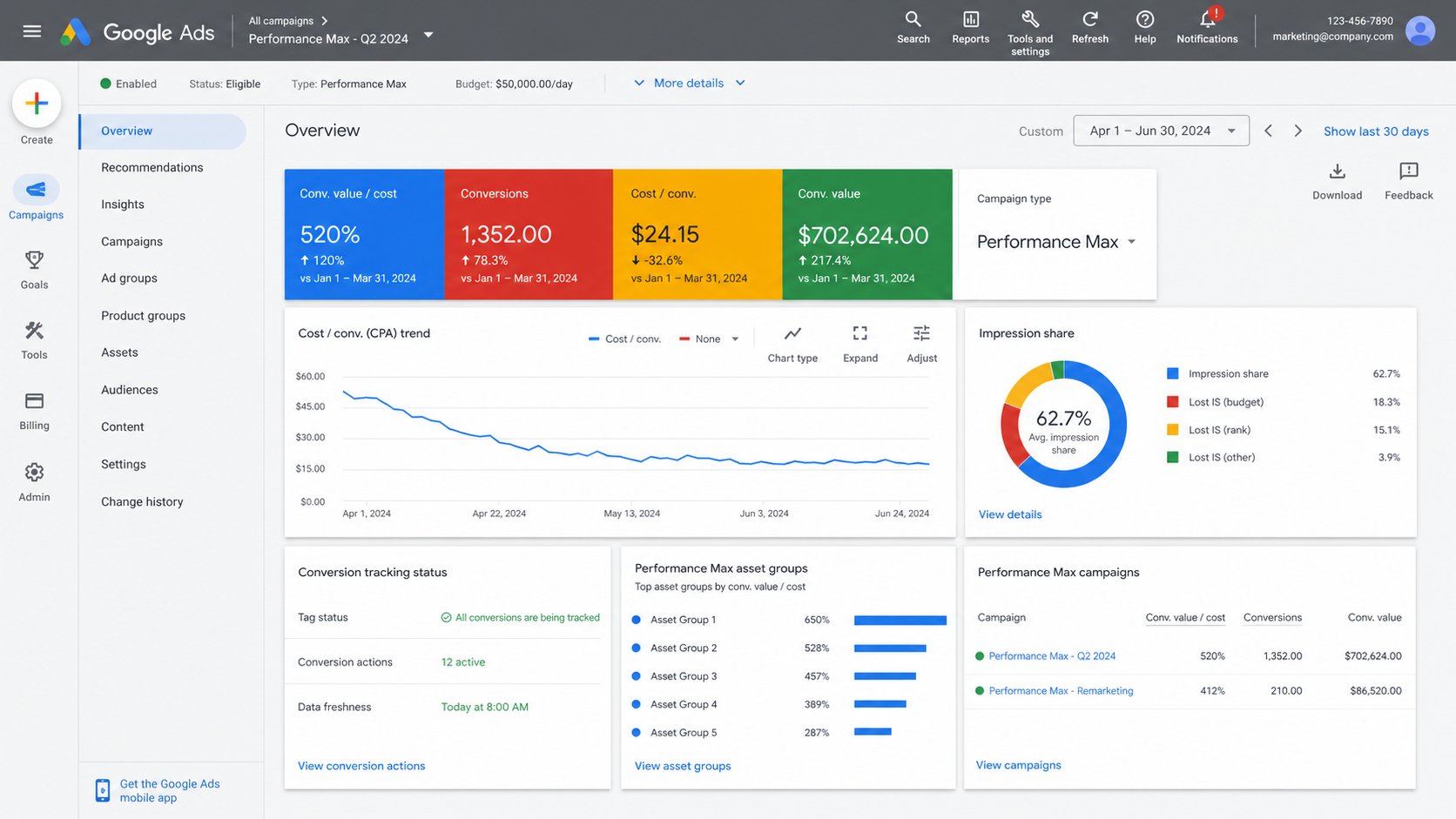
Google’s auction evaluates eligible ads each time a user searches. Actual position and eligibility are influenced by bid, ad quality, expected impact of assets, thresholds, search context, and competition. Paying more does not guarantee the best result, and a lower bid can sometimes compete effectively when relevance and expected user experience are strong.
Quality-related components include expected click-through rate, ad relevance, and landing-page experience. Quality Score is a diagnostic indicator rather than a direct billing factor, but its components can help identify weaknesses in relevance and experience. We do not optimize for a high Quality Score in isolation. We optimize for qualified outcomes, because a highly relevant ad that attracts the wrong audience is not commercially successful.
Ad assets—formerly commonly called extensions—can improve visibility and provide additional paths to action. Depending on eligibility and account type, these may include sitelinks, callouts, structured snippets, image assets, lead forms, call assets, location assets, price assets, promotion assets, and app assets. Assets should be relevant, accurate, and consistent with the landing-page experience.
Search Campaign Configuration
Search campaign settings require careful review. Important controls can include:
- Networks included in the campaign.
- Location targeting and location-interest settings.
- Presence versus presence-or-interest geographic options.
- Language targeting.
- Ad schedule and time-zone configuration.
- Device performance and user context.
- Conversion goals used for optimization.
- Audience observation or targeting settings.
- Final URL and tracking templates.
- Auto-tagging and UTM parameters.
- Brand-safety and content exclusions where relevant.
Location targeting is frequently misunderstood. A business serving only specific areas may need to target people physically present in those areas rather than people merely showing interest in them. We validate location settings against the actual service model and examine location reports for wasted spend.
Ad scheduling should reflect operational reality. A campaign designed to generate phone calls may need different schedules from a campaign designed to collect online forms. However, we avoid making bid adjustments solely from small data sets. Sufficient volume and a clear business reason are needed before applying granular controls.
Responsive Search Ads and Asset Testing
Responsive Search Ads use multiple headlines and descriptions that Google can combine into different configurations. Technical management involves supplying diverse but compatible assets, avoiding repetitive variations, pinning only when necessary, and monitoring combinations and performance signals.
We develop assets around distinct message angles, such as:
- Core service or product relevance.
- Customer problem and solution.
- Business differentiator.
- Expertise or credentials.
- Location and availability.
- Process clarity.
- Offer, pricing, or next step.
- Trust and proof.
Testing should be controlled enough to learn but flexible enough for the platform to serve combinations. We review asset-level indicators alongside conversion data, query quality, and landing-page performance. A label such as “low” or “best” is not a substitute for analyzing real business outcomes.
Bidding Strategies and Conversion-Based Optimization
Google Ads bidding strategies can include manual or automated approaches, depending on campaign type and account conditions. Automated strategies may optimize toward clicks, conversions, conversion value, target cost per action, target return on ad spend, or other objectives. The right approach depends on data quality, conversion volume, budget stability, margins, and the reliability of the goal being optimized.
Maximize Clicks
This strategy can be useful for traffic-generation or early exploration, but it may prioritize volume rather than business value. It requires strict query, audience, and budget monitoring.
Maximize Conversions
This strategy uses available conversion signals to seek more conversions within budget. It can be effective when primary conversions are accurate and meaningful. If micro-conversions or unqualified actions are included, automation may optimize toward the wrong behavior.
Target CPA
Target cost per acquisition attempts to obtain conversions at an average target cost. The target must be realistic relative to historical data, competition, conversion lag, and available budget. A target that is too restrictive can reduce volume.
Maximize Conversion Value
For ecommerce and revenue-tracked accounts, this strategy seeks to maximize total conversion value rather than simply count conversions. Values must be accurate, deduplicated, and representative of actual business value.
Target ROAS
Target return on ad spend can support value-based optimization, but an aggressive target may limit delivery. It should be evaluated against gross margin, refunds, shipping costs, repeat purchases, and the difference between revenue and profit.
We review learning periods, bid strategy status, conversion volume, budget constraints, seasonality, conversion lag, and major changes before judging a bidding strategy. Constantly changing bids and settings can reset learning and make performance difficult to interpret.
Conversion Tracking: The Technical Foundation
Conversion tracking determines what Google Ads considers success. A technically advanced account may track website forms, button clicks, phone calls, purchases, appointment bookings, qualified leads, and offline sales. The challenge is ensuring that each action is correctly defined, fired once, attributed appropriately, and assigned the right value.
Google Tag Manager
Google Tag Manager can be used to deploy and manage tags, triggers, and variables without editing website code for every change. We review container structure, tag firing conditions, trigger specificity, data-layer availability, consent behavior, duplicate tags, and debugging results.
A robust implementation may use a data layer to pass structured values such as transaction ID, currency, product information, lead type, form status, customer value, or order total. Data-layer events are generally more reliable than fragile selectors based on changing page elements.
GA4 and Google Ads Linking
GA4 can provide event and conversion data for analysis, while Google Ads can use selected conversion actions for campaign optimization. Linking must be configured carefully to prevent duplicate conversions from imported events and native Google Ads tags. We check event naming, event parameters, conversion marking, attribution settings, cross-domain behavior, referral exclusions, and data retention considerations.
Enhanced Conversions
Enhanced conversions can supplement first-party customer information in a privacy-conscious, hashed format to improve conversion measurement when browser signals are limited. Implementation requires correct capture of consented user-provided data, normalization, hashing or platform-supported handling, and testing. Enhanced conversions are not a replacement for a properly designed consent process or accurate primary conversion events.
Consent Mode and Privacy Controls
Consent requirements vary by jurisdiction and business context. Consent Mode can communicate user consent choices to Google tags and support modelling when users do not grant certain permissions. Implementation should work with the organization’s consent management platform and legal guidance. We review whether tags fire before consent, how consent states are passed, whether analytics and advertising storage are handled separately, and whether the implementation matches the site’s privacy notice.
Call Tracking
Phone calls may be a major conversion source for service businesses. Tracking can include calls from ads, calls from a website number replacement system, call duration thresholds, missed calls, answered calls, and qualified outcomes. A call lasting 30 seconds is not necessarily equivalent to a booked appointment. Where possible, call outcomes should be fed back into reporting and optimization.
Offline Conversion Imports
A form submission is often only the first step in a sales process. Offline conversion imports can connect Google Ads clicks with later CRM stages such as qualified lead, appointment attended, proposal accepted, customer acquired, or revenue recognized.
Identifiers such as Google Click ID, enhanced conversions for leads, or other supported methods must be captured and stored accurately. The CRM process must preserve the association between the lead and advertising interaction. Import schedules, conversion names, time zones, deduplication rules, event values, and validation procedures require careful design.
Ecommerce and Merchant Center Technical Management
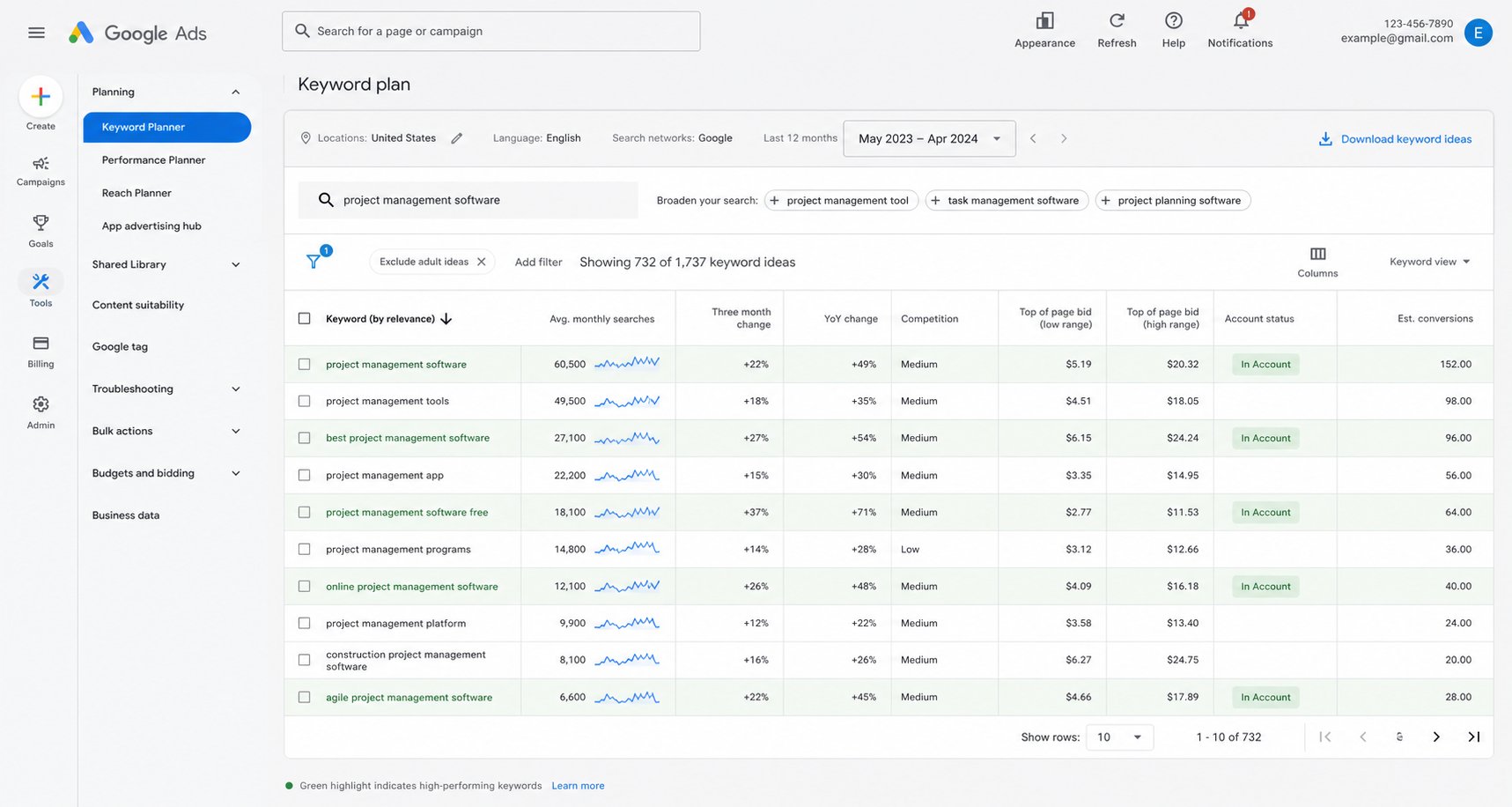
For ecommerce advertisers, product data is central to campaign performance. Merchant Center feeds should contain accurate titles, descriptions, links, prices, availability, brand, GTIN where applicable, condition, images, shipping information, tax settings, and product identifiers.
We review feed errors, disapprovals, mismatched price or availability, image quality, product categorization, custom labels, sale pricing, shipping configurations, and supplemental feed logic. Custom labels can support segmentation by margin, bestseller status, seasonality, inventory, price range, or strategic priority.
Purchase tracking should pass transaction ID, value, currency, tax and shipping treatment where appropriate, and product-level data. Duplicate purchases, test transactions, refunds, payment failures, and cross-domain checkout issues can distort reporting. For businesses that need profit-aware decisions, revenue values may need to be adjusted to account for product margin, returns, fulfillment, or customer acquisition economics.
Performance Max and Cross-Channel Campaigns
Performance Max campaigns can access multiple Google surfaces using creative assets, product data, audience signals, conversion goals, and machine-learning systems. Because the campaign spans inventory, measurement and input quality are particularly important.
We evaluate asset group organization, listing groups, audience signals, search themes, brand exclusions where appropriate, URL expansion, final URL rules, location settings, customer acquisition goals, new-customer value, and conversion goals. Audience signals guide the system but do not function as strict targeting in the same way as traditional audience targeting.
Performance Max should not be treated as a black box. We analyze available search-category information, asset performance, product performance, placement and content controls where available, brand traffic, new versus returning customers, and the quality of conversions. In lead-generation accounts, strict conversion definitions and CRM feedback are especially important because automated systems can otherwise pursue inexpensive but low-quality actions.
Display, YouTube, and Remarketing Technical Considerations
Display and YouTube campaigns require a different measurement framework from high-intent search. We consider audience composition, frequency, viewability, video completion, engaged visits, assisted actions, placement quality, content suitability, and incremental impact.
Remarketing audiences may be created from website visitors, product viewers, cart abandoners, past purchasers, customer lists, or engaged video viewers, subject to eligibility and privacy requirements. Audience duration, exclusions, frequency controls, creative rotation, and customer-list consent must be managed carefully.
We also separate prospecting from remarketing where useful. Mixing audiences with different levels of intent can make budget and performance analysis unclear. A prospecting campaign may be judged on qualified new-user actions, while a remarketing campaign may be judged on assisted conversion, return purchase, or recovery of abandoned intent.
Analytics, Attribution, and Data Quality
Attribution is an interpretation of the customer journey, not a perfect record of causation. Google Ads reports may differ from GA4, CRM reports, call-tracking platforms, and finance systems because they use different scopes, attribution models, lookback windows, time zones, filters, and definitions.
We document the source of truth for each decision. For example, platform data may be useful for campaign optimization, while CRM and finance data may be more appropriate for evaluating qualified pipeline and profitability. We investigate discrepancies rather than automatically assuming one system is wrong.
Data-quality checks can include:
- Comparing platform conversions with backend records.
- Checking duplicate event IDs and transaction IDs.
- Testing thank-you pages and form events.
- Validating currency and decimal formatting.
- Confirming time zones and conversion dates.
- Reviewing consent-related signal loss.
- Checking cross-domain and payment-provider referrals.
- Monitoring sudden drops or spikes in conversion volume.
- Separating test traffic from production data.
- Confirming that phone and offline conversions are not double-counted.
Automation, Scripts, and Monitoring
Automation can improve account hygiene and reduce manual errors. Depending on account requirements, we may use alerts, scheduled checks, spreadsheets, dashboards, or Google Ads scripts to monitor items such as disapproved ads, broken URLs, unusual spend, zero-impression campaigns, conversion tracking changes, budget exhaustion, or sudden performance deviations.
Automation should support human judgment rather than replace it. A script that pauses a campaign after a simple threshold may create problems when conversion lag, seasonality, or a planned promotion is involved. We define thresholds, exclusions, notification recipients, and review processes before using automated changes.
Reporting dashboards can combine Google Ads, GA4, CRM, call tracking, and ecommerce data. Useful dashboards show trends, comparisons, annotations, funnel stages, budget pacing, and recommended actions. A dashboard should answer management questions, not merely display every available metric.
Technical SEO and Landing-Page Interaction
Paid advertising and organic search are separate channels, but landing-page quality affects both. We review page relevance, indexable content where appropriate, mobile layout, Core Web Vitals, server response, image size, form usability, accessibility, structured content, internal links, and technical errors that could reduce user confidence or conversion rate.
Paid landing pages do not always need to be built for organic rankings, but they should be fast, clear, accessible, and aligned with the ad promise. Tracking parameters must be preserved through redirects, form submissions, booking systems, and payment flows where attribution depends on them.
Google Ads Reporting for Executives and Marketing Teams
Technical data is useful only when it supports decisions. We provide reporting at two levels. The executive view focuses on spend, qualified outcomes, revenue or pipeline, acquisition cost, return, risks, and decisions required. The operational view can include campaign trends, query changes, asset tests, bidding status, tracking health, budget pacing, and next actions.
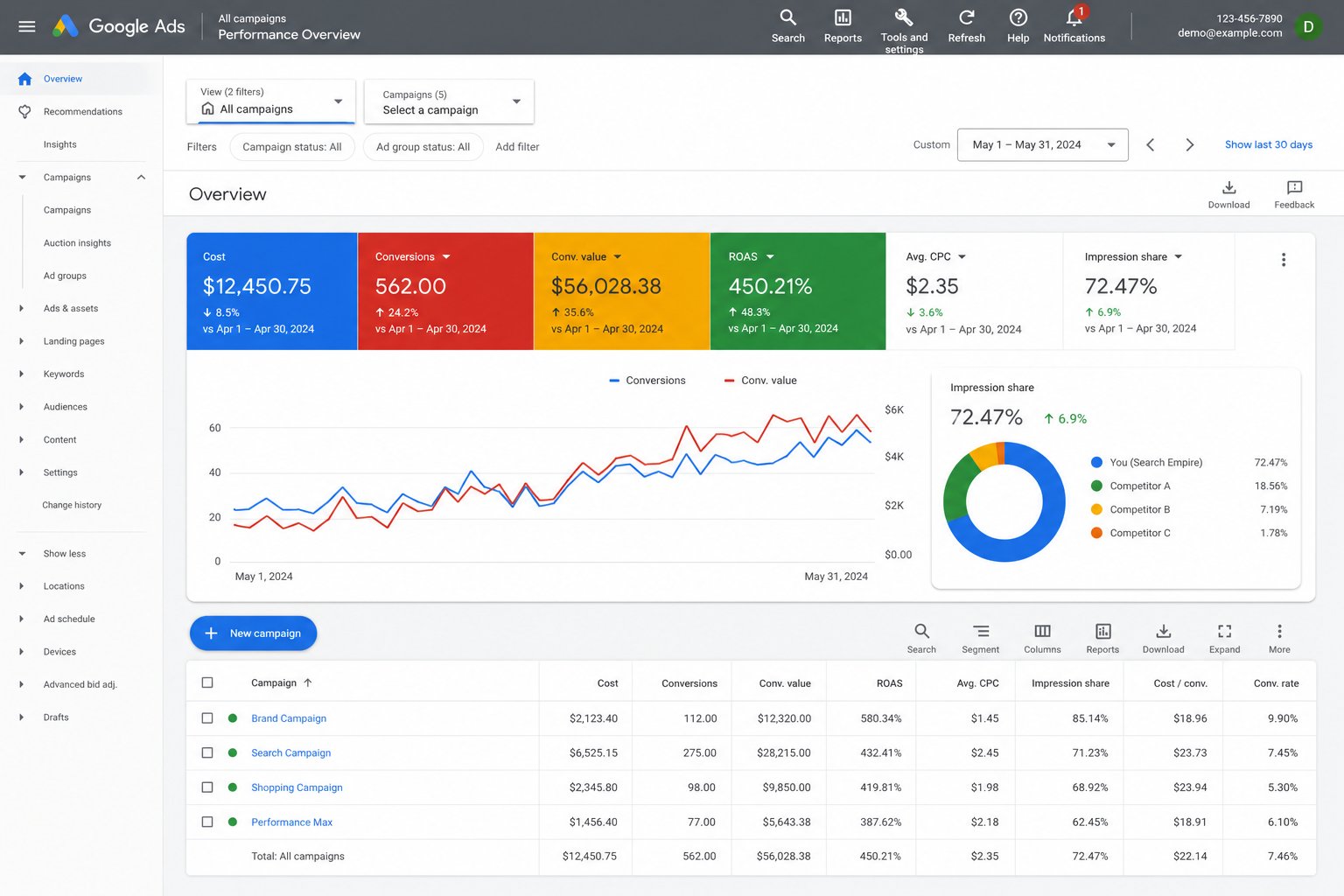
We can report metrics such as impressions, clicks, click-through rate, average cost per click, impression share, search lost impression share, conversions, conversion rate, cost per conversion, conversion value, return on ad spend, new-customer rate, lead qualification rate, opportunity value, and customer acquisition cost.
Metrics are interpreted in context. For example, a lower conversion rate may be acceptable if the campaign has expanded into a more valuable audience. A higher cost per lead may be positive if lead-to-sale rate has improved. A high return on ad spend may be misleading if it comes primarily from existing customers or branded searches. We connect the metric to the question it is meant to answer.
A Technical Audit Before You Increase Budget
Increasing budget before fixing measurement and targeting can scale waste. Before recommending expansion, we assess:
- Whether primary conversion actions represent real business outcomes.
- Whether conversion values are accurate and deduplicated.
- Whether search terms are relevant.
- Whether location and language settings match the service area.
- Whether landing pages load and function correctly on mobile.
- Whether leads are being contacted and qualified promptly.
- Whether campaigns are limited by budget or by demand.
- Whether additional spend can be supported operationally.
- Whether marginal conversions remain profitable.
- Whether the account has enough reliable data for automation.
This approach helps prevent the common mistake of scaling a reporting problem rather than scaling a successful acquisition system.
Why Unified Management Consulting Is Different
Unified Management Consulting combines Google Ads expertise with management consulting. We do not treat advertising as an isolated technical channel. We consider customer economics, sales capacity, operations, reporting, technology, and leadership priorities.
Our service can support organizations that need:
- A new account built on a documented technical foundation.
- An independent audit of an existing Google Ads account.
- Tracking and analytics repair.
- Lead-quality and CRM integration.
- Ecommerce and Merchant Center optimization.
- Multi-location campaign governance.
- Budget and profitability analysis.
- Ongoing optimization and reporting.
- Strategic advice across marketing and management.
You retain ownership and visibility of your advertising assets. Recommendations are explained, priorities are documented, and decisions are tied to measurable objectives.
Frequently Asked Technical Questions
Can you work with Google Tag Manager and GA4?
Yes. We can review or plan implementations involving Google Tag Manager, GA4, Google Ads conversion tags, event configuration, data layers, cross-domain measurement, consent controls, and conversion imports. Access and implementation requirements depend on your website and technology stack.
Can you track qualified leads instead of only form submissions?
Yes. Where your CRM captures the required identifiers and lifecycle stages, offline conversion imports can connect advertising interactions with qualified leads, opportunities, sales, and revenue. This generally produces more useful optimization data than treating every form submission as equal.
Can you support server-side or enhanced measurement?
We can assess whether enhanced conversions, consent-aware tagging, server-side collection, or CRM-based imports are appropriate. The implementation depends on your privacy requirements, platform architecture, developer resources, and data governance.
Do you manage Google Merchant Center feeds?
Yes, when ecommerce is part of the engagement. We can review feed health, product attributes, disapprovals, custom labels, product segmentation, price and availability synchronization, and purchase-value measurement.
Do you guarantee a specific ROAS or number of leads?
No responsible provider can guarantee a specific result without controlling the market, offer, website, competition, budget, and sales process. We establish a measurable framework, identify assumptions, test improvements, and report transparently on outcomes and limitations.
How often should a Google Ads account be optimized?
Monitoring frequency depends on spend and conversion volume. High-spend accounts may need frequent checks, while smaller accounts can be reviewed on a structured weekly or monthly schedule. Optimization should be consistent but not reckless; changing too many variables at once can make results impossible to interpret.
Build a Measurable Google Advertising System
Google advertising rewards businesses that combine technical accuracy with commercial clarity. Correct tracking, clean data, relevant queries, strong ad assets, appropriate bidding, reliable feeds, fast landing pages, and CRM feedback all contribute to better decisions.
Unified Management Consulting provides Google Ads management services for organizations that want this level of discipline. We help you understand not only what your campaigns are doing, but why they are doing it and what should happen next.
Contact Unified Management Consulting for a technical Google Ads audit, conversion-tracking review, or customized advertising management plan.
Suggested SEO Metadata
SEO title: Technical Google Ads Management Services | Unified Management Consulting
Meta description: Get advanced Google Ads management services covering account structure, bidding, conversion tracking, GA4, Google Tag Manager, enhanced conversions, CRM imports, feeds, and reporting.
Suggested URL slug: /technical-google-ads-management-services/
Primary keyword: Google Ads management services
Secondary keywords: Google advertising management, Google Ads agency, paid search management, Google Ads conversion tracking, Google Ads campaign management, PPC management services, Google Ads consultant, Google Ads audit
Suggested Calls to Action
- Request a technical Google Ads audit
- Review your conversion tracking
- Connect Google Ads with your CRM
- Improve paid search data quality
- Schedule a Google advertising strategy consultation