
Chart values are an illustrative planning model based on typical UMC engagements and published industry benchmarks. They are not a guarantee of results on any specific project.
Organic social is not free reach. It is a publishing operation with a distribution cost measured in consistency, and the accounts that win are the ones that treat it as one: a calendar somebody owns, a community standard somebody answers, and a set of pillars that explain why each post exists.
Social media management at Unified Management Consulting is the running of an organic programme across the platforms where a business’s customers actually are — strategy, pillars, production, publishing, community management, amplification of what works and reporting that ties the activity to enquiries and revenue rather than to impressions. We manage programmes for B2B industrial and professional firms, dealerships and showrooms, hospitality venues, heritage and fashion retail, clinics, and multi-location businesses, across India and for clients whose audiences sit in Africa, the Gulf, Europe and North America.
The engagement is deliberately operational. A social programme fails for reasons that have nothing to do with creativity: nobody approves content quickly enough, nobody answers the comments, the profile is incomplete, the pillars were never written down, and the reporting counts reach because nothing else was measured. We fix those first, then produce, then amplify the formats that earn attention, and we hand the whole apparatus over documented so it survives the end of the retainer.
📱 Social Media Management (Organic) — Quick Summary
| Component | What We Deliver |
|---|---|
| Audit and baseline | Every profile reviewed for completeness, history and audience, with the current engagement measured against the category benchmark and the gaps written down. |
| Strategy and content pillars | Three to six pillars defined by the commercial job each one does, with the formats, the tone and the evidence each pillar needs to keep earning its place. |
| Profile and presence build | Bios, links, highlights, categories, services, locations and the verification or business setup each platform requires, completed once and maintained. |
| Content calendar | A rolling twelve-week calendar mapped to pillars, campaigns, seasons and product news, with an owner per slot. |
| Production pipeline | Photography, video, design and copy produced to a repeatable specification, with templates so the output looks like one brand across platforms. |
| Publishing and approval flow | A schedule that respects each platform’s timing, and an approval path fast enough that content is not stale when it goes out. |
| Community management | Comments, mentions, messages and reviews answered to a service standard, with escalation for complaints and a record of what was promised. |
| Paid amplification of winners | The organic posts that earned attention promoted to the audiences they proved, instead of starting paid creative from scratch. |
| Influencer and creator collaboration | Where it fits the category, creators briefed, contracted and measured on the same terms as owned content. |
| Reporting and iteration | Monthly reporting against the pillars with enquiries attributed, and a quarterly review that changes the plan rather than restating it. |
What This Service Actually Covers
The service covers the whole organic operation. It is delivered as a monthly retainer with a fixed production volume and a named community standard, or as a build-and-handover engagement where we establish the programme and train the internal team to run it.
| Component | What we do | What you keep | Duration |
|---|---|---|---|
| Audit | Profile, history and audience review with an engagement baseline | A written gap list and the benchmark the programme is judged against | 1–2 weeks |
| Pillars and tone | Pillars defined by commercial job, with a tone guide and examples | A pillar document that explains why each post exists | 1–2 weeks |
| Profile build | Bios, links, categories, services, locations, verification | Complete profiles that convert a visitor into a follower or an enquiry | 1 week |
| Calendar | A rolling twelve-week calendar mapped to pillars and campaigns | A plan with an owner per slot | Ongoing |
| Production | Photo, video, design and copy to a repeatable specification | An asset library and templates the internal team can reuse | Ongoing |
| Publishing | Scheduled to each platform’s timing, with an approval path | A published cadence that does not depend on one person remembering | Ongoing |
| Community | Comments, mentions, messages and reviews answered to a standard | An SLA, an escalation path and a log of commitments made | Ongoing |
| Amplification | Winning organic posts promoted to proven audiences | A tested creative library with performance evidence attached | Ongoing |
| Reporting | Monthly against the pillars, with enquiries attributed | A report that answers whether the programme is working | Monthly |
| Handover | Documented processes, templates and training | A programme the internal team can run without us | 2 weeks |
The retainer volume is agreed per platform and per format, because a video-led Instagram programme and a text-led LinkedIn programme are different operations at very different cost. We quote the volume explicitly rather than promising “consistent posting”.
Why Organic Social Is Managed Like a Publishing Operation
The platforms have removed most of the free distribution that made organic social look cheap, and what remains rewards accounts that publish consistently, answer quickly and produce formats the platform wants to show. Those are operational properties.
| Property of a publishing operation | How it appears in social | What fails without it |
|---|---|---|
| An editorial calendar with owners | A rolling twelve-week calendar mapped to pillars | Content decided weekly by whoever has time, which collapses under any busy period |
| A style guide | Pillars, tone, visual templates and a do-not-publish list | Output that looks like several different brands across platforms |
| A production pipeline | Shoot days, template sets, approval stages and an asset library | Every post produced from scratch, which caps the cadence permanently |
| A service standard for the audience | Reply times, escalation, and a log of commitments | Questions unanswered and complaints handled ad hoc in public |
| Distribution decisions based on evidence | Formats and topics promoted because they performed | Amplification budget spent on new creative rather than proven creative |
| Editorial review that changes the plan | A quarterly review that retires weak pillars | The same plan restated every quarter while engagement flatlines |
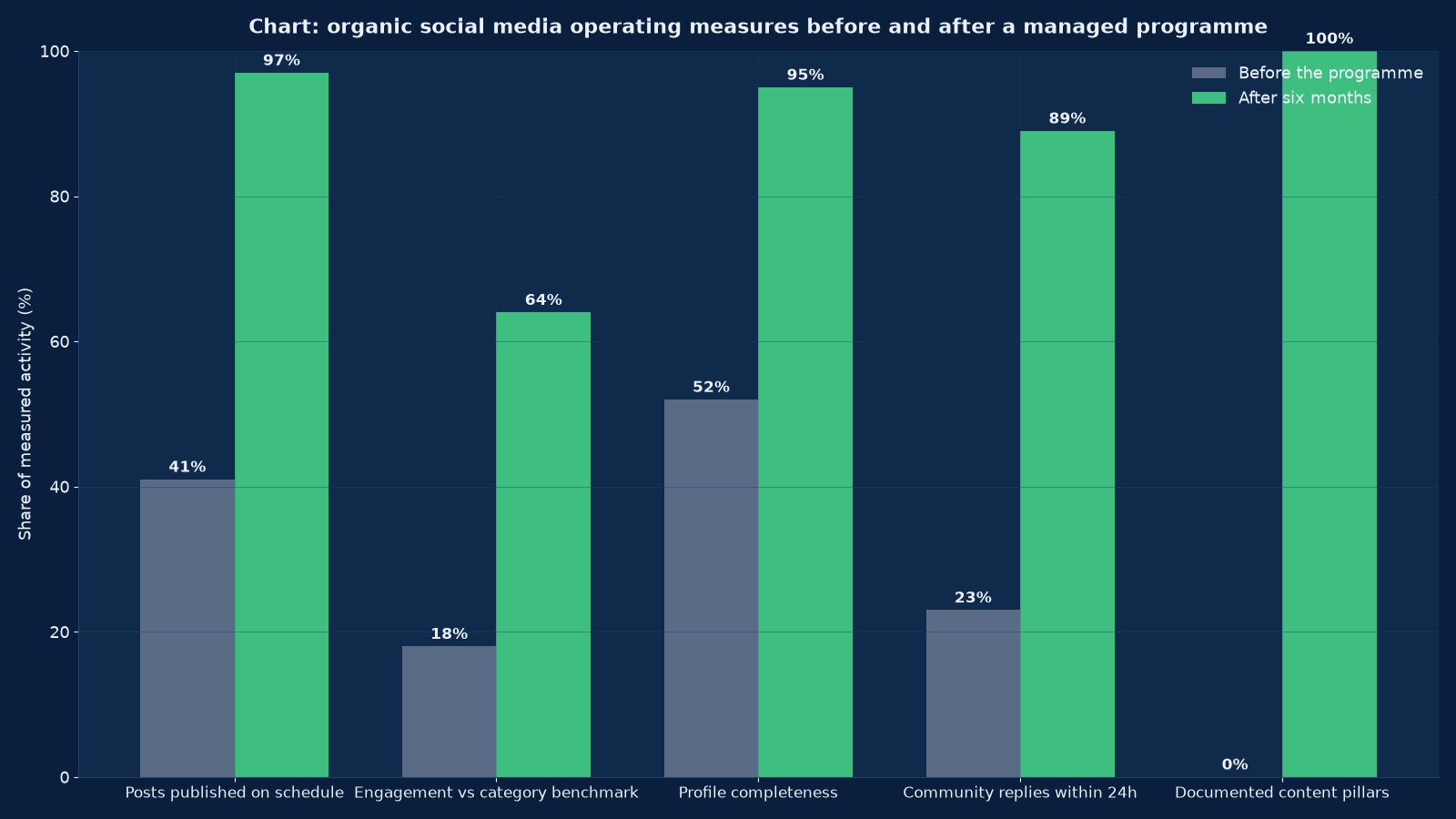
This is why our reporting leads with discipline measures before reach. Figure 1 is the shape of a programme that is being run properly, and the measures in it are the ones an internal team can hold itself to after handover.
Platform Selection: Where the Audience Actually Is
Most businesses are on too many platforms and good on none. Selection starts with where the buying audience spends attention and what the platform rewards, not with where a competitor happens to post.
| Platform | Best for | Format that wins | The common mistake |
|---|---|---|---|
| B2B services, professional firms, industrial and technology sellers, hiring | Documented expertise, case detail, founder and employee voice | Corporate announcement copy with no person in it | |
| Consumer retail, hospitality, fashion, clinics, local services | Reels and carousels with a strong first frame, plus a complete profile | A grid that looks good and a bio that explains nothing | |
| Local businesses, community and older demographics, groups, marketplace | Local relevance, events, offers and responsive community management | Treating it as dead when the local audience is still there | |
| YouTube | Considered purchases, education, product demonstration, long shelf life | Searchable videos that answer a real question, with chapters and thumbnails that work | Uploading campaign films nobody searches for |
| TikTok | Younger consumer demand, entertainment-led discovery | Native, unpolished, hook-first video at volume | Repurposed advertisements, which the audience rejects immediately |
| X / Twitter | News-adjacent sectors, technology, media, public conversation | Timeliness and a distinct point of view | Scheduling a week ahead in a medium that rewards the same day |
| Visual discovery for home, fashion, food, weddings, travel | Idea-led pins that link to a useful page | Pinning products with no idea attached and no destination page | |
| WhatsApp and community channels | Retention, service updates, local demand | Consent-based, useful, infrequent messages | Broadcasting promotions to a list that never opted in |
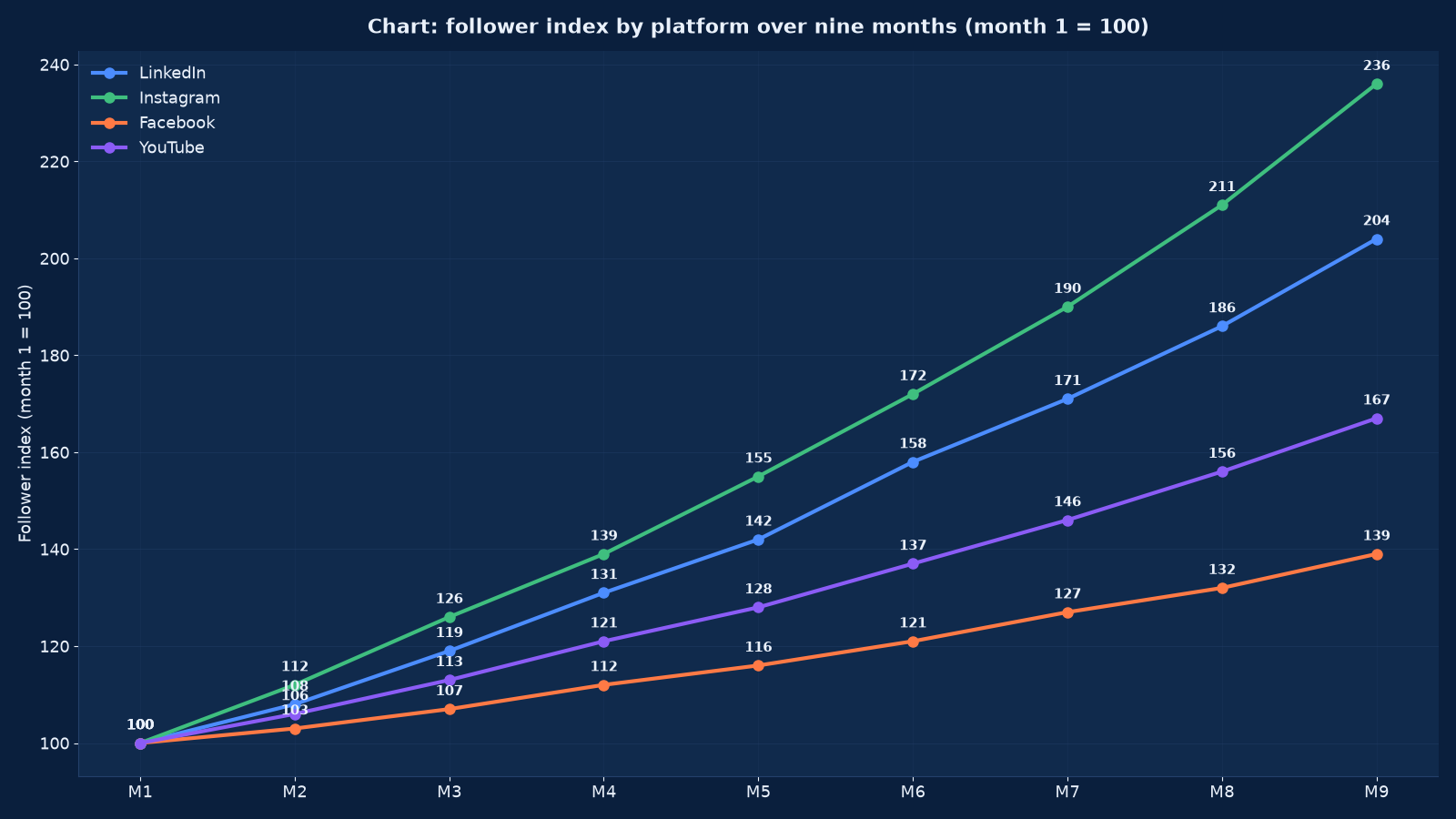
Chart values are an illustrative planning model based on typical UMC engagements and published industry benchmarks. They are not a guarantee of results on any specific project.
Content Pillars: the Commercial Job Each Post Does
A pillar is not a topic. It is a category of post with a stated commercial job, a format, a cadence and a measure. Accounts with documented pillars stop arguing about what to post and start arguing about whether the pillar still earns its place.
| Pillar | Commercial job | Typical formats | Measured by |
|---|---|---|---|
| Proof | Remove doubt: show the work, the outcome and the customer | Case detail, before and after, testimonials, site or factory footage | Saves, profile visits, enquiries that mention it |
| Expertise | Establish the right to be chosen on grounds other than price | Explainers, myth correction, checklists, short video answers | Watch time, shares, follower quality |
| Product and offer | Convert attention into demand for what is sold | Product detail, bundles, seasonal offers, availability | Clicks, add-to-cart, bookings, code redemptions |
| People and place | Make the business legible as a real organisation | Team, process, premises, hiring, community involvement | Comments, messages, applications, local enquiries |
| Customer stories | Let the customer make the argument | Interviews, user content, review responses, community features | Shares, sentiment, referral mentions |
| Conversation | Earn reach through relevance rather than promotion | Sector news, questions, polls, responses to what is being discussed | Comments per post, reply rate, reach from non-followers |
Three to six pillars is the workable range. Fewer than three makes the calendar repetitive; more than six makes production unmanageable and the reporting meaningless. Each pillar gets a share of the calendar and a review at the end of the quarter, where the ones that do not earn their share are retired rather than defended.
Production: How a Sustainable Cadence Is Actually Made
| Stage | What happens | Frequency | The bottleneck it removes |
|---|---|---|---|
| Shoot and capture | Photography and video captured in batches against the calendar | Monthly or quarterly shoot days | Content dependent on whatever happens to be available this week |
| Template build | Reusable layouts per pillar and format, in the brand’s system | Once, then maintained | Every post designed from scratch, which caps volume permanently |
| Copy and hooks | Captions and first-frame hooks written to a pattern per pillar | Weekly in batches | Copy written at publishing time, when there is no time to write it well |
| Approval | One named approver, a defined window, and a do-not-publish list | Weekly | Content stuck for days between three people who each want a change |
| Scheduling | Loaded into the scheduler with platform-specific timing and formats | Weekly | A person remembering to post, which fails every holiday |
| Asset library | Everything stored, tagged by pillar and reusable | Continuous | Re-shooting material that already exists |
| Repurposing | One asset cut into the formats each platform wants | Per asset | A good piece of content used once on one platform |
Batch production is the single highest-leverage change we make. A monthly shoot day and a template library turn an unmanageable cadence into a manageable one, and they are what allow the volume in a retainer to be quoted honestly.
Community Management: the Standard, Not the Intention
Community management is where organic social produces enquiries, and it is where most programmes fail quietly. In Figure 1 the share of replies answered inside twenty-four hours rises from 23 to 89 per cent, and that measure moves more revenue than the publishing cadence does.
| Channel | Standard | Escalation |
|---|---|---|
| Comments | Every comment acknowledged; questions answered fully or moved to a message | Abuse and trolling handled by the published policy, not by improvisation |
| Direct messages | Answered inside the stated window during business hours | Enquiries logged to the CRM with the source marked as social |
| Mentions and tags | Responded to, shared where useful, and monitored for complaints | A complaint routed to whoever can resolve it, with the resolution logged |
| Reviews | Every review answered, including the negative ones | A pattern in the reviews treated as operational intelligence and reported |
| User-generated content | Permission obtained, credited, and reused across the programme | Rights recorded so an asset is never reused beyond its permission |
| Crisis or viral negative | A pre-agreed holding statement and a single spokesperson | Legal and leadership briefed before any public response is issued |
The standard is written down with the hours it applies to and the name of whoever is responsible outside them. A community standard that depends on somebody noticing a notification is not a standard.
Paid Amplification of Organic Winners
The most efficient paid social creative is usually the organic post that already worked. Amplification is therefore a decision rule rather than a separate campaign: promote what earned attention, to the audience that proved it.
| Decision | Rule | Why |
|---|---|---|
| Which posts to promote | Those exceeding the pillar benchmark on saves, shares, watch time or comments | The audience has already voted; the promotion is testing scale, not quality |
| Which audience | Lookalike or interest audiences derived from the post’s engagers, plus retargeting of profile visitors | Proof of resonance is a better targeting input than a demographic guess |
| How much budget | A fixed test allocation per winner, scaled only on cost per result | Prevents a single viral post consuming the month’s budget |
| What to change | Nothing in the creative; only the audience and the budget | Editing a proven post destroys the evidence that made it worth promoting |
| When to stop | When cost per result exceeds the channel’s threshold, or the audience saturates | A winner is a winner for a while, not forever |
| How it is reported | Alongside the organic result, with the incremental effect stated | Otherwise the organic programme is credited with paid results |
This is where organic and paid stop being separate budgets arguing for the same recognition. The organic programme produces tested creative; the paid programme scales it; and the reporting attributes each result honestly.
Influencer and Creator Collaboration
| Stage | What we do | The control |
|---|---|---|
| Fit assessment | Creators selected by audience overlap and content quality, not follower count | A stated rationale per creator, recorded before contact |
| Vetting | Audience authenticity, past brand work, and any reputational risk reviewed | A written vetting note, so the decision survives the person who made it |
| Brief | Objectives, must-say points, do-not-say list, usage rights and timing | A brief the creator can work from without guessing |
| Contract | Deliverables, exclusivity, disclosure obligations, rights, payment terms | Disclosure compliance and usage rights in writing |
| Production support | Product, access, information and a review point before publishing | One review point, not a re-edit of the creator’s voice |
| Measurement | Reach, engagement, traffic, code redemptions and enquiries attributed | A unique code or link per creator, so results are separable |
| Usage | Winning creator content reused in paid, on the site and in email within the granted rights | Rights recorded with an expiry date |
| Relationship | Repeat collaboration with creators who delivered, and a documented exit for those who did not | A creator roster with performance history |
Creator work is measured on the same terms as owned content. A collaboration that produces impressions and no enquiries is a sponsorship, and it should be budgeted as one rather than reported as marketing performance.
The Twelve-Week Programme
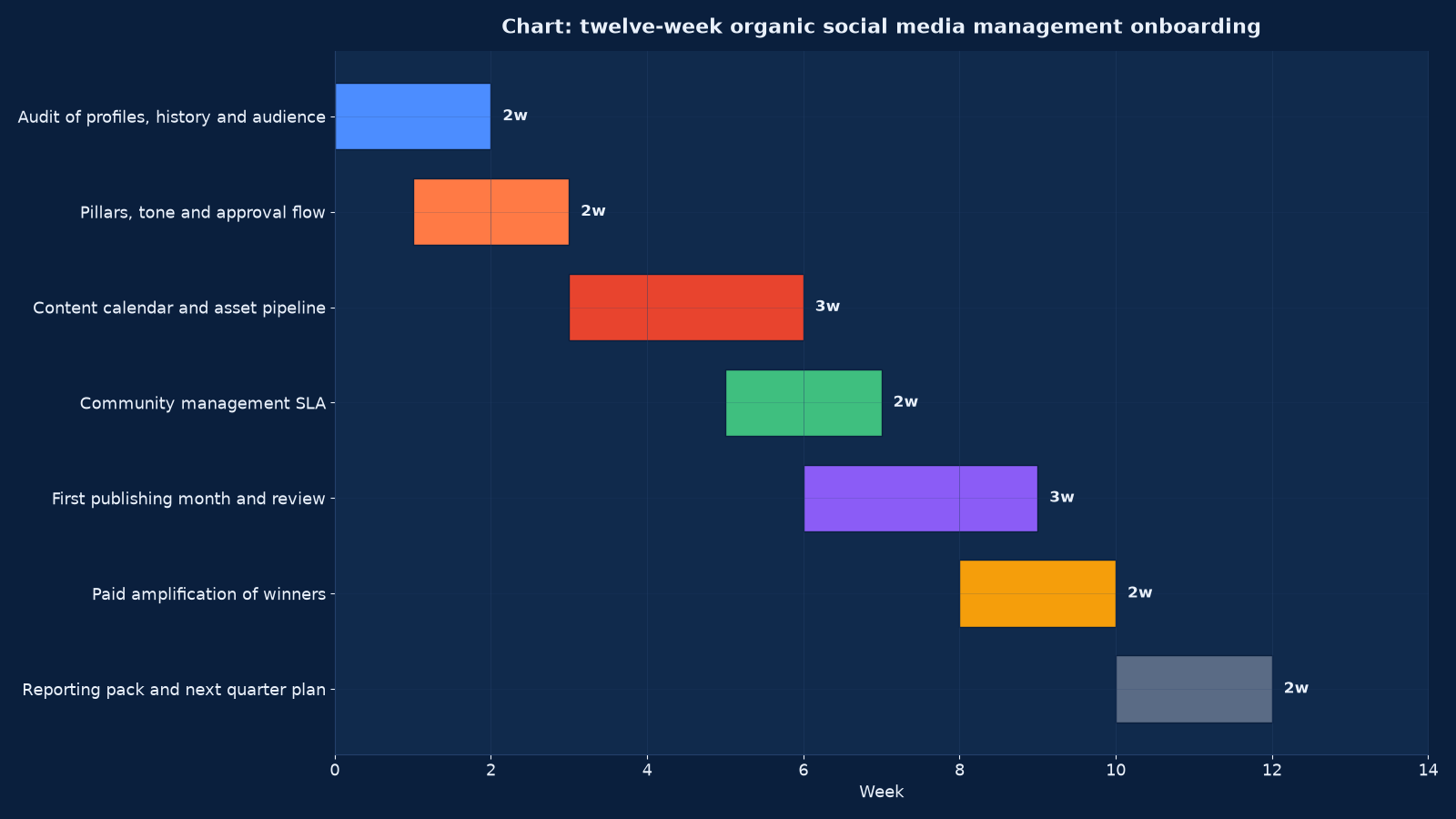
Chart values are an illustrative planning model based on typical UMC engagements and published industry benchmarks. They are not a guarantee of results on any specific project.
| Weeks | Workstream | Gate to pass |
|---|---|---|
| 1–2 | Audit of profiles, history and audience | Every profile reviewed, an engagement baseline set, and the gap list written |
| 2–3 | Pillars, tone and approval flow | Three to six pillars documented with a commercial job each, and one named approver |
| 4–6 | Content calendar and asset pipeline | A twelve-week calendar loaded, templates built, and the first shoot day captured |
| 6–7 | Community management standard | Reply windows, escalation and ownership agreed and tested |
| 7–9 | First publishing month and review | A full month published on schedule, reviewed against the baseline |
| 9–10 | Paid amplification of winners | The posts that beat benchmark promoted, with results reported separately |
| 11–12 | Reporting pack and next quarter plan | Monthly reporting live, and the next quarter’s calendar agreed with pillars retired or added on evidence |
Twelve weeks establishes the programme. The following nine months are what produce the curve in Figure 2, and the reason we quote a minimum initial term rather than a month-by-month arrangement: organic social compounds, and a programme restarted every quarter never reaches the part of the curve where it pays.
Measurement: Beyond Reach and Followers
| Measure | Definition | What it tells you |
|---|---|---|
| Publishing discipline | Posts published on schedule against the calendar | Whether the operation is running at all |
| Engagement rate against benchmark | Engagement per post normalised to the category and audience size | Whether the content resonates, independent of follower count |
| Follower quality | Growth in followers matching the target profile, not total growth | Whether the audience being built is the audience that buys |
| Reach from non-followers | Distribution beyond the existing audience | Whether the platform is showing the content to new people |
| Profile visits and link clicks | Traffic driven to the site, the booking page or the catalogue | The first step towards an attributable enquiry |
| Enquiries attributed to social | Enquiries with social as the stated or tracked source | The commercial result, and the number that should head the report |
| Response time | Time from comment or message to a human reply | Whether the community standard is real |
| Sentiment and complaint volume | Tone of conversation and the number of unresolved issues | Operational problems surfacing publicly before they surface internally |
| Cost per attributed enquiry | Retainer plus production plus amplification, over enquiries | The honest unit cost, comparable with paid channels |
| Asset productivity | Output per shoot day and per template | Whether the production pipeline is efficient or drifting |
We report cost per attributed enquiry alongside the discipline measures. Where attribution is weak — and in social it often is, because the platform will not tell you what happened after the click — we say so and use the strongest available proxy rather than claiming precision the data does not support.
Governance, Ownership and the Approval Problem
| Role | Responsibility | The failure when it is unassigned |
|---|---|---|
| Programme owner | The plan, the budget and the quarterly review | A programme that continues because nobody is empowered to change it |
| Approver | One named person with a defined window | Content delayed by a committee, then published stale |
| Community responder | Replies inside the standard, during the stated hours | Questions unanswered and complaints handled by whoever sees them |
| Subject expert | Technical accuracy on claims, specifications and process | Content that is engaging and wrong |
| Asset custodian | The library, the templates and the rights records | Assets reused beyond their permission, and material re-shot unnecessarily |
| Data owner | Access, platform permissions and the reporting source | An account locked behind a departed employee’s login |
Platform access is the governance item that causes the most damage. We insist on business manager access with roles rather than shared passwords, so that a leaver cannot take the account with them and an agency change does not require a recovery process.
What Differs By Sector
A social programme for an industrial consultancy and one for a heritage retail brand share an operating model and almost nothing else. The pillars, the tone, the proof required and the enquiry path all change, and copying a programme across sectors is the fastest way to produce content that is correct in form and useless in substance.
| Sector | What the audience needs | Pillars that work | Enquiry path |
|---|---|---|---|
| B2B industrial and professional | Evidence of competence, risk reduction, a named person to talk to | Proof, expertise, people and place | A long path: content, a conversation, a specification, then a formal enquiry |
| Consumer retail and fashion | Desire, availability, and reassurance about fit and quality | Product and offer, customer stories, conversation | A short path: post, profile, message or store visit |
| Hospitality | Atmosphere, price clarity, reviews, and the ease of booking | People and place, customer stories, offer | Direct booking, with the aggregator comparison always present |
| Clinics and practices | Trust, credentials, and what the experience is actually like | Expertise, proof with consent, people | A call or a booking form, with claims kept strictly factual |
| Dealerships | Offers, stock, location and the response to an enquiry | Product and offer, proof, people and place | A walk-in or a call, where response time decides the outcome |
| Heritage and craft | The story, the making, and why it costs what it costs | Proof of process, customer stories, expertise | A considered purchase, often through a message conversation |
| Technology and SaaS | Documented capability, honest limits, and peer validation | Expertise, proof, conversation | A trial or a demo request, with the technical buyer reading closely |
The sector table is agreed with the client during the pillar work, because the client usually knows which of these paths their customers actually take, and the programme is built around that rather than around a template.
Policy, Rights and Platform Risk
Social programmes carry risks that are not performance risks: a claim that breaches a platform’s policy or a regulator’s rules, an asset reused beyond its permission, an account locked behind a departed employee, or a public complaint handled badly. These are managed as controls, not as contingencies.
| Risk | Control | Who owns it |
|---|---|---|
| Regulated claims | A do-not-publish list covering health, financial, comparative and superlative claims, applied at approval | The approver, with the subject expert consulted on technical statements |
| Asset rights | Permission and usage rights recorded per asset, with an expiry date | The asset custodian |
| Music and third-party content | Platform-licensed audio only where the licence covers commercial use; third-party material cleared in writing | Production, checked at approval |
| Customer consent | Written consent for featuring customers, patients, employees and premises, retained with the asset | The programme owner |
| Account access | Business manager access with roles, two-factor authentication, and no shared passwords | The data owner |
| Platform policy changes | A quarterly check of format, disclosure and advertising policy changes against the programme | Us, reported in the quarterly review |
| Public complaints | A pre-agreed holding statement, one spokesperson, and an escalation route to whoever can resolve it | The community responder, with leadership briefed before any response |
| Data protection | Enquiry data captured through the CRM rather than in direct messages, with a retention rule | The data owner |
Handover: What Survives When We Leave
A programme that only works while an agency runs it is a liability, and the test of our work is whether it continues after handover. Everything below is delivered as a document and trained, not held as tacit knowledge.
| Artefact | Contents | Why it matters after handover |
|---|---|---|
| Pillar document | Each pillar’s commercial job, formats, cadence share, measure and examples | Stops the calendar reverting to whatever is easy to produce |
| Tone and visual guide | Voice, vocabulary, do-not-publish list, templates and their sources | Keeps output recognisable as one brand across platforms |
| Calendar process | How the twelve-week calendar is built, reviewed and loaded | Makes the cadence a process rather than a person’s habit |
| Production runbook | Shoot day structure, capture list, batch copy process, approval window | Allows an internal team to produce at volume |
| Community standard | Reply windows, escalation, holding statements, and the log of commitments | Prevents the standard collapsing under staff changes |
| Reporting pack | The measures, their definitions, the sources and the review questions | Ensures the programme is still judged on enquiries rather than reach |
| Access and rights register | Platform roles, two-factor owners, asset permissions and expiries | Prevents lockouts and unlicensed reuse |
| Amplification rule | Which posts get promoted, to whom, with what budget and what stop condition | Keeps paid spend tied to evidence |
Handover includes two rounds of training and a month of support while the internal team runs the programme with us reviewing rather than producing. We would rather be judged on a programme that outlives the retainer than on one that stops when it ends.
Failure Modes We Are Called In To Fix
| What we find | Why it happened | What we do |
|---|---|---|
| Posting stopped for four months | One person owned it and left | A calendar with owners, templates, and a scheduler that does not depend on memory |
| Reach is fine and enquiries are nil | Content optimised for impressions with no commercial job attached | Pillars rebuilt around proof, product and conversation, with enquiries reported |
| Six platforms, none maintained | Presence treated as a checkbox rather than an operation | Two or three platforms run properly and the rest closed or parked honestly |
| Comments unanswered for weeks | No community standard and no owner | A reply window, an escalation path, and the measure reported monthly |
| Content that looks like an advertisement | Campaign assets repurposed without adaptation | Native formats per platform, produced for the feed rather than for the campaign |
| An influencer campaign with no measurement | No codes, no links and no brief | A brief, a unique code per creator, and results reported against owned content |
| The profile bio and links are wrong | Set up once and never revisited | Profile completeness rebuilt and added to the quarterly checklist |
| Reporting that only shows follower growth | Nothing else was measured | A reporting pack with discipline, engagement, enquiries and cost per enquiry |
Organic Social and the Rest of the Stack
Organic social produces the creative, the audience and the proof that every other channel consumes. We plan it with those channels rather than in isolation.
- Instagram Marketing Services — the platform-level discipline for reels, carousels, stories and the profile that converts a visitor.
- Facebook & Meta Advertising Services — where the organic winners get amplified, with the audience data the organic programme generates.
- LinkedIn Marketing Services — the B2B programme, including founder and employee voice alongside the company page.
- YouTube Advertising & Video Marketing Services — the video assets the social programme produces, given a searchable second life.
- TikTok Advertising Management Services — the native short-form formats that cannot be repurposed from elsewhere.
- Influencer Marketing Services — creator selection, briefing, contracts and measurement on the same terms as owned content.
- Content Marketing Strategy Services — the editorial engine that feeds the pillars with substance rather than filler.
- Social Media Marketing Services in Lucknow — the same programme run for businesses whose customers are in this market.
- Conversion Rate Optimisation (CRO) Services — the pages social traffic lands on, where the enquiry is either captured or lost.
- Analytics & Attribution (GA4) Services — the tracking that makes attributed enquiries measurable rather than estimated.
Evidence From Our Work
The engagements and writing below are published on this site, each described by the subject its own page documents. They are listed because social programmes are usually commissioned by a business that has been posting for years without a plan and wants to know what a managed one produces.
- Twelve months of social media management for a Maruti Suzuki showroom — a sustained twelve-month programme for a single dealership: the cadence, the community handling and the local enquiry results a full year produces.
- Social media management and paid social for a pan-African B2B industrial consultancy — a B2B programme across multiple African markets, where the audience is professional and the content has to carry technical credibility.
- Digital presence work for Ethnava, a Chikankari heritage brand — a craft-led consumer brand whose social programme carries the story of the product as much as the product itself.
- Social media advertising for Green Hotel & Resort — a hospitality venue where the organic profile and the paid campaigns are judged together against direct bookings.
- Social media advertising for a Hyundai car dealership — dealership demand generation where the offer, the location and the response handling decide the outcome.
- Social media marketing strategies and best practices — the platform, pillar and cadence decisions a programme is built on.
- Content marketing execution plan — the production pipeline and calendar discipline that make a cadence sustainable.
- Influencer marketing for small businesses in Lucknow — creator selection and measurement in a market where audience authenticity varies widely.
- Video marketing for small businesses — how a small team produces video at a volume the platforms reward.
- The digital marketing insight archive — further writing on social, content and measurement.
Engagement Models and Commercials
Retainers are quoted against platform count, production volume and the community standard, because those three determine the effort. Media spend for amplification is separate and is the client’s.
| Model | Best for | What you get | Indicative shape |
|---|---|---|---|
| Programme build, fixed fee | A business that needs the apparatus before it needs volume | Audit, pillars, profile rebuild, calendar, templates, community standard and training | Twelve weeks, one fee |
| Managed retainer | An ongoing programme with a defined volume | A stated number of posts and stories per platform per month, community management to the SLA, monthly reporting | Monthly, banded by platform count and volume |
| Build and handover | A business with an internal team that needs the system | Everything in the build, plus documented processes, templates and two rounds of training | Twelve weeks plus a handover month |
| Amplification add-on | A programme already producing winners | Paid promotion of proven organic posts with separate reporting on incremental results | Monthly, plus media spend |
| Creator collaboration | A category where creators reach the audience better than the brand does | Vetting, briefing, contracting, measurement and rights management | Per campaign |
We state the volume in the agreement: posts per platform per month, shoot days per quarter, reply windows, and what counts as a produced asset. A retainer that promises “consistent posting” is a retainer with no volume, and volume is the only part of social media management a client can actually verify.
Frequently Asked Questions About Social Media Management
How many platforms should we be on?
Two or three, run properly, in almost every case. Selection starts with where the buying audience spends attention and what that platform rewards, not with where a competitor posts. Six platforms maintained badly is worse than two maintained well, because a stale profile is evidence against you at the moment a customer checks.
How often should we post?
Whatever the calendar says, consistently. Volume is agreed per platform in the retainer, because a video-led Instagram programme and a text-led LinkedIn programme have very different sustainable cadences. Consistency beats intensity: a moderate cadence held for nine months produces the curve in Figure 2, and a burst followed by silence produces nothing.
Will organic social generate enquiries?
It does, but slowly and through a path the platforms will not fully report. Enquiries come from proof content and from the community standard rather than from reach, which is why our reporting leads with attributed enquiries and cost per enquiry. Where attribution is weak we say so rather than claiming precision.
How quickly will we see results?
Discipline measures move in the first month; engagement against benchmark in two to three; audience growth and attributed enquiries over six to nine. Figure 2 is a nine-month curve, and the reason we ask for a minimum initial term is that organic social compounds — a programme restarted quarterly never reaches the part of the curve where it pays.
Do we need a content creator or can you produce everything?
We produce everything within the agreed volume using batch shoot days and a template library, which is what makes a sustainable cadence possible. Where a business has strong internal material — engineers, chefs, clinicians, showrooms — we build the capture process so it can contribute without becoming a bottleneck.
Who approves the content?
One named approver, with a defined window and a do-not-publish list agreed in advance. Content delayed between three people who each want a change is published stale, and stale content performs worse than imperfect content.
What about negative comments and complaints?
Answered to the same standard as everything else, with a pre-agreed escalation path and a log of commitments made. A complaint handled visibly and resolved is worth more than its absence, and a pattern of similar complaints is operational intelligence we report rather than suppress.
Should we use influencers?
Where the category suits it, yes, and on the same measurement terms as owned content: a brief, a unique code or link, rights in writing, and results reported separately. A collaboration that produces impressions and no enquiries is a sponsorship and should be budgeted as one.
How does this work with our paid social?
The organic programme produces tested creative and audience evidence; the paid programme scales the winners. We promote posts that beat their pillar benchmark, to audiences derived from the people who engaged, and we change nothing in the creative — only the audience and the budget. Reporting keeps the two separate so neither is credited with the other’s results.
Can you take over from our current agency?
Yes. The first requirement is business manager access with roles rather than shared passwords, so the transition does not depend on a recovery process. We audit what exists, keep the assets that are working, and rebuild the calendar and the community standard around them.
What if we want to bring it in house?
That is what the build-and-handover model is for: documented pillars, templates, an asset library, a community standard and two rounds of training. A programme that survives handover is the measure of whether we did the job properly.
What does it cost?
Banded by platform count, production volume and the community standard, with shoot days per quarter stated and amplification media quoted separately. There is no percentage of media spend, because most of the cost is production and community time rather than buying reach.
Commission a Social Programme Audit
Send us your platform handles, your last six months of activity and the enquiries you believe social has produced. Within two weeks you will have an engagement baseline measured against your category benchmark, a profile completeness gap list, an assessment of which platforms to run and which to close, three to six proposed pillars each with its commercial job and measure, a production plan with shoot days and templates, a community management standard with named owners, and a costed twelve-week programme with the retainer volume stated explicitly.
Contact Unified Management Consulting to arrange a confidential first conversation.
Related Services
Organic social media management is delivered with the platform, content and measurement practices around it:
- Instagram Marketing Services — reels, carousels and the profile that converts a visitor
- Facebook & Meta Advertising Services — where proven organic posts get amplified
- LinkedIn Marketing Services — the B2B programme, including founder and employee voice
- YouTube Advertising & Video Marketing Services — a searchable second life for the programme’s video
- TikTok Advertising Management Services — native short-form that cannot be repurposed
- Influencer Marketing Services — creators briefed, contracted and measured on owned-content terms
- Content Marketing Strategy Services — the editorial engine behind the pillars
- Social Media Marketing Services in Lucknow — the same programme for this market
- Conversion Rate Optimisation (CRO) Services — the pages social traffic lands on
- Analytics & Attribution (GA4) Services — tracking that makes attributed enquiries measurable
- Pinterest Marketing Services — visual discovery for the categories it suits