
Organic search is the largest source of considered-purchase demand in every showroom category, and the least managed one. A customer deciding between two models, or looking for the nearest authorised branch, is not on your website yet – they are on a search results page that contains your competitor, two aggregators, a video review and a map pack. What your estate controls is whether your branch appears in that map pack with correct hours, whether your variant page answers the price question, and whether an enquiry from either lands in a system that follows it up within fifteen minutes.
Showroom SEO therefore has two halves that are usually treated as separate disciplines. The local half is operational: profiles, citations, review velocity, branch pages with genuine local content, and consistency between what the website says and what the listing says. The content half is structural: a model, variant, price and offer architecture that search engines and AI assistants can read as records rather than as prose. Both halves are measured on the same thing – calls, bookings, test drives and delivered units – because a ranking that produces no enquiry is a hobby.
What an engagement includes, at a glance
| Component | What We Deliver |
|---|---|
| Branch audit and local foundation | Every branch profile, citation and listing checked against the website: name, address, phone, hours, services, categories and photos. Disagreements cost rankings and cost enquiries, and they are fixed before anything is published. |
| Model, variant and price architecture | One rankable page per model, per variant and per price question, built from structured records rather than duplicated brochure copy – and designed so a range change is a data update. |
| City, locality and near-me coverage | Branch and service-area pages with genuine local substance, not doorway duplicates, plus the locality queries that decide which branch a customer drives to. |
| Review velocity and reputation | A managed request flow per branch, a response discipline with an SLA, and reporting on volume and sentiment – because review signals affect both ranking and the decision to visit. |
| Structured data and inventory feeds | Vehicle, product, offer, branch and FAQ markup generated from the same records the site renders, plus inventory feeds for the surfaces that accept them. |
| Technical foundation | Crawl and indexation control, duplicate handling across branches and variants, Core Web Vitals on mobile, and a migration plan that does not lose a ranked URL. |
| Content that qualifies rather than fills | Finance explainers, comparisons, ownership and service guides written to answer the question that precedes a visit, with an enquiry path on every page. |
| AI search and answer-engine visibility | Machine-readable price, availability and offer data, entity clarity and citation-worthiness, so assistants summarising a purchase recommend your branch rather than an aggregator. |
| Measurement joined to outcomes | Call tracking, booking attribution, walk-in source capture and delivery reporting joined on one identifier, so organic is judged on cost per delivered unit rather than on sessions. |
What showroom SEO has to produce, and the assumptions it has to unlearn
Most SEO practice is written for businesses that complete a transaction online, and importing it into a showroom estate produces activity without revenue. Traffic is not the goal; a booked test drive is. Rankings are not the goal; appearing in the map pack for the locality a customer will actually drive to is. Content volume is not the goal; answering the price and finance questions that precede a visit is. The table below is the translation we run in the first fortnight, and it is why a showroom engagement starts with a branch audit and a lead-flow map rather than with a keyword list.
| The imported assumption | The showroom reality | What changes in the programme |
|---|---|---|
| Rank higher for head terms | Win the locality and the variant question | Branch, model and variant pages prioritised over category pages |
| Traffic is the KPI | Calls, bookings and delivered units are the KPI | Call tracking, booking attribution and walk-in source capture built first |
| One site, one market | Many branches, many cities, several brands | A local architecture with one record per branch and no duplicate doorway pages |
| Content wins links | Availability, price and trust win the visit | Price transparency, offer validity and review signals treated as ranking inputs |
| The website is the asset | The business profile is the asset customers see first | Profile, citation and photo discipline run as an operating process |
| Conversion happens on the page | Conversion happens at the branch, days later | Assisted-contribution measurement rather than last-click session reporting |
| Product data is marketing copy | Product data is structured records | Schema and feeds generated from the same source the page renders |
| Reviews are a reputation matter | Reviews are a ranking and conversion input | A managed request and response flow per branch, with velocity reported |
| Migrations are a technical event | A migration loses ranked branch pages permanently | URL mapping, redirects and a re-indexation plan per branch |
| AI search is a future problem | Assistants already answer price and availability questions | Machine-readable offers and inventory, plus citation-worthy branch pages |
- The discipline underneath is the same one applied to a different conversion event: technical growth SEO with a local layer, and the build that hosts it is the showroom website programme.
- Where the group also sells online – accessories, service plans, bookings with payment – that demand behaves like e-commerce and needs its own template set and inventory feeds.
- Where the estate is multi-brand across several states, the architecture has to accommodate regional language variants and different registration regimes – see international and multi-region SEO for the multi-market mechanics, applied domestically.
- Nothing here works if the site is slow or unusable on a phone: Core Web Vitals and accessibility are ranking and conversion inputs, not polish.
Branch-level local search: profiles, citations and the map pack
For a branch-led business the map pack is the highest-value real estate in search, and it is controlled by data consistency rather than by content. Name, address, phone, hours, categories, services and photos have to agree across the website, the business profile, the manufacturer locator, aggregators and the municipal record – because a disagreement is read as low confidence, and low confidence is why a nearer competitor appears instead. This is local SEO and business profile management run as an operating discipline with an owner per branch, not a one-time cleanup.
| Element | What must be true | What usually is true | How it is fixed and held |
|---|---|---|---|
| Business name | The real-world name, consistently, with no keyword stuffing | Variants per branch, plus stuffing attempts | One naming rule, audited quarterly across every listing |
| Address and plus-code | Exactly as the customer will navigate to it | Old address after a shift, or a mall-level description | Verified per branch with a directions note and parking detail |
| Phone numbers | A number that is answered, per department where possible | One landline, or a personal mobile | Tracked numbers mapped to branch and department, with routing |
| Opening hours | Current, including festive exceptions and lunch closures | Hours from the year the profile was created | Hours held in the branch record and pushed to site and profile |
| Categories | The primary category that matches the offering | A generic category chosen at setup | Primary and secondary categories reviewed per brand and service |
| Services and attributes | Sales, service, used vehicles, accessibility, parking | Left blank | Populated from the branch record, updated on change |
| Photos and video | Recent exterior, interior, stock and team images | Three photos from opening day | A monthly photo routine with a named branch owner |
| Citations and aggregators | Consistent data across the listings that matter in your market | Partial, contradictory or duplicate listings | A citation inventory with corrections logged and re-checked |
| Duplicate listings | One listing per physical branch | Two listings for a moved branch | Merge or removal requests, then monitoring for recurrence |
| Manufacturer locator parity | Your branch data matching the brand’s own locator | The brand locator shows a closed branch | A quarterly reconciliation with the brand’s dealer network team |
- Branch pages on the website and branch profiles in search must be generated from one record. Maintaining them separately is how the hours on the site and the hours in the map pack drift apart – the schema and the source are described in the website development programme for showrooms.
- Local campaigns and local search share a landing surface: Local Services Ads and Performance Max with local goals both benefit from the same branch page quality that organic does.
- Where a branch closes or moves, the redirect, the listing and the citations all have to change in the same week. A closed branch still ranking is a complaint generator, and the IT and operations owner of the branch record is who prevents it.
Model, variant and price architecture: the pages that actually convert
The commercial core of showroom organic is a small set of templates: the model page, the variant or price page, the comparison page and the offer page. Each answers a different question at a different point in the decision, and each needs its own record-driven structure – because the queries are specific (‘ex-showroom price’, ‘top variant features’, ‘automatic vs manual’, ‘current offer validity’) and a general brochure page answers none of them. Building these as templates over structured data is an information-architecture decision, taken once, that determines whether a range change is an update or a rebuild.
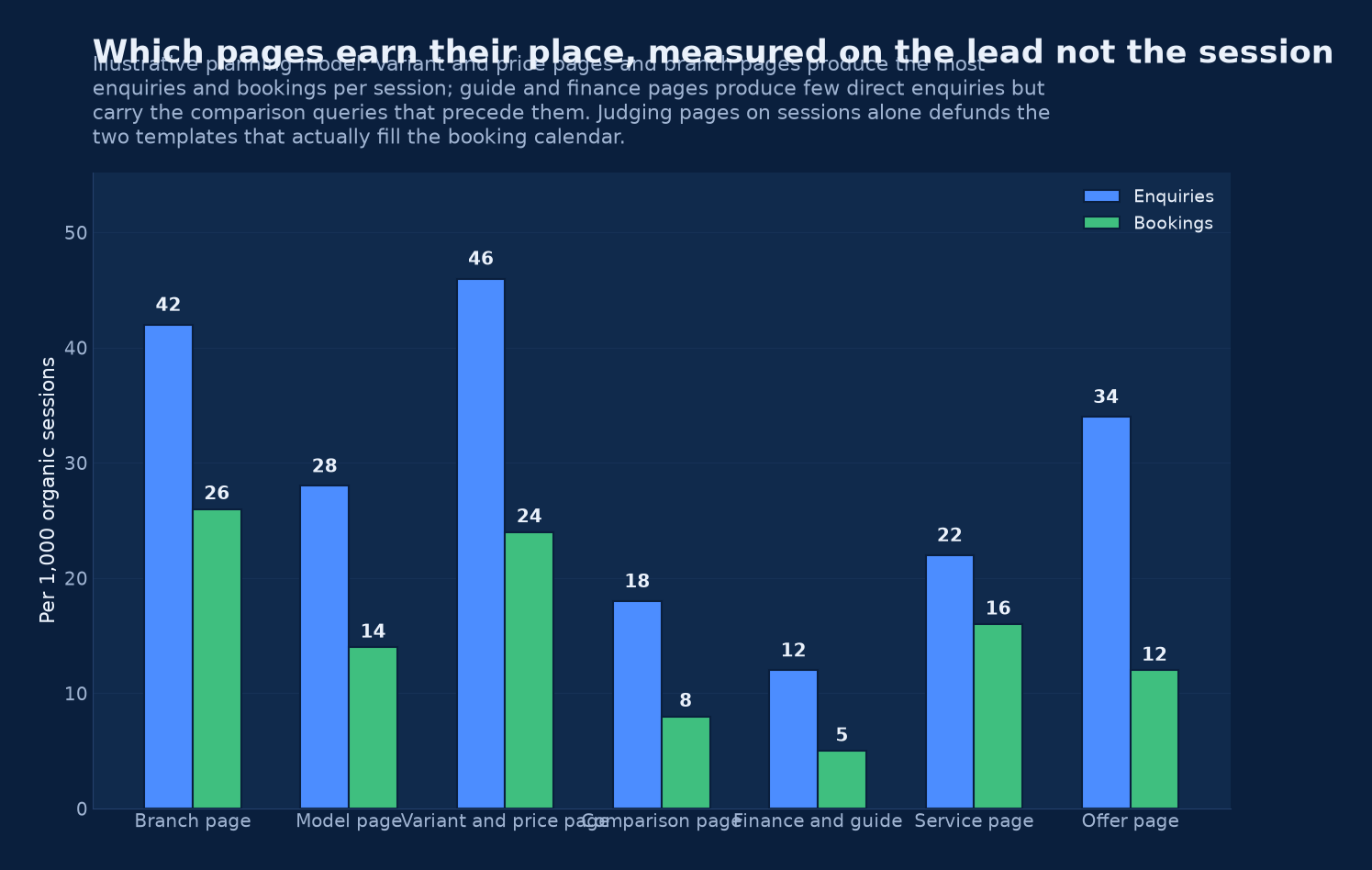
Chart values are an illustrative planning model based on typical UMC engagements and published industry benchmarks. They are not a guarantee of results on any specific project.
| Template | The query it answers | Content that must be present | Enquiry path | Maintenance trigger |
|---|---|---|---|---|
| Model page | What is this model, and is it right for me | Variants, key specifications, images, price band, reviews summary | Branch selector, test-drive booking, call | Range change or facelift |
| Variant and price page | What does the variant I want cost | Ex-showroom and on-road build-up by state, features, colours | EMI calculator, offer check, booking | Every price revision |
| Comparison page | Which of these two should I buy | Attribute-by-attribute table with honest gaps | Save, share, book both for a test drive | New variant launch |
| Offer page | What is available this month | Validity dates, eligible variants, terms and exclusions | Check eligibility, book, call branch | Weekly during festive periods |
| Branch page | Where are you and are you open | Hours, tracked numbers, services, directions, stock, reviews | Call, WhatsApp, booking, directions | Any operational change |
| Service and workshop page | Can you service what I own | Bay capacity, labour rates, packages, booking slots | Service booking, callback | Rate or package change |
| Used and exchange page | What will you give me for mine | Valuation bands, inspection process, current inventory | Valuation request, inspection booking | Inventory change |
| Finance and insurance page | What will it cost me monthly | Lender panel, tenures, documents, eligibility | Pre-approval, finance appointment | Rate change |
| Guide and explainer | What do I need to understand first | Answer-first structure, cited figures, next step | Related variant and branch links, enquiry form | Regulatory or price change |
| Launch and campaign page | What is new and when can I see it | Dates, booking for the launch event, branch participation | Event registration, test-drive booking | Campaign lifecycle |
- Templates over records is the whole point: website strategy and information architecture decides the URL structure and the entity model once, so a new variant is a row rather than a page written by hand.
- Duplicate risk is highest here – the same variant described on four branch pages with the same words is a cannibalisation problem, solved by canonical structure and branch-specific substance rather than by thinning the content.
- Every template needs a conversion path and a measured one: conversion rate optimisation on variant and branch pages usually returns more than a new content campaign, because the traffic already exists.
- The presentation layer matters at the moment of decision: UX and UI design on a price build-up is the difference between a customer who understands and one who calls to ask.
City, locality and near-me coverage without building doorway pages
Showroom estates are tempted into scale by generating a page per locality per model, and search engines have treated that pattern as spam for a decade. The version that works is narrower and more useful: one substantive page per physical branch, service-area coverage described where a branch genuinely serves it, and city-level pages only where there is city-specific substance – registration costs, festive calendars, fuel prices, road conditions, delivery timelines. Everything else is served by the branch locator and by structured data, not by duplicated prose.
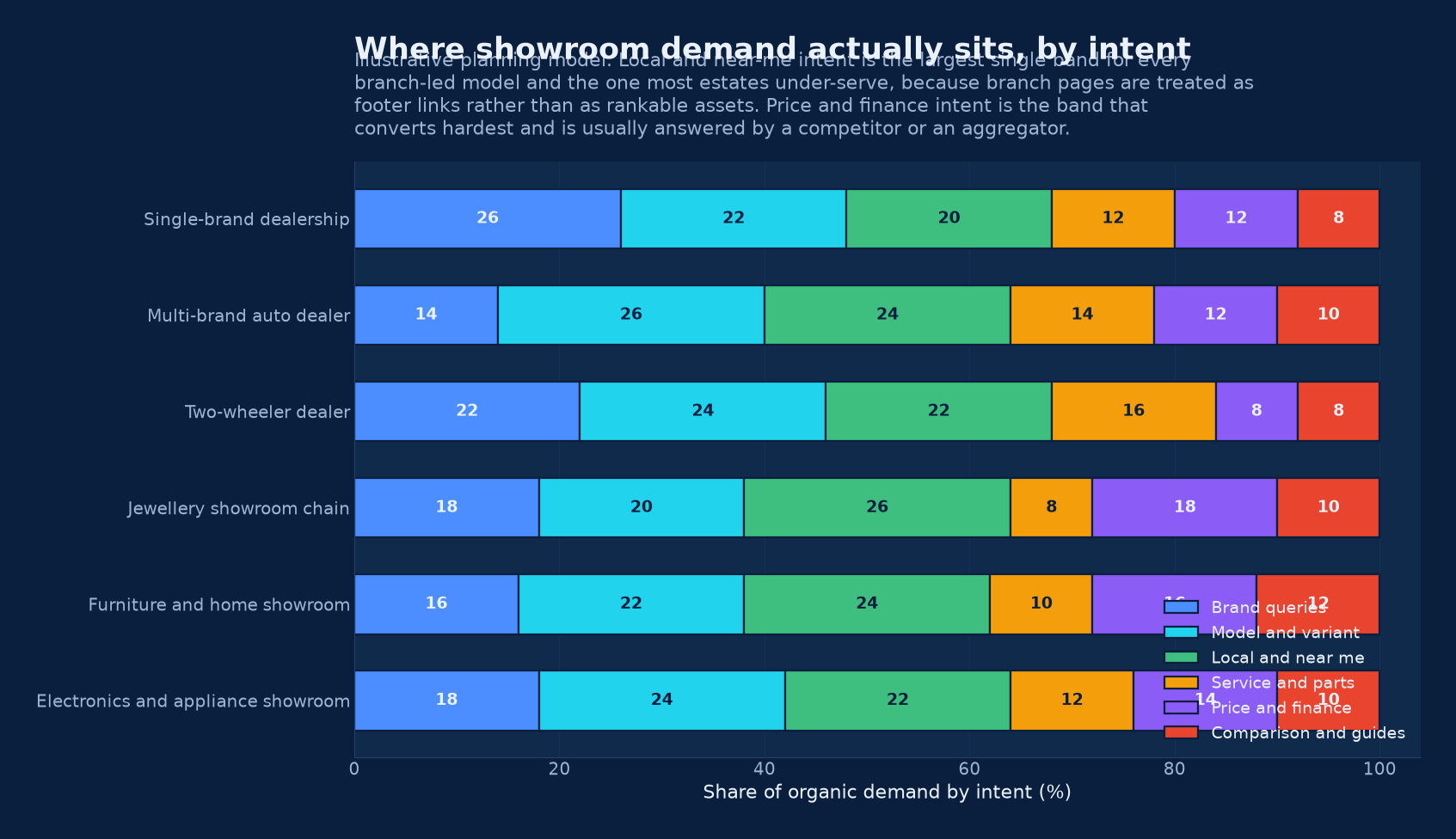
Chart values are an illustrative planning model based on typical UMC engagements and published industry benchmarks. They are not a guarantee of results on any specific project.
| Page type | When it deserves to exist | What makes it substantive | What to do instead |
|---|---|---|---|
| Branch page | Always – one per physical branch | Hours, tracked numbers, services, stock, photos, directions, reviews | Nothing; this is the core local asset |
| City page | Where the city has several branches or distinct demand | Branch list, city registration and tax detail, city offers, delivery timelines | Branch pages plus a locator, if the city is small |
| Locality page | Where a locality generates real query volume | The branch that serves it, travel detail, parking, local landmarks | A section on the branch page, unless volume justifies more |
| Service-area page | Where the branch serves customers who do not visit | Home test drive zones, pickup and drop, delivery coverage | A service flag on the branch record, rendered in the locator |
| Model-by-city page | Almost never | Only with genuine city-specific price or availability data | Model page with a branch selector and per-state price build-up |
| Near-me landing page | Never as a page | It is a query pattern, not a destination | Branch pages with correct proximity signals and profiles |
| Regional language page | Where the market demands it | Translated records with native review, not machine prose | Language variants served from the same structured records |
| Competitor comparison page | Where buyers genuinely compare | Factual attributes, honest gaps, no disparagement | A comparison template driven by attribute data |
| Dealer-versus-aggregator page | Where aggregators take the enquiry | Price transparency, direct booking, exchange and finance in one place | Better branch pages and structured offers |
| New branch announcement | On opening or relocation | Opening date, services, team, launch offers, directions | Nothing; announce it and keep the page as the branch page |
- Local substance is what earns the ranking: registration costs by state, festive demand patterns, delivery timelines and even road conditions are the content a city page can hold that an aggregator cannot.
- Where a group is expanding into new cities, the local architecture should be planned with the expansion rather than retrofitted – market expansion consulting sets the sequence; this page structure has to be ready for it.
- Language variants are a records question: one content model rendered in several languages keeps price, hours and availability consistent, which duplicated translated pages never do.
Reviews and reputation: velocity, response and the honest way to grow both
Reviews are the only ranking input a showroom can improve every week without a technical change, and they are also the content customers read before they visit. Two numbers matter: velocity – how many reviews arrive per month per branch – and response rate, including to the negative ones. Both are process problems before they are marketing problems, which means they belong to a named branch owner with a target and a report, not to an agency with a request for ‘testimonials’.
| Element | What good looks like | What usually happens | How it is operated |
|---|---|---|---|
| Request timing | Asked at the moment of highest satisfaction – delivery, service completion | Asked in a monthly batch by email | Triggered from the delivery or service record |
| Request channel | WhatsApp or SMS with a direct link to the profile | A printed card nobody scans | One-tap link, tracked per branch and per executive |
| Volume target | A per-branch monthly target tied to deliveries | No target, so no reviews | Reported beside delivery counts each month |
| Response discipline | Every review answered, negatives within a day | Positives ignored, negatives unaddressed | Response SLA with escalation to the branch manager |
| Negative review handling | Contact, resolve, then ask for an update if warranted | Argued with publicly, or deleted where possible | A documented resolution path and a complaints log |
| Review content | Specific mentions of service, staff and process | One-word ratings | Ask one specific question in the request message |
| Photo and video reviews | Recent images from real customers and staff | Stock photos from opening | A monthly photo routine with consent recorded |
| Cross-platform consistency | The same branch story on search, social and the site | Different ratings in different places | One reputation dashboard covering every surface |
| Fake review exposure | No incentivised or purchased reviews | A vendor offering ’50 reviews’ | Policy stated, staff briefed, and any vendor removed |
| Reporting | Velocity, rating, response rate and sentiment per branch | An occasional screenshot | Monthly report to the general manager |
- Incentivised reviews breach platform policy and, in several categories, consumer law. The sustainable route is timing and ease: ask at delivery, on the channel the customer already uses, with one tap.
- Reputation is a conversion asset as much as a ranking one: displaying branch ratings on the branch page lifts enquiry rates, and the display has to be honest and current – part of the showroom website build.
- The response discipline is a customer-service process: CRM records the complaint, the support workflow tracks resolution, and the review reply is the last step rather than the first.
- Sentiment trends are also market research: recurring complaints about delivery timelines or finance paperwork are competitive and market insight that no survey would surface.
Structured data and inventory feeds: making the estate machine-readable
Search engines and AI assistants do not read a showroom website the way a customer does; they read entities and relationships. A branch is a place with hours and a phone number; a vehicle is a product with variants, offers and availability; a finance explainer is an article with an author and a date. Marking those up is not decoration – it is what allows a map pack to show hours, a rich result to show a price, and an assistant to answer ‘which authorised branch near me has this variant’ with your branch rather than an aggregator.
| Markup or feed | What it describes | Where it appears | Data source | Failure to avoid |
|---|---|---|---|---|
| LocalBusiness or AutoDealer | Branch identity, address, hours, phones, geo | Map pack, knowledge panel, local results | The branch record | Hours that disagree with the profile |
| Product and Offer | Model, variant, price, availability, offer validity | Rich results, price snippets, shopping surfaces | The variant and price records | An offer shown after its validity date |
| AggregateRating and Review | Branch or model rating and review count | Star ratings in results | The review platform, honestly sourced | Self-serving or incentivised review markup |
| FAQPage | The questions a branch or model page answers | FAQ rich results and assistant answers | Curated questions with real answers | Marketing prose formatted as questions |
| BreadcrumbList | The path from home to model to variant | Result URLs and hierarchy understanding | The information architecture | Breadcrumbs that do not match the URL structure |
| Service | Workshop, home service, pickup and drop | Service-rich results and local queries | The branch service flags | Services listed that the branch does not offer |
| Event | Launches, camps, festive events | Event results and calendar surfaces | The marketing calendar | An event page left live after the date |
| Vehicle or product inventory feed | Live stock with price and availability | Inventory surfaces and comparison engines | DMS or ERP stock ledger | A feed that keeps listing sold units |
| Organisation and sameAs | Brand identity and official social profiles | Knowledge panel and entity clarity | Group records | Multiple conflicting organisation entities |
| Article and author | Guides and explainers with a named expert | Article results and trust signals | Editorial process | Undated, unattributed finance content |
- Markup must be generated from the same records the page renders. Hand-written schema drifts the moment a price changes, and a wrong price in a rich result is worse than no rich result.
- Entity clarity is what AI assistants rely on: grounding an answer in your structured data rather than in a scraped forum post is the substance of AI search optimisation, and the retrieval layer behind an on-site assistant is RAG and knowledge-system engineering.
- Feeds are integrations, so they inherit integration risk: freshness monitoring, exception queues and a replay path are systems integration disciplines applied to marketing data.
- Where the group operates in several markets with different languages and registries, the same markup has to be emitted per variant of the page – a multi-region concern handled in the international and multi-region mechanics.
Technical foundation for a dealership estate
The technical problems in showroom SEO are predictable and mostly self-inflicted: duplicated branch templates, parameter URLs from filters and configurators, stale offer pages left indexed, a stock feed that produces thousands of thin pages, image weights that destroy mobile performance, and a migration that dropped every ranked URL. None is difficult; all are cheaper to prevent than to repair. The starting point is an audit that measures crawl, indexation and rendering against the templates that matter commercially.
| Area | What goes wrong in showroom estates | How it presents | The fix and the guard |
|---|---|---|---|
| Crawl and indexation | Filter and configurator parameters crawled as pages | Index full of duplicates, crawl budget wasted | Parameter handling, canonicals, and index rules per template |
| Duplicate content | Same variant text on every branch page | Branches cannibalise each other for model queries | Branch-specific substance plus canonical structure |
| Stock-generated pages | One page per unit in stock | Thousands of thin pages that expire weekly | Aggregate stock into variant pages; noindex unit pages |
| Offer and campaign pages | Expired offers left live and indexed | Customers arriving at a dead offer, and a trust problem | Validity fields with automated expiry and takedown |
| Performance on mobile | Heavy galleries, autoplay video, tag sprawl | Slow LCP, high abandonment on the model page | Image pipeline, lazy loading, a tag budget – Core Web Vitals work |
| Rendering | Client-side price and availability never seen by crawlers | Pages indexed without their commercial content | Server-render or pre-render the critical content |
| Migrations and replatforms | URLs changed without mapping | Ranked branch and model pages lost for months | Full URL mapping, redirects, and staged re-indexation – see technical SEO audits and migrations |
| Security and trust | Mixed content, expired certificates, insecure forms | Browser warnings on an enquiry page | Certificate monitoring and TLS hygiene, part of security operations |
| Accessibility | Unlabelled forms, poor contrast, no keyboard path | Excluded customers and failed public tenders | WCAG 2.2 AA conformance verified per template |
| Monitoring | Nobody notices a template broken by a release | A silent ranking or conversion drop | Uptime, indexation and Core Web Vitals monitoring under maintenance and support |
- A technical audit is a prioritised list, not a report: every finding carries a commercial consequence and an owner, which is how technical growth SEO is run rather than reported.
- Where the estate is due for a rebuild, the technical plan and the build plan are the same plan – a migration that ignores URL mapping costs more in lost organic than the rebuild saves.
- Rendering decisions belong to the architecture: a headless or composable front end gives excellent performance and needs deliberate pre-rendering, which must be specified before build rather than discovered after launch.
- Indexation and certificate monitoring are infrastructure concerns that sit naturally under managed IT services once the estate is stable.
Content that qualifies: finance, comparison and ownership guides
Showroom content only earns its cost when it answers a question that precedes a visit. That narrows the brief considerably: on-road price explained by state, EMI and tenure trade-offs, insurance and warranty terms, exchange valuation mechanics, variant comparisons with honest gaps, running costs, service intervals, and the paperwork a first-time buyer has to bring. Editorial that restates a brochure answers nothing and ranks for nothing. This is content marketing strategy with a dealership constraint: every figure cited has to come from a published rate table with an effective date.
| Content type | The question it answers | What makes it rank and convert | Refresh trigger |
|---|---|---|---|
| On-road price explainer | What will I actually pay in my state | Itemised components, per-state tables, a calculator | Any tax, registration or price revision |
| Finance and EMI guide | What will it cost me monthly, and am I eligible | Tenure comparisons, document lists, lender panel, honest caveats | Rate changes and lender policy changes |
| Variant comparison | Which trim should I buy | Attribute tables, what you gain per rupee, a booking path | Every variant or range change |
| Model-versus-competitor | Should I buy this or that | Factual attributes, no disparagement, both booking paths | Competitor launches and price changes |
| Ownership and running cost | What will it cost after purchase | Fuel, service intervals, insurance bands, resale evidence | Annual revision |
| Service and workshop guide | What does a service cost and how long | Package detail, bay capacity, booking slots | Rate and package changes |
| Exchange and resale guide | What is my vehicle worth and how is it valued | Valuation bands, inspection process, documentation | Quarterly market movement |
| Buyer paperwork checklist | What do I need to bring | Per-state documentation, timelines, common rejections | Regulatory change |
| Launch and first-look | What is new and when can I see it | Dates, specs, booking for the launch event, branch list | Campaign lifecycle |
| Festive buying guide | When is the best time to buy | Offer validity, stock reality, delivery timelines | Each festive calendar |
- Citation-worthy content is also link-worthy content: original price tables, per-state registration data and genuine ownership research earn links that a rewritten press release never does – the discipline in digital PR and link building.
- Video answers the same questions for a different audience: walkarounds, variant comparisons and delivery-day films on YouTube feed both search results and the consideration phase, and they are produced to a standard rather than improvised – brand and creative production.
- Launch and event content needs a distribution plan, not just a page: event and webinar campaigns for virtual launches, creator and influencer work for reach into owner communities, and organic social to carry the branch story between campaigns.
- Mobile is where this content is read, usually in a showroom car park: mobile experience and page speed decide whether the guide is finished or abandoned.
AI search and answer engines: being the branch an assistant recommends
A growing share of purchase research now happens inside an assistant that summarises rather than lists: ‘which authorised dealership near me has this variant in stock’, ‘what is the on-road price with the current offer’, ‘can I book a test drive on Saturday’. Those assistants answer from structured, current, citable data – which means the estate that wins is the one whose prices, hours, availability and offers are machine-readable and consistent everywhere they appear. This is not a separate channel to bolt on; it is the same structured-data and consistency work, judged by whether an assistant can answer correctly about you.
| What an assistant needs | How a showroom estate provides it | How it is verified | What happens if it is absent |
|---|---|---|---|
| Current price and offers | Offer records with validity, rendered and marked up | Ask the assistant the price question monthly, per model | An aggregator’s stale figure is quoted instead |
| Branch availability | Live stock per branch from the DMS | Availability questions tested against the yard | The customer is sent to a branch without the vehicle |
| Branch identity and hours | LocalBusiness markup plus a maintained profile | Hours and phone checked against reality quarterly | A closed or wrong branch is recommended |
| Authorisation and legitimacy | Organisation entity, brand relationships, consistent citations | Entity check across search and assistant answers | An unauthorised reseller ranks as the answer |
| Answerable comparisons | Structured attributes at variant level | Comparison questions tested against your own data | A third-party review site supplies the comparison |
| Finance and documentation facts | Cited rate tables, checklists, effective dates | Finance answers checked against lender terms | An invented or outdated figure is repeated |
| Review and reputation context | Honest aggregate ratings with responses | Sentiment and rating monitored per branch | Reputation is summarised from unmanaged sources |
| Booking capability | A bookable slot the assistant can point to | Test the booking path from an assistant referral | The customer is told to call, and does not |
| Freshness signals | Dates on guides, offers and stock | Content audit for undated pages | Older but well-linked pages are preferred |
| On-site assistant parity | Your own assistant grounded in the same records | Answer accuracy against the retrieval source | Two systems giving customers different answers |
- Being cited by an assistant is a data-quality outcome, not a content trick: AI search optimisation is structured data, entity clarity and freshness applied consistently.
- Where you deploy your own assistant on the website, it must read the same records – an AI agent grounded in stock, hours and offers, with escalation to a branch, rather than a general model guessing.
- The governance question is real: published prices and offers are consumer-facing claims, so an assistant that states them needs a review trail – part of an audit and compliance evidence set.
Measuring offline outcomes: calls, bookings, walk-ins and delivered units
The hardest and most valuable part of showroom SEO is measurement, because the conversion happens at a branch, days after the session. It is solvable with three joins: a tracked number per branch and campaign joined to the call log; a booking system that carries the source through confirmation to show-up; and a walk-in source question at the desk that reaches the DMS. With those, organic stops being a traffic line and becomes a cost per delivered unit – the only figure that survives a budget conversation.
| Outcome | How it is captured | Joined on | Reported to whom | What it decides |
|---|---|---|---|---|
| Phone enquiry | Tracked numbers per branch and campaign | Call record with source and duration | Branch and marketing | Whether the branch page is working |
| WhatsApp enquiry | Business API conversation with a source parameter | Conversation attached to the lead record | Sales manager | Which channel deserves investment |
| Form enquiry | Form submission with page, source and model | Lead identifier carried to the DMS | Sales manager | Which template produces qualified leads |
| Test-drive booking | Slot booked with source captured | Booking record to show-up to order | Branch manager | Show rate and weekend capacity |
| Walk-in | One question at the desk: how did you hear about us | DMS lead source field | General manager | The offline share no digital tool sees |
| Quotation and order | DMS quote and order records | Lead identifier end to end | General manager | Where the funnel actually leaks |
| Delivery | DMS delivery and invoice record | Lead identifier end to end | Leadership | Cost per delivered unit by source |
| Service booking | Workshop slot with source | Booking to bay utilisation to upsell | Service manager | Whether service content earns its place |
| Assisted contribution | Sessions that touched an enquiry path but did not convert | Multi-touch attribution over the lead identifier | Marketing and leadership | Whether organic is undervalued by last-click |
| Channel mix over time | Spend and outcomes by channel by month | Warehouse of joined marketing and DMS data | Leadership | Budget reallocation, argued with evidence |
- The join is engineering work: one lead identifier from click to delivery, stored where it can be queried – a warehouse with lead, booking and order facts.
- Two audiences need two reports: a branch manager wants yesterday’s calls, bookings and follow-up SLA; a group head wants cost per delivered unit by brand and city – both from the same dashboard layer.
- Follow-up discipline is part of the measurement, because a lead nobody calls is a lost attribution as well as a lost sale: sales analytics and pipeline intelligence makes the SLA visible.
- Organic and paid are not additive in a simple way, so reallocating budget on last-click will mislead: marketing mix modelling plus periodic holdouts is how the split is argued honestly.
Launches, festive seasons and digital PR for showrooms
Showroom demand is calendrical: a model launch, a festive window, a year-end clearance and a new-branch opening each produce a spike that the estate has to be ready to receive. Readiness means the landing pages, structured offers, branch stock and booking capacity exist before the campaign starts – because a launch that drives traffic to a page with no bookable slot pays for the traffic and loses the customer. Amplification then decides how much of the spike you own rather than rent.
| Moment | What the estate needs ready | Amplification that works | Measure of success |
|---|---|---|---|
| Model launch | Model, variant and price pages live with schema; launch event page | Digital PR, YouTube walkarounds, creator first-drives | Enquiries and bookings per branch in launch week |
| Festive window | Offer pages with validity, stock feed current, extended hours published | Out-of-home supporting local search, social offer creative | Cost per delivered unit against the same window last year |
| Year-end clearance | Ageing stock visible per branch, exchange valuations published | Email and SMS to the existing database, retargeting | Ageing stock cleared and margin held |
| New branch opening | Branch page, profile, citations and photos before opening day | Local PR, an opening event, local creators | Map-pack presence and first-month enquiries |
| Service campaign | Service pages, packages, bay capacity and booking slots | WhatsApp reminders to due customers, nurture sequences | Bay utilisation and upsell rate |
| Price revision | Every affected page and offer updated the same day | A note to the database and a refreshed comparison page | No stale price anywhere on the estate |
| Used-vehicle push | Inventory pages, valuation tool, inspection booking | Lifecycle campaigns to trade-in-age owners | Valuations completed and units sold |
| Awards and recognition | A citeable page with the facts and the date | PR outreach and profile updates | Referring domains and entity mentions |
| Crisis or complaint spike | A factual response page and a monitored review flow | Rapid, documented responses; no argument in public | Sentiment recovery and enquiry stability |
- Every amplification route ends at the same branch pages, so the local foundation has to be finished before the calendar starts – which is why listings and reviews precede the content push in the programme.
- Media planning across festive windows is a buying discipline as much as a creative one: media planning and buying decides whether out-of-home and digital reinforce the same localities, and Meta and Instagram placements carry the branch-level creative that local search then converts.
- The database is the cheapest demand available: email, SMS and WhatsApp sequences to owners at trade-in age or service-due date convert at a fraction of acquisition cost.
Organic and paid together: where they overlap, and where they must not be double-counted
In showroom categories the overlap between organic and paid is large and usually mishandled in both directions: brand terms bought defensively at a high cost while the organic brand result already owns the click, or non-brand budget credited with enquiries that organic would have produced anyway. The honest approach is to measure both against the same qualified-lead definition, run periodic holdouts, and let the geography decide – because in local search a branch that ranks organically in its own locality rarely needs to buy its own name there.
| Situation | What usually happens | The disciplined answer | How it is measured |
|---|---|---|---|
| Brand queries | Brand terms bought at high cost in every geography | Buy defensively only where an aggregator or competitor sits above you | Incremental enquiries from a brand-term holdout |
| Model and variant queries | Paid carries the whole demand | Organic variant and price pages take the research; paid takes the offer | Enquiries per channel on the same query set |
| Local and near-me queries | Map pack ignored, local ads bought instead | Fix profiles and branch pages first, then buy only the gaps | Map-pack presence and call volume by branch |
| Offer and festive queries | Both channels bidding on the same landing page | One offer page, one qualified-lead event, split by source | Cost per qualified lead by channel |
| Service and parts queries | Left to whichever channel remembered them | Organic service pages plus Local Services Ads where available | Service bookings by source |
| Competitor queries | Expensive, low-converting and legally sensitive | Comparison pages instead, with factual claims only | Conversion rate on comparison traffic |
| Retargeting | Site visitors retargeted with offers they have already seen | Sequenced by funnel stage: research, comparison, offer, booking | Booking rate by sequence step |
| Attribution | Last click credits paid for an organic journey | Multi-touch over the lead identifier, plus periodic holdouts | Assisted contribution by channel |
| Budget seasonality | Spend held flat while demand triples | Calendar-driven budgets with a stated cost-per-unit ceiling | Delivered units per rupee by month |
- Paid and organic share a landing surface and a definition: Google Ads and Performance Max campaigns should point at the same branch and variant pages that rank, and fire the same qualified-lead event.
- Where the total marketing cost per delivered unit is the number under scrutiny, the conversation is cost rationalisation and margin recovery with marketing evidence attached, not a channel argument.
- In a group under pressure, sequencing beats cuts: unified top-level management decides which channels are paused and which are protected, using the joined data rather than platform dashboards.
- The strategy question – which brands, which cities, which segments – precedes both channels: business strategy consulting sets the plan the media has to serve.
The ninety-day showroom SEO programme, and what we need from you
The programme below is the shape we run for a dealership group or showroom chain: three weeks of branch audit and technical assessment, overlapping local and architecture work, templates and content from week five, structured data and feeds from week eight, the review engine running from week nine, amplification from week eleven, and measurement joined to the DMS from week thirteen. Local listings and reviews start early because they are the fastest-moving inputs and because they do not depend on a build.
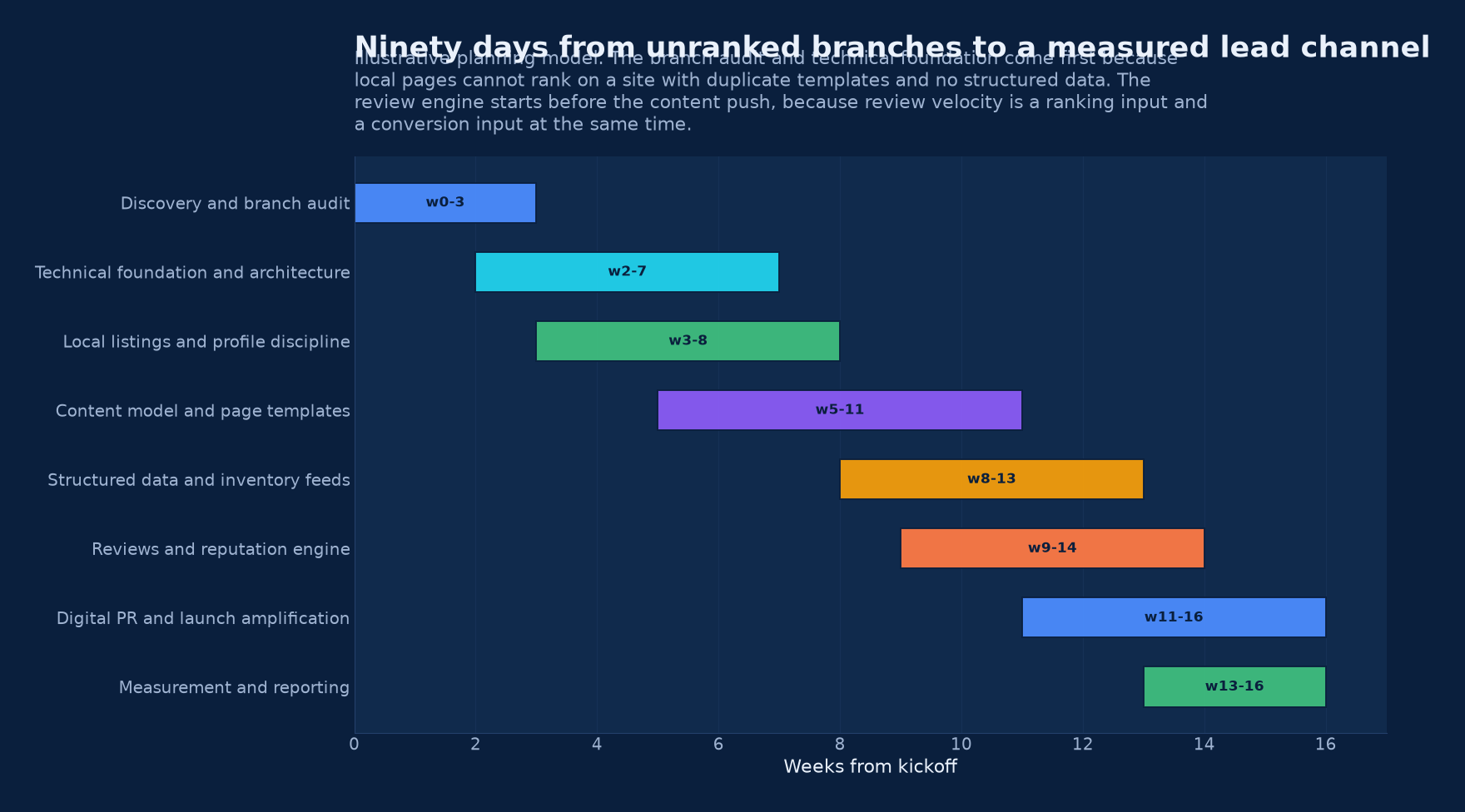
Chart values are an illustrative planning model based on typical UMC engagements and published industry benchmarks. They are not a guarantee of results on any specific project.
| Weeks | Workstream | Deliverable | Decision it enables |
|---|---|---|---|
| Zero to three | Discovery and branch audit | Branch, citation and profile audit; technical assessment; lead-flow map | What is broken, what is missing, and what to fix first |
| Two to seven | Technical foundation and architecture | Indexation and duplicate fixes, template set, URL structure, performance budget | Whether the estate can support branch and variant pages |
| Three to eight | Local listings and profiles | Corrected profiles, citation inventory, photo routine, per-branch owners | Whether the map pack can be won in each locality |
| Five to eleven | Content model and templates | Model, variant, price, branch, service and guide pages built from records | Whether a range change is an update or a rebuild |
| Eight to thirteen | Structured data and feeds | Markup generated from records, inventory feeds, validation and monitoring | Whether assistants and rich results can read the estate |
| Nine to fourteen | Reviews and reputation | Request flow at delivery and service, response SLA, monthly reporting | Whether velocity and sentiment move |
| Eleven to sixteen | Amplification and PR | Launch and festive content, citation-worthy assets, outreach | How much of the demand spike you own |
| Thirteen to sixteen | Measurement and reporting | Call and booking tracking joined to the DMS, dashboards, baseline report | What each channel costs per delivered unit |
- What we need: the branch list with verified hours and numbers, profile and listing access, DMS or ERP read access for stock and orders, twelve months of enquiry and order history, price and offer feeds, brand guidelines, and one named owner per branch.
- What you keep regardless: the branch audit, the citation inventory, the content model, the structured-data specification, the review process and the measurement definitions. They are yours.
- What we will also tell you: which pages to stop producing, which listings to let lapse, and where paid is paying for traffic you already own.
Showroom SEO by city, and worked examples
Showroom organic is local by definition, so the city layer decides the programme: registration and tax components change the on-road price pages state by state, festive calendars change the campaign rhythm, language variants change the content model, and branch density decides whether a city page is worth building at all. The engagements below are dealership, showroom and store projects where organic, local and paid were run against one lead definition.
- Get more automobile sales leads in Lucknow
- Digital marketing company for automobile dealers in Lucknow
- Website development company for automobile dealers in Lucknow
- Get more jewellery customers in Lucknow
- Digital marketing company for jewellery stores in Lucknow
- Digital marketing and IT services in Lucknow
- Services across Indian cities
- Case study: Hyundai group showroom full-service social advertising contract
- Case study: a fashion retail showroom
- Case study: WordPress and WooCommerce online mobile store
- The showrooms and dealerships industry hub – all eight disciplines
- Retail and e-commerce: catalogue, feed and checkout SEO
- Manufacturing: dealer networks, catalogues and B2B search
- Hotels and hospitality: booking-led organic and local search
- All industry verticals we build programmes for
- All digital marketing services
- About Unified Management Consulting
- Contact us about SEO for showrooms and dealerships
Where this page sits in our showrooms programme
SEO is the second discipline of our showrooms and dealerships programme. The hub page explains how the eight disciplines fit together, each discipline has its own page as it is published, and the generic service page for every discipline stays listed below alongside the vertical pages. A discipline that is not listed is not published yet – the list is generated from live pages and refreshes automatically as each spoke lands.
- Showrooms – the vertical main page
- Website development for showrooms and dealerships
- Google Ads for showrooms and dealerships
- Social media marketing for showrooms and dealerships
- CRM and lead management for showrooms
- Business intelligence for showrooms
- IT support for showrooms and dealerships
- AI for showrooms and dealerships
- Website development services – the generic service page
- Google Ads management – the generic service page
- Social media management – the generic service page
- Custom CRM development and integration – the generic service page
- BI dashboards and executive reporting – the generic service page
- Managed IT infrastructure and AMC – the generic service page
- AI agent deployment and automation – the generic service page
Frequently asked questions about SEO for showrooms and dealerships
How is showroom SEO different from e-commerce SEO?
The conversion is a visit, a call or a booked test drive rather than a checkout, so the programme is built on branch pages, local profiles, review velocity and price transparency, and it is measured on calls, bookings and delivered units rather than on sessions and revenue per visit.
What matters more: our website or our business profile?
For local queries the profile is what the customer sees first, and it is judged on consistency with your website. Both are needed and both are generated from one branch record – fixing one without the other leaves the disagreement that suppresses rankings.
How many branch and city pages should we have?
One substantive page per physical branch, city pages only where there is city-specific substance such as registration costs or delivery timelines, and no model-by-city or locality pages generated at scale. Duplicated local pages are treated as spam and cost the whole estate.
How do we get more reviews without breaking the rules?
Ask at the moment of highest satisfaction – delivery or service completion – on the channel the customer already uses, with a one-tap link, and answer every review including the negative ones within a day. Never incentivise or purchase reviews; it breaches platform policy and consumer law.
Can our live stock appear in search?
Yes, where the DMS or ERP can expose it: availability is rendered on variant and branch pages, marked up, and pushed to the inventory feeds that accept it. The requirement is freshness monitoring, because a listing for a sold unit is a complaint.
How do we track enquiries that happen by phone or in person?
With tracked numbers per branch and campaign joined to a call log, booking records that carry the source through to show-up, and one question at the desk about how the customer heard about you, written into the DMS. Joined on one lead identifier, that gives cost per delivered unit by source.
What about AI assistants answering price questions?
They answer from structured, current, citable data. Offer records with validity dates, live availability, LocalBusiness markup and consistent citations are what make an assistant describe your branch correctly rather than quoting an aggregator’s stale figure.
How long does showroom SEO take to show results?
Local fixes – profiles, citations, hours, photos – move map-pack visibility within weeks. Template and content work typically shows in three to six months, and reviews compound over the same period. Anything promising delivered units in thirty days is selling something else.
Should we stop paying for ads once organic works?
Rarely, but you should stop paying twice. Where your branch already owns the map pack and the organic brand result, defensive brand bidding is usually wasteful; where an aggregator sits above you, it is not. Holdouts and a shared qualified-lead definition settle it with evidence.
Do you work with our manufacturer’s templates and rules?
Yes. Franchise obligations are treated as a constraint on the design rather than an obstacle: brand templates are extended with local substance, structured data and lead routing, and the manufacturer locator is reconciled with your branch data quarterly.
What happens to our rankings if we change website platform?
They are protected by planning, not by luck: a full URL map, redirects for every ranked page, staged re-indexation, and post-migration monitoring of indexation and Core Web Vitals. Migrations that skip this lose branch pages for months.
What do you need from us to start?
The branch list with verified hours and numbers, profile and listing access, DMS or ERP read access, twelve months of enquiry and order history, price and offer feeds, and one named owner per branch. Access and data confirmation are almost always the constraint, not the audit.
Start with the branch audit and the qualified-lead definition
Give us three weeks with your branch list, profile and listing access, DMS or ERP read access, twelve months of enquiry and order history and your current price and offer feeds, and we will return a branch-by-branch audit of profiles, citations and hours against your website, a technical assessment of indexation, duplicates and performance, a content model for model, variant, price, branch and guide templates, a structured-data specification, a review process with a per-branch target, and a measurement plan that defines a qualified lead with your sales team and joins it to deliveries. Yours to keep whether or not we run the programme.
Contact Unified Management Consulting to arrange a confidential first conversation.