
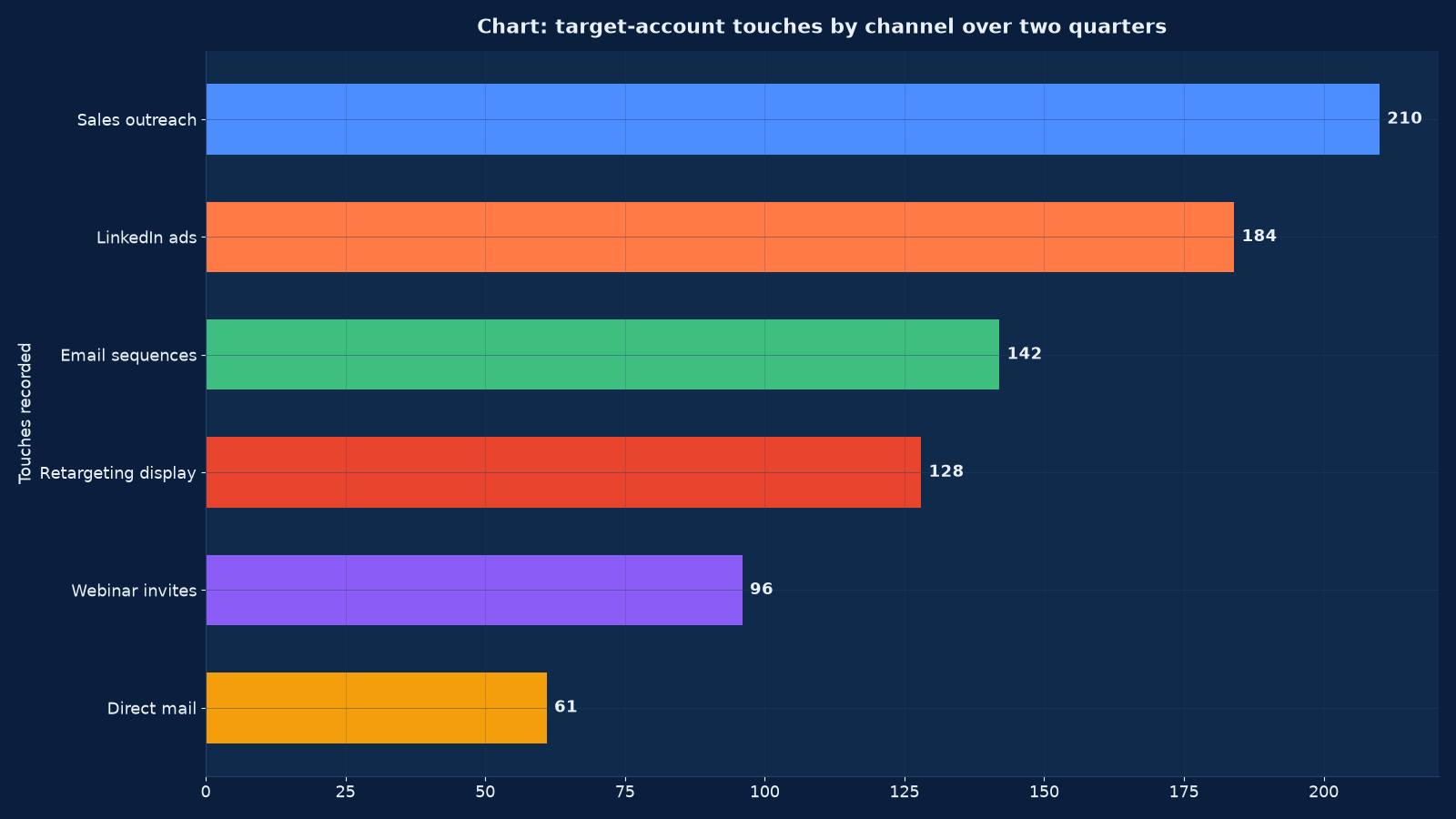
Chart values are an illustrative planning model based on typical UMC engagements and published industry benchmarks. They are not a guarantee of results on any specific project.
Account-based marketing is a sales strategy with a marketing budget attached. If marketing and sales do not agree on which accounts matter, on what counts as engagement, and on what happens when an account raises its hand, then the channels, the intent data and the creative are all decoration.
Account-based marketing at Unified Management Consulting is the design and running of programmes that treat a named set of target accounts as the market: ideal customer profile and tiering agreed with sales, account lists built and refreshed, intent and engagement scoring, messages and offers written per tier, coordinated touches across LinkedIn, retargeting, email, direct mail, webinars and events, a handover service level sales actually meets, and reporting in coverage, engagement, pipeline and deal value rather than in leads. We run these for B2B industrial, technology, professional services, healthcare and infrastructure sellers, for businesses with long sales cycles and buying committees, and for clients whose target accounts sit in India, Africa, the Gulf, Europe and North America.
The engagement starts with a working session between marketing and sales, because an account list that marketing chose and sales did not agree to will be ignored at the moment it matters. Everything after that — the tiers, the scoring thresholds, the handover rule, the reporting — is built on that agreement and written down so it survives a change of personnel.
🎯 Account-Based Marketing (ABM) — Quick Summary
| Component | What We Deliver |
|---|---|
| Ideal customer profile and tiering | The profile defined from won-deal evidence, and the target universe split into tiers with different investment per account. |
| Account list with sales | A named list built jointly, with the inclusion and exclusion rules documented and an owner per account. |
| Data foundation | Account and contact records normalised, hierarchies mapped, and the platform of record agreed. |
| Intent and engagement scoring | First-party engagement plus third-party intent, combined into a threshold that means something to a salesperson. |
| Message and offer per tier | Positioning, proof and the entry offer written for each tier and each role in the buying committee. |
| Coordinated channel touches | LinkedIn, retargeting, email sequences, direct mail, webinars and events run against the same accounts on the same timetable. |
| Sales handover SLA | The engagement level that triggers a handover, the response time sales commits to, and what happens when it is missed. |
| Sales enablement | Account briefs, conversation openers and the evidence pack each rep needs before the first call. |
| Pipeline review | A standing review of target-account pipeline, with the list refreshed on evidence. |
| Reporting | Coverage, engagement, qualified accounts, pipeline and deal value from target accounts, reported monthly. |
What This Service Actually Covers
The service covers the strategy, the data, the programmes and the reporting. It is delivered as a fourteen-week build followed by a standing programme, or as a standing programme from the start where the account list and the sales agreement already exist.
| Component | What we do | What you keep | Duration |
|---|---|---|---|
| ICP and tiering | The profile derived from won deals, with tiers and investment per tier | A documented profile and a tiering rule anyone can apply | 1–2 weeks |
| Account list | A named list built with sales, with inclusion and exclusion rules | A list sales owns, and a refresh process | 1–2 weeks |
| Data foundation | Account hierarchies, contact records, normalisation, platform of record | Clean account data that scoring can rely on | 2–3 weeks |
| Intent and scoring | First-party and third-party signals combined into thresholds | A scoring model with a documented meaning per band | 2 weeks |
| Message and offer | Positioning, proof and entry offers per tier and per role | A message map that a new joiner can use | 2–3 weeks |
| Channel programmes | LinkedIn, retargeting, email, direct mail, webinars and events coordinated | A quarter’s coordinated touches with owners | Ongoing |
| Handover SLA | Trigger, response time, escalation and the missed-handover route | An agreement between marketing and sales, in writing | 1 week |
| Enablement | Account briefs, openers, evidence packs | Material reps use rather than material they are sent | Ongoing |
| Pipeline review | A standing monthly review with a list refresh | A process that keeps the list honest | Monthly |
| Reporting | Coverage, engagement, pipeline and deal value from target accounts | A monthly pack in the language of the revenue meeting | Monthly |
The unusual component is the handover SLA. It is not a marketing artefact, and it is the one that determines whether the programme produces pipeline or produces a dashboard.
Why ABM Is Not a Campaign With a List Uploaded
| Dimension | Demand generation | Account-based marketing |
|---|---|---|
| Unit of measurement | The lead | The account |
| Audience | Anyone matching a profile, discovered through targeting | Named accounts chosen in advance, with the people inside them identified |
| Success | Volume of qualified leads at an acceptable cost | Coverage of the target list, engagement of the buying committee, and pipeline from named accounts |
| Message | One offer to many | Different messages per tier, per role and per account situation |
| Sales relationship | Marketing hands over leads; sales works them | Marketing and sales work the same accounts on the same timetable |
| Cycle length | Days to weeks | Quarters to years, with the deal size to match |
| Attribution | Last touch or a simple model per lead | Multi-touch across a committee, which no single-contact model can represent |
| What fails first | Lead quality | The account list, or the handover |
Uploading a list of accounts into an advertising platform is not ABM. It is targeted advertising, and it is worth doing, but it produces the coverage column of a report and none of the pipeline unless the rest of the apparatus exists.
Ideal Customer Profile and Tiering
The profile is derived from won deals rather than from aspiration. The tiering then decides how much each account is worth investing, which is the mechanism that makes a programme affordable at scale.
| Tier | Account count | Investment per account | Motion | Who owns it |
|---|---|---|---|---|
| Tier 1: one-to-one | A handful — typically five to twenty | The highest: bespoke research, custom creative, direct mail, executive engagement | Named-account selling with marketing support per account | A named sales owner and a named marketing owner |
| Tier 2: one-to-few | Tens, grouped by segment or situation | Moderate: segment-level creative, coordinated sequences, targeted events | Cluster selling with shared messaging per cluster | A sales pod and a marketing lead per cluster |
| Tier 3: one-to-many | Hundreds | Programmatic: LinkedIn and retargeting against the list, email sequences, webinars | Scaled engagement with handover on a threshold | Marketing runs it; sales engages when the account qualifies |
| Outside the list | Everyone else | Ordinary demand generation | Inbound and broad targeting | Marketing |
- Derive the profile from won deals: sector, size, situation, buying committee shape, cycle length and deal value.
- Record the disqualifiers explicitly — the accounts that look right and never close — because they save more budget than the qualifiers earn.
- Tier by potential value times win probability, not by brand recognition.
- Cap tier one honestly: five to twenty accounts is what a team can genuinely research and personalise.
- Review the tiering quarterly; an account that moves up deserves the motion that goes with it.
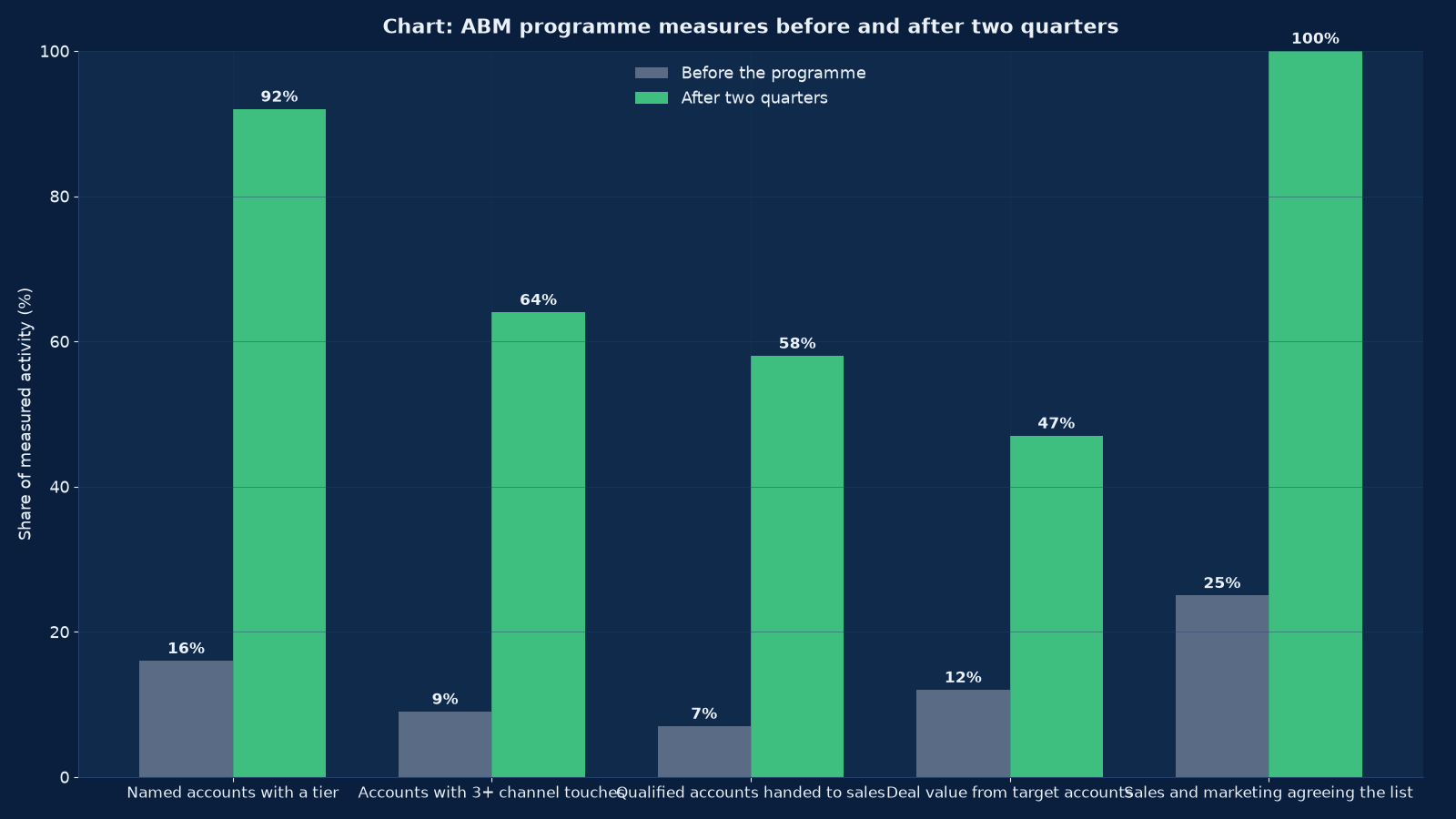
Chart values are an illustrative planning model based on typical UMC engagements and published industry benchmarks. They are not a guarantee of results on any specific project.
Building the Account List With Sales
| Step | What happens | The output |
|---|---|---|
| Evidence review | Won and lost deals from the last three years examined for the patterns that predicted a close | A draft profile with the disqualifiers named |
| Universe construction | Firmographic and situational filters applied to produce a candidate universe | A universe of accounts that could fit, before any judgement |
| Sales nomination | Sales nominates accounts they believe are winnable, with a reason each | A nominated list with rationale attached, which is the part usually missing |
| Marketing challenge | Marketing tests nominations against the profile and the evidence | Accounts kept, moved or removed, each with a recorded reason |
| Tiering | Value times win probability assigned, and the tier agreed jointly | A tiered list with investment per tier |
| Ownership | A named sales owner per tier-one and tier-two account | An ownership map, which is what makes the handover SLA enforceable |
| Exclusion | Existing customers, conflicts and disqualified accounts removed | An exclusion rule so the list does not quietly fill with accounts already served |
| Refresh cadence | A quarterly review with a stated process for additions and removals | A list that stays honest as the market and the product change |
The list is a joint artefact with both signatures on it. Where sales did not participate in building it, the handover rate collapses and the programme is reported as a marketing activity rather than a revenue one.
Intent Data and Engagement Scoring
| Signal | Source | What it indicates | How it is used |
|---|---|---|---|
| Page and content engagement | Your own analytics, keyed to the account where identity is resolved | Active interest in a specific problem | The most reliable first-party signal; drives the handover threshold |
| Form fills and downloads | Marketing platform | A named person raising a hand | Immediate sales notification where the account is tier one or two |
| Email engagement | Marketing platform | Sustained attention from a role in the committee | Sequence progression rather than handover on its own |
| Ad engagement | LinkedIn and retargeting platforms | Attention without identity, at account level | Coverage and early warming; never a handover trigger by itself |
| Third-party intent | An intent provider measuring research behaviour across the web | A topic surging inside a named account | Timing: which accounts to move up the sequence this month |
| Technographic and firmographic change | Data providers | A trigger event: new funding, a new system, a hiring surge, a leadership change | The most actionable signal there is, and the one most programmes ignore |
| Sales-reported signals | The rep | A conversation, a referral, a competitor evaluation | Weighted highest, because a human observed it |
| Event and webinar behaviour | Registration and attendance data | Multiple people from one account attending the same session | A committee forming, which is the strongest tier-one signal |
Scoring combines these into bands with a documented meaning: browsing, warming, engaging, qualified. The bands matter only if sales agrees what each one obliges them to do, which is why the scoring model and the handover SLA are written together rather than sequentially.
Message and Offer Architecture by Tier and Role
| Layer | What varies | Example treatment |
|---|---|---|
| By tier | Depth of research and degree of personalisation | Tier one gets a documented account situation and a bespoke entry offer; tier three gets a segment-level message |
| By role | The problem the role owns and the evidence that role trusts | A finance buyer sees payback and risk; an operations buyer sees process and uptime; a technical buyer sees specification and limits |
| By buying stage | What the account is currently deciding | Unaware accounts get the problem framed; evaluating accounts get the comparison; deciding accounts get the risk removed |
| By situation | The trigger event that made this quarter different | A new system, a regulatory change, a leadership appointment, an expansion |
| Proof | What is credible to this sector | A comparable engagement, a named result, a technical document rather than a testimonial quote |
| Entry offer | The smallest useful next step | An assessment, a working session, a benchmark, a diagnostic — not a demonstration |
| Objection handling | The reasons this account would say no | Addressed in the content rather than left for the first call |
Channel Programmes: Coordinating the Touches
| Channel | Role in the programme | What it is measured on | The common mistake |
|---|---|---|---|
| LinkedIn advertising | Reach the committee by account and role, with matched audiences | Account coverage and engagement rate, not clicks | Broad interest targeting that reaches the sector but not the named accounts |
| Retargeting display | Sustain presence with people who engaged | Frequency against the account list and assisted engagement | Frequency caps so low that no account ever sees the message twice |
| Email sequences | Carry the argument over time to identified contacts | Reply rate and sequence progression | A blast to the whole list rather than a sequence per tier |
| Sales outreach | The channel that actually produces the meeting | Touches per account, meetings booked, pipeline | Outreach that does not reference what the account has already seen |
| Webinars and events | Assemble several people from one account in one room | Accounts attending with two or more people | Registrant counts reported instead of account attendance |
| Direct mail | Break through to a tier-one account that ignores digital | Meetings produced per piece, at tier one only | Sent to tier three, where the cost per contact cannot be justified |
| Content and research | The asset the whole programme points at | Engagement from target accounts and its use in sales conversations | Generic content that no account situation requires |
| Executive engagement | Peer-to-peer contact at tier one | Meetings held and relationships established | Left until the deal is already competitive |
The Sales Handover Service Level
The handover is where most ABM programmes are decided. A threshold that sales did not agree to produces qualified accounts that nobody calls, and the engagement data that took two quarters to build becomes a report.
| Element | What must be defined | Why |
|---|---|---|
| Trigger | The combination of signals and the score band that constitutes a qualified account | Without it, handover is a judgement call made differently by every rep |
| Contents | What marketing sends: the account brief, the engagement history, the people involved and the suggested opener | A handover with no context is a cold call with extra steps |
| Response time | How long sales has to make first contact | Engagement decays; a week-old signal is a cold one |
| Feedback obligation | What sales records back: accepted, rejected with a reason, or progressed | Without feedback the scoring model cannot be corrected |
| Missed-handover route | What happens when the response time is exceeded | Otherwise the account is recycled by nobody and the signal is wasted |
| Recycling | Where a handover is rejected, what the account does next | Rejection is information, not an ending |
| Escalation | Who resolves a disagreement about whether an account qualified | Disputes left unresolved become a reason to disengage from the process |
| Review | A monthly look at handover volume, acceptance rate and time to contact | The measure that shows whether the agreement is real |
In Figure 2 qualified accounts handed to sales rise from 7 to 58 per cent of measured activity, and the acceptance rate is reported alongside it. A handover rate that rises while acceptance falls means the threshold is wrong, and the fix is in the scoring model rather than in sales discipline.
The Fourteen-Week Programme
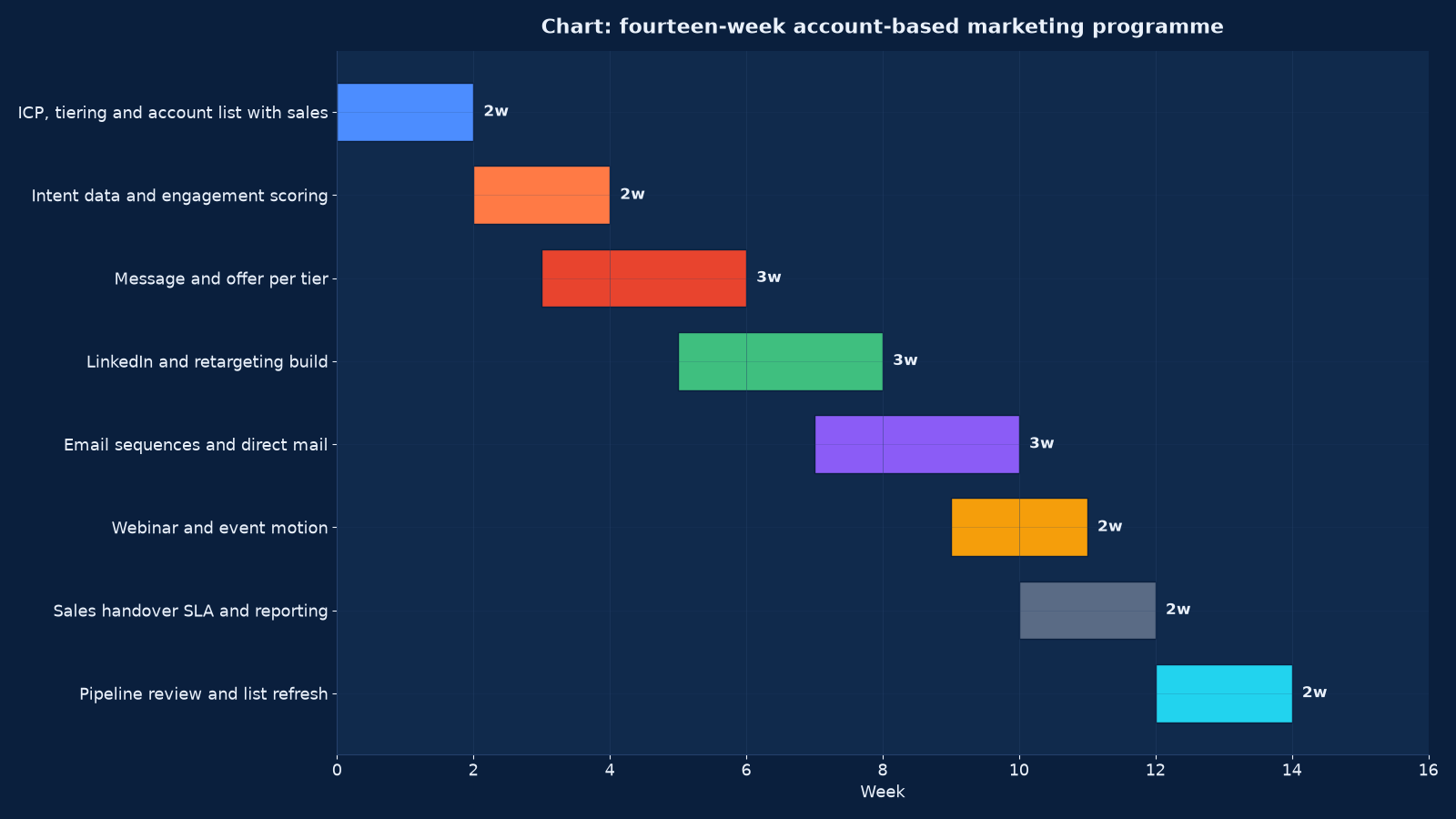
Chart values are an illustrative planning model based on typical UMC engagements and published industry benchmarks. They are not a guarantee of results on any specific project.
| Weeks | Workstream | Gate to pass |
|---|---|---|
| 1–2 | ICP, tiering and the account list with sales | A tiered named list with owners, signed off by both functions |
| 3–4 | Intent data and engagement scoring | Scoring bands documented with a meaning sales accepts |
| 4–6 | Message and offer per tier | A message map by tier, role and stage, with the entry offer defined |
| 6–8 | LinkedIn and retargeting build | Matched audiences live against the list, with account-level reporting |
| 8–10 | Email sequences and direct mail | Sequences per tier running, and the tier-one mail programme scheduled |
| 10–11 | Webinar and event motion | An event designed to assemble committees, with account attendance measured |
| 11–12 | Sales handover SLA and reporting | The SLA agreed in writing, and the monthly pack specified |
| 13–14 | Pipeline review and list refresh | The first review held, with additions, removals and tier changes recorded |
Fourteen weeks builds the apparatus. The following two quarters are what move the measures in Figure 2, because ABM compounds slowly and its first quarter is mostly coverage and learning rather than pipeline.
Measurement: Coverage, Engagement, Pipeline, Deal Value
| Measure | Definition | What it tells you |
|---|---|---|
| Account coverage | Share of the target list reached by any channel in the period | Whether the programme is reaching the accounts it exists to reach |
| Multi-channel coverage | Share reached through three or more channels | The real coverage measure; single-channel reach is noise |
| Committee coverage | Share of target accounts where two or more roles engaged | Whether a buying committee is forming rather than one curious individual |
| Engagement rate | Engagement per reached account, by tier | Whether the message suits the tier |
| Qualified accounts | Accounts crossing the handover threshold | The programme’s output, in the unit sales works in |
| Handover acceptance rate | Qualified accounts accepted by sales | Whether the threshold is calibrated |
| Time to first contact | From qualification to sales contact | Whether the SLA is being met |
| Pipeline from target accounts | Value created in the period | The commercial result |
| Deal value from target accounts | Share of closed value from the list | Whether ABM is changing the composition of revenue, not just its volume |
| Cycle length | From first engagement to close, against the non-ABM baseline | Whether coordinated engagement is shortening the cycle |
| Win rate on the list | Closed-won against closed-lost for target accounts | Whether the profile and the tiering are right |
| List accuracy | Share of the list still meeting the profile at refresh | Whether the list is decaying between reviews |
We report coverage and engagement monthly, pipeline monthly, and deal value and win rate quarterly, because the last two move slowly enough that a monthly read invites the wrong conclusion.
Attribution in an Account-Based Programme
| Problem | Why it is hard | How we handle it |
|---|---|---|
| Multiple contacts per account | A deal is influenced by a committee, not a person | Account-level multi-touch attribution, with weight distributed across the touches recorded |
| Long cycles | Touches fall outside any conventional attribution window | The window set to the observed cycle length, not to a default |
| Offline touches | Events, direct mail and executive conversations are not tracked automatically | Sales logs them; the log is treated as data, not as anecdote |
| Identity resolution | The same person appears as several contacts across systems | Normalisation against the account hierarchy before scoring |
| Self-reported attribution | Ask the buyer how they found you and the answer is often “a colleague” | Collected anyway, and treated as a check on the model rather than the model |
| Controlled comparison | The cleanest evidence is a set of comparable accounts not in the programme | Where the universe allows it, a matched comparison group is used |
| Incrementality claims | Every channel claims the same deal | One agreed model, documented, applied to all channels including ABM |
The honest position is that ABM attribution is directional rather than precise, and that the strongest evidence is the change in deal composition: the share of closed value coming from named accounts, which in Figure 2 rises from 12 to 47 per cent. That measure does not depend on any touch model.
Data, Technology and the Platform Question
| Layer | What it must do | The failure without it |
|---|---|---|
| Account hierarchy | Represent parent and child entities so engagement aggregates correctly | A global account scored as twenty separate small ones |
| Contact records | Hold roles, seniority and relationship to the account | Messages aimed at a title rather than at a person’s actual remit |
| Identity resolution | Link anonymous engagement to a known account where possible | Most first-party intent discarded as unidentified traffic |
| Engagement store | Record touches from every channel against the account | Coverage measured from one platform and reported as the programme |
| Scoring engine | Apply the agreed model and expose the band to sales | A spreadsheet score nobody acts on |
| Advertising integration | Push the account and contact list to the ad platforms and pull engagement back | Audiences refreshed by hand, and stale within a week |
| CRM sync | Two-way, so sales feedback corrects the model | Marketing reporting engagement and sales reporting reality, separately |
| Reporting layer | Produce the monthly pack from one source | Four exports reconciled by hand every month, which stops happening |
We work with the client’s existing CRM and marketing platform wherever they can carry the model, and we say plainly when they cannot. Buying an ABM platform before the account list and the handover agreement exist is the most expensive sequencing error in this discipline.
Governance and the Standing Programme
| Cadence | Activity | Owner | Output |
|---|---|---|---|
| Weekly | Signal review: accounts crossing thresholds, trigger events detected | Marketing, with sales notified per the SLA | Handovers made inside the response time |
| Monthly | Coverage, engagement and handover review; message performance per tier | Marketing and sales leads together | Tuning decisions: which sequences, audiences and offers change |
| Monthly | Pipeline review of target accounts | Sales leadership with marketing | A current view of what the list is producing |
| Quarterly | List refresh: additions, removals, tier changes, exclusion review | Both functions, signed off | A list that still reflects the market and the profile |
| Quarterly | Attribution and measurement review | Marketing with finance | A model that is still defensible in the revenue meeting |
| Annually | Profile re-derivation from the last year’s won and lost deals | Both functions | A profile updated by evidence rather than by preference |
Failure Modes We Are Called In To Fix
| What we find | Why it happened | What we do |
|---|---|---|
| A list of 2,000 accounts called tier one | Nobody wanted to exclude anyone | Re-derive the profile from won deals and cap tier one at what the team can actually research |
| Marketing built the list and sales ignored it | No joint session, no signatures | Rebuild the list with sales nominating and marketing challenging, then document the agreement |
| Coverage reported but no pipeline | Reach mistaken for engagement, and no handover threshold | Multi-channel and committee coverage measures, a scoring band, and a written SLA |
| Qualified accounts never called | No response time and no escalation | An SLA with a response time, a feedback obligation and a missed-handover route |
| Every channel running its own list | No coordination layer | One list, one timetable, and touches recorded against the account rather than the channel |
| Direct mail sent to the whole universe | A tactic chosen before the tiering | Direct mail restricted to tier one, where the cost per contact is justifiable |
| Webinars measured by registrants | The wrong unit | Account attendance, and specifically accounts with two or more people present |
| The list never refreshed | No cadence and no owner | A quarterly refresh with additions, removals and tier changes recorded |
| Attribution arguments every quarter | Each channel using its own model | One documented model applied to everything, including ABM, with the composition measure as the tie-breaker |
ABM and the Rest of the Stack
An ABM programme consumes research, data, content, advertising and sales process. We plan it with those functions rather than treating it as a channel to be added to the mix.
- LinkedIn Marketing Services — the channel that reaches a named committee by account and role, and the source of most tier-three coverage.
- Programmatic Advertising Services — retargeting and account-list targeting at scale across the display and video inventory.
- Marketing Automation (HubSpot & Marketo) Services — the scoring engine, the sequences and the handover automation.
- Custom CRM Development & Integration Services — the account hierarchy, the contact records and the two-way sync the SLA depends on.
- Email Marketing Campaign Services — the tier-level sequences that carry the argument over time.
- Content Marketing Strategy Services — the research and assets the programme points at, built for account situations rather than for keywords.
- Analytics & Attribution (GA4) Services — first-party engagement resolution and the agreed attribution model.
- Data Science & Analytics Services — the scoring model, the profile derivation and the win-probability work behind the tiering.
- Predictive Analytics & Demand Forecasting Services — where a model rather than a rule decides which accounts to move up.
- Google Ads Management Services — the search layer that captures target-account demand when it becomes active.
- Business Strategy Consulting — the segmentation and go-to-market decisions an account list is built on.
Evidence From Our Work
The engagements and writing below are published on this site, each described by the subject its own page documents. They are listed because account-based programmes are usually commissioned by a B2B seller whose lead volume looks healthy and whose pipeline from the accounts it actually wants does not.
- B2B Google Ads management for industrial consultancies operating across Africa — account-led paid demand generation across multiple markets, where the audience is a defined set of industrial buyers rather than a broad category.
- Social media management and paid social for a pan-African B2B industrial consultancy — the committee-facing content and paid social layer that an ABM programme runs alongside sales outreach.
- Apollo: enterprise wireless network deployment with Cisco infrastructure — a long-cycle enterprise technology engagement of the kind an account-based motion is built to serve.
- B2B digital marketing for businesses in Lucknow — the account-led demand generation context for industrial and professional sellers in this market.
- Competitor analysis for businesses: how to research and outperform the market — the account and competitor intelligence that makes a tier-one brief worth reading.
- CEO survey insights: confidence, cost pressure and resilience — what a survey of chief executives reports about confidence, cost pressure and resilience, which is the frame any ABM report is read in.
- Keyword research for businesses: how to find the right keywords — the research layer behind account-situation content and the search programmes that support it.
- Targeted-impact link building: how to build links to the pages that matter — the authority work that makes a target account’s research land on you rather than on a competitor.
- The business consulting insight archive — further writing on strategy, segmentation and go-to-market.
Engagement Models and Commercials
ABM is quoted against the size of the target list, the number of tiers actively worked and the channel mix, because those determine the research and coordination effort.
| Model | Best for | What you get | Indicative shape |
|---|---|---|---|
| ABM foundation build | A business with no agreed list or handover | ICP, tiering, the joint list, data foundation, scoring, message map, the handover SLA and the reporting pack | Fourteen weeks, fixed fee |
| Standing ABM programme | An agreed list that needs running | Coordinated channel touches, weekly signal review, monthly pipeline review, quarterly list refresh | Monthly, banded by list size and tier mix |
| Tier-one intensive | A handful of high-value accounts | Per-account research, bespoke creative, direct mail, executive engagement support and account briefs | Per account, per quarter |
| Sales and marketing alignment | Two functions that do not agree | A joint working session, a documented list and SLA, and a governance cadence with named owners | Three to four weeks, fixed fee |
| Measurement rebuild | A programme nobody can prove | One attribution model, account-level reporting, and a comparison group where the universe allows it | Four to six weeks, fixed fee |
Media spend for LinkedIn, retargeting and search is the client’s and is quoted separately. The fee covers research, coordination, content, data and reporting — which in ABM is most of the work and none of the media.
Frequently Asked Questions About Account-Based Marketing
How is ABM different from running targeted ads at a list of companies?
Targeted advertising produces coverage. ABM produces coordinated engagement across several channels on the same timetable, with a scoring threshold, a handover service level sales has agreed to, and reporting in pipeline and deal composition. Uploading a list to an ad platform is one of the eight channels in Figure 1, not the programme.
How many accounts should be on the list?
As many as the tiering can support. Tier one is five to twenty accounts, because that is what a team can genuinely research and personalise; tier two is tens, worked in clusters; tier three is hundreds, worked programmatically. A list of 2,000 accounts all called tier one is not a list, it is an audience.
Does sales have to be involved?
Yes, and it is the first thing we settle. In Figure 2 the measure of sales and marketing agreeing the account list rises from 25 to 100 per cent, and it is the precondition for the other four measures. Where sales did not help build the list, the handover rate collapses and the programme becomes a marketing report.
What is intent data and do we need to buy it?
Third-party intent measures research behaviour across the web and tells you which accounts are actively investigating a topic this month, which is a timing signal. It is useful but not foundational: your own first-party engagement plus trigger events such as funding, hiring, a new system or a leadership change are more actionable and cheaper. Buy intent once the list and the scoring model exist.
How long until we see pipeline?
Coverage and engagement in the first quarter; qualified accounts and handovers in the second; pipeline and deal composition from the second or third, depending on your cycle length. ABM compounds slowly, which is why we build the apparatus in fourteen weeks and then measure it over two quarters rather than promising a first-quarter return.
What does a qualified account look like?
A documented combination: a score band built from first-party engagement, committee coverage of two or more roles, and ideally a trigger event or a sales-reported signal. The definition is agreed with sales before the scoring model is built, and it carries an obligation — a response time — rather than being an observation.
Can we do ABM without an ABM platform?
Usually, yes. What you need is an account hierarchy, contact records with roles, engagement recorded against the account from every channel, a scoring model and a two-way CRM sync. Where your existing CRM and marketing platform can carry that, we use them. Buying a platform before the list and the handover agreement exist is the most expensive sequencing error in this discipline.
How do you personalise at scale?
By tier, and honestly. Tier one gets per-account research and a bespoke entry offer; tier two gets cluster-level messaging built around a shared situation; tier three gets segment-level messaging with the account name and the trigger event inserted only where the data supports it. Fake personalisation is worse than none, because the committee notices.
How do you measure it without attribution arguments?
With one documented model applied to every channel, account-level multi-touch weighting, a window matched to the observed cycle length, and sales logging the offline touches. Then we lead with the measure that needs no touch model at all: the share of closed deal value coming from named accounts, which rose from 12 to 47 per cent in Figure 2.
What if sales rejects most of our handovers?
Then the threshold is wrong, and that is useful information rather than a conflict. We review the rejected accounts, adjust the scoring bands, and report the acceptance rate monthly. A rising handover rate with a falling acceptance rate means marketing is generating noise, not pipeline.
Does ABM replace our demand generation?
No. Accounts outside the target list still arrive through ordinary demand generation, and some of them turn out to fit the profile better than nominated accounts did. We run both and feed the inbound evidence into the quarterly list refresh.
What does it cost?
Banded by list size, the number of tiers actively worked and the channel mix, with media spend separate. A foundation build is a fixed fee over fourteen weeks; the standing programme is monthly; tier-one intensive work is quoted per account per quarter. Most of the cost is research, coordination and data rather than media.
Commission an ABM Foundation Assessment
Send us your last three years of won and lost deals, your current account list if you have one, and the names of the sales and marketing leads who would own it. Within three weeks you will have an ideal customer profile derived from your own deal evidence with the disqualifiers named, a proposed tiering with investment per tier, a joint working session to build and sign off the named list, a scoring model with bands sales will agree to, a draft message map by tier and role, a handover service level with a response time and an escalation route, and a costed fourteen-week build with the reporting pack specified in advance.
Contact Unified Management Consulting to arrange a confidential first conversation.
Related Services
Account-based marketing is delivered with the data, content, channel and sales-process practices around it:
- LinkedIn Marketing Services — reaching a named committee by account and role
- Programmatic Advertising Services — account-list targeting and retargeting at scale
- Marketing Automation (HubSpot & Marketo) Services — scoring, sequences and handover automation
- Custom CRM Development & Integration Services — account hierarchies and the two-way sync the SLA depends on
- Email Marketing Campaign Services — tier-level sequences that carry the argument
- Content Marketing Strategy Services — assets built for account situations rather than keywords
- Analytics & Attribution (GA4) Services — first-party engagement resolution and one attribution model
- Data Science & Analytics Services — the scoring model and the profile derivation
- Predictive Analytics & Demand Forecasting Services — which accounts to move up, decided by a model
- Google Ads Management Services — capturing target-account demand when it becomes active
- Business Strategy Consulting — the segmentation and go-to-market decisions a list is built on
- Lifecycle & Retention Campaign Services — Lifecycle and retention campaigns: deliverability, RFM segmentation, welcome, replenishment and win-back flows, offer guardrails and holdouts
- Lead Nurturing & Drip Programme Services — Lead nurturing and drip programmes: stage definitions, lead scoring, sequences by buying stage, CRM handover, recycling rules and holdout testing
- Webinar & Event Campaign Services — Webinar and event campaigns: topic and offer design, registration, promotion, attendance programmes, delivery, segmented follow-up and repurposing