
Paid search for a showroom buys something an e-commerce account never has to: an appointment. The click is not the conversion, the form fill is not the conversion, and even the test-drive booking is not the conversion – the delivered unit is, and it happens weeks later in a branch. That single fact governs the whole account. Structure has to follow branches and models rather than keyword themes, bidding has to be trained on outcomes imported from the dealer management system, and the report has to survive a question no dashboard answers comfortably: what did this cost per delivered unit.
Most dealership accounts fail on the operational half rather than the media half. The campaigns are adequate; the phone rings into a queue nobody logs, the form lands in an inbox, the follow-up happens on day three, and the test drive is never reminded. Fixing that is a routing and measurement project that runs alongside the account rebuild – and it is what turns a lead-volume report into a cost-per-delivery one. This is Google Ads management applied to a branch-led business, with the lead flow from the showroom website programme underneath it.
What an engagement includes, at a glance
| Component | What We Deliver |
|---|---|
| Tracking, call measurement and the lead definition | What counts as a qualified enquiry, agreed with sales in writing; call tracking per branch and campaign; form, WhatsApp and booking events wired to one identifier before any budget moves. |
| Account structure by branch and model | Campaigns that mirror how the business is run – brand, model, local, service, used vehicles – with branch-level targeting, budgets and reporting rather than one national pool. |
| Search: model, price, local and brand | Intent-separated campaigns for variant and price queries, locality and near-me queries, service queries and brand defence, each with its own landing surface and its own measure. |
| Performance Max with local goals | Store-visit and local-lead objectives, asset groups per model and branch, feed-driven assets, and explicit controls on what the automation may and may not do. |
| Local Services Ads and call-first demand | Where the category supports them, plus call-only campaigns, call assets and a phone path that is answered during trading hours. |
| Inventory and feed-driven ads | Live stock from the DMS turned into vehicle or product ads, with availability rules so a sold unit stops serving within the hour. |
| Offline conversion import and Smart Bidding | Test drive shown, quotation, order and delivery imported back against the click, so bidding learns from outcomes rather than from form fills. |
| Budget governance by season and branch | Calendar-driven budgets with a stated ceiling on cost per delivered unit, festive uplift planned in advance, and a rule for what happens when a branch cannot honour the leads. |
| Reporting joined to the DMS | One report from spend to delivered unit by branch, model and campaign, with the funnel losses shown rather than hidden inside a cost-per-lead average. |
What showroom paid media buys: an appointment, not a click
The vocabulary of paid search assumes a transaction the showroom does not have. ‘Conversion’ in a dealership account has to be defined in a chain – enquiry, qualified lead, test drive booked, test drive shown, quotation, order, delivery – and each link is owned by a different person in a different system. Until that chain is agreed in writing with the sales team, bidding is optimising towards a form fill that may be worth nothing, and reporting is a dispute rather than a document.
| The imported assumption | The showroom reality | What changes in the account |
|---|---|---|
| A conversion is a purchase | A conversion is a delivered unit, weeks after the click | Offline conversion import from the DMS, with the click identifier carried through |
| Cost per lead is the KPI | Cost per qualified test drive and per delivered unit are | A lead definition agreed with sales, and outcome codes on every lead |
| One national campaign set | Demand, stock and capacity are branch-level | Branch-level targeting, budgets and reporting inside shared structures |
| Landing page = homepage | Landing page = the variant, offer or branch page | Intent-matched landing pages built from the content model |
| More budget fixes volume | More leads against a broken follow-up raises cost per delivery | Capacity checks before budget increases, per branch |
| Automation needs no supervision | Smart Bidding learns whatever it is fed | Conversion values and imported outcomes set deliberately, then reviewed |
| Calls are secondary | Calls are the primary channel in most showroom categories | Call tracking, call assets, call-only campaigns and a phone that is answered |
| Creative is a marketing task | Creative has to carry price, offer and branch | Asset groups per model with offer validity and stock reality |
| Attribution is last click | A visit follows several touches over weeks | Data-driven attribution plus periodic holdouts and mix modelling |
| Seasonality is a surprise | The festive calendar is known a year ahead | Budget and capacity planned against the calendar, not against last month |
- The chain has to be instrumented before it can be optimised: tracking, call measurement and the DMS join are engineering work, and they belong to the same team that runs the account – see enterprise systems integration for the middleware pattern.
- Where the lead record is the problem rather than the platform, the fix is a CRM with routing, SLA timers and outcome codes; paid media simply exposes what is already broken.
- Defining a qualified lead is a management decision with a marketing consequence, and in a group under pressure it belongs in business strategy rather than in an agency’s spreadsheet.
Account structure by branch, model and intent
Structure is the cheapest lever in a dealership account and the one most often set wrong at creation. The useful principle is that a campaign should correspond to a decision somebody can take: a model campaign answers ‘do we fund this range’, a branch campaign answers ‘can this location absorb more leads’, a service campaign answers ‘is the workshop full’. Structures built around keyword themes instead of decisions produce reports nobody acts on, and they make branch-level budget governance impossible.
| Campaign family | What it covers | Targeting | Landing surface | Primary measure |
|---|---|---|---|---|
| Brand defence | Your brand and dealership name queries | All geographies you serve | Homepage or nearest branch page | Cost per call against the organic brand position |
| Model and variant | Non-brand model, variant and price queries | Radius or city per branch | Variant and price page | Cost per qualified enquiry by model |
| Local and near me | Dealership, showroom and ‘near me’ queries | Branch radius with locality exclusions | Branch page | Calls, directions and bookings per branch |
| Service and workshop | Service, repair, parts and recall queries | Branch service catchment | Service page with booking | Cost per booked bay |
| Used and exchange | Used vehicle and valuation queries | City level | Used inventory and valuation tool | Valuations completed and units sourced |
| Offers and festive | Current schemes and seasonal promotions | Branch radius, dayparted to trading hours | Offer page with validity | Cost per booked test drive during the window |
| Competitor and comparison | Comparison queries where policy allows | City level | Comparison page with factual claims | Conversion rate, not volume |
| Inventory and feed | Live stock by unit or variant | Branch radius | Variant or unit page | Enquiries on aged stock specifically |
| Upper funnel and launch | Awareness for a new model or branch | City and interest-based | Launch page with event booking | Assisted deliveries, judged with a holdout |
| Retargeting | Previous visitors by funnel stage | Audience lists, sequenced | The page matching the stage | Booking rate per sequence step |
- Branch-level budgets require branch-level capacity data. A campaign that doubles enquiries for a branch with two consultants produces no-shows rather than orders, so budget moves follow demand and capacity forecasting rather than impulse.
- Structure also decides what organic and paid overlap costs you: the same variant page serving both channels is planned in the showroom SEO programme, not discovered during a budget review.
- Where several brands sit under one group, brand-level separation matters commercially as well as operationally – manufacturer co-funding usually requires it, and the reporting has to survive a compliance review of how funds were spent.
Search campaigns: model, price, local, service and brand terms
Search remains the largest source of qualified showroom demand because the intent is explicit and the decision is close. The work is less about finding keywords than about separating intents that need different landing pages, different bids and different measures: a price query needs a price build-up, a locality query needs hours and directions, a service query needs a bookable bay, and a brand query needs the branch nearest to the searcher. Mixing them into one campaign produces an average that hides all four.
| Intent | Example query pattern | Landing page | Bid logic | What ruins it |
|---|---|---|---|---|
| Model research | Model name, review, specifications | Model page with variants | Moderate, broadened by match type testing | Sending research traffic to a booking form |
| Variant and price | Variant price, on-road price, ex-showroom | Variant and price page with build-up | Higher – closest to a visit | A price that disagrees with the branch |
| Offer and scheme | Current offer, festive discount, exchange bonus | Offer page with validity dates | Higher during the window | An expired offer still bidding |
| Locality and near me | Dealership plus locality, showroom near me | Branch page with hours and directions | Radius-based, dayparted | A branch page without a phone number that is answered |
| Service and parts | Service cost, workshop booking, recall | Service page with slots | Separate budget from sales | Service demand consuming the sales budget |
| Used and exchange | Used model, sell my car, valuation | Used inventory and valuation tool | Value-based on margin per unit | Valuation promises the yard will not honour |
| Brand | Brand plus city, authorised dealer | Nearest branch page | Low, defended only where needed | Overpaying for clicks organic already owns |
| Finance and insurance | EMI, loan eligibility, insurance quote | Finance page with calculator | Moderate, high commercial value | Compliance-light claims about approval |
| Comparison | Model versus competitor | Comparison page with attributes | Moderate, tested for policy | Disparaging claims and a legal exposure |
| Post-purchase and ownership | First service, warranty, roadside | Ownership guide with booking | Low bid, high retention value | Ignoring it entirely and losing the service base |
- Negative keywords are a showroom discipline rather than a hygiene task: job-seeker queries, spares-only queries and other-city queries consume a disproportionate share of budget in this category.
- Ad copy has to carry the three facts that decide a click – price or offer, branch locality and a bookable next step – which is brand and creative production working to a response constraint.
- Query intent shifts when assistants answer first: the questions that remain in search are the transactional ones, which is why AI search optimisation and paid search are now planned together rather than separately.
Performance Max with local goals: what to control and what to accept
Performance Max is genuinely useful in showroom categories because it reaches across search, display, video, maps and Discover with one budget – and genuinely dangerous because it will happily consume that budget on brand traffic and unqualified form fills while reporting impressive totals. The disciplined version sets a local objective, feeds it structured assets per model and branch, imports real outcomes as conversions, applies account-level negatives where available, and reads the asset-group and search-theme reports rather than the headline number.
| Control | What it prevents | How it is set | How it is monitored |
|---|---|---|---|
| Campaign goal | Optimising for visits that cannot be attributed | Local store visits and leads, with the branch feed attached | Goal contribution split in the campaign report |
| Conversion actions and values | Bidding towards form fills of unknown worth | Qualified lead, test drive shown and delivery imported with values | Value per conversion trend against the DMS |
| Asset groups | One generic group serving every model and branch | Per model, per branch cluster, with locality-specific assets | Asset-group performance and low-rated asset alerts |
| Feed quality | Serving units that are sold or unavailable | Live stock feed with availability rules | Feed disapprovals and staleness alerts |
| Search themes and negatives | Spending on irrelevant and brand-only queries | Themes per model and locality, negatives where the account allows | Search-term insights reviewed weekly |
| Geography and radius | Leads from branches that cannot serve them | Radius per branch with overlap rules | Lead-to-branch distance in the CRM |
| Budget and pacing | Festive budget exhausted in week one | Calendar-driven budgets with a cost-per-delivery ceiling | Daily pacing against the monthly ceiling |
| Final URL expansion | Traffic landing on irrelevant pages | Restricted to the approved template set | Landing-page report checked weekly |
| Brand handling | Paying for brand clicks already owned organically | Brand excluded or capped where organic holds the position | Incremental brand calls from a holdout |
| Creative compliance | Claims that cannot be substantiated | Approved price and offer language only | Asset review per campaign change |
- Performance Max is not a substitute for structured search campaigns in this category; it is a complement that works best once offline conversions are imported and the feed is live – see Performance Max management for the general discipline.
- Where the same automation is applied to an online-first catalogue business, the controls differ because the conversion is on-site: the Google Ads programme for retail and e-commerce sets out that version.
- Feed quality is the binding constraint: inventory ads, Shopping-style placements and Merchant Centre feeds all fail together when stock data is stale.
Local Services Ads, call assets and phone-first demand
In several showroom categories the phone is the primary conversion device, and an account built only for form fills misses most of the demand. Call handling has three parts that are usually addressed in the wrong order: a number that is answered during trading hours, a tracked number per branch and campaign so the call can be attributed, and a record of the call outcome so a qualified call is distinguishable from a wrong number. Only then does call-only advertising make sense.
| Element | What good looks like | Common failure | Fix and measure |
|---|---|---|---|
| Call answering | Answered within four rings in trading hours, by a named role | A landline ringing in an empty sales office | Duty rota and escalation; measure answer rate |
| Call tracking | A number per branch and campaign, mapped to the source | One number everywhere, so nothing is attributable | Number inventory with an owner; measure attributed calls |
| Call recording and outcomes | Outcome coded: enquiry, booking, wrong number, service | Calls logged as duration only | Outcome codes in the CRM; measure qualified call rate |
| Call assets in ads | Branch-specific numbers with dayparting | A national number answering nowhere in particular | Assets per branch; measure call rate by branch |
| Call-only campaigns | Used where calls convert better than forms | Running all day including closed hours | Dayparted to trading hours; measure cost per qualified call |
| Local Services Ads | Where the category and market support them | Profile incomplete, so placement is weak | Complete profile and reviews; measure cost per lead |
| WhatsApp click-to-chat | A business API path with a source parameter | A personal number belonging to one executive | Business API with routing; measure conversation-to-booking |
| Callback requests | A queued task with an SLA timer | A missed call treated as an outcome | Callback queue with a target; measure completion |
| Out-of-hours handling | An assistant or a booked callback, not silence | Enquiries lost overnight and at weekends | Out-of-hours flow; measure overnight enquiry recovery |
| Branch profile parity | The same numbers and hours as the website | Profile numbers that ring a closed desk | One branch record feeding both; measure discrepancies |
- The WhatsApp path deserves the same engineering as a form: a business API conversation with a source parameter, routed to a branch queue, is WhatsApp marketing run as an enquiry channel rather than a broadcast one.
- Out-of-hours demand is real and unattended in most estates. An AI assistant grounded in branch hours, stock and offers can capture and book it, with escalation to a human in the morning.
- Call attribution has to reach the same warehouse as everything else, or the report splits: warehouse joins calls, forms, bookings and deliveries on one lead identifier.
- Profile and listing parity is a shared obligation with organic – local SEO and business profile management and paid local campaigns read the same branch record.
Inventory and feed-driven ads: stock as the creative
Showroom advertising has an advantage most categories lack: the inventory is specific, photographed, priced and finite. Feed-driven campaigns turn that into ads per unit or per variant, so a customer searching for a colour and trim sees the actual vehicle available at their nearest branch. The discipline is availability: a feed that keeps serving sold units produces enquiries the branch cannot honour, which is worse than no campaign, and it poisons the bidding data at the same time.
| Feed element | What it must carry | Refresh requirement | Failure mode |
|---|---|---|---|
| Unit or variant identifier | A stable ID that matches the DMS record | Per change | Duplicate listings for one unit |
| Availability | In stock, in transit, sold, reserved | Hourly or event-driven | Enquiries for sold units and damaged trust |
| Branch and location | Which branch holds the unit | On transfer | A customer sent to the wrong branch |
| Price and offer | Ex-showroom, on-road components, current scheme | On revision | A price the branch cannot honour |
| Images | Real unit images where possible, model images otherwise | Per unit intake | Generic images on a specific-vehicle ad |
| Attributes | Variant, colour, fuel, transmission, registration year | Per unit | Filters and comparisons that do not work |
| Mileage and condition (used) | Odometer, condition band, warranty | Per inspection | A valuation dispute at the desk |
| Landing URL | The variant or unit page, not the homepage | Per URL change | Traffic landing somewhere with no booking path |
| Compliance fields | Claims, disclaimers and statutory language | Per campaign | A disapproved feed or a legal exposure |
| Feed health | Disapprovals, missing fields, staleness | Monitored continuously | A silent feed failure read as a bad week |
- Feed-driven ads are an integration before they are a campaign: the pipeline from DMS to feed needs freshness monitoring, exception handling and a replay path.
- The same feed serves several surfaces – inventory ads, Merchant Centre, the website’s availability display and marketplace listings – so it is built once, to the strictest consumer’s requirements.
- Aged stock is where feed campaigns earn their cost: targeting advertising at units above a stock-age threshold is a merchandising decision with a media mechanism, and it should be reported against markdown avoided.
- Where accessories and service plans are sold online, that inventory behaves like commerce and is managed as e-commerce with its own feed rules.
Tracking, offline conversions and the join that makes bidding work
Everything above depends on one technical achievement: carrying an identifier from the click through the enquiry, the booking, the test drive and the delivery, then importing the outcome back into the ad platform. Without it, Smart Bidding optimises towards form fills, reports overstate value, and the argument about whether paid works is settled by opinion. With it, the account can bid on delivered units and the report can state a cost per delivery by branch and model – which is the number that decides the budget.
| Stage | What is captured | Where it is stored | Imported back as | Common gap |
|---|---|---|---|---|
| Click | Click identifier, campaign, branch, landing page | Ad platform plus the lead record | – | Identifier dropped by the form or the CRM |
| Enquiry | Form, call or WhatsApp event with source | CRM or DMS lead table | A conversion with a provisional value | Duplicate leads from two forms |
| Qualification | Outcome code from the first contact | CRM lead record | A qualified-lead conversion | No outcome code, so all leads look equal |
| Booking | Test-drive slot with branch and model | Booking system | A booking conversion | Bookings held in a branch calendar |
| Show-up | Whether the customer arrived | Branch record at the slot | A valued conversion | No-show never recorded, so value is wrong |
| Quotation | Priced offer with finance or exchange detail | DMS quote record | A high-value conversion | Quotes issued off-system |
| Order | Booking amount and order record | DMS | An order conversion | Order recorded without the lead source |
| Delivery | Invoiced and delivered unit | DMS delivery record | The primary valued conversion | Delivery never joined back to the click |
| Service and retention | Workshop visits after purchase | DMS service records | A lifetime-value signal | Retention value ignored in bidding |
| Loss reasons | Bought elsewhere, price, wait time, finance | CRM outcome field | Suppressed conversions | Losses recorded as ‘not interested’ |
- Enhanced conversions and consent mode have to be configured properly, with a privacy position that can be explained to a customer and an assessor – tracking is a compliance artefact as well as a marketing one.
- The import is a scheduled job with monitoring, not a spreadsheet upload: systems integration discipline, including retries and a replay path when a batch fails.
- Once deliveries are imported, the reporting question changes from cost per lead to pipeline and sales analytics – funnel conversion by stage, by branch and by source.
- Attribution across a multi-week journey needs a model and an occasional experiment: data-driven attribution plus holdouts, argued with marketing mix modelling when the budget split is contested.
Bidding and budget: cost per qualified test drive as the operating number
Bidding strategy in a showroom account follows directly from what has been imported. With form fills only, target cost-per-acquisition bidding buys volume; with qualified leads and test drives shown, it buys appointments; with deliveries imported and valued, it buys units. Most estates are stuck at the first stage and conclude that automation does not work, when the actual problem is that the platform has never been told what a good outcome looks like. Budget then becomes a governance question: a ceiling per delivered unit, capacity checks per branch, and a calendar that knows when demand triples.
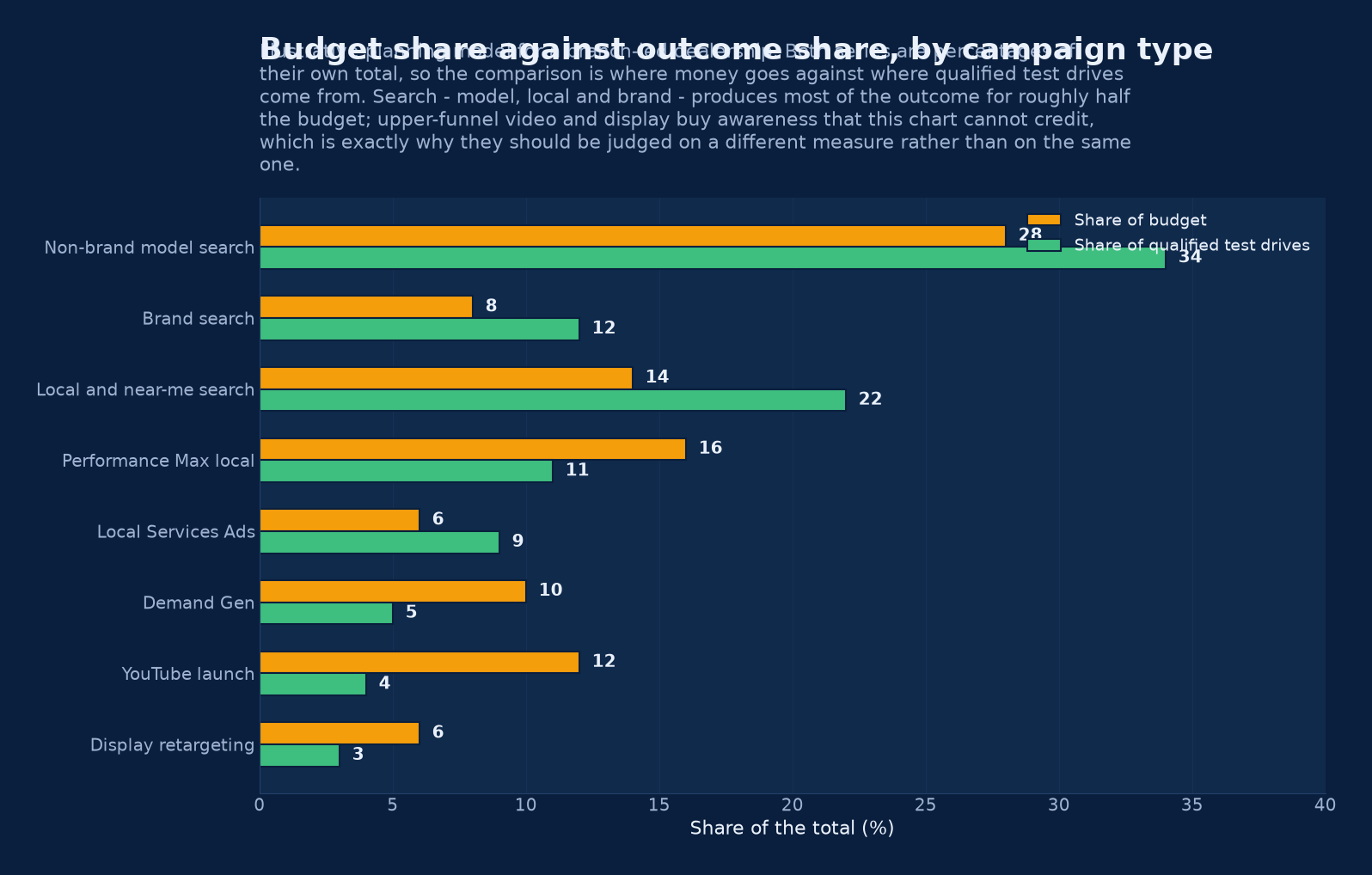
Chart values are an illustrative planning model based on typical UMC engagements and published industry benchmarks. They are not a guarantee of results on any specific project.
| Decision | Data it requires | Rule we apply | What happens without it |
|---|---|---|---|
| Which bidding strategy | Imported outcomes with values | Start on qualified leads, move to valued deliveries once volume supports it | Automation optimising towards noise |
| Target cost per outcome | Delivered-unit margin by model | A ceiling derived from margin, not from last month’s spend | A target set by what the budget happens to be |
| Budget per branch | Branch capacity, stock and consultant hours | Budget follows capacity, with a stated lead ceiling per branch | Leads queued for a branch that cannot call them |
| Budget per model | Stock availability and margin per model | Weighted towards models with stock and margin | Demand generated for variants with a six-month wait |
| Dayparting | Call answer rates and branch hours by hour | Bid to trading hours and staffed desks | Spend on calls nobody answers |
| Festive uplift | Previous-year demand curve and this year’s stock | Planned in advance with capacity agreed | A spike that the branches experience as chaos |
| Bid adjustments by geography | Distance from branch to conversion | Radius-weighted, with exclusions where a branch cannot serve | Leads from three hours away |
| Device and channel weighting | Conversion rate by device and channel | Mobile weighted where calls convert, desktop where forms do | Averaged bids that overpay on one device |
| Audience strategy | CRM segments, previous visitors, owner lists | Observation first, then bidding adjustments with evidence | Audiences added because the platform suggests them |
| Pause and stop rules | Cost per delivered unit by campaign | A documented threshold that pauses a campaign automatically | A poorly performing campaign defended for a quarter |
- Budget governance is a management process with a marketing input: where the ceiling has to come down for cash reasons, the sequence of what to pause matters and belongs in cash flow and working capital planning or, at group level, unified top-level business management.
- The report leadership needs is short: spend, qualified leads, test drives shown, orders, deliveries and cost per delivery by branch and model – a dashboard with six columns, not forty charts.
- Where the cost per delivered unit is rising while volume is flat, the cause is usually operational rather than media, and the investigation is cost rationalisation and margin recovery with the funnel data attached.
- Competitive pressure changes bids faster than any internal review: market and competitive analysis on share of voice and price positioning is what explains a sudden cost increase.
Landing pages and creative: making the click worth what it cost
A showroom account can be structurally perfect and still lose money at the landing page, because the click arrives with a specific expectation – a price, a branch, an offer, a bookable slot – and most landing pages answer a general one. The rule is that every campaign points at a page built for its intent, that the page loads fast on a phone in a car park, and that the next step is a booking or a call rather than a brochure download.
| Intent | What the landing page must show above the fold | Primary action | Secondary action | Usual leak |
|---|---|---|---|---|
| Variant and price | Ex-showroom and on-road build-up for the searcher’s state | Book a test drive | Calculate EMI | A price that requires a form to reveal |
| Locality and near me | Branch hours, a tracked number, directions, stock | Call the branch | Book a visit | A contact form as the only path |
| Offer and festive | The offer, its validity, eligible variants | Check eligibility and book | Call | An offer without an expiry date |
| Model research | Variants, key specs, images, honest comparisons | Book a test drive | Save and share the configuration | A brochure download presented as the next step |
| Service and workshop | Packages, labour rates, bookable slots | Book a bay | Request a callback | A phone number with no slot visibility |
| Used and exchange | Valuation band, inspection process, current inventory | Request a valuation | Book an inspection | A valuation promise the yard will not honour |
| Finance | Tenures, EMI examples, documents, eligibility caveats | Start a pre-approval | Book a finance appointment | Approval implied rather than qualified |
| Launch and event | Dates, what will be shown, branch participation | Register for the event | Book a later test drive | A registration with no reminder flow |
| Retention and ownership | Warranty, service plans, roadside, recall status | Book service | Renew a plan | Ownership traffic sent to a sales page |
- Landing pages are templates over records, so the campaign and the page stay in step when a price changes – the same content model the showroom website programme builds.
- Conversion work on these pages returns more than most bid changes: conversion rate optimisation on a variant page, with a booking path tested against a form, is a week of work and a permanent lift.
- Speed is a bidding input as well as a conversion one: Core Web Vitals on mobile affects Quality Score and cost per click, and a mobile-first build is assumed rather than negotiated.
- Creative and page have to agree visually and verbally – UX and UI design carrying the offer language from the ad into the page, without a redesign in between.
- Where the page needs editorial support – a guide that answers the research question first – that is content marketing with an enquiry path, not a blog with a sidebar.
Launches, festive windows and upper-funnel video
Upper-funnel media in showroom categories is judged unfairly, because it is measured with the same instrument as search. A launch film or a festive brand campaign does not produce a qualified test drive in seven days; it produces the demand that search then harvests, and the honest way to run it is with its own measure, its own budget line and a holdout that shows what it contributed. What it must not do is run without the lower funnel being ready – a launch that drives traffic to a branch page with no bookable slot pays for the traffic twice.
| Moment | Media that works | What must be ready first | Measure that is fair |
|---|---|---|---|
| Model launch | YouTube walkarounds and first-drive films, Demand Gen | Model, variant and price pages live; launch event booking open | Assisted deliveries and branded search lift, with a city holdout |
| Festive window | Search on offers, Meta and Instagram creative, out-of-home in branch localities | Offer pages with validity, stock feed current, extended hours published | Cost per delivered unit against the same window last year |
| Branch opening | Local search, local media, an opening event | Branch page, profile, citations and photos before opening day | First-month enquiries and map-pack presence |
| Clearance of aged stock | Inventory ads targeted at aged units, retargeting | Ageing stock visible per branch, exchange valuations published | Units cleared and margin held |
| Service campaign | Search on service intent, WhatsApp to due owners | Service pages, packages and bay capacity | Bay utilisation and upsell rate |
| Owner community work | Creators and owner clubs, delivery-day films | Consent, rights and a brand-safe brief | Referral enquiries and review velocity |
| Virtual launch or briefing | Webinar and event campaigns for fleets and partners | Registration flow with reminders | Registrations, attendance and fleet enquiries |
| Database reactivation | Email, SMS and nurture sequences to owners | Consent records and trade-in-age segments | Reactivation enquiries at a fraction of acquisition cost |
| Retention journeys | Lifecycle campaigns keyed to service due and warranty expiry | Service history joined to the customer record | Service bookings and repeat purchase |
| Reputation moments | Rapid factual response, review generation | A monitored review flow and a named owner | Sentiment recovery and enquiry stability |
- Upper-funnel and lower-funnel media have to be planned as one calendar: media planning and buying decides which localities get out-of-home and which get search weight, so the two reinforce rather than duplicate.
- Social carries the branch story between campaigns and answers the questions search does not receive: organic social plus paid amplification, with comment and DM handling treated as an enquiry channel.
- Every route ends at the same branch and variant pages, so the local foundation from the SEO programme for showrooms has to be finished before the calendar starts.
Where paid leads leak: the losses that never appear in a platform report
Platform reports show what was bought; they cannot show what was dropped. In showroom accounts the majority of paid spend is lost after the click – at a form nobody routes, a phone nobody answers, a follow-up that arrives on day three, a test drive nobody reminded. None of these appears as a line item, and all of them are visible the moment the funnel is instrumented end to end. Fixing them is cheaper than any bid change and it improves organic conversion at the same time.
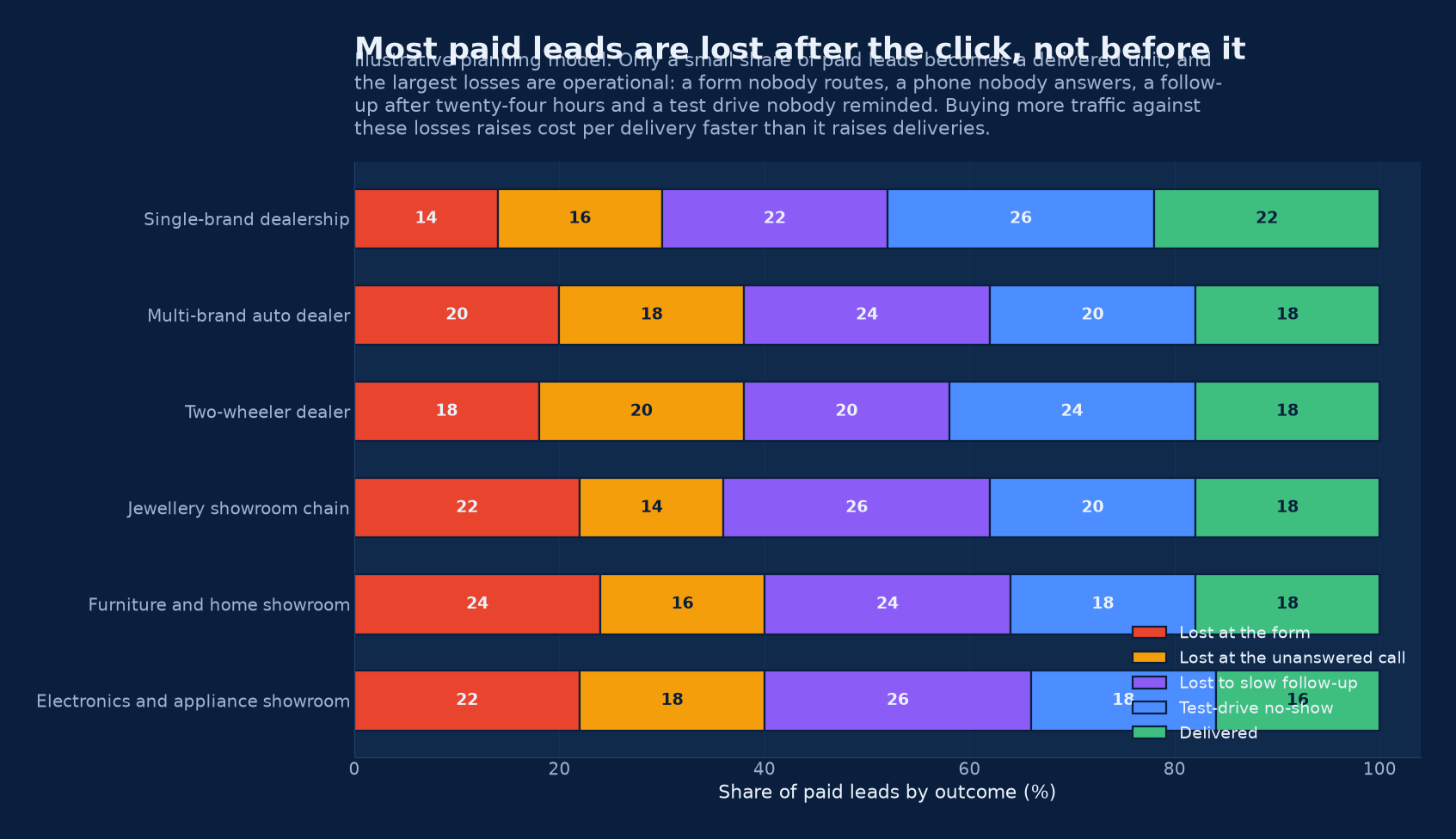
Chart values are an illustrative planning model based on typical UMC engagements and published industry benchmarks. They are not a guarantee of results on any specific project.
| Leak | How it presents | How it is detected | Fix | Effect on cost per delivery |
|---|---|---|---|---|
| Form not routed | Enquiries sit in a shared inbox | Time-to-first-contact report | Routing to a branch queue with an SLA timer | Large and immediate |
| Call unanswered | A landline ringing in an empty office | Call answer rate by branch and hour | Duty rota, tracked numbers, out-of-hours flow | Large |
| Slow follow-up | First contact after twenty-four hours | Lead age at first contact | Fifteen-minute target in trading hours | Large – the decay curve is steep |
| No outcome coding | Every lead looks the same in the report | Percentage of leads with an outcome code | Mandatory outcome codes before a lead can close | Indirect but decisive for bidding |
| Test-drive no-show | A booked slot with nobody in it | Show rate by branch and by source | WhatsApp reminders and a reschedule link | Large |
| Duplicate leads | One customer counted three times | Duplicate rate on phone plus model | Deduplication at capture and at import | Distorts every metric |
| Wrong branch routing | A lead sent to a branch an hour away | Lead-to-branch distance | Radius rules and a manual override log | Moderate, and it costs the customer |
| Stale offer advertised | An expired scheme still bidding | Offer validity monitored against live ads | Automated takedown on expiry | Moderate, plus a trust cost |
| Sold-unit enquiries | Ads for vehicles no longer available | Feed staleness alerts | Availability rules on the feed | Moderate, plus wasted branch time |
| Unmeasured walk-ins | Customers who saw an ad and just arrived | One question at the desk, recorded in the DMS | Source capture at reception | Understates paid value, so budgets get cut wrongly |
- Every leak above is an operations fix with a marketing payoff, and most belong to the branch rather than to the agency – which is why the funnel report goes to the general manager, not only to marketing.
- The systems that carry the fixes need to be supported: routing, telephony and the CRM are part of the estate managed under managed IT services, and a routing failure is an incident like any other.
- Where the funnel is instrumented but the follow-up still slips, the constraint is staffing against demand – a capacity question answered by forecasting weekend enquiry volumes rather than by exhortation.
The ninety-day showroom paid media programme, and what we need from you
The programme below is the shape we run for a dealership group: three weeks to define the lead chain and instrument it, overlapping account restructuring, search and local campaigns live from week four, inventory ads from week seven once the feed is trustworthy, offline conversion import from week nine, upper-funnel added only once the lower funnel is measured, and budget governance handed over at the end. The dependency that decides the timeline is access – to the DMS, to the telephony and to the branch data.
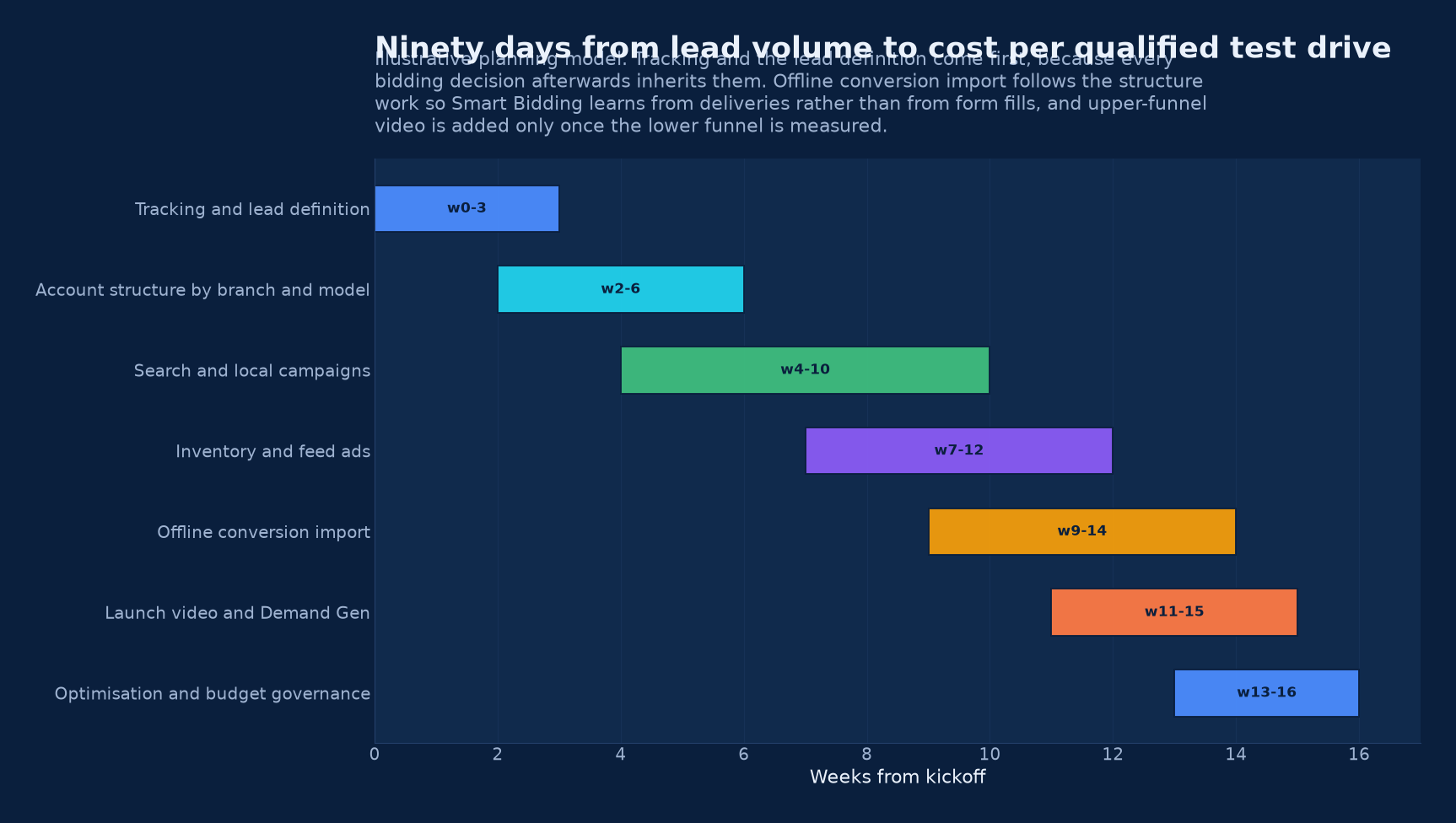
Chart values are an illustrative planning model based on typical UMC engagements and published industry benchmarks. They are not a guarantee of results on any specific project.
| Weeks | Workstream | Deliverable | Decision it enables |
|---|---|---|---|
| Zero to three | Tracking and lead definition | Qualified-lead definition in writing, call tracking, conversion actions, baseline report | What the account is allowed to optimise towards |
| Two to six | Account structure | Campaign families by branch, model and intent, with negatives and landing mapping | Which decisions each campaign answers |
| Four to ten | Search and local campaigns | Model, price, locality, service and brand campaigns live with intent-matched pages | Where the qualified demand actually is |
| Seven to twelve | Inventory and feed ads | Live stock feed, availability rules, aged-stock campaigns | Which units advertising should clear |
| Nine to fourteen | Offline conversion import | Test drive, quotation, order and delivery imported with values | Whether bidding can move to delivered units |
| Eleven to fifteen | Upper funnel and launches | Video and Demand Gen with holdouts, festive calendar plan | What awareness media contributes, honestly measured |
| Thirteen to sixteen | Governance and handover | Budget ceilings, pause rules, reporting pack, training | Who runs it, and on what limits |
| Ongoing | Optimisation and review | Weekly search-term and funnel review, monthly cost-per-delivery report | Whether the account is improving or drifting |
- What we need: ad account and analytics access, the DMS or CRM with a lead identifier we can carry, branch list with verified hours and tracked numbers, live stock access, twelve months of spend and lead history, and one named owner from sales who will agree the lead definition.
- What you keep regardless: the lead definition, the tracking specification, the account structure, the import job and its documentation, the funnel report and the budget governance rules. They are yours.
- What we will tell you plainly: which campaigns to stop, which brand terms you are overpaying for, and where the leak is operational rather than media – usually in the first fortnight.
- Ongoing operation of the estate around the account – hosting, monitoring, access, backups – sits with application maintenance and the wider technology services catalogue, and paid media reporting lives beside the rest of marketing in the digital marketing set.
Showroom paid media by city, and worked examples
Paid media in this category is local by construction: radius targeting, branch capacity, registration and tax components in the price message, language variants in the creative, and a festive calendar that differs by region. City-level economics decide the ceiling on cost per delivered unit more than any bid setting does. The engagements below are dealership, showroom and store projects where paid, organic and the lead flow were run against one definition.
- Get more automobile sales leads in Lucknow
- Digital marketing company for automobile dealers in Lucknow
- Website development company for automobile dealers in Lucknow
- Get more jewellery customers in Lucknow
- Digital marketing company for jewellery stores in Lucknow
- Digital marketing and IT services in Lucknow
- Services across Indian cities
- Case study: Hyundai group showroom full-service social advertising contract
- Case study: a fashion retail showroom
- Case study: WordPress and WooCommerce online mobile store
- The showrooms and dealerships industry hub – all eight disciplines
- Retail and e-commerce: Shopping, Performance Max and retail media
- Manufacturing: dealer networks and B2B demand generation
- Hotels and hospitality: booking-led paid media and direct-channel economics
- All industry verticals we build programmes for
- About Unified Management Consulting
- Contact us about Google Ads for showrooms and dealerships
Where this page sits in our showrooms programme
Google Ads is the third discipline of our showrooms and dealerships programme. The hub page explains how the eight disciplines fit together, each discipline has its own page as it is published, and the generic service page for every discipline stays listed below alongside the vertical pages. A discipline that is not listed is not published yet – the list is generated from live pages and refreshes automatically as each spoke lands.
- Showrooms – the vertical main page
- Website development for showrooms and dealerships
- SEO for showrooms and dealerships
- Social media marketing for showrooms and dealerships
- CRM and lead management for showrooms
- Business intelligence for showrooms
- IT support for showrooms and dealerships
- AI for showrooms and dealerships
- Website development services – the generic service page
- SEO services – the generic service page
- Social media management – the generic service page
- Custom CRM development and integration – the generic service page
- BI dashboards and executive reporting – the generic service page
- Managed IT infrastructure and AMC – the generic service page
- AI agent deployment and automation – the generic service page
Frequently asked questions about Google Ads for showrooms and dealerships
What should a dealership measure in Google Ads?
Cost per qualified test drive and cost per delivered unit, by branch and model. Lead volume is an input, not an outcome, and cost per lead varies by a factor of several depending on what a lead is allowed to mean – which is why the definition is agreed with sales in writing before budget moves.
Can Google Ads know that a lead became a delivery?
Yes, with an offline conversion import: a click identifier is carried into the lead record, and the DMS outcomes – test drive shown, quotation, order, delivery – are imported back against it. That is what lets Smart Bidding optimise towards units rather than form fills.
How should the account be structured?
By the decisions the business takes: brand defence, model and variant, local and near-me, service and workshop, used and exchange, offers, and inventory – each with branch-level targeting, budgets and reporting. Structures built around keyword themes cannot be governed per branch.
Is Performance Max suitable for a showroom?
Yes, with a local goal, per-model and per-branch asset groups, a live stock feed, imported outcomes as conversions, and weekly review of search terms and asset groups. Without those controls it concentrates spend on brand traffic and unqualified forms.
Do calls matter more than forms in our category?
In most showroom categories, yes. That means a number that is answered during trading hours, tracked numbers per branch and campaign, outcome coding on calls, and call assets or call-only campaigns dayparted to when somebody can respond.
How do we advertise live stock without annoying customers?
With an availability rule on the feed: units that are sold or reserved stop serving within the hour, branch location is carried so a customer is not sent across the city, and aged stock is targeted deliberately rather than advertised as new.
What is a realistic budget for a dealership?
It follows the delivered-unit target and the margin per unit, not the other way round. Set a ceiling on cost per delivered unit, work back through expected funnel conversion to the required qualified lead volume, and check that each branch has the capacity to absorb it before increasing spend.
How do we handle festive season demand?
Plan it: calendar-driven budgets agreed in advance, offer pages with validity dates, stock feed current, extended branch hours published, and capacity checked per branch. Festive spikes punished estates that could not answer the phone rather than estates that bid too high.
Should we bid on our own brand name?
Only where you would otherwise lose the click – to an aggregator, a competitor or a thin organic result. Where your branch page and profile already own the brand query, defensive brand bidding usually buys what you already had, and a holdout test settles it.
How do paid and organic work together here?
They share landing pages, a lead definition and a measurement join. Organic wins the research and local queries over time; paid covers launches, offers and gaps, and both are judged on the same qualified-lead chain rather than on separate platform dashboards.
What about advertising finance and offers – is there a compliance angle?
Yes. Published rates, honest exclusions, no implied approval guarantees, offer validity dates and substantiated claims. We keep an evidence trail per campaign, which is also what an audit or an insurer eventually asks for.
What do you need from us to start?
Ad account and analytics access, DMS or CRM access with a lead identifier we can carry, the branch list with verified hours and tracked numbers, live stock access, twelve months of spend and lead history, and one named owner from sales to agree the lead definition. Access is usually the constraint, not budget.
Start with the lead definition and the tracking join
Give us three weeks with ad account and analytics access, DMS or CRM access, your branch list with verified hours and tracked numbers, live stock access and twelve months of spend and lead history, and we will return a written qualified-lead definition agreed with your sales team, a tracking and offline-import specification, an account structure by branch, model and intent with landing mapping, a funnel-loss report showing where paid leads are actually dropped, a budget governance model with a ceiling per delivered unit, and a ninety-day plan that states which campaigns we would stop. Yours to keep whether or not we run the account.
Contact Unified Management Consulting to arrange a confidential first conversation.