
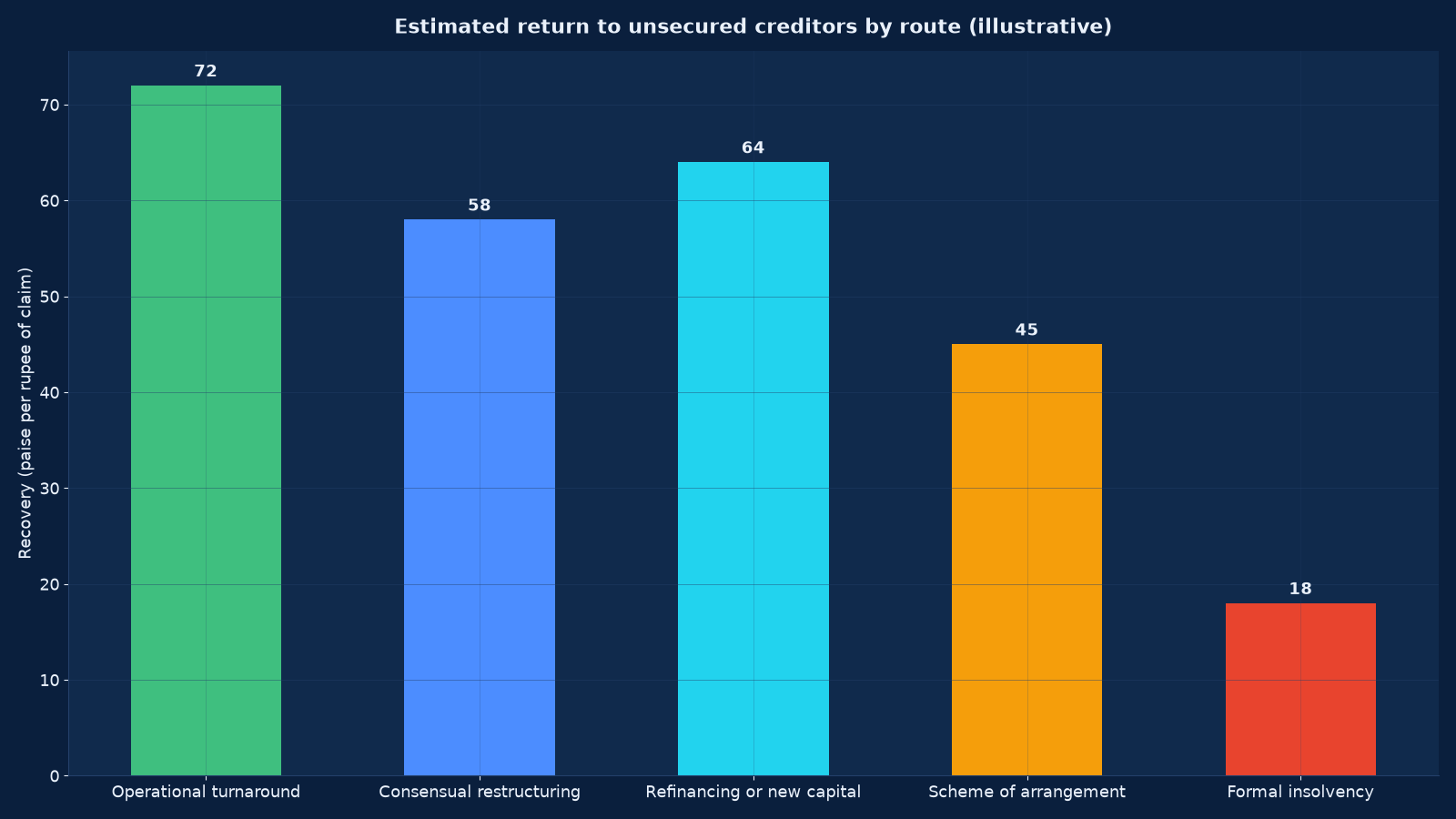
Chart values are an illustrative planning model based on typical UMC engagements and published industry benchmarks. They are not a guarantee of results on any specific project.
Distress is not a financial condition. It is a timing condition: the moment when the obligations falling due exceed the resources available to meet them. Everything about restructuring is therefore about buying time honestly — from lenders, from suppliers, and from the business’s own cost base.
Distressed business restructuring is what happens when a viable business has an unviable balance sheet, or a viable balance sheet has run out of cash. Unified Management Consulting works alongside owners, boards, lenders and insolvency practitioners to stabilise cash, establish an honest position, negotiate with stakeholders, restructure the operations and the debt, and preserve more value than any alternative route would. We are advisers and operators, not lawyers — we work with your counsel and, where a formal process is required, with the appointed insolvency professional.
⚠️ Distressed Business Restructuring — Quick Summary
| Component | What We Deliver |
|---|---|
| Stabilisation | Immediate cash control: payment release authority, critical-supplier protection, statutory dues kept current, and a thirteen-week forecast running from day one. |
| Honest position | An evidence-based view of assets, liabilities, claims, security and contingent exposure — the document every stakeholder conversation depends on. |
| Options analysis | Each route costed for stakeholder recovery and for the owner: operational turnaround, refinancing, consensual restructuring, scheme, sale, or a formal process. |
| Stakeholder mapping | Who holds security, who has priority, who can stop supply, who can force a process, and what each of them actually wants and fears. |
| Lender negotiation | A credible plan, a realistic ask, moratorium or standstill where available, covenant resets, and documentation that survives scrutiny. |
| Operational restructuring | Portfolio pruning, site and capacity rationalisation, headcount and structure, cost base reset — run in parallel with the financial work, not after it. |
| Balance-sheet restructuring | Repayment rescheduling, haircuts, debt-for-equity, asset sales, new money and the security package that accompanies it. |
| Governance under stress | Decision rights tightened, reporting to lenders established, board or owner oversight formalised, and a record of every material decision. |
| Exit or completion | The business handed back with a sustainable structure, or a managed process completed protecting stakeholders and statutory obligations. |
This service normally follows the 30-Day Turnaround Diagnostic, which establishes whether the business is on a restructuring route at all, and it runs alongside cash flow and working capital recovery for the stabilisation phase. Where the underlying governance is the cause, Risk, Governance & Business Continuity Support is the follow-on. Engagements are led by Mr Avinash Sharma under strict confidentiality.
The Stages of Distress — and Why Stage Determines Everything
The single most important variable in any restructuring is not the size of the debt. It is the stage at which the owner asks for help. Figure 1 is really a chart about time: the recovery available to creditors falls as options narrow, and options narrow with delay.
| Stage | What it looks like | Options still open | Typical time left |
|---|---|---|---|
| 1. Strained | Forecasts are missed, the overdraft is at its limit, but all obligations are met | Everything: turnaround, refinancing, growth funding, sale at full value | 12–24 months |
| 2. Stretched | Payments are being scheduled around receipts; suppliers are asked to wait; the owner is personally funding gaps | Operational turnaround, refinancing, consensual restructuring with a credible plan | 6–12 months |
| 3. Distressed | Some obligations are missed or deferred; lenders are asking questions; key suppliers are tightening credit | Consensual restructuring, standstill, new money against security, managed sale | 2–6 months |
| 4. Critical | Statutory dues or employee payments at risk; lenders issuing notices; creditors threatening action | Formal standstill, restructuring under lender supervision, sale as a going concern | 4–12 weeks |
| 5. Insolvent in fact | Unable to pay debts as they fall due, or liabilities exceed assets on a realistic valuation | A formal process, or an orderly wind-down; duties to creditors now dominate | Immediate |
Two consequences follow. At stages 1 and 2 the owner retains control of the outcome — the business can be fixed, refinanced or sold on their terms. At stage 4 and beyond the creditors and the statute set the agenda, and the owner’s role becomes cooperation rather than direction. Most of the value destroyed in restructurings is destroyed in the eighteen months a business spends moving from stage 2 to stage 4 while everyone hopes.
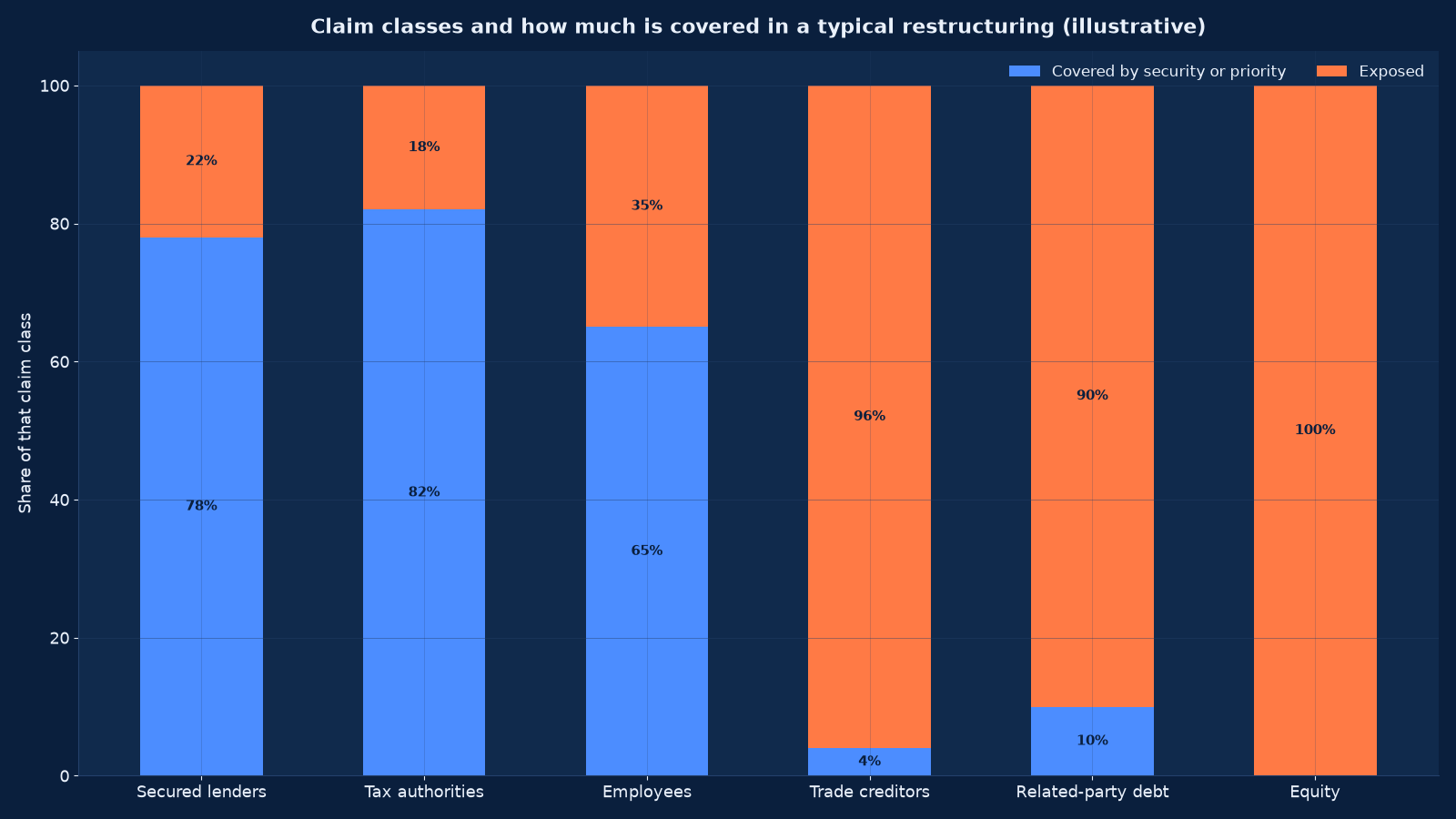
Chart values are an illustrative planning model based on typical UMC engagements and published industry benchmarks. They are not a guarantee of results on any specific project.
The Options Ladder
| Route | When it works | What it costs | What it risks |
|---|---|---|---|
| Operational turnaround | The business is viable and the debt is serviceable once performance recovers | Management time, advisory cost, usually some new working capital | Too slow if creditors will not wait |
| Refinancing or new money | The problem is the structure of the debt rather than the business | Higher pricing, more security, sometimes personal guarantees | Adding debt to a business that has not fixed its cash generation |
| Consensual restructuring | Lenders and major creditors will agree terms outside a formal process | Advisory and legal cost, haircuts or extended tenor, loss of some control | One dissenting creditor can unravel it; requires near-unanimity |
| Scheme or arrangement | A binding compromise is needed across a class of creditors | Court or tribunal process, legal cost, time, publicity | Court timelines are not under your control |
| Formal insolvency process | The business cannot pay its debts and a statutory framework is needed to bind creditors or to preserve value | Process cost, loss of owner control, severe creditor haircuts, reputational effect | Value destruction: Figure 1’s eighteen paise |
| Sale as a going concern | The business is worth more to someone else, or the owner cannot fund the recovery | Loss of ownership; a process that must be run quickly and confidentially | A distressed sale price if the process is visible |
| Managed wind-down | No route preserves value above the cost of continuing | Closure costs, redundancy, residual claims | Doing it disorderly, which creates personal exposure |
The Stakeholder Map
Restructuring is a negotiation with nine audiences at once, each of whom is being given incomplete information by circumstances. The map below is built in week one and drives the communication plan.
| Stakeholder | What they want | What they fear | How to handle them |
|---|---|---|---|
| Secured lenders | Full repayment, or the maximum recovery with the least process cost | Security being eroded, value leaking out, being subordinate to new money | Early, factual communication with a forecast; never surprise them; ask for what you need with a plan attached |
| Unsecured lenders and bondholders | A better outcome than a formal process would give them | Being crammed down or paid last | Show them the comparison honestly — the consensual outcome usually beats the alternative |
| Tax authorities | Statutory dues paid, filings current | Preferential treatment of other creditors while dues accumulate | Keep dues current wherever possible; where impossible, disclose and seek a payment plan early |
| Employees | Wages paid, jobs preserved, honesty | Sudden closure and unpaid dues | Communicate earlier than feels comfortable; unpaid wages destroy cooperation and often trigger processes |
| Critical suppliers | To be paid and to keep a customer | Being left with unsecured exposure while others are protected | Rank by criticality, protect the critical few explicitly, negotiate terms with the rest |
| Customers | Continuity of supply and service levels | A supplier failing mid-contract | Reassure with facts where possible; a lost anchor customer can make recovery impossible |
| Landlords | Rent paid or the property back | A long arrears position with no exit | Negotiate early; rent concessions are more available than owners expect |
| Owner and family | The business to survive, personal exposure limited, dignity preserved | Personal guarantees being called, public failure | Be direct about personal exposure at the outset — it changes every decision |
| Board or investors | An honest position and a credible plan | Discovering the position late | Full disclosure, documented decisions, no optimistic framing |
The pattern across all of them is the same: early, factual, consistent. Every restructuring that goes badly has at its core a stakeholder who learned the position from someone else, or who was told something that later proved optimistic. Credibility is the only currency an owner has in a restructuring, and it is spent quickly.
Lender and Creditor Negotiation
Negotiation is preparation, not persuasion. The work that determines the outcome happens before anyone sits down.
- Build the position first. A thirteen-week forecast, an asset and liability statement, the claim map, and the options analysis with recovery figures per route. A lender asked for patience without a plan hears a request; asked with a plan, they hear a proposal.
- Know what you are asking for. A standstill period, a covenant reset, an amortisation holiday, additional facilities, a rate change, or a haircut. Each has a different cost to the lender and a different probability.
- Know what you can offer. Additional security, a personal contribution, governance changes, reporting commitments, milestone-based releases, equity dilution, or asset sales with proceeds applied to debt.
- Understand the lender’s own constraints. Bank officers operate within internal policies, provisioning rules and regulatory frameworks. An ask that is impossible for them to approve internally will be refused however well it is presented — so shape the ask to something they can take to their committee.
- Sequence the creditors. Start with the party whose cooperation unlocks the others, usually the secured lender. Announcing a plan to unsecured creditors before the secured lender has engaged is how plans collapse.
- Document everything. Every agreed change in writing, including interim arrangements. Verbal forbearance is not forbearance.
Where a lender has commissioned an independent business review, treat it as an opportunity rather than a threat: a competent reviewer’s findings usually support the operational plan the business already needs. Our bank credit facility project summary is an example of work delivered with a financial institution’s expectations in view.
Operational Restructuring: Run It in Parallel
The most common error in restructuring is treating the financial and operational work as sequential — negotiate first, then fix. Creditors do not fund a plan they cannot see being delivered, and an operational improvement that arrives after the negotiation has concluded is worth nothing to that negotiation.
| Area | Typical action | Cash effect | Risk |
|---|---|---|---|
| Portfolio | Exit or reprice loss-making products, customers and contracts | Margin improvement within one cycle | Losing scale that carries shared cost — model the residual cost absorption |
| Sites and capacity | Consolidate sites, sublet space, break leases where possible, reduce shift patterns | Rent and utility savings, one-off exit costs | Capacity needed for the recovery itself |
| Structure and headcount | Flatten spans, remove duplicated layers, reduce where activity has gone | Immediate and durable | Losing the people who know how things work; redundancy costs and statutory process |
| Procurement | Consolidate suppliers, renegotiate, remove maverick spend | 2–15% on addressable spend | Supply continuity from a single source |
| Working capital | The full programme in our cash flow service | Largest short-term cash effect | Over-stretching suppliers or under-stocking |
| Pricing | Withdraw uneconomic discounts, reprice to cost changes, index where contracts allow | Fast and often large | Customer attrition — measure it, do not assume it |
| Non-core assets | Sell assets not required for the core operation | Lumpy, plus removal of running cost | Sale-and-leaseback converting a capital problem into a permanent fixed cost |
| Technology and services | Remove unused licences, consolidate tools, renegotiate contracts | Modest but quick | Cutting the systems the recovery depends on |
Sequence what you can, parallelise what you must: cash control and the honest position in weeks one to three; stakeholder engagement from week two; operational restructuring from week four, with early wins reported into the negotiation as evidence.
Balance-Sheet Restructuring
Once operations are moving, the balance sheet has to be reshaped so the business can service it. Six instruments, usually combined.
Rescheduling. Extending tenor and reprofiling amortisation so repayments match the cash the business will actually generate. The cheapest instrument and the first to ask for.
Moratorium or standstill. A period without repayments or enforcement, usually in exchange for reporting, milestones and sometimes additional security or interest capitalisation.
Haircut or one-time settlement. A reduction in principal, typically in exchange for immediate payment of the balance. Lenders accept these when the alternative recovery is worse — which is why the options analysis with recovery figures matters.
Debt-for-equity. Converting debt into ownership. It cleans the balance sheet and dilutes the owner, and it changes the lender from a creditor into a shareholder with different incentives.
New money. Additional funding, almost always secured and often with priority over existing lenders, which is precisely why existing lenders resist it. The argument for new money is that it protects their recovery by preserving the going concern.
Asset sales with debt application. Selling non-core assets and applying proceeds to specific facilities, which deleverages and simplifies the security package at the same time.
Every one of these has tax, accounting and legal consequences, and several require documentation that only counsel should draft. Our role is to establish which combination preserves the most value, to model it, and to negotiate the commercial terms.
The Indian Frameworks You Are Actually Operating Within
This is general information, not legal advice, and every situation turns on its own documents — but an owner who does not understand the framework cannot make the first decisions well.
| Framework | What it does | When it becomes relevant |
|---|---|---|
| Insolvency and Bankruptcy Code, 2016 | A time-bound process for resolving insolvency or liquidating a corporate debtor, triggered by default, with management vesting in a resolution professional | When a default has occurred and a creditor or the company itself may initiate a process — including before someone else does |
| Corporate insolvency resolution process (CIRP) | A moratorium on claims while resolution plans are solicited, with a statutory timetable | Stage 4–5, where a binding process across all creditors is needed |
| Pre-packaged resolution for MSMEs | A faster, debtor-initiated route available to MSME corporate debtors, with management retaining more involvement | MSME businesses at stage 4 that want a binding outcome without a full CIRP |
| Liquidation waterfall (section 53) | Sets the order of payment: process costs first, then workmen’s dues for 24 months and secured creditors who relinquish security, then employee wages, then unsecured financial creditors, then government dues, then other creditors, then shareholders | When comparing a consensual offer against what a formal process would deliver |
| SARFAESI Act, 2002 | Allows secured lenders to enforce security without court intervention, after notice | When a secured lender is considering enforcement — the reason to engage before notices arrive |
| RBI prudential frameworks on stressed assets | Require lenders to recognise stress early and pursue resolution within defined timelines | Whenever a bank is a lender: it explains why your bank may be less patient than it used to be |
| Personal guarantees | Expose promoters and directors personally, including under the insolvency framework for personal guarantors to corporate debtors | At the outset of every engagement — this changes the owner’s own calculus |
| Companies Act obligations | Director duties, accounting and filing obligations, and restrictions on transactions when the company is distressed | Continuously; and acutely before any related-party payment or asset transfer |
| Tax and statutory dues | GST, TDS, PF, ESI and income tax dues carry their own consequences and, in some cases, personal exposure | Before any payment priority is decided — deferring these is rarely a real option |
Three points matter more than the rest. The process can be started by someone else. A creditor can initiate a resolution process on default, so the decision to engage early is also a decision about who controls the timetable. Personal guarantees are usually in play. Most promoter-led businesses in this market have them, and they are frequently forgotten until they are invoked. Director duties sharpen as insolvency approaches. Payments to related parties, transfers of assets, and preferential treatment of one creditor over another can be examined and reversed afterwards. We will tell you plainly when a proposed action creates that exposure, and we will not help implement one that does.
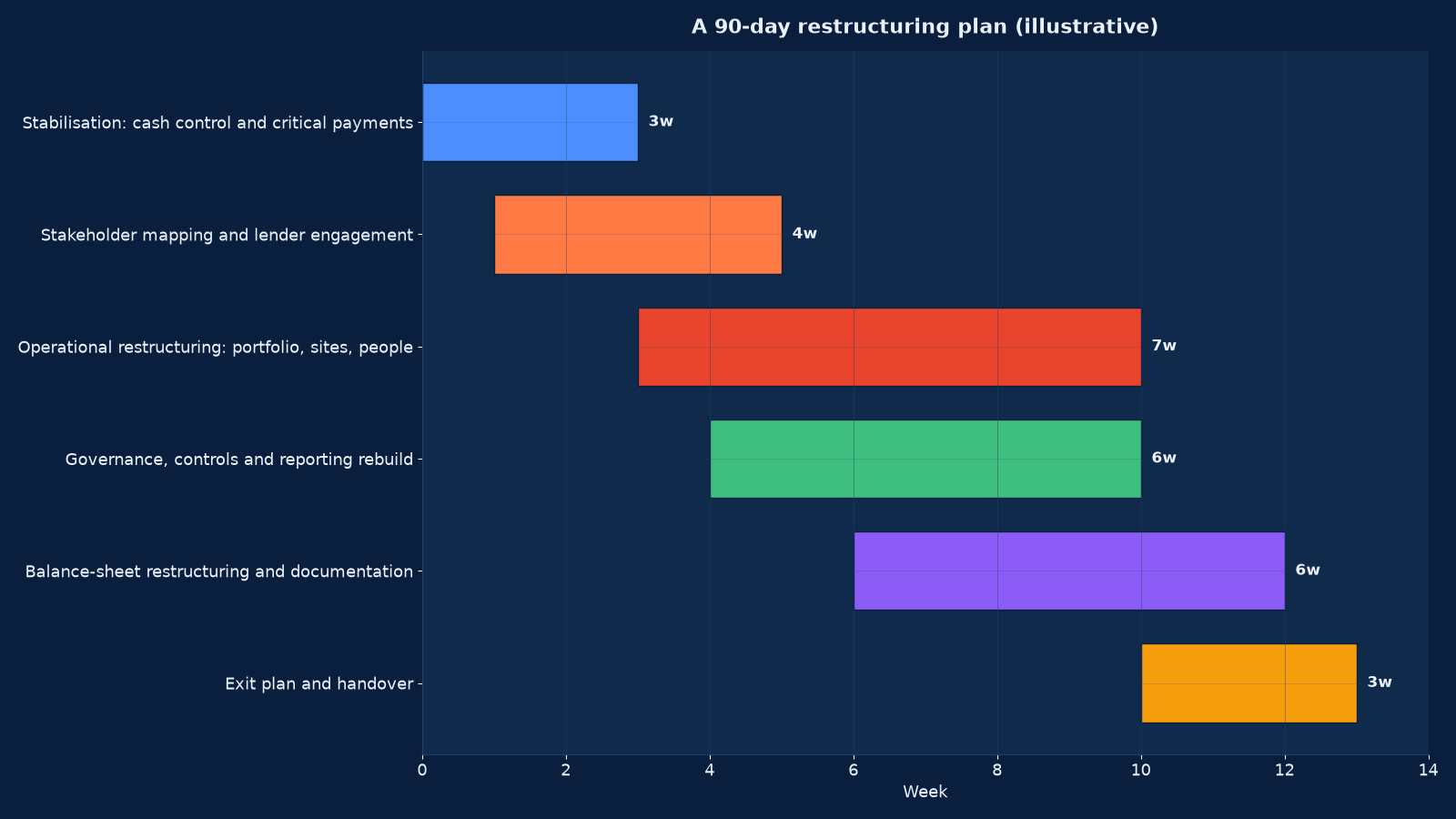
Chart values are an illustrative planning model based on typical UMC engagements and published industry benchmarks. They are not a guarantee of results on any specific project.
The Ninety-Day Restructuring Plan
| Phase | Weeks | What happens | Output |
|---|---|---|---|
| Stabilisation | 1–3 | Payment release authority, critical supplier protection, statutory dues review, 13-week forecast, immediate cash actions | Cash under control and a credible near-term position |
| Honest position | 1–4 | Assets, liabilities, claims, security, contingent exposure, related-party balances, guarantees | The document every stakeholder conversation uses |
| Stakeholder engagement | 2–5 | Lender conversations, supplier and employee communication, landlord and customer approach where needed | Standstill or forbearance where available; a communication plan running |
| Operational restructuring | 4–10 | Portfolio, sites, structure, procurement, pricing, working capital | Measured cost reduction and margin recovery feeding the plan |
| Governance and reporting | 5–10 | Decision rights tightened, lender reporting established, board or owner oversight formalised | A decision log and a reporting pack lenders accept |
| Balance-sheet restructuring | 7–12 | The ask, the offer, negotiation, documentation, new money if required | Agreed terms documented |
| Exit or completion | 11–13 | Handover of the operating rhythm, or completion of the agreed process | A sustainable structure, or an orderly conclusion |
Directors, Owners and Personal Exposure
This is the section owners read last and should read first.
- Personal guarantees. List every guarantee given — to banks, to suppliers, on leases, on vehicle or equipment finance. In a restructuring the guarantee is often the binding constraint on what the owner can agree to, and it must be on the table at the start rather than surfacing at signature.
- Preferential and related-party payments. Paying a connected creditor, a family member’s loan or one favoured supplier ahead of others when the business is distressed can be challenged and reversed. Ask before you pay, not after.
- Asset transfers. Moving assets to another entity or to family members to protect them is the most reliably counter-productive action available: it is discoverable, it is reversible, and it destroys the credibility needed for everything else.
- Statutory obligations. Filings, tax deductions and employee dues continue to be obligations during distress, and some carry personal consequences.
- Employment law. Redundancy, wage payment and notice obligations apply throughout, and unpaid wages frequently trigger the processes owners were trying to avoid.
- Knowing when the duty shifts. As insolvency approaches, directors’ duties are owed increasingly to creditors rather than to shareholders. Recognising that moment is a legal judgement — take it with counsel, and take it early.
We raise these points in every engagement because owners under pressure consistently underestimate them, and because the actions that feel protective in the moment are the ones that remove options later.
Governance While the Restructuring Runs
A business in restructuring needs tighter governance than a healthy one, not looser, because the margin for error is gone and the audience for decisions is larger.
Cash authority centralised. Above a low threshold, no payment leaves without a named approver. This is not bureaucracy; it is how a business survives thirteen weeks.
A single source of truth. One forecast, one claim map, one set of management accounts, used with every stakeholder. Different numbers to different parties is how restructurings fail.
Lender reporting on a fixed calendar. Weekly or fortnightly, to an agreed format, delivered whether or not the news is good. Voluntary transparency buys forbearance.
A decision log. Every material decision recorded with date, decision, authority and rationale. If a process is ever scrutinised afterwards, that log is the directors’ best evidence that they acted deliberately and on information.
Escalation with a clock. Covenant concerns, supplier stoppages, customer losses and any legal notice escalate the same day.
This is the same operating discipline described in our unified top-level business management service, applied under pressure and with an external audience. Where it has to be installed because internal capacity has gone, an interim appointment from our leadership service is usually faster than building it.
Measuring the Restructuring
| Measure | Definition | Target |
|---|---|---|
| Cash runway | Weeks of operations fundable from available cash and facilities | Above 13 weeks and rising |
| Forecast accuracy | Weekly variance of actual to forecast | Inside 5% by week 8 |
| Statutory dues status | Any arrears in tax, GST, TDS, PF, ESI | Zero, or a documented plan |
| Critical supplier status | Any critical supplier on stop, credit-hold or cash-in-advance | None, and none created by us |
| Covenant headroom | Position against every covenant at each test date | Known monthly; no surprise breach |
| Cost reduction delivered | Run-rate saving evidenced in the accounts | Against plan, measured not projected |
| Contribution margin | Margin after the portfolio and pricing actions | Rising |
| Stakeholder agreements | Standstills, forbearance, reschedulings documented in writing | Every material agreement documented |
| Claims quantified | Share of total claims agreed with the claimant | Above 90% by week 8 |
| Recovery comparison | Estimated stakeholder recovery under the plan versus the alternative | The plan demonstrably better — this is what makes it acceptable |
Engagement Models
| Model | Duration | Deliverables | Best when |
|---|---|---|---|
| Restructuring readiness review | 2–3 weeks | Stage assessment, options analysis with recovery comparison, personal exposure review, recommended route | Before committing to a route, or when a lender is asking questions |
| Stabilisation mandate | 4–8 weeks | Cash control, 13-week forecast, honest position, critical supplier protection, initial stakeholder engagement | The business is at stage 3 or 4 and needs control first |
| Full restructuring | 3–9 months | All seven phases: stabilisation, position, negotiation, operational restructuring, governance, balance-sheet restructuring and completion | The standard mandate where a consensual route is viable |
| Lender negotiation support | 6–12 weeks | The pack, the ask, the offer, attendance at meetings and documentation support | Management is capable but needs an experienced counterparty |
| Support through a formal process | Per process | Operational management, information provision, stakeholder communication, working alongside the appointed professional | A statutory process is live and the business must keep trading |
| Interim leadership in distress | 3–12 months | An interim executive with restructuring experience holding the operating layer | Internal capacity or credibility is exhausted |
When to Stop — and What Success Looks Like
Not every business should be restructured, and part of this service is saying so early.
Success looks like this at the end: the business funds itself from operations, the debt is serviceable from a conservative forecast, statutory dues are current, critical suppliers are paid per terms, the lenders have a reporting rhythm they trust, contribution margin has recovered, and the owner can describe the plan in two sentences. The balance sheet may be smaller and the ownership may be diluted; the business survives and generates cash.
Stopping is the right answer when the underlying business cannot generate enough contribution to service any realistic structure, when the assets are worth more sold than traded, when the market has moved permanently, or when the cost of the process would consume the recovery. In those cases the honest recommendation is a managed sale or an orderly wind-down — which protects employees, creditors and the owner’s own position far better than a disorderly failure.
We will give you that recommendation if it is the right one. It is a poor use of an advisory relationship to spend a year restructuring something that should have been closed in a quarter, and our mission-led transformation study makes the same point from the other direction: persistence is a virtue when the mission is viable and a cost when it is not.
Frequently Asked Questions About Distressed Business Restructuring
How do I know whether my business is actually distressed?
Apply the staging table honestly. If you are scheduling payments around receipts, asking suppliers to wait, or funding gaps personally, you are at stage 2 or 3 whatever the accounts say. The practical test is the thirteen-week forecast: build it from bank statements and ageing, and see whether there is a week in which obligations exceed available resources. If there is, you are in distress; if there is not, you are strained and should still fix the causes.
Should I tell my bank before I have a plan?
Tell them before they discover it from somewhere else, but tell them with something. A lender who learns of a problem from a supplier complaint or a missed covenant has already lost confidence, and confidence is what buys forbearance. Ideally you approach with the forecast, the causes and the first actions — which is two to three weeks of work, and is why stabilisation comes first.
Will restructuring mean I lose my business?
Not in a consensual restructuring, which is the route we pursue first. It may mean dilution if debt-for-equity or new money is involved, tighter governance and reporting, and personal guarantees being tested. Formal processes are different: management control passes to a resolution professional and outcomes are less predictable, which is exactly why the earlier stages matter.
What happens to my personal guarantees?
They remain enforceable unless specifically renegotiated, and in our experience they are the constraint owners notice last. We list every guarantee in week one and treat them as part of the negotiation rather than as a separate personal problem, because lenders know they exist and will factor them into what they offer.
Can we keep trading while restructuring?
Yes, and usually you must — a business that stops trading loses the customers and the going-concern value that make the restructuring worth doing. Trading requires cash control, critical-supplier protection and honest communication, all of which are in the stabilisation phase. What you cannot do is trade while deferring statutory dues or employee wages indefinitely.
How is this different from insolvency?
Insolvency is a financial state — unable to pay debts as they fall due, or liabilities exceeding assets. Restructuring is what you do about it, and most restructuring happens consensually outside any formal process. A formal insolvency process is one instrument among several, used when a binding outcome across creditors is required or when no consensual route exists.
What does a restructuring cost?
Advisory and legal fees, plus the cost of the operational actions — redundancy, lease exits, asset write-downs. Set against that is the difference in stakeholder recovery between the routes in Figure 1, which is usually a multiple of the fees. We work on a fixed or capped fee basis by phase so the cost is known before each commitment, and we will tell you if the likely recovery does not justify the work.
Do you work with insolvency practitioners and lawyers?
Yes, routinely, and we would rather join an existing professional team than replace it. Our role is the operating and financial work: the position, the forecast, the negotiation, the operational restructuring and the governance. Legal advice and any statutory process belong with counsel and the appointed professional.
How confidential is this?
Fully, unless and until you decide otherwise. We do not appear in your communications, we do not contact your stakeholders without authorisation, and working papers stay with us. Where a lender requires disclosure as a condition of forbearance, we agree the scope with you in advance. The one thing we will not do is help present a position to a third party that we know to be wrong.
What if the owners disagree about what to do?
Then the options analysis becomes the decision instrument. Costing each route for stakeholder recovery, owner outcome, personal exposure and time usually converts a disagreement about instinct into a comparison of consequences. Where disagreement persists, it is a governance question for the board or the shareholders, and we will set out the position for them rather than advocate for one side.
Can a business be restructured twice?
It can, but the second time is harder every round: lender confidence is lower, supplier credit is tighter, key people have left, and the asset base available as security is smaller. That is why the follow-on work matters — an operating layer, cash discipline and governance that prevent the same causes recurring. Restructuring without that is a delay rather than a solution.
What should we do first?
Build the honest position and the thirteen-week forecast, and list every personal guarantee and security. Those three documents take two to three weeks and they determine every subsequent decision — including whether you are at stage 2, where the owner still chooses the outcome, or stage 4, where the creditors and the statute choose it for you.
A Confidential Conversation About Where the Business Actually Stands
The first conversation is confidential, without charge and without obligation, and it normally establishes three things within an hour: which stage of distress the business is in, which routes are still genuinely open, and what has to happen in the next two weeks. If the position is acute we can begin stabilisation immediately.
Contact Unified Management Consulting to arrange a confidential first conversation.
Related Services
Restructuring draws on most of our business consulting and turnaround services:
- Mr Avinash Sharma — who leads restructuring engagements personally
- Risk, Governance & Business Continuity Support — the governance framework that has to hold while the restructuring runs
- Business Strategy Consulting — where the route is a managed sale or a repositioned business
- Data Science Services for Business Analytics — the forecasting and claim analysis behind the options model
- Market Research & Competitive Analysis — testing whether the market problem is temporary or permanent
- Cloud Cost Optimisation & FinOps — technology cost, often a material line in the operational restructuring
- IT Audit, Compliance & ISO 27001 / SOC 2 Readiness — controls evidence for lenders and acquirers
- Unified Top-Level Business Management & Handling — one operating layer across finance, operations and people, with decision rights and cadence
- 30-Day Turnaround Diagnostic — thirty days to an evidenced position across cash, cost, margin, contracts and governance
- Cash Flow & Working Capital Recovery — a thirteen-week forecast, receivables and payables discipline, inventory release and covenant cover
- Interim & Fractional Leadership — a written mandate with published decision rights for CEO, COO, CFO and transformation roles
- Cost Rationalisation & Margin Recovery — cost-base decomposition, contribution by customer and product, cost to serve and pricing discipline