
Chart values are an illustrative planning model based on typical UMC engagements and published industry benchmarks. They are not a guarantee of results on any specific project.
Most leads are not rejected. They are abandoned. A business generates an enquiry, sends one follow-up, hears nothing, and files the lead as unqualified. The lead was usually qualified for a purchase it intends to make in four months, and the only thing missing was anybody still talking to them in month four.
Lead nurturing and drip programme management at Unified Management Consulting is the design and running of the sequences that keep a lead moving between the moment they enquire and the moment they buy: stage definitions agreed with sales, a scoring model with thresholds that mean something, drip sequences mapped to buying stages rather than to a calendar, CRM synchronisation and handover automation, recycling and re-engagement rules for leads that stall, and reporting that measures conversion against a holdout group instead of claiming every opportunity the sequence touched. We build these for B2B services and industrial sellers with long cycles, for e-commerce and retail with high-consideration baskets, for clinics, education and professional practices, and for businesses whose lead volume is healthy and whose pipeline is not.
The work starts with the lead sources and the forms that produced them, because a nurture programme written without knowing how a lead arrived will send the same sequence to a price-comparer, a student, a competitor and a genuine buyer. Stage definitions come next and are agreed with sales, not with marketing, since the entire purpose of the programme is to hand over a lead that sales considers ready.
🌱 Lead Nurturing & Drip Programmes — Quick Summary
| Component | What We Deliver |
|---|---|
| Lead source and form audit | Every entry point reviewed for what it captures, what it promises and what quality of lead it actually produces. |
| Stage definitions with sales | A shared vocabulary from new lead to closed deal, with the evidence required to move a lead between stages. |
| Scoring model and thresholds | Explicit and implicit signals weighted into bands, with the handover threshold agreed and tested. |
| Drip sequences by stage | Sequences mapped to buying stages, each message with a job, a stop condition and a measure. |
| Content mapping | The asset that answers each stage’s question, and the gaps identified before the sequence is written. |
| CRM sync and handover automation | Two-way synchronisation, automatic notification at the threshold, and a response time sales commits to. |
| Recycling and re-engagement | Rules for stalled and rejected leads, so nothing is closed that could be revived. |
| Channel mix | Email as the backbone, with SMS, WhatsApp and retargeting used where the lead’s behaviour justifies it. |
| Reporting and holdout | Conversion measured against a control group, per sequence and per source, reported monthly. |
| Tuning | A monthly review that adjusts timing, content and thresholds on evidence rather than on preference. |
What This Service Actually Covers
The service covers the stage model, the scoring, the sequences, the automation and the measurement. It is delivered as a ten-week build followed by monthly tuning, or as a standing programme where we own the sequences and the reporting.
| Component | What we do | What you keep | Duration |
|---|---|---|---|
| Source and form audit | Every entry point reviewed for capture, promise and lead quality | A source quality table that decides what each sequence says first | 1 week |
| Stage definitions | Stages agreed with sales, with the evidence required to move between them | A shared vocabulary that ends the argument about lead quality | 1–2 weeks |
| Scoring model | Explicit and implicit signals weighted, thresholds tested against history | A documented model with a meaning per band | 1–2 weeks |
| Drip sequences | Sequences per stage with a job, a stop condition and a measure per message | Flows that stop when the lead acts | 2–3 weeks |
| Content mapping | Assets matched to stage questions, gaps written and filled | A content map that shows what each stage needs | 2 weeks |
| CRM sync and handover | Two-way sync, threshold notification, response-time agreement | Automation that survives a marketing tool change | 1–2 weeks |
| Recycling rules | Stalled, rejected and closed-lost leads routed back into a path | A rule that nothing is discarded without a reason | 1 week |
| Reporting and holdout | Conversion against a control group, per sequence and per source | A monthly pack that answers whether the programme pays | Ongoing |
| Tuning | Timing, content and thresholds adjusted monthly on evidence | A programme that improves rather than decays | Monthly |
The audit is first because it is cheap and decisive: a lead from a pricing page and a lead from a downloadable checklist are at different stages on arrival, and treating them identically wastes the first three messages of every sequence.
Why Leads Stall, and What a Sequence Actually Fixes
| Reason a lead stalls | How common it is | What the sequence does about it |
|---|---|---|
| The purchase is real but not now | The most common reason by a wide margin | Keeps contact at a low, useful frequency until the timing changes, rather than asking repeatedly |
| Nobody answered the enquiry properly | Very common in high-volume lead generation | An immediate acknowledgement with substance, then a follow-up that does not depend on a person remembering |
| The lead does not understand the offer | Common where the product is complex or new | Explainer content sequenced before any ask |
| The lead is comparing several suppliers | Almost always | Comparison and proof content that gives them the criteria to decide with |
| Internal approval is required | Common in B2B | Material the lead can forward: a business case, a specification, a cost summary |
| Trust has not been established | Common for new or unknown suppliers | Evidence, credentials, client work and a consistent presence over weeks |
| The lead was never qualified | Common where forms capture nothing | Progressive profiling that asks one useful question at a time |
| The lead is a student, a competitor or a job-seeker | Common in some sectors | Scoring that identifies them early and routes them out of the sales path |
A sequence does not persuade anybody to buy sooner than they intend. It makes sure that when they do intend to, you are the supplier they have been talking to for four months rather than one they have to find again.
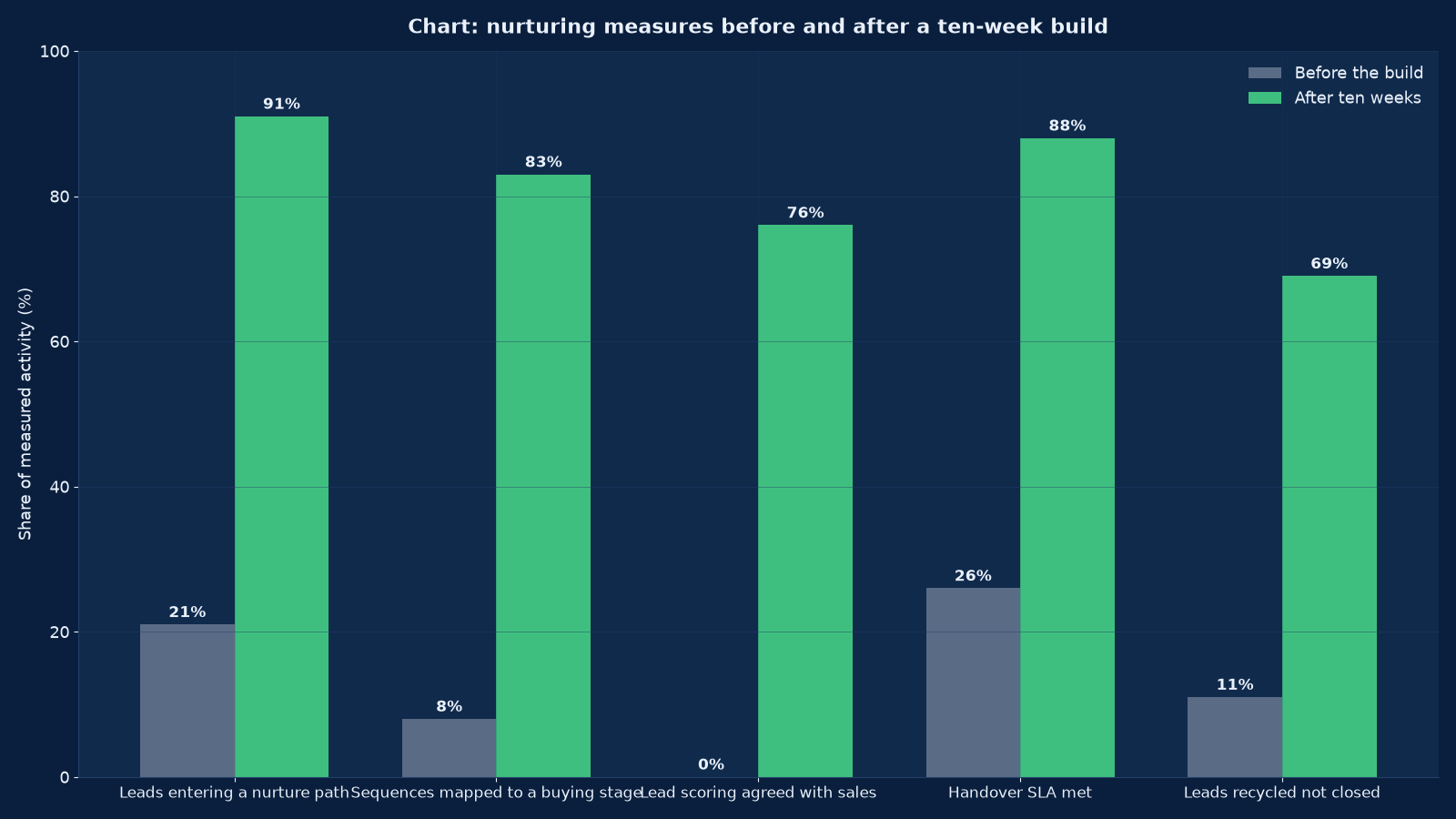
Chart values are an illustrative planning model based on typical UMC engagements and published industry benchmarks. They are not a guarantee of results on any specific project.
Stage Definitions: the Vocabulary Sales and Marketing Share
| Stage | Definition | Evidence required to enter it | Who acts |
|---|---|---|---|
| New lead | An enquiry captured from any source, unqualified | A form submission, a call, a message or an imported record | Automation: acknowledgement and entry to a source-matched sequence |
| Engaged | The lead has taken a second action beyond the initial enquiry | A click, a reply, a content download, a page revisit | Automation: progression to the next sequence step |
| Marketing qualified | The lead matches the profile and has engaged with buying-stage content | A score above the agreed threshold | Marketing, with a handover notification to sales |
| Sales accepted | Sales has reviewed and agreed to work the lead | A recorded acceptance inside the response time | Sales |
| Sales qualified | A need, an authority, a budget and a timeframe are established | A documented conversation, not an impression | Sales |
| Opportunity | A specific deal with a value and an expected close | An opportunity record created in the CRM | Sales, with marketing supporting the account |
| Closed won / closed lost | The outcome | A recorded reason on every loss | Both: the reason feeds the profile and the sequences |
| Recycled | Not now, or not this offer, but not never | A rejection reason that indicates future potential | Automation: entry to a low-frequency re-engagement path |
The stage model is written down and signed by both functions. In Figure 2 the share of leads with scoring agreed with sales rises from nothing to 76 per cent, and that agreement is what allows the handover service level to rise from 26 to 88 per cent: sales meets a threshold it helped define.
Lead Scoring: Explicit, Implicit and Behavioural
| Signal type | Examples | Weight | The trap |
|---|---|---|---|
| Explicit: firmographic | Sector, size, role, geography, budget indicated | High, because it decides whether the lead can buy at all | Scoring attributes the lead self-reported without verifying any of them |
| Explicit: captured progressively | One useful question added per interaction | Moderate, and it improves every other signal | A long form at the first contact, which reduces the leads available to score |
| Implicit: content consumed | Pricing page, comparison guide, specification, case study | High for buying-stage content, low for educational content | Weighting a blog read the same as a pricing visit |
| Implicit: engagement pattern | Email opens and clicks, revisits, sequence progression | Moderate, and decaying with time | Counting opens from an inbox that previews everything as engagement |
| Behavioural: frequency and recency | How often and how recently the lead acted | High when combined with content type | A score that never decays, so a lead from last year looks warm |
| Negative signals | Free-email domain where it matters, unsubscribes, competitor domains, student or job-seeker patterns | Negative weight | No negative scoring at all, so unqualified leads accumulate towards the threshold |
The model is calibrated against history: the scores of leads that became opportunities against those that did not. A threshold set by intuition is either so high that nothing is handed over or so low that sales stops trusting it, and both failures look like a lead-quality problem from the outside.
Sequence Architecture: Mapping Messages to Stages
| Sequence | Entry condition | Length and cadence | Job of the messages | Exit |
|---|---|---|---|---|
| Immediate acknowledgement | Any new lead | Minutes, then one follow-up within a day | Confirm receipt, set expectations, deliver what was promised | Entry to the source-matched sequence |
| Source-matched welcome | The lead’s entry point | Three to five messages over two weeks | Answer the question that made them enquire, and qualify progressively | Progression on engagement, or to the education path |
| Education | Engaged but early-stage | Six to ten messages over six to eight weeks | Frame the problem, give the criteria to decide with, establish credibility | A buying-stage action, or to the long-term path |
| Buying stage | Buying-stage content consumed or score above a lower threshold | Four to six messages over two to three weeks | Comparison, proof, risk removal, and a concrete next step | Handover at the threshold |
| Handover support | Marketing qualified and accepted | Two to three touches coordinated with sales | Reinforce the conversation sales is having, without contradicting it | Sales owns the contact from here |
| Stalled | No engagement over a defined window | Two messages, then silence | One direct question, then an easy way to opt out of the frequency | To the long-term path or to recycling |
| Long-term | Not now, but not never | One message per month, indefinitely | Stay useful without asking, so the timing change finds you present | Re-entry on any buying-stage action |
| Recycled and closed-lost | A rejection with future potential | Quarterly, with a different angle each time | Reopen on new evidence: a new capability, a market change, a season | Re-entry to the buying-stage sequence on engagement |
Every message has one job and every sequence has a stop condition. The stop condition is the part most programmes omit, which is why leads who have already booked a call keep receiving invitations to book one.
Content Mapping: What Each Stage Needs To Read
| Stage question | Content that answers it | Format that works | The gap we usually find |
|---|---|---|---|
| What is my problem, exactly? | A framing piece that names the situation precisely | A short article or a two-page guide | Content that starts with the product instead |
| What are my options? | A comparison of approaches, including doing nothing | A comparison table or a decision guide | A comparison that only compares you with your weakest competitor |
| Will this work for a business like mine? | Sector and size-specific proof | A case study with numbers, or a documented engagement | Testimonial quotes with no context, no sector and no outcome |
| What will it cost and what do I get? | Pricing logic, ranges, and what drives the number | A pricing guide or a cost calculator | No pricing content at all, which lengthens every cycle |
| What happens next? | A clear process with timings and what is asked of the customer | A process page or a one-page summary | A process that exists internally and was never published |
| Who else has to approve this? | A business case, a specification, a risk summary | A forwardable document | Nothing the lead can hand to a finance director |
| Why should I act now? | A genuine reason: a deadline, a capacity limit, a market change | A short, honest message | A manufactured urgency, which destroys trust the first time it is noticed |
Channel Mix for Nurturing
| Channel | Role in the sequence | When to add it | The discipline |
|---|---|---|---|
| The backbone: carries the argument over weeks | Always | One job per message, a frequency cap, and a real unsubscribe | |
| SMS | Time-critical prompts: an appointment, a deadline, a delivered quote | Where the lead gave a mobile number and consented | Rarely, and never for content an email could carry |
| Conversational qualification and markets where it is the default channel | Where the lead initiated or explicitly opted in | Template rules respected; used as a service channel first | |
| Retargeting | Sustaining presence with leads who visited but did not convert | From the engaged stage onward | Frequency capped and creative matched to the stage, not to the campaign |
| B2B leads whose role and account can be identified | For marketing-qualified leads in tier accounts | Coordinated with the sales outreach so the lead is not approached twice in a day | |
| Phone | The highest-converting channel, and the one automation cannot replace | At the handover threshold, and for stalled high-value leads | A script that references what the lead has read, not a cold opener |
| Direct mail | High-value leads that ignore digital | Selectively, at the buying stage | Only where the deal value justifies the cost per contact |
Sequences are orchestrated so the lead experiences one conversation. A global frequency cap and suppression rules between sequences prevent the experience that ends a relationship: the same offer by email, SMS and retargeting in a single day.
The Ten-Week Build
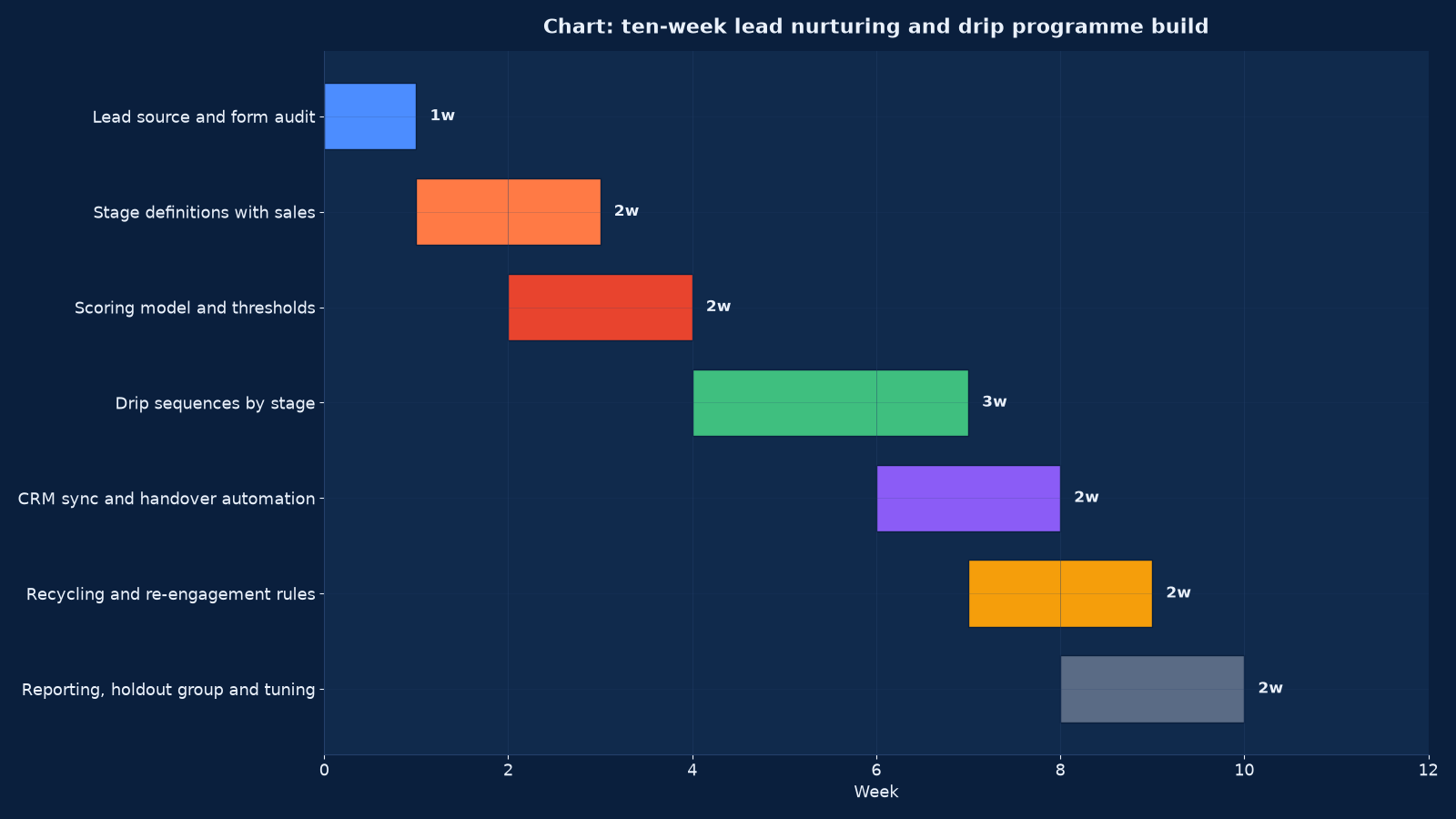
Chart values are an illustrative planning model based on typical UMC engagements and published industry benchmarks. They are not a guarantee of results on any specific project.
| Weeks | Workstream | Gate to pass |
|---|---|---|
| 1 | Lead source and form audit | Every entry point documented with the lead quality it actually produces |
| 2–3 | Stage definitions with sales | A signed stage model with the evidence required per stage |
| 3–4 | Scoring model and thresholds | A model calibrated against history, with the handover threshold agreed |
| 5–7 | Drip sequences by stage | Sequences live with a job, a stop condition and a measure per message |
| 7–8 | CRM sync and handover automation | Two-way sync tested, and the response time agreed in writing |
| 8–9 | Recycling and re-engagement rules | Stalled, rejected and closed-lost leads routed rather than discarded |
| 9–10 | Reporting, holdout and tuning | A holdout group running and the first monthly pack delivered |
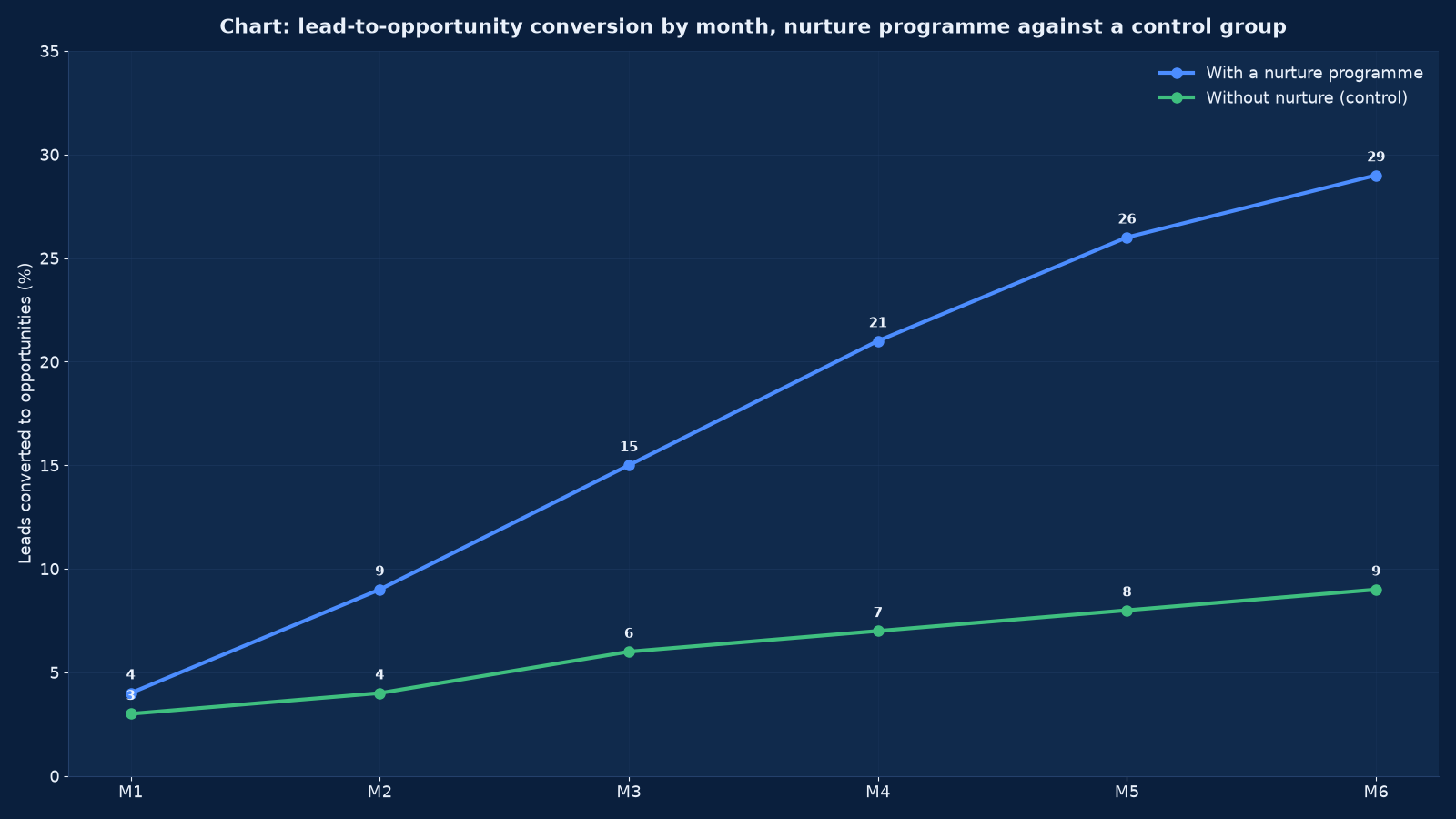
Ten weeks builds it. The following months are what produce the curve in Figure 1, because the conversion advantage of a nurture programme grows as the sequences mature, the scoring calibrates against real outcomes and the content map fills its gaps.
Measurement: Conversion Against a Control
| Measure | Definition | Why it is the right one |
|---|---|---|
| Leads entering a path | Share of all leads that enter any sequence | Coverage: a lead outside every path is a lead abandoned |
| Sequence completion rate | Share reaching the end without unsubscribing or stalling | Whether the cadence and the content suit the audience |
| Engagement per message | Clicks and replies, per message and per stage | Which messages earn their place and which are filler |
| Score distribution | How leads are spread across the bands | Whether the threshold is calibrated or arbitrary |
| Handover volume and acceptance | Leads handed over, and the share sales accepts | The agreement between the two functions, in numbers |
| Time to first contact | From threshold crossing to sales contact | Whether the service level is real |
| Conversion to opportunity | Leads becoming opportunities, over time | The programme’s output, and the measure in Figure 1 |
| Incremental conversion | Programme group against the holdout group | The only version of that measure that survives scrutiny |
| Cycle length | From first enquiry to opportunity | Whether nurturing shortens the cycle or merely fills it |
| Recycled lead revival | Recycled leads that re-enter a buying stage | Whether the recycling rules are worth running |
| Source quality | Conversion by lead source, over time | Where acquisition budget should move, which is the most commercially useful output |
| Unsubscribe and complaint rate | Per sequence and per message | The cost of the programme, and the early warning for over-contact |
Source quality is the output that changes budgets. Once conversion is measured per source over six months, the lead sources that look productive on volume and produce nothing on pipeline become visible, and the acquisition mix can be corrected on evidence.
The Holdout Question
| Question | The honest answer |
|---|---|
| How do we know the sequence caused the conversion? | A holdout: a randomly selected share of leads that receives nothing, compared over the same window. In Figure 1 the control group reaches 9 per cent while the nurtured group reaches 29 per cent. |
| How large should the holdout be? | Large enough to be usable and small enough to be tolerable. A few per cent, re-randomised periodically so it does not become a permanent under-served group. |
| Is it acceptable to leave leads uncontacted? | For a defined share and a defined period, yes, and the alternative is worse: a programme credited with conversions that would have happened anyway, funded indefinitely on a number nobody can defend. |
| What if volume is too low to measure? | Then we say so, report conversion by source and stage as the primary evidence, and introduce the holdout once volume supports it. |
| Does platform-reported performance count? | It is reported, labelled as touched-revenue rather than incremental, and never used alone. Every platform credits the last message before a decision the lead had already made. |
| How often is the holdout re-randomised? | Quarterly, so the comparison stays valid and no lead is permanently excluded from the programme. |
Recycling: the Leads Everybody Throws Away
| Rejection reason | What it usually means | The recycling path |
|---|---|---|
| “Not now” | A real intention with the wrong timing | The long-term path at one message per month, with re-entry on any buying-stage action |
| “Went with a competitor” | A decision made, and a renewal or dissatisfaction date in the future | A quarterly path with a different angle, timed near the renewal |
| “No budget” | Either true now, or a polite refusal | A low-frequency path with pricing and business-case content, so the answer changes when the budget does |
| “Too small / too large” | A profile mismatch | Out of the sales path entirely, and into whatever content suits them — or into the exclusion list |
| “Never heard back” | A process failure rather than a rejection | Straight back into the buying-stage sequence with an apology and a direct contact route |
| “Wrong person” | A useful referral opportunity | A forwardable business case, and a request for the right colleague |
| Closed-lost opportunities | The most valuable recycling pool there is | A quarterly path with new evidence: capabilities, market changes, seasons |
In Figure 2 the share of leads recycled rather than closed rises from 11 to 69 per cent. The reason is simple: a rejection reason is data, and a lead file marked “closed” with no reason is an asset written off without a decision.
What Differs By Sector and Cycle Length
The architecture is the same everywhere; the timings, the content and the threshold are not. A sequence built for a three-week consumer decision will over-contact a B2B lead, and one built for a nine-month enterprise cycle will lose a consumer who decided in a fortnight.
| Sector | Typical cycle | Sequence shape | The threshold question |
|---|---|---|---|
| B2B industrial and manufacturing | Three to twelve months, committee decisions | A long education path, forwardable business-case content, and a low-frequency long-term path for the not-now leads | Whether one engaged person is enough, or two roles must be identified |
| Professional services and consulting | One to six months, relationship-led | Credibility and expertise content, with an early offer of a conversation rather than a demonstration | Whether a reply, not a click, is what constitutes qualification |
| Technology and SaaS | Two weeks to three months, product-led | A short trial-oriented sequence with usage signals weighted heavily | Whether product usage replaces explicit engagement as the trigger |
| E-commerce and retail | Days to weeks, individual decisions | Short, visual, offer-bearing sequences with a fast exit once the purchase happens | Whether a cart abandonment is a lead at all, or a separate programme |
| Clinics, education and practices | Two weeks to three months, personal decisions | Reassurance, process clarity and an easy booking route, with SMS for appointments | Whether a booking request or a completed consultation is the handover point |
| Hospitality and events | Days to two months, group and occasion decisions | Occasion-based sequences with dates, availability and a direct booking path | Whether an enquiry with dates is immediately a sales contact |
| Financial and regulated services | One to six months, with compliance constraints | Factual, approved content only, with every claim reviewable | Whether the compliance review is part of the sequence build or a bottleneck after it |
We set the cadence from the client’s own historical cycle length where the data exists, and from the sector norm where it does not, then correct it against engagement in the first two months. A cadence chosen from a template is the reason most drip programmes feel either relentless or absent.
Deliverability: the Foundation a Nurturing Programme Lives On
A nurture sequence is a long-run relationship with a mailbox provider as well as with a lead. Every message that lands in spam costs the reputation that the next message depends on, and reputation is per domain, so a careless campaign damages the sequence that follows it.
| Control | What it means | Why it matters for nurturing specifically |
|---|---|---|
| Authentication | Sender policy framework, domain keys and abuse reporting configured for every sending domain | Unauthenticated mail is filtered by default; a sequence that relies on it never arrives |
| Consent records | How each address was collected, and whether the record supports the messages being sent | Long sequences amplify any consent weakness, because the lead has many opportunities to complain |
| List hygiene | Invalid, dormant and duplicate addresses retired on a schedule | Bounce and complaint rates are computed per send, so dead addresses damage live ones |
| Engagement-based frequency | Frequency reduced for leads who stop opening, before they complain | A long sequence sent to a disengaged lead is the fastest route to a spam complaint |
| Sunset policy | A defined point at which an unresponsive address leaves the sequence | Sequences run for months, so without a sunset they accumulate dead weight indefinitely |
| Preference centre | Frequency and topic choices, with an easy unsubscribe | A lead who can reduce frequency stays on the list; one who cannot, unsubscribes |
| Transactional separation | Order and booking confirmations on their own domain and template | A marketing complaint rate should never endanger a confirmation email |
| Placement monitoring | Inbox placement measured per mailbox provider, per sequence | A drop is visible in days rather than discovered when conversion falls in a quarter |
| Complaint handling | Every complaint investigated for its cause, not merely recorded | A complaint pattern usually names a specific message or a specific source |
Deliverability is not a separate discipline from nurturing; it is the constraint that decides how long a sequence can be and how often it can send. We build both together and report placement alongside conversion, because a falling conversion rate is often a delivery problem wearing a content costume.
Governance and Tuning
| Cadence | Activity | Owner | Output |
|---|---|---|---|
| Weekly | Sequence error check, handover volume, response-time compliance | Us, with the sales lead informed | Exceptions fixed before they accumulate |
| Monthly | Per-message engagement, conversion by sequence and source, threshold review | Programme owner | Tuning decisions: retiming, rewriting, retiring |
| Monthly | Holdout comparison and incremental conversion | Programme owner with finance | The number that justifies the programme |
| Quarterly | Scoring recalibration against outcomes, holdout re-randomisation | Marketing with sales | A model that reflects the last quarter’s reality |
| Quarterly | Content map review: what each stage needs and what exists | Marketing | A prioritised content gap list |
| Annually | Stage model review with sales, and a source-quality review against acquisition spend | Both functions | A revised stage model and a corrected acquisition mix |
The monthly tuning decision is documented per message: kept, retimed, rewritten or retired. A sequence that has never been revised in a year is a sequence whose content is a year old, and the lead can tell.
Nurturing and the Rest of the Stack
A nurture programme sits between the acquisition channels and the sales process, so it depends on both and is planned with both.
- Email Marketing Automation Services — the sequence engine, the templates and the deliverability underneath every drip programme.
- Marketing Automation (HubSpot & Marketo) Services — the platform, the scoring model and the orchestration across channels.
- Custom CRM Development & Integration Services — the lead record, the stage model and the two-way sync the handover depends on.
- Conversion Rate Optimisation (CRO) Services — the forms and landing pages that decide what a lead tells you on arrival.
- Content Marketing Strategy Services — the assets each stage needs, and the gap list the sequence exposes.
- Google Ads Management Services — the acquisition sources whose quality the nurture data eventually reveals.
- Facebook & Meta Advertising Services — lead-form volume, which is the source most in need of a nurturing path.
- LinkedIn Marketing Services — the B2B leads whose role and account make a scored handover possible.
- Analytics & Attribution (GA4) Services — the engagement signals and the attribution model the scoring uses.
- SMS Marketing Services and WhatsApp Marketing Services — the channels reserved for the time-critical steps in a sequence.
- Search Engine Optimisation (SEO) Services — the organic entry points that produce the highest-intent leads in most programmes.
Evidence From Our Work
The engagements and writing below are published on this site, each described by the subject its own page documents. They are listed because nurture programmes are usually commissioned by a business that can see leads arriving and cannot see them becoming opportunities.
- Landing page optimisation: how to convert more visitors into customers — the forms and pages that decide what a lead reveals on arrival, which is the input every sequence depends on.
- Email marketing trends and tactics that drive revenue — what currently works in the channel that carries most nurture sequences, including the deliverability realities.
- Best CRMs for wholesalers: features and fit — a buyer guide to CRM selection in a distribution business, and the features that decide whether a platform can carry a lead record, a stage model and a score.
- CRM data migration: planning, cleansing, mapping and go-live control — what happens to sequences and scores when the system underneath them changes.
- Marketing attribution models: how to choose the right one for your business — why touched-revenue overstates a sequence’s contribution and how a holdout corrects it.
- Remarketing and retargeting: converting visitors who did not buy — the paid counterpart to a nurture path, aimed at the same engaged leads.
- Content marketing execution plan — how the content map behind a sequence is actually produced rather than wished for.
- Customer retention strategies: how to keep customers coming back — what happens to a lead after the first purchase, which is where nurturing becomes lifecycle.
- B2B marketing strategies for Lucknow businesses — the long-cycle, committee-based buying behaviour most nurture programmes are written for.
- The marketing automation insight archive — further writing on sequences, scoring and platform choice.
Engagement Models and Commercials
Nurture work is quoted against the number of sequences, the source complexity and the CRM integration required, not against lead volume.
| Model | Best for | What you get | Indicative shape |
|---|---|---|---|
| Nurture audit, fixed fee | A business with sequences that are not converting | Source quality table, stage and scoring review, per-message engagement analysis and a repair plan | Two weeks, one fee |
| Nurture build | A business with leads and no programme | Stage model with sales, scoring calibrated against history, sequences by stage, CRM sync, recycling rules, reporting and a holdout | Ten weeks, fixed fee |
| Programme retainer | An existing programme that needs owning and tuning | Monthly tuning with documented decisions, new sequences, content mapping, holdout reporting and source-quality analysis | Monthly |
| Scoring and handover rebuild | Two functions that disagree about lead quality | A joint stage model, a calibrated scoring model, and a written handover service level | Three to four weeks, fixed fee |
| Recycling programme | A large file of closed and rejected leads | Reason-based routing, re-engagement paths, and revival measured | Three weeks, fixed fee |
There is no percentage of media spend and no fee tied to lead volume. A nurture programme whose agency earns more when more leads arrive has an incentive to defend the sources that produce them, and the source-quality analysis is the part of the reporting that most needs to be independent.
Frequently Asked Questions About Lead Nurturing & Drip Programmes
What is the difference between a drip campaign and lead nurturing?
A drip campaign is a fixed sequence sent on a schedule. Lead nurturing is a system where the next message depends on what the lead did, the sequence is mapped to a buying stage, and progression, handover and recycling are all defined. Most businesses have the first and need the second.
How many emails should a sequence contain?
As many as the stage needs and no more, each with one job and the sequence with a stop condition. A buying-stage sequence is usually four to six messages over two to three weeks; an education sequence six to ten over six to eight weeks. The stop condition matters more than the count: a sequence that keeps asking a lead who has already booked a call is how programmes start producing complaints.
How do we know it works?
With a holdout: a randomly selected share of leads that receives nothing, compared over the same window. In Figure 1 the nurtured group reaches 29 per cent conversion to opportunity by month six against 9 per cent for the control. Platform-reported revenue is touched-revenue, not incremental, and we report it labelled as such.
Do we need a CRM for this?
You need somewhere the lead record, the stage and the score live, and somewhere sales records what happened. That is usually a CRM. Where yours cannot carry a scoring model or a two-way sync, we say so during the build and treat the platform change as separate, quoted work rather than building sequences on a foundation that will not hold them.
How quickly should a lead be contacted?
Immediately by automation with something useful, and by a person within the response time sales agrees at the handover threshold. In Figure 2 the share of handovers meeting the service level rose from 26 to 88 per cent, and that measure is worth more than any change to the message copy.
What about leads that are clearly not going to buy?
Score them out early and route them away from the sales path. Negative signals — competitor domains, student patterns, job-seeker behaviour, a profile mismatch — are part of the model precisely so that sales is not asked to work them. Excluding well is what makes the threshold credible.
Should every lead get the same sequence?
No. Entry is matched to the source and to what the lead asked for, because a lead from a pricing page and a lead from a downloadable checklist arrive at different stages. Sending both the same first three messages wastes the part of the sequence where attention is highest.
How do SMS and WhatsApp fit in?
As reserved channels for time-critical steps: an appointment, a delivered quote, a deadline. Both require consent, both are governed by frequency discipline, and WhatsApp is used as a service channel first. Neither should carry content an email could carry.
What happens to leads sales rejects?
They are recycled on the reason. “Not now” goes to a monthly path; “went with a competitor” goes to a quarterly path timed near the renewal; “no budget” gets pricing and business-case content; “wrong person” gets a forwardable case. In Figure 2 the share recycled rather than closed rose from 11 to 69 per cent.
Can nurturing shorten our sales cycle?
It shortens the part of the cycle spent re-establishing contact and re-explaining the offer, which is often most of it. It does not make a customer buy before they intend to. We measure cycle length from first enquiry to opportunity and report it honestly, including where it does not move.
Who owns the programme?
Your team does, with the stage model, the scoring documentation, the sequence map, the recycling rules and the tuning runbook handed over and trained. A nurture programme held as an agency’s tacit knowledge stops the day the retainer ends.
What does it cost?
Quoted against the number of sequences, source complexity and CRM integration. An audit is a small fixed fee; a ten-week build a larger one; the retainer is monthly. No percentage of media spend and no fee tied to lead volume, because the source-quality analysis has to be independent of both.
Commission a Lead Nurturing Audit
Send us your lead sources, your last six months of lead data with outcomes if you have them, and whatever sequences are currently running. Within two weeks you will have a source quality table showing which entry points produce pipeline rather than volume, a review of your stage model and where sales and marketing disagree, an assessment of your scoring or the case for building one, a per-message engagement analysis of the sequences you have, a recycling assessment of the leads you have closed, a holdout design so the conversion lift can be proven, and a costed ten-week build with the reporting pack specified in advance.
Contact Unified Management Consulting to arrange a confidential first conversation.
Related Services
Lead nurturing is delivered with the platform, content and sales-process practices around it:
- Email Marketing Automation Services — the sequence engine and the deliverability underneath it
- Marketing Automation (HubSpot & Marketo) Services — scoring, orchestration and the handover automation
- Custom CRM Development & Integration Services — the lead record, the stage model and the two-way sync
- Conversion Rate Optimisation (CRO) Services — the forms that decide what a lead reveals on arrival
- Content Marketing Strategy Services — the assets each stage needs
- Google Ads Management Services — the sources whose quality the nurture data reveals
- Facebook & Meta Advertising Services — lead-form volume that most needs a nurturing path
- LinkedIn Marketing Services — B2B leads whose role makes a scored handover possible
- Analytics & Attribution (GA4) Services — the engagement signals scoring depends on
- SMS Marketing Services — the time-critical steps in a sequence
- WhatsApp Marketing Services — conversational qualification where it is the default channel
- Search Engine Optimisation (SEO) Services — the organic entry points that produce the highest-intent leads
- Lifecycle & Retention Campaign Services — Lifecycle and retention campaigns: deliverability, RFM segmentation, welcome, replenishment and win-back flows, offer guardrails and holdouts
- Account-Based Marketing (ABM) Services — Account-based marketing for B2B: ICP and tiering, named account lists, intent scoring, coordinated channels, sales handover and pipeline reporting
- Webinar & Event Campaign Services — Webinar and event campaigns: topic and offer design, registration, promotion, attendance programmes, delivery, segmented follow-up and repurposing