
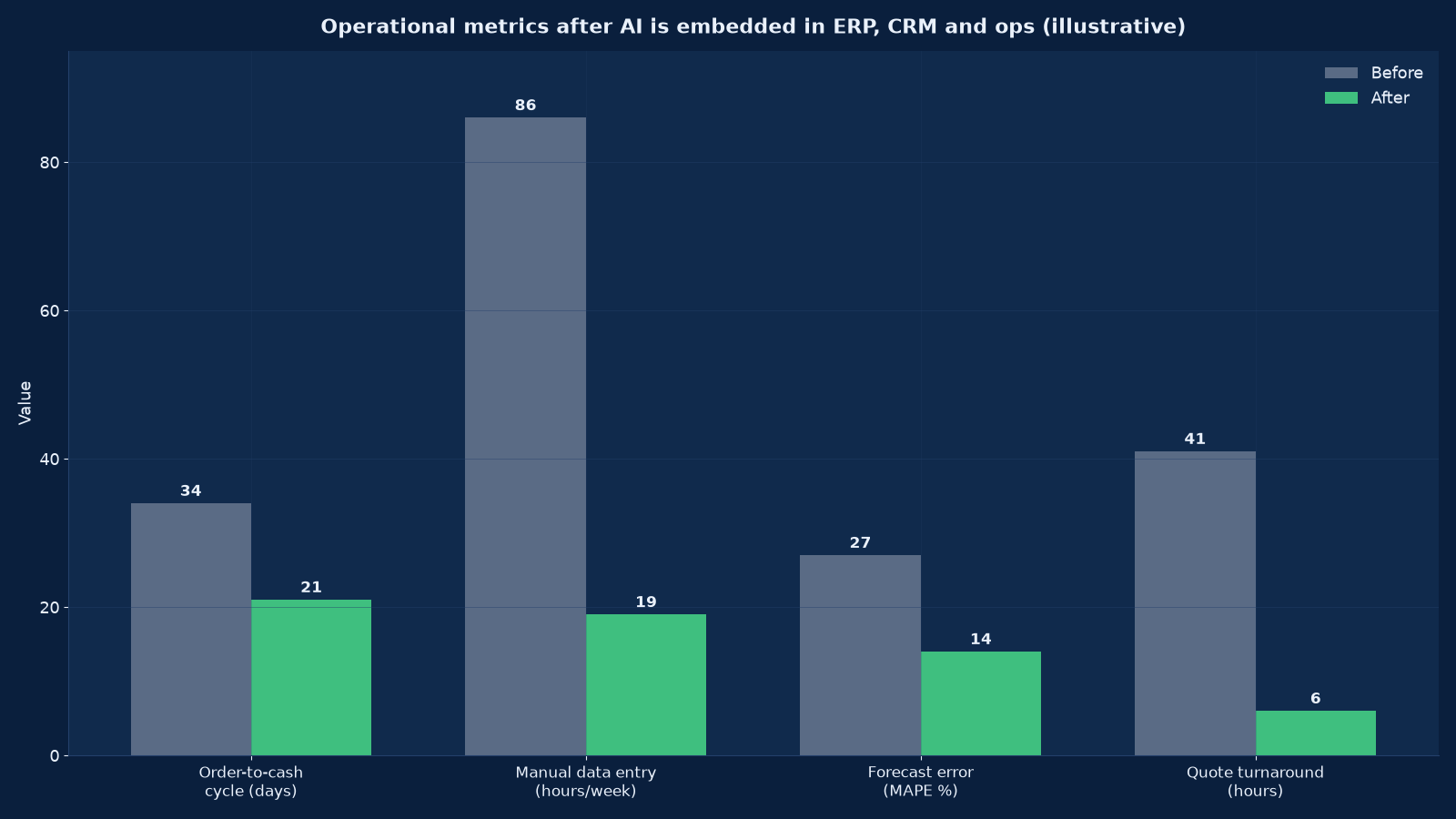
Chart values are an illustrative planning model based on typical UMC engagements and published industry benchmarks. They are not a guarantee of results on any specific project.
An AI tool that a human has to copy results into is a productivity aid. An AI capability that reads the order, writes the record, checks the credit and raises the exception is an operating change. The distance between those two is integration work, and it is where most AI value is either realised or lost.
AI integration is the engineering of connecting models and agents to the systems that actually run the business — ERP, CRM, service desk, warehouse, finance and HR platforms. It is not a prompting exercise. It requires writable interfaces, a permission model that mirrors the existing one, idempotent writes, human checkpoints where the risk demands them, audit logging that satisfies your auditors, and a rollback path. Unified Management Consulting delivers that integration as a controlled programme with a sandbox, a pilot process and measured go-live, rather than as a connector switched on across everything at once.
🔌 AI Integration into ERP, CRM & Operations — Quick Summary
| Component | What We Deliver |
|---|---|
| System & data-flow mapping | Every system in scope documented with its role, interfaces, writable APIs, data ownership, change-control route and the processes that cross between them. |
| Integration design | Read and write patterns per use case, idempotency keys, retry and compensation behaviour, human-in-the-loop checkpoints, and the permission model mapped from existing roles. |
| Connector build | Authenticated, versioned connectors into ERP, CRM, ticketing, WMS and finance systems, built and tested in sandbox before any production write. |
| Agent & model wiring | The AI capability connected to real records with tool definitions, validation rules and constrained actions rather than open-ended write access. |
| Controlled pilot | One process, one business unit, shadow mode first then supervised writes, with a measured comparison against the manual baseline. |
| Monitoring & rollback | Action logging, anomaly alerting, drift detection, kill switch and a documented reversal path for every automated write. |
| Change control & handover | Release notes, runbook, on-call procedure and owner training, delivered through your existing governance rather than around it. |
Integration work depends on a clean knowledge and data layer, which is why it pairs with our data engineering service, and on a decision framework for what to automate at all, which is what AI Readiness Assessment & Roadmap produces. Where the target system is a CRM you also own or extend, see Custom CRM Development & Integration Services.
Why AI Stalls at the Edge of the System of Record
Most organisations reach a predictable plateau. Chat interfaces get deployed, staff paste data in and copy results out, and the measured benefit stays small because the human is still the integration layer. The plateau exists because systems of record were not designed to be driven by a probabilistic component, and because the surrounding controls — change management, segregation of duties, audit — assume a human is accountable for every write.
Crossing the plateau is an engineering and governance problem in equal parts. Our survey of what actually blocks these programmes is shown in Figure 2: the top two blockers are not about models at all, they are about writable interfaces and data quality. How industries must operate in the AI era sets out why the operating model, not the tool, is the binding constraint.
| Gap | Why it exists | What integration work resolves |
|---|---|---|
| Models cannot write | AI tooling is built to converse, not to transact | Explicit tool definitions with validation, idempotency and bounded scope |
| No sandbox route | ERP and finance changes go through heavyweight release cycles | A standing sandbox with seeded representative data and a fast test loop |
| Permissions do not map | AI acts as one service identity with broad access | Per-user or per-role delegation so the AI can only do what the requester could do |
| No audit trail | Writes happen without a record of who or what authorised them | Immutable action log linking model output, approval, and the resulting record change |
| Failure is silent | A failed write is retried or dropped without alerting | Dead-letter handling, alerting and a reconciliation job |
| No reversal path | An incorrect automated write cannot be undone at volume | Compensating transactions and a documented rollback per action type |
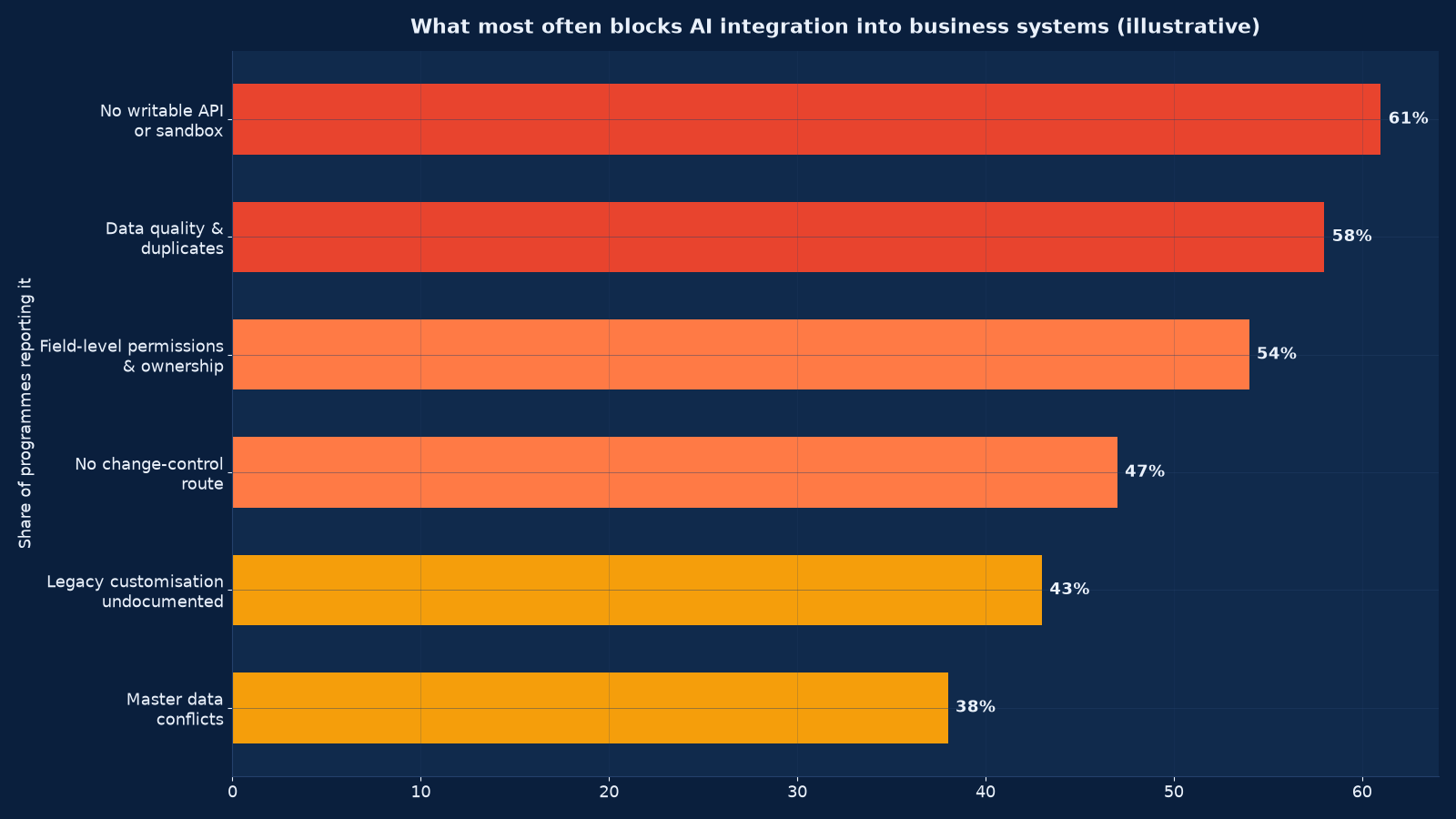
Chart values are an illustrative planning model based on typical UMC engagements and published industry benchmarks. They are not a guarantee of results on any specific project.
Choosing the Integration Depth Per Use Case
Not every process should sit at the same depth. The decision is a function of transaction value, reversibility, volume and regulatory exposure. Start low, measure, and only deepen where the evidence supports it.
| Depth | What the AI can do | Risk profile | Typical use cases |
|---|---|---|---|
| 0. Read-only assist | Retrieves and summarises from the system; a human acts | Low — no writes | Case summaries, account briefs, order status explanations |
| 1. Draft for approval | Prepares a record or action; a human approves before it is written | Low to moderate — human gate | Quote drafts, journal entries, ticket responses, purchase requisitions |
| 2. Supervised autonomous | Writes within tight limits; exceptions escalate to a human | Moderate — bounded and monitored | Order acknowledgement, master-data correction, SLA-driven escalations |
| 3. Autonomous with reconciliation | Writes freely inside policy; a reconciliation job detects and reverses errors | Higher — needs strong controls | High-volume transaction matching, inventory adjustment, routine invoicing |
| 4. Cross-system orchestration | Coordinates multi-step processes across several systems | Highest — compensating logic required | Order-to-cash, procure-to-pay, lead-to-opportunity flows |
A useful rule: if an incorrect action cannot be reversed within one business day at acceptable cost, it belongs at depth 1 until you have several months of clean evidence. Depth 4 orchestration is where most of the value sits and also where most failed programmes die, because compensating logic across four systems is genuinely hard. Our assessment of AI agent production realities covers the economics of that gap.
System Landscape: What We Actually Connect
Integration is specific. Each platform has its own authentication model, rate limits, validation behaviour and change-control culture, and the design has to respect all four. The table below is the landscape we work in most often and the traps that recur.
| System | What we connect | Common interface | Watch-outs |
|---|---|---|---|
| ERP (SAP, Oracle, Microsoft Dynamics, NetSuite, Odoo) | Orders, inventory, procurement, master data, finance postings | OData / REST services, RFC or BAPI, middleware, direct DB read-only views | Customisation is rarely documented; test every field you intend to write |
| CRM (Salesforce, HubSpot, Dynamics, Zoho, custom) | Accounts, contacts, opportunities, quotes, activities | Vendor REST API, webhooks, bulk API | Field-level security and validation rules differ by profile; automate as the requesting user where possible |
| Service desk & ticketing (ServiceNow, Jira, Zendesk, Freshservice) | Tickets, knowledge, SLA timers, routing | REST API plus webhook events | SLA clocks keep running during automated handling — account for it explicitly |
| Warehouse & logistics (WMS, TMS, 3PL portals) | Stock levels, pick and pack, shipments, exceptions | EDI, API, file drop with strict schemas | Latency and batch windows mean near-real-time is often the honest description |
| Finance & expense (Sage, QuickBooks, Xero, Concur, banking) | Invoices, payments, reconciliation, journals | Vendor API, bank feeds, statement parsing | Segregation of duties is non-negotiable; the AI must not both create and approve |
| HR & workforce (Workday, BambooHR, SAP SuccessFactors) | Employee data, absence, onboarding tasks | Vendor API with strict scope | Personal data handling needs a documented lawful basis and retention rule |
| Document & content stores (SharePoint, Drive, Box, DMS) | Contracts, policies, correspondence | Graph API, vendor SDK, search API | Permissions must be read live, not cached — see our data engineering service |
Permissions, Identity and Segregation of Duties
The single most common design error is giving the AI one service identity with broad access. It works in the demo and fails in the security review, because every automated action then appears to come from a superuser with no relationship to the person who requested it.
- Act as the requesting user where the platform allows it. OAuth on-behalf-of or delegated flows keep the existing permission model intact and make the audit trail meaningful.
- Where a service identity is unavoidable, scope it hard. Named object types, named fields, value ranges, and an explicit deny on approval and payment actions.
- Preserve segregation of duties. The component that creates a record must not be the component that approves it. Encode this as a technical control, not a policy sentence.
- Bind limits to the action, not the model. Maximum value, maximum records per run, permitted currencies, permitted cost centres — enforced in the connector, because prompt-level limits are not limits.
- Log the effective identity. Every action records both the human on whose behalf it ran and the technical identity that executed it.
- Test entitlements as multiple identities. A scheduled test that asserts the AI cannot perform an action outside its granted scope, run in CI.
This is the same control philosophy as AI Governance, Risk & Compliance Services, applied at the interface layer rather than the policy layer.
Reliability Patterns for Automated Writes
A conversational model that produces a wrong answer costs a correction. An integrated model that produces a wrong write costs a reconciliation exercise across systems. The engineering patterns below are what make the difference acceptable.
| Control | Purpose | Implementation |
|---|---|---|
| Idempotency key | Prevents duplicate writes on retry | Deterministic key from the business object, checked before write |
| Pre-write validation | Stops structurally invalid or out-of-policy actions | Schema validation plus business rules evaluated in the connector |
| Dry-run / shadow mode | Proves behaviour without production effect | Full pipeline executed, writes suppressed, outputs compared to human decisions |
| Approval checkpoint | Human accountability where risk demands it | Queued action with context, one-click approve or edit, timeout behaviour defined |
| Rate and volume limit | Contains a runaway loop | Per-minute and per-run caps with circuit breaker |
| Kill switch | Stops all automated writes immediately | Single flag checked before every write, operable without a deployment |
| Compensating action | Reverses an incorrect write | Recorded inverse operation per action type, tested, with a manual fallback |
| Reconciliation job | Detects drift between systems | Scheduled comparison of AI-written records against source of truth |
| Immutable action log | Audit and incident investigation | Append-only store with request, model output, decision, approver and result |
Two of these deserve emphasis. Shadow mode is the cheapest risk reduction available: run the full pipeline against live data with writes suppressed, and compare the AI’s intended action to what a human actually did. Four to eight weeks of shadow comparison produces better evidence than any pilot report. The kill switch must be operable by the process owner without an engineering release, because the person who notices the problem is rarely the person who can deploy the fix.
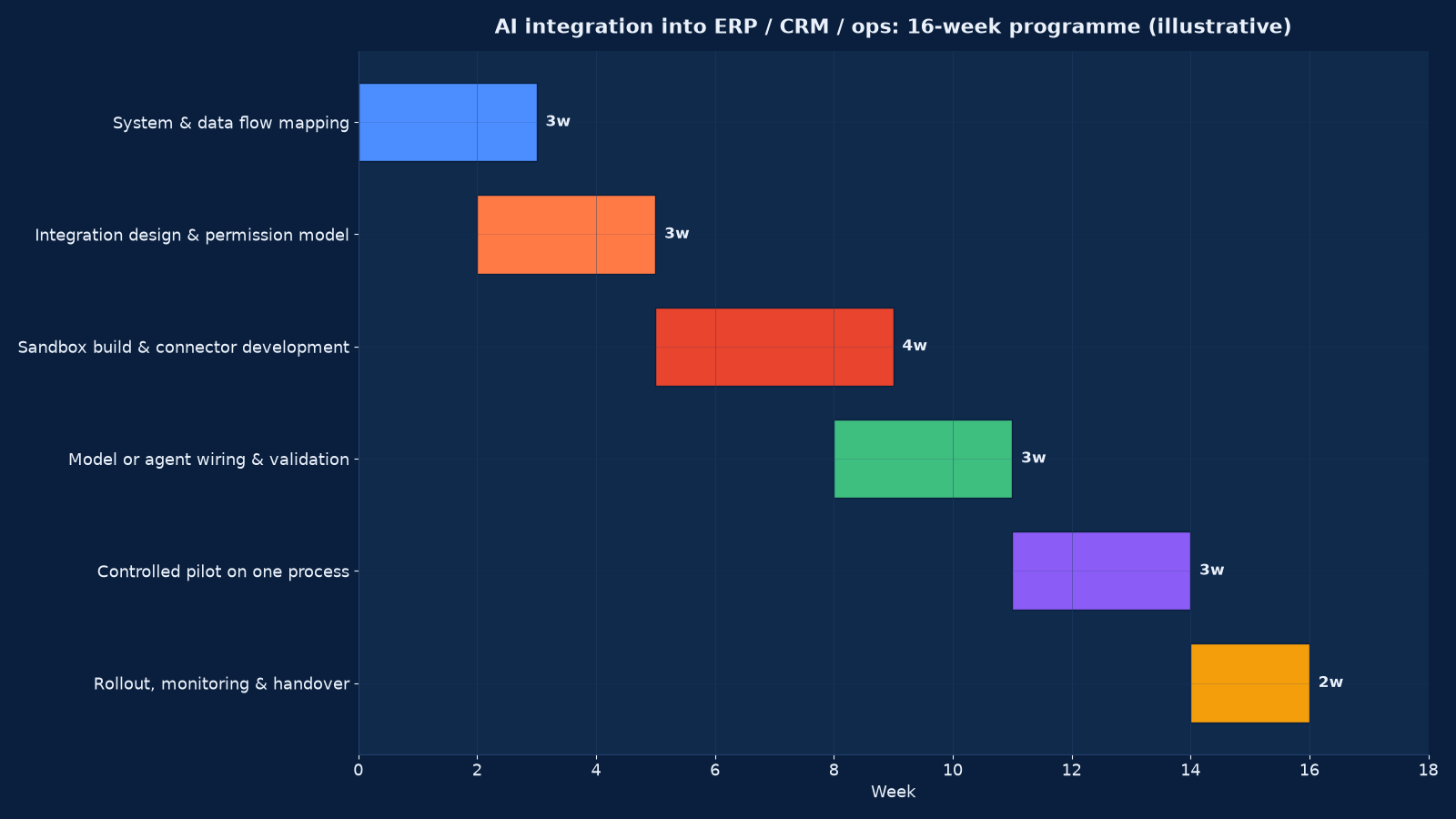
Chart values are an illustrative planning model based on typical UMC engagements and published industry benchmarks. They are not a guarantee of results on any specific project.
Delivery Programme: Sixteen Weeks to an Owned Capability
The shape below is what we run most often. Timelines compress where interfaces are already documented and a sandbox exists; they extend where customisation is undocumented or where change control requires a formal release window.
| Stage | Weeks | Key activities | Exit criteria |
|---|---|---|---|
| Discovery | 1–3 | Process selection, system inventory, interface capability assessment, baseline measurement, risk and compliance review | One process chosen with a measurable baseline and a confirmed writable interface |
| Design | 2–5 | Integration depth decision, permission model, control set, data contracts, failure and rollback design | Design signed off by platform, security and the process owner |
| Sandbox build | 5–9 | Sandbox provisioning, seeded data, connector implementation, validation rules, test suite | End-to-end flow demonstrated in sandbox with automated tests passing |
| Wiring & validation | 8–11 | Model or agent connected to real records in shadow mode, comparison against human decisions, tuning | Agreement rate above the threshold set at design, with exceptions categorised |
| Controlled pilot | 11–14 | Supervised writes on one business unit, daily review, incident process rehearsed | Four consecutive weeks inside quality and error thresholds with no severity-1 incident |
| Rollout & handover | 14–16 | Staged enablement, monitoring live, runbook and on-call handover, benefit measurement started | Operating ownership transferred and the scorecard computing automatically |
Architecture Options and Their Trade-offs
There is no default answer. The choice follows from the number of systems, the freshness requirement, the volume, and how much integration infrastructure you already operate.
| Architecture choice | When it is right | When it is wrong |
|---|---|---|
| Point-to-point connector per system | Two or three systems, stable interfaces, one team owning it | Five or more systems — the test surface grows faster than the value |
| Integration / middleware layer (MuleSoft, Boomi, Azure Integration Services, Workato) | Multiple systems, existing middleware investment, need for central monitoring | Small scope where the middleware licence exceeds the benefit |
| Event-driven with a message bus | Near-real-time needs, many consumers of the same events, high volume | Batch-oriented processes where ordering complexity buys nothing |
| Agent orchestration layer with tool definitions | Multi-step reasoning across systems with human checkpoints | A single deterministic transformation that a workflow engine handles more cheaply |
| Read-only replica plus separate write path | Heavy query load, or a source system that cannot tolerate additional traffic | When freshness requirements make replica lag unacceptable |
One pattern is consistently under-used: keeping the read path and the write path deliberately different. Reads can be broad, cached and tolerant of latency; writes must be narrow, validated, idempotent and logged. Designing them as one symmetric interface produces a system that is either too slow to be useful or too permissive to be safe. DevOps & CI/CD Engineering Services covers the pipeline and release discipline that keeps either choice deployable.
Data Quality: The Prerequisite Nobody Wants to Fund
An integrated AI system amplifies whatever data quality it is given. Duplicate customer records become duplicated orders. Inconsistent units become inconsistent forecasts. Missing mandatory fields become failed writes that pile up in a queue nobody monitors.
We assess data quality as part of discovery rather than after go-live, on the specific fields the integration will touch. The assessment measures completeness, uniqueness, validity against domain rules, currency, and consistency between systems where the same entity is represented twice. Where remediation is needed it is scoped as a bounded piece of work with an owner and a deadline, not as an open-ended “data quality project”.
| Dimension | What we measure | Consequence if poor |
|---|---|---|
| Completeness | Share of mandatory fields populated on records in scope | Writes fail validation; the exception queue fills |
| Uniqueness | Duplicate entities under different identifiers | Actions applied twice, or to the wrong record |
| Validity | Values conforming to domain rules, formats and reference lists | Silent downstream errors that surface days later |
| Currency | Age of records relative to the process that uses them | Decisions taken on stale state |
| Cross-system consistency | Same entity agreeing across ERP, CRM and finance | Reconciliation failures blamed on the AI |
| Reference data integrity | Products, customers, cost centres, chart of accounts | Mapping tables that need constant manual correction |
Where the remediation is substantial, it is usually better delivered as a separate data engineering engagement running ahead of the integration, which is the scope of our RAG and knowledge systems service and of Data Science Services for Business Analytics.
Measuring an Integration, Not Just a Model
Model accuracy is necessary and insufficient. The numbers that decide whether an integration is working are operational, and they should be reported on the same executive scorecard as the rest of the AI programme.
| Metric | Definition | Measured how |
|---|---|---|
| Straight-through rate | Share of transactions completed without human intervention | Action log, per process |
| Human intervention rate | Share requiring edit, approval or correction | Approval and override events |
| Error escape rate | Incorrect automated writes found downstream | Reconciliation job plus incident records |
| Cycle time | Elapsed time from trigger to completion | Source system timestamps |
| Cost per transaction | All-in cost including inference, integration and supervision | Telemetry plus finance allocation |
| Exception queue age | How long failed actions wait for attention | Queue monitoring with alerting thresholds |
| Rollback usage | How often compensating actions are invoked | Action log, reviewed weekly |
| User trust indicator | Approval-without-edit rate over time | Approval events; a rising rate means trust is earned, a falling rate means quality slipped |
Reporting these is the job of the measurement layer described in our AI ROI service. Without it, an integration is judged on anecdotes and the straight-through rate is never known.
Risk, Audit and Regulatory Considerations
Automated writes into financial, HR or customer systems attract scrutiny that a chatbot does not. Prepare for four specific questions.
- Who is accountable? A named process owner, not the platform team. The owner approves the depth, the limits and the exception policy.
- Can you show what happened? An immutable log from trigger to result, including the model input, the output, the validation decision, the approver if any, and the record change.
- Can you stop it? A kill switch with a stated activation procedure and a rehearsed reversal path. Auditors ask whether it has been tested, not whether it exists.
- Does it respect data protection? Purpose limitation, minimisation, retention, cross-border transfer rules for any external model call, and a lawful basis documented per data category.
Sector-specific rules add more: financial services will ask about model risk management and the audit trail on any decision affecting a customer; healthcare about clinical validation and data segregation; manufacturing about safety-critical interactions. Risk, Governance & Business Continuity Support is how we bring that evidence together, and our AI governance policy framework describes the documentation set.
Common Failure Modes in Production
- The connector breaks on a vendor release. Field renamed, endpoint versioned, rate limit tightened. Contract tests run against a sandbox on a schedule catch this; discovering it through user complaints does not.
- The exception queue becomes a black hole. Failed actions accumulate with no owner and no alert. Every queue needs a named owner, an age threshold and an escalation path.
- Partial writes leave inconsistent state. A multi-system transaction completes in two of three systems. This is why compensating logic is designed before the happy path, not after.
- Prompt-level limits are treated as controls. “Do not approve invoices above ten thousand” in a system prompt is not a control. Enforcement belongs in code.
- Shadow mode is skipped to save time. The team goes straight to supervised writes and spends the pilot discovering mapping errors that shadow comparison would have surfaced in week one.
- No owner after handover. The integrating team moves on, the model or API changes, and the capability quietly degrades until someone notices the volume of manual work has returned.
- Scope creep in automation. One more document type, one more field, one more system, each added without re-running validation. Depth should only increase on evidence.
Engagement Models
| Model | Duration | Deliverables | Best when |
|---|---|---|---|
| Integration feasibility & design | 3–5 weeks | Interface assessment, depth recommendation, permission model, control design, costed plan and risk register | You are deciding whether and how to automate a specific process |
| Single-process integration build | 10–16 weeks | Sandbox, connectors, validation, shadow run, pilot, monitoring, runbook and handover | One high-value process is ready to automate end to end |
| Multi-system orchestration | 16–26 weeks | Orchestration layer, compensating logic across systems, staged rollout and reconciliation | A cross-functional flow such as order-to-cash or procure-to-pay |
| Integration health review | 2–3 weeks | Assessment of an existing AI integration against the control set, with prioritised remediation | Something is live but fragile, unaudited or under-performing |
Making the Integration Last
The handover is the point at which most integrated AI capabilities begin to decay. Three practices prevent it.
Own the contract, not just the code. Every interface the AI depends on is documented as a contract with a version, an owner and a test. When the vendor changes something, the test fails before the process does.
Re-measure on a cadence. Straight-through rate, error escape rate and cost per transaction reviewed monthly, with a threshold that triggers action rather than discussion.
Keep a champion in the process team. Not an engineer — someone who uses the output daily, knows what normal looks like, and is empowered to hit the kill switch. How Loveholidays made everyone a builder is a useful case study in distributing that ownership rather than centralising it.
Where the integration is the first of several, the design decisions taken here become the pattern for everything that follows. That is the strongest argument for investing properly in the first one: not because it is the largest opportunity, but because it sets the standard. What the AI era means for software organisations discusses how this changes the shape of internal engineering teams.
Frequently Asked Questions About Integrating AI into ERP, CRM and Operations
Can AI be integrated with an ERP that has no modern API?
Usually yes, but the route matters. Options in rough order of preference: an existing middleware or integration layer, vendor-provided legacy interfaces such as RFC or stored procedure access, a read-only database replica for the query side combined with a narrow validated write path, and — least preferable — user-interface automation. The last one is brittle and hard to audit, so we treat it as a stopgap with a stated replacement plan rather than an architecture.
How do you stop the AI writing something wrong into a live system?
With layered enforcement rather than a single check: schema and business-rule validation in the connector, hard limits on value and volume, an approval checkpoint where the depth requires it, shadow mode before any supervised writes, a reconciliation job that detects drift, and a compensating action for each write type. Prompt instructions are not part of that list, because they are not enforceable.
What is shadow mode and how long should it run?
The full pipeline runs against live data with writes suppressed, and every intended action is compared to what a human actually did. Four to eight weeks is typical — long enough to cover a month-end or a seasonal peak, which is when the edge cases appear. The output is an agreement rate and a categorised list of disagreements, which is far better evidence than a pilot narrative.
Does the AI act as the user or as a service account?
As the user wherever the platform supports delegation, because it preserves the existing permission model and makes the audit trail meaningful. Where a service identity is unavoidable, it is scoped to named objects, named fields and value ranges, with an explicit deny on approval and payment actions, and every action logs both the requesting human and the executing identity.
How do you handle segregation of duties?
As a technical control. The component that creates a record cannot be the component that approves or pays it, enforced in the connector and verified by a scheduled test. This is the first thing a finance auditor will ask about and it cannot be retrofitted credibly after go-live.
What happens when the vendor changes their API?
Contract tests running against a sandbox on a schedule should fail before production does. Where the change is breaking and immediate, the kill switch stops automated writes, the process reverts to manual, and the connector is updated through the normal release route. Both the switch and the reversion need to have been rehearsed, not just documented.
Can we integrate with systems we do not own, such as a 3PL or a bank portal?
Sometimes, subject to their terms and the interface they provide. Where only file drops or portals exist, expect batch cadence rather than real time, and design for late or malformed files. Where a partner will not provide a stable interface, the honest answer is that automation stops at that boundary and a human checkpoint is required.
How much does data remediation add to the timeline?
For a focused process it is usually two to six weeks and can run in parallel with design. The risk is not the elapsed time but discovering it late: if data quality is assessed after the connector is built, the remediation becomes a blocking dependency with no slack. Assessing the specific fields in scope during discovery is what keeps it bounded.
Should we automate one process deeply or several shallowly?
One process deeply, first. A depth-2 or depth-3 integration on a single high-volume process delivers measurable benefit, produces the control patterns and the monitoring you need, and gives the organisation evidence to fund the next one. Several shallow read-only assistants produce usage statistics and very little financial effect.
How do we prove the benefit to finance?
By measuring the baseline before go-live and comparing straight-through rate, cycle time, error escape rate and cost per transaction afterwards, with the calculation method written down. That is the service described in our AI ROI measurement page, and doing it before the build rather than after is what makes the number credible.
What about personal data and cross-border transfer?
Determine per data category whether it may be sent to an external model at all, and under what contractual terms. Where it may not, route that tier to a private or single-tenant deployment, or exclude those fields from the request. Document the lawful basis, the retention period and the transfer mechanism — this belongs in the design document, not in a later compliance questionnaire.
Book an Integration Feasibility Session
Bring one process you want automated and the systems it touches. We will assess whether a writable interface exists, what depth is defensible, which controls your auditors will require, and what the baseline measurement has to capture before anything is switched on.
Contact Unified Management Consulting to book an initial working session on your AI programme.
Related Services
AI integration sits between the platform services and the process services:
- AI Agent Deployment & Automation — the agent layer that drives multi-step processes
- Custom CRM Development & Integration Services — building or extending the CRM that AI writes into
- AI Product Engineering for Production-Ready Intelligent Products — productising the capability beyond a single process
- AI Governance, Risk & Compliance — the control and audit framework around automated writes
- DevOps & CI/CD Engineering Services — pipelines, contract tests and release discipline
- Cloud Services Migration & Engineering — hosting the integration layer
- Risk, Governance & Business Continuity Support — evidence pack for audit and regulators
- AI ROI Measurement & Executive Scorecard Services — baseline capture, bottom-up benefit and cost models, instrumentation, the executive scorecard itself and the gate criteria that make AI spend auditable
- Data Engineering for AI: RAG & Knowledge System Services — source audit, ingestion connectors, cleaning and metadata, permission-aware retrieval and the evaluation harness that proves every answer is grounded
- AI Training & Enablement Services for Teams — role-based enablement, a measured capability baseline, build clinics and a champion network that makes adoption stick after delivery
- AI Forward-Deployed Engineering Services for Production-Ready Business Transformation — engineers embedded inside your team and your systems, building the capability with you rather than handing over a specification and leaving