
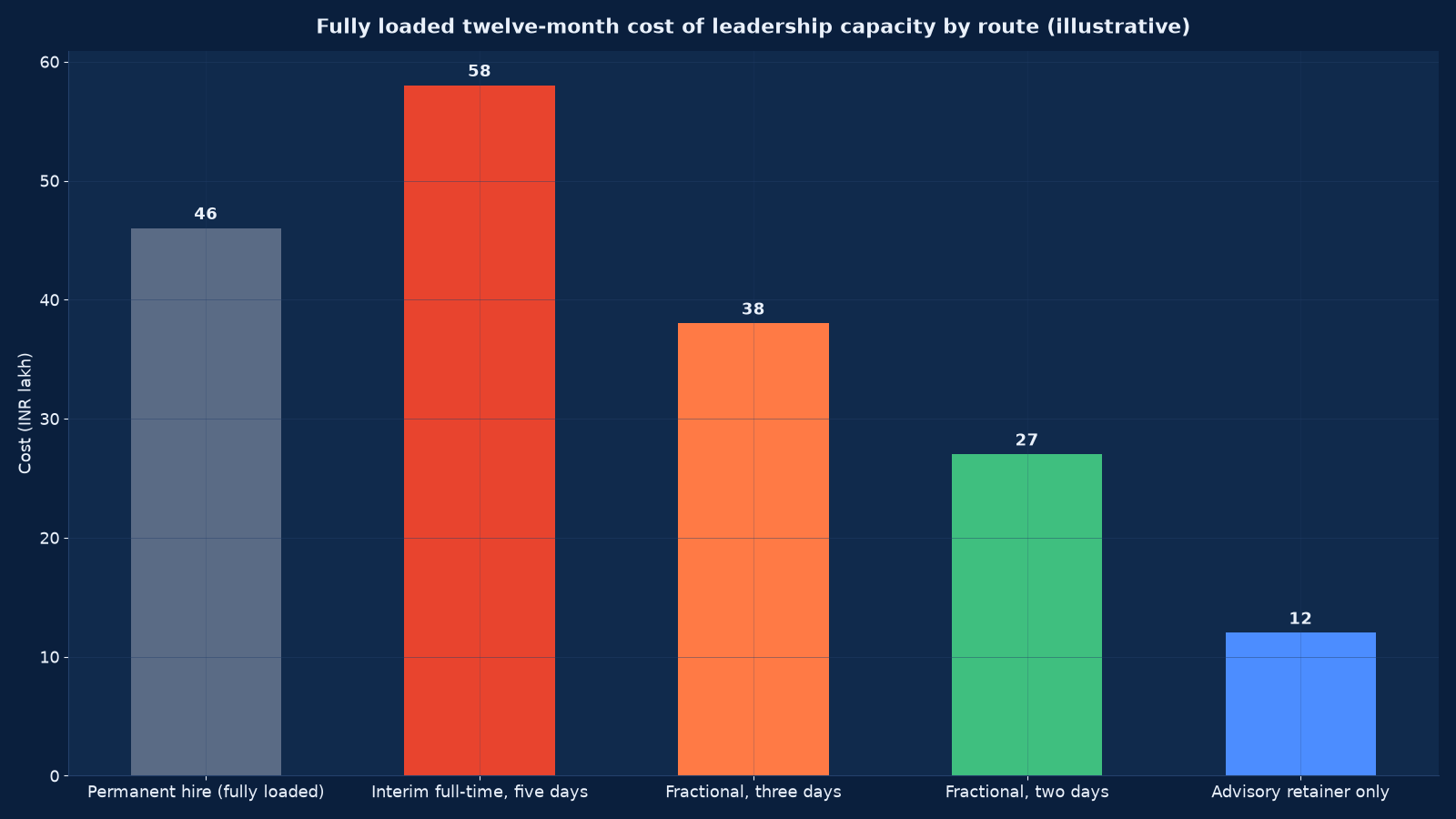
Chart values are an illustrative planning model based on typical UMC engagements and published industry benchmarks. They are not a guarantee of results on any specific project.
A leadership vacancy is not an absence of a person. It is an absence of decisions — and the cost of those undecided decisions accumulates silently in the operating numbers for as long as the seat stays empty.
Interim and fractional leadership supplies experienced operators into your business for a defined mandate: an interim executive holding a role full-time for three to twelve months, or a fractional leader holding it two or three days a week while you recruit or while the need is part-time. Unified Management Consulting places leaders with operating and turnaround experience into CEO, COO, CFO and transformation mandates, with a written decision-right mandate, a defined exit and a handover that leaves the business able to run without them.
🤝 Interim & Fractional Leadership — Quick Summary
| Component | What We Deliver |
|---|---|
| Mandate definition | A written mandate: the problem, the decision rights, the measures of success, the reporting line, the duration and the exit criteria — agreed before the appointment starts. |
| Roles covered | Interim CEO, COO, CFO and transformation lead; fractional finance director, operations director and commercial director; and short diagnostic mandates where a full appointment is not justified. |
| First thirty days | A structured entry: listen, establish the cash and performance position, take the decisions that have been deferred, and set the operating rhythm. |
| Operating authority | Real decision rights published to the organisation, so the appointment is not advisory in practice while titled executive in theory. |
| Delivery, not advice | The interim holds the number: cost, cash, delivery performance, margin. Reports are a by-product, not the output. |
| Handover discipline | Documentation of decisions, processes and relationships; recruitment support for the permanent role; a structured exit with a post-exit review. |
| Fractional economics | Senior capability two or three days a week at a fraction of full-time cost, with the discipline that makes part-time work actually land. |
| Independence | No conflict with recruitment fees, software resale or downstream work — the recommendation is the one that suits the mandate. |
| Continuity for the owner | A single point of contact for the board or owner, with reporting that answers the questions they actually have. |
Appointments are made from a small group of operators, led by Mr Avinash Sharma, whose own operating background sets the standard we place against. The service is most often used alongside the 30-Day Turnaround Diagnostic, distressed restructuring and cash recovery programmes in this category, and it complements IT Staff Augmentation Services for technical capacity.
When Interim Beats Permanent — and When It Does Not
The honest answer is that a permanent hire is usually better value over three years, and interim is usually better value over six months. The decision turns on how long the need will last and how urgently decisions are required.
| Situation | Permanent hire | Interim appointment | Fractional |
|---|---|---|---|
| A role has suddenly become vacant | 60–120 days of no decisions, plus notice risk | In post within one to two weeks, holding the number from day one | Suitable only if the role was already part-time in practice |
| A turnaround or restructuring is needed | Wrong instrument — a permanent hire inherits the problem they did not create | The right instrument: mandate-bound, experienced in stress, exits when delivered | Rarely sufficient for a full turnaround |
| The business is between stages | Expensive if the need is temporary | Bridges the gap and defines the permanent role properly | Often the best answer: the need is real but not full-time |
| Finance capability is missing below owner level | A permanent FD may be more than the business can justify yet | Useful for a project such as systems or fundraising | The classic fractional case: two or three days a week |
| An owner wants to step back from operations | Eventually, yes | First: an interim COO proves what the role needs to be | A transition route before the permanent hire |
| A function is failing and nobody knows why | Cannot be diagnosed by hiring into it | A short diagnostic mandate, then a decision | Possible where the diagnosis is narrow |
| The board needs independent challenge | Not the instrument | An interim with board reporting can provide it | An advisory or fractional role suits this well |
The recruitment lag is the number most owners underestimate. Between the decision to hire and a competent leader making their first binding decision, ninety days is a good outcome and one hundred and fifty is common. During that period the role’s decisions are made badly by someone else, or not made at all, and Figure 1’s cost comparison should really be read against that gap.
Roles We Fill
| Role | Typical mandate | Duration | First deliverable |
|---|---|---|---|
| Interim CEO | Hold the business through a transition, restructuring or ownership change; set direction; lead the team | 6–18 months | An honest position and a decision on route within three weeks |
| Interim COO | Fix delivery, cost to serve and the operating rhythm; usually the step before a permanent appointment | 4–12 months | Delivery performance baseline and the first cost actions in four weeks |
| Interim CFO | Cash control, forecasting, lender relationships, controls and often a fundraising or restructuring process | 3–12 months | A thirteen-week forecast within ten working days |
| Transformation lead | Deliver one defined programme — integration, systems consolidation, margin recovery | 3–9 months | A delivery plan with measures and dates in three weeks |
| Fractional finance director | Monthly close discipline, management information, cash forecasting, budget ownership | Ongoing, 2–3 days per week | A management pack on a fixed calendar within six weeks |
| Fractional operations director | Delivery performance, process standardisation, supplier management | Ongoing | Delivery baseline and the top three process fixes in four weeks |
| Fractional commercial director | Pricing discipline, pipeline management, key account strategy | Ongoing | Margin by customer and a reprice list within six weeks |
| Diagnostic mandate | Establish the position and recommend a route without taking a role | 2–5 weeks | A report with findings, options and a recommendation |
The First Thirty Days in Post
An interim appointment is judged on its first month, and rightly: the value of the route is speed. This is the structure we use.
- Days 1–3: the position. Cash, headcount, commitments, the top ten customers and suppliers, anything already in breach or dispute. No decisions of consequence before this exists.
- Days 1–10: listen. Structured conversations with every direct report, key customers and critical suppliers, and the people who have been holding the role informally. The informal holder is the most important conversation of the month.
- Days 5–15: take the deferred decisions. Every business with a leadership gap has a list of decisions nobody was authorised to make. Making three of them in week two establishes the appointment faster than any announcement.
- Days 10–20: publish the mandate. Decision rights, reporting lines and measures communicated to the organisation, so everyone knows what has actually changed.
- Days 15–30: the plan. A ninety-day plan with measures, owners and dates, presented to the owner or board, including what will not be done.
- Days 20–30: the operating rhythm. Weekly review, monthly pack, decision log running. If the rhythm is not in place by day thirty it usually never is.
The thirty-day structure deliberately mirrors the diagnostic in this category, because in most appointments the interim is doing that work with the authority to act on it.
The Mandate: The Document That Makes It Work
Interim appointments fail for one reason more than any other: the mandate was never written, so the appointment’s scope was negotiated weekly by whoever asked loudest.
| Mandate element | What it must state | Why it fails when omitted |
|---|---|---|
| The problem | In one or two sentences, with the measures that show it | Without it the appointment becomes general management and the exit never arrives |
| Decision rights | What the interim may decide alone, what needs the owner, what is reserved to the board | The interim defers everything, or decides everything and creates resentment |
| Reporting line | Who they report to and who reports to them | Two masters, which in practice means none |
| Measures of success | Three to five, numeric, with a baseline and a target | Success becomes a matter of opinion at exit |
| Duration and review points | An end date and a formal review at intervals | Open-ended appointments drift and cost more than the problem |
| Budget and resources | What the interim may spend and hire | Every action requires approval, and speed is lost |
| Exit criteria | What must be true for the appointment to end | Nobody can agree it is finished |
| Handover obligations | Documentation, recruitment support, transition period | The capability leaves with the person |
We write the mandate before the appointment starts, and we review it at each interval. It is a short document — two to three pages — and it is the difference between an executive who delivers and a consultant who advises.
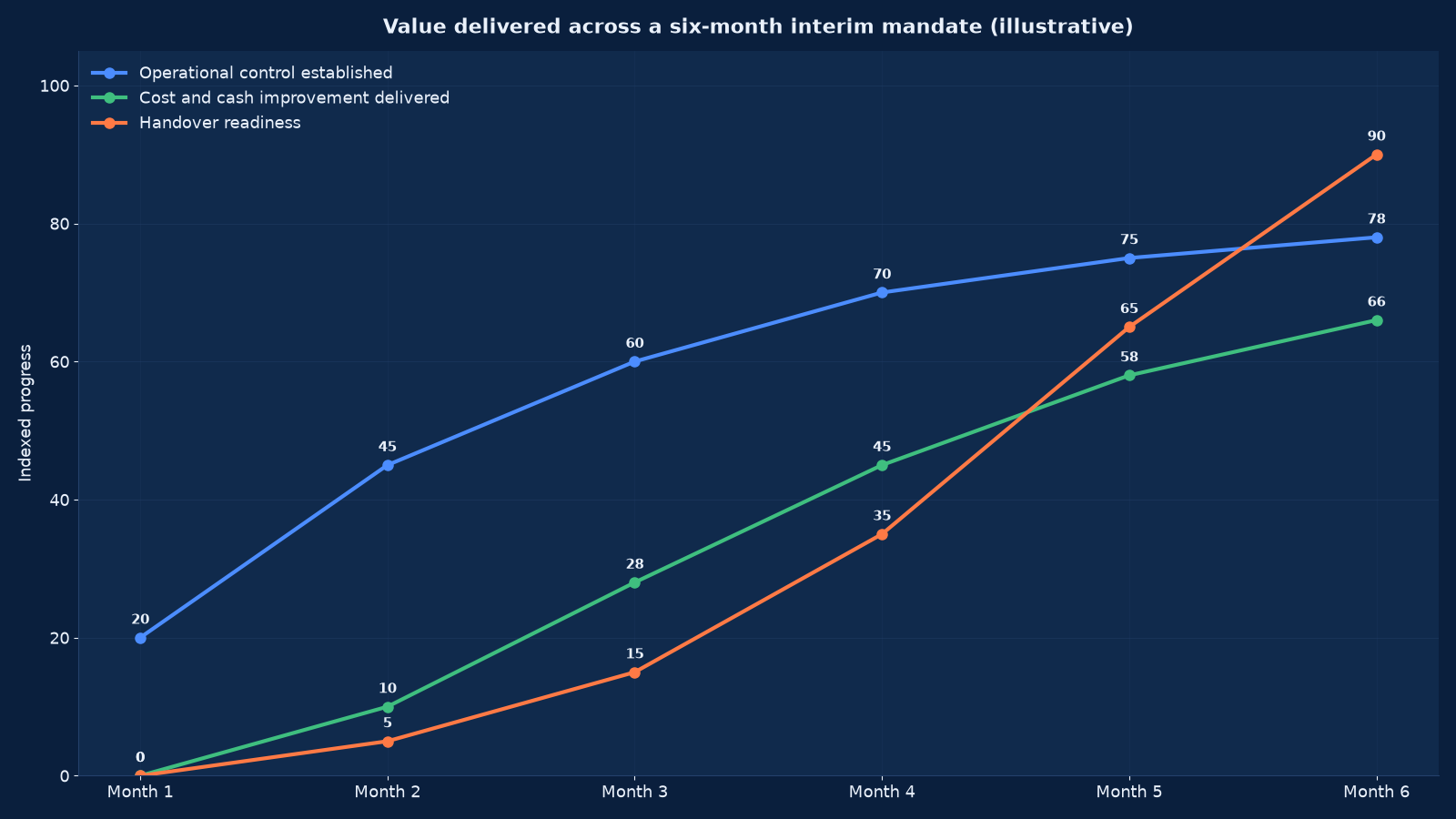
Chart values are an illustrative planning model based on typical UMC engagements and published industry benchmarks. They are not a guarantee of results on any specific project.
Fractional Leadership: The Economics and the Discipline
Fractional is not part-time employment. It is a specific arrangement with specific requirements, and it fails in predictable ways when treated as a cheaper employee.
The economics. A fractional finance director three days a week costs roughly sixty per cent of a full-time appointment in Figure 1 and delivers the capability that matters — the close, the pack, the forecast, the lender conversation. What it does not deliver is presence for the daily stream of questions, which is why fractional works for finance, strategy and governance far better than for delivery roles.
What makes it work. A defined output per month rather than days present; a deputy inside the business who handles the daily stream; a fixed calendar of reviews; and explicit decision rights, because a fractional leader without authority produces advice that nobody implements.
What makes it fail. Treating the days as available capacity for whoever asks; no internal counterpart, so the fractional leader becomes the process rather than the owner of it; and no exit criterion, so the arrangement continues for years solving nothing.
When to convert. When the function’s workload exceeds roughly three days a week on a sustained basis, or when the business needs daily presence. That is a signal of growth rather than of failure, and a good fractional leader will tell you when it arrives.
Handover: The Part That Determines Whether It Was Worth It
An interim appointment that leaves no structure behind is expensive temporary relief. Four obligations apply to every mandate.
- Documented decisions. A decision log with rationale, so the successor does not have to reconstruct why things are as they are. This is also the directors’ evidence if the period is ever scrutinised.
- Processes that do not depend on the person. The weekly review, the pack, the forecast, the approval thresholds — each with a named internal owner before exit, not at exit.
- No shadow structures. An interim who becomes the only route to a supplier, a lender or a key customer has created a dependency that must be unwound deliberately. We transfer relationships during the mandate rather than at the end.
- Recruitment support. Defining the permanent role from what the mandate revealed, assessing candidates honestly including saying when an internal candidate is ready, and a transition period where the successor leads and the interim supports.
The last point is where interim providers most often have a conflict, since many earn recruitment fees. We do not: the recommendation is the one that suits the mandate, including when it is to promote internally or to decide the role is not needed.
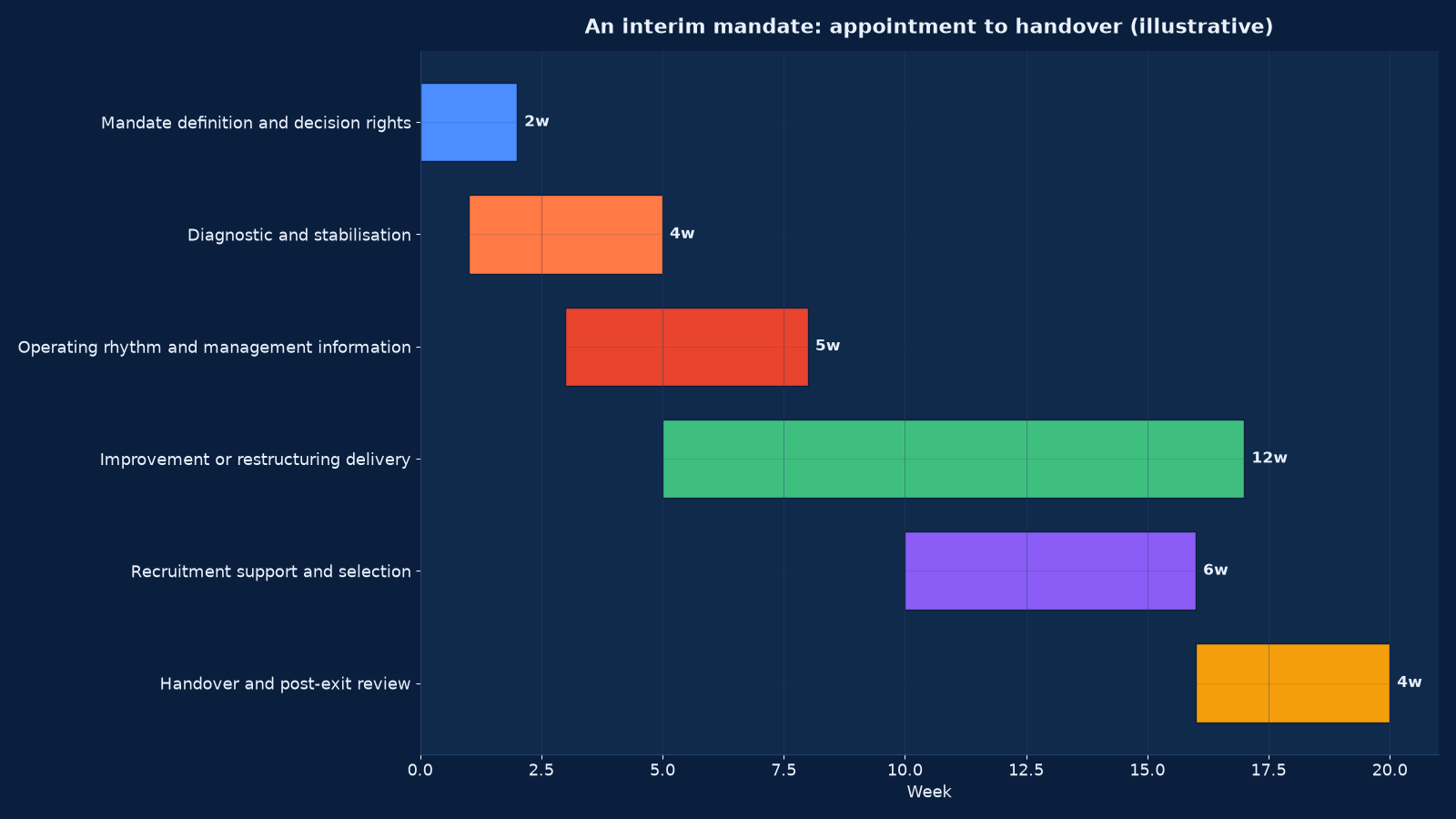
Chart values are an illustrative planning model based on typical UMC engagements and published industry benchmarks. They are not a guarantee of results on any specific project.
The Mandate Lifecycle
| Phase | Weeks | What happens | Output |
|---|---|---|---|
| Mandate and entry | 1–2 | Mandate agreed in writing, decision rights published, the position established | A mandate document and an honest baseline |
| Diagnostic and stabilisation | 2–5 | Cash, performance, cost, people and stakeholder review; deferred decisions taken | Baseline measures and the first actions delivered |
| Operating rhythm | 4–8 | Weekly review, monthly pack, decision log, ownership map | A rhythm that runs without the interim chairing it |
| Delivery | 6–17 | The mandate’s substance: cost, cash, margin, restructuring, integration or system change | Measured delivery against the mandate’s targets |
| Recruitment and succession | 11–16 | Role definition, candidate assessment, selection support | A successor appointed or the role redefined |
| Handover and exit | 17–20 | Relationship transfer, documentation, transition period, post-exit review at 30 and 90 days | A business able to run without the appointment |
Working With Owners and Boards
The relationship between an interim and the owner determines everything, and it needs three agreements made explicitly at the start.
How the owner will be told bad news. Weekly, in writing, without softening. An interim who manages the owner’s emotions has already stopped being useful.
What the owner may still decide. Owners who have run a business for twenty years do not stop having opinions, and should not. The mandate states which decisions are reserved to them and which are delegated, so the delegation is deliberate rather than resented.
How disagreement is resolved. The interim states the recommendation and the reasoning, the owner decides, and the decision is logged. Where the interim cannot implement a decision they believe is wrong, that is an exit conversation rather than quiet non-delivery.
For boards, the same discipline applies with an added obligation: the interim reports the position as it is, including when management’s framing differs. That independence is the reason boards commission interims rather than promoting internally during a crisis. Our analysis of how CEOs balance immediate pressure with long-term opportunity describes the tension an interim is appointed to hold.
Measuring an Appointment
These are agreed in the mandate and reviewed at each interval. The last one is the measure most providers avoid and the only one that tells you whether the money was well spent.
| Measure | Definition | Target |
|---|---|---|
| Mandate targets met | Progress against the numeric measures in the mandate | All met or explicitly re-scoped by review |
| Time to first binding decision | Days from appointment to a material decision taken | Under 15 days |
| Time to operating rhythm | Days until the weekly and monthly cycle runs | Under 45 days |
| Cash or cost delivered | Value evidenced in the accounts, not projected | Against the mandate baseline |
| Deferral cleared | Number of previously deferred decisions taken | All material ones inside 60 days |
| Team stability | Attrition among the interim’s direct reports | No increase — a good interim settles a team |
| Documentation | Decision log, processes and ownership documented before exit | Complete at exit |
| Successor readiness | Whether the permanent role is filled or properly defined at exit | Yes |
| Post-exit durability | Whether the measures hold at 90 days after exit | Holding — the real test |
We report at 30 and 90 days after exit as standard. If a measure has decayed, that is our finding to fix, not the client’s to absorb — and it is why handover discipline is part of the mandate rather than an afterthought.
Typical Mandates
Mandates vary more than roles do. These are the shapes we see most often, described in terms of the situation rather than the title — because the title is usually the last thing to be settled and the situation is what determines whether an appointment is right.
| Mandate | The situation | What the appointment delivered | Duration |
|---|---|---|---|
| Interim COO in a services business | Delivery slipping, margins falling, the operations director had resigned with no successor | A delivery baseline within three weeks, cost-to-serve measured by client, two layers of coordination removed, a permanent COO recruited from the internal team in month five | 7 months |
| Interim CFO during a refinancing | Facility maturing, forecast unreliable, lender confidence low | A thirteen-week forecast running by week three, covenant headroom restored, the facility refinanced on better terms, and monthly reporting installed before exit | 5 months |
| Interim CEO through an ownership transition | Founder stepping back, no successor identified, management team unsettled | The business held steady through the transition, a decision-rights map published, the successor appointed internally with a structured handover | 11 months |
| Fractional finance director in a growing group | Owner-led finance function, no pack, no forecast, accounts filed late | Monthly pack on a fixed calendar by week six, cash forecast by week ten, a full-time FD recruited in month nine | Ongoing, 3 days per week |
| Transformation lead for an integration | Two acquired businesses running separately, duplicate systems and no combined reporting | One operating model, one chart of accounts, duplicate systems consolidated, savings in run-rate by month six | 8 months |
| Diagnostic mandate before a restructuring | The board could not agree whether the problem was the market, the cost base or the leadership | A four-week independent position establishing which of the three it was, and a recommended route with costings | 4 weeks |
Three patterns are worth noting. First, the majority of mandates begin with a position nobody could state clearly, so the first two weeks are diagnostic in almost every case regardless of the title. Second, the appointment frequently ends with an internal promotion rather than an external hire, because the mandate reveals what the role actually requires and who already meets it. Third, the mandates that deliver most are the ones with the narrowest written scope — a defined problem beats a general management brief every time.
Engagement Models
| Model | Duration | What you get | Best when |
|---|---|---|---|
| Diagnostic mandate | 2–5 weeks | An operator inside the business establishing the position and recommending a route | You need an answer before committing to an appointment |
| Interim executive | 3–18 months | A full-time operator holding the role with a written mandate and published decision rights | A vacancy, a turnaround, a restructuring or a transition |
| Fractional leadership | Ongoing | A senior leader two or three days a week with defined monthly outputs and an internal counterpart | The need is real but not full-time |
| Transformation mandate | 3–9 months | Delivery of one defined programme with measures and dates | A programme exists but nobody owns its delivery |
| Appointment plus operating layer | 3–12 months | An interim who also installs the decision rights, information set and cadence before exit | The cause of the vacancy was structural |
| Board or owner advisory | Ongoing | Independent challenge and reporting without an executive role | The owner wants a second opinion with no conflict |
The Risks of the Route, Stated Plainly
Interim leadership has three failure modes, and knowing them is how you avoid them.
Dependency. The business becomes unable to act without the interim. The countermeasure is handover obligations in the mandate, relationship transfer during the appointment, and an exit date that is enforced rather than extended by default.
Shadow management. The owner continues to make the decisions and the interim becomes an expensive messenger. The countermeasure is published decision rights and a logged record, so reversals are visible.
Mandate drift. The appointment starts as a turnaround and ends as general management with no exit. The countermeasure is review points with an explicit decision to continue, re-scope or end.
There is also a cost risk that is worth naming: an interim is more expensive per month than a permanent hire, so an appointment that runs three times longer than planned can cost more than the problem was worth. That is why duration and exit criteria are in the mandate, and why we will tell you when a permanent hire or a fractional arrangement is the better instrument. Our energy transition leadership piece and the mission-led transformation study both examine what happens when leadership capacity and mission clarity are out of step.
Frequently Asked Questions About Interim & Fractional Leadership
How fast can someone be in post?
One to two weeks for most mandates, because the mandate document and the position review can start before the appointment is confirmed. Slower where security clearance, sector knowledge or a specific technical background is essential. If the situation is acute — a sudden resignation or a lender deadline — we will tell you in the first conversation whether that timetable is achievable.
What does an interim cost?
More per month than a permanent hire, and less over a year when recruitment lag, notice periods and the cost of undecided decisions are included. Figure 1 shows the fully loaded comparison. We quote a fixed monthly fee by mandate with no recruitment commission and no success fees tied to the numbers the interim reports on.
Is fractional just a part-time employee?
No, and the distinction matters. A fractional leader is engaged against defined monthly outputs — a pack on a fixed calendar, a forecast updated weekly, a pricing review completed — not against hours present. They require an internal counterpart for the daily stream of questions and explicit decision rights. Without those three things, fractional becomes expensive advice.
Which roles work well fractionally?
Finance director, strategy, governance, commercial direction and non-executive style roles work well, because their value is in cadence and judgement rather than presence. Delivery, operations and people-management roles generally do not, because they require daily availability. If a fractional need exceeds about three days a week sustained, that is the signal to convert to full-time.
Will an interim make decisions my managers resent?
They will make decisions that were previously unmade, which is the point. Resentment usually comes from ambiguity rather than from decisions — when nobody knows who is authorised, every decision looks like an intrusion. Publishing decision rights in week two removes most of it, and an interim who takes the deferred decisions early is usually welcomed by the team carrying them informally.
How do you prevent the business becoming dependent on the interim?
With obligations written into the mandate: relationship transfer during the appointment rather than at the end, documentation of decisions and processes with named internal owners before exit, an enforced end date with review points, and post-exit reviews at thirty and ninety days. If a measure has decayed after exit, that is our finding to address.
Can an interim recruit my permanent leader?
They can define the role from what the mandate revealed, assess candidates including internal ones, and support the transition. We take no recruitment fee and have no agency relationship, so the recommendation is not distorted — including when the honest answer is that the role as originally conceived is not the role the business needs.
Do you work with our existing management team or around them?
With them. An interim who bypasses the existing team produces results that collapse on exit. The structured entry in the first thirty days spends most of its time with the people who have been holding the role informally, because they know where the problems actually are and they are the ones who will operate whatever is put in place.
What if the mandate changes halfway through?
Then it is re-scoped formally at a review point, with the new measures, duration and exit criteria written down. Mandate drift is one of the three failure modes of this route and the only reliable countermeasure is a documented decision to continue, re-scope or end — not an informal extension.
Is this suitable for a family business?
Often particularly suitable. An interim brings decisions that are difficult for a family member to take against other family members, and does so under a written mandate rather than through family politics. Reserved decisions stay with the family; operational authority is delegated explicitly. The same arrangement is used for succession, where an interim holds the operating layer while the next generation takes responsibility.
What should we do first?
Define the problem in one or two sentences with the measures that show it. If you cannot, the right first engagement is a two-to-five-week diagnostic mandate rather than an appointment — and that is a cheaper way to find out what you actually need.
Discuss the Mandate Before the Appointment
Most conversations start with the problem rather than the role. Tell us what is not working, who is holding it informally, and how long you expect the need to last. We will tell you whether an interim, a fractional arrangement, a short diagnostic or a permanent hire is the right instrument — and if it is an appointment, we will draft the mandate with you before anyone starts.
Contact Unified Management Consulting to arrange a confidential first conversation.
Related Services
Interim and fractional leadership is used alongside our other turnaround services:
- Mr Avinash Sharma — the operating background behind these appointments
- Risk, Governance & Business Continuity Support — the governance framework an interim mandate often installs
- Business Strategy Consulting — where the mandate is direction rather than delivery
- IT Staff Augmentation Services — the same model for technical capacity
- Data Science Services for Business Analytics — the measurement capability a fractional finance or commercial mandate depends on
- AI Training & Enablement Services for Teams — capability building that outlasts the appointment
- About Unified Management Consulting — the firm behind the mandate
- Unified Top-Level Business Management & Handling — one operating layer across finance, operations and people, with decision rights and cadence
- 30-Day Turnaround Diagnostic — thirty days to an evidenced position across cash, cost, margin, contracts and governance
- Cash Flow & Working Capital Recovery — a thirteen-week forecast, receivables and payables discipline, inventory release and covenant cover
- Distressed Business Restructuring — the options ladder from consensual standstill to formal insolvency, with lender and stakeholder plans
- Cost Rationalisation & Margin Recovery — cost-base decomposition, contribution by customer and product, cost to serve and pricing discipline