
Manufacturing growth is not a campaign problem. It is a specification problem, a distribution problem and a data problem wearing a campaign’s clothes. A buyer who cannot find the datasheet does not enquire; a distributor who cannot see stock does not push the product; an export enquiry answered three days late goes to the competitor who answered in three hours; and a plant whose ERP, quality system and shop-floor data disagree cannot tell you which product actually earns its margin. The marketing that follows those facts is unusual in shape: technical content that engineers trust, product data complete enough to be quoted, a pipeline measured by qualified opportunity rather than form fill, and account-based work aimed at a defined list of buyers rather than an audience.
Unified Management Consulting works with component and assembly manufacturers, process industries, capital equipment makers, contract manufacturers, export houses and the industrial businesses that supply them. Everything here is delivered remotely and written to be geography-neutral – certification regimes, export controls and market-specific claims rules are handled inside the engagement. This is the vertical’s main page; the industries index lists every sector we cover, and hospitals and restaurants show the same discipline set applied to consumer-facing operations.
What an engagement includes, at a glance
| Component | What We Deliver |
|---|---|
| Product data and technical content | Datasheets, specifications, CAD references, application notes – the assets that actually produce industrial enquiries. |
| Industrial search and AI search | Part numbers, equivalents, substitutions and specification queries, answered in content an assistant can quote. |
| Route to market | Direct OEM, distributors, export, tender and marketplace – modelled by contribution, not volume. |
| LinkedIn and ABM | A named account list, a buying committee map and outreach measured by qualified conversations. |
| CRM and pipeline quality | Enquiry to quote to order with stage definitions sales actually follows. |
| Distributor enablement | Portals, stock visibility, co-marketing and training for the channel that carries your volume. |
| Production and margin reporting | Yield, downtime, cost per unit, contribution per product family and customer. |
| Plant IT and OT security | Segmented networks, backups, asset registers and the baseline an insurer or auditor asks for. |
What manufacturers search for, and what it really means
Enquiries from this sector arrive with an operational problem attached to a marketing request. The mapping below is what we do in week one, because proposing campaigns before it is done produces leads that cannot be quoted.
| What gets searched or asked | What is actually happening | What we do about it |
|---|---|---|
| “B2B marketing for manufacturers” | Enquiries arrive but sales calls them unqualified | Stage definitions, qualification criteria and a routing rule agreed with sales |
| “industrial SEO services” | Product pages are images and part numbers with no specification content | Product data model plus technical content per family and application |
| “generate export enquiries” | Export demand exists but response times lose it | Enquiry routing with time-zone cover and an export document checklist |
| “LinkedIn marketing for manufacturing” | Posts published, no pipeline effect | Account list, buying committee map and ABM sequences measured on meetings |
| “distributor portal development” | Distributors call for stock and price instead of ordering | Portal with live stock, price tiers, order status and co-marketing assets |
| “ERP reporting is useless” | Numbers argued about monthly across ERP, quality and shop floor | Metric dictionary, warehouse layer, production and margin dashboards |
| “plant network security” | Office and production networks share one segment | Segmentation, asset register, OT monitoring and a security baseline |
Four of the seven are data problems and two are process problems. Only one is a media problem, which is the honest shape of industrial growth work and the reason our strategy and margin recovery practices sit inside these programmes rather than beside them.
The industrial buying journey: long cycles, many approvers
An industrial purchase involves a specifier, a user, a maintenance or quality voice, a buyer and often a finance approver, over weeks to months, with a technical evaluation in the middle. That produces two consequences most marketing programmes ignore: the enquiry is not the lead (the qualified technical conversation is), and the content that matters most is the content consumed between the first enquiry and the RFQ – specifications, comparisons, test reports, installation and compatibility guidance.
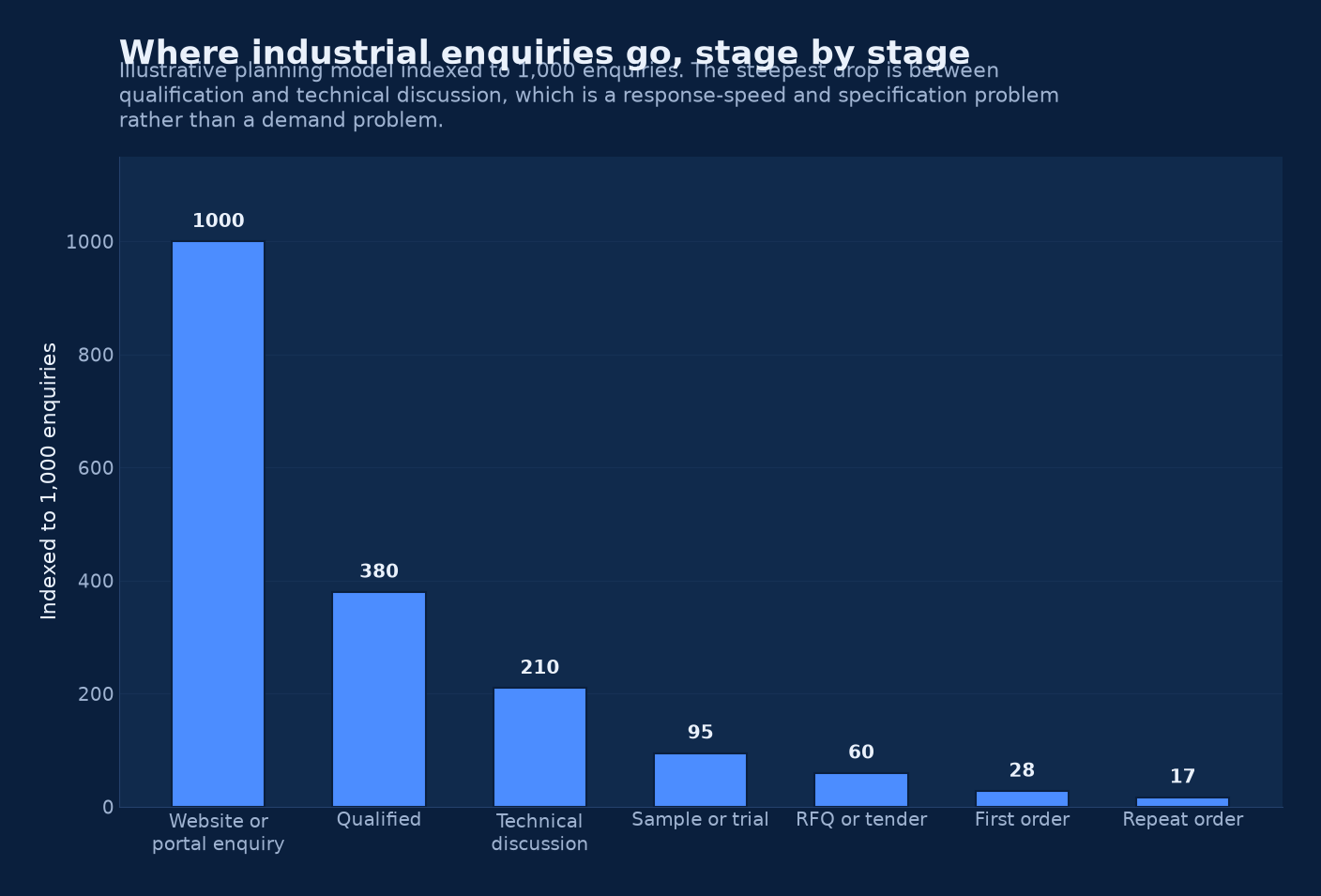
Chart values are an illustrative planning model based on typical UMC engagements and published industry benchmarks. They are not a guarantee of results on any specific project.
| Stage | Who is involved | What must exist | How it is measured |
|---|---|---|---|
| Problem recognition | Engineer, maintenance, operations | Application content, problem-led pages, technical articles | Non-branded visibility and content engagement |
| Specification | Specifier, consultant, design team | Datasheets, CAD, compliance certificates, selection guidance | Datasheet downloads and specification inclusions |
| Supplier shortlist | Buying committee | Credibility proof, references, capability pages, local presence | Enquiries per family, tender invitations |
| Technical evaluation | User plus quality or maintenance | Samples, trial support, test data, application engineering | Sample-to-trial conversion, technical meeting count |
| Commercial negotiation | Buyer and finance | Clear pricing logic, terms, total cost of ownership | Quote-to-order rate, discount leakage |
| Order and delivery | Supply chain | Order status visibility, lead-time honesty | On-time delivery, order accuracy |
| Repeat and expansion | Account owner | Consumption tracking, reorder prompts, cross-sell data | Repeat rate, share of wallet per account |
Notice that four of the seven stages are owned by engineering, quality or supply chain rather than marketing. That is why an industrial growth programme is a cross-functional project with a marketing workstream inside it.
Route to market: where the margin actually is
Most manufacturers sell through several routes at once and report them as one number. Separating them is the first commercial act of the programme, because each route has a different contribution, a different cost to serve and a different marketing requirement: distributors need enablement and stock visibility, export needs documents and time-zone response, tenders need compliance and bid discipline, direct OEM needs technical selling and long relationship work.
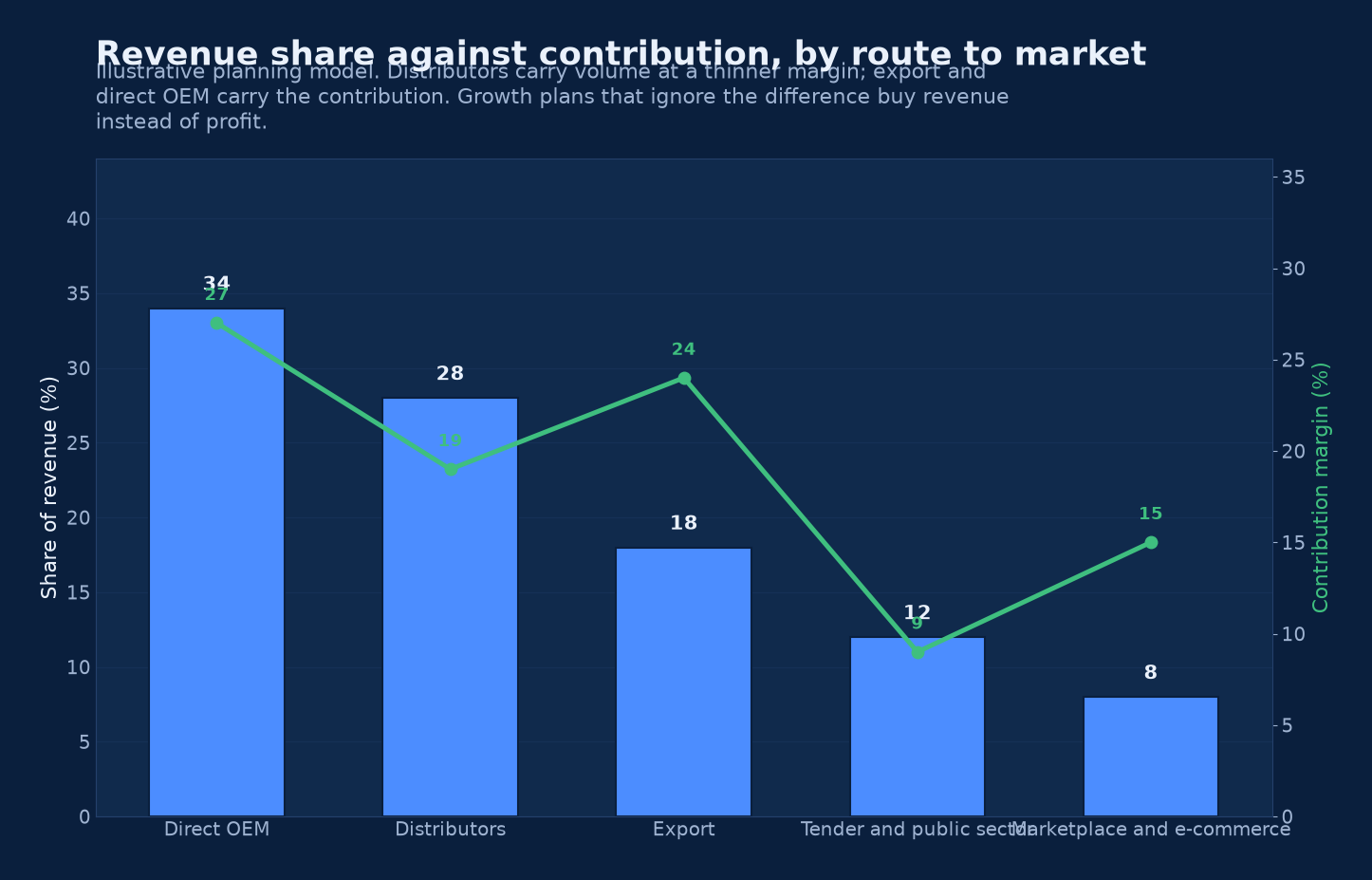
Chart values are an illustrative planning model based on typical UMC engagements and published industry benchmarks. They are not a guarantee of results on any specific project.
| Route | Cost to serve | Marketing requirement | Growth lever |
|---|---|---|---|
| Direct OEM | High – technical selling, long cycle | Specification content, account plans, engineering support | Design wins and share of wallet |
| Distributors | Medium – channel margin plus support | Portal, stock visibility, co-marketing, training | Active distributor count and sell-through |
| Export | Medium-high – documents, logistics, time zones | Country pages, certifications, responsive enquiry desk | New market entry with a documented process |
| Tender and public sector | High – bid cost, compliance | Bid library, capability statements, compliance evidence | Win rate and bid cost per order |
| Marketplace and e-commerce | Low-medium – fees and fulfilment | Product feeds, pricing rules, reviews | Assortment and buy-box position |
We build the route model with finance in week three and use it to decide where media and sales effort go. market expansion consulting and market research and competitive analysis cover the entry decision; cost rationalisation and margin recovery covers the case where the route mix is the reason revenue grows and profit does not.
The manufacturing technology stack we integrate with
Industrial data lives in systems that were bought for different reasons in different decades. The audit below is week one: what exists, what it can export, who owns it, and which numbers are contested.
| System | What it holds | What we need from it | Common blocker |
|---|---|---|---|
| ERP | Orders, inventory, pricing, procurement, finance | Order and margin extracts per product family and customer | Licence cost for reporting seats, customised fields |
| MES and shop floor | Production counts, downtime, yield, OEE | Shift-level output and reason codes | Manual entry, reason codes nobody uses |
| PLM and engineering | Drawings, BOMs, revisions, specifications | The specification truth behind product content | BOM revisions not reflected in published data |
| Quality / LIMS | Inspections, non-conformances, certificates | Certificate availability and defect trends | Certificates issued as scanned PDFs |
| CRM | Enquiries, quotes, accounts, pipeline | Stage-defined pipeline with source attribution | Sales logging calls but not stages |
| Distributor portal or EDI | Stock, price tiers, orders, claims | Sell-through and active account data | Distributors ordering by phone and email |
| Product information (PIM) | Descriptions, attributes, media, translations | One source for every published specification | Product data living in spreadsheets per team |
| Infrastructure and OT | Plant networks, servers, controllers, backups | Asset register, segmentation, uptime | Office and production sharing one network |
Integration is delivered through enterprise systems integration, data warehouse and lakehouse where ERP, MES and quality must agree, and data engineering for AI and knowledge systems where the same data will feed models and technical search later. full-stack Java development and portal development cover the heavier application work such as distributor and customer portals.
Service requirements by role
| Role | The question they ask | What we deliver | The number they watch |
|---|---|---|---|
| Managing director or promoter | Which products and routes actually make money? | Route and product contribution model, growth case | Contribution per family and per route |
| Sales head | Are these leads worth my team’s time? | Qualification criteria, routing, account plans, ABM | Qualified opportunities per seller |
| Export manager | Which markets, and how do we respond in time? | Country pages, certification list, time-zone enquiry cover | Enquiry-to-quote time and win rate by country |
| Plant or operations head | Will this change what the shop floor does? | Demand signals, forecast accuracy, downtime reporting | OEE, on-time delivery, yield |
| Marketing lead | What do we publish, and to whom? | Product data, technical content, campaigns, events | Specification-stage engagement and sourced pipeline |
| Finance | What did the pipeline cost and what did it return? | Cost per qualified opportunity, bid cost, margin reporting | Marketing spend per order value |
| IT head | Who owns the network between office and plant? | Segmentation, monitoring, backups, security baseline | Downtime minutes and audit gaps closed |
Product data and technical content: the real SEO asset
In industrial sectors the content that ranks and converts is unglamorous: a complete specification table, a dimensional drawing, a compatibility list, an installation note, a test certificate, a substitution guide. Marketing copy is secondary – buyers who cannot verify a specification do not enquire, and assistants asked “which product meets this rating” quote whoever published the rating in readable form. The work is therefore a product data model first, then content generated and maintained from it, so a revision in engineering does not leave the website lying.
| Asset | What it must contain | Why buyers need it | Maintenance owner |
|---|---|---|---|
| Product family page | Application, range, standards met, selection guidance | To decide whether you are even a candidate | Product management |
| Product page | Full specification table, variants, dimensions, materials | To specify without emailing you | Engineering plus marketing |
| Datasheet and CAD | Downloadable, versioned, with a revision date | To put into their own design | Engineering |
| Certificates | Standard, scope, validity, issuing body | To satisfy their compliance step | Quality |
| Application notes | Problem, method, result, limitations | To trust that it works in their conditions | Application engineering |
| Comparison and substitution | Equivalent part numbers, differences, migration notes | To replace a competitor or a discontinued item | Product management |
| Installation and maintenance | Torque, environment, service intervals, spares | To estimate total cost of ownership | Service |
| Case and reference projects | Sector, scale, outcome, constraints | To believe you have done it before | Sales with marketing |
This is content marketing with an engineering dependency, delivered alongside website strategy and information architecture so the catalogue is navigable at ten thousand SKUs, and brand performance and creative production for the photography, diagrams and video that make a plant and a product legible to a buyer who will never visit.
Industrial search and AI search
Industrial search behaviour is precise: part numbers, standards references, ratings, dimensions, equivalents. That makes it both easier and harder than consumer search – easier because intent is unambiguous, harder because the page must actually contain the value in text rather than in an image of a table. The same precision applies to AI assistants, which increasingly answer specification questions by quoting whoever published structured, consistent data.
| Query type | Example intent | What must exist | Common failure |
|---|---|---|---|
| Part number | Find the exact item or its replacement | Part number in text, variants, status | Part numbers only in PDFs |
| Specification | Meet a rating, standard or dimension | Structured specification tables | Specifications inside images |
| Equivalent or substitute | Replace a competitor or obsolete part | Cross-reference content with differences stated | No cross-reference at all |
| Application | Solve a problem in a named industry | Application notes and sector pages | One generic industry page |
| Supplier near me | Local availability or service | Plant, branch and distributor location pages | No location pages |
| Compliance | Does it meet our standard? | Certificate pages with scope and validity | Certificates emailed on request |
| Price and lead time | Can we plan a project around it? | Indicative pricing logic and lead-time honesty | “Contact us” for everything |
Delivery runs through SEO, AI search optimisation, local SEO and profile management for plants, branches and distributor locations, and content marketing with an engineering review step. The published proof of method is our B2B SEO project for a chemical earthing company.
Paid media: search, LinkedIn and account-based work
Industrial paid media splits cleanly. Search captures specification-stage demand – part numbers, standards, applications – and is measurable in enquiries. LinkedIn reaches the buying committee in accounts you have named, and is measurable in conversations rather than clicks. Everything else – display, video, retargeting – supports those two and should be sized accordingly. The most common waste in this sector is a broad match campaign aimed at consumers and hobbyists, buying clicks from people who will never purchase in volume.
| Job | Channels | Budget logic | Measured by |
|---|---|---|---|
| Capture specification demand | Search on part numbers, standards, applications | Bounded by exact and phrase intent, negative lists maintained weekly | Qualified enquiries and cost per qualified opportunity |
| Reach named accounts | LinkedIn, ABM sequences, targeted content | Sized by account list and buying committee, not impressions | Meetings booked, accounts engaged, pipeline created |
| Support the channel | Display retargeting, video, trade media | Small, always-on, aimed at known visitors and accounts | Assisted conversions and branded search lift |
| Recruit and reputation | Employer brand, trade press, events | Event-led and seasonal | Applications and event-sourced enquiries |
| Marketplace and feeds | Shopping and B2B marketplace listings | Inside route-to-market contribution, not as marketing | Incremental orders per route |
Execution runs through Google Ads management, LinkedIn advertising with B2B expertise, account-based marketing, webinar and event campaigns for technical audiences, YouTube for demonstration and installation video, and media planning and buying where several business units share one budget. Automation-led campaigns such as Performance Max are used only with strict negative and asset controls, because an automated campaign in B2B will happily spend a month buying hobbyist traffic. Our B2B Google Ads engagement for an African engineering consultancy shows the method.
Websites, catalogues, configurators and portals
An industrial website is a catalogue with a quotation path. The failure modes are consistent: ten thousand products in an unsearchable list, specifications in images, a contact form as the only call to action, no stock or lead-time signal, and a distributor who has to phone for a price. The build work below is what replaces that, and the measure of success is whether a buyer can specify, price and enquire without speaking to anyone.
| Capability | What it does | Failure it replaces | Typical dependency |
|---|---|---|---|
| Faceted catalogue | Filter by family, standard, rating, dimension | An alphabetical product list | Clean product data model |
| Product pages | Specification tables, drawings, certificates, downloads | A photo and a paragraph | Engineering and quality sign-off |
| Selection and configuration | Guided selection, valid combinations, output spec | Enquiries that cannot be quoted | Rules agreed with engineering |
| RFQ and quote flow | Multi-line enquiry, file upload, routing to the right desk | A generic contact form | Routing rules with sales |
| Distributor portal | Live stock, price tiers, order status, claims, assets | Phone and email ordering | ERP integration and price governance |
| Customer account | Order history, reorder, documents, certificates | Requests to the sales inbox | ERP and document store |
| Local and plant pages | Location, capability, service coverage, careers | One address in the footer | Local data per site |
| Performance and access | Fast on a plant network, usable on a phone, accessible | A brochure site that takes nine seconds | Core Web Vitals and accessibility work |
Delivery runs through website development, e-commerce and B2B ordering, portal development, UX and UI design, Core Web Vitals, accessibility, mobile apps for field sales and service, and maintenance and support so a product revision reaches the site the same week. Our WordPress build for an African architectural company and engagement with an Indian architecture company show catalogue-led work in adjacent technical sectors.
CRM, pipeline quality and distributor enablement
Industrial CRM fails in a specific way: it becomes a call log rather than a pipeline, because the stages were designed by marketing and not by the people who sell. The fix is to define stages around real events – specification included, sample dispatched, trial agreed, RFQ received, quote issued, order placed – and to make the qualification criteria something sales agrees to before the first campaign runs. Then the marketing number stops being disputed, because everybody is counting the same thing.
| Component | Design decision | Failure mode | Measurement |
|---|---|---|---|
| Stage definitions | Tied to events sales recognises | Stages nobody updates | Stage accuracy on audit |
| Qualification criteria | Volume, timing, specification fit, authority | Every form fill counted as a lead | Qualified rate and seller acceptance |
| Account structure | Groups, sites, buying committee roles | One contact record per company | Committee coverage per account |
| Source attribution | Campaign, content, event, distributor, referral | “Website” recorded for everything | Sourced pipeline share |
| Distributor records | Territory, tier, sell-through, co-marketing | Distributors missing from the CRM entirely | Active distributors and sell-through |
| Quote and order link | CRM to ERP so quotes and orders reconcile | Two systems telling different stories | Quote-to-order conversion |
Build and run sit with CRM development and integration, nurturing programmes for long cycles, lifecycle campaigns for reorder and consumption triggers, email for technical bulletins, WhatsApp and SMS where those are how the channel actually communicates, and marketing automation for the sequences. sales and pipeline analytics provides the reporting layer, and marketing mix modelling answers the question of what produced the order when the cycle is nine months long.
Business intelligence: production, sales and margin in one place
Manufacturing reporting arguments are about definitions: does yield count rework, is downtime planned or unplanned, does contribution include freight, is revenue recognised at dispatch or invoice, does a distributor’s sell-in count as demand. The dictionary comes first, then the dashboards – which is the same discipline as everywhere else, with the added complication that the shop floor, the ERP and the quality system each hold a different piece of the truth.
| Metric | Definition that must be fixed | Why it is contested | Refresh |
|---|---|---|---|
| OEE | Availability, performance and quality with the reason-code list stated | Planned stops counted as downtime | Per shift |
| Yield and scrap | Good units over input, with rework stated separately | Rework hidden inside yield | Daily |
| Cost per unit | Material, labour, overhead with the allocation rule | Overhead allocated by volume rather than driver | Monthly |
| Contribution per family | Net revenue less variable cost, freight stated | Freight and duty allocated arbitrarily | Monthly |
| On-time delivery | Against the promised date at order confirmation | Promise dates revised to make the metric look good | Weekly |
| Quote-to-order | Quotes issued against orders won, by route | Quotes issued informally and never logged | Monthly |
| Distributor sell-through | Sales out versus sell-in by account | Only sell-in is recorded | Monthly |
| Forecast accuracy | Forecast versus actual by family and period | Sales forecast and production plan maintained separately | Monthly |
On top of that, forecasting becomes usable: demand by family, seasonality, tender pipeline, distributor stock position – which turns procurement and rostering from reaction into plan. The practices are BI dashboards and executive reporting, predictive analytics and demand forecasting, data warehouse and lakehouse and cloud cost optimisation where the reporting estate runs in the cloud.
Artificial intelligence in manufacturing, sequenced by value against risk
The useful AI in a plant is specific and mostly unglamorous: turning specification PDFs into structured product data, answering technical questions from the published catalogue, forecasting demand and downtime, detecting quality drift, drafting tender responses from the bid library, and summarising enquiry threads for the sales desk. The AI that is not useful is anything that controls a machine or signs off a quality decision without a human, and anything that answers a specification question from a model’s general knowledge rather than from your data.
| Use case | Value | Risk | Human in the loop |
|---|---|---|---|
| Product data extraction | Thousands of datasheets become structured data | Low-medium – a wrong attribute misleads a buyer | Engineering reviews a sample per family |
| Technical question copilot | Answers from your catalogue, not the internet | Medium – an ungrounded answer is a specification error | Grounded retrieval plus escalation to engineering |
| Demand and downtime forecasting | Better procurement and maintenance planning | Medium – a wrong forecast costs stock or downtime | Planner confirms the plan |
| Quality drift detection | Catches a trend before a batch fails | Medium – false alarms cost inspection time | Quality triages every alert |
| Tender and proposal drafting | Faster bids from the approved library | Medium – a compliance misstatement can disqualify | Bid owner reviews before submission |
| Enquiry summarisation and routing | Faster response, better qualification | Low | Sales owns the conversation |
| Machine control or safety decisions | Potentially high | High – safety and liability | Not deployed |
The practice set is AI readiness assessment, AI agents and automation, AI integration with ERP and operations, data engineering for AI and knowledge systems, AI governance, risk and compliance, enablement and ROI measurement. Product data extraction is usually the first pilot, because it pays for itself in the catalogue work it unblocks.
IT support for plant and office, including OT
A manufacturer’s IT estate includes everything an office has plus the systems that run the plant: controllers, drives, weighbridges, lab instruments, machine networks, historians and the PCs that only one vendor can touch. The security consequence is structural – office and production must be segmented, vendor access must be controlled and logged, and backups must cover configuration as well as data, because rebuilding a controller from scratch takes longer than rebuilding a server.
| Area | What we put in place | Why it matters in a plant | Evidence produced |
|---|---|---|---|
| Asset and vendor register | Every device with owner, criticality, contract, spares | Some assets have a single vendor and no documentation | Register with criticality and vendor terms |
| IT and OT segmentation | Production separated from office, guest and vendor | A phishing email must not reach a controller | Crossing-rules table |
| Monitoring and on-call | Alerts by criticality, covering ERP, network and key machines | Downtime is measured in units, not tickets | Alert catalogue and rota |
| Backup and recovery | Data plus configuration, tested restores | Rebuilding a controller takes days | Timed restore records |
| Security baseline | Patch policy, MFA on administrative access, logging | Insurers and customers now ask for evidence | Baseline checklist and gap list |
| Industrial network design | Switching, wireless coverage in the plant, cabling | Metal buildings and interference defeat office Wi-Fi designs | Survey and design documents |
| Cloud and workloads | ERP adjacencies, reporting estate, cost control | Cloud spend grows invisibly | Workload inventory and cost report |
The practices are managed IT and AMC, helpdesk and end-user support, network engineering, server, storage and data centre engineering, cybersecurity, backup and disaster recovery, IT audit, compliance and ISO or SOC 2 readiness, cloud services and migration, DevOps and CI/CD and SRE and observability where the reporting estate needs to be dependable.
Export and international growth
Export growth is a process discipline before it is a marketing exercise: knowing which markets your certifications cover, answering an enquiry inside the buyer’s working day, producing a compliant document set, quoting freight and duty honestly, and following up for eighteen months while the project is approved. Most manufacturers we meet have the product and lack the process, which is why their export enquiries arrive and disappear.
| Stage | What must exist | Owner | Measured by |
|---|---|---|---|
| Market selection | Certification coverage, competitive price position, demand evidence | Export manager with research support | Markets shortlisted with a documented case |
| Country presence | Country pages, language, local standards, agent or distributor named | Marketing | Country-level visibility and enquiries |
| Enquiry response | Time-zone cover, technical checklist, response templates | Export desk | Hours to first substantive response |
| Documentation | Certificates, HS codes, packing and shipping documents | Export and quality | Document error and delay incidents |
| Quotation | Freight, duty, Incoterms and validity stated | Export with finance | Quote-to-order by country |
| Partner management | Distributor or agent agreements, targets, training | Export manager | Active partners and sell-through |
| After-sales | Spares, warranty process, local service route | Service | Repeat orders and claim resolution time |
market expansion consulting and market research and competitive analysis carry the entry decision; the marketing and portal work follows the same pattern as domestic. For operators in India, our export-focused local pages cover the regional detail.
Multi-plant and group operations
Groups need one standard and plant-level execution, and the standard worth centralising is narrower than most head offices assume: product data model, brand and content system, reporting definitions, security baseline, and the qualification criteria sales uses. Everything else – local distributors, plant capability pages, language, service coverage, community relationships – belongs at the plant, because that is where the knowledge lives.
| Layer | Central | Plant or country | Shared artefact |
|---|---|---|---|
| Product data | Data model, attribute standard, revision process | Local variants, translations, certifications | One product data source |
| Brand and content | Brand system, templates, approval process | Plant pages, local case work, language | Content library |
| Reporting | Metric dictionary and consolidated views | Plant dashboards and shift detail | One set of definitions |
| Pipeline | Stage definitions and qualification criteria | Account plans, distributor relationships | CRM configuration |
| IT and security | Baseline, monitoring, vendor management | Plant assets, spares, downtime rehearsal | Asset register and evidence pack |
| Procurement of services | Framework agreements and standards | Local execution and relationships | Vendor scorecards |
Deployment follows readiness rather than the org chart, and the readiness verdict is published per plant. unified top-level business management and business strategy consulting cover the group-level conversation that usually precedes it.
How an engagement runs: the first ninety days
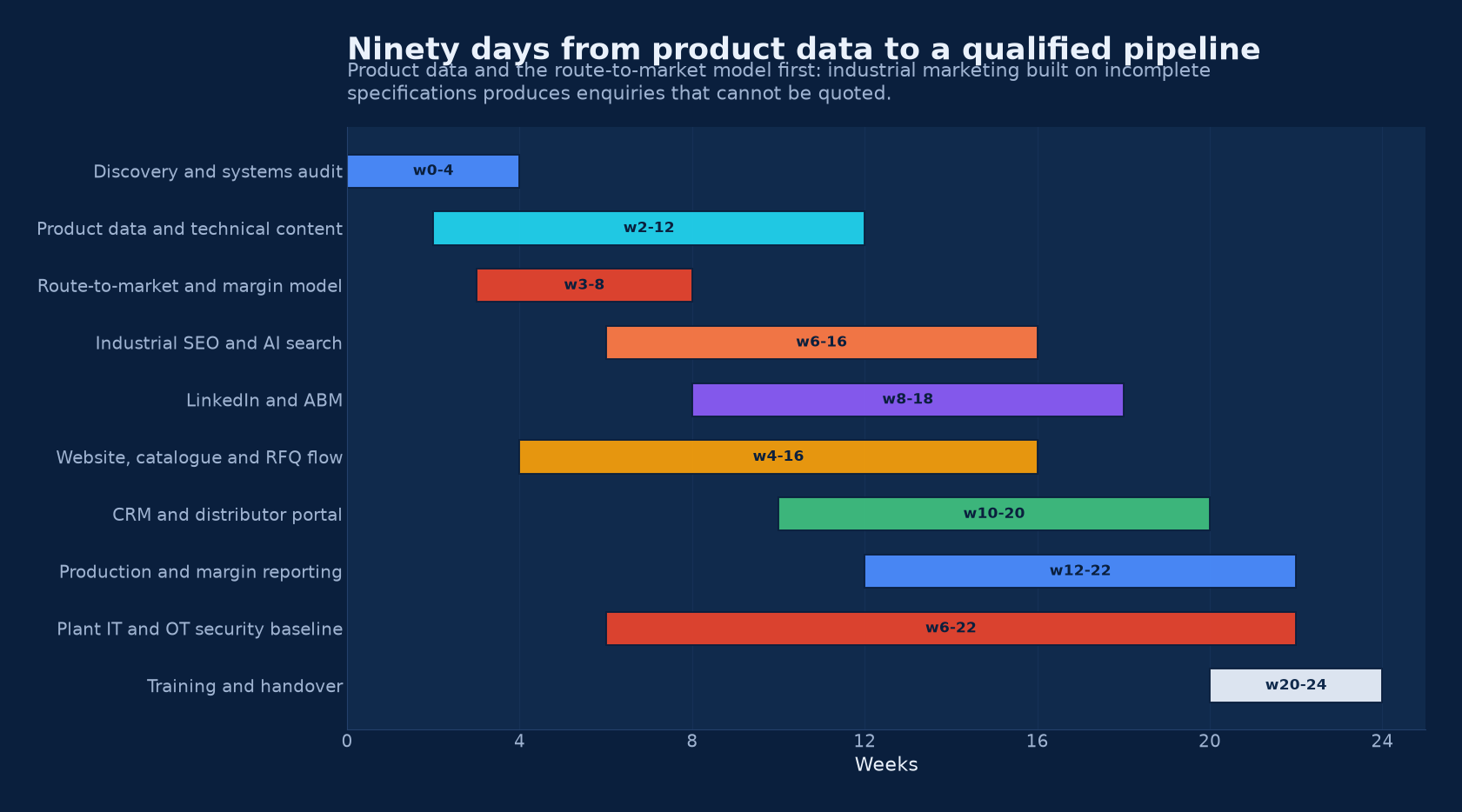
Chart values are an illustrative planning model based on typical UMC engagements and published industry benchmarks. They are not a guarantee of results on any specific project.
Weeks one to four are discovery: the systems audit, the route-to-market and contribution model, the pipeline stage definitions agreed with sales, and the product data model drafted with engineering. Technical content production runs from week two to twelve, because it is the longest lead item and everything downstream depends on it. Industrial SEO and AI search work starts at week six once the data model exists. LinkedIn and ABM begin at week eight against the agreed account list. The catalogue, RFQ flow and distributor portal build from week four to sixteen. CRM configuration lands by week twenty, production and margin reporting by week twenty-two, the plant IT and OT security baseline by week twenty-two, and training and handover close the programme.
| Deliverable | Week | What the business keeps |
|---|---|---|
| Systems audit and data verdict | 4 | What can and cannot be exported, with options |
| Route-to-market and contribution model | 8 | Where the margin is, by route and family |
| Product data model | 8 | Attributes, owners and a revision process |
| Pipeline stages and qualification criteria | 6 | Definitions sales agreed to |
| Technical content library | 12 | Family, product, application and certificate pages |
| Catalogue, RFQ and portal | 16 | A buyer can specify and enquire unaided |
| LinkedIn and ABM programme | 18 | Account list, sequences, meeting targets |
| CRM configuration and attribution | 20 | Sourced pipeline everyone counts the same way |
| Production and margin reporting | 22 | Dashboards on a published dictionary |
| Plant IT and OT security baseline | 22 | Asset register, segmentation, evidence pack |
| Training and handover | 24 | Runbooks, recordings, named owners |
Pricing and engagement models
| Model | Best for | What it includes | Commercial shape |
|---|---|---|---|
| Assessment only | A board that needs the truth before spending | Systems audit, route model, pipeline definitions, written verdict | Fixed fee, three to four weeks |
| Programme build | A manufacturer fixing data, site and pipeline together | Product data, content, catalogue, CRM, reporting, IT baseline | Fixed fee by workstream, ninety-day core |
| Managed retainer | A business that wants it run | Media, content, profile upkeep, reporting, IT support hours | Monthly, agreed scope, quarterly review |
| Fractional leadership | A group between hires | Marketing, IT or operations leadership part-time with the programme attached | Monthly, time-boxed with a handover plan |
Every model separates the assessment from the build, so a manufacturer can stop after the verdict and keep the model, the data specification and the stage definitions. Where the real issue is margin or cash, we route to cost rationalisation and margin recovery or cash flow and working capital recovery and say so.
Compliance, claims and safety
Industrial claims are regulated differently from consumer claims but no less strictly: performance claims need test evidence, standards references must be accurate and current, certifications must be in scope, environmental and safety claims must be substantiated, and export controls or restricted-party rules can apply to who you may even quote. The register approach is the same one we use in healthcare: what may be said, what must be qualified, what may never be said, approved by whoever owns the risk.
| Area | What we check | Where it shows up | Owner |
|---|---|---|---|
| Performance claims | Test data and methodology behind every number | Datasheets, ads, tender responses | Engineering |
| Standards and certifications | Standard reference, scope, validity, issuing body | Product pages, certificates, bid documents | Quality |
| Environmental claims | Substantiation, scope, no implied certification | Brand content, reports, packaging copy | Sustainability or quality |
| Safety instructions | Complete, current, matching the shipped product | Installation and maintenance content | Engineering plus service |
| Export controls | Restricted parties, dual-use rules, destination limits | Enquiry handling and quotation | Export manager with legal |
| Data and privacy | Consent for marketing contact, employee data, customer contacts | CRM, portal, events | Named data owner |
| Intellectual property | Drawings, CAD and specifications shared under terms | Downloads, portals, tender submissions | Legal plus engineering |
AI governance applies to anything automated – especially a technical copilot, which must answer from your catalogue and escalate when it cannot, because a confident wrong specification is more damaging than no answer at all.
How we measure success
| Outcome | Metric | Baseline source | Review cadence |
|---|---|---|---|
| More qualified enquiries | Qualified opportunities by family, route and source | CRM after stage definitions | Weekly during build |
| Faster response | Hours to first substantive response, by route and country | Desk and CRM logs | Weekly |
| Better conversion | Quote-to-order and sample-to-trial rates | CRM and ERP | Monthly |
| Healthier route mix | Contribution and volume per route | Finance and ERP | Monthly |
| Stronger technical presence | Visibility for specification and part-number queries | Search data | Monthly |
| Channel productivity | Active distributors and sell-through | Portal or ERP | Monthly |
| Reliable production data | Forecast accuracy, OEE reporting, on-time delivery | MES and ERP | Monthly |
| Honest spend | Cost per qualified opportunity, marketing per order value | Finance and CRM | Quarterly |
The scorecard is the artefact that outlives the engagement. A manufacturer that can see contribution by route and product family does not need an agency to explain last quarter.
Proof: industrial and B2B work we have delivered
Our published B2B work spans industrial products, engineering consultancies and technical services – the pattern of long cycles, specification-led content and qualification discipline is the same across them.
Related Services
B2B and industrial case studies:
- B2B SEO for a renowned chemical earthing company
- B2B Google Ads for an African engineering consultancy
- An Indian architecture company – technical services engagement
- WordPress development for an African architectural company
Where confidentiality applies – as it does for defence-adjacent, process and contract manufacturing – we share the method, the numbers and the constraints under a non-disclosure agreement.
Every capability a manufacturer can draw on, by family
| Family | Capabilities | Typical manufacturing use |
|---|---|---|
| Demand capture | SEO, AI search optimisation, content marketing, local SEO | Specification and part-number visibility, application content, plant locations |
| Paid media | Google Ads, LinkedIn, ABM, webinars and events, YouTube, media planning | Specification-stage demand and named-account work |
| Brand and content | brand performance and creative production, social media management, technical creators and trade voices | Plant and product photography, demonstration video, technical storytelling |
| Build | website development, B2B commerce, distributor and customer portals, UX and UI, performance, field apps, full-stack Java | Catalogue, configurator, RFQ flow, portals |
| Customer data | CRM development and integration, nurturing, lifecycle campaigns, email, WhatsApp, automation | Pipeline stages, attribution, reorder triggers |
| Intelligence | dashboards, forecasting, pipeline analytics, mix modelling, warehouse and lakehouse | Production, margin, pipeline and forecast reporting |
| Consulting | strategy, market research, expansion, cost and margin, cash flow, unified management | Route design, market entry, turnaround, group reporting |
| Infrastructure | managed IT, helpdesk, networks, servers and data centre, cybersecurity, backup and DR, audit, cloud, DevOps | Plant IT and OT, segmentation, uptime, evidence packs |
| Artificial intelligence | readiness, agents, integration, data engineering, governance, enablement, ROI | Product data extraction, technical copilots, forecasting |
Local teams: manufacturers in Lucknow, exports and across India
These pages are written to be geography-neutral because the work is delivered remotely. For businesses that want a provider in their own market, the local pages carry regional detail including export-specific programmes.
- Digital marketing company for manufacturers in Lucknow
- Website development company for manufacturers in Lucknow
- Increase manufacturing sales in Lucknow
- Digital marketing company for exporters in Lucknow
- Website development company for exporters in Lucknow
- Grow your export business
- Digital marketing and IT services across Indian cities
- Contact us
Related industry verticals
Manufacturing and industrial is one of nine verticals. The consumer-facing ones – retail, showrooms, restaurants, hotels – and the healthcare ones share the same method: unit economics and capacity first, systems second, campaigns third.
Frequently asked questions about manufacturing marketing, data and IT
Can you guarantee more orders?
No. We commit to a measured programme: qualified opportunities by family and route, response time, quote-to-order conversion and cost per qualified opportunity, reported with the misses included.
Our products are highly technical. Can you write the content?
We write it with your engineers, using a review step per page and a named technical owner. Content that engineering has not read is content a buyer will discredit in one question.
We sell only through distributors. Does marketing still apply?
Yes, and it changes shape: distributor enablement, sell-through visibility, co-marketing, portal and stock data, plus demand generation that lands on your distributors rather than around them.
How do you measure marketing with a nine-month sales cycle?
With sourced pipeline and stage movement during the cycle, and mix modelling afterwards. Last-click attribution in industrial B2B is fiction, and we do not report it.
Our ERP data is a mess. Should we fix that first?
Fix the reporting path first, not the whole ERP. A warehouse layer over what the ERP can export gives you a dictionary and dashboards in weeks; a full ERP remediation is a separate programme.
Do you handle plant networks and OT security?
Yes – segmentation between production and office, asset registers including controllers and instruments, vendor access control, backups that cover configuration, and the evidence an insurer or customer audit asks for.
What about tenders and public sector work?
We build the bid library, capability statements and compliance evidence pack, then measure win rate and bid cost per order so unprofitable tender types can be declined deliberately.
Can AI answer technical questions for our customers?
Yes, if it is grounded in your catalogue and escalates when it cannot answer. An ungrounded technical copilot produces confident specification errors, which is worse than no copilot.
How do we handle export enquiries across time zones?
With routing rules, templates, a document checklist and cover in the buyer’s working day. The measure is hours to first substantive response, by country.
Do you work with small manufacturers?
Yes. The assessment-only model exists for that: route model, product data specification, pipeline definitions and a written verdict, at a fixed fee, in a few weeks.
What if our problem is margin, not demand?
Then the assessment says so. A meaningful share of industrial engagements we are asked to quote start with route mix, cost per unit or working capital, and we would rather name that in week three than buy advertising in week thirty.
Do you work outside India?
Yes. Programmes are delivered remotely and written geography-neutral, with certification, export control and market claim rules handled inside the engagement.
Can you run the whole thing for us?
On a managed retainer, yes – media, content, catalogue upkeep, reporting and IT support hours, with a named owner on your side and a quarterly review.
Start with the route model and the product data specification
Give us four weeks with your ERP extracts, your engineering documentation and your sales team, and we will return the route-to-market contribution model, the product data specification, the pipeline stage definitions and a written verdict including what we would not start with – yours to keep either way.
Contact Unified Management Consulting to arrange a confidential first conversation.