
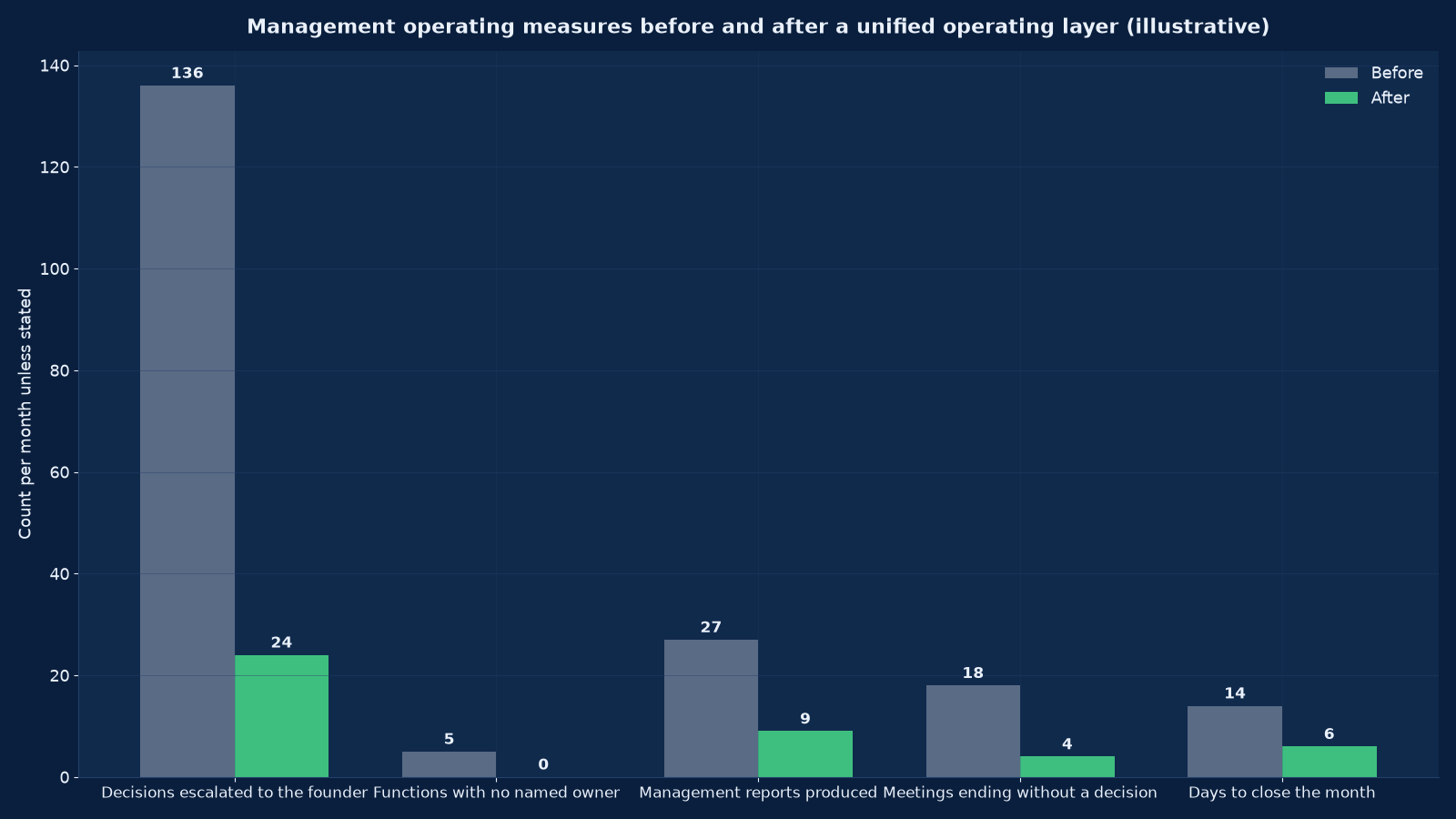
Chart values are an illustrative planning model based on typical UMC engagements and published industry benchmarks. They are not a guarantee of results on any specific project.
A business does not fail because its people are weak. It stalls because nobody can say who decides what, on what information, by when — so every significant question travels up to one person, and that person becomes the constraint.
Unified top-level business management is the operating layer that sits above your functions: a single accountable structure in which finance, operations, commercial, people, technology and risk each have a named owner, a defined decision right, one primary measure and a fixed place in the management cadence. Unified Management Consulting designs and installs that layer, runs it alongside your leadership team until it holds, and hands it over with the documentation that keeps it running after we leave.
🏛️ Unified Top-Level Business Management — Quick Summary
| Component | What We Deliver |
|---|---|
| Mandate & scope | A written mandate defining what the operating layer covers, who owns what, and which decisions are reserved to the board or founder. |
| Decision rights | A decision register: for each recurring decision type, who decides, who is consulted, what threshold triggers escalation, and how fast it must be made. |
| Ownership map | One named owner per function and per critical process, with the authority and the information that owner needs to actually own it. |
| Management information | A single information set — one primary measure per function, defined once, produced on a fixed calendar, replacing the duplicate reports nobody reads. |
| Operating cadence | Weekly operational review, monthly performance review, quarterly strategy review, each with a standing agenda, pre-read and decision log. |
| Escalation & exception path | A defined route for issues that cross functions or breach thresholds, with time limits so nothing sits unresolved. |
| Financial control | Budget ownership, approval thresholds, monthly close discipline and a cash view that leadership actually reads. |
| People & performance | Objectives cascaded from the business plan, review rhythm, and consequences that are applied consistently rather than personally. |
| Handover & embedding | The layer run alongside your team for at least one full cycle, then handed over with documentation, training and a review date. |
This service is the operating counterpart to Business Strategy Consulting and depends on the information discipline in Data Science Services for Business Analytics. Where the trigger is distress rather than drift, the 30-Day Turnaround Diagnostic in this same category is the faster entry point. Engagement is led by Mr Avinash Sharma, whose profile sets out the operating experience behind it.
What “Unified Top-Level Management” Means in Practice
The phrase is used loosely in our industry, so it is worth being precise. It is not another committee, and it is not a reorganisation. It is the minimum structure that lets a leadership team run a business rather than a collection of functions.
| Dimension | Fragmented business | Unified operating layer |
|---|---|---|
| Decisions | Travel upwards until someone senior enough decides; the same question is decided differently in different functions | Made at the lowest level with the information and the consequence, against published thresholds |
| Ownership | Functions have leaders but processes have none; three people share responsibility for delivery and none is accountable | One named owner per function and per critical process, with the authority to act |
| Information | Each function keeps its own numbers; the finance version and the operations version disagree and both are defended | One definition per measure, one source, one calendar, one pack |
| Meetings | Frequent, long, and ending in further meetings | Fixed cadence, pre-read circulated in advance, decisions logged and tracked |
| Cash | Known after the month closes, discussed when it becomes a problem | Forecast forward, reviewed weekly, with thresholds that trigger action |
| Performance | Reviewed annually, or when something goes wrong | Reviewed monthly against plan, with the same measures the owners are accountable for |
| Escalation | Informal, via whoever is most insistent | A defined path with time limits and a record |
The test is simple and uncomfortable: ask who decides a pricing exception above a given margin, how fast, on what information, and who is told afterwards. In a fragmented business the answer is a person; in a unified one it is a rule. Our analysis of how CEOs balance immediate pressure against long-term opportunity describes why the person-based answer breaks down as the business grows.
The Five Patterns That Make This Necessary
- Founder as bottleneck. Every significant decision waits for one person, so the business moves at that person’s available attention. Growth stalls without anything visibly failing.
- Post-growth drift. The structures that worked at thirty people were never replaced; at two hundred, three functions each believe they own delivery.
- Succession or ownership change. A new owner, a returning founder or a promoted successor inherits informal arrangements that were legible only to their predecessor.
- Post-acquisition integration. Two operating rhythms, two charts of accounts and two definitions of gross margin, none of which has been reconciled.
- Recovery after a shock. A lost contract, a failed product or a financing squeeze exposes that nobody had been watching the leading indicators.
All five produce the same symptom: good people working hard in a structure that cannot convert effort into decisions. Our piece on mission-led transformation makes the same observation from the delivery side — the mission is clear, the operating layer is not.
Decision Rights: The Core of the Operating Layer
Most operating problems are decision problems wearing a different costume. The decision register is the artefact that fixes them, and it is worth more than any org chart.
| Decision type | Decides | Consulted | Threshold that escalates | Target speed |
|---|---|---|---|---|
| Pricing and discounting | Commercial owner | Finance | Below floor margin, or above a value limit | Same day |
| Hiring below leadership | Function owner | HR, finance | Outside approved headcount plan | 5 working days |
| Capital expenditure | Function owner up to a limit, then CEO | Finance | Above the delegated limit | 10 working days |
| Supplier and contract changes | Procurement or function owner | Legal, finance | Above value limit, or a change of critical supplier | 10 working days |
| Customer escalations and credits | Delivery owner | Commercial, finance | Above a credit limit, or any regulatory implication | 48 hours |
| Product or service changes | Product or delivery owner | Commercial, operations, technology | Any change to committed scope or price | Per release cycle |
| Credit terms for customers | Finance owner | Commercial | Beyond standard terms, or exposure above a limit | 3 working days |
| Strategy and structure | Board or founder | Leadership team | Always reserved | Quarterly cycle |
Two rules make a register work. Thresholds are numeric, not qualitative — “above ₹5 lakh” is a rule, “significant” is an argument. Speed targets are published, because a decision right without a clock becomes a queue. Where a decision consistently breaches its target, the threshold is wrong or the information is missing — both are fixable, and both are visible once you measure them.
The Ownership Map and the One-Measure Rule
Each function gets one named owner and one primary measure. Not a dashboard of forty indicators — one number that, if it moves the wrong way, means the function is failing.
| Function | Owner | Primary measure | Reviewed |
|---|---|---|---|
| Finance and capital | CFO or finance head | Cash position against the 13-week forecast; month closed by day six | Weekly cash, monthly P&L |
| Commercial and revenue | Commercial or sales head | New orders and contribution margin by segment | Weekly pipeline, monthly margin |
| Delivery and operations | Operations head | On-time delivery and cost to serve per unit of output | Weekly |
| People | HR head | Attrition in critical roles, time to fill, overtime share | Monthly |
| Technology | IT or technology head | System availability for business-critical services, backlog age | Monthly |
| Risk and compliance | Risk owner (often combined with finance) | Open high-risk findings and their age | Monthly, quarterly to the board |
| Procurement | Procurement or finance | Spend under management, supplier concentration | Monthly |
Supporting measures exist, but they live underneath the primary one and are the owner’s business, not the leadership meeting’s. This is the single most effective reduction in management overhead available: it removes the argument about whose numbers are right, because there is only one definition of each. Data Science Services for Business Analytics is how the definitions get built properly where the data is not yet trustworthy.
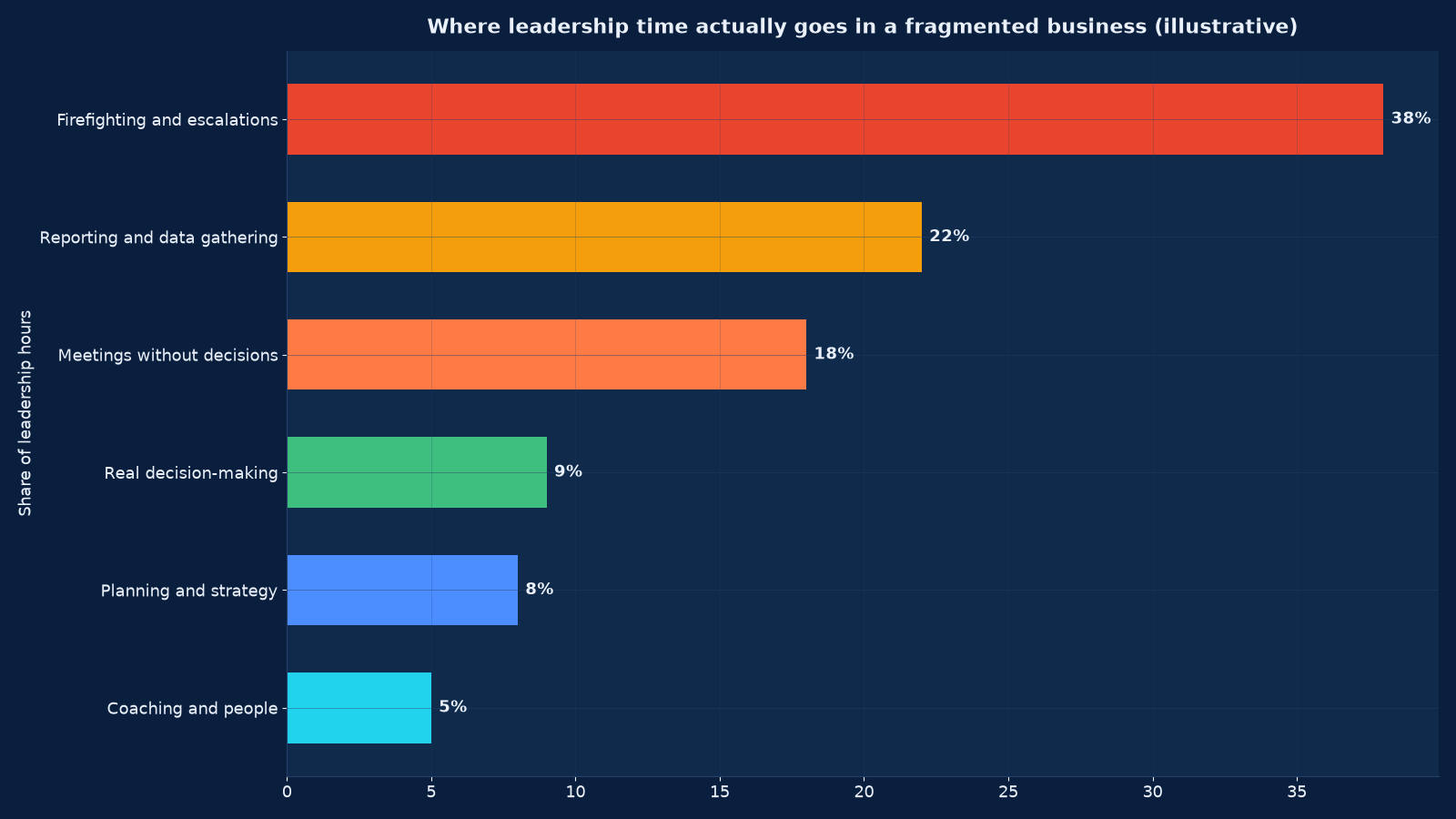
Chart values are an illustrative planning model based on typical UMC engagements and published industry benchmarks. They are not a guarantee of results on any specific project.
The Operating Cadence
Cadence is what converts structure into behaviour. Four meetings, fixed agendas, circulated pre-reads and a decision log are enough to run most businesses up to several hundred people.
| Cycle | Frequency | Attends | Standing agenda | Output |
|---|---|---|---|---|
| Operational review | Weekly, 60 minutes | Function owners | Cash position, delivery and service performance, escalations, decisions needed this week | Decision log updated; actions with owners and dates |
| Performance review | Monthly, half a day | Leadership team | P&L against plan by function, primary measures, pipeline, people, risk findings | Reforecast, corrective actions, resource decisions |
| Strategy review | Quarterly, one to two days | Leadership plus board or owner | Market position, plan progress, portfolio and investment choices, capability gaps | Updated plan, investment decisions, reserved-decision record |
| Cash review | Weekly during stress, monthly otherwise | Finance owner plus CEO | 13-week forecast, receivables and payables movement, covenant position | Cash actions and financing decisions |
The pre-read is not optional and it is where most implementations fail. If the numbers are presented in the room, the meeting becomes a reading session and the decisions slip to the next one. Circulate 48 hours ahead, require questions in advance, and spend the meeting on the three items that need a decision.
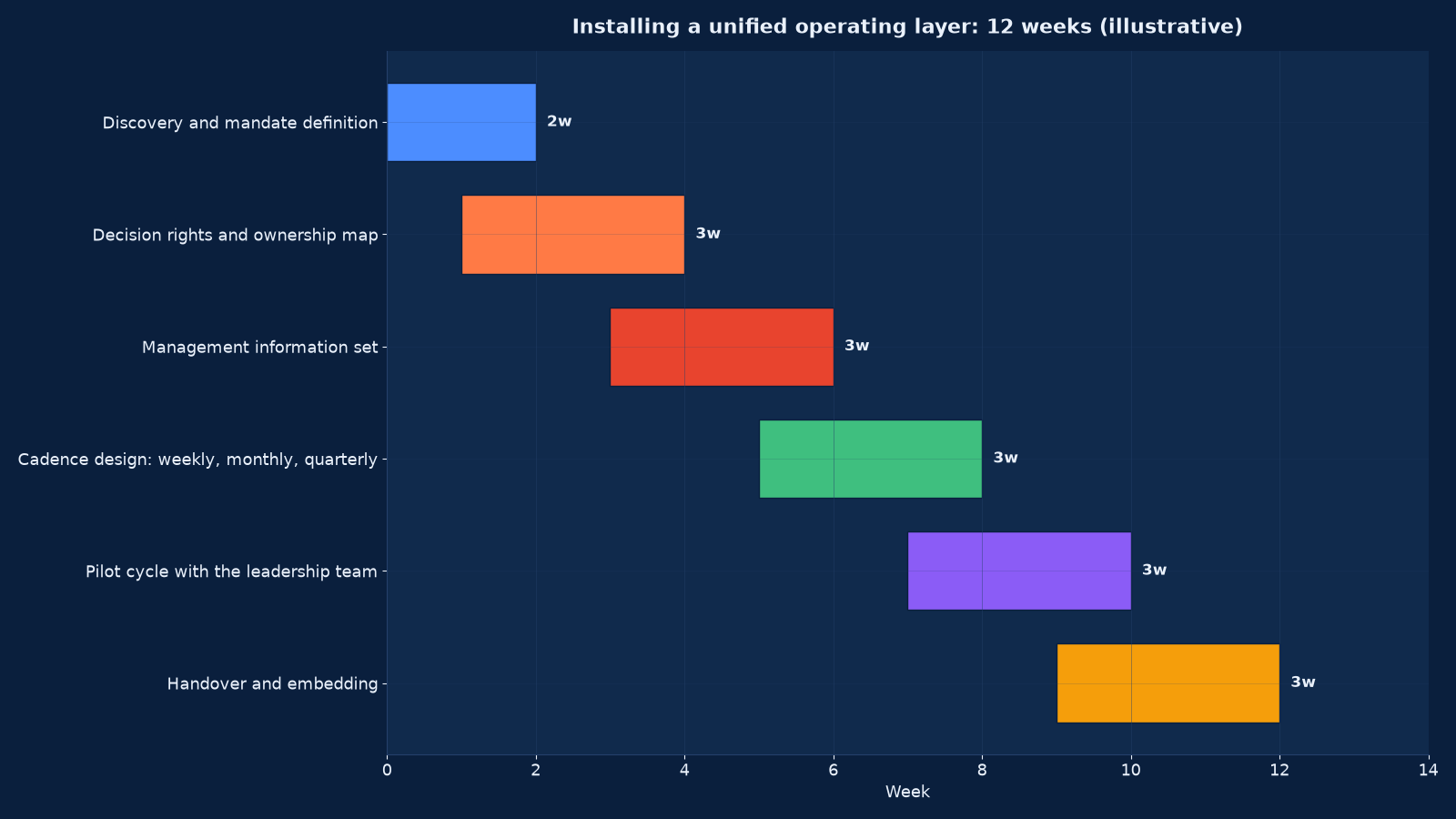
Chart values are an illustrative planning model based on typical UMC engagements and published industry benchmarks. They are not a guarantee of results on any specific project.
Installing It: Twelve Weeks
| Phase | Weeks | What happens | Output |
|---|---|---|---|
| Discovery and mandate | 1–2 | Interviews with the owner and each function lead, review of existing reporting, financials and recent decisions, mapping of where decisions actually go today | A written mandate and a diagnosis of the current decision flow |
| Decision rights and ownership | 2–4 | Decision register drafted with thresholds, ownership map agreed, reserved decisions listed | Approved decision register and ownership map |
| Management information | 4–6 | Primary measure per function defined, sources identified, the pack designed, duplicate reports retired | One pack, one calendar, one definition per measure |
| Cadence design | 6–8 | Meeting structure, agendas, pre-read templates, decision log and escalation path agreed | Cadence documented with named chairs |
| Pilot cycle | 8–10 | One full monthly cycle run with the leadership team, facilitated then observed | First cycle completed; friction points recorded and fixed |
| Handover and embedding | 10–12 | Chairs take over, documentation transferred, owners trained, review date set | Operating layer owned internally with a 90-day review booked |
Working With an Existing Leadership Team
This is not a replacement service and it does not work if it is presented as one. Three principles keep it constructive.
Diagnose the structure, not the people. When a decision takes three weeks, the cause is nearly always a missing threshold, a missing measure or a missing forum — not a reluctant manager. Framing it that way is what makes the register acceptable rather than threatening.
Owners keep their authority. The register gives owners more authority than they usually have, because it stops every decision travelling upwards. That is the trade that makes accountability acceptable.
Change one thing at a time. Decision rights first, then information, then cadence. Attempting all three at once produces a fortnight of enthusiasm and a return to the old habits. Where the business is under cash pressure, sequence cash control first — that is what the turnaround diagnostic does.
Governance, Escalation and the Exception Path
An operating layer needs a route for the cases it did not anticipate, or the exceptions will recreate the old informal system.
- Cross-function issues go to the weekly operational review with both owners present, and are decided there or given a date.
- Threshold breaches — cash below the floor, margin below the floor, a critical supplier failing — escalate immediately to the CEO and the board chair, not at the next meeting.
- Reserved decisions (structure, major investment, financing, senior appointments) are listed explicitly so nobody has to guess.
- A time limit on every escalation. An escalated item that has not been decided within its limit is a governance failure and is reported as one.
- A decision log. Every material decision recorded with date, decision, owner, rationale and review point. This is also what makes handover possible and what an acquirer or lender will ask to see.
The log has an unexpected second benefit: it is the evidence base for Risk, Governance & Business Continuity Support and for the control testing described in our IT audit and compliance service, both of which need to see that decisions were made deliberately by someone with the right to make them.
Measuring the Operating Layer
Figure 1 uses a subset of these. The full set is baselined in week two and reported at each monthly review, because an operating layer that is not measured decays silently.
| Measure | Definition | Target direction |
|---|---|---|
| Escalations to the founder or CEO | Count per month of decisions that could not be made at function level | Falling to a small reserved set |
| Decision latency | Days from a decision being needed to it being made, by decision type | Inside the published target for 90% of decisions |
| Unowned functions or processes | Count of critical activities with no named owner | Zero |
| Month-end close | Working days to a reviewed management pack | Six days or fewer |
| Meeting load | Leadership hours per week in scheduled management meetings | Falling, with the same or better decisions |
| Actions closed on time | Share of logged actions completed by their date | Above 85% |
| Report count | Number of recurring management reports in circulation | Falling as duplicates are retired |
| Forecast accuracy | Variance of the rolling forecast to actual | Tightening quarter on quarter |
| Attrition in owned roles | Turnover among function owners and their direct reports | Stable or falling — clarity retains people |
The measure most leaders resist is decision latency, and it is the one that reveals the most. Once you can see that a supplier change takes twenty-six days, the conversation stops being about people and starts being about thresholds and information — which is where it should have been all along.
Running This in an Indian Mid-Market Business
The structure is universal; the constraints are local. These six features appear in almost every engagement we run in this market, and each has a specific handling.
| Feature of the Indian mid-market | What it does to the operating layer | How we handle it |
|---|---|---|
| Promoter or family ownership | Reserved decisions are often unwritten, and family members hold influence without holding roles | Reserved decisions are listed explicitly and agreed with the family, so routine operational decisions stop travelling to them |
| Related-party transactions | Pricing, rent and loans between group entities distort the true margin of each business | Contribution is calculated at arm’s-length equivalents, with related-party effects shown separately rather than hidden |
| Statutory compliance calendar | MCA and ROC filings, GST returns, TDS and TCS, PF and ESI, and professional tax all carry fixed dates and personal consequences for directors | A single compliance calendar owned by finance, reviewed in the monthly cycle, with arrears treated as a critical escalation |
| Informal delegation | Authority is granted verbally and withdrawn verbally, so nobody is sure what they may commit | The decision register replaces it, and the first month is spent confirming existing practice before changing it |
| Multiple entities or sites | Each entity keeps its own rhythm and its own version of the numbers | One cadence and one information set at group level, with entity-level packs underneath |
| Succession in progress | The next generation is given responsibility without authority, which produces parallel decision paths | Authority is transferred in the register at the same moment as responsibility, with a stated review date |
The compliance calendar deserves emphasis. Statutory dues and filings are not an administrative detail in a business under pressure — arrears carry interest, penalties and, in some cases, personal exposure for directors, and they are frequently the first thing a lender examines. Bringing them into the monthly review as a standing item with a named owner is a small change that removes a disproportionate risk. Our IT Audit, Compliance & ISO 27001 / SOC 2 Readiness service covers the systems and information-security side of the same discipline.
The First Ninety Days: Where Implementations Fail
- The pre-read slips. Numbers presented in the room turn the review into a reading session and the decisions move to the next meeting. This is the first thing to protect and the first thing to decay.
- Owners defer anyway. A manager with a published threshold still escalates, because escalating has always been safer than deciding. It takes two or three explicit reversals — sending the decision back with the register cited — before the behaviour changes.
- The measure definitions get renegotiated monthly. Once a definition is agreed, changing it should require a recorded decision, not a conversation.
- Parallel reporting survives. Functions keep producing their own version “officially for internal use”, and within a quarter that version is the one being argued from. Retiring duplicate reports has to be explicit and verified.
- The cadence is chaired by the consultant for too long. Handover has to happen while we are still in the room, not after.
- No consequences are attached. Actions logged and not closed, three months running, with nothing happening. The escalation rule matters more than the template.
Underneath all of this sits a tooling question that is often asked too early. The operating layer does not require new systems; it requires definitions and a calendar. That said, once the measures exist, three things usually become worth doing: consolidating the systems that produce them (Enterprise Systems Integration & Tech-Stack Consolidation), building the reporting layer properly (Data Science Services for Business Analytics), and instrumenting the commercial side so that pipeline and attribution are measurable (Analytics & Attribution (GA4)). Where the operating layer is expected to deliver a financial return rather than just control, the measurement approach in our AI ROI Measurement & Executive Scorecards service transfers directly — baseline, owner, cadence, evidence.
Engagement Models
| Model | Duration | Deliverables | Best when |
|---|---|---|---|
| Operating model design | 4–6 weeks | Mandate, decision register, ownership map, information set design, cadence design | You want the structure designed and will implement it yourself |
| Full installation | 12 weeks | Design plus implementation, one facilitated monthly cycle, documentation, owner training and handover | The layer does not exist and needs building with the team |
| Unified management (operated) | 6–24 months | We hold the operating layer: chair the cadence, produce the pack, run the decision log, report to the owner or board | Leadership capacity is absent, in transition, or the owner does not want the role |
| Post-acquisition integration | 3–6 months | Reconciled chart of accounts, single measure definitions, combined cadence, decision rights across both organisations | Two operating systems have to become one |
| Operating layer review | 2–3 weeks | Assessment of an existing structure against the measures above, with a prioritised fix list | You have a structure and suspect it has decayed |
What Good Looks Like Six Months After Handover
The layer has taken hold when the leadership team stops needing us. Concretely:
- Decisions are made at function level against published thresholds, and the founder’s inbox contains exceptions rather than routine questions.
- One pack arrives on the same day each month, with one definition per measure, and the arguments about whose numbers are right have stopped.
- Every critical process has a named owner who can tell you their primary measure without looking it up.
- The weekly review finishes in an hour with a decision log that people actually read.
- Escalations are rare, time-limited and recorded.
- A new joiner can find out who decides what in ten minutes from a document rather than six weeks from gossip.
- Cash is forecast forward and reviewed weekly, so surprises arrive as forecasts rather than as crises.
Where the business is preparing for investment, sale or a financing round, this documentation is also what a lender or acquirer examines first. Our bank credit facility project summary shows how much of that work is operating discipline rather than financial engineering, and the CEO survey insights on confidence, cost pressure and resilience explains why so many leadership teams defer it until the pressure arrives.
Frequently Asked Questions About Unified Top-Level Business Management
Is this just another name for a COO?
It overlaps, but they are not the same. A COO is a person; this is a structure that works whether or not you have one. Many of our engagements install the operating layer under an existing CEO and function leads without adding a role. Where a business does need the person, our interim and fractional leadership service supplies one — but installing the structure first is what makes that appointment succeed rather than flounder.
How is this different from business strategy consulting?
Strategy decides where the business is going; the operating layer decides how it runs while getting there. A strategy without the layer becomes a document, because nobody owns the decisions that would deliver it. In practice we often run them together: the strategy sets the plan, and this service installs the cadence and decision rights that make the plan executable.
We already have meetings and reports. What would actually change?
Three things usually. The number of reports falls sharply because duplicates are retired and one definition per measure replaces competing versions. Meetings get shorter because pre-reads arrive in advance and the agenda is decisions rather than updates. And decision latency becomes visible and managed, which is the change leaders notice most — things that took weeks start taking days.
Will my managers lose autonomy?
The opposite. The decision register gives function owners explicit authority up to published thresholds, which most of them currently lack in practice — today they defer because deferring is safer. Accountability increases alongside authority, and that trade is what makes the structure acceptable to a competent team.
How long until we see an effect?
The decision register and ownership map produce visible change within the first month, because they answer questions people ask daily. The information set takes six to eight weeks to stabilise as definitions are agreed. The full effect — measured in escalations, close times and decision latency — is visible at the end of the twelve-week installation and consolidates over the following quarter.
What does it cost?
Design-only engagements are the smallest; a full twelve-week installation is a mid-sized project; operated arrangements run monthly and are priced against the scope of the cadence and the pack. The honest comparison is against what the current structure costs: founder hours spent on routine decisions, duplicate reporting, late closes and decisions made slowly. That comparison is part of the discovery phase.
Can this work in a family business?
Yes, and it is often most valuable there, because the informal structure is usually built on family relationships rather than roles. The register separates the two: it makes explicit who decides what as an owner of a function, which removes the personal friction from ordinary operational decisions. Reserved decisions stay with the family or board, in writing.
What if our data is not good enough for one measure per function?
Then defining the measure is what exposes the problem, which is useful rather than blocking. We start with the measure that can be produced reliably today, set a date for the better version, and use the interim definition consistently rather than switching between three imperfect ones. Where the gap is structural, our data science service builds the pipeline behind the measure.
Do you replace our finance function?
No. Finance usually owns the information set and the close calendar, and this service gives them the authority to enforce one definition per measure — which is what finance teams have wanted and rarely had. Where finance capacity itself is missing, that is an interim or fractional appointment, not an operating-layer project.
How do you hand over without it decaying?
By running one full cycle alongside your team and then observing a second, with named chairs from your side taking over progressively. Everything is documented — registers, agendas, templates, definitions — and a 90-day review is booked at handover. Decay almost always starts with the pre-read slipping, so that is the first thing we monitor.
What should we do first?
A two-week discovery that maps where decisions actually go today and produces the mandate. It is small, it needs no commitment to the full installation, and it usually surprises the owner: the gap between how the business believes it decides and how it actually decides is the whole case for the work.
Arrange a Confidential Discovery Conversation
Most engagements begin with a two-hour conversation and a two-week discovery. We map how decisions actually move through your business today, identify where the structure is missing rather than where people are failing, and tell you plainly whether an operating layer is the right intervention or whether something narrower — a diagnostic, a cash programme, an interim appointment — will serve you better.
Contact Unified Management Consulting to arrange a confidential first conversation.
Related Services
Unified top-level management is delivered alongside our other business consulting services:
- Business Strategy Consulting — the direction the operating layer exists to execute
- Risk, Governance & Business Continuity Support — the governance and control discipline this layer makes possible
- Market Research & Competitive Analysis — the external evidence behind the quarterly strategy review
- Data Science Services for Business Analytics — building the measures and the data behind them
- Market Expansion Consulting — growth that the operating layer has to absorb
- Mr Avinash Sharma — the operating experience behind this engagement
- Selected projects — where this work has been delivered
- 30-Day Turnaround Diagnostic — thirty days to an evidenced position across cash, cost, margin, contracts and governance
- Cash Flow & Working Capital Recovery — a thirteen-week forecast, receivables and payables discipline, inventory release and covenant cover
- Distressed Business Restructuring — the options ladder from consensual standstill to formal insolvency, with lender and stakeholder plans
- Interim & Fractional Leadership — a written mandate with published decision rights for CEO, COO, CFO and transformation roles
- Cost Rationalisation & Margin Recovery — cost-base decomposition, contribution by customer and product, cost to serve and pricing discipline
- BI Dashboards & Executive Reporting — metric definitions, a governed semantic layer, three reporting tiers and the retirement of superseded spreadsheets