
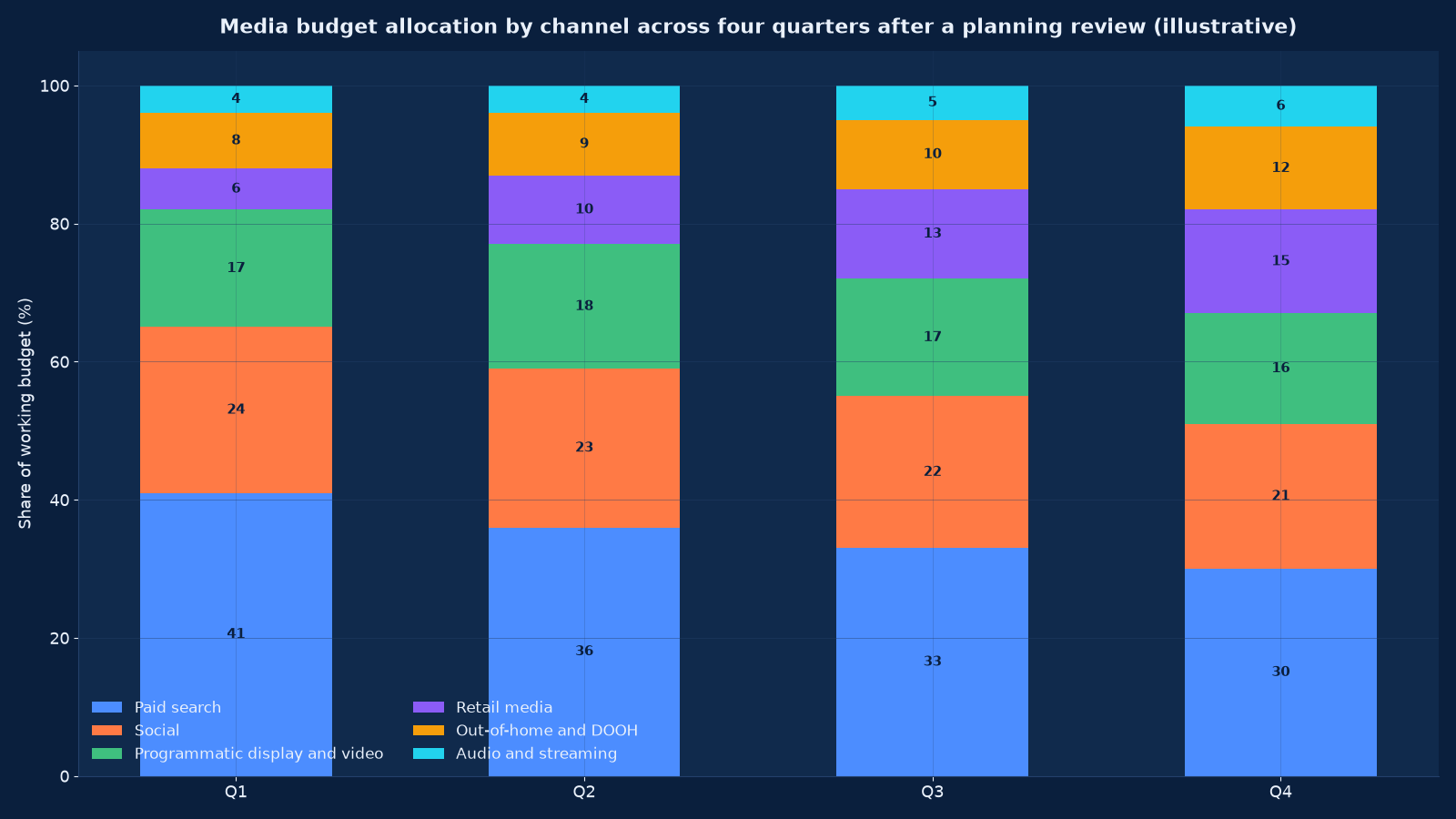
Chart values are an illustrative planning model based on typical UMC engagements and published industry benchmarks. They are not a guarantee of results on any specific project.
Media buying is not the purchase of impressions. It is the purchase of an audience, at a price, under a contract, with a measurement attached — and most of the money is lost in the parts of that sentence people skip.
Media planning and buying is the cross-channel discipline that turns a marketing budget into an audience reached at a known cost with a measured result. Unified Management Consulting plans and buys across paid search, social, programmatic display and video, streaming and connected TV, retail media, out-of-home, print, radio and cinema — and, unusually, we do it on a disclosed-fee basis with an audit right, because the largest single source of waste in Indian media is not bad creative or bad targeting. It is undisclosed margin between the advertiser and the inventory.
📡 Media Planning & Buying — Quick Summary
| Component | What We Deliver |
|---|---|
| Objective and audience definition | One stated commercial objective, one audience model with reach and frequency targets, and an agreed definition of what counts as success before any money moves. |
| Channel role assignment | Each channel given a job — harvest, persuade, remind, cover — and a measure suited to that job, rather than every channel judged on last-click conversions. |
| Budget construction | Bottom-up from audience and cost-per-reach, reconciled against the commercial target, with a working-media floor stated as a percentage of total spend. |
| Cross-channel plan and flighting | A week-by-week plan across channels and markets, with dayparting, pulsing and a pacing rule that survives contact with reality. |
| Buying route selection | Direct, private marketplace, open exchange, retail network or agency desk chosen per channel on evidence of delivered cost, not on relationship. |
| Disclosure and contract controls | Fee-based remuneration, no undisclosed principal margin, rebate disclosure, right to audit, data and account ownership retained by the advertiser. |
| Ad verification | Independent viewability, invalid traffic, brand safety and fraud measurement on every digital line, reported separately from platform-self-reported numbers. |
| In-flight management | Weekly pacing against plan, creative fatigue monitoring, reallocation rules with thresholds, and a documented decision log. |
| Post-flight measurement | Platform metrics reconciled to independent measurement and to the ledger, with incrementality reads where the budget is large enough to test. |
This service is the umbrella over the channel specialists the business already offers: Programmatic Advertising Services, Google Ads Management, Facebook & Meta Advertising, YouTube & Video Advertising, Influencer Marketing Management and OTT & Connected TV Advertising. What it adds is the decision layer above them: which channel gets the next rupee, on what evidence, and how the answer is verified. The measurement machinery is described in Marketing Mix Modelling & Attribution and Analytics & Attribution (GA4).
What Media Planning and Buying Actually Covers
Nine workstreams, each producing one decision. The discipline is that the decisions are taken in order and each is recorded — an advertiser who cannot say why money moved between channels in week six cannot learn anything from week seven.
| Workstream | Decision it produces | Measure of quality | Common failure |
|---|---|---|---|
| Commercial objective setting | What the spend must achieve, in revenue, volume or share terms, over what horizon | A single objective expressed as a number with a date | Three objectives of unequal weight, so no channel can be judged |
| Audience modelling | Who must be reached, how often, and in which markets | Reach and frequency targets derived from category purchase behaviour | Audiences defined by platform segments available for purchase rather than by who buys |
| Channel role assignment | What job each channel does in the journey | Each channel has one primary role and one primary measure | Every channel judged on last-click conversion, so upper-funnel budget is cut first |
| Budget construction | How much, per channel, per market, per week | Bottom-up cost-per-reach reconciled to the commercial target | Last year plus or minus a percentage, with no cost evidence behind it |
| Buying route and contract | Who buys what, on what terms, at what disclosed margin | A fee-based contract with an audit right and advertiser-owned accounts | Principal-acting arrangements where the buyer is also the seller |
| Plan and flighting | The week-by-week allocation, with dayparts and pulses | A plan that states its pacing rule and its reallocation thresholds in advance | An annual plan with no in-flight governance, so spend drifts to whoever asks loudest |
| Verification | Whether what was bought was actually delivered | Independent viewability, invalid traffic and brand-safety reporting | Platform self-reported impressions accepted as fact |
| In-flight management | What changes this week and why | A decision log with thresholds, so reallocation is rule-governed | Daily fiddling with no record, which destroys the ability to learn anything |
| Post-flight reconciliation | What it cost, what it delivered, what to do next quarter | Spend reconciled to the ledger and to independent measurement, with a written recommendation | A results deck quoting platform metrics that sum to more than total revenue |
Where the nine are done properly, the plan is short and the governance is strong. Where they are not, the plan is long, colourful and unenforceable, which is the more common outcome and the reason a media audit usually finds the problem in the contract rather than in the campaign.
Channel Roles and the Mix Decision
Every channel does one job well and several badly. The mix decision is not a preference; it follows from the objective, the audience’s media behaviour and the measured cost of each channel’s job.
| Channel | Primary role | Right measure | Wrong measure | Typical share of a balanced mix |
|---|---|---|---|---|
| Paid search | Harvest existing demand; defend brand terms | Incremental revenue per rupee, and share of brand-term auctions won | Total ROAS, which credits spend for demand that would have converted organically | |
| Paid social | Persuade and prospect; build the audience pool search later harvests | Cost per incremental qualified action, frequency, and holdout-tested lift | Cost per click, which rewards curiosity rather than intent | |
| Programmatic display and video | Reach at scale with frequency control; retarget warm audiences | Viewable CPM, verified reach, and brand-lift where budget allows | Delivered impressions, of which a material share may be invalid or unviewed | |
| Streaming and connected TV | Persuade at scale with TV-like impact and digital targeting | Verified completed views, incremental reach over linear, cost per completed view | Gross impressions bought, which ignore completion and co-viewing | |
| Linear TV, radio, print, cinema | Mass reach and credibility in specific markets and demographics | Rated reach against the target audience, and cost per rating point | Digital-equivalent CPM comparisons that ignore attention and context | |
| Retail media networks | Harvest at the point of purchase, on marketplace and quick-commerce inventory | Incremental units and total advertising cost of sales across the catalogue | Advertising cost of sales on advertised SKUs alone, which hides cannibalisation | |
| Out-of-home and digital OOH | Local presence, frequency in a defined geography, always-on brand reminder | Verified audience in the catchment and footfall or search correlation | Site count or impression estimates supplied by the site owner | |
| Influencer and creator | Credibility transfer and content supply to specific communities | Cost per engaged view with sentiment, and sales or search correlation in the exposure window | Follower count or reach claimed by the creator | |
| Email, SMS and messaging | Retain and reactivate an owned audience at near-zero marginal media cost | Incremental revenue per recipient and list health over time | Open rate, which measures a client and a subject line rather than a commercial outcome |
The measure discipline matters more than the mix. Judging paid search on total return overstates it, because it captures demand that would have converted anyway; judging paid social on cost per click understates it, because prospecting value is realised later and elsewhere. Assign each channel the measure suited to its role and the mix argument largely resolves itself. Our comparison of owned and paid channels and our Google Ads versus Meta ROI comparison both turn on exactly this point.
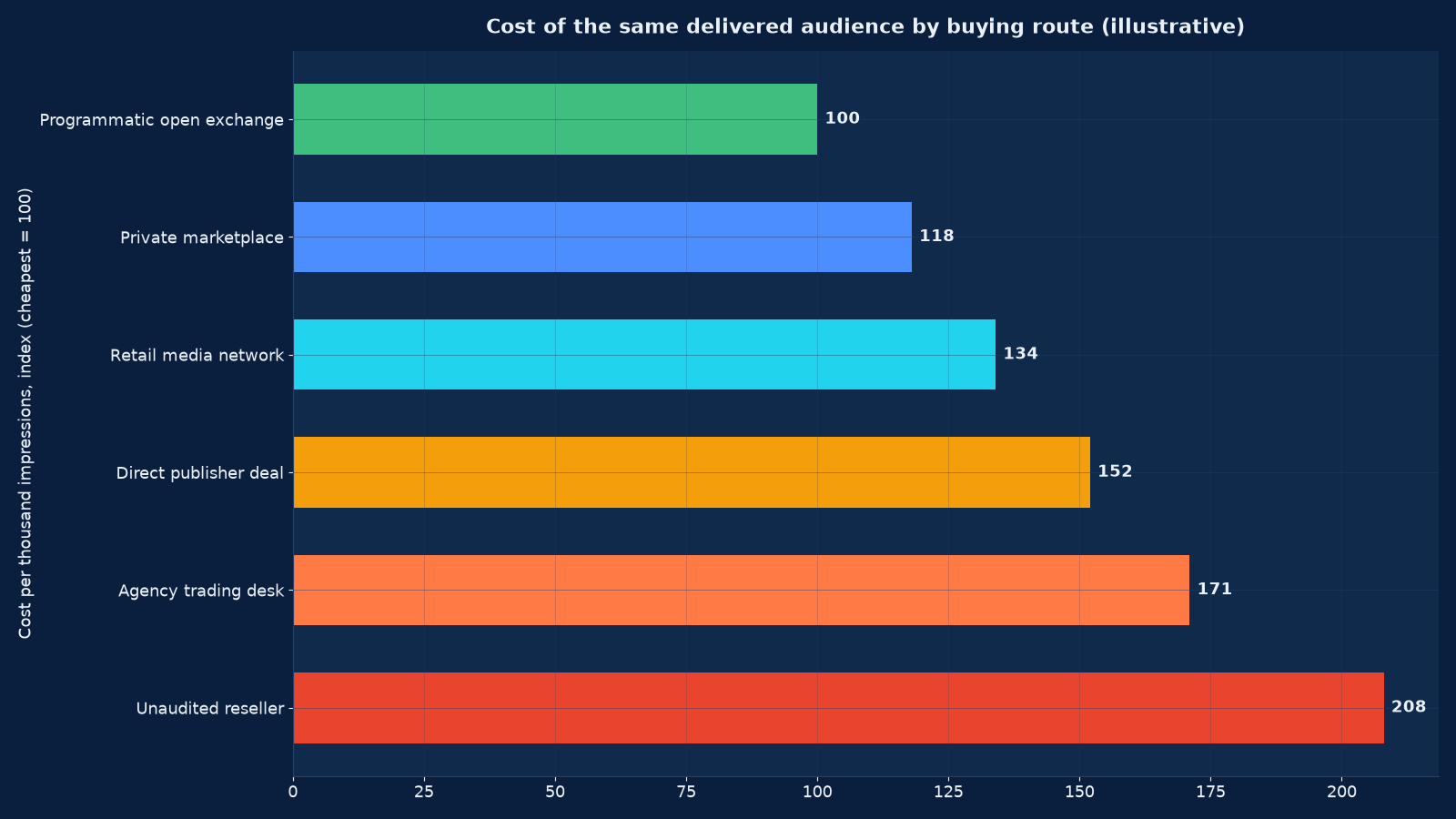
Chart values are an illustrative planning model based on typical UMC engagements and published industry benchmarks. They are not a guarantee of results on any specific project.
Buying Routes: What Each Costs and What Each Conceals
Six routes, spanning a more-than-two-fold cost difference for the same delivered audience. The choice is driven by the trade-off between price, control, verification and risk.
| Buying route | How it works | Cost and control | When to use it |
|---|---|---|---|
| Direct with the publisher or owner | A negotiated contract for a defined period, position or audience | Highest list price, but full transparency, guaranteed delivery and direct accountability | Premium positions, sponsorship, tent-pole moments, and any buy where context and exclusivity matter |
| Agency trading desk | The agency buys across publishers using its volume | Better rates than direct, but fees and any volume incentives are often undisclosed | Large multi-market buys where consolidated trading genuinely earns its fee — provided the fee is contractual and auditable |
| Private marketplace / preferred deal | Invitation-only programmatic access to a publisher’s inventory at a negotiated floor | Better quality and brand safety than open exchange, at a modest premium | The default for most display and video buying where quality matters and scale is needed |
| Programmatic open exchange | Open auction across many supply sources | Lowest unit cost, highest fraud and brand-safety risk, longest and least transparent supply chain | Performance and retargeting at scale, with verification, supply-path limits and blocklists enforced |
| Retail media network | Self-serve or managed buying on a marketplace’s own inventory | Highly measurable at the point of sale, but measured by the seller of the inventory | Where you sell through that marketplace and can reconcile its reporting to your own sales data |
| Principal-acting (undisclosed) | The intermediary buys inventory and resells it to the advertiser at a marked-up price | Cheapest to negotiate, most expensive in reality: the margin is invisible and the incentive is to sell inventory that carries it | Never, unless the margin is disclosed in writing and the advertiser has accepted it as a fee |
The last row is the one to watch. Principal-acting is legitimate when disclosed and priced as a fee; it is corrosive when the advertiser believes it is paying a transparent commission while the intermediary earns on the spread. The incentive then points towards inventory that carries the largest margin rather than the inventory that performs, and nothing in the reporting reveals it, because the reporting comes from the same party.
Disclosure, Rebates and the Controls That Make Spend Auditable
Seven practices, all of them legal in some form and all of them expensive when undisclosed. None is detectable from campaign reporting; each is detectable from contracts and reconciliation.
| Practice | What it is | How it is detected | Contract control |
|---|---|---|---|
| Undisclosed principal margin | The buyer purchases inventory and resells it to the advertiser at a spread | Reconciling invoiced media cost to publisher or platform statements; unexplained gaps between working media and total spend | A contractual prohibition on principal-acting, or full written disclosure of any margin with an audit right |
| Volume bonuses and rebates | Payments from publishers or platforms to the buyer based on spend thresholds | Asking directly and requiring disclosure of all incentives received in relation to the account | A clause requiring all rebates, discounts and benefits to be credited to the advertiser or disclosed |
| Free media and added value | Bonus spots or placements given to the buyer rather than the advertiser | Comparing delivered volume to contracted volume; inventory appearing with no corresponding invoice line | A clause stating that all added value accrues to the advertiser and is reported |
| Barter and inventory swap | Media traded for goods, services or cross-promotion | Inventory in the plan with no cash cost and no commercial rationale | Requiring barter to be declared, valued and approved before it enters the plan |
| Owned inventory placement | The buyer places client budget in media it owns or partly owns | Disclosure of the buyer’s media ownership and reconciliation of placements against it | A prohibition, or a disclosure and approval requirement with an independent performance test |
| Opaque technology fees | Ad server, verification, data and platform charges bundled into an unexplained total | Line-item invoicing with named vendors and pass-through rates | Requiring technology costs to be invoiced at cost, separately, with vendor named |
| Data and account capture | Accounts, pixels, audiences and historical data held in the buyer’s name | Checking account ownership, admin access and data export rights today, before any dispute | Advertiser-owned accounts from day one, with admin access and a data-portability clause |
The single most valuable clause is the audit right. An advertiser with a contractual right to audit invoices against publisher statements, and to be repaid anything undisclosed, changes the buyer’s behaviour whether or not the audit is ever exercised. Advertisers without it are relying on goodwill, and goodwill does not survive a change of personnel at the agency. This is the same governance logic as IT Audit, Compliance & ISO 27001 / SOC 2 Readiness applied to a commercial relationship, and the same reconciliation discipline that Marketing Mix Modelling & Attribution requires before a model can be built at all.
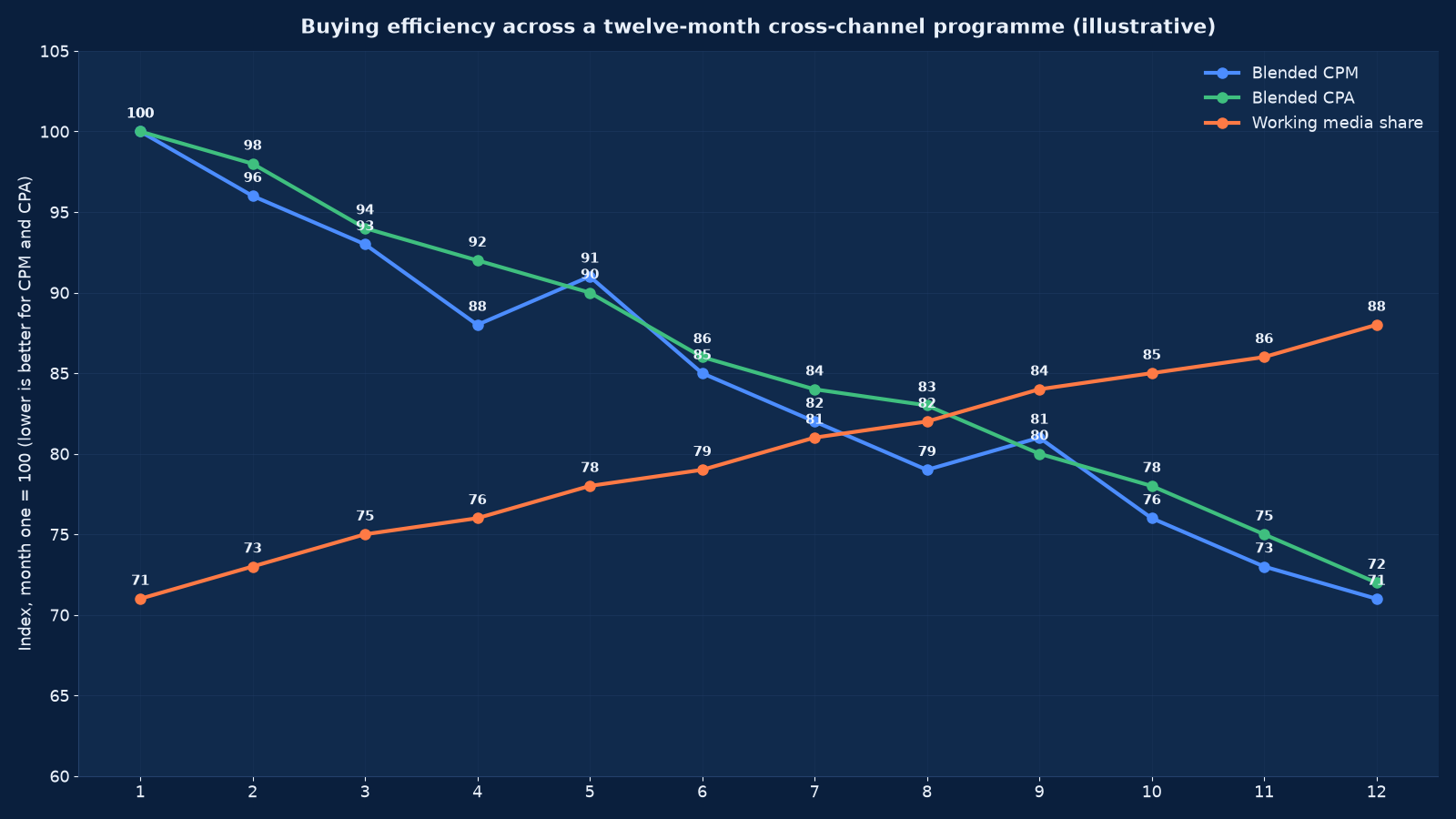
Chart values are an illustrative planning model based on typical UMC engagements and published industry benchmarks. They are not a guarantee of results on any specific project.
Budget Construction: Six Methods and the One That Holds
Method choice determines whether the budget is an argument or an arithmetic. Most Indian mid-market advertisers use percentage of sales because it is easy to approve, then wonder why spend cannot be defended when revenue falls.
| Budget method | How it works | Strength | Weakness |
|---|---|---|---|
| Objective-and-task (bottom-up) | Define the audience and frequency target, price the reach required per channel, sum to a budget | Directly tied to a commercial objective; defensible line by line | Needs cost-per-reach data by channel and market, which most advertisers do not hold |
| Percentage of sales | A fixed share of historic or forecast revenue | Simple, stable, and easy to get approved | Pro-cyclical: spend falls exactly when the business needs it, and it says nothing about efficiency |
| Competitive parity | Match or index to competitor share of voice | Prevents being out-shouted in a category where presence matters | Assumes competitors are right, and share of voice is hard to measure accurately across channels |
| Affordability | Whatever is left after other costs | Cannot cause a cash problem | Not a strategy; produces erratic, reactive investment and no cumulative brand effect |
| Modelled allocation | Response curves and contribution estimated from history, then optimised subject to a budget | The only method that can say what the next rupee should buy and where it stops paying | Requires clean spend and revenue history, and honest uncertainty ranges |
| Hybrid, with a working-media floor | Bottom-up to establish the requirement, a stated floor on working media as a share of total spend, and modelled reallocation in flight | Combines defensibility with a hard control on non-working cost | Requires the floor to be contractual, or it becomes advisory and erodes |
Working media is the number to govern. Total spend less fees, production, technology, verification and agency margin equals what actually bought media. In an undisciplined programme that figure can be well under three quarters of the budget; a contractual floor of 85 per cent or more, reported monthly, is the simplest and most effective single control in media management. It also makes the trade-off visible: every rupee of production is a rupee of reach, and the plan should say which it bought. Cost Rationalisation & Margin Recovery applies the same logic to the wider cost base, and our guide to digital marketing costs shows how to benchmark unit costs rather than percentages.
Flighting, Pacing and In-Flight Governance
The plan is where media management is won or lost. An annual allocation with no in-flight governance produces spend that drifts to whoever asks loudest; a plan with thresholds and a decision log produces learning.
| Element | What it decides | Rules that make it work |
|---|---|---|
| Flighting pattern | Continuous, pulsing, burst or seasonal concentration | Chosen from purchase cycle and category seasonality, not from the financial calendar; a continuous presence for short-cycle purchases, pulses for considered ones |
| Daypart and day-of-week weighting | When impressions are bought within the flight | Weighted to observed response, with an explicit test period before the weighting is trusted |
| Geographic weighting | How budget is split across markets | By potential and measured response per market, not evenly; small markets can carry disproportionate returns |
| Frequency caps | Maximum exposures per user per period | Set from the effective frequency range for the category; uncapped retargeting is the commonest self-inflicted waste in digital media |
| Pacing rule | How spend is released against the plan | Even, front-loaded or accelerated, stated in advance with a tolerance, so an underspend in week two is a decision rather than an accident |
| Reallocation thresholds | When budget may move between channels in flight | Pre-agreed numeric triggers with a cooling-off period, so reallocation is rule-governed and recorded rather than reactive |
| Creative refresh trigger | When an asset is retired | A frequency or click-through decay threshold, because fatigue is measurable and predictable |
| Holding and contingency | What is deliberately left unallocated | A stated percentage reserved for opportunistic or reactive buying, with a rule for who may release it |
| Decision log | What changed, when, and on what evidence | A single record; without it the post-flight review reconstructs rather than measures, and the organisation learns nothing |
Reallocation thresholds are the mechanism. Agree in advance that if a channel’s measured cost per incremental action exceeds its target by a stated margin for two consecutive weeks, budget moves to the named alternative, by a named amount, recorded in the log. That single rule removes most in-flight argument, and it makes the post-flight review possible. Our guide to campaign optimisation strategies that actually work covers the execution layer beneath it.
Measurement and Incrementality
Seven questions, each with a method that can answer it and a limit that must be stated. The commonest error is asking a method to answer a question it structurally cannot.
| Question | Method | What it can prove | What it cannot |
|---|---|---|---|
| Did this channel contribute revenue? | Geo-holdout or matched-market test: switch off or reduce in a comparable market and measure the difference | Causal contribution in the tested market, with a confidence range | Nothing about markets too small to test, or effects that take longer than the test window |
| What is the incremental return on paid search? | Brand-term pause tests and geo experiments separating branded from non-branded | How much of paid search return is incremental versus captured organic demand | The long-term effect of being absent from your own brand terms |
| How do channels combine? | Marketing mix modelling over spend, revenue and controls | Contribution by channel, saturation points, and the effect of interactions over time | Individual campaign or creative performance, which is below the model’s resolution |
| Was the impression delivered and seen? | Independent ad verification: viewability, invalid traffic, brand safety, fraud | What proportion of bought inventory was viewable, valid and safe | Whether the exposure changed anyone’s behaviour |
| Did the brand move? | Brand tracking with exposed and unexposed samples, or platform brand-lift studies | Shifts in awareness, consideration and association attributable to exposure | Revenue, and anything the platform’s own study design cannot see |
| Did the creative work? | Pre-testing before flight, plus in-flight decay monitoring by asset | Which assets hold attention and which fatigue, and how fast | Why they work, which needs qualitative research |
| What did it actually cost? | Reconciliation of platform reporting to invoices and to the general ledger | The true cost per delivered unit, including fees, technology and non-working spend | Anything about effectiveness — but it is the prerequisite for every other row |
Start with the last row. Until spend is reconciled to the ledger, every other measurement is built on the platform’s own accounting of money you have not yet confirmed you paid. That reconciliation is unglamorous and it is the foundation. The modelling layer above it — mix modelling, response curves, saturation — is described in full in Marketing Mix Modelling & Attribution, and our guide to attribution models explains why last-click reporting systematically misallocates budget. Where the objective is a forecast rather than an explanation, Predictive Analytics & Demand Forecasting supplies the volume side.
The Twenty-Six-Week Programme
A full planning, contracting and buying cycle. The first eight weeks are analysis, negotiation and control — the part most advertisers skip, and the part that determines whether the following eighteen weeks are governed.
| Phase | Weeks | Activities | Output |
|---|---|---|---|
| Objective, baseline and audit | 1–2 | Commercial objective agreed, current spend reconciled to the ledger, contracts and disclosure position reviewed, baseline efficiency measured | A baseline: what is spent, on what, at what disclosed cost, delivering what |
| Audience and channel strategy | 2–4 | Audience model with reach and frequency targets, channel roles assigned, measures defined per channel | An audience strategy and a channel role map with one primary measure each |
| Budget construction and costing | 4–5 | Bottom-up cost per reach by channel and market, working-media floor set, contingency defined, reconciled to the commercial target | A budget by channel, market and quarter with a stated working-media floor |
| Plan, flighting and buying route | 5–7 | Week-by-week plan, dayparting and geographic weighting, frequency caps, pacing and reallocation thresholds, route selection per channel | An executable plan with governance rules written into it |
| Contracts, disclosure and accounts | 6–8 | Fee-based terms, audit right, rebate and added-value clauses, advertiser-owned accounts and data portability, verification vendors appointed | Contracts that make the spend auditable, and accounts the advertiser controls |
| Launch and in-flight management | 8–24 | Weekly pacing against plan, verification reporting, creative fatigue monitoring, rule-governed reallocation, decision log maintained | A live programme managed against thresholds rather than opinion |
| Post-flight measurement and next plan | 22–26 | Incrementality reads, mix model refresh, spend reconciled, brand tracking reviewed, next-period plan drafted from evidence | A measured result, a written recommendation, and the next plan |
Smaller engagements run a subset: a media audit and disclosure review in weeks one to four; or a planning and budget cycle without the contracting work where terms are already acceptable. What should not be shortened is the baseline reconciliation, because a plan built on unreconciled spend inherits whatever the previous arrangement was concealing.
Contract Terms Worth Negotiating
Nine clauses. None is exotic; all are routinely omitted, and all are cheaper to negotiate at signature than to litigate afterwards.
| Contract term | What to insist on | Why |
|---|---|---|
| Remuneration model | A disclosed fee — fixed, retainer or a stated percentage — with no principal margin | Removes the incentive to buy inventory that pays the buyer rather than performs for you |
| Right to audit | Audit of invoices against publisher and platform statements, with repayment of anything undisclosed | The clause that makes every other disclosure clause real |
| Rebates and added value | All discounts, rebates, free media and benefits credited to the advertiser or disclosed in writing | Volume incentives are substantial in Indian media; without this clause they accrue to the buyer |
| Account and data ownership | Advertiser-owned ad accounts, pixels, audiences and historical data, with admin access and an export right | Otherwise a change of agency costs you the data your next plan depends on |
| Technology costs | Invoiced at cost, separately, with the vendor named | Prevents ad server, verification and data charges being absorbed into an opaque total |
| Verification and transparency | Independent viewability, invalid traffic and brand-safety reporting as a contractual deliverable | Platform self-reporting cannot be the sole evidence of delivery |
| Performance commitments | Defined deliverables, reporting cadence and consequences for sustained under-delivery | Converts a service relationship into a measurable one |
| Conflicts and ownership disclosure | Disclosure of any media ownership, principal relationships or competing accounts | Owned-inventory placement is invisible unless it is disclosed |
| Termination and transition | Notice period, handover obligations and continued access during transition | A clean exit is what makes the relationship a choice rather than a lock-in |
The fourth is the one advertisers most often discover too late. When accounts, pixels and audience data sit in an agency’s name, the cost of changing agency is not the transition — it is the loss of the historical data that the next plan would have been built on. Insisting on advertiser-owned accounts from day one costs nothing and is occasionally resisted, which is itself informative.
Running This in India
Conditions that change the plan rather than merely the price.
Measurement is channel-by-channel and non-uniform. Television has a currency panel; radio has its own measurement; print readership is surveyed periodically; out-of-home has no unified audience currency at all; and digital is largely self-reported by the platforms selling the inventory. A cross-channel plan therefore cannot compare channels on one metric, and any deck that does has made an assumption it has not disclosed. Planning must state the measurement basis per channel and the uncertainty attached to each.
Regional and linguistic fragmentation. A national buy is rarely efficient: language markets differ in media consumption, in creative requirement and in cost. Regional weighting, regional creative versions and regional measurement are planning requirements, and the cost of versioning is routinely underestimated — see our social media strategy guide for the creative side of the same problem.
Festive and event concentration. A disproportionate share of annual category demand falls in the festive quarter, and inventory prices rise with it. Planning against the festival calendar rather than the financial calendar, and committing early where a guaranteed position matters, is usually cheaper than bidding in-season. Cricket and tent-pole events carry a similar premium with a similar lead time.
Print and radio remain substantial. Unlike many markets, Indian print retains real reach and credibility in specific demographics and geographies, and radio holds metro commuter audiences. Digital-first plans that ignore both routinely overpay for reach they could have bought more cheaply elsewhere.
Tax and payment mechanics. Advertising spend carries goods-and-services tax and withholding obligations that differ by the nature of the payment — media purchase, agency fee, production or commission. Getting the classification wrong at contract stage creates a price disagreement after award and, occasionally, a disallowance. Finance should review the contract before signature, and the ledger reconciliation in week one is what proves it was done correctly.
Disclosure culture is improving but not settled. Principal-acting and undisclosed incentives remain common enough that an audit right is a genuine protection rather than a formality. Advertisers who ask for one sometimes meet resistance; that reaction is itself useful information. Our banking-sector full-service digital marketing contract and the B2B Google Ads programme for an engineering consultancy both ran on disclosed-fee terms with advertiser-owned accounts.
Engagement Models
| Model | Duration | Deliverables | Best when |
|---|---|---|---|
| Media audit and disclosure review | 3–4 weeks | Spend reconciled to the ledger, contract and disclosure position reviewed, buying routes and efficiency benchmarked, working-media share established, prioritised findings | You cannot currently say what your media actually cost or whether the terms are fair |
| Full planning and buying programme | 26 weeks | Objective and audience model, channel roles, bottom-up budget, executable plan with governance rules, contracts with audit rights, launch and in-flight management, post-flight measurement | The standard engagement for a business resetting how it buys media |
| Planning and budget only | 6–8 weeks | Audience model, channel strategy, budget by channel market and quarter, flighting plan and governance thresholds | You buy in-house or through a settled agency and need the plan layer |
| Contract and disclosure remediation | 4–6 weeks | Renegotiated terms with audit right, account and data ownership transferred, technology costs unbundled, disclosure clauses added | An audit found undisclosed margin, or accounts sit in a third party’s name |
| Measurement build | 8–12 weeks | Reconciliation process, verification stack, incrementality test design, mix model refresh and the reporting cadence that maintains them | Spend is agreed but effectiveness is unmeasured |
| Managed planning and buying | Monthly | Ownership of the plan, pacing, reallocation against thresholds, verification reporting, vendor management and quarterly strategy review | You want the discipline maintained without building an in-house function |
What Good Looks Like After Twenty-Six Weeks
The programme has worked when the media conversation changes from opinion to arithmetic.
- One commercial objective, expressed as a number with a date, governs the plan.
- Every channel has one primary role and one primary measure suited to it.
- The budget was built bottom-up from cost per reach and reconciled to the objective.
- Working media as a share of total spend is measured monthly against a contractual floor.
- Buying routes were selected on delivered cost and risk, and the choice is documented.
- Contracts carry a disclosed fee, an audit right, rebate disclosure and advertiser-owned accounts and data.
- Independent verification reports viewability, invalid traffic and brand safety separately from platform self-reporting.
- Reallocation in flight follows pre-agreed thresholds and is recorded in a decision log.
- Spend is reconciled to invoices and to the general ledger every period.
- At least one incrementality test has been run, and the next plan reflects what it found.
Two follow-ons usually apply. Where reconciliation reveals that reported conversions exceed what the ledger shows, the problem is measurement architecture rather than media, and Analytics & Attribution (GA4) is where it is fixed. Where the mix model shows a channel saturated and another under-invested but the business lacks the audience evidence to act, Market Research & Competitive Analysis supplies it. Our Google Ads ROI guide and our paid search best practices cover the channel-level execution underneath all of it.
Frequently Asked Questions About Media Planning & Buying
Do you take a commission on media spend?
No. We work on a disclosed fee — fixed or retainer — and we do not buy inventory as principal, take rebates, or earn margin on the spread between what you are invoiced and what the publisher receives. This is a commercial choice rather than an ethical flourish: a fee-based adviser has no incentive to recommend the inventory that pays best, which is the entire point of the arrangement. We will also review an incumbent agency’s terms on the same basis.
We already have an agency. What would you add?
The decision layer and the controls. Most agencies plan and buy competently; few are contractually required to disclose their margin, hand over audit rights, or transfer account and data ownership. We establish the objective and audience model, build the budget bottom-up, write the governance rules into the plan, negotiate the contract terms in section nine, and reconcile spend to your ledger each period. The agency still executes; you gain the ability to judge whether it executed well and at what real cost.
How do we know if our current agency is taking undisclosed margin?
Reconcile. Compare what you were invoiced for media against publisher and platform statements for the same period, and separately establish your working-media share: total spend less fees, production, technology and verification, divided by total spend. A share materially below 80 per cent in a mid-market programme needs explaining. Neither test is conclusive on its own, but together they usually locate the gap — and if the agency declines to provide publisher statements, that answer is also informative.
What budget does this need to be worth doing?
The audit and planning work is viable from roughly fifty lakh rupees of annual media spend, because the reconciliation and contract findings alone typically exceed the fee. Incrementality testing needs more: a geo-holdout requires a market large enough that the difference is measurable above noise, which in practice means a few lakh rupees per test market. Below that, we would rather build you a clean plan and a disclosed contract than run tests whose results you could not trust.
Which channels do you plan across?
All of them: paid search, paid social, programmatic display and video, streaming and connected TV, linear television, radio, print, cinema, out-of-home and digital out-of-home, retail media networks, influencer and creator, and owned channels including email, SMS and messaging. The point of a cross-channel plan is precisely that the comparison happens; a digital-only plan cannot tell you whether television or print would have bought the reach more cheaply in your market, and in India it frequently would.
How do you compare television to digital when the measurements differ?
By stating the basis rather than forcing a single metric. Television is compared on rated reach against the target audience and cost per rating point; digital on verified, viewable reach and cost per incremental action. We then compare them on the one dimension that is genuinely commensurable — cost per verified reach of the target audience in a defined market — and we publish the uncertainty on each. Any plan that puts television and digital in one column with one metric has made an assumption it did not disclose.
Can you guarantee a return on media spend?
No, and neither can anybody else honestly. What we can commit to is a measured baseline, a plan with governance rules, contracts that make cost auditable, verification that establishes whether delivery happened, and at least one incrementality test where budget allows. That is a very different proposition from a guaranteed return, and it is the one that survives a bad quarter with the reasoning intact.
Who owns the ad accounts, pixels and audience data?
You do, contractually, from day one. Accounts are opened in your name, you hold admin access, and the contract includes a data-portability clause and a transition obligation. This is the term most often resisted and most often conceded too late: when accounts and history sit with a third party, changing agency costs you the data your next plan would have been built on, which turns a commercial decision into a hostage situation.
How does this relate to marketing mix modelling?
Planning decides where the next rupee goes; mix modelling measures where the last one actually went. They are the same evidence loop running in opposite directions. Modelling needs reconciled spend and revenue history, which is what weeks one and two of this programme produce, so a business that has never reconciled its media cannot yet be modelled. Marketing Mix Modelling & Attribution describes the modelling side in full, including response curves and saturation.
What about retail media and quick-commerce?
Both are planned within the mix and measured on incremental units and total advertising cost of sales across the catalogue rather than on advertised SKUs alone, because cannibalisation is otherwise invisible. The complication is that retail media is sold and measured by the marketplace that owns the inventory, so its reporting must be reconciled to your own sales data before it is believed. That discipline is the subject of our retail media networks service.
What should we do first?
A three-to-four-week media audit and disclosure review. It reconciles twelve months of spend to your ledger, establishes your working-media share, reviews contracts for the nine terms in section nine, benchmarks buying routes and efficiency, and gives you a prioritised findings list. It requires no change of agency, no system change and no budget commitment — and it is the only way to know whether the next conversation should be about the plan or about the contract.
Commission a Media Audit
Give us twelve months of media invoices, the agency contract and platform access. In three to four weeks we will reconcile what you spent to your ledger, establish your working-media share, review the contract against the nine terms that make spend auditable, and tell you whether the problem is the plan, the buying route or the disclosure.
Contact Unified Management Consulting to arrange a confidential first conversation.
Related Services
Media planning and buying is the decision layer above our channel services and our measurement practice:
- Programmatic Advertising Services — the display and video execution layer
- Google Ads Management Services — paid search execution and brand term defence
- Facebook & Meta Advertising Management — social prospecting and retargeting
- YouTube & Video Advertising Services — video and streaming execution
- OTT & Connected TV Advertising Services — connected TV reach and frequency
- Influencer Marketing Management Services — creator and community channel
- Email Marketing Campaign Services — the owned-audience end of the mix
- Analytics & Attribution (GA4) — the measurement architecture the plan depends on
- Marketing Mix Modelling & Attribution — contribution, saturation and the reallocation model
- Market Research & Competitive Analysis — the audience and competitor evidence behind the mix
- Cost Rationalisation & Margin Recovery — media cost governance within the wider cost base
- Signage Planning & Production Consulting — multi-site audits, statutory approvals, substrate specification, competitive tendering, install sequencing and maintenance
- Retail Media Networks & Marketplace Advertising — sponsored product governance, ACOS discipline, retail media measurement and off-site audience extension
- Out-of-Home & Digital OOH Advertising — corridor selection, CPM benchmarking, flighting, creative duration discipline and geofenced measurement
- Brand Performance & Creative Production — one narrative, a modular creative system, production economics, media-weighted testing and always-on optimisation