
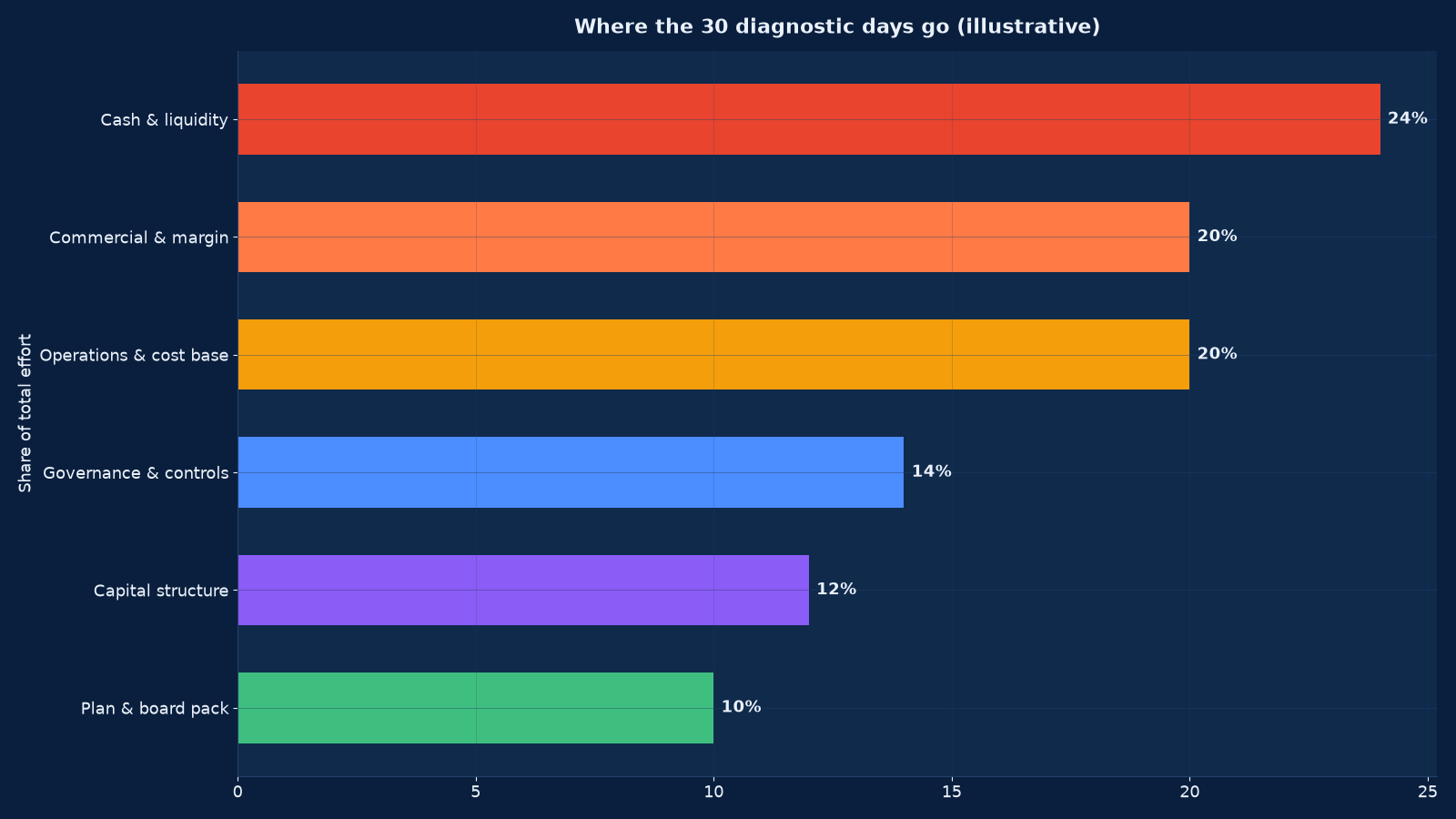
Chart values are an illustrative planning model based on typical UMC engagements and published industry benchmarks. They are not a guarantee of results on any specific project.
Thirty days is not enough to fix a business. It is enough to stop guessing about it — to know to the week what the cash will do, which customers and products actually make money, and which of the problems in front of you are urgent, important, or neither.
The 30-Day Turnaround Diagnostic is our entry engagement for a business under pressure or for an owner who suspects the business is drifting. In thirty calendar days we produce a 13-week cash forecast, a margin analysis by product, customer and channel, a cost-base decomposition, a governance and controls assessment, a clear view of the capital structure and lender position, and a prioritised 90-day action plan with a board-ready pack. It is deliberately short, deliberately evidence-based, and deliberately priced so that it can be commissioned without a committee.
🚨 30-Day Turnaround Diagnostic — Quick Summary
| Component | What We Deliver |
|---|---|
| 13-week cash forecast | Weekly receipts and payments built from actual ledgers, not from the budget, with a base and a downside case and a stated funding requirement. |
| Margin analysis | Contribution by product, customer, contract and channel, identifying which revenue is worth keeping and which is not. |
| Cost-base decomposition | Every cost line split into addressable, contractual and structural, with a value against each opportunity. |
| Working capital position | Debtor ageing, disputes, inventory coverage and creditor profile — the levers that release cash without new funding. |
| Governance & controls | Decision rights, approval thresholds, segregation of duties, contract and compliance exposure, and whether the numbers can be relied on. |
| Capital structure & lenders | Facilities, covenants, security, headroom, arrears and the realistic negotiating position with each stakeholder. |
| Commercial reality check | Pipeline quality, concentration, churn, pricing discipline and whether the sales forecast is a forecast or a hope. |
| Findings by severity | Every finding classified critical, major or minor, with an owner, an action and a date. |
| 90-day plan & board pack | A prioritised action plan, the funding or financing ask if there is one, and a pack that can be put in front of a board, lender or investor without rewriting. |
The diagnostic feeds every other service in this category — cash flow and working capital recovery, distressed restructuring, cost rationalisation and interim leadership — and it complements Risk, Governance & Business Continuity Support for businesses that are not yet in difficulty. It is normally led by Mr Avinash Sharma personally.
What a Diagnostic Is — and What It Is Not
It is not an audit, and it is not a strategy exercise. Audits look backwards and certify; strategy looks forwards and chooses. A diagnostic looks at the present under time pressure and establishes what is true.
| Engagement | Question it answers | Duration | Output |
|---|---|---|---|
| 30-day turnaround diagnostic | What is actually wrong, how bad is it, and what must happen in what order? | 30 calendar days | Evidence-based position, findings by severity, 90-day plan, board pack |
| Financial audit | Do the statements fairly present the past? | 4–12 weeks | An opinion on historic accounts |
| Strategy review | Where should the business go and how will it win? | 4–8 weeks | A strategic plan and choices |
| Operating model design | How should decisions, ownership and reporting work? | 4–6 weeks | Decision rights, information set, cadence |
| Due diligence | What are we buying, and what is hidden? | 3–6 weeks | A risk report for a transaction |
The distinction matters because a business in difficulty usually commissions the wrong one first. An audit tells you the accounts were right; a strategy review tells you the market is attractive; neither tells you whether you can meet payroll in seven weeks. Our CEO survey analysis on confidence, cost pressure and resilience documents how often leadership teams already suspect the answer and delay confirming it.
When to Commission One
- Cash has become a weekly conversation. Payments are being scheduled around receipts, suppliers are being stretched, or the overdraft is permanently at its limit.
- The forecast keeps being wrong. Each month closes worse than expected, and the explanation changes each time.
- A covenant, facility renewal or lender review is coming. You need a position you can present, not one you have to defend.
- Margins are falling but revenue is not. Something in the mix, the pricing or the cost to serve has moved and nobody can say what.
- A major customer or contract has been lost, or is at risk.
- A new owner, investor or lender is asking questions you cannot answer quickly.
- Key people have left, and the knowledge of how the business actually works left with them.
- The business is growing and getting worse at the same time — the most common and least recognised trigger.
Two of these are enough. Waiting for all eight is how a fixable cash problem becomes a restructuring, and the difference between them is usually two or three quarters.
The Six Domains
| Domain | Core questions | Primary evidence | Days |
|---|---|---|---|
| Cash & liquidity | What comes in and goes out, weekly, for thirteen weeks? Where is the trough? What is the funding requirement and when? | Bank statements, ledgers, debtor and creditor ageing, payroll calendar, tax and loan schedules | 1–5 |
| Commercial & margin | Which products, customers and channels actually contribute? What is concentrated? Is the pipeline real? | Sales ledger by customer and product, price lists, contracts, pipeline, churn data | 6–12 |
| Operations & cost base | What does it cost to deliver, per unit? Which costs are addressable, contractual or structural? | Trial balance detail, headcount and overtime, supplier contracts, property costs, process observation | 13–20 |
| Governance & controls | Who decides what? Can the numbers be relied on? Where is the exposure? | Approval records, board minutes, delegated authorities, contract register, compliance obligations | 21–26 |
| Capital structure | What is owed, to whom, on what security and covenants? What is the headroom and the negotiating position? | Facility letters, security documents, covenant certificates, arrears, tax and statutory dues | 22–27 |
| Plan & board pack | What must happen in ninety days, in what order, by whom, and what does it cost or release? | Everything above, plus management interviews | 27–30 |
Days 1–5: Cash and Liquidity
This comes first and it is not abbreviated. Until the cash position is known to the week, every other judgement in the diagnostic is speculation.
- Build the 13-week forecast from the ledgers, not the budget. Receipts from the debtor ageing with a realistic collection assumption per band; payments from the creditor ageing, payroll calendar, tax dates, loan schedules and committed spend.
- Identify the trough. The lowest projected balance in the thirteen weeks, and the week it occurs. That number drives everything else.
- Test the assumptions with the people who know. The sales team’s view of what will be collected, the finance team’s view of what can be deferred, and the owner’s view of what will not be deferred in practice.
- Produce a downside case. One major customer paying thirty days late, or one facility not being renewed. If the downside case breaks the business, that is a finding, not a sensitivity.
- List the immediate cash actions. Usually six to ten items available within two weeks: unbilled work, disputed invoices, unclaimed credits, deposit requests, deferred non-critical spend, asset sales.
The output is a forecast the leadership team believes and updates weekly. That single artefact changes behaviour, because it converts an ambient anxiety into a list of dates and amounts. Where cash is the dominant problem, the recovery programme that follows is described in our cash flow and working capital service in this category.
Documents We Request on Day One
The list is long and deliberately so. A diagnostic that runs on summaries inherits the assumptions of whoever prepared them; one that runs on ledgers and statements finds what the summaries omitted.
| Category | What we ask for | Why it matters |
|---|---|---|
| Banking | Twelve months of statements for every account, plus facility letters, sanction terms, security documents and the latest covenant certificate | The cash forecast has to reconcile to the bank, not to the books, and headroom is a document question |
| Ledgers | Trial balance to the latest month, full debtor and creditor ageing with invoice dates, and the general ledger detail for the largest cost lines | Ageing bands drive the collection assumption; ledger detail is what separates addressable cost from structural cost |
| Payroll and statutory | Headcount by function and grade, overtime for six months, contractor spend, and the status of GST, TDS, PF, ESI and professional tax dues | People cost is usually the largest addressable line, and statutory arrears change the urgency of the whole plan |
| Commercial | Revenue and contribution by customer and product for twenty-four months, price lists, discount approvals, the top twenty contracts and the current pipeline with stage definitions | This is where the negative-contribution findings come from, and where the fastest margin recovery is found |
| Contracts and commitments | Property leases with break dates, key supplier agreements, customer contracts with service levels and termination rights, and any guarantees given | Contractual cost cannot be treated as addressable, and undisclosed commitments are the most dangerous finding a diagnostic can miss |
| Governance | Board or owner minutes for twelve months, delegated authorities, the approval process actually used, and any pending disputes, notices or litigation | Establishes whether decisions are recorded and whether exposure exists that the accounts do not show |
| Management information | Whatever pack the leadership team currently uses, and the definitions behind each number | If two functions produce different versions of the same measure, that gap is itself a finding |
Two practical notes. If some of this does not exist, we start anyway and record its absence as a governance finding rather than delaying the engagement. And if documents will be shared with a lender, we agree what is shared and by whom before day one, so that nothing reaches a third party without the owner having seen it first.
Days 6–12: Commercial and Margin
Revenue is not the unit of analysis; contribution is. In thirty-day diagnostics the most common single finding is that a substantial share of revenue contributes nothing or is negative once the real cost to serve is included.
- Contribution by customer. Revenue less direct cost, less the specific cost to serve — account management, customisation, delivery exceptions, credit cost, payment behaviour. Payment behaviour belongs here: a customer who pays in 120 days consumes cash that has a price.
- Contribution by product or service line. Including the shared costs that are genuinely attributable, and excluding the ones that are not.
- Contribution by channel. Direct, partner, tender, online — each carries a different cost structure and a different concentration risk.
- Price discipline. The gap between list, approved and actually invoiced, and who approved the exceptions. Discount leakage is frequently several points of margin.
- Concentration. What share of contribution comes from the top five customers, and what the business looks like if the largest leaves.
- Pipeline reality. Stage definitions applied consistently, weighted by historical conversion rather than optimism, and reconciled to the forecast used in the cash model.
This domain produces the uncomfortable list: customers to reprice or exit, products to rationalise, discounts to withdraw. It also produces the fastest margin recovery available without any cost cutting, which is why it runs in parallel with the cost work rather than after it. Market Research & Competitive Analysis extends the external half of this analysis where the question is market position rather than immediate profitability.
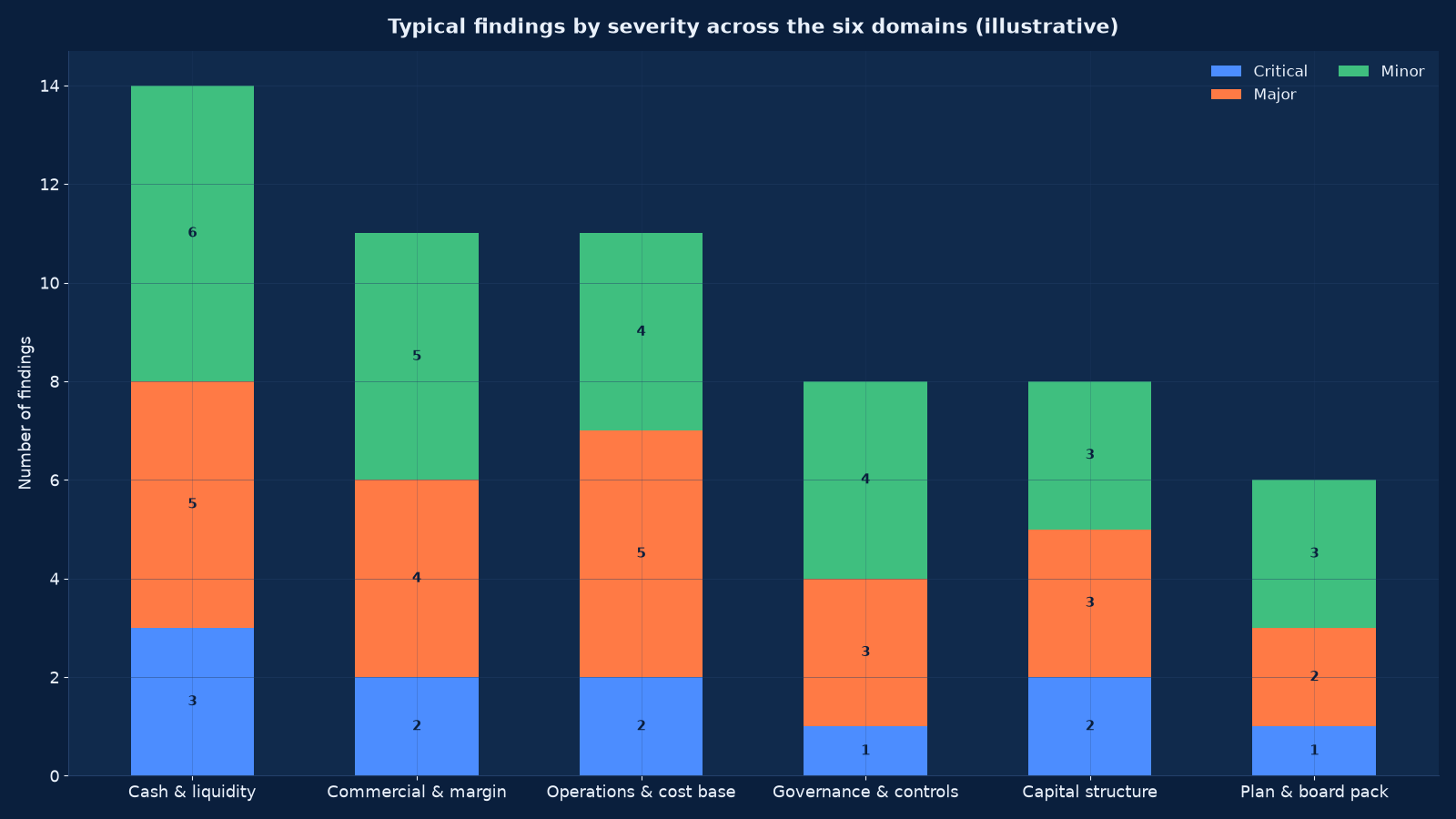
Chart values are an illustrative planning model based on typical UMC engagements and published industry benchmarks. They are not a guarantee of results on any specific project.
Days 13–20: Operations and the Cost Base
Every cost line is classified as addressable (can be changed inside ninety days), contractual (committed, with a known end or break date) or structural (would require a change in the business model). The classification is what stops the plan from promising savings that cannot be delivered.
| Cost category | What we test | Typical finding |
|---|---|---|
| People | Headcount against activity, overtime share, spans of control, vacant roles carrying work, contractor spend | Overtime covering a structural gap; duplicated roles across functions |
| Property and facilities | Space used against space paid for, lease terms and break dates, utilisation by site | Under-used space with a break opportunity in the next 12 months |
| Procurement and third parties | Spend by supplier, contract coverage, price against market, duplicate suppliers for the same category | Five to fifteen per cent on addressable spend, concentrated in a few categories |
| Technology | Licences against active users, overlapping tools, renewal dates and commitment terms | Unused licences and two tools doing the same job |
| Marketing | Spend by channel against attributable outcomes | Channels funded by habit rather than by return |
| Finance and professional | Recurring advisory, audit, banking and legal spend | Retained services no longer used |
| Cost of sales | Input prices, yield, waste, rework, freight | Input price drift never passed through, or rework treated as normal |
We also measure cost to serve per unit of output, because it is the number that tells you whether operational improvement or commercial repricing is the larger lever. Frequently the answer surprises everyone: the operational problem is small and the pricing problem is large. Where technology cost is a material line, our cloud cost and FinOps service applies the same classification discipline to infrastructure spend specifically.
Days 21–27: Governance, Controls and Capital Structure
Two domains that are usually examined last and should be examined early enough to change the plan.
Governance and controls. Who can commit the business and up to what value; whether approvals are recorded; whether duties are segregated enough that an error or a fraud would be found; whether contracts exist for the commitments the business has made; whether statutory filings, tax dues and statutory payments are current. A diagnostic that finds unrecorded commitments or arrears in statutory dues has found the most urgent item in the report, and it must be surfaced in week three rather than week four.
Capital structure. Every facility, its security, its covenants, its headroom and its renewal date; arrears with lenders, tax authorities and employees; related-party loans; guarantees given by the owner personally. We then assess the realistic negotiating position with each stakeholder — not the legal position alone, but what each party is likely to do and why.
This is where the diagnostic determines which route the business is on. If the capital structure is sustainable and the problem is operational, the answer is a turnaround plan. If the debt cannot be serviced from any realistic forecast, the answer is a restructuring conversation with lenders, and the diagnostic becomes the evidence base for it. That second path is set out in our distressed business restructuring service.
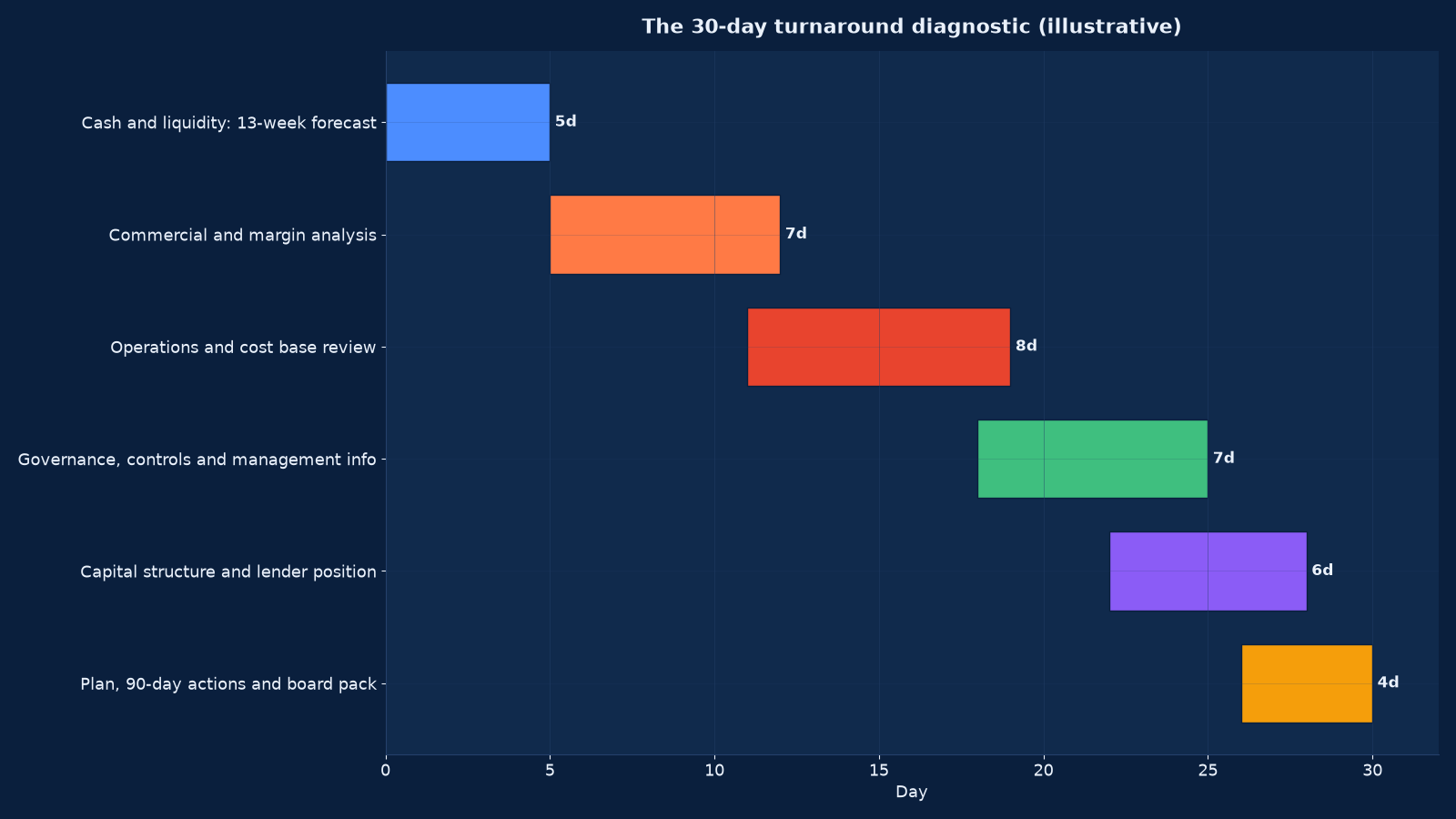
Chart values are an illustrative planning model based on typical UMC engagements and published industry benchmarks. They are not a guarantee of results on any specific project.
What You Receive on Day 30
| Deliverable | Format | Used by |
|---|---|---|
| 13-week cash forecast | Weekly model with base and downside cases, assumptions stated, updated weekly | Owner, finance, lenders |
| Findings register | Every finding with severity, evidence, owner, action and date | Leadership team |
| Margin analysis | Contribution by customer, product and channel, with the reprice or exit list | Commercial leadership |
| Cost-base decomposition | Addressable, contractual and structural, with values | Owner and finance |
| Capital structure summary | Facilities, security, covenants, headroom, arrears, negotiating position | Owner, board, lenders |
| 90-day action plan | Prioritised, resourced, with the cash effect of each action and its date | Leadership team and board |
| Board or lender pack | A presentation-ready summary of position, causes, plan and ask | Board, lenders, investors |
| Route recommendation | Stabilise, restructure, sell or wind down — with the reasoning | Owner and board |
Triage: Which Route the Business Is Actually On
The most valuable sentence in the day-30 report is usually the route recommendation, because it ends the ambiguity that paralyses owners and boards.
| Route | When it applies | What follows | Timeframe |
|---|---|---|---|
| Stabilise and improve | The business is viable, cash is tight but recoverable, and the problems are operational and commercial | Cash and working capital recovery, cost rationalisation, then an operating layer | 90 days to stabilise, 6–12 months to improve |
| Restructure with stakeholders | The debt cannot be serviced from any realistic forecast, but the underlying business has value | Lender negotiation, consensual restructuring, possibly new capital, with operational restructuring in parallel | 3–9 months |
| Refinance or raise | The business is sound but the capital structure is wrong — short-term debt funding long-term assets, or an over-levered balance sheet | A financing case built on the diagnostic, then lender or investor process | 2–6 months |
| Sell or merge | The owner’s appetite or capacity has gone, or scale is the binding constraint | Preparation of the business for sale, with the diagnostic as the honest vendor position | 6–18 months |
| Managed wind-down | No route preserves value above the cost of continuing | An orderly plan that protects stakeholders and statutory obligations | 3–12 months |
We give one recommendation with the reasoning and the alternative we rejected. Where the route is restructuring, the diagnostic pack becomes the document lenders are shown, which is why the evidence standard is high from day one.
Measuring the Diagnostic Itself
A diagnostic that cannot be measured produces a report and no change. These are the measures we report at day thirty and again at day ninety.
| Measure | Definition | Target |
|---|---|---|
| Forecast accuracy | Variance of the 13-week forecast to actual, rolling | Inside 5% by week 8 |
| Findings closed | Share of critical and major findings actioned within their date | Critical 100%, major above 80% |
| Cash actions realised | Value of immediate cash actions actually delivered | Above 70% of the identified value |
| Contribution identified | Value of negative or sub-floor contribution found | Measured, then repriced or exited |
| Addressable cost quantified | Value of cost classified addressable with an owner and date | Fully attributed |
| Decision latency | Days from the report to the first structural decision | Under 10 days |
| Stakeholder confidence | Whether the lender, board or investor accepted the position as credible | Assessed at day 30 and day 90 |
| Route clarity | Whether the business can state its route and the reasoning in one sentence | Yes, by day 30 |
Forecast accuracy is the leading indicator: if the cash forecast is right by week eight, the business has stopped surprising itself, and everything else in the plan becomes manageable.
How We Work With Boards, Lenders and Owners
Diagnostics are sensitive, and the manner of delivery determines whether the findings are acted on or defended against.
- One version of the truth. The owner, the board and any lender see the same report. We do not produce a soft version and a hard version, and we will not present findings to a lender that the owner has not seen first.
- Evidence behind every finding. Each one cites the ledger, contract, statement or interview it came from, so it can be checked rather than argued with.
- Severity, not drama. Critical means the business is at risk inside thirteen weeks. Major means value is being lost steadily. Minor means it should be fixed when the others are.
- Confidentiality by default. The engagement is confidential, the working papers stay with us unless released, and we do not appear in the business’s communications unless asked to.
- Named individuals, not a team of juniors. A thirty-day diagnostic under pressure cannot be delivered by people learning the business as they go.
Where a lender has commissioned or co-funded the work, we agree the reporting lines in writing before day one. That agreement is what allows us to be useful to both parties without becoming an advocate for either.
Engagement Models
| Model | Duration | Scope | Best when |
|---|---|---|---|
| Full 30-day diagnostic | 30 calendar days | All six domains, all deliverables, route recommendation | The standard entry point, and the right one for most situations |
| Cash-only diagnostic | 10–14 days | 13-week forecast, immediate cash actions, lender position | Liquidity is the immediate threat and the rest can wait |
| Extended diagnostic with implementation | 30 days + 90 days | Diagnostic plus delivery of the top actions with your team | Internal capacity to execute is limited |
| Lender or investor commissioned | 30 days | Diagnostic to an agreed scope with reporting lines set in advance | A third party needs an independent position |
| Pre-acquisition diagnostic | 3–4 weeks | The six domains applied to a target business, from a buyer’s perspective | You are acquiring and need the operating truth, not just the accounts |
What Happens After Day 30
The report is not the deliverable; the ninety days after it are. Three patterns follow.
Stabilise. The cash actions go in, the forecast becomes a weekly discipline, the reprice-or-exit list is worked, and the addressable cost plan is executed. Most businesses see the trough pass inside eight weeks.
Restructure. The pack goes to lenders, the negotiating position is agreed with the owner, and operational restructuring runs in parallel rather than after — because a creditor conversation without an operational plan is a request for patience rather than a proposal.
Install. Where the underlying cause is structural rather than financial — no decision rights, no reliable information, no cadence — the diagnostic is followed by the unified operating layer, so that the same diagnosis is not needed again in eighteen months. Our energy transition leadership piece and the mission-led transformation study both describe businesses where the second failure was structural, not financial.
Whichever pattern applies, the ninety-day plan is reviewed at day thirty, sixty and ninety against the measures above, and the forecast accuracy number tells you early whether the plan is working.
Frequently Asked Questions About the 30-Day Turnaround Diagnostic
Why thirty days and not longer?
Because the value of a diagnostic decays with time. A business under pressure cannot wait twelve weeks for a report, and a longer engagement tends to expand into analysis rather than converging on decisions. Thirty days is enough to build a credible cash forecast from ledgers, complete a margin and cost analysis, and produce a plan the board can act on. Where the situation genuinely needs more, we say so in week two and scope it explicitly.
What do you need from us to start?
Bank statements and ledgers for the last six months, the current debtor and creditor ageing, payroll and tax schedules, facility letters and covenant certificates, the management accounts, a customer and product revenue listing, and about six hours of interview time with the owner and each function lead. If some of it does not exist, that is itself a finding and we work with what is available.
Will you talk to our bank?
Only with your written authorisation, and only after you have seen the report. If a lender has commissioned or co-funded the diagnostic, the reporting lines are agreed before day one. We will not present a position to a lender that you have not seen, and we will not soften findings to make a conversation easier — a pack that fails under lender scrutiny costs you more than an honest one.
Is the 13-week forecast something we can maintain ourselves?
Yes, and it should be. We build it in a format your finance team can update weekly, with the assumptions stated separately from the numbers so they can be challenged. Handover includes running it with them for at least two cycles. A forecast that only a consultant can maintain is not a control.
What does it cost?
The full thirty-day diagnostic is a fixed fee agreed before we start, sized by revenue, site count and complexity rather than by hours. Cash-only diagnostics are smaller. Extended engagements with ninety days of implementation are quoted separately. We will tell you in the first conversation if a narrower engagement would serve you better.
Can you guarantee you will find savings that pay for it?
No, and you should be wary of anyone who does. What we can say is that the great majority of diagnostics identify addressable cost and negative-contribution revenue well in excess of the fee, and that the immediate cash actions alone are usually material. The value of the engagement is as much in the route recommendation and the credible pack as in the savings list.
Do you work with businesses that are already in formal insolvency?
We work alongside insolvency practitioners rather than in place of them. If a formal process is live or unavoidable, we will tell you so in week one and explain what that means for the scope of our work and for the duties of the directors. Our restructuring service covers the consensual routes in more detail.
Will this upset my management team?
It can, if it is presented as an investigation of them. We present it as an investigation of the structure, and the findings are overwhelmingly about missing thresholds, missing definitions and missing information rather than about individuals. Function leads are interviewed early, see findings in their own domain before the final report, and are usually the strongest advocates for the plan afterwards.
What if the diagnosis finds nothing serious?
Then you have paid for certainty, which has real value before a financing round, an acquisition or a major investment. It happens more often than you would expect: a business that feels like it is failing is sometimes suffering from information failure rather than performance failure, and the fix is an operating layer rather than a turnaround.
How is this different from your other business consulting services?
Strategy consulting decides where to go; this decides whether you can get there and what is blocking you now. Market research tells you what the market is doing; this tells you what your own numbers are doing. Risk and governance support builds the control framework for a stable business; this assesses the controls of one that is not. The diagnostic is the fastest and most concrete of the set, which is why it is the entry point.
What should we do first?
Call. The first conversation is confidential and free, and it usually takes less than an hour to establish whether a diagnostic is the right instrument, whether the situation can wait thirty days, and what we would need on day one. If the cash position is acute, we will tell you to commission the cash-only version and start within the week.
Commission a 30-Day Turnaround Diagnostic
The first conversation is confidential, without charge and without obligation. If the situation is acute we can usually start within a week, and we will tell you in that first call whether you need the full thirty days or the ten-day cash diagnostic.
Contact Unified Management Consulting to arrange a confidential first conversation.
Related Services
The diagnostic is the entry point to the rest of this category:
- Mr Avinash Sharma — who leads these engagements personally
- Risk, Governance & Business Continuity Support — the control framework for a business that is not yet in difficulty
- Business Strategy Consulting — the direction the ninety-day plan serves
- Market Research & Competitive Analysis — the external evidence behind the commercial findings
- Data Science Services for Business Analytics — where the information failure is structural
- Cloud Cost Optimisation & FinOps — the same cost classification discipline applied to technology spend
- Selected projects — including work delivered under lender scrutiny
- Unified Top-Level Business Management & Handling — one operating layer across finance, operations and people, with decision rights and cadence
- Cash Flow & Working Capital Recovery — a thirteen-week forecast, receivables and payables discipline, inventory release and covenant cover
- Distressed Business Restructuring — the options ladder from consensual standstill to formal insolvency, with lender and stakeholder plans
- Interim & Fractional Leadership — a written mandate with published decision rights for CEO, COO, CFO and transformation roles
- Cost Rationalisation & Margin Recovery — cost-base decomposition, contribution by customer and product, cost to serve and pricing discipline