
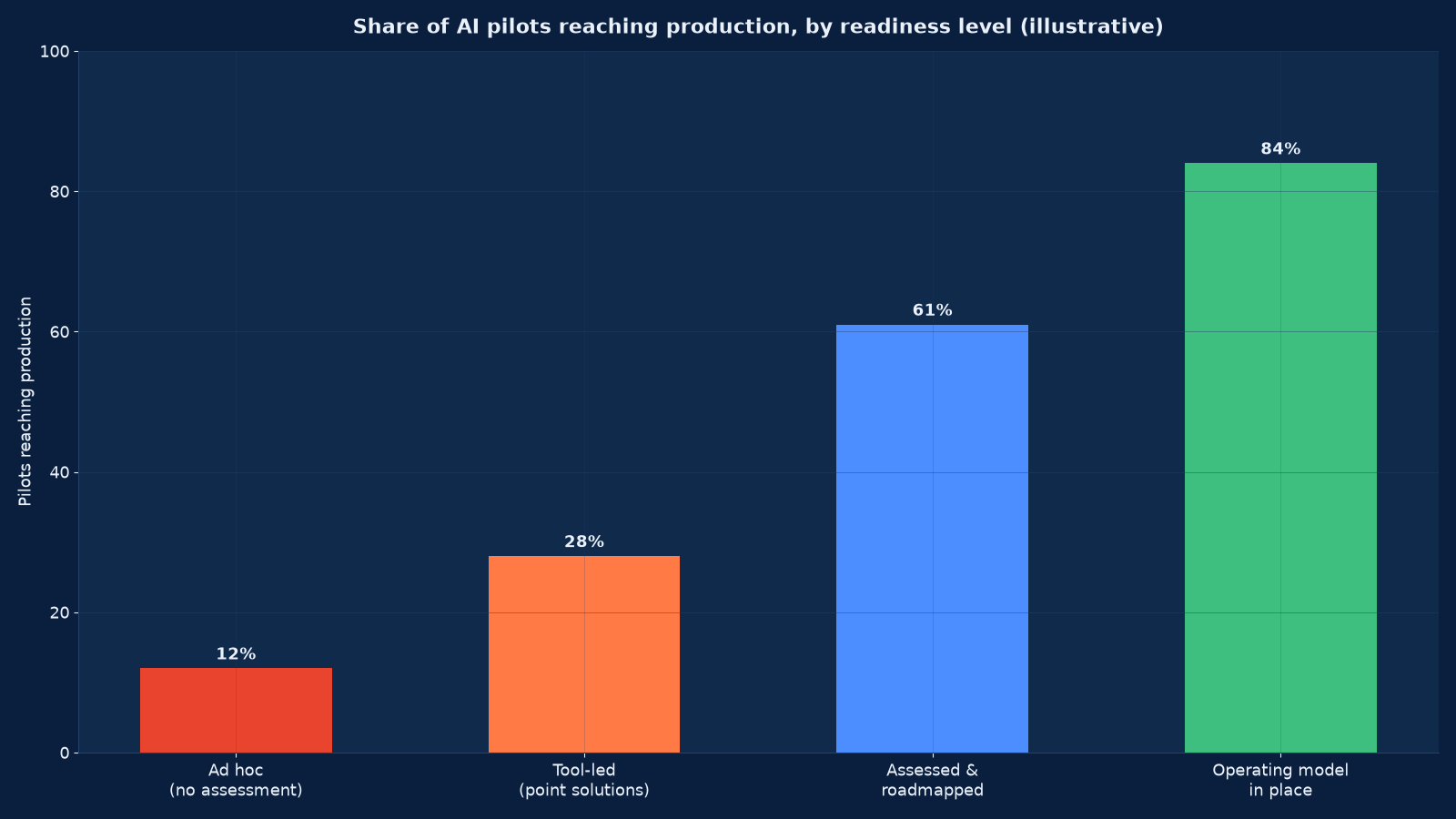
Find out whether your business can actually absorb AI — before you spend on it. Unified Management Consulting delivers AI readiness assessments and implementation roadmaps that score your data, skills, systems, governance and value measurement, then convert the findings into a phased, costed plan with named owners, sequenced use cases and measurable milestones.
Most AI programmes do not fail because the model was weak. They fail because the organisation around the model was not ready: the data was not accessible, nobody owned the outcome, the workflow could not absorb a probabilistic answer, or the finance team could not tie the spend to a result. An AI readiness assessment exists to surface those constraints while they are still cheap to fix, and a roadmap exists to sequence the work so that early use cases build the capability the later ones depend on.
This is an evidence-based engagement, not a workshop that ends in a slide deck. We audit your actual systems, interview the people who do the work, score each dimension against a defined rubric, and rank every candidate use case on value, feasibility and risk. You leave with a decision-ready investment case and a delivery sequence your teams can start on.
📋 AI Readiness Assessment & Roadmap — Quick Summary
| Component | What We Deliver |
|---|---|
| Readiness scoring | Six-dimension assessment across data, skills, platform, governance, sponsorship and value measurement, each scored 0–100 with evidence |
| Use-case inventory | Every candidate AI use case captured, then ranked on business value, technical feasibility, data availability and risk exposure |
| Data & systems audit | Where the data lives, how complete and current it is, who can access it, and what integration work each use case actually needs |
| Skills & ownership map | Who will build it, who will run it, who will be accountable for the outcome, and what capability you must hire or buy |
| Phased roadmap | A sequenced 12–36 month plan with waves, dependencies, owners, effort estimates and gate criteria between phases |
| Investment case | Cost per wave, expected benefit, payback period and the metrics that will be used to judge each phase before the next is funded |
Chart values are an illustrative planning model based on typical UMC engagements and published industry benchmarks. They are not a guarantee of results on any specific project.
AI Readiness Assessment at a Glance
| Engagement component | What we examine | Output you receive |
|---|---|---|
| Strategy & sponsorship | Executive mandate, funded owner, tolerance for experimentation, alignment to the business plan | Sponsorship score and a named accountable executive per use case |
| Data readiness | Source systems, completeness, duplication, lineage, access rights, retention, quality defects | Data readiness matrix per use case with remediation effort |
| Skills & operating model | Internal engineering, analytics, product and change capacity; who maintains systems after handover | Capability gap list with build, buy or partner recommendation |
| Platform & MLOps | Cloud estate, CI/CD, environments, monitoring, model and prompt versioning, cost controls | Platform gap assessment and minimum viable architecture |
| Governance & risk | AI policy, approval route, data protection, vendor terms, incident and escalation process | Risk register with tiers and required controls |
| Value measurement | Baseline metrics, attribution method, reporting cadence, finance sign-off on the benefit definition | Measurement plan and executive scorecard template |
Each dimension is scored against the same rubric on every engagement, which means your result is comparable to the cohort and comparable to yourself six months later. That comparability matters more than the absolute number: the purpose of the score is to show where a small investment removes the largest amount of delivery risk.
Why an AI Readiness Assessment Comes Before the Build
AI spend is unusually easy to start and unusually hard to stop. A team can buy seats, run a pilot and generate a demonstration in weeks without any change to procurement, security review or data governance. That is why so many organisations accumulate a portfolio of impressive pilots and almost nothing in production. The gap between the two is rarely the model. It is permissions, data plumbing, ownership, monitoring and the willingness of a process owner to accept a probabilistic output in a workflow that was designed for a deterministic one.
Assessing first changes the economics. A readiness engagement typically costs a fraction of a single failed implementation, and it converts an open-ended ambition into a ranked list where the first wave is chosen because it can genuinely succeed with what you have today. It also gives your finance and risk functions something concrete to approve, which is often the real bottleneck.
- Avoid funding a use case whose data does not exist in usable form yet
- Sequence work so wave one creates the platform, permissions and evaluation harness wave two needs
- Expose shadow AI already running in the business before it becomes an incident our shadow AI workplace guide covers how this usually surfaces
- Establish a benefit baseline you can measure against, rather than arguing about ROI retrospectively
- Give the board a single ranked view instead of fifteen unrelated pilot proposals
The Six Readiness Dimensions We Score
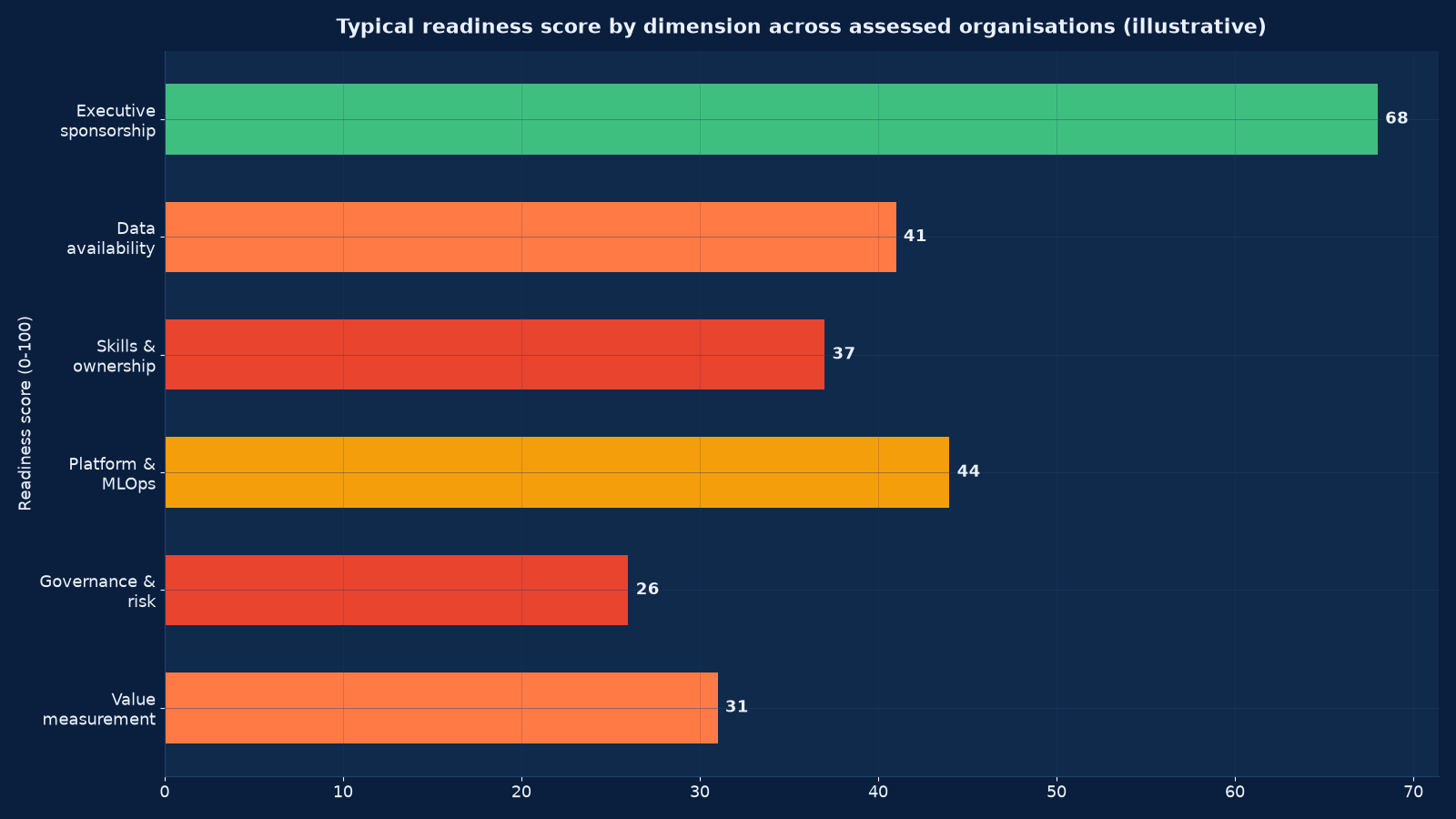
Chart values are an illustrative planning model based on typical UMC engagements and published industry benchmarks. They are not a guarantee of results on any specific project.
The pattern in Figure 2 is consistent enough to be predictable. Sponsorship is usually the strongest dimension, because an executive has already decided AI matters. Governance and value measurement are usually the weakest, because nobody has been asked to define them yet. Those two are also the dimensions that determine whether a production system can be audited and whether its benefit can be proven — which is why they appear in wave one of almost every roadmap we write.
1. Data readiness
We inventory the systems that hold the data each candidate use case needs, then test the data rather than trusting the documentation. That means measuring completeness on the fields the model would actually consume, quantifying duplication across systems of record, checking how current the data is against the decision cadence, and confirming who is permitted to extract it. A use case that looks trivial on a whiteboard frequently depends on three systems, two of which have no export path and one of which is reconciled manually each month.
2. Skills and operating model
We separate three roles that are often collapsed into one: the team that builds the system, the team that operates it, and the person accountable for the business outcome. Missing any of the three is the most common reason a working pilot is never adopted. Where the gap is real we recommend build, buy or partner explicitly, and we tie that recommendation to the roadmap so hiring lead time is inside the plan rather than discovered during it.
3. Platform and MLOps
We assess whether you can promote a change safely: source control, environments, CI/CD, secrets handling, model and prompt versioning, evaluation datasets, latency and cost monitoring, and a rollback path. If you cannot answer how you would revert a degraded AI feature on a Friday evening, that is a wave-one item. Our DevOps and CI/CD engineering service is frequently the delivery route for this dimension.
4. Governance and risk
We map your current policy position against what the use cases actually require: approval routes, data protection basis, vendor and model terms, human review thresholds, logging, incident definition and escalation. Readiness and governance are assessed together but delivered separately — risk, governance and business continuity covers the enterprise wrapper, while our dedicated AI governance service builds the AI-specific controls, model inventory and risk tiering.
5. Executive sponsorship and accountability
We test whether the mandate is funded and named, or merely verbal. The distinguishing question is simple: if this use case fails in month four, who is accountable, and do they control the budget and the process owner’s time? Where the answer is unclear we recommend a smaller first wave with a single accountable owner rather than a broad programme with diffuse responsibility.
6. Value measurement
We agree the baseline before any build starts. That means capturing the current numbers for cycle time, handling volume, error or rework rate, conversion and cost per transaction, and agreeing with finance how a benefit will be attributed. Our guide to measuring AI ROI with an executive scorecard sets out the scorecard structure we install as part of this dimension.
How the Assessment Runs
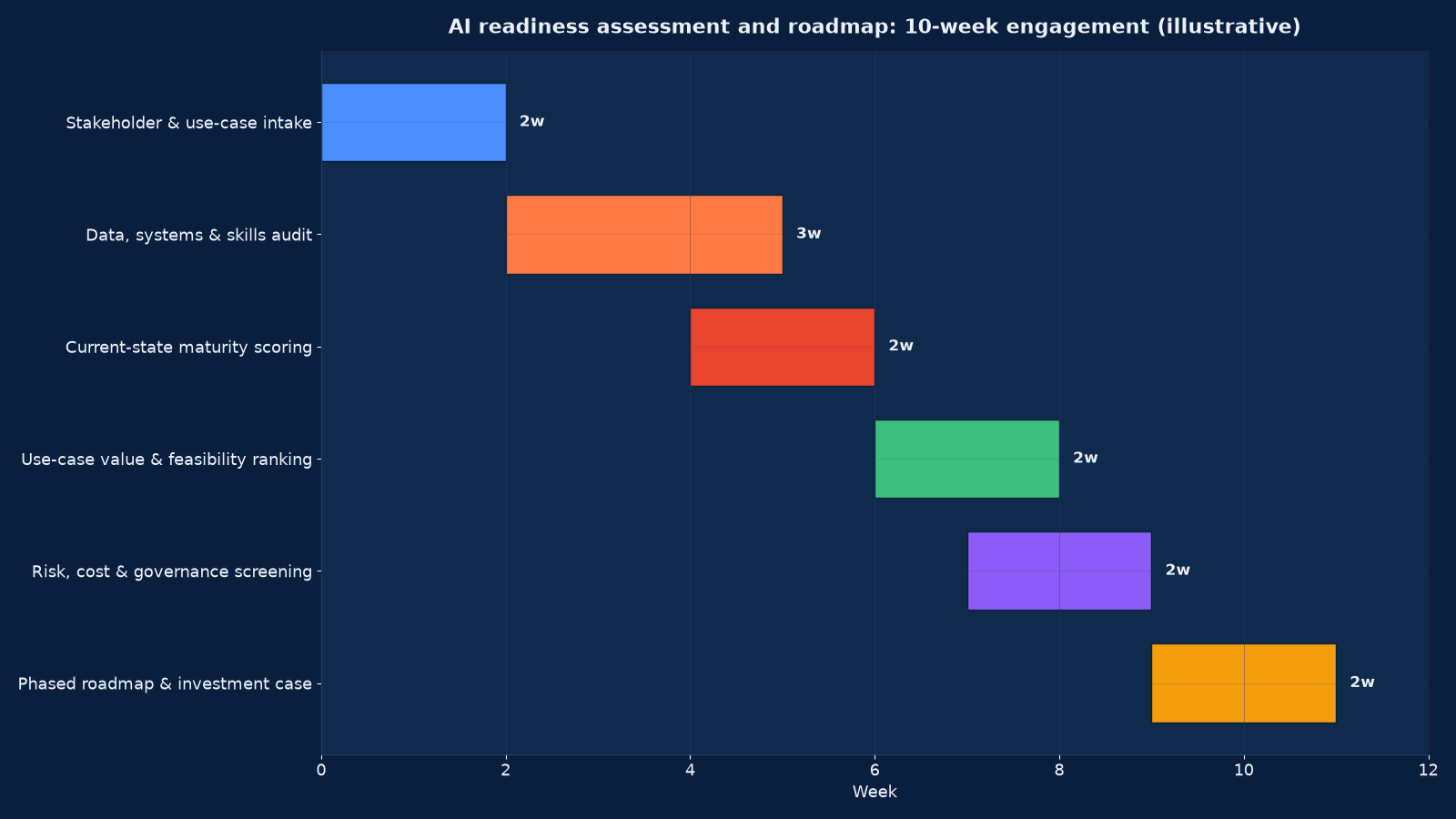
Chart values are an illustrative planning model based on typical UMC engagements and published industry benchmarks. They are not a guarantee of results on any specific project.
| Week | Activity | Who is involved | Evidence produced |
|---|---|---|---|
| 1–2 | Stakeholder and use-case intake | Executives, process owners, IT leadership | Use-case long list, sponsor map, success definitions |
| 2–4 | Data, systems and skills audit | Data owners, engineers, operations teams | Data readiness matrix, capability gap list, access constraints |
| 4–5 | Current-state maturity scoring | Assessment lead with dimension owners | Six-dimension scores with evidence notes |
| 6–7 | Use-case value and feasibility ranking | Process owners, finance, IT | Ranked portfolio with effort and benefit estimates |
| 7–8 | Risk, cost and governance screening | Risk, legal, security, procurement | Risk register, control requirements, vendor constraints |
| 9–10 | Phased roadmap and investment case | Executive sponsor, finance, delivery leads | Wave plan, gate criteria, budget, scorecard |
Use-Case Ranking: How We Decide What Comes First
Every candidate use case is scored on four axes, and the ranking is deliberately not a simple sum. Value and feasibility determine the order; risk and data readiness act as gates. A high-value use case with no usable data does not move to wave one — it moves behind the data work, and the roadmap says so explicitly.
| Axis | What we score | Weight in the ranking |
|---|---|---|
| Business value | Revenue impact, cost avoidance, cycle-time reduction, quality improvement, strategic option value | Primary — sets the ceiling |
| Technical feasibility | Model maturity required, integration complexity, latency tolerance, evaluation difficulty | Primary — sets the floor |
| Data availability | Does usable data exist today, and what remediation is needed before it does | Gate — can defer a use case by a wave |
| Risk exposure | Customer-facing impact, regulated decisions, reversibility, audit sensitivity | Gate — requires controls before build |
The output is a wave plan rather than a priority list. Wave one is chosen to succeed with your current capability and to leave behind reusable assets — an evaluation harness, a deployment path, a monitoring baseline, a governance route. Wave two consumes those assets, which is why its delivery cost is usually lower even when its scope is larger.
What the Roadmap Deliverable Contains
- Current-state score — six dimensions, each with the evidence behind the number and the specific gap to close
- Ranked use-case portfolio — every candidate with value, feasibility, data and risk scores and a wave assignment
- Wave plan — 12 to 36 months, with dependencies drawn explicitly so nothing is scheduled before its prerequisite
- Gate criteria — the measurable conditions that must be true before the next wave is funded
- Effort and cost model — internal time, external cost, platform and inference run-rate per wave
- Operating model — who owns each system after handover, with the skills plan to make that true
- Risk register — per use case, with required controls and the accountable owner
- Measurement plan — baselines captured, metrics defined, attribution agreed with finance, reporting cadence set
- Decision log — what was rejected and why, so the same proposals do not return unfunded in six months
The roadmap is written to be handed to a delivery team that was not in the room. Every wave names its systems, its data dependencies, its owner and its exit test. If your engineers cannot start wave one from the document alone, the document is not finished.
Building the AI Investment Case Your Finance Team Will Accept
An AI business case fails for predictable reasons: the benefit is stated as a percentage with no baseline, the cost omits inference run-rate and internal time, and the payback period assumes full adoption on day one. We build the case the other way round. Baselines are captured during the audit, cost includes run-rate and the internal effort that will actually be consumed, and benefit is phased against a realistic adoption curve with a stated ramp.
| Cost line often omitted | Why it matters | How we quantify it |
|---|---|---|
| Inference and platform run-rate | Scales with volume, not with headcount, and can exceed build cost within a year | Modelled per use case at projected volume with a cost ceiling |
| Internal time | Process owners, data engineers and reviewers are consumed during and after delivery | Named roles and hours per wave, agreed with line management |
| Data remediation | Frequently the true critical path, and usually invisible at proposal stage | Effort estimate per source system from the audit findings |
| Evaluation and monitoring | Ongoing cost of keeping quality provable, not a one-off build task | Recurring effort plus tooling, stated as run-rate |
| Change and training | Determines whether the benefit is realised at all | Audience sizes, sessions and reinforcement period |
Where the honest answer is that a use case does not pay back inside your investment horizon, we say so and move it down the ranking. A roadmap that recommends against three of your twelve ideas is more useful than one that endorses all twelve, and it is considerably more likely to survive contact with a finance review.
AI Readiness Assessment Engagement Models
| Model | Best suited to | Typical duration | What is included |
|---|---|---|---|
| Focused assessment | A single business function or one decision already on the table | 4–6 weeks | Three dimensions in depth, one ranked use-case set, a wave-one plan |
| Enterprise assessment | Multiple functions, an existing pilot portfolio, board-level reporting required | 10–12 weeks | All six dimensions, full portfolio ranking, 12–36 month roadmap, investment case |
| Assessment plus delivery start | You want wave one underway before the report is formally closed | 12–16 weeks | Enterprise assessment plus wave-one mobilisation and gate criteria set with the delivery team |
| Reassessment | Six to twelve months after the original engagement, to measure movement | 2–3 weeks | Same rubric re-scored, delta report, roadmap revision |
Every model is priced as a fixed engagement against a defined scope, not as open-ended advisory time. The scope is agreed in writing before we start, and the number of systems, functions and candidate use cases is capped so the assessment does not expand into the delivery it is meant to precede.
Readiness Failures We See Repeatedly
- The pilot portfolio problem. Many approved experiments, no shared platform, no evaluation standard, and no route to production for any of them.
- Sponsorship without an owner. An executive endorses AI in principle while no named individual controls budget, process access and delivery capacity.
- Data assumed rather than tested. The use case is approved on the belief that the data exists; the audit finds it spread across systems with no export path.
- Vendor-first selection. A platform is bought before the use cases are ranked, which forces the roadmap to justify the purchase rather than the business need.
- No baseline. Benefit cannot be proven later because nobody recorded the current numbers, so the programme is judged on sentiment.
- Governance deferred. Controls are postponed until after launch, at which point the system is already making decisions nobody can explain to an auditor.
- Capability rented indefinitely. Delivery succeeds but nothing is transferred, so every change requires the original supplier.
Each of these is visible during the audit and cheap to correct at that stage. That is the practical argument for assessing first: the cost of the assessment is small relative to the cost of discovering the same problems halfway through a funded build. Our guide to building AI capability, skills and strategy sets out the longer-term capability model these findings feed into, and how industries must operate in the AI era frames the competitive pressure that usually prompts the engagement.
Frequently Asked Questions About AI Readiness Assessment and Roadmap Services
What is an AI readiness assessment?
It is a structured evaluation of whether your organisation can successfully adopt and operate AI. We score six dimensions — data, skills and operating model, platform and MLOps, governance and risk, executive sponsorship, and value measurement — against a defined rubric, using evidence gathered from your systems and your people rather than self-reported questionnaires.
How long does an AI readiness assessment take?
A focused single-function assessment runs four to six weeks. An enterprise assessment covering multiple functions and an existing pilot portfolio typically runs ten to twelve weeks, including the audit, scoring, portfolio ranking, risk screening and the roadmap itself.
Do we need to have started any AI work before being assessed?
No. We assess organisations that have never run a pilot and organisations carrying fifteen unfinished ones. If you have an existing portfolio, the assessment includes reviewing it and recommending which projects continue, which are resequenced and which should stop.
What is the difference between a readiness assessment and an AI strategy?
A strategy states where you intend to compete and why AI matters to that position. A readiness assessment measures whether you can execute it today, and the roadmap sequences the work that closes the gap. We deliver both in the enterprise engagement, but the readiness evidence is what makes the strategy credible.
Will the roadmap tell us which tools and vendors to buy?
It specifies the capabilities and architectural requirements each wave needs, and it screens vendor options against those requirements. We deliberately avoid naming a single platform before the use cases are ranked, because premature platform selection is one of the most common causes of a roadmap that cannot be delivered.
How do you measure readiness objectively?
Each dimension has a rubric with defined levels and the evidence required for each. Scores are supported by named findings — a data quality measurement, a missing deployment path, an unfunded owner — so the number can be challenged and defended. Re-running the same rubric later gives a comparable delta.
What happens after the roadmap is delivered?
Most clients mobilise wave one immediately, either with their own team or with us delivering. Gate criteria are agreed at handover so the decision to fund wave two is based on measured results from wave one rather than on renewed enthusiasm.
Can you assess only our data readiness?
Yes, as a focused engagement. Data readiness is the most common blocking constraint, and where it is the only open question a targeted audit of the relevant source systems is usually sufficient.
Do you work with our existing AI suppliers?
Regularly. The assessment is independent of any supplier, and where an incumbent is already delivering we assess their work against the same rubric and include findings in the roadmap.
How does this relate to your AI engineering services?
The assessment and roadmap decide what to build and in what order. AI forward-deployed engineering and AI product engineering are how we build it, and data science services covers the analytics and modelling work that many wave-one use cases depend on.
Get an Evidence-Based View of Your AI Readiness
If you are being asked when AI will deliver value, or you have pilots that will not reach production, the missing input is usually evidence rather than ambition. We will assess your data, skills, platform, governance and measurement position, rank your use cases against it, and hand you a phased roadmap with costed waves and gate criteria your finance team can approve.
Request an AI readiness assessment and tell us which functions are in scope. We will confirm the assessment model, the systems we need access to and the ten-week schedule before any work begins.
Related Services
Readiness assessment is usually the first step in a sequence. These are the services clients most often move to next.
- AI Forward-Deployed Engineering Services — embedded engineers who build and ship the wave-one use cases inside your environment
- AI Product Engineering Services — production-grade AI products with evaluation, monitoring and sustainable economics
- Data Science Services for Business Analytics — the modelling, forecasting and analytics capability many roadmap use cases depend on
- Cloud Services & Migration (AWS, Azure, GCP) — the platform foundation when the assessment finds your estate cannot host AI workloads
- DevOps & CI/CD Engineering Services — the promotion, rollback and monitoring path that wave one usually has to create
- Risk, Governance & Business Continuity Support — the enterprise risk wrapper around an AI programme
- Business Strategy Consulting — where the AI roadmap has to reconcile with a wider transformation plan
- Custom CRM Development & Integration — a frequent wave-two target, because CRM data is where most commercial AI use cases land
- AI ROI Measurement & Executive Scorecard Services — baseline capture, bottom-up benefit and cost models, instrumentation, the executive scorecard itself and the gate criteria that make AI spend auditable
- Data Engineering for AI: RAG & Knowledge System Services — source audit, ingestion connectors, cleaning and metadata, permission-aware retrieval and the evaluation harness that proves every answer is grounded
- AI Integration Services for ERP, CRM & Operations — embed AI into ERP, CRM and operational systems with mapped permissions, supervised writes, immutable action logging and a tested rollback path
- AI Training & Enablement Services for Teams — role-based enablement, a measured capability baseline, build clinics and a champion network that makes adoption stick after delivery