
Pharmaceutical commercial work is the only discipline on this site where the audience you most want to reach is the audience you are least allowed to address. Prescription medicines may not be advertised to the public in most markets, so demand is built indirectly – through prescribers, pharmacists, payers, formulary committees, guidelines, evidence and the scientific reputation of the company. That produces a completely different marketing shape: content that survives medical and legal review, channels that reach verified professionals with a lawful basis, measurement built on prescription data rather than clicks, and processes that can catch an adverse-event mention arriving through a channel nobody expected. Add manufacturing, quality and distribution to the same company and the commercial programme sits inside a regulated environment where an unapproved claim is not a marketing error but a compliance event.
Unified Management Consulting works with pharmaceutical manufacturers, marketing and distribution companies, generics and formulation businesses, CDMO and API producers, medical device and diagnostics companies, and the consumer-health divisions inside them. Everything here is delivered remotely and written to be geography-neutral, with national codes, platform health policy, data-residency rules and transfer-of-value transparency handled inside the engagement. This is the vertical’s main page; prescriber-side work sits in hospitals and clinics, production-side work in manufacturing, and the industries index lists every sector we serve.
What an engagement includes, at a glance
| Component | What We Deliver |
|---|---|
| HCP-facing digital within the codes | Verified professional audiences, approved claims, lawful basis for contact, and an approval workflow that does not stop the work. |
| Medical and scientific content | Disease state, mechanism, evidence summaries, medical information responses – reviewed, versioned and dated. |
| Market access support | Formulary dossiers, payer evidence packs, value story and HTA-ready content. |
| Field-force effectiveness | Targeting, call plans, coverage, frequency and the analytics that show what changed. |
| Distribution and retail visibility | Stockist and pharmacy data, availability, primary versus secondary sales, shelf execution. |
| Adverse-event-aware processes | Any channel can produce an AE; routing, capture and handover to PV within the required window. |
| Validated CRM and data | GxP-aware configuration, access control, audit trails, residency and retention. |
| Launch and brand planning | Therapeutic-area strategy, launch excellence, portfolio prioritisation and honest forecast ranges. |
What pharma and life sciences teams search for, and what it really means
Enquiries from this sector arrive with a compliance constraint attached to a commercial request, and the useful response addresses both in the same document. The mapping below is what we do in week one.
| What gets searched or asked | What is actually happening | What we do about it |
|---|---|---|
| “pharmaceutical marketing agency” | A brand plan exists but digital execution cannot clear review | Claims framework and an approval workflow with medical and legal |
| “HCP digital engagement” | Rep-triggered emails sent to lists with no consent or verification | Verified HCP base, lawful basis, preference centre, measurable engagement |
| “medical affairs website” | Scientific content buried in PDFs nobody can find | Medical information architecture with versioning and review dates |
| “pharma CRM implementation” | Field force records calls but management cannot see coverage | Targeting model, call plans, coverage and frequency analytics |
| “increase secondary sales” | Primary sales look healthy while pharmacy offtake does not move | Retail visibility programme with availability and shelf execution data |
| “pharma market access consulting” | Listed nowhere, priced without a value story | Payer evidence pack, formulary strategy, HTA-ready content |
| “GxP IT support” | Validated systems supported by whoever is free | Managed IT with change control, audit trails and evidence packs |
Four of the seven are governance problems disguised as marketing problems. That is why our AI governance, risk and compliance and IT audit and compliance readiness practices sit inside these programmes from week one rather than at the end.
Two audiences, two rulebooks
The first decision in any pharma programme is which audience a piece of work addresses, because the rules, the channels and the measurement differ completely. Prescription products are promoted to professionals; consumer communication is limited to disease awareness, non-prescription ranges and corporate information in most markets. Mixing the two – a disease awareness campaign that makes the brand obvious, for example – is the most common way a compliant programme becomes a non-compliant one.
| Dimension | HCP-facing work | Consumer-facing work |
|---|---|---|
| Permitted content | Approved claims, evidence, dosing, safety information | Disease awareness, wellness, OTC ranges, corporate news |
| Audience verification | Professional register, licence number, role | None required, but consent for contact is |
| Channels | Detailing, portals, e-detailing, CME, congresses, professional media | Mass media, social, search, pharmacy and retail, community programmes |
| Approval | Medical, legal and regulatory review with version control | Regulatory review where required, plus brand and legal |
| Measurement | Prescription data, share, coverage, engagement quality | Awareness, consideration, offtake, retail availability |
| Adverse events | Expected and routed to PV within the required window | Possible from any comment, message or review – routing is mandatory |
| Transparency | Transfers of value recorded and disclosed | Not applicable in most markets |
Both audiences are served by the same discipline set – content, search, media, CRM, analytics – but the governance differs, so we build them as separate programmes with a shared claims register rather than one campaign with mixed audiences.
HCP engagement: the funnel that actually matters
Commercial measurement in this sector runs on a funnel that has nothing to do with clicks: how many prescribers are targeted, how many can lawfully be reached, how many engage with scientific content, how many are detailled or meet the medical team, how many change prescribing behaviour, and how many sustain it a year later. Every stage has a different owner and a different failure mode, and the last two stages are only visible if the prescription data exists.
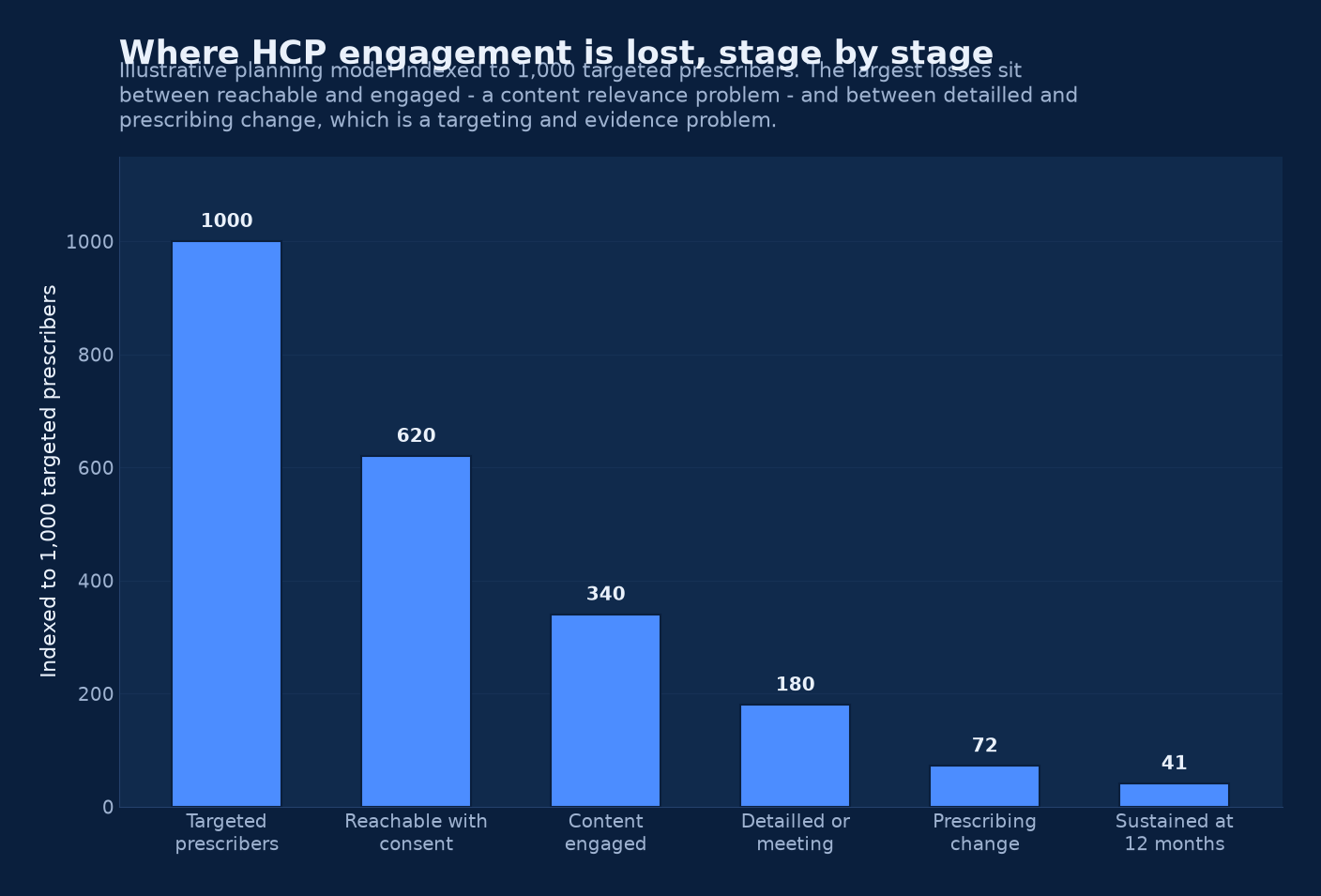
Chart values are an illustrative planning model based on typical UMC engagements and published industry benchmarks. They are not a guarantee of results on any specific project.
| Stage | Owner | What must exist | How it is measured |
|---|---|---|---|
| Targeting | Commercial with market research | Segmentation by potential, specialty, access and behaviour | Target list quality and refresh cadence |
| Reachability and consent | IT, legal and commercial | Verified contact data with a lawful basis and preferences | Share of targets reachable and consented |
| Content engagement | Medical and marketing | Relevant scientific content in the channels they actually use | Engagement depth, content completion, requests for information |
| Detailing and meetings | Field force and MSLs | Call plans, approved detail aids, recorded interactions | Coverage, frequency and call quality |
| Prescribing change | Commercial with data providers | Prescription or offtake data with a lag understood | Share movement, new prescribers, script volume |
| Sustained prescribing | Field force with analytics | Retention programmes, reminders, evidence refresh | Twelve-month retention of new prescribers |
The data lag is the part most programmes mishandle: prescription data arrives weeks or months late in many markets, so the operational measures – coverage, engagement, availability – must be managed weekly while the outcome measure is reviewed on its own cadence. predictive analytics and demand forecasting and marketing mix modelling are how the two are reconciled.
Portfolio and brand economics
Most pharmaceutical portfolios contain a mature area that pays the bills, a growth area that deserves the field effort, and a declining area that still consumes calls. Reporting the three as one revenue line is how effort gets misallocated for years. The model we build separates share of revenue, growth direction, contribution after field and medical cost, and the strategic role each brand plays – cash, growth, defence or exit – and then aligns targeting and call capacity to it.
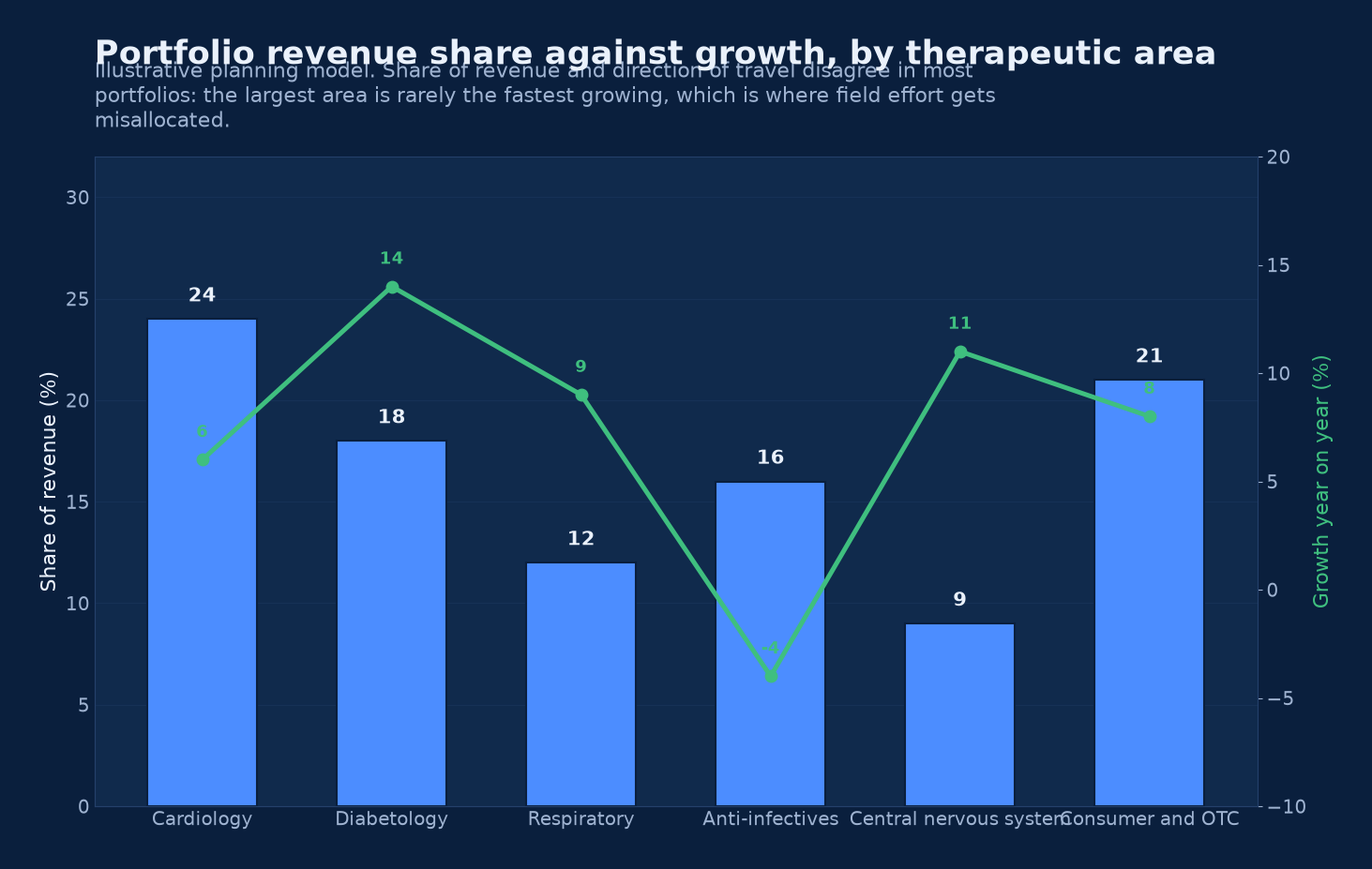
Chart values are an illustrative planning model based on typical UMC engagements and published industry benchmarks. They are not a guarantee of results on any specific project.
| Strategic role | What it means | Field and media implication | Measure |
|---|---|---|---|
| Cash brand | Mature, high share, low growth | Defend availability, minimise call cost, protect margin | Share retention and contribution |
| Growth brand | Lower share, strong growth, evidence advantage | Concentrate coverage and frequency on target prescribers | New prescribers and share movement |
| Launch brand | New entry, awareness building | Launch cadence, access work, early adopter targeting | Listing, adoption speed, first-year share |
| Defence brand | Under generic or competitor pressure | Switch-cost messaging where permitted, retention programmes | Erosion rate and retention |
| Exit or harvest | Declining, low contribution | Reduce calls, maintain availability, plan divestment | Contribution per call and stock position |
This is business strategy consulting and market research and competitive analysis applied to a portfolio, with cost rationalisation and margin recovery where the answer is to stop spending on a brand rather than to spend better.
Market access, formulary and payer evidence
A prescription is only the last step; before it, the product has to be listed, reimbursed or affordable in the setting where the patient is treated. Access work is therefore evidence work: the value story told in the payer’s language, the budget-impact model, the comparator analysis, the formulary submission, the hospital protocol conversation and the patient-access programme where one exists. Commercial teams routinely underestimate it because the cycle is longer than a brand plan and the audience reads methods sections.
| Access audience | What they need | Artefact we build | Cycle |
|---|---|---|---|
| National or state payer | Cost-effectiveness, budget impact, comparator evidence | Dossier with an evidence table and a plain-language summary | Months to years |
| Formulary committee | Clinical positioning, safety, administration burden, cost | Submission pack plus anticipated questions | Weeks to months |
| Hospital pharmacy and therapeutics | Protocol fit, dosing, wastage, storage | Protocol-aligned value summary and budget line | Weeks to months |
| Private insurer | Medical policy criteria, prior authorisation logic | Criteria mapping and authorisation support material | Weeks |
| Patient access programmes | Eligibility, consent, administration, audit | Programme design with consent and data handling | Months |
| Pharmacy channel | Margin, availability, substitution rules | Trade terms and shelf or counter guidance | Weeks |
Access work is delivered with market research, mix modelling and attribution for the value story, and content marketing discipline applied to scientific rather than promotional documents – reviewed, versioned, dated and retrievable.
The commercial technology stack we integrate with
A pharmaceutical company runs a commercial estate and a regulated estate side by side, and the integration points between them are where most programmes fail. The audit below is week one: what exists, who owns it, whether it is validated, and what it can export.
| System | What it holds | What we need from it | Common blocker |
|---|---|---|---|
| CRM and field-force system | Calls, targets, samples, interactions, content usage | Coverage, frequency and engagement per target | Configuration without a targeting model behind it |
| Prescription or offtake data | Scripts, volume, share by geography and specialty | Brand and market trend with a stated lag | Vendor licences that prohibit internal joins |
| ERP and distribution | Primary sales, stock, batch, expiry, credit | Primary versus secondary view by stockist | Secondary data arriving as spreadsheets |
| Medical information system | Queries, responses, literature requests | Response times and recurring question themes | Queries landing in shared mailboxes |
| Pharmacovigilance database | Adverse events, case processing, submissions | Intake from every digital channel with timestamps | Digital channels not routed to PV at all |
| Quality and LIMS | Batch release, deviations, stability, specifications | Availability signals and complaint themes | Separate identifiers from commercial systems |
| Content and approval system | Claims, versions, approvals, expiry dates | One source of approved claims for every channel | Approved content living in email attachments |
| Identity and consent | HCP verification, preferences, lawful basis, transfers of value | Proof of consent per contact per purpose | Consent captured per campaign, not per person |
Integration is delivered through enterprise systems integration, data warehouse and lakehouse where commercial and regulated data must meet under governance, and data engineering for AI and knowledge systems where the same corpus will feed medical information retrieval later. full-stack Java development and portal development cover HCP portals and e-detailing platforms.
Service requirements by role
| Role | The question they ask | What we deliver | The number they watch |
|---|---|---|---|
| Commercial or brand head | Is the brand plan working, and where do we spend next? | Portfolio model, targeting, campaign programmes, measurement plan | Share movement and new prescribers |
| Medical affairs | Is the science communicated accurately and within the rules? | Scientific content architecture, medical information workflow, KOL engagement | Query response time and content approval cycle |
| Market access | Are we listed, reimbursed and affordable where it matters? | Payer evidence, formulary packs, budget impact, access strategy | Listings achieved and access cycle time |
| Sales head | Is the field force covering the right people? | Targeting model, call plans, coverage and frequency analytics | Coverage of target prescribers and call quality |
| PV and regulatory | Can an adverse event reach us from any channel? | AE routing from every digital surface, capture forms, training | Intake completeness and reporting timeliness |
| IT and quality | Is the system validated, and can we evidence it? | Validation documentation, access control, backups, audit trails | Audit findings and change-control compliance |
| Finance | What did the brand cost and what did it return? | Cost per call, cost per engagement, contribution per brand | Contribution after field and medical cost |
Search, content and AI search in a regulated sector
Search behaviour splits by audience. Professionals search for mechanisms, dosing, interactions, comparators, guidelines and evidence; patients search for symptoms, conditions, side effects and support, which in most markets may only be answered with non-promotional disease information. Both need content, and both need it structured so an assistant can quote it accurately – because an assistant that guesses about a medicine is a patient-safety issue, not a marketing issue.
| Audience and query type | Permitted content | What must exist | Failure to avoid |
|---|---|---|---|
| HCP – mechanism and evidence | Scientific, referenced, non-promotional | Medical section with references and review dates | Promotional language inside scientific content |
| HCP – dosing and administration | Approved labelling only | Structured, versioned dosing information | Outdated SmPC or package insert text |
| HCP – comparators | Fair, substantiated, code-compliant comparison | Approved comparison tables with sources | Implied superiority without evidence |
| Patient – condition and symptoms | Disease awareness, when to seek care | Non-branded condition content with signposting | Brand suggestion for a prescription product |
| Patient – side effects and safety | Safety information and reporting routes | Clear AE reporting route on every page | A safety page with no way to report |
| Payer and access | Value, budget impact, evidence | Access section with downloadable summaries | Value claims without methodology |
| Assistant and AI search | Consistent, structured, sourced facts | Structured data, one source of truth per fact | Contradictory facts across pages |
Delivery runs through SEO for professional and condition queries, AI search optimisation with structured data and one source of truth per fact, content marketing with a medical review step, and local SEO for retail pharmacy and distribution locations. Every page carries a review date and an owner, because in this sector stale content is a compliance finding.
Paid media and HCP digital within the codes
Paid media here is bounded twice: by the code and by platform health policy, which frequently refuses pharmaceutical advertising outright or restricts it to certified accounts. The workable channels are professional networks, search on professional and condition queries with strict negative lists, congress and event support, e-detailing and rep-triggered communication, professional media and webinars. Consumer media is limited to what the market permits – disease awareness, OTC ranges and corporate reputation.
| Channel | Audience | What is permitted | Measured by |
|---|---|---|---|
| Professional search | HCPs and patients by query intent | Non-promotional for patients; approved claims for professionals | Qualified engagement, not clicks |
| Professional networks | Verified professionals by role and specialty | Scientific and educational content, event promotion | Engagement depth, registrations, content requests |
| E-detailing and rep-triggered | Targeted prescribers with consent | Approved detail content with an interaction record | Opens, time on content, follow-up calls |
| Webinars and CME-style events | Professionals, sometimes with credit | Educational, independent where credit is involved | Attendance, completion, questions asked |
| Congress and event support | Attendees and speakers | Booth, symposia, materials within transparency rules | Meetings held, materials requested, transfers of value logged |
| Consumer media | Public | Disease awareness and OTC only, where permitted | Awareness, consideration, retail offtake |
| Retail and pharmacy media | Shoppers and pharmacists | OTC and availability messaging | Offtake and availability |
Execution runs through Google Ads management with strict negatives and approval gates, LinkedIn advertising with B2B expertise for verified professional audiences, account-based marketing for named institutions and payer organisations, webinar and event campaigns for scientific exchange, YouTube for mechanism-of-action and patient-education content where permitted, and media planning and buying for multi-market programmes.
Websites, HCP portals and e-detailing
A pharmaceutical web estate usually has three sites pretending to be one: the corporate site, the brand site and the medical information section, plus whatever the field force uses to detail. The design problem is separation with navigation – promotional and non-promotional content must be distinguishable, access-controlled where required, and individually versioned with approvals – while the user problem is that a clinician should reach dosing information in two clicks from any entry point.
| Surface | What it must do | Failure that costs credibility | Our default |
|---|---|---|---|
| Corporate site | Company, portfolio, pipeline, careers, contact, media | A brochure with no substance and no owner | Structured corporate pages with named owners |
| Medical information section | Dosing, safety, interactions, literature, contact route | PDFs with no dates and no review trail | Versioned content with review dates and a query route |
| Brand sites (where permitted) | Approved claims, indication, safety, support | Claims that drifted from the approved version | Claims pulled from one approved source |
| HCP portal | Verified access, personalised content, e-detailing, samples | Verification that nobody completes | Fast verification, real content value, low friction |
| Adverse event route | Visible on every page, simple, timestamped | A contact form buried in the footer | Prominent AE route wired to PV intake |
| Patient support | Programme information, consent, adherence support | Support content that promotes rather than helps | Non-promotional support with consent capture |
| Accessibility and performance | Usable by every professional and patient | Heavy templates that fail on hospital networks | Accessibility testing and performance targets |
Delivery runs through website development, portal development, UX and UI design, accessibility, performance, information architecture for the promotional and non-promotional separation, mobile apps for field teams and maintenance and support with change control where the system is validated.
Field-force effectiveness and call planning
The field force is still the largest commercial cost in most pharmaceutical businesses, and it is usually managed on activity rather than outcome: calls made, coverage achieved, samples distributed. The shift that changes results is a targeting model with a reason behind each call – potential, access, behaviour, evidence need – and a call plan that specifies what the rep is trying to change, with the interaction recorded in a way that analytics can read.
| Component | Design decision | Failure mode | Measurement |
|---|---|---|---|
| Segmentation and targeting | Potential, access, behaviour, specialty, geography | Targets inherited from a previous manager | Target list quality, refresh cadence |
| Call plan | Objective per call, content used, next step | Calls recorded as a number with no content | Objective completion and follow-up rate |
| Coverage and frequency | Calls per target per quarter by segment | High frequency on comfortable, low on high-potential | Coverage of target list, frequency balance |
| Content usage | Which approved asset, which version, which claim | Reps using personal decks | Asset usage and version compliance |
| Sample and gift control | Limits, records, transparency disclosure | Samples recorded loosely or not at all | Sample accountability and audit findings |
| Coaching | Field coaching with a rubric, not a personality assessment | Ride-alongs with no recorded outcome | Rubric scores and improvement trend |
| Incentive design | Rewards the behaviour the strategy needs | Volume-only incentives that buy primary sales | Secondary sales and share movement |
sales and pipeline analytics provides the reporting, CRM development and integration the system, and market research the segmentation evidence. Where the field model itself is the problem – too many calls, too little medical presence – that is a strategy question and we say so.
Distribution, availability and retail visibility
A prescription that cannot be filled is a lost patient and a damaged prescriber relationship, so availability is a commercial metric with a supply-chain owner. The discipline is separating primary from secondary sales – what was shipped to stockists versus what was sold through pharmacies – and then measuring the last mile: is the product present, in the right pack size, at the right price, with the pharmacist able to answer the substitution question.
| Element | What we measure | Common failure | Fix |
|---|---|---|---|
| Primary versus secondary | Shipments to stockists versus offtake to pharmacies | Primary sales celebrated while channel stock builds | Both reported weekly with a stock-days view |
| Stockist coverage | Active stockists by geography and class | Dormant stockists counted as coverage | Activity-based coverage definition |
| Pharmacy availability | Presence by chain and independent, pack size, price | Availability audited once a year | Sampled audits with a cadence and a photo record |
| Expiry and returns | Near-expiry stock, returns, write-offs | Write-offs discovered at year end | Expiry dashboards with alert thresholds |
| Trade terms | Margin, schemes, credit, settlement behaviour | Schemes that buy primary sales and damage margin | Scheme effectiveness by stockist class |
| Pharmacist communication | Substitution rules, counselling points, availability | Pharmacists learning about a change from a patient | Communication flow with a named owner |
| Counter and shelf execution | Placement, visibility material, compliance | Materials sent and never verified | Verification visits or photo evidence |
The consumer-health and OTC side of this work uses the same disciplines as retail: local SEO for pharmacy locations, retail media where the market has it, and the reporting described in BI dashboards. Our manufacturing vertical covers the production and distribution side for companies that also make the product.
Adverse events from any channel: the process most programmes forget
Every channel a pharmaceutical company opens can carry an adverse-event report: a comment under a post, a message to a portal, a review, a call to a support line, a reply to a webinar question, a chat with an assistant. Regulatory expectation is straightforward – capture it, timestamp it, hand it to pharmacovigilance within the required window – and the operational reality is that the person who received it works in marketing and has never been trained. Building the routing is therefore part of the digital programme, not an addition to it.
| Channel | How an AE arrives | Routing rule | Evidence kept |
|---|---|---|---|
| Website and portal forms | A field in a contact or support form | Dedicated AE field, immediate queue to PV | Timestamp and submission record |
| Social comments and messages | A public comment or direct message | Monitoring with AE keywords, same-day handover | Screenshot or export with timestamp |
| Medical information queries | A clinician asking about a case | Query system flags and routes case-level detail | Query record with response |
| Calls and support lines | A patient or relative describing an event | Scripted capture form, immediate PV notification | Call record and capture form |
| Field force interactions | A rep hearing it during a call | Mandatory same-day reporting route in the CRM | CRM interaction with AE flag |
| Chat and AI assistants | A user describing symptoms after a dose | Hard stop, human handover, no clinical advice | Transcript with escalation timestamp |
| Reviews and third-party sites | A review mentioning an event | Monitoring with a defined sweep cadence | Export with source and date |
The training is short and repeated: recognise, capture, route, do not advise. It belongs in enablement for every team that touches a public channel, and the routing rules belong in AI governance for anything automated. We write the process with your PV function and test it before launch, because an untested AE route is a route that will fail on the first real case.
Business intelligence: share, availability and spend in one view
Pharmaceutical reporting has three truths that rarely meet: prescription or offtake data with a lag, primary and secondary sales from the ERP, and field activity from the CRM. The dictionary work matters more here than in most sectors because the numbers are used for incentive payments as well as decisions, and because external data licences restrict what may be joined with what.
| Metric | Definition that must be fixed | Why it is contested | Refresh |
|---|---|---|---|
| Market share | Volume or value, with the market definition stated | Market boundaries redrawn to flatter a brand | Per data lag |
| Prescriber coverage | Targets called over targets defined, in the period | Target lists changed mid-period | Weekly |
| Call frequency | Calls per covered target per quarter by segment | Calls logged without content or objective | Weekly |
| Primary versus secondary | Shipments versus offtake with stock days | Primary reported as demand | Weekly |
| Availability | Pharmacy presence by sample and geography | Audited too rarely to act on | Monthly |
| Cost per engagement | Programme cost over qualified engagements, not clicks | Clicks reported as engagement | Monthly |
| Contribution per brand | Revenue less field, medical and variable cost | Medical cost allocated to nothing | Monthly |
| Query and AE handling | Medical information response time, AE intake completeness | Queries logged in mailboxes | Weekly |
Forecasting on top of this – launch uptake curves, generic entry erosion, seasonal respiratory demand, tender timing – turns the brand plan from a narrative into a range with a confidence attached. The practices are BI dashboards and executive reporting, predictive analytics and demand forecasting, marketing mix modelling and attribution and data warehouse and lakehouse with the licence constraints documented.
Artificial intelligence in pharma, sequenced by value against risk
This sector has both the largest potential gains from AI and the least tolerance for an unreviewed output. We start where a human already reviews everything: literature monitoring and summarisation, medical information drafting from the approved corpus, adverse-event intake triage with a human deciding, field coaching analysis, content versioning and claims checking, and demand forecasting. We do not deploy anything that answers a clinical question without grounding in your approved content, and nothing that contacts a professional or patient without a lawful basis and a human owner.
| Use case | Value | Risk | Human in the loop |
|---|---|---|---|
| Literature monitoring and summarisation | Medical teams stop missing relevant publications | Medium – a missed or misread study | Medical reviewer signs every summary |
| Medical information drafting | Faster, consistent responses from the approved corpus | Medium – an ungrounded answer becomes a claim | Medical information specialist approves |
| Adverse-event intake triage | Faster recognition from unstructured channels | High if wrong – a missed case is a regulatory failure | PV professional makes every determination |
| Claims and content checking | Catches drift from the approved version | Low-medium | Regulatory reviewer approves |
| Field coaching analysis | Patterns in call quality across a large team | Medium – fairness and employment exposure | Manager reviews with the rep |
| Demand and uptake forecasting | Better launch planning and supply | Medium – a wrong forecast costs stock or availability | Commercial confirms the plan |
| Clinical decision or diagnosis support | Potentially high | High – regulatory clearance required | Not deployed without clearance and governance |
The practice set is AI readiness assessment, AI agents and automation, AI integration with ERP and CRM, data engineering for AI and knowledge systems for the approved-corpus retrieval layer, AI governance, risk and compliance, enablement and ROI measurement. In this sector the governance workstream produces the validation-style evidence your quality function will ask for.
IT, validation and data residency
Pharmaceutical IT is two disciplines at once: keeping the commercial estate running and keeping the regulated estate evidenced. Systems that touch product quality, patient safety data or approved claims need change control, audit trails, access reviews, backup and restore evidence, and documentation that survives an inspection. The commercial estate needs the ordinary disciplines – uptime, security, cost control – plus one addition: data residency and transfer rules, because patient and professional data frequently may not leave the market it was collected in.
| Area | What we put in place | Why it matters here | Evidence produced |
|---|---|---|---|
| System inventory and criticality | Every system with GxP relevance stated | Validation effort must be spent where it matters | Inventory with criticality and GxP flag |
| Change control | Versioned releases with approval and rollback | An uncontrolled change to a validated system is a finding | Change records and approvals |
| Access and audit trails | Role-based access, MFA, immutable logs, joiners and leavers | Inspectors ask who changed what and when | Access reviews and log samples |
| Backup and recovery | Tested restores with retention aligned to record rules | Records must survive for years, not months | Timed restore records |
| Security baseline | Controls mapped to your standard and customer expectations | Partner audits and cyber insurance both ask | Baseline checklist and gap list |
| Data residency | Storage and transfer rules per market | Patient and professional data may not leave jurisdiction | Residency statement per system |
| Vendor management | Contracts with audit rights, exit and data return | A vendor that will not return your data is a compliance risk | Vendor register with terms |
The practices are managed IT and AMC, helpdesk and end-user support, cybersecurity, backup and disaster recovery, IT audit, compliance and ISO or SOC 2 readiness, cloud services and migration, cloud security posture management, network engineering, DevOps and CI/CD and SRE and observability for the digital estate that field teams depend on daily.
Manufacturing, quality and serialisation support
For companies that also make the product, the commercial programme sits beside a production and quality estate with its own data: batch records, deviations, stability, yield, serialisation and track-and-trace, complaints and recalls. The commercial relevance is direct – availability drives prescriptions, a recall destroys a brand’s reputation faster than any campaign can rebuild it, and complaint themes are the earliest signal of a quality problem the market will notice.
| Area | Commercial relevance | What we do | Measured by |
|---|---|---|---|
| Batch and deviation data | Availability and confidence in supply | Reporting that connects deviations to supply risk | Deviation trend and supply incidents |
| Stability and shelf life | Expiry management, stock rotation, returns | Expiry dashboards with alert thresholds | Write-offs and near-expiry stock days |
| Serialisation and track-and-trace | Market requirements, anti-counterfeit | Integration and reporting for the markets that require it | Submission success and exceptions |
| Complaints and recalls | Brand trust and prescriber confidence | Complaint theme analysis with a commercial feedback loop | Complaint trend and recall response time |
| Yield and cost | Margin per pack and pricing flexibility | Cost per unit reporting with the allocation rule stated | Cost per unit and contribution |
| Capacity planning | Launch volumes and tender commitments | Demand forecast joined to capacity | Forecast accuracy and service level |
This is the manufacturing and industrial discipline applied inside a GMP environment, with cost rationalisation and margin recovery where the pack economics do not support the price the market will bear.
Multi-market and affiliate operations
Pharmaceutical companies are usually federations: a head office that owns the molecule, the global claims and the brand strategy, and affiliates that own the market rules, the field force, the payers and the local language. Digital programmes fail in that structure when the centre publishes a platform the affiliates cannot use legally, or when each affiliate builds its own and the global claims leak. The working model is a central approved-content library with market variants, central governance with local interpretation, and reporting that consolidates without flattening.
| Layer | Central | Affiliate or market | Shared artefact |
|---|---|---|---|
| Claims and content | Global claims library, core brand platform, approval workflow | Market variants, local codes, translations | One claims source with versions |
| Governance | Policy, code interpretation, escalation route | Local legal and medical sign-off | Governance pack with market appendices |
| Platforms | CRM, portal, analytics, consent architecture | Configuration, language, residency | One platform, documented configurations |
| Measurement | Global definitions and consolidated view | Local data sources and lag | One dictionary |
| Field model | Segmentation logic, incentive framework | Target lists, call capacity, local channels | Targeting methodology |
| Access | Global value story and evidence | Payer conversations, dossiers, pricing | Evidence library |
market expansion consulting covers entry sequencing, unified top-level business management the governance question above it, and cloud cost optimisation the platform spend that grows invisibly across affiliates.
How an engagement runs: the first ninety days
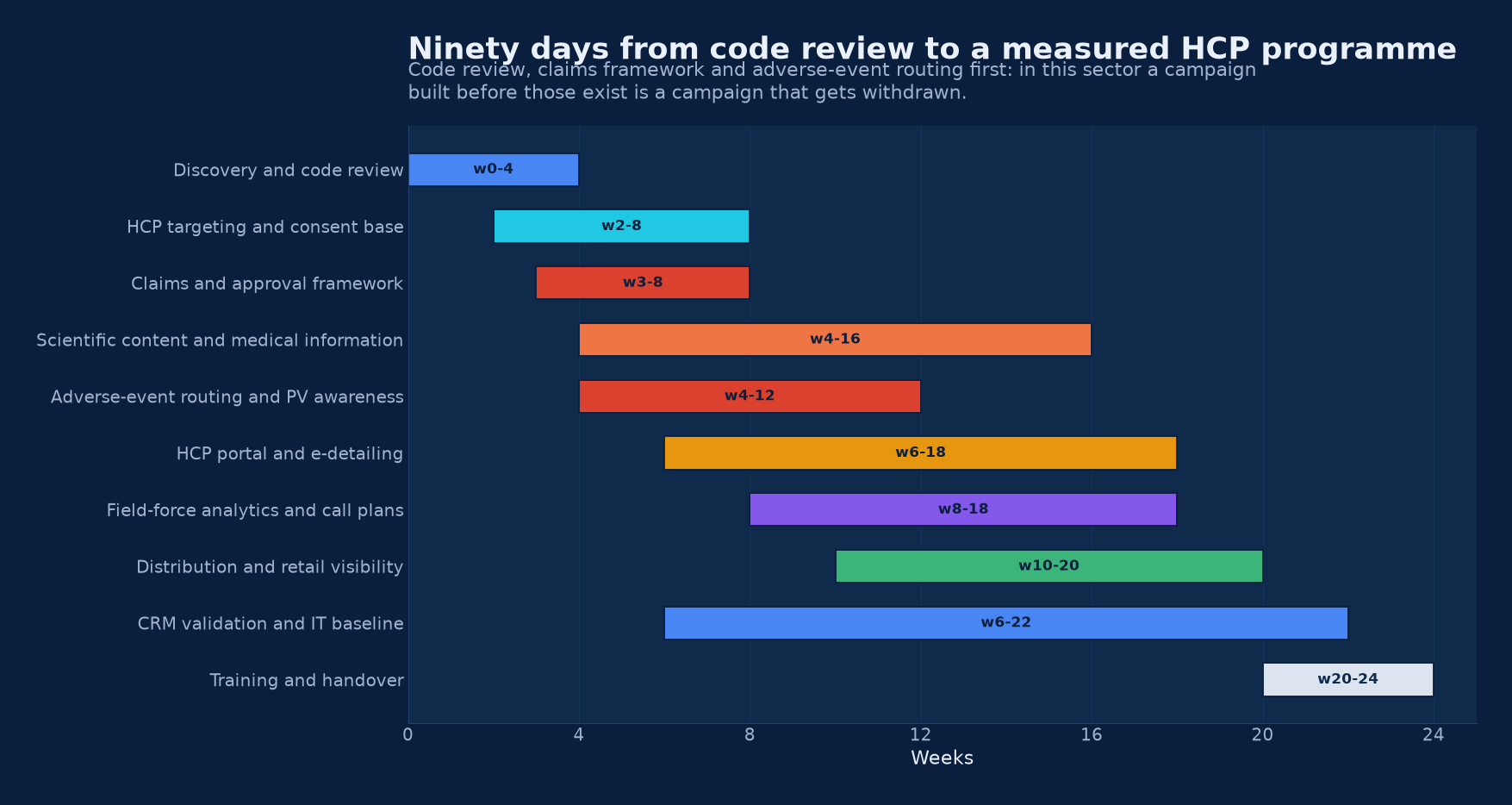
Chart values are an illustrative planning model based on typical UMC engagements and published industry benchmarks. They are not a guarantee of results on any specific project.
Weeks one to four are discovery: the code and platform-policy review, the systems audit including what is validated, the portfolio and brand economics model, and the HCP targeting baseline. The claims and approval framework is signed off by week eight, and no campaign runs before it. Adverse-event routing is designed and tested by week twelve. Scientific content and the medical information architecture run to week sixteen. The HCP portal and e-detailing build from week six to eighteen. Field-force analytics and call plans land by week eighteen, distribution and retail visibility by week twenty, CRM validation and the IT baseline by week twenty-two, and training and handover close the programme.
| Deliverable | Week | What the company keeps |
|---|---|---|
| Code and policy review | 4 | What is permitted per market and per platform |
| Systems audit and validation status | 4 | Inventory with GxP flags and gaps |
| Portfolio and brand economics model | 8 | Strategic role per brand, effort aligned |
| Claims register and approval workflow | 8 | One source of approved claims |
| Adverse-event routing and training | 12 | A tested route from every channel |
| HCP targeting and consent base | 8 | Target list with lawful basis per contact |
| Scientific content architecture | 16 | Versioned, reviewed, dated content library |
| HCP portal and e-detailing | 18 | A verified-access surface the field can use |
| Field-force analytics and call plans | 18 | Coverage, frequency and call quality |
| Distribution and retail visibility | 20 | Primary versus secondary with availability |
| CRM validation and IT baseline | 22 | Change control, audit trails, evidence pack |
| Training and handover | 24 | Runbooks, recordings, named owners per workstream |
Pricing and engagement models
| Model | Best for | What it includes | Commercial shape |
|---|---|---|---|
| Assessment and code review | A company that needs the boundaries before spending | Code and policy review, systems audit, portfolio model, written verdict | Fixed fee, three to four weeks |
| Programme build | A brand or affiliate launching a digital commercial model | Claims framework, content, portal, field analytics, AE routing, IT baseline | Fixed fee by workstream, ninety-day core |
| Managed retainer | An affiliate that wants it run | Content upkeep, campaigns, portal, reporting, IT support hours | Monthly, agreed scope, quarterly review |
| Fractional leadership | A company between hires | Digital commercial, medical affairs or IT leadership part-time | Monthly, time-boxed with a handover plan |
Every model separates the assessment from the build, and every model assumes your medical, legal and regulatory reviewers are part of the process rather than a gate at the end – which is the single biggest determinant of whether the work ships.
Compliance, codes and claims
The compliance layer is not a section of the programme; it is the programme’s operating system. National codes, industry association codes, platform health policies, transfer-of-value transparency rules, sample and gift limits, sponsorship rules, data protection and residency requirements all apply simultaneously, and they differ by market. We therefore build one register with market appendices rather than several competing policies.
| Area | What we check | Where it shows up | Owner |
|---|---|---|---|
| Promotional claims | Approved wording, indication, references, fair balance | Every channel and every asset | Regulatory and medical |
| Non-promotional content | Separation from promotion, scientific accuracy | Medical information, disease awareness | Medical affairs |
| Transparency | Transfers of value, sponsorship, consultancy fees | Events, advisory boards, KOL work | Compliance and finance |
| Samples and gifts | Limits, records, prohibited items | Field force activity | Commercial with compliance |
| Consent and data | Lawful basis, purpose limitation, residency, retention | HCP and patient contact, portals, analytics | Named data owner |
| Adverse events | Intake from every channel, timeliness, training | All public and private channels | PV with commercial |
| Interactions with payers | Appropriate channels and evidence | Access meetings and dossiers | Market access |
| Digital asset lifecycle | Version, approval, expiry, withdrawal | Sites, portals, campaigns, materials | Marketing with regulatory |
AI governance, risk and compliance covers anything automated, IT audit and compliance readiness produces the system evidence, and both are run inside the programme timeline rather than after it.
How we measure success
| Outcome | Metric | Baseline source | Review cadence |
|---|---|---|---|
| Share and prescribing movement | Market share, new prescribers, retention | Prescription or offtake data with a stated lag | Per data cycle |
| Reach and engagement quality | Coverage of targets, engagement depth, content requests | CRM and portal analytics | Monthly |
| Field effectiveness | Coverage, frequency, call objective completion | CRM | Weekly during build |
| Availability | Secondary sales, pharmacy presence, stock days | ERP and audits | Weekly |
| Access progress | Listings, formulary decisions, payer meetings | Access log | Monthly |
| Compliance health | Approval cycle time, claims drift, AE intake completeness | Approval system and PV log | Monthly |
| Medical information quality | Query volume, response time, recurring themes | Medical information system | Monthly |
| Honest spend | Cost per qualified engagement, contribution per brand | Finance and campaign data | Quarterly |
We report the compliance measures alongside the commercial ones, deliberately: a programme that grows share while approval cycle times lengthen is accumulating risk, and management deserves to see both lines in the same view.
Proof: healthcare and life sciences work we have delivered
Our published work in this space spans medical companies across markets, patient-facing programmes and large healthcare institutions – the common thread is regulated content, consent-handled data and measurement that survives scrutiny.
Related Services
Healthcare and life sciences case studies:
- A renowned medical company in Africa
- Medical tourism company – international patient programme
- Apollo Hospitals – digital engagement
- Medicity Hospitals – digital engagement
- Global Hospitals – digital engagement
Confidentiality in this sector is contractual as well as cultural, so we share method, numbers and constraints under a non-disclosure agreement rather than publishing the company.
Every capability a pharma or life sciences company can draw on
| Family | Capabilities | Typical pharma use |
|---|---|---|
| Demand capture | SEO, AI search optimisation, content marketing, local SEO | Professional and condition queries, medical information, pharmacy locations |
| Paid media | Google Ads, LinkedIn, ABM, webinars and events, YouTube, media planning | Verified professional audiences, congress support, education |
| Brand and content | brand performance and creative production, social media management | Mechanism-of-action content, disease awareness, corporate reputation |
| Build | website development, HCP portals, UX and UI, accessibility, performance, field apps, full-stack Java | Promotional and non-promotional separation, e-detailing, support sites |
| Customer and consent data | CRM development and integration, automation, nurturing, lifecycle, email, WhatsApp | HCP base with lawful basis, rep-triggered communication, preference centres |
| Intelligence | dashboards, forecasting, field and pipeline analytics, mix modelling, warehouse and lakehouse | Share, availability, coverage, launch forecasting |
| Consulting | strategy, market research, market expansion, cost and margin, cash flow, unified management | Portfolio strategy, access, launch planning, turnaround |
| Infrastructure | managed IT, helpdesk, cybersecurity, backup and DR, audit, cloud, cloud security posture, networks, DevOps | Validated systems, residency, evidence packs, uptime |
| Artificial intelligence | readiness, agents, integration, data engineering, governance, enablement, ROI | Literature monitoring, medical information drafting, AE triage, forecasting |
Local teams: pharmacy, manufacturing and prescriber programmes
These pages are written to be geography-neutral because the work is delivered remotely. For companies that want a provider in their own market, the local pages carry regional detail across pharmacy retail, manufacturing and prescriber-facing programmes.
- Get more pharmacy customers in Lucknow
- Digital marketing company for manufacturers in Lucknow
- Website development company for manufacturers in Lucknow
- Digital marketing company for hospitals in Lucknow
- Digital marketing company for doctors in Lucknow
- Digital marketing and IT services across Indian cities
- Contact us
Related industry verticals
Pharmaceutical and life sciences work sits beside the healthcare provider verticals – hospitals, clinics and doctors – and the wider programme covers retail, showrooms, food service, hospitality and manufacturing on one shared method.
Frequently asked questions about pharmaceutical marketing, data and IT
Can you advertise prescription medicines to patients?
Not in most markets, and we will not. What we do build is non-promotional disease awareness, support programmes and OTC or consumer-health communication where the market permits it.
How do you keep content compliant across markets?
With one central claims register and market appendices, an approval workflow that names the medical and regulatory reviewer, version control, and expiry dates so stale content is withdrawn automatically.
Can you handle adverse events arriving through social channels?
Yes – that is a designed part of every programme: monitoring with AE keywords, a same-day handover to pharmacovigilance, timestamped evidence, and repeated training for anyone who touches a public channel.
Do you implement pharmaceutical CRM systems?
We implement and integrate CRM with a targeting model behind it, change control, access reviews and audit trails where the system is in scope for validation.
How do you measure marketing when prescription data lags?
By managing operational measures weekly – coverage, engagement, availability, query response – and reviewing the outcome measure on the data’s own cadence, with mix modelling to connect them.
Can you support market access and formulary work?
Yes: payer evidence packs, budget-impact models, formulary submissions, anticipated-question libraries and the value story in the payer’s language, with medical sign-off.
Do you work with generics and CDMO businesses?
Yes, and the emphasis shifts: availability, tender discipline, price erosion defence, distribution depth and B2B technical content rather than brand promotion.
What about medical device and diagnostics companies?
Same framework with device-specific rules: clinical evaluation content, user training, incident reporting routes analogous to adverse events, and procurement-led access work.
Can AI draft medical information responses?
It can draft from your approved corpus with a medical information specialist approving every response. Ungrounded generation in this sector produces claims, which is precisely what the codes prohibit.
How do you handle data residency?
By documenting storage and transfer per system and market before build, and choosing hosting and analytics accordingly rather than discovering the constraint at go-live.
Do you support field-force training?
Yes – call objective design, approved content usage, sample and gift control, adverse-event recognition and the coaching rubric that makes improvement measurable.
Can you work with our existing agency?
Yes, usually as the governance, data and platform layer while a creative agency produces assets. We define the claims source and the approval workflow so both sides ship compliantly.
Do you work outside India?
Yes. Programmes are delivered remotely and written geography-neutral, with national codes, platform policies, residency and transparency rules handled per market inside the engagement.
Start with the code review, the claims register and the portfolio model
Give us four weeks with your codes, your approved content, your CRM and your prescription or offtake data, and we will return the claims register with market appendices, the portfolio and brand economics model, the adverse-event routing design and a written verdict including what we would not start with – yours to keep either way.
Contact Unified Management Consulting to arrange a confidential first conversation.