
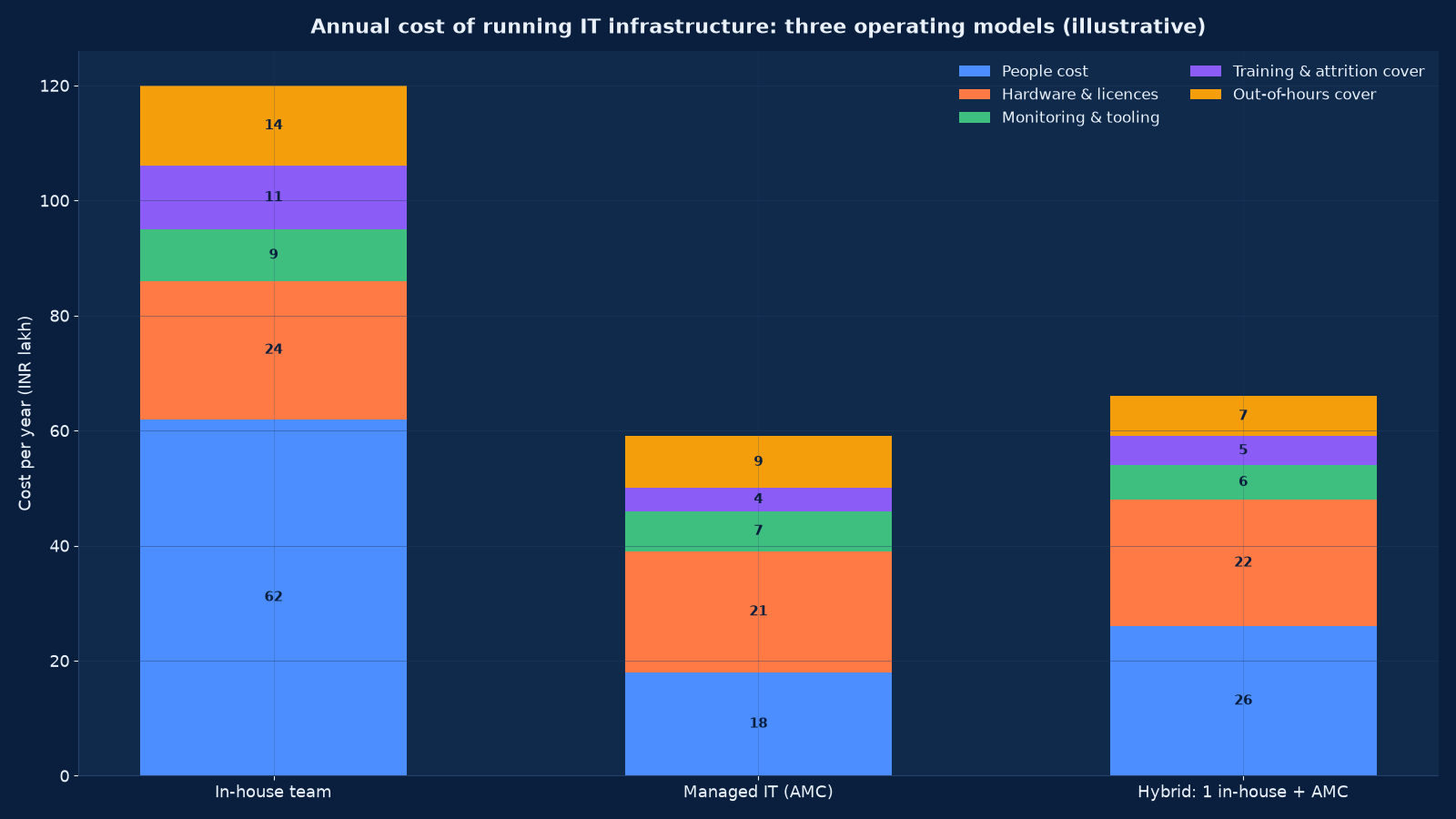
Chart values are an illustrative planning model based on typical UMC engagements and published industry benchmarks. They are not a guarantee of results on any specific project.
Infrastructure does not fail loudly. It fails in the small hours, on a Friday, on a device nobody has documented, restored by someone who is already handing in their notice. A managed service is not really about saving money — it is about making that sentence untrue.
Managed IT infrastructure is the ongoing operation of your servers, storage, network, endpoints, backups and monitoring under a defined service level, delivered as an annual maintenance contract rather than as a series of break-fix invoices. Unified Management Consulting runs this as a documented service with named engineers, published response and restoration targets, monthly reporting and a quarterly service review — not as an arrangement where somebody’s phone number is the support process.
🖧️ Managed IT Infrastructure & IT AMC — Quick Summary
| Component | What We Deliver |
|---|---|
| Asset & dependency discovery | Every server, VM, container, network device, storage volume, endpoint, licence and SaaS application inventoried with owner, criticality tier, dependencies and end-of-support dates. |
| 24×7 monitoring & alerting | Availability, capacity, performance, security events and backup outcomes monitored with thresholds tuned per asset and alert routing that reaches a person, not a shared inbox. |
| Patch & vulnerability management | Scheduled operating-system, firmware, hypervisor and application patching inside agreed windows, with critical vulnerabilities remediated to a published clock. |
| Backup verification | Backup jobs monitored daily and restores tested on a schedule — a backup that has never been restored is an assumption, not a control. |
| Proactive maintenance | Capacity trending, log review, certificate and domain expiry tracking, firmware currency and hardware health, actioned before it becomes an incident. |
| Incident & problem management | Defined severity levels with response and restoration targets, escalation matrix, root-cause analysis on repeat incidents and a known-error database. |
| Documentation & runbooks | Network diagrams, configuration baselines, credential custody, runbooks per critical system and a change log — maintained as part of the service, not at the end of it. |
| Reporting & service review | Monthly service report against SLA with trend data, and a quarterly review covering capacity, risk, spend and the improvement backlog. |
This service is the operational backbone behind Cybersecurity Services, Routing, Switching, Firewall & Network Engineering and Computing, Server, Storage & Data Centre Engineering. We have delivered it end to end — see our IT infrastructure management case study.
The Problems an AMC Actually Solves
Organisations rarely buy a managed service because they want one. They buy it after a specific bad week. The patterns below are what we find most often during discovery, and each one has a structural cause rather than a staffing one.
| Symptom | What it usually means underneath | What a managed service changes |
|---|---|---|
| The same server fails every few months | No problem management — incidents are closed, not investigated | Root-cause analysis on repeat incidents with a tracked known-error database |
| Nobody knows what is running where | No asset register and no dependency map | Discovery, inventory and criticality tiering, refreshed quarterly |
| Patching happens after an incident | No scheduled maintenance window and no patch ownership | Published patch calendar with critical-vulnerability clocks |
| Backups “run green” but nobody has restored | Job status treated as proof of recoverability | Scheduled restore tests with results reported |
| Support depends on one person | Single-person knowledge with no documentation | Runbooks, credential custody and a team with shared context |
| IT spend is unpredictable | Break-fix billing plus emergency hardware purchases | Fixed annual contract with planned lifecycle budgeting |
| After-hours failures wait until morning | No out-of-hours rota | 24×7 monitoring with an on-call escalation path |
The unifying theme is that break-fix support optimises for the invoice, not for the environment. Nobody is paid to notice that a disk array has been at 88% capacity for three months, or that a TLS certificate expires in nine days. A managed contract changes the incentive: the provider’s cost rises when the environment is unstable, so stability becomes commercially rational.
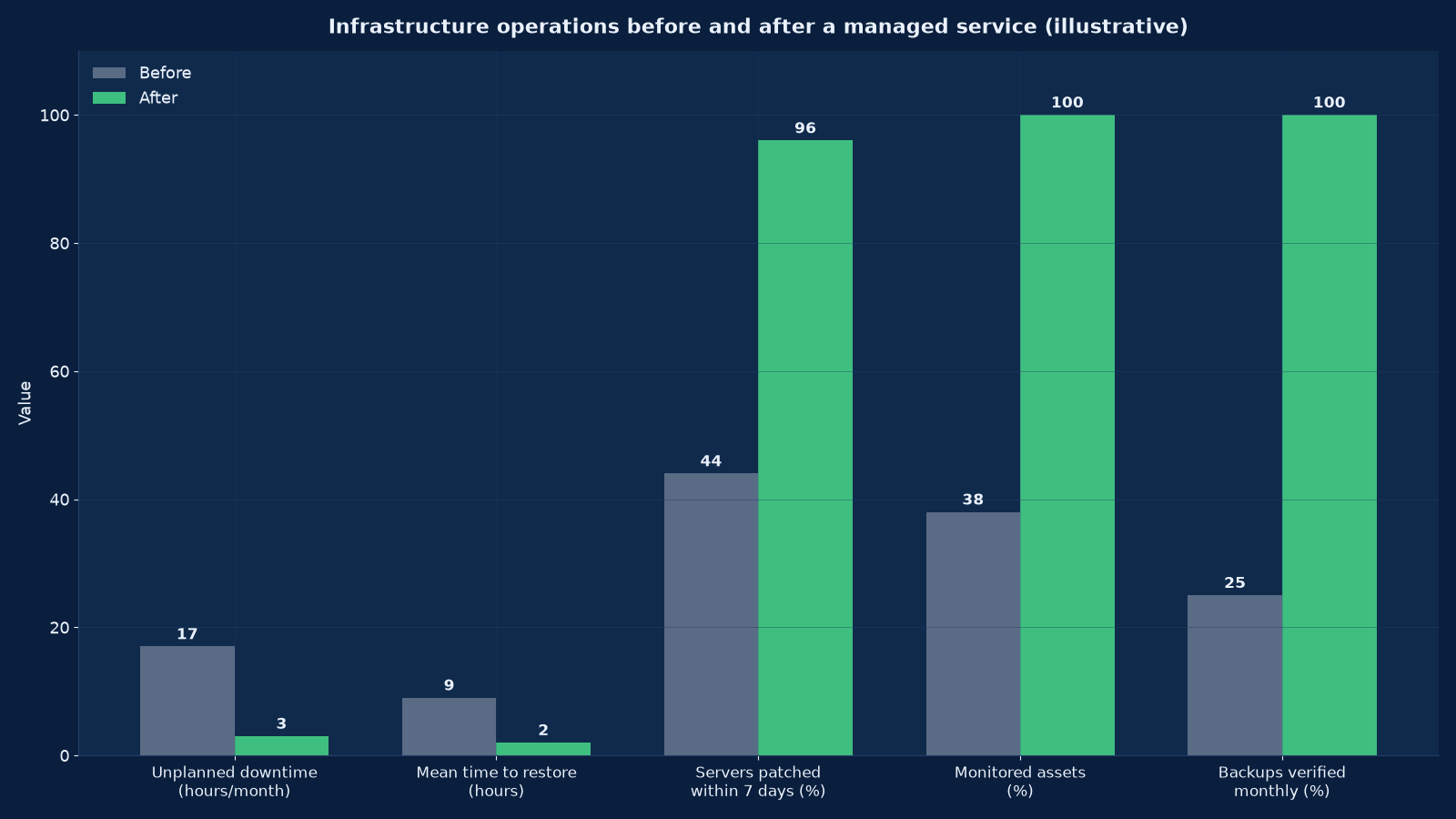
Chart values are an illustrative planning model based on typical UMC engagements and published industry benchmarks. They are not a guarantee of results on any specific project.
Service Levels: Response, Restoration and Severity
A service level is only meaningful if severity is defined by business impact rather than by who shouts loudest. The tiering below is the structure we start from and then adjust to your actual dependency map.
| Tier | Covered | Response target | Restoration target | Typical assets |
|---|---|---|---|---|
| Tier 1 — Critical | 24×7 | 15 minutes | 4 hours | Customer-facing systems, core network, domain controllers, production database servers |
| Tier 2 — Business-critical | 24×7 | 1 hour | 8 business hours | ERP, finance systems, file services, email and collaboration, primary storage |
| Tier 3 — Important | Business hours | 4 business hours | 2 business days | Internal applications, print services, non-production environments, most endpoints |
| Tier 4 — Standard | Business hours | 1 business day | 5 business days | Peripheral devices, individual software issues, non-urgent requests |
Three points that separate a real SLA from a marketing one. Response is not resolution — both are measured and both are reported. The clock is defined — business hours versus calendar hours, with holidays stated. Breach has a consequence — service credits, a remediation plan, or an exit right; without one of the three the target is aspirational.
What an AMC Should Cover — and What It Usually Does Not
Scope disputes are the most common cause of friction in year one. Define the boundary in writing before signature, asset class by asset class.
| Scope area | Included | Typical exclusions to negotiate |
|---|---|---|
| Servers & virtualisation | OS patching, health monitoring, capacity trending, VM lifecycle, hypervisor management | Application-level code changes; database tuning beyond baseline |
| Storage | Capacity monitoring, volume management, snapshot policy, performance alerting | Physical array replacement parts (usually a vendor contract) |
| Network | Switch, router, firewall and wireless configuration management, monitoring, firmware | Structured cabling works; carrier fault management beyond escalation |
| Endpoints | OS and application patching, antivirus and EDR management, disk encryption, asset tracking | Physical repair and hardware warranty handling |
| Backup | Job monitoring, retention policy enforcement, scheduled restore verification | Secondary site costs and immutable storage consumption |
| Identity & access | User provisioning and de-provisioning, MFA management, group policy, privileged access review | Full IAM platform implementation |
| SaaS & licences | Renewal tracking, licence utilisation reporting, admin configuration | Commercial negotiation of vendor agreements |
| Security operations | Alert triage, vulnerability scanning, patch remediation | Penetration testing and full SOC service (see our cybersecurity offering) |
The exclusions column is not a criticism — it is what keeps the fixed price honest. The problem arises when exclusions are discovered during an incident rather than agreed during negotiation. Where security operations scope is needed beyond triage, that belongs with Cybersecurity Services, and where the network needs redesign rather than operation, with our network engineering service.
Commercial Models and Their Trade-offs
The pricing model determines behaviour more than the price does. Choose the one whose incentives match what you actually need.
| Model | How it is priced | Advantage | Risk to watch |
|---|---|---|---|
| Per-device / per-user | Fixed monthly rate per endpoint, server or named user | Simple to budget and easy to audit | Encourages under-reporting of assets; poor fit for heterogeneous estates |
| Tiered bundle | Banded by estate size with defined scope per band | Predictable, scales with growth | Band boundaries create step-costs; renegotiation needed as you grow |
| Monitoring-only | Lower fee for monitoring and alerting, work billed separately | Cheapest entry point; visibility without commitment | Alerts arrive but remediation is still break-fix, so the benefit is limited |
| Fully managed (all-inclusive) | Single fee covering monitoring, maintenance and remediation | Aligned incentives; genuinely predictable cost | Highest fee; scope must be tightly defined or disputes follow |
| Co-managed | Your internal team keeps some layers, we take the rest | Retains internal capability while covering gaps and out-of-hours | Requires a clean handover definition per task, not per system |
| Hours bank | Pre-purchased block of engineering hours | Flexible for project-shaped work | Not a managed service — no proactive cover, and the bank runs out at the worst moment |
For most organisations between twenty and five hundred endpoints with some server infrastructure, fully managed or co-managed produces the best outcome, because the provider carries the cost of instability. Monitoring-only is a legitimate stepping stone where budget is genuinely constrained, provided everyone understands that detection without remediation leaves the risk where it was.
Transition and Onboarding: The First Twelve Weeks
Most managed service failures are onboarding failures. The provider takes over an environment they do not understand, inherits an undocumented estate, and spends six months reacting instead of stabilising. Figure 3 shows the sequence we run.
- Weeks 1–3 — Discovery. Automated and manual inventory, dependency mapping, criticality tiering, end-of-support identification, credential collection under custody, and a current-state risk list. Nothing is changed yet.
- Weeks 2–5 — Baseline. Monitoring agents deployed, alert thresholds set per tier, documentation started, access provisioned on least privilege, and the existing backup position verified by an actual restore test.
- Weeks 4–8 — Catch-up. The remediation backlog worked down: patch debt, failing backups, expired certificates, firmware gaps, unencrypted endpoints, orphaned accounts. This is the unglamorous phase that determines whether year one is calm.
- Weeks 7–9 — Runbooks. Recovery procedures written and tested for every Tier 1 and Tier 2 system, with the escalation matrix agreed and rehearsed.
- Weeks 9–11 — Service levels live. Targets measured, reporting running, first monthly report issued and reviewed with the business.
- Week 11–12 — Handover to steady state. Ownership confirmed, the improvement backlog prioritised, and the first quarterly review scheduled.
Two rules make this work. First, discovery before change — modifying an environment you have not mapped causes outages. Second, the catch-up phase is explicitly funded and scheduled, because inherited patch and backup debt is real work and pretending otherwise is how month three becomes a dispute.
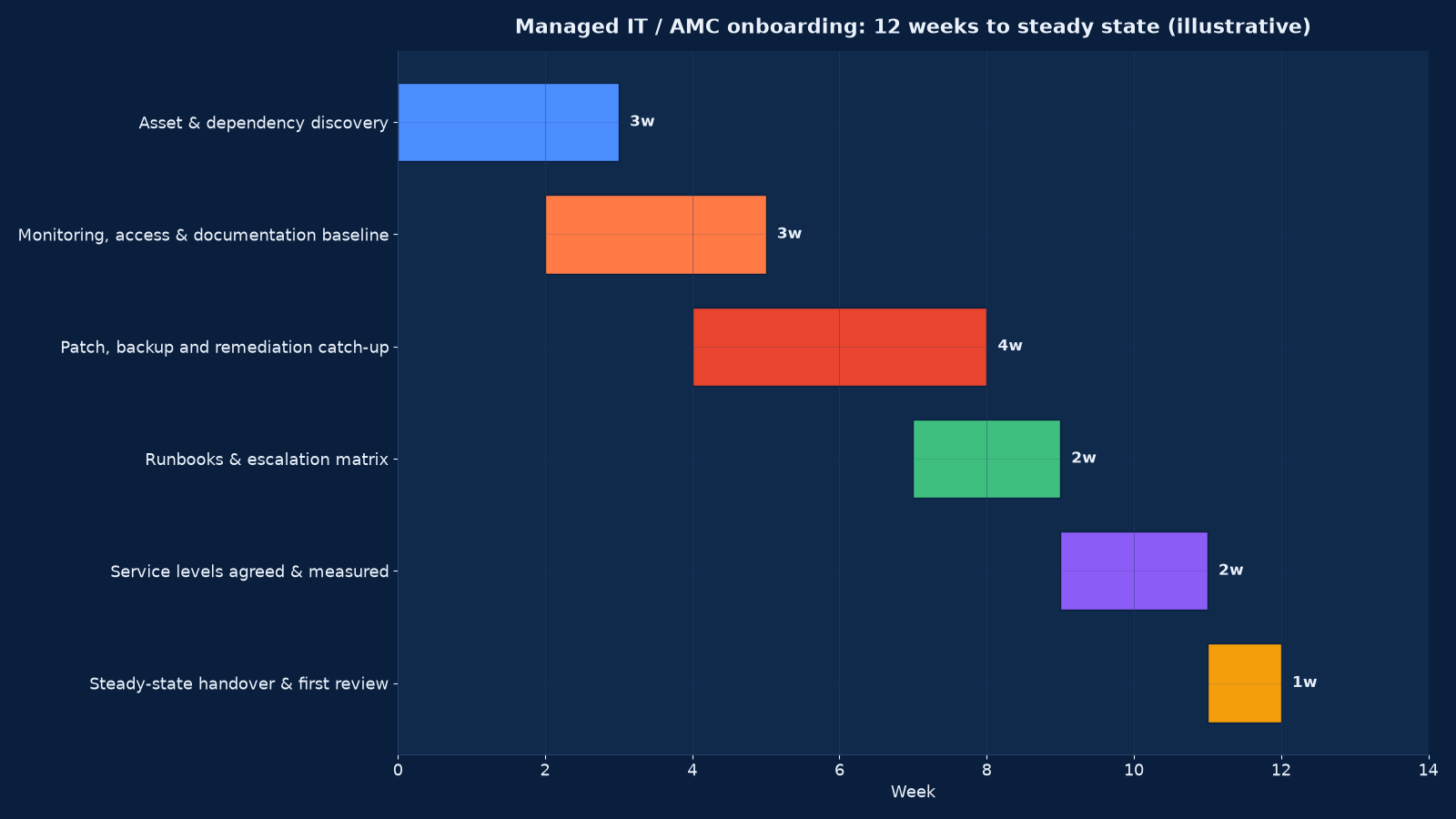
Chart values are an illustrative planning model based on typical UMC engagements and published industry benchmarks. They are not a guarantee of results on any specific project.
Reporting: What You Should Insist On Seeing
Monthly reporting is the mechanism by which a managed service is held to account, and most reports are too shallow to be useful. These are the measures we report by default.
| Metric | Definition | Reported | Why it matters |
|---|---|---|---|
| Availability per tier | Uptime percentage against the agreed target | Monthly | The number the business actually experiences |
| Mean time to respond | Alert or ticket to first engineer action | Monthly | Detects rota and routing failures early |
| Mean time to restore | Incident start to service restoration | Monthly | Distinguishes fast acknowledgement from fast recovery |
| Patch currency | Assets patched within the agreed window | Monthly | The single most predictive security indicator |
| Backup success and restore verification | Job success rate plus restores tested in period | Monthly | The only real evidence of recoverability |
| Alert-to-incident ratio | Proportion of alerts that were genuine | Quarterly | Measures tuning; a low ratio means alert fatigue |
| Recurring incident count | Incidents linked to an existing known error | Monthly | Shows whether problem management is working |
| Change success rate | Changes completed without rollback or incident | Monthly | Predicts future stability better than incident volume |
| Capacity headroom | Compute, storage and network utilisation trend | Quarterly | Turns surprise purchases into planned budget |
The report should also carry a plain-language summary for non-technical readers, because the person who approves the renewal rarely reads the alert tables. Where you want the operational numbers tied to financial outcomes, that is the discipline in our AI ROI Measurement & Executive Scorecards service applied to IT.
In-House, Outsourced or Co-Managed: Deciding Honestly
The decision is rarely binary. Three questions usually settle it.
Do you need coverage you cannot staff? 24×7 cover requires at least five to six people to do properly with leave and attrition. Most organisations below that scale cannot sustain it, and the honest options are outsourcing the hours or accepting the gap.
Is your estate standard or distinctive? Standard infrastructure — servers, network, endpoints, backups — is a commodity and buys well. Highly distinctive application estates need people who understand the application, which argues for keeping that layer internal or co-managed.
What happens when your one knowledgeable person leaves? If that question has no answer, the dependency is the risk, not the cost. Documentation, runbooks and a team with shared context are what remove it.
| Situation | Recommended model | Rationale |
|---|---|---|
| Under ~50 endpoints, no server room, all SaaS | Monitoring-only or light managed bundle | Little to operate; visibility and patching are the main value |
| 50–500 endpoints with on-prem or hybrid servers | Fully managed or co-managed | Enough complexity to need real operations, not enough to staff 24×7 |
| Regulated sector with audit obligations | Fully managed with compliance reporting | Evidence production is a service feature, not an extra |
| Large internal IT team with skills gaps | Co-managed on specific layers | Retains capability, covers out-of-hours and specialisms |
| Multi-site with inconsistent infrastructure | Managed with a standardisation programme first | Operating inconsistency costs more than the contract; standardise then manage |
| Project-shaped work rather than operations | Fixed-scope project, not an AMC | An hours bank or AMC is the wrong instrument for a build |
Where the gap is people rather than process, IT Staff Augmentation Services is the better instrument, and where the work is a build rather than an operation, it should be scoped as a project. Our guide to what growing businesses need from an IT partner covers the selection questions from the buyer’s side.
Security and Compliance Inside an AMC
A managed service touches everything, so it is also a concentration of risk. Four controls should be contractual, not verbal.
- Least-privilege access with named individuals. Not one shared admin account. Every engineer identifiable, every session logged.
- Credential custody. Documented, access-controlled and revocable, with a defined procedure for rotation on staff change at either organisation.
- Background checks and confidentiality. Stated in the contract for everyone with access, including subcontractors.
- Incident notification with a clock. A defined number of hours to notify you of a security incident affecting your environment, and an obligation to cooperate with your own notification duties.
If you hold or intend to hold ISO 27001 certification or a SOC 2 report, your supplier relationships are in scope and the AMC provider becomes an audited supplier. That means their own controls, their subcontractors and their evidence become your problem at audit time. Our AI Governance, Risk & Compliance service and the IT audit and compliance offering in this category both address supplier assurance; the cybersecurity skills roadmap explains the competencies that sit behind them.
Common Failures in Managed Service Contracts
- No asset schedule. The contract says “all servers” without listing them. Every dispute about scope traces back to this.
- SLA measured on response only. Fast acknowledgement with slow recovery reports as green while the business suffers.
- No exit provision. Without documentation handover, credential return and a transition assistance period, leaving is impossible in practice.
- Change management absorbed by the provider. Convenient, until something breaks and nobody can say what was changed or who approved it.
- Project work conflated with operations. A migration, a new site or a platform build should be separately scoped; burying it in the AMC produces arguments about hours.
- No improvement obligation. Pure operations keeps the lights on at the same cost forever. A quarterly improvement backlog is what makes the contract worth renewing.
- Subcontracting undisclosed. Know who actually touches your environment and make it contractual.
The exit provision deserves emphasis because it is almost always omitted and it is the one that determines whether the relationship stays healthy. A provider who knows you can leave cleanly behaves differently from one who knows you cannot.
Evaluating a Provider: Eight Questions
| Question to ask | What a good answer sounds like | Warning sign |
|---|---|---|
| Who will be on my account, by name? | A named service lead and a defined engineering group, with a deputy | “Our team” with no names, or a different engineer every call |
| What monitoring do you use and what do you alert on? | Specific tooling, thresholds per tier, and alert routing to a rota | Alerts emailed to a shared inbox |
| How often do you test restores? | A schedule by tier with results reported | “Backups complete successfully” offered as the answer |
| What does your monthly report contain? | The metric set above, plus trend and a summary for non-technical readers | A ticket count and nothing else |
| How is out-of-hours actually staffed? | A rota with a named on-call engineer and a defined wake-up threshold | An answering service that takes a message |
| What happens if you breach the SLA? | Service credits, a remediation plan, or a termination right — in the contract | “We would discuss it” |
| How do we leave? | Documentation handover, credential return, transition assistance period, all written down | No exit clause at all |
| What is excluded? | A specific list, asset class by asset class | “Everything is covered” |
Delivery Model at UMC
We operate managed infrastructure engagements with a named service lead, a documented estate, and reporting that a finance director can read. The engagement shape depends on what you already have.
| Engagement | Duration | Deliverables | Best when |
|---|---|---|---|
| Infrastructure health assessment | 2–3 weeks | Asset and dependency inventory, criticality tiering, risk register, patch and backup position, capacity outlook, costed remediation plan | Before committing to a contract, or when an existing one is not working |
| Full AMC onboarding | 12 weeks to steady state | Discovery, monitoring baseline, remediation catch-up, runbooks, SLA live, first quarterly review | Taking over operations from break-fix or from a departing internal hire |
| Co-managed support | Ongoing | Defined layers taken over, joint escalation, shared documentation, out-of-hours cover | You have an internal team and need coverage or specialisms |
| Standardisation programme | 8–16 weeks | Baseline builds, configuration standards, image and patch pipeline, naming and documentation conventions | Multi-site or acquisition-grown estates where inconsistency is the main cost |
| Transition assistance | 4–8 weeks | Documentation recovery, credential audit, knowledge transfer, interim cover | Leaving a provider, or recovering from an abrupt internal departure |
The health assessment is the right first step in almost every case, including where you already have a provider. It produces the asset schedule that most contracts lack and tells you whether the service you are buying matches the estate you actually have.
Cost, Budgeting and the Renewal Conversation
Figure 1 shows the operating-model comparison, but the budgeting conversation has three parts that are usually conflated.
Run cost is the contract fee: predictable, and the point of the exercise. Lifecycle cost is hardware and licence renewal on a three-to-five-year cycle: lumpy, and it should be forecast years ahead rather than discovered. Improvement cost is the project work that makes the estate better: optional, and it should never be hidden inside the run cost.
Organisations that budget only the first of the three are surprised every second year. A good managed service produces a lifecycle forecast as part of quarterly reporting, so that a storage array reaching end of support in eighteen months appears in this year’s planning rather than in an emergency purchase order.
At renewal, ask for three numbers: SLA performance against target across the year, the remediation backlog closed versus opened, and the lifecycle forecast for the next two years. Those three tell you whether the contract is working better than the invoice does. Our piece on the maintenance costs businesses forget to budget for makes the same argument for web infrastructure, where the pattern is identical.
What Steady State Looks Like After a Year
Twelve months in, a well-run managed service is boring, and boring is the objective. Concretely:
- An asset register that is accurate enough to be used for decisions, refreshed quarterly.
- Every Tier 1 and Tier 2 system with a tested runbook and a named owner.
- Patch currency above 95% with critical vulnerabilities closed inside the agreed clock.
- Backups verified by restore test on schedule, with results in the monthly report.
- Alert volume tuned so that most alerts are actionable — the ratio improves every quarter.
- Recurring incidents falling, because problem management closes causes rather than tickets.
- A lifecycle forecast that lets you budget two years ahead.
- Documentation good enough that a different engineer can recover a critical system at 3am without calling anyone.
The last point is the real test. If recovery still depends on one person’s memory after a year of managed service, the contract has not delivered, whatever the SLA report says.
Where the estate is moving to cloud rather than being operated on-premises, the same operational discipline applies with a different toolchain — see Cloud Services & Migration and DevOps & CI/CD Engineering Services. Where the driver is cost rather than resilience, the FinOps offering in this category is the better entry point. And where the infrastructure has to survive a site loss rather than a server failure, that is the backup and disaster recovery service.
Frequently Asked Questions About Managed IT Infrastructure & IT AMC
What does an IT AMC actually cost?
It is driven by asset count, criticality mix, coverage hours and remediation backlog rather than by revenue or headcount. A monitoring-only arrangement on a small estate is a fraction of a fully managed 24×7 contract on a hybrid environment with regulated data. The honest way to price it is to inventory the estate first — which is why we run a health assessment before quoting, and why a quote given without one is usually wrong in someone’s disfavour.
Is managed IT cheaper than an in-house team?
For coverage, usually yes; for total capability, it depends. Figure 1 compares the three models with out-of-hours cover, training and attrition included, which is where in-house costs are normally understated. The decisive factor is rarely the annual number — it is whether you can staff 24×7 cover, which needs roughly five to six people to do properly. Below that scale, co-managed or fully managed wins on resilience even where it does not win on cost.
What happens to our existing support contracts and vendor relationships?
They usually stay with you, and we operate within them. Hardware warranties, vendor support agreements and carrier contracts are typically more effective when the asset owner holds them. What changes is that someone is accountable for chasing them, logging them and escalating through them — which is most of the value.
Can you take over an environment with no documentation?
Yes, and it is the common case. Discovery rebuilds the documentation from the environment itself: automated inventory, network mapping, configuration export and structured interviews with whoever currently knows how things work. Budget for that phase explicitly rather than expecting it to be free, because it is real engineering work.
Do we lose control if we outsource IT operations?
You should gain it. Change approval, priority setting and budget decisions stay with you; execution and reporting move to us. The control risk runs the other way — an undocumented estate operated by one person is the least controlled arrangement available. Insist on named access, logged sessions and a written exit provision, and control improves.
How quickly can you take over from an existing provider or a departing employee?
Emergency transition can begin within days for monitoring and access, with full onboarding over eight to twelve weeks. Where someone has left abruptly, the priority order is credential recovery, backup verification, monitoring coverage and then documentation — in that order, because the first three are what stop the next incident.
What is the difference between an AMC and break-fix support?
An AMC is proactive and scheduled: monitoring, patching, capacity trending, backup verification and reporting happen whether or not anything breaks, for a fixed fee. Break-fix is reactive and priced per event, so nobody is incentivised to prevent the event. The cost difference is usually smaller than expected; the reliability difference is not.
Will you work alongside our internal IT person?
That is the co-managed model and it is common. The handover has to be defined per task rather than per system — who patches servers, who handles endpoint issues, who is on call at night — otherwise both parties assume the other has it. Done well, it removes the single-person dependency while retaining internal knowledge of the business.
How do you handle multi-site or acquired businesses?
With a standardisation programme before or alongside the managed service. Operating an inconsistent estate costs more than standardising it, because every site needs its own runbooks, its own spares and its own troubleshooting knowledge. Baseline builds, naming conventions and a common patch pipeline are what make one contract cover several sites.
What should we do in the first month?
Commission an infrastructure health assessment. It produces the asset schedule, the criticality tiers, the risk register and the remediation backlog — and it is the evidence base for either negotiating a proper contract or fixing the one you have. Everything after that is easier with it, and harder without it.
Book an Infrastructure Health Assessment
We will inventory what you actually run, map the dependencies nobody has written down, test whether your backups restore, and give you a costed risk register. Most organisations discover two or three items in that first assessment that change the conversation about support entirely.
Contact Unified Management Consulting to arrange an initial assessment of your environment.
Related Services
Managed infrastructure is the operational layer under most of our technology services:
- Cybersecurity Services & Solutions — the security operations that sit on top of a managed estate
- Routing, Switching, Firewall & Network Engineering — network design and build where operation is not enough
- Computing, Server, Storage & Data Centre Engineering — compute and storage design, build and capacity planning
- Cloud Services & Migration (AWS, Azure, GCP) — moving workloads off the estate we operate
- DevOps & CI/CD Engineering Services — pipeline and release automation
- IT Staff Augmentation Services — where the gap is people rather than process
- Case study: IT Infrastructure Management for an IT Company — this service delivered end to end
- Enterprise Systems Integration & Tech-Stack Consolidation — application inventory, integration architecture, decommissioning and measured savings
- IT Audit, Compliance & ISO 27001 / SOC 2 Readiness — Annex A gap analysis, control design, evidence automation and certification support
- Backup, Disaster Recovery & Business Continuity — business impact analysis, RTO and RPO tiering, immutable copies and tested runbooks
- Cloud Cost Optimisation & FinOps — tagging, allocation, showback, right-sizing, commitments and a monthly cadence
- IT Helpdesk & End-User Support — tiered service desk, published SLAs, knowledge management and shift-left automation
- Web Application Maintenance & Support — patching, monitoring, verified backups, defect management, committed change capacity and monthly service reporting