
Retail is a data business with a logistics problem attached. The customer decides from a product page, a marketplace listing, a creator video and a review; the business decides from a feed, a stock file, a courier scan and a returns register. When those two views disagree the money goes missing in places that marketing cannot see: a feed with the wrong size attribute suppresses the listing, a delivery promise the warehouse cannot keep produces a return, and a return on a margin-thin line removes the contribution of three good orders. Retail therefore cannot be run as a series of channel campaigns. It is one operating model with a catalogue at its centre.
Unified Management Consulting works with online-first retail brands, multi-channel and omnichannel retailers, marketplace seller businesses, D2C and private-label manufacturers selling direct, fashion and apparel houses, electronics and appliance retailers, beauty and personal care, grocery and quick commerce operations, furniture and home improvement, and franchise retail networks. Physical showroom and dealership operations – footfall, test drives, dealer management systems, branch-level local search – are covered in the showrooms and dealerships vertical; this page covers the commerce side of retail: catalogue and feed economics, checkout and delivery promise, returns and markdown discipline, marketplace and retail media, cohort economics and the systems that hold them together. Everything is delivered remotely and written to be geography-neutral – festive calendars, marketplace commission structures, payment regulation and labelling rules are handled per market inside the engagement. The industries index lists every sector we cover.
What an engagement includes, at a glance
| Component | What We Deliver |
|---|---|
| Contribution margin per order | Revenue less product cost, payment fee, pick and pack, delivery, return handling, marketplace commission and channel advertising – per order, per line, per cohort. Not revenue, not gross margin, not advertising return on spend in isolation. |
| Catalogue and feed quality | Whether the product data is complete, consistent and correctly attributed across the own site, Google Merchant Centre, each marketplace and every advertising channel that reads it. |
| Checkout and delivery promise | Whether the customer can pay in the way they want, sees a delivery date the warehouse can actually meet, and is not surprised by a cost at the last step. |
| Returns and reverse logistics | Return rate by line and by reason, the cost of a return, how much returned stock is resold at full price, and whether the reason codes are honest. |
| Repeat purchase and cohort value | What a cohort of first-time buyers is worth at ninety, one hundred eighty and three hundred sixty-five days, and how much it cost to acquire them. |
| Stock cover and markdown | Weeks of cover by line, the share of stock sold at full price against marked down, and the ageing profile that predicts next season’s markdown before it is needed. |
| Channel and marketplace mix | Which channels own the customer, which rent it, what each costs after commission and in-marketplace advertising, and what the dependency risk is. |
| Commerce systems and security | Order management, warehouse, ERP, payment and fraud tooling: whether they integrate, whether they reconcile, and whether card data and customer data are protected. |
What retail and e-commerce teams search for, and what it really means
Requests from this sector arrive as channel complaints that are usually catalogue, logistics or unit-economics problems in disguise. ‘Our Google Shopping cost per acquisition doubled’ is normally a feed-quality and stock-sync problem before it is a bidding problem. ‘Our marketplace sales fell’ is normally a listing-quality, pricing or buy-box problem. ‘Returns are killing us’ is normally a product-information and sizing problem with a logistics bill attached. The table below is the translation we run in the first fortnight of every retail engagement, and it is the reason the first deliverable is an audit rather than a campaign.
| What gets searched or asked | What is actually happening | What we do about it |
|---|---|---|
| Shopping cost per acquisition has doubled | Feed attributes are incomplete or stock sync lags, so impressions go to unavailable or badly-matched products | Feed audit, attribute completion, stock sync under five minutes, negative rules by margin band |
| Marketplace sales fell after a good quarter | Listing content, price parity, review velocity or buy-box eligibility moved; or a commission and advertising change erased contribution | Per-marketplace contribution model, listing rewrite, price-parity monitoring, advertising inside the marketplace measured after commission |
| Returns are destroying the margin | Size, colour and expectation mismatch created at the product page; returns counted without cost | Reason-code discipline, size and fit content, costed return model, resellable-share target |
| Traffic is up but revenue is flat | Traffic bought for low-margin or out-of-stock lines; checkout friction; delivery promise not credible | Contribution-weighted acquisition, checkout telemetry, delivery promise by pin code |
| We cannot tell which channel is profitable | Last-click attribution plus commission-free channel reporting; no shared definitions | Contribution margin per order by channel, incrementality tests, marketing mix modelling |
| Repeat purchase is too low | No post-purchase lifecycle, no cohort view, discounting used instead of relevance | Cohort reporting, lifecycle programme by segment, discount governance |
| The site is slow during sales events | Unoptimised media, third-party scripts, no caching strategy, untested peak load | Core Web Vitals remediation, load testing at event multiples, caching and queueing |
| Payment failures and fraud are rising | Single gateway, weak device and velocity checks, chargeback evidence not retained | Gateway redundancy, fraud rules by risk band, chargeback evidence pipeline |
| Stock and website disagree | Batch sync, manual updates, no single order-management source of truth | OMS integration, near-real-time stock publishing, exception alerting |
| Nobody can explain the markdown bill | Buying decisions made without cover and sell-through targets; markdown decided late | Stock cover and sell-through reporting, markdown trigger rules, open-to-buy discipline |
Eight of the ten are data, process and systems problems. That is why this vertical is staffed with commerce engineers, analysts and process consultants alongside media buyers, and why the media work only starts after the feed and the checkout are honest. The commercial consequence is straightforward: a retail business that fixes catalogue quality and checkout conversion before buying more traffic usually gets the same revenue at a materially lower cost, and keeps the improvement when the campaigns stop.
The retail funnel: session to delivered, kept and repeated
The retail funnel has one stage most sectors do not have – the return – and it happens after the sale has been counted. Reporting that stops at ‘order placed’ therefore overstates performance systematically, and the overstatement is largest exactly where the business is most fragile: high-return categories, marketplace-heavy mixes and discount-led acquisition. We build the funnel to the kept order and then to the repeat order, because those are the two numbers that decide whether the business is growing or merely transacting.
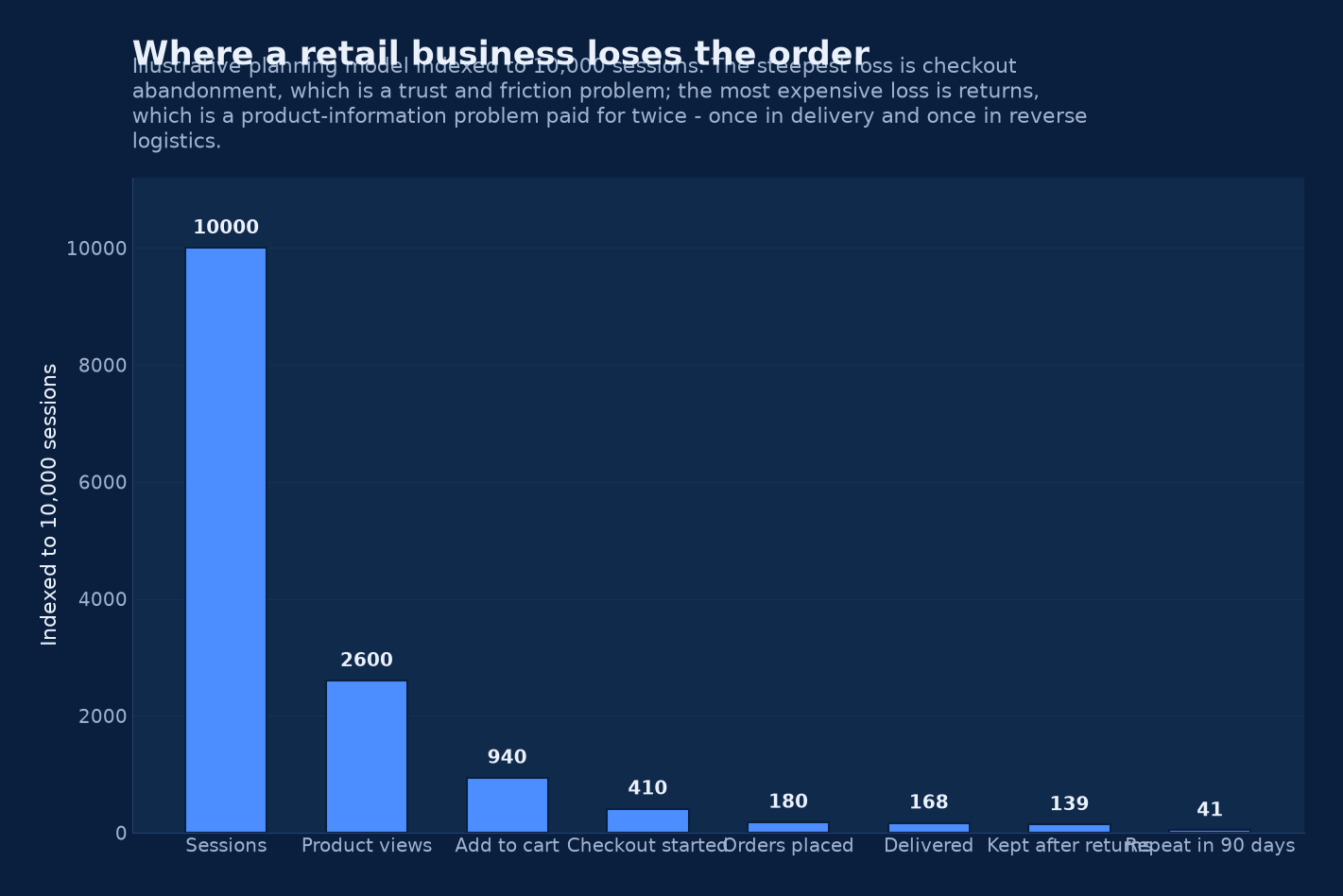
Chart values are an illustrative planning model based on typical UMC engagements and published industry benchmarks. They are not a guarantee of results on any specific project.
| Stage | Owner | What must exist | How it is measured |
|---|---|---|---|
| Session | Marketing | Channel intent matched to a landing experience; fast, crawlable, correctly tagged | Sessions by channel and intent, bounce, entry page quality |
| Product view | Merchandising | Complete attributes, honest imagery, size and fit information, availability | Product view rate, content completeness score, image coverage |
| Add to cart | Merchandising and UX | Variant selection that cannot be got wrong, stock truth, cross-sell that is relevant | Add-to-cart rate by category, variant error rate |
| Checkout started | Commerce engineering | Guest checkout, saved address, multiple payment methods, visible delivery date | Checkout start rate, step-level abandonment |
| Order placed | Commerce and finance | Payment success, fraud decision, order written to OMS without manual touch | Conversion rate, payment failure rate, straight-through order share |
| Delivered | Supply chain | Promise met, tracking visible, exception handled before the customer complains | On-time-in-full, promise accuracy, delivery exception rate |
| Kept | Merchandising and CX | Product matched expectation; return reason captured honestly | Return rate by line and reason, resellable share |
| Repeat | Lifecycle marketing | Post-purchase journey, replenishment timing, segment relevance, consent respected | Repeat rate at 90/180/365 days, cohort revenue curve |
Each stage has a different owner and a different fix, which is why a retail programme is an operating-model exercise and not a media plan. The engineering of the funnel – checkout, payment, stock publishing and order flow – sits with e-commerce development and marketing, headless and composable commerce where the catalogue is large, UX and UI design for the decision moments and Core Web Vitals and performance for the speed that conversion depends on.
Unit economics: contribution margin per order
Retail arguments are settled by one number more than any other: contribution margin per order, and its two companions – contribution per line and contribution per cohort. Revenue-per-channel dashboards flatter marketplaces and discount-led campaigns because they omit commission, in-marketplace advertising, payment fees, pick and pack, delivery, return handling and the cost of the discount itself. When those are loaded in, the channel ranking frequently reverses, and the strategic question – own the customer or rent it – answers itself.
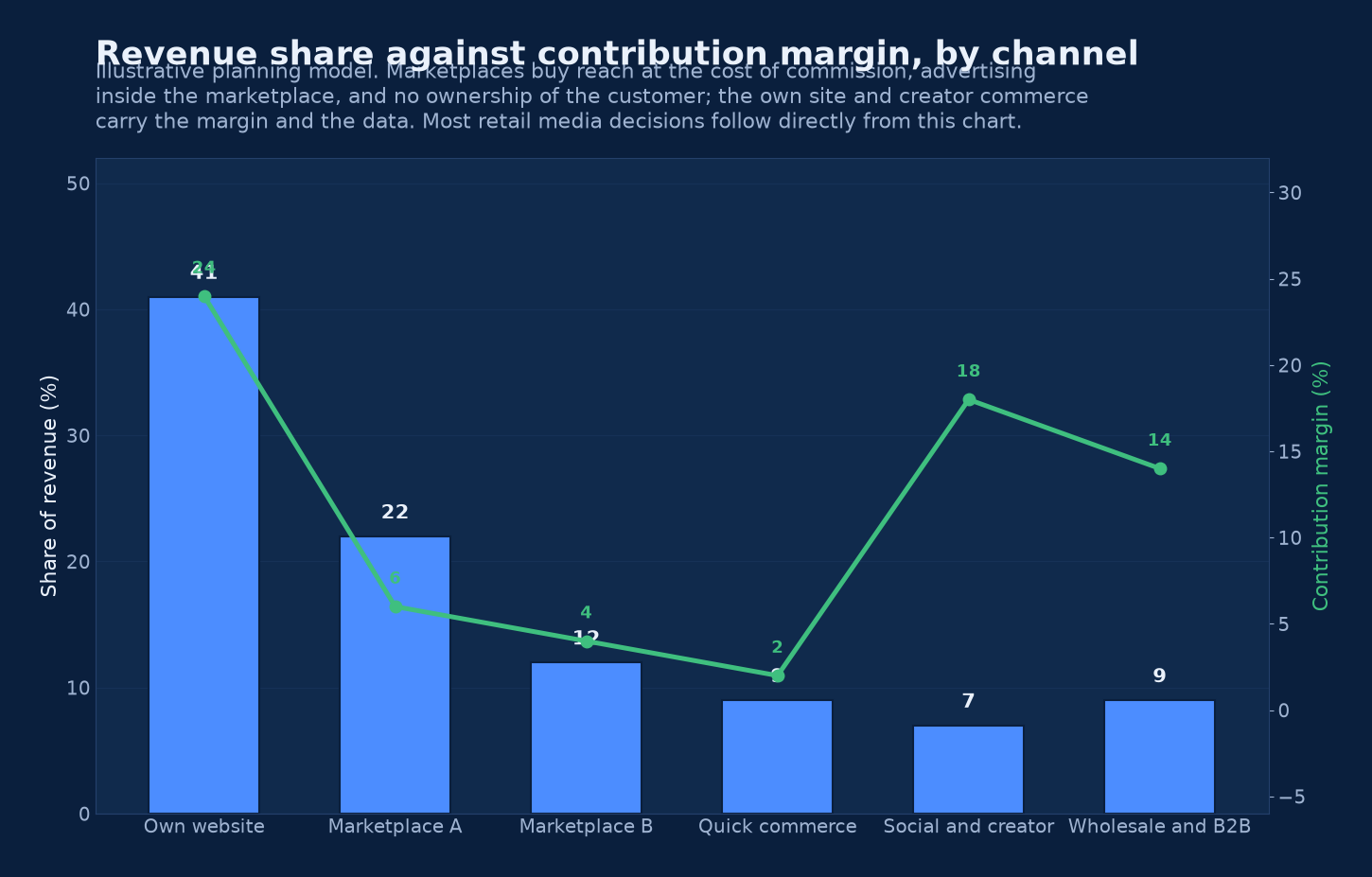
Chart values are an illustrative planning model based on typical UMC engagements and published industry benchmarks. They are not a guarantee of results on any specific project.
| Cost element | What it includes | Why it is omitted | How we load it in |
|---|---|---|---|
| Product cost | Landed cost, duty, inbound freight, packaging | Usually present, but stale after a supplier change | Refreshed per purchase order, not per season |
| Marketplace commission | Category commission, closing fee, fixed fee per unit | Reported net of revenue, so invisible in gross numbers | Per-SKU commission table by marketplace |
| Channel advertising | In-marketplace ads, retail media, platform promotion costs | Booked as marketing, not as cost of sale | Allocated to the orders it produced, by campaign |
| Payment cost | Gateway fee, EMI subvention, failure and retry cost | Treated as finance overhead | Per-transaction, split by method |
| Fulfilment | Pick, pack, consumables, warehouse handling, slotting fees | Absorbed in a warehouse overhead line | Per order, per unit, with peak-period surcharge |
| Delivery | Outbound freight, express premium, failed-delivery cost | Assumed constant across pin codes | By zone and weight band, with promise cost |
| Returns | Reverse freight, inspection, refurbishment, markdown on resold stock | Counted as units, not as money | Costed return model per line and reason code |
| Discounts and offers | Coupon value, bundled discount, loyalty redemption | Netted off revenue before anybody analyses it | Gross revenue retained, discount shown as a cost line |
This model is built with finance in weeks one to three and governs every later decision about budget allocation, marketplace dependency, pricing and promotion depth. The analytical practices are marketing mix modelling and attribution, data science for business analytics, cost rationalisation and margin recovery where the margin is already under pressure, and cash flow and working capital recovery where stock is holding the cash.
Catalogue, feeds and product data: the foundation everything reads
A retail catalogue is read by at least six consumers with different rules: the own website’s search and category pages, Google Merchant Centre, each marketplace, paid social catalogue ads, affiliate and comparison partners, and increasingly AI answer engines that summarise product information directly. They all read the same underlying data, so a defect there caps every channel at once and no amount of bidding skill recovers it. Feed work is therefore the first technical workstream in this vertical, and it is measured on completeness, consistency and freshness rather than on impressions.
| Component | What it does | Failure it replaces | Typical dependency |
|---|---|---|---|
| Single product master | One authoritative record per SKU with attributes, media, variants and hierarchy | The same product described differently on site, feed and marketplace | Agreement on attribute ownership between merchandising and IT |
| Attribute completeness | Mandatory and recommended attributes filled per channel: size, colour, material, gender, age group, GTIN, MPN | Listing suppression and disapproval in Shopping and marketplaces | A rules table maintained per channel, not per campaign |
| Media standard | Resolution, background, aspect ratio, alt text, variant coverage, video where useful | Low click-through and poor marketplace ranking despite good price | Shoot standards and a digital asset workflow |
| Stock and price sync | Availability and price published near-real-time to every channel | Orders for stock that does not exist; price-parity penalties | OMS and integration quality, not feed schedule |
| Feed diagnostics | Disapproval, warning and suppression monitoring with owner and fix path | Silent loss of impressions discovered at month end | Alerting wired to a person, not a dashboard |
| Category and taxonomy | Google product category, marketplace category, internal hierarchy aligned | Products advertised in the wrong auction, at the wrong cost | A mapping table versioned with the catalogue |
| Search and facets | On-site search, synonyms, spelling tolerance, facet counts that reflect stock | High-intent internal search returning nothing | Search relevance tuning and query-log review |
| Structured data | Product, offer, aggregate rating and availability markup validated | Rich results and answer-engine citations lost | Template-level implementation, tested per release |
Delivery runs through Google Shopping and Merchant Centre feed management, technical SEO and site migration for crawl and index hygiene, enterprise systems integration between the product master, OMS and channels, and data engineering for AI and knowledge systems where the catalogue must also be machine-readable for answer engines. AI search optimisation covers the last of those as a discipline rather than an afterthought.
Search, category pages and organic product demand
Retail organic search is three different problems wearing one name. Category demand – ‘buy running shoes online’ – is won by architecture, internal linking, faceted navigation handled correctly and content that answers the comparison question. Product demand – a specific model or SKU – is won by data completeness, availability signals, reviews and page speed. Brand and informational demand – guides, buying advice, care instructions – is won by editorial quality and is the cheapest acquisition a retailer has. Most retail SEO budgets are spent on the second and ignore the first and third, which is why performance plateaus.
| Layer | What wins it | Common defect | Measured by |
|---|---|---|---|
| Category and subcategory | Clean hierarchy, crawlable facets, unique copy, internal links from related guides | Facet URLs multiplied into the crawl budget; duplicate thin pages | Category rankings, category conversion, crawl share |
| Product page | Complete attributes, unique description, real imagery, availability, reviews, speed | Manufacturer copy pasted across the web; no variant-level content | Product page impressions, add-to-cart rate, indexation |
| Guides and editorial | Buying guides, comparison content, care and usage content by real demand | Content written for keywords nobody in the category uses | Assisted conversions, guide-to-category click-through |
| Local and store | Store locators, per-branch pages with genuine local content, profile management | One thin page per city, or no store locator at all | Store-locator usage, click-and-collect orders, local pack |
| Brand and reputation | Brand search coverage, review responses, PR and creator mentions | Negative results owned by third parties | Brand search volume, sentiment, share of citations |
| International and multi-region | hreflang, localised pricing and currency, per-market catalogue subset | One domain serving several markets with no signals | Per-market organic revenue and rankings |
The practices are SEO services, content marketing strategy, digital PR and link building for authority, local SEO and Google Business Profile management for store estates, international and multi-region SEO for exporters, and website strategy and information architecture for the hierarchy decisions that make all of the above possible. A worked example of full-stack catalogue SEO in apparel is the Ethnava chikankari WooCommerce project.
Paid shopping, Performance Max and retail media
Retail paid media is bought inside three different auctions with three different rules. Open web auctions – Shopping and Performance Max – reward feed quality, price competitiveness and conversion signals. Marketplace auctions reward listing quality, price parity, review velocity and stock depth, and they charge commission on top of the advertising spend. Retail media networks – the advertising arms of large retailers and quick commerce platforms – reward relevance to a shopper who is already in a buying session, and they report with a closed-loop accuracy the open web cannot match. Budget decisions across the three cannot be made on a common metric unless contribution is the metric.
| Channel | What it is good for | What breaks it | How we judge it |
|---|---|---|---|
| Google Shopping | High-intent product demand with a visible price comparison | Incomplete attributes, stale stock, uncompetitive price, no negative rules | Contribution per order after payment and fulfilment, by margin band |
| Performance Max | Cross-inventory coverage, demand capture beyond search, asset-led discovery | Thin asset groups, feed defects, no exclusion logic, brand cannibalisation | Incremental orders, new-customer share, brand-term overlap |
| Catalogue ads on Meta | Prospecting and retargeting with product-level creative at scale | Small catalogue, poor segmentation, over-retargeting recent buyers | Contribution by cohort, frequency, new-customer rate |
| Marketplace advertising | Defending and taking share in a category where the shopper is already searching | Commission ignored; advertising judged on gross revenue | Contribution after commission and advertising; buy-box share |
| Retail media networks | Closed-loop measurement, in-basket relevance, sponsored placement at decision moment | Treating it as one network rather than several with different inventory | Incremental sales, share of category, halo on own site |
| Creator and social commerce | Category creation, trust transfer, new audience segments | No tracked link or code, no briefing on claims, no rights agreement | Contribution per creator, repeat purchase of the cohort acquired |
| Quick commerce promotions | Velocity, trial and top-of-mind in dense urban catchments | Slotting and promotional cost erasing an already thin margin | Contribution per order including slotting; repeat rate |
Execution runs through Shopping and Merchant Centre feeds, Performance Max management, Google Ads management, Google Ads audit where spend has been running unaudited, retail media networks, Meta advertising, Instagram advertising, Pinterest advertising for visually-led categories, YouTube and video marketing for demonstration-led lines, TikTok advertising and influencer marketing management for creator commerce, with media planning and buying setting the split and brand performance and creative production supplying the assets. The Hyundai group social advertising contract is a full-service example of this working at multi-branch scale.
Checkout, payment and conversion reliability
Checkout is the only part of a retail website where a defect converts directly into lost money within minutes, and it is usually the least-instrumented part of the estate. The reliable pattern is unglamorous: fewer steps, guest checkout, saved address, a delivery date shown before payment, every payment method the market expects, transparent costs, and telemetry at each step so a rise in failure is detected the same day rather than at month end. Sale events multiply every weakness, so peak behaviour is designed and load tested rather than hoped for.
| Element | What good looks like | Common failure | Measured by |
|---|---|---|---|
| Step count and friction | Guest checkout, address autofill, one page or clearly progressive steps | Forced account creation; repeated address entry on mobile | Step-level abandonment, time to order |
| Payment methods | Cards, UPI or local rails, wallets, net banking, EMI, cash on delivery where it pays | One gateway; EMI offered on lines whose margin cannot carry subvention | Method mix, payment success rate by method |
| Payment reliability | Gateway redundancy, smart retry, tokenisation, no card data in logs or chats | Single point of failure during the highest-revenue hour of the year | Failure rate, retry success, downtime minutes |
| Delivery promise at checkout | A date the warehouse can meet, shown before payment, by pin code | A generic ‘three to five days’ that is wrong in half the pin codes | Promise accuracy, cancellation after promise |
| Cost transparency | Shipping, taxes and any surcharge visible before the final step | Surprise cost at the last step – the single largest abandonment cause | Abandonment at cost disclosure step |
| Trust and reassurance | Return policy, warranty, secure-payment marks, real contact details, reviews | Policy buried in a footer page nobody opens | Checkout exit surveys, support contacts per order |
| Fraud and risk decisioning | Rules by risk band, device and velocity checks, manual review queue with a service-level target | Blanket decline of legitimate orders, or blanket approval of fraud | False-decline rate, chargeback rate, fraud loss |
| Peak behaviour | Load tested at event multiples, queueing, cache strategy, degraded-mode plan | Untested third-party scripts bringing the site down at launch | Peak conversion, error rate, page speed at peak |
| Accessibility and inclusion | Keyboard and screen-reader usable checkout, readable contrast, sensible labels | An unusable flow for assistive-technology users and a compliance exposure | Audit findings closed, assisted-conversion rate |
The practices are conversion rate optimisation, UX and UI design, e-commerce development, Core Web Vitals and performance engineering, accessibility and WCAG remediation, DevOps and CI/CD engineering for release safety, SRE and observability for peak monitoring and cybersecurity services for payment and fraud controls. The platform itself is built and maintained through website development services, full-stack WordPress and WooCommerce development for catalogue-led stores, website migration and replatforming where the constraint is architectural, PHP and Laravel development for custom commerce logic, and full-stack Java or full-stack .NET engineering where the commerce layer sits inside a larger enterprise estate.
Delivery promise, fulfilment and inventory truth
The delivery promise is a marketing claim made by a system the marketing team does not control. When inventory data is a day old, when the warehouse picks in batches, when the courier has no capacity in a pin code, the promise breaks – and the cost arrives as a cancellation, a return, a support ticket and a review. Fulfilment work in this vertical is therefore mostly integration and exception work: make stock true, make the promise computed rather than static, and make exceptions visible to a person before the customer notices them.
| Capability | What it does | Failure it replaces | Typical dependency |
|---|---|---|---|
| Order management | One order record routed to the right node – warehouse, store, supplier – with status visible everywhere | Orders held in a marketplace dashboard and a spreadsheet | Agreement on which system owns order status |
| Near-real-time stock publishing | Availability pushed to site, feeds and marketplaces within minutes of a movement | Selling stock that has already gone; oversell penalties | Integration quality and buffer policy by channel |
| Delivery promise engine | A computable date per pin code, service and basket, including cut-off times | A static promise that is wrong in half the country | Courier coverage data and warehouse cut-off rules |
| Warehouse discipline | Pick, pack, dispatch scanned at each step; exception alerts on stuck orders | Orders ageing silently until the customer asks | WMS capability or a scanned process over the ERP |
| Store-as-a-node and click-and-collect | Store stock sellable online, reserve-in-store, collection with verification | Two separate businesses with two separate stock pools | Store staff process, not technology, is usually the blocker |
| Courier management | Multi-courier allocation by cost and reliability, tracking normalised, RTO handled | One courier, one rate card, no reliability data | Tracking ingestion and a serviceability table |
| Exception handling | Aged, stuck, failed-delivery and part-dispatch orders in one queue with owners | Customer-initiated discovery of a problem | Alert thresholds agreed with operations |
| Reconciliation | Marketplace settlements, courier charges and gateway payouts reconciled to orders | Revenue leakage discovered at audit, months late | Finance participation from week one |
Delivery runs through enterprise systems integration, AI integration with ERP, CRM and operations where the estate is already ERP-led, predictive analytics and demand forecasting for stock cover, web application maintenance and support for the daily exceptions, and data warehouse and lakehouse for the reconciliation layer that makes leakage visible.
Returns, reverse logistics and markdown discipline
Returns are a product-information problem with a logistics bill attached, and markdown is a buying problem with a marketing bill attached. Both are usually managed reactively – a return is processed, a markdown is authorised – rather than managed as a rate with a cause. The change we make is measurement first: return rate by line and by reason code with the reason code made honest, cost per return including the resold-at-discount loss, and stock cover with sell-through by week so markdown is triggered by a rule rather than by panic in week eleven.
| Lever | What we change | Why it works | Measured by |
|---|---|---|---|
| Reason-code honesty | Structured reasons at the point of return, with a free-text field analysed monthly | ‘Size issue’ and ‘product different from description’ have opposite fixes | Return rate by reason, trend by line |
| Fit, size and expectation content | Size charts measured not guessed, model and garment dimensions, material and colour under real light, video where it helps | Removes the largest single return cause in apparel and footwear | Return rate by category before and after |
| Costed return model | Reverse freight, inspection, refurbishment, packaging loss and markdown on resale loaded per return | Turns a unit count into a margin decision | Cost per return, resellable share at full price |
| Return policy design | Policy by category and risk band, with instant-refund or exchange-first options where the economics support it | Exchange-first retains revenue; blanket instant refund invites abuse | Exchange share, refund cost, abuse flags |
| Reverse logistics | Pickup scheduling, hub consolidation, inspection SLA, resellable-to-stock turnaround | Stock returned to sale in days rather than weeks recovers full price | Days from pickup to resellable |
| Stock cover and sell-through | Cover in weeks by line, sell-through curve against plan, ageing buckets | Predicts the markdown bill before it is needed | Full-price sell-through share, markdown depth |
| Markdown governance | Trigger rules by ageing and cover, depth bands, exclusion of hero lines, calendar set in advance | Removes the ad-hoc discount that trains customers to wait | Markdown as percent of revenue, discount leakage |
| Open-to-buy discipline | Buying decisions tied to cover targets and sell-through history by category | The cheapest markdown is the stock never bought | Buy accuracy, aged stock at season end |
The analytical practices are predictive analytics and demand forecasting, data science for business analytics, BI dashboards and executive reporting for the weekly markdown decision, cost rationalisation and margin recovery where margin recovery is the mandate, and business strategy consulting where the range itself needs changing.
Marketplaces, aggregators and multi-channel governance
Marketplaces are not a channel to be maximised; they are a channel to be governed. They supply demand at scale and take commission, advertising spend, price-parity control and ownership of the customer relationship. A retailer that grows to eighty percent marketplace-dependent has traded a margin problem for an existential one, because a commission change, a category policy change or a suspension is not survivable at that weight. The governance we install is commercial before it is technical: a per-channel contribution model, a price-parity and MAP policy, a defined own-site acquisition target, and a listing standard that makes marketplace effort reusable.
| Governance area | The decision that must be written down | Risk if it is not | Owner |
|---|---|---|---|
| Channel weighting | Target share of contribution by channel, reviewed quarterly | Marketplace share drifts upward without a decision being taken | Commercial head |
| Contribution model | Which costs are loaded per channel, and the minimum acceptable contribution | Growth reported in channels that lose money | Finance with marketing |
| Pricing and parity | Price parity policy, MAP rules, promotional depth by channel, who may discount | Marketplace penalties, own-site erosion, margin race to the bottom | Commercial head |
| Listing standard | One content standard: title structure, attributes, imagery, claims, compliance | Per-marketplace rework and inconsistent claims exposure | Merchandising |
| Advertising inside channels | Budget, target contribution after commission, and a stop rule | Advertising spend that only defends share at negative margin | Marketing |
| Review and reputation | Response SLA, escalation, review-generation policy that follows platform rules | Ranking loss and unanswered negative reviews | Customer experience |
| Settlement reconciliation | Monthly reconciliation of commission, advertising, penalties and payouts | Leakage that compounds silently for quarters | Finance |
| Dependency and exit | What happens if a channel suspends, changes terms or exits the market | No own-site list, no direct relationship, no plan | Leadership |
The commercial practices are business strategy consulting, market research and competitive analysis, market expansion consulting for new channels and new geographies, unified top-level business management for the governance forum itself, and account-based marketing plus LinkedIn advertising for the wholesale and B2B side of a retail business. The EZ1 in Services full-stack e-commerce platform and the online mobile store WooCommerce build show the own-site side of that balance being built.
Lifecycle marketing: email, SMS, WhatsApp and retention
Repeat purchase is the only retail growth that does not have to be bought again, and it is produced by a small number of journeys executed with discipline rather than by campaign volume. The set that earns its cost in almost every retail business: welcome and first-purchase onboarding, browse and cart abandonment with stock truth, post-purchase shipping and delivery communication, review request at the moment of satisfaction, replenishment for consumables, cross-sell by genuine affinity, win-back for lapsed cohorts, and a festive or event calendar that respects capacity. Everything runs on consent, and everything is measured on contribution by cohort rather than on revenue per send, because the latter rewards discounting.
| Journey | Trigger | The content decision | Measured by |
|---|---|---|---|
| Welcome and onboarding | Signup or first order | Brand promise, category guidance, policy clarity – not an immediate discount | First-purchase rate, second-purchase rate of the cohort |
| Browse and cart recovery | Abandonment with stock available | The exact item, honest availability, delivery date, no false urgency | Recovery rate, contribution of recovered orders |
| Post-purchase and delivery | Order, dispatch, out for delivery, delivered | Transactional clarity, then a relevant cross-sell at the right interval | Support contacts per order, cancellation rate |
| Review and user-generated content | Delivery plus a usage interval by category | One ask, easy path, photo prompt for visual categories | Review volume, rating, review-driven conversion lift |
| Replenishment | Category-specific usage cycle | Timing from purchase history, not a fixed monthly send | Replenishment repeat rate, unsubscribe rate |
| Affinity cross-sell | Purchase history and category affinity | Affinity logic explainable to a merchandiser, not a black box | Attach rate, basket size, cohort contribution |
| Win-back | Lapse beyond the category cycle | A reason to return that is not only a discount, and a suppression rule afterwards | Win-back rate, contribution after discount |
| Loyalty and tiering | Cumulative value or frequency | Benefits that cost less than the discount they replace | Tier migration, loyalty-member contribution share |
| Festive and event calendar | Market calendar, with capacity checked first | Offer depth by margin band and stock cover, not blanket sitewide | Event contribution, full-price share after the event |
- Email marketing campaign services
- SMS marketing services
- WhatsApp marketing services
- Marketing automation with HubSpot and Marketo
- Lifecycle and retention campaigns
- Lead nurturing and drip programmes
- Custom CRM development and integration
Build and run sit with marketing automation, lifecycle and retention campaigns, CRM development and integration for the data layer, webinar and event campaigns for launches and masterclasses, and social media management for the community that keeps a brand present between sends. Consent, suppression and preference handling are treated as a governance requirement, not a footer link.
Customer data, CRM and the owned audience
The strategic difference between a retail brand and a marketplace seller is ownership of the customer record. An owned record – identity, contact, consent, purchase history, preferences, service interactions – is the asset that makes lifecycle marketing possible, reduces dependence on paid acquisition, and survives a change in a platform’s terms. Building it is mostly unglamorous work: identity resolution across site, marketplace and store; one consent record with a source and a timestamp; suppression that is respected by every tool; and a segment model a merchandiser can understand and argue with.
| Component | Design decision | Failure mode | Measurement |
|---|---|---|---|
| Identity resolution | Match rules across email, phone, device and marketplace buyer ID, with confidence thresholds | One customer held as four records; journeys fire twice | Match rate, duplicate rate, unresolved share |
| Consent and preference | Purpose-level consent with source, timestamp and version; one suppression list all tools obey | Messages sent to people who opted out, in every channel independently | Consent coverage, complaint rate, suppression honoured |
| Customer profile | Purchases, returns, categories, spend, last contact, service history, tier | A profile that says nothing an email tool cannot already infer | Profile completeness, field usage in journeys |
| Segmentation model | Recency, frequency, value plus category affinity and lifecycle stage – explainable | Black-box segments nobody in the business will act on differently | Segment size, response rate, contribution by segment |
| Service and complaint record | Tickets, returns, delivery failures and reviews attached to the customer | Marketing to a customer who is mid-complaint | Complaint-linked suppression, resolution time |
| Data platform | Warehouse holding orders, refunds, marketing and support data on one key | Every report rebuilt from a channel export | Refresh latency, report count served from the warehouse |
| Activation | Segments pushed to email, SMS, WhatsApp, advertising and on-site personalisation | Insight produced and never used | Activated segments, journeys live, time to activate |
| Governance | Owner per field, retention periods, access by role, export and deletion process | Personal data spread across tools with no owner | Access reviews, deletion requests closed |
Build and run sit with custom CRM development and integration, marketing automation, data warehouse and lakehouse, enterprise systems integration and portal development for trade, wholesale and franchise partner access.
Business intelligence: cohort, contribution and stock reporting
Retail reporting arguments are definitional before they are technical. Is revenue gross or net of returns and discounts? Is contribution before or after fulfilment? Is a repeat purchase counted from first order date or delivery date? Which channels are included in a cohort acquired through a marketplace? Until those are written down, dashboards produce parallel truths and the leadership meeting spends its time on reconciliation rather than decisions. We publish a metric dictionary first, then build to it.
| Metric | Definition that must be fixed | Why it is contested | Refresh |
|---|---|---|---|
| Net revenue | Gross revenue less cancellations, returns, refunds and discount value | Marketplaces report differently from the own site | Daily |
| Contribution margin per order | Net revenue less product cost, payment, fulfilment, delivery, returns, commission and channel advertising | Which advertising is a cost of sale is a judgement | Daily, closed monthly |
| Contribution by channel | The same calculation grouped by acquisition and selling channel | Marketplace commission and in-channel ads are often omitted | Weekly |
| Repeat purchase rate | Share of customers with a second order within a defined window, by acquisition cohort | Window length changes the answer; marketplace identity limits matching | Monthly |
| Customer lifetime value | Cohort contribution accumulated over a stated horizon, net of acquisition cost | Horizon and discount rate are assumptions, not measurements | Quarterly |
| Return rate | Units or value returned as a share delivered, by line, reason and channel | Units or value; includes or excludes cancellations | Weekly |
| Stock cover and sell-through | Weeks of cover at current run rate; sell-through against buy by category and week | In-transit and allocated stock treated inconsistently | Weekly |
| Markdown and discount leakage | Depth and share of revenue sold below full price, by trigger and by approver | Coupons, bundles and marketplace promos land in different systems | Weekly |
| Delivery promise accuracy | Share of orders delivered by the date promised at checkout | Promise shown at cart differs from promise shown at checkout | Daily |
| Contribution per marketing spend | Incremental contribution against spend, not last-click revenue against spend | Attribution model determines the winner | Monthly with test calendar |
The practices are BI dashboards and executive reporting, sales and pipeline intelligence for wholesale and B2B lines, predictive analytics and demand forecasting, marketing mix modelling and attribution, data warehouse and lakehouse, data science services and IT staff augmentation where the analytics capacity has to be borrowed for a quarter rather than hired. The fashion retail showroom case study shows the reporting layer being built alongside the commercial work rather than after it.
Artificial intelligence in retail, sequenced by value against risk
Retail has more visible AI use cases than almost any sector and a worse record of returning value from them, because the interesting ones – dynamic pricing, demand forecasting, assortment planning – depend on the data discipline described earlier in this page. The sequence that works puts administrative and content AI first, where errors are cheap and recoverable, and commercial decision AI later, where an error prices a line below cost at national scale. Every deployment carries a named human owner, a stated fallback and a measured benefit.
| Use case | Value | Risk | Human in the loop |
|---|---|---|---|
| Product content generation | Attribute completion, descriptions at scale, localisation, alt text | Invented specifications and non-compliant claims | Merchandiser approves before publish; claims checked against source data |
| Catalogue and attribute extraction | Structured attributes from supplier sheets and images at ingest | Wrong category or attribute silently suppressing a listing | Confidence thresholds with a manual review queue |
| Search relevance and synonyms | Better internal search results and fewer zero-result queries | Relevance tuned for clicks rather than contribution | Merchandiser reviews query-log samples monthly |
| Visual search and similar items | Discovery for visually-led categories; substitute suggestions when out of stock | Substitutes shown at a different price point without context | Category manager sets substitution rules |
| Support and order-status agents | Instant answers on delivery, returns and policy from live order data | A refund or cancellation promised without authority | Escalation rules; no financial commitment without a human |
| Demand forecasting and replenishment | Better buy quantities, fewer stockouts, lower aged stock | Forecast error concentrated in the lines that matter most | Buyer overrides with recorded reasons; error reviewed weekly |
| Pricing and promotion optimisation | Price elasticity by line, promotion depth that protects contribution | Automated price below cost, or a parity breach on a marketplace | Floor and ceiling prices, parity rules, human approval on depth |
| Personalisation and merchandising | Ranking, bundling and on-site content by segment and affinity | Filter bubbles that suppress new lines; opaque ranking | Merchandising holds reserved placement; ranking audited |
| Fraud and returns abuse detection | Risk scoring on orders and on serial returners | False decline of good customers; unfair treatment patterns | Review queue, appeal path, model fairness checks |
| Creative and campaign production | Adaptive creative by segment and channel, faster event turnaround | Off-brand or non-compliant creative published at scale | Brand approval gates; claim and disclosure checklist |
The practice set is AI readiness assessment and roadmap, data engineering for AI and knowledge systems, AI agent deployment and automation, AI integration with ERP, CRM and operations, AI product engineering, forward-deployed AI engineering, AI governance, risk and compliance, AI ROI measurement and executive scorecard and AI training and team adoption.
IT, commerce security and payment compliance
A retail estate is a payment-processing, personal-data-holding, always-on commercial system, which puts it in a different security category from most businesses. The controls that matter are specific: card data out of scope by design rather than by policy, customer data classified and access-controlled, dependencies and plugins patched on a schedule because commerce platforms are a favourite target, fraud rules that do not merely decline legitimate orders, backups that are restored on a timetable, and monitoring that notices a checkout failure at two in the morning during a sale.
| Area | What we put in place | Why it matters here | Evidence produced |
|---|---|---|---|
| Payment scope reduction | Hosted or tokenised payment fields, no card data in logs, tickets, chats or exports | Card data in a support ticket is the most common retail breach pattern | Scope diagram and quarterly attestation evidence |
| Access control | Role-based access to commerce admin, warehouse and finance tools; MFA on all administrative accounts; leaver process | Seasonal staff and agencies hold powerful credentials | Access review log with joiner-mover-leaver records |
| Dependency and patch discipline | Plugin, theme, library and platform patching on a schedule with staging verification | Commerce platforms are targeted within days of a disclosure | Patch register and release notes |
| Web application security | Hardened headers, bot and scraping controls, rate limiting, injection and authorisation testing | Price manipulation and coupon abuse are commercial attacks, not pranks | Penetration test report with remediation status |
| Fraud controls | Device, velocity and address rules by risk band, with false-decline measurement | Chargebacks cost the margin and can cost the gateway relationship | Fraud loss, chargeback rate, false-decline rate |
| Backups and recovery | Commerce database, media and configuration backed up off-platform, restores timed | A lost catalogue is a lost trading period, not an inconvenience | Timed restore records |
| Monitoring and on-call | Synthetic checkout tests, error-rate and latency alerts, sale-event rota | Peak trading happens outside office hours | Alert catalogue, on-call rota, incident records |
| Vendor and platform risk | Contract, data-flow and exit review for every platform holding customer or order data | Dependency risk is usually contractual before it is technical | Vendor register with data flows and exit notes |
| Compliance readiness | Data protection, consumer protection, labelling and claims evidence assembled | Marketplaces and regulators ask for evidence, not intentions | Evidence pack and audit readiness note |
The practices are cybersecurity services, IT audit and compliance readiness, cloud security posture management, backup and disaster recovery, managed IT infrastructure and AMC, IT helpdesk and end-user support, cloud migration and management, cloud cost optimisation and FinOps where the platform bill scales with traffic, Kubernetes and container platform and cloud-native modernisation for high-traffic estates, network engineering and server, storage and data centre engineering for store and warehouse connectivity. The IT infrastructure management case study shows the managed-operations side of this.
Omnichannel, stores and the franchise network
Omnichannel is not a technology purchase; it is an agreement about which system owns which truth, and about who is credited with what. The useful starting point is narrow and commercial: sell store stock online, let a customer collect or return in store, give store staff a single view of the customer, and measure contribution rather than channel revenue so a store is not penalised for an online order it fulfilled. Franchise networks add a governance layer – one standard for brand, content, data, consent and security, local execution for stock, staffing and community – with co-marketing attribution agreed in writing before the first shared campaign.
| Capability | What it enables | The blocker that is usually organisational | First step |
|---|---|---|---|
| Sell store stock online | Wider availability without a larger warehouse; faster delivery in dense catchments | Store-level stock accuracy and staff incentive | Stock count discipline at three pilot stores |
| Click-and-collect | Delivery-cost-free fulfilment and a footfall reason | Pick SLA, collection verification, staffing at peak | One store, one promise, measured for a month |
| In-store return of online orders | Cheaper reverse logistics and a recovery conversation | Refund policy alignment and till process | Policy decision before system change |
| Single customer view for staff | Service conversations that know the order and return history | Data access rules and device availability on the floor | Read-only customer card on the till device |
| Store-level local presence | Catchment demand captured by search, maps and local advertising | One thin page per city, or inconsistent branch information | Per-store page and profile standard, with an owner |
| Endless aisle and kiosk | Range extended in store without extending floor stock | Delivery promise from a node the customer did not choose | Promise rules by node before the kiosk is bought |
| Franchise standard | Consistent brand, content, data and security across independent operators | Contract terms that predate the digital standard | Written standard plus co-marketing attribution rules |
| Attribution between nodes | Store credited for online-fulfilled orders and vice versa | Bonus structures tied to channel revenue | Contribution-based measure agreed with finance |
The practices are local SEO and Google Business Profile management and Local Services Ads and local campaigns for catchment demand, out-of-home and digital OOH and signage planning and production for physical presence, mobile app development where an app is genuinely warranted, portal development for franchisee and wholesale access, and market expansion consulting for new catchments.
How an engagement runs: the first ninety days
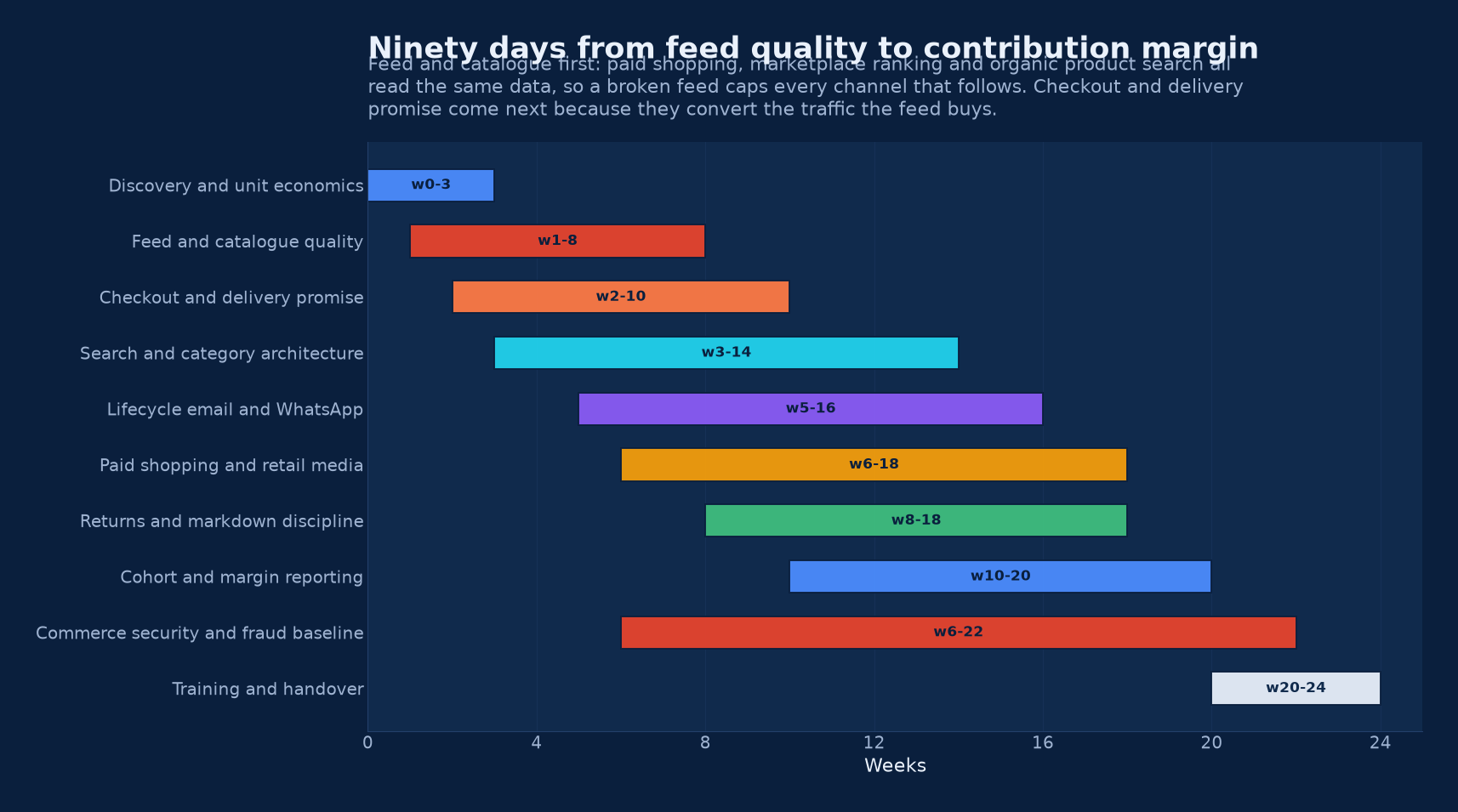
Chart values are an illustrative planning model based on typical UMC engagements and published industry benchmarks. They are not a guarantee of results on any specific project.
Weeks one to three are discovery: the unit-economics model with finance, the feed and catalogue audit against every channel that reads it, checkout telemetry and payment failure analysis, the returns register with honest reason codes, a systems map from product master to settlement, and a written verdict that includes what we would not start with. Feed and catalogue quality runs from week one to eight because it gates paid shopping, marketplace ranking and organic product search simultaneously. Checkout and delivery promise land by week ten. Search and category architecture build from week three to fourteen. Lifecycle journeys start at week five, paid shopping and retail media at week six – after the feed is honest, because advertising a broken catalogue buys returns. Returns and markdown discipline runs from week eight to eighteen, cohort and contribution reporting is live by week twenty, the commerce security and fraud baseline by week twenty-two, and training and handover close the programme.
| Deliverable | Week | What the business keeps |
|---|---|---|
| Unit-economics model | 3 | Contribution per order, line and channel, with finance signed up |
| Feed and catalogue audit | 3 | Every defect by channel, with owner and fix path |
| Checkout and payment analysis | 3 | Step-level abandonment, failure rates, fraud picture |
| Returns register and reason codes | 3 | Return rate by line and reason, costed |
| Systems and data map | 3 | Who owns which truth, and where the gaps are |
| Feed and catalogue remediation | 8 | Complete attributes, media standard, stock sync, diagnostics |
| Checkout and delivery promise | 10 | Fewer steps, method coverage, computed promise date |
| Search and category architecture | 14 | Hierarchy, facets, internal links, indexation |
| Lifecycle journeys live | 16 | Welcome, recovery, post-purchase, replenishment, win-back |
| Paid shopping and retail media | 18 | Contribution-based structure, stock-aware rules, pause logic |
| Returns and markdown discipline | 18 | Costed return model, markdown triggers, cover reporting |
| Cohort and contribution reporting | 20 | Metric dictionary plus weekly and monthly pages |
| Commerce security and fraud baseline | 22 | Scope reduction, access control, fraud rules, evidence pack |
| Training and handover | 24 | Runbooks, recordings, named owners, decision rights |
Pricing and engagement models
| Model | Best for | What it includes | Commercial shape |
|---|---|---|---|
| Assessment only | A founder or commercial head who needs the truth before spending | Unit-economics model, feed and catalogue audit, checkout and payment analysis, returns register, systems map, written verdict | Fixed fee, three weeks |
| Programme build | A retail business fixing several workstreams in one plan | Feed remediation, checkout and promise, search architecture, lifecycle journeys, reporting and security baseline | Fixed scope by workstream, milestone billing |
| Managed marketing | A brand that has the platform and needs channel execution | Paid shopping and retail media, SEO and content, lifecycle, creative production, weekly contribution reporting | Monthly retainer with a contribution target |
| Commerce engineering | A build, replatform, integration or performance problem | Commerce platform work, OMS and WMS integration, feed pipelines, peak readiness | Fixed price per release, or time and materials |
| Fractional leadership | A business between hires, or a family business needing a commercial function | Part-time commercial or digital leadership, governance forum, vendor management, hiring support | Monthly, defined days |
| Audit and compliance | A business that must evidence security, data or consumer-protection compliance | Payment scope review, access and patch review, application security testing, evidence pack | Fixed fee with remediation options |
Service requirements by role
| Role | The question they ask | What we deliver | The number they watch |
|---|---|---|---|
| Founder or owner | Is this business actually making money per order, and what should we stop doing? | Unit-economics model, channel contribution, a verdict with named stops | Contribution margin per order |
| Commercial or sales head | Which channels and lines should carry the growth plan? | Channel weighting plan, marketplace governance, pricing and promotion rules | Contribution by channel and category |
| Marketing head | How do we grow without paying more for every order? | Feed-driven shopping, SEO architecture, lifecycle journeys, retail media, creative | Contribution per marketing spend, repeat rate |
| E-commerce or digital manager | What is broken on the site, and in which order do we fix it? | Checkout telemetry, conversion roadmap, release and peak plan | Conversion rate, checkout abandonment |
| Merchandising or category head | What should we buy, how should we present it, and when do we mark it down? | Sell-through and cover reporting, markdown triggers, content standards | Full-price sell-through, stock cover weeks |
| Supply chain or operations head | Can we keep the promise the website is making? | Promise engine, exception queue, OMS and WMS integration, reconciliation | On-time-in-full, promise accuracy |
| Finance head | Where is revenue leaking, and can I trust the channel numbers? | Settlement and gateway reconciliation, contribution definitions, leakage report | Net revenue, leakage as percent of revenue |
| IT head or CTO | Is the estate secure, integrated and supportable? | Security baseline, integration architecture, monitoring, vendor register | Incidents, patch age, uptime at peak |
| Customer experience head | Why are customers contacting us, and what would stop it? | Contact-reason analysis, returns and policy redesign, support agents with guardrails | Contacts per order, resolution time |
| Franchise or expansion head | How do we keep one standard across independent operators? | Written standard, co-marketing attribution, franchisee portal and reporting | Per-node contribution, standard compliance |
Roles differ by business size – in a founder-led retail brand one person holds four of the rows above – which is why engagements are scoped against the decision each role has to make rather than against a headcount. Who we are explains the consulting model behind that scoping, and the contact page is the shortest route to a three-week assessment.
Related Services
Related industry verticals
- Showrooms and dealerships
- Restaurants, cafés and cloud kitchens
- Hotels and hospitality
- Manufacturing and industrial
- Hospitals and healthcare
- Clinics and diagnostic centres
- Pharmaceutical and life sciences
- Doctors and medical practitioners
- All industry verticals
- Business consulting services
- Digital marketing services
- Technology services
Retail work by city, and retail case studies
Programmes are delivered remotely to retail businesses anywhere, and location-specific pages carry the local detail – festive calendars, marketplace and courier coverage, payment mix, language and the catchment economics that decide whether a store or a warehouse should fulfil a demand. The retail case studies below are full-stack engagements across SEO, commerce build, social advertising and managed infrastructure; each is written to show the problem, the constraint and the measured result rather than the campaign.
- Increase e-commerce sales (Lucknow)
- Website development company for retail stores in Lucknow
- Get more retail customers in Lucknow
- Digital marketing company for automobile dealers in Lucknow
- Website development company for automobile dealers in Lucknow
- Get more automobile sales leads in Lucknow
- Digital marketing company for jewellery stores in Lucknow
- Website development company for jewellery stores in Lucknow
- Get more jewellery customers in Lucknow
- Get more pharmacy customers in Lucknow
- Digital marketing and IT services in Lucknow
- Digital marketing and IT services across Indian cities
- Case study: a fashion retail showroom
- Case study: Ethnava full-stack SEO for a chikankari WooCommerce store
- Case study: EZ1 in Services full-stack e-commerce platform
- Case study: WordPress WooCommerce online mobile store
- Case study: Hyundai group showroom full-service social advertising
- Case study: IT infrastructure management for an IT company
- Contact us
Dedicated pages for retail, one per service
A vertical this broad cannot be answered by one page, so each service gets its own dedicated page for retail. This page is the vertical overview; the pages below carry the depth for one discipline each.
- Website development for retail and e-commerce — Commerce platform builds and replatforming, headless and composable storefronts, product-data and feed pipelines, checkout and payment engineering, sub-second LCP under sale load, WCAG 2.2 AA.
- SEO for retail and e-commerce — Category and facet architecture, product-page data quality, crawl and indexation control, guide and comparison content, structured data, digital PR and AI search visibility for catalogues.
- Google Ads for retail and e-commerce — Shopping and Merchant Centre feed management, Performance Max with stock-aware controls, retail media networks, brand and non-brand separation, bidding to contribution rather than revenue.
- Social media marketing for retail and e-commerce — Catalogue ads and creator commerce, content pillars by category, community and comment handling, social proof production, contribution per creator rather than reach.
- CRM, loyalty and lifecycle for retail — Identity resolution across site, marketplace and store, consent and preference governance, lifecycle journeys, loyalty tiering and cohort value measurement.
- Business intelligence for retail — One metric dictionary above commerce, marketplace, warehouse and finance data: contribution per order, cohort value, stock cover and sell-through, markdown and leakage, promise accuracy.
- IT support and commerce security for retail — Payment scope reduction, access control and MFA, patch and dependency discipline, fraud rules, backups with timed restores, peak-trading monitoring and on-call.
- AI for retail and e-commerce — Product content and attribute extraction, search relevance, support agents on live order data, demand forecasting, pricing guardrails, personalisation, fraud and returns-abuse detection – sequenced by value against risk.
Frequently asked questions about retail and e-commerce growth
Is our problem advertising, or something else?
Usually something else. In most retail audits the largest recoverable value sits in feed and catalogue defects, checkout friction, a delivery promise the operation cannot keep, or returns caused by product information. We measure all four in the first three weeks and say plainly which one is worth the money.
How do we know which channel is actually profitable?
By loading commission, in-channel advertising, payment, fulfilment, delivery, returns and discount into a contribution margin per order, by channel and by line. Revenue-per-channel reporting cannot answer the question because it omits most of the cost.
Should we sell on marketplaces at all?
Yes, with governance: a per-channel contribution floor, a price-parity policy, a listing standard, monthly settlement reconciliation and a defined own-site acquisition target. The risk is not marketplaces; it is reaching eighty percent dependency without having decided to.
Why did our Shopping cost per acquisition double?
Most often because the feed degraded: attributes went incomplete, stock sync lagged so impressions went to unavailable variants, or a category mapping changed the auction. Feed diagnostics with an owner and a fix path prevent the silent version of this.
How do we reduce returns without hurting sales?
By removing the cause rather than the right: honest size and fit content, real imagery and material description, structured reason codes, exchange-first options where the economics support them, and returned stock back to resellable in days rather than weeks.
Do we need a replatform, or can we fix what we have?
It depends on whether the constraint is commercial or architectural. If the catalogue, checkout and integrations can be fixed on the current platform, a replatform is an expensive delay. We assess the platform against the constraint and give a written recommendation, including the option of doing nothing yet.
How do you handle festive and sale events?
With capacity first – stock cover, warehouse throughput, courier allocation, payment capacity and support cover – then load testing at event multiples, offer depth by margin band rather than sitewide, stock-aware advertising with pause rules, and a post-event contribution review that separates event demand from pulled-forward demand.
What about retail media networks – are they worth it?
Where you already sell through that retailer, usually yes, because measurement is closed-loop and the shopper is in a buying session. They are not a substitute for own-site acquisition, and they are judged on incremental sales and share of category, not on reported return on ad spend alone.
Can AI write our product content at scale?
Yes for attributes, descriptions, localisation and alt text, from your source data, with a merchandiser approving before publish and a check against specification and claims rules. Generated content that invents a specification becomes a return and a compliance problem.
How do we build repeat purchase?
With cohort reporting first so the number is real, then a small set of disciplined journeys: onboarding, post-purchase, review, replenishment, affinity cross-sell and win-back – measured on contribution by cohort rather than revenue per send, and governed by consent.
Is our customer data safe across all these tools?
Only if it is designed that way: payment scope reduced by architecture, role-based access with MFA, one suppression list every tool obeys, a vendor register with data flows, patch discipline, tested backups and monitoring that covers peak trading hours.
Do you work with physical stores as well as online?
Yes – omnichannel work is a large part of this vertical: selling store stock online, click-and-collect, in-store returns, a single customer view for staff, per-store local presence, and contribution-based attribution so no node is penalised for another’s order.
Do you work outside India?
Yes. Programmes are delivered remotely and written geography-neutral, with marketplace terms, payment rails, consumer protection, labelling and festive calendars handled per market inside the engagement.
What if the problem is the range or the buying, not the marketing?
Then the verdict says so. Aged stock, weak sell-through, discount leakage and an open-to-buy process without cover targets cause more bad quarters than low traffic, and we would rather name that in week three than advertise around it for a year.
Start with the unit economics and the feed audit
Give us three weeks with your order and channel exports, your finance detail on commission, fulfilment and returns, and access to your feed and checkout analytics, and we will return the contribution margin model by order, line and channel, the feed and catalogue defect list by channel, the checkout and payment failure analysis, the returns register with costed reasons, the systems map, and a written verdict including what we would not start with – yours to keep either way.
Contact Unified Management Consulting to arrange a confidential first conversation.