
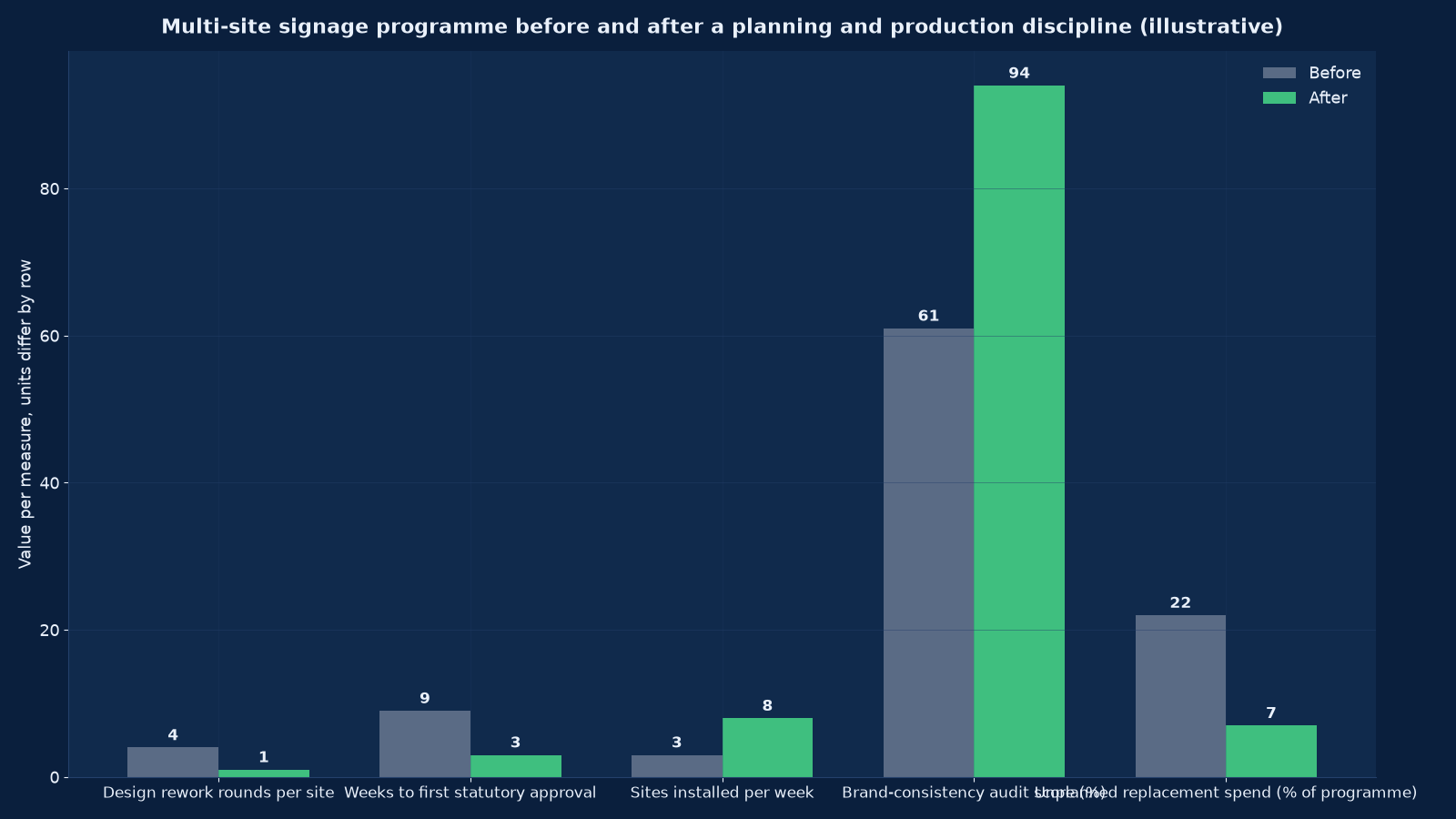
Chart values are an illustrative planning model based on typical UMC engagements and published industry benchmarks. They are not a guarantee of results on any specific project.
Signage is the only marketing asset that is simultaneously a brand statement, a structure, an electrical installation and a statutory permission. Treating it as printing is why rollout budgets are overrun.
Signage planning and production consulting covers the whole life of a physical sign estate: the survey that establishes what is actually on your sites, the design and engineering that makes it buildable, the permissions that make it lawful, the fabrication specification that makes it durable, the installation programme that makes it safe, and the asset register and maintenance plan that make it last. Unified Management Consulting runs this for multi-site retailers, dealership networks, hospitals, campuses, banks, hospitality groups and manufacturers — typically twenty to two thousand sites — and we specify, tender and supervise rather than fabricate, which is what keeps the specification honest.
🪧 Signage Planning & Production Consulting — Quick Summary
| Component | What We Deliver |
|---|---|
| Site survey and condition audit | Every sign on every site measured, photographed, assessed for structural and electrical condition, and recorded against the brand standard. |
| Sign type strategy | Which sign types belong at which site class, with a standard specification per type so a store, a dealership and a corporate office each get the right thing. |
| Design and engineering | Artwork to brand guidelines, plus structural and electrical engineering drawings that a fabricator can build from and an authority can approve. |
| Permissions and statutory approvals | Municipal sign and hoarding licences, highway authority consent, structural stability certificates, fire and electrical clearances, tracked to expiry. |
| Materials and fabrication specification | Substrates, LED modules and drivers, films, finishes and tolerances written as a specification with named acceptable equivalents, not as a picture. |
| Tender and vendor management | A like-for-like tender, an evaluated award, and a fabrication schedule with hold points and a dry fit before anything travels to site. |
| Installation, safety and logistics | Method statements, permits to work, working-at-height controls, and a site-by-site installation sequence that respects trading hours. |
| Asset register and maintenance | A register carrying warranty, permission expiry, electrical load and maintenance interval per sign, plus an annual maintenance contract with response times. |
| Cost control | A cost model per site class, tender benchmarking, and variation control so the programme is measured against a budget rather than discovered at the end. |
Signage sits alongside Global Advertising & Promotional Campaigns and OTT & Connected TV Advertising Services as the physical half of a brand’s presence, and it is usually the half nobody owns. Design discipline comes from UX & UI Design Services, structural and public-safety risk from Risk, Governance & Business Continuity Support, and statutory and process assurance from IT Audit, Compliance & ISO 27001 / SOC 2 Readiness where the estate also carries digital displays. Where the programme is part of a wider cost exercise, Cost Rationalisation & Margin Recovery supplies the savings governance.
What Signage Consulting Covers, and Who Usually Does It
Signage work is fragmented across brand, facilities, procurement, legal and vendors, and almost nobody holds the whole picture. That fragmentation, not fabrication quality, is where the money goes.
| Workstream | Who usually does it | What goes wrong | What consulting adds |
|---|---|---|---|
| Site survey and condition audit | A vendor’s salesperson, free of charge, as part of a quote | The survey records what the vendor can sell, not what the estate contains; condition is described rather than measured | An independent register with measured dimensions, photographs, materials, electrical load and a condition grade per sign |
| Sign type strategy | Nobody — the brand manual specifies one storefront and the rest is improvised | Every site gets the same treatment regardless of size, tenure, footfall or landlord consent | A site-class model: which sign types, sizes and materials apply to which class, and what a landlord or lease permits |
| Design and artwork | The brand team or an agency producing print-ready artwork | Artwork that cannot be fabricated: letter strokes too thin, colours unreachable in vinyl or LED, no allowance for joins or fixings | Fabrication-aware artwork plus engineering drawings, with materials and tolerances specified alongside the design |
| Structural and electrical engineering | The fabricator, informally | No wind-load calculation, no stability certificate, no sanctioned load — which is what turns a storm into a casualty and an inspection into a closure | Calculations and drawings from a licensed engineer, and a statutory compliance file per sign |
| Permissions | The vendor, or nobody until an notice arrives | Unlicensed hoardings, expired permissions, and signs installed before consent | A permissions matrix by municipality and sign type, applications tracked to approval and to expiry |
| Fabrication specification and tender | A single vendor quoted, price-led | Quotes that are not comparable because the scope differs; substitutions after award | One specification, a like-for-like tender, an evaluated award, and named acceptable equivalents for every material |
| Installation and safety | The vendor’s crew | No method statement, no permit to work, uninsured labour, trading hours ignored | Method statements, permits, height and electrical controls, and snagging signed off per site |
| Asset register and maintenance | Nobody, or a spreadsheet in facilities | Warranties lapse unclaimed, failures are fixed ad hoc at premium rates, permission renewals are missed | A register with warranty and expiry dates, an AMC with response times, and a maintenance calendar |
The pattern is consistent: a vendor surveys for free and quotes for what it can sell; the brand team produces artwork that has never met a fabricator; facilities handles failures reactively; and nobody owns the permissions file. A signage programme consolidates all eight workstreams under one specification and one register.
Sign Types: Choosing Deliberately Rather Than by Habit
Ten sign types cover almost every commercial estate. Each carries different design constraints and a different statutory load, and the most expensive error is applying one type’s assumptions to another — typically treating a pylon as a facade sign and discovering the foundation and consent requirements afterwards.
| Sign type | Typical application | Design constraints | Engineering and permission load |
|---|---|---|---|
| Facade / storefront sign | Primary brand identification on a retail or office frontage | Landlord consent, lease restrictions on projection and illumination, local language requirements | Facade fixing into the building envelope, wind load, illumination limits and curfew hours |
| Channel letters (front-lit, back-lit, halo) | Premium frontages, dealerships, corporate offices, hospitals | Minimum stroke width for LED return, letter height for legibility distance, colour temperature consistency | Individual fixing and load per letter, electrical circuit and driver access, maintenance access |
| ACP clad elevation | Full-fascia brand treatment across a frontage | Panel modulation and join lines, colour batch consistency, sheen | Sub-frame design, wind load and pull-out testing, fire rating of the composite core |
| Pylon / monument / totem | Site identification set back from the frontage, fuel and highway sites | Legibility at speed, two-sided or three-sided faces, night visibility | Foundation design, structural stability certificate, highway setback and consent, aviation clearance near airports |
| Hoardings and billboards | Paid outdoor advertising on owned or leased structures | Creative adaptation to aspect ratio, message rotation | Structural design for wind and cyclone zones, municipal hoarding licence, insurance, and in many cities a ban on new rooftop structures |
| Digital displays and DOOH screens | In-store, drive-through, lobby and roadside screens | Brightness and glare, content scheduling, aspect ratios per screen | Electrical load and heat dissipation, structural support, content compliance, and municipal permission where externally visible |
| Wayfinding and directional | Campuses, hospitals, malls, plants, parking | Information hierarchy, pictograms, accessibility including tactile and braille, multilingual ordering | Low structural load, but fire-escape and statutory signage must comply with building codes |
| Statutory, safety and mandatory signage | Factories, warehouses, construction sites, public buildings | Prescribed colours, symbols and wording — not a brand decision | Mandatory under factory and building regulations; inspected; absence is a citable defect |
| Retail POP and in-store | Shelf talkers, gondola ends, window graphics, counter units | Campaign lead times, seasonal changeover, print consistency across vendors | Minimal, but window graphics and frosting interact with egress and natural-light rules |
| Vehicle livery | Fleet branding on owned and leased vehicles | Panel-by-panel artwork distortion, film durability, wash and fuel resistance | Registration-plate and reflector obscuration rules; removal obligations at lease end |
Two decisions dominate. First, whether the sign is a structure or an appliance: anything freestanding, cantilevered or above head height is a structure and needs engineering and consent. Second, whether it is illuminated: illumination adds electrical sanction, driver access for maintenance, brightness and curfew constraints, and a failure mode that is visible at night to everyone including your competitors.
The Site Survey and Condition Audit
Everything downstream is only as good as the survey. A vendor survey is a sales document; an audit is an evidence base. The distinction costs money and saves more.
| Recorded per site | Why it matters |
|---|---|
| Site class, tenure and landlord | Determines which sign types are permitted, who must consent, and what can be fixed to the building |
| Every existing sign: position, dimensions, height above ground | The baseline for replacement scope, and the input to legibility and wind-load calculations |
| Materials and construction of each existing sign | Establishes whether it can be refurbished, re-faced or must be replaced, and what disposal involves |
| Electrical supply: circuit, load, metering, driver location | Determines whether an illuminated replacement is possible without a new sanction, and where maintenance access must be |
| Structural condition and fixing integrity | Corrosion, fatigue, pull-out failure and previous repairs — the difference between a refurbishment and a liability |
| Facade construction and fixings available | Brick, concrete, curtain wall, ACP or sandwich panel each take different fixings and different loads |
| Permissions held, and their expiry | What is already lawful, what must be applied for, and what must be renewed on a date |
| Access and installation constraints | Trading hours, ceiling height, crane or scaffold availability, parking, restricted zones, heritage or airport proximity |
| Photographic record, geo-tagged and dated | The evidence base for the specification, the tender, and any later dispute about what was there before |
| Brand-consistency score against the standard | Quantifies the gap, makes the case for investment, and becomes the measure the programme is judged on |
How it is run. A standard capture form, one per site, completed on a tablet with geo-tagged photographs; a condition grade per sign (serviceable, refurbish, replace, remove); and a consolidation into a single register that becomes the programme’s source of truth. For estates above roughly a hundred sites we sample-audit a statistically valid subset first, establish the distribution, and then decide whether a full census is worth its cost — usually it is, but not always. Our architecture practice case study shows the same discipline of measured survey before design applied to a built asset.
Design and Engineering: Where Artwork Becomes Buildable
Brand artwork and fabrication drawings are two different documents, and the gap between them is where rework lives.
- Fabrication-aware artwork. Letter stroke widths that a return can be formed around, colour references given in both the brand system and the achievable film or paint range, join and seam lines drawn in rather than discovered, and legibility distance calculated from letter height rather than assumed.
- Structural engineering. Wind-load calculation to the applicable code for the site’s zone and terrain, fixing design and pull-out capacity, foundation design for anything freestanding, and a stability certificate signed by a licensed structural engineer. This is the document a municipal authority asks for and the document an insurer asks for after a failure.
- Electrical engineering. Load schedule, circuit and protection design, driver and power-supply specification with a defined quality floor, access for replacement without dismantling the sign, and ingress protection appropriate to the location.
- Illumination design. Luminance and uniformity targets, colour temperature consistency across a batch and across sites, spill and glare control, dimming or curfew compliance, and — for channel letters — the halo and hot-spot behaviour that separates a good installation from an obviously cheap one.
- Accessibility and wayfinding logic. Information hierarchy, tactile and braille provision, mounting heights, contrast ratios, and multilingual ordering that follows how people actually navigate rather than how the org chart is arranged.
- Adaptation rules. A documented rule for how the standard adapts to a site that does not fit it: what may be resized, what may never be omitted, and who approves a deviation. Without this rule, every unusual site becomes a negotiation and the estate drifts.
Design work of this kind is adjacent to UX & UI Design Services in method — a system, documented rules, and controlled deviation rather than one-off artwork — and to Market Research & Competitive Analysis where the question is how a frontage performs against competitors on the same street.
Permissions and Statutory Approvals
This is the workstream most often left to a vendor and most often the cause of a stalled programme. Ten distinct consents can apply to a single estate, and they are held by different authorities on different clocks.
| Permission or clearance | Typical authority | Applies to | Practical note |
|---|---|---|---|
| Shop sign / advertisement licence | Municipal corporation or nagar nigam | Most illuminated and externally projected commercial signage | Annual or multi-year; fees vary by size and illumination; renewal dates must be diarised or the sign becomes unlawful overnight |
| Hoarding / billboard licence | Municipal corporation, often with a separate outdoor advertising policy | Freestanding and rooftop advertising structures | Many cities have restricted or banned new rooftop hoardings after structural failures; expect a structural stability certificate and insurance as conditions |
| Highway or road-adjacent consent | National or state highway authority, PWD | Any sign visible from or within the right-of-way of a highway | Setback, height and illumination restrictions; unauthorised roadside boards are removed at the owner’s cost |
| Structural stability certificate | Licensed structural engineer, filed with the authority | Pylons, cantilevers, rooftop structures, large ACP elevations | Not optional for anything freestanding; the certificate is also what an insurer will ask for |
| Fire clearance / NOC | State fire service | Signs affecting egress, facade cladding, high-rise installations | Composite panel core fire rating is scrutinised; a combustible core can invalidate a building’s clearance |
| Electrical sanction and inspection | Distribution licensee or building electrical inspector | All illuminated signage | Load must be sanctioned and metered correctly; unsanctioned load is a disconnection risk and an insurance void |
| Landlord or lease consent | Property owner, mall management, lessor | Tenanted premises, malls, business parks | Often the binding constraint: many leases cap projection, illumination and hours, and some require reinstatement at lease end |
| Airport, heritage or zone restrictions | Airport authority, heritage committee, special planning zone | Sites in approach surfaces or protected areas | Height and illumination limits can rule out a pylon entirely; check before design, not after |
| Language and content requirements | State government, municipal bylaws | Commercial signage in several states | Some jurisdictions require the local language at a specified proportion or prominence; content must also satisfy the advertising self-regulatory code |
| Vehicle livery restrictions | Transport department | Branded fleet vehicles | Registration plate, lamps and reflectors must not be obscured; commercial vehicle liveries may need separate permission |
How we run it. A permissions matrix by municipality and sign type is built in week one, so the programme knows before fabrication which sites need what and how long each takes. Applications are filed with the engineering drawings attached, tracked to approval, and — critically — every granted permission is entered into the asset register with its expiry date and a renewal lead time. Most signage liabilities are not unpermitted installations; they are permitted installations whose renewal nobody owned. Risk, Governance & Business Continuity Support is the discipline that turns a permissions file into a controlled register.
Materials and Fabrication Specification
A signage specification is a list of floors, not a list of preferences. Every line below is a place where a like-for-like-looking substitution changes the life, the safety or the lawfulness of the sign.
| Component | Specification floor | Common substitution | Consequence |
|---|---|---|---|
| Aluminium composite panel | Specified thickness, coil-coated finish, and a defined fire rating for the core | Thinner panel, or a combustible core supplied as fire-rated | Oil-canning and visible waviness, shorter life, and a fire clearance that no longer holds |
| Acrylic | Cast acrylic for illuminated faces, with a named manufacturer range and colour code | Extruded acrylic, or a different manufacturer’s white | Uneven glow, hot-spotting, and a colour temperature mismatch between sites and between batches |
| LED modules | Named-brand modules with a stated lumen output, efficacy, warranty and binning tolerance | Unbranded modules with optimistic lumen claims | Rapid lumen depreciation, colour drift within a single sign, and failures just outside warranty |
| Power supplies / drivers | A defined quality floor with correct ingress protection, load margin and warranty | Underspecified generic drivers | The single most common cause of an illuminated sign failing; usually inaccessible, so repair costs far exceed the component |
| Steel sub-frames | Section sizes, weld quality, hot-dip or powder-coat protection, and a stated design life | Lighter sections, painted rather than galvanised | Corrosion from the inside, fixing failure, and a structure that cannot be certified |
| Vinyl films and laminates | Named cast films with a matched laminate, stated exterior durability and warranty | Calendered film, or film without laminate | Shrinkage at edges, fading, and removal damage to the substrate when it finally comes off |
| Fixings and anchors | Type, size, embedment and pull-out capacity matched to the facade construction | Whatever the crew has on the van | The failure mode that puts a sign on the pavement; also the item an inspector checks first |
| Finishes and paints | Specified system with surface preparation, film thickness and colour reference | Single-coat enamel over unprepared steel | Early corrosion, colour mismatch, and a refurbishment cost inside three years |
| Seals and gaskets | Specified ingress protection for the location and a compatible sealant | Site-applied silicone of unknown compatibility | Water ingress into electronics, and staining of the facade that is expensive to reverse |
The rule that makes specification work: name the acceptable equivalents in the document itself. A specification that says only “approved equivalent” invites a substitution request after award, when the commercial leverage has moved to the vendor. A specification that lists three acceptable brands and requires written approval for anything else keeps substitutions visible, comparable and rare.
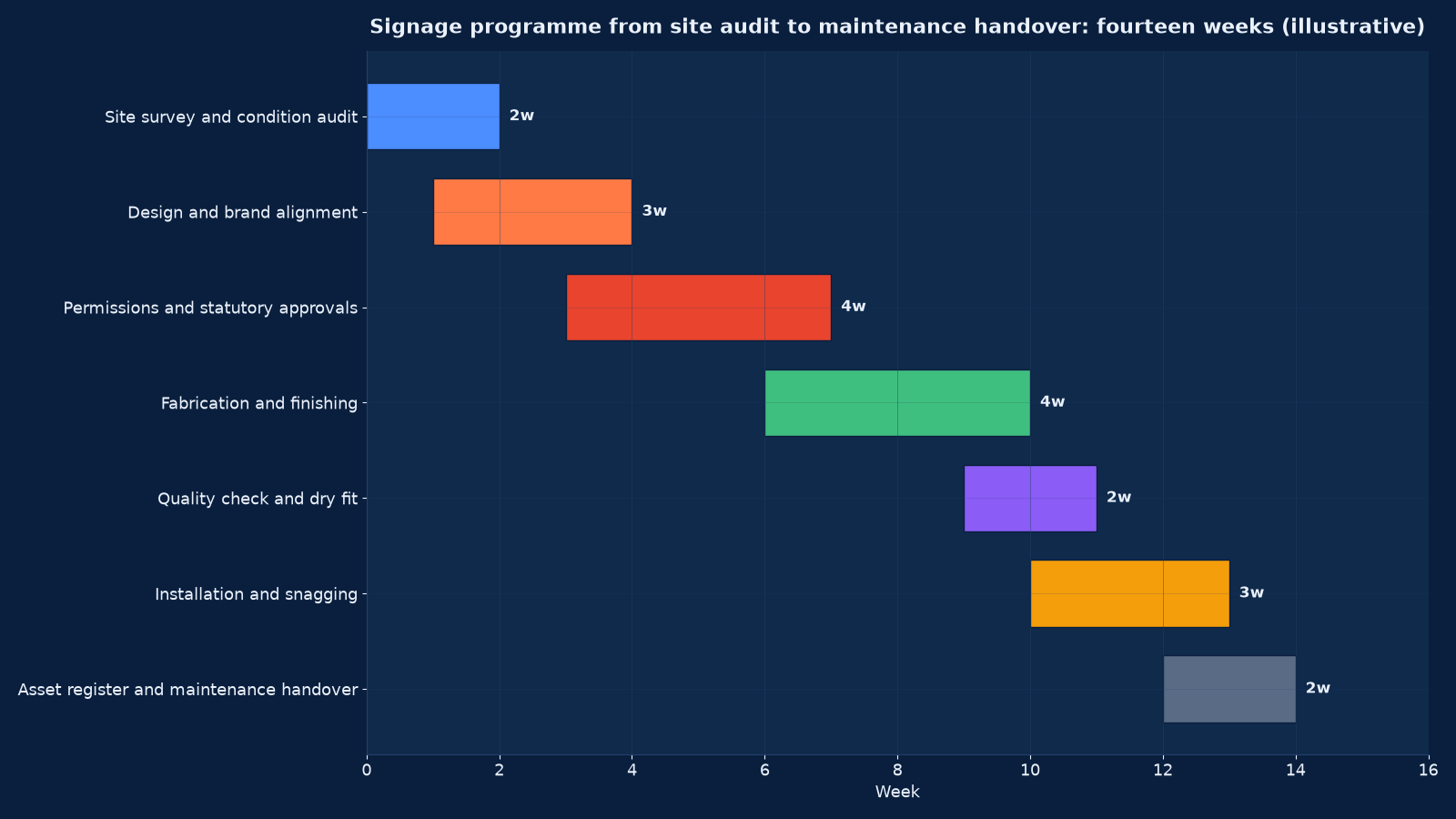
Chart values are an illustrative planning model based on typical UMC engagements and published industry benchmarks. They are not a guarantee of results on any specific project.
The Fourteen-Week Programme
| Phase | Weeks | Activities | Output |
|---|---|---|---|
| Survey and condition audit | 1–2 | Standard capture form deployed, all sites surveyed and photographed, condition grades assigned, electrical and structural findings recorded | A complete asset baseline with a condition grade and a brand-consistency score per site |
| Site-class and sign-type strategy | 2–3 | Sites classified, sign types mapped to classes, landlord and lease constraints gathered, deviation rules written | A standard specification per site class, and a documented adaptation rule |
| Design and engineering | 2–5 | Fabrication-aware artwork, structural calculations and drawings, electrical design, illumination targets, accessibility review | A design pack a fabricator can build from and an authority can approve |
| Permissions and approvals | 3–7 | Permissions matrix by municipality and sign type, applications filed with drawings, structural stability certificates lodged, consents tracked | Approvals per site, with expiry dates entered into the register |
| Specification and tender | 5–7 | Materials and workmanship specification issued, a like-for-like tender, an evaluated award, named acceptable equivalents, hold points agreed | An awarded contract with a fabrication schedule and a variation procedure |
| Fabrication and quality control | 6–10 | Batch production with hold points, colour and lumen verification, dry fit of a first article, pre-shipment inspection | Signed-off fabrication ready to ship, with a first-article record |
| Installation and snagging | 10–13 | Method statements and permits to work, sequenced installation respecting trading hours, electrical connection and testing, per-site snagging and handover | Installed estate with signed snag lists and as-built records |
| Register and maintenance handover | 12–14 | Asset register completed with warranty, permission expiry and electrical load, AMC scoped with response times, maintenance calendar issued, facilities trained | An owned, maintainable estate with a named internal owner |
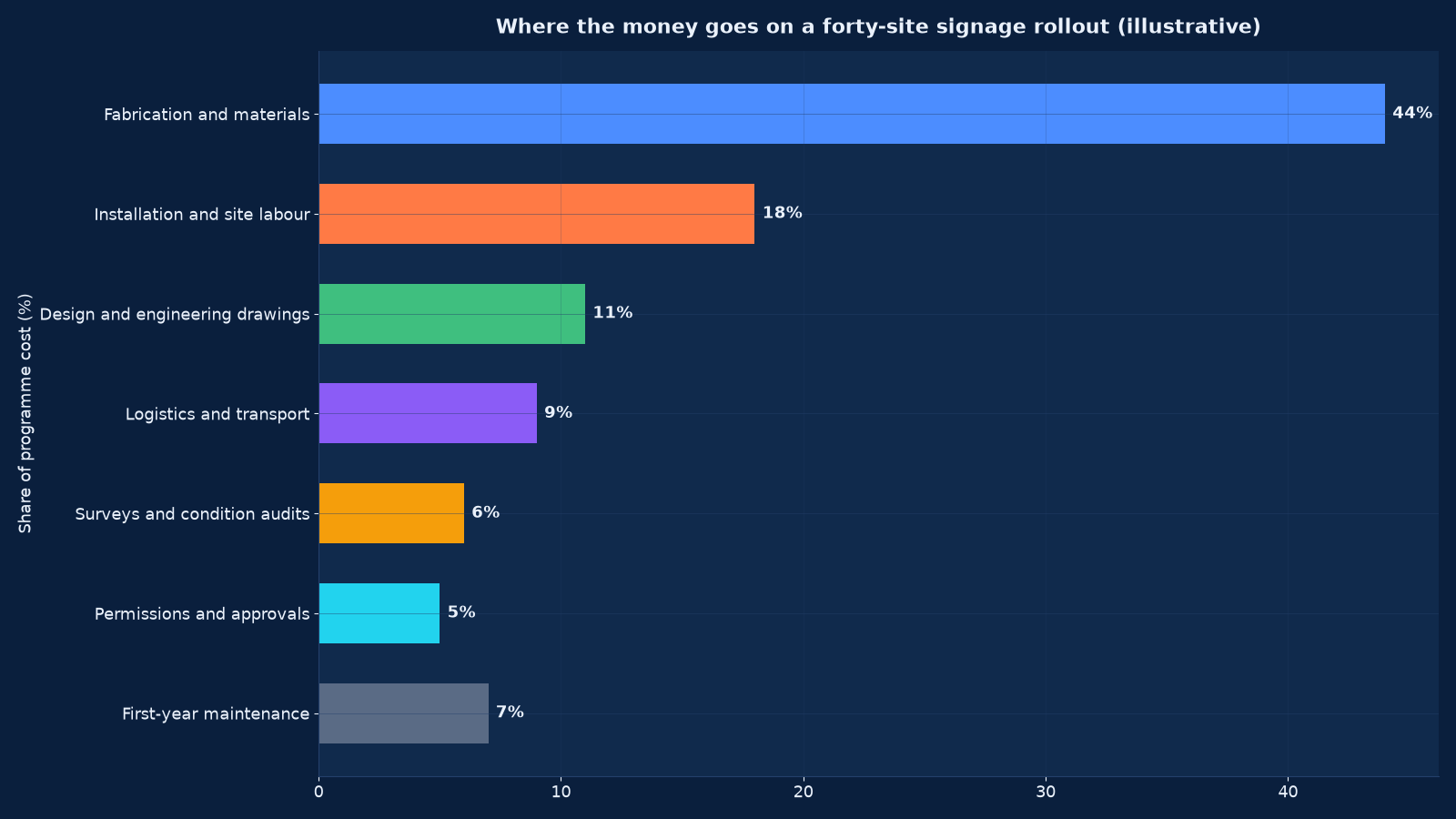
Chart values are an illustrative planning model based on typical UMC engagements and published industry benchmarks. They are not a guarantee of results on any specific project.
Cost Model and Where Programmes Lose Money
A cost model per site class, benchmarked against a like-for-like tender, is what turns a signage programme from an expense into a controlled capital project.
| Cost driver | Typical share | How it is controlled |
|---|---|---|
| Fabrication and materials | ≈44% | Specification floors, batch buying across the estate, named acceptable equivalents, and a first-article dry fit before the batch runs |
| Installation and site labour | ≈18% | Sequenced routes, night or non-trading windows planned in advance, standard fixings per facade type, and per-site snagging rather than return visits |
| Design and engineering drawings | ≈11% | One standard per site class reused across sites, with engineering done once per sign type rather than once per site |
| Logistics and transport | ≈9% | Regional fabrication hubs, flat-pack design where possible, and consolidated deliveries matched to the installation sequence |
| Surveys and condition audits | ≈6% | A standard capture form and a sampling decision for large estates; the cheapest line in the budget and the one that protects all the others |
| Permissions and approvals | ≈5% | A permissions matrix built early, applications filed in batches, and renewal dates owned in the register |
| First-year maintenance | ≈7% | An AMC with response times and included callouts, priced from the specification rather than from a vendor’s rate card |
The four leaks. First, re-scoping after award, because the survey was not independent. Second, substitutions, because the specification named one product rather than a floor with equivalents. Third, permissions discovered late, because nobody built the matrix until an authority wrote to the business. Fourth, reactive maintenance at premium rates, because no AMC was scoped and warranties were allowed to lapse. Together these typically cost more than the fabrication savings a hard negotiation would have won. Cost Rationalisation & Margin Recovery is the wider discipline this belongs to, and our guide to digital marketing costs in Lucknow makes the same point about physical brand spend: benchmarked unit costs, not percentages of turnover.
Where Signage Programmes Fail
Ten failure modes, all of them governance and specification failures rather than fabrication failures. Every one is prevented by a decision taken in the first three weeks.
| Failure mode | How it presents | Prevention |
|---|---|---|
| Vendor-led survey | Scope grows after award; the register matches what was quoted, not what exists | An independent audit completed and signed off before any tender is issued |
| Artwork that cannot be built | Rework rounds, colour compromise, and a finished sign that does not match the brand system | Fabrication-aware design with a first-article approval before batch production |
| No structural calculation | A stability certificate cannot be produced when an authority or insurer asks, and the sign is removed | Engineering drawings and a signed certificate for every freestanding or cantilevered sign |
| Permissions discovered late | Installation halted, or signs removed at the business’s cost after a municipal notice | A permissions matrix by municipality and sign type in week one, with applications filed before fabrication completes |
| Single-vendor, price-led tender | Quotes that cannot be compared, and a low award price recovered through variations | One specification, a like-for-like tender, an evaluated award and a documented variation procedure |
| Substitution after award | Thinner panel, generic drivers, calendered film — visible within two years as fading, hot-spots and failure | Named acceptable equivalents in the specification, and pre-shipment inspection against it |
| No dry fit or first article | Systematic defect repeated across every site, discovered only on installation | A first-article dry fit as a contractual hold point before the batch runs |
| Installation without method statements | Injury, facade damage, trading disruption, and an uninsured claim | Method statements, permits to work, height and electrical controls, and insured labour verified before mobilisation |
| No asset register | Warranties lapse unclaimed, permission renewals missed, failures fixed at premium rates | A register carrying warranty, expiry, load and maintenance interval per sign, with a named owner |
| No AMC | Failures accumulate until a senior visitor notices, then everything is fixed expensively at once | An AMC with response times, included callouts and a planned maintenance calendar from handover |
The tenth is the most common and the least visible. An estate without an AMC does not look broken; it looks slightly tired, with a few dark letters and a faded panel, until somebody senior visits and the whole estate is replaced at emergency rates. A maintenance calendar costs a fraction of that.
Measuring the Programme
Ten measures, baselined at survey so improvement is a comparison rather than a claim. The last four are the ones that reveal whether the specification was good, and they only mature in year two.
| Measure | Definition | Baseline and target |
|---|---|---|
| Brand-consistency audit score | Score per site against the standard: correct sign types, sizes, colours, illumination, condition | Baselined at survey; typically 55–70 before and above 90 at handover |
| Cost per site versus model | Actual against the site-class cost model, split by fabrication, installation and permissions | Within five per cent, with every variance explained |
| Statutory compliance coverage | Share of signs with a current permission or a documented exemption | 100% — anything less is a live liability |
| Illuminated sign uptime | Share of illuminated signs fully lit at any night-time inspection | Above 98% once the AMC is running |
| Design rework rounds | Number of artwork or engineering revisions per sign type before release | Falls from three or four to one |
| Weeks to first statutory approval | Elapsed time from application to first grant, by municipality | Known per municipality, and falling as the matrix matures |
| First-time-right installation | Share of sites installed without a return visit | Above 90% |
| Unplanned replacement spend | Replacement or repair outside the AMC and outside warranty, as a share of programme cost | Falls sharply in year two — the real test of specification quality |
| Warranty claims made within term | Share of eligible failures claimed from the vendor rather than absorbed | Above 90%, which requires the register to hold the dates |
| Permission renewals missed | Count of permissions allowed to expire | Zero |
Where a measure cannot be baselined because the data does not exist, that is recorded as a finding. Most estates cannot answer “how many signs do we have, and are they permitted?” on the day the programme starts, and answering it is the single most valuable output of the first two weeks.
Running This in India
Conditions that change the programme rather than merely complicating it.
Permissions are municipal and non-uniform. Sign licences, fees, illumination curfews and hoarding policies differ between municipal corporations and change with local policy — several cities restricted rooftop hoardings after structural failures. A national estate therefore needs a permissions matrix per city, not per country, and it must be refreshed rather than written once.
Monsoon, heat and cyclone exposure. Ingress protection, UV-stable films, corrosion protection on steel and correct wind-load zoning are not upgrades but baseline requirements. Coastal and cyclone-prone sites need a materially different structural specification, and the sites that fail are usually the ones specified as though they were inland.
Fragmented fabrication quality. The vendor landscape ranges from national signage companies to single-workshop fabricators. Capability varies by process — some excel at channel letters and are weak on ACP elevations — so a tender should be awarded by sign type and region rather than as one national lot, with hold points and first-article approval applied uniformly.
Language and content requirements. Several states require the local language at a defined prominence on commercial signage, and content must satisfy the advertising self-regulatory code. Both belong in the design standard rather than being discovered at installation.
Landlord and mall consent as the binding constraint. In malls and high streets the lease, not the municipality, often decides: capped projection, banned illumination hours, approved vendor lists and reinstatement obligations. Gathering lease terms in the survey phase prevents a design that cannot be installed. Where the estate spans many small landlords, our multi-site dealership programme illustrates how a dealer network’s physical brand presence is standardised across independently owned premises.
GST and contract structure. Supply-and-install signage is generally treated as a works contract rather than a goods supply, which changes the tax treatment, the invoice structure and the retention terms. Getting this wrong at tender stage creates a price disagreement after award — one of the commonest causes of a variation dispute. Finance should review the tender documents before they are issued.
Engagement Models
| Model | Duration | Deliverables | Best when |
|---|---|---|---|
| Signage estate audit | 2–4 weeks | Full or sampled survey, condition grades, brand-consistency score, permissions status, prioritised remediation list and a cost model | You cannot currently say how many signs you own, what condition they are in, or whether they are permitted |
| Full fourteen-week programme | 14 weeks | Site-class strategy, design and engineering pack, permissions matrix, specification, tender and award, fabrication supervision, installation and snagging, asset register, AMC and handover | A rollout, rebrand or standardisation across an estate |
| Specification and tender only | 4–6 weeks | Materials and workmanship specification, engineering drawings, like-for-like tender, evaluated award recommendation and variation procedure | You have the design and need the procurement discipline |
| Permissions and compliance remediation | 4–8 weeks | Permissions matrix, applications filed, stability certificates lodged, register of expiry dates and renewal process | An authority notice, an acquisition due diligence, or an audit finding |
| Rebrand rollout management | 3–9 months | Phased rollout plan, vendor management, quality control, snagging, and progress reporting against the cost model | A name, logo or format change across many sites |
| Managed signage estate | Monthly | Ownership of the asset register, permission renewals, AMC administration, condition inspections and a capital plan | You want the estate maintained without the internal headcount |
What Good Looks Like After Fourteen Weeks
The programme has worked when the estate stops being a facilities problem and becomes a managed asset.
- You can say how many signs you own, where they are, what condition they are in, and whether each is permitted.
- There is one standard specification per site class, with documented adaptation rules and a named approver for deviations.
- Structural and electrical engineering exists for every sign type, with signed stability certificates for anything freestanding.
- Permissions are held in a register with expiry dates, renewal lead times and a named owner.
- Fabrication was tendered like-for-like against a specification with named acceptable equivalents, and a first article was approved before the batch ran.
- Every installation had a method statement and a permit to work, and every site was snagged and signed off.
- An AMC with response times is live, and a planned maintenance calendar exists rather than a reactive callout habit.
- Cost per site is measured against a model, and every variance is explained.
- Somebody inside the business owns the register and reports brand-consistency score each quarter.
Two follow-ons usually apply. Where the estate carries digital screens, the content, scheduling and uptime questions become a media and technology matter, which our out-of-home and connected-channel offerings address alongside OTT & Connected TV Advertising. Where the audit reveals that the physical estate is fine but nobody can say whether it drives anything, the measurement question belongs with Marketing Mix Modelling & Attribution and Analytics & Attribution (GA4) — and BI Dashboards & Executive Reporting is where the register’s metrics become a quarterly board view.
Frequently Asked Questions About Signage Planning & Production Consulting
Do you fabricate signs yourselves?
No, and that is deliberate. We survey, specify, engineer, tender, supervise and hand over, but we do not fabricate. A consultancy that also fabricates cannot evaluate a tender honestly or enforce a specification against itself. Our income comes from the programme, not from a margin on materials, which is what makes the specification floors in section six credible when a vendor proposes a substitution.
How many sites do you need before this is worth doing?
Around twenty sites is where a standard specification and a register start to repay themselves; below that a focused audit and a specification document is usually enough. Above a hundred sites the sampling question becomes real: we audit a statistically valid subset first, establish the condition distribution, and only then decide whether a full census is worth its cost. For single-site businesses the honest answer is that a good local fabricator with a written specification is what you need, not a consultant.
Can you help with permissions we do not currently hold?
Yes, and it is often the most valuable part of the engagement. We build a permissions matrix by municipality and sign type, lodge applications with the engineering drawings and stability certificates attached, and track each to approval. What we cannot do is guarantee a grant: an authority may refuse, particularly for rooftop or highway-adjacent structures, and where it does we redesign to something lawful rather than install and hope.
What happens if a sign is already unlawful?
It is recorded, graded by exposure, and put into a remediation plan with a cost and a deadline. The options are usually to regularise by application, to modify so that it complies, or to remove. Which one is right depends on the notice position, the structure’s condition and the site’s commercial value. What is never right is leaving it undocumented, because an unrecorded liability cannot be provided for, insured or transferred in a sale.
How do you handle a franchise or dealer network where sites are independently owned?
By separating the standard from the spend. The franchisor specifies and approves; the operator pays and installs, usually through an approved vendor list. That needs a documented adaptation rule, an approval gate for deviations, and a condition-audit right in the franchise agreement — without the audit right, a standard is aspirational. Our dealership programme is an example of brand presence standardised across independently owned premises.
Can existing signs be refurbished instead of replaced?
Frequently, and the condition audit exists precisely to separate the two. Re-facing an ACP elevation, re-lamping or re-moduling channel letters, and replacing films are all materially cheaper than replacement where the structure and fixings are sound. What cannot be refurbished is a corroded sub-frame, a fatigued fixing or an unsanctioned electrical supply — and refurbishing those is how a saving becomes an incident.
How do you keep forty sites looking like the same brand?
With a specification rather than a picture: named materials with colour references in both the brand system and the achievable film or paint range, defined illumination targets and colour temperature, batch-controlled LED binning, and a first-article approval before production runs. Then a brand-consistency audit score per site, measured at handover and re-measured annually, so drift is detected while it is still cheap to correct.
What does it cost?
A fixed fee scoped on the number of sites, the number of sign types and the permissions burden. An estate audit is the smallest engagement; the full fourteen-week programme is the standard one; and managed estate ownership is priced monthly. Fabrication and installation costs are paid directly to the awarded vendors — we do not mark them up, and we benchmark them against the cost model in section eight so you can see whether a quote is fair.
How does signage relate to our advertising spend?
It is the always-on half of it. A storefront sign works every hour the site is open at a fixed capital cost, while paid media works only while budget is committed. They should be planned together: our out-of-home and media planning services treat owned physical presence and bought media as one reach problem, and our comparison of owned versus paid channels makes the same argument for digital assets. Where the question is whether the signage investment is producing anything, that is a measurement problem for Marketing Mix Modelling & Attribution.
Can you manage digital signage and screens too?
Yes for the physical estate: structural support, electrical load and heat dissipation, brightness and glare, permissions where externally visible, and the asset register and maintenance regime. Content management, scheduling and player infrastructure is a different engagement, and where screens are externally visible and sold or bought as advertising inventory they belong with our out-of-home offering. What we insist on is that a screen is specified as a structure with an electrical load before it is specified as a display.
What should we do first?
A two-to-four-week estate audit. It establishes what you own, what condition it is in, whether it is permitted, and what it would cost to bring it to standard — with a prioritised remediation list and a cost model per site class. It requires no capital commitment, it is the document every later phase depends on, and in our experience it changes the conversation from “how much will new signs cost?” to “which of our sites are we legally and commercially exposed on?”
Start With an Estate Audit
Give us your site list. In two to four weeks we will survey and photograph every sign, grade its condition, establish whether it is permitted, score each site against a brand standard, and hand you a prioritised remediation list with a cost model per site class — before any fabrication is tendered.
Contact Unified Management Consulting to arrange a confidential first conversation.
Related Services
Signage planning and production consulting is delivered alongside our other brand, property and risk services:
- Global Advertising & Promotional Campaigns — the campaign layer that physical presence supports
- OTT & Connected TV Advertising Services — the screen-based counterpart to a physical estate
- UX & UI Design Services — the same systems-thinking applied to digital surfaces
- Risk, Governance & Business Continuity Support — structural, public-safety and permissions exposure
- IT Audit, Compliance & ISO 27001 / SOC 2 Readiness — the assurance discipline for registers and controlled evidence
- Cost Rationalisation & Margin Recovery — programme cost governance within a wider cost exercise
- Business Strategy Consulting — where a store-format or site-portfolio decision drives the signage standard
- BI Dashboards & Executive Reporting — turning the asset register into a quarterly management view
- Media Planning & Buying — audience-first channel mix, negotiated rate cards, frequency and brand-safety controls, live pacing and an independent post-campaign audit
- Retail Media Networks & Marketplace Advertising — sponsored product governance, ACOS discipline, retail media measurement and off-site audience extension
- Out-of-Home & Digital OOH Advertising — corridor selection, CPM benchmarking, flighting, creative duration discipline and geofenced measurement
- Brand Performance & Creative Production — one narrative, a modular creative system, production economics, media-weighted testing and always-on optimisation