
Chart values are an illustrative planning model based on typical UMC engagements and published industry benchmarks. They are not a guarantee of results on any specific project.
Performance Max is not a black box you surrender to. It is an auction across six networks that spends whatever you let it spend, towards whatever value you told it to optimise. Most disappointing accounts are not being outbid. They are being accurately optimised towards the wrong number.
Performance Max management at Unified Management Consulting is the discipline of making an automated, cross-network campaign type behave like a managed media plan. That means conversion values that reflect margin rather than a count of events, asset groups split by intent instead of by convenience, audience signals that mean something, brand exclusions applied so the campaign is not credited for demand you already owned, creative produced to a standard the networks can actually use, and governance over the search terms and placements the campaign buys on your behalf.
We run Performance Max for e-commerce estates with feeds, for lead-generation businesses with staged conversion values, and for mixed accounts where the campaign has to be prevented from eating the search budget. We are as willing to recommend against it: a business with ten conversions a month, no reliable values and one product line will usually do better on a structured search and shopping account, and we will say so in writing rather than sell an automation that has nothing to learn from. Where Performance Max is the right answer, the difference between a managed campaign and a launched one is typically visible within two quarters, in the network mix as much as in the cost.
🎯 Performance Max Management — Quick Summary
| Component | What We Deliver |
|---|---|
| Conversion value staging | Values that reflect margin, lead quality or lifetime value, agreed with whoever owns revenue, and imported so the strategy optimises towards money rather than events. |
| Asset groups by intent | One group per intent or margin band, each with its own headlines, descriptions, images, video and final URLs — the structural control that replaces keyword targeting. |
| Audience signals | First-party segments, custom segments by search term and by interest, and a written statement of what each signal is for and how its effect will be judged. |
| Brand exclusions and cannibalisation control | Brand terms excluded or accounted for, so the campaign is not credited for demand the brand already owned, and so the incremental value is measurable. |
| Creative production | Images, logos, headlines, descriptions and video produced to each network’s specification, with a refresh cadence and a record of what was tested. |
| Feed and Merchant Centre health | For e-commerce: disapprovals cleared, identifiers present, prices and availability synchronised, titles built from what shoppers type. |
| Search term and placement governance | Insights read on a schedule, negatives and exclusions applied where the campaign type allows, and placement review for Display and YouTube. |
| Budget and target calibration | Targets set from the account’s own history and moved in steps, with budget allocated between Performance Max and standard campaigns on stated grounds. |
| Network-mix analysis | Conversions and spend read by network each month, which is the clearest available evidence of what the campaign is actually buying. |
| Reporting and creative refresh | A monthly pack covering value, network mix, asset-group performance, search-term insights and the next creative wave. |
What This Service Actually Covers
Performance Max is usually bought as part of a wider paid-search engagement, and it should be, because a campaign that spans six networks cannot be governed in isolation from the campaigns it competes with inside your own account.
| Component | What we do | What you keep | Cadence |
|---|---|---|---|
| Account and value design | Conversion actions, values, offline imports and the primary and secondary split | A value model agreed with sales or finance | Once, then reviewed quarterly |
| Structure | Campaign and asset-group design by intent, margin band or product family | A structure diagram with the reason per group | Once, then as the catalogue changes |
| Audience signals | First-party lists, custom segments by term, interest and URL | A signal register stating the purpose of each | Once, refreshed quarterly |
| Brand control | Exclusions, brand campaign separation and incremental measurement | A written position on how brand demand is accounted for | Once, then audited monthly |
| Creative | Production to network specifications, with a testing record | An asset library and a refresh calendar | Wave one, then quarterly |
| Feed health | Disapprovals, identifiers, price and availability sync, title structure | A feed specification and a monitoring rule | Weekly monitoring for e-commerce |
| Governance | Search-term insights, placements, exclusions and anomalies | A monthly governance log | Monthly |
| Budget and targets | Calibration against history, staged target moves, budget split with standard campaigns | A budget plan with the reasoning | Monthly |
| Reporting | Value, network mix, asset-group performance and the next actions | A monthly pack readable by finance | Monthly |
What Performance Max Actually Is, and What It Is Not
The campaign type is described in marketing language that hides its mechanics. Stated plainly: it is one budget, one bid strategy and one set of assets, auctioned across Search, Shopping, Display, YouTube, Discover, Gmail and Maps, with the allocation decided by the system against the conversion goal you set.
| What it is | What it is not |
|---|---|
| A single budget competing across every Google network | A separate channel you can compare cleanly against search or shopping |
| Optimised towards the conversion actions and values you declare | Optimised towards profit, unless profit is what you declared |
| Steered by asset groups, audience signals, values, exclusions and creative | Steered by keywords, which it does not have |
| Able to find conversions you would not have bought manually | Guaranteed to find incremental ones — some were already yours |
| Reported by network, asset group and insight, with effort | Transparent at the auction level, which nobody outside the platform can see |
| Best where conversion volume and values are reliable | A rescue for an account with thin data and no value model |
| A campaign type that rewards structure and creative discipline | A set-and-forget product, which is how most disappointing accounts are run |
The consequence for management is that every lever you retain has to be pulled deliberately. There is no keyword list to curate, so the equivalent work moves into values, asset groups, signals, exclusions and creative — which is more work than a search campaign, not less, and is the reason an unmanaged Performance Max campaign drifts towards cheap branded conversions.
The Transparency Problem, and How We Work Around It
Clients are told Performance Max is opaque. It is partially opaque, and the parts that are visible are usually enough to manage it well. The discipline is to read what is available on a schedule rather than to complain about what is not.
| Available signal | Where it lives | How we use it |
|---|---|---|
| Conversions and spend by network | Campaign reporting, segmented by network | The primary management view: it shows whether the campaign is buying search, shopping or display, and how that mix is moving |
| Asset group performance | Asset-group reporting, with Low, Good and Best labels | Which intents are working, and which groups need creative rather than budget |
| Search terms insights | Insights page, categorised rather than exhaustive | The themes the campaign is buying, which drives exclusions and new asset groups |
| Placement and publisher insights | Insights for Display and YouTube | Where the budget is landing, and whether any placement should be excluded |
| Auction insights | Where available for the campaign | Competitor presence and overlap, read directionally |
| Impression share and lost share | Campaign metrics | Whether the constraint is budget or eligibility |
| Conversion paths and attribution | Analytics and the attribution reports | How much of the credit is assisted rather than last-click, which changes the value case |
| Feed diagnostics | Merchant Centre | For e-commerce, the health of the inventory the campaign is selling |
What is genuinely unavailable is the internal auction: which query at which moment was matched to which asset at which price. We do not pretend otherwise, and we do not build a strategy that depends on knowing it. The management model is therefore one of inputs and observed outputs — change one input, measure the network mix and the value, keep what worked.
Conversion Values: the Only Real Steering Wheel
If one part of this page mattered more than the rest, it would be this. Performance Max optimises towards the value you declare. An account that declares every lead as worth one unit will buy the cheapest leads available, which are usually the least qualified, and the campaign will look efficient while the sales team gets worse.
| Value model | When it is right | What it produces | The risk |
|---|---|---|---|
| Uniform value per conversion | A business with genuinely identical outcomes per lead | Volume at the lowest cost per lead | Buying cheap, unqualified leads that satisfy the metric and not the business |
| Staged values by lead quality | Most lead-generation businesses | A bias towards the leads that become opportunities | Requires sales agreement on what quality means, and a feedback loop that actually runs |
| Margin per order | E-commerce with variable margin across the catalogue | Spend concentrated on the products that make money | Margin data must be current, or the campaign optimises towards last year’s economics |
| Lifetime or cohort value | Subscription, repeat-purchase or high-retention businesses | Willingness to pay more for the first order of a good cohort | The value must be defensible and stable, or the strategy chases a moving target |
| Offline conversion import | Long B2B cycles where revenue is closed outside the platform | Optimisation towards closed deals rather than form fills | Import lag: the strategy learns from conversions that happened weeks ago |
We agree the value model with whoever owns revenue, write it down, and state in the report what the campaign is being asked to do. A Performance Max campaign optimising towards staged lead values will show a higher cost per lead than one optimising towards raw leads. That is not a failure; it is the model working, and the alternative is a cheaper lead that nobody can sell to.
Asset Groups by Intent
Asset groups are the structural unit of Performance Max and the closest thing it has to a keyword strategy. One group per intent means one set of creative, one landing page and one readable performance number. One group for the whole catalogue means none of those.
| Split basis | Example groups | Why it works |
|---|---|---|
| By intent | Buy now, compare, local service, replacement part, support | Each intent gets a headline, an image and a landing page that answers it |
| By margin band | High-margin families, volume families, clearance | Value-based bidding has something meaningful to differentiate |
| By product family | One group per category with its own feed subset | Creative relevance and a readable performance comparison |
| By audience | New customer, lapsed customer, existing customer | Different offers and different values, which is where new-customer acquisition is actually controlled |
| By geography or language | One group per market | Creative and landing pages in the market’s language, and per-market reporting |
| By funnel stage | Demand generation against demand capture | Prevents the campaign from confusing awareness inventory with bottom-funnel intent |
- Every asset slot filled with distinct copy: fifteen headlines, five long headlines, five descriptions, and images at each required ratio, with no slot left to the system’s generation if it can be helped.
- Final URLs that match the group’s intent, rather than one homepage for twelve groups.
- One group per landing page proposition, so message match is a structural property rather than a hope.
- A naming convention that encodes intent, market and audience, because asset-group reporting is the main diagnostic surface available.
- Groups retired when their intent is absorbed elsewhere, with the retirement recorded rather than left paused and forgotten.
Audience Signals: What They Do and Do Not Do
Audience signals are a hint, not a targeting restriction, and treating them as targeting is the most common misunderstanding in this campaign type. They tell the system where to look first; they do not limit who is reached.
| Signal type | What we supply | What it is for |
|---|---|---|
| First-party lists | Customer, cart-abandoner, lapsed-customer and lead lists, uploaded with consent and refreshed on a schedule | The strongest signal available, and the basis of any new-versus-returning split |
| Custom segments by search term | The terms your buyers actually type | Reaching people whose recent behaviour matches your demand, which is the closest thing to keyword targeting here |
| Custom segments by interest | Interests and purchase intentions relevant to the category | Broadening beyond terms where the terms are too narrow |
| Custom segments by URL | Competitor, review-site and category URLs | Reaching an audience defined by where it browses, useful in considered purchases |
| Your data segments | Analytics-derived segments of engaged visitors | Reinforcing patterns the site already shows |
We record the purpose of each signal in a register, because a signal added without a reason cannot be evaluated and will never be removed. The honest expectation is modest: signals shorten the learning period and bias the early auction. Over months, the value model and the asset-group structure matter considerably more.
Brand Exclusions and the Cannibalisation Question
The single most common reason a Performance Max campaign looks excellent and the business feels no difference is that it is buying branded search terms the account was already winning cheaply. The spend moves, the credit moves, and nothing new happens.
| Approach | How it works | When we recommend it |
|---|---|---|
| Brand exclusions at account level | Brand terms and misspellings excluded from the campaign | The default: a separate brand search campaign is cheaper, more controllable and easier to report |
| Brand asset group | A dedicated group for brand demand with its own creative and value | Where brand demand is large enough to manage separately inside the campaign type |
| Holdout measurement | A period or a market where the campaign is off, compared against the rest | Where the incremental question is genuinely disputed and the budget allows a clean test |
| Cannibalisation monitoring | Brand campaign volume tracked alongside Performance Max brand conversions | Always: it is the cheapest available evidence of whether the campaign is adding or claiming |
| New-customer acquisition goal | A value premium or a goal for customers not in your lists | Where growth, not efficiency, is the objective |
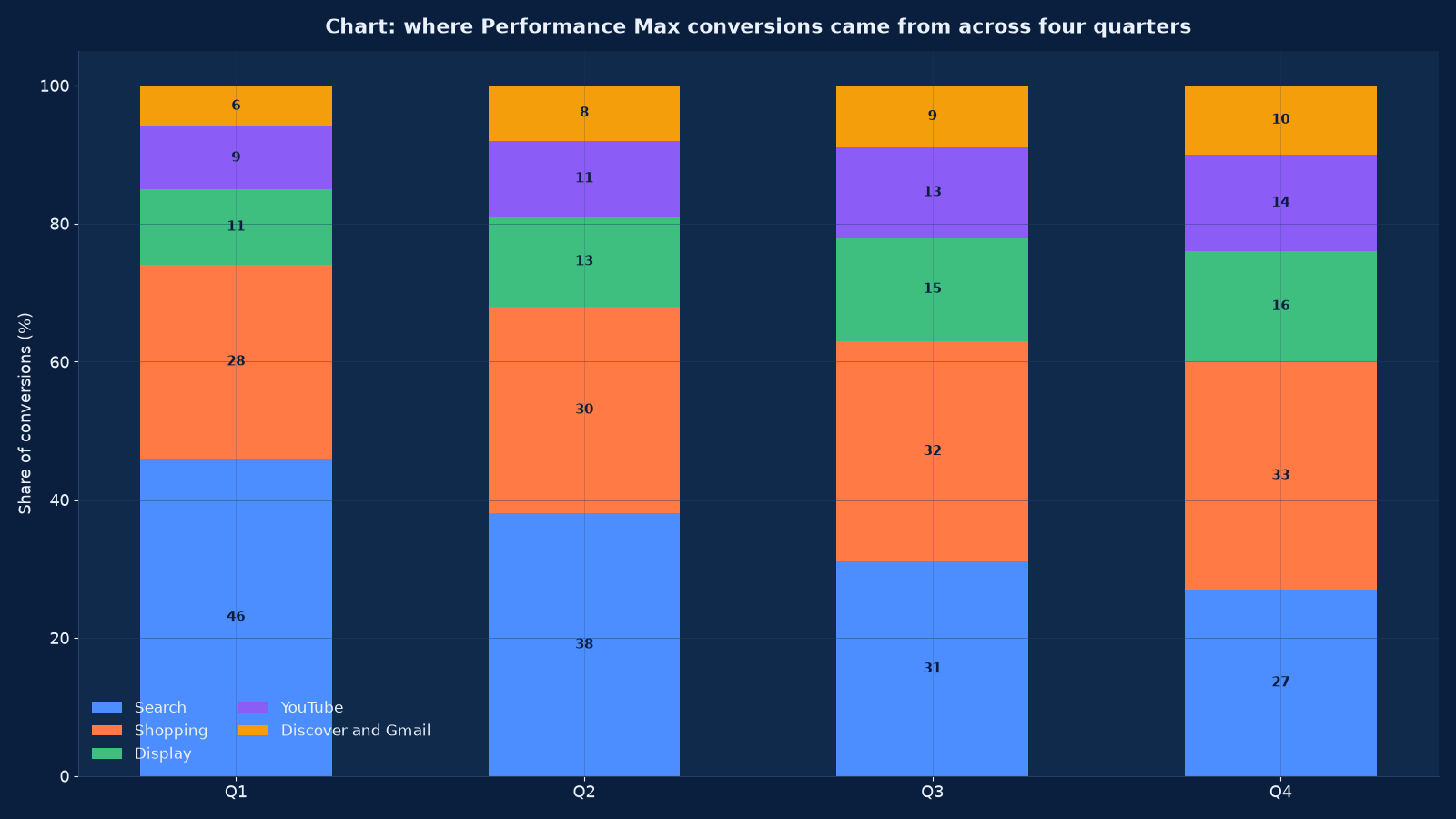
Figure 1 is the evidence that this works. In the first quarter of that programme, 46 per cent of conversions came from the Search network, which for a business with an established brand usually means branded queries. By the fourth quarter Search was 27 per cent and Shopping, Display, YouTube and Discover between them had grown from 54 to 73 per cent. The campaign was buying demand it had not previously reached, and the total conversion value rose rather than merely relocating.
Chart values are an illustrative planning model based on typical UMC engagements and published industry benchmarks. They are not a guarantee of results on any specific project.
Search Terms, Placements and the Governance Log
Performance Max does not offer a search-term report in the classic sense, and it does not accept negative keywords in most configurations. What it offers is categorised insights and account-level exclusions, which is enough to govern the campaign if somebody reads them on a schedule.
| Governance item | Frequency | Action available |
|---|---|---|
| Search term insight categories | Monthly | New asset groups for themes worth owning, account-level brand and irrelevant-category exclusions |
| Placement and publisher insights | Monthly | Placement exclusions where the inventory is irrelevant or the brand environment is unacceptable |
| Content suitability and inventory | Once, then on change | Inventory tiers set deliberately rather than left at the default expansion |
| Asset-group ratings | Monthly | Creative replacement in groups rated Low, and budget attention to groups rated Best |
| Anomalies in spend or value | Weekly | A pause or a target correction before a week of budget is spent wrongly |
| Exclusion list review | Quarterly | Confirmation that every exclusion is still wanted, since these lists decay silently |
| Feed diagnostics | Weekly for e-commerce | Disapproval clearance, because a disapproved product cannot be sold by the campaign |
The governance log is part of the monthly report. It records what was reviewed, what was changed, what was deliberately not changed, and why. That log is what makes an automated campaign type auditable a year later, and it is the artefact most often missing when a client arrives saying the campaign has drifted and nobody knows when it started.
Creative Production and the Refresh Cadence
Creative is the input with the most leverage after values, and the one clients most often under-resource. The campaign needs assets in every required ratio and duration, and it will assemble them into formats you did not design if you do not supply them.
| Asset | Specification discipline | Refresh trigger |
|---|---|---|
| Headlines and long headlines | Distinct by intent, within character limits, no duplicated variants padded to fill slots | When asset-group ratings fall, or quarterly |
| Descriptions | One clear proposition and one reason to act per description | With any offer or price change |
| Images | Landscape, square and portrait at the required ratios, product-led for shopping intents and human-led for service intents | Seasonally, and whenever a rating drops |
| Logos | Square and horizontal, legible at small sizes | On brand change only |
| Video | A short, hook-led video where the campaign serves YouTube, supplied rather than auto-generated | Per creative wave, since video fatigue arrives first |
| Landing pages | One per asset-group intent, message-matched and fast on mobile | Whenever the intent or offer changes |
Where a client has no video, we say so plainly: the system will assemble one from stills and text, and it will look like what it is. Supplying one short video is usually the highest-return creative investment in the first wave, and it is also the one most often deferred.
Budget, Targets and the Learning Cycle
Automated strategies learn from data and are reset by change. Most accounts we inherit have been edited often enough that the strategy has rarely had a stable period, and the recommendation is therefore as much about restraint as about adjustment.
| Decision | Rule we apply | Why |
|---|---|---|
| Starting target | Set from the account’s own recent history, not from an ambition | A target the data cannot support starves the campaign of impressions |
| Target movement | In steps of roughly ten per cent, no more often than the conversion cycle allows | Large or frequent moves restart learning and waste the budget in between |
| Budget allocation | Between Performance Max and standard campaigns on measured incremental value | Otherwise the automated campaign absorbs budget from the ones you can steer |
| Budget changes | Increases planned, not reactive; decreases staged | A capped campaign and a suddenly funded one both destabilise delivery |
| Edit cadence | Fewer, larger, planned changes rather than daily tweaks | Stability is a requirement of the learning period, not a preference |
| Seasonal peaks | Targets and budgets adjusted in advance, with the dates recorded | A reactive change during a peak arrives after the peak |
| New market or product | Its own asset group and, where volume allows, its own campaign | Mixing a new launch into a mature campaign hides both |
Performance Max Alongside Search, Shopping and Social
The campaign type competes with your other campaigns for the same queries and the same customers, and it competes with your social campaigns for the same creative budget. Managing it in isolation produces an account that argues with itself.
| Relationship | The problem if unplanned | How we plan it |
|---|---|---|
| Brand search campaign | Performance Max claims brand conversions at a higher cost than a brand campaign would | Brand excluded or separately grouped, with both volumes reported together |
| Non-brand search | Overlap on generic terms, with two bids competing | Asset groups mapped to intents, and search campaigns restricted to the intents where manual control earns its keep |
| Shopping | The feed is shared, so a disapproval affects both | One feed specification, one monitoring rule, and product groups aligned across campaigns |
| Display and YouTube bought separately | Duplicated reach and unclear attribution | One plan for prospecting inventory, with the campaigns’ roles stated |
| Social paid campaigns | Same audience, same creative needs, different platforms | A shared creative calendar and a shared value model so channels can be compared |
| Organic search | Paid campaigns buying terms the site already ranks for | A joint view of terms, so spend goes where organic cannot yet reach |
The Twelve-Week Programme
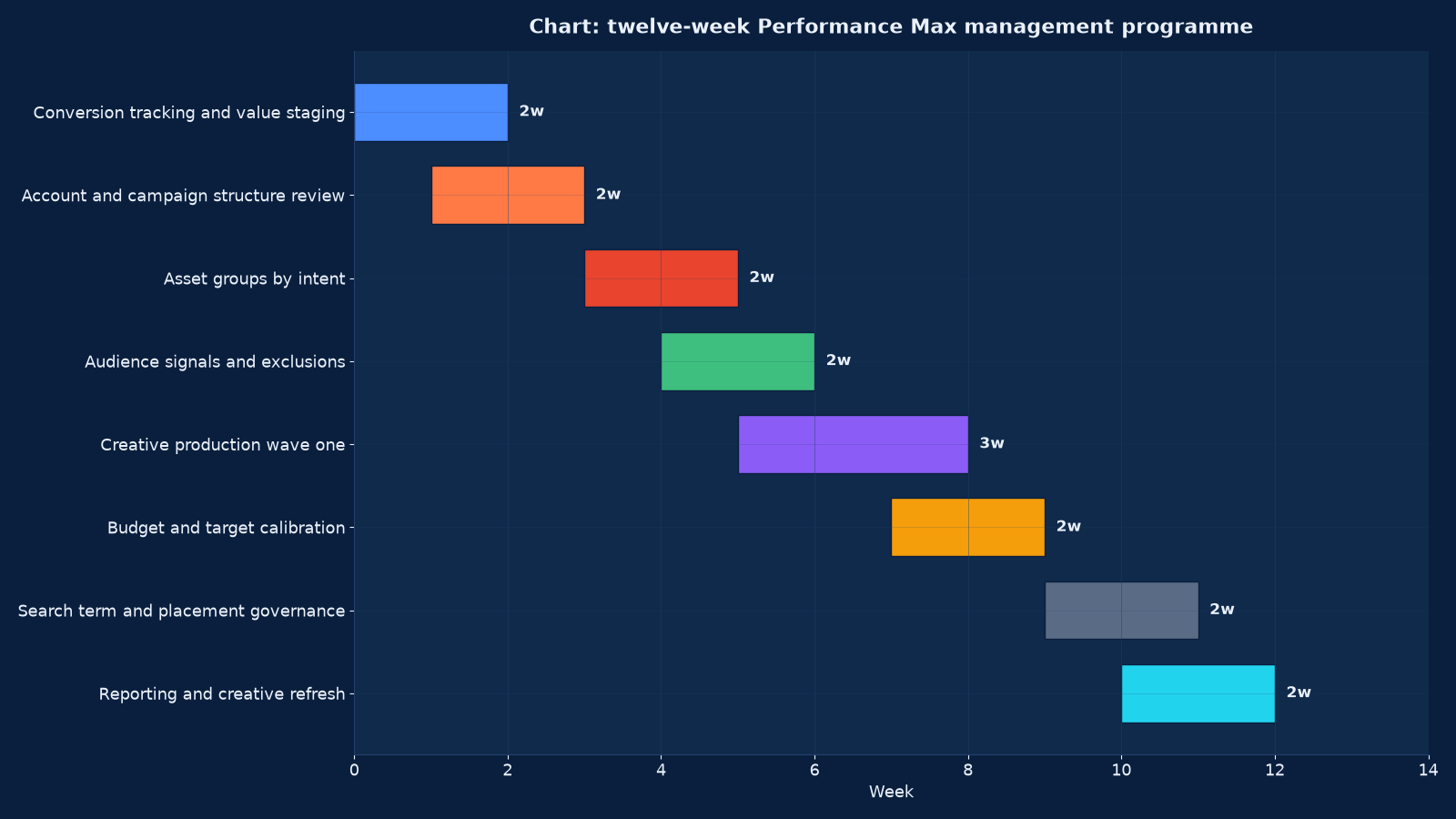
Chart values are an illustrative planning model based on typical UMC engagements and published industry benchmarks. They are not a guarantee of results on any specific project.
| Weeks | Workstream | Gate to pass |
|---|---|---|
| 1–2 | Conversion tracking, values and offline imports | A value model agreed in writing with whoever owns revenue |
| 2–3 | Account and campaign structure review | A target structure with the reason per campaign and per asset group |
| 4–5 | Asset groups rebuilt by intent | Every group with distinct copy, matching final URLs and a readable name |
| 5–6 | Audience signals and exclusions | A signal register with a purpose per entry, and brand exclusions applied |
| 6–8 | Creative production wave one | All required ratios and durations supplied, including video where YouTube matters |
| 8–9 | Budget and target calibration | Targets set from history and a budget split agreed with the standard campaigns |
| 10–11 | Search term and placement governance | The governance log opened, with exclusions and insights reviewed on schedule |
| 11–12 | Reporting and the next creative wave | A monthly pack covering value, network mix and asset groups, plus the refresh calendar |
Twelve weeks is the time to a governed campaign, not to a transformed one. The network mix shift in Figure 1 took four quarters, because value-based strategies need conversion volume and time to relearn. A client should expect the controls to be in place at week twelve, the first evidence at the end of the following quarter, and the real judgement at six to twelve months.
Measurement and Reporting
| Measure | Definition | Reported |
|---|---|---|
| Conversion value | Declared value by the agreed model, not the platform’s event count | Weekly, with the model restated |
| Return on ad spend against margin | Value divided by spend, using margin where margin is the declared value | Monthly |
| Network mix | Conversions and spend by network, as shares | Monthly — the primary management view |
| Asset-group performance | Value and volume per group, with the platform’s rating | Monthly |
| Brand versus non-brand | Conversions attributed to brand demand against the rest | Monthly, with the exclusion position restated |
| New versus returning | New-customer share where the data supports it | Monthly for e-commerce, quarterly for lead generation |
| Impression share and lost share | Eligibility against budget and against rank | Monthly |
| Search-term insight themes | The categories the campaign is buying, and their movement | Monthly |
| Feed health | Disapproved, limited and missing-attribute products | Weekly for e-commerce |
| Governance log | What was reviewed, changed, and deliberately left alone | Monthly |
When Performance Max Is the Wrong Answer
We decline or defer this campaign type more often than most agencies do, because it is easy to launch and hard to govern, and an ungoverned automated campaign spends money at scale.
| Situation | Why it fails | What we recommend instead |
|---|---|---|
| Ten conversions a month | No volume for a value-based strategy to learn from | Structured search with manual or maximise-clicks bidding until volume exists |
| No agreed conversion values | The campaign will optimise towards whatever a count implies | A value model first, agreed with sales or finance, then the campaign |
| One product and one landing page | Asset groups have nothing to differentiate | A search and shopping structure, which gives more control for less complexity |
| Strict brand-safety requirements | Inventory control is coarser than a managed display buy | A display or video campaign with explicit placement targeting |
| A business that cannot supply creative | The system assembles assets and the brand suffers | A creative plan first; the campaign type is not the constraint |
| An account already struggling with tracking | Automation amplifies a measurement defect | Fix tracking, then automate |
| A short promotional burst | The learning period outlasts the promotion | Manual campaigns for the burst, with Performance Max for the always-on baseline |
Where we recommend against it, the recommendation is written into the proposal with the reasoning, and we will manage the alternative. An agency that only ever recommends the automated product is describing its own convenience rather than your account.
Failure Modes We Are Usually Called In To Fix
| What we find | Why it happened | What we do |
|---|---|---|
| Great return on ad spend, no business growth | The campaign is buying branded demand that was already converting | Brand exclusions, a separate brand campaign, and cannibalisation monitoring before any other change |
| Cheap leads that sales cannot use | A uniform conversion value with no quality staging | Staged values agreed with sales, then a target reset from the new history |
| One asset group for the whole catalogue | The campaign was launched as a single unit | Rebuild by intent or margin band, in stages so learning is not reset all at once |
| No video, so the system made one | Creative was deferred | Supply a short hook-led video and replace the generated asset |
| Display and YouTube spending with nobody reviewing placements | Insights were never opened | A monthly governance log with placement exclusions |
| Target ROAS set to an ambition | A goal entered as a setting | Reset from history and moved in steps |
| Feed disapprovals silently removing products | No feed monitoring | Weekly diagnostics and a feed specification owned by somebody |
| Budget absorbed from the search campaigns | No plan for how the campaigns relate | A budget split on measured incremental value, reviewed monthly |
Evidence From Our Work
The engagements and writing below are published on this site, each described by the subject its own page documents. They are listed because a Performance Max conversation usually starts with a client who has been told the campaign type is either the future or a scam, and neither is useful.
- B2B Google Ads campaign project summary — a live paid-search engagement with its objectives, structure, budget allocation and performance indicators documented, which is the governance this page describes applied to a B2B account.
- Google Ads and Meta Ads strategy for a fashion retail showroom — a retail account where shopping inventory, margin per family and social creative had to be planned together rather than per platform.
- WordPress WooCommerce e-commerce development for Suri Retail Group — a multi-brand retail catalogue, where the feed, the product taxonomy and the asset-group structure are the same design problem.
- Google Ads guide to maximise ROI — the platform fundamentals an automated campaign type still depends on, including tracking, structure and reporting.
- Marketing attribution models: how to choose the right one for your business — why a cross-network campaign’s last-click report understates its assisted contribution, and how to read it instead.
- Landing page optimisation: how to convert more visitors into customers — the message-match work per asset group, which is where most of the recoverable value sits.
- Video marketing for small businesses — how short video is produced and repurposed, which is the supply problem behind most weak YouTube inventory.
- E-commerce marketing for Lucknow businesses — the feed, shopping and catalogue work an e-commerce Performance Max campaign depends on.
- Digital marketing budgeting — how a budget is split between automated and manual campaigns on evidence.
- How AI is transforming digital marketing — the automation context: what these systems do well, and where human judgement is still the constraint.
- The digital marketing insight archive — further writing on paid media, creative and measurement.
Engagement Models and Commercials
Performance Max is managed work rather than project work, because the levers decay: creative fatigues, values go stale, exclusions are forgotten and the catalogue changes. We therefore quote a rebuild and a retainer, and we will quote the rebuild alone for a team that wants to run it afterwards.
| Model | Best for | What you get | Indicative shape |
|---|---|---|---|
| Rebuild, fixed fee | A live campaign that has never been structured | Values, structure, asset groups, signals, exclusions, creative brief and the governance log opened | Twelve weeks, one fee |
| Managed retainer | A business that wants the campaign run continuously | Monthly governance, creative waves, budget and target calibration, reporting | Monthly, usually with a media spend band |
| Feed and shopping programme | An e-commerce estate where the feed is the constraint | Feed specification, disapproval clearance, title and attribute optimisation, monitoring | Fixed fee, then monitoring |
| Value-model engagement | A business that has never priced a conversion | A value model agreed with sales or finance, staged values, offline imports | Two to four weeks, one fee |
| Second opinion | A campaign managed elsewhere with disputed results | An independent read of values, structure, brand cannibalisation and network mix | Fixed fee, three weeks |
Media spend is not marked up and is never a basis for our fee. The fee is quoted against the work: the number of asset groups, the creative waves, the markets and languages, the feed size, and whether offline conversion imports have to be built. A client who wants a cheaper engagement usually wants fewer asset groups, and we will tell them what that costs in performance rather than pretending the two are unrelated.
Frequently Asked Questions About Performance Max Management
Is Performance Max worth it?
Where conversion volume and values are reliable, usually yes, and the network mix evidence in Figure 1 is the case for it. Where a business has ten conversions a month, no agreed values and one landing page, no: a structured search and shopping account gives more control for less complexity. We assess which situation you are in before proposing anything.
Why does my Performance Max campaign only seem to buy branded traffic?
Because branded search is the cheapest conversion available and the campaign optimises towards cost-efficient conversions unless told otherwise. The fix is brand exclusions or a dedicated brand asset group, a separate brand search campaign, and cannibalisation monitoring so you can see the effect. It is the most common finding in our audits of this campaign type.
Can I use negative keywords in Performance Max?
Not in the classic per-campaign sense. You can apply account-level brand exclusions and, depending on configuration, exclude categories and specific terms at the account level, and you can govern through asset-group structure and search-term insights. We set the exclusions deliberately and record them, because an exclusion applied once and forgotten becomes wrong as the catalogue changes.
Do audience signals actually target those audiences?
No. They are a hint that shortens the learning period and biases early delivery; the campaign will reach beyond them. We supply first-party lists, custom segments by search term and by URL, and we record the purpose of each so it can be evaluated rather than accumulated.
How much creative do I need?
Fifteen headlines, five long headlines, five descriptions, images in every required ratio, square and horizontal logos, and video if you want the YouTube inventory to represent your brand rather than an assembly of your stills. Per asset group, not per campaign — which is why the number of asset groups is the main driver of creative cost.
How long does it take to see results?
Controls can be in place in twelve weeks. Meaningful evidence usually arrives at the end of the following quarter, because a value-based strategy needs conversion volume and stability to relearn. A real judgement is a six to twelve month view, and anybody promising a different timeline is describing a campaign that was already working.
Can you prove the conversions are incremental?
Partly, and we are explicit about the limits. The available evidence is the network mix moving away from search towards shopping, display, video and Discover, cannibalisation monitoring against a separate brand campaign, and — where budget and patience allow — a holdout in one market or one period. We will not claim more certainty than those methods support.
Should Performance Max replace my search campaigns?
Rarely all of them. The usual design is Performance Max for broad cross-network demand capture, with search campaigns retained where manual control earns its keep: high-value generic terms, tightly messaged landing pages, or intents where you need to see and curate every query. We decide that per intent rather than per doctrine.
How do you handle e-commerce feeds?
As the primary control surface. Disapprovals cleared, identifiers present, prices and availability synchronised with the site, titles built from what shoppers type, and product groups aligned to the asset-group structure. A disapproved product cannot be sold by the campaign, so feed diagnostics run weekly and appear in the monthly report.
What reporting will I get?
A monthly pack covering conversion value against the agreed model, return on spend, the network mix, asset-group performance, brand versus non-brand, impression share, search-term insight themes, feed health for e-commerce, and the governance log of what was reviewed and changed. It is written so a finance director can read it without a glossary.
Do you charge a percentage of media spend?
No. Fees are quoted against the work: asset groups, creative waves, markets, feed size and whether offline conversion imports must be built. A spend percentage rewards a larger budget rather than better management, which is the wrong incentive for an automated campaign type.
What if we want to bring it in-house?
Then the rebuild is the right purchase and the retainer is not. We deliver the structure, the value model, the signal register, the governance log and the creative calendar in an editable form, and we train whoever will run it. Several clients do exactly that after the first twelve weeks.
Commission a Performance Max Assessment or Rebuild
Send us read access to the account, your monthly spend, what a conversion is worth and who decides that. Within three weeks you will have an assessment of the value model against what the campaign is actually optimising towards, a network-mix analysis showing what it is buying, a brand cannibalisation read, an asset-group and creative gap list, a feed health report if you sell products, and a costed twelve-week rebuild plan with the honest statement of whether this campaign type is the right one for your account at all.
Contact Unified Management Consulting to arrange a confidential first conversation.
Related Services
Performance Max management is delivered with the paid, creative and measurement practices around it:
- Google Ads Management Services — the search and shopping campaigns this one has to be planned alongside
- Programmatic Advertising Services — display and video bought with explicit placement control, where that control is a requirement
- Facebook & Meta Advertising Services — the social counterpart, sharing the creative calendar and the value model
- YouTube Advertising & Video Marketing Services — the video supply that decides whether the YouTube inventory represents your brand
- Conversion Rate Optimisation (CRO) Services — testing the landing pages each asset group sends traffic to
- Analytics & Attribution (GA4) Services — the conversion values, offline imports and attribution the strategy runs on
- E-commerce Development & Marketing Services — the catalogue, feed and product data behind a shopping-led campaign
- Marketing Automation (HubSpot & Marketo) Services — where lead quality and closed-deal values come from
- Google Ads Agency in Lucknow — local delivery of this work with local auction context
- Google Ads Audit: Fixed-Fee Account Review — A fixed-fee Google Ads audit: wasted spend by cause, tracking and conversion review, structure, negatives, bidding and a costed repair plan
- Google Shopping & Merchant Centre Feed Services — Google Shopping and Merchant Centre feeds: disapproval repair, GTIN and identifier fixes, price sync, titles, labels and campaign wiring
- Local Services Ads & Local Campaign Management — Local Services Ads and local campaigns: eligibility and verification, service areas, profiles, reviews, lead routing, disputes and cost per job