
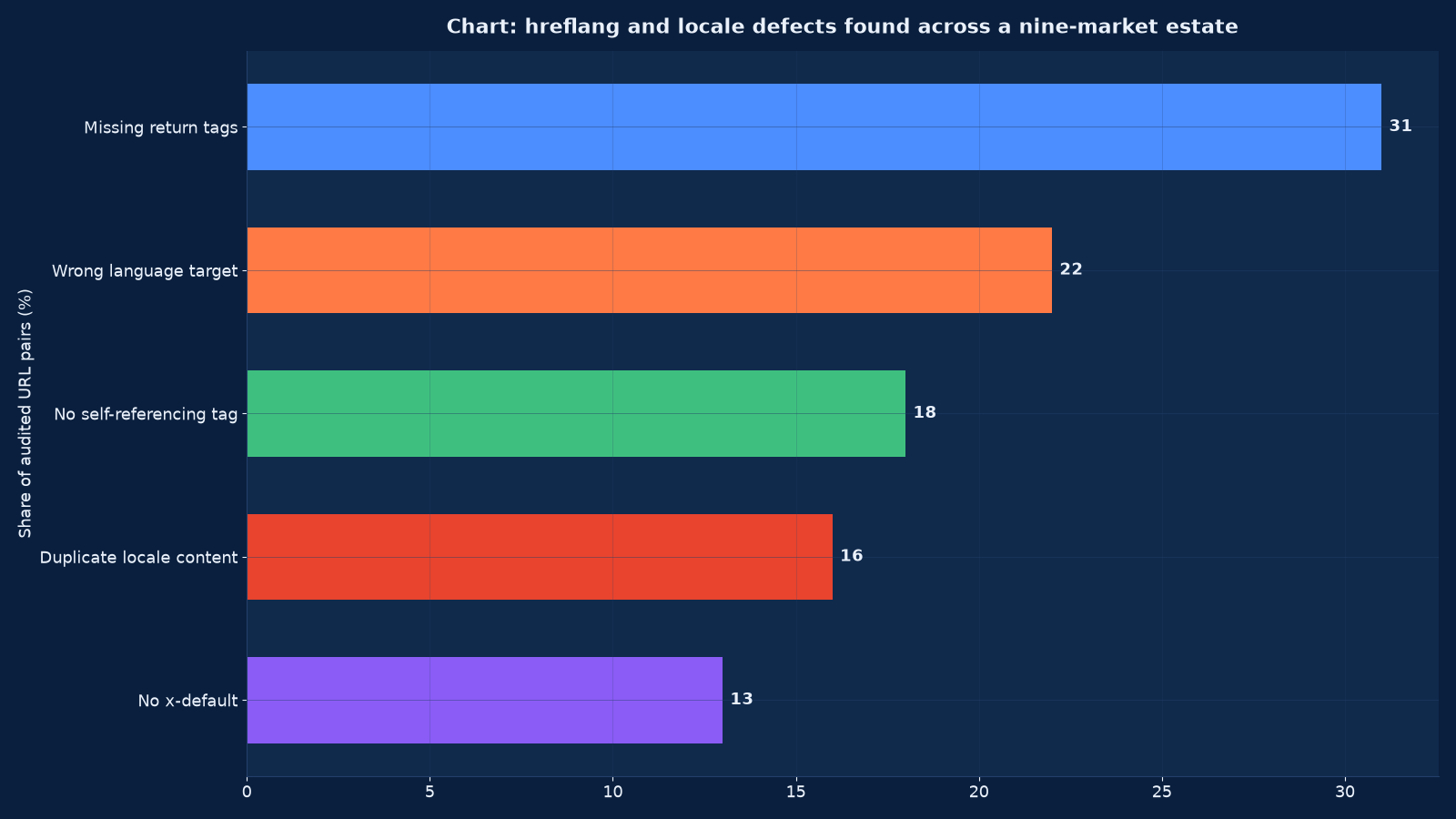
Chart values are an illustrative planning model based on typical UMC engagements and published industry benchmarks. They are not a guarantee of results on any specific project.
International SEO fails quietly. The pages render, the translations read well, the traffic in the home market is unaffected, and nobody notices for eight months that the German market is canonicalised to the English one, the French pages are served to Belgian crawlers, and the Japanese subfolder was noindexed during development and never turned back on.
International and multi-region SEO at Unified Management Consulting is the discipline of making one domain serve several markets without them interfering with each other. It is a structural problem before it is a content problem: the URL architecture, the canonical and hreflang relationships, the locale templates, the structured data, the listings and the measurement all have to agree per market, and a defect in any one of them silently suppresses the others. Most estates we audit are not missing translations. They are missing the plumbing that tells a search engine which translation belongs to which market.
We work with businesses entering their second market and with estates already live in nine. The early case is mostly a decision — ccTLD, subfolder or subdomain, and the reason for it — taken before any content is produced, because the choice is expensive to reverse. The later case is mostly remediation: reconciling an estate that grew market by market, each with its own conventions, into one governed structure with per-market indexation that can be proved rather than assumed. Where a market also needs local listings, reviews and a map presence, that work is planned with the local SEO programme rather than after it.
🌐 International & Multi-Region SEO — Quick Summary
| Component | What We Deliver |
|---|---|
| Market selection and demand evidence | Which markets are worth entering, in what order, and on what evidence: search demand per locale, competition, commercial fit, language cost and the operational ability to serve. |
| URL and locale architecture | ccTLD, subfolder or subdomain decided against the estate’s authority, budget and governance, with the reasoning recorded and the consequences stated. |
| hreflang implementation and testing | Complete bidirectional clusters, self-referencing tags, x-default, and automated testing that fails a release when a cluster breaks. |
| Canonical strategy per locale | Self-referencing canonicals on every locale page, with no locale canonicalised to another market, and duplicates across parameters resolved per market. |
| Localised templates and metadata | Titles, descriptions, headings, navigation, breadcrumbs and calls to action written for the locale rather than translated word for word. |
| Transcreation and native-speaker review | Content adapted to the market’s search language, reviewed by a native speaker, with a glossary and style guide per locale. |
| Localised structured data | Markup per locale: language, currency, address format, telephone format, opening hours and region-appropriate types. |
| Region-specific listings and citations | The directories, map services and business listings that matter in each market, with local name-address-phone formats. |
| Geo-routing and crawler safety | No hard geo-redirects that trap a crawler, CDN and cache behaviour per market, and a language selector that is crawlable. |
| Per-market measurement | Search Console properties, sitemaps, index coverage, rank tracking and revenue reported by market rather than in aggregate. |
What This Service Actually Covers
The service covers the structural, linguistic and measurement work of serving several markets from one estate. It is delivered as a rollout programme for new markets and as a remediation programme for estates that already have them.
| Component | What we do | What you keep | Duration |
|---|---|---|---|
| Market assessment | Demand, competition, commercial fit and cost per candidate market | A ranked market list with the evidence and the sequence | 2–3 weeks |
| Architecture decision | ccTLD, subfolder or subdomain, with the trade-offs written down | A decision record an engineer and a CFO can both read | 1 week |
| hreflang and canonical design | Cluster maps, self-referencing rules, x-default policy | A specification plus tests that run in the release process | 1–2 weeks |
| Template localisation | Metadata patterns, navigation, breadcrumbs, schema per locale | Locale templates rather than per-page overrides | 2–4 weeks |
| Content adaptation | Transcreation with native-speaker review, glossary and style guide | Published locale content and the glossary that keeps it consistent | 4–12 weeks |
| Listings and local presence | Per-market directories, map services, citations and profiles | A market-by-market listing inventory | 2–4 weeks |
| Indexation validation | Search Console properties, sitemaps, coverage and per-market crawl | A coverage report per market with every exclusion explained | Ongoing |
| Measurement | Rank tracking by market and language, revenue by locale, and a dashboard that separates them | A per-market reporting pack | Ongoing |
| Governance | Rules for adding a market, changing a template or retiring a locale | A governance note that survives staff turnover | At handover |
We do not sell machine translation as localisation. A translated page that reads like a translation ranks like one, because the phrases it uses are not the phrases that market types. Where a client’s budget only supports machine translation with review, we say so and scope it honestly rather than describing it as native content.
The Structural Decision: ccTLD, Subfolder or Subdomain
This is the one decision in international SEO that is genuinely expensive to reverse, and it is usually taken by whoever sets up the hosting first. All three structures can work. They differ in how much authority each market inherits, how much governance the estate needs, and what it costs to run.
| Structure | What it gives you | What it costs | When we recommend it |
|---|---|---|---|
| ccTLD per market, such as example.de | The clearest geographic signal, a local domain that can earn its own trust and links, and no ambiguity about the market | Each domain starts with no authority, needs its own links, its own Search Console property and often its own hosting and registration | Where a market is large enough to justify its own brand presence and its own link budget |
| Subfolders on one domain, such as example.com/de/ | One domain’s authority serves every market, one codebase, one certificate, and the simplest governance | The geographic signal is weaker and depends entirely on hreflang and Search Console targeting being correct | The default for most businesses: fastest to launch, cheapest to run, easiest to fix |
| Subdomains, such as de.example.com | Separation of content and some independence, without buying a domain | Treated closer to separate sites for authority, but with the administrative overhead of one domain — the worst of both, unless there is a technical reason | Rarely; where a market runs a genuinely different platform or team |
| Parameters or query strings for locale | Nothing worth having | Duplicate content, crawl waste and a canonical problem in every market | Never. Where we find it, replacing it is the first task |
| Separate sites per region with no relationship | Total local control | Duplicated effort, split authority, inconsistent brand and no shared measurement | Only where markets are operationally separate businesses |
The honest answer for most estates is subfolders, and the honest reason is governance rather than ranking: one domain means one set of templates, one release process and one place to fix a defect. A ccTLD is the right answer when a market is big enough to fund its own link acquisition and its own local team, and when the domain itself carries brand value in that market.
Market Selection and the Evidence Behind It
Markets are chosen on evidence, not on where a director has a contact. The evidence is available before any content is written, and gathering it is the cheapest part of an international programme.
| Evidence | Source | What it decides |
|---|---|---|
| Search demand per locale | Keyword data in the local language, not translated English terms | Whether a market has demand at all, and what it calls the product |
| Competitive set per market | Who ranks locally, with what structure and what content | The effort required and whether the market is already saturated |
| Existing traffic by country and language | Analytics, segmented by locale and by browser language | Which markets are already arriving unmanaged, which is where we usually start |
| Commercial ability to serve | Logistics, payment methods, regulation, language support, tax | Whether the market can be served at all, which outranks every SEO consideration |
| Cost of localisation | Translation and review cost per word, per template, per year | The ongoing budget, which most plans underestimate by treating it as one-off |
| Link and PR feasibility | Whether there is a press and trade ecosystem to earn links in | Whether authority can be built locally or must be inherited |
| Regulatory and data constraints | Local data-residency, advertising and consumer rules | Structural constraints that may force a ccTLD or a separate estate |
A useful output of this stage is a market tier. Tier one markets get full localisation, native content and their own link programme. Tier two get localised templates, translated core pages and hreflang. Tier three get a language selector, an x-default and no pretence that they are being served. Writing that down prevents the common failure of nine markets each getting a third of the effort one market needed.
hreflang: the Rules That Actually Matter
hreflang is the mechanism that tells a search engine which language and regional version of a page to serve. It is unforgiving of partial implementation: a cluster where one direction is missing is treated as no cluster at all, and the pages compete with each other instead.
| Rule | What breaks it | How we verify it |
|---|---|---|
| Every tag must be returned by the target page | A one-directional annotation added from one template only — the single most common defect, and 31 per cent of the pairs in Figure 1 | A crawler test that walks each cluster and fails when a return tag is missing |
| Each page must reference itself | Templates that emit tags for every locale except the current one | Per-template assertion in the release tests |
| Language and region must be valid | Invented codes, a region without a language, or a language code used where a region was intended | Validation against the ISO code lists, in CI |
| One x-default per cluster | No x-default, or several, or an x-default pointing at a locale page | Cluster-level test; x-default should point at the selector or the default locale |
| Tags must point at indexable URLs | hreflang pointing at a noindexed, redirected or 404 URL | Every tag target is fetched and its status and robots directives checked |
| Clusters must be complete | A new market added to the header but not to the sitemap annotations, or vice versa | A single source of truth for the cluster, emitted to both delivery methods |
| One delivery method, consistently | Headers on some templates, HTML tags on others, sitemap annotations on a third | A standard chosen per estate and enforced in the templates |
hreflang does not create rankings and it is not a canonical signal. It says which version belongs to which audience. Estates that use it to try to consolidate duplicates are disappointed, because that is what a canonical tag is for — and the two must not contradict each other, which is the second most common defect we find.
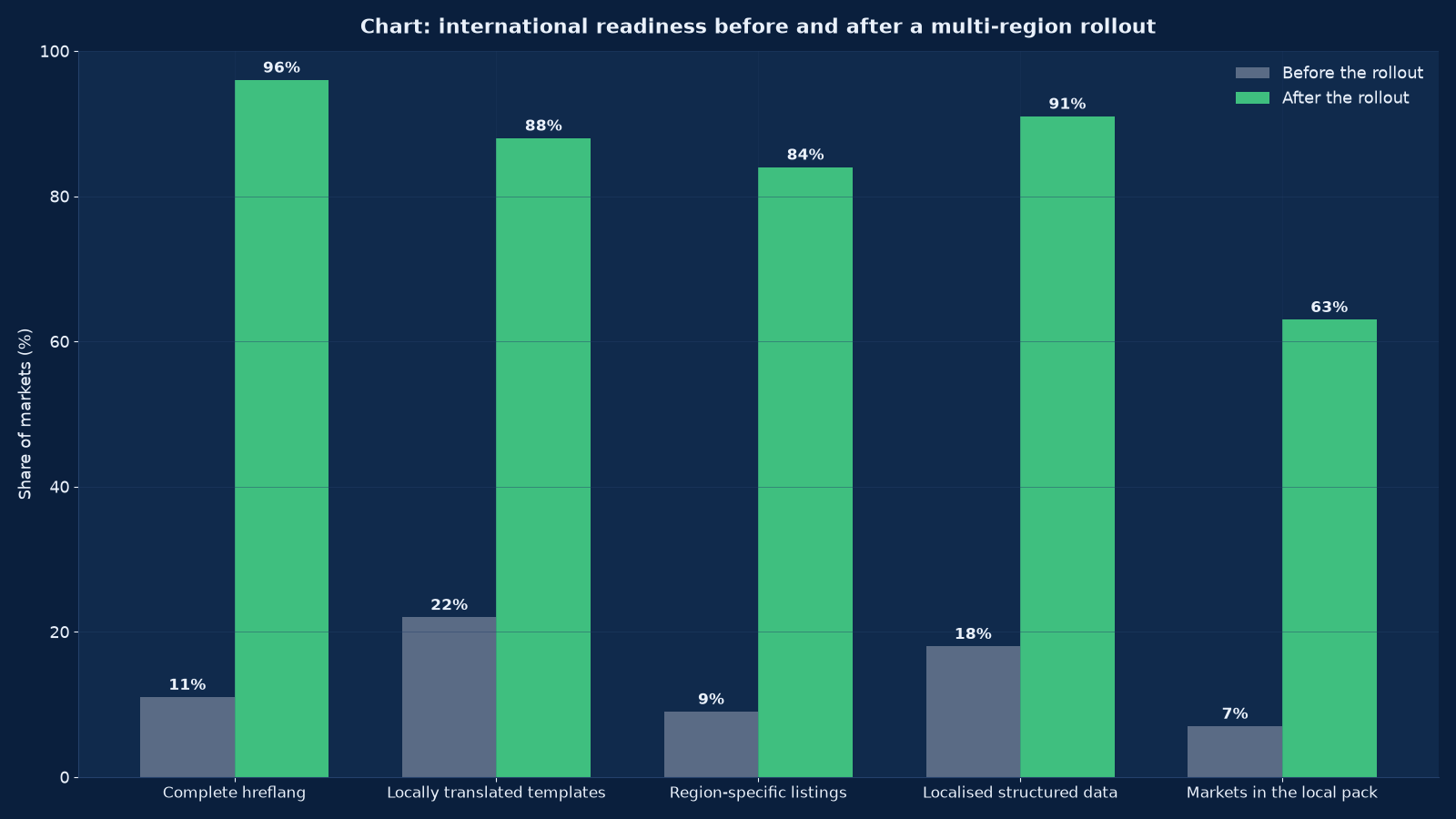
Chart values are an illustrative planning model based on typical UMC engagements and published industry benchmarks. They are not a guarantee of results on any specific project.
Canonical Strategy per Locale
The canonical and hreflang relationship is where estates contradict themselves. The rule is simple and routinely broken: every locale page carries a self-referencing canonical, and hreflang points at the same set of URLs the canonicals point at.
| Situation | Correct treatment | The defect we usually find |
|---|---|---|
| Locale pages with near-identical content | Self-referencing canonical on each, hreflang across the cluster | Every locale canonicalised to the default market, which removes them from the index |
| A market served by more than one URL | One canonical URL for that market, everything else redirected | Two live URLs for one market with hreflang pointing at both |
| Translated content syndicated elsewhere | Canonical to your own locale page, agreed with the syndicator | A syndicator’s copy outranking the original in its own market |
| Parameter or session variants per locale | Self-canonical on the clean locale URL | Canonicals emitted with the parameter still attached |
| A locale being retired | Redirect to the nearest live locale, remove it from every cluster and sitemap | Retired locale pages left in hreflang clusters, breaking the whole cluster |
| x-default | The language selector or the default locale, self-canonical and indexable | x-default pointing at a 404 or at a noindexed page |
Translation, Transcreation and Native-Speaker Review
Translation converts words. Transcreation converts intent. The difference is measurable: a translated page uses the vocabulary of the source language rendered into the target, while a transcreated page uses the vocabulary that market actually searches with.
| Layer | What it covers | Who does it |
|---|---|---|
| Glossary and style guide | Product names, terminology, tone, forms of address, number and date formats, currency | Built once per locale, owned by the client with our input |
| Metadata patterns | Title and description structures adapted to the locale’s character norms and search phrasing | Us, with native review |
| Core page content | Service and product pages written for the market’s intent | Native-speaking writer or transcreation from a brief, never blind translation |
| Editorial content | Blog and resource content on local topics with local examples | Local author where volume justifies it |
| Legal and regulatory copy | Terms, privacy, disclaimers, pricing statements | Client’s counsel, with our markup requirements |
| Review and QA | Native-speaker review of everything published, plus a rendering check | A named reviewer per locale, recorded per page |
- Search phrasing differs even between languages that share an alphabet: the term a German user types is not the translation of the English term, and volume data proves it.
- Character norms differ: a title pattern that fits English may truncate in German, which compounds words, or waste space in a language that is more compact.
- Forms of address carry commercial meaning in several markets, and a template that hard-codes one of them will be wrong somewhere.
- Numbers, dates, currencies and units must be formatted per locale, including in structured data, or the markup contradicts the visible page.
- Idioms, humour and case-study references rarely survive translation and usually need replacing with local equivalents rather than removing.
Localised Structured Data
Markup that is correct in one market is often wrong in the next, because it encodes language, currency, address and telephone formats. Markup that contradicts the visible page is worse than no markup, and in a multi-market estate those contradictions multiply.
| Element | Per-locale requirement | Common failure |
|---|---|---|
| inLanguage | The locale’s language code on every page | The default language emitted on every locale by a shared header |
| Address | The country’s address format, with postal code position and region naming | One address template used across markets |
| Telephone | International format with the correct country code | A domestic format that is meaningless to a caller in another market |
| Price and currency | The locale’s currency, with the correct symbol position and decimal separator | A currency converted at build time and never refreshed |
| Organization and sameAs | The local social profiles and directories, not the global ones | Global profiles declared on every locale |
| LocalBusiness | Only where there is a genuine local presence in that market | Markup claiming a presence the business does not have |
| BreadcrumbList | The locale’s own trail, in its own language | An English trail emitted on a translated page |
| Article and author | Local authorship where the content has a local author | One global author declared for content in six languages |
Region-Specific Listings, Citations and Local Presence
Structure and content decide whether a market can rank. Listings and reviews decide whether it appears in that market’s map results, and whether a local customer trusts what they find. This is the part most international programmes omit, because it is unglamorous and per-market.
| Per market | What we do | Why it matters |
|---|---|---|
| Map and business profiles | Claim or create profiles in the services that market actually uses, which are not the same services everywhere | Map presence is the cheapest visibility in a new market |
| Local directories | The directories that market’s customers and businesses use, with local name-address-phone formatting | Consistency feeds the entity’s confidence in that market |
| Reviews | A request flow in the local language, on the platforms locals use | Review volume in a new market starts at zero and is the slowest input to build |
| Local phone and contact path | A local number where it is justified, or a clearly international one, with local hours | A contact path that suggests nobody is there suppresses conversion whatever the ranking |
| Local links and press | Trade bodies, local press and partner links in that market | Authority inherited from the home domain does not always transfer |
| Localised landing evidence | Local customers, local projects, local regulation referenced on the page | The difference between a market page and a translated brochure |
This work is planned with the local SEO programme rather than bolted on, because the profile, the landing page and the citations have to agree in each market exactly as they do in one.
Geo-Routing, CDNs and the Crawler Trap
The most damaging international defect is often a helpful feature: a redirect that sends visitors to their local version. It works for customers and it hides the rest of the estate from crawlers, which are usually geolocated in one place.
| Mechanism | Risk | Safe design |
|---|---|---|
| Hard geo-redirect by IP | A crawler in one country only ever sees one locale; the rest of the estate appears not to exist | No forced redirect. Show a banner suggesting the local version and let the user choose |
| Cookie-based locale memory | A crawler with no cookie gets an unpredictable version | The default locale must be served to a first-time, cookie-less request |
| CDN edge caching by region | Different edges serve different content for one URL, and a cache key that omits the locale serves the wrong one | Vary on the locale explicitly, and verify what each edge returns |
| Language selector as a script | The selector is not crawlable, so locale links are not discovered | Real anchors with real hrefs for every locale, in the header or footer |
| Automatic browser-language detection | Reasonable for a user, opaque for a crawler | Detect and suggest, never redirect without consent |
| Geo-DNS to different estates | Two estates with split authority and no hreflang between them | One structure with clusters, or fully separate ccTLDs treated as separate sites |
Search Console, Sitemaps and Per-Market Index Coverage
Aggregate reporting hides every international defect. Coverage must be readable per market, which means the properties, the sitemaps and the tracking are organised that way from the start rather than reconstructed after a problem appears.
| Setup item | Standard | Why |
|---|---|---|
| Search Console properties | One property per structure that can be verified — domain property plus per-subfolder or per-ccTLD properties where useful | Coverage and queries become readable per market |
| Sitemaps | One sitemap per locale, referenced from an index, with every URL self-canonical and indexable | Submission errors become attributable to a market |
| hreflang in sitemaps | Where sitemap annotations are the chosen delivery method, every URL carries its full cluster | One source of truth rather than three |
| International targeting | Set only where it is correct for the structure; a ccTLD does not need it and a subfolder must not be mistargeted | A wrong setting overrides the geographic signal entirely |
| Coverage monitoring | Per-market indexed counts, with expected consolidation stated | A market silently dropping out of the index is otherwise invisible |
| Rank tracking | Tracked from the market, in the language, on a schedule, with the local competitor set | A rank checked from the home country is not that market’s rank |
| Analytics segmentation | Sessions, conversions and revenue by market, language and currency | The commercial case for the next market depends on it |
The Sixteen-Week Rollout
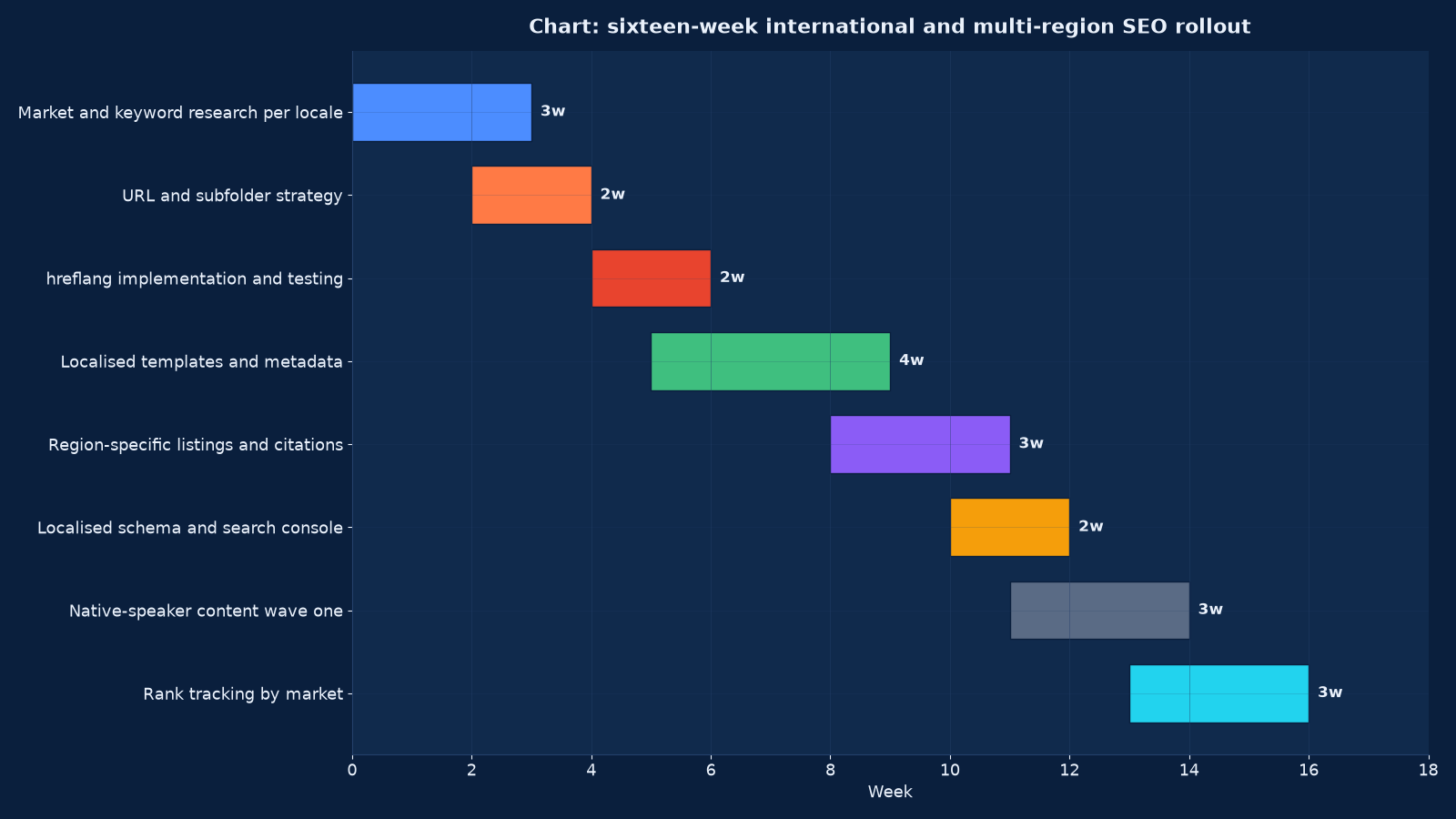
Chart values are an illustrative planning model based on typical UMC engagements and published industry benchmarks. They are not a guarantee of results on any specific project.
| Weeks | Workstream | Gate to pass |
|---|---|---|
| 1–3 | Market and keyword research per locale | A tiered market list with demand evidence and a per-locale phrase set |
| 3–4 | URL and subfolder strategy | A decision record, and the migration or rollout plan that follows from it |
| 5–6 | hreflang implementation and testing | Every cluster complete and bidirectional, with automated tests in the release process |
| 6–9 | Localised templates and metadata | Locale templates emitting correct titles, descriptions, navigation and canonicals |
| 9–11 | Region-specific listings and citations | A listing inventory per market with local formats and owners |
| 11–12 | Localised schema and Search Console setup | Markup validated per locale, properties and sitemaps submitted |
| 12–14 | Native-speaker content wave one | Core pages published per locale with a named reviewer recorded |
| 14–16 | Rank tracking by market and reporting | Per-market dashboards live, with the baseline captured before the wave |
A rollout is sixteen weeks to a governed structure, not sixteen weeks to visibility. New markets typically take two to four quarters to produce meaningful organic volume, because authority in a market is earned locally and listings and reviews accrue slowly. Figure 2 is therefore a post-rollout picture, and the commercial plan should be built around it.
Measurement by Market
| Measure | Per market | Reported |
|---|---|---|
| Indexed URLs | Count against the intended set, with exclusions explained | Monthly |
| hreflang cluster integrity | Share of clusters complete and bidirectional | Every release |
| Canonical correctness | Share of locale pages self-canonical | Every release |
| Impressions and clicks | By market and language, from the market’s own property | Monthly |
| Rank positions | Tracked from the market, in the language, against local competitors | Monthly |
| Local pack presence | Share of markets appearing in a map result for their core phrases | Quarterly |
| Conversion and revenue | By locale and currency, normalised for reporting | Monthly |
| Content coverage | Share of core pages localised per market, with the reviewer recorded | Quarterly |
| Listing consistency | Share of a market’s listings matching its canonical local record | Quarterly |
| Crawl distribution | Share of crawl requests per locale, from logs | Quarterly, to catch a market being starved |
Failure Modes We Are Usually Called In To Fix
| What we find | Why it happened | What we do |
|---|---|---|
| A market missing from the index entirely | A noindex left on during development, or a canonical pointing at the default locale | Audit every source of robots and canonical directives per locale, then re-validate coverage |
| hreflang clusters half-built | Tags added from one template, or a market launched without being added to existing clusters | Generate clusters from one source of truth and test them in CI |
| A geo-redirect hiding four markets from the crawler | A well-intentioned user-experience feature | Replace it with a suggestion banner and verify what a crawler in each region receives |
| Machine-translated pages ranking for nothing | Translation treated as localisation | Rebuild the core pages with transcreation and native review, starting with the tier-one markets |
| Duplicate content across locales | One template serving every locale with no self-canonical | Per-locale canonicals plus hreflang, then re-measure the index |
| Currency and address markup contradicting the page | Global schema emitted on every locale | Locale-aware markup, validated against what is visibly rendered |
| No way to tell which market is performing | One Search Console property and one aggregate dashboard | Per-market properties, sitemaps, tracking and revenue segmentation |
| A retired locale still in every cluster | The market was closed without touching the annotations | Remove it from all clusters and sitemaps, redirect it, and re-test |
International SEO and the Rest of the Stack
A multi-market estate is a technical estate first. The structure, the templates and the release process decide whether any of the linguistic work is visible, which is why this service is planned with the engineering practices rather than after them.
- Search Engine Optimisation (SEO) Services — the organic programme each market’s work sits inside.
- Local SEO Services in Lucknow — the city-level delivery model that each market’s listings, profiles and local pages follow.
- Our India presence — the market page for the estate’s largest non-US audience, and an example of a region landing page done properly.
- Headless & Decoupled Development — where locale routing, rendering and hreflang emission are actually implemented.
- Website Design & Development Services — the templates that carry locale metadata and markup.
- Website Strategy & Information Architecture — the information architecture a multi-market navigation has to survive.
- Content Marketing Strategy Services — the editorial calendar per locale, which is where transcreation budget actually goes.
- Google Ads Management Services — paid campaigns per market, sharing the same locale landing pages.
- Analytics & Attribution (GA4) Services — the per-market measurement that makes the next market decision evidence-based.
Evidence From Our Work
The engagements and writing below are published on this site, each described by the subject its own page documents. They are listed because an international programme is usually commissioned by a business that already serves more than one market informally and wants the estate to reflect it.
- WordPress development for an African medical-tourism company — a business whose entire demand crosses borders: patients in one market, treatment in another, and a site that has to serve both without confusing either.
- WordPress development for an African architectural firm — a multi-city practice whose portfolio and project pages had to work across locations from one estate.
- Social media management and paid social for a pan-African B2B industrial consultancy — a genuinely multi-market engagement: the client operates across African markets, and the campaign had to be planned per market rather than once. This page’s title on the site names a different sector from the work its own content documents, so we describe the work rather than the title.
- WordPress WooCommerce e-commerce development for Suri Retail Group — a multi-brand retail chain, where catalogue structure and locale handling are the same problem at a different scale.
- Keyword research for businesses: how to find the right keywords — how a per-locale phrase set is built from what that market actually types rather than from a translated English list.
- Enterprise rank tracking — tracking at a scale where per-market, per-language positions have to be automated rather than sampled.
- Semantic keywords — how topic coverage is judged in a language whose entity vocabulary differs from English.
- Schema markup and structured data — the markup standard, and the rule that it must match the visible page in every locale.
- Local SEO strategies — the listings, reviews and map work each market needs alongside the structure.
- Google Search Console for business owners — how per-market properties and coverage reports are used as evidence.
- The Search Engine Optimization Guide archive — further writing on technical SEO, indexation and international structure.
Engagement Models and Commercials
International work is either a decision, a rollout or a standing governance obligation. We quote all three separately, because a client who only needs the decision should not pay for the rollout.
| Model | Best for | What you get | Indicative shape |
|---|---|---|---|
| Market and structure assessment | A business deciding its second or third market | Tiered market list with evidence, the structure decision with its trade-offs, and a costed rollout plan | Two to four weeks, one fee |
| Rollout programme | Markets approved and needing delivery | hreflang and canonical implementation, locale templates, listings, schema, per-market measurement | Fixed fee per phase, typically sixteen weeks per wave |
| Estate remediation | An existing multi-market estate that has drifted | Full audit of clusters, canonicals, coverage and listings per market, then remediation | Fixed fee, scoped from the market count and URL volume |
| Governance retainer | An estate that adds markets or ships releases regularly | Release review, cluster testing in CI, quarterly coverage audit and per-market reporting | Monthly |
| Localisation management | A client with writers but no process | Glossaries, briefs, native-speaker review coordination and per-page QA records | Monthly, per locale |
Every quote states which markets are in scope and at which tier, because the cost of an international programme is dominated by the number of markets treated seriously rather than by the technical work.
Frequently Asked Questions About International & Multi-Region SEO
Should we use subfolders or country domains?
Subfolders for most businesses: one domain’s authority serves every market, one codebase, one release process and one place to fix a defect. Country domains where a market is large enough to fund its own links and local team, and where the domain itself carries brand value there. The decision is expensive to reverse, so it should be written down with the reasoning before any content is produced.
Do we need to translate everything?
No, and trying to is the most common way budgets are wasted. Tier your markets: tier one gets full localisation and native content, tier two gets localised templates and translated core pages with correct hreflang, tier three gets a language selector and an x-default. That is a decision to publish, not an admission to hide.
Is machine translation good enough now?
For internal search and rough comprehension, increasingly. For pages that have to rank and convert, no: a machine-translated page uses vocabulary that market does not type, and it reads like a translation to the people who matter. Machine translation with native-speaker review is a legitimate middle tier provided it is described honestly and not sold as native content.
What exactly does hreflang do?
It tells a search engine which language and regional versions of a page exist, so the right one is served to the right audience. It does not create rankings, it is not a canonical signal, and a cluster with a missing return tag is treated as no cluster at all. Every tag must be reciprocated, every page must reference itself, and one x-default should point at the selector or default locale.
Our German pages are not indexed. Where do we start?
Four places, in this order: is the locale noindexed anywhere, including by a plugin, header or CDN rule; does each German page carry a self-referencing canonical rather than one pointing at the English page; is the hreflang cluster complete in both directions; and is a geo-redirect or cookie rule preventing a crawler from seeing the German version at all. Those four account for most cases.
Can we geo-redirect visitors to their local version?
You can, but a forced redirect is how estates hide most of themselves from crawlers, which are usually geolocated in one country. Detect and suggest instead: a banner offering the local version, with the choice remembered by consent. It is better for the user, and it leaves every locale crawlable.
How many markets can one domain handle?
Structurally, many. Practically, as many as you can localise properly and report on separately. The failure mode is not a technical limit but nine markets each receiving a third of the effort one market needed, with no per-market measurement to show that none of them is working.
Does each market need its own links?
Largely yes, especially on a ccTLD. A subfolder inherits the domain’s authority, which helps, but relevance in a market comes from that market’s press, trade bodies, directories and partners. Budget for local link acquisition per tier-one market rather than assuming the home market’s profile carries it.
What is x-default for?
It declares which URL to serve when no locale in the cluster matches the user — typically a language selector or the default locale. There should be exactly one per cluster, it must be indexable, and it must not point at a 404 or a noindexed page.
How do we report on this to a board that only sees total revenue?
Segment everything by market from the start: Search Console properties per market, analytics by locale and currency, rank tracking from each market, and revenue normalised for reporting. An aggregate dashboard cannot show that one market is working and another is invisible, which is the exact situation an international programme is meant to fix.
We already have local landing pages in several cities. Is that the same thing?
It is the same discipline at a smaller scale, and it is a good foundation. City pages within one market need unique local detail, consistent name-address-phone data, local schema and real internal links; international estates need all of that plus language, hreflang, currency and per-market governance. The habits transfer; the plumbing does not.
How long before a new market produces traffic?
Structure and indexation are provable within weeks. Meaningful organic volume typically takes two to four quarters, because authority, listings and reviews in a market are earned locally and accrue slowly. Any plan that promises a new market’s traffic inside one quarter is describing paid media, not SEO.
What does this cost?
It is dominated by the number of markets treated seriously and the volume of content per market, not by the technical work, which is bounded. We quote the structure decision, the rollout per wave and the ongoing governance separately, so a client can buy the decision without the rollout and can see what each additional market adds.
Commission an International Structure and Market Assessment
Send us the domain, the markets you serve or want to serve, and your current analytics country and language breakdown. Within four weeks you will have a tiered market list with demand evidence per locale, a structure decision with its trade-offs written for both an engineer and a finance director, a full hreflang and canonical audit of every existing cluster, a per-market index coverage report with every exclusion explained, an assessment of your geo-routing and CDN behaviour from a crawler’s point of view, and a costed sixteen-week rollout for the first wave — including which markets we recommend you do not localise yet.
Contact Unified Management Consulting to arrange a confidential first conversation.
Related Services
International and multi-region SEO is delivered with the structural and local practices it depends on:
- Search Engine Optimisation (SEO) Services — the organic programme each market’s work sits inside
- Local SEO Services in Lucknow — the listings, profiles and local pages each market needs alongside its structure
- Headless & Decoupled Development — where locale routing, rendering and hreflang emission are implemented
- Website Design & Development Services — the templates that carry locale metadata, canonicals and markup
- Website Strategy & Information Architecture — the architecture a multi-market navigation has to survive
- Content Marketing Strategy Services — the per-locale editorial calendar and transcreation process
- Google Ads Management Services — paid campaigns per market on the same locale landing pages
- Analytics & Attribution (GA4) Services — per-market measurement by locale, language and currency
- Our India presence — a region landing page from this estate, built to the standard described here
- Local SEO & Google Business Profile Management — Local SEO and Google Business Profile management: profile rebuild, citations, reviews, local pages, map-pack tracking and attributed enquiries
- Digital PR & Link Building Services — Digital PR and link building: newsworthy campaigns, data studies, outreach to publishers, authority repair and links measured against rankings
- Technical SEO Audits & Site Migration Services — Technical SEO audits and site migrations: crawl and index control, Core Web Vitals, structured data, migration mapping and pre-launch validation