
Repeat purchase is the only retail growth that does not have to be bought again, and it is produced by knowing who a customer is, having permission to contact them, and sending something worth receiving at the moment it is relevant. That is a data and governance problem before it is a creative one. A retailer with four partial records of the same customer cannot personalise, cannot measure a cohort, and will eventually send a promotion to somebody who is mid-complaint – which is the moment a marketing channel becomes a churn channel.
This page covers customer relationship management for retail and e-commerce: identity resolution across site, marketplace and store, consent and preference governance, the segmentation model, lifecycle journeys, loyalty mechanics, the customer data platform underneath, service integration, and measurement by cohort contribution. Acquisition sits in Google Ads for retail and social media marketing for retail; the storefront that captures the data in website development for retail; the reporting layer in business intelligence; and the commercial model in the retail and e-commerce hub.
What an engagement includes, at a glance
| Component | What We Deliver |
|---|---|
| Identity resolution | One customer record across the commerce platform, marketplace accounts, point of sale, marketing tools and customer service, with match rules and confidence thresholds written down. |
| Consent and preference governance | Purpose-level consent with source and timestamp, one suppression list every tool obeys, and a deletion and export process that works when it is used. |
| Segmentation model | Recency, frequency and value plus category affinity and lifecycle stage – explainable to a merchandiser, not a black box. |
| Lifecycle journeys | A small set run with discipline: onboarding, recovery, post-purchase, review, replenishment, affinity cross-sell, win-back. |
| Loyalty mechanics | Benefits that cost less than the discount they replace, with tier migration and member contribution measured. |
| Customer data platform | A warehouse holding orders, refunds, marketing and support data on one key, with segments activated to every channel. |
| Service integration | Tickets, returns, delivery failures and complaints attached to the customer, and respected by marketing suppression. |
| Cohort measurement | Contribution accumulated by acquisition cohort at ninety, one hundred eighty and three hundred sixty-five days, net of acquisition cost. |
| Governance and access | An owner per field, retention periods, role-based access, and an audit trail that survives a regulator’s question. |
What retail CRM teams ask for, and what the constraint usually is
CRM requests arrive as tooling questions – ‘which platform should we buy’ – and the constraint is almost never the tool. It is usually that the customer cannot be identified across channels, that consent lives in four places with four different truths, that nobody owns the definition of a repeat customer, or that a journey was designed before the data could support it. Buying a platform into that state produces a more expensive version of the same problem.
| What gets asked | What is usually happening | What we do about it |
|---|---|---|
| Which CRM platform should we buy? | The data model and the consent position have not been decided, so no platform can work | Data model, match rules and consent governance first; platform choice after |
| Our repeat rate is too low | No cohort view, so the number is not real; and no post-purchase journey at all | Cohort baseline, then the three journeys that move a second purchase |
| We send too many messages | Every team sends independently with one shared suppression list that nobody obeys | One frequency and suppression governance layer above all tools |
| Personalisation does not work | Four partial records per customer; segments built on demographics nobody verified | Identity resolution, then segments built from purchase behaviour |
| Loyalty is expensive and nobody uses it | A discount programme with a points label, no tier logic and no benefit design | Mechanics redesigned against contribution, with benefits cheaper than discounts |
| Marketing emails to angry customers | Service state is not visible to marketing; suppression is manual | Complaint and return state joined to the record with automatic suppression |
| We cannot delete or export on request | Personal data is spread across tools with no register | Data map, processor register, deletion workflow tested end to end |
| Attribution argues with itself | Acquisition source is not held on the customer record | Source and cohort stamped at first order and never overwritten |
| Marketplace customers are invisible | Platform data gives an order, not an identity | Post-purchase capture, package inserts, warranty registration – within platform rules |
| The team cannot run this without us | Journeys built as bespoke code with no documentation | Configuration over code, runbooks, training and a supported transition |
Seven of the ten are data and governance problems. That is why the first deliverable is a customer data model and a consent position rather than a platform recommendation, and why business strategy consulting is involved early: what a business is willing to promise a customer determines what the system has to hold.
Identity resolution: one customer across site, marketplace and store
A retail customer appears as an email address on the site, a platform buyer ID on a marketplace, a card token in a store, a phone number in a messaging thread and a device identifier in an advertising platform. Until those are resolved into one record with a stated confidence, every downstream capability degrades: journeys fire twice, cohorts cannot be measured, personalisation guesses, and a complaint in one channel is invisible in another. Resolution is a rules problem with a governance wrapper, not a purchase.
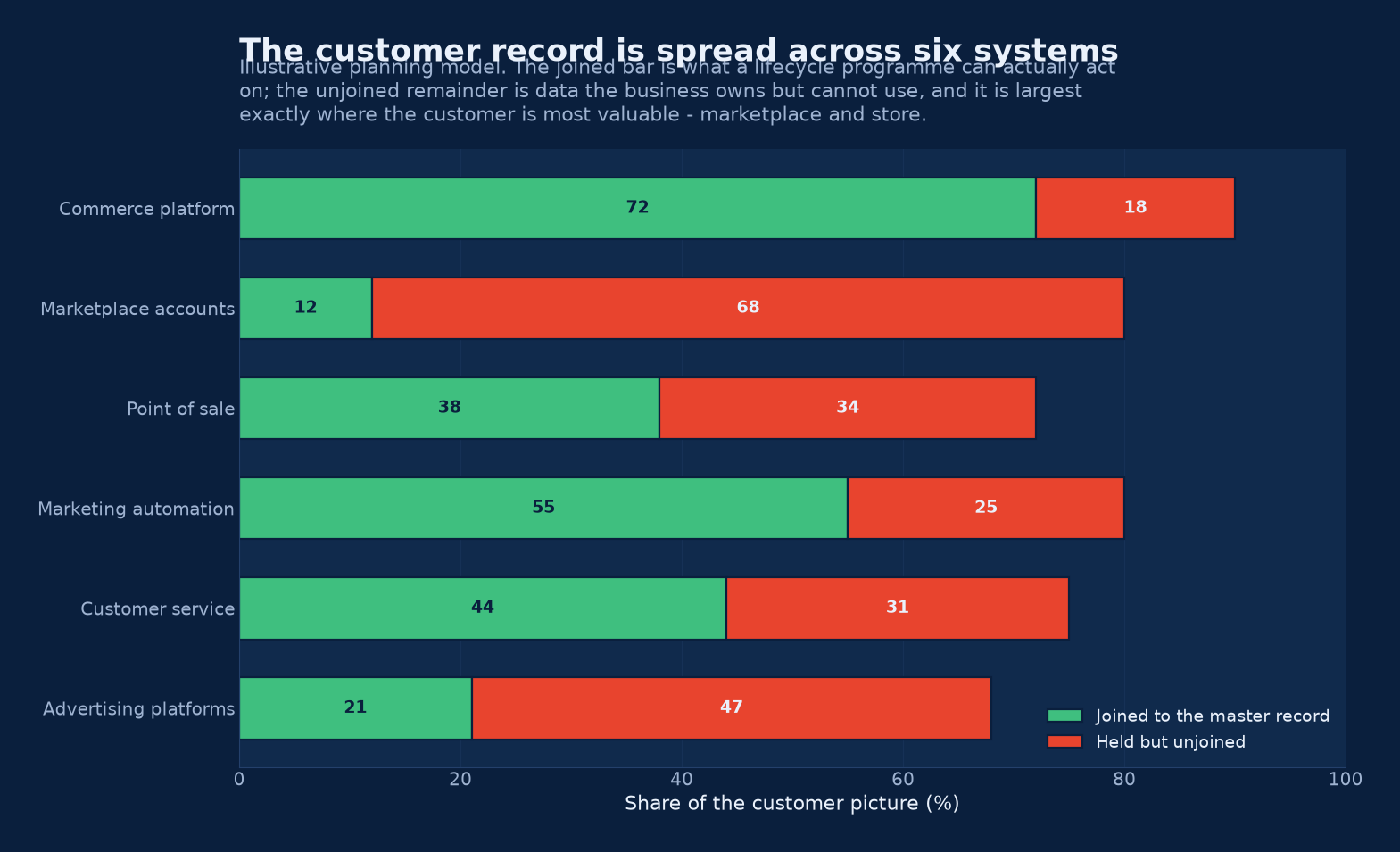
Chart values are an illustrative planning model based on typical UMC engagements and published industry benchmarks. They are not a guarantee of results on any specific project.
| Component | Design decision | Failure mode | Measurement |
|---|---|---|---|
| Match keys | Email, phone, card token, platform buyer ID, device ID – ranked by reliability | Matching on a shared family email and merging two customers | Match rate, false-merge rate |
| Confidence thresholds | Automatic merge above a threshold, review queue below it, never merge on one weak key | A merged record that cannot be split again | Review queue volume and resolution time |
| Merge and unmerge | Reversible merges with an audit trail of what changed and why | Data loss discovered months after a bad merge | Merge audit completeness |
| Household and B2B relationships | Separate relationship records rather than forcing one household into one customer | Trade buyers treated as consumers; families treated as duplicates | Relationship coverage by segment |
| Marketplace identity | What the platform allows: post-purchase capture, inserts, warranty registration | Terms breach, or a customer record that never leaves the platform | Share of marketplace orders with a resolved identity |
| Store identity | Loyalty enrolment, click-and-collect capture, till-level consent | Store staff asking for data with no reason and no record | Store-captured record share |
| Golden record ownership | One system designated authoritative for identity, with a documented tie-break rule | Two systems both claiming to be the master | Discrepancy rate between systems |
| Privacy by design | Pseudonymisation where identity is not needed, retention limits, access by role | A master record that becomes the single largest breach exposure | Access reviews, retention compliance |
Delivery runs through custom CRM development and integration, enterprise systems integration for the source systems, data warehouse and lakehouse for the resolution layer, data engineering for AI and knowledge systems where the same record has to serve machine-readable use, and cybersecurity services because a master customer record is the most valuable target in the estate.
Consent, preference and the governance layer
Consent in retail is usually held in several systems with several truths: the commerce platform, the email tool, the messaging provider, the loyalty scheme and the store till. The governance fix is to designate one authoritative consent record with purpose-level granularity, a source, a timestamp and a version, and to make every sending tool obey one suppression service rather than its own list. It is unglamorous work that removes the most common compliance and reputation failure in lifecycle marketing.
| Control | What it means in practice | Risk it removes | Evidence |
|---|---|---|---|
| Purpose-level consent | Separate consent for transactional, marketing, profiling and partner messages | A single tick used to justify everything forever | Consent record per purpose with version |
| Source and timestamp | Where, when and how consent was captured, including the wording shown | An unprovable consent challenged by a regulator or a platform | Capture evidence with wording version |
| One suppression service | Every tool queries it before sending; unsubscribes propagate in minutes | A customer who unsubscribed receiving three more messages from other tools | Suppression latency test |
| Preference centre | Frequency, channel and category preferences the customer can actually change | All-or-nothing unsubscribe that loses a reachable customer | Preference adoption and churn effect |
| Retention schedule | Defined periods per data type, with automated deletion | Data held indefinitely because nobody decided otherwise | Deletion run records |
| Access, export and deletion | A working process for subject requests across every system | A request answered for one system and not the other five | Request log with completion times |
| Processor register | Every vendor holding personal data, with purpose and contract terms | Unknown downstream processing | Register reviewed quarterly |
| Access control | Role-based access to the customer record, MFA on administrative access, leaver process | Seasonal staff and agencies holding full customer visibility | Access review log |
| Audit trail | Who changed a record, a consent or a journey, and when | An incident with no reconstructable history | Immutable audit log |
| Complaint-driven suppression | An open complaint or return suspends promotional contact automatically | Marketing to a customer mid-dispute | Suppression hits per month |
The practices are IT audit and compliance readiness, AI governance, risk and compliance where profiling and generated personalisation are involved, CRM development for the record itself, and unified top-level business management for the forum that decides policy rather than leaving it to whoever configures the tool.
Segmentation that a merchandiser can argue with
The useful test of a segmentation model is whether a merchandiser can look at a segment and disagree with it intelligently. Models built purely by clustering fail that test: they produce groups nobody can name, so nobody changes behaviour on the basis of them. The model we install is behavioural and explainable – recency, frequency and value as the spine, with category affinity, lifecycle stage and service state layered on – and every segment has a stated action attached, because a segment with no action is only a report.
| Segment | Definition | The action it exists to trigger | Measured by |
|---|---|---|---|
| New customer, first ninety days | One purchase, inside the onboarding window | Onboarding, second-purchase encouragement, review request | Second-purchase rate |
| Established repeat | Three or more orders in twelve months across two categories | Affinity cross-sell, early access, tier progression | Share of wallet, tier migration |
| Category-loyal | Repeats within one category, ignores the rest | Depth in category, one reasoned adjacency | Category attach rate |
| High value | Top contribution decile regardless of frequency | Service priority, exclusive access, no discounting | Retention, contribution stability |
| Discount-led | Purchases only within promotional windows | Value-led content, deliberately reduced offer frequency | Full-price purchase share |
| At risk | No purchase beyond the category cycle with prior frequency | A relevance-led nudge before a discount-led one | Reactivation rate, contribution after |
| Lapsed | Beyond the win-back window | One win-back attempt, then suppression | Win-back rate, unsubscribe rate |
| Complaint or return active | Open service case, recent return, or negative review | Promotional suppression, service-first contact | Resolution rate, subsequent retention |
| Trade or wholesale | B2B terms, bulk behaviour, account structure | Account-based contact, ordering ease, credit and terms | Order value, account retention |
| Store catchment | Resolved to a branch catchment by address or profile | Local range, events, click-and-collect | Store visit and collection rate |
Segments are produced on the warehouse layer with data science services for the affinity and risk modelling, activated through marketing automation, and reviewed quarterly against contribution rather than size. Market research supplies the qualitative check that a behavioural segment cannot: why a customer in a segment behaves as they do.
The lifecycle journeys that earn their cost
Most retail lifecycle value comes from a small number of journeys executed consistently, not from a large number executed occasionally. The set below is the one we install first in almost every retail business, in this order, because each one is measurable on its own and the sequence builds the data the later journeys need. Every journey is measured on contribution by cohort rather than revenue per send, since the latter rewards discounting and trains customers to wait.
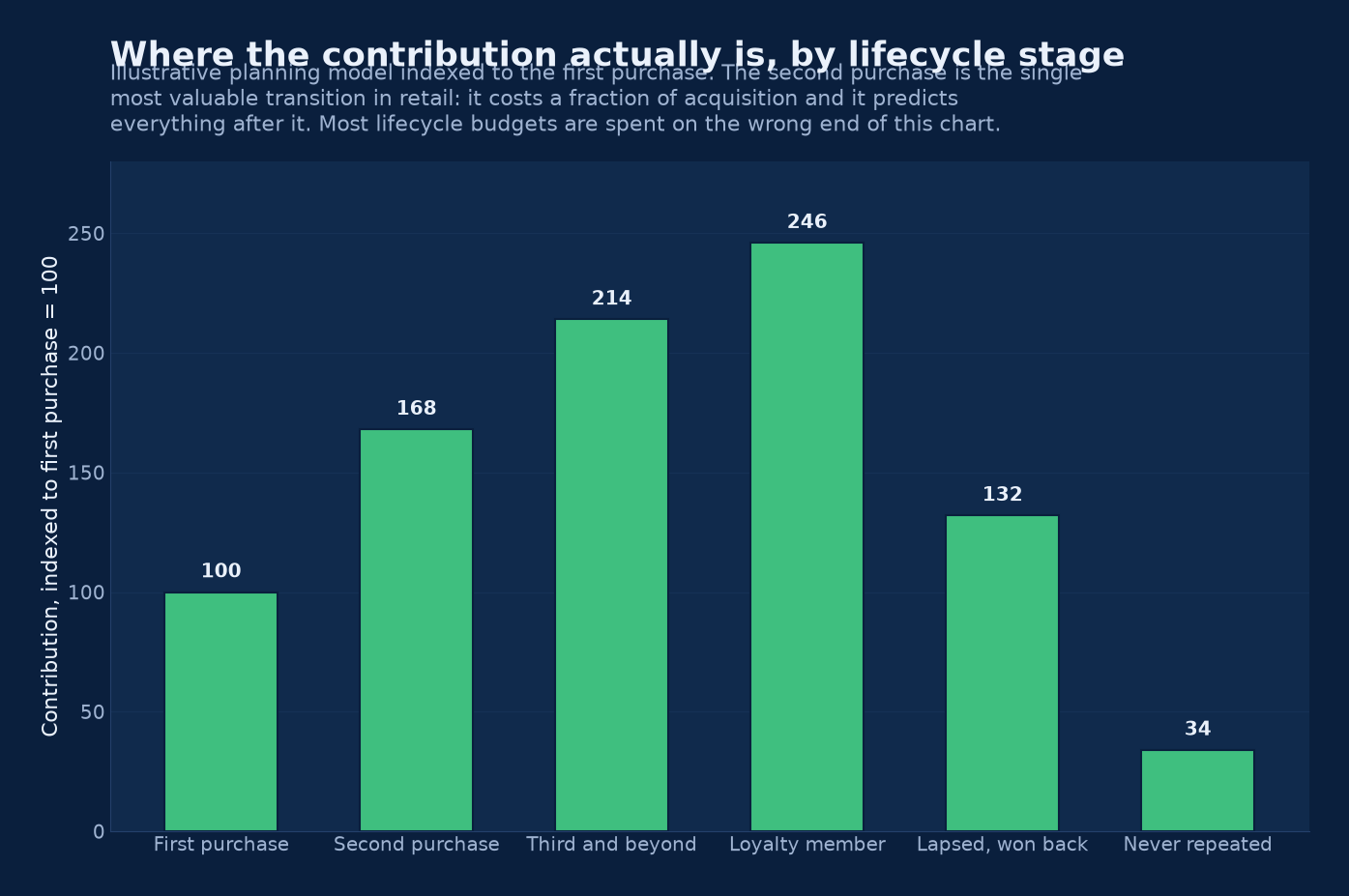
Chart values are an illustrative planning model based on typical UMC engagements and published industry benchmarks. They are not a guarantee of results on any specific project.
| Journey | Trigger | The design decision that matters | Measured by |
|---|---|---|---|
| Welcome and onboarding | Signup or first order | Brand promise, category guidance and policy clarity before any offer | First-to-second purchase rate of the cohort |
| Cart and browse recovery | Abandonment with stock available | The exact item, honest availability and delivery date, no false urgency | Recovery rate and contribution of recovered orders |
| Post-purchase and delivery | Order, dispatch, out for delivery, delivered | Transactional clarity first, cross-sell only at a sensible interval | Support contacts per order, cancellation rate |
| Review and content request | Delivery plus a category-appropriate usage interval | One ask, an easy path, a photo prompt for visual categories | Review volume, media-attached share, rating |
| Replenishment | Usage cycle derived from purchase history, not a fixed calendar | Timing accuracy; a reason to reorder rather than a discount | Replenishment repeat rate, unsubscribe |
| Affinity cross-sell | Purchase history plus category affinity | Affinity logic a merchandiser can explain and override | Attach rate, basket size, cohort contribution |
| Tier and benefit progression | Cumulative value or frequency crossing a threshold | Benefits that cost less than the discount they replace | Tier migration, member contribution share |
| At-risk intervention | Lapse predicted before it happens | Relevance first, offer second, and only for the right segments | Reactivation rate, contribution after intervention |
| Win-back | Lapse beyond the category cycle | One attempt with a reason to return, then suppression | Win-back rate, cost per reactivation |
| Service recovery | Complaint, failed delivery, or return completed | Resolution first, and no promotional contact until it is closed | Post-incident retention against the baseline |
Delivery runs through lifecycle and retention campaigns, marketing automation, nurturing and drip programmes for the longer consideration categories, email, WhatsApp and SMS as the channels, and conversion rate optimisation on the landing experiences the journeys point at. For trade and wholesale lines, account-based marketing replaces the consumer journey set, and webinar and event campaigns carry range launches. The journeys point at pages that have to convert, so the storefront matters as much as the message: e-commerce development for the landing and account experience, mobile app development where an app is the retention surface, and paid media whose audiences are built from the same segments.
Loyalty mechanics: benefits that cost less than discounts
A loyalty scheme is a pricing instrument with a marketing label, and most retail schemes are simply discounts that are slower and more expensive to administer. The design question is what the business can give that costs it less than the margin it protects: early access, free delivery thresholds, exclusive ranges, services, experiences, recognition, and conveniences such as extended returns. Points have a place where the category has a natural replenishment cycle; in low-frequency categories they mostly create a liability on the balance sheet and no behaviour change.
| Mechanic | When it works | When it does not | Cost profile |
|---|---|---|---|
| Points per currency spent | High-frequency, replenishment categories with predictable repeat cycles | Low-frequency categories where the balance never reaches a reward | A deferred discount plus an accounting liability |
| Tiered benefits | A wide value spread where high-value customers deserve different treatment | A narrow spread where everybody sits in one tier | Low marginal cost if benefits are conveniences |
| Paid membership | Frequent buyers who will pay for delivery or service certainty | Occasional buyers who will not amortise a fee | Revenue-positive, with a churn risk to manage |
| Free delivery threshold | Basket-size leverage where delivery cost is material | Where the threshold trains customers to add junk to the basket | Delivery cost, partly recovered by basket lift |
| Early access and exclusives | Fashion, launches and limited ranges with genuine scarcity | Commodity categories where nothing is exclusive | Very low cash cost, high perceived value |
| Services and experiences | Categories with fitting, installation, care or repair needs | Where service capacity cannot absorb the demand created | Capacity cost, offset by margin on the service |
| Recognition and community | Brands with an identity customers want to belong to | Undifferentiated categories where nobody wants to belong | Near zero cash cost |
| Charity and values linkage | Where the claim is evidenced and consistent with the brand | As a substitute for a commercial benefit, or without substantiation | Low, with a governance cost |
Scheme design sits with business strategy consulting and finance, because the liability and the margin effect are financial decisions; cost rationalisation and margin recovery where a discount-led scheme is eroding contribution, and cash flow and working capital recovery where the scheme’s liability matters to the balance sheet. Measurement of tier migration and member contribution runs on BI dashboards.
The customer data platform and activation
A customer data platform is worth buying when the business has decided what it will do with the data, and worth building when the decision needs a join the vendor cannot make. In retail the join that matters is commerce orders, refunds, marketplace settlements, store transactions, marketing events and service cases on one key – which is usually a warehouse with an activation layer rather than a marketing product. The test of the platform is activation latency: how long between a customer doing something and every channel being able to act on it.
| Layer | What it holds | Requirement | Failure if absent |
|---|---|---|---|
| Source integration | Commerce, marketplace, POS, marketing tools, service desk, advertising platforms | Incremental, reliable, with schema-change detection | A platform fed by nightly exports that are silently stale |
| Identity and resolution | Matched customer keys with confidence and an audit trail | Reversible merges, review queue, documented tie-breaks | Journey duplication and unmeasurable cohorts |
| Event store | Browse, cart, order, return, review, service and campaign events | One event specification agreed across teams | Every report rebuilt from a channel export |
| Profile and segments | Attributes, computed metrics, segment membership, service state | Segments explainable and overridable by a human | Personalisation nobody trusts or can debug |
| Consent and suppression | Purpose-level consent, preferences, opt-outs, complaint state | Queried by every channel before contact | Compliance exposure and reputational incidents |
| Activation | Pushes to email, messaging, advertising, on-site personalisation and store tools | Latency measured per destination | Insight produced and never used |
| Measurement | Cohort contribution, journey performance, incrementality | One definition set shared with finance | Parallel truths and an unfundable programme |
| Governance | Field ownership, retention, access, audit, change control | Named owner per data domain | A platform nobody is accountable for |
Build and run sit with data warehouse and lakehouse, CRM development and integration, enterprise systems integration, portal development for trade and franchise access, maintenance and support for the daily exceptions, and AI integration with ERP, CRM and operations where document and exception handling can be automated safely. The same record is what makes organic search and paid targeting coherent, because the segments that drive a journey also drive the audiences, and team enablement is what lets the in-house team run the programme after handover.
Service, complaints and the suppression that protects the brand
The fastest way to lose a retail customer is to market to them while they are waiting for a refund. Service state is therefore a marketing input, not only an operations one: an open case, a failed delivery, an unresolved return or a negative review should suppress promotional contact automatically until it is closed, and the resolution should trigger a recovery journey rather than nothing at all. This is a small integration with a large effect on retention.
| Service state | Marketing behaviour | Recovery action | Measured by |
|---|---|---|---|
| Open complaint | All promotional contact suppressed; transactional only | Resolution followed by a service-recovery journey | Post-complaint retention against baseline |
| Failed delivery | Promotional suppression until redelivery or refund is settled | Proactive contact before the customer chases | Chase rate, cancellation rate |
| Return in progress | Cross-sell suppressed; exchange-first content allowed where appropriate | Confirmation of refund or exchange, then a relevance-led follow-up | Post-return repeat rate |
| Negative review | No promotional contact referencing the reviewed product | Public substantive response plus private resolution | Review revised or removed rate |
| Refund dispute or chargeback | Full suppression, case owned by finance and support | None until resolved; no automated re-marketing | Chargeback rate by acquisition channel |
| Warranty or safety issue | Recall-style communication only, approved by legal | Clear instructions, a remedy and a named contact | Response rate, remedy completion |
| Vulnerable customer flag | Reduced frequency, no pressure mechanics, human handling | Case-by-case with a documented decision | Flagged-case handling audit |
| Closed and resolved | Normal cadence resumed after a cooling interval | A thank-you and a reason to return that is not a discount | Ninety-day repeat rate after resolution |
The integration runs through CRM development, IT helpdesk and end-user support where the service desk is part of the estate we operate, enterprise systems integration for the state feed, and AI agents for first-line triage with a named human owner and hard escalation rules. Social media management carries the public half of the same queue, which must read the same suppression state.
Measurement: cohort contribution and what a customer is worth
Retention is measured badly in most retail businesses because the metric is chosen for convenience: revenue per send, open rate, or a repeat rate computed on a window that flatters the number. The model that changes decisions is cohort contribution – what a group acquired in a given period and channel is worth over a stated horizon, net of acquisition cost – reported against a baseline that was recorded before the programme started. It makes loyalty, journey and channel decisions comparable, which nothing else does.
| Metric | Definition that must be fixed | Why it is contested | Cadence |
|---|---|---|---|
| Repeat purchase rate | Share of customers with a second order within a stated window, by acquisition cohort | The window changes the answer; marketplace identity limits matching | Monthly |
| Cohort contribution | Contribution accumulated by cohort over ninety, one hundred eighty and three hundred sixty-five days, net of acquisition cost | Which costs are loaded, and when the horizon starts | Monthly, closed quarterly |
| Customer lifetime value | Projected contribution over a stated horizon with a stated discount rate | It is a model, not a measurement, and the assumptions move it | Quarterly |
| Purchase frequency | Orders per active customer per period, by category | Category cycle differences make one number misleading | Monthly |
| Share of wallet | Your share of a customer’s category spend, estimated | Estimation method, and honesty about the error | Annually with research |
| Churn and lapse rate | Share of customers passing the category cycle without purchase | Cycle definition by category | Monthly |
| Journey contribution | Incremental contribution of a journey against a holdout or pre-period | Journeys overlap; last-touch over-credits the last message | Per journey, quarterly review |
| Loyalty economics | Member contribution against non-member, with the scheme’s cost loaded in | Members self-select, so the comparison overstates the effect | Quarterly |
| Consent and deliverability | Opt-out rate, complaint rate, inbox placement | Seen as an email metric rather than a programme health metric | Weekly |
| Data quality | Duplicate rate, match rate, field completeness, activation latency | Invisible until a journey misfires | Weekly |
The practices are BI dashboards and executive reporting, data warehouse and lakehouse, data science services for lifetime value and churn modelling, predictive analytics for the at-risk journey, marketing mix modelling for the acquisition-cost side of the cohort, and AI ROI measurement where automated personalisation needs its own return measured.
Retail CRM in adjacent verticals
The mechanics of identity, consent and lifecycle transfer across sectors, but the commercial logic differs enough that a copy-paste programme fails. A hotel’s loyalty asset is a stay cycle with high emotional salience; a pharmacy’s is a replenishment cycle with clinical constraints on what may be said; a showroom’s is a multi-year purchase cycle with an aftersales revenue stream attached. Where a retail business operates across these models – a brand with stores, a pharmacy chain, a dealership group – the programme is designed per cycle and joined at the customer record.
| Vertical | Lifecycle shape | What loyalty has to earn | Where the constraint sits |
|---|---|---|---|
| Retail and e-commerce | Short cycle, high frequency, category-driven | Convenience, access and recognition rather than points | Identity across marketplace and store |
| Showrooms and dealerships | Multi-year purchase cycle with an aftersales stream | Service booking ease, warranty handling, part-truthful reminders | Dealer management system data and branch execution |
| Hotels and hospitality | Stay cycle with strong emotional salience | Recognition and status across properties and channels | Property management and channel manager fragmentation |
| Restaurants and food service | Very short cycle, location-bound, weather and occasion driven | Convenience, ordering memory, and a reason to choose again this week | Aggregator data ownership |
| Pharmacy and healthcare retail | Replenishment cycle with clinical and advertising constraints | Adherence support, reminders within the rules, discretion | Regulation on what may be promoted, and to whom |
| Manufacturing and trade | Account-based, contract-driven, long consideration | Ordering ease, terms, technical support, availability truth | Account structure rather than individual identity |
The adjacent programmes are showrooms and dealerships, hotels and hospitality and pharmaceutical and life sciences, each with its own constraint set; the retail-specific work is what this page covers.
How a ninety-day CRM and lifecycle programme runs
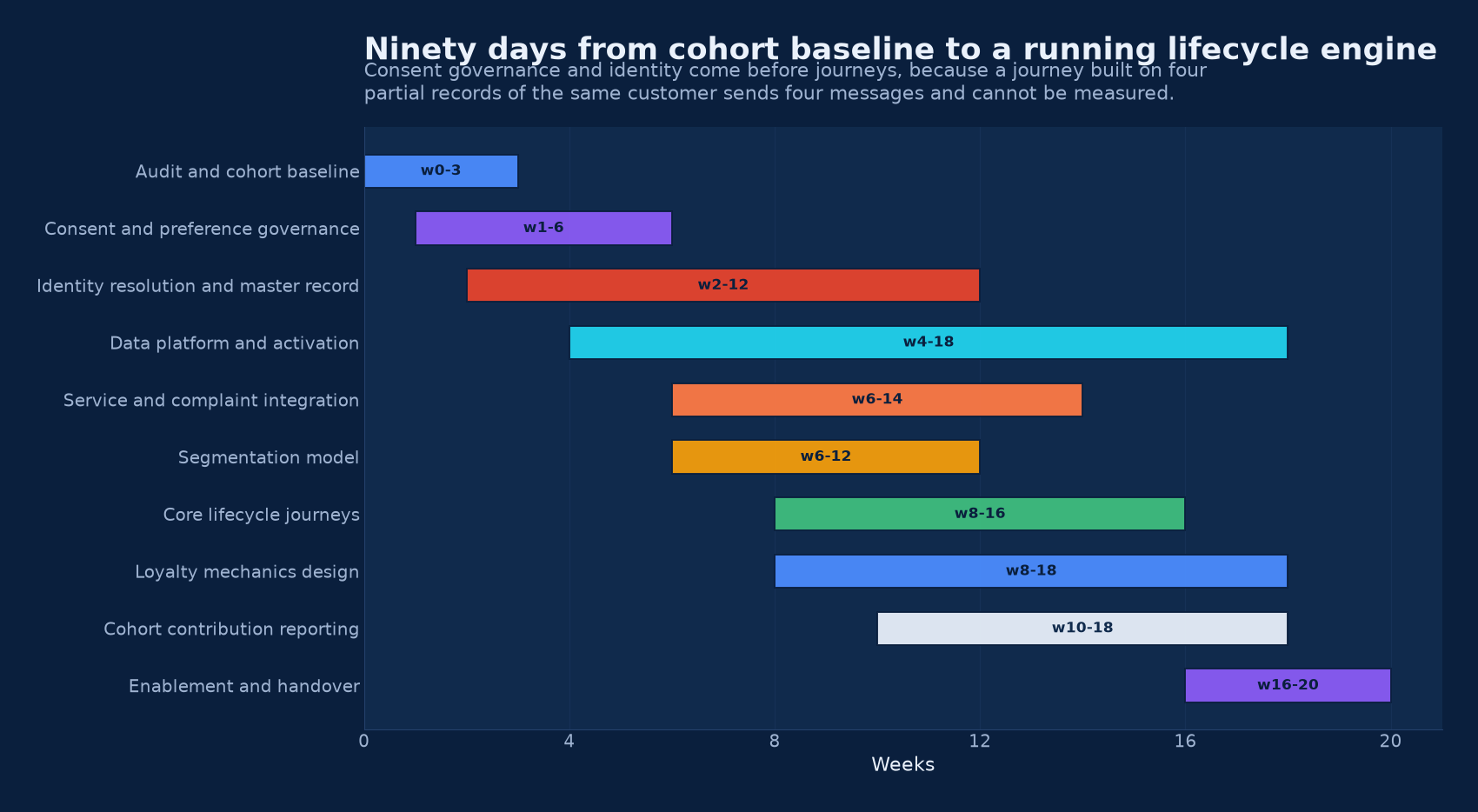
Chart values are an illustrative planning model based on typical UMC engagements and published industry benchmarks. They are not a guarantee of results on any specific project.
Weeks one to three are the audit and the cohort baseline: what the order data says about repeat, lapse and value; where the customer record is held and how much is joined; the consent position across every tool; and a written verdict including what we would not build. Consent and preference governance lands by week six with one suppression service. Identity resolution and the master record run weeks two to twelve. The data platform and activation layer run weeks four to eighteen. Service and complaint integration lands by week fourteen so suppression is automatic. The segmentation model is agreed by week twelve, core journeys go live from week eight to sixteen in the order shown earlier, loyalty mechanics are designed from week eight to eighteen against the contribution model, cohort reporting is live by week eighteen, and enablement and handover close the programme at week twenty.
| Deliverable | Week | What the business keeps |
|---|---|---|
| Audit and cohort baseline | 3 | Repeat, lapse and value by cohort, with the identity and consent position |
| Consent and suppression governance | 6 | One authoritative consent record and one suppression service |
| Identity resolution live | 12 | A master record with match rules, confidence and an audit trail |
| Data platform and activation | 18 | Event store, profiles, segments, activation with measured latency |
| Service state integration | 14 | Automatic suppression and a recovery journey per state |
| Segmentation model | 12 | Named segments with an action and an owner each |
| Core lifecycle journeys | 16 | Onboarding, recovery, post-purchase, review, replenishment, cross-sell, win-back |
| Loyalty mechanics | 18 | A scheme designed against contribution, with a liability view |
| Cohort contribution reporting | 18 | One definition set shared with finance, reported monthly |
| Enablement and handover | 20 | Runbooks, journey documentation, training, named owners |
Pricing and engagement models for retail CRM
| Model | Best for | What it includes | Commercial shape |
|---|---|---|---|
| CRM assessment | A business about to buy a platform and wanting to avoid buying the wrong problem | Data model, identity and consent position, cohort baseline, platform options, written verdict | Fixed fee, three weeks |
| Programme build | A retailer installing identity, consent, journeys and reporting together | Full ninety-day programme as described above | Milestone billing by workstream |
| Lifecycle retainer | A business with the platform and needing the programme run | Journey design and optimisation, content direction, segmentation, monthly cohort reporting | Monthly retainer with a retention target |
| Loyalty scheme design | A business whose scheme is a discount with a points label | Mechanics, benefit costing, tier logic, liability model, launch and communication plan | Fixed fee with finance involvement |
| Data platform build | A business whose customer data cannot be joined | Warehouse, identity resolution, event specification, activation, governance | Fixed price per release |
| Consent and compliance programme | A business with an audit finding, a tender requirement or a regulator’s question | Consent architecture, suppression service, retention schedule, request workflows, evidence pack | Fixed fee, then a monitoring retainer |
| Enablement and handover | A business bringing CRM in house | Runbooks, journey documentation, training, a supported transition period | Fixed fee over eight weeks |
Retail CRM by city, and worked examples
CRM programmes are delivered remotely, with the local layer handled where it exists: messaging channel mix by market, language and preference norms, festive and seasonal cycles, store-level enrolment, and the data-protection rules that apply where the customer lives. The examples below are engagements where the customer record, the commerce platform and the commercial model were built together.
- Get more retail customers in Lucknow
- Increase e-commerce sales in Lucknow
- Get more jewellery customers in Lucknow
- Get more pharmacy customers in Lucknow
- Digital marketing and IT services across Indian cities
- Case study: EZ1 in Services full-stack e-commerce platform development
- Case study: a fashion retail showroom
- Hotels and hospitality – a loyalty-led comparison
- Pharmaceutical and life sciences – a constrained-lifecycle comparison
- About Unified Management Consulting
- Contact us
Where this page sits in our retail programme
This page is one discipline of the retail vertical programme. The hub ties the set together, each discipline has its own page as it is built, and the generic service page for every discipline stays listed below alongside the vertical pages. A sibling that is not listed is not published yet: this list is generated from live pages and refreshes automatically as each spoke lands.
- Retail – the vertical main page
- Website development for retail and e-commerce
- SEO for retail and e-commerce
- Google Ads for retail and e-commerce
- Social media marketing for retail and e-commerce
- Business intelligence for retail
- IT support and commerce security for retail
- AI for retail and e-commerce
- Website development services – the generic service page
- SEO services – the generic service page
- Google Ads management – the generic service page
- Social media management – the generic service page
- BI dashboards and executive reporting – the generic service page
- Managed IT infrastructure and AMC – the generic service page
- AI agent deployment and automation – the generic service page
Frequently asked questions about retail CRM, loyalty and lifecycle marketing
Which CRM platform should we choose?
The one that fits a data model and consent position you have already decided. Choosing first and designing afterwards produces a more expensive version of the current problem, so we settle identity rules, consent granularity, segment definitions and activation targets before naming a product.
How do we identify marketplace customers?
Within the platform’s terms: post-purchase capture on the delivery and support path, package inserts, warranty or service registration, and order-level data joined in the warehouse. What you cannot do is extract a buyer’s identity in breach of terms, and we will not design a programme that depends on it.
Is a loyalty scheme worth it?
Only if the benefits cost less than the discount they replace and the scheme changes behaviour that would not otherwise happen. In low-frequency categories points mostly create a balance-sheet liability; early access, delivery convenience, services and recognition usually earn more.
How many messages should we send?
As many as the customer’s behaviour justifies and no more, governed by one frequency policy above every tool. The measure is not volume but opt-out rate, complaint rate and cohort contribution – and a preference centre that lets people choose frequency beats a global cap.
How do we measure whether lifecycle marketing works?
With cohort contribution against a recorded baseline, and a holdout where the journey allows one. Revenue per send cannot answer the question because it rewards discounting, and open rates cannot answer it because they measure an inbox, not a business.
Can AI personalise our messaging?
For subject lines, send-time, product selection from affinity and content variants, yes – from your data, with a stated fallback and a human owner. For anything that makes a claim about a product, a price or a delivery promise, no: those come from the systems of record.
What happens when a customer asks to be deleted?
A workflow that runs across every system holding their data – commerce, marketplace integration, marketing tools, service desk, warehouse, backups on their own schedule – with a record of what was deleted and what was legally retained. We test it end to end rather than documenting it and hoping.
How do we stop marketing to angry customers?
By making service state a marketing input: an open complaint, failed delivery, unresolved return or negative review suppresses promotional contact automatically until it is closed, and the resolution triggers a recovery journey.
Our customer data is in six systems. Is that fatal?
No, but it does mean the first deliverable is a designated golden record with documented tie-break rules, not a new seventh system. Most retail estates are improved by joining what exists rather than by replacing it.
Do we need a customer data platform product?
Sometimes. The question is whether the join you need is one a vendor supports out of the box. For many retailers a warehouse with an activation layer is cheaper, more flexible and easier to govern than a marketing product doing data engineering.
How does CRM work with our paid acquisition?
The cohort record is the bridge: acquisition source and cost stamped at first order, never overwritten, so a channel can be judged on the contribution its cohorts produce over a year rather than on its first-order return.
Do you work outside India?
Yes. Programmes are delivered remotely with per-market messaging norms, language, channel mix, festive calendars and data-protection requirements handled inside the engagement.
Start with the cohort baseline and the consent position
Give us three weeks with two years of order data, access to every system holding a customer record, and your current message volumes and opt-out rates, and we will return the cohort contribution baseline, an identity and consent position with the gaps named, a segmentation model with an action per segment, the journey set in priority order, and a written verdict on whether a loyalty scheme or a platform purchase is worth your money – yours to keep either way.
Contact Unified Management Consulting to arrange a confidential first conversation.