
A retail IT estate has one unusual property: it is revenue-critical every hour it is open, and it is open during the weeks when nobody can afford to change anything. The storefront, the point of sale, the order-management system, the warehouse feed and the marketplace listings are all the same business seen from different angles, and a fault in any one of them shows up as lost sales within minutes rather than as a ticket in a queue.
So retail IT support is not a break-fix function. It is a set of unglamorous disciplines that keep trading possible: knowing every asset and dependency that can fail, reducing the number of systems that can see a card, removing standing access from people who do not need it, patching on a schedule rather than in a panic, proving restores by timing them, detecting an outage before a customer service inbox does, and having fraud rules tuned against real order data. Everything else – the marketing, the merchandising, the analytics – assumes this layer holds.
What an engagement includes, at a glance
| Component | What We Deliver |
|---|---|
| Asset and dependency inventory | Every system, plugin, integration, domain, certificate, cloud account and third-party service that can stop trading, with an owner, a criticality rating and a documented failure mode. Nothing can be protected, patched or recovered before it is listed. |
| Payment scope reduction | Fewer systems able to see card data means less to assess, less to breach and less to insure. Tokenised gateways, hosted payment fields, iframe isolation and removing card handling from the warehouse and support tooling. |
| Access control and MFA | Named accounts, role-based access, MFA on every administrative and finance path, quarterly recertification, and immediate removal on exit – including agency, freelance and marketplace accounts that outlive the people who created them. |
| Patch, plugin and dependency discipline | A tested update path for the commerce stack with staging, rollback and a published cadence, plus end-of-life tracking so a plugin sunset is a planned change rather than an emergency. |
| Backups with timed restores | Immutable or versioned backups, a documented restore runbook, and a measured restore time per system – rehearsed, not assumed. A backup nobody has restored is a hope. |
| Monitoring, alerting and on-call | Synthetic checkout tests, availability and latency monitoring, error and queue alerting, and a named on-call rota with escalation – covering peak trading, not just office hours. |
| Fraud, chargeback and payment abuse rules | Velocity, address and device rules tuned to your own order history, a dispute evidence pack per chargeback reason, and a returns-abuse policy that survives customer-service pressure. |
| Store, branch and network IT | POS health, branch connectivity and failover, till and peripheral support, kiosk and signage endpoints, and the branch-to-cloud path that carries stock and sales data. |
| Audit evidence and compliance posture | The logs, policies, records and access reviews an assessor, insurer or marketplace partner will ask for – assembled continuously, not reconstructed in a fortnight before an audit. |
What breaks first in a retail IT estate, and why retail is unusually exposed
Retail estates fail in predictable patterns, and the pattern depends on the business model more than on the technology. A single-brand D2C estate fails through a plugin or an over-privileged agency account. A multi-store chain fails at the branch: a router, a till, a print server, a sync job that stopped three days ago and nobody noticed. A marketplace-led seller fails through an API change it did not control. The common thread is that the failure is discovered by a customer or a store manager rather than by a monitor, which is why the first engagement is usually managed IT infrastructure and support with monitoring, not a project.
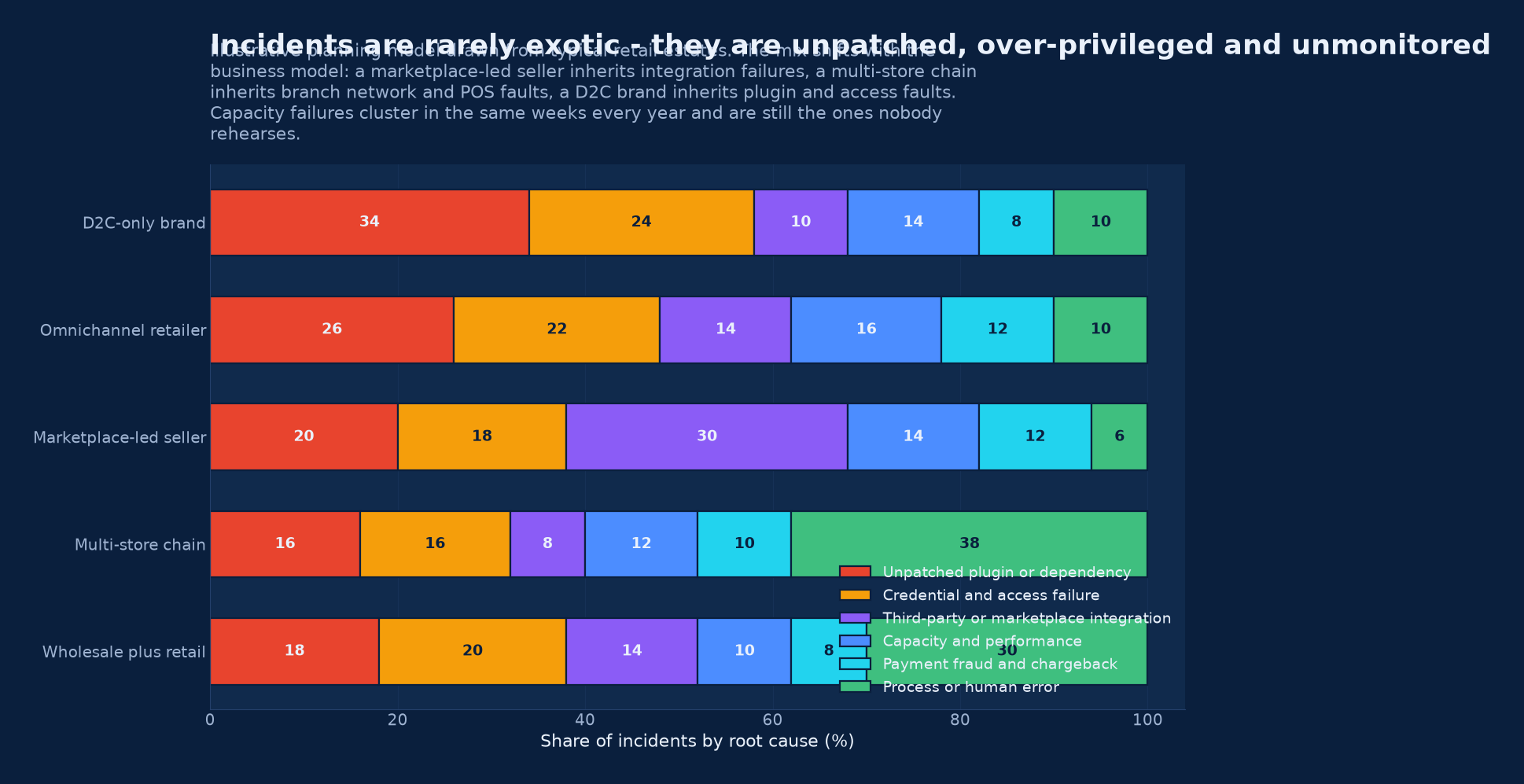
Chart values are an illustrative planning model based on typical UMC engagements and published industry benchmarks. They are not a guarantee of results on any specific project.
| Failure | How it presents | Why retail is exposed | First control we put in place |
|---|---|---|---|
| Storefront outage | Checkout errors, blank category pages, cart failures | Every minute is revenue, and peak traffic is predictable but unrehearsed | Synthetic checkout monitoring with paging alert |
| Plugin or dependency exploit | Defacement, injected scripts, admin accounts appearing | Commerce stacks are large, public and updated unevenly | Asset inventory, staged patch cadence, file-integrity alerts |
| Credential compromise | Orders exported, customer list taken, discount codes issued | Marketing, agency and support staff all hold admin access | MFA everywhere, named accounts, quarterly recertification |
| Payment data exposure | Card data in logs, tickets, exports or a support screenshot | Support teams need order detail to do their job | Scope reduction and masked fields in support tooling |
| Branch network fault | Tills offline, card payments declined, stock not syncing | Branch connectivity is heterogeneous and rarely monitored | Link failover, POS health checks, offline mode tested |
| Integration breakage | Orders not flowing to warehouse, listings out of stock, refunds stuck | Marketplace and carrier APIs change without notice | Queue monitoring with age alerts and a replay path |
| Backup that will not restore | A recovery attempt reveals corrupt, stale or partial backups | Backups are configured once and never tested | Timed restore drills with a recorded result |
| Fraud and chargeback spike | Loss appears in settlement, not in the sales report | Festive demand makes velocity rules noisy and easy to relax | Rules tuned on order history, evidence pack per dispute |
| Certificate or domain expiry | Storefront unreachable or serving a browser warning | Certificates are spread across CDN, gateway and branch devices | Expiry inventory with alerts sixty and fourteen days out |
| Cloud cost or capacity shock | Throttling during a campaign, or an unexpected invoice | Sale events multiply traffic without a matching capacity plan | Load testing before peak and cloud cost controls |
- Most of these are governance failures with a technical symptom. The remedy is a named owner, a schedule and evidence – which is the substance of cybersecurity services applied to a trading business rather than to a network diagram.
- Where the estate is unknown rather than unmanaged, the starting point is an IT audit and compliance review: you cannot prioritise controls for systems nobody has listed.
- Where the failures are commercial rather than technical – a channel that keeps breaking and keeps being funded – the conversation belongs in business strategy or unified top-level business management, with IT supplying the evidence.
Payment scope: the fastest risk reduction available to a retailer
Card data is the one thing in a retail estate that turns an ordinary breach into an expensive one: fines, forensic investigation, card replacement costs, higher processing rates and, in some cases, the loss of the ability to take cards at all. The most effective control is not encryption, it is reduction – making sure fewer systems can see card data in the first place. Hosted payment fields and tokenisation remove the storefront from scope; masked order records remove the helpdesk; direct-to-gateway terminals remove the back office. Each step shrinks what an assessor examines and what an attacker can find.
| Approach | What it takes out of scope | Trade-off to accept | Typical effort |
|---|---|---|---|
| Hosted or iframe payment fields | The storefront and its servers | Less control over the payment step’s look and feel | Days to weeks |
| Gateway tokenisation | Stored card numbers across the estate | Migration of saved cards, and a token vault to protect | Weeks |
| Direct-to-gateway POS terminals | Branch servers and back-office systems | Terminal estate management and per-device certification | Weeks per chain |
| Masked order data in support tools | Helpdesk, CRM and analytics layers | Support agents need a lookup path for the last four digits | Days |
| Removing card data from logs and exports | Log platforms, BI exports, email threads | Debugging payment failures becomes harder without a trace ID | Days |
| Settlement file handling | Finance systems and shared drives | A controlled location and named custodians for settlement data | Days |
| Network segmentation at branch | Till network from guest and back-office Wi-Fi | Cabling, VLAN design and device reconfiguration per site | Weeks per site |
| Vendor and marketplace scope review | Third parties who can reach payment paths | Contractual assurances and, occasionally, changing a vendor | Weeks |
| Quarterly scope attestation | Creep – the slow return of card data to new tools | A recurring review with a named owner | Hours per quarter |
- Scope reduction is also the cheapest control per rupee spent, because it reduces every other obligation that follows: fewer systems to scan, fewer to log, fewer to assess and less to insure.
- The commerce platform itself has to cooperate. Where a WooCommerce or custom commerce build stores payment state it does not need to, that is a website development for retail change, not a security configuration.
- Branch networks are where scope reduction usually stalls, because till, office and guest traffic share a switch – that is routing, switching and firewall engineering work with a retail constraint: the tills must keep trading while it happens.
Access control, MFA and the admin-account problem
Ask a retailer who can change a price, issue a discount code, export an order list or redeploy the storefront, and the honest answer is usually ‘more people than we think’. Access accumulates through agencies, freelancers, marketplace account managers, temporary festive staff and integrations that were given an admin token to make a launch date. Each of those is a path into the business that outlives the person who created it. The control set is small and boring: named accounts, least privilege, MFA on every administrative and financial path, a joiner-mover-leaver process that actually runs, and a quarterly recertification someone signs.
| Access path | Who typically holds it | Control that should exist | Recertification |
|---|---|---|---|
| Commerce platform admin | Founders, marketing, agencies, developers | Role separation, MFA, named accounts only | Quarterly |
| Marketplace seller accounts | Founder plus a marketplace account manager | Sub-accounts with scoped permissions, MFA, no shared login | Quarterly |
| Payment gateway and banking | Finance, sometimes the founder alone | Dual authorisation for payouts and bank-detail changes | Quarterly |
| Cloud and hosting accounts | Developers, an agency, an IT vendor | IAM roles not shared keys, break-glass account sealed and logged | Quarterly |
| Domain, DNS and email | Often the original web agency | Registrar lock, in-house ownership, MFA, documented transfer path | Annually |
| POS and branch back office | Store managers, regional managers | Role-based till permissions, price-override limits, audit log | Half-yearly |
| Helpdesk and CRM | Support agents, outsourced partners | Masked payment fields, export restrictions, session timeouts | Quarterly |
| Analytics and BI tools | Marketing, merchandising, consultants | Row-level security on margin, no raw customer export | Half-yearly |
| Integration service accounts | Every third-party connector | Scoped tokens with expiry, inventoried and reviewed | Quarterly |
| Leaver and agency-exit path | Nobody, until it is needed | Same-day removal checklist including tokens, keys and mailboxes | On every exit |
- The domain and DNS entry is the one retailers most often discover they do not control. Losing it loses the storefront, the email and the brand at once, and recovering it takes weeks – so ownership is transferred early in any engagement.
- Access review is also a customer-data question: the CRM and loyalty programme holds the most personal data in the estate, and its permissions deserve the same treatment as payment paths.
- Where access has to be granted to an analytics or AI tool, the same least-privilege logic applies – see AI governance, risk and compliance for the model- and data-access side of it.
Patch, plugin and dependency discipline for commerce stacks
Commerce platforms are patched in public: an advisory names a plugin, and within days every unpatched store is a target. Retailers cannot simply apply updates the moment they appear, because a broken checkout costs more than a day of exposure – but they also cannot defer indefinitely, because deferral is how a minor plugin becomes a breach. The answer is a rehearsed update path: a staging environment that mirrors production, a test set that covers checkout end to end, a rollback that has been used at least once, and a published cadence the business can plan trading around.
| Layer | What goes wrong | Cadence | Test that must pass before production |
|---|---|---|---|
| Platform core | Security releases with breaking changes | Within days of a security release, monthly otherwise | Checkout, payment capture, order export, login |
| Plugins and extensions | Exploited public vulnerabilities, conflicts after core updates | Monthly, security releases immediately | Affected feature plus checkout regression |
| Theme and templates | Broken rendering, performance regressions, script conflicts | Per release | Key templates on mobile and desktop, plus Core Web Vitals |
| Payment and shipping SDKs | Deprecated APIs, certificate rotations, gateway changes | Per vendor advisory | A live-value transaction in sandbox and a refund |
| Server runtime and OS | End-of-life runtimes, kernel and library CVEs | Monthly security patches, planned upgrades per EOL | Full application smoke test plus restore point |
| Database and search | Version lag, index corruption, slow queries under load | Quarterly review | Query performance on the top twenty pages |
| POS and branch software | Vendor updates applied unevenly across branches | Per vendor release, rolled out in waves | Till sale, refund, offline mode and sync |
| Mobile app | Store rejection, SDK deprecation, OS permission changes | Per release train | Install, login, browse, purchase, push notification |
| Certificates and keys | Silent expiry taking the storefront or a webhook down | Inventory with sixty and fourteen day alerts | Renewal applied in staging first |
| Third-party scripts | Tag manager additions that break checkout or leak data | Per change, with review | Checkout on a real browser with script blocking off |
- A staging environment that does not mirror production is worse than none, because it produces false confidence. Where mirroring is expensive, cloud-native deployment patterns and CI/CD pipelines make an identical throwaway environment cheap.
- Performance is part of the regression set: an update that adds three hundred milliseconds to the product page is a revenue problem, tracked as Core Web Vitals and performance work.
- End-of-life tracking is the discipline that prevents emergencies. A runtime sunset announced eighteen months ahead becomes an unplanned migration if nobody owned the date.
- The same discipline applies to web application maintenance and support contracts: what is patched, how fast, and who is paged when it fails.
Backups that survive: timed restores, immutability and ransomware
Retailers generally have backups. What they rarely have is a measured restore, an immutable copy and a decision about how much trading they can afford to lose. Those are three different questions: can the data be recovered at all, can it be recovered if the attacker has admin access, and how much of it can the business afford to lose. Answering them turns backup from a checkbox into a plan with numbers attached – a recovery point and a recovery time per system, rehearsed on a schedule and recorded. This is backup and disaster recovery work with a retail constraint: the drill has to happen without stopping trading.
| System | What must be recoverable | Recovery point | Recovery time target | Drill |
|---|---|---|---|---|
| Commerce database | Orders, customers, catalogue, stock, price rules | Fifteen minutes | Two hours | Quarterly, timed |
| Media and asset store | Product images, documents, theme assets | Twenty-four hours | Four hours | Half-yearly |
| Order and warehouse system | Open orders, shipments, stock movements | Fifteen minutes | Two hours | Quarterly, timed |
| POS and branch data | Till journals, offline queues, branch stock | One trading hour | Same shift | Half-yearly per region |
| Finance and settlement records | Invoices, settlements, refunds, audit trail | Twenty-four hours | One business day | Annually |
| CRM and loyalty data | Customer records, consent, points balances | One hour | Four hours | Quarterly |
| Configuration and code | Infrastructure definitions, environment variables, keys | Per change | One hour | Half-yearly |
| Email and collaboration | Mailboxes, shared drives, order correspondence | Twenty-four hours | One business day | Annually |
| Immutable offline copy | A copy no administrative credential can alter or delete | Twenty-four hours | Twenty-four hours | Annually, with a full rebuild test |
| Runbook and contacts | Who does what, in what order, with which vendor numbers | Current at all times | Immediate | Reviewed quarterly |
- The ransomware scenario that matters in retail is not encryption of the storefront, it is encryption plus deletion of backups plus extortion using the customer list. Immutability and segmented credentials are what break that chain.
- Restore drills produce a second benefit: they surface the undocumented dependencies – a search index, a queue, a licence server – that no diagram mentions.
- Where backups live in cloud storage, posture matters as much as schedule: cloud security posture management catches the publicly readable bucket that turns a backup into a breach.
Fraud, chargebacks and returns abuse: the losses that never reach a ticket
Retail fraud is a data problem before it is a security problem. The signals are already in the order stream: velocity by device and address, first-order size, delivery-to-billing mismatch, gift-card and coupon stacking, refund patterns by customer and by SKU. Tuning rules against your own history rather than a vendor default is what separates a control that blocks fraud from one that blocks festive customers – and the cost of a false positive is real revenue plus a customer who does not come back.
| Abuse pattern | Signal in the order data | Rule or control | Cost of a false positive |
|---|---|---|---|
| Stolen card testing | Many small authorisations from one device or IP | Velocity limit per device, IP and card BIN | Legitimate family purchases blocked |
| Account takeover | Login from a new device followed by address change and large order | Step-up authentication on address and payment changes | Friction for a returning customer |
| Friendly fraud | Delivered order disputed as not received, same customer repeatedly | Delivery evidence pack, dispute history scoring | Losing a genuine claim |
| Return abuse | High return ratio by customer, worn or swapped items | Per-customer return scoring, restocking policy, image evidence | Punishing honest returns |
| Coupon and discount stacking | Codes applied in combinations never intended | Exclusion rules, per-customer redemption caps | Blocking a legitimate promotion |
| Gift-card draining | Balance checks and redemptions at speed from one source | Rate limiting, PIN entropy, redemption monitoring | Slower legitimate redemption |
| Bot checkout and scalping | Purchase bursts within milliseconds of a launch | Queueing, bot detection, per-account limits | Genuine early customers queued |
| Marketplace listing hijack | Your product listing altered or counterfeit variants added | Brand registry controls, listing monitoring, rapid takedown | Lost sales while unresolved |
| Fake reviews and reputation attack | Review bursts with no matching orders | Verified-purchase gating, platform reporting | None, if handled through the platform |
| Insider discount fraud | Manual price overrides and refunds by a small set of accounts | Override limits, refund dual authorisation, till audit | Slower service at the counter |
- Chargeback evidence is a workflow, not a document: the pack has to be assembled automatically from order, delivery and communication records within the dispute window, or it does not get assembled at all.
- Fraud rules interact with marketing. A velocity rule tightened during a campaign run by Google Ads for retail will reject the exact customers the campaign paid for, so rules and calendars are reviewed together.
- The same order data that drives fraud rules drives retention: lifecycle campaigns, email, SMS and WhatsApp journeys all read it, which is why masking and access control extend to the marketing stack.
Peak trading: capacity, monitoring and on-call that survive October
Retail has a calendar, and the calendar is unforgiving. The estate that handles a normal Tuesday handles four to eight times that load during a festive sale, with a marketing budget pushing traffic at precisely the moment the platform is least able to absorb a fault. Peak readiness is therefore a planned season: load testing against a stated multiple, capacity headroom purchased in advance, change freeze dates published, monitoring tuned so the alert that matters is not buried, and an on-call rota with named humans who have rehearsed the runbook. The discipline is SRE and observability applied to a business with a trading calendar.
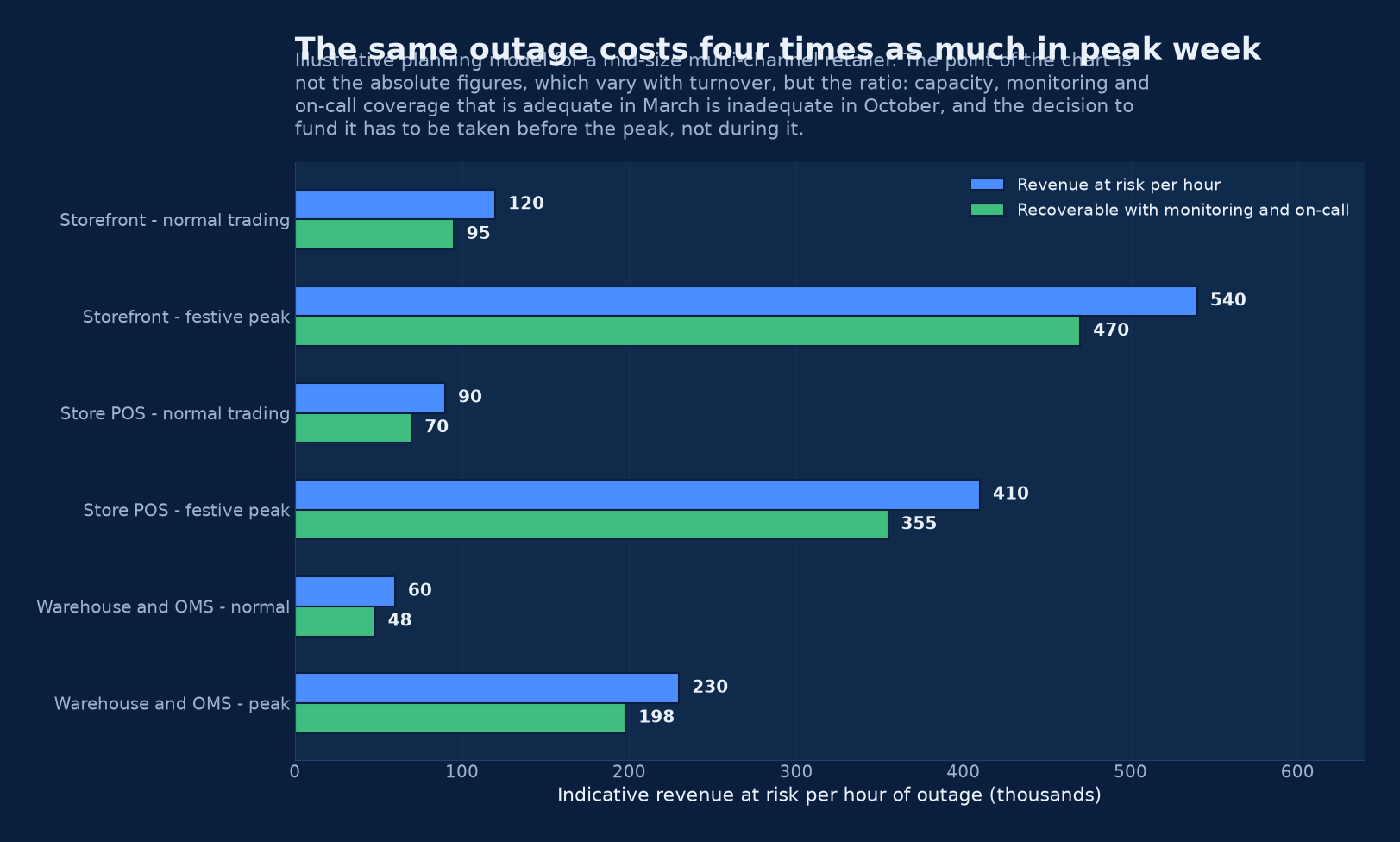
Chart values are an illustrative planning model based on typical UMC engagements and published industry benchmarks. They are not a guarantee of results on any specific project.
| Control | What it detects or prevents | Threshold that triggers action | Who acts |
|---|---|---|---|
| Synthetic checkout test | A broken payment, cart or login path | Two consecutive failures from two locations | On-call engineer, immediately |
| Availability and latency monitoring | Slow pages before they become failed pages | P95 page time above the agreed budget | On-call plus performance owner |
| Error-rate alerting | A deployment or dependency failing quietly | Error rate above baseline for five minutes | On-call engineer |
| Queue and integration lag | Orders not reaching the warehouse, refunds stuck | Queue age beyond the fulfilment promise | Operations plus on-call |
| Load test before peak | The ceiling of the current configuration | Failure below the planned peak multiple | Engineering lead |
| Autoscaling and cache headroom | Traffic spikes from campaigns and creators | Utilisation above seventy percent sustained | Infrastructure owner |
| Change freeze | A well-intentioned update during the busiest week | Freeze window published before the season | Delivery lead |
| On-call rota and escalation | Nobody knowing who is responsible at two in the morning | Alert unacknowledged for fifteen minutes | Escalation to engineering lead |
| Incident channel and comms | Customers and store staff hearing nothing | Any customer-visible fault | On-call plus customer service lead |
| Post-incident review | The same fault returning next season | Every severity-one and severity-two incident | Engineering lead, within a week |
- Peak readiness is also a demand question: if the BI layer forecasts the traffic and the sales, capacity can be bought against a number rather than against last year’s panic.
- Campaign-driven spikes need coordination, not just headroom – a creator post or a social campaign can multiply traffic in minutes, and the on-call rota should know the campaign calendar.
- Where the ceiling is architectural rather than configuration – a monolith that cannot scale the checkout independently – the fix is engineering, handled with the website development for retail team, and it belongs in the pre-season plan.
Store and branch IT: tills, connectivity and the path back to head office
Branch IT is where retail differs most from a pure e-commerce business, and where most support models fail: the users are on their feet, the devices are old, the connectivity is uneven, and the failure is visible to a customer standing at a counter. A branch estate needs a support model that works in a shop – one number to call, a device swap path, an offline mode that has actually been tested, and a way for a store manager to see whether the till is healthy without reading logs. The data path back to head office matters just as much, because branch sales and stock that arrive late produce wrong replenishment and wrong reporting.
| Element | What good looks like | What usually goes wrong | Control |
|---|---|---|---|
| POS terminals | Patched, imaged from a standard build, spares held regionally | Per-branch improvisation and unknown versions | Standard image, version report, swap path |
| Branch connectivity | Primary link with automatic failover and tested offline mode | A single broadband line with no failover | Dual link, failover test, offline queue |
| Till peripherals | Printers, scanners and card readers with a documented reset sequence | A peripheral fault stops trading until a vendor visits | Reset runbook, spares, vendor SLA |
| Card acceptance at branch | Certified terminals, P2PE, no card data on branch servers | Terminals added ad hoc, some storing data locally | Terminal inventory, scope review |
| Branch back office | One shared counter device with individual logins | A shared password used by every shift | Named logins, MFA where feasible, audit |
| Stock and sales sync | Near-real-time sync with visible lag and error states | A failed sync discovered at month end | Sync monitoring with age alerts |
| Staff devices and email | Managed devices, MFA, remote wipe, phishing-resistant habits | Personal phones used for branch administration | Device policy, MDM, training |
| Signage, kiosks and CCTV | Segmented from the till network, patched, monitored | Kiosks on the same VLAN as POS, unpatched for years | Segmentation, patch schedule, inventory |
| In-store customer Wi-Fi | Isolated, rate-limited, no route to internal systems | Guest Wi-Fi bridged to the office network | VLAN separation, firewall rules |
| Support model for branch staff | One number, business-hours plus peak cover, ticket status visible | Escalation by personal WhatsApp to whoever answered last | Structured helpdesk and end-user support with SLAs |
- Branch hardware is an infrastructure discipline in its own right: server, storage and device engineering at regional level is computing, server and data-centre engineering, and a chain that has outgrown a single back-room server usually needs it before it needs anything else.
- The branch-to-head-office path is an enterprise systems integration question with a retail deadline: POS, ERP, warehouse and the customer record have to agree about the same sale.
- Where branch staff use an app for stock checks, clienteling or task lists, that app is part of the estate – mobile app development and support with the same patch, access and monitoring discipline as the storefront.
Integrations and third parties: the supply chain of retail IT risk
A modern retail estate is mostly other people’s software: marketplaces, quick-commerce partners, carriers, payment gateways, comparison engines, review platforms, loyalty vendors, ERP and accounting packages, and the agencies that hold credentials to all of them. Each connection is a route by which an outage, a data leak or a bad change reaches your customers without ever touching your own servers. Managing that is less about contracts than about inventory: which third parties exist, what they can reach, what data leaves, how a failure would present, and how quickly it can be revoked.
| Third party | What it can reach | Failure mode | Control |
|---|---|---|---|
| Marketplace seller platforms | Catalogue, price, stock, order and settlement data | API change, listing suppression, account suspension | Inventory feed monitoring, listing health checks, appeal path |
| Quick-commerce partners | Stock, price and fulfilment status | Stock disagreement leading to cancellation | Availability sync monitoring with tolerance alerts |
| Carriers and last-mile partners | Delivery address, order status, customer contact | Webhook failure leaving orders stuck in transit | Event-age monitoring, manual reconciliation path |
| Payment gateways and wallets | Payment authorisation and settlement | Certificate rotation or gateway outage at peak | Secondary method configured and tested |
| Retail media and ad platforms | Catalogue feeds, campaign data, spend | Feed rejection stopping retail media placements | Feed health monitoring, see Shopping feed management |
| ERP, accounting and inventory | Orders, invoices, stock, customer credit | Sync backlog producing wrong stock and wrong reporting | Queue monitoring, ERP and CRM integration review |
| Loyalty and CRM vendors | Customer identifiers, consent, purchase history | Data export by a vendor account nobody remembers | Access review, export restriction, contract clauses |
| Agencies and freelancers | Admin access to commerce, ads, analytics, DNS | Access retained after the engagement ends | Scoped accounts, expiry dates, exit checklist |
| Support and BPO partners | Order and customer detail, sometimes payment context | Data copied into unapproved tools for convenience | Masked fields, tool allowlist, audit logging |
| Analytics and AI vendors | Order, product and customer data | Training or retention terms nobody read | Data-processing review before connection |
- Every third-party connection should have a stated revocation path. ‘We would have to ask them’ is not a path, and it is the answer in most estates.
- Feed-driven channels are the quiet dependency: if the catalogue feed breaks, paid listings and the organic product pages both go stale, and the revenue loss looks like a marketing problem.
- Where the integration layer itself is bespoke – a headless or composable storefront talking to five services – the risk register has to name each hop, because there is no single system to blame.
The support model: triage, service levels and what ‘covered’ means
‘We have IT support’ means very different things in different businesses. For a retailer it has to mean: a known way to report a problem, a response commitment that reflects trading hours rather than office hours, a severity model that distinguishes ‘checkout is down’ from ‘the report is ugly’, named humans on call during peak, and a record of what happened. Without that, support is a set of personal relationships that break when someone leaves – and the cost shows up as repeated incidents and unplanned spend rather than as a line item.
| Severity | Definition in retail terms | Response | Update cadence | Escalation |
|---|---|---|---|---|
| One – trading stopped | Checkout down, POS down chain-wide, payment failure, data breach suspected | Fifteen minutes, any hour | Every thirty minutes | Engineering lead and director immediately |
| Two – trading degraded | Slow pages, one branch down, one channel failing, sync backlog | One hour in trading hours | Every two hours | Engineering lead after four hours |
| Three – function impaired | A report broken, a non-critical integration failing, admin error | One business day | Daily | Delivery lead after three days |
| Four – request or improvement | New user, access change, small enhancement | Two business days | On change | Reviewed in the weekly service call |
| Security event | Any suspected compromise, credential leak or malware | Immediate, out of band | Hourly until contained | Director, plus legal and insurer as required |
| Peak-season cover | Any severity during a published sale or festive window | Halved response times, on-call staffed | Every thirty minutes | Named peak lead on the rota |
| Branch cover | Store-level faults during opening hours | Thirty minutes by phone, next-visit for hardware | Same day | Regional manager after four hours |
| Vendor management | A fault owned by a gateway, carrier or marketplace | Raised and chased by us, not by your team | Daily until resolved | Account manager, then commercial route |
| Problem management | A recurring incident class | Root-cause review within a week | Weekly | Engineering lead owns the fix plan |
| Service review | Trend, cost, risk and roadmap | Monthly with the leadership team | Monthly | Director level, with a written record |
- A support model is also a cost model. Where the spend keeps rising without the incident count falling, that is a cost rationalisation question with an IT input, not an IT question with a cost attached.
- Severity one in retail is a cash event. The same incident log feeds cash flow and working capital discussions, because a trading halt changes settlement timing as well as revenue.
- Service reporting should read like a management report, not a ticket dump – the same discipline as executive dashboards, applied to availability, incidents and risk.
Where the storefront lives: hosting, cloud and the capacity decision
The hosting question in retail is a trading question: can the platform absorb a campaign, a creator post and a festive week without an engineering change, and does the bill scale with sales or with panic? Most estates sit somewhere between an under-specified shared host and an over-engineered cluster nobody understands. The right answer is usually in between – managed infrastructure with autoscaling, a CDN and cache layer that does most of the work, infrastructure defined as code so it can be rebuilt, and cost visibility per environment so staging does not run at production scale all year.
| Option | When it is the right answer | What it demands | Retail risk if chosen wrongly |
|---|---|---|---|
| Managed commerce hosting | Standard platform, predictable traffic, small team | A vendor SLA you have read, and staging | Throttling at peak with no lever to pull |
| Cloud with autoscaling | Campaign-driven traffic, multiple channels, seasonal peaks | Infrastructure as code, monitoring, cost controls | An unbounded bill or an unbounded outage |
| Containers and orchestration | Several services, independent checkout and catalogue scaling | Kubernetes and container platform skills, or a partner with them | Complexity that outlives the team that built it |
| Own or colocation server | Data-residency needs, legacy POS integration, sunk investment | Power, patching, hardware spares and a recovery site | A single-site failure that stops trading |
| Hybrid estate | Chains with branch servers plus cloud commerce | Documented data flows and one monitoring pane | Two estates, neither properly monitored |
| CDN and edge cache | Any catalogue-heavy storefront | Cache invalidation rules tied to price and stock | A stale price served to thousands of customers |
| Multi-region or failover | Turnover where an hour of outage is material | Tested failover, data replication, cost acceptance | A failover that has never been switched on |
| Migration or replatforming | End-of-life platform, or capacity ceiling reached | A sequenced plan with rollback, and a trading calendar | Migration during peak, which is how both fail |
- Hosting decisions are usually taken during an incident, which is the worst time to take them. The migration conversation belongs in the pre-season plan – see cloud migration and infrastructure for the assessment side.
- Cost and capacity are the same conversation: cloud cost optimisation in retail is less about savings and more about knowing what a peak week will cost before it happens.
- Whatever the platform, the customer-facing obligations stay the same: performance budgets, accessibility conformance and a checkout that works on a mid-range phone on a branch-street connection.
Compliance, audit evidence and the AI controls retailers now need
Retail compliance is a set of overlapping obligations rather than one certificate: card-scheme requirements for anyone handling payments, privacy law for anyone holding customer data, consumer-protection rules for pricing and claims, marketplace partner standards for anyone selling through them, and increasingly, insurer questionnaires that ask whether the controls exist and can be evidenced. The efficient approach is to produce evidence continuously – logs, access reviews, patch records, restore results, incident reports – so an audit is a retrieval exercise. Where artificial intelligence enters the estate, the same logic applies before deployment rather than after.
| Obligation or question | Who asks | Evidence that satisfies it | Cadence |
|---|---|---|---|
| Card-data scope and controls | Acquirer, assessor, insurer | Scope diagram, segmentation proof, scan results, attestation | Annual, with quarterly scope review |
| Customer privacy and consent | Regulator, customer, marketplace partner | Consent records, retention schedule, access and deletion log | Continuous, reviewed quarterly |
| Access governance | Auditor, insurer, board | Access lists, recertification sign-offs, leaver records | Quarterly |
| Patch and vulnerability management | Auditor, insurer | Scan history, patch records, exception log with dates | Monthly |
| Backup and recovery | Auditor, insurer, board | Drill results with measured restore times | Quarterly drills, annual full test |
| Incident and breach readiness | Regulator, legal, insurer | Runbook, incident log, notification templates, drill record | Reviewed half-yearly |
| Vendor and third-party assurance | Auditor, partner, insurer | Vendor inventory, contracts, certifications, revocation paths | Half-yearly |
| Marketplace partner standards | Each marketplace | Account health, listing compliance, fulfilment metrics | Continuous |
| AI readiness and use case control | Board, insurer, regulator | AI readiness assessment with baseline and risk rating | Per use case, reviewed annually |
| AI governance and model risk | Board, legal, auditor | Governance framework, review records, human-in-the-loop points | Per release |
| Grounded AI on retail data | Anyone asking an assistant a question | Retrieval and knowledge-system engineering with lineage to the source | Per deployment |
| Operational AI in commerce systems | Operations and finance | AI integration with ERP, CRM and operations with change control | Per release |
| Agent deployment and automation | Operations, customer service | Agent deployment with permission scope and kill switch | Per agent |
| Team capability and adoption | Leadership, auditor | Training and enablement records per role | Half-yearly |
| Assurance calendar | Leadership | One dated calendar of every review, drill, scan and attestation | Annual plan, monthly tracking |
- The single most useful artefact is the assurance calendar: one page, dated, naming who produces each piece of evidence. Most retail compliance failures are scheduling failures.
- AI controls are cheap before deployment and expensive after. An assistant that answers questions about stock, orders or margin needs the same access review as a human analyst – and ideally reads the governed BI metric layer rather than raw exports.
- Where forecasting or pricing is automated, the model becomes part of the control environment: predictive analytics and demand forecasting with error bands and an override path, not a black box that sets buy depth.
The ninety-day retail IT programme, and what we need from you
The programme below is what we run for a retailer with an existing estate: three weeks to list what exists and who can reach it, overlapping work to shrink payment scope and baseline dependencies, restore drills that produce real numbers, monitoring and on-call built before the next peak, fraud rules tuned against actual order history, and an evidence pack assembled as we go. The sequence is deliberate – visibility first, then reduction, then detection, then tuning – because every later step depends on knowing what the earlier one found.
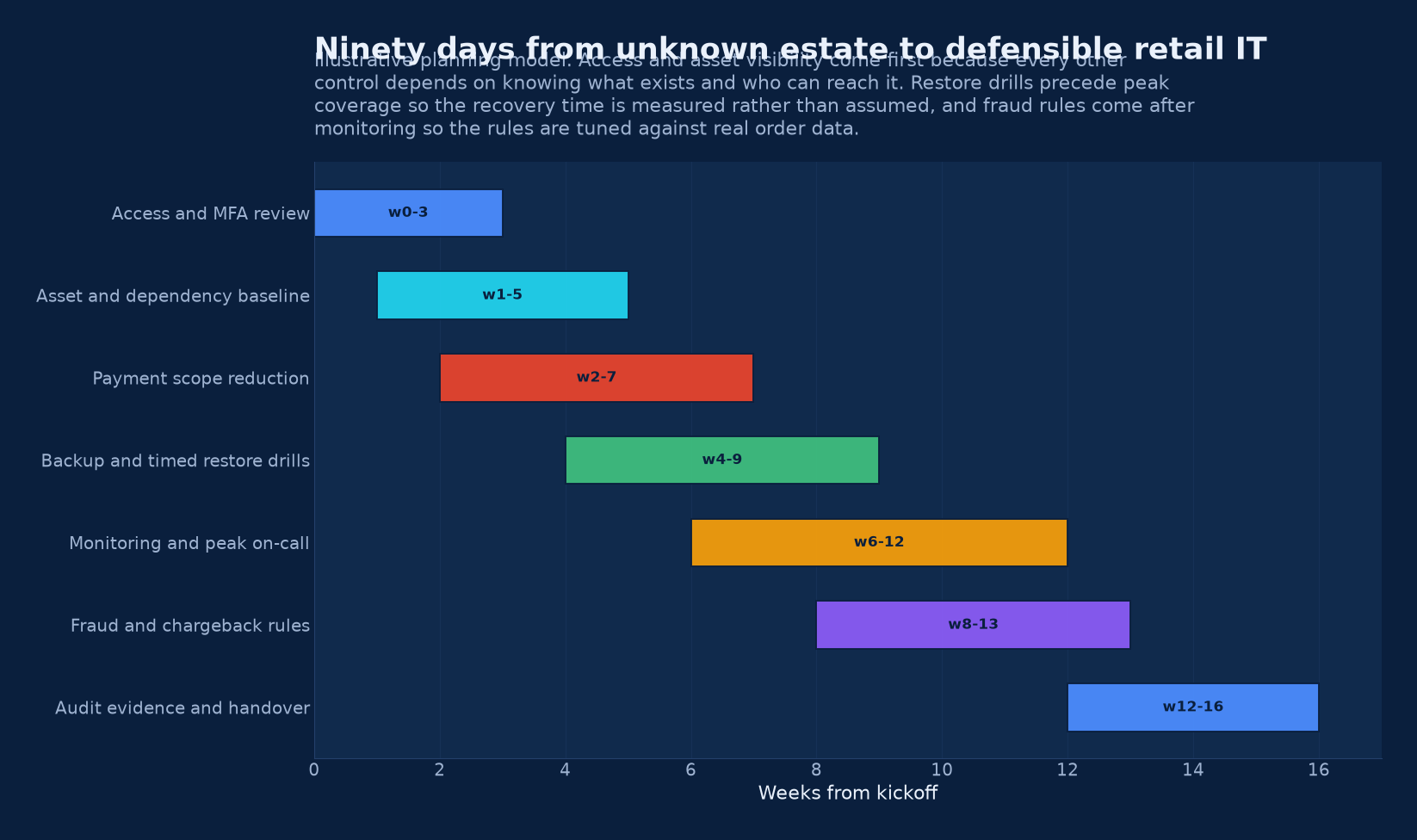
Chart values are an illustrative planning model based on typical UMC engagements and published industry benchmarks. They are not a guarantee of results on any specific project.
| Weeks | Workstream | Deliverable | Decision it enables |
|---|---|---|---|
| Zero to three | Access and asset review | Asset and dependency inventory, access list with owners, risk register | What exists, who can reach it, and what to fix first |
| One to five | Baseline and hygiene | Patch and version report, certificate and domain inventory, EOL list | What must be updated before the next peak |
| Two to seven | Payment scope reduction | Scope diagram, tokenisation or hosted-field plan, masked support views | How much assessment and breach surface is removed |
| Four to nine | Backup and restore | Backup inventory, timed restore results, immutable copy plan, runbook | The real recovery point and recovery time per system |
| Six to twelve | Monitoring and on-call | Synthetic checkout tests, alert set, severity model, rota and escalation | Whether an outage is detected before a customer reports it |
| Eight to thirteen | Fraud and chargeback controls | Rules tuned on order history, dispute evidence workflow, returns policy | How much loss is prevented and how many good orders are blocked |
| Twelve to sixteen | Evidence and handover | Assurance calendar, policy set, audit evidence pack, support transition | Whether the estate is defensible and who runs it after us |
| Ongoing | Service and problem management | Monthly service review, incident trends, risk register updates | Whether the controls are holding or drifting |
- What we need: administrative access under an agreed scope, the current vendor and agency list, two years of incident and ticket history if it exists, order data for fraud tuning, and one named owner per system.
- What you keep regardless: the asset inventory, the risk register, the assurance calendar, the restore results and the runbooks. They are yours whether or not we operate the estate.
- What we will tell you honestly: which systems to stop maintaining, which vendors to leave, and which risks are cheaper to accept than to fix – with the reasoning written down.
Retail IT support by city, and worked examples
Support and security engagements run remotely with branch visits where hardware is involved, and the local layer matters in three ways: branch connectivity and vendor coverage vary by city, peak calendars differ by region, and on-call has to be staffed in the timezone the business trades in. The engagements below are commerce, infrastructure and support projects where the control set was built alongside the platform it protects.
- Website development company for retail stores in Lucknow
- Get more retail customers in Lucknow – the local-intent page
- Increase e-commerce sales in Lucknow
- Digital marketing and IT services in Lucknow
- Services across Indian cities
- Case study: IT infrastructure management for an IT company
- Case study: EZ1 In Services full-stack e-commerce platform development
- Case study: WordPress and WooCommerce online mobile store
- Case study: a fashion retail showroom
- Case study: Ethnava chikankari garment WooCommerce and SEO project
- The retail and e-commerce industry hub – all eight disciplines
- Showrooms and dealerships: branch IT, DMS and footfall systems
- Manufacturing: plant, inventory and OT-adjacent IT
- All industry verticals we build programmes for
- About Unified Management Consulting
- Contact us about retail IT support and commerce security
Where this page sits in our retail programme
IT support and commerce security is the seventh discipline of our retail and e-commerce programme. The hub page explains how the eight disciplines fit together, each discipline has its own page as it is published, and the generic service page for every discipline stays listed below alongside the vertical pages. A discipline that is not listed is not published yet – the list is generated from live pages and refreshes automatically as each spoke lands.
- Retail – the vertical main page
- Website development for retail and e-commerce
- SEO for retail and e-commerce
- Google Ads for retail and e-commerce
- Social media marketing for retail and e-commerce
- CRM, loyalty and lifecycle for retail
- Business intelligence for retail
- AI for retail and e-commerce
- Website development services – the generic service page
- SEO services – the generic service page
- Google Ads management – the generic service page
- Social media management – the generic service page
- Custom CRM development and integration – the generic service page
- BI dashboards and executive reporting – the generic service page
- AI agent deployment and automation – the generic service page
Frequently asked questions about IT support and security for retail
What does IT support for a retail business actually cover?
The storefront, the point of sale, order and warehouse systems, integrations, hosting, access, backups, monitoring, fraud controls and the evidence an assessor or insurer will ask for. In practice it means keeping trading possible, detecting a fault before customers do, and being able to prove the controls exist.
How is retail IT support different from generic managed IT?
Retail is revenue-critical by the hour and seasonal by the year. Response commitments follow trading hours rather than office hours, peak seasons need pre-purchased capacity and staffed on-call, and the estate spans branches, marketplaces and carriers that a conventional IT contract never mentions.
Do we need PCI compliance if we use a payment gateway?
Using a gateway reduces what you must comply with, it does not remove the obligation. You still have to keep card data out of your own systems, protect the payment page, segment branch networks, and complete the self-assessment your acquirer requires. Scope reduction is what makes that manageable.
What is the first thing you would fix in a retail IT estate?
Usually visibility: an inventory of systems, integrations, credentials, domains and certificates with an owner each. Almost every serious incident we investigate involved something nobody knew was there – a plugin, an agency login, a forgotten webhook, a branch server.
How quickly can you restore our store if it is compromised?
That depends on whether a restore has ever been timed. Our first drill produces a measured recovery point and recovery time per system; typical retail targets are fifteen minutes of data loss and two hours to trade again for the commerce database, with an immutable copy behind it.
Can you support our branches as well as the website?
Yes. Branch work covers POS health, connectivity and failover, peripherals, till user administration and the sync path to head office, with a support number store staff can actually use and hardware escalation through regional partners.
How do we stop an agency or ex-employee still having access?
With an access inventory and a quarterly recertification someone signs, plus a same-day leaver checklist covering admin accounts, cloud roles, integration tokens, DNS, mailboxes and marketplace sub-accounts. The inventory is the control; the checklist is the discipline.
What monitoring do we need for a festive sale?
A synthetic checkout test from two locations, availability and latency alerts with a P95 budget, error-rate and queue-age alerts, plus a load test against a stated multiple of normal traffic and a published change freeze. Then a named rota, because monitoring without a human is just a log.
How do fraud rules avoid blocking genuine customers?
By being tuned on your own order history rather than vendor defaults, with thresholds reviewed against the campaign calendar, a manual review queue instead of a hard block for borderline cases, and a false-positive rate reported alongside the fraud prevented.
Do you handle marketplace and carrier integrations too?
Yes – they are part of the estate. That means feed and listing health monitoring, webhook and queue-age alerts, reconciliation of settlements, and a documented escalation path with each partner when an API changes without notice.
Is AI safe to use in our retail operations?
Where it is governed: a readiness assessment with a recorded baseline, scoped data access, human-in-the-loop points for anything that changes a price, refunds an order or contacts a customer, and grounding on your own systems of record so answers can be traced. Ungoverned assistants on raw exports invent confidently.
What does retail IT support cost?
It scales with estate size, branch count, integration count and the response commitment you need – not with the number of users alone. We quote after the inventory and access review, so the price reflects what actually exists, and peak-season cover is priced separately and in advance.
Start with the inventory, the access review and one timed restore
Give us three weeks with administrative access under an agreed scope, your vendor and agency list, any incident history and two years of order data, and we will return an asset and dependency inventory with an owner per system, an access list showing everyone who can reach payment, pricing and customer data, a payment-scope reduction plan, a measured restore result rather than an assumed one, a monitoring and on-call proposal for your next peak, and a risk register that says plainly which risks to fix, which to fund later and which to accept. Yours to keep whether or not we run the estate afterwards.
Contact Unified Management Consulting to arrange a confidential first conversation.