
Social does a job in retail that no other channel does: it creates demand for a line nobody was searching for, and it does so with an image rather than a bid. That makes it the most creative-dependent channel in the mix, the one where the difference between good and adequate work is largest, and – because its results are the least attributable – the one most often judged on the wrong number. Reach, followers and engagement are inputs. The output is a cohort of customers with a contribution and a repeat rate attached.
This page covers the social programme for retail and e-commerce: audience and content-pillar design, the asset and shoot system that makes catalogue-scale creative possible, catalogue and creator advertising, comment and DM handling as a service channel, review and user-generated content, claims and rights governance, and measurement against cohort contribution. Paid search, Shopping and retail media sit in Google Ads for retail; the organic search half in SEO for retail; the storefront these all land on in website development for retail; and the commercial model in the retail and e-commerce hub.
What an engagement includes, at a glance
| Component | What We Deliver |
|---|---|
| Audience and cohort model | Who the social programme is for, which cohort each pillar serves, and what a cohort is worth at ninety and three hundred sixty-five days – agreed before any content is produced. |
| Content pillars and calendar | Four to six pillars with a stated job each, a weekly cadence the team can actually sustain, and a rule for what does not get published. |
| Asset and shoot system | Templates, a shoot standard, a digital asset workflow and rights records, so product-level creative is generated rather than commissioned one at a time. |
| Catalogue and creator advertising | Feed-driven catalogue ads for prospecting and retention, plus a creator programme with briefs, contracts and contribution measured per creator. |
| Community and service flow | Comment and DM handling with response targets, escalation into the support system, and a record of every conversation against the customer. |
| Review and user-generated content | A policy and an engine for asking, moderating, rights-clearing and reusing customer content. |
| Claims, disclosure and rights | Substantiation for every claim, disclosure for every partnership, and written rights for every asset – checked before publication. |
| Measurement | Contribution by cohort and creator, assisted conversions, sentiment and service metrics, and an incrementality view rather than platform-reported return. |
| Enablement and handover | Who posts, who approves, who answers, and what happens when somebody leaves – documented, trained and rehearsed. |
What retail social teams ask for, and what the constraint usually is
Social requests arrive as visibility complaints – ‘we are posting every day and nothing happens’ – and the cause is almost never posting frequency. It is usually one of four things: content with no pillar behind it, so nothing can be measured or repeated; creative that is not good enough to stop a scroll; a comment and DM queue nobody owns, which turns a marketing channel into an unanswered service channel; or measurement on platform-reported numbers that omit contribution. The table below is the translation we run in the first fortnight.
| What gets asked | What is usually happening | What we do about it |
|---|---|---|
| We post daily and see no sales | Content is undifferentiated promotion with no pillar, no cohort and no path | Pillar design with a job per pillar, and a path from each to a category |
| Engagement is good, revenue is not | The audience being entertained is not the audience that buys | Audience model rebuilt from purchase data, not from follower demographics |
| Our creative looks amateur next to competitors | No shoot standard, no template system, assets resized rather than produced | Shoot standard, template layer, and a small number of real concepts per season |
| Comments and DMs are a mess | Nobody owns the queue; questions answered twice; complaints left visible | Service flow with targets, escalation into support, and a conversation record |
| Creators are expensive and unpredictable | No brief, no rights agreement, no per-creator contribution measure | Creator programme with tiers, briefs, contracts and cohort measurement |
| We cannot prove social works | Platform-reported return with no incrementality view and no cohort join | Cohort contribution, assisted conversions, and a holdout where possible |
| A claim or partnership went wrong | No substantiation file, no disclosure rule, no approval gate | Claims register, disclosure policy, pre-publication approval |
| Customer content is unusable | No rights request process, so good content cannot be reused | Rights workflow at the point of capture, with a reusable asset library |
| Every channel gets the same post | One asset resized for six platforms with native behaviour ignored | Per-platform format and behaviour rules inside one pillar system |
| The team cannot keep this up | A cadence designed for an agency, not for the people who have to run it | Cadence set from real capacity, with enablement and a handover pack |
Six of the ten are design and governance problems, two are creative, one is service operations and one is measurement. Which is why a social engagement here starts with an audience and pillar model rather than with a content calendar.
Audience model: built from purchase data, not from follower counts
Most retail social programmes are aimed at the wrong audience because the audience was defined by who follows the brand rather than by who buys from it. The correction is uncomfortable and quick: take two years of order data, segment the buyers by category, frequency, value and acquisition channel, and compare that with the current follower and engagement profile. The gap between the two is the size of the problem, and it usually shows an audience that is younger, less repeat-purchase and less profitable than the content is being made for.
| Segment | How it is defined | What social should do for it | Measured by |
|---|---|---|---|
| High-value repeat | Top contribution decile with three or more orders | Early access, range depth, service responsiveness, community | Retention, share of wallet, referral |
| One-purchase cohort | Bought once in the last twelve months and not again | Use-case content, replenishment cues, cross-sell by affinity | Second-purchase rate at ninety and one hundred eighty days |
| Category-loyal | Buys one category repeatedly, ignores the rest | Depth in that category, adjacency content with a reason | Category attach rate |
| Discount-led | Buys only in promotion windows | Value content that is not a discount; deliberate under-serving | Full-price purchase share, contribution per order |
| Lapsed | No purchase beyond the category cycle | Win-back with a reason to return, then suppression if it fails | Win-back rate, contribution after discount |
| Prospect lookalike | Modelled from the profitable cohorts rather than from followers | Discovery content and proof, not offers | First-purchase rate and ninety-day contribution |
| Store catchment | Geo-defined around branches with stock and services | Local range, events, click-and-collect, staff and community | Store-locator usage, click-and-collect orders |
| Trade and wholesale | B2B buyers with a different decision process | Range and margin information, ordering ease, account service | Account openings, order value, repeat orders |
The modelling sits with data science services and market research, on a warehouse layer that joins commerce and social data, and it feeds the audience signals used by Meta and Google Ads rather than being a separate exercise. Business strategy consulting settles which segments the range is actually built for. Trade and wholesale segments are reached differently again, through LinkedIn advertising and a B2B tone rather than a consumer one; and where a segment is only reachable on discount, cost rationalisation and margin recovery is the honest companion work.
Content pillars, and the job each one does
A pillar is a repeatable content category with a stated commercial job, an owner and a measure. Without pillars, a social feed is a stream of unrelated posts that cannot be evaluated, repeated or handed over. With four to six of them, a team can plan a quarter, judge what to stop, and produce at volume without losing coherence. The set below is the one we start most retail brands with; the weights change by category, and the promotion pillar is deliberately the smallest, because a feed that is only offers trains an audience to wait for an offer.
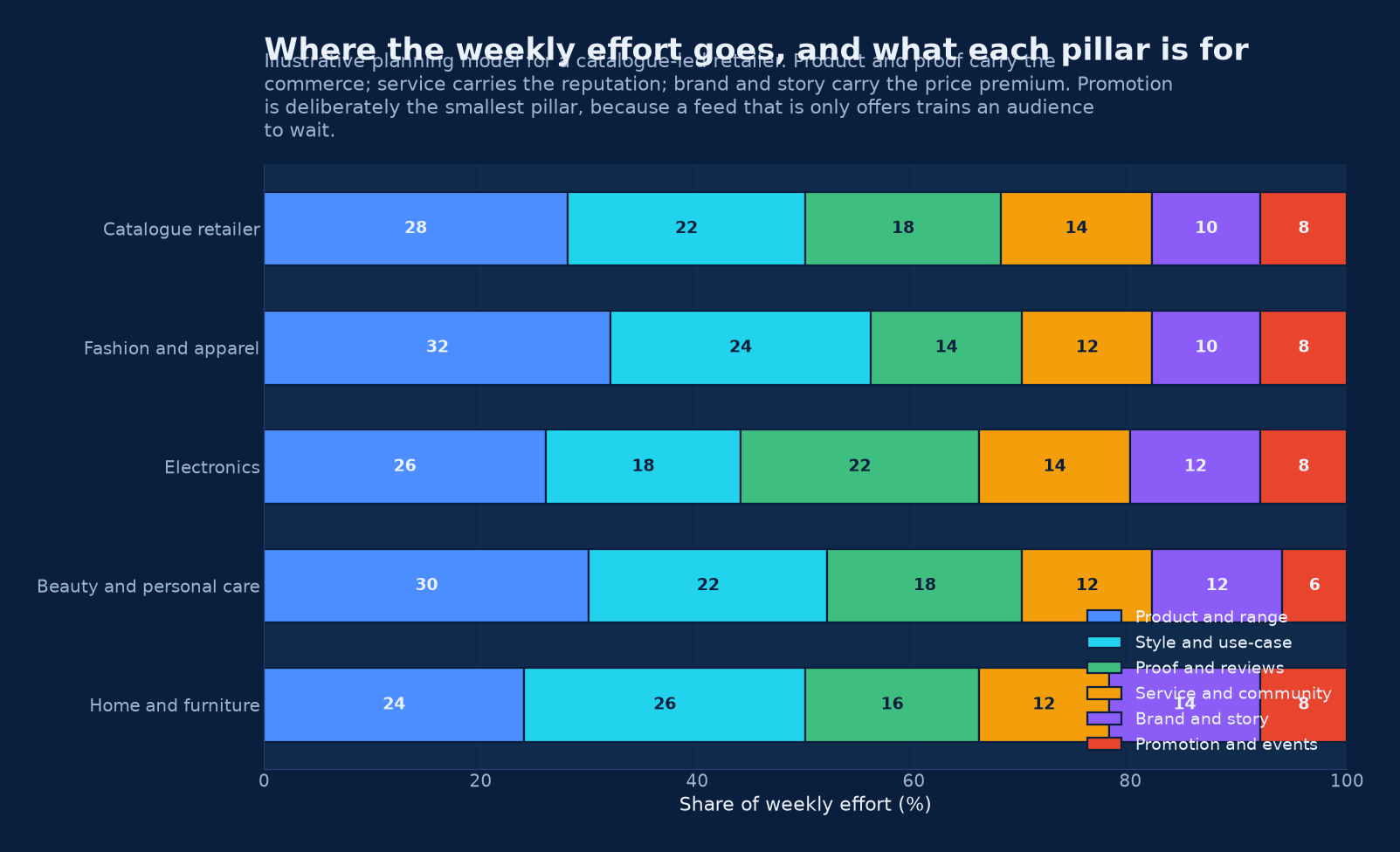
Chart values are an illustrative planning model based on typical UMC engagements and published industry benchmarks. They are not a guarantee of results on any specific project.
| Pillar | Commercial job | Typical formats | Measured by |
|---|---|---|---|
| Product and range | Make the range visible and shoppable; drive category traffic | Product cards, range edits, new-in, shoppable tags | Click-through to category, add-to-cart, contribution |
| Style and use-case | Create demand for a line nobody was searching for | Styling, room sets, demonstrations, occasion content | Saves, shares, assisted conversions on the featured lines |
| Proof and reviews | Reduce the risk of buying without touching the product | Customer photos, review quotes, comparisons, testing | Conversion lift on featured products, sentiment |
| Service and community | Protect the reputation and answer publicly and privately | Q&A, how-to, policy clarity, responses, staff and store life | Response time, resolution rate, complaint volume |
| Brand and story | Support the price premium and the reason to choose you | Founders, makers, sourcing, craft, values with evidence | Branded search lift, follower quality, earned coverage |
| Promotion and events | Convert existing demand at a defined moment | Offers, event countdowns, live shopping, restock alerts | Event contribution, full-price share afterwards |
| Education and care | Reduce returns and increase the life of the product | Sizing and fit guidance, care, repair, compatibility | Return-rate movement on the lines it covers |
| Local and store | Fill a catchment rather than a national feed | Branch stock, events, click-and-collect, local stories | Store visits, click-and-collect orders, local followers |
Pillar content is produced through social media management with brand performance and creative production supplying the asset system, and content marketing strategy ensuring the same assets serve organic search rather than being made twice. Where a brand’s story is the differentiator, digital PR extends it beyond the platforms.
The asset and shoot system: creative at catalogue scale
A retailer with thousands of SKUs cannot commission creative one asset at a time, and does not need to. What it needs is a system that separates the few things worth producing properly – concepts, campaigns, hero films – from the many things that should be generated – product cards, variant creative, offer overlays, retargeting assets. The system has four parts: a shoot standard that makes catalogue imagery usable as advertising, a template layer driven by the product feed, a rights and claims record attached to every asset, and a retirement rule so fatigue is managed rather than discovered.
| Component | What it is | Why it matters commercially | Owner |
|---|---|---|---|
| Shoot standard | Lighting, angle, background, model and styling rules, plus a shot list per product type | Catalogue imagery becomes ad-usable without a second shoot | Creative lead with merchandising |
| Concept slate | Four to eight produced concepts per season, each with a hypothesis and a test plan | The only part of social that can genuinely create demand | Creative lead with marketing head |
| Template layer | Feed-driven variants: product, price, benefit overlay, per-platform aspect ratios | Coverage of the long tail without per-SKU cost | Creative operations |
| Asset library and rights | Every asset tagged, versioned, and carrying its rights and claim record | Reuse without legal risk; auditability when a claim is challenged | Creative operations with legal |
| User-generated intake | A request-and-clear workflow at the point a customer posts | The cheapest and most credible creative a retailer has | Community lead |
| Localisation set | Language, currency, seasonal and cultural variants per market | One concept working in several markets rather than one | Marketing with regional leads |
| Fatigue and retirement rule | Frequency thresholds and a stop rule per concept | Spend on exhausted creative is the most common waste in social | Media lead |
| Approval workflow | Who signs a claim, a price and a partnership disclosure, and how fast | Speed without an incident | Marketing head |
The production practices are brand performance and creative production and influencer marketing management for creator-sourced assets, with AI governance covering generated variants and team enablement so the in-house team can run the template layer after handover. The fashion retail showroom case study shows the asset system being built alongside the commercial work rather than after it. The same asset system feeds surfaces beyond the feed: out-of-home and digital OOH for catchment presence, and the e-commerce templates for the product page the click eventually lands on.
Catalogue ads, retargeting and social commerce
Catalogue advertising is where social and the product data meet: the same feed that drives Shopping drives dynamic prospecting and retargeting, at product level, to audiences defined by behaviour rather than by interest. Done well it is the most efficient retention spend a retailer has. Done badly it is a repetitive irritation that burns an audience and inflates frequency, because the same product is shown to somebody who already bought it, at a price that has since changed, with a stock status that is wrong.
| Component | Design decision | Failure mode | Measured by |
|---|---|---|---|
| Catalogue quality | Feed completeness, imagery standard, price and stock accuracy at the moment of serving | Ads for unavailable products, or imagery too weak to stop a scroll | Disapproval rate, click-through by image type |
| Prospecting audiences | Lookalikes and interest sets built from profitable cohorts, not from followers | Reach into an audience that never buys | First-purchase rate, ninety-day contribution |
| Retargeting windows | Short windows for high-intent actions, longer for considered categories | A ninety-day cart window chasing somebody who bought elsewhere in week one | Contribution per incremental order, frequency |
| Exclusions | Recent purchasers, recent returners, service complainants, existing lifecycle audiences | Advertising to somebody who is mid-complaint | Complaint volume from paid social |
| Creative rotation | Multiple variants per product group with a fatigue threshold | One asset served until it is ignored | Frequency, hook rate decay |
| Social commerce surface | In-platform checkout or a clean path to the site, chosen deliberately | An in-platform shop with no stock sync and no contribution view | Contribution per surface, reconciliation |
| Landing experience | The ad’s promise honoured on arrival: same product, price, offer and delivery date | A click that converts at half the rate because the page disagrees | Landing conversion by campaign |
| Attribution hygiene | Server-side or catalogue-level conversion data joined to the warehouse | Platform-reported revenue that cannot be reconciled to orders | Reconciled contribution by campaign |
Execution runs through Meta advertising and Instagram advertising for the catalogue engine, TikTok and Pinterest where the category and cohort suit them, YouTube for demonstration-led lines, and Shopping feed management because the same data drives both. The landing experience is a build and conversion question, and the reconciliation is an integration one. The commerce side of the same promise is the e-commerce build: an ad that lands on a slow or contradictory product page pays twice.
Creators, influencers and the rights question
Creator commerce works in retail because a person demonstrating a product in their own home transfers trust that no brand asset can. It fails when it is bought as reach: a large audience with no category relevance, no brief on claims, no rights agreement, and no way to measure the cohort it acquired. The version that pays treats creators as a portfolio – a small number of long-term partners in the category, a rotating set of mid-tier and micro creators for volume and credibility, and your own community and staff as the cheapest and most credible tier of all.
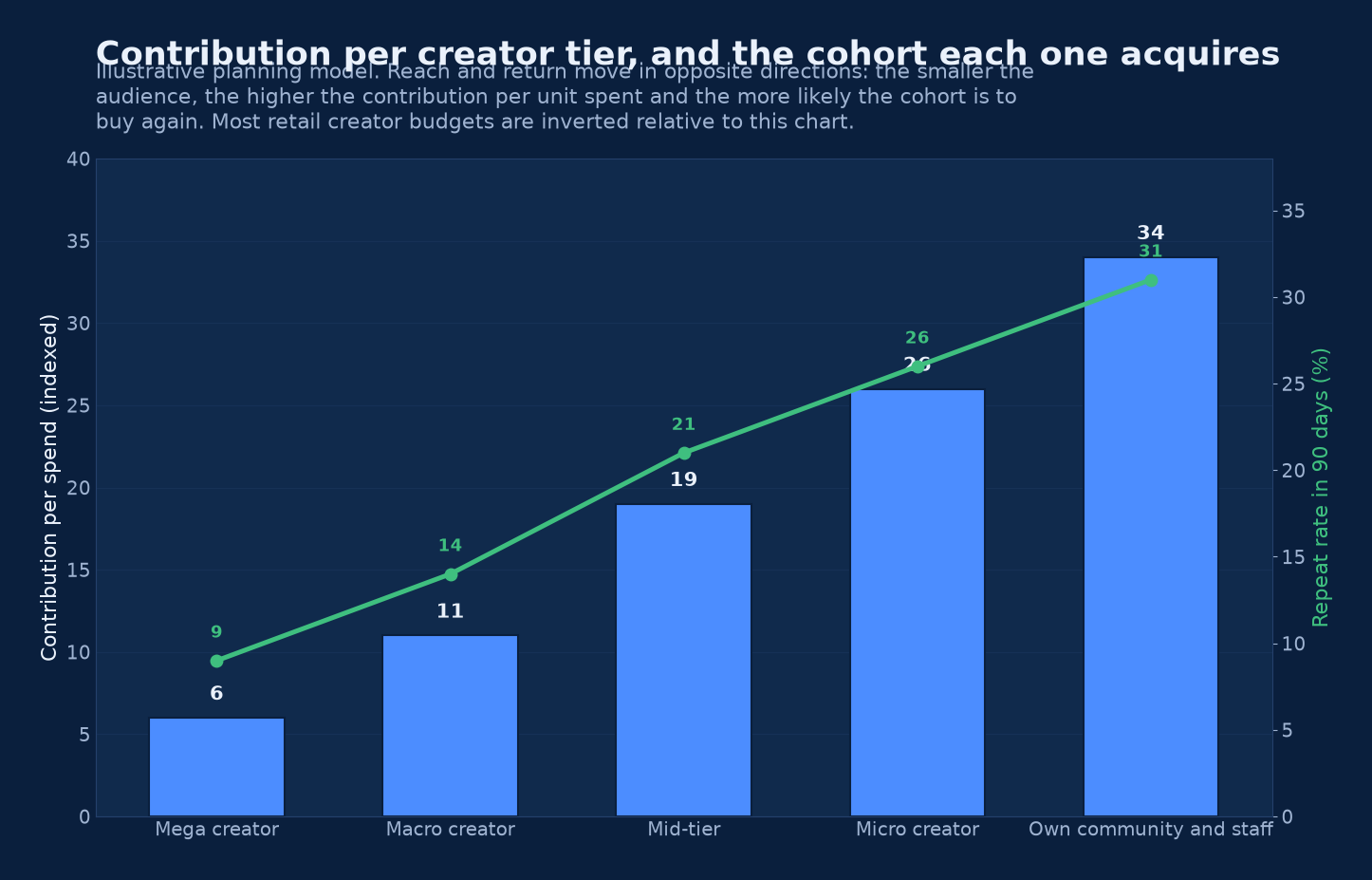
Chart values are an illustrative planning model based on typical UMC engagements and published industry benchmarks. They are not a guarantee of results on any specific project.
| Element | What good looks like | What goes wrong | Evidence kept |
|---|---|---|---|
| Tier strategy | A written portfolio: long-term partners, mid-tier volume, micro credibility, own community | One mega creator per quarter with nothing behind it | Portfolio plan with budget by tier |
| Selection | Category relevance, audience quality, past conversion evidence, brand fit | Follower count as the selection criterion | Selection scorecard per creator |
| Brief | The claim boundaries, the product truth, the disclosure requirement, the do-not-say list | A creative brief with no compliance content | Signed brief per partnership |
| Contract and rights | Usage rights, duration, territory, whitelisting terms, exclusivity, payment terms | An asset you cannot reuse, or a creator who works for a competitor next week | Executed contract with a rights record |
| Disclosure | Clear, platform-native and unambiguous partnership labelling | A disclosure buried where the regulator will not accept it | Disclosure screenshots per post |
| Tracking | Unique codes, tracked links, creator-level cohort joining in the warehouse | ‘Use code CREATOR10’ with no way to attribute the order | Per-creator contribution and cohort report |
| Relationship management | One named owner, seeding, feedback, renewal decisions taken deliberately | Transactional one-off deals that never compound | Partner history and renewal record |
| Affiliate boundary | Creators and affiliates managed under one policy so terms do not conflict | An affiliate undercutting a creator’s code in search | Unified partner terms |
The practice is influencer marketing management, planned through media planning and buying so creator spend competes on evidence with paid search and retail media, and measured through marketing mix modelling where a claim needs an independent check. The Hyundai group social advertising contract shows creative, media and measurement run as one programme rather than three.
Community, comments and DMs as a service channel
A retail brand’s comment section is a public service desk whether the business treats it as one or not. Customers ask about stock, delivery, sizing and refunds in public, and the response time and tone are visible to every prospective buyer reading the thread. The operational fix is small and the commercial effect is large: one queue across platforms, response targets by message type, escalation into the support system with the conversation attached, and a record against the customer so the next interaction does not start from zero.
| Message type | Target response | Who handles it | Escalation rule |
|---|---|---|---|
| Product and stock question | Under two hours in trading hours | Community team with live stock access | Unavailable item: offer an alternative and a restock alert |
| Order and delivery status | Under two hours, with the order record open | Community team with read access to the order system | Delayed beyond promise: hand to support with a commitment |
| Complaint or negative review | Under one hour, publicly acknowledged, privately resolved | Community lead with customer experience | Any legal, safety or discrimination claim: to the named senior owner immediately |
| Refund or return request | Same day, into the returns process rather than answered informally | Support, with the community thread linked | Serial returns or abuse flags: to the risk queue |
| Partnership and creator approach | Within two working days | Marketing, with a standard reply for speculative approaches | Relevant category: into the creator pipeline |
| Press and media | Within one hour, no substantive comment without approval | Named communications owner only | Crisis protocol triggered by any adverse story |
| Troll and abuse | No engagement; hide or block per policy | Community team following a written policy | Threats or illegal content: preserve evidence and escalate |
| Accessibility and inclusion concerns | Under two hours, taken seriously, answered substantively | Community lead with the responsible owner | Any pattern: into the product and content review |
The tooling is a CRM with the conversation attached to the customer record, an integration between the platforms and the support system, and AI agents for first-line triage with a named human owner and hard escalation rules. Messaging channels extend the same discipline: WhatsApp and SMS for transactional and consented marketing messages, with marketing automation enforcing suppression so a complaint is never followed by a promotion. Listening extends past the owned queue: Reddit and X carry the unfiltered conversation about a retail brand, and both are sampled monthly for complaint patterns the queue never sees.
Reviews, user-generated content and social proof
For a retailer, proof is a conversion asset before it is a reputation asset: a product with genuine reviews, customer imagery and answered questions converts materially better than the same product without them, and the same content feeds advertising, category pages and answer engines. The engine that produces it is mostly process – when to ask, how to make it easy, how to clear rights at the point of capture, how to respond to negative reviews substantively, and how to get the content onto the product page rather than leaving it on a platform you do not control.
| Element | Design decision | Failure mode | Measured by |
|---|---|---|---|
| Ask timing | Requested after a usage interval appropriate to the category, not on delivery | Reviews written about packaging rather than the product | Review volume, mention of product attributes |
| Ask channel | Email, messaging and post-purchase page, with one clear path | Three asks in a week from three systems | Conversion of the ask, unsubscribe rate |
| Photo and video prompt | Explicit prompt with a reason, plus rights clearance at capture | Great content on a platform you cannot reuse | Media-attached review share, reusable asset count |
| Moderation | Published per policy with genuine negative reviews kept | A filtered feed that shoppers correctly distrust | Rating distribution authenticity |
| Response discipline | Every negative review answered substantively with a resolution path | An unanswered complaint as the last word on a product | Response rate, resolution time, sentiment movement |
| On-page placement | Reviews visible above the fold on the product page with markup | Proof hidden behind a tab the crawler never opens | Conversion lift on products with reviews |
| Q&A | Answered by the brand and by other buyers, indexed | Unanswered questions that read as neglect | Answer rate, question volume by line |
| Rights and reuse | A cleared library of customer content for advertising and category pages | Reuse without rights, or rights cleared but never used | Cleared assets, assets in active use |
The engine is delivered with lifecycle campaigns and email marketing for the ask, the storefront build for placement and markup, AI search optimisation because answer engines cite review content, and conversion rate optimisation to test placement rather than argue about it.
Claims, disclosure and brand safety
Retail social content is commercial speech at volume, produced quickly, often by people outside the business. That combination makes it the most likely place for an unsubstantiated claim, an undisclosed partnership or an unlicensed asset to appear – and the resulting complaint arrives from a regulator, a marketplace or a competitor rather than from a customer. The control is a small governance layer that does not slow production: a claims register, a disclosure policy, an approval gate for the categories that carry risk, and rights records attached to assets.
| Risk area | The control | Who approves | Evidence retained |
|---|---|---|---|
| Product claims | A substantiation file per claim type; banned-phrasing list by category | Merchandising with legal for regulated categories | Claims register with sources and dates |
| Health, beauty and supplement claims | Category-specific rules; no efficacy claims without evidence | Regulatory or legal reviewer | Approval record per asset |
| Price and offer claims | Offer terms, validity windows and comparison-price rules stated in the asset | Commercial head | Offer terms captured with the asset |
| Partnership disclosure | Platform-native labelling on every paid or gifted partnership | Marketing head | Disclosure screenshot per post |
| Comparative claims | Named comparisons only with verifiable, current evidence | Legal | Evidence file and review date |
| Rights and licensing | Music, imagery, font and creator usage rights recorded per asset | Creative operations | Rights record in the asset library |
| Data and privacy | No customer data used in creative without consent and anonymisation | Data protection owner | Consent and anonymisation note |
| Crisis protocol | Trigger conditions, named owners, holding statements, escalation times | Leadership | Protocol document and rehearsal record |
The governance practice is AI governance, risk and compliance where content is generated at scale, with security and data protection covering the accounts themselves – a compromised social account is a brand-safety incident that no content policy survives. Business strategy owns the boundary between what a brand will say and what it will not.
Measurement: cohort contribution, assistance and incrementality
Social is the channel most often measured on numbers that cannot fund a budget: impressions, engagement rate, follower growth. None of them is wrong, and none of them answers the question. The measurement we install has three layers – direct contribution joined to the order data by cohort, assistance measured across the journey, and incrementality tested periodically – and one reporting page that shows all three so the argument does not have to be restarted each quarter.
| Layer | Metric | How it is produced | What it decides |
|---|---|---|---|
| Direct contribution | Contribution per order and per cohort by campaign and creator | Conversion data joined to order, cost and returns data in the warehouse | Which campaigns and creators continue |
| Cohort value | Ninety, one hundred eighty and three hundred sixty-five day contribution of socially acquired customers | Acquisition source held on the customer record | What a first order is worth bidding for |
| Assistance | Social touchpoints in journeys that converted elsewhere | Path analysis across ad, site and CRM data | Whether upper-funnel spend is doing work |
| Incrementality | Lift against a holdout audience or geo, where the platform allows one | A designed test with a stated window and minimum spend | Whether the channel earns its budget at all |
| Content performance | Per-pillar and per-format saves, shares, click-through and decay | Platform data normalised into the warehouse | What to produce more of, and what to retire |
| Creator performance | Contribution, repeat rate and rights value per creator | Codes and tracked links joined to cohorts | Renewal, tier mix and budget per tier |
| Service performance | Response time, resolution rate, complaint volume, sentiment | Conversation data from the queue | Staffing and process changes |
| Brand health | Branded search lift, share of conversation, sentiment trend | Search data plus listening, sampled and reviewed | Whether the brand pillar is working |
| Platform reconciliation | Platform-reported revenue against actual orders | Monthly reconciliation with a variance threshold | How much of the platform’s number to believe |
The practices are BI dashboards and executive reporting, data warehouse and lakehouse, marketing mix modelling and attribution, data science services for the cohort and incrementality work, and AI ROI measurement where generated creative and automated tools need their own return measured. Adopting the tooling that produces all of it is a decision in its own right, and an AI readiness assessment settles which parts are worth automating before they are automated.
Operating model: cadence, roles and enablement
A social programme fails most often at the operating-model stage rather than at the strategy stage: a good plan that nobody has time to execute. The cadence below is what a mid-size retail brand can actually sustain, with named roles and a stated approval time. Where the business intends to run it in house, enablement and handover are deliverables with a date rather than a courtesy at the end.
| Cadence | Activity | Owner | Output |
|---|---|---|---|
| Daily | Queue cleared to target, published posts checked, comments and DMs answered | Community lead | Queue at zero backlog; incident log if any |
| Weekly | Publish to calendar, review last week’s performance, adjust the coming week | Social manager | Weekly page: pillar performance, actions |
| Fortnightly | Creative review: what is fatigued, what is working, what to shoot next | Creative lead with social manager | Shoot list and retirement decisions |
| Monthly | Contribution and cohort reporting, creator renewals, budget reallocation | Marketing head with finance | Monthly report and a reallocation decision |
| Quarterly | Pillar review, audience model refresh, platform mix decision | Marketing head | Revised pillar weights and platform plan |
| Per season | Concept slate, campaign plan, event calendar with capacity check | Marketing with merchandising and supply chain | Season plan with a capacity sign-off |
| Per event | Pre-event readiness, in-event monitoring, post-event review | Social manager with media lead | Readiness checklist and a written review |
| Annual | Incrementality test, brand health study, agency and tooling review | Marketing head | Evidence pack for the next budget round |
| On change | Policy, platform or team change triggers a training and documentation update | Social manager with enablement | Updated runbook and a training record |
Enablement is delivered through AI training and team adoption where the team will use generated assets, marketing automation and lifecycle campaigns for the retention half of the job, and mobile app development only where an app genuinely earns its place in the mix.
How a ninety-day social programme runs
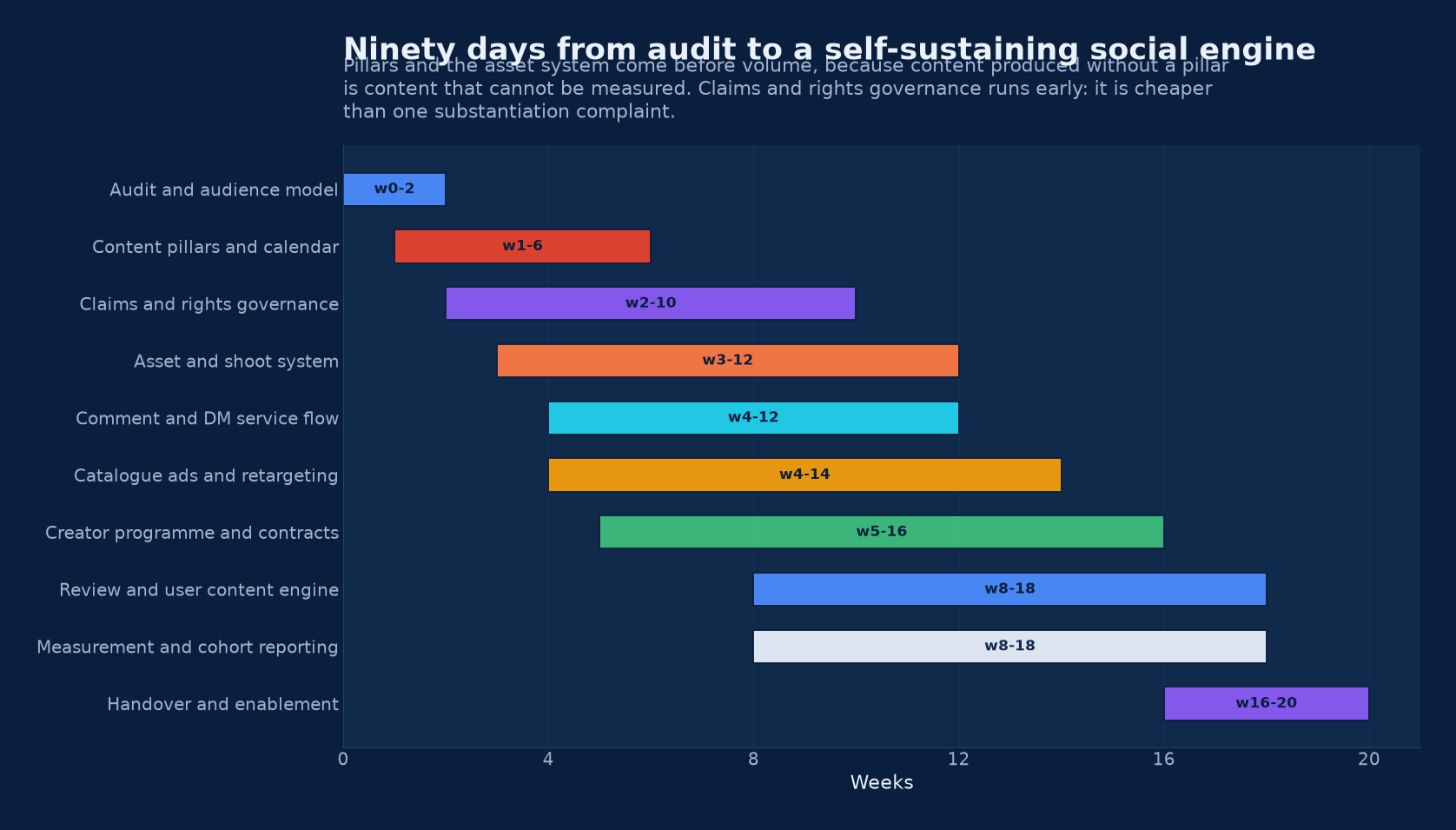
Chart values are an illustrative planning model based on typical UMC engagements and published industry benchmarks. They are not a guarantee of results on any specific project.
Weeks one and two are the audit and the audience model: what the purchase data says about who buys, compared with who currently follows and engages, plus a review of the existing estate, queue and rights position. Content pillars and the calendar are agreed by week six, with claims and rights governance in place by week ten because it is cheaper than one substantiation complaint. The asset and shoot system runs weeks three to twelve. Comment and DM service flow lands by week twelve with response targets and escalation. Catalogue ads and retargeting rebuild from week four to fourteen, on the corrected audience model. The creator programme starts at week five with contracts and tracking, running to week sixteen. The review and user-content engine is live by week eighteen, cohort measurement from week eight, and handover and enablement close the programme at week twenty.
| Deliverable | Week | What the business keeps |
|---|---|---|
| Audit and audience model | 2 | Segments from purchase data, with the gap to the current audience |
| Content pillars and calendar | 6 | Four to six pillars with a job, owner and measure each |
| Claims and rights governance | 10 | Claims register, disclosure policy, rights records |
| Asset and shoot system | 12 | Shoot standard, template layer, library, retirement rule |
| Comment and DM service flow | 12 | One queue, response targets, escalation, conversation record |
| Catalogue ads and retargeting | 14 | Audiences from cohorts, exclusions, rotation, reconciliation |
| Creator programme | 16 | Tier portfolio, briefs, contracts, tracking, renewal decisions |
| Review and user content engine | 18 | Ask timing, moderation, rights intake, on-page placement |
| Cohort and contribution reporting | 18 | One page: direct, assisted, incremental, plus service |
| Enablement and handover | 20 | Runbook, training, named owners, approval workflow |
Pricing and engagement models for retail social
| Model | Best for | What it includes | Commercial shape |
|---|---|---|---|
| Social audit and strategy | A brand that posts constantly and cannot show what it produces | Audience model from purchase data, pillar design, estate and queue review, rights and claims position, written plan | Fixed fee, three weeks |
| Managed social programme | A retailer that wants the channel run against a contribution target | Pillars, calendar, production, community, catalogue ads, creator management, monthly reporting | Monthly retainer with a stated target |
| Creative and asset system | A brand whose strategy is sound and whose creative is not | Shoot standard, concept slate, template layer, library and rights workflow | Fixed fee per season plus production |
| Creator programme | A brand buying creators as reach and getting reach | Portfolio design, selection, briefs, contracts, tracking, renewal governance | Programme fee, no percentage of creator spend |
| Community and service setup | A business whose comment section is an unanswered service desk | Queue design, targets, escalation, support integration, training | Fixed fee, then included in support |
| Measurement build | A business that cannot prove or disprove its social spend | Warehouse join, cohort model, assistance and incrementality, one reporting page | Fixed build, then a reporting retainer |
| Enablement and handover | A business bringing social in house | Runbooks, templates, training, approval workflow, a supported transition period | Fixed fee over eight weeks |
Retail social by city, and worked examples
Social programmes are delivered remotely, with the local layer handled where it matters: language and cultural variants, city demand and price sensitivity, branch content and catchment targeting, regional creators, and the festive calendar that decides when a concept slate has to be ready. The examples below are engagements where creative, media and measurement were run as one programme.
- Get more retail customers in Lucknow
- Increase e-commerce sales in Lucknow
- Digital marketing company for jewellery stores in Lucknow
- Digital marketing and IT services in Lucknow
- Digital marketing and IT services across Indian cities
- Case study: Hyundai group showroom full-service social advertising
- Case study: a fashion retail showroom
- Case study: Ethnava full-stack SEO for a chikankari WooCommerce store
- Showrooms and dealerships – the physical retail vertical
- Restaurants, cafés and cloud kitchens – a visually-led comparison
- Manufacturing and industrial – the B2B social case
- About Unified Management Consulting
- Contact us
Where this page sits in our retail programme
This page is one discipline of the retail vertical programme. The hub ties the set together, each discipline has its own page as it is built, and the generic service page for every discipline stays listed below alongside the vertical pages. A sibling that is not listed is not published yet: this list is generated from live pages and refreshes automatically as each spoke lands.
- Retail – the vertical main page
- Website development for retail and e-commerce
- SEO for retail and e-commerce
- Google Ads for retail and e-commerce
- CRM, loyalty and lifecycle for retail
- Business intelligence for retail
- IT support and commerce security for retail
- AI for retail and e-commerce
- Website development services – the generic service page
- SEO services – the generic service page
- Google Ads management – the generic service page
- Custom CRM development and integration – the generic service page
- BI dashboards and executive reporting – the generic service page
- Managed IT infrastructure and AMC – the generic service page
- AI agent deployment and automation – the generic service page
Frequently asked questions about social media marketing for retail
How often should we post?
As often as you can produce to your own standard and answer the response – which for most retail brands is four to seven times a week per platform, not four times a day. Frequency without a pillar produces content that cannot be measured or repeated.
Which platforms should we be on?
Where your profitable cohorts are and where your category can be shown properly. For most visual retail categories that is Instagram and Meta with a short-form video layer; Pinterest and TikTok for specific cohorts; LinkedIn only where there is a genuine trade or wholesale audience.
How do we prove social media revenue?
With three layers: direct contribution joined to order data by cohort, assistance measured across the journey, and a periodic incrementality test with a holdout. Platform-reported return is reconciled against actual orders monthly, and the variance is published.
Are creators worth it, or is it just expensive reach?
Worth it when bought as a portfolio with relevance, a brief on claims, written rights and per-creator cohort tracking. Bought as follower count with none of those, it is expensive reach with no reusable asset at the end.
Who should answer comments and DMs?
One named team with live stock and order access, response targets by message type, and escalation into support with the conversation attached. The record must sit against the customer so the next interaction does not start from zero.
How do we get customer photos we can actually use?
By asking at the point of capture with a clear rights request, recording the clearance against the asset, and giving the customer a reason to say yes – feature, credit, or a small benefit. Reposting without clearance is the riskiest cheap creative there is.
Can AI produce our social content?
For variants, captions at template level, resizing and first-draft concepts, yes – from your product data and brand rules, with a human approving before publication and claims checked against the substantiation file. For a concept that has to be believed, no.
How do we handle a negative post going viral?
With a protocol agreed before it happens: named owner, holding statement, one substantive public response, private resolution, no deletion of genuine complaints, and a written review afterwards. Speed matters; defensiveness costs more.
Should we sell directly on the platforms?
Only with a deliberate decision: in-platform checkout needs stock sync, a contribution view including fees, and reconciliation. For many retailers a clean path to the own site earns more and keeps the customer record.
How does social work with our paid search and retail media?
They compete for the same budget and should be judged on the same contribution definition. Social creates demand that search later harvests, so a holdout on one usually moves the other – which is exactly why they are planned together.
What does handover look like?
Runbooks per platform, a pillar and calendar template, the asset library with rights records, the queue configuration, an approval workflow with named owners, recorded training, and a supported transition period in which we review rather than publish.
Do you work outside India?
Yes. Programmes are delivered remotely with per-market language, cultural and festive variants, regional creators, and platform mixes that reflect how each market actually shops.
Start with the audience model and the pillar design
Give us three weeks with two years of order data, your current platform access, your asset library and your claims position, and we will return the audience model built from buyers rather than followers, a pillar set with a job and a measure for each, an asset and shoot system that works at catalogue scale, a community service flow with response targets, and a measurement plan that reports contribution – including what we would stop doing. Yours to keep either way.
Contact Unified Management Consulting to arrange a confidential first conversation.