
A retail website is not a brochure with a basket attached; it is the operating system of the commerce business. It decides what the catalogue looks like to a search engine, whether a customer can pay in the way they prefer, whether the delivery date shown at checkout is a promise the warehouse can keep, how fast a category page renders on a mid-range phone during a sale, and whether finance can reconcile a marketplace settlement without a spreadsheet. Every commercial number in the retail vertical – contribution per order, return rate, repeat purchase – is produced or destroyed inside this layer.
This page covers the build discipline for retail and e-commerce: platform choice and replatforming, the product data model and the feed pipelines that read it, category and on-site search architecture, checkout and payment engineering, performance under peak load, accessibility, integrations to order management, warehouse and finance systems, and the release and monitoring discipline that keeps a trading site safe. Commercial strategy, media and lifecycle work sit in the retail and e-commerce hub; the physical showroom side sits in showrooms and dealerships.
What an engagement includes, at a glance
| Component | What We Deliver |
|---|---|
| Platform decision, documented | A written recommendation with the constraints that drove it – catalogue size, integration depth, peak load, in-house capability, three-year cost – including the option of not replatforming yet. |
| Product data model | One authoritative record per SKU with attributes, variants, media and hierarchy, designed for the channels that read it rather than for the current theme. |
| Feed and integration pipelines | Near-real-time stock and price publishing to the site, Google Merchant Centre and each marketplace, with failure alerting wired to a person. |
| Storefront and templates | A design system covering category, product, cart, checkout, account, store locator and editorial, built for merchandisers rather than for developers. |
| Checkout and payment engineering | Guest checkout, method coverage, gateway redundancy, tokenisation, fraud hooks, and step-level telemetry from the first release. |
| Performance budget | A stated LCP, interaction and layout budget per template, enforced in the pipeline and load tested at event multiples before a sale. |
| Accessibility conformance | WCAG 2.2 AA on the money path first, with an audit report, a remediation plan and a regression check in the pipeline. |
| Migration and SEO handover | URL map, redirect set, indexation control, structured data, crawl-budget plan and a post-migration measurement window with named owners. |
| Run and release discipline | Environments, staging data, release cadence, rollback path, monitoring, on-call and a runbook the business can follow without us. |
The decisions that shape a retail build
Most retail website problems are decisions taken too early or too late. Taken too early: a template chosen before the product data model exists, so attributes get forced into fields that were designed for a different category. Taken too late: performance and accessibility left to a final ‘polish’ phase that meets the first sale event. The eight decisions below are the ones we settle in discovery, in writing, before any template is drawn – and each one has a measurable consequence if it is guessed.
| Decision | What it determines | Cost of guessing | How we settle it |
|---|---|---|---|
| Catalogue shape | Attribute set, variant model, hierarchy depth, bundle and kit logic | Facets that cannot be built; variants held as separate products; duplicate content | Category workshops plus a sample of the hardest 50 SKUs |
| Platform and architecture | Where the cart, price and stock truths live; what is composed versus bought | A replatform in eighteen months, or a licence that cannot carry the roadmap | Constraint-led comparison against a three-year plan, not a feature matrix |
| Order and stock truth | Which system owns order status and availability, and how fast it publishes | Oversells, cancellations, and two systems that disagree in front of the customer | Data-flow diagram with latency targets per hop |
| Pricing and promotion engine | Who may discount, at what depth, on which lines, in which channels | Discount leakage, parity breaches, margin surprises at month end | Rules agreed with finance and commercial, then encoded and tested |
| Checkout shape | Steps, guest path, methods, address handling, delivery promise display | Abandonment that no campaign can recover, and a promise the operation breaks | Telemetry-first design, tested on real devices and real pin codes |
| Performance budget | Media pipeline, third-party script policy, caching strategy, render path | A slow money path during the highest-revenue week of the year | Stated budget per template, enforced in the pipeline, load tested |
| Editor and content model | What merchandising can change without a developer, and what needs a release | Every campaign becomes a development ticket; the site goes stale | Task-based editor testing with the people who will actually use it |
| Measurement and data layer | Events, parameters, attribution inputs, warehouse feed | Dashboards built on guesses; no way to prove contribution per channel | Event specification agreed with marketing and finance before build |
The practices behind these decisions are website strategy and information architecture, business strategy consulting where the platform choice is really a business-model choice, market research and competitive analysis for category expectations, and UX and UI design for the templates that follow.
Choosing the platform: what actually drives the answer
Platform debates in retail are usually fought with feature lists, and feature lists are a poor decision instrument because every serious platform has every feature on paper. The questions that separate them are structural: how large and how complex is the catalogue, how much of the commercial logic is genuinely custom, what is the peak load, what does the in-house team be able to run, and what does the estate cost over three years including the integrations that a cheaper licence pushes into professional services. Answered honestly, those questions usually narrow five candidates to two.
| Approach | When it is right | When it is wrong | What it costs later |
|---|---|---|---|
| Configured SaaS storefront | A focused catalogue, standard commerce logic, small team, speed matters most | Deep ERP coupling, unusual pricing, very large catalogues, data residency needs | Per-transaction or tier fees that scale with success; extension limits |
| WooCommerce on WordPress | Catalogue-led retail, editorial strength, in-house editing, cost control | Very high peak concurrency without engineering, complex multi-node fulfilment | Plugin estate discipline; performance work as the catalogue grows |
| Headless with a commerce backend | Large catalogue, several frontends, custom experience, strong engineering in house | A small team that wants one system to log into; editorial flexibility without a CMS plan | Two systems to run, and content operations must be designed deliberately |
| Enterprise suite commerce | Multi-brand, multi-country, complex pricing and B2B alongside B2C | A single-brand retailer that needs speed and low running cost | Licence plus implementation plus a specialist team to operate it |
| Full custom build | Commerce logic that is genuinely the product, and the team to own it forever | Almost every retailer whose differentiation is range, service or brand | Everything is yours to maintain, including the parts that were boring in year three |
| Keep and fix the current platform | The constraint is data, checkout or performance rather than the platform itself | The platform cannot expose the data or the extension points the roadmap needs | Nothing, if the diagnosis was right – which is why we test it first |
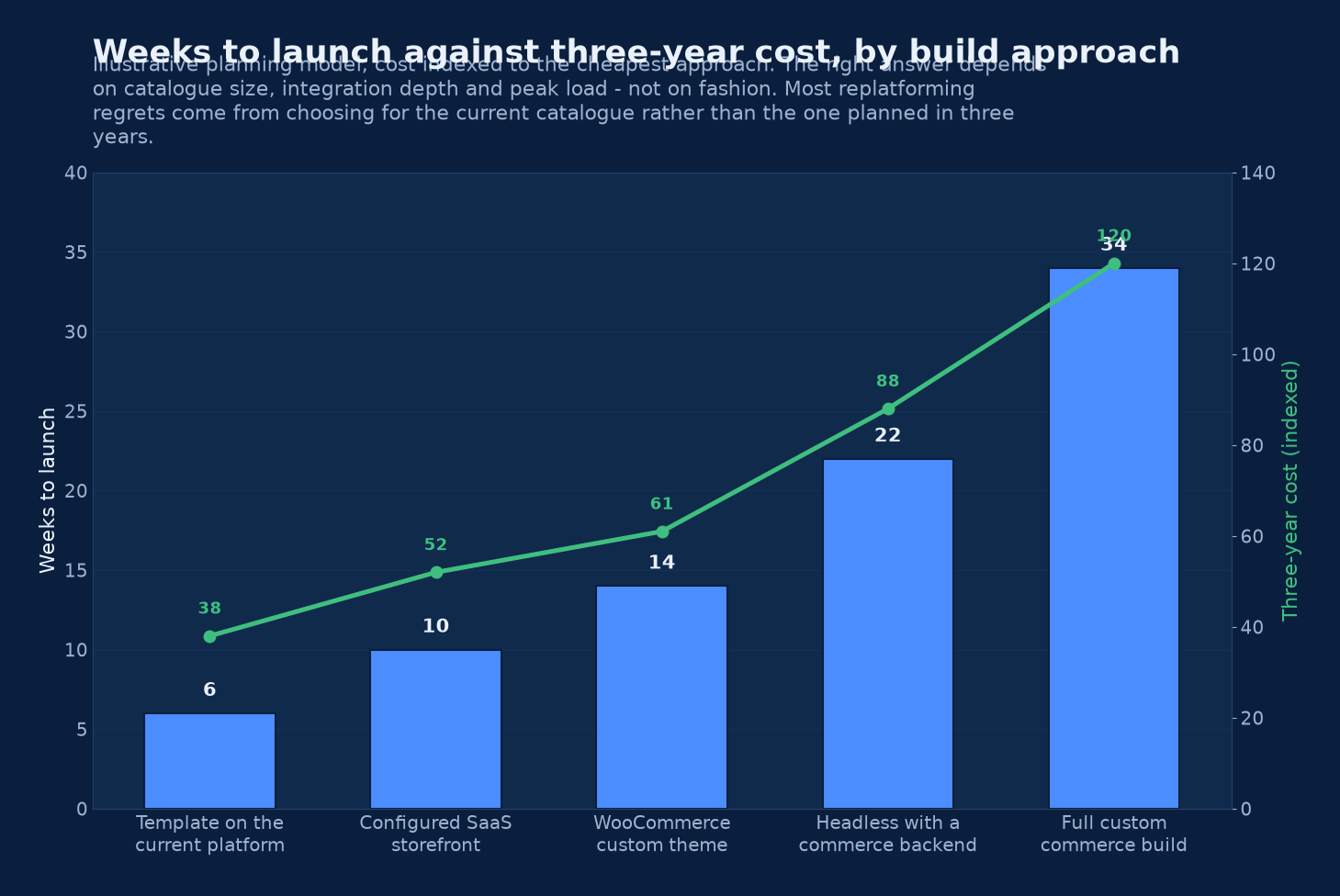
Chart values are an illustrative planning model based on typical UMC engagements and published industry benchmarks. They are not a guarantee of results on any specific project.
Delivery runs through e-commerce development and marketing services, full-stack WordPress and WooCommerce development for catalogue-led stores, headless and composable commerce, website migration and replatforming where the change is structural, PHP and Laravel development for custom commerce logic, and full-stack Java or full-stack .NET engineering where commerce sits inside a larger enterprise estate. The EZ1 in Services full-stack e-commerce platform and the online mobile store WooCommerce build are both worked examples.
The product data model and the feed pipeline
Everything downstream reads the product data: the storefront, the on-site search index, Google Merchant Centre, each marketplace, catalogue ads on social, affiliates, comparison engines and increasingly AI answer engines. Designing the data model for one of those consumers is the most common structural mistake in retail builds, and it is expensive to undo because the fix touches templates, integrations and campaigns at once. The model we build is channel-neutral: one authoritative record, an attribute set designed from the hardest category in the range, a variant model that cannot be got wrong, and a publishing layer with per-channel projections and latency targets.
| Layer | What it holds | Design rule | Failure if skipped |
|---|---|---|---|
| Product master | Identity, hierarchy, attributes, media references, lifecycle status | One record per SKU; attributes owned by merchandising, not by the theme | The same product described differently on every channel |
| Variant and option model | Size, colour, pack, bundle and kit relationships | Variant dimensions modelled as data, never as separate products | Duplicate content, split reviews, stock confusion, broken facets |
| Attribute dictionary | Mandatory and recommended attributes per channel, with validation rules | Written as a table with an owner and a review date | Listing suppression and disapprovals discovered at month end |
| Media pipeline | Ingest, crop, compress, modern formats, alt text, variant coverage | Automated on upload, with a standard the shoot must meet | Slow pages, inconsistent imagery, missing alt text at scale |
| Price and offer model | List price, channel price, offer mechanics, validity windows, approval rules | Rules encoded and tested; discounts are data, not code | Discount leakage and parity breaches across channels |
| Stock and availability | Available to promise by node, buffer policy by channel, latency target | Published near-real-time; a stale feed is a cancelled order | Oversells, cancellations, marketplace penalties |
| Channel projections | Per-channel feed with category mapping, rules and suppression logic | Generated from the master, never maintained by hand | Six channels drifting apart, each fixed manually |
| Diagnostics and alerting | Disapprovals, warnings, sync failures, coverage gaps, with owners | Alert to a person with a fix path, not to a dashboard nobody opens | Silent loss of impressions and orders between reviews |
The practices are enterprise systems integration for the pipelines, data engineering for AI and knowledge systems where the catalogue must also be machine-readable, Google Shopping and Merchant Centre feed management for the largest single consumer of that data, data warehouse and lakehouse for the reporting layer above it, and AI search optimisation so the same data serves answer engines rather than being rewritten for them. Where catalogue data is the front of a wider AI programme, AI readiness assessment, AI product engineering and forward-deployed AI engineering carry it, with AI governance, risk and compliance setting the rules for generated product content before it is published at scale.
Category architecture, facets and on-site search
Category pages are the highest-value pages a retailer owns: they carry commercial intent, they are where merchandising expresses a range, and they are where most internal link equity is either concentrated or wasted. They are also the easiest pages to break technically, because faceted navigation can multiply a thousand products into a hundred thousand crawlable URLs. The build has to serve three masters at once – the shopper narrowing a choice, the merchandiser arranging a range, and the crawler that must be told which combinations matter.
| Component | Build requirement | Commercial consequence | Verification |
|---|---|---|---|
| Hierarchy and depth | Three or four levels maximum to a product, with a rule for where a category may appear twice | Shoppers reach a product in two decisions; crawlers spend budget on pages that matter | Click-depth audit plus crawl-budget report |
| Faceted navigation | Facets as parameters with an indexation policy: canonical, noindex or crawlable by rule | Long-tail landing pages where they earn, suppressed where they duplicate | Crawl sample against the written facet policy |
| Merchandising controls | Manual ranking, pinned products, badges, content blocks per category, scheduled changes | A range can be arranged without a developer and without a release | Task test with the merchandiser, timed |
| On-site search | Typo tolerance, synonyms, attribute and brand weighting, zero-result recovery | Internal searchers convert several times better than browsers when search works | Query-log review: zero-result rate, first-click rate |
| Sort and filter relevance | Default sort that reflects margin and stock, not only popularity | The first page of a category is a merchandising decision, not an accident | A/B test of default sort by category |
| Empty and thin states | Out-of-stock handling, discontinued products, near-match suggestions | A dead end is a lost order; a suggestion is a saved one | Journey test on discontinued and out-of-stock SKUs |
| Structured data | Product, offer, availability, aggregate rating, breadcrumb and item-list markup | Rich results and answer-engine citations depend on it | Validation per template in the pipeline |
| Content in category pages | Buying guidance that answers the comparison question, editable without a release | Organic capture for research queries that precede the purchase | Editorial ownership and refresh cadence agreed |
This is where the build and the SEO programme meet: the architecture decisions here are the ones technical SEO and migration work later has to live with, and content marketing strategy supplies the guidance that makes category pages earn research traffic as well as transactional traffic. The Ethnava chikankari WooCommerce project is an example of catalogue architecture and SEO being built together rather than in sequence. The same architecture is what Shopping feeds, Performance Max, Google Ads and retail media buy against – a facet structure that cannot be crawled cleanly cannot be advertised profitably either – and store estates add local SEO and Google Business Profile management and social media management for the catchment layer around each branch.
Checkout, payment and the money path
Checkout is the smallest number of pages with the largest financial consequence, and it is where engineering discipline shows up most clearly. The reliable pattern is not clever; it is instrumented. Every step emits an event with a reason, every payment method reports its own success rate, every failure has a retry path, and the whole flow is tested on real devices on real networks before it is tested in a boardroom. Most of that traffic arrives on small screens, which is also the honest test of whether a native app would add anything to the money path. Sale events do not create new failure modes – they multiply the ones already present.
| Element | Engineering requirement | What breaks without it | Evidence we leave |
|---|---|---|---|
| Guest checkout | No forced account creation; account offered after the order, with order linking | Abandonment at the first step for a large share of new customers | Step-level funnel with and without account |
| Address handling | Autofill, validation, pin-code serviceability check before payment | Failed deliveries and cancellations caused at checkout, discovered at the door | Undeliverable-order rate before and after |
| Delivery promise | Computed per pin code, service and basket, including cut-off times, from live capacity | A static promise the operation cannot keep, and the cancellation that follows | Promise accuracy measured daily |
| Payment methods | Cards, local rails, wallets, net banking, EMI where margin supports it, cash on delivery with a risk rule | Lost orders at the method step, concentrated in specific segments | Method mix and success rate by method |
| Gateway resilience | Redundant gateways, smart routing, tokenisation, retry with a different route | A single provider outage during the highest-revenue hour of the year | Failover test record and downtime minutes |
| Card data scope | Hosted or tokenised fields so card data never touches your servers or logs | A compliance scope that grows silently and a breach surface that follows | Scope diagram and quarterly evidence |
| Fraud hooks | Device, velocity and address signals passed to the risk engine; review queue with an SLA | Either fraud loss or false declines of good customers | False-decline and chargeback rates |
| Failure telemetry | Step, reason and payment-failure events with alerting thresholds | A conversion drop discovered at month end rather than in an hour | Alert catalogue and an incident example |
| Order confirmation path | Order written to OMS without manual touch, confirmation and tracking communications fired | Support tickets asking whether the order exists | Straight-through order share |
The build sits with e-commerce development, conversion rate optimisation for the experiment programme afterwards, UX and UI design for the decision moments, and cybersecurity services for payment scope and fraud controls. The commercial side of the same funnel is in the retail hub.
Performance, Core Web Vitals and peak trading
Retail performance work has a specific shape because the load is not evenly distributed: a sale event can multiply traffic by five or ten within minutes, on the same templates that were quiet all month. That means the budget has to be set per template, enforced in the pipeline rather than audited afterwards, and validated by load testing at event multiples – not at average traffic. The media pipeline usually carries the largest single gain, and third-party scripts usually carry the largest single risk.
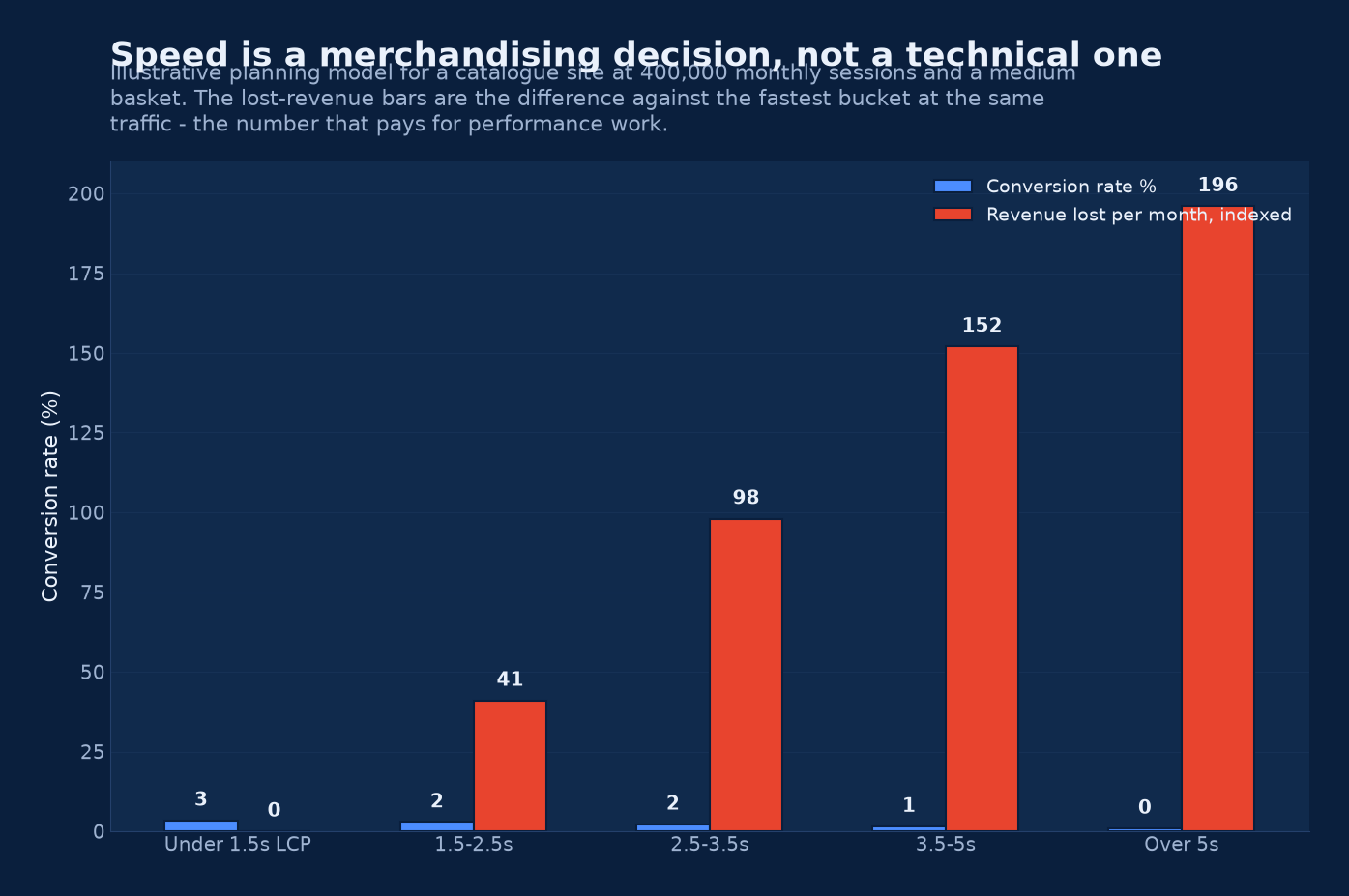
Chart values are an illustrative planning model based on typical UMC engagements and published industry benchmarks. They are not a guarantee of results on any specific project.
| Lever | What we change | Typical gain | How it is held |
|---|---|---|---|
| Media pipeline | Modern formats, responsive sizes, compression on upload, lazy loading below the fold, explicit dimensions to stop layout shift | The largest single LCP gain on catalogue sites | Enforced at upload; a regression fails the build |
| Critical rendering path | Inline critical CSS, defer non-essential JavaScript, preconnect to origins that matter | Faster first render on mid-range mobile devices | Budget per template, measured per release |
| Caching strategy | Edge and page caching by template with short TTLs on stock and price fragments | Peak absorption without origin collapse | Cache-hit ratio monitored during events |
| Third-party script governance | A register with owner, purpose and cost; tag management; consent-aware loading | Removes the failure mode nobody in-house controls | Quarterly register review; new scripts need approval |
| Search and category queries | Indexed queries, avoided N+1 patterns, cached facets, curated result ordering | Category pages stop degrading as the catalogue grows | Slow-query monitoring with thresholds |
| Load testing | Tested at event multiples against realistic journeys including checkout | Finds the bottleneck before the event does | Test record per event, with the fix list |
| Autoscaling and queueing | Horizontal scaling rules, background job queues, graceful degradation plan | Absorbs a spike instead of falling over | Scaling policy plus a tested degraded mode |
| Monitoring and on-call | Synthetic checkout tests, error-rate and latency alerts, rota covering trading hours | A 2 a.m. failure during a sale is noticed by you, not by customers | Alert catalogue, rota and incident records |
The practices are Core Web Vitals and performance engineering, SRE and observability, DevOps and CI/CD engineering, cloud migration and management, Kubernetes and container platform and cloud-native modernisation for high-concurrency estates, and cloud cost optimisation because peak infrastructure that runs all month is a margin problem, not only an engineering one.
Accessibility, inclusion and the legal surface
Retail accessibility is often treated as a compliance checkbox, which wastes it: the same work that makes a checkout usable with a screen reader makes it usable one-handed on a small screen in bright sunlight, and the same labelling discipline that satisfies an audit improves search understanding of the catalogue. We build to WCAG 2.2 AA with the money path first – browse, product, cart, checkout, account, returns – because that is where both the exclusion and the legal exposure sit.
| Area | Requirement | Why it matters commercially | How it is verified |
|---|---|---|---|
| Keyboard operability | Every action reachable and operable by keyboard, with a visible focus order | Assistive technology users, power users and broken touchscreens all depend on it | Keyboard-only journey test on the money path |
| Form labelling and errors | Programmatic labels, described errors, error summary, autocomplete attributes | Checkout abandonment is frequently a form problem before it is a price problem | Screen-reader pass plus automated form audit |
| Contrast and text sizing | Contrast ratios met at AA, text resizes to 200 percent without loss of content | Readable in sunlight, on low-quality panels and for older shoppers | Automated contrast scan per template |
| Images and media | Meaningful alt text from the product data, decorative images marked, captions for video | Alt text at catalogue scale is a data problem, not an editorial one | Alt coverage report from the product master |
| Motion and timing | No content that depends on hover alone; carousels pausable; no flashing above threshold | Carousels that cannot be paused hide merchandising from everybody | Template review against the criteria list |
| Dynamic content announcements | Cart updates, stock changes, filter results announced to assistive technology | A silent cart update reads as a broken button | Live-region audit on interactive components |
| Documents and policies | Accessible PDFs or an HTML equivalent for policies, size charts and care guides | Policies are the trust layer of a checkout | Document audit with remediation list |
| Regression control | Automated checks in the pipeline plus a manual pass each release on the money path | Accessibility decays release by release if it is only audited annually | Pipeline gate and a signed release note |
Delivery runs through accessibility and WCAG remediation, with UX and UI design carrying the inclusive patterns into new templates and web application maintenance and support holding the regression checks.
Integrations: OMS, WMS, ERP, marketplace and finance
A retail site that is not integrated is a data-entry machine. The integration set is what turns an order into a shipment, a settlement into a reconciled number and a stock movement into an updated listing, without anybody re-keying anything. The work is mostly unglamorous and mostly about agreements: which system owns which truth, what the latency target is per hop, what happens when a hop fails, and who is told. Design those first and the connectors become routine; skip them and every connector becomes a source of arguments.
| System | What the site needs from it | What it needs from the site | Latency target |
|---|---|---|---|
| Order management | Order status, node allocation, cancellation and refund state | Orders, amendments, returns requests, customer notes | Status within a minute; allocation immediate |
| Warehouse or 3PL | Pick, pack and dispatch scans, tracking numbers, exception flags | Confirmed orders with delivery instructions and priority | Dispatch event within minutes of the scan |
| ERP and finance | Cost prices, tax rules, customer credit for B2B, settlement data | Invoices, revenue recognition inputs, refund records | Nightly batch, with intraday for cost changes |
| Product information | Attributes, hierarchy, media references, lifecycle status | Channel-specific overrides, enrichment, translations | On change, published within five minutes |
| Marketplaces | Orders, settlements, commission and advertising charges, listing status | Stock, price, listing content, dispatch confirmations | Stock and price within minutes; orders within five |
| Payment and gateways | Authorisation state, captures, refunds, chargebacks, payout files | Payment intent, method selection, fraud signals | Immediate, with a daily reconciliation file |
| CRM and marketing automation | Segments, consent state, journey triggers, suppression lists | Events: browse, cart, order, return, review, support contact | Events near-real-time; consent immediate |
| Customer service tooling | Order and shipment history, return eligibility, previous contacts | Case creation, refund requests, callback outcomes | Read on demand; write within a minute |
| Store and point of sale | Store stock for click-and-collect, staff availability, collection status | Reservations, collection orders, returns accepted in store | Stock within fifteen minutes; reservations immediate |
The practices are enterprise systems integration, AI integration with ERP, CRM and operations where document and exception handling can be automated safely, portal development for trade, wholesale and franchise partner access, data warehouse and lakehouse for the reconciliation layer, and web application maintenance and support for the daily exceptions. The same event stream is what makes marketing automation and lifecycle campaigns possible: a journey cannot fire on a purchase it was never told about.
Release discipline, environments and hypercare
Retail sites are changed constantly – prices, offers, ranges, creative, scripts – which makes release discipline a commercial control rather than an engineering preference. The minimum viable set is three environments with representative data, a pipeline that runs the performance and accessibility budgets automatically, a rollback path that has been used at least once in rehearsal, and a change freeze around peak events with an exceptions process. Without those, the site is one bad plugin away from a lost trading day.
| Control | What it looks like in practice | What it prevents | Cadence |
|---|---|---|---|
| Environments | Development, staging with masked production-shaped data, production; parity of config | ‘It worked on staging’ becoming untrue | Standing |
| Pipeline gates | Build, tests, performance budget, accessibility checks, security scan, artefact produced | A regression reaching customers because it was invisible in review | Every release |
| Release cadence | Small, scheduled releases with a written note; no Friday-afternoon deploys before a trading weekend | Large unreviewable releases and avoidable weekend incidents | Weekly or fortnightly |
| Change freeze | Declared window around peak events with a named approver for exceptions | A creative or plugin change breaking checkout during the sale | Per event |
| Rollback path | Database and code rollback rehearsed, with a decision owner and a time limit | An incident becoming a three-hour investigation while trading continues | Rehearsed quarterly |
| Configuration and secrets | Config as code, secrets in a managed store, no credentials in repositories or tickets | The leak that starts with a screenshot in a support thread | Standing |
| Hypercare | Named on-call, tightened alert thresholds, daily stand-up, known-issues list after a launch or event | Post-launch problems being discovered by customers | Two weeks after launch or event |
| Runbook and handover | How to deploy, roll back, purge, restore, investigate; recordings and named owners | Dependency on one person or one agency | At handover, refreshed quarterly |
The practices are DevOps and CI/CD engineering, SRE and observability, web application maintenance and support, IT staff augmentation where capacity has to be borrowed for a build rather than hired permanently, and IT helpdesk and end-user support for the editor and store-user side.
Security and compliance for a trading site
A commerce site holds payment data, personal data, order history and stock information that is commercially sensitive – a competitor with your stock file knows your range plan. The controls are therefore both commercial and regulatory, and they are cheapest when designed in: payment scope reduced by architecture, access controlled by role, dependencies patched on a schedule because commerce platforms are targeted within days of a disclosure, and evidence assembled continuously rather than reconstructed before an audit.
| Control | Implementation | Retail-specific reason | Evidence |
|---|---|---|---|
| Payment scope reduction | Hosted or tokenised payment fields; no card data in logs, tickets, exports or chats | Card data in a support ticket is the most common retail breach pattern | Scope diagram, quarterly attestation |
| Access control | Role-based access to commerce admin, warehouse and finance tools; MFA on all administrative accounts; leaver process | Seasonal staff and agencies hold powerful credentials for short periods | Access review log with joiner-mover-leaver records |
| Application security | Hardened headers, rate limiting, bot and scraping controls, injection and authorisation testing | Price manipulation, coupon abuse and stock scraping are commercial attacks | Penetration test report with remediation status |
| Dependency discipline | Plugin, theme, library and platform patching on a schedule, verified on staging | A disclosed vulnerability in a popular commerce plugin is exploited within days | Patch register and release notes |
| Data protection | Classification, retention, encryption in transit and at rest, export and deletion process, processor register | Customer data is spread across commerce, marketing and support tools | Data map, retention schedule, deletion test |
| Backups and recovery | Database, media and configuration backed up off-platform; restores timed | A lost catalogue is a lost trading period, not an inconvenience | Timed restore records |
| Cloud posture | Misconfiguration detection, least-privilege identity, network segmentation, logging | Peak scaling creates resources nobody remembers provisioning | Posture findings with remediation dates |
| Compliance readiness | Consumer protection, labelling and claims evidence, marketplace policy compliance | Platforms and regulators ask for evidence, not intentions | Evidence pack and audit readiness note |
The practices are cybersecurity services, IT audit and compliance readiness, cloud security posture management, backup and disaster recovery, managed IT infrastructure and AMC for the surrounding estate, network engineering and server, storage and data centre engineering where stores and warehouses are connected to the same estate.
Migration and replatforming without losing the organic estate
A replatform is the highest-risk scheduled event in a retail site’s life, because the asset most at risk is invisible: years of accumulated organic visibility held in URLs, internal links and indexation. The failure pattern is consistent – a launch that looks perfect in staging, then a traffic fall discovered three weeks later when the ranking data catches up. The defence is boring and it works: a complete URL map, a tested redirect set, indexation control during the transition, structured data carried across, and a measurement window with named owners before and after.
| Phase | What must happen | What goes wrong otherwise | Artefact |
|---|---|---|---|
| Pre-migration audit | Full URL inventory with traffic, revenue and backlink value; template and parameter map | Migration scoped by page count rather than by value | URL inventory ranked by commercial value |
| URL and redirect map | One-to-one mapping where possible, rules where the structure changes, chain elimination | Redirect chains, loops and 404s on the pages that earned the traffic | Map plus automated chain and loop test |
| Indexation control | Staging blocked, canonical strategy decided, XML sitemaps regenerated, crawl budget managed | Duplicate indexation of staging, or a sitemap that lists dead URLs | Robots, canonical and sitemap specification |
| Structured data and markup | Product, offer, availability, rating and breadcrumb markup carried across and validated | Rich results and answer-engine citations lost silently | Validation report per template |
| Content parity | Category copy, buying guides, policies and media migrated with owners | Thin pages after launch because content was treated as optional | Content parity checklist signed by merchandising |
| Performance parity | Budgets met on the new platform, tested at peak multiples before switch | A faster catalogue and a slower checkout, or the reverse | Performance test record |
| Cutover and rollback | Switch plan with DNS and TTL handling, a rehearsed rollback and a decision owner | An unrecoverable launch discovered in public | Cutover runbook with rollback criteria |
| Post-migration window | Daily crawl and indexation checks, ranking and revenue monitoring, four to eight weeks | A fall attributed to seasonality because nobody measured the baseline | Post-migration report with baseline comparison |
Delivery runs through website migration and replatforming and technical SEO audits and site migrations, with the SEO programme owning the baseline and the recovery window, and SRE and observability covering the cutover itself.
Who does what: build team and client roles
| Role | Responsibility on a retail build | What we ask of them | Deliverable they sign |
|---|---|---|---|
| Engagement lead (ours) | Scope, sequencing, risk register, commercial decisions escalated early | One named counterpart with authority to decide | Scope and change log |
| Solution architect (ours) | Platform decision, data flows, integration contracts, non-functional requirements | Access to current systems and their constraints | Architecture decision record |
| Commerce engineers (ours) | Storefront, checkout, payment, catalogue, integrations | Sandbox credentials, test accounts, sample data | Working increments per sprint |
| Data and feed engineer (ours) | Product master, feed pipelines, diagnostics, warehouse feed | Attribute ownership decisions from merchandising | Feed specification and diagnostics report |
| Designer (ours) | Design system, templates, editor experience, accessibility patterns | Merchandiser availability for task testing | Design system and template specs |
| QA and performance (ours) | Test strategy, budgets, load tests, accessibility audits, regression gates | Realistic test data and peak traffic estimates | Test and load reports per release |
| Client product owner | Priorities, acceptance, commercial rules, discount governance | Weekly availability and decision turnaround within two days | Acceptance per increment |
| Client merchandising lead | Category structure, attributes, content, seasonal calendar | The hardest 50 SKUs and the real category tree | Attribute dictionary and category map |
| Client IT or operations lead | System access, integration endpoints, security requirements, hosting | Credentials, firewall and change-window arrangements | Integration and security sign-off |
| Client finance lead | Price, tax, settlement, reconciliation, contribution definitions | One meeting in week one and a named contact thereafter | Metric dictionary input |
How a build runs: sixteen weeks
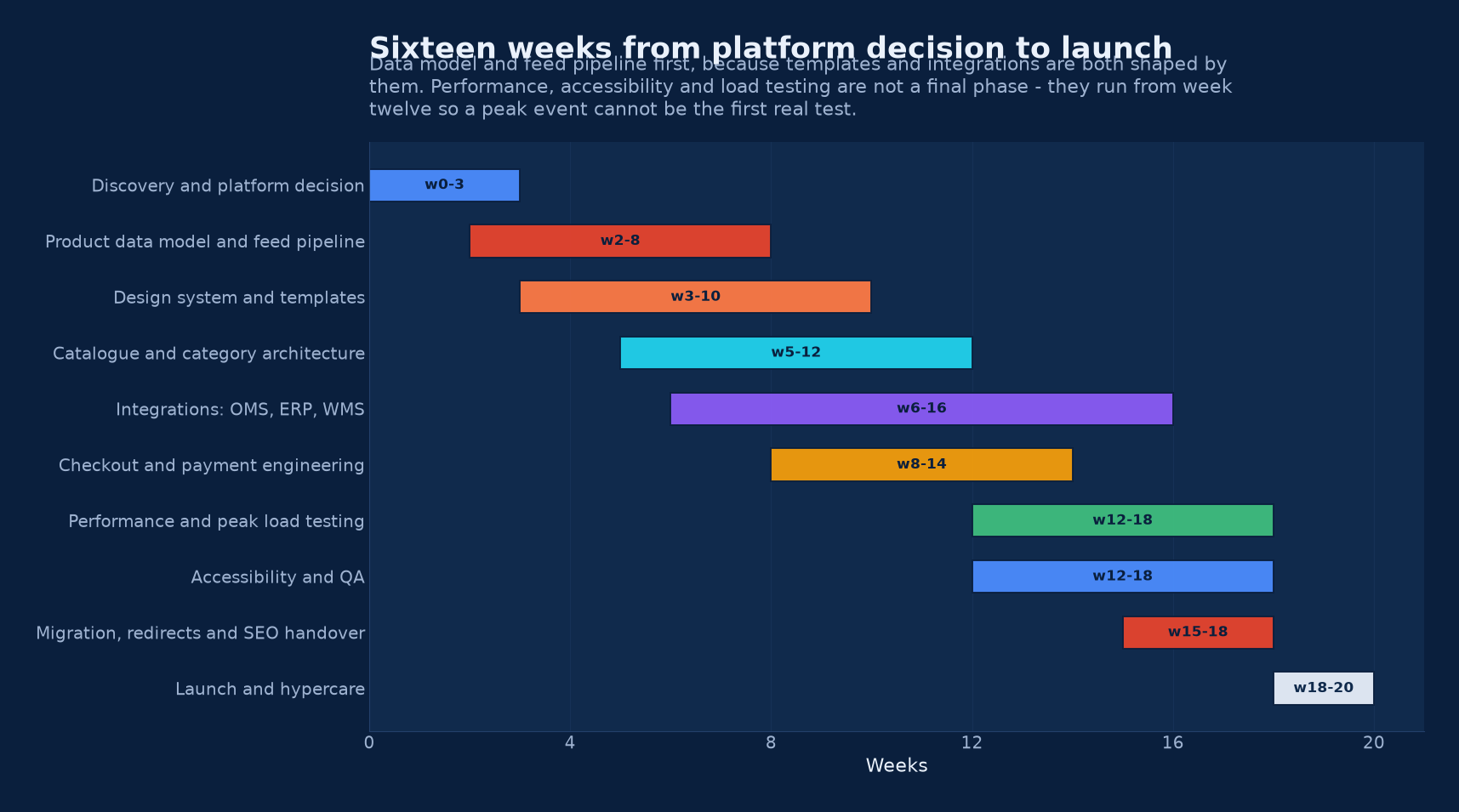
Chart values are an illustrative planning model based on typical UMC engagements and published industry benchmarks. They are not a guarantee of results on any specific project.
Weeks one to three settle the eight decisions in writing: catalogue shape, platform, order and stock truth, pricing engine, checkout shape, performance budget, editor model and measurement. The product data model and feed pipeline run from week two to eight, in parallel with the design system and templates from week three to ten. Category and catalogue architecture build from week five. Integrations to order management, warehouse and finance run from week six to sixteen, and checkout and payment engineering from week eight to fourteen – after the pricing and stock rules exist, because a checkout built before them gets rebuilt. Performance and peak load testing, accessibility and quality assurance run from week twelve to eighteen. Migration, redirects and the SEO handover occupy weeks fifteen to eighteen, launch is week eighteen, and hypercare closes at week twenty.
| Deliverable | Week | What the business keeps |
|---|---|---|
| Written platform recommendation | 3 | Constraints, options, three-year cost, decision record |
| Product data model and attribute dictionary | 5 | One catalogue truth with named owners |
| Design system and templates | 10 | Category, product, cart, checkout, account, editorial |
| Feed pipeline with diagnostics | 8 | Near-real-time publishing and alerting per channel |
| Category and facet architecture | 12 | Indexation policy, merchandising controls, search |
| Checkout and payment engineering | 14 | Instrumented money path with gateway resilience |
| Integrations live | 16 | OMS, WMS, ERP, marketplace, CRM and finance connected |
| Performance and load test record | 18 | Budgets met at event multiples, with the fix list |
| Accessibility audit and remediation | 18 | WCAG 2.2 AA on the money path, plus a gate |
| Migration map and redirect set | 18 | URL inventory, redirects, indexation control |
| Launch and hypercare report | 20 | Known issues, monitoring baseline, runbook |
| Handover pack | 20 | Runbooks, recordings, named owners, decision rights |
What we measure, and what we hand over
A build is finished when the business can run it without us, and that is a measurable condition rather than a sentiment. The handover numbers below are the ones we report at week twenty and again at week thirty-two, because the second reading is the one that shows whether the discipline survived the handover.
| Measure | Definition | Target at launch | Why it is the right measure |
|---|---|---|---|
| LCP by template | 75th percentile largest contentful paint on mobile for category, product and checkout | Under 2.5 seconds on all money-path templates | It is the speed customers experience, not the speed a lab reports |
| Checkout conversion | Orders divided by checkout starts, with step-level abandonment alongside | At or above the pre-launch baseline, with no step regressing | It isolates the money path from traffic quality |
| Payment success rate | Successful authorisations divided by attempts, by method | Above the baseline per method, with failover proven | A gateway problem looks like a conversion problem without it |
| Feed health | Disapproved, suppressed and out-of-sync product share per channel | Under one percent, with alerting to a named owner | It caps every paid and organic channel at once |
| Straight-through order share | Orders reaching the warehouse with no manual intervention | Above ninety percent at launch, rising after | It measures whether the integration actually works |
| Promise accuracy | Orders delivered by the date promised at checkout | Above ninety-five percent | It converts a marketing claim into an operational metric |
| Accessibility defects | Open WCAG 2.2 AA issues on the money path | Zero critical, zero serious at launch | It is both an inclusion and a legal exposure measure |
| Incident response | Time to detect and time to recover for production incidents | Detection under fifteen minutes, recovery under two hours | It shows whether monitoring and the runbook are real |
| Editor self-sufficiency | Share of merchandising changes made without a developer | Above eighty percent by week thirty-two | It is the practical test of the content model |
The measurement layer is built with BI dashboards and executive reporting and data warehouse and lakehouse; the analysis behind the targets uses data science services and predictive analytics where forecasting feeds the buy. Where margin is the mandate rather than growth, cost rationalisation and margin recovery frames the same numbers from the finance side.
Pricing and engagement models for retail builds
| Model | Best for | What it includes | Commercial shape |
|---|---|---|---|
| Platform assessment | A business deciding whether to build, buy, replatform or fix | Constraint analysis, three-year cost model, architecture options, written recommendation | Fixed fee, three weeks |
| Full build or replatform | A committed programme with a launch date | Data model, storefront, checkout, integrations, migration, performance, accessibility, handover | Fixed price per release or milestone billing |
| Commerce engineering retainer | A business with a platform and a roadmap it cannot staff | Sprint capacity, release management, monitoring, priority queue | Monthly retainer with named engineers |
| Performance and peak readiness | An estate facing a sale event or a known speed problem | Audit, media pipeline, caching, script governance, load testing at event multiples | Fixed fee with a measured target |
| Accessibility programme | A business with an audit finding, a tender requirement or an inclusion mandate | WCAG 2.2 AA audit, remediation, pipeline gate, editor training, statement publication | Fixed fee, then a retainer for regression control |
| Migration and SEO handover | A replatform where the organic asset must survive | URL inventory, redirect map, indexation control, structured data, post-migration window | Fixed fee tied to the cutover |
| Managed run and support | A business that wants the estate operated, not just built | Monitoring, patching, backups, on-call, small changes, quarterly reporting | Monthly, tiered by estate size |
Where this page sits in our retail programme
This page is the build discipline of the retail vertical. The retail and e-commerce hub ties the vertical together, each discipline has its own page as it is built, and the generic service page for every discipline stays linked below alongside the vertical pages. If a sibling page is not listed, it is not published yet – this list is generated from live pages, and it refreshes automatically as each spoke lands.
- Retail – the vertical main page
- SEO for retail and e-commerce
- Google Ads for retail and e-commerce
- Social media marketing for retail and e-commerce
- CRM, loyalty and lifecycle for retail
- Business intelligence for retail
- IT support and commerce security for retail
- AI for retail and e-commerce
- SEO services – the generic service page
- Google Ads management – the generic service page
- Social media management – the generic service page
- Custom CRM development and integration – the generic service page
- BI dashboards and executive reporting – the generic service page
- Managed IT infrastructure and AMC – the generic service page
- AI agent deployment and automation – the generic service page
Retail build teams by city, and worked examples
Builds are delivered remotely to retail businesses anywhere, with time-zone overlap agreed up front and a named lead per workstream. Location pages carry the local detail that a geography-neutral page should not pretend to own: payment mix, courier and fulfilment coverage, festive calendars, language, and the catchment economics that decide whether a store or a warehouse should fulfil demand. The case studies below are full-stack engagements, written to show the constraint and the measured result rather than the technology.
- Website development company for retail stores in Lucknow
- Increase e-commerce sales in Lucknow
- Digital marketing and IT services in Lucknow
- Digital marketing and IT services across Indian cities
- Case study: EZ1 in Services full-stack e-commerce platform development
- Case study: WordPress WooCommerce online mobile store project
- Case study: Ethnava full-stack SEO for a chikankari WooCommerce store
- Case study: a fashion retail showroom
- About Unified Management Consulting
- Contact us
Frequently asked questions about retail website development
How long does a retail e-commerce build take?
Sixteen weeks is typical from platform decision to launch for a single-brand catalogue with standard integrations, plus two weeks of hypercare. Multi-brand, multi-country or deeply ERP-coupled programmes run longer, and the extra time is almost always in the data model and the integrations rather than in the templates.
Should we replatform, or fix what we have?
It depends on whether the constraint is commercial or architectural. If the catalogue model, checkout and integrations can be fixed on the current platform, a replatform is an expensive delay. We test that first and give a written recommendation that includes the option of not moving yet.
Will our team be able to manage the site without you?
That is an explicit deliverable, not a hope. Merchandisers get structured blocks for categories, products and offers with role-based permissions; editors are task-tested during the build; and we hand over runbooks, recordings and named owners. If a routine change needs a developer, the content model was designed wrong and we fix it before handover.
How do you handle product data at catalogue scale?
With one authoritative product master, an attribute dictionary owned by merchandising, an automated media pipeline, and generated per-channel projections – never six hand-maintained feeds. Alt text, attributes and availability are data problems at scale, not editorial ones.
Can you build for marketplace sellers as well as our own site?
Yes. The same product master feeds the own site, Google Merchant Centre and each marketplace, with per-channel category mapping, price and stock rules, and settlement reconciliation. The commercial governance of marketplace dependency sits in the retail hub.
How do you make sure the site survives a sale event?
With a performance budget per template enforced in the pipeline, a third-party script register, caching with short TTLs on stock and price fragments, load testing at event multiples against realistic journeys, autoscaling rules, a rehearsed degraded mode and a change freeze with a named approver.
What does WCAG 2.2 AA actually involve on a shop?
Keyboard operability and visible focus, programmatic form labels with described errors, contrast and text sizing, meaningful alt text from the product data, announcements for cart and filter updates, pausable motion, accessible policies, and a regression gate in the pipeline so it does not decay release by release.
Will a migration cost us our Google rankings?
It can, and the defence is measurement rather than optimism: a URL inventory ranked by commercial value, one-to-one redirects with chains and loops tested, indexation control, structured data carried across, content parity signed by merchandising, performance parity, and a four-to-eight-week post-migration window against a recorded baseline.
Can you integrate our ERP, warehouse and finance systems?
Yes, and the first deliverable is an agreement about which system owns which truth and what the latency target is per hop. Where a system cannot expose what we need, we say so in week three with options rather than discovering it in week fourteen.
Do you build mobile apps as well?
Where an app is genuinely warranted – usually high-frequency categories with a loyal cohort – yes, as a separate decision with its own business case. For most retailers a fast mobile web experience plus a well-run lifecycle programme returns more than an app.
Who owns the code, the data and the accounts?
You do. Repositories, cloud accounts, platform licences, domains and data are in your name from the start, credentials are managed in your store, and the handover pack is written so another team could run the estate without us.
How do you charge?
Assessments are fixed fee over three weeks. Builds are fixed price per release or milestone. Ongoing capacity is a monthly retainer with named engineers. We do not bill by the hour against an open-ended scope, because that rewards the wrong behaviour on both sides.
Start with the platform decision and the data model
Give us three weeks with your current catalogue extract, your order and settlement data, your integration list and two days with the people who merchandised and finance the range, and we will return a written platform recommendation with a three-year cost model, a product data model and attribute dictionary, an integration map with latency targets, a performance and accessibility budget per template, and a sixteen-week plan with named owners – including what we would not build yet. Yours to keep either way.
Contact Unified Management Consulting to arrange a confidential first conversation.