
Digital marketing for hotels is the discipline that decides how much of a property’s demand it captures directly and how much of it rents from intermediaries, and it is the reason owners, general managers and revenue teams come to us. Hotels, resorts, serviced apartments and hospitality groups buy the same outcomes in every market: more direct bookings, lower distribution cost, fuller midweek occupancy, stronger food-and-beverage and event revenue, and a guest experience that earns reviews and repeat stays. The search queries behind those outcomes look different by country, but the requirements behind them do not. This page maps what hotel and hospitality operators search for to the services Unified Management Consulting actually delivers – search, paid media, websites and booking engines, revenue business intelligence, guest CRM, artificial intelligence, and the IT, cloud, network and security work that keeps a property running – and it is written for owners, general managers, revenue leaders and group marketing teams anywhere in the world, because every engagement below is delivered remotely.
We work with independent properties, small groups, management companies and franchisees. Nothing on this page assumes we are in your city: audits run against your live stack and your analytics, builds run in staging with your developers or ours, campaigns run in your ad accounts and your currency, and reporting runs on a cadence your executive committee actually reads. Where a market needs boots on the ground – photography, mystery shopping, on-site training – we coordinate local partners and hold the quality bar ourselves.
What a hotel or hospitality engagement includes, at a glance
| Component | What We Deliver |
|---|---|
| Direct booking growth | Metasearch, paid search, conversion-rate work and lifecycle marketing that move share from online travel agencies to brand.com. |
| Distribution cost control | Channel-by-channel economics: commission negotiation support, rate-parity hygiene, wholesaler exposure and paid-media efficiency. |
| Hotel SEO and content | Destination, amenity and intent coverage with local optimisation for every property, outlet and event space. |
| Websites and booking engines | Fast, accessible, multi-language, multi-currency sites integrated with your property management system and payment provider. |
| Revenue and business intelligence | Pace, pickup, segmentation and RevPAR reporting in dashboards your revenue and finance teams trust. |
| Guest CRM and loyalty | Consented guest data, segmentation and automated pre-stay, in-stay and post-stay journeys. |
| AI in operations | Pre-booking concierge, review-response drafting, forecasting support and visibility in AI assistants’ answers, with governance. |
| IT, cloud and security | Guest Wi-Fi, PCI scope, cross-property networks, backup and recovery, managed support and audit readiness. |
Dedicated pages for Hotels, one per service
A vertical this broad cannot be answered by one page, so each service has its own dedicated page for hotels. This page is the vertical overview; the pages below carry the depth for one discipline each, and more are added as the cluster is built.
- Website development for hotels — Booking-engine sites, PMS and channel-manager integration, a 2.5-second LCP budget, WCAG 2.2 AA, multi-language and multi-currency, migration discipline.
- Hotel SEO services — Technical SEO for booking-driven sites, map-pack local SEO per outlet, destination and amenity content, hotel schema and rich results, hreflang and digital PR.
- Google Ads for hotels — Hotel Ads and metasearch, brand and non-brand search, retargeting, rate feeds and parity-safe bidding, measured on cost per confirmed booking.
- Social media marketing for hotels — Content pillars that sell the stay, channel engines, creators and fam trips, DM booking flow and assisted-booking reporting.
- Hotel CRM & guest loyalty — Unified guest profiles from PMS and POS, consent-safe lifecycle journeys, upsell and win-back flows, benefit programmes and repeat-rate measurement.
- Hotel business intelligence — One truth above PMS, POS, channel manager and CRM: pace and forecast views, outlet and event analytics, parity alerts and an executive cadence.
- IT support for hotels — Managed IT and AMC, segmented networks, guest Wi-Fi that survives a full house, PMS and POS uptime, locks and IPTV, backups, DR and security baselines.
- AI for hotels — Readiness assessment, guest messaging copilots with guardrails, demand and pace forecasting on your BI layer, governance and staff enablement.
What hotel and hospitality teams search for, and what it really means
Most hotel search queries are symptoms, not specifications. “Digital marketing for hotels” usually means “our online travel agency mix is too expensive and our website does not convert”. “Hotel revenue management consulting” usually means “nobody can explain why last month’s RevPAR moved”. Reading the requirement behind the query is the first deliverable, because it decides what gets built and what gets measured.
| Search query | The requirement behind it | Capability that answers it |
|---|---|---|
| digital marketing for hotels | A coordinated demand programme, not a list of channels | Full-funnel strategy across search, paid social and lifecycle |
| hotel marketing agency | An accountable partner with hospitality economics, not generic retainer hours | Vertical team, single reporting line, shared scorecard |
| how to increase direct hotel bookings | Cheaper distribution and a website that converts | Metasearch and paid search plus conversion-rate work on the booking path |
| reduce OTA commission hotel | Channel mix and rate-parity control | Channel economics review, pricing analysis and negotiation support |
| hotel SEO services | Rankings for destination, amenity and brand queries in each market | technical and content SEO with local and multilingual coverage |
| Google Ads for hotels | Demand capture at the compare and book stages | Hotel Ads, brand defence and generic search in Google Ads |
| hotel website development company | A fast, accessible site that hands the booking engine a qualified guest | WordPress or headless builds and Core Web Vitals work |
| hotel revenue management consulting | Explainable pricing, segmentation and forecasting | Revenue reporting in dashboards plus forecasting models |
| hotel CRM software implementation | One consented guest record across stays and outlets | CRM build and marketing automation in HubSpot or Marketo |
| IT support for hotels | Guest-facing systems that never fail at the front desk | Managed infrastructure, helpdesk and cross-property networks |
| hotel business intelligence dashboard | One version of the truth for owner, GM and finance | BI dashboards over PMS, POS and channel data |
| AI chatbot for hotel bookings | Instant, accurate pre-booking answers without extra headcount | AI agents wired to rates, availability and FAQs |
The table is deliberately blunt: a query is a buying signal, and a buying signal is only useful if it maps to a capability with an owner, a method and a measurement. Everything below follows that mapping, grouped the way a hotel actually operates rather than the way agencies like to sell.
Channel economics: why the mix decides hotel profitability
Every room night sold through an online travel agency carries a commission that typically lands between fifteen and twenty-five percent of the room rate, before the agency’s preferred-placement programmes, before the payment fee, and before the guest who books through the agency becomes the agency’s customer rather than yours. Wholesalers and bedbanks take more and add opacity. Metasearch costs a click but keeps the relationship. Brand.com direct costs payment processing and the marketing that earned the visit, and keeps everything else – including the guest record that makes the next stay cheaper to win.
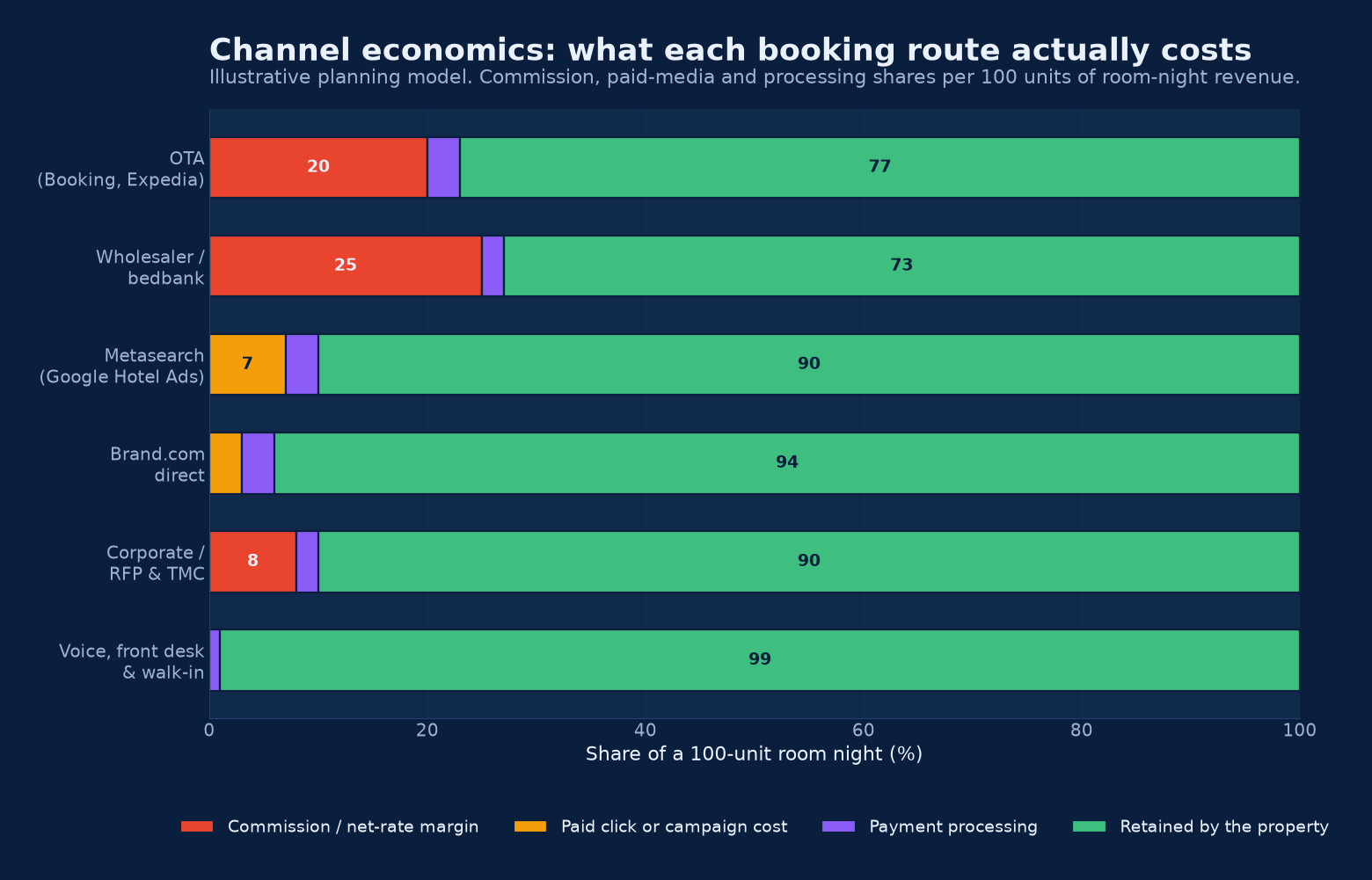
Chart values are an illustrative planning model based on typical UMC engagements and published industry benchmarks. They are not a guarantee of results on any specific project.
The model above is illustrative, not a promise: your numbers come from your own channel report. The point is the shape. A property that shifts five points of mix from commissioned channels to direct recovers margin on every night of the year without raising a single rate, and a property that cannot see its channel economics cannot defend a budget request to do so. We start every engagement by rebuilding that view from your reservation and finance data, then set a mix target with the general manager and the owner, not around it.
Rate parity deserves its own sentence because it is where good channel strategy goes to die. Agreements that forbid a cheaper public direct rate can be worked with rather than against: member rates, package value, loyalty pricing and closed-user-group rates are all legitimate levers in most markets, and we model them before anyone touches a public price.
The hotel technology stack we integrate with
Hotel work is integration work. A marketing plan that ignores the property management system is a poster, not a programme. We have delivered against the systems below and their equivalents, and where a property runs something unusual we read its API documentation before we promise anything.
| Layer | Common systems | What we do with it |
|---|---|---|
| Property management | Oracle OPERA, Cloudbeds, Mews, Little Hotelier, Protel | Availability and rate feeds, reservation data for reporting, upsell triggers |
| Channel management | SiteMinder, RateGain, D-EDGE, Cubilis | Parity monitoring, channel mix reporting, allocation rules |
| Booking engine | Property-branded engines on the hotel site | Conversion-rate work, abandonment recovery, payment-flow review |
| Revenue management | IDeaS, Duetto, Atomize, or spreadsheet-driven | Segmentation and pace reporting; we support the system, never replace your judgment |
| Point of sale | Oracle MICROS, Toast, Lightspeed | Outlet revenue in the same dashboard as rooms; menu and event analytics |
| CRM and guest data | HubSpot, Salesforce, Revinate, Cendyn, or none | Consented guest record, segmentation, lifecycle journeys, loyalty tiers |
| Reputation | ReviewPro, TrustYou, Google and TripAdvisor natively | Review velocity, response workflow, sentiment into operations |
| Analytics and BI | GA4, Looker Studio, Power BI, Metabase | One measurement layer across site, campaigns, PMS and POS |
Where a property has no CRM at all, that is not a blocker; it is a sequencing decision. A clean guest record built from reservation history is often worth more in year one than any campaign, and our custom CRM development practice covers exactly that build.
Service requirements by role: owner, GM, revenue, marketing, IT, finance
A hotel buys through several people at once, and each has a different failure they are trying to avoid. Naming those failures is how a scope stays honest.
| Role | The pressure they carry | What we hand them |
|---|---|---|
| Owner / asset manager | Asset value, yield on capital, exit readiness | Channel economics, RevPAR index versus comp set, a defensible marketing P&L |
| General manager | This month’s number, guest scores, staff load | A weekly operating cadence: what moved, why, and the next single action |
| Revenue manager | Pace, pickup, segmentation, forecast accuracy | Pace and pickup reporting, segment trends, forecast error tracking |
| Director of marketing | Pipeline, brand, content velocity, agency management | Campaign ownership, creative production, SEO and content engine, measurement |
| IT / operations | Systems up at 6 a.m., PCI scope, vendor sprawl | Managed support, network and backup design, security baseline, vendor consolidation |
| Finance | Cost per acquisition, commission leakage, forecast reliability | Channel-level cost reporting and a monthly variance walk |
If your property is owner-operated with no marketing head, the same scope runs with a smaller cadence and a single point of contact on our side. The deliverables do not change; the meeting count does.
Digital marketing for hotels: demand capture across the guest journey
Hospitality demand moves through five stages, and each stage has its own channels, its own economics and its own failure mode. Treating “digital marketing” as one bucket is why hotel budgets leak: money lands where the agency is comfortable rather than where the guest is deciding.
| Journey stage | What the guest is doing | Channels that win it | Measurement |
|---|---|---|---|
| Dream | Browsing destinations, saving properties, watching video | Organic content, social, YouTube, influencer partnerships | Assisted conversions, branded search growth |
| Compare | Checking rates and reviews across tabs | Metasearch, paid search, reputation score | Impression share, review velocity |
| Book | Choosing a channel and completing payment | Brand.com conversion path, booking engine, retargeting | Conversion rate, cost per booking |
| Stay | On property, spending across outlets | In-stay offers, WhatsApp and SMS upsell, QR menus | Outlet attachment, spend per occupied room |
| Return | Deciding where to go next year | email lifecycle, SMS and WhatsApp, loyalty pricing | Repeat rate, cost per repeat stay |
Two stages are chronically underfunded in hotels: Compare and Return. Compare is where review score and rate presentation decide the click, and it is the cheapest place to win because the guest has already chosen your city. Return is where the guest record you already own turns into a booking that costs almost nothing to acquire. Our programmes weight budget by stage, and we show you that weighting every month.
Search engine optimisation for hotels and hotel groups
Hotel SEO is three problems wearing one coat. There is the brand and property problem – your name, your address, your photos, your reviews, consistent everywhere. There is the destination problem – travellers search for the place, the event and the season long before they search for a hotel. And there is the transactional problem – “hotel near”, “boutique hotel with pool”, “extended stay” – where intent is high and the results page is brutal. A hotel programme that only writes blog posts has solved none of the three.
Our search engine optimisation practice runs the technical baseline first: crawlability of the booking path, duplicate rate pages, canonical discipline across language and currency variants, structured data for rooms, offers, events and reviews, and Core Web Vitals on the pages that take money. Content then follows the demand map – destination guides, neighbourhood and venue pages, event calendars, amenity pages that actually describe the amenity, and meeting-and-events pages with real capacity numbers, because that is what meeting planners search for and what competitors leave blank.
- Local profiles for every property, outlet, spa and event space, with review generation wired into the post-stay journey
- Multilingual and multi-currency hreflang discipline for groups trading across borders
- Digital PR and citations that earn authority without buying links
- Answer-engine and AI-assistant visibility: your rates, policies and amenities stated where large language models read them
- A content calendar tied to your demand calendar, not to a generic publishing quota
Paid media: metasearch, Google Ads and Meta for hospitality
Paid media in hospitality is not one campaign type; it is a portfolio with different jobs. Metasearch and hotel-specific placements capture the guest who is comparing rates today. Brand search defends the guest who already knows you, which is the cheapest revenue you will ever buy and the first thing a competitor will try to take. Generic search wins the guest with a need but no hotel in mind. Meta and YouTube create the demand that the other channels later harvest, and they carry the property film, the offer and the story that a rate grid cannot tell.
| Campaign type | Job | Typical budget shape | Primary measurement |
|---|---|---|---|
| Metasearch / hotel ads | Capture comparison shoppers | Percent-of-revenue bid strategy | Cost per booking, direct share |
| Brand search | Defend known demand | Small, always on, tight match | Impression share, cost per click |
| Generic search | Win unbranded intent | Scaled to season and event calendar | Cost per booking by segment |
| Meta and Instagram | Create desire, target lookalikes and event audiences | Pulsed around offers and seasons | Assisted conversions, cost per click |
| YouTube and video | Tell the property story, support group and events sales | Flighted around campaigns | View-through, branded search lift |
| Retargeting | Recover abandoned booking paths | Small, frequency-capped | Return-on-ad-spend on the abandon cohort |
The discipline is in the guardrails: frequency caps so a guest is not stalked across the internet, negative lists so brand budget is not spent on people already booked, and a single attribution view that admits metasearch and direct both deserve credit. Our Google Ads management and paid media planning practices run this portfolio, and creative production keeps the creative pipeline fed without a new agency every quarter.
Websites, booking engines and Core Web Vitals
The hotel website has one job above all others: hand a qualified guest to the booking engine without losing them on the way. Everything else – the story, the gallery, the meetings page – serves that handover. In practice most hotel sites lose guests to slow media, a booking widget that reloads the page, rates that disagree with the metasearch result, a mobile path that hides the book button, and forms that ask for information the property already has.
We build and rebuild hotel sites in WordPress or headless architectures depending on the group’s appetite for control, and we treat the booking path as a product: measured, tested, and versioned. Full-stack WordPress development and React and headless builds cover the build; Core Web Vitals work covers the speed budget; accessibility remediation covers guests who use assistive technology, which is both a legal requirement in several markets and simply the right thing to do; website strategy covers the information architecture that lets a guest find the spa, the ballroom capacity or the airport shuttle in two clicks.
- Booking-engine integration with your PMS and payment provider, with PCI scope kept narrow
- Multi-language and multi-currency variants with correct canonical and hreflang handling
- Rate and availability widgets that never disagree with your channel manager
- Structured data for rooms, offers, FAQs, events and reviews
- Abandonment recovery: a saved-quote and callback path that respects consent
- A maintenance and support model so the site never silently breaks after launch
Revenue management support and business intelligence
Revenue management is where hotel data goes to be argued about. Pace versus last year, pickup by segment, forecast accuracy, comp-set index, channel cost – each is simple alone and contradictory together, which is why most properties run them in spreadsheets that disagree. Our contribution is not a new revenue system; it is one measurement layer your revenue manager, general manager and finance lead all trust, built on the business intelligence dashboard and data warehouse and lakehouse practices.
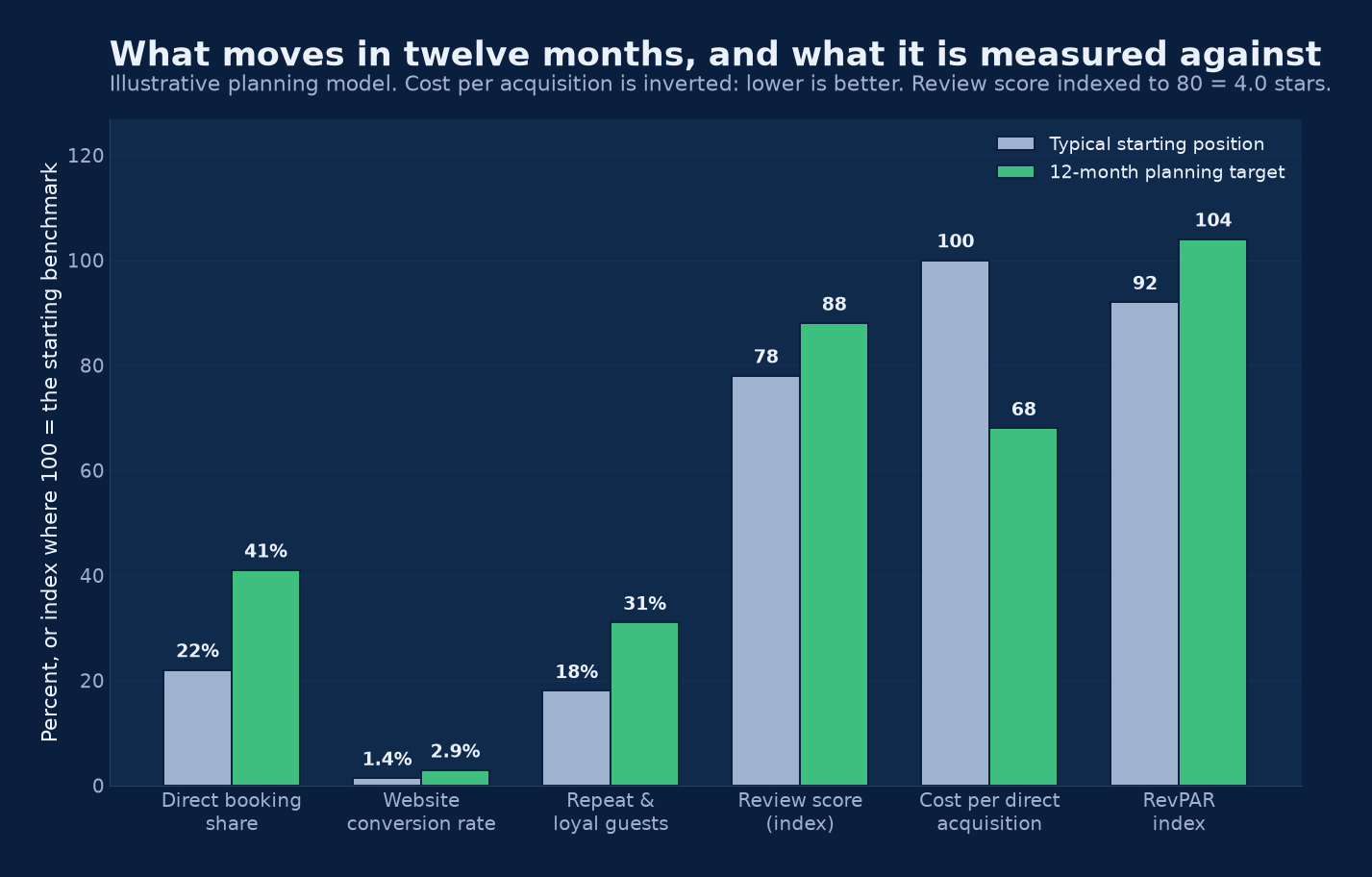
Chart values are an illustrative planning model based on typical UMC engagements and published industry benchmarks. They are not a guarantee of results on any specific project.
| Dashboard | Audience | Refresh | Measures it owns |
|---|---|---|---|
| Owner and asset pack | Owner, asset manager | Monthly | RevPAR index, channel mix, marketing P&L, capital requests |
| Commercial weekly | GM, revenue, sales | Weekly | Pace, pickup, segmentation, group pipeline, competitor rate moves |
| Marketing performance | Marketing, agency | Weekly | Cost per booking by channel, funnel conversion, content and review velocity |
| Operations and outlets | F&B, spa, events | Daily | Cover counts, spend per occupied room, outlet margin, event conversion |
Where forecasting is still intuition, predictive analytics and demand forecasting adds a statistical baseline and marketing mix modelling keeps every channel dollar honest against the revenue it actually caused. Neither replaces your revenue manager; both give them an argument they can win in a meeting.
Artificial intelligence in hotel operations, with governance
AI in hospitality is at its best when it answers the guest instantly and accurately at two in the morning, drafts the review response a tired manager would otherwise skip, and summarises yesterday’s exceptions for the morning meeting. It is at its worst when it promises rates it cannot honour or invents policies. We deploy AI agent deployment against your live rates, availability, menus and policies, with escalation to a human whenever confidence drops, and we put the guardrails in writing before anything faces a guest, following our AI governance, risk and compliance practice.
There is a second, quieter AI problem: guests increasingly ask assistants, not search engines, where to stay. Properties whose rates, amenities, policies and reviews are stated clearly and consistently across the web get recommended; properties whose information is scattered do not. Our AI readiness assessment and data engineering for AI and knowledge systems work makes the property legible to those systems without a single keyword stuffed anywhere.
- Pre-booking concierge on web and WhatsApp, wired to availability and rates
- Review-response drafting with tone control and human approval
- Demand-forecasting support for revenue and F&B planning
- Staff copilots for sales proposals, group enquiries and event quotations
- An executive scorecard so AI spend is judged on outcomes, via AI ROI measurement
Guest CRM, loyalty and lifecycle marketing
A hotel that cannot recognise a returning guest is paying acquisition cost twice for the same person. The fix is unglamorous and high-yield: one consented guest record, assembled from reservations, point of sale, events and enquiries, with clear segmentation and journeys that run before, during and after the stay. Where a group already runs HubSpot, Salesforce, Revinate or Cendyn we build on it; where it does not, our custom CRM development designs the record and the integrations, and our marketing automation practice runs the automation on HubSpot or Marketo.
Loyalty does not need a points scheme to work. A member rate, an early-access window, a recognised preference and a post-stay thank-you that references the actual stay will move repeat share further than a plastic card. Lifecycle channels follow the guest’s habits: email for the long relationship, SMS and WhatsApp for the in-stay and last-minute moments, always with consent recorded and honoured.
IT, cloud, networks and security across properties
Guests experience IT as three things: Wi-Fi that works, check-in that is fast, and payment that is safe. Everything else is our problem. We design guest and corporate networks that survive a full house, keep card data inside a narrow PCI scope, back up the systems a property cannot lose, and put a named support route in front of the front desk instead of a vendor portal. Our managed IT infrastructure, cross-property network engineering, backup and disaster recovery and cybersecurity practices cover the estate, and cloud cost optimisation keeps a group’s cloud bill explainable to its finance team.
| Exposure | What it costs a hotel | Control we implement |
|---|---|---|
| Guest Wi-Fi failure | Reviews, direct rebooking loss, outlet payment failures | Segmented SSIDs, capacity planning, monitoring with alerting |
| Card data sprawl | PCI fines, breach liability, brand damage | Scope reduction, tokenised flows, quarterly evidence packs |
| PMS or channel outage | Inability to sell or check in | Documented fallback, tested restores, vendor escalation paths |
| Single-property backups | Ransomware that ends a trading week | Off-site, immutable, tested restores with named owners |
| Vendor sprawl | Unowned renewals, duplicated licences, slow incidents | A consolidated stack with one support contract and one roadmap |
For groups, the same design runs as a template: property one proves it, properties two to twenty inherit it, and the centre keeps visibility without owning every switch.
How an engagement runs: the first ninety days
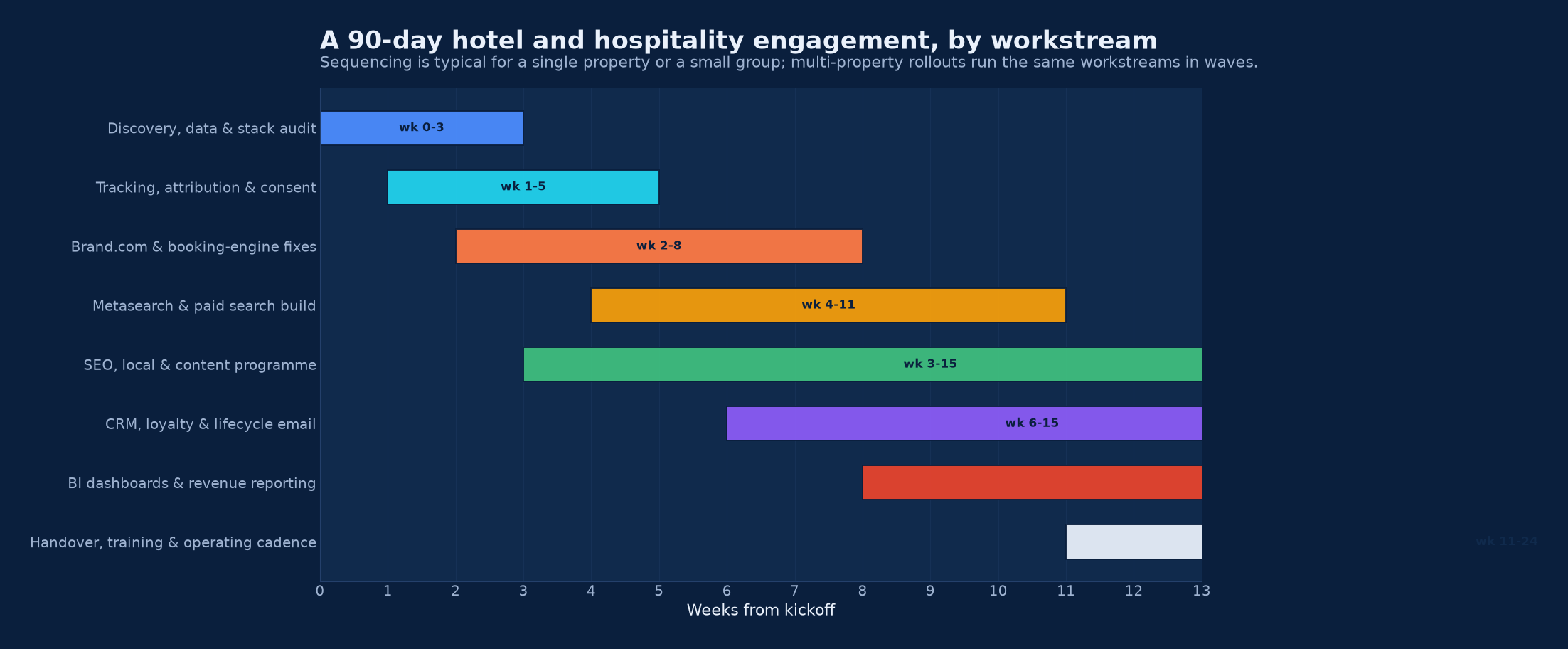
Chart values are an illustrative planning model based on typical UMC engagements and published industry benchmarks. They are not a guarantee of results on any specific project.
Weeks zero to three are discovery and data: your channel report, your analytics, your PMS extract, your review history, your contracts. Weeks two to six fix the foundation – tracking, consent, the booking path – because paid media on a broken path buys expensive data about a broken path. Metasearch and paid search switch on from week four, once measurement can tell truth from noise. SEO and content run from week three and never stop. CRM and lifecycle arrive once the guest record is trustworthy, and the dashboards land last so they are built on data that has already been argued about and settled.
At week twelve you get a written operating cadence: who meets when, which numbers get read, which decisions get escalated, and what the next ninety days contain. The engagement is a success when your team can run it without us, and a failure when it cannot.
Multi-property, multi-market and remote delivery
Most of our hotel clients are not in our city, and several are not in our country. The model is remote-first by design: audits against live systems, builds in staging, campaigns in your accounts, reporting in your timezone, documentation in your language of record. Multi-market groups get one measurement framework with local execution notes per market, currency-safe reporting so a euro and a rupee are never silently added together, and data-handling positions written for GDPR, CCPA and India’s DPDP rather than improvised per project.
Franchise and management-contract properties get an extra layer of care: brand standards, approved vendors and central marketing funds are constraints we work inside, and we will tell you plainly when a brand rule blocks the fastest route and what the compliant alternative is.
Pricing and engagement models
Indicative shapes, in the currency of your contract; every engagement starts with a scoped, fixed-fee audit so the retainer is priced on evidence rather than optimism.
| Model | Fits | Indicative shape | What is included |
|---|---|---|---|
| Audit first | Properties testing whether to change anything | Fixed fee, 2-3 weeks | Channel economics, site and booking-path review, measurement gap analysis, prioritised roadmap |
| Growth retainer | Single property or small group with demand targets | Monthly, 6-12 month term | Strategy, search and paid media, content, reporting, cadence |
| Build project | Site, booking path, CRM or dashboard rebuild | Fixed fee by milestone | Discovery, design, build, integration, launch, handover docs |
| Advisory | Groups with in-house teams needing senior review | Monthly hours, quarterly deep dives | Plan review, vendor review, executive reporting |
We do not take commission on media spend and we do not mark up third-party licences; the incentive stays on your side of the table.
Compliance, brand safety and reputation
Hospitality marketing touches regulated ground more often than marketers expect: guest data under GDPR, CCPA and DPDP; card data under PCI-DSS; accessibility law in several markets; review-platform rules that punish incentivised reviews; advertising standards on claims about sustainability, awards and prices; and franchise brand books that govern imagery and tone. We treat each as a design constraint from day one, which is cheaper than treating it as an incident later.
- Consent recorded at collection and honoured across every channel
- Review generation that asks every guest and incentivises none
- Price and offer claims that match what the booking engine actually charges
- Accessibility targets set in the brief, not retrofitted after launch
- A written incident path for reputation events, with owners and holding statements
How we measure success
| Measure | Definition | Source | Cadence |
|---|---|---|---|
| Direct booking share | Brand.com bookings as a share of all bookings | PMS and channel report | Monthly |
| Cost per direct booking | Marketing cost divided by direct bookings | Ad platforms and PMS | Monthly |
| Website conversion rate | Sessions reaching a completed booking | Analytics | Weekly |
| Review velocity and score | New reviews per month and rolling average | Review platforms | Weekly |
| Repeat and loyal share | Returning guests as a share of stays | CRM and PMS | Quarterly |
| RevPAR index versus comp set | Your RevPAR against the chosen set | Benchmarking provider | Monthly |
| Outlet attachment | Occupied rooms with F&B or spa spend | POS and PMS | Monthly |
Every measure above has an owner on your side and ours, a source system, and a place it gets read out loud. A number nobody reads is decoration.
Proof: hospitality work we have delivered
A selection of published hospitality engagements, each written up as a project summary on this site rather than as a logo on a homepage:
- Marriott Hotel Hyderabad case study – paid media and campaign delivery for a full-service Hyderabad property
- Fern Hotel Hyderabad case study – social and performance programme for a boutique Hyderabad hotel
- Råd Hotel Hyderabad case study – design and campaign work for an independent boutique property
- Green Hotel Resort social advertising case study – social advertising for a green hotel and resort
- Green Hotel and Resort website case study – WordPress build for the same resort group
Hospitality sits inside a wider portfolio that also covers healthcare, manufacturing, retail and showroom verticals, each with the same discipline: a written scope, a measurement layer, and a handover your team can run.
Why hotel and hospitality groups choose Unified Management Consulting
- One partner across marketing, technology and consulting, so the website team and the media team cannot blame each other
- Vertical economics: we price and plan against commission structures and seasonality, not generic retail benchmarks
- Remote-first delivery proven across markets, currencies and timezones
- Measurement that survives an owner’s questions, because it is built from your own systems
- Handover as a deliverable: documentation, training and an operating cadence, not dependency
Related Services
The practices this page draws on, each with its own detailed scope on this site:
- Search engine optimisation services – organic demand, technical baseline and content engine
- Google Ads management services – demand capture at compare and book stages
- Facebook and Meta advertising and Instagram advertising – inspiration, offers and property storytelling
- YouTube advertising and video marketing – property films and destination video
- Email marketing campaign services – subscribers into repeat stays
- Website development services – the booking-path foundation
- Custom CRM development and integration – one consented guest record
- BI dashboards and executive reporting – the measurement layer for owner, GM and finance
- Predictive analytics and demand forecasting – pricing and segmentation evidence
- AI agent deployment and automation – guest-facing automation with guardrails
- Managed IT infrastructure and AMC – systems that stay up at six in the morning
- Business strategy consulting – group and owner strategy, market research and expansion
Every capability a hotel can draw on, by family
One page cannot carry every scope in detail, so here is the full directory of the practices a hotel or hospitality group typically touches, grouped the way our teams are organised. Each link goes to a page with its own scope, method and measurement.
Demand and marketing
- Search engine optimisation services
- Google Ads management services
- Facebook and Meta advertising
- Instagram advertising
- YouTube advertising and video marketing
- LinkedIn advertising
- Influencer and creator partnerships
- Social media management (organic)
- Email marketing campaigns
- SMS marketing
- WhatsApp marketing
- Marketing automation on HubSpot and Marketo
- All digital marketing services
Websites, commerce and experience
- Website development services
- Full-stack WordPress development
- Full-stack React development
- Headless and composable commerce
- E-commerce development and marketing
- Core Web Vitals and performance
- Accessibility and WCAG remediation
- UX and UI design
- Website strategy and information architecture
- Website migration and replatforming
- Web application maintenance
- Mobile app development
- Portal development
Data, intelligence and AI
- BI dashboards and executive reporting
- Predictive analytics and demand forecasting
- Marketing mix modelling and attribution
- Sales analytics and pipeline intelligence
- Data warehouse and lakehouse builds
- AI agent deployment and automation
- AI integration with ERP and CRM
- Data engineering for AI and knowledge systems
- AI readiness assessment and roadmap
- AI governance, risk and compliance
- AI ROI measurement and executive scorecard
- Custom CRM development and integration
Infrastructure, security and support
- Managed IT infrastructure and AMC
- IT helpdesk and end-user support
- Routing, switching, firewall and network engineering
- Backup and disaster recovery
- Cybersecurity services and solutions
- IT audit and compliance readiness
- Cloud migration across AWS, Azure and GCP
- Cloud cost optimisation and FinOps
- Enterprise systems integration
- IT staff augmentation
- All technology services
Consulting, commercial and proof
- Business strategy consulting
- Market research and competitive analysis
- Market expansion consulting
- Brand performance and creative production
- Media planning and buying
- Cost rationalisation and margin recovery
- Cash flow and working capital recovery
- Unified top-level business management
- All business consulting services
- About Unified Management Consulting
- Contact us
Local teams: hotels in Lucknow and across India
If your property trades in Lucknow or elsewhere in India, we also run dedicated local-intent pages with local search, map and regional campaign detail:
- Digital marketing company for hotels in Lucknow
- Website development company for hotels in Lucknow
- How to get more hotel bookings in Lucknow
The capability is identical; the local pages carry the map-pack, regional language and on-the-ground detail that a global page should not pretend to own.
Related industry verticals
Hospitality is one of nine industry verticals we run as a complete programme – hub page, eight discipline spokes, cross-linked to the generic service practices. Food service, healthcare, retail and manufacturing clients share the same operating discipline: unit economics first, then the systems, then the campaigns.
Frequently asked questions about hotel and hospitality services
Do you work with hotels outside India?
Yes. Most engagements are delivered remotely against your live systems, ad accounts and analytics, with reporting in your timezone and documentation in your language of record. Where a market needs physical presence we coordinate vetted local partners and own the quality bar.
Can you work alongside our existing agency?
Yes, and often we should. We take the measurement layer and the gaps your agency does not cover – channel economics, booking-path conversion, BI, IT – and we will say plainly if the cleanest answer is to consolidate rather than add.
How quickly can direct bookings improve?
Metasearch and brand search usually move within the first month because they capture existing demand. Organic and lifecycle gains compound over two to four quarters. We set the expectation per channel in the audit, not in the pitch.
Do you need access to our PMS?
Read-level access to reservation and channel data, yes – it is the difference between opinion and evidence. We never need write access to rates or inventory, and access is scoped, logged and revocable.
Will you replace our revenue management system?
No. We support the system you have, from IDeaS and Duetto to a well-kept spreadsheet, and we add the reporting and forecasting layer around it. Replacing a revenue system is rarely the bottleneck.
How do you handle franchise brand standards?
As constraints, not obstacles. We work inside brand books, approved-vendor lists and central fund rules, and we flag early when a standard blocks the fastest route, with the compliant alternative priced alongside it.
What if we only have one property?
Single properties are most of our hospitality work. The scope is the same discipline with a smaller cadence and one point of contact; the audit-first model keeps it affordable and honest.
Do you build websites or work with our developer?
Both. We build WordPress, headless and React sites end to end, and we also work as the senior layer above an in-house or local developer, with specifications, review and acceptance testing.
How do you report results?
In dashboards built from your own systems, on a cadence your committee actually reads, with a written monthly note that says what moved, why, and what happens next. No vanity screenshots.
Is our guest data safe with you?
We design for GDPR, CCPA and India’s DPDP from day one: consent recorded at collection, data minimised, access scoped, retention scheduled, and processing documented in writing.
Do you offer an audit before any retainer?
Always. The audit is fixed-fee, two to three weeks, and ends with a prioritised roadmap you keep whether or not you continue with us.
Can you support F&B outlets, spas and events separately?
Yes. Outlets have their own demand patterns and their own local search footprint; we treat a restaurant, spa or ballroom as its own small business inside the property programme.
How do you price multi-property groups?
Property one is built in full and becomes the template; subsequent properties inherit it at a reduced rate, with the centre keeping one measurement framework and one reporting line.
What makes you different from a hospitality-only agency?
Breadth with discipline. A hospitality-only agency sells media; we also own the website, the guest record, the dashboards and the IT estate, so the thing that blocks growth – whichever it is – can actually get fixed.
Start with your channel economics
Send us one month of your channel report and your current site, and we will return a written view of where your distribution cost really sits and which three moves would pay for themselves first.
Contact Unified Management Consulting to arrange a confidential first conversation.