
Social media for hotels is not a mood board. It is the place where a guest falls in love with a room three months before they search for it, where a local decides Friday’s dinner, where a wedding planner shortlists a lawn, and where an unhappy guest tells you about the air conditioning before they tell the internet. Run well, it is a demand engine with its own economics: content pillars that sell the stay rather than the logo, a shoot and user-generated pipeline that never runs dry, community management that converts DMs into bookings, creator and fam-trip work that buys reach money cannot, and reporting that credits social for the bookings it assisted weeks earlier. Run badly, it is a daily post about sunsets that nobody books from.
We run hotel social programmes remotely and in your voice: audits against your live channels and your booking data, a written voice and pillar guide your team can follow, calendars built around your demand curve and outlet realities, and a measurement view that reconciles assisted bookings with the engine. This page is the depth page for the organic social discipline; paid amplification pairs with our Google Ads and metasearch page and Meta campaigns, the pages social links to are built by our hotel website development page, and the vertical overview is the hotels and hospitality main page.
What hotel social media covers, at a glance
| Component | What We Deliver |
|---|---|
| Content pillars that sell the stay | Rooms, food, people, place and proof – five pillars with formats and cadence, not a feed of logos. |
| Channel engines | Instagram, Facebook, YouTube, LinkedIn and Pinterest with distinct jobs, not mirrored posts. |
| Asset pipeline | Shoot planning, user-generated content, rights and a library that never runs dry in week six. |
| Community and DM bookings | Response SLAs, a DM flow that reaches the booking path, and handoffs to reservations. |
| Creators and fam trips | Tiered creator programmes, disclosure compliance and measurable deliverables. |
| Outlet programmes | Restaurant, spa and events channels that feed local demand the property channel cannot reach. |
| Paid amplification | Boosting with discipline: what earns spend, what never does, and the retargeting handoff. |
| Assisted-booking reporting | Social credited for the bookings it started weeks before the click that last-click steals. |
What hoteliers ask social media to fix
The complaints that open a social engagement are usually about silence or noise: channels that stopped in 2023, a feed of stock sunsets with no rooms in it, DMs nobody answers, or a wedding enquiry lost in a comments thread. Each maps to a workstream, and naming it is half the proposal.
| What we hear | The real problem | The workstream that answers it |
|---|---|---|
| “Our Instagram is pretty but books nothing” | Content shows the property, not the decisions a booker needs | Pillars rebuilt around rooms, rates, proof and place |
| “Nobody answers DMs” | No owner, no SLA, no booking path from the message | Community management with a DM-to-booking flow |
| “We run out of photos by week six” | No pipeline, only a launch shoot | Asset pipeline: seasonal shoots, UGC with rights, library governance |
| “The restaurant’s covers are empty” | Outlet demand never addressed | Outlet channels tied to local SEO and menus |
| “An influencer stayed free and nothing happened” | No brief, no deliverables, no tracking | Creator programme with contracts and measured outputs |
| “Social shows zero bookings in the report” | Last-click attribution on a long-window channel | Assisted-booking view reconciled to the engine |
If your complaint is not listed it is usually a variant of one; the programme below is organised by problem, not by platform.
The five pillars of hotel content that sells
A hotel feed that only shows the property is a brochure; a feed that helps a guest decide is a sales channel. We build five pillars with written formats and cadence: rooms and rates (the product, honestly), food and outlets (the reason to come this month), people (the staff who make the stay), place (the destination the guest is actually buying), and proof (guests, reviews, press, returners). Each pillar has formats that suit it and a cadence that survives a quiet Tuesday in low season.
| Pillar | What it sells | Formats that work | Cadence |
|---|---|---|---|
| Rooms and rates | The product and its truth | Room walkthrough reels, rate-from stories, honest view-versus-view posts | 2-3 per week |
| Food and outlets | This month’s reason to come | Menu drops, chef hands, service moments, price-band honesty | 3-4 per week per outlet |
| People | Trust and warmth | Staff introductions, craft moments, tenure stories | 1-2 per week |
| Place | The destination dream | Neighbourhood walks, season calendars, honest distances | 2 per week |
| Proof | The decision nudge | Guest reels with permission, review quotes, press and awards, returner stories | 1-2 per week |
The pillar guide is written down with examples from your own property, because a guide that shows another hotel’s pool teaches nothing. It also states what never gets posted: rooms that are sold out for the season, rates the engine cannot honour, and imagery that flatters beyond recognition.
Channel roles: five channels, five jobs
Mirroring one post to five channels is how hotel social becomes invisible five times. Each channel has a job and a booker: Instagram carries the dream and the younger leisure booker; Facebook carries the older, higher-spend booker, the events enquiry and the local community; YouTube carries the long-form proof – walkthroughs, wedding films, neighbourhood guides – that also feeds search; LinkedIn carries the corporate, meetings and trade audience; Pinterest carries wedding and destination planning with a shelf life of months, not hours.
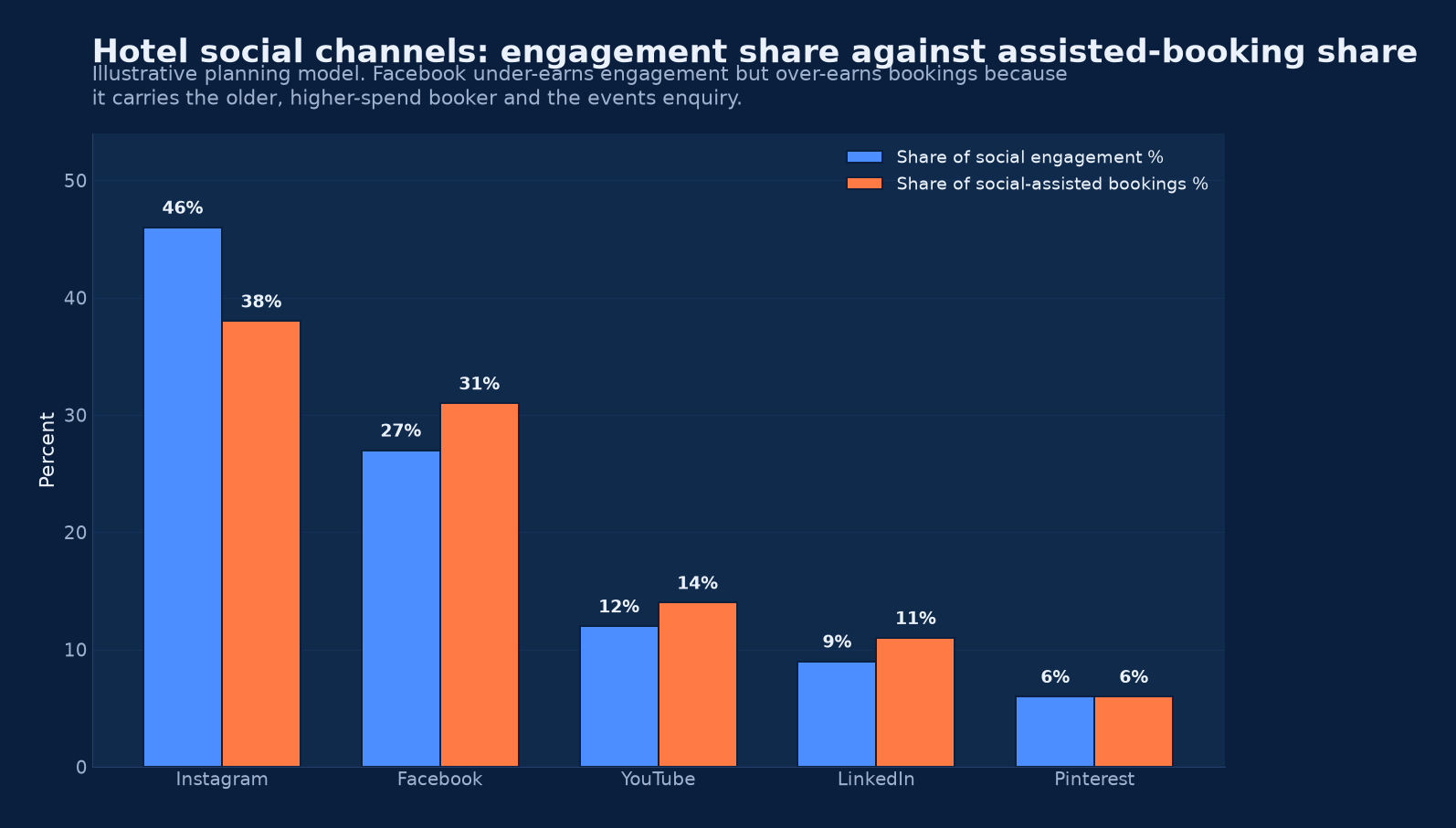
Chart values are an illustrative planning model based on typical UMC engagements and published industry benchmarks. They are not a guarantee of results on any specific project.
| Channel | Primary booker | Job | Non-negotiables |
|---|---|---|---|
| Leisure 25-44, dream and plan stages | Desire plus decision support | Reels cadence, stories with rate and booking sticker, highlights as a mini-site | |
| Leisure 45+, locals, events enquirers | Community, events, local demand | Events listings, reviews responses, outlet pages linked | |
| YouTube | Planners and high-consideration stays | Long-form proof and search presence | Walkthroughs, wedding films, chapters and titles written for search |
| Corporate, meetings, trade | Rooms-night and event pipeline | Sales team voices, case notes, venue facts | |
| Wedding and destination planners | Shelf-life discovery | Boards by season and event type, fresh pins from existing assets |
Where a property cannot staff five channels we run two well – usually Instagram and Facebook plus one outlet channel – and say plainly which audiences that leaves unserved, because honest scope beats five dead channels.
The long window: why social looks worthless to last-click
A guest sees a reel in March, saves it, discusses it, and books in May through a metasearch click that last-click attribution credits to paid. On hotel data the median gap between first social touch and confirmed booking runs three to five weeks for leisure and longer for weddings, which means a report that judges social on same-week bookings measures a quarter of its work – and then kills the channel that was feeding the next two months.
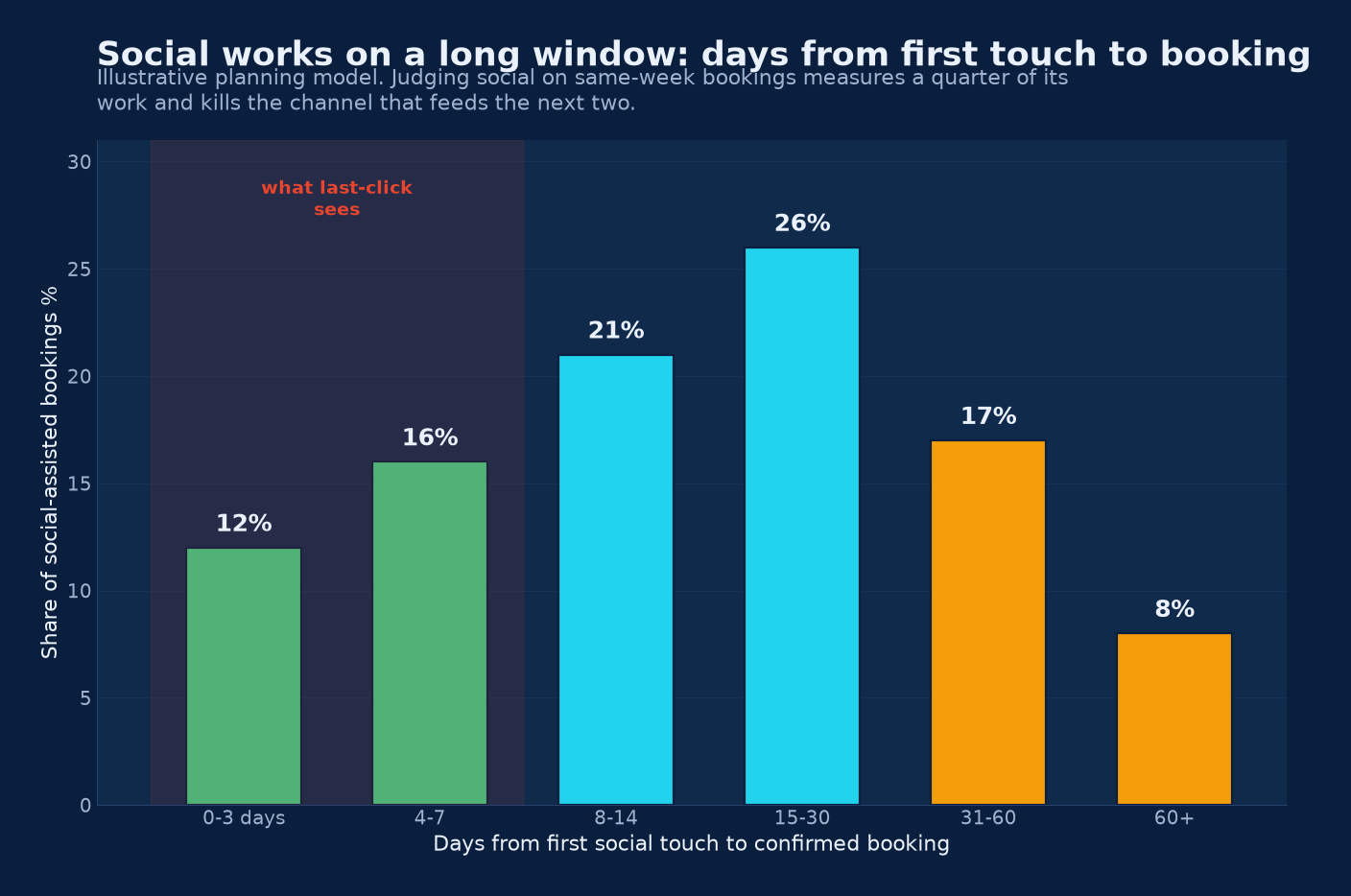
Chart values are an illustrative planning model based on typical UMC engagements and published industry benchmarks. They are not a guarantee of results on any specific project.
| Attribution view | What it credits to social | Use it for | Never use it for |
|---|---|---|---|
| Platform last-click | Same-session bookings only | Sanity checks | Budget decisions |
| Platform data-driven | Modelled assists within window | Channel comparison | Board reporting alone |
| GA4 / engine reconciled assists | Touch paths ending in confirmed stays | Monthly board number | Weekly optimisation |
| Holdout or geo test | Incremental bookings vs no-social market | Quarterly truth check | Weekly optimisation |
We report all four on one page with the variance stated, because the argument about social’s value ends the day everybody sees the same four numbers. The reconciliation build is our BI dashboards practice and the tracking underneath is the same GA4 foundation the paid programme relies on.
The asset pipeline: shoots, UGC and rights
Most hotel channels die in week six for one reason: the launch shoot ran out. A living channel needs a pipeline – two to four planned shoots a year timed to seasons and offers, a standing shot list by pillar, staff with phones trained to capture service moments, and a user-generated programme that asks guests for permission properly and files the rights with the asset. The library is governed: every asset tagged by pillar, room type, outlet and season, so a shoulder-season offer in year two finds its imagery in minutes.
- Seasonal shoot calendar tied to the demand curve and the offer plan
- Standing shot list by pillar: rooms, food, people, place, proof
- Staff capture programme with simple rules and a weekly collection point
- UGC permission flow: ask, record, credit, file the rights with the asset
- Library governance: tagging, expiry for dated offers, no stock imagery of other properties
- Edit pipeline: captions, subtitles, thumbnails and platform-native crops from one master
Community management: DMs are a booking channel
A guest who messages “price for two nights in June?” is hotter than any lead form. Hotels lose those bookings silently, because the DM sits unread until the guest books an OTA that answered in four minutes. We run community management as a reservations function: response SLAs by channel and hour, templated-but-human answers for rates and policy, a DM flow that carries dates and guests into the booking path, and a handoff rule for anything a human must own – complaints, weddings, group blocks, press.
| Message type | SLA | Owner | Path |
|---|---|---|---|
| Rate and availability | Under 1 hour in business hours | Community manager | DM flow to booking path with dates pre-filled |
| Complaint in public | Under 30 minutes | Duty manager plus community manager | Acknowledge publicly, move to private, resolve, close the loop publicly |
| Wedding or event enquiry | Same day | Events sales | CRM record with source tagging |
| Press or creator | Same day | Marketing lead | Brief and contract path |
| Group or corporate block | Same day | Sales | CRM record and proposal path |
Every enquiry that becomes a record carries its social source into the CRM, which is how a wedding that enquires on Instagram and signs eight months later still credits the channel that found it.
Creators and fam trips: buying reach money cannot
A creator whose audience trusts them can move a shoulder season in a way no boost can, and a fam trip that hosts six relevant creators costs less than one weekend of metasearch. The difference between a free stay and a programme is the brief: deliverables, usage rights, disclosure, dates and the metrics that will judge it. We tier creators by audience match rather than follower count – a 12k account of regional wedding planners outranks a 400k travel generalist for a wedding lawn – and we contract for assets the property keeps, because the reel is worth one weekend and the file is worth years.
| Tier | Typical profile | Exchange | What we contract for |
|---|---|---|---|
| Macro | National travel or lifestyle, 250k+ | Paid fee plus stay | Deliverables, usage rights, exclusivity window |
| Mid | Regional travel, food or weddings, 40-250k | Fee or stay plus fee | Deliverables, usage rights, affiliate or code tracking |
| Micro | Niche local or interest, 8-40k | Stay plus expenses | Deliverables and usage; disclosure compliance |
| Trade and planners | Wedding planners, corporate travel buyers | Fam trip | Relationship, pipeline, no posting obligation |
Disclosure is not optional and not awkward: paid and gifted collaborations are labelled per platform and per market regulator, and a programme that hides its gifts is a compliance liability wearing a media plan. The method is our influencer marketing practice, with hotel-specific tiers and fam-trip logistics on top.
Outlets: the restaurant, the spa and the lawn need their own voice
A property channel cannot serve a Friday-night local crowd and a dream-stage traveller in Singapore in the same feed. Outlets with genuine local demand get their own channel or at least their own content line: menus that change, service moments, price-band honesty, events that end. The outlet programme ties into local search – the map pack answers “spa near me” and the outlet channel answers “which spa” – which is the local half of our hotel SEO programme.
Paid amplification: boost what earned it, never everything
Boosting is a tool, not a strategy. The rule we run: organic proof first – a post that already out-performs its pillar baseline earns amplification; a post that needs a boost to exist was the wrong post. Amplification budgets then follow three jobs only: extending a proven post to a lookalike of your booker profile, retargeting engaged audiences into the booking path, and filling a specific need period the organic calendar cannot reach alone. The campaigns themselves sit with our Meta work inside the Meta advertising practice and the Instagram advertising practice, coordinated with the paid media programme so social retargeting and metasearch do not bid against each other for the same guest.
Weddings, events and the LinkedIn pipeline
The highest-value social enquiry in most full-service hotels is not a room night; it is a wedding or a conference block, and it arrives through channels marketing teams under-invest in: a planner saving Pinterest boards, a couple tagging each other in a reel, an executive assistant reading a LinkedIn venue note. We build the event content line – capacity facts, floor plans, real weddings with permission, sample timelines – and the LinkedIn presence that puts those facts in front of planners and corporate buyers, because a lawn photographed beautifully with its capacity stated honestly outsells a mood film with no numbers.
Crisis, complaints and the public reply
Every hotel has a bad week: a power cut, a pool closure, a review storm, a viral complaint. The difference between an incident and a reputation event is the first public reply – fast, factual, owned, and moved to a private channel without disappearing. We write the crisis playbook before the crisis: holding statements by scenario, approval chain with names and phone numbers, the rule that nobody argues in public, and the closing-the-loop post after resolution, which is the one most properties forget and the one that repairs the record.
- Holding statements pre-written for the six scenarios hotels actually face
- Approval chain with named owners and out-of-hours contacts
- Public acknowledge, private resolve, public close – never argue in the thread
- Staff guidance: what employees may and may not post during an incident
- Post-incident review feeding the playbook and the operations fix
The playbook lives in the same document set as the voice guide, so the person answering at 11pm is not improvising tone under pressure.
Twelve weeks to an engine that runs without heroics
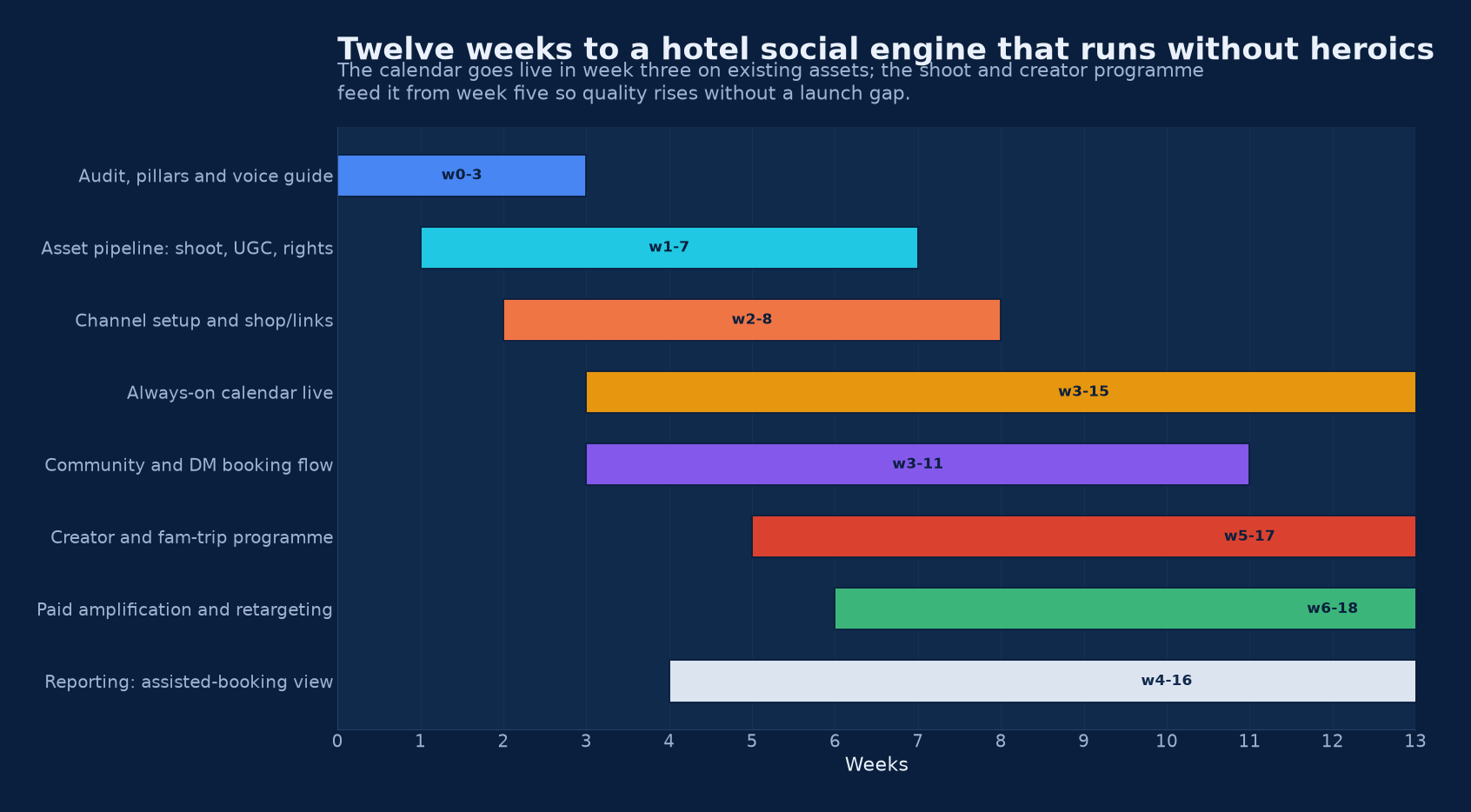
Chart values are an illustrative planning model based on typical UMC engagements and published industry benchmarks. They are not a guarantee of results on any specific project.
Weeks one to three audit the channels, write the pillar and voice guide, and stand up the calendar on what already exists, because a channel that pauses for a rebuild loses the audience it had. The asset pipeline and channel commerce links – shop, booking stickers, highlight mini-site – land by week six; community SLAs and the DM flow go live with the calendar; creators start in week five so their content lands inside the first quarter; and the assisted-booking report appears in week four, baseline first, so every later number has something honest to beat.
| Deliverable | Week | Evidence you receive |
|---|---|---|
| Pillar and voice guide | 3 | Written guide with examples from your property |
| Always-on calendar live | 3 | First four weeks published plus the rolling plan |
| Community SLAs and DM flow | 4 | Response-time report and booking-path test |
| Assisted-booking baseline | 4 | Reconciliation sheet against the engine |
| Channel commerce links | 6 | Highlights, stickers and shop links tested on device |
| Seasonal shoot delivered | 8 | Tagged library with rights recorded |
| Creator programme wave one | 10 | Contracts, deliverables and performance sheet |
| Amplification rules | 12 | Written boost criteria and budget caps by job |
Measurement: the four numbers and the variance
Social reporting for a board should fit on one page: assisted bookings and their value, cost per assisted booking including content production, pipeline from enquiries that became CRM records, and audience health – reach, saves, shares and return visits, not follower count, which is a vanity metric that buys nothing at renewal. Beneath the page sit the channel details; on the page sit the four numbers and the variance between attribution views, stated rather than hidden.
| Number | Definition | Source | Cadence |
|---|---|---|---|
| Assisted bookings and value | Confirmed stays with a social touch in the path | GA4 plus engine reconciliation | Monthly |
| Cost per assisted booking | Fees plus production plus amplification over assisted stays | Finance plus the reconciliation | Monthly |
| Enquiry pipeline | Social-sourced CRM records by type: room, event, corporate | CRM with source tagging | Monthly |
| Audience health | Reach, saves, shares, profile visits, return viewers | Platform analytics | Weekly trend, monthly report |
Follower count appears nowhere on the page, on purpose: it is the metric that survives every failure and therefore proves nothing.
Compliance: disclosure, music, guests and privacy
Hotel social touches three compliance edges at once: advertising disclosure on creator and gifted content, music and footage licensing on reels that use trending audio, and guest privacy – faces, children, and plates in a dining room. We keep a per-market checklist in the programme documentation: disclosure labels by platform and regulator, licensed music sources for brand accounts, consent capture for guest features, and a takedown path when a guest asks to be removed, honoured quickly and without argument.
Voice and tone: writing like a hotel, not like a brand
The fastest way to make good hotel content worthless is to write it in corporate voice. Guests do not book elevated wellness journeys; they book the spa that stays open till ten and the therapist who remembers your shoulder. We write the voice guide as rules with examples from your own property: sentences a concierge would say aloud, prices stated plainly, superlatives earned by evidence, and the three phrases your marketing has overused since 2019 retired with honour. Tone shifts by pillar and by moment – the crisis reply is not the wedding reel – and the guide shows the shift side by side so a new hire can reproduce it in a week.
The guide also states the boundaries: what we never claim (walk times we have not walked, views we cannot show, stars we were not awarded), how we answer price questions in public, and how we say no to a guest request in a comment without sounding like a terms-of-service page. Voice is not decoration in hospitality; it is the first sample of the service.
Low season: what to post when there is nothing to say
Every hotel channel faces the same February: nothing open, nothing launching, nothing to announce. The channels that survive it stop selling and start serving – the place pillar carries the destination when the property is quiet, the people pillar carries the team that is refurbishing, the proof pillar carries last season’s guests remembering. Low season is also the cheapest window to build: creators cost less, shoots face no guests in shot, and content banked in February sells June. We plan the low-season calendar in the high season, from the asset library and the events calendar of the place rather than the property, so the quiet months feed the loud ones instead of starving the channel.
Social commerce: stickers, shops and the booking link
A profile is a mini-site if you build it that way: highlights organised as rooms, offers, outlets, place and policies; story stickers carrying dates and rates into the booking path; link-in-bio landing on a page that knows where the guest came from; and shop surfaces where vouchers, spa packages and event tickets sell without a second platform. Each of these is a five-minute setup and a permanent conversion gain, and each is tested on a real device at setup, because a sticker that opens a dead offer is worse than no sticker – it trains guests to stop tapping. The landing pages themselves belong to the hotel website build, and the UTM discipline that makes the source readable in reports belongs to the measurement layer.
Proof and related capability
Social programmes we have delivered include the resort-group engagement where the organic social engine and the paid programme share one measurement view, and the WordPress-plus-social build for a green hotel and resort published in our case studies. The generic disciplines live in our social media management practice.
Related Services
The practices this programme draws on:
Where this page sits in our hotel programme
This spoke covers organic social. The vertical’s other intents each have their own page, and the hub ties them together:
- Hotels and hospitality – the vertical main page
- Website development for hotels – the pages social links to
- SEO for hotels – the earned search side of the same demand
- Google Ads for hotels – metasearch and paid, including the retargeting handoff
- Hotel CRM & guest loyalty – the retention programme
- Hotel business intelligence – dashboards, pace and forecasting above PMS and POS
- IT support for hotels – managed IT, networks and guest Wi-Fi
- AI for hotels – guest copilots, forecasting and governance
- Guest CRM and loyalty – where social enquiries become records
- Digital marketing company for hotels in Lucknow – the local-intent page
If your property trades in Lucknow or elsewhere in India, the local page carries the regional detail; this page carries the programme.
Frequently asked questions about hotel social media
How many posts per week does a hotel need?
Fewer than you fear: eight to twelve quality pieces across channels beats twenty recycled ones. The pillar cadence table in this page is the honest version, by channel and outlet.
Does social media actually bring bookings?
It assists them on a three-to-five-week window for leisure and longer for weddings. Measured on assisted bookings reconciled to the engine, yes; measured on last-click same-day, deceptively no.
Should the restaurant have its own page?
If it serves locals, yes – its own channel or at least its own content line. A property feed cannot speak to a Friday-night local and a Singapore dreamer at once.
Who answers DMs at 9pm?
Whoever the SLA names, with templates and an escalation chain. If the answer is nobody, the DM flow is not a booking channel yet and we say so in the proposal.
Do we need to pay creators?
Macro and mid tiers usually yes; micro tiers often stay-plus-expenses with clear contracts. Gifted stays without deliverables and rights are donations, not marketing.
Can we use guest photos?
With recorded permission, yes, and it is the best proof content a hotel has. Without permission, no – and we build the ask into the programme so the permission arrives with the photo.
What about trending audio on reels?
On brand accounts, licensed or platform-cleared sources only. Trending audio that is fine on a personal account can be infringement on a commercial one.
How do we handle a viral complaint?
Fast public acknowledgement, private resolution, public close. The playbook is written before the incident, with holding statements and named approvers.
Is follower count worth anything?
As a reach proxy, mildly; as a success metric, no. The board page carries assisted bookings, cost per assisted booking, pipeline and audience health.
Can you work with our in-house content creator?
Yes, and preferably: we bring pillars, calendar, pipeline governance and measurement; they bring the property’s eye. The split is written down so nobody owns the same task twice.
What if our photography is poor?
Then the first deliverable is a shoot plan, because no caption rescues a dark corridor. The pipeline section of this page is how we keep it from running dry again.
How soon will we see results?
Response-time and enquiry metrics move in weeks; assisted-booking trends need a quarter, because the window is the point.
Start with an audit of what social already assisted
Give us channel access and three months of booking-engine numbers, and we will return the assisted-booking baseline plus a pillar plan for your property – yours to keep either way.
Contact Unified Management Consulting to arrange a confidential first conversation.