
Website development for hotels is not website development with a beach photograph on it. A hotel site carries a transaction – rates, availability, payment, cancellation policy, tax – through a booking engine it does not own, on media that is four times heavier than any brochure site, in several languages and currencies, under accessibility law in half the markets it sells into, while a channel manager elsewhere decides what the rate is. Get any one of those wrong and the site looks finished and earns nothing. This page is our scope for building and rebuilding hotel, resort and hospitality-group websites: the architecture, the booking-path engineering, the speed budget, the accessibility work, the migration discipline and the measurement that proves the build paid for itself.
We build for independent properties, small groups, management companies and franchisees, and we deliver remotely: discovery against your live analytics and your PMS sandbox, builds in staging, launch with redirect maps and rollback, handover with documentation your team can actually run. If you are comparing agencies on a portfolio of pretty homepages, this page will read differently, because the homepage is the least important page on a hotel website.
What a hotel website build includes, at a glance
| Component | What We Deliver |
|---|---|
| Booking-path engineering | Rates, availability and payment wired to your booking engine and PMS without a page reload in the money step. |
| Architecture choice | WordPress, headless or React, decided on your group’s need for control, speed and editor autonomy – not on our preference. |
| Speed budget | A written Largest Contentful Paint target of 2.5 seconds on mid-range 4G, enforced in the build, not tested after launch. |
| Accessibility | WCAG 2.2 AA as a brief requirement: booking path, galleries, forms, contrast and keyboard flow. |
| Multi-market | Language and currency variants with correct hreflang and canonical handling so variants never fight each other. |
| Migration discipline | Redirect maps, canonical continuity and ranking monitoring so a replatform does not cost you a season. |
| Structured data | Rooms, offers, events, FAQs, reviews and local business markup, validated before launch. |
| Measurement | Funnel analytics from session to confirmed booking, with the booking engine’s own numbers reconciled against them. |
What hoteliers search for, and what each query really asks for
The queries below arrive at agencies every week, and almost none of them mean “we want a new homepage”. They mean something is leaking money and the website is where the leak is visible.
| Search query | The requirement behind it | What we build |
|---|---|---|
| website development for hotels | A site whose job is confirmed bookings, not impressions | Booking-path-first build with a speed budget and funnel analytics |
| hotel website design company | Design that sells the stay and survives brand review | Design system with room, offer, event and destination templates |
| hotel booking engine website | Rates and availability on the site without a jump to a third-party domain | Booking-engine integration with parity to the channel manager |
| resort website development | Multiple stays, outlets and experiences in one coherent site | Multi-property information architecture with outlet sub-sites |
| hotel website redesign | The current site loses guests and nobody can say where | Funnel diagnosis first, then a rebuild scoped to the leaks |
| WordPress hotel website | Editors who must update rates, offers and events without a developer | WordPress with structured content blocks and role-based editing |
| headless hotel website | A group that wants one content hub feeding web, app and kiosks | Headless build with a content API and preview workflow |
| hotel website not getting direct bookings | Traffic arrives and leaves to an OTA | Rate presentation, trust signals and retargeting foundations in the build |
If your query is not on that list, it is probably a variant of one of them; the scope below is organised by the requirement, not by the wording.
Where a hotel website loses the guest
Most hotel sites lose two thirds of their sessions before a room is seen, and half of what remains before the booking path opens. The losses are rarely mysterious: a homepage that leads with a video instead of rates, a rooms page that hides price until the third click, a booking widget that reloads into a different domain, a mobile menu that buries the book button, and a form that asks for a passport number before asking for a date.
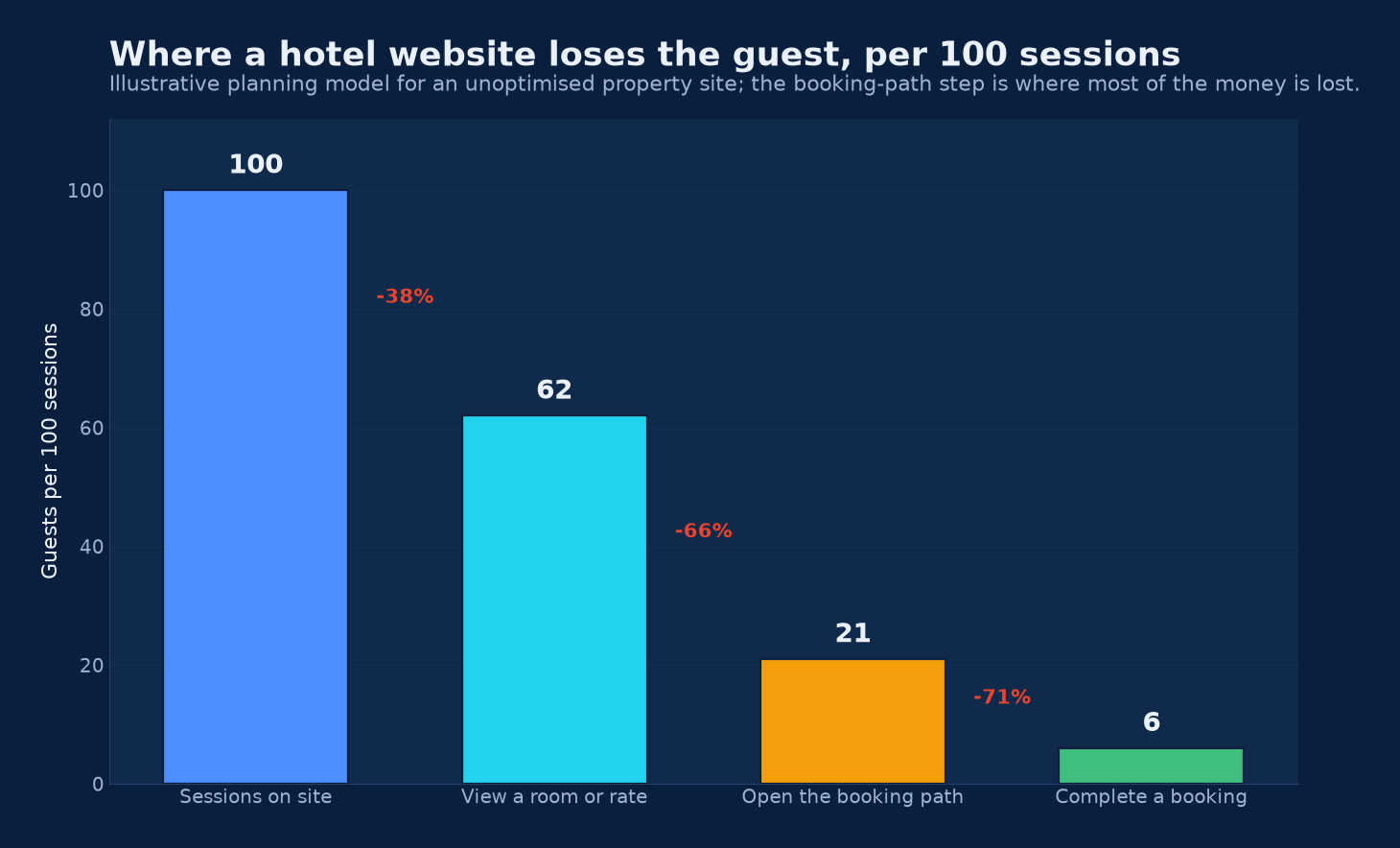
Chart values are an illustrative planning model based on typical UMC engagements and published industry benchmarks. They are not a guarantee of results on any specific project.
| Leak | Typical cause | Fix we build in |
|---|---|---|
| Sessions bounce before rooms | Slow media, no rate signal above the fold | Speed budget, rate-from widget, destination context |
| Room views without booking starts | Price hidden, policy unclear, trust absent | Transparent rate display, policy summary, review evidence |
| Booking starts abandoned | Reload to third-party domain, long form, no guest checkout | In-page engine step, short form, guest checkout, saved quote |
| Completed bookings lost later | Confirmation unclear, no pre-stay journey | Confirmation design, pre-stay email and WhatsApp hooks |
Conversion work is part of the build, not a phase after it. A rebuild that ships the same booking path with new paint has moved nothing, and we will say so in the proposal rather than after the invoice.
Booking engines, PMS and channel managers: the integration layer
The booking engine is the heart of the site and usually the part nobody owns. It sits between your property management system, your channel manager and your payment provider, and each of the three has opinions. We have integrated against the common combinations and we read the API documentation before we promise a behaviour.
| System | Common products | Integration we deliver |
|---|---|---|
| Booking engine | Property-branded and white-label engines | In-page rate and availability steps, no domain jump, abandonment hooks |
| Property management | Oracle OPERA, Cloudbeds, Mews, Little Hotelier, Protel | Reservation write-back, upsell triggers, reporting extract |
| Channel manager | SiteMinder, RateGain, D-EDGE, Cubilis | Parity monitoring so the site never undercuts or overcuts the OTAs |
| Payment | Stripe, Adyen, bank gateways | Tokenised flow that keeps card data out of your PCI scope |
| Rates and offers | Promo codes, member rates, packages | Offer logic with clear terms and no surprise totals at payment |
Two rules we do not break: the site never displays a rate the channel manager would contradict, and the payment step never asks the guest to start over. Both sound obvious; both are violated on most hotel websites we audit.
Choosing the architecture: WordPress, headless or React
There is no best platform; there is a best platform for your operating model. A single property with one marketing manager needs editors who can publish an offer at nine in the morning without a ticket. A twenty-property group with a central brand team needs one content hub, governed templates and an API that feeds web, app and in-room screens. A resort with heavy commerce – gift vouchers, spa packages, event tickets – needs a commerce layer that does not fight the booking engine.
| Architecture | Fits | Strengths | Watch-outs |
|---|---|---|---|
| Optimised WordPress | Single property or small group | Editor autonomy, huge plugin and talent ecosystem, fast to change | Needs discipline to stay fast; plugin sprawl |
| Headless with content API | Groups with central brand and multiple fronts | One content hub, governed templates, front-end freedom | Higher build cost; editors need a preview workflow |
| React / Next front end | Performance-led groups and app-adjacent products | Best speed ceiling, component reuse across brands | Needs in-house or retained engineering after handover |
| WordPress + WooCommerce layer | Resorts selling vouchers, spa and events | Commerce and booking coexist without a second platform | Two transactional surfaces to keep secure and fast |
We recommend in writing, with the reasoning and the three-year cost of ownership, and we will build on the platform your team can live with even when it is not the one we would choose for ourselves. The builds themselves run on our full-stack WordPress, headless and composable commerce and full-stack React practices.
The speed budget: 2.5 seconds or the build is not finished
Hotel sites are media-heavy by nature and slow by habit: forty-megabyte hero videos, uncompressed room galleries, six tracking scripts and a booking widget that loads its own jQuery. Guests on mid-range phones in mid-range networks pay for all of it, and they pay in abandonment. We set a written speed budget in the brief – Largest Contentful Paint of 2.5 seconds on mid-range 4G – and enforce it in code review, because a budget tested only at launch is a post-mortem.
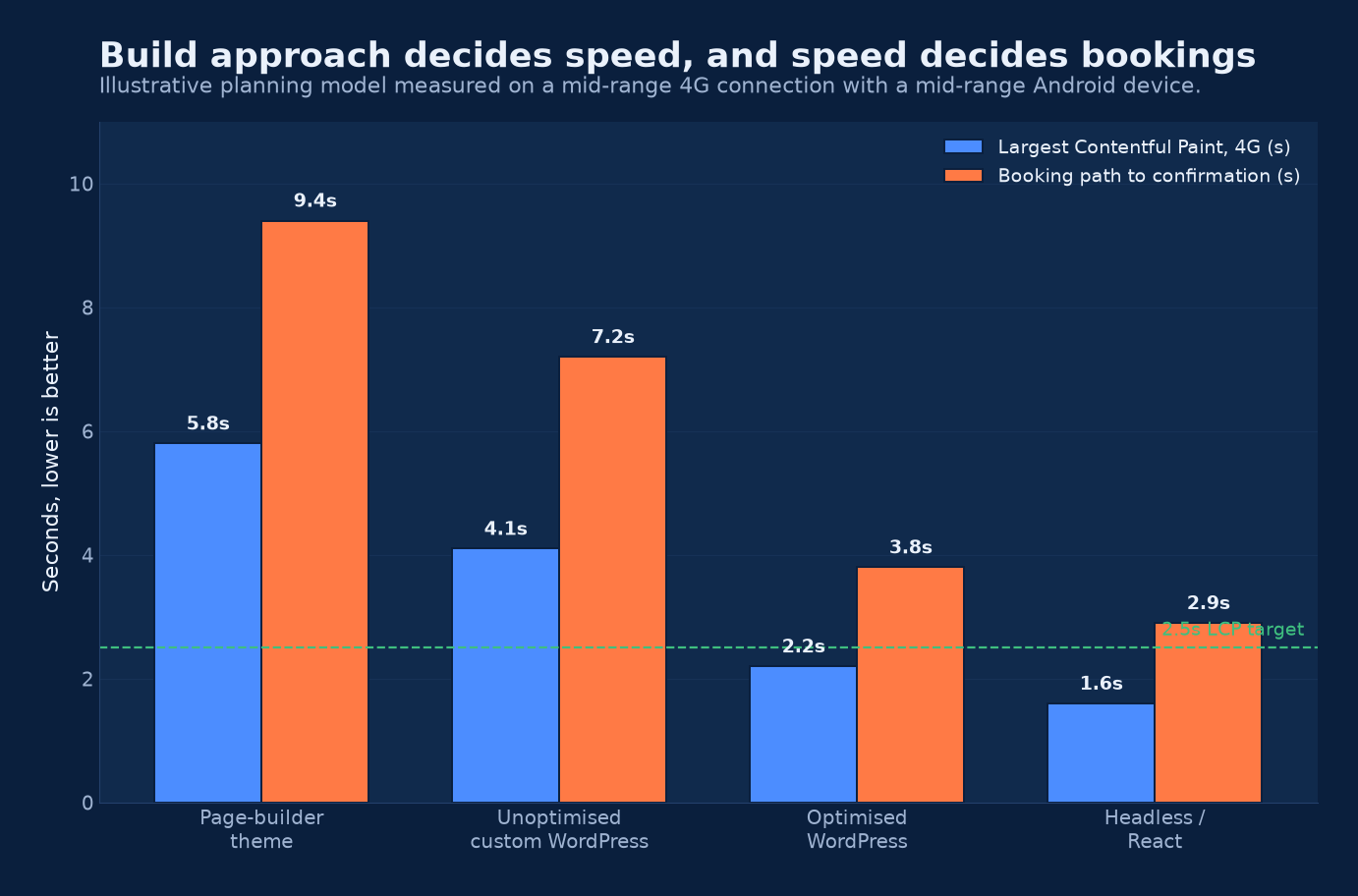
Chart values are an illustrative planning model based on typical UMC engagements and published industry benchmarks. They are not a guarantee of results on any specific project.
- Modern image pipeline: AVIF and WebP with correct dimensions and lazy loading below the fold
- Font budget: two families, subset, preloaded, with swap
- Script governance: every third-party tag justified, deferred or removed
- Critical CSS inlined for the booking path; everything else deferred
- Caching and CDN configuration matched to rate volatility, not to blog assumptions
- Core Web Vitals monitored in the field after launch, via our performance practice
Accessibility and the law, treated as a brief requirement
A hotel website that a blind guest cannot use to book a room is a legal exposure in the United States, the European Union and a growing list of other markets, and a reputational one everywhere. Accessibility is also conversion work: keyboard flow, contrast, focus states and clear labels help every guest on a bright terrace with a cracked screen. We build to WCAG 2.2 AA through our accessibility remediation practice and we test the booking path with a screen reader before launch, because the booking path is where most accessibility failures hide.
Multi-market: languages, currencies and hreflang without self-competition
Groups selling into several markets need language and currency variants, and variants are where hotel sites quietly cannibalise themselves: duplicated English content served at four URLs, hreflang pointing at the wrong variant, canonicals that collapse a German page into the English one. We specify the variant matrix before build – which languages, which currencies, which markets get localised content versus translated content – and we implement hreflang and canonical rules so each variant owns exactly one market.
Information architecture and the content model of a hotel
A hotel is not a brochure; it is a small portfolio of sellable things – rooms, suites, offers, meeting spaces, outlets, spa, events, destination – each with its own buyer, its own season and its own search queries. The information architecture has to let each of them rank and convert on its own while keeping the property coherent.
| Content type | Buyer | Must carry | Template needs |
|---|---|---|---|
| Rooms and suites | Leisure and corporate bookers | Real rates, bed and occupancy facts, views, floor, photos that match reality | Rate widget, comparison, upsell to next category |
| Offers and packages | Price-sensitive and seasonal demand | Inclusions, blackout dates, terms in plain language | Offer card, validity logic |
| Meetings and events | Planners and agencies | Room capacities by layout, floor plans, AV, catering menus | Enquiry form with date and headcount, RFP download |
| Food, beverage, spa | Locals as well as guests | Menus, hours, price bands, reservation path | Outlet sub-site with local SEO hooks |
| Destination and neighbourhood | Dream-stage travellers | What is actually near, seasonal calendar, honest distances | Editorial template with internal links to rooms |
The content model is specified as structured content, not as free-form pages, so an editor adding a room in two years produces a page that still ranks and still converts. Our website strategy and information architecture practice owns this layer.
The homepage: five seconds to earn the booking path
Guests decide in about five seconds whether a hotel site understands them. In that window the page must answer four questions without a scroll: where am I, what does a night cost, is it available on my dates, and can I trust this with my card. Most hotel homepages answer none of the four; they answer “what does our brand video look like”. We design the first screen as a decision surface – property identity, a rate-from signal wired to live availability, a date picker that survives the scroll, and one unmissable path to booking – and we put the brand story immediately below it, where it can do its job without blocking the transaction.
- Rate-from widget fed by the booking engine, cached for speed and labelled honestly
- Date and guest picker persistent across the whole site, not just the homepage
- Three trust signals above the fold: review score, location truth, and policy clarity
- Destination context for the dream stage, linked through to rooms and offers
- A single primary action per screen; everything else is navigation
Room and suite pages: the anatomy of a page that converts
The room page is the product page of a hotel, and it is where most sites fail the guest who is already convinced. Photographs that flatter rather than describe, bed sizes omitted, floor and view unstated, price revealed only after three clicks, and a gallery of forty near-identical images that loads for eleven seconds. We specify room pages as structured product pages: facts first, media second, price always visible, and a comparison link to the next category so the guest can trade up without leaving the page.
| Element | Why it matters | Standard we build to |
|---|---|---|
| Facts block | Size, bed, occupancy, view, floor, accessibility features | Visible without interaction, in the guest’s language |
| Honest media | Guests book the room they were shown | Six to ten images plus one short walkthrough clip, compressed |
| Price and terms | Hidden price is the fastest abandon trigger | Rate-from plus what is included, and the cancellation rule in one line |
| Category comparison | Upsell without a dead end | Link to the next category with the delta stated in facts, not adjectives |
| Social proof | Doubt kills the booking path | Room-level review excerpts where the platform allows them |
Structured room content also feeds search: rooms, offers and amenities expressed as schema are the difference between a room page that ranks for “deluxe sea view room” and one that only exists inside a booking widget.
Offers and packages: terms in plain language
An offer page with buried exclusions is a complaint generator and a refund liability. We build offer templates that state inclusions, blackout dates, booking window and cancellation rule in plain language above the fold, with the legal detail one click away rather than three. Offers are structured content with validity logic, so an expired package stops appearing on the site and in search on the day it expires, without anyone remembering to unpublish it.
The commercial point is equally blunt: an offer that merely discounts teaches the market to wait. The offers we build add value the property already owns – late checkout, breakfast, spa credit, event access – because added value protects rate integrity while a discount erodes it, and because value-added packages are what metasearch and search campaigns can promote without training guests to hunt for the cheapest night.
SEO foundations baked into the build
A rebuild is the cheapest moment you will ever get to fix technical SEO, because everything is already being touched: URL structure, redirects, canonicals, structured data, internal linking, image alt text, sitemap logic. We ship rooms, offers, events, FAQs, reviews and local-business schema validated before launch, an internal-link model that passes authority from destination content to rooms, and a redirect map that protects every URL that currently earns traffic. The ongoing organic programme lives in our search engine optimisation practice; this page builds the foundation it stands on.
Migration and replatform without losing a season
The scariest sentence in hotel marketing is “we are replatforming before high season”. It is survivable with discipline: a full crawl and ranking baseline before touching anything, a redirect map for every URL with traffic or links, canonical continuity, structured-data parity, a staged launch behind feature flags, and daily ranking and revenue monitoring for thirty days after. Our website migration and replatforming practice runs exactly this, and we have walked replatforms back from the edge often enough to price the monitoring honestly.
- Baseline: rankings, traffic, revenue by landing page, backlinks by URL
- Redirect map reviewed line by line with your team, not generated and trusted
- Launch window chosen against your demand calendar, never against our availability
- Rollback plan tested, because an untested rollback is a wish
- Thirty-day monitoring with a named owner on both sides
Security, payments and PCI scope
Hotel sites take card details, hold guest passports in enquiry forms and sit on the same network as the front desk. We keep card data inside a tokenised flow so your PCI scope stays narrow, minimise what enquiry forms collect, encrypt and expire what must be held, and put the site on a maintenance and patching regime through our managed IT and cybersecurity practices. A hotel website is infrastructure; it gets maintained like infrastructure.
How the build runs: twelve weeks, eight workstreams
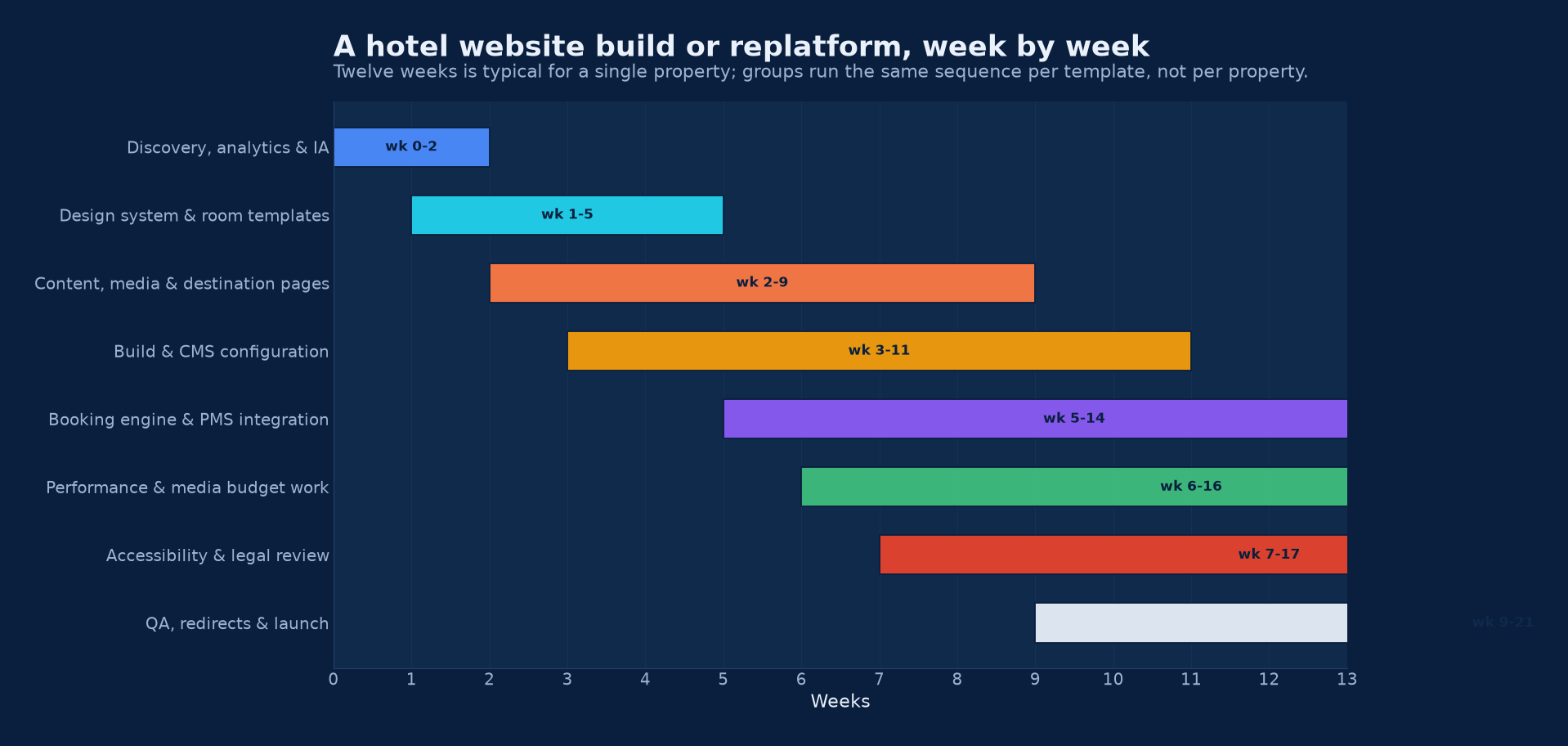
Chart values are an illustrative planning model based on typical UMC engagements and published industry benchmarks. They are not a guarantee of results on any specific project.
Discovery reads your analytics, your booking engine’s numbers and your PMS sandbox before anyone opens a design tool, because the funnel decides the brief. Design produces a system, not a homepage: room, offer, event, outlet and destination templates with real content in them, reviewed on real devices. Build and integration run in parallel with content, so launch is not a content crisis. Accessibility and legal review sit inside the build window, not after it, and launch is a checklist with owners: redirects, schema, sitemap, analytics, speed, screen-reader pass, rollback.
| Handover item | What you receive |
|---|---|
| Editor guide | How to publish rooms, offers and events without breaking templates |
| Integration documentation | Booking engine, PMS and channel-manager behaviour as built |
| Speed and accessibility report | Field and lab numbers at launch, with the budget restated |
| Measurement setup | Funnel from session to confirmed booking, reconciled to engine data |
| Support model | Named route, response times, patching cadence, via maintenance and support |
Pricing and engagement models
| Model | Fits | Indicative shape | Includes |
|---|---|---|---|
| Audit and roadmap | Deciding whether to rebuild or repair | Fixed fee, 2 weeks | Funnel, speed, accessibility, SEO and integration review with a costed roadmap |
| Single-property build | One hotel or resort | Fixed fee by milestone | Design system, build, integrations, launch, handover |
| Group template programme | Multi-property groups | Template build + per-property rollout | Templates, governance, rollout support, central measurement |
| Retained engineering | Post-launch evolution | Monthly hours | Feature work, performance, accessibility and security upkeep |
Media and licences are never marked up, and the audit is yours to keep whether or not we build.
Who owns the website after launch
The most common failure mode of a hotel website is not a bad build; it is an orphaned one. Six months after launch the rates are stale because nobody owns the offer template, the events page still advertises a festival that ended, and the speed has decayed because four new tracking scripts arrived without a review. Ownership is therefore part of the deliverable: a named owner on your side for content, a named owner on ours for the platform, a monthly change cadence with a standing agenda, and editor training recorded on video so the next hire inherits the method rather than guessing at it.
We also write the rules down: which changes an editor may make alone, which need a reviewer, and which must come back to us because they touch the booking path, the payment flow or the structured data. A website with written rules ages slowly; a website without them ages into a liability, and the rebuild you then commission costs double because half the budget goes to undoing drift. Our maintenance and support practice practice is the retained form of exactly this discipline, and most clients move onto it after the first quarter because the alternative is silent decay.
How we measure a hotel website build
| Measure | Definition | Source | Cadence |
|---|---|---|---|
| Booking-path conversion | Sessions reaching a confirmed booking | Analytics + engine | Weekly |
| LCP in the field | 75th percentile Largest Contentful Paint | Field data | Weekly |
| Direct share of bookings | Brand.com against all channels | Channel report | Monthly |
| Enquiry-to-event conversion | RFP and event enquiries becoming booked events | CRM | Monthly |
| Accessibility defects | Open WCAG AA issues on the booking path | Audit tooling + manual | Monthly |
| Organic visibility | Rankings and clicks for room, offer and destination queries | Search console | Weekly |
The build is judged against the baseline taken at discovery. If the funnel does not improve, the project is not finished, and that clause is in our statement of work.
Proof and related capability
Hospitality builds we have published include the WordPress build for a green hotel and resort and the social advertising case study for that resort for the same resort group – the pair shows the build and the demand programme working as one engagement.
Related Services
The practices this build draws on:
- Website development services
- Full-stack WordPress development
- Full-stack React development
- Headless and composable commerce
- Core Web Vitals and performance
- Accessibility and WCAG remediation
- UX and UI design
- Website strategy and information architecture
- Website migration and replatforming
- Web application maintenance
- WordPress WooCommerce development for large projects
- Search engine optimisation services
- Custom CRM development
- Cybersecurity services
- Contact us
Where this page sits in our hotel programme
This spoke covers the build. The vertical’s other intents each have their own page, and the hub ties them together:
- Hotels and hospitality – the vertical main page
- SEO for hotels – the organic programme for hotel queries
- Google Ads for hotels – metasearch, PPC and paid media programme
- Social media marketing for hotels – content, creators and community
- Hotel CRM & guest loyalty – the retention programme
- Google Ads management – metasearch and paid search for hotels
- Hotel business intelligence – dashboards, pace and forecasting above PMS and POS
- IT support for hotels – managed IT, networks and guest Wi-Fi
- AI for hotels – guest copilots, forecasting and governance
- BI dashboards – the measurement layer above PMS and POS
- AI agents – pre-booking concierge and operations copilots
- Website development company for hotels in Lucknow – the local-intent page
If your property trades in Lucknow or elsewhere in India, the local page carries the map-pack and regional detail; this page carries the build.
Frequently asked questions about hotel website development
How long does a hotel website build take?
Twelve weeks is typical for a single property, from discovery to launch. Groups take longer because templates and governance come first; the per-property rollout after that is fast.
Will we be able to update rates and offers ourselves?
Yes. Editors get structured blocks for rooms, offers and events with role-based permissions, and a written guide. If a change needs a developer, the template was designed wrong.
Do you replace our booking engine?
Only if it is the bottleneck. Usually the win is integrating the engine properly – in-page steps, no domain jump, parity with the channel manager – rather than swapping it.
Can you work with our existing brand guidelines?
Yes, including franchise brand books. We design inside them and flag, early, where a guideline hurts conversion, with a compliant alternative.
What if our photography is poor?
We specify the shoot: shot list by room type and outlet, lighting and staging notes, and a media pipeline that keeps the result fast. Bad photography cannot be fixed in code.
How do you keep the site fast with so many images?
A written media budget: modern formats, correct dimensions, lazy loading below the fold, and a critical path that never waits on a gallery.
Do you handle multiple languages and currencies?
Yes, with a variant matrix specified before build and hreflang and canonical rules implemented so variants never compete with each other.
Is the site accessible to guests with disabilities?
WCAG 2.2 AA is a brief requirement, tested with a screen reader on the booking path before launch, and re-tested after major changes.
Will a rebuild hurt our search rankings?
It should help them. We baseline rankings and revenue by URL, map every redirect, keep canonical continuity and monitor daily for thirty days after launch.
Can the site sell vouchers, spa packages and event tickets?
Yes, through a commerce layer that coexists with the booking engine without a second platform to maintain.
Who maintains the site after launch?
You can, or we can, through a named support route with response times and a patching cadence. The choice is priced in the proposal, not discovered later.
Do you build for management companies and franchise groups?
Yes. Central brand teams get governance and templates; property teams get autonomy inside them, and the centre keeps one measurement layer.
Start with a funnel and speed audit
Give us analytics access and your booking engine’s last three months, and we will return a written view of where the site loses guests and what the rebuild would recover first.
Contact Unified Management Consulting to arrange a confidential first conversation.