
Hotel managers are not short of AI offers. They are short of an answer to a simpler question: which decisions on this property would be better if a model made or informed them, what would that cost, who would own the failure, and what do we need to have fixed first? The honest answer for most properties is that the interesting part of AI in hospitality is not the chatbot – it is the unglamorous sequence behind it: clean guest and revenue data, an integration layer that does not depend on a single vendor’s goodwill, a governance rule about what a model may say to a guest and what it may not decide about price, and staff who understand the difference between a suggestion and an instruction. Get those and several useful models become possible; skip them and the first pilot becomes a demo that quietly stops being used.
We deliver hotel AI programmes the way we deliver hotel BI and hotel IT: assessment first, one guest-facing pilot with guardrails, models that sit on your reporting layer rather than beside it, governance written down and tested, and enablement so the property can run the thing without us. This page is the depth page for that discipline. The vertical overview is the hotels and hospitality main page, the data foundation is our hotel business intelligence page, and the infrastructure the models run on is covered in IT support for hotels.
What hotel AI consulting covers, at a glance
| Component | What We Deliver |
|---|---|
| Readiness and use-case screen | Which decisions would improve, what data exists to improve them, and what must be fixed first. |
| Guest messaging copilot | Answers to repeat questions in your voice, with escalation rules and a human always reachable. |
| Forecast and pace models | Demand, pace and rate guidance on your own reporting layer, inside the revenue manager’s window. |
| Operations optimisation | Housekeeping sequencing, staffing levels and maintenance predictive triggers. |
| Data and integration groundwork | PMS, POS, channel manager, CRM and messaging in one model, not five exports. |
| Governance and risk | What AI may say to a guest, what it may never decide, audit trails and consent. |
| Staff enablement | Shift-level training, prompt libraries and a review cadence. |
| AI ROI scorecard | Deflection, conversion, labour hours and satisfaction, reported monthly, including the misses. |
Where AI actually earns its place in a hotel
Value and risk are not the same ranking. Guest messaging scores highest on value because the volume of repeat questions is enormous and the cost of a slow answer is a lost direct booking; it scores low on risk because a wrong answer about breakfast hours is correctable in seconds. Revenue rate guidance scores almost as high on value but carries the most risk in the programme, because a model that moves price without a human in the decision can destroy a segment in one weekend and destroy the revenue manager’s trust for a year. The screen below is how we sequence, and it is the first artefact any hotel AI engagement produces.
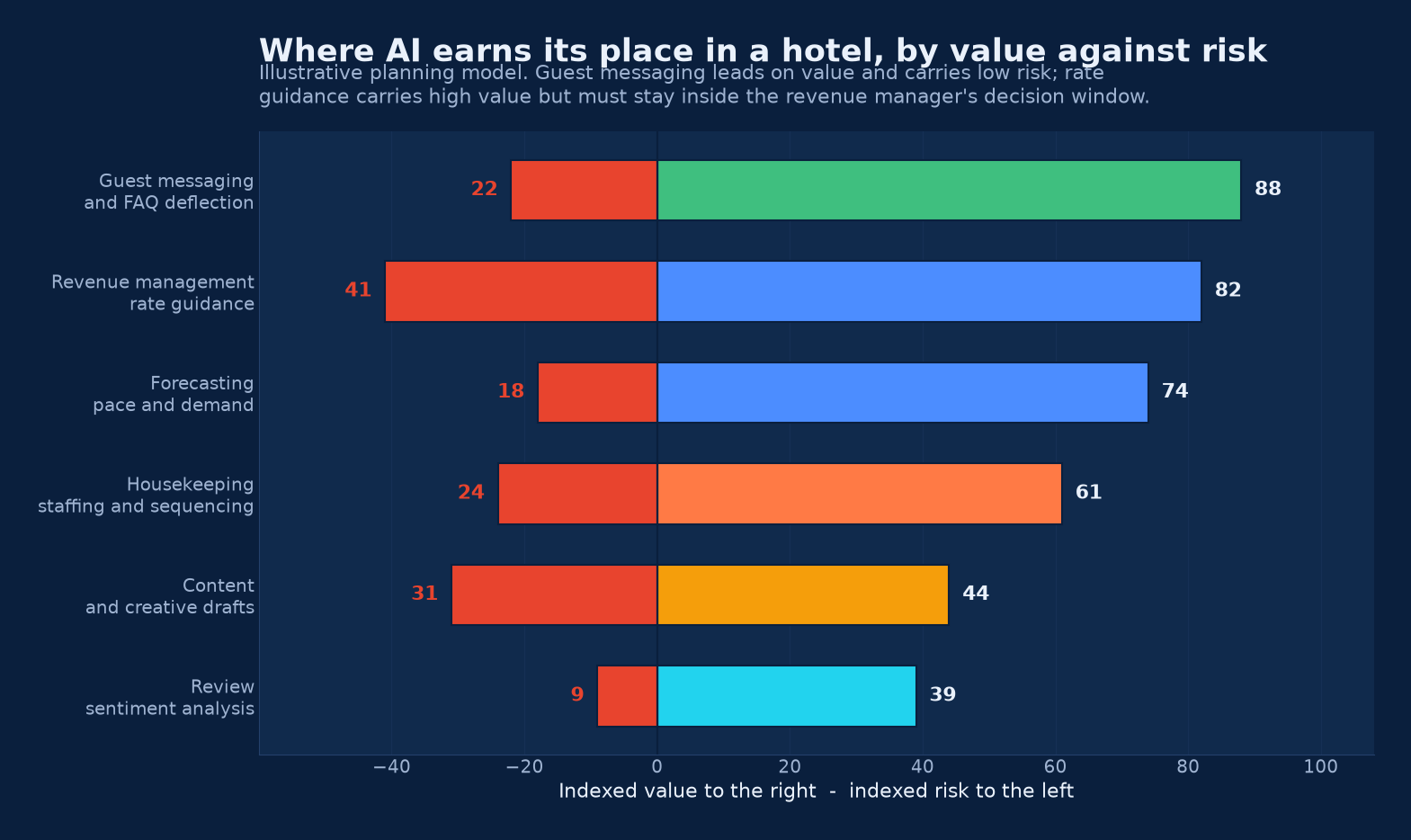
Chart values are an illustrative planning model based on typical UMC engagements and published industry benchmarks. They are not a guarantee of results on any specific project.
| Use case | Value driver | Risk profile | Human in the loop? |
|---|---|---|---|
| Guest messaging and FAQ deflection | Answered faster than any rota can; direct-booking questions captured | Low – wrong answers are cheap to correct | Escalation on request, complaint and payment topics |
| Review and sentiment analysis | Themes surfaced weekly instead of quarterly | Low – reads public text | Human writes the response |
| Forecast, pace and rate guidance | Fewer missed windows, better rate decisions | High – money moves on the output | Mandatory: model suggests, manager decides |
| Housekeeping and staffing optimisation | Labour hours matched to arrivals and departures | Medium – affects staff, not guests directly | Supervisor confirms the plan |
| Content and creative drafts | Faster campaigns and page copy | Medium – brand and legal exposure | Human edits and approves |
| Maintenance prediction | Fewer guest-facing failures | Low-medium – false positives cost inspection time | Engineer triages |
The last column is the one to negotiate before signing anything. A hotel AI programme whose money-touching outputs have no named human is a governance failure with a good demo attached.
What has to be true before the first model
Three things, and they are not exciting: the data exists in one place, the integrations are not vendor-hostage, and somebody owns the AI decisions. A property with a PMS whose reporting API closes at 5pm, a channel manager that cannot export pace history, and no named owner will produce a pilot that works in a sandbox and dies in production. That is why we run the readiness assessment as a real assessment with a written verdict rather than a sales conversation, and why the groundwork workstream overlaps the first pilot instead of preceding it by six months.
| Precondition | How we test it | What we do if it fails |
|---|---|---|
| One source of truth for stays, rates and guest records | Row-count and definition check across PMS, POS, channel manager, CRM | Build the extract and dictionary first – the BI spoke’s workstream |
| Stable machine access, not spreadsheets | API, database or scheduled export test with a 30-day window | Negotiate vendor access or add an integration layer |
| Named owner and decision rights | Written RACI for AI outputs | Stop and get the owner appointed before spending |
| Consent and privacy position | Mapping of markets sold into against capture records | Fix capture in the CRM spoke before profiling guests |
| Staff baseline | Two workshops per department | Enablement moves earlier in the roadmap |
Readiness is not a gate that delays the programme; it is the part that makes the rest of it survive the first busy quarter. Our generic service page on the same subject is AI readiness assessment and roadmap; this page is the hospitality version of it.
The guest messaging copilot, done properly
The copilot is the first thing guests touch, so it is built to fail politely. It answers the questions that repeat – parking, breakfast hours, late checkout, airport transfer, pet policy, whether the pool is heated – in the property’s own voice, using only approved content as its source, and it escalates by rule rather than by guesswork: any complaint, any payment or refund, any accessibility or medical need, any legal or safety topic, and any guest who asks for a human, goes to a person with the conversation history attached. Everything else it answers, and every answer is logged with the source document it came from so a wrong answer can be traced and the content fixed rather than the model blamed.
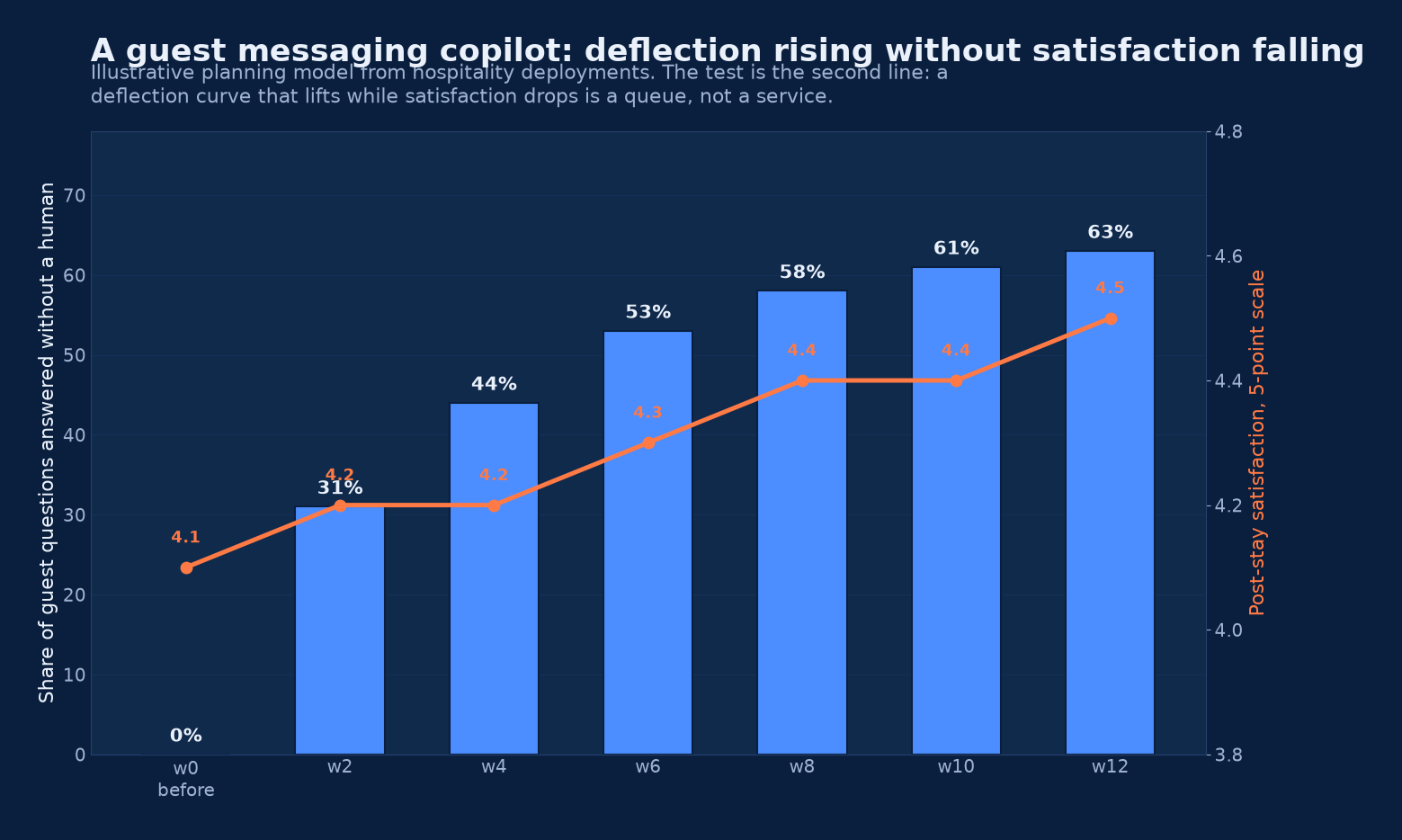
Chart values are an illustrative planning model based on typical UMC engagements and published industry benchmarks. They are not a guarantee of results on any specific project.
Deployment is staged: pre-arrival on the website and confirmation email, in-stay on the messaging channel guests already use, and post-stay for the low-stakes questions that arrive at 11pm. The metric set is small and unforgiving – share of questions answered without a human, median first-response time, escalation accuracy, post-stay satisfaction on the questions the copilot handled, and direct-booking conversations started from a guest answer. We report all five monthly, including the escalations that should have happened earlier.
Forecasting, pace and rate guidance on your own data
This is where hotel AI stops being customer service and starts being revenue discipline, and it is also where the honesty requirement peaks. A demand model for a hotel has to survive compression nights, a wedding that books out two floors, a competitor refurbishment, a new flight route, and a pandemic-shaped outlier in the training data. Models that ignore those produce confident nonsense; models that account for them need the event calendar, the group bookings and the market data attached, which is an integration problem before it is a modelling problem. We build pace and demand models on the BI layer the property already uses so the forecast appears next to the actuals in the same view, with the model’s confidence shown rather than hidden, and rate guidance presented as options with the reasoning attached – never as an automatic price move. Our generic pages on the same ground are predictive analytics and demand forecasting and hotel business intelligence.
| Model | Inputs it needs | Decision window it serves | Failure mode to guard |
|---|---|---|---|
| Demand and pace forecast | OTB history, events, market data, lead-time mix | 90 days out, weekly | Ignoring one-off events and reading them as demand |
| Rate guidance | Forecast, competitor rates, segment mix, inventory left | 60-7 days out, daily | Moving price without a human and breaking segment trust |
| No-show and cancellation risk | Booking source, lead time, deposit, guest history | At booking and at 48 hours | Penalising OTA guests who are simply new to you |
| Housekeeping labour plan | Arrivals, departures, stayovers, room types, absence history | 48 hours out, daily | Optimising for rooms cleaned rather than rooms ready in time |
| Maintenance triggers | Asset age, failure history, occupancy, sensor data where present | Rolling | False positives that teach engineers to ignore alerts |
Each model ships with a plain-language explanation of what moved the number, because a revenue manager who cannot interrogate a forecast will not use it, and a housekeeping supervisor who cannot see why Tuesday is short-staffed will override it.
Operations AI: housekeeping, maintenance and the back office
The least glamorous AI in a hotel is often the most valuable, because it addresses the cost lines a general manager controls directly. Housekeeping sequencing matched to arrival times and departure patterns reduces both overtime and the guest waiting in the lobby for a room that was cleaned in the wrong order. Maintenance triggers derived from asset age, failure history and occupancy catch the air-conditioning unit that fails every July before a guest reports it. In the back office, invoice and purchase-order capture, roster drafting against forecast demand, and supplier price-variance detection remove hours that nobody enjoys spending. None of these need a frontier model; most need clean history, a supervisor who trusts the output, and a rule that the plan is confirmed by a human before it reaches the shift board.
Governance: what AI may say, decide and remember
Hotel AI governance has four questions and they must be answered in writing before the first guest sees anything. What may the system say? Approved content only, no invented amenities, no medical or legal advice, no price commitments beyond what the booking engine can honour, and a clear statement that a human is available. What may it decide? Nothing that moves money, changes a guest’s reservation terms, or affects a staff member’s roster without confirmation. What does it remember? Guest data only where consent exists, for the retention period the market requires, with profiling separable from service. And what happens when it is wrong? A named escalation, a correction path, a log entry with the source document, and a monthly review of the errors that matter. This is the hospitality-shaped version of AI governance, risk and compliance, and it is the deliverable an auditor, an insurer or a brand standard asks for.
| Governance question | The rule we write | How it is verified |
|---|---|---|
| What may it say? | Approved-content-only answers; escalation topics listed | Weekly sample review plus complaint-driven testing |
| What may it decide? | No price, no terms, no roster without human confirmation | Permission matrix tested quarterly |
| What does it remember? | Consent-linked retention; profiling separable | Retention report against the CRM consent map |
| Who is accountable? | Named AI owner per property with escalation rights | RACI reviewed at every quarterly business review |
| What if it is wrong? | Correction path, logged source, monthly error review | Error register with themes and content fixes |
Where a group operates in several markets, the governance document carries the market-specific differences as an appendix rather than three competing versions, because a policy with three versions is a policy with none.
Integration: the part vendors underquote
Every hotel AI vendor demonstrates against their own clean dataset. The property’s reality is a PMS with an on-premise database, a channel manager that exports CSV on a schedule, a POS from a different era, a CRM that arrived with the brand, and messaging split across three channels. The integration workstream therefore covers extract and load for each system, identity resolution so one guest is one guest, an event path for real-time triggers such as check-in or a complaint, and a fallback for when an API changes without notice – which it will. We specify it as the same object model the BI layer uses, because two models of the same property is how a forecast and a dashboard end up disagreeing in front of the owner. The generic service pages behind this work are AI integration across ERP, CRM and operations and data engineering for AI and knowledge systems.
A twenty-week roadmap that leaves the property able to run it
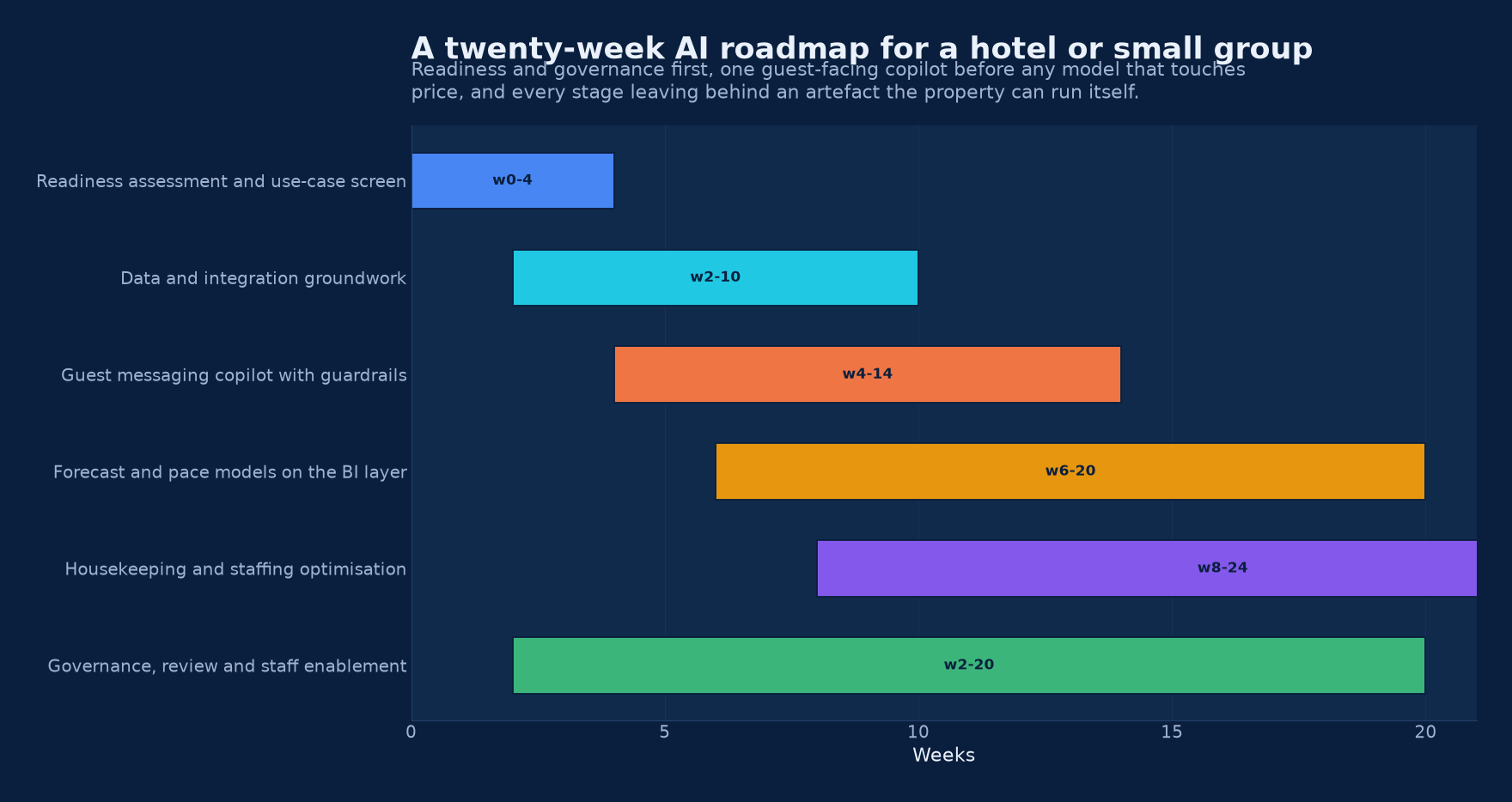
Chart values are an illustrative planning model based on typical UMC engagements and published industry benchmarks. They are not a guarantee of results on any specific project.
Weeks one to four are the readiness assessment and use-case screen, with the written verdict and the sequenced list. Data and integration groundwork starts in week two and runs to week ten; governance is drafted in parallel and stays under review to the end. The guest messaging copilot goes live in week ten behind guardrails, with a two-week supervised period before it answers without review. Forecast and pace models build from week six on the BI layer and reach the revenue manager’s desk by week fourteen. Housekeeping and staffing optimisation runs weeks eight to sixteen, ending with a supervisor-confirmed daily plan. Staff enablement and the handover package close the programme at week twenty.
| Deliverable | Week | What the property keeps |
|---|---|---|
| Readiness verdict and use-case screen | 4 | Sequenced list with owners and value cases |
| Integration and object model | 10 | Documented extracts, dictionary and fallbacks |
| Guest copilot live with guardrails | 10 | Approved content base, escalation rules, logs |
| Forecast and pace models | 14 | Models on the BI layer with confidence shown |
| Housekeeping and staffing optimisation | 16 | Daily plan confirmed by the supervisor |
| Governance pack and error register | 18 | Policy, RACI, permission matrix, review cadence |
| Enablement and handover | 20 | Prompt library, training recordings, runbooks, owner appointed |
The other side: guests who ask an AI instead of a search engine
Hotel AI is not only inward-facing. A growing share of trip planning starts with a traveller asking an assistant to shortlist properties – “family-friendly hotels near the convention centre with a pool, under this budget” – and the answers those assistants give are drawn from content that is structured, consistent and quotable. That changes three things on the property’s side of the fence. Amenities and policies need to be stated in machine-readable form on your own site rather than living only in an OTA’s free-text box, because the assistant cites what it can verify. Rate and availability claims must be consistent across your site, your channel manager and your brand page, since a contradiction between sources usually drops you from the shortlist rather than choosing one. And the copilot’s own answers become part of the public record of what your hotel offers, which is a second reason the approved-content base must be accurate rather than merely plausible.
We treat that as one workstream with two halves: the outward half is AI search optimisation – structured data, entity consistency, answer-shaped content and monitoring of how assistants describe the property – and the inward half is the copilot that answers the same questions on your own channels with the same approved facts. Running them separately is how a hotel ends up telling an assistant one thing and its own chatbot another. The generic discipline is AI search optimisation and AIEO services; the hospitality application sits with our hotel SEO spoke and this one.
Buying AI in hospitality: three routes, one test
Properties arrive at AI by three routes: a vendor’s bundled feature inside the PMS or channel manager, a specialist point solution for messaging or revenue management, or a build on their own data. Each is defensible, and each fails in a characteristic way. Bundled features are cheap and shallow – they answer what the vendor anticipated, and their data stays inside a product you may not keep. Point solutions are strong at one job and indifferent to your object model, so they duplicate guest identity rather than resolve it. Builds are expensive first and then cheap, but only if the data groundwork was real. The single test that distinguishes them is portability: if the vendor leaves, does the property keep the approved content, the conversation logs, the model configuration and the data? If not, you are renting a capability you will need to rebuild later.
| Route | Best when | Watch for | Portability |
|---|---|---|---|
| Bundled PMS or channel feature | Small property, limited IT, one channel | Depth ceiling and data locked in the product | Low |
| Specialist point solution | One acute problem: messaging or rate | Duplicate guest identity and another dashboard | Medium |
| Build on your own data | Group, multiple sources, BI layer in place | Groundwork cost and the need for a named owner | High |
| Hybrid: point solution on your data layer | Most properties | Contract terms on data export and retention | Medium-high |
Most of our hotel engagements end up hybrid, and the negotiation that matters is the export clause in week one, not the demo in week four.
Costs, ROI and the scorecard that survives scrutiny
Hotel AI costs are usually mis-estimated in both directions: the licence is smaller than expected and the enablement is bigger. Budget lines that recur across engagements are the integration work, the approved-content build and its maintenance, the governance and audit artefacts, staff time in workshops and training, and the ongoing review cadence – a monthly error review and a quarterly content refresh, which somebody must be paid to attend. Against that, the returns we measure are deflection hours saved at the desk, direct-booking conversations influenced, forecast accuracy improvement expressed as revenue variance, labour hours moved rather than added, and satisfaction on handled interactions. The scorecard carries the misses too, because a hotel AI programme that reports only wins is a programme that nobody is actually reading. Our generic service page for the measurement discipline is AI ROI measurement and executive scorecards.
| Return line | How it is measured | Typical horizon |
|---|---|---|
| Desk hours saved | Deflected questions multiplied by average handle time | First quarter after go-live |
| Direct bookings influenced | Conversations that reached the booking engine, attributed conservatively | Two quarters |
| Forecast accuracy | Mean absolute error against actuals, before and after | Two to three quarters |
| Labour hours moved | Overtime reduction against planned hours | Two quarters |
| Satisfaction on handled interactions | Post-stay score segmented by handler type | Continuous |
| Error and escalation cost | Corrections, complaints and staff time on overrides | Continuous – reported honestly |
Multi-property and brand groups
Groups buy AI once and deploy it many times, which changes the shape of the programme: brand voice and approved content live centrally, market-specific policy differences live in an appendix, models are trained per property but governed per brand, and the scorecard rolls up so head office sees the properties where enablement failed rather than only the average. The practical difficulty is rarely technology – it is that properties differ in PMS versions, channel managers and staffing maturity, so the deployment sequence follows readiness rather than the org chart. We publish the readiness verdict per property and let the group decide whether to sequence by readiness or by strategic priority; both are reasonable, and saying so in writing prevents the argument later.
The risks hoteliers should refuse to accept
A short list, because the long list belongs in the governance pack. Refuse a copilot that invents amenities – a promised spa that does not exist is a compensation claim and a review. Refuse automated price moves without a human decision record. Refuse guest profiling without a consent basis you can demonstrate. Refuse any deployment whose data cannot be exported when the contract ends. Refuse staff-facing optimisation rolled out without the supervisors who will be blamed for it. And refuse a vendor who cannot show the error log, because a system with no logged errors has no logged usage.
Proof and related capability
The practices behind this page are AI readiness assessment, AI agents and automation deployment, AI product engineering, AI integration, AI governance, risk and compliance, AI training and team adoption and AI ROI measurement. In hospitality the engagements combine those practices with the reporting and infrastructure work described in the BI spoke and the IT support spoke.
Related Services
The practices this programme draws on:
Where this page sits in our hotel programme
This is the eighth spoke of the hotels vertical. The others own the disciplines AI feeds or depends on:
- Hotels and hospitality – the vertical main page
- Website development for hotels – where the copilot meets the booking path
- SEO for hotels – organic demand and AI search visibility
- Google Ads for hotels – paid demand the models help price
- Social media marketing for hotels – where guests decide before they book
- Hotel CRM and loyalty – consent and guest identity AI depends on
- Hotel business intelligence – the layer the models sit on
- IT support for hotels – networks, uptime and the systems AI reads
- Digital marketing company for hotels in Lucknow – the local-intent page
If your property trades in Lucknow or elsewhere in India, the local page carries the regional detail; this page carries the programme.
Frequently asked questions about AI for hotels
What is the first AI use case a hotel should adopt?
Guest messaging with approved content and escalation rules. It has the highest volume of repeat questions, the cheapest errors, and it produces the content discipline every later use case needs.
Will AI replace our revenue manager?
No. It shortens the analysis and widens the options; the rate decision stays with a human, because accountability for a price move cannot be delegated to a model.
Do we need a data warehouse before starting?
You need one model of the property and stable machine access. That can be a light extract layer for a single property; a warehouse becomes worth it when sources multiply.
How do we stop the copilot inventing things?
Approved-content-only retrieval, escalation topics listed explicitly, logged sources per answer and a weekly sample review. Guardrails are a configuration and a process, not a hope.
What does a hotel AI programme cost?
Assessment first and priced separately; then integration, content build, governance and enablement, which together usually exceed the licence. We quote the lines individually.
How long until guests notice a difference?
The copilot is guest-visible at week ten in our standard roadmap, and deflection is measurable in the first month after that.
Is guest data safe with AI?
It is safe when consent exists, retention is enforced, profiling is separable and the vendor contract limits training use. Those four conditions are in the governance pack we deliver.
Can AI help with reviews?
For analysis, yes – themes and sentiment weekly. For responses, it drafts and a human approves, because a templated reply to a genuine complaint makes it worse.
What about staff resistance?
It is usually about being measured rather than about technology. Enablement with supervisors present, confirmation rights on any plan that affects shifts, and a scorecard that reports misses all reduce it materially.
Do you build or buy for us?
We screen both and recommend, then implement the recommendation. Most properties end up hybrid: a point solution running on their own data layer.
How is success reported?
A monthly scorecard: deflection, response time, escalation accuracy, forecast error, labour hours moved, satisfaction and the error register.
Can you work with our existing PMS vendor?
Yes, and we start there: vendor cooperation determines which integrations are cheap. Where access is refused we say so in the assessment rather than promising around it.
Start with the assessment and one honest verdict
Give us two weeks with your systems and your department heads, and we will return the use-case screen, the readiness verdict and the costed sequence – including the use cases we would not start with.
Contact Unified Management Consulting to arrange a confidential first conversation.