
Dealerships are unusually good candidates for applied AI and unusually bad candidates for AI enthusiasm. Good, because the work is full of patterns that machines handle better than a rota of executives – routing an enquiry, scoring a lead against a delivery history, forecasting service demand from a delivered parc, reading a registration document, flagging a unit that has been on the yard for ninety days. Bad, because the value of each of these depends entirely on data that sits in vendor-controlled systems, on consent that has to be lawful, and on branch staff who will abandon any tool that slows them down in front of a customer.
So the useful question is never ‘what AI can we use’ but ‘which decision is currently made badly, often, and with data we can already reach’. Answered that way, the sequence writes itself: a readiness assessment to find the open data routes, one pilot with a measurable outcome, agents and automation in production with evaluation and monitoring, governance over anything that touches a customer or a price, and an ROI scorecard that reports the change rather than the technology.
What an engagement includes, at a glance
| Component | What We Deliver |
|---|---|
| Use-case selection by value against risk | A ranked list where each candidate has a decision it improves, a metric that proves it, an effort estimate, a data route and a failure consequence – not a list of techniques. |
| Lead scoring and routing | Every enquiry scored against delivered-lead history and routed to the branch and executive most likely to convert it, with the score explained and the outcome fed back. |
| Enquiry-response assistants | Out-of-hours and overflow capture on WhatsApp, chat and voice, answering from governed inventory and price data, escalating to a human with the context attached. |
| Test-drive and service scheduling | Bookings made against real demonstrator, bay and consultant capacity, with reminders and no-show prediction. |
| Service demand and stock forecasting | Workshop load, parts requirement, enquiry volume and stock cover forecast from history, calendar effects and the delivered parc. |
| Stock, ageing and pricing intelligence | Days-in-stock trajectories, discount-need prediction and margin guidance per unit and model, with the reasons visible to a sales manager. |
| Document and image AI | Extraction from KYC, finance and registration documents, and image assessment for exchange valuation and damage – with a human sign-off step and an accuracy record. |
| Evaluation, monitoring and drift control | A test set per use case, accuracy and fairness checks, production monitoring, cost per transaction, and a rollback path when a model degrades. |
| Governance, consent and the human in the loop | Which decisions may be automated, which need a person, how a customer can ask why, how data access is scoped and logged, and how the whole estate is audited. |
What AI is worth in a dealership, and what it is not
There is a version of dealership AI that is a chatbot on a website and a slide about the future, and there is a version that changes a number in the funnel. The difference is not model quality. It is whether the use case sits on a decision that is made often, badly and with data the business can already reach – and whether the output can be evaluated, monitored and explained when a sales manager disagrees with it. This section is deliberately sceptical, because the expensive mistake in this sector is buying a capability before choosing a decision.
| Use case class | Example in a showroom | Why it works | Why it fails | Verdict |
|---|---|---|---|---|
| High-volume routing and scoring | Score every enquiry against delivered-lead history and route it to the right branch and executive | Thousands of small decisions a month, a clear outcome label, data already in the CRM and DMS | Scored on form fills instead of deliveries; no feedback loop; nobody trusts an unexplained number | Do this first |
| Capture and triage assistants | Answer an out-of-hours WhatsApp enquiry with stock facts and a bookable slot, then hand over | Demand arrives outside staffed hours; the assistant captures rather than replaces | Answering from an ungoverned model with stale stock and prices; no escalation rule | Do this second, with a knowledge source and a human path |
| Forecasting | Predict service load, enquiry volume and stock cover for the next quarter | Strong seasonality, a long history, a clear error measure | Forecast produced once and never re-measured; no owner for the error | High value, low risk – do it early |
| Document and image extraction | Read KYC, finance and registration documents; assess exchange-vehicle condition from photographs | Repetitive, rules-bound, expensive in staff time | Deployed without an accuracy record or a human sign-off step; errors reach a customer or a lender | Valuable with a human in the loop |
| Pricing and discount guidance | Recommend a discount band per unit from ageing, market and margin data | Margin leakage is measurable and large | A recommendation that overrides commercial judgement without explanation, or leaks a pricing rule | Valuable, needs governance and explainability |
| Conversational showroom surfaces | A virtual showroom assistant that guides a configurator conversation | A differentiated customer experience where the data is clean | Expensive to build and to keep accurate, hard to evaluate, and it faces the customer directly | Later, after the harness exists |
| Content generation at scale | Model descriptions, offer copy, social captions, service explainers | Volume work with a brand and compliance constraint | Published without review, producing claims the branch cannot honour | Useful with an approval step |
| Internal knowledge assistants | Answer a technician’s or executive’s question from manuals, schemes and process documents | Reduces search time; low customer risk | Answers from documents that are out of date, with no citation | Good second-tier candidate |
| Autonomous customer commitments | An assistant that agrees a price, a delivery date or a refund without a person | Almost never appropriate in this sector | A commercial or legal commitment made by a system nobody can defend | Do not do this |
- The judgement about what to automate is a management decision with a technology dependency, which is why it belongs near the top of the business – unified top-level management setting the boundary, and IT and marketing operating inside it.
- Where AI is being considered as part of a wider repositioning – a group consolidating brands, moving to a hub-and-spoke branch model – the use-case list should follow the strategy rather than precede it: business strategy consulting first.
- The sector comparison is instructive: retail and e-commerce automates against high-frequency basket data, hotels against reservation and rate data, and a dealership against a six-week funnel with an ownership tail – different data, different sequence, the same discipline.
Sequencing by value against risk
The ordering below is the one we would defend in a board meeting: start where a data route is already open, the outcome is labelled by an event that already happens, and the cost of being wrong is a misrouted lead rather than a wrong price quoted to a customer. Each step also builds an asset the next step reuses – the evaluation harness, the access model, the monitoring pattern – which is why the second use case costs less than the first even when it is harder.
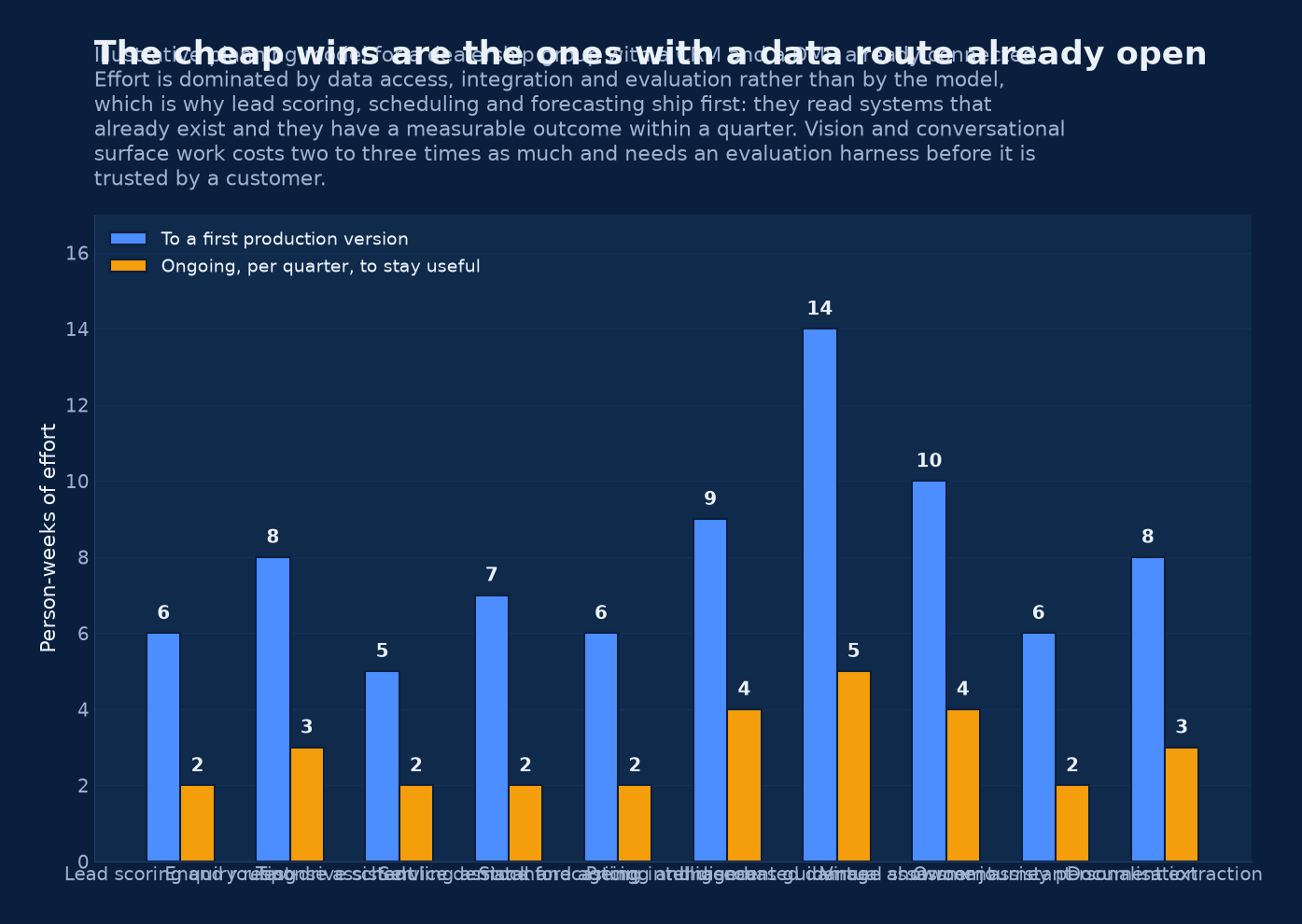
Chart values are an illustrative planning model based on typical UMC engagements and published industry benchmarks. They are not a guarantee of results on any specific project.
| Order | Use case | Value if it works | Risk if it fails | Prerequisite | Metric that proves it |
|---|---|---|---|---|---|
| One | Lead scoring and routing | More of the same demand converted; response time inside the SLA | A good lead routed badly – recoverable, visible, fixable | A CRM record with outcome codes and a delivery join | Qualified-lead-to-delivery rate, response time, cost per delivered unit |
| Two | Enquiry capture and triage assistant | Out-of-hours demand captured instead of lost | A wrong stock or price answer to a customer | A governed knowledge source and a human escalation path | Captured enquiries outside hours, handover rate, correction rate |
| Three | Service demand forecasting | Right rostering, parts holding and bay scheduling | A wrong forecast absorbed by a manual override | Twelve to twenty-four months of service history | Forecast error, utilisation, jobs delayed for parts |
| Four | Test-drive and appointment scheduling | Higher show rate, better demonstrator use | A double booking, which is embarrassing and fixable | Capacity data per branch and slot type | Show rate, slot utilisation, booking abandonment |
| Five | Stock ageing and clearance signals | Discount given earlier and smaller; less cash in the yard | A clearance recommendation ignored or over-followed | Days-in-stock and holding-cost data | Average days in stock, discount leakage, holding cost |
| Six | Document extraction with sign-off | Faster finance and registration processing | A misread field reaching a lender or a customer | A human review step and an accuracy record | Processing time, first-pass accuracy, rework rate |
| Seven | Pricing and discount guidance | Margin protected per unit with a defensible reason | A pricing rule exposed or a wrong recommendation acted on | Margin data, governance and explainability | Margin per unit, discount variance against guidance |
| Eight | Internal knowledge assistant | Less time searching schemes, manuals and process documents | An outdated answer to a staff question | Document currency and citation | Time saved, answer acceptance rate, citation checks |
| Nine | Owner journey personalisation | Higher service capture, retention and referral | A message sent without a lawful basis or at the wrong time | Consent state and journey triggers | Service capture by interval, referral enquiries |
| Ten | Virtual showroom and configurator assistant | A differentiated pre-visit experience | A customer-facing failure with brand consequences | A clean model, variant and stock dataset plus an evaluation harness | Sessions assisted, enquiries per assisted session, correction rate |
- Sequencing is engineering management, not enthusiasm: the pattern is a short readiness assessment, one pilot in production, then a scale-out with the harness reused – forward-deployed engineering working beside the branch rather than in front of it.
- The business case for the sequence should be written in the language of the P&L: hours saved, discount leakage reduced, cash released from the yard – the same arithmetic as cost rationalisation and working capital recovery.
- A use case that cannot name its metric should not be funded, and the metric definitions come from the CRM programme rather than from the model vendor.
The foundations: data access, identity and the metric layer
Every dealership AI programme that stalls, stalls here. A model cannot score a lead that was never recorded, cannot quote a stock position from a feed that is two days stale, and cannot be trusted if the access it uses is a shared admin login. The foundations are the same ones the data and support disciplines build – a governed metric layer, scoped service identities, monitored pipelines – and an AI programme that skips them produces a demonstration instead of a system.
| Foundation | What has to exist | Why AI specifically needs it | How it is verified |
|---|---|---|---|
| One customer and lead record | Deduplicated, with source, stage and outcome codes | Scoring needs labels; assistants need context on the person asking | Duplicate rate, outcome-code coverage, label completeness |
| Delivery join | One identifier from enquiry to DMS invoice | The only honest target variable for a sales model | Join rate per month, with exceptions reviewed |
| Fresh stock and price data | Availability, variant, price and scheme data on a schedule | An assistant that quotes a sold unit destroys trust immediately | Feed freshness monitoring, sampled against the yard |
| Service and ownership history | Jobs, intervals, warranty, plans per vehicle | Retention and forecasting models need the parc, not the campaign | Interval coverage, feed completeness by branch |
| Scoped service identities | A named, least-privilege account per model or agent | So access can be audited, revoked and attributed | Access matrix, permission review, log coverage |
| Data retention and consent state | Consent per channel carried into the model’s input | So an assistant or journey never contacts somebody who opted out | Consent coverage report, suppression tests |
| Knowledge source with currency | Schemes, manuals, process documents with version and date | So answers cite governed facts rather than plausible ones | Citation checks, currency review per document class |
| Monitoring and pipelines | Freshness, row counts, failures, latency, cost per transaction | Because a silent feed failure looks like a model failure | Alert tests, run history, incident notes |
| Evaluation set | A held-out sample per use case with a labelled outcome | Because accuracy claims without a test set are marketing | Test-set refresh schedule and score history |
| Rollback and override | A way to turn a model off or bypass it per branch | Because a degraded model must not take the funnel down with it | A rehearsed rollback, recorded |
- The data half is a warehouse and pipeline project with a model at the end of it: warehouse and lakehouse work plus systems integration, where AI integration with ERP, CRM and operations is the specific discipline of giving a model governed access to trading systems.
- The access half is an IT programme: scoped identities, MFA, logging and vendor terms, which sits with managed IT services and is evidenced by IT audit and compliance rather than asserted in a policy.
- Customer data at model scale is a security question before it is a capability question: security controls over the training and inference paths, plus backup and recovery for the artefacts a model depends on.
- The foundations are reusable, which is the real argument for sequencing: the second use case inherits the access model, the monitoring and the harness.
Lead scoring and routing: the first production model
Scoring is the right first model because it is small, reversible and measurable in weeks. Every enquiry arrives with a source, a model interest, a locality and a time of day; the record history says which combinations delivered. A score that ranks enquiries and a routing rule that assigns them to the branch and executive most likely to convert does not require a customer to trust anything – it requires the sales team to trust the queue. That trust comes from explanation and from a feedback loop, not from accuracy alone.
| Element | Design choice | Why it matters | How it is checked |
|---|---|---|---|
| Target variable | Delivered unit, not form fill or qualified flag | Optimising a proxy produces more proxies | Join rate reviewed monthly; label definition published |
| Features | Source, model band, locality, time of day, message content, prior contact, stock availability | Features must be available at scoring time, not later | Feature availability audit and drift monitoring |
| Model class | A simple, explainable model first; complexity only if it earns it | A branch manager will not act on a number nobody can explain | Compare against a rule baseline before shipping |
| Output | A band with a reason, not a bare probability | Reasons drive behaviour; probabilities drive arguments | Reason coverage and executive acceptance rate |
| Routing rule | Branch, model skill, current workload and shift, with capacity limits | A perfect score routed to a full queue is still lost | Queue depth, response time and conversion per executive |
| Feedback loop | Outcome codes written back within twenty-four hours | Without labels the model degrades silently | Label latency and completeness per branch |
| Fairness and consistency | No scoring on protected or proxy attributes; parity checked | A model that under-serves a locality is a commercial and ethical failure | Parity checks by locality and source, reviewed quarterly |
| Human override | An executive or manager may reassign, with a reason recorded | Overrides are training data and a trust mechanism | Override rate and the reasons behind it |
| Failure mode | Fall back to round-robin if the model or feed fails | A scoring outage must not stop routing | Failover test with the model disabled |
| Reporting | Score band against actual conversion, by branch and month | Calibration drift is invisible without it | Calibration chart in the weekly review |
- The score is only as good as the record behind it, so the CRM discipline is a co-requisite: custom CRM development and integration with outcome codes, and the showroom CRM programme that defines the stages the model is trained on.
- Routing performance is a pipeline question, and the analysis of which executives and branches convert is sales and pipeline analytics – the model changes the order, the analytics proves the effect.
- Scores must reach the people who act on them, which is a delivery problem: a manager view in the dashboard set and an alert in the branch channel rather than a nightly export.
- Because scoring decides who gets a customer, it is a governed decision: AI governance covering the feature policy, the parity checks, the override log and the explanation a customer could be given.
- Where paid media buys the demand being scored, the same joined outcome trains the bidding as well as the model – the Google Ads programme and the scoring model share a target variable.
Enquiry-response assistants and the out-of-hours queue
Showroom demand does not respect trading hours: a large share of enquiries arrives in the evening and at the weekend, when nobody is at the desk, and an enquiry that waits until Monday has usually been answered by somebody else. An assistant that captures the model, the locality and the preferred contact, answers factual questions from governed stock and price data, books a slot against real capacity and hands over to a human with the context attached converts lost evenings into booked test drives. The discipline that makes it safe is the boundary: what it may answer, what it must escalate, and what it must never promise.
| Capability | What it may do | What it must not do | Control |
|---|---|---|---|
| Capture | Ask for model, variant, locality, budget band, contact preference and consent | Store more than the journey needs, or contact without a basis | A field list approved by the business, consent recorded per channel |
| Factual answers | Quote published prices, variants, features, scheme windows, branch hours | Invent availability, discount or delivery dates | Answers retrieved from governed sources with citation; refusal by default |
| Stock questions | Report availability from the live feed with a stated timestamp | Promise a unit that is not confirmed | Freshness threshold; stale feed triggers escalation |
| Booking | Offer real slots against demonstrator, bay and consultant capacity | Double-book or invent capacity | Capacity service as the only source of truth |
| Finance questions | Explain the process and documents, and route to a finance officer | Indicate approval, rate or EMI as a commitment | Approved language with a mandatory handover |
| Exchange valuation | Explain the process and book an inspection | Quote a valuation figure | Escalation to the used-vehicle team |
| Complaints | Acknowledge, record and route to a named owner immediately | Argue, defend or close a complaint | A complaint trigger that bypasses the assistant |
| Handover | Summarise the conversation, the model interest and the booking into the CRM | Lose the thread when a human joins | Context written to the record, not only to a chat log |
| Out-of-scope | Say it does not know and offer a callback | Guess | A refusal rate monitored as a health metric |
| Identity and disclosure | State that it is an assistant and how to reach a person | Impersonate a sales executive | Disclosure in the first message; escalation always available |
- The channel matters more than the technology: in India this is a WhatsApp business conversation with routing and retention, not a website widget nobody opens – and the same queue discipline applies to voice and chat through helpdesk and end-user support.
- Factual answers have to come from a governed knowledge source with currency and citation, which is data engineering for AI and knowledge systems rather than a model recalling a brochure.
- A customer-facing assistant is a product with reliability requirements – latency, uptime, versioning, evaluation, cost per conversation – which is AI product engineering work, and it fails publicly when it is treated as a script.
- The assistant has to work on a phone in a branch and on a customer’s phone outside it, so the surface is a mobile experience problem as much as a language one.
- Everything the assistant captures must land in the record with a source, or the CRM funnel will understate the channel it just created.
Scheduling assistants: test drives, service bays and capacity
Booking is the most underestimated AI opportunity in a dealership because it is operational rather than conversational: capacity is finite, demand is lumpy, and the cost of a bad allocation is a customer who waits or a demonstrator that sits idle. A scheduling layer that reads real capacity, predicts no-shows, sequences reminders and rebalances between branches improves show rate and utilisation at the same time – and it does so without asking a customer to trust a machine with anything more than a time slot.
| Scheduling problem | Inputs | What the model or rules do | Outcome measured |
|---|---|---|---|
| Test-drive slots | Demonstrator availability, consultant roster, zone for home drives | Offer feasible slots, prevent double booking, balance across the day | Slot utilisation and show rate |
| No-show prediction | Source, lead age, prior contact, reminder state, distance | Flag at-risk bookings for an extra confirmation step | Show rate improvement on flagged bookings |
| Reminder sequencing | Booking time, channel preference, consent | Choose channel and timing per booking rather than one rule for all | Reminder delivery and show rate by variant |
| Home test-drive routing | Zone, driver roster, fuel, traffic window | Sequence drives to reduce dead mileage | Drives per driver per day and cost per drive |
| Service bay scheduling | Job type, estimated hours, technician skill, parts availability | Fit jobs to bays with parts on hand, reducing idle time | Utilisation, jobs delayed for parts, first-visit fix |
| Courtesy vehicle allocation | Fleet size, job duration, customer priority | Match vehicles to jobs likely to exceed a threshold | Courtesy utilisation and customer satisfaction |
| Delivery bay scheduling | Preparation status, documents, customer availability | Sequence deliveries against preparation completion | Deliveries per day and wait time on the day |
| Cross-branch balancing | Enquiry volume, capacity, distance, model availability | Suggest routing a booking to a nearby branch with capacity | Bookings retained in the group rather than lost |
| Peak-window planning | Forecast demand, roster, demonstrator count | Recommend additional slots, staff or vehicles before the window | Peak-week show rate against the previous year |
| Cancellation recovery | Cancelled and no-showed bookings | Offer the released slot to a waiting enquiry | Recovered bookings per released slot |
- Scheduling is forecasting applied to a calendar, so it inherits the same error discipline: predictive analytics and forecasting with the error measured per branch rather than asserted.
- The slot has to be bookable from every surface a customer uses – the website, a social post, a message thread – which makes the booking path a website and capture dependency before it is a model.
- Capacity decisions have a capital consequence: whether a branch needs a fourth demonstrator or a fourth executive is answered by the utilisation data the scheduler produces.
Service demand, stock and the forecasts that change a roster
Forecasting is the least glamorous and most reliably valuable AI work in a dealership, because the demand is seasonal, the history is long and the cost of being wrong is absorbed by a manual override rather than by a customer. Two forecasts matter most: workshop load, which decides rosters, bay scheduling and parts holding; and enquiry-to-delivery volume, which decides ordering, allocation requests and staffing for a festive window. Both are ordinary statistical problems with an unusual amount of calendar structure – schemes, launches, registration deadlines, festive weeks and interest-rate moves.
| Forecast | Data required | Method worth starting with | Horizon | Error measure | What it changes |
|---|---|---|---|---|---|
| Workshop load | Job history by type, model age, interval mix, seasonality | A seasonal model per branch with event regressors | Weekly, four to thirteen weeks out | Mean absolute percentage error per branch | Technician rostering and overtime planning |
| Parts requirement | Job forecast plus failure rates by model and age | Demand per part class with safety stock by criticality | Monthly | Fill rate and jobs delayed for parts | Fast-moving parts holding |
| Enquiry volume | History, spend plan, scheme calendar, festive effects | A seasonal model with spend and calendar regressors | Weekly to monthly | Forecast versus actual per branch | Duty rotas and executive cover |
| Deliveries | Open pipeline by stage weighted by historical conversion | A stage-weighted pipeline model, reviewed weekly | Monthly to quarterly | Delivered versus forecast with reasons | Allocation requests and revenue planning |
| Stock cover | Delivery forecast, ageing policy, allocation lead time | Cover by model against forecast demand | Monthly | Cover variance and clearance events | Ordering and inter-branch transfers |
| Days in stock trajectory | Arrival date, model, season, market price trend | A survival or hazard model per unit | Per unit, weekly refresh | Predicted versus realised clearance age | Discount timing and size |
| Service retention by interval | Delivered parc by age, capture history | Cohort capture rates with reminder effects | Quarterly | Capture rate forecast versus actual | Reminder timing and journey design |
| No-show probability | Booking attributes, source, reminder state, distance | A classification model per booking | Per booking | Calibration and lift on flagged bookings | Confirmation effort and slot overbooking policy |
| Cash requirement | Stock holding, discount policy, disbursement timing | A cash model driven by the delivery and stock forecasts | Monthly | Forecast versus closing position | Working-capital planning and lender conversations |
| Peak-window uplift | Historical window uplift by model and city | Event-effect estimates from past windows | Per window | Uplift forecast versus realised | Stock, staffing and creative timing |
- Beyond the first seasonal model, the work becomes statistical modelling with business constraints – cohort behaviour, hazard rates, elasticity – which is data science for business analytics and it is worth doing only after the facts reconcile.
- A forecast that is never re-measured becomes a ritual: the error history is the deliverable, which is why forecasting engagements include a review calendar rather than a model handover.
- The stock and cash forecasts are the ones finance cares about, because days in stock is working capital: cash-flow and working capital planning driven by a model rather than by a gut feel about the yard.
- The same techniques transfer to dealer networks and production planning upstream, which is where manufacturing clients usually start.
Stock, ageing and pricing intelligence
Discount is the most expensive decision a dealership makes repeatedly and the least informed. It is usually taken under pressure – a customer in front of an executive, a unit that has been on the yard too long, a month-end target – with no view of what the same unit would have fetched next week or what the holding cost has already accrued. Pricing intelligence is not an automated discount; it is a band, a reason and a timer, presented to the person who holds the authority, early enough to be useful.
| Signal | What it detects | How it is produced | Who acts | Guardrail |
|---|---|---|---|---|
| Ageing trajectory | A unit likely to cross ninety days at the current rate | Hazard model per unit from arrival date, model and season | Stock manager | A recommendation, not an automatic price change |
| Holding cost accrual | What each aged unit has already cost in finance and space | Finance cost plus yard space per day, from the ledger | Sales and finance manager | Published calculation so the number is trusted |
| Market price movement | A model’s market price falling faster than the stock plan assumed | Listed prices, competitor listings, auction and exchange data where available | Pricing owner | Sources and dates shown with every figure |
| Discount leakage | Discount given against authority, by executive, model and month | Quote and invoice data against the authority matrix | Sales manager | Used for coaching, not only for policing |
| Margin at risk | Units where the projected clearance price erodes margin below a threshold | Margin model with holding cost and predicted discount | General manager | Thresholds set by finance, not by the model |
| Variant and colour mix | A mix that arrives and does not clear | Order-to-sale velocity by variant | Purchasing | Feeds the ordering conversation with the manufacturer |
| Demonstrator rotation | A demonstrator approaching the age where it becomes a discount problem | Age, mileage and resale trend per unit | Used-vehicle manager | A rotation schedule decided in advance |
| Pre-owned valuation | An exchange vehicle’s likely retail and disposal value | Age, mileage band, condition inputs, market comparables | Used-vehicle manager | A human inspection confirms before an offer |
| Clearance timing | Whether to discount now or hold for a scheme window | Uplift history for the window against holding cost | Sales manager | A stated reason recorded with the decision |
| Scheme effectiveness | Whether a manufacturer scheme actually moved aged stock | Uplift against a comparable non-scheme period | Marketing and sales head | A control comparison rather than a before-and-after |
- Pricing guidance is a governed decision surface: explainability, an authority matrix and an audit trail are prerequisites, which is AI governance applied to margin rather than to a chatbot.
- The analysis is only actionable if it reaches the person who decides, so it ships as a view in the dashboard set with the reason attached, not as a nightly file.
- Discount leakage and holding cost are the same numbers a margin recovery programme needs, which makes this a natural companion to cost rationalisation and margin recovery.
- Where the group is choosing which models to stock in a new city, the velocity and mix signals become an expansion input: market expansion modelling with local demand rather than national averages.
Document and image AI: extraction with a human signature
Dealerships move a great deal of paper and a growing number of photographs: KYC and address proofs, income documents for finance, registration forms, insurance papers, warranty claims, and images of exchange vehicles for valuation. Extraction and assessment models reduce hours of rekeying and speed a finance application, but they operate on documents that reach lenders, regulators and customers – so the design rule is that a model proposes and a person disposes, with an accuracy record that says how often the proposal was wrong.
| Application | What the model does | Human step | Accuracy record kept | Failure consequence if ungoverned |
|---|---|---|---|---|
| KYC and identity documents | Extract name, address, document number and expiry | An officer verifies against the original | Field-level first-pass accuracy and rework rate | A rejected finance application or a compliance finding |
| Income and finance documents | Extract income figures, employer, tenure | A finance officer confirms before submission | Extraction accuracy per lender template | A misstated application, with lender consequences |
| Registration and RTO paperwork | Pre-fill forms from the customer record and documents | A delivery executive checks and signs | Pre-fill acceptance rate | A registration delay the customer experiences |
| Insurance documents | Extract policy detail for renewal and claims | An insurance advisor confirms the quote | Field accuracy and quote rework | A coverage gap discovered at claim time |
| Exchange vehicle assessment | Estimate a condition band from photographs and inputs | A physical inspection confirms before an offer | Predicted band versus inspected band | An overpaid exchange, or a customer dispute |
| Damage estimation | Identify panels and severity from images for a repair estimate | A workshop estimator approves the job card | Estimate variance against final job cost | An underquoted repair and an unhappy customer |
| Warranty claim preparation | Assemble job data and documents into a claim | A warranty administrator submits | Claim acceptance and recovery rate | Unrecovered warranty revenue |
| Odometer and document fraud signals | Flag inconsistencies across documents and history | An investigator reviews the flag | Flag precision and confirmed cases | A fraudulent unit sold to a customer |
| Contract and scheme extraction | Read manufacturer scheme documents into structured terms | A commercial manager confirms the interpretation | Term accuracy against the source document | A scheme misapplied across branches |
| Customer correspondence | Summarise a long email or complaint thread for the owner | The owner reads before responding | Summary acceptance and correction rate | A response based on a summary that missed the point |
- Where documents have to be collected from a customer or a partner, the surface matters as much as the model: a document portal with status tracking turns extraction into a workflow rather than an email chase.
- Accuracy has to be measured continuously, not at launch, because templates and document formats change – production AI engineering with an evaluation set per document class.
- These documents are personal and financial data, so the retention, access and audit rules are the same ones an IT audit will test, and the storage controls are security requirements rather than preferences.
- The business case is hours and cycle time: measure processing time, first-pass accuracy and rework, and report it in the same scorecard as everything else.
Virtual showroom, configurator and content assistance
The customer-facing end of dealership AI – a configurator assistant, a virtual walkaround, generated model content – is the most visible and the least forgiving. It is also the part that should come last, after the knowledge source is governed and the evaluation harness exists. Used well it shortens research and produces better-qualified walk-ins; used early it produces a confident wrong answer about a variant that does not exist, in public, on a page that is also trying to rank.
| Surface | What it should do | Data it depends on | Risk if ungoverned | Measure |
|---|---|---|---|---|
| Configurator assistant | Guide a variant, colour and accessory choice with honest comparisons | A clean model, variant, price and accessory dataset | Recommending a variant that is not available or mispriced | Assisted sessions and enquiries per assisted session |
| Virtual walkaround | Answer feature and dimension questions during research | Manufacturer specifications with version control | Specifications that contradict the brochure or the branch | Correction rate and time on page |
| Stock-aware availability | Show what is actually available at the nearest branch | A live stock feed with a freshness threshold | A customer visiting for a unit that was sold yesterday | Visits that converted to a booking |
| Comparison guidance | Compare against alternatives on published, substantiated attributes | A maintained comparison dataset with sources | An unsubstantiated or disparaging claim | Comparison-page enquiries and complaint count |
| Model and offer content | Draft descriptions and offer copy for review | Brand guidelines, scheme terms, price list | A published claim the branch cannot honour | Content production time and approval rate |
| Service explainers | Explain what a service covers, in plain language, per model | Service package definitions and labour rates | A price or inclusion quoted wrongly | Service enquiries from explainer pages |
| Owner self-service | Answer ownership questions and book service | Ownership history, warranty state, plan terms | Disclosing one customer’s record to another | Self-service bookings and containment rate |
| Multilingual support | Serve the same facts in the languages a city actually uses | A governed term base per language | A translation that changes a price or a claim | Enquiries by language and correction rate |
| Search-facing content | Produce accurate, structured answers for search and AI assistants | Structured data, current prices, branch facts | Stale structured data contradicting the page | Visibility in AI answer surfaces and branded queries |
| Accessibility | Serve the same content to assistive technology and slow connections | Semantic markup and lightweight delivery | An assistant that excludes part of the audience | Assisted-session share and task completion |
- Everything an assistant says on a public page is also what search and AI answer surfaces read, so accuracy is a visibility question: the SEO programme for showrooms covers structured data and answer-surface presence, and an assistant that contradicts the page undermines both.
- These surfaces live on the website and degrade like any other software: web application maintenance with synthetic checks on the assistant as well as on the forms.
- Content assistance is a production tool with an approval gate, not a publishing pipeline – the same rule the social programme applies to claims and offers.
- A configurator assistant that cannot book a slot is a toy; the booking path is the website discipline’s job and it has to be wired before the assistant ships.
What a use case actually consumes
The most common budgeting error in dealership AI is pricing the model. The model is a fifth to a quarter of the work; the rest is getting access to a vendor-controlled system, building the integration, evaluating the output, monitoring it in production, training the people who have to use it, and documenting the governance so a decision can be defended. Budgets set by model size underspend on exactly the parts that decide whether the thing is used and whether it survives the first quarter.
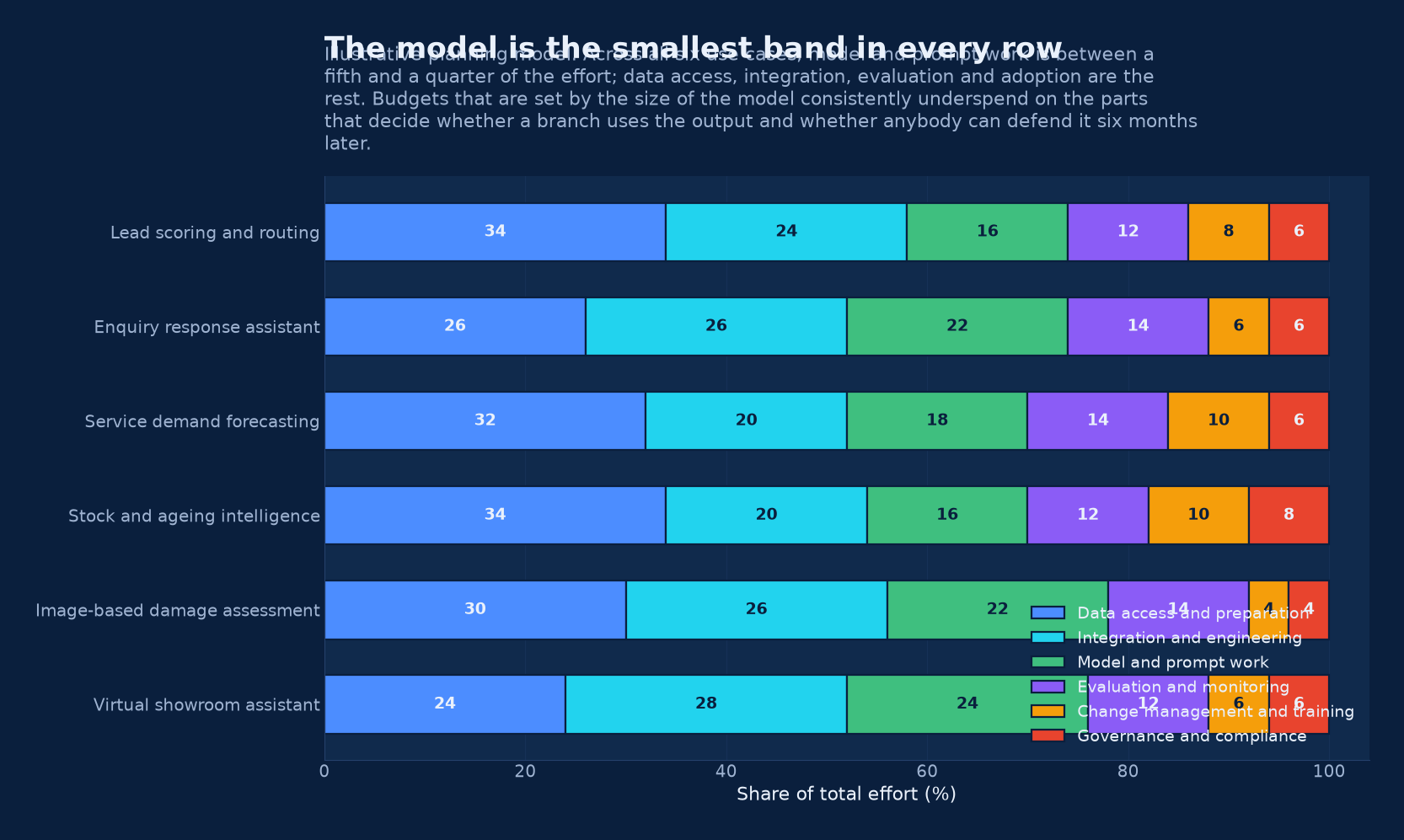
Chart values are an illustrative planning model based on typical UMC engagements and published industry benchmarks. They are not a guarantee of results on any specific project.
| Cost element | What drives it | Typical share | How to reduce it |
|---|---|---|---|
| Data access and preparation | Vendor permission, schema drift, deduplication, label completeness | A quarter to a third | Reuse the warehouse and the CRM record rather than building a new extract |
| Integration and engineering | Writing back to the DMS or CRM, latency, error handling, retries | A fifth to a quarter | Integrate once at the record level, not per use case |
| Model and prompt work | Feature selection, retrieval design, evaluation-driven iteration | A sixth to a quarter | Start with the simplest model that beats a rule baseline |
| Evaluation and monitoring | A labelled test set, calibration checks, drift and cost monitoring | An eighth | Build the harness once and reuse it across use cases |
| Change management and training | Branch time, workflow change, override habits | A tenth | Design the output into an existing screen rather than a new one |
| Governance and compliance | Access review, logging, disclosure, retention, model documentation | A twentieth to a twelfth | Do it during the build; retrofitting costs several times more |
| Infrastructure and runtime | Inference cost per transaction, storage, environment | Small per use case, compounding across many | Measure cost per transaction and cache aggressively |
| Ongoing operation | Model refresh, feed repair, evaluation refresh, incident response | A quarter of the build cost per year | Put it in a managed arrangement with a named owner |
| Vendor and licence fees | Platform, model API, data subscriptions | Variable and often underestimated | Negotiate with a usage forecast, review quarterly |
| Failure cost | A wrong answer to a customer, a misrouted lead, a bad discount | Unbudgeted and large | Guardrails, refusals, human sign-off and a rollback path |
- The runtime belongs in a proper environment: cloud infrastructure with CI/CD pipelines so a prompt or model change is a reviewed deployment with a rollback, not an edit made in a console on a Friday.
- Production AI needs the same operational discipline as any other service – latency, error budgets, alerting, on-call – which is SRE and observability applied to inference.
- Inference and storage costs drift upward with usage, and nobody notices until the invoice: cloud cost optimisation with cost per transaction reported alongside accuracy.
- The engineering pattern that works in a dealership is embedded rather than remote – forward-deployed engineering beside the branch and the vendor, because half the problems are access and workflow problems wearing a model costume.
Evaluation, monitoring and drift: the harness that makes a second use case cheap
An AI system in a dealership is not finished when it ships; it is finished when somebody can say how accurate it was last month, what it cost per transaction, where it was overridden and why. That requires a harness built once and reused: a labelled evaluation set per use case, a calibration view, drift and freshness monitors, a cost meter, an override log and a rollback path. Groups that build the harness with the first pilot find the second use case costs a third as much; groups that skip it rebuild everything each time and trust nothing.
| Harness element | What it contains | Cadence | Who reviews it | What happens on failure |
|---|---|---|---|---|
| Evaluation set | A held-out labelled sample per use case, refreshed as the business changes | Refreshed quarterly, run on every change | The use-case owner with the analyst | The change does not ship |
| Baseline comparison | The rule or human baseline the model must beat | At build and at each refresh | Analyst and manager | The model is not deployed, or is redeployed as a rule |
| Calibration view | Predicted band against actual outcome, by branch and month | Weekly for scoring, monthly for forecasting | Sales or operations manager | Recalibration and a review of the feature set |
| Drift monitoring | Feature distributions, input mix, source composition | Daily automated, reviewed monthly | Analyst | Investigation before performance degrades visibly |
| Feed freshness | Age of every input feed the model reads | Continuous with alerts | IT operations | Failover to the rule path or a refusal |
| Cost metering | Cost per transaction, per use case, per branch | Weekly | IT and finance | Caching, model choice or a usage cap |
| Override log | Every human override with a reason | Continuous, reviewed weekly | The process owner | A feature, prompt or workflow change |
| Correction rate | How often an assistant answer was wrong and corrected | Weekly sampling | The use-case owner | Knowledge-source fix, or scope narrowed |
| Incident record | Any customer-visible failure with impact and resolution | Per incident | IT lead and operations | A documented change, not a verbal apology |
| Model documentation | Purpose, data, limits, owner, review date, known failure modes | Updated on every change | Governance owner | The model is suspended until documented |
- The harness is a product in its own right and should be built as one – AI product engineering covering versioning, evaluation, deployment and rollback rather than a notebook and a hope.
- Monitoring is operations, not analytics: alerts, thresholds and an on-call route come from observability practice, and the freshness monitors come from the pipeline layer.
- The outputs belong where managers already look – a calibration panel in the dashboard set – because a harness nobody opens is a harness nobody trusts.
- Reused across use cases, the harness is the difference between an AI function and a series of experiments, and it is what makes agent deployment safe to extend.
Governance, risk and the human in the loop
Dealership AI touches decisions with consequences: who gets a customer, what a customer is told about a price, what a document says, whether a vehicle is safe to take in exchange. Governance is therefore a design constraint rather than a review at the end – a published boundary of what may be automated, scoped and logged access, disclosure to the customer, a human path that always works, retention rules on model inputs and outputs, and documentation that would survive an auditor, a lender or a lawyer asking how a decision was made.
| Risk | How it arises in a showroom | Control | Evidence |
|---|---|---|---|
| A wrong customer-facing statement | An assistant invents availability, price or a delivery date | Retrieval from governed sources only, refusal by default, freshness thresholds | Citation logs, refusal rate, correction sampling |
| An unfair or unexplainable score | A model under-serves a locality or a source | Feature policy, parity checks, banded output with reasons, override rights | Parity reports, override log, published explanation format |
| A commercial commitment by a system | An assistant agreeing a price, refund or delivery | A hard boundary: assistants may inform and book, never commit | Boundary documentation and a test suite that proves it |
| Personal data in a model | Customer records used for training or sent to a third-party API | Data minimisation, contractual terms, no training on customer data without a basis | Data-flow map, processor terms, retention rules |
| Consent and messaging | A journey contacting a customer who opted out | Consent state as a model input and a suppression check before any send | Consent coverage report and suppression tests |
| Vendor and model dependency | A model provider changes terms, pricing or behaviour | Version pinning, an abstraction layer, an exit route | Version register and a rehearsed fallback |
| Access creep | A service account holding more permission than the use case needs | Least privilege per model, quarterly recertification | Access matrix and review records |
| Logging and attribution | No record of what the system said or did | Immutable logs of inputs, outputs, actions and approvals | Log retention and sampling audits |
| Shadow AI | Staff using consumer tools on customer documents | An approved tool list, training, and an easier sanctioned route | Policy acknowledgement, training records, network monitoring |
| Change without review | A prompt edited in production on a Friday evening | Change control with evaluation before deployment | Deployment history with evaluation results |
- This is a designed control set with an owner and a review calendar – AI governance, risk and compliance – and it is cheaper to install during the build than to retrofit after a customer incident.
- The access, logging and retention controls are the same ones the rest of the estate needs, so they are evidenced through IT audit and compliance and protected by security operations rather than duplicated for AI.
- Where AI influences marketing measurement – scoring leads that a model then reports on – the evaluation has to be independent of the platform: mix modelling and attribution with holdouts is how an AI-driven change is proved rather than assumed.
- The boundary of what may be automated is a board-level decision, and it should be written down once: unified top-level management owning the policy, with the disciplines operating inside it.
ROI and the executive scorecard
AI spend is usually approved on a promise and reviewed on an anecdote. The alternative is a scorecard agreed before the build: a baseline for each metric, a target, a measurement method, a cost including the ongoing operation, and a review date at which the use case is continued, changed or stopped. In a dealership the metrics that survive scrutiny are operational – response time, show rate, service capture, days in stock, processing hours, cost per delivered unit – rather than adoption percentages.
| Use case | Baseline to capture first | Target worth setting | Cost to include | Review point |
|---|---|---|---|---|
| Lead scoring and routing | Current qualified-to-delivery rate and response time by branch | A stated lift in conversion and response time within the SLA | Build, integration, ongoing refresh, monitoring | Ninety days after production |
| Enquiry assistant | Enquiries arriving outside hours and how many are currently answered | A capture rate for out-of-hours demand with a correction-rate ceiling | Build, knowledge curation, inference cost per conversation | Sixty days, then quarterly |
| Scheduling assistant | Current show rate and slot utilisation | Show-rate improvement on flagged bookings, utilisation lift | Build, capacity integration, ongoing monitoring | One full quarter |
| Service forecasting | Current roster accuracy and jobs delayed for parts | Forecast error inside a stated band, fewer delayed jobs | Build, data preparation, quarterly recalibration | Two quarters, given seasonality |
| Stock and pricing signals | Average days in stock and discount leakage by model | Reduced days in stock and leakage without losing volume | Build, market data subscriptions, ongoing refresh | Two quarters |
| Document extraction | Processing hours per application and rework rate | Hours saved with first-pass accuracy above a threshold | Build, per-document cost, human review time | Ninety days |
| Owner journey personalisation | Service capture by interval and referral enquiries | Capture improvement at the weakest interval | Build, journey operation, messaging cost | Two quarters |
| Virtual showroom assistant | Research-session behaviour and enquiry quality | Enquiries per assisted session with a correction ceiling | Build, data curation, inference and maintenance | Two quarters, and only after the harness exists |
| Internal knowledge assistant | Time spent searching schemes and process documents | Time saved with an answer acceptance rate | Build, document curation, refresh | One quarter |
| Whole programme | Baseline estate: response time, conversion, capture, stock, hours | Net contribution after all costs, including operation | Everything above plus governance and training | Semi-annual, at leadership level |
- The scorecard is a discipline with a format: AI ROI measurement and executive scorecards that report baseline, movement, cost and a continue-or-stop decision rather than a capability list.
- Ongoing cost is the line most often omitted – inference, curation, refresh and support – which is why cost optimisation belongs in the scorecard rather than in the IT budget alone.
- The operational metrics come from the metric layer, so the scorecard inherits its definitions: executive reporting with AI use cases as a panel rather than a separate truth.
- Where a use case fails its review, stopping it is a success of the process, not a failure of the technology – and the harness makes stopping cheap.
The ninety-day showroom AI programme, and what we need from you
The programme below is the shape we run for a dealership group or showroom chain: three weeks to assess readiness and choose the pilot on evidence, overlapping data access work, a lead-scoring pilot in production by week eight, an enquiry assistant from week six where the knowledge source is ready, the evaluation harness built alongside and reused, governance from week ten, scale-out and adoption at the end. The dependency that decides the timeline is vendor data access and one person empowered to say what the assistant may and may not promise.
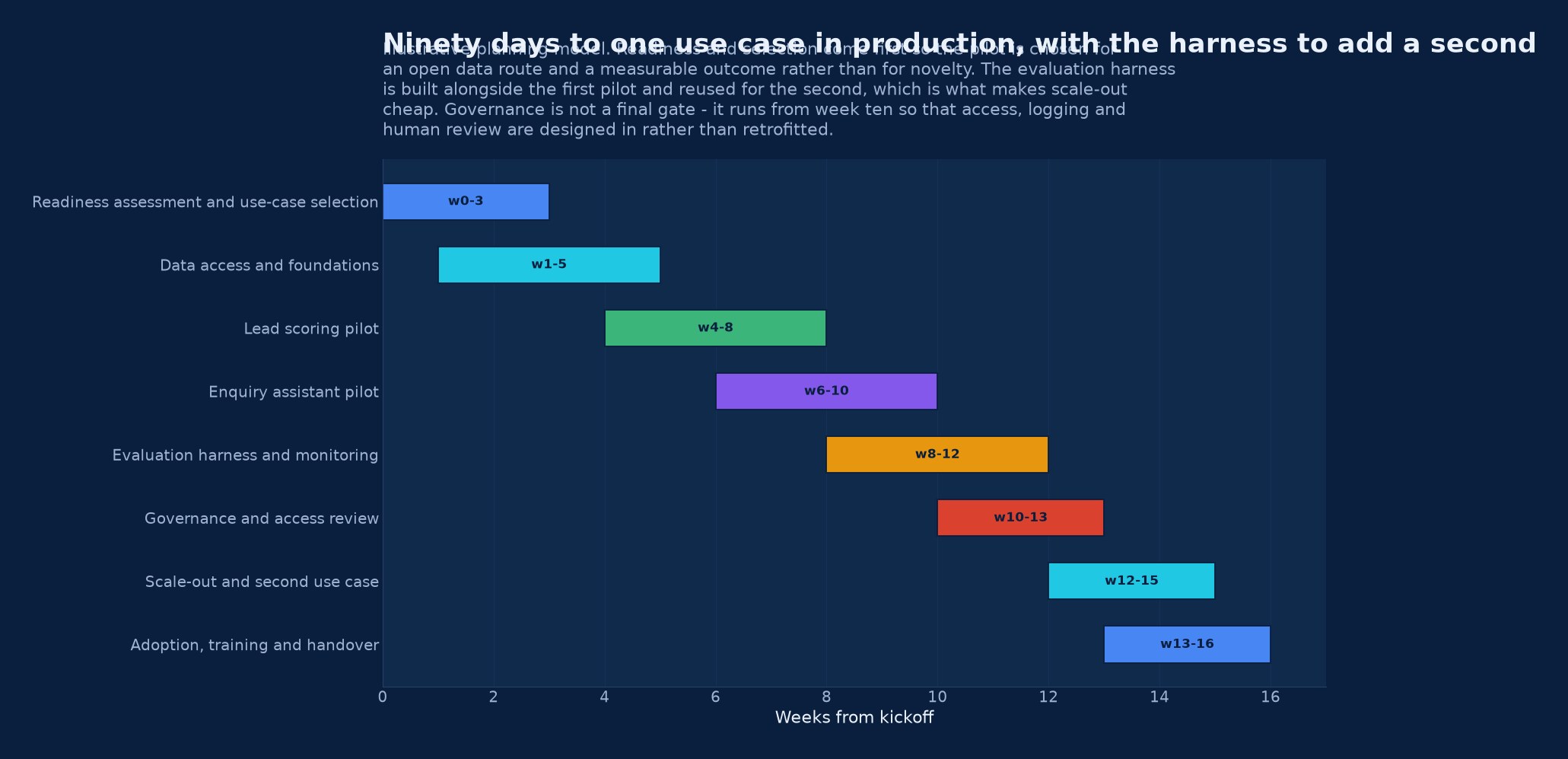
Chart values are an illustrative planning model based on typical UMC engagements and published industry benchmarks. They are not a guarantee of results on any specific project.
| Weeks | Workstream | Deliverable | Decision it enables |
|---|---|---|---|
| Zero to three | Readiness assessment and use-case selection | Data route map, ranked use cases with value, risk, effort and metric each, a pilot choice | What gets built first and what is deliberately not built |
| One to five | Data access and foundations | Scoped service identities, feed connections, label completeness report, consent coverage | Whether the pilot can be trained and served honestly |
| Four to eight | Lead scoring pilot | A scored and explained queue, routing rules, override log, calibration view | Whether scoring changes conversion and response time |
| Six to ten | Enquiry assistant pilot | A governed knowledge source, capture and booking flow, escalation rules, disclosure | Whether out-of-hours demand is captured safely |
| Eight to twelve | Evaluation harness and monitoring | Evaluation sets, drift and freshness monitors, cost metering, rollback path, documentation | Whether the next use case can be added cheaply and safely |
| Ten to thirteen | Governance and access review | Automation boundary, feature policy, parity checks, logging and retention, access recertification | What may be automated, and how a decision is defended |
| Twelve to fifteen | Scale-out and second use case | Rollout to all branches, plus a second pilot reusing the harness | Whether the pattern scales beyond the pilot branch |
| Thirteen to sixteen | Adoption, training and handover | Role-based training, workflow changes, the ROI scorecard, a review calendar, documentation | Who runs it, on what rules, and how it is reviewed |
- What we need: read access to the CRM and DMS with a technical contact, twelve to twenty-four months of enquiry, order and service history, the stock and price feed route, vendor terms that permit integration, a named owner per use case, and one decision-maker empowered to set the automation boundary.
- What you keep regardless: the readiness assessment and ranked use-case list, the data access design, the models and their evaluation sets, the harness and monitoring, the governance documentation and the scorecard. They are yours.
- What we will tell you plainly in week three: which use cases your data cannot support yet, which vendor will block access and on what terms, and where the constraint is data discipline rather than model capability – almost always the first.
- What follows once the first use case is stable: adoption work so branches use it rather than route around it – AI training, enablement and team adoption – plus the support arrangement that keeps the feeds and identities healthy, which sits with managed IT services.
Showroom AI by city, and worked examples
Dealership AI is shaped by local conditions: language and script decide what an assistant must handle, branch density decides whether routing is worth modelling, vendor DMS variety decides how much access work a pilot needs, and the festive calendar decides where forecasting pays first. The engagements below are dealership, showroom, store and infrastructure projects where data, automation and measurement were built as one programme.
- Get more automobile sales leads in Lucknow
- Digital marketing company for automobile dealers in Lucknow
- Website development company for automobile dealers in Lucknow
- Get more jewellery customers in Lucknow
- Digital marketing company for jewellery stores in Lucknow
- Digital marketing and IT services in Lucknow
- Services across Indian cities
- Case study: Hyundai group showroom full-service social advertising contract
- Case study: IT infrastructure management for an IT company
- Case study: a fashion retail showroom
- Case study: WordPress and WooCommerce online mobile store
- The showrooms and dealerships industry hub – all eight disciplines
- Retail and e-commerce: recommendation, forecasting and service automation
- Manufacturing: demand planning, quality and dealer network AI
- Hotels and hospitality: rate, occupancy and guest-service AI
- All industry verticals we build programmes for
- All digital marketing services
- About Unified Management Consulting
- Contact us about AI for showrooms and dealerships
Where this page sits in our showrooms programme
AI is the eighth and final discipline of our showrooms and dealerships programme. The hub page explains how the eight disciplines fit together, each discipline has its own page as it is published, and the generic service page for every discipline stays listed below alongside the vertical pages. A discipline that is not listed is not published yet – the list is generated from live pages and refreshes automatically as each spoke lands.
- Showrooms – the vertical main page
- Website development for showrooms and dealerships
- SEO for showrooms and dealerships
- Google Ads for showrooms and dealerships
- Social media marketing for showrooms and dealerships
- CRM and lead management for showrooms
- Business intelligence for showrooms
- IT support for showrooms and dealerships
- Website development services – the generic service page
- SEO services – the generic service page
- Google Ads management – the generic service page
- Social media management – the generic service page
- Custom CRM development and integration – the generic service page
- BI dashboards and executive reporting – the generic service page
- Managed IT infrastructure and AMC – the generic service page
- Get more automobile sales leads in Lucknow
- Digital marketing company for automobile dealers in Lucknow
- Get more jewellery customers in Lucknow
Frequently asked questions about AI for showrooms and dealerships
What is the first AI use case a dealership should build?
Lead scoring and routing, where the CRM already records outcome codes and the DMS records deliveries. It is small, reversible, measurable within a quarter and it improves the funnel without asking a customer to trust a machine. Forecasting service demand is the close second and carries even less risk.
Can an AI assistant really answer customer enquiries?
It can capture, answer factual questions from governed stock and price data, book a slot against real capacity and hand over to a human with context. It must not promise a price, a discount, a delivery date or a finance approval. The design rule is retrieval from governed sources with refusal by default, plus disclosure that it is an assistant.
Do we need a data warehouse before we can use AI?
You need one governed route to the data a use case reads, with labels, consent state and freshness monitoring. For a single pilot that can be a scoped extract; for more than two use cases a warehouse becomes cheaper than repeated extracts, because every use case otherwise rebuilds the same access and quality work.
Our DMS is vendor-controlled. Can we still do this?
Usually yes, but access is a negotiation, not an assumption. Read access, an export route or a reporting view is normally available; what is rarely available is real-time write access. The readiness assessment exists to find this out in week two rather than in week ten.
How do we stop a model from giving a wrong price?
Do not let the model hold prices. Retrieve them from the governed stock and price feed with a timestamp, refuse when the feed is stale, and never let an assistant state a discount, a delivery date or a finance outcome. Then measure the correction rate weekly and narrow the scope if it rises.
Is lead scoring fair to every branch and locality?
Only if you check. We apply a feature policy that excludes protected and proxy attributes, run parity checks by locality and source, publish the reason bands, allow a human override with a recorded reason, and review the parity report quarterly. A score that under-serves a locality is a commercial failure as well as an ethical one.
What does AI cost to run after the build?
Roughly a quarter of the build cost per year per use case, covering inference, feed repair, model refresh, evaluation refresh, monitoring and support – plus vendor and data subscription fees. Cost per transaction should be metered and reported in the same scorecard as accuracy, because usage growth shows up in the invoice before it shows up in a report.
Can AI help with stock and discount decisions?
Yes, as a signal rather than an automatic price change: ageing trajectories, holding cost accrued per unit, market price movement and discount leakage by executive. Presented early with a reason, it reduces both the size and the lateness of discounts. The authority to discount stays with a person.
What about documents – can AI read our finance and registration paperwork?
Extraction from KYC, income, registration, insurance and warranty documents reduces hours of rekeying and shortens application cycles, with a human verifying before anything is submitted to a lender or a customer. Accuracy is recorded per document class and per field, because templates change.
Is a virtual showroom or configurator assistant worth it?
Eventually, and not first. It is the most expensive and least forgiving surface because it faces the customer directly and depends on a clean variant, price and stock dataset. Build it after the knowledge source, the evaluation harness and the booking path exist, and measure enquiries per assisted session rather than engagement.
How do we stop staff using consumer AI tools on customer documents?
Give them a sanctioned route that is easier than the workaround, publish an approved tool list, train by role, and monitor. Shadow AI is almost always a symptom of a missing internal capability rather than a policy failure.
Who owns AI in a dealership group?
A named owner per use case in the function that works the process – sales for scoring, aftersales for forecasting, marketing for assistants – with IT owning access, pipelines and runtime, and leadership owning the automation boundary. AI owned by nobody becomes a series of demos; owned by one central team alone, it becomes a queue.
Start with a readiness assessment and one pilot with a metric
Give us three weeks with read access to your CRM and DMS and a technical contact, twelve to twenty-four months of enquiry, order and service history, the stock and price feed route, your vendor integration terms, a named owner per candidate use case, and one decision-maker empowered to set the automation boundary, and we will return a data route map naming what is reachable and what a vendor will block, a ranked use-case list with value, risk, effort and a metric for each, a lead-scoring pilot specification with its evaluation set and calibration view, an enquiry assistant design with a governed knowledge source and escalation rules, an evaluation and monitoring harness you can reuse for the second use case, a governance boundary stating what may be automated and what may not, and an ROI scorecard with baselines and review dates – including the use cases we would tell you not to build yet. Yours to keep either way.
Contact Unified Management Consulting to arrange a confidential first conversation.