
Showroom social has a job that retail social does not: it has to make a customer drive somewhere. Nobody impulse-buys a car, a jewellery set or a sofa from a reel, so the channel cannot be judged on the click it produces. It is judged on whether a family shortlists your branch, whether a delivery photograph makes a neighbour ask which showroom it came from, and whether a comment asking ‘price?’ becomes a booked test drive inside an hour.
That changes what gets produced. The highest-value asset in a dealership is not a studio shoot – it is the delivery moment that happens in the branch every day, with a real customer, a real vehicle and a real reason to trust the place. The second is the branch itself: staff, workshop, stock on the floor, the locality. Neither can be produced centrally, which is why showroom social is a system with a branch routine at its centre rather than a content calendar with an agency at its centre. This is organic social media management built for a branch-led business.
What an engagement includes, at a glance
| Component | What We Deliver |
|---|---|
| Audience and platform model | Which cohorts matter – first-time buyers, upgrade buyers, fleet purchasers, owners due for service, wedding and festive jewellery buyers – and where each one actually spends attention, agreed before any content is produced. |
| Content pillars with a commercial job | Four to six pillars, each with a stated job, a measure and a production owner: delivery and owner stories, model and variant content, branch and local, offers and festive, service and ownership, launch and events. |
| The delivery-day engine | A branch routine – consent, capture, edit, publish, tag – that turns every delivery into an asset, plus the owner-community content that follows it. |
| Branch-level content and the local layer | Locality-relevant content per branch, staff faces, workshop and stock reality, and the local search signals social activity feeds. |
| DM, comment and WhatsApp sales flow | Response targets, escalation into the CRM, a source parameter on every link sent, and a record of each conversation – social as an enquiry channel, not a broadcast. |
| Creators, owner clubs and launch amplification | Category creators with a brief and a contract, owner communities, and launch or festive amplification measured on assisted enquiries rather than on reach. |
| Paid social by funnel stage | Retargeting by stage, lookalikes from delivered customers, offer campaigns dayparted to trading hours, and creative that carries price, locality and a bookable next step. |
| Claims, rights and reputational governance | Substantiated claims, consent and rights records for every face and vehicle, a complaints escalation path, and an out-of-hours monitoring rule. |
| Measurement joined to the branch | Cost per qualified enquiry and per booked test drive by platform and branch, joined on one lead identifier to the DMS so a delivered unit can be traced to a post. |
What showroom social has to do: create the visit, not the click
Social practice written for e-commerce imports badly into a showroom. There is no cart to abandon, no catalogue ad to retarget a browsing session with, and no same-week purchase to measure. What there is instead: a decision cycle measured in weeks, a family that discusses it, a branch that has to be trusted before it is visited, and a delivery day that produces the most persuasive content the business will ever own. Building the channel around those facts is what separates a dealership feed that produces enquiries from one that produces followers.
| The imported assumption | The showroom reality | What changes in the programme |
|---|---|---|
| Reach is the goal | A shortlisted branch is the goal | Local reach and saved/shared model content valued over impressions |
| Catalogue ads drive sales | There is no catalogue to add to a cart | Model, offer and branch content with a booking path instead |
| Conversion happens in the session | Conversion happens weeks later at a branch | Assisted-enquiry measurement joined to the DMS |
| Content is produced centrally | The best content happens on the showroom floor | A branch routine with consent, capture and same-day publishing |
| Followers are the audience | Owners and prospects in your catchment are | Owned communities – WhatsApp, owner clubs – weighted above rented reach |
| Comments are engagement | Comments are enquiries with a public audience | Response SLA, escalation into the CRM, source-tagged links |
| Creators drive volume | Creators drive trust at launch | Briefs, contracts and assisted-enquiry measurement per creator |
| Offers drive action | Offers train an audience to wait | Offer content capped, with validity dates always shown |
| One national feed | Branch localities differ in language, festivity and stock | Branch-level content with a shared template and local substance |
| Service content is boring | Service content retains the next purchase | Ownership and workshop content scheduled as a pillar, not a filler |
- Social feeds the same landing surfaces as every other channel, so the pages have to exist and convert: the showroom website programme builds the branch, model and booking pages that a post points at, and conversion work decides whether the click becomes a booking.
- Social activity also moves local search: profile consistency, review generation and branded query volume are inputs the SEO programme for showrooms depends on.
- Where a group runs several brands, one content system with per-brand voice is cheaper than separate feeds – a strategy decision about brand architecture before it is a creative one.
Audience and platform model: who is where, and what they need
Showroom audiences are fewer and more identifiable than a consumer brand’s, which is an advantage: a first-time buyer, an upgrade buyer, a fleet purchaser, an owner due for service and a festive jewellery buyer each need different proof and different next steps. Mapping them to the platforms they actually use – rather than the platforms the business likes – decides where production effort goes and which metrics are worth reporting.
| Cohort | Where the attention is | What they need to see | Format that works | Measure |
|---|---|---|---|---|
| First-time buyer | Instagram reels, YouTube explainers, family WhatsApp groups | On-road price clarity, finance documents, what happens at delivery | Short explainer reels and a price build-up post | Enquiries with a first-purchase intent code |
| Upgrade buyer | YouTube reviews, Instagram, owner communities | Variant differences, exchange value, wait times | Comparison content and exchange valuation posts | Valuation requests and comparison saves |
| Fleet and B2B purchaser | LinkedIn, email, direct contact | Total cost of ownership, service SLAs, bulk terms | Case content and a downloadable fleet brief | Fleet enquiries and meetings booked |
| Owner due for service | WhatsApp, SMS, email | Service packages, turnaround time, pickup and drop | Reminder plus a workshop reel | Service bookings from owned channels |
| Festive and wedding buyer | Instagram, Facebook, local creator content | Collections, making charges, hallmarking, festive offers | Collection films and store-visit content | Store visits and appointments booked |
| Local community | Facebook groups, local pages, Instagram location tags | That the branch exists, is authorised and is nearby | Branch content, local events, staff faces | Locality enquiries and map-pack lift |
| Delivered customer | WhatsApp, Instagram, owner clubs | Recognition, ownership tips, referral reward | Delivery story, first-service reminder | Referral enquiries and review velocity |
| Lost or dormant prospect | Retargeting audiences, WhatsApp, email | A reason to re-engage: stock arrival, offer, new variant | Sequenced retargeting with a specific hook | Re-engagement enquiries per sequence step |
| Enthusiast and advocate | YouTube, Instagram, forums, clubs | Access, recognition, honest technical content | Behind-the-scenes, club events, long-form video | Earned mentions and creator-sourced enquiries |
| Staff and internal | Internal channels, LinkedIn | What to post, what not to, and who approves | A one-page brief and a template kit | Branch participation rate |
- Cohort definition should come from delivered customers rather than from platform demographics: market and competitive analysis on who actually buys, and from where, produces a model the feed can be built against.
- Owned channels outrank rented ones on every commercial measure, which is why WhatsApp and owner communities are a pillar rather than an afterthought – WhatsApp marketing with consent, and SMS and email where the audience prefers them.
- Platform choice is a capacity decision too: four platforms done badly is worse than two done to a standard, and the honest answer is usually Instagram plus WhatsApp plus YouTube for a dealership, with Facebook for local reach.
Content pillars with a commercial job each
A pillar is a recurring content type with a stated job, a production owner, a cadence the branch can actually sustain, and a measure. Without those four, a feed becomes whatever was easiest that week – usually an offer graphic. The pillar set below is the one we install for showroom clients, weighted towards the assets that produce trust and enquiries rather than the ones that produce reach.
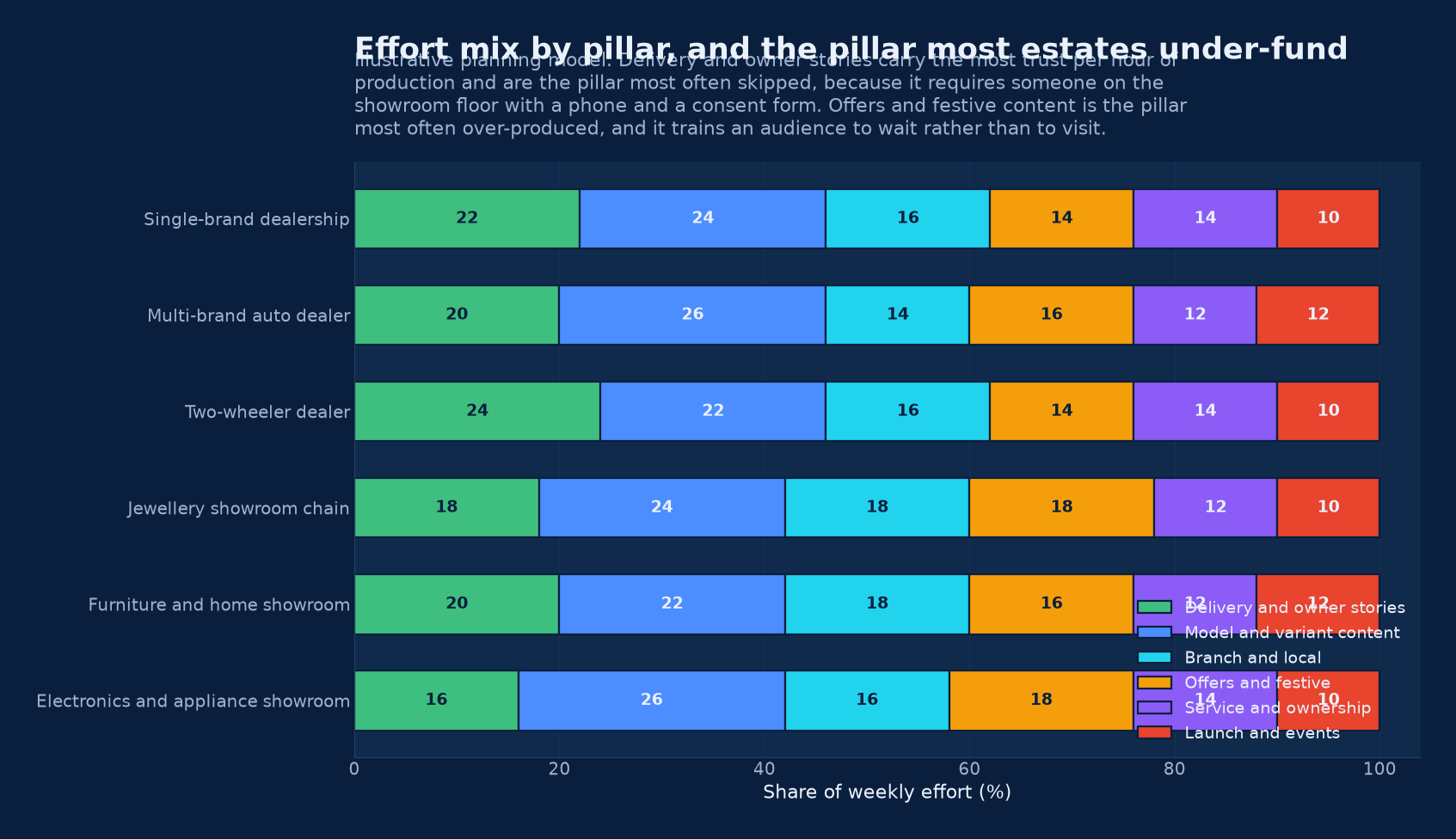
Chart values are an illustrative planning model based on typical UMC engagements and published industry benchmarks. They are not a guarantee of results on any specific project.
| Pillar | Commercial job | Typical formats | Cadence | Measure | Production owner |
|---|---|---|---|---|---|
| Delivery and owner stories | Prove that real people buy here and are looked after | Delivery reel, owner quote, first-service follow-up | Two to four per week | Shares, saves, referral enquiries | Branch, with a central template |
| Model and variant content | Answer the shortlisting questions | Walkaround, variant comparison, feature spotlight | Three to five per week | Saves, profile visits, model-page clicks | Central team plus branch stock |
| Branch and local | Establish that you exist, are authorised and are near | Staff faces, workshop tour, locality content, event coverage | Two to three per week | Locality enquiries, map-pack lift | Branch |
| Offers and festive | Convert an audience that is already considering | Offer card with validity, festive campaign film | One to two per week, capped | Bookings attributed to the offer | Central marketing |
| Service and ownership | Retain the customer for the next purchase | Service package explainer, maintenance tips, recall notices | One to two per week | Service bookings, owner retention | Workshop plus marketing |
| Launch and events | Create a moment worth visiting | Launch film, event coverage, live session, creator first drive | Per calendar event | Event registrations, launch-week enquiries | Central team with branch execution |
| Proof and reputation | Reduce the risk of choosing you | Review quotes, ratings, warranty and authorisation facts | Weekly | Review velocity, sentiment | Branch plus marketing |
| Education and transparency | Win the research phase | On-road price explained, finance documents, buying checklist | Weekly | Saves, guide clicks, enquiry quality | Central team |
- Every pillar points at a page that can take the enquiry, which ties the content model to the information architecture of the site – a post with no destination is reach, not demand.
- The production system matters more than the ideas: templates, a shoot standard and a rights record are brand and creative production disciplines applied at branch scale.
- Editorial content that answers the research question in depth still belongs on the site, where it can rank: content marketing strategy with social as the distribution layer.
- Pillars are reviewed quarterly against what produced enquiries, not against what was easiest to make – which requires the measurement in section ten to be running first.
The delivery-day engine: the asset every dealership already owns
Nothing persuades a showroom customer like seeing someone they recognise taking delivery at a branch near them. Most dealerships produce this moment several times a day and capture none of it, because nobody owns the thirty seconds required: ask for consent, take three photographs and a short video, write one honest line, publish the same day, tag the branch, and record the customer in the CRM for the follow-up sequence. Installed as a routine with a named owner per branch, it becomes the highest-trust content pillar the estate has, at close to zero production cost.
| Step | What happens | Who owns it | Timing | Evidence kept |
|---|---|---|---|---|
| Consent | A short written or recorded consent covering image, name and platform | Delivery executive | At paperwork, before the reveal | Signed or recorded consent against the customer record |
| Capture | Three to five photographs, one short vertical video, one owner quote | Delivery executive or branch content owner | During the delivery ceremony | Assets uploaded to the branch folder the same day |
| Fact check | Model, variant, colour, branch and offer stated correctly | Branch manager | Before publishing | Approval note in the content calendar |
| Publish | Post with locality tag, branch handle and a booking link | Central marketer or trained branch owner | Same day, ideally within two hours | Published URL recorded against the customer |
| Respond | Comments and DMs answered inside the response window | Social owner with escalation to sales | Within one hour in trading hours | Conversation record and outcome code |
| Thank and follow up | A personal thank-you message plus a review request | Delivery executive | Within twenty-four hours | Review request sent and outcome logged |
| Owner sequence | First-service reminder, ownership tips, referral ask | CRM journey | Day seven, day thirty, service interval | Journey state per customer |
| Referral capture | A named referral route with a reward that is actually paid | Branch manager | At first service | Referral enquiries attributed to the delivery post |
| Rights and takedown | A route for a customer to withdraw consent | Marketing lead | On request, immediately | Takedown log with the date honoured |
| Reporting | Delivery posts per branch, engagement, enquiries attributed | Marketing lead | Monthly | Branch participation rate and cost per enquiry |
- Consent is the control that makes this safe: a written record per customer, a takedown route honoured the same day, and no images of children or number plates without explicit permission – the same discipline a privacy and security review would ask for.
- The follow-up is where the value compounds: a delivery post joined to a lifecycle journey produces review velocity, service bookings and referrals rather than a photograph.
- Where branches will not participate, the cause is usually effort rather than willingness – a template kit, a thirty-second brief and one named owner per branch fixes it faster than any instruction from head office.
Branch-level content and the local layer
A national feed cannot tell a customer that the branch twelve minutes away has the variant they want, that its workshop has a bay free on Saturday, or that its team has served the locality for eight years. Branch-level content does, and it is also the layer that feeds local search: location-tagged posts, branch handles, review generation and locality relevance all influence whether the map pack chooses you. The operating question is how to keep branch content on-brand without requiring a marketing team in every city.
| Element | What it should show | How it is produced | Guardrail |
|---|---|---|---|
| Branch handle or location tag | Which physical branch is speaking | One handle per branch, or one handle with consistent tags | Naming rule agreed with the brand’s guidelines |
| Locality content | Landmarks, neighbourhoods, local events, delivery areas | Branch staff with a template and a monthly prompt list | No invented local claims; verify before publishing |
| Staff faces | Who the customer will actually meet | Short introductions, workshop and sales team features | Consent per employee, and a right to opt out |
| Stock on the floor | What is available here, today | Photographed from the feed or the yard, tagged to the branch | Availability must be current; remove when sold |
| Workshop reality | Bays, equipment, turnaround, service packages | Monthly workshop shoot with a shot list | No customer vehicles without consent |
| Local offers | Branch-specific schemes with validity | Central template with branch fields | Validity date always visible; automated takedown |
| Community and events | Local sponsorships, camps, festive celebrations | Event coverage with a same-day post | Partner approvals and rights cleared |
| Language | The language the locality reads in | Regional captions from the same content record | Native review, not machine translation alone |
| Review generation | A request at delivery and at service completion | One-tap link tracked per branch | Never incentivised; response SLA on every review |
| Response ownership | Who answers a comment about this branch | Branch owner plus central escalation | Response time reported per branch |
- Branch content and branch listings are the same asset seen twice: hours, numbers and services must match across the feed, the profile and the site – local SEO and business profile management is the operating discipline that keeps them aligned.
- Locality relevance is also what AI assistants read when they recommend a branch, so consistent entity data across social profiles and the site supports showroom SEO in the answer engines as well as in the map pack.
- A multi-branch estate needs branch administration rather than central bottleneck: role-based access to post, approve and respond is part of the website and platform build and the wider IT support model.
Comments, DMs and WhatsApp: social as a sales channel
In showroom categories a large share of demand arrives as a comment – ‘price?’, ‘which branch?’, ‘is this available?’ – or as a DM. Treated as engagement, those enquiries are answered eventually and lost usually. Treated as a sales channel, they get a response target, an escalation path into the CRM, a source-tagged booking link, and an outcome code so the conversation can be reported beside every other lead source. The change is operational, not creative, and it typically produces more qualified enquiries than any increase in posting.
| Element | What good looks like | What usually happens | Fix and measure |
|---|---|---|---|
| Response target | Under fifteen minutes in trading hours, under an hour otherwise | Answered when somebody notices | Rota plus notifications; measure first-response time |
| Triage | Enquiry, complaint, spam and praise separated at first read | All treated the same | A short decision tree; measure misrouted conversations |
| Escalation | Priced or complex enquiries routed to a branch executive | Answered generically by whoever is online | Routing rules in the CRM; measure handover time |
| Complaints | Taken offline, owned, resolved, then answered publicly and briefly | Argued with publicly, or deleted | A documented path; measure resolution time and sentiment |
| Booking link | A source-tagged link so the conversation is attributable | A homepage link with no source | UTM and branch parameters; measure bookings per channel |
| WhatsApp path | A business API number with routing, not a personal phone | An executive’s personal number | Business API with a queue; measure conversation-to-booking |
| Consent and privacy | Opt-in recorded, data handled per policy | Numbers copied into a personal phone book | Consent capture in the flow; measure policy exceptions |
| Outcome coding | Every conversation closed with a reason | Conversations simply stop | Mandatory outcome codes; measure share coded |
| Out of hours | An assistant captures and books; a human follows up | Silence until morning | Out-of-hours flow; measure overnight recovery |
| Reporting | Volume, response time, bookings and cost per enquiry by platform | Follower and like counts | One monthly report to the general manager |
- The routing target is the CRM or DMS lead table with a source and a branch, not an inbox: CRM development and integration is what makes a DM countable.
- A conversational channel needs the same engineering as a form – a source parameter, a duplicate check, an SLA timer – which is systems integration work at small scale.
- Out-of-hours volume justifies automation in this channel more than any other: an AI assistant grounded in branch hours, stock and offers can capture and book, escalating to a human in the morning.
- When the queue outgrows one person, the discipline is a helpdesk workflow with owners and targets – social inbox management is customer service, whether or not it is labelled that way.
Creators, owner communities and launch amplification
Creators in showroom categories are not a reach buy; they are a trust instrument used at specific moments – a model launch, a branch opening, a festive campaign, a new segment. The value comes from credibility with an audience that already researches purchases there, and it is destroyed by a brief that reads like an advertisement. Owner communities are the under-used counterpart: a club, a WhatsApp group or an event series for delivered customers produces referral demand at a fraction of acquisition cost and supplies the content that persuades the next buyer.
| Instrument | Best used for | What the brief must contain | Measure | Common failure |
|---|---|---|---|---|
| Category creators and reviewers | Model launches and variant comparisons | Access, facts, disclosure, and editorial freedom | Assisted enquiries and branded search lift | A scripted read that the audience discounts |
| Local creators | Branch openings, locality reach, festive campaigns | Branch visit, local angle, offer validity | Locality enquiries and event attendance | A national creator with no local audience |
| Owner communities and clubs | Referral demand, retention, advocacy | Recognition, access, useful ownership content | Referral enquiries, review velocity, event turnout | A group used only for broadcasting offers |
| Delivery-day features | Trust at the moment of decision | Consent, accuracy, same-day publishing | Shares, saves, referral enquiries | Consent never taken, so it cannot be published |
| Launch events and live sessions | A reason to visit in a specific week | Date, branch participation, booking link | Registrations, attendance, launch-week enquiries | An event nobody can book into |
| Fleet and B2B content | Corporate purchases and bulk enquiries | Total cost of ownership, service SLAs, contacts | Fleet enquiries and meetings | Consumer tone aimed at a procurement audience |
| Employee advocacy | Branch credibility and recruitment | What to post, what not to, and approval path | Branch participation and reach quality | No guidance, so nobody posts or everybody improvises |
| Press and editorial | Authorisation, awards, expansion news | Facts, quotes, images, a contact | Referring domains and citation-worthy mentions | A press release with nothing verifiable in it |
| Out-of-home support | Reinforcing a locality campaign | Same message, same offer window, same branch list | Branded search and walk-in source capture | Hoarding and digital saying different things |
| Retargeting from social | Returning a warm audience to a booking path | Stage-specific creative and a specific hook | Booking rate per sequence step | The same creative shown repeatedly with no next step |
- Creator work needs contracts and rights, not handshakes: usage windows, disclosure, exclusivity and a payment schedule are influencer and creator management disciplines, and the same rights record protects the brand later.
- Amplification is planned as one calendar rather than as channel silos: media planning and buying decides whether a launch week is carried by YouTube, out-of-home in the branch localities, or both – and virtual launch sessions where the audience is national or fleet-based.
- Press and editorial earn the citations that assistants and journalists reuse: digital PR and link building built on verifiable facts – authorisation, awards, delivery volumes – rather than on adjectives.
- Owner communities produce the data that makes the next campaign cheaper: referral sources and repeat-purchase cohorts belong in the same warehouse as paid and organic outcomes.
Paid social by funnel stage: what to buy, and what to stop buying
Paid social in a showroom account works in stages rather than in campaigns. At the top, a launch or festive film creates the shortlist; in the middle, retargeting by stage returns a warm audience to a booking path; at the bottom, offer and locality campaigns convert people who are already deciding. What does not work is a single always-on objective aimed at ‘engagement’, which buys cheap interactions from an audience that will never visit. Budget follows the stage with the weakest evidence, and every stage is measured against the same qualified-lead definition the search account uses.
| Stage | Objective worth buying | Audience | Creative requirement | Measure |
|---|---|---|---|---|
| Awareness at launch | Reach and video views in the branch localities | Locality and interest-based, plus lookalikes from delivered customers | A film with a date, a branch and a reason to visit | Branded search lift and assisted enquiries, with a city holdout |
| Consideration | Traffic to model, comparison and price pages | Engagers, video viewers, site visitors by page depth | Variant facts, honest comparisons, price transparency | Model-page sessions and saves |
| Intent | Lead and booking campaigns with a form or a call | Site visitors, form abandoners, offer-page viewers | Offer validity, branch, bookable slot | Cost per qualified enquiry by branch |
| Local and store traffic | Performance Max with local goals, Local Services Ads where supported | Radius per branch with overlap rules | Branch image, hours, tracked number | Directions, calls and walk-in source capture |
| Retargeting sequences | Stage-specific return visits | Sequenced by funnel stage, capped by frequency | A new hook per step, not the same creative repeated | Booking rate per step |
| Owner and retention | Service bookings and referral asks | Delivered customers by age of purchase | Useful ownership content plus a booking path | Service bookings and referral enquiries |
| Festive windows | Offer campaigns dayparted to trading hours | Locality plus warm audiences | Offer with validity and branch list | Cost per delivered unit against the same window last year |
| Catalogue and inventory | Stock-based creative where the platform supports it | Warm audiences plus lookalikes | Real unit images, price, availability | Enquiries on the specific units advertised |
| Creator amplification | Whitelisting or partnership ads on creator content | Creator audience plus your retargeting lists | Disclosure and a brief that survives the creator’s voice | Assisted enquiries per creator |
| What to stop | Always-on engagement objectives, national reach for a local branch | Broad audiences with no locality constraint | Creative with no next step | Interactions that never become enquiries |
- Paid social and paid search share one measurement chain and one landing model, so they are planned together: the Google Ads programme for showrooms sets the lead definition, the tracking and the offline import that social campaigns are judged against.
- The creative has to carry commerce facts, not moods – Meta and Instagram placements that show price, locality and a bookable slot outperform brand-only creative in this category.
- Inventory-style creative requires a trustworthy stock feed: the same pipeline that serves Merchant Centre and inventory ads serves social catalogue placements, and both fail together when availability is stale.
- Warm audiences decay without a sequence behind them: nurture programmes and lifecycle journeys are what make retargeting worth more than repetition.
Creative production at dealership scale
The constraint on showroom social is production capacity, not ideas. A branch can supply the moment – a delivery, a workshop bay, a new arrival – but it cannot supply editing, captions, compliance checks and a calendar. The system that works is a small central unit holding templates, standards and approval, plus a trained person in each branch holding a phone and a thirty-second shot list. Everything else – stock libraries, creator footage, manufacturer assets – is supplementary and carries rights questions.
| Element | What the system needs | Why branches fail without it | How it is held |
|---|---|---|---|
| Shot list per moment | Delivery, arrival, workshop, event, staff – five shots each | Staff photograph whatever is nearest | A laminated card and a monthly prompt list |
| Templates | Caption structure, offer card, review quote, branch intro | Every post redesigned from scratch | A template kit versioned centrally |
| Capture standard | Vertical video, natural light, no number plates without consent | Unusable footage and privacy problems | A one-page standard with examples |
| Editing turnaround | Same-day for delivery content, forty-eight hours for campaigns | Content published after the moment has passed | A queue with a stated turnaround |
| Approval path | Who signs off price, offer and claims | A wrong price published publicly | Named approver per content type |
| Rights and consent | Customer, employee, creator and music rights recorded | A takedown request with no record of consent | A rights register per asset |
| Asset library | Manufacturer images, creator footage, branch photography, indexed | The same three photographs reused for a year | A library with usage rights and expiry |
| Accessibility | Captions, alt text, contrast, no autoplay sound reliance | Excluded audiences and platform penalties | Checked per template, not per post |
| Landing readiness | Every post points at a page that loads fast and books | Traffic arriving at a slow or generic page | Page checks per campaign – Core Web Vitals and mobile experience |
| Calendar and capacity | A weekly plan the branch can actually sustain | Bursts of activity followed by silence | A rolling four-week calendar with owners |
- Production is a discipline with a brand constraint: brand performance and creative production gives the templates and standards; the branch supplies the moments.
- Design decisions inside the post matter commercially – a price build-up that is legible on a phone converts better than a beautiful graphic – which is UX and UI design applied to a 1080-pixel canvas.
- Where the same assets feed the website, the app and the branch screens, one asset library with rights records prevents three versions of the truth.
Measurement: cost per qualified test drive by platform and branch
Showroom social is usually reported on reach and engagement because those are the numbers the platforms provide, and neither survives a budget conversation. The alternative is a short chain with a join: platform to conversation or click, click to lead record with a source, lead record to booking, booking to show-up, show-up to order and delivery in the DMS. Once that chain exists, social can be compared with search honestly, upper-funnel work can be credited with assistance rather than guessed at, and a branch that produces referrals from its delivery content becomes visible.
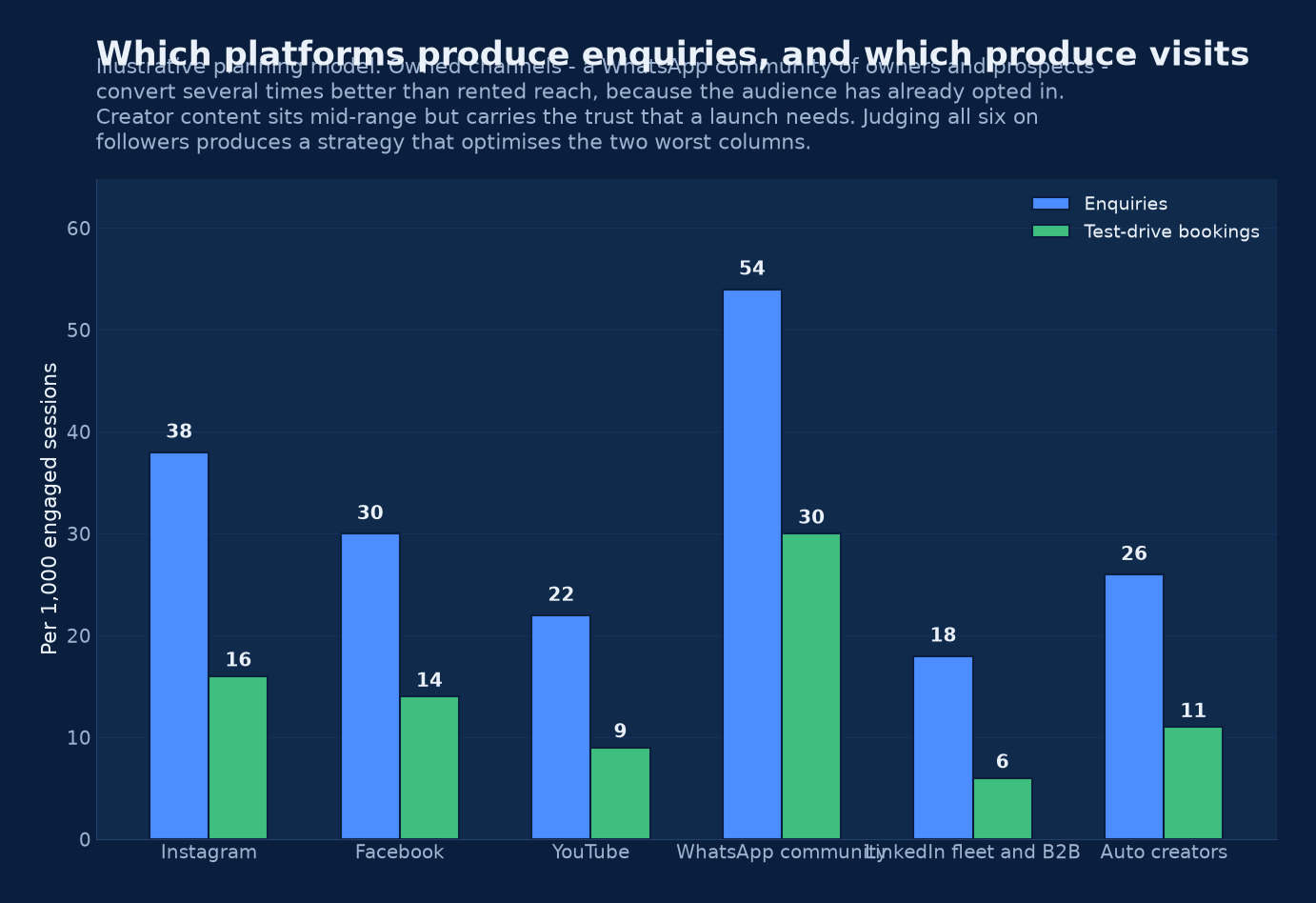
Chart values are an illustrative planning model based on typical UMC engagements and published industry benchmarks. They are not a guarantee of results on any specific project.
| Metric | Definition | Source | Reported to | What it decides |
|---|---|---|---|---|
| Enquiry from social | A conversation or click that produced a lead record with a social source | CRM plus platform | Marketing | Which platform produces demand |
| Qualified enquiry | Reachable, in-market, right model and locality | CRM outcome code | Sales manager | Whether the audience is right |
| Test-drive booking | A slot booked with a social source | Booking system | Branch manager | Whether content carries a next step |
| Show rate | Bookings that arrived | Branch record | Branch manager | Whether the reminder flow works |
| Order and delivery | DMS records joined to the lead identifier | DMS | General manager | Cost per delivered unit by platform |
| Cost per qualified enquiry | Spend plus production cost divided by qualified enquiries | Finance plus platforms | Marketing and leadership | Where production effort should move |
| Assisted contribution | Deliveries where social touched the journey but did not close it | Multi-touch over the lead identifier | Leadership | Whether upper-funnel work is worth funding |
| Referral enquiries | Enquiries citing a delivery post, an owner or a community | CRM source plus the desk question | Branch manager | Whether the delivery engine compounds |
| Review velocity | Reviews requested and received per branch per month | Reputation dashboard | Branch manager | Whether the follow-up routine is running |
| Response time and outcome coding | First response and share of conversations coded | Social inbox plus CRM | Marketing lead | Whether the sales flow is being operated |
- The join is the whole exercise: one lead identifier from a DM to a delivered unit, stored where it can be queried – warehouse work with a marketing deadline.
- Two reports from the same data: a branch manager wants yesterday’s conversations, bookings and show rate; a group head wants cost per delivered unit by platform and branch – executive dashboards built once, rendered twice.
- Follow-up discipline shows up here before it shows up anywhere else: pipeline and sales analytics exposes which branches convert social demand and which lose it.
- Social and search are not additive in a simple way, so a blended last-click view will misallocate budget: marketing mix modelling with periodic holdouts is how the split is argued, and forecasting weekend enquiry volume is how branches are staffed for it.
Governance: claims, rights, offers and reputational risk
A dealership feed publishes prices, offers, finance indications and images of real customers, which makes it a consumer-facing and legal surface rather than a marketing one. The controls are unexciting and they are what allow the channel to move fast: an approval path for anything carrying a price or a claim, a rights register for every face and every piece of music, a complaints escalation that takes a dispute offline within minutes, and a monitoring rule for out-of-hours. None of it slows production once installed; all of it prevents the single post that costs more than a year of content.
| Risk | How it arises | Control | Evidence kept |
|---|---|---|---|
| Price and offer claims | A post states a price the branch cannot honour | Approval by a named owner; validity dates always shown; automated takedown on expiry | Approval log and published-date record |
| Finance indications | An EMI figure or approval implied without caveats | Approved language, rate table reference, disclaimer in the creative | Rate table version cited per post |
| Customer images | A delivery photograph published without consent | Consent captured before the reveal, takedown honoured same day | Consent record per customer and per asset |
| Employee images | Staff featured without an opt-out route | Consent at onboarding, right to withdraw, no punitive consequence | Employee consent register |
| Music and third-party rights | Trending audio used on a commercial account | Licensed or platform-cleared audio only for business accounts | Rights register per asset |
| Creator contracts | Usage beyond the agreed window or territory | Written scope, disclosure, exclusivity and payment terms | Signed contract and usage log |
| Comparative claims | A competitor named or implied unfavourably | Factual, substantiated attributes only; no disparagement | Substantiation note per claim |
| Complaints and disputes | A public argument with an unhappy customer | Take offline within minutes, own it, resolve it, then respond briefly in public | Complaint log with resolution and time |
| Out-of-hours incidents | A negative post spreading overnight | Monitoring with a threshold, an on-call owner, a holding response | Incident record and response times |
| Data and privacy | Customer numbers harvested from DMs into a personal phone | Business channels only, consent recorded, retention applied | Access log and a privacy review – see IT audit and compliance |
- Governance is cheaper than remediation and it is mostly a schedule: a weekly approval review, a monthly rights audit, a quarterly policy refresh.
- Where a claim or a complaint becomes a legal or insurance matter, the evidence trail is what decides the outcome – the same trail a security and privacy review would ask for.
- Social spend is often the first line cut under pressure and the last one measured: where the decision is commercial rather than creative, it belongs in cost rationalisation or, at group level, unified top-level management, with the funnel data attached.
- Where cash is tight, sequencing beats cuts – a festive campaign funded while the follow-up routine is unfunded produces leads the business cannot convert, which is a working capital problem dressed as a marketing one.
Service, retention and the owner lifecycle
The cheapest demand a showroom can buy is the customer it already delivered to. Owners return for service, they replace on a predictable cycle, they refer neighbours, and they generate the reviews that decide the next buyer’s shortlist – yet most dealership feeds speak only to people who have not bought yet. An owner-lifecycle layer turns delivery into a sequence: a thank-you, ownership tips, a first-service reminder, a festival greeting, a trade-in-age conversation, and a referral ask with a reward that is actually paid.
| Moment | What the owner needs | Channel that works | Content | Measure |
|---|---|---|---|---|
| Delivery day | Recognition and what happens next | In person, then WhatsApp | Delivery story, first-week tips | Consent rate and same-day publish rate |
| Day seven | Reassurance and a review request | WhatsApp or SMS | A short check-in plus a one-tap review link | Review velocity per branch |
| First service due | What a service costs and how long it takes | WhatsApp, email, SMS | Package explainer with a booking slot | Service bookings from the sequence |
| Ownership milestones | Useful tips, not offers | Email or WhatsApp community | Maintenance, insurance, resale value | Open and click rates, enquiry quality |
| Warranty and plan expiry | What is covered and what it costs to extend | Email plus a call from the branch | Plan comparison with honest exclusions | Plan renewals |
| Recall or campaign | A clear instruction and a booked slot | SMS, WhatsApp, phone | Facts, no marketing language | Completion rate within the window |
| Festive greeting | Recognition without a hard sell | WhatsApp or a card | A local, human message | Response rate and sentiment |
| Trade-in age | What the vehicle is worth now | Email plus a valuation tool | Valuation band and an inspection booking | Valuations completed and upgrades |
| Referral ask | A reward that is paid, and a simple route | WhatsApp, in person at service | Named referral link or code | Referral enquiries attributed |
| Owner events | Community, not a sales pitch | Invitation plus reminders | Club meet, workshop day, drive event | Attendance and post-event enquiries |
- Sequences are operated from one place with consent recorded: nurture programmes and retention campaigns across email, SMS and WhatsApp, rather than three separate tools with three separate lists.
- The customer record has to be one record for this to work – identity across site, branch and service history is a CRM prerequisite, and without it the same owner receives the first-service reminder twice.
- Retention content is also acquisition content: an owner community that posts its own delivery photographs does more for the next buyer than any campaign.
The ninety-day showroom social programme, and what we need from you
The programme below is the shape we run for a dealership group or showroom chain: three weeks to model the audience and choose the platforms honestly, overlapping pillar and calendar design, the delivery-day engine installed from week four with branch training, branch content and the local layer from week six, the DM and WhatsApp sales flow from week eight, creator and launch amplification from week ten, paid social and measurement from week eleven, and reporting handed over at the end. The dependency that decides the timeline is branch cooperation, which is a management task rather than a creative one.
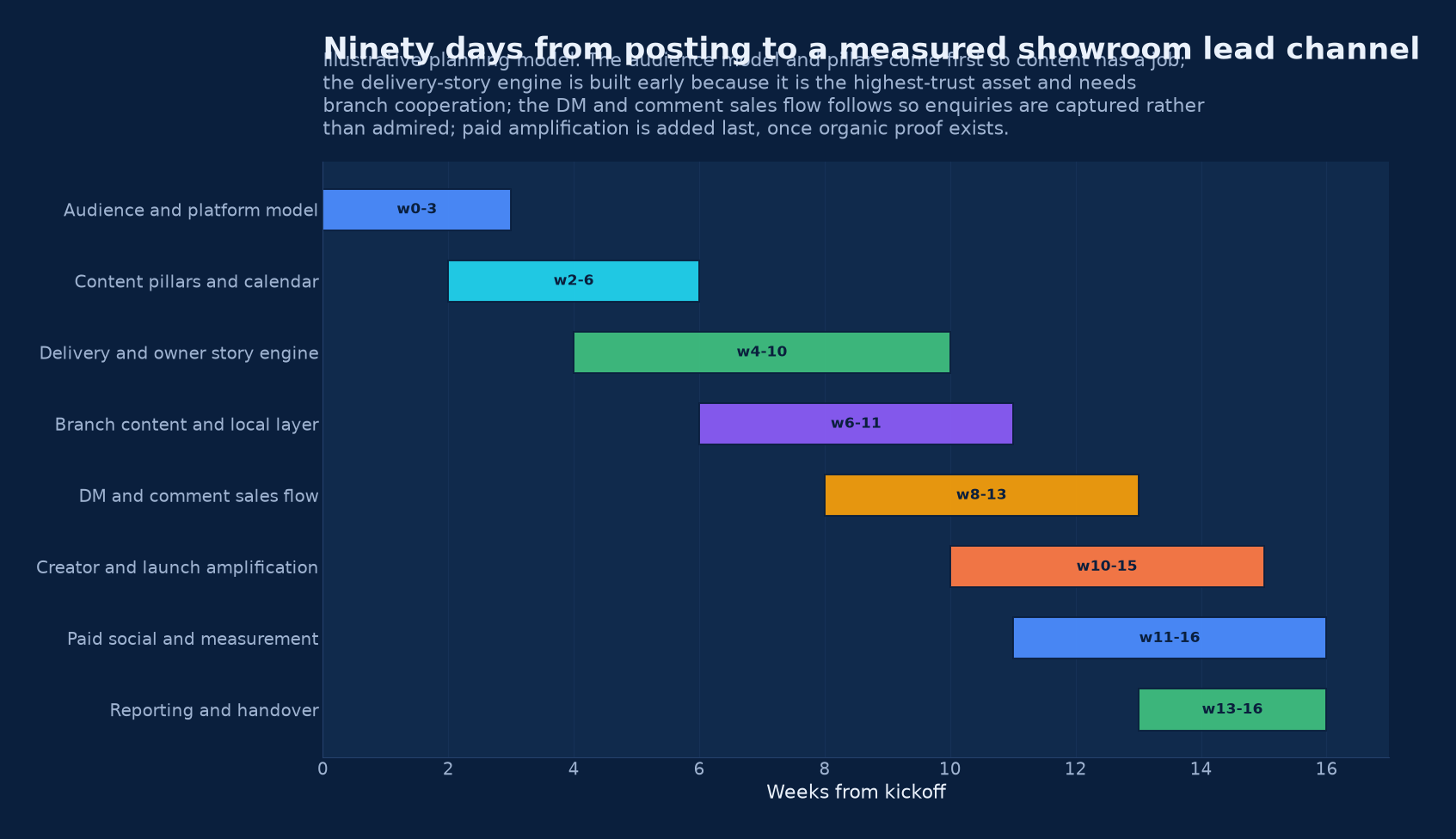
Chart values are an illustrative planning model based on typical UMC engagements and published industry benchmarks. They are not a guarantee of results on any specific project.
| Weeks | Workstream | Deliverable | Decision it enables |
|---|---|---|---|
| Zero to three | Audience and platform model | Cohort map, platform choice with a reason each, baseline metrics | Where effort goes, and what is deliberately not done |
| Two to six | Pillars and calendar | Pillar set with a job and measure each, a rolling four-week calendar | What is produced weekly and by whom |
| Four to ten | Delivery-day engine | Consent form, shot list, templates, branch training, publishing routine | Whether branches participate and how fast content ships |
| Six to eleven | Branch content and local layer | Branch handles or tags, locality prompts, review generation routine | Whether local search and walk-ins benefit |
| Eight to thirteen | DM and comment sales flow | Response SLA, triage tree, CRM routing, source-tagged links, outcome codes | Whether enquiries are captured rather than admired |
| Ten to fifteen | Creators and launch amplification | Creator briefs and contracts, launch plan, event booking path | What a launch week should cost and produce |
| Eleven to fifteen | Paid social and measurement | Stage-based campaigns, retargeting sequences, the joined report | Cost per qualified enquiry and per delivered unit by platform |
| Thirteen to sixteen | Governance and handover | Claims and rights process, complaint escalation, documentation, training | Who runs it, on what rules, and how it is reviewed |
- What we need: platform and ad account access, the branch list with a named content owner per branch, twelve months of delivery and service volumes, current creative assets and rights records, the CRM or DMS lead route, and one decision-maker who will set the response SLA.
- What you keep regardless: the audience model, the pillar set and calendar, the delivery-day routine and templates, the consent and rights registers, the sales-flow documentation and the measurement definitions. They are yours.
- What we will tell you plainly: which platforms to leave, which posting habits to stop, and where the constraint is branch follow-up rather than content volume – usually in the first fortnight.
Showroom social by city, and worked examples
Showroom social is local by construction: language and script decide the caption, the festive calendar decides the campaign rhythm, locality references decide whether a post feels like it was made for the reader, and branch density decides whether content is produced centrally or per branch. The engagements below are dealership, showroom and store projects where social, paid and the lead flow were operated as one programme.
- Get more automobile sales leads in Lucknow
- Digital marketing company for automobile dealers in Lucknow
- Website development company for automobile dealers in Lucknow
- Get more jewellery customers in Lucknow
- Digital marketing company for jewellery stores in Lucknow
- Digital marketing and IT services in Lucknow
- Services across Indian cities
- Case study: Hyundai group showroom full-service social advertising contract
- Case study: a fashion retail showroom
- Case study: WordPress and WooCommerce online mobile store
- The showrooms and dealerships industry hub – all eight disciplines
- Retail and e-commerce: catalogue, creator and social commerce
- Manufacturing: dealer networks, B2B demand and trade communities
- Hotels and hospitality: booking-led social and reputation management
- All industry verticals we build programmes for
- All digital marketing services
- About Unified Management Consulting
- Contact us about social media for showrooms and dealerships
Where this page sits in our showrooms programme
Social media marketing is the fourth discipline of our showrooms and dealerships programme. The hub page explains how the eight disciplines fit together, each discipline has its own page as it is published, and the generic service page for every discipline stays listed below alongside the vertical pages. A discipline that is not listed is not published yet – the list is generated from live pages and refreshes automatically as each spoke lands.
- Showrooms – the vertical main page
- Website development for showrooms and dealerships
- SEO for showrooms and dealerships
- Google Ads for showrooms and dealerships
- CRM and lead management for showrooms
- Business intelligence for showrooms
- IT support for showrooms and dealerships
- AI for showrooms and dealerships
- Website development services – the generic service page
- SEO services – the generic service page
- Google Ads management – the generic service page
- Custom CRM development and integration – the generic service page
- BI dashboards and executive reporting – the generic service page
- Managed IT infrastructure and AMC – the generic service page
- AI agent deployment and automation – the generic service page
Frequently asked questions about social media marketing for showrooms and dealerships
What should a dealership measure on social media?
Qualified enquiries, test-drive bookings, show rate and cost per delivered unit by platform and branch – joined on one lead identifier. Reach, followers and engagement are inputs; they explain whether the content is seen, not whether the business gained a customer.
Which platforms should a showroom be on?
Where your buying cohorts research and where your branches can be shown properly. For most dealerships that is Instagram plus WhatsApp plus YouTube, with Facebook for local reach and LinkedIn only where there is a genuine fleet or B2B audience. Four platforms done badly is worse than two done to a standard.
How often should we post?
As often as you can produce to your own standard and answer the response – typically four to seven times a week per platform for a dealership, with delivery content published the same day. Frequency without a pillar produces content nobody can measure or repeat.
Can we really publish customer delivery photos?
Yes, with consent taken at the paperwork stage, a named owner of the routine, no number plates or children without explicit permission, and a takedown route honoured the same day. Delivery content is the highest-trust asset a showroom owns, and consent is what makes it usable.
How do we handle comments asking for price?
As an enquiry, inside a response target: answer publicly with a range and a bookable next step, move the detail to a DM or WhatsApp with a source-tagged link, route the conversation into the CRM, and close it with an outcome code. Treating it as engagement loses the sale.
Do creators and influencers work for dealerships?
At specific moments – a launch, a branch opening, a festive campaign – with editorial freedom, disclosure and a contract covering usage. They are a trust instrument rather than a reach buy, and they are judged on assisted enquiries and branded search lift, not on views.
How do we prove social media revenue?
With three layers: enquiries and bookings joined to the DMS by source, assistance measured across the journey, and periodic holdouts – for example running a launch campaign in some cities and not others. Platform-reported figures alone will overstate direct response and understate assistance.
Should our branches post, or should head office post for them?
Both, with a division of labour: head office holds templates, standards, approvals and the calendar; branches supply the moments – deliveries, stock, staff, workshop, local events. Branch content without a template kit becomes inconsistent; central content without branch moments becomes generic.
How does social help our local search?
Location-tagged posts, consistent branch naming and hours, review generation and branded query volume all support local relevance. The requirement is consistency: the branch story on social must match the profile and the website, or all three are weakened.
What about WhatsApp – is it social or sales?
Both, and it is usually the highest-converting channel a dealership owns. Run it on a business API number with routing, consent and outcome coding rather than on an executive’s personal phone, and it becomes a measurable enquiry channel with an owner-community layer on top.
How do we handle a public complaint?
Respond quickly and briefly in public, take it offline, own it, resolve it, and only then update the public thread. Never argue, never delete a legitimate complaint, and log the resolution – complaint handling is a reputational asset when it is visibly fair.
What does a showroom social programme cost?
It scales with branch count, production capacity and whether paid amplification is included. A central production unit plus trained branch owners plus a measurement join is the core; creator work, launch films and paid budgets are scoped per campaign. We quote after the audience and platform model, so the price reflects what you will actually sustain.
Start with the audience model and the delivery-day engine
Give us three weeks with your platform and ad account access, the branch list with a named content owner per branch, twelve months of delivery and service volumes, your current assets and rights records, and the CRM or DMS route a lead can travel, and we will return an audience and platform model with a reason for each choice, a pillar set with a job and a measure each, a delivery-day engine with consent, shot list and templates ready to train branches on, a DM and WhatsApp sales flow with response targets and outcome codes, and a measurement plan that reports cost per qualified test drive by platform and branch – including what we would stop posting. Yours to keep either way.
Contact Unified Management Consulting to arrange a confidential first conversation.