
A showroom website has a job that an e-commerce website does not: it has to end in a visit, a test drive or an appointment, not in a checkout. That single difference changes almost every design decision. The product page is not a conversion page, it is a qualification page. The most important number is not revenue per session but cost per qualified test drive. The most important integration is not a payment gateway but the dealer management system that has to receive the enquiry before the customer changes their mind.
Most showroom websites are brochures with a contact form, and they fail in the same three places: the stock shown is not the stock on the floor, the branch information is wrong or missing, and the enquiry lands in an inbox rather than in the system the sales team works in. Fixing those three is a data and integration project as much as a design one – which is why our showroom builds start with the lead flow and the content model, and treat the templates as the last step rather than the first. The underlying discipline is website development services, applied to a business whose conversion event is a visit.
What an engagement includes, at a glance
| Component | What We Deliver |
|---|---|
| Lead-flow mapping | Every route by which a customer can reach a branch – form, call, WhatsApp, walk-in from a listing, booking – traced to the system that owns it, the person who follows it up and the report it appears in. Nothing is designed until this exists. |
| Model, variant and stock content model | One structure for models, variants, colours, trims, prices and availability that works across branches and survives a mid-year range change, rather than a page per brochure PDF. |
| Branch locators and local pages | Real opening hours, real phone numbers that route, real directions, staffed service bays and the branch-level pages that local search actually ranks. |
| Test-drive and appointment booking | Slot-based booking against branch capacity, with confirmation, reminder and a no-show path – and the show rate reported back to marketing. |
| DMS, stock and finance integrations | Live stock from the DMS or ERP, price and offer data, EMI and exchange calculators, and a lead record written back to the system the sales team lives in. |
| Enquiry channels that convert | Click-to-call with tracking, WhatsApp with a business-API path rather than a personal number, and a form set short enough that people complete it. |
| Performance on mobile and on the showroom floor | Sub-second LCP on a mid-range phone over mobile data, and a site that works on the tablet a sales consultant is holding next to a customer. |
| Accessibility, language and trust | WCAG 2.2 AA conformance, regional language variants, and the trust signals – authorisation, warranty, reviews, price transparency – that decide whether an enquiry happens at all. |
| Measurement and handover | Qualified-lead definitions agreed with sales, call and form tracking wired to source, a dashboard the general manager reads, and documentation that lets your team change an offer without calling us. |
What a showroom website is for: a visit, not a checkout
The fastest way to build the wrong showroom website is to copy an e-commerce one. Both sell considered purchases, but only one completes the transaction online. A showroom website is a qualification and routing machine: it has to give a customer enough information to decide to visit, capture the enquiry in a system that will act on it within minutes, and route it to the right branch and the right person. Everything else – the gallery, the brochure download, the editorial – is support material. The build consequences are concrete and they show up in the information architecture, which is why website strategy and information architecture precedes any template work.
| The e-commerce assumption | The showroom reality | What it changes in the build |
|---|---|---|
| The product page converts | The product page qualifies; the branch converts | Every model page carries a branch, a booking and a call path above the fold |
| Stock is a warehouse number | Stock is a floor and yard position, per branch, changing hourly | A live stock feed with branch-level availability, not a static ‘in stock’ label |
| Price is the price | Price is ex-showroom, on-road, with finance, exchange and offers | A price model with components, and a calculator rather than a number |
| Cart and checkout | Booking, appointment and enquiry | Slot-based booking against branch capacity with confirmation and reminders |
| One fulfilment path | Delivery, pickup, home test drive, exchange, service | Multiple flows with different data requirements and different owners |
| Anonymous browsing then purchase | Long consideration, multiple visits, family involvement | Saved configurations, shareable links, retargeting audiences and a follow-up sequence |
| Support is a cost centre | Sales follow-up is the revenue engine | Enquiry routing, SLA timers and follow-up states visible to managers |
| Conversion rate is the KPI | Cost per qualified test drive and show rate are the KPIs | Call, form and WhatsApp tracking joined to the lead record, not to sessions |
| One language, one market | Regional languages, city variants, festive calendars | Localisation in the content model, not bolted on as translated pages later |
| The site is the channel | The site feeds walk-in, phone and marketplace enquiries too | Attribution designed for assisted visits, not only last-click online leads |
- Where a dealership also sells online – accessories, service packages, bookings with payment – that part is genuinely commerce and is built as e-commerce alongside the showroom layer rather than instead of it.
- Where the group runs several brands and several cities, the same content model has to serve all of them; that is a multi-site architecture question with a brand-consistency constraint, handled with brand and creative production rather than by duplicating pages.
- Where the estate has outgrown the current site – a brochure platform with no stock feed and no lead routing – the honest conversation is a migration or replatforming, sequenced so trading and enquiry flow never stop.
Mapping the lead flow before designing anything
Every showroom website we have audited loses leads in the same place: between the enquiry and the system that owns it. A form fills an inbox; a call reaches a landline nobody logs; a WhatsApp message sits on a personal phone; a walk-in is recorded in the DMS with no source. The result is that marketing cannot say what produced a test drive, sales cannot prove follow-up discipline, and management cannot price a lead. Mapping the flow first is not consultancy overhead – it is the specification for the integrations, and it usually changes the design.
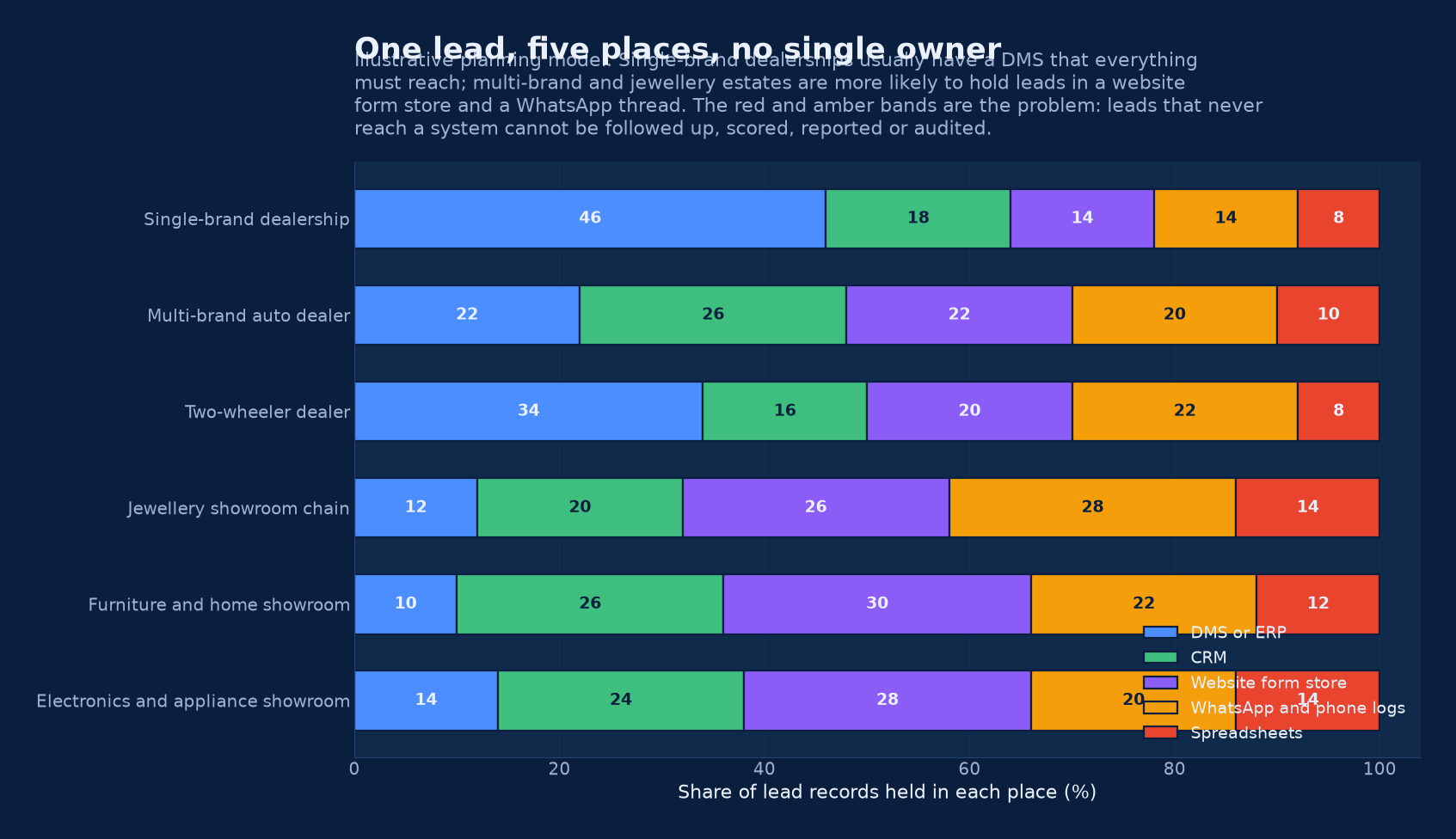
Chart values are an illustrative planning model based on typical UMC engagements and published industry benchmarks. They are not a guarantee of results on any specific project.
| Enquiry route | Where it usually lands | Where it has to land | Follow-up owner | Measure that proves it works |
|---|---|---|---|---|
| Model page form | A shared inbox | The DMS or CRM lead table with source and model | Branch sales executive | Time to first contact, under fifteen minutes in trading hours |
| Click-to-call | A landline with no record | A tracked number mapped to branch and campaign | Branch reception or sales desk | Calls connected, duration, outcome logged |
| WhatsApp enquiry | A personal phone | A business API conversation with a lead record | Assigned executive, visible to the manager | Response time, conversation outcome |
| Test-drive booking | A calendar invite | A slot against branch capacity with reminders | Branch sales manager | Bookings, show rate, conversion to order |
| Service appointment | A phone call | A booked bay with parts and labour estimate | Service adviser | Bay utilisation, upsell rate, turnaround |
| Exchange valuation request | An email thread | A valuation record attached to the prospect | Used-vehicle manager | Valuations completed, conversion to purchase |
| Finance pre-approval | A lender’s portal | A status field on the same lead record | Finance officer | Applications, approvals, disbursal time |
| Walk-in from a listing | The DMS, source ‘walk-in’ | The DMS with the listing or campaign source | Branch sales executive | Source attribution on delivered units |
| Callback request | A missed-call log | A queued task with an SLA timer | Duty manager | Callback completion within the promised window |
| Showroom event registration | An event spreadsheet | A lead record tagged to the event | Marketing plus branch manager | Registrations, attendance, orders attributed |
- The routing target matters more than the form design: a lead written to the CRM or DMS lead table with a source, a model and a branch is worth more than a prettier form that lands in an inbox.
- Where the DMS is closed or vendor-controlled, the pragmatic path is a middleware layer that accepts the enquiry and pushes it through the vendor’s supported interface – enterprise systems integration with a dealership constraint.
- Follow-up discipline is a management question the website only makes visible: SLA timers, escalation and a manager view are sales analytics and pipeline intelligence applied to a showroom floor.
- Every route needs a defined outcome code. ‘Enquiry’ is not an outcome; ‘test drive booked’, ‘not reachable’, ‘bought elsewhere’ are – and without them no report means anything.
The content model: models, variants, offers and availability
Showroom content fails when it is written as pages instead of structured as records. A car, a bike, a jewellery collection or a furniture range is a model with variants, and each variant has attributes, prices, colours, availability by branch, applicable offers and finance terms. Model that properly and every surface – listing page, variant page, comparison, booking form, stock feed, ad creative, AI answer – reads the same record. Model it as prose and each surface becomes a maintenance task that drifts. This is the single most consequential decision in the build.
| Content type | Fields that actually matter | Source of truth | Update frequency | What breaks if it is wrong |
|---|---|---|---|---|
| Model | Name, segment, body style, fuel, launch status, key USPs | Brand or manufacturer master | Per range change | Comparison and filtering become meaningless |
| Variant and trim | Engine, transmission, features, colour options, price | Price list from the manufacturer | Per price revision | A customer quotes a price the branch cannot honour |
| Branch availability | Stock count by variant and colour, per branch | DMS or ERP stock ledger | Hourly or on change | Test drives booked for vehicles that are not there |
| On-road price build-up | Ex-showroom, RTO, insurance, handling, accessories | Finance and registration rules by state | Per revision | Price mistrust, the fastest way to lose an enquiry |
| Offers and schemes | Validity, eligible variants, funding source, stacking rules | Marketing calendar plus manufacturer schemes | Weekly during festive periods | An expired offer still advertised, or a legal exposure |
| Finance and EMI | Tenure, rate, down payment, lender panel | Lender terms | Per rate change | An EMI figure that fails at the desk |
| Exchange and residual value | Valuation bands by age, model and condition | Used-vehicle team | Monthly | Valuations that cannot be honoured |
| Service and warranty | Plan coverage, intervals, roadside terms | Service department | Per policy change | Promises the workshop will not accept |
| Branch record | Address, hours, phones, services offered, directions | Operations, verified per branch | On any change | A customer driving to a closed branch |
| Media and documents | Images, video, brochures, spec sheets | Brand asset library with rights | Per campaign | Wrong-colour images and unlicensed assets |
- Structure first, templates second: once the model exists, a variant page is a rendering of a record, and a range change is a data update rather than a rebuild.
- The same structured data is what search engines and AI assistants read, so the content model is also the SEO foundation – product and vehicle structured data, branch data and offer validity all come from these records.
- Where the estate spans several brands, the model has to accommodate different attribute sets without becoming a lowest-common-denominator table – a schema design decision worth taking slowly, and one we revisit in market expansion conversations when a new brand is added.
- Offers with validity dates need a publishing discipline: an expired offer left live is a consumer-problem, not a cosmetic one, so expiry is a field with an automated takedown.
Branch locators, hours and the local layer
For a branch-led business the branch page is the highest-intent page on the site, and it is usually the worst-maintained. A customer who searches for a dealership near them wants four things within ten seconds: is it open now, how far is it, what does it have, and can I talk to someone. Getting those right is a data problem – hours that change for festivals, phone numbers that route to a person rather than a queue, stock that reflects the yard – and a local search problem, because the same information feeds the map pack. The build requirement is one branch record with many renderings: website, map listing, ad extension and AI answer.
| Element | What the customer needs | What usually exists | Build requirement |
|---|---|---|---|
| Branch list and map | The nearest branch that does what I need | A static list of addresses | Searchable locator filtered by service, brand and city |
| Opening hours | Is it open now, and does it close for lunch | Hours copied from an old brochure | Per-branch hours with festive exceptions and a live open-now state |
| Phone numbers | A number somebody answers | One landline for sales, service and accounts | Tracked numbers per department and per branch, with routing |
| Directions and parking | How to arrive and where to stop | A Google Maps embed | Deep link with plus-codes, parking and landmark notes |
| Branch services | Sales, service, used vehicles, accessories, finance desk | Implied by the branch name | Service flags driving the locator filters and ad extensions |
| Branch stock | What is actually on the floor today | A phone call | Live availability from the stock feed, per branch |
| Branch staff | Who will I meet, and can I book with them | Nobody listed | Optional consultant profiles with booking, where the branch wants it |
| Reviews and reputation | Whether this branch is any good | Reviews on a profile nobody manages | Review display with a managed response path, per branch |
| Local landing pages | Whether this brand serves my area | One national page | City and branch pages with genuine local content, not duplicates |
| Language and script | Whether I can read it | English only | Regional language variants served from the same records |
- The website and the map listing must agree. Divergent hours or phone numbers between the site and the business profile cost enquiries and rankings at once – see local SEO and Google Business Profile management for the listing side of the same record.
- Branch pages are the landing surface for local campaigns: Local Services Ads and Performance Max with local goals both need a page whose content matches the branch targeting.
- A chain with many branches eventually needs branch-level administration – a manager who can edit hours without a developer. That is a portal and role-based editing layer, and it is cheaper to build during the launch than to retrofit.
Booking: test drives, appointments and service slots
Booking is where a showroom website stops being information and becomes operations. A test-drive request that lands as an email is a test drive that may not happen; a slot booked against real branch capacity, confirmed on WhatsApp, reminded the night before and marked as shown or no-show is a measurable appointment. The design detail that matters most is capacity: a branch with three demonstrator vehicles and two consultants cannot accept forty bookings for Saturday morning, and a booking system that does not know that produces no-shows and disappointed customers rather than orders.
| Booking type | Capacity constraint | Confirmation flow | No-show handling | Measure reported |
|---|---|---|---|---|
| Test drive at branch | Demonstrator vehicles and consultant hours | Instant confirmation plus WhatsApp reminder | One reschedule offer, then released slot | Bookings, show rate, order conversion |
| Home test drive | Route and driver availability by zone | Slot with an arrival window and a driver contact | Same-day cancellation window, then a fee-free release | Home drives completed, cost per completed drive |
| Purchase appointment | Consultant desk availability | Confirmation with documents checklist | Reminder sequence, then reassignment | Appointments held, orders placed |
| Service appointment | Bay and technician hours | Slot with pickup and drop option | Reminder with a reschedule link | Bay utilisation, turnaround, upsell |
| Used-vehicle inspection | Inspector availability and yard space | Slot with valuation report timing | Release back to the pool | Inspections completed, conversion |
| Finance consultation | Finance desk hours, lender panel | Slot with document checklist | Reschedule with a document reminder | Applications submitted, approval rate |
| Delivery slot | Delivery bay and paperwork preparation | Confirmed time with a preparation checklist | Hard reschedule, since the vehicle is prepared | On-time deliveries, customer satisfaction |
| Event or launch registration | Venue capacity and invite list | Registration with a QR or reference | Waitlist promotion | Registrations, attendance, orders attributed |
| Virtual or video consultation | Consultant hours and connectivity | Link with a reminder | Reschedule prompt | Consultations held, follow-up booked |
- Reminders are the cheapest show-rate improvement available: a WhatsApp reminder the evening before and a message two hours ahead typically moves show rates more than any redesign – see WhatsApp marketing for the business-API path that keeps it compliant.
- Booking data is pipeline data. Every slot, show and no-show belongs in the same record as the enquiry, which is what makes forecasting of weekend demand and consultant staffing possible at all.
- A booking engine that cannot be changed by branch staff will be worked around. Give the manager an override, a block-out for training days and a view of the week – and log every override so the capacity model can be corrected.
DMS, stock and finance integrations: the part that decides whether the site is true
A showroom website without integrations is a promise the branch cannot keep. The critical connections are the DMS or ERP for stock, orders and customer records; the finance stack for EMI, pre-approval and disbursal status; the telephony and WhatsApp layer for conversation records; and the marketing platforms that need audiences and conversion events. Each one has a dealership-specific difficulty: vendor-controlled schemas, rate limits, batch windows that close at night, and branch staff who will notice an error before any monitor does.
| System | Data exchanged | Direction | Failure mode | Control |
|---|---|---|---|---|
| DMS or ERP | Stock, variants, prices, orders, customer and lead records | Both | A nightly batch that silently fails | Row-count and freshness monitoring with an alert to a named owner |
| Manufacturer stock portal | Allocation, in-transit units, range changes | Inbound | Schema changes without notice | Contract-tested ingestion and an exception queue |
| Finance and lending partners | EMI calculation, pre-approval status, disbursal | Both | A rate change applied to the site but not the calculator | Rate table with effective dates and a version log |
| Insurance partners | Quotes and policy issuance for on-road price | Both | Quote expiry while the customer is still deciding | Validity windows shown on the page |
| Telephony and call tracking | Call events mapped to branch and campaign | Inbound | Numbers reassigned without updating mapping | Number inventory with an owner and a change log |
| WhatsApp business API | Conversations, templates, opt-in state | Both | A template rejected mid-campaign | Template versioning and a fallback to SMS |
| CRM and lead routing | Lead creation, assignment, SLA timers, outcomes | Both | Duplicate leads from two forms | Deduplication on phone plus model, with a merge rule |
| Marketing platforms | Conversion events, audiences, offline lead imports | Outbound | Conversions fired for unqualified enquiries | Qualified-lead event defined with sales, not marketing |
| Review and reputation platforms | Ratings and responses per branch | Both | A negative review with no owner | Routing to the branch manager with a response SLA |
| Analytics and warehouse | Sessions, events, leads, outcomes joined to source | Outbound | Leads and orders in separate systems | A single lead identifier carried end to end |
- The integration layer needs a home. Where the DMS is vendor-controlled, a middleware service with retries, idempotency and a replay path is the difference between an outage and an inconvenience – ERP, CRM and operations integration describes the pattern.
- Everything the integrations produce should land in one place that can be queried: a warehouse with lead, booking, stock and outcome facts, so a general manager can ask what a campaign produced in delivered units.
- Integration endpoints are an attack surface and a compliance one: secrets management, scoped tokens and logging are security work, and the customer data crossing them makes audit and compliance evidence a build artefact rather than a later request.
- Hosting has to survive a launch weekend: autoscaling, caching and cost controls belong in the same plan – cloud infrastructure with cost discipline so a viral offer does not produce an invoice surprise.
Calculators, valuations and the layer that qualifies a lead
On a showroom website the calculator is the qualification device. An EMI estimate tells you the budget; an exchange valuation tells you whether there is a part-exchange; an on-road price build-up tells you the customer understands what they are buying; a service cost estimate tells you whether they will book. Each one is also a data capture point, and each one has a failure mode that costs trust: a figure the branch cannot honour is worse than no figure at all. The design rule is that every calculated number must be reproducible from a published rate table with an effective date.
| Tool | What it qualifies | Data it needs | Design rule | Common failure |
|---|---|---|---|---|
| EMI calculator | Budget and tenure preference | Lender rate table, down payment norms | Show the assumptions, let the customer change them | A rate that changed last month |
| On-road price build-up | Whether the customer understands the real cost | Ex-showroom price, state RTO rates, insurance, handling | Itemise every component, per state | One national number presented as local |
| Exchange valuation | Whether there is a part-exchange and its band | Age, model, condition bands from the used-vehicle team | Give a band and book an inspection, never a promise | A precise figure the yard will not honour |
| Offer eligibility check | Which schemes apply to this variant | Offer rules with validity and stacking logic | State the expiry date on the same screen | Stacked offers that finance will reject |
| Service cost estimate | Whether the owner will book the workshop | Labour rates, parts bands, service intervals | Present a range with what would change it | A fixed quote for a job nobody has inspected |
| Warranty and plan comparison | Whether an extended plan is worth it | Plan coverage, exclusions, prices | Show exclusions as prominently as coverage | Coverage implied that the workshop disputes |
| Comparison tool | Which variant or competitor model is shortlisted | Structured attributes at variant level | Let the customer save and share the comparison | Attributes missing for half the variants |
| Configurator | Colour, trim and accessory preference | Variant options, accessory catalogue, images | Persist the configuration and attach it to the enquiry | A configuration that cannot be sent to a branch |
| Fuel and running-cost estimate | Total cost of ownership for the segment | Certified figures, fuel prices, insurance bands | Cite the source of every input | Marketing numbers presented as certified ones |
| Booking availability check | Whether the customer can be seen this week | Branch capacity, demonstrator availability | Show real slots, not a request form | A slot offered that the branch cannot honour |
- Every calculator should attach its inputs to the lead record. ‘Customer estimated EMI at this tenure with this down payment’ is the most useful line a sales executive can read before calling.
- Configurators and comparisons are heavy front-end work; they must stay fast on a mid-range phone, which is a UX and UI design constraint as much as an engineering one.
- Valuation and finance tools touch regulated territory – published rates, honest exclusions, no implied guarantees – and that is a compliance review before launch, not after a complaint.
Performance on mobile, and on the showroom floor
Showroom traffic is overwhelmingly mobile, and a large share of it happens inside the branch – on the customer’s phone and on the consultant’s tablet, often over the branch Wi-Fi that is also carrying CCTV, signage and a dozen devices. That makes performance a sales issue rather than a technical one: a variant page that takes six seconds to show a price loses the conversation happening next to the vehicle. The budget is set from the weakest realistic connection, not from an office fibre line, and it is measured in the field.
| Surface | What it has to do | Budget we hold it to | How it is measured | Usual cause of failure |
|---|---|---|---|---|
| Model and variant pages | Show price, availability and a booking path immediately | LCP under 2.0s on 4G mid-range | Field test plus RUM from real visits | Hero images served at desktop size |
| Branch locator | Find the nearest open branch in two taps | Interactive under 2.5s, map lazy-loaded | Task timing with branch staff | A full map library loaded on every page |
| Booking flow | Complete a test-drive booking in under a minute | Three steps maximum, no account required | Funnel completion and abandonment | A form asking for details the branch does not need |
| Image and video galleries | Load progressively without blocking the page | Lazy-loaded, next-gen formats, capped autoplay | Page weight budget per template | Autoplaying video on mobile data |
| Calculators | Recalculate instantly as inputs change | No network round trip per keystroke | Interaction latency testing | Server-side calculation on every field |
| Consultant tablet view | Work on the branch network, offline-tolerant | Cached price and spec data, graceful degradation | On-site testing at the branch | A site that assumes a stable connection |
| Stock availability | Reflect the yard, not last night’s batch | Refresh interval agreed with operations | Freshness monitor with an alert | A nightly batch presented as live |
| Third-party scripts | Track without blocking the render | Tag budget with a total weight ceiling | Script audit per release | Marketing tags added without review |
| Core Web Vitals overall | Pass on mobile for every template | LCP, INP and CLS within Google’s good range | Core Web Vitals field data, not lab only | One heavy template dragging the whole origin |
- Performance work is not a launch task, it is a maintenance discipline: every new campaign asset, tag and plugin is a chance to undo it, so the budget is enforced per release.
- The branch network is part of the experience. A dealership whose Wi-Fi cannot serve a specification page will blame the website – which is why routing, switching and network engineering appears in showroom programmes more often than expected, and where a DMS still runs from a branch server room, server and storage engineering is part of the same conversation.
- Where the estate runs a heavy front-end – configurator, 3D viewer, virtual walkthrough – the architecture usually needs a decoupled front end with an API layer, which is a headless or composable decision taken early rather than retrofitted.
- App and tablet tooling for consultants is a companion surface, not an afterthought: mobile app development for the sales desk shares the same records as the website, and duplicating them is how two prices appear in one conversation.
Enquiry channels: click-to-call, WhatsApp and forms people complete
In showroom markets the phone and the messaging app outrank the form. A customer who wants to ask one question will not fill in six fields, and a sales team that receives an enquiry as an email will not respond inside fifteen minutes. The build implication is that every channel has to be tracked, recorded and joined to the same lead record – a call without a source is an unattributable order, and a WhatsApp thread on a personal phone is an unauditable one.
| Channel | What it is good for | Tracking requirement | Record requirement | Failure to design against |
|---|---|---|---|---|
| Click-to-call | Immediate questions, older customers, service enquiries | Number per branch and per campaign | Call log with duration and outcome | One landline shared by four departments |
| Photos, location, quick confirmation, reminders | Business API with template versions | Conversation attached to the lead record | A personal number that leaves when the executive leaves | |
| Web forms | Structured enquiries with model and branch context | Source, campaign and page captured per submission | Written to DMS or CRM within seconds | Six required fields and a captcha |
| SMS | Reminders, offer expiry, service due | Delivery and click status per message | Consent state and message history | Broadcasts without an opt-out path |
| Nurturing a long consideration cycle, documentation | Open, click and reply tracking per journey | Preference centre and consent record | One monthly newsletter to the whole database | |
| Callback request | Customers who cannot talk now | Requested window captured | Queued task with an SLA timer | A missed call treated as an outcome |
| Chat and assistant | Out-of-hours questions, routing to a branch | Session and resolution tracking | Transcript attached to the lead | A bot that cannot see stock or branch hours |
| Social direct messages | Comment and DM enquiries from campaigns | Platform plus campaign reference | Copied into the lead system, not left in the inbox | Enquiries answered publicly with a phone number |
| Marketplace and listing leads | Leads from auto portals and aggregators | Portal and listing identifier | Imported to the same lead table with source | Portal leads tracked in a separate spreadsheet |
- Paid and organic traffic are only as good as the channel that receives them: Google Ads campaigns, Performance Max and Local Services Ads all need call and form tracking wired to the same qualified-lead event, and organic model pages need a call path on mobile.
- Social is where showroom demand is created rather than captured: organic social, Meta and Instagram ads, YouTube launch films and inventory-style feeds for accessories all end at the same branch pages.
- Long consideration cycles need a sequence, not a single message: nurturing programmes and lifecycle campaigns by email, SMS and WhatsApp, with consent recorded at capture.
- A lead that arrives out of hours should still be answered. Where the volume justifies it, an AI assistant grounded in branch hours, stock and offers handles the first exchange and books the slot – with escalation to a human, never instead of one.
Accessibility, language and the trust signals that decide the enquiry
A showroom website is a public-facing service, and in most markets that carries obligations as well as commercial sense: WCAG 2.2 AA conformance is a requirement for government and large corporate suppliers, and it is simply better for customers using screen readers, low vision, one-handed mobile use or a slow connection. Language is the second trust layer – a customer reading about a five-lakh purchase in their own language converts differently. The third is transparency: authorisation, warranty terms, price components and reviews, presented where the decision is made.
| Requirement | What it means in practice | Why it matters commercially | How we verify |
|---|---|---|---|
| WCAG 2.2 AA conformance | Keyboard paths, focus order, contrast, labels, captions | Public-sector and fleet contracts require it; all customers benefit | Automated scan plus manual assistive-technology testing |
| Mobile-first interaction | Thumb-reachable actions, no hover-only behaviour | Most showroom traffic is on a phone | Device matrix testing including low-end Android |
| Regional language variants | Translated templates served from the same records | Considered purchases are discussed in the local language | Native review per language, not machine output alone |
| Price transparency | Itemised on-road price with every component | The fastest trust gain available to a dealership | Published rate tables with effective dates |
| Authorisation and provenance | Brand authorisation, dealership identity, registration details | Distinguishes an authorised branch from a broker | Footer and branch records reviewed legally |
| Reviews and responses | Branch-level reviews with a managed response path | Read before every visit, and they feed local rankings | Response SLA and escalation for negatives |
| Offer clarity | Validity dates, eligibility, exclusions on the same screen | An expired or misleading offer is a complaint | Automated takedown on expiry |
| Privacy and consent | Clear purpose, opt-in for messaging, data rights | Enquiry volumes depend on trust in the form | Consent records auditable per lead |
| Document accessibility | Brochures and spec sheets as text, not scanned images | Search engines and screen readers cannot read a scan | Document audit per template |
| Support and escalation | A visible path to a human, including out of hours | A dead-end page loses the enquiry entirely | Mystery-shopping the enquiry journey |
- Accessibility is a build standard rather than a remediation project when it is set at the start: WCAG remediation afterwards costs several times what designing to the standard costs.
- Language and content variants are a content strategy question with a records answer – one content model, many renderings – otherwise translation becomes duplication.
- Trust signals also feed the AI answers customers increasingly read first: structured authorisation, price and review data is what launch and event pages and AI assistants cite, so it has to be machine-readable as well as persuasive.
Measurement: cost per qualified test drive, not cost per lead
Showroom marketing is usually reported on lead volume, which is the metric most easily inflated and least connected to a delivered unit. The alternative is a short chain of definitions agreed with sales: what counts as a qualified enquiry, what counts as a test drive shown, what counts as an order, and what each stage costs. Once that chain exists, the website can be judged on the only number that matters – cost per delivered unit by source – and the argument about whether a campaign ‘worked’ becomes arithmetic.
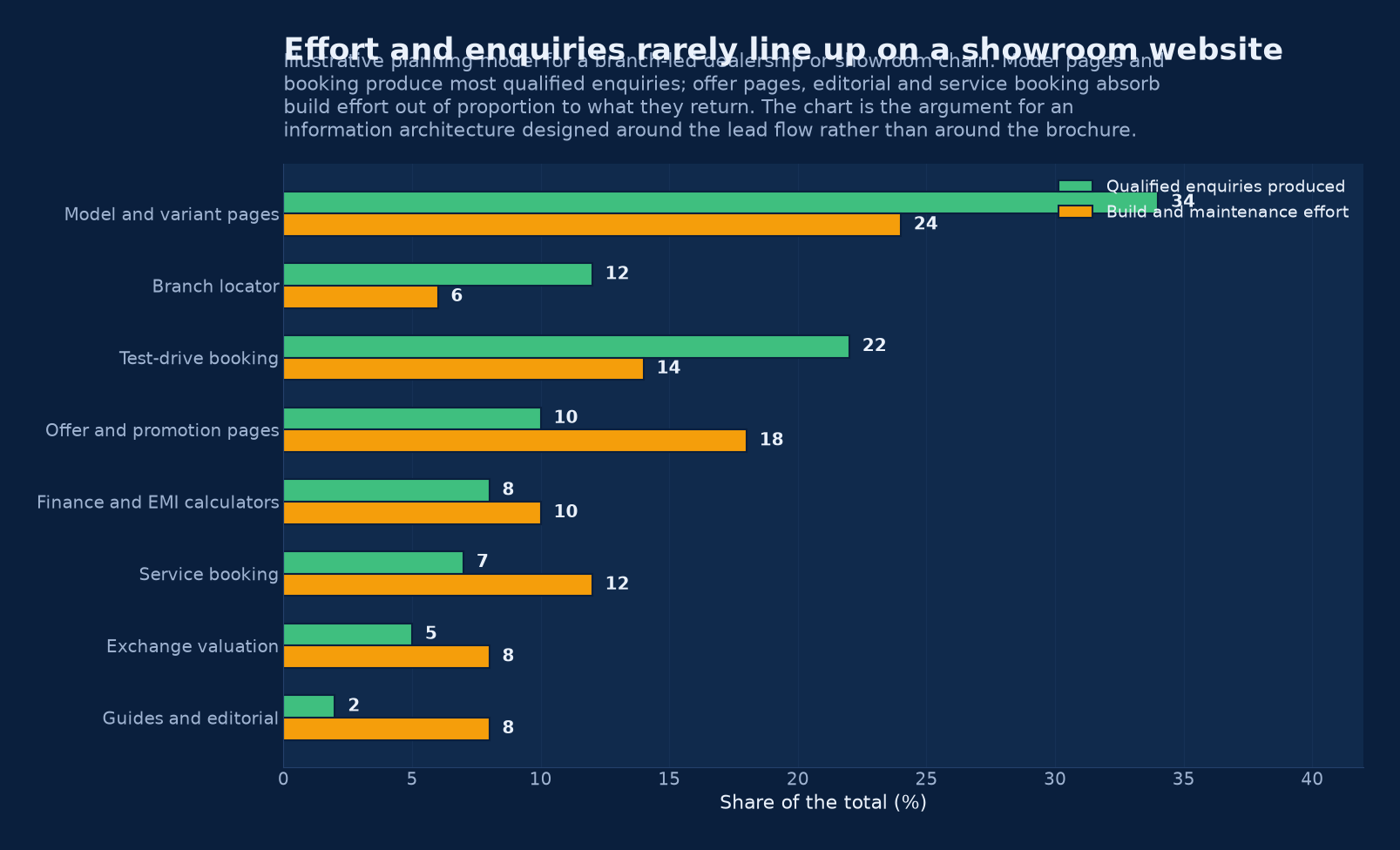
Chart values are an illustrative planning model based on typical UMC engagements and published industry benchmarks. They are not a guarantee of results on any specific project.
| Metric | Definition agreed with sales | Source | Who reads it | Decision it drives |
|---|---|---|---|---|
| Enquiry | Any inbound contact with a model or branch context | Forms, calls, WhatsApp, portal imports | Marketing | Volume and channel mix |
| Qualified lead | Reachable, in-market, right model and budget band | Lead record outcome code | Sales manager | Whether the source is worth funding |
| Test drive booked | A slot confirmed against branch capacity | Booking system | Branch manager | Weekend staffing and demonstrator count |
| Test drive shown | The customer arrived and drove | Branch record at the slot | Branch manager | Reminder flow and slot design |
| Quotation issued | A priced offer with finance or exchange detail | DMS quote record | Sales manager | Where the funnel actually leaks |
| Order placed | Booking amount received and order recorded | DMS order record | General manager | Revenue and mix by source |
| Delivery | Unit delivered and invoiced | DMS delivery record | General manager | The only true numerator for cost per unit |
| Cost per qualified lead | Spend divided by qualified leads, by source | Ad platforms joined to lead outcomes | Marketing | Budget reallocation |
| Cost per delivered unit | Spend divided by deliveries attributed to the source | Warehouse of joined marketing and DMS data | Leadership | Whether the channel survives next quarter |
| Show rate and follow-up SLA | Bookings shown, and first contact within the window | Booking plus lead records | Branch and sales management | Process discipline, not spend |
- The join between marketing and the DMS is the whole exercise: a single lead identifier carried from click to delivery, held in one queryable place, is warehouse work with a dealership deadline.
- Reporting has to reach the people who act. A branch manager needs yesterday’s bookings and follow-ups on one screen; a group head needs cost per delivered unit by brand and city – two different dashboards from the same data.
- Offline attribution is imperfect and should be said so: walk-ins from a hoarding or a radio campaign will never be fully traced, which is why forecasting and period comparison sit alongside source reporting rather than replacing it.
Platform choice, ownership and the total cost of a showroom website
The platform question in showrooms is really an ownership question: who changes an offer on a Saturday, who adds a branch, who fixes a price, and what happens when the agency that built it moves on. A dealer group with twelve branches and three brands needs an estate that its own team can operate, with integrations it can inspect and a cost it can predict. That argues for standard frameworks, documented records, branch-level administration and a support model – not for a bespoke platform nobody can maintain.
| Option | When it is the right answer | What it demands | Total-cost trap |
|---|---|---|---|
| Manufacturer template site | A single-brand franchise with mandated hosting | Compliance with brand rules and limited local content | Local differentiation impossible; leads owned by the brand |
| Managed CMS on a standard stack | Most dealership groups and showroom chains | A content model, branch admin roles, an integration layer | Plugin sprawl and an unmaintained theme |
| Headless with an API layer | Configurators, multi-brand groups, app companions | Engineering capability in-house or on contract | Complexity that outlives the team that built it |
| Commerce-enabled site | Accessory, service-plan and booking payments online | Payment, tax and refund handling, plus support | A checkout maintained for a fraction of the catalogue |
| Group multi-brand estate | Several brands and cities under one ownership | Shared components with per-brand theming and permissions | Duplicated builds per brand, each drifting |
| Portal for partners and staff | Consultants, fleet buyers, service partners | Role-based access, audit logging, single sign-on | A portal bolted on later with a second user store |
| Legacy site kept alive | Migration is not affordable this year | Security patching, monitoring and a documented exit date | Paying twice: maintenance now and migration later |
| Full replatform | End-of-life stack, no stock feed, no lead routing | A sequenced migration with redirects and no enquiry loss | Migrating before festive season, or during it |
- Whatever the platform, someone must own it day to day: application maintenance and support with a stated response commitment is part of the cost, and end-user support for branch staff is what stops workarounds appearing.
- The estate is infrastructure as well as marketing – hosting, network, devices, backups and access control sit under managed IT services, and the technology catalogue behind them is the whole technology services stack.
- Cost conversations belong in the management accounts: a website whose cost per delivered unit is known is a channel; one whose cost is a lump sum is overhead – which is how it ends up in a cost rationalisation exercise.
- Where the group is under cash pressure, sequencing matters more than scope: cash flow and working capital discipline often means shipping the lead-routing and booking layer first and deferring the configurator, and unified top-level management is where that trade-off is properly taken.
- Choosing between these options is a strategy decision with a technology input, not the reverse: business strategy consulting sets the branch and brand plan the estate has to serve.
The ninety-day showroom website programme, and what we need from you
The programme below is the shape we run for a dealership group or showroom chain: three weeks mapping the lead flow and agreeing the content model, overlapping information architecture and design work, a core build from week six, integrations running in parallel from week nine, performance and accessibility verification from week twelve, and launch with measurement and handover in the last fortnight. The dates that matter most are the ones where operations has to confirm data – stock feeds, branch hours, price tables – because those are the ones that slip.
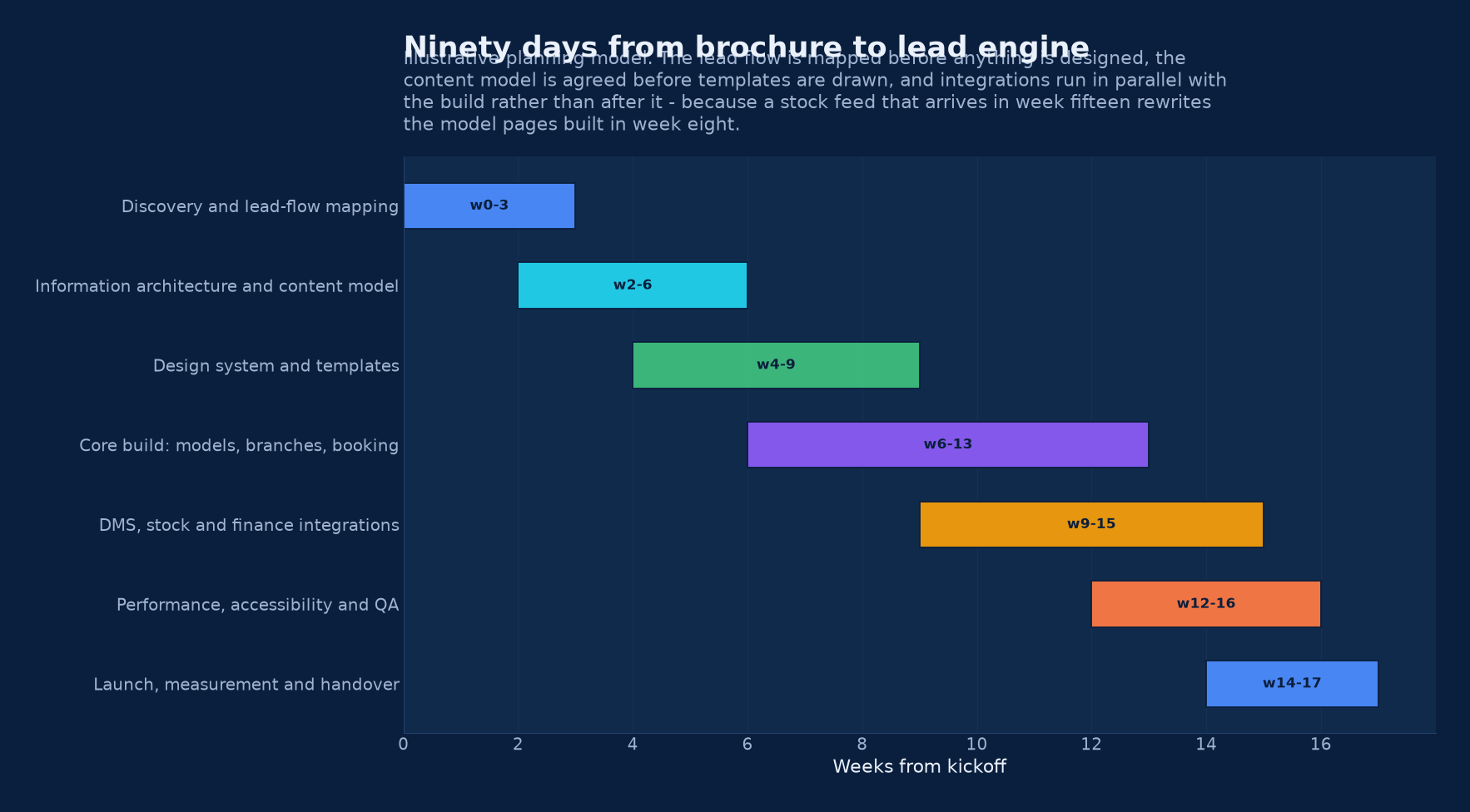
Chart values are an illustrative planning model based on typical UMC engagements and published industry benchmarks. They are not a guarantee of results on any specific project.
| Weeks | Workstream | Deliverable | Decision it enables |
|---|---|---|---|
| Zero to three | Discovery and lead-flow mapping | Every enquiry route traced to a system, an owner and a measure | What the site has to route, and where it lands |
| Two to six | Information architecture and content model | Model, variant, branch, offer and booking schemas plus URL structure | Whether a range change is a data update or a rebuild |
| Four to nine | Design system and templates | Component library, mobile-first templates, branch and variant pages | What branch staff can edit without a developer |
| Six to thirteen | Core build | Locator, booking, calculators, forms, lead routing, admin roles | Whether enquiries reach the DMS inside minutes |
| Nine to fifteen | Integrations | Stock feed, finance rates, telephony, WhatsApp, review and ad-platform joins | Whether the site tells the truth about availability |
| Twelve to sixteen | Performance, accessibility and QA | Core Web Vitals in the field, WCAG 2.2 AA verification, device matrix | Whether it works on the floor and on a mid-range phone |
| Fourteen to sixteen | Launch, measurement and handover | Redirects, analytics, qualified-lead definitions, dashboards, documentation | What each source costs per delivered unit |
| Ongoing | Maintenance and iteration | Release cadence, performance budget, offer publishing, monitoring | Whether the estate improves or drifts |
- What we need: DMS or ERP access under an agreed scope, the manufacturer price and offer feeds, branch list with verified hours and phone numbers, current lead and order history, brand guidelines, and one named owner per branch for data confirmation.
- What you keep regardless: the lead-flow map, the content model, the integration documentation, the qualified-lead definitions and the dashboards. They are yours.
- What we will tell you plainly: which pages to stop maintaining, which third-party widgets to remove, and whether a rebuild is cheaper than another year of patching.
Showroom websites by city, and worked examples
Showroom programmes are branch-specific by nature: opening hours and festive calendars differ by city, language variants matter more in some markets than others, RTO and insurance components change the on-road price build-up state by state, and the branch network decides whether the locator is a convenience or the primary navigation. The engagements below are dealership, showroom and store projects where the site, the lead flow and the measurement were built together.
- Website development company for automobile dealers in Lucknow
- Get more automobile sales leads in Lucknow
- Digital marketing company for automobile dealers in Lucknow
- Website development company for jewellery stores in Lucknow
- Get more jewellery customers in Lucknow
- Digital marketing and IT services in Lucknow
- Services across Indian cities
- Case study: Hyundai group showroom full-service social advertising contract
- Case study: a fashion retail showroom
- Case study: WordPress and WooCommerce online mobile store
- The showrooms and dealerships industry hub – all eight disciplines
- Retail and e-commerce: online-first and multi-channel operations
- Manufacturing: dealer networks, catalogues and B2B ordering
- Hotels and hospitality: booking-led websites and property systems
- All industry verticals we build programmes for
- About Unified Management Consulting
- Contact us about a showroom or dealership website
Where this page sits in our showrooms programme
Website development is the first discipline of our showrooms and dealerships programme. The hub page explains how the eight disciplines fit together, each discipline has its own page as it is published, and the generic service page for every discipline stays listed below alongside the vertical pages. A discipline that is not listed is not published yet – the list is generated from live pages and refreshes automatically as each spoke lands.
- Showrooms – the vertical main page
- SEO for showrooms and dealerships
- Google Ads for showrooms and dealerships
- Social media marketing for showrooms and dealerships
- CRM and lead management for showrooms
- Business intelligence for showrooms
- IT support for showrooms and dealerships
- AI for showrooms and dealerships
- SEO services – the generic service page
- Google Ads management – the generic service page
- Social media management – the generic service page
- Custom CRM development and integration – the generic service page
- BI dashboards and executive reporting – the generic service page
- Managed IT infrastructure and AMC – the generic service page
- AI agent deployment and automation – the generic service page
Frequently asked questions about website development for showrooms and dealerships
How is a showroom website different from an e-commerce site?
It ends in a visit, a test drive or an appointment rather than a checkout. That changes the information architecture, the key metric – cost per qualified test drive rather than conversion rate – and the integrations: the dealer management system and telephony matter more than a payment gateway.
What should a dealership website cost?
It scales with branch count, brand count, integration depth and booking capability rather than with page count. A single-branch showroom site is a fraction of a multi-brand, multi-city estate with live stock, finance calculators and slot-based booking. We scope after the lead-flow mapping, so the price reflects the integrations you actually need.
Can you integrate with our DMS?
Usually yes, with one of three paths: the vendor’s supported API, a database-level extract under an access agreement, or a middleware layer where the vendor allows neither. The discovery phase establishes which is available, because it decides whether stock can be live or only nightly.
How live can stock availability be?
As live as the source allows. Where the DMS supports event or frequent polling, availability can be minutes old; where it is a nightly batch, the site must say so rather than imply real-time stock. Either way we monitor freshness and alert on a silent failure.
Do you build test-drive booking with real capacity?
Yes – slots are held against demonstrator vehicles and consultant hours per branch, with confirmation, WhatsApp reminders, reschedule links and no-show recording, so show rate becomes a measured figure rather than an impression.
What about multiple branches and multiple brands?
One content model with per-branch records and per-brand theming, plus role-based administration so a branch manager can update hours, stock notes and offers without a developer. Duplicating a site per brand is the expensive route and it always drifts.
Will the site help our local search rankings?
It is a precondition for them. Branch pages with verified hours, tracked numbers, services and genuine local content are what the map pack and local organic results read – and they have to agree with the business profile, which is why local SEO and the build are planned together.
How do we measure whether the website is working?
With a chain of definitions agreed with sales: enquiry, qualified lead, test drive booked, test drive shown, quotation, order, delivery – and cost per delivered unit by source. Everything is joined on one lead identifier, so marketing spend and DMS outcomes meet in the same report.
Can customers apply for finance on the site?
They can get an EMI estimate from a published rate table, check offer eligibility, and start a pre-approval that writes status back to the lead record. Actual approval stays with the lender and the finance desk, with document checklists handled through the booking.
Do you handle regional languages?
Yes, served from the same structured records rather than as duplicated translated pages, with native review per language. That keeps price, stock and hours consistent across every language version.
What happens to our existing enquiries and URLs when we migrate?
Every URL is mapped and redirected, in-flight enquiries are exported and imported into the new lead table, and the cutover is sequenced outside peak trading. Migration is planned as an operations change, not a launch event.
Who maintains the site after launch?
Whoever you nominate, with our documentation and training – or us, under a maintenance and support agreement with a stated response commitment, performance budget and release cadence. Branch staff get role-based editing plus a support path, so offers and hours change without a developer.
Start with the lead-flow map and the content model
Give us three weeks with your branch list and opening hours, the DMS or ERP access you can grant, manufacturer price and offer feeds, twelve months of enquiry and order history, and one named owner per branch, and we will return a lead-flow map showing every route from enquiry to delivery with its owner and its measure, a content model for models, variants, branches, offers and bookings, an integration plan stating honestly how live your stock can be, a qualified-lead definition agreed with your sales team, and a build estimate with the dates that depend on your data. Yours to keep whether or not we build it.
Contact Unified Management Consulting to arrange a confidential first conversation.