
Retail is the sector where artificial intelligence is easiest to demonstrate and hardest to justify. A catalogue of ten thousand products can be enriched in an afternoon; a support assistant can answer a delivery question in seconds; a forecast can be produced for every SKU. What none of those demonstrations answers is the question a retail board actually asks: what did it change, in contribution, against a baseline recorded before it existed.
So our retail AI work starts with ranking rather than building. Each candidate use case is scored on the value it could create and the risk it carries if it is wrong, then sequenced – and the first thing built is not a model but a baseline: the hours, error rate, stockout frequency or conversion figure that the use case is supposed to move. Only then does a governed pilot run, with an evaluation harness that decides whether it may touch a customer, and a scorecard that reports the saving afterwards. That sequence is an AI readiness assessment and roadmap followed by AI ROI measurement, and it is the difference between one use case in production and five in demo.
What an engagement includes, at a glance
| Component | What We Deliver |
|---|---|
| Use-case ranking and roadmap | Every candidate scored on value against risk, with dependencies named, and a sequenced roadmap that says what to build first, what to defer and what not to build at all. |
| Baseline and measurement plan | The current hours, error rate, conversion, stockout or dispute figure recorded before anything changes – without it, no return can be evidenced later and the project becomes a matter of opinion. |
| Catalogue and content intelligence | Attribute extraction, title and description generation to a house style, image tagging, duplicate and variant detection, and category mapping across channels. |
| Search, discovery and relevance | Semantic and synonym-aware search, query understanding, ranking that respects stock and margin, and merchandising rules that survive contact with real queries. |
| Support agents on live order data | Assistants grounded in your own order, delivery and returns data, with permission scope, escalation to a human, and a record of every answer given. |
| Demand forecasting and replenishment | Forecasts at the grain the buying decision is taken at, with error bands, promotion effects and stockout-corrected history. |
| Pricing, promotion and margin guardrails | Elasticity estimates, competitor price awareness and promotion simulation – behind floor prices, margin rules and a human approval path. |
| Personalisation and lifecycle intelligence | Propensity, next-best-category and churn-risk scoring feeding the journeys and campaigns that already exist, rather than a parallel personalisation stack. |
| Governance, evaluation and adoption | Guardrails, evaluation sets, access control, logging, model review, and training that leaves your team able to run and extend what we built. |
What retail AI is sold as, and what it is actually for
The retail AI market sells capability; retailers need outcomes. A vendor will show generated product descriptions, a chat assistant and a demand curve, and each demo is genuine – the difficulty is that the demo runs on clean data, with no permissions, no margin rules, no integration into the system that actually ships the order, and no measurement of what changed. The translation below is the one we run in discovery, and it is the reason our first deliverable is a ranked roadmap with baselines rather than a proof of concept.
| What gets promised | What it usually delivers | What makes it work in retail | What makes it fail |
|---|---|---|---|
| Product descriptions at scale | Drafts that need editing, in a voice that is not yours | A style guide, an attribute source and a review queue | Publishing without review; duplicated or wrong specifications |
| A chatbot that deflects tickets | Deflection of easy questions, escalation of the rest | Grounding on live order data and a real escalation path | An assistant that cannot see the order, so it guesses |
| Demand forecasting | A curve that misses promotions and stockouts | Cleaned history with interventions flagged, and error bands | Point estimates with no uncertainty, bought against blindly |
| Dynamic pricing | Price moves that damage margin or trust | Floor prices, competitor rules and a human approval path | Automation without guardrails during a sale |
| Personalisation | Recommendations of items already bought or out of stock | Stock-aware ranking and a resolved customer identity | Personalising on a fragmented identity, so the same person is four people |
| Fraud detection | Blocks that fall hardest on festive first-time buyers | Rules tuned on your order history and a manual review queue | Vendor defaults applied to a business they were not trained on |
| An AI assistant for staff | Answers that sound right and are unverifiable | Retrieval over your own documents with citations | No grounding, so confidence replaces accuracy |
| Automated reporting | A summary of numbers nobody governed | A metric dictionary underneath, with one owner per metric | Automating a definition dispute rather than resolving it |
| Creative and campaign generation | Volume of assets with diluted brand consistency | Templates, a claim-check step and rights records | Generated claims that cannot be substantiated |
| End-to-end automation | A brittle chain that fails at the first exception | Human-in-the-loop points and a kill switch per step | Removing the human before the exception handling exists |
- The pattern is that value comes from narrow, well-instrumented use cases connected to real systems – which is AI product engineering for production-ready products rather than model experimentation.
- Where the work has to happen inside your estate, with your data, your permissions and your release process, that is forward-deployed AI engineering: engineers sitting with the merchandising and support teams rather than beside them.
- Where the question is whether AI belongs in the operating model at all – who owns it, what it replaces, what it costs – that is a business strategy conversation, and we will say so rather than sell a pilot.
Ranking use cases by value against risk, and sequencing them
Sequencing is the whole discipline. The use case with the highest value is not necessarily the right first one, because it may depend on data that does not exist yet; and the use case that is easiest to demo is often the one with the highest public-failure risk. We score each candidate on value – hours saved, contribution protected, revenue enabled – and on risk: what happens when it is wrong, who sees it, and whether it can be reversed. Then we sequence so that each step produces data the next step needs.
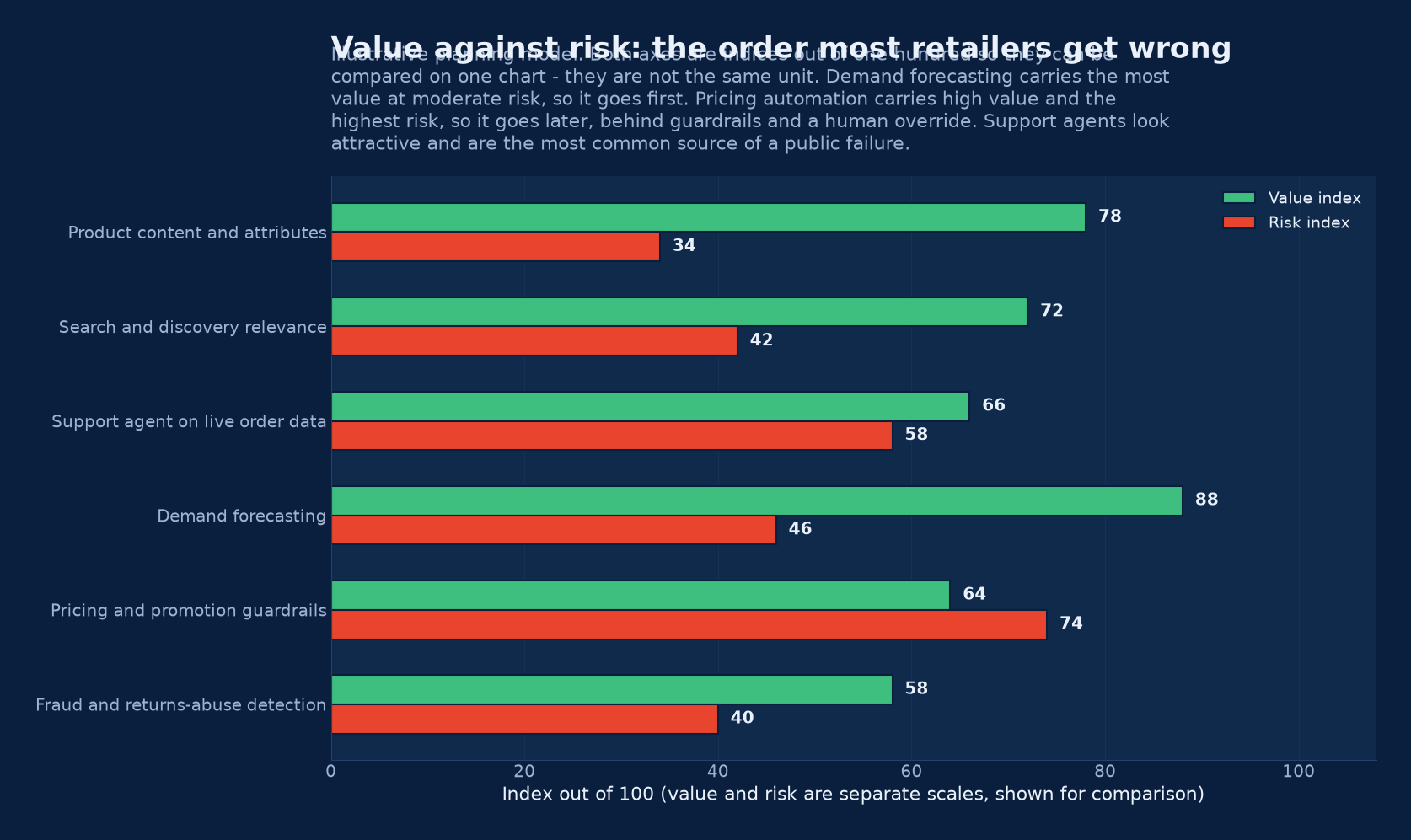
Chart values are an illustrative planning model based on typical UMC engagements and published industry benchmarks. They are not a guarantee of results on any specific project.
| Use case | Value mechanism | Risk if it is wrong | Sequence | Guardrail that makes it safe |
|---|---|---|---|---|
| Catalogue enrichment | Hours saved, better search and feed quality, fewer rejections | Incorrect specification published at scale | First | Attribute source of record plus a review queue above a confidence threshold |
| Demand forecasting | Fewer stockouts, lower markdown, better buy depth | Overbuy or lost sales, both internal | First or second | Error bands published, override path for buyers, stockout-corrected history |
| Search relevance | Higher conversion, fewer zero-result queries | Wrong product surfaced, revenue quietly lost | Second | Offline evaluation set plus merchandising rules that cannot be overridden |
| Support assistant | Ticket deflection, faster answers, lower cost to serve | A wrong or rude answer to a customer, in public | Second or third | Grounding on live order data, escalation triggers, no refunds above a limit |
| Personalisation | Higher repeat rate and basket value | Irrelevant or out-of-stock recommendations | Third | Stock-aware ranking, frequency caps, holdout measurement |
| Fraud and returns abuse | Lower loss, fewer disputes won by fraudsters | Genuine customers blocked at peak | Third | Manual review queue instead of hard block, false-positive reporting |
| Pricing and promotion | Margin protection, competitive response | A wrong price sold at volume, or a margin race to the bottom | Later | Floor and ceiling prices, margin rules, human approval on any move |
| Marketing budget allocation | Spend moved to what actually produces contribution | Budget cut from a channel that works slowly | Later | Mix modelling plus incrementality tests before reallocation |
| Store operations assistance | Task prioritisation, staffing against forecast demand | Branch staff told the wrong thing at the counter | Later | Advisory only at first, with a feedback loop from branch managers |
| Autonomous replenishment | Purchase orders raised without a human | Committed spend on a wrong forecast | Last | Value limits, category exclusions, and a buyer who can stop it |
- The scoring is done with your team in the room, using your numbers. A roadmap produced without the merchandising lead is a document, not a plan.
- Risk is assessed as a control question, not a sentiment: AI governance, risk and compliance gives each use case a rating, an owner and a review date before it is built.
- Where the estate cannot support any of the above yet – no metric layer, no inventory of systems – the honest first step is the business intelligence programme and the IT support and security programme, and we will say that in week one.
Catalogue and content intelligence: the use case that pays first
Catalogue work is the best first retail AI use case because the value is immediate, the risk is containable and the output improves everything downstream: search relevance, feed acceptance, paid listing quality, conversion and support deflection all read the same attributes. A retailer with ten thousand SKUs and a two-person content team has a structural problem that automation genuinely solves – extracting attributes from supplier sheets, generating descriptions to a house style, detecting duplicates and variants, mapping categories across channels, and flagging claims that need substantiation before they are published.
| Task | Input | Output | Human check | Where the value lands |
|---|---|---|---|---|
| Attribute extraction | Supplier sheets, spec PDFs, images | Structured attributes at a defined schema | Sampled review, full review below a confidence score | Faceted navigation, filters, feed acceptance |
| Title and description generation | Attributes, house style guide, category norms | Draft copy per SKU and per channel | Editor approval before publish | Content hours saved, consistent voice |
| Category and taxonomy mapping | Own taxonomy plus marketplace category trees | Mapped category per SKU per channel | Exception list reviewed weekly | Fewer listing rejections and suppressions |
| Duplicate and variant detection | Titles, images, identifiers, specifications | Merged records and variant groups | Confirmation before merge, reversible | Cleaner search, accurate stock per variant |
| Image tagging and quality check | Product images | Tags, angle, background compliance, defect flags | Rejected images returned to the studio | Feed compliance and faster shoot turnaround |
| Claim and compliance flagging | Generated and existing copy | Flags on absolute, medical or comparative claims | Legal or category owner sign-off | Fewer takedowns, advertising-standards exposure |
| Translation and localisation | Approved source copy | Regional language variants | Native reviewer per language | City and regional storefronts served properly |
| Feed optimisation | Attributes plus channel requirements | Channel-ready feeds for Shopping and marketplaces | Feed health monitoring with alerts | Impression share and fewer disapprovals |
| Search-term enrichment | Query logs plus catalogue | Synonyms, redirects, zero-result fixes | Merchandiser review of the top changes | Fewer dead-end searches, higher conversion |
| Content refresh scheduling | Age, performance and stock status | A prioritised rewrite queue | Category owner confirms priority | Effort spent on pages that can still earn |
- Catalogue intelligence is retrieval work as much as generation work: grounding every output in your own attribute source of record is what stops invention, and that is data engineering for AI and RAG knowledge systems.
- The output has to land somewhere. On a WooCommerce or custom commerce platform the enriched attributes must flow through to the feed, the filters and the product page – a systems integration task with a content deadline.
- Generated copy still has to rank and convert, so it is reviewed against the retail SEO programme and the content strategy rather than published in volume and left alone.
- Where AI search engines read the catalogue directly, the same structured attributes feed AI search optimisation – one schema, two audiences.
Search, discovery and relevance: where AI changes conversion quietly
On-site search is the highest-intent surface a retailer owns, and the one most often running on keyword matching from a decade ago. Zero-result queries, size and colour phrasing, local spelling, synonym gaps and stock-blind ranking quietly remove revenue every day without appearing in any report. Modern relevance work combines query understanding with semantic matching, then ranks by a blend of relevance, availability and contribution – which means search becomes a merchandising instrument rather than a lookup utility.
| Problem | Approach | Evidence it worked | Failure mode to design against |
|---|---|---|---|
| Zero-result queries | Query rewriting, synonym expansion, closest-match fallback | Zero-result rate down, conversion of those sessions up | Fallback so loose it shows irrelevant products |
| Natural-language queries | Semantic matching and intent classification | Click position improved, reformulation rate down | Semantic drift on long queries |
| Attribute phrasing | Facet and filter mapping from free text | Filter usage up, time to first click down | Wrong facet applied, filtering out the right product |
| Stock-blind ranking | Availability and cover as ranking inputs | Cancellation and backorder rate down | Hiding slow lines entirely, killing clearance |
| Margin-blind ranking | Contribution as a ranking input with a weight | Contribution per session up at flat conversion | Weighting so high that relevance visibly suffers |
| Personalised ranking | Behavioural signals plus resolved identity | Repeat-visitor conversion up, measured against a holdout | Filter bubbles that narrow discovery |
| Category page ordering | Learned ordering with merchandising pins | Category conversion up, no loss on new-range visibility | New lines never seen because they have no history |
| Mobile and voice queries | Short-query handling and typo tolerance | Mobile search conversion gap narrowed | Typo tolerance changing the intent of a short query |
| Merchandising control | Rules that override learning for launches and clearance | Launch visibility achieved without manual reordering | Rules accumulating until learning is meaningless |
- Relevance work is judged on an offline evaluation set before it is judged on revenue: a frozen set of queries with expected results, run on every change. That is data science discipline applied to a search box.
- Ranking by contribution requires contribution to exist per SKU, which is why search relevance sits downstream of the BI metric layer rather than beside it.
- The storefront has to be able to serve the results fast enough for them to matter – see UX and UI design and the performance work in the website development programme for retail.
Support agents on live order data: the highest-visibility use case
A retail support assistant is judged by customers, in public, on the first answer – which makes it the use case with the least tolerance for invention. The design constraint is grounding: the assistant must read the actual order, shipment, return and loyalty record rather than a knowledge article about orders in general, and it must know what it is not allowed to do. Done that way it resolves the repetitive half of the queue – where is my order, can I change the address, what is my return window – and hands the rest to a human with the context already assembled. That is AI agent deployment and automation with a permission scope attached, sitting on top of a helpdesk that keeps the record.
| Tier | What the assistant may do | Data it reads | Escalation trigger | Control |
|---|---|---|---|---|
| Order status | Report order, shipment and delivery state in the customer’s words | Order and carrier events | Any state the assistant cannot explain | Read-only, no commitment on a delivery date |
| Returns and refunds | Explain eligibility, issue a return label within policy | Order, returns policy, return history | Outside policy, high value, or an abuse flag | Value cap per case, everything above goes to a human |
| Address and cancellation | Change an address or cancel before dispatch | Order state and dispatch status | Already dispatched, or a marketplace order | Time-boxed and logged, with a confirmation message |
| Product questions | Answer from catalogue attributes and approved content | Catalogue, size guides, approved FAQs | Any specification not present in the source of record | Citation shown internally; no answer without a source |
| Loyalty and points | Explain tier status, points and rewards | Loyalty ledger | Disputed balance or missing points | Read-only; adjustments require a human |
| Complaints and sentiment | Detect frustration and route immediately | Conversation text and order history | Anger, legal threat, media mention, safety issue | Priority queue with a named owner |
| Internal agent assist | Draft a reply, summarise the case, suggest the policy clause | Case history plus policy documents | Nothing – the human sends it | Draft only, never auto-sent on the first deployment |
| Branch and store queries | Answer stock availability and store service questions | Stock by branch, store information | Anything requiring a judgement on a customer’s case | Advisory to staff, not customer-facing at first |
| Voice and chat handover | Move between channels without losing context | Conversation record and customer identity | Identity not resolvable | One case record across channels, not two |
- Grounding is a data-engineering problem before it is a model problem: retrieval over your own orders, policies and catalogue with citations, so an answer can be checked – the discipline described in RAG and knowledge-system engineering.
- The assistant needs the customer record to be one record. Where identity is fragmented across site, app, store and marketplace, the CRM and loyalty programme has to resolve it first, or the assistant will confidently describe someone else’s order.
- Access to order data is a security decision, not a feature: the IT support and security programme sets the permission scope, and security controls decide what the assistant may read and log.
- Adoption is what determines the saving. Agents who do not trust the assistant will work around it, which is why training and enablement is part of the deployment rather than an optional extra.
Demand forecasting and replenishment: the largest value, the least publicity
Forecasting is where retail AI earns its budget, because the value is large, the risk is internal and the data usually exists. Two percentage points of stockout reduction and two of markdown avoidance move contribution more than most marketing initiatives, and neither is visible to a customer. The method matters less than the preparation: history corrected for stockouts, promotions and calendar shifts, forecasts produced at the grain where the buying decision is actually taken, and an error band published next to every number so a buyer knows what they are relying on. That is predictive analytics and demand forecasting applied to a retail calendar.
| Forecast | Grain and horizon | Method that usually fits | Error measure published | Decision it drives |
|---|---|---|---|---|
| Baseline demand | SKU by channel, weekly, thirteen weeks | Seasonal model with price and promotion effects | MAPE and bias by category | Reorder quantity and timing |
| Promotional uplift | SKU by event | Event study against matched non-promoted weeks | Uplift range, not a point | Buy depth for the promotion |
| Festive peak | Category by week | Year-on-year shape with calendar-shift adjustment | Interval per week | Stock build, staffing and marketing timing |
| New line | SKU, first twelve weeks | Analogue matching to comparable lines | Wide interval, stated honestly | Initial allocation and repeat decision |
| Branch demand | Branch by category, weekly | Hierarchical model reconciled to the total | Branch-level error | Allocation, transfers and staffing |
| Replenishment trigger | SKU by warehouse, continuous | Demand variability against lead-time variability | Service level achieved | Automatic reorder point |
| Markdown timing | Line by week of age | Elasticity estimated from previous markdowns | Elasticity confidence | When and how deep to reduce |
| Returns volume | Category by week | Return rate against shipped volume by reason | Rate error by reason | Reverse-logistics capacity and provisions |
| Cash requirement | Group by week, thirteen weeks | Purchase commitments, settlement lag and payroll | Range per week | Working-capital planning |
- A forecast without an interval is an opinion. Publishing the error is what makes the model usable, and it is also what allows the business to notice when the model has degraded.
- The history has to be corrected before it is fitted: stockouts recorded as zero demand, promotions never flagged and a mid-year category rename will all produce a confident wrong answer. That correction lives in the data warehouse rather than in the model.
- Competitive and category context improves the forecast more than a cleverer algorithm: market research and competitive analysis tells you whether a decline is yours or the category’s.
- Forecast output belongs on the same page as the trading numbers – executive dashboards showing forecast against actual against error, so the conversation is about the gap rather than about the tool.
Pricing, promotion and margin: automate the analysis, guard the decision
Pricing is the fastest way to destroy margin in retail and the fastest way to protect it, which is why it is the use case we deploy last and guard hardest. Elasticity estimation, competitor price awareness, promotion simulation and markdown optimisation are all genuinely valuable – and all of them produce a recommendation, not an action. The guardrails are not a formality: floor and ceiling prices, a minimum margin per line, category-level budget limits, an approval path for any move beyond a threshold, and a kill switch. Where those exist, pricing AI becomes the most useful analytical tool in the business; where they do not, it becomes the incident.
| Technique | What it optimises | Guardrail required | Human approval point |
|---|---|---|---|
| Elasticity estimation | Volume response to a price change by line | Estimated range with confidence, not a single coefficient | Buyer approves any price move |
| Competitor price awareness | Position against named competitors on matched products | Matched-product confidence threshold; ignore unmatched | Category owner reviews exceptions |
| Promotion simulation | Expected uplift, cannibalisation and margin effect | Simulation compared against a holdout after the event | Commercial lead signs the promotion plan |
| Markdown optimisation | Timing and depth to clear ageing stock | Floor price at or above the agreed minimum margin | Merchandiser approves each markdown wave |
| Dynamic repricing | Price response to demand and stock state | Move limits per hour and per line, plus a trading blackout | Automatic within limits, escalated outside them |
| Bundle and basket pricing | Basket value through combinations | Contribution floor on the bundle, not on each item | Merchandiser approves the bundle set |
| Delivery threshold setting | Order value at which delivery is free | Cost-to-serve data behind the threshold | Operations and finance sign off jointly |
| Channel price parity | Consistency across site, marketplace and store | Marketplace rules and contractual parity obligations | Channel owner resolves conflicts |
| Loyalty and member pricing | Reward for repeat purchase without training discount waiting | Contribution per cohort measured after the change | Commercial lead approves tier benefits |
- Pricing AI is a margin instrument, so it belongs in the same conversation as cost rationalisation and margin recovery – a price move and a cost move are the same basis points on contribution.
- Where pricing pressure is existential rather than optimisation – a category in structural decline, a cash squeeze – the sequencing changes and the entry point is cash flow and working capital recovery or unified top-level business management.
- Advertising and pricing interact constantly: a retail media placement or a paid campaign driving traffic to a line you have just discounted changes the elasticity estimate, so spend and price are modelled together.
Personalisation and lifecycle intelligence: recommendation with a contribution test
Personalisation in retail is not a recommendation widget. It is a set of scores – propensity to buy a category, likelihood to repeat, churn risk, expected contribution – that feed the journeys, campaigns and storefront surfaces that already exist. Deployed that way it is invisible to the customer and measurable to the business: a holdout group shows the lift, and the lift is expressed in contribution per cohort rather than in clicks. Deployed as a widget it produces recommendations for products already bought or currently unavailable, which is worse than nothing.
| Score or model | What it predicts | Where it is used | Measured by |
|---|---|---|---|
| Next best category | Which category a customer buys next | Homepage, email and app surfaces | Category attach rate against a holdout |
| Repeat propensity | Likelihood of a second purchase within ninety days | Lifecycle journeys and win-back timing | Repeat rate against a holdout |
| Churn risk | Likelihood a customer has stopped buying | Retention offers, service priority | Reactivation rate and cost per reactivation |
| Expected contribution | Predicted twelve-month contribution per customer | Acquisition budget ceilings by channel | Actual against predicted by cohort |
| Size and fit prediction | Likely size from purchase and return history | Product page size guidance | Return rate for size reasons |
| Replenishment timing | When a consumable will run out | Email and WhatsApp reminders | Repeat purchase within the window |
| Basket building | Complementary items that genuinely co-occur | Cart and post-purchase surfaces | Units per order and contribution per order |
| Store and city relevance | Local assortment, weather and festive variation | Branch content and local campaigns | Branch conversion and footfall |
| Send-time and channel choice | When and where a customer responds | Campaign orchestration | Open, click and conversion per contact |
| Offer sensitivity | Depth of discount required, if any | Promotion targeting | Contribution after discount, not revenue |
- Every personalisation model needs a holdout, or the lift is unprovable – and an unprovable lift becomes a permanent budget line nobody can defend.
- The scores are only as good as the identity behind them: a resolved customer record across site, app, store and marketplace is a CRM and data-engineering prerequisite, and the segment has to be pushable back into the operating tool.
- Personalisation changes what a page shows, which changes what it ranks for; the SEO programme and the conversion rate optimisation work have to be read together with it.
- Where the same scores drive paid audiences, the Google Ads programme for retail gets better inputs – one model, two consumers, one measurement.
Fraud, returns abuse and trust: models that must be explainable
Fraud and returns-abuse detection is one of the oldest retail AI use cases and one of the few where a model must be explainable at the individual case level, because the output can refuse a customer. That changes the design: scores feed a review queue rather than a hard block, the reasons are recorded, the false-positive rate is reported alongside the loss prevented, and thresholds are reviewed against the trading calendar – because a rule tuned for March will reject genuine festive first-time buyers in October.
| Model or rule | Signal used | Action taken | Explainability requirement |
|---|---|---|---|
| Card and device velocity | Authorisation attempts per device, IP and card | Step-up authentication or review | Reason code shown to the agent |
| Account-takeover detection | New device plus address or payment change | Temporary hold and confirmation | Customer-facing message that does not reveal the rule |
| First-order risk | Basket size, address match, email age | Manual review above a threshold | Reviewer sees the contributing factors |
| Return abuse scoring | Return ratio, reason pattern, item condition history | Policy applied per customer tier | Decision must be defensible to the customer |
| Chargeback prediction | Dispute history, delivery evidence, category | Evidence pack assembled automatically | Every field traceable to a record |
| Coupon and promo abuse | Redemption patterns across accounts and devices | Code blocked, account flagged | Promotion owner sees the pattern |
| Bot and scalper detection | Session behaviour at launch | Queue or challenge | Challenge must not block assistive technology |
| Insider and till anomaly | Refunds, overrides and voids by account | Branch audit task | Anomaly explained against the branch baseline |
| Marketplace abuse | Listing hijack, counterfeit variants, review manipulation | Takedown request with evidence | Evidence pack per report |
| Model drift monitoring | Score distribution against the training period | Retrain or roll back | Drift report reviewed monthly |
- Fraud models interact with every other control in the estate: logging, access review and incident response are managed IT and support disciplines, and the fraud model is one consumer of them.
- Where a model refuses a customer, that decision may need to be evidenced to a regulator, an insurer or a marketplace – which is an IT audit and compliance artefact, produced continuously rather than reconstructed.
- Availability matters as much as accuracy here: a fraud service that fails closed blocks revenue, so it needs the same monitoring and on-call as the storefront – see SRE and observability.
The data foundations AI inherits, and what has to be fixed first
No model compensates for the estate it reads. Retail data domains differ sharply in readiness: order history and catalogue data are usually usable within weeks; customer identity is fragmented across site, app, store and marketplace; and support conversations – the domain a chat assistant depends on most – are the least structured of all. An honest AI roadmap therefore names the data work as part of the use case, with an owner and a date, rather than treating it as a dependency somebody else will resolve.
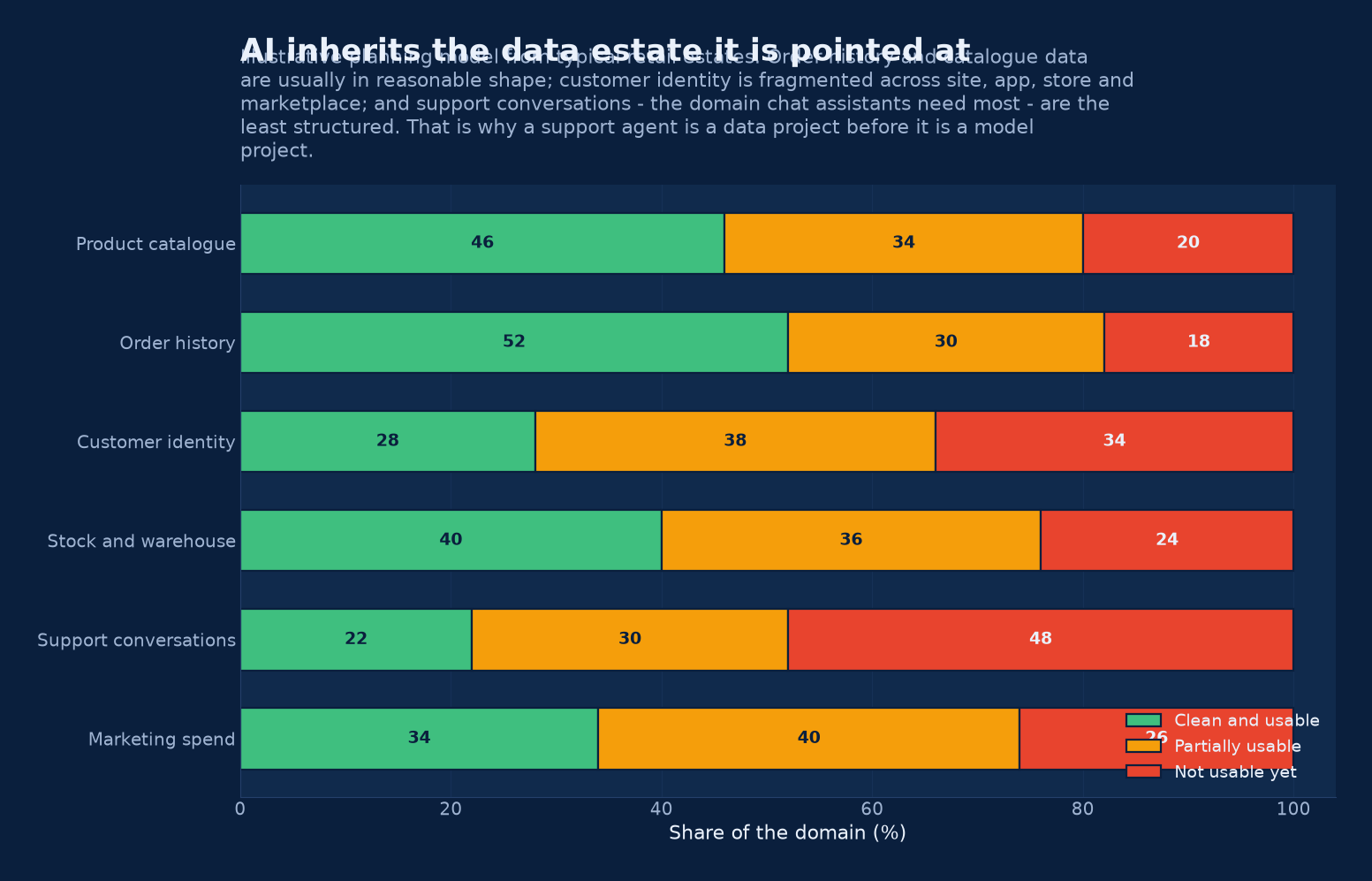
Chart values are an illustrative planning model based on typical UMC engagements and published industry benchmarks. They are not a guarantee of results on any specific project.
| Domain | What the AI needs from it | Typical state in retail | Work that comes first |
|---|---|---|---|
| Product catalogue | One attribute schema, one source of record, variant logic | Several schemas across channels, inconsistent attributes | Attribute dictionary and a mapping layer |
| Order history | Grain-level orders with returns, cancellations and costs attached | Orders present, cost lines missing or in finance only | Contribution model joined at order grain |
| Customer identity | One resolved customer across site, app, store and marketplace | Duplicate records, marketplace buyers unidentifiable | Identity resolution with consent respected |
| Stock and warehouse | Stock by location in near-real time, with in-transit | Branch and warehouse counts disagreeing, in-transit invisible | Reconciliation and a sync monitor |
| Support conversations | Structured case records with outcomes and reasons | Free text across email, chat, phone notes and marketplaces | Case taxonomy, outcome coding and a single record |
| Marketing spend | Spend by campaign and channel against joined order data | Platform-reported revenue, no join to orders | Order-level join and a common attribution rule |
| Pricing history | Price, depth and duration per line per day | Snapshots nobody kept, promotions unlogged | Price and promotion logging from now on |
| Content and assets | Images, copy, rights and claim records | Assets on shared drives, rights undocumented | Asset workflow with rights and claim fields |
| Operational systems | ERP, POS, warehouse and finance events available to read | Batch exports at night, no event stream | ERP, CRM and operations integration with an event path |
| Composability and events | Front-end events captured where the storefront is decoupled | Events in one platform, orders in another | Event capture in the headless or composable layer |
- App and storefront instrumentation is usually the cheapest fix with the widest effect: mobile app and web event capture feeds search relevance, personalisation and support context at once.
- Data foundations decay. Pipelines break, schemas drift and a marketplace changes an export – so maintenance and support of the data layer is part of the AI budget, not an afterthought.
- Modelling the domains once, with definitions and lineage, is a data warehouse and lakehouse exercise; it is the single highest-leverage prerequisite in this table.
- Readiness is assessed, not assumed: an AI readiness assessment records the state of each domain before any use case is scheduled.
Guardrails, evaluation and governance: what makes a pilot safe to ship
A retail AI pilot becomes a production system when four things exist that did exist in the demo: an evaluation set that is run on every change, guardrails that constrain the output, logging that records what was decided and why, and a human who owns it. None of these is exciting and all of them are the reason a deployment survives contact with a festive season, a supplier price change and a journalist. Governance in retail AI is also a commercial matter: insurers, marketplace partners and, increasingly, customers ask what the controls are.
| Control | Why retail needs it | How it is implemented | Evidence kept |
|---|---|---|---|
| Evaluation set | Outputs change when models, prompts or data change | Frozen retail cases with expected outcomes, run per release | Pass rate and diff per release |
| Confidence thresholds | A wrong specification published at scale is expensive | Below-threshold output routed to a human queue | Queue volumes and approval rates |
| Grounding and citation | Invented answers damage trust instantly | Retrieval over approved sources with a citation per claim | Source used per answer, retained for review |
| Permission scope | An assistant must not read or change what it does not need to | Scoped service accounts, masked fields, action allowlists | Access review record, quarterly |
| Action limits | Refunds, price moves and cancellations carry money | Value caps, rate limits, dual authorisation above a threshold | Every action logged with an approver |
| Kill switch | A failing model has to be stopped faster than it can be debugged | Feature flag per use case with a documented rollback | Switch test recorded, not just built |
| Bias and fairness review | Refusals and offers must not vary by protected characteristics | Outcome analysis by segment before and after deployment | Review report with dates and owners |
| Logging and auditability | A decision affecting a customer may have to be explained | Immutable log of input, output, source and action | Retention schedule and access log |
| Model and prompt change control | A prompt edit is a release, not a tweak | Versioned prompts and models, reviewed deployments | Change log tied to evaluation results |
| Vendor and data terms | Customer data must not train someone else’s model | Contract review, data-residency settings, retention limits | Signed terms and configuration evidence |
| Human-in-the-loop points | Some decisions should never be fully automated | Named approval steps for pricing, refunds and claims | Approval record per decision |
| Adoption and training | An unused control is not a control | Role-based training and enablement with a refresher | Attendance and competency record |
- The framework itself is AI governance, risk and compliance; the retail version simply adds trading-specific limits – no price move during a published freeze, no automated refund above a value, no customer-facing answer without a source.
- Guardrails are a security surface too. Prompt injection through a product review, a support message or a supplier feed is a real retail vector, and it belongs in the security review rather than in the model review.
- Generated content has an organic consequence: pages that read as machine-produced and say nothing new lose ranking, so output is held to the same standard as the SEO programme applies to human copy.
- Assurance is assembled continuously: the logs, reviews and evaluation results above are the artefacts an IT audit or an insurer will ask for.
Measuring the return: baselines, scorecards and knowing when to stop
The reason retail AI projects lose executive support is rarely that the technology failed; it is that nobody could say what it changed. The fix is procedural and cheap: record the baseline before the pilot, define the measure and the holdout in advance, and report the result on a scorecard that sits beside the trading numbers. Equally important is the exit criterion – the condition under which a use case is stopped – because a pilot that cannot fail is not a pilot, it is a subscription.
| Use case | Baseline recorded before starting | Measure afterwards | Exit criterion |
|---|---|---|---|
| Catalogue enrichment | Hours per hundred SKUs, feed rejection rate | Hours saved, rejection rate, content coverage | No reduction in hours or rejections after two cycles |
| Search relevance | Zero-result rate, search conversion, reformulation rate | Same three measures against a holdout | No measurable lift in search conversion |
| Support assistant | Contacts per hundred orders, average handling time, cost per contact | Deflection rate, handling time, satisfaction, escalation quality | Deflection below the agreed floor, or satisfaction falling |
| Demand forecasting | Stockout rate, markdown value, forecast error of the current method | Same measures with error bands published | Error not better than the incumbent method |
| Pricing guardrails | Margin per line, price-move lead time, parity exceptions | Margin held, moves faster, exceptions fewer | Margin flat with higher operational complexity |
| Personalisation | Repeat rate, units per order, contribution per cohort | Same measures against a holdout group | Lift inside the noise after two quarters |
| Fraud detection | Fraud loss, chargeback rate, false-positive rate | Loss reduced with false positives reported | False positives rising faster than loss falling |
| Internal agent assist | Time to draft a reply, policy errors per hundred cases | Drafting time and error rate | No time saved, or errors unchanged |
| Reporting automation | Hours spent assembling recurring reports | Hours saved and decisions taken from the output | Reports automated that nobody reads |
- Every entry is expressed in the business’s own unit – hours, basis points, orders, rupees – and never in model accuracy alone. Accuracy is an engineering metric; contribution is the one the board reads.
- The scorecard is AI ROI measurement and executive reporting run properly: baseline, measure, holdout, cost of running the model, and the net figure with the confidence attached.
- It belongs on the same page as trading performance – a single executive view where AI outcomes sit beside contribution, cover and promise accuracy rather than in a separate innovation report.
- Where the measured saving is real, it changes the cost base – and it should be reflected in cost rationalisation and margin recovery rather than left as a technology success story.
The ninety-day retail AI programme, and what we need from you
The programme below delivers one governed use case in production within a quarter, with the measurement to justify the second. Ranking happens first, data foundations run alongside the pilot rather than before it, the evaluation harness is built with the pilot rather than after it, and deployment starts only when the baseline exists. It is deliberately narrow: a retailer with one working, measured use case will fund the second; a retailer with five demos will fund nothing.
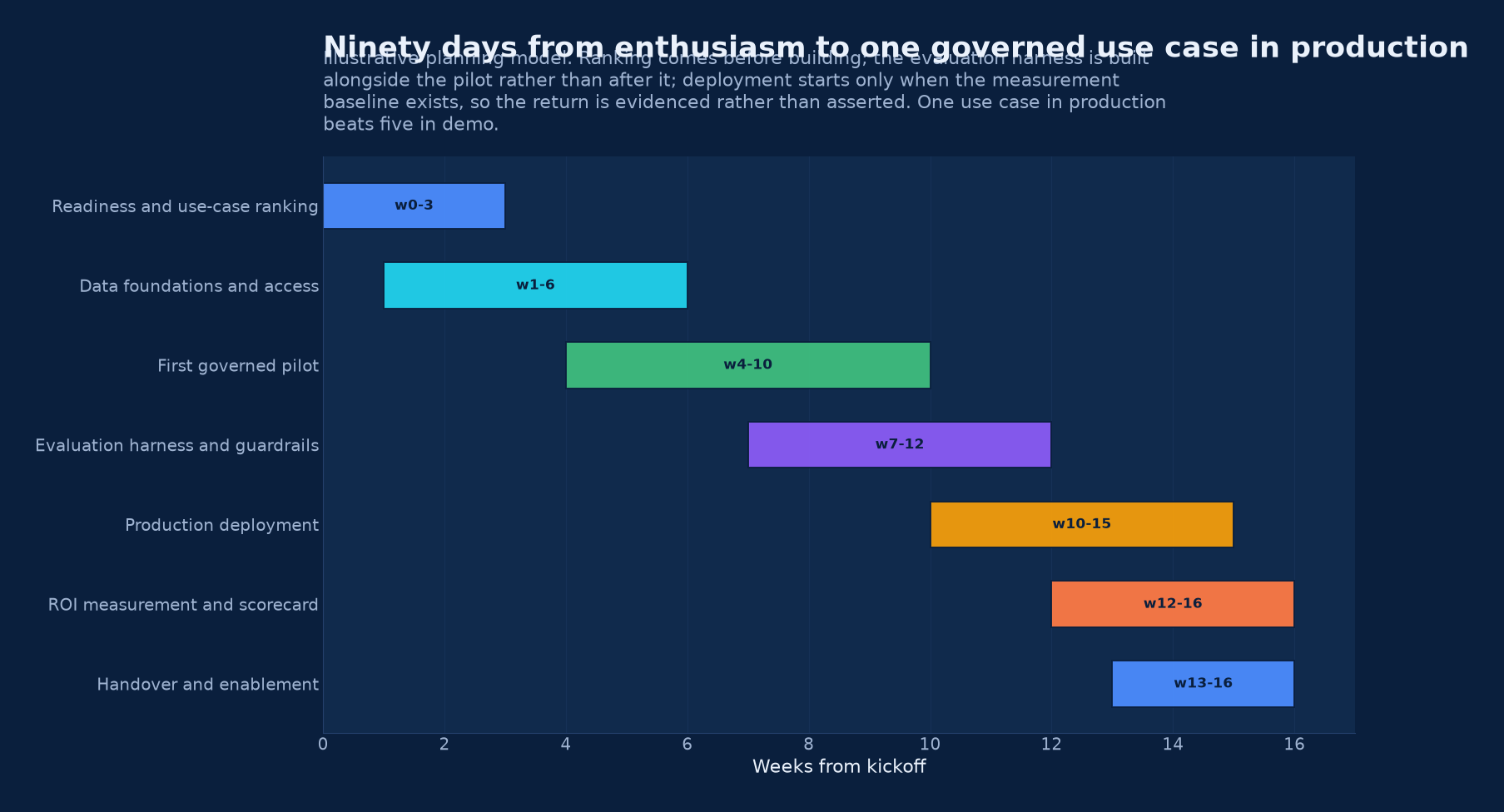
Chart values are an illustrative planning model based on typical UMC engagements and published industry benchmarks. They are not a guarantee of results on any specific project.
| Weeks | Workstream | Deliverable | Decision it enables |
|---|---|---|---|
| Zero to three | Readiness and ranking | Use-case scores, data-domain readiness, ranked roadmap | What to build first, what to defer, what not to build |
| One to six | Data foundations and access | Access granted, domain fixes scoped, baselines recorded | Whether the first use case is feasible now or later |
| Four to ten | First governed pilot | Working use case on real data, in a limited scope | Whether the output is good enough to ship |
| Seven to twelve | Evaluation and guardrails | Evaluation set, thresholds, limits, kill switch, logging | Whether it may touch a customer or move money |
| Ten to fifteen | Production deployment | Deployed with monitoring, permissions and a rollback | Who runs it, and what is watched |
| Twelve to sixteen | Measurement and scorecard | Baseline against result, with holdout and cost of running | Whether to fund the second use case |
| Thirteen to sixteen | Handover and enablement | Documentation, training, ownership transfer, support model | Whether your team extends it or waits for us |
| Ongoing | Review and drift control | Monthly evaluation run, drift report, governance review | Whether the use case is still earning its keep |
- What we need: administrative or scoped read access to the systems the first use case reads, two years of order data, the catalogue with whatever attributes exist, current support case history, and one named owner per use case.
- What you keep regardless: the ranked roadmap, the readiness findings, the recorded baselines, the evaluation set and the guardrail configuration. They are yours.
- What we will tell you: which use cases not to pursue this year, which vendor claims to disbelieve, and where the honest answer is to fix the data estate first – usually with the BI programme or the IT support programme.
Retail AI by city, and worked examples
AI engagements run remotely with data exchanged under an access agreement, and the local layer matters in three ways: language and script variation changes what catalogue and support models must handle, regional festive calendars change what a forecast must learn, and city-level delivery economics change what a promise model may assume. The engagements below are commerce, content and platform projects where the data and delivery discipline described on this page was part of the build.
- Website development company for retail stores in Lucknow
- Get more retail customers in Lucknow – the local-intent page
- Increase e-commerce sales in Lucknow
- Digital marketing and IT services in Lucknow
- Services across Indian cities
- Case study: EZ1 In Services full-stack e-commerce platform development
- Case study: WordPress and WooCommerce online mobile store
- Case study: a fashion retail showroom
- Case study: Ethnava chikankari garment WooCommerce and SEO project
- The retail and e-commerce industry hub – all eight disciplines
- Showrooms and dealerships: AI on footfall, test drives and DMS data
- Manufacturing: forecasting, quality and production data
- All industry verticals we build programmes for
- About Unified Management Consulting
- Contact us about AI for retail and e-commerce
Where this page sits in our retail programme
Artificial intelligence is the eighth and final discipline of our retail and e-commerce programme. The hub page explains how the eight fit together, each discipline has its own page, and the generic service page for every discipline stays listed below alongside the vertical pages. The list is generated from live pages and refreshes automatically as the programme grows across the other industry verticals.
- Retail – the vertical main page
- Website development for retail and e-commerce
- SEO for retail and e-commerce
- Google Ads for retail and e-commerce
- Social media marketing for retail and e-commerce
- CRM, loyalty and lifecycle for retail
- Business intelligence for retail
- IT support and commerce security for retail
- Website development services – the generic service page
- SEO services – the generic service page
- Google Ads management – the generic service page
- Social media management – the generic service page
- Custom CRM development and integration – the generic service page
- BI dashboards and executive reporting – the generic service page
- Managed IT infrastructure and AMC – the generic service page
- Get more retail customers in Lucknow – the local-intent page
- Increase e-commerce sales in Lucknow
- Website development company for retail stores in Lucknow
Frequently asked questions about AI for retail and e-commerce
Which AI use case should a retailer start with?
Usually catalogue and content intelligence or demand forecasting – both carry large value, the mistake stays internal, and both produce cleaner data for everything that follows. Customer-facing assistants and pricing automation come later, once guardrails, evaluation and a baseline exist.
How do we know an AI project has actually paid for itself?
By comparing a measure recorded before the project against the same measure afterwards, with a holdout where one is possible and the running cost included. Hours per hundred SKUs, stockout rate, cost per support contact, contribution per cohort – expressed in your units, not in model accuracy.
Can AI write our product descriptions safely?
Yes, with three conditions: attributes come from a source of record rather than from inference, output follows a written house style, and anything below a confidence threshold goes to a human review queue. Claims that need substantiation are flagged before publication, not after.
Will a chatbot handle our customer service?
It will handle the repetitive half – order status, returns eligibility, delivery windows – if it is grounded in live order data and knows what it may not do. Refunds above a limit, disputes, complaints and anything outside policy go to a human with the context already assembled.
How accurate does a demand forecast need to be?
Accurate enough to beat the method it replaces at the grain the buying decision is taken at, with the error published. A forecast with a stated interval that a buyer uses beats a precise-looking point estimate that is quietly ignored or quietly wrong.
Is automated pricing a good idea?
Automated pricing analysis, yes; unguarded automated price moves, no. Elasticity estimates, competitor awareness and promotion simulation are valuable behind floor and ceiling prices, margin minimums, move limits, a trading blackout and a human approval path.
What data do we need before starting?
Two years of order data with returns, the catalogue with whatever attributes exist, stock by location, support case history, marketing spend by campaign, and read access to the systems holding them. Gaps are normal – the readiness assessment exists to name them.
Does our customer data train a third-party model?
It should not, and that is a contractual and configuration question settled before deployment: data-processing terms, retention settings, residency and whether training on your data is disabled. We record the evidence, because an insurer or a marketplace partner will eventually ask.
How do you stop an AI assistant inventing answers?
With grounding and citations – retrieval over your own catalogue, orders and policies, so an answer without a source is not given – plus confidence thresholds, a human queue, an evaluation set run on every change, and logging that lets a wrong answer be traced and fixed.
Can AI help our stores as well as the website?
Yes: forecasting at branch level, staffing against predicted footfall, task prioritisation, till anomaly detection and clienteling assistance for staff. Branch deployments start as advisory, because a wrong instruction at a counter is more damaging than a wrong recommendation on a page.
What does an AI engagement cost?
A readiness assessment and ranked roadmap is fixed-fee and short. A first governed use case in production is scoped after the assessment, with the data work named separately, and running cost – model, infrastructure, monitoring and review – is quoted alongside so the return is net, not gross.
Do we need our own data science team?
Not to start. Most retail AI value comes from a small number of governed use cases connected to existing systems, which we build, document and hand over with training. An in-house capability is worth building once two or three use cases are running and someone has to own them.
Start with the ranking, the readiness findings and one measured use case
Give us three weeks with scoped access to your catalogue, two years of order data, support case history and current spend, and we will return a ranked use-case roadmap scored on value against risk, a data-readiness finding per domain naming what has to be fixed first, recorded baselines for the use cases you care about, a guardrail and evaluation design, and one governed pilot with a scorecard that shows the change against the baseline – including the use cases we would tell you not to build this year. Yours to keep whether or not we deploy it.
Contact Unified Management Consulting to arrange a confidential first conversation.