
Retail SEO is three different problems that get bought as one. Category demand – a shopper researching a purchase – is won by architecture, internal linking and content that answers the comparison question. Product demand – a specific model or SKU – is won by data quality, availability signals, reviews and speed. Brand and informational demand is won by editorial authority, and it is the cheapest acquisition a retailer has. Most retail SEO budgets are spent on the second layer and ignore the first and third, which is why performance plateaus at exactly the point where the client expected it to compound.
This page covers the organic programme for retail and e-commerce: technical control of crawl and indexation, category and facet architecture, product-page data quality, structured data, buying guides and comparison content, digital PR, local and store visibility, and the newer discipline of being cited by answer engines rather than only ranked by search engines. The commerce build that all of it depends on sits in website development for retail within this vertical; the commercial model – contribution per order, channel mix, returns – sits in the retail and e-commerce hub.
What an engagement includes, at a glance
| Component | What We Deliver |
|---|---|
| Technical baseline and control | Crawl, indexation, canonical and facet policy written down and enforced, with a baseline recorded before any change so movement can be attributed rather than assumed. |
| Category and facet architecture | A hierarchy that reaches a product in two or three decisions, facets governed by an indexation rule, and internal links that concentrate equity where it earns. |
| Product data quality | Complete attributes, unique descriptions, real imagery, availability and price signals, reviews – the same data the paid and marketplace channels read. |
| Structured data and rich results | Product, offer, availability, rating, breadcrumb and item-list markup validated per template and re-validated per release. |
| Content that answers the research question | Buying guides, comparisons, care and usage content mapped to real demand and linked into the categories they support. |
| Authority and digital PR | Links and citations earned by data, expertise and newsworthiness rather than purchased at scale, with a record of what each asset produced. |
| Local and store visibility | Per-store pages with genuine local content, profile management, and a store locator that search engines can read. |
| Answer engine visibility | Machine-readable catalogue and editorial content, entity clarity, and measurement of citations in AI answers as well as rankings in search results. |
| Measurement and forecasting | Organic contribution by layer and cohort, indexation and ranking coverage, and a forecast that finance would recognise rather than a traffic projection. |
What retail teams ask for, and what the organic problem actually is
Organic requests arrive as traffic complaints, and the diagnosis is rarely ‘we need more content’. More often the estate is technically capped – a crawl budget spent on facet combinations, product pages that are near-duplicates of the manufacturer’s copy, categories with no internal links, or a migration that quietly dropped the URLs carrying the revenue. The table below is the translation we run in the first fortnight, and it is why the first deliverable is a technical audit with a recorded baseline rather than a content calendar.
| What gets asked | What is usually happening | What we do about it |
|---|---|---|
| Organic traffic is flat despite publishing | Content published into a capped crawl, or targeting queries the estate cannot win | Technical control first, then demand-mapped content with a stated winning condition |
| Category pages do not rank | Facet duplication, thin copy, weak internal links, or the hierarchy buried too deep | Indexation policy, unique category content, internal-link plan, depth reduction |
| Product pages rank for the wrong queries | Manufacturer copy shared with hundreds of retailers; no variant-level detail | Unique data-driven descriptions, attribute completeness, review and Q&A content |
| Traffic grew but revenue did not | Growth landed on guides and low-margin lines; no contribution view of organic | Organic contribution by layer, internal links from guides to earning categories |
| We lost rankings after a replatform | Redirect gaps, lost internal links, changed templates, dropped structured data | Migration audit against a value-ranked URL inventory, then targeted recovery |
| Rich results disappeared | Markup broken by a theme change, or ratings no longer eligible on the page | Per-template validation in the pipeline; markup regenerated from product data |
| Competitors outrank us on everything | Authority gap plus a range or price gap that content cannot close | Honest verdict: which queries are winnable, and which need commercial change |
| AI answers cite our competitors | Catalogue and editorial content is not machine-readable or not entity-clear | Answer-engine optimisation: structure, entity data, citation-worthy assets |
| Local searches do not find our stores | One thin page per city, inconsistent branch data, unmanaged profiles | Per-store pages, profile standard, local content with a named owner |
| Nobody can forecast organic revenue | Rankings tracked without a value model; seasonality never separated | Forecast built on contribution per query cluster, with seasonality and decay |
Seven of the ten are technical or data problems, two are commercial, and one – the authority gap – is genuinely a time-and-evidence problem. Naming which is which in week two is the most valuable thing an organic audit does, because it stops a business buying content for a problem that a redirect map would have fixed.
The three layers of retail organic demand
Retail search demand splits into layers with different economics, and the split is the reason a single ‘SEO budget’ number is useless. Category demand is broad, competitive and high-volume; product demand is specific, longer-tail and closer to purchase; research demand converts badly on its own and well through assistance; brand demand is cheap and must be defended rather than grown. Each layer needs a different template, a different content investment and a different success measure.
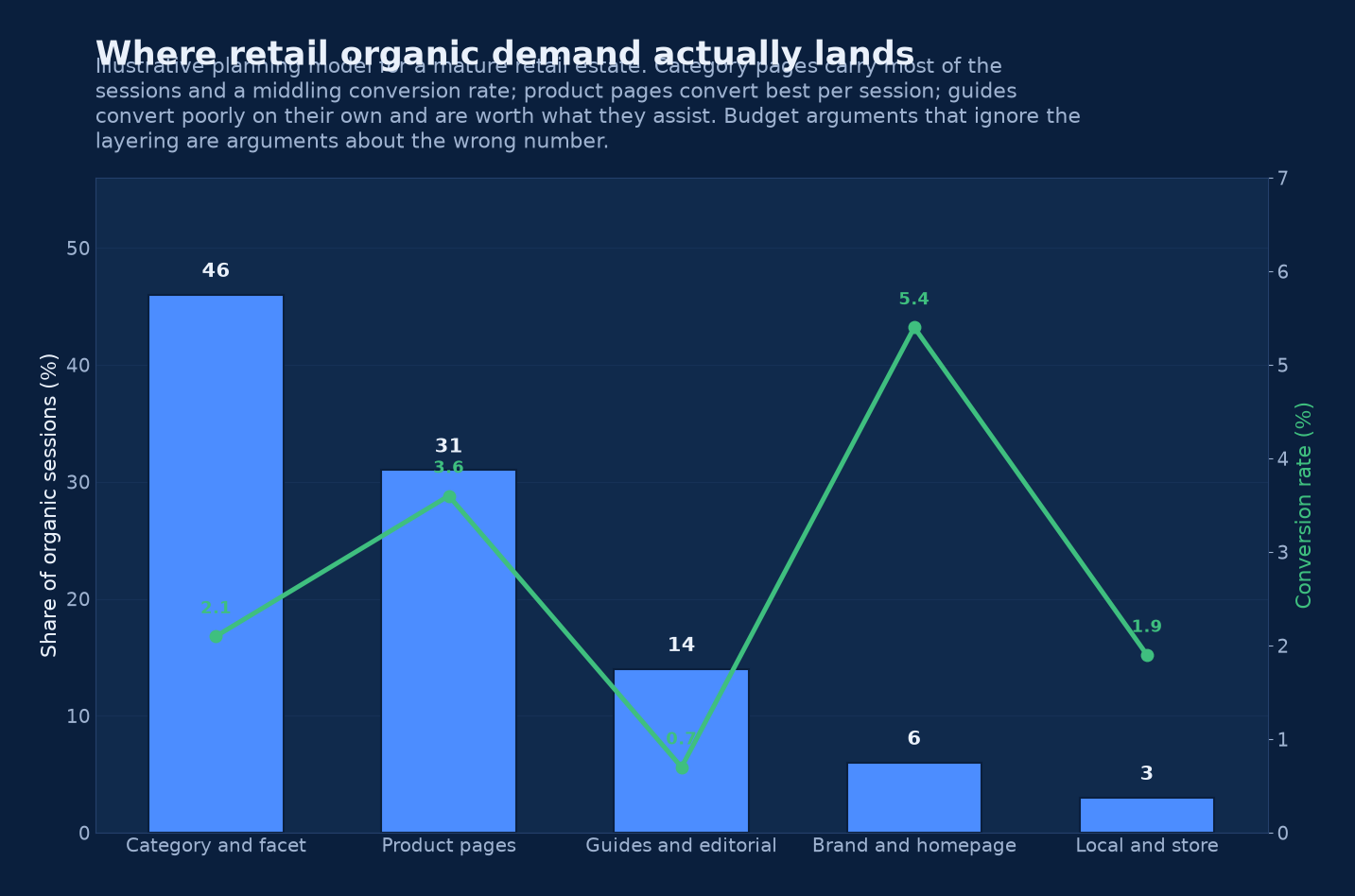
Chart values are an illustrative planning model based on typical UMC engagements and published industry benchmarks. They are not a guarantee of results on any specific project.
| Layer | Query character | Winning condition | Measured by |
|---|---|---|---|
| Category and subcategory | Broad commercial: a product type plus an attribute, use or audience | Clean hierarchy, indexable facets, unique copy, internal links from related guides | Cluster rankings, category sessions, category contribution |
| Product and SKU | Specific: model name, model number, variant, or ‘buy X online’ | Complete data, availability, price, reviews, speed, markup | Product impressions, add-to-cart rate, indexation coverage |
| Research and editorial | Informational and comparative: how to choose, best for, versus, is it worth it | Genuine expertise, evidence, and a path into the category it supports | Assisted conversions, guide-to-category click-through |
| Brand | Brand plus a modifier: reviews, discount code, returns, store near me | Own the results page; answer the operational questions on site | Brand share of results, brand sessions, complaint deflection |
| Local and store | Geo-modified: near me, city plus category, opening hours, click and collect | Per-store pages, accurate profiles, genuine local content | Map-pack presence, store-locator usage, click-and-collect orders |
| Answer engines | Conversational: a question phrased as a person would ask it | Machine-readable data, entity clarity, citation-worthy evidence | Citations in answers, referral sessions from answer surfaces |
The layering also decides the order of work: technical control and product data first (they cap everything), category architecture second (it carries the volume), editorial third (it compounds), and answer-engine work throughout, because it reads the same data as the rest. Business strategy consulting and market research settle which layers the range can actually win.
Technical SEO: crawl, indexation and the facet problem
A retail site is the classic crawl-budget casualty: faceted navigation, sorting, pagination, session parameters and internal search can multiply a thousand-product catalogue into hundreds of thousands of crawlable URLs, most of which are duplicates that will never be landed on. The crawler’s budget then goes to the wrong pages, new products take weeks to be discovered, and template changes propagate slowly. Governance is a written policy plus enforcement: which parameter combinations are crawlable, which are canonicalised, which are blocked, and which are noindexed – and a pipeline that fails a release which breaks it.
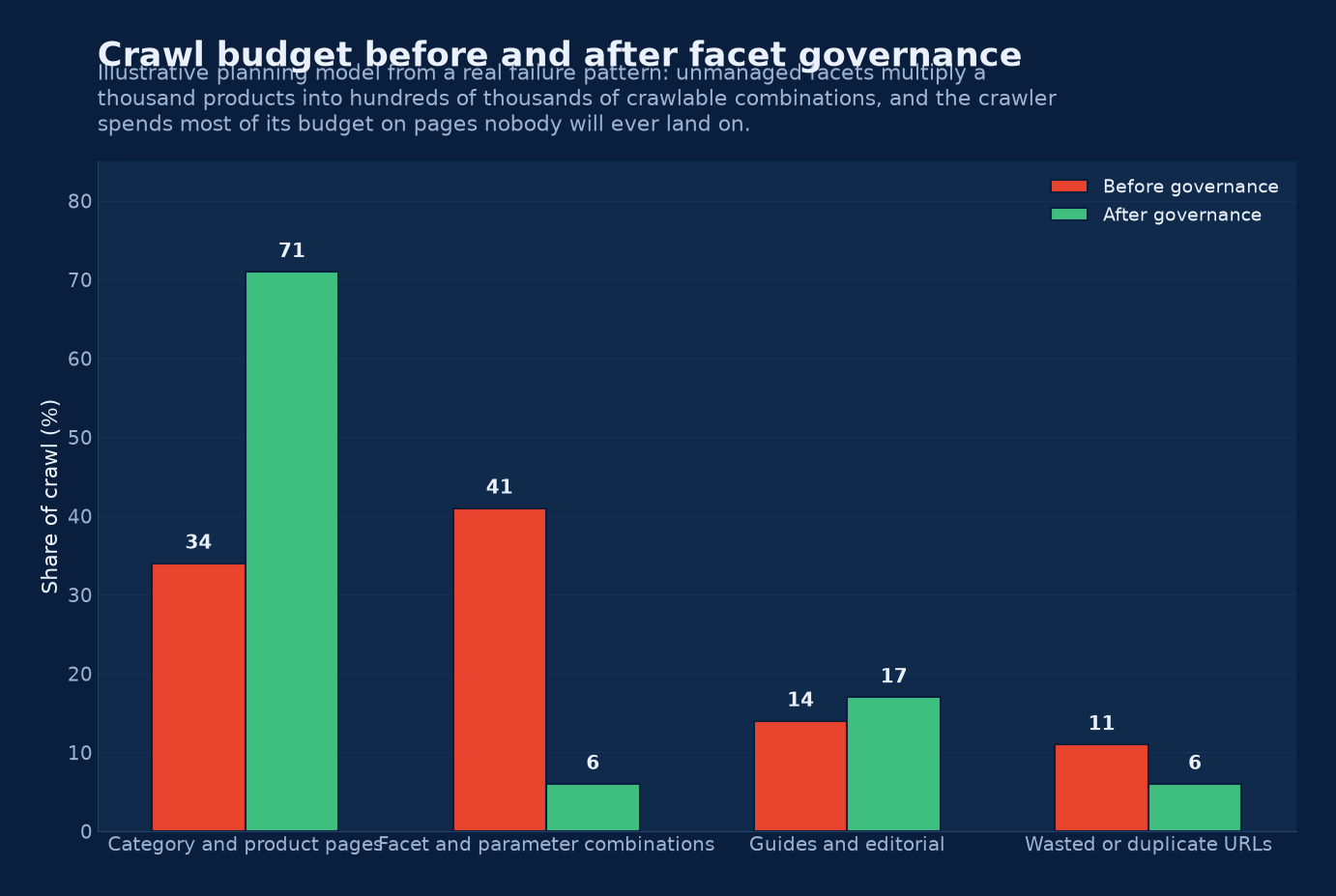
Chart values are an illustrative planning model based on typical UMC engagements and published industry benchmarks. They are not a guarantee of results on any specific project.
| Control | What we implement | What it prevents | Verification |
|---|---|---|---|
| Facet indexation policy | A written rule per facet type: crawlable, canonical, parameter-blocked or noindexed | Hundreds of thousands of duplicate URLs consuming the crawl | Crawl sample audited against the policy |
| Canonical discipline | Self-canonical on indexable pages, canonical to the parent on filtered variants | Equity split across variants; the wrong URL ranking | Canonical report per template |
| Pagination and infinite scroll | Crawlable pagination with a stable order, and a scroll implementation that does not hide it | Products beyond page two never discovered | Depth audit: every product within three clicks |
| Internal search results | Blocked from indexing, with useful zero-result and synonym handling | Search-result URLs competing with category pages | Indexation report on search parameters |
| XML sitemaps | Split by type, generated from live stock, refreshed on change, submitted and monitored | A sitemap listing discontinued or out-of-stock URLs | Sitemap versus index coverage comparison |
| Robots and directives | Deliberate, tested, and never used as a noindex substitute | A directive that blocks the crawler from seeing a noindex it needs to read | Directive test with a live fetch |
| Rendering and JavaScript | Critical content server-rendered or reliably rendered; measured, not assumed | A headless storefront whose content the crawler never sees | Rendered-versus-raw comparison per template |
| Index coverage monitoring | Discovered, indexed, excluded and duplicate counts tracked weekly by template | A silent deindexation discovered three months later | Coverage trend with alert thresholds |
| Log-file analysis | Crawler behaviour by template, status code and depth, reviewed monthly | Guessing where the crawl budget actually goes | Log analysis report with the change list |
Delivery runs through technical SEO audits and site migrations, SEO services, Core Web Vitals and performance engineering because speed is a ranking input and a conversion input, DevOps and CI/CD engineering to put the policy in the pipeline, and website migration and replatforming where the estate is moving. For headless builds, headless and composable commerce covers the rendering decisions that decide whether any of this is visible to a crawler. Page experience belongs to the same control set: Core Web Vitals because speed is both a ranking and a conversion input, and accessibility because the labelling, focus order and markup discipline that make a storefront usable with assistive technology are the same signals a crawler reads to understand the page.
Product pages: data quality is the ranking strategy
A retailer cannot out-write a manufacturer’s product description, and it should not try to out-write nine hundred other retailers using the same one. What wins a product page is data the others do not have: complete and correctly typed attributes, variant-level detail, availability and price signals that are true at crawl time, genuine reviews and questions, imagery that shows what the manufacturer’s does not, and a page that loads quickly enough to be measured fairly. None of that is editorial work; all of it is data work, which is why the organic programme and the commerce build share a deliverable.
| Element | What good looks like | What usually goes wrong | Measured by |
|---|---|---|---|
| Attribute completeness | Every mandatory and recommended attribute filled, typed and consistent | Attributes held in the description text where no machine can read them | Completeness score by category |
| Unique description | Data-driven copy assembled from attributes plus a category-specific angle | Manufacturer copy shared with every other retailer online | Duplicate-content share across the catalogue |
| Variant handling | Variants as one page with selectable options, not one page per colour | Split reviews, split equity, and a customer who cannot find the size they want | Variant URL count versus product count |
| Availability and price | Accurate at crawl time, in the markup and on the page, with a restock signal | A ranking page for a product that has been out of stock for two months | Indexed-but-unavailable product count |
| Reviews and questions | Genuine, on-page, structured, with an honest aggregate and a response path | Reviews behind a tab the crawler never opens, or none at all on new lines | Review coverage, rating distribution, answer rate |
| Imagery and media | Multiple angles, scale reference, material detail, alt text from the data | One supplier image, no alt text, and a heavy file that costs the page its speed | Image coverage per SKU, alt coverage, media weight |
| Internal linking | Linked from its category, from related guides, and from similar products | Orphan products reachable only by internal search | Orphan count, inbound internal links per product |
| Discontinued handling | A deliberate decision: redirect, keep with alternatives, or remove and deindex | Hundreds of dead pages accumulating, each diluting the crawl | Discontinued-page policy compliance |
The same data feeds Shopping and Merchant Centre, Performance Max, Google Ads and retail media, so a data-quality programme pays for itself in paid efficiency as well as organic. Data engineering for AI and knowledge systems is the discipline that makes the catalogue readable by answer engines too, and the warehouse layer is where the reporting lives. None of it survives without the estate being run properly: e-commerce development for the templates that render the data, WordPress and WooCommerce engineering where that is the platform, and maintenance and support so coverage does not decay between releases.
Structured data, rich results and answer engines
Structured data is the cheapest visibility a retailer can buy because it is mostly a by-product of good product data: the same attributes that make a page rank also make it eligible for price, availability, rating and delivery annotations, and for inclusion in the answers that AI surfaces produce. The discipline is generation rather than hand-coding – markup produced from the product master, validated per template, and re-validated in the pipeline so a theme change cannot silently break it.
| Markup type | What it enables | Generation rule | Failure mode |
|---|---|---|---|
| Product and offer | Price, availability and condition annotations in results | From the product master and the live price and stock service | Markup disagreeing with the visible page – a manual-action risk |
| Aggregate rating | Star annotations where reviews genuinely exist | From the review store, only where the reviews are on the page | Rating markup on a page with no visible reviews |
| Breadcrumb | Path display in results and clearer hierarchy signals | From the category tree, one canonical path per product | Breadcrumb paths that contradict the on-site navigation |
| ItemList | Category and carousel understanding; better extraction by answer surfaces | From the rendered category list, in the displayed order | A list that does not match what the user sees |
| Organisation and brand | Entity clarity: who you are, what you sell, where you operate | Consistent identifiers across the site, profiles and knowledge panels | Entity ambiguity that costs citations in AI answers |
| Store and local business | Per-store details, opening hours, click-and-collect eligibility | From the store master, with the same data on the profile | Site data contradicting the business profile |
| FAQ and how-to | Answer-style annotations where the content genuinely answers | Only where the question and answer are visible on the page | Markup used as decoration on pages that do not answer anything |
| Pipeline validation | Regression protection rather than a one-off audit | Validated per template per release, with a failing gate | Markup broken by a theme update and found a quarter later |
The practices are technical SEO, AI search optimisation and answer-engine visibility for the citation side, AI governance, risk and compliance where generated product content is involved, and enterprise systems integration because markup quality is only as good as the data pipeline behind it.
Content that earns: guides, comparisons and category copy
Retail content fails in two predictable ways. Written for keywords rather than for the decision the shopper is making, it ranks for nothing; written well but not linked into the categories it supports, it ranks and earns nothing. The discipline that fixes both is a demand map: every piece of content attached to a category it feeds, a question it answers, a stated winning condition, and an internal-link obligation on both sides. Category copy is part of the same programme, because a category page with no guidance is a grid of products competing with nine hundred identical grids.
| Content type | The question it answers | Link obligation | Success measure |
|---|---|---|---|
| Buying guide | How do I choose in this category, given my use case and budget? | Links into three to six subcategories; linked from each of them | Assisted conversions and guide-to-category click-through |
| Comparison and versus | Which of these two or three should I buy, and why? | Links to both product or category pages with a verdict | Rankings for versus queries, assisted revenue |
| Category copy | What is in this range, who is it for, and how is it organised? | Links down to subcategories and across to related guides | Category rankings, conversion rate, time to first click |
| Care, use and repair | How do I look after what I bought – and can I fix it? | Links from the product page and the post-purchase journey | Return-rate movement on the lines it covers |
| Data and research assets | What does your data say that nobody else can say? | Earns citations and links rather than internal clicks | Referring domains, citations, branded search lift |
| Seasonal and event content | What should I buy for this occasion, and by when? | Built in advance, linked from the category and the campaign | Event-window organic revenue against the prior year |
| Local and store content | What does this branch stock, and how do I collect from it? | Linked from the store locator and the city page | Map-pack presence, click-and-collect orders |
| Answer-engine assets | What is the crisp, citable answer to this question? | Structured, entity-clear, and consistent with the visible page | Citations in AI answers and referral sessions from them |
Delivery runs through content marketing strategy, website strategy and information architecture for the hierarchy the content hangs from, conversion rate optimisation so the traffic is worth something when it arrives, and data science services for the demand modelling that decides what gets written next. The Ethnava chikankari full-stack SEO project is a worked example of catalogue SEO and content built together on WooCommerce.
Authority, digital PR and the marketplace question
Retail authority is earned in three currencies: evidence nobody else has (your own data on prices, availability, returns or demand), expertise that is quotable (a buyer, a merchandiser, a category specialist), and usefulness that people link to without being asked (a size calculator, a compatibility checker, a genuine industry index). Purchased links at scale are a poor substitute and a risk. The marketplace question sits alongside: large marketplaces will outrank you on generic product queries forever, so the organic strategy has to be about the queries where being the brand is the advantage.
| Asset type | What makes it earn links | Who owns it internally | Measured by |
|---|---|---|---|
| Proprietary data index | Nobody else can publish your price, availability or demand data | Commercial head with analytics | Referring domains, citations in press |
| Category expertise | A named specialist who will answer a journalist’s question properly | Head of category or buying | Quotes secured, branded search lift |
| Useful tools | A calculator or checker people bookmark and reference | Product owner with engineering | Inbound links, direct tool usage |
| Newsworthiness | A genuine first: a range, a policy, a sustainability claim with evidence | Marketing head with legal review | Coverage volume and quality |
| Supplier and partner content | Co-authored guides where both parties have an audience | Partnerships with merchandising | Links, referral sessions, joint conversion |
| Review and community proof | Volume and quality of genuine reviews across surfaces | Customer experience | Rating, review velocity, snippet eligibility |
| Marketplace coexistence | Brand queries owned on your site; generic queries conceded deliberately | Commercial head | Brand share of results, own-site new-customer rate |
The practices are digital PR and link building, influencer marketing management where creators are part of the authority story rather than only a channel, social media management for the distribution that makes assets findable, and market research and competitive analysis for the gap that decides what is worth building. Where authority is weak and the range is strong, cost rationalisation and margin recovery is the honest companion conversation: organic growth has a floor set by the commercial offer.
Store estates, local search and omnichannel visibility
For any retailer with physical stores, local organic is the highest-converting demand there is, and it is usually the least maintained part of the estate. The pattern that works is a per-store page with genuine local content – what the branch stocks, how to collect, who works there, parking and access – held to the same data standard as the business profile, with a locator that a crawler can read and a named owner per branch. One thin page per city is worse than no page at all, because it competes with the branch it was meant to support.
| Element | Standard | Common defect | Owner |
|---|---|---|---|
| Per-store page | Unique content, real photos, stock and services offered, hours, contact, directions | Duplicated template copy across every branch | Branch manager plus marketing |
| Business profile | Same name, address, hours and categories as the site; managed centrally with local edits | Branch staff editing hours without telling anyone | Marketing with branch sign-off |
| Store locator | Crawlable, with a page per store and structured data for each | A JavaScript widget with no indexable pages | Commerce engineering |
| Local inventory signals | Branch stock and click-and-collect eligibility visible on the product page | Online availability shown where the store has none | Supply chain with engineering |
| Reviews per branch | Genuine, responded to, and consistent with the site’s review policy | All reviews pooled at brand level, none at branch level | Customer experience |
| Local content | Community, events and range news that is true of that branch | City pages written for keywords with no branch behind them | Branch plus content |
| Local advertising alignment | Paid local campaigns pointing at the same store pages and profiles | Ads sending catchment traffic to a national homepage | Marketing |
| Measurement | Map-pack presence, store-locator usage, click-and-collect orders, branch contribution | Local judged on impressions only | Analytics with finance |
The practices are local SEO and Google Business Profile management and, on the paid side of the same catchment demand, Google Ads with local campaigns and retail media. The omnichannel operating model behind it – selling store stock online, click-and-collect, in-store returns – is covered in the retail hub, and the physical showroom case in showrooms and dealerships.
International, multi-region and multi-language retail SEO
Exporting retailers hit a specific set of failures: one domain serving several markets with no signals, hreflang that contradicts itself, prices and availability that are wrong for the market being shown, and content machine-translated into a language nobody in the team can review. The structural decisions – country code domains versus subdirectories, which catalogue subset per market, which currency and which fulfilment promise – are commercial decisions with SEO consequences, so they get taken together rather than sequentially.
| Decision | Options | What decides it | Consequence of getting it wrong |
|---|---|---|---|
| Domain structure | ccTLD per market, subdirectory per market, or one domain with signals | Brand strategy, existing authority, operational capacity | Authority split, or a market that cannot be targeted at all |
| hreflang and alternates | Reciprocal, complete, including a default, validated per release | How many language and market combinations genuinely exist | The wrong market shown, and duplicated content competing with itself |
| Catalogue subset | Full range everywhere, or a market-specific range | Compliance, logistics, price positioning, local demand | Ranking pages for products that cannot be shipped to that market |
| Currency, tax and duty | Displayed per market, with the rules stated before checkout | Finance and legal, not marketing | A delivery or cost surprise that becomes a return and a complaint |
| Translation and localisation | Human review of every category and product template at minimum | Who in the business can actually read the language | Machine-translated copy that ranks poorly and reads worse |
| Local search presence | Per-market profiles, directories and review surfaces | Which surfaces that market actually uses | Invisible in the market that matters most |
| Marketplace coexistence | Which markets are served through marketplaces rather than the own site | Contribution after commission and logistics | An own site competing with your own marketplace listing |
| Measurement | Per-market organic contribution, not per-market sessions | Finance involvement from the start | A market kept alive on traffic numbers that never paid for anything |
Delivery runs through international and multi-region SEO, technical SEO for the signals, content marketing strategy for localisation governance, and marketing mix modelling and attribution so the per-market investment case is argued with numbers rather than ambition.
Measurement, forecasting and the organic contribution model
Retail SEO is usually under-funded because it is under-measured: rankings are reported, revenue is assumed. The model that changes the conversation attaches contribution to organic demand by layer and by query cluster, separates assisted from last-click value, and forecasts with seasonality and decay so finance can hold it to a number. It also records a baseline before any change, which is the only way a migration or a template redesign can be judged honestly.
| Measure | Definition | Why it beats the alternative | Cadence |
|---|---|---|---|
| Organic contribution | Contribution margin from organic orders, by page layer and query cluster | Revenue ignores margin; sessions ignore value | Weekly, closed monthly |
| Assisted value | Organic touchpoints in journeys that converted elsewhere | Last-click under-values research content to near zero | Monthly |
| Indexation coverage | Share of intended URLs indexed, by template and category | A ranking report cannot see a page that was never indexed | Weekly |
| Ranking coverage | Visibility by query cluster weighted by demand and value, not by count | An average position across irrelevant queries means nothing | Weekly |
| Crawl efficiency | Share of crawl spent on indexable, valuable templates | Explains slow discovery of new lines before it costs revenue | Monthly |
| Content performance | Per-asset assisted conversions, inbound links and decay rate | Publishing volume is an input, not a result | Monthly |
| Rich result coverage | Share of eligible pages carrying valid markup and earning annotations | A markup audit says nothing about whether it is working | Monthly |
| Answer-engine citations | Citations and referral sessions from AI answer surfaces | The channel is growing and nobody is measuring it | Monthly |
| Organic forecast | Contribution by month with seasonality, decay and a stated confidence range | A traffic projection cannot be held to account by finance | Quarterly |
| Post-change baseline comparison | The same measures against the recorded pre-change baseline for eight weeks | Seasonality otherwise absorbs both the damage and the gain | Per change |
The practices are BI dashboards and executive reporting, data warehouse and lakehouse for the join between search, commerce and finance data, predictive analytics and demand forecasting for the forecast itself, and marketing mix modelling for the incrementality question that paid and organic teams argue about every quarter.
How a twelve-month programme runs
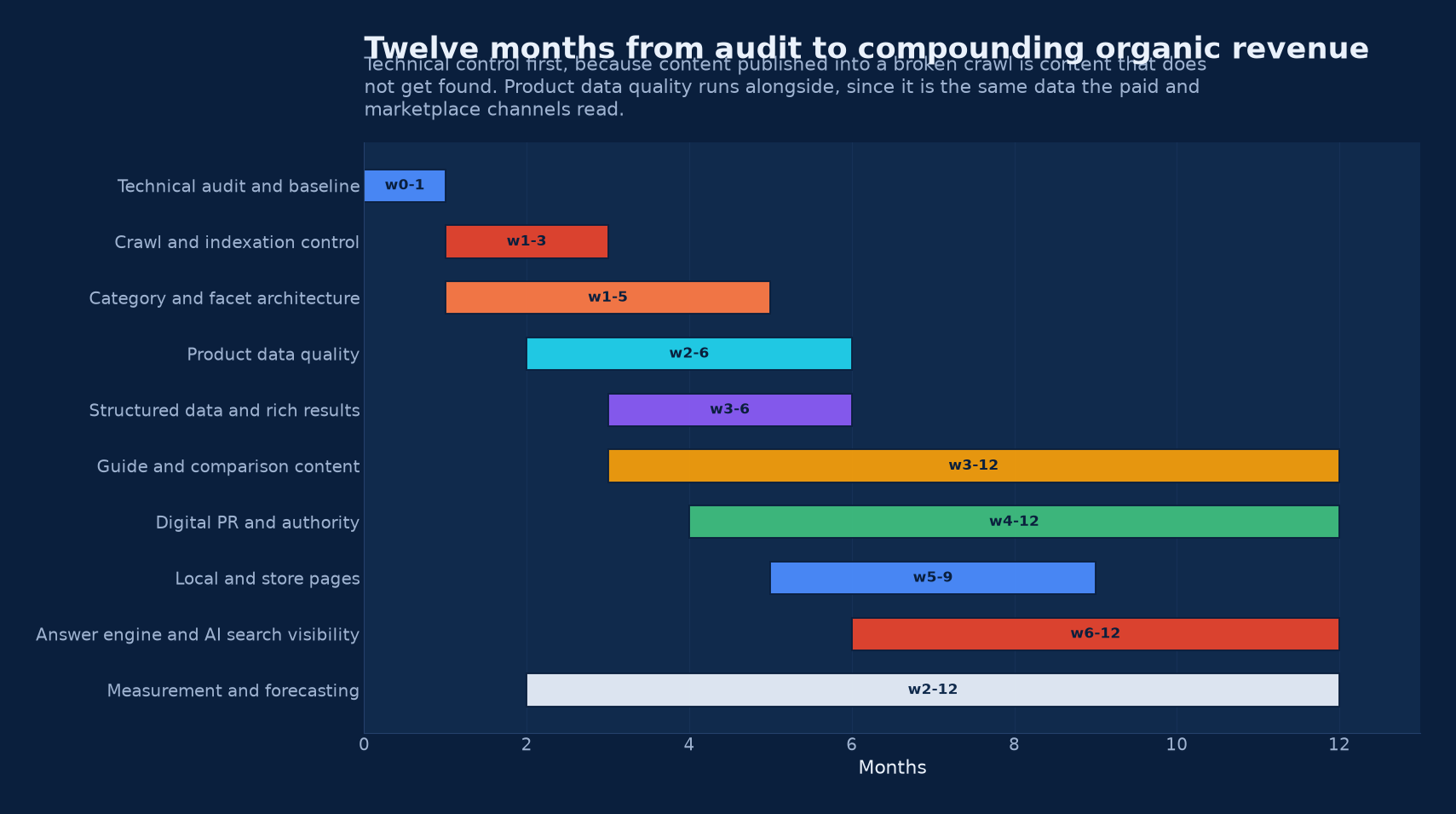
Chart values are an illustrative planning model based on typical UMC engagements and published industry benchmarks. They are not a guarantee of results on any specific project.
Month one is the technical audit and the baseline: crawl and indexation state, facet policy, template-level coverage, structured data validity, speed, and a recorded baseline for every measure in the table above, plus the honest verdict about which query clusters the range can win. Months one to three put crawl and indexation control in place. Months one to five rebuild category and facet architecture with the internal-link plan. Months two to six run product data quality, which is also the paid-channel deliverable. Months three to six generate and validate structured data per template. Guide and comparison content runs from month three to twelve at a cadence the business can actually sustain – a calendar nobody can staff is a plan for failure. Digital PR and authority build from month four. Local and store pages run months five to nine for store estates. Answer-engine visibility work runs from month six, on the same data. Measurement and forecasting are live from month two and reported monthly from month three.
| Deliverable | Month | What the business keeps |
|---|---|---|
| Technical audit and baseline | 1 | Every measure recorded, with the verdict on what is winnable |
| Crawl and indexation control | 3 | Written facet policy, enforced in the pipeline |
| Category and facet architecture | 5 | Hierarchy, internal-link plan, indexation per facet |
| Product data quality | 6 | Attribute completeness, unique descriptions, coverage reporting |
| Structured data per template | 6 | Generated markup, validated, gated in the pipeline |
| Content programme running | 12 | Demand map, cadence, ownership, per-asset measurement |
| Digital PR and authority assets | 12 | Named assets with the links and citations they earned |
| Local and store pages | 9 | Per-store standard, profile governance, locator rebuilt |
| Answer-engine visibility | 12 | Entity and data readiness, citation measurement |
| Organic contribution model and forecast | 3 then quarterly | A number finance recognises, with a confidence range |
| Migration readiness (if a replatform is planned) | before cutover | Value-ranked URL inventory, redirect map, post-migration window |
Pricing and engagement models for retail SEO
| Model | Best for | What it includes | Commercial shape |
|---|---|---|---|
| Technical audit and baseline | A business that needs the truth before committing budget | Crawl, indexation, template, data, markup, speed and content audit with a recorded baseline and a written verdict | Fixed fee, three to four weeks |
| Full organic programme | A retailer treating organic as a channel with a revenue target | Technical control, architecture, data quality, content, authority, local, measurement | Monthly retainer with an organic contribution target |
| Technical SEO only | A business with an in-house content team and a broken estate | Crawl and indexation governance, template and markup fixes, pipeline gates, monitoring | Fixed scope, then a monitoring retainer |
| Content programme | A business with a sound estate and no editorial engine | Demand map, briefs, production, internal linking, per-asset measurement | Per-asset or monthly, with a sustained cadence |
| Migration and recovery | A replatform, a redesign, or a traffic fall needing diagnosis | URL inventory by value, redirect map, indexation control, post-migration window, recovery plan | Fixed fee tied to the cutover, then eight weeks of monitoring |
| Answer-engine readiness | A business that wants to be cited, not only ranked | Entity and data readiness, machine-readable content, citation measurement | Fixed assessment, then included in the retainer |
| Fractional SEO leadership | A business between hires or with a junior in-house team | Strategy, governance, agency and freelancer management, reporting to the board | Monthly, defined days |
Retail SEO by city, and worked examples
Organic programmes are delivered remotely, with the local layer handled where it exists: language, city demand, branch data and the review surfaces each market actually uses. The case studies below are full-stack engagements where SEO was built alongside the commerce platform and the commercial model rather than after them, which is the only arrangement in which it compounds.
- Get more retail customers in Lucknow
- Increase e-commerce sales in Lucknow
- Website development company for retail stores in Lucknow
- Digital marketing and IT services in Lucknow
- Digital marketing and IT services across Indian cities
- Case study: Ethnava full-stack SEO for a chikankari WooCommerce store
- Case study: a fashion retail showroom
- Case study: EZ1 in Services full-stack e-commerce platform
- Manufacturing and industrial – the supply-side vertical
- About Unified Management Consulting
- Contact us
Where this page sits in our retail programme
This page is one discipline of the retail vertical programme. The hub ties the set together, each discipline has its own page as it is built, and the generic service page for every discipline stays listed below alongside the vertical pages. A sibling that is not listed is not published yet: this list is generated from live pages and refreshes automatically as each spoke lands.
- Retail – the vertical main page
- Website development for retail and e-commerce
- Google Ads for retail and e-commerce
- Social media marketing for retail and e-commerce
- CRM, loyalty and lifecycle for retail
- Business intelligence for retail
- IT support and commerce security for retail
- AI for retail and e-commerce
- Website development services – the generic service page
- Google Ads management – the generic service page
- Social media management – the generic service page
- Custom CRM development and integration – the generic service page
- BI dashboards and executive reporting – the generic service page
- Managed IT infrastructure and AMC – the generic service page
- AI agent deployment and automation – the generic service page
Frequently asked questions about retail and e-commerce SEO
How long does retail SEO take to show revenue?
Technical control and product-data work can move indexation and product-page visibility inside eight to twelve weeks. Category and content work compounds over two to three quarters. Anything promising a step change in thirty days is selling you a rankings report rather than a programme.
We publish constantly and nothing moves. Why?
Usually one of three things: the crawl is capped by facet duplication so new content is discovered late, the content targets queries your estate cannot win, or it is not linked into the categories it is supposed to support. All three are diagnosable in a fortnight.
Should we write unique descriptions for every product?
For the lines that earn, yes – and the efficient way is data-driven generation from complete attributes with a category-specific angle, reviewed by a merchandiser. For the long tail, complete attributes, imagery, reviews and internal links do more than prose ever will.
How do we handle faceted navigation without losing rankings?
With a written policy per facet type: crawlable where the combination has genuine demand and unique value, canonicalised or blocked where it does not, and enforced in the pipeline. The policy is a merchandising decision as much as a technical one.
Our marketplace listings outrank our own site. Should we care?
Only for the queries where being the brand matters: brand terms, category terms you can serve better, and research terms where you own the evidence. Conceding generic product queries to a marketplace is usually correct, provided you are winning the customer relationship somewhere.
What about AI answers – is SEO dying?
The click is being compressed for informational queries, and the citation is becoming a channel in its own right. The response is the same data discipline: machine-readable catalogue, entity clarity, genuinely citable evidence, and measurement of citations alongside rankings.
How do you prove SEO revenue when the customer buys later?
With an organic contribution model that records assisted touchpoints, a baseline captured before change, and – where the budget allows – a holdout or geo test. Last-click reporting under-values research content to near zero, which is why we do not use it alone.
Can you guarantee page-one rankings?
No, and neither can anybody else who is telling you the truth. What we guarantee is a written diagnosis, a stated winning condition per query cluster, and measurement against contribution so that a cluster that is not working gets stopped rather than quietly renewed.
Do you work with marketplace-only sellers?
Yes, with a different programme: listing content quality, category and attribute compliance, review velocity, price parity, and marketplace search ranking – measured on contribution after commission rather than on sessions.
What happens to SEO during a replatform?
It becomes a migration workstream with its own deliverables: a value-ranked URL inventory, a redirect map with chains and loops tested, indexation control, structured data carried across, content and performance parity, and an eight-week post-migration window against the recorded baseline.
How do you work with our in-house team?
Against a written split: we own strategy, technical governance, measurement and the hard builds; your team owns content production, merchandising decisions and channel execution, with us reviewing. Knowledge transfer is a deliverable, not a courtesy.
Do you work outside India?
Yes. Programmes are delivered remotely and written geography-neutral, with per-market search behaviour, language, review surfaces, marketplace presence and compliance handled inside the engagement.
Start with the technical audit and the recorded baseline
Give us three weeks with search console and crawl access, your catalogue extract, your template list and one year of revenue by landing page, and we will return the technical verdict with the facet and indexation policy, the product-data coverage report, the layer-by-layer organic contribution baseline, the query clusters your range can actually win, and a twelve-month plan with a forecast finance would recognise – including the clusters we would not pursue. Yours to keep either way.
Contact Unified Management Consulting to arrange a confidential first conversation.