
A restaurant website has one job that pays and several that pretend to. The job that pays is filling tables and taking orders – a reservation completed, a delivery basket paid for, a call made to the right outlet at the right hour. Everything else, including the photography everybody loves, exists to make that decision easier. Most restaurant sites are brochures with a menu attached, and the menu itself is usually a PDF or an image: unsearchable, unbookable, impossible to update on a Saturday afternoon when a dish runs out.
The alternative is to treat the menu as data and the outlets as first-class pages. A menu held as structured records – dishes, courses, modifiers, allergens, prices, availability, per-outlet variation – can be rendered as a page, a booking surface, an ordering basket, a delivery feed and structured data for search at the same time, from one edit. That is website development for high-performance digital growth applied to a business whose product changes twice a day, and it is the difference between a site that describes a restaurant and one that fills it.
What an engagement includes, at a glance
| Component | What We Deliver |
|---|---|
| The menu as data, not as a PDF | Dishes, courses, modifiers, allergens, dietary flags, prices and availability held as records with per-outlet variation, rendered as pages, baskets and structured data from one edit. |
| Reservations and table booking | Slots against real capacity, party size and table mix, deposits and cancellation policy, no-show handling, and a booking path that works on a phone in three taps. |
| Own-channel ordering and the aggregator question | Delivery and pickup on your own checkout with guest data retained, alongside the aggregator listings you cannot afford to leave, with the commission economics visible per channel. |
| Outlet pages and the locator | One page per outlet with true opening hours, address, parking, accessibility, contact, its own menu and its own reviews – the pages local search actually ranks. |
| Photography, video and Core Web Vitals | An image pipeline that delivers food photography at sub-second LCP on a mid-range phone, without asking the design to be smaller. |
| Accessibility and allergen information | WCAG 2.2 AA, allergen and dietary information reachable without a download, menus that work with a screen reader, and contrast that survives a bright terrace. |
| A CMS the outlet team will actually use | Menu changes, sold-out toggles, hour edits and offer publishing by outlet, with approval workflow and a rollback – not a developer ticket. |
| Payments, gift cards and compliance | Reduced payment scope, stored value and gift cards, data protection and consent, and the labelling obligations that apply to food sold online. |
| Measurement that reaches the covers | Reservation completions, order value, calls, menu views per outlet and abandonment, joined to the booking system rather than counted as clicks. |
What the site is for: covers, orders and calls
Every decision on a restaurant website should be testable against a cover, an order or a call. That sounds obvious and it is routinely ignored, because the alternative measures – how the site looks, how many pages it has, whether the chef has a biography – are easier to argue about. The practical consequence of taking covers seriously is a different information architecture: the menu sits next to a booking path, the outlet page carries its own hours and reviews, and the photography exists to make a decision rather than to fill a hero.
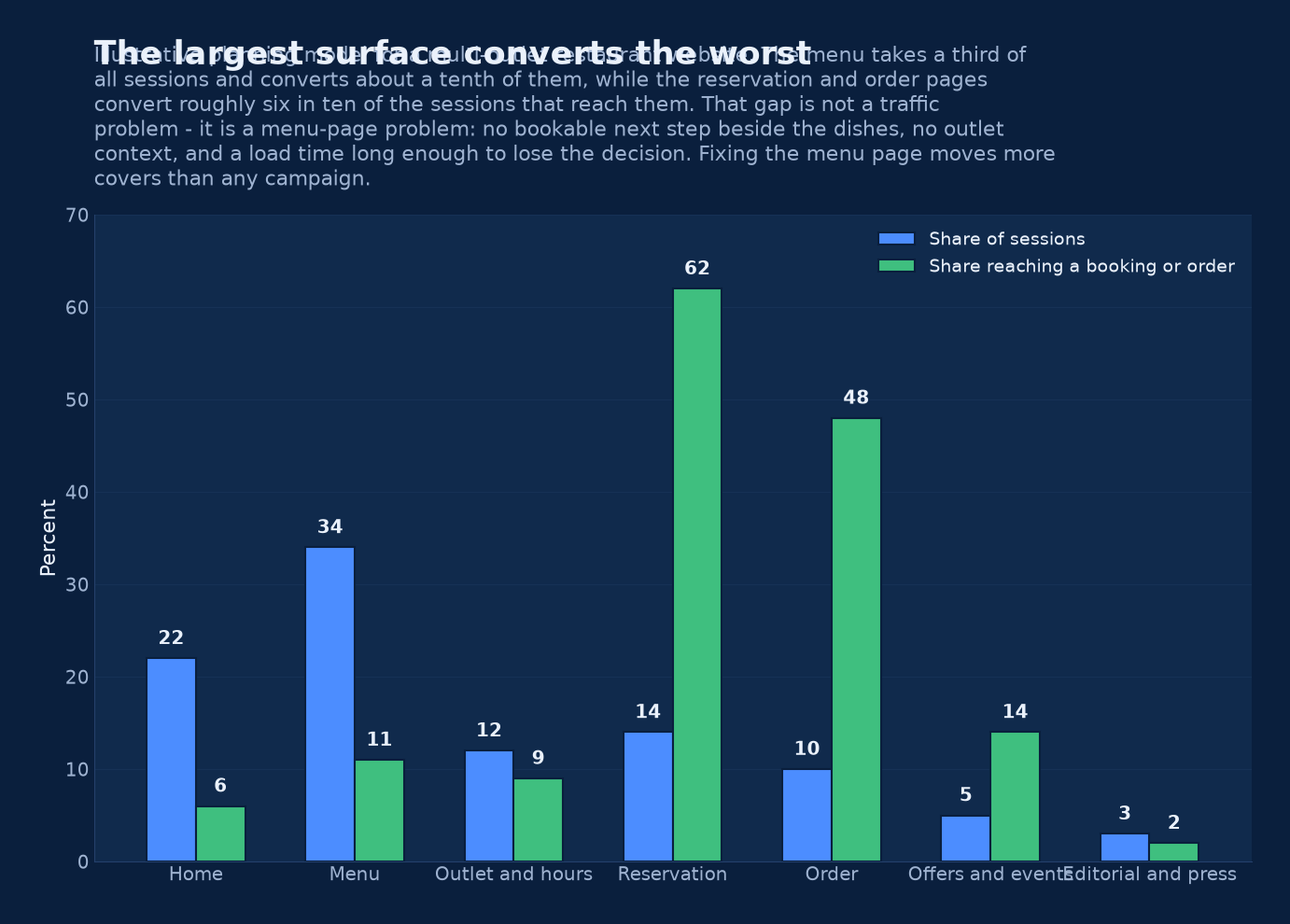
Chart values are an illustrative planning model based on typical UMC engagements and published industry benchmarks. They are not a guarantee of results on any specific project.
| The brochure habit | What a booking surface does instead | Why it changes the outcome |
|---|---|---|
| A menu as a PDF or an image | Menu records rendered as pages with filters, allergens and a bookable next step | Searchable, indexable, updatable in minutes, and readable by a screen reader |
| One page for all outlets | One page per outlet with true hours, address, parking and its own menu | Local queries have something to rank, and a guest gets the right answer |
| A ‘contact us’ form | A reservation widget, a call button and a WhatsApp route per outlet | The decision becomes an action instead of an enquiry |
| Photography as decoration | Photography as evidence, delivered through an image pipeline | Desire without a two-second wait on a mid-range phone |
| Opening hours in a footer | Hours as data, per outlet, synced to the profile and the schema | Fewer wasted journeys and fewer wrong-answer penalties |
| Offers as a banner | Offer pages with validity, outlet list and a booking path | A promotion becomes measurable rather than decorative |
| Ordering delegated entirely to aggregators | An own-channel order path alongside the aggregator listings | Guest data, margin and repeat demand come back in-house |
| Allergens on request | Allergen and dietary flags on every dish | A legal obligation met, and a segment that can actually choose |
| No measurement below the click | Completions, order value, calls and abandonment joined to the booking system | Decisions taken on covers rather than on sessions |
| A redesign every two years | A template set and a content model that absorbs new outlets | Growth becomes a data entry task rather than a project |
- The ordering of pages, the depth of the menu and the placement of the booking path are architecture decisions with a revenue consequence, which is why they are taken in website strategy and information architecture before any template is drawn.
- The visual layer has to survive a bright terrace and a greasy thumb: UX and UI design for food service means contrast, tap targets and a path that does not require reading.
- A site that describes a restaurant and a site that fills one are the same site with a different content model – the difference is decided in week one, not at launch.
The menu as data: dishes, modifiers, allergens and availability
The menu is the single most important data structure a restaurant owns online, and it is almost always the least structured. Held as records rather than as text, one edit updates the website, the ordering basket, the delivery feed, the printed card and the structured data that search and AI answer surfaces read. Held as a PDF, every one of those is a separate manual task with a separate chance of being wrong – and the wrong one is usually the price a customer sees.
| Menu field | Why it exists | What breaks without it | Who maintains it |
|---|---|---|---|
| Dish and course | The unit everything else hangs from | No filtering, no search, no structured data | Chef or outlet manager |
| Description | Appetite and clarity, in the brand’s voice | Guests choose blind and ask the same questions | Marketing with the chef |
| Price and per-outlet variation | Prices differ by city, format and daypart | A guest arrives to a different price than the site showed | Finance or the outlet manager |
| Modifiers and add-ons | Sides, sauces, portion sizes, substitutions | An order that cannot be taken, or a phone call to finish it | Outlet manager |
| Allergens and dietary flags | Legal labelling and guest safety | A compliance exposure and an excluded guest | Chef, reviewed per recipe change |
| Availability and sold-out state | What is on the pass right now | An order for a dish that ran out an hour ago | Outlet manager, toggled live |
| Menu version and daypart | Breakfast, lunch, dinner, weekend brunch, festive | One menu shown at the wrong service | Outlet manager on a schedule |
| Photography per dish | Conversion and expectation setting | A menu that is text on a phone screen | Marketing with a shot list |
| Nutrition and portion information | Increasingly expected, sometimes required | A corporate or institutional client cannot order | Chef or a nutrition partner |
| Category and cuisine tags | Navigation, filtering and search relevance | A sixty-item list with no way through it | Marketing |
| Outlet applicability | Which outlets serve this dish | A dish shown at an outlet that does not cook it | Operations |
| Schema and feed output | Structured data for search plus feeds for delivery platforms | Manual re-entry into every channel, with drift | The platform, automatically |
- Menu records have to reach the point of sale and the delivery platforms, which makes the menu an integration surface rather than a page: enterprise systems integration between the CMS, the POS and the aggregator feeds.
- Where the same records feed ordering, loyalty and guest history, the menu becomes the join point for the CRM – what a guest actually eats is the most useful preference data a restaurant holds.
- Own-channel ordering is commerce with a short basket and a time constraint, so it inherits e-commerce engineering: modifiers, availability, payments, refunds and order states.
- Where a group runs several formats – fine dining, casual, QSR, cloud kitchen – one menu model with per-outlet variation is cheaper than four sites, and it is operations and CRM integration territory once AI reads the same records.
Reservations: slots against real capacity, and the no-show problem
A reservation engine is a capacity system with a customer-facing face. The failures are rarely technical: they are a site that offers a slot the outlet cannot honour, a party of eight routed to a four-top, a deposit policy nobody can find, or a confirmation that never arrives on WhatsApp. Get the capacity model right – tables, table mix, service windows, turn times, covers per slot – and the booking path becomes three taps; get it wrong and the outlet spends the evening rearranging tables the website promised away.
| Element | What good looks like | Failure mode | How it is controlled |
|---|---|---|---|
| Capacity model | Tables, mix and turn times per service, editable per outlet | Overbooking at peak, empty tables off-peak | A capacity table per outlet per daypart |
| Party size handling | Large parties routed to a held table or an enquiry | A party of ten booked against two fours | Rules by party size with a manual path |
| Deposit and prepay | Clear policy, refundable window, stored value where allowed | No-shows on a Friday with no commitment | Deposit by slot, outlet and date, published plainly |
| Cancellation and rescheduling | Self-service link that keeps the history | A cancelled booking replaced by a new one, orphaning the record | One booking record with a change log |
| Confirmation and reminders | Instant confirmation plus a reminder on the guest’s channel | No-shows from forgotten bookings | Reminder state and delivery status per booking |
| Waitlist | A released table offered to the next guest automatically | Released capacity going unsold | Waitlist order and offer acceptance tracking |
| Walk-in and table management | The same capacity view at the desk | Two systems disagreeing on a Saturday night | One source of truth, with desk overrides logged |
| Special requests | Occasion, seating preference, accessibility, allergies | Requests captured but never reaching the floor | Requests printed or pushed to the host station |
| Private dining and events | An enquiry path with capacity, menus and a coordinator | Large bookings handled by the reservation widget | A separate flow with a named owner |
| Guest history | Previous visits, occasions, preferences, no-show count | Every booking treated as a stranger | One guest record across outlets and channels |
- Confirmations and reminders are consented messaging on the channel the guest chose – WhatsApp, SMS and email – run from one automation layer rather than three tools: marketing automation with the booking system as the trigger.
- Demand for slots is highly seasonal and highly predictable, so capacity planning should be forecast rather than guessed: predictive analytics and demand forecasting off the booking history.
- A booking is the strongest signal a restaurant gets, and it has to land in the guest record with its source, or the CRM will never know which channel filled the table.
Own-channel ordering and the aggregator question
Delivery aggregators bring demand and take a fifth to a third of it, plus the guest relationship: the customer belongs to the platform, the data stays there, and the margin decision is made by somebody else’s ranking algorithm. No restaurant can simply leave them. What it can do is build an own-channel order path that is genuinely easier – saved addresses, reorder in two taps, loyalty on every order, a real delivery window – and use the website to move repeat guests across, where the contribution per order is two or three times higher. The website’s job is to make both channels work and to make the economics visible.
| Dimension | Own channel | Aggregator | What the website has to do |
|---|---|---|---|
| Commission | Payment processing only | A percentage per order plus listing and promotion fees | Show the guest a reason to order direct that is worth more than the discount |
| Guest data | Yours: contact, consent, order history, preferences | The platform’s, usually masked | Capture consent at first order and use it lawfully |
| Margin per order | Higher, less promotional pressure | Lower, with discount expectations set by the platform | Report contribution per order by channel, not order count |
| Discovery | Only as strong as your brand and local search | Strong, especially for new guests | Convert aggregator discovery into a direct relationship over time |
| Menu control | Full, including bundles and exclusives | Constrained by the platform’s structure and category rules | Publish direct-only bundles and offers |
| Delivery operations | Your riders, a partner fleet or pickup only | The platform’s fleet with its service levels | Show honest delivery windows per outlet and pincode |
| Refunds and disputes | Your policy, your conversation | Platform policy, often decided without you | A clear policy page and a fast human route |
| Peak behaviour | You control throttling and slot capacity | Orders arrive whether the kitchen can cope or not | A capacity-aware order path that pauses rather than fails |
| Loyalty | Points, tiers and stored value on every order | Rarely permitted, or platform-branded | Make loyalty visible at the basket, not in a footer |
| Measurement | Full funnel to the kitchen and the guest record | Platform-reported, limited and self-serving | Join both into one channel view with true contribution |
- The commission question is a margin question wearing a technology label, and it belongs in cost rationalisation and margin recovery as much as in the website brief.
- Own-channel ordering changes the cash cycle – money at order rather than at settlement – which is a working capital argument finance will understand immediately.
- The channel decision is strategic rather than tactical: which formats stay aggregator-led, which move direct, and over what horizon is business strategy territory with a commerce dependency.
- The ordering path itself is commerce engineering – baskets, modifiers, payments, refunds, order states – and it should be built on the same e-commerce discipline a retail client would expect, not bolted onto a brochure.
Outlet pages, hours and the locator: the pages local search actually ranks
In a multi-outlet business, the outlet page is the most important page on the site and the one usually treated as a list item. It carries the address, the hours that are true today, the parking and accessibility facts, the phone number that is answered, the menu that outlet actually serves, and the reviews that outlet has earned. Those are exactly the signals a local query is answered from – by search engines, by map services, and increasingly by AI answer surfaces that read structured data rather than prose.
| Outlet page element | Why it matters | Common failure | Control |
|---|---|---|---|
| Name, address, phone | The core local signal, matched to the map listing | A call centre number instead of the outlet | One record per outlet, synced to the business profile |
| Opening hours | Answers the most common question and drives the visit decision | Hours that change for festivals and are never updated | Hours as data with exceptions and a scheduled edit |
| Menu for that outlet | Guests check dishes and prices before travelling | A group menu shown at an outlet that does not serve it | Menu records scoped per outlet |
| Reservation and order entry points | The action a local visitor came for | A generic enquiry form on an outlet page | Book and order buttons wired to that outlet’s capacity |
| Directions, parking and landmarks | Removes the last friction before a visit | A map pin with no parking or entry information | A short facts block per outlet |
| Accessibility facts | Step-free entry, restroom, seating – a real decision for many guests | Omitted, or claimed without verification | Verified fields, published honestly |
| Reviews and rating | The trust layer a new guest reads | Aggregated group reviews with no outlet context | Outlet-level reviews with a generation routine |
| Photography of the actual space | Sets the expectation for the visit | Brand imagery that does not match the outlet | A shot list per outlet, refreshed annually |
| Offers and events at that outlet | Gives a reason to come this week | Group offers that the outlet does not honour | Offer records scoped per outlet with validity |
| Structured data | Restaurant, Menu, OpeningHours, Geo, AggregateRating | Missing or contradicting the visible page | Generated from the same records as the page |
- Outlet pages and business profiles have to agree to the letter – name, address, hours, phone – which is local SEO and Google Business Profile management as much as web development.
- The page architecture, internal linking and dish-level intent coverage are the sibling discipline’s job: SEO for restaurants takes the outlet structure this section builds and makes it rank.
- AI answer surfaces increasingly quote structured facts rather than prose, so a menu held as records is also an AI search visibility asset – the same data, a different consumer.
- Outlet pages are also the landing surface for paid local campaigns, so their quality decides the cost per cover: Google Ads management sends traffic to whatever these pages are.
Photography, video and Core Web Vitals on a food site
Restaurant sites are heavy because food is visual, and heavy sites lose covers on the devices guests actually use. The tension is real but it is not a design compromise: a well-built image pipeline delivers full-bleed food photography at sub-second largest contentful paint by generating the right sizes and formats at upload, serving them responsively, and refusing to let a hero video or a dozen third-party tags block the first paint. Performance work on a food site is an engineering discipline with a design constraint, not a cleanup after launch.
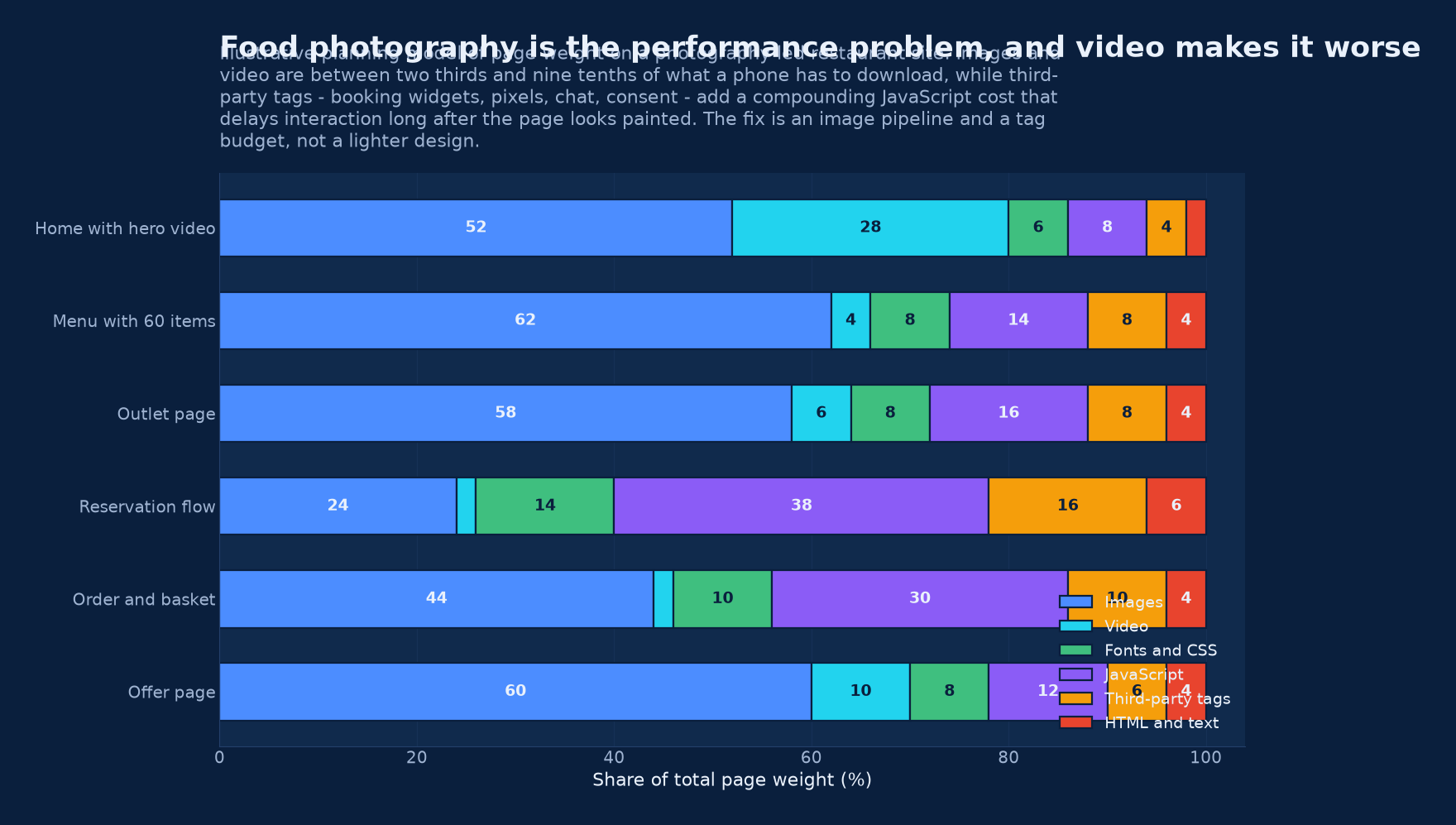
Chart values are an illustrative planning model based on typical UMC engagements and published industry benchmarks. They are not a guarantee of results on any specific project.
| Problem | How it shows up | Fix | How it is verified |
|---|---|---|---|
| Oversized hero images | LCP of three to six seconds on mobile | Responsive sizes generated at upload, modern formats, correct priority hint | Field and lab LCP per template |
| Uncompressed dish photography | A menu page that is eight megabytes | A pipeline with target weights per slot and quality floors | Page weight budget per template |
| Autoplay hero video | Bandwidth consumed before the menu is read | Poster image first, video deferred or removed on mobile data | Interaction delay measured on a mid-range device |
| Render-blocking scripts | A painted page that does not respond | Deferred and async loading, critical CSS inlined | Total blocking time and interaction metrics |
| Third-party tag sprawl | Booking, pixels, chat, consent and analytics each adding weight | A tag budget with an owner, loaded after interaction where possible | Tag inventory reviewed quarterly |
| Layout shift from late images | Content jumping as images load | Explicit dimensions and reserved space for every media slot | Cumulative layout shift per template |
| Font loading | Invisible or flashing text on first paint | Subset fonts, preloaded, with a sensible fallback stack | Font-display behaviour tested on a slow connection |
| No caching strategy | Every visit re-downloading the same assets | Long-lived immutable asset caching with versioned filenames | Repeat-visit load time |
| Images served from a shared host | Slow origin, no edge delivery | A delivery network or optimised origin with compression | Time to first byte by region |
| Performance measured once at launch | Regression within a month | Continuous field monitoring with a budget and an alert | A monthly performance report against the budget |
- Core Web Vitals are a ranking input and a conversion input at the same time, so they get a budget and an owner rather than a one-off fix: Core Web Vitals and performance work with continuous field measurement.
- Where imagery is delivered from a cloud origin with a CDN, the delivery architecture is part of the performance plan – cloud services and migration sized for peak service hours rather than average traffic.
- Media delivery and tag costs scale with traffic and are easy to let drift, so they belong in the same monthly review as the rest of the estate: cloud cost optimisation.
- A restaurant guest is almost always on a phone, often on mobile data at the edge of a busy area, which makes mobile experience the primary design target rather than a responsive afterthought.
Platform and architecture: WordPress, headless, and the multi-outlet content model
The platform question in food service is less about frameworks than about who publishes what. A single outlet with a chef who edits the menu needs a friendly CMS and nothing more. A chain with forty outlets, four formats, per-outlet pricing and a marketing team needs a content model with inheritance, scoped editing rights, approval workflow and an API for the POS and delivery feeds. Both can be served well; the mistake is buying the second when the first is needed, or discovering you need the second after a launch built on the first.
| Option | Fits when | Strengths | Costs and risks |
|---|---|---|---|
| Managed WordPress with a custom theme | One to ten outlets, editorial-led, marketing publishes | Fast to build, easy to edit, huge ecosystem, low licence cost | Plugin sprawl, patch discipline required, weaker at complex menu models |
| WordPress with a structured content plugin | Multi-outlet with a real menu model and scoped editing | Familiar editing, structured records, good structured-data output | Needs disciplined field design and a build that does not fight the CMS |
| Headless CMS with a front-end framework | Chains with app, kiosk and web surfaces sharing content | One content API for every surface, strong performance control | Higher build and running cost, editors lose visual context |
| Commerce-first platform with restaurant extensions | Ordering-led formats, cloud kitchens, QSR | Basket, payments and order states built in | Content and editorial usually weaker; extension lock-in |
| Booking-platform site builder | A single venue that wants a presence this week | Included, integrated with the reservation system | Template-bound, weak SEO control, data lives with the platform |
| Aggregator storefront only | Delivery-only formats with no brand ambition | No build cost, immediate demand | No guest data, no margin control, no brand |
| Custom build | A group with unusual formats, loyalty and stored value at scale | Exactly what the operating model needs | The most expensive to build and to keep, and it needs an owner |
| Hybrid: CMS for content, service for ordering | Most chains, in practice | Editorial freedom plus commerce robustness | An integration to own, and two release cycles |
- For most restaurants and chains the honest answer is a well-built WordPress estate with a structured menu model: full-stack WordPress development gives editors a familiar surface and search a clean output.
- The outlet network, Wi-Fi and any on-premise serving still matter to a website that has to work from a back-office machine in a basement kitchen – network engineering is part of the publishing story, not separate from it.
- Build capacity is a real constraint for a growing group: IT staff augmentation lets a small internal team ship a chain-wide template set without hiring for a peak.
- Whatever is built has to be maintained – patches, dependency updates, form and webhook monitoring, content fixes – which is web application maintenance with a named owner rather than a hope.
Accessibility and allergen information: who the site excludes
Food service has an accessibility obligation that goes beyond good practice. A guest who cannot read a menu because it is an image cannot order; a guest who cannot see allergen information cannot eat safely; a guest using a screen reader cannot find the booking button if it is a background image. WCAG 2.2 AA is the target and it is achievable on a photography-led site – the work is semantic markup, real text, keyboard paths, contrast that survives sunlight, and allergen information rendered as content rather than attached as a document.
| Requirement | What it means on a restaurant site | Common failure | How it is tested |
|---|---|---|---|
| Menus as text | Every dish, price and modifier readable without a download | A menu image or PDF as the only version | Text extraction check plus a screen-reader pass |
| Allergen disclosure | Allergen and dietary flags on each dish, reachable in one step | A single PDF for the whole menu, or ‘ask staff’ | Field presence per dish and a navigation test |
| Keyboard operation | Booking, ordering and filtering without a pointer | A widget that traps focus or skips the calendar | A keyboard-only walkthrough of each flow |
| Screen-reader semantics | Headings, lists, tables, form labels and live regions in order | A decorative menu layout with no structure | An assistive-technology audit per template |
| Contrast in daylight | Text legible on a terrace or near a window | Cream text on a pale background for elegance | Contrast ratios measured per component |
| Tap targets and spacing | Usable with one hand, in a hurry, with cold or wet fingers | A row of small icons for book, call and directions | Target size and spacing checks on real devices |
| Motion and autoplay | No unexpected movement, no autoplaying sound | A hero video that plays with sound on load | Preference-respecting behaviour tested |
| Language and script | The languages a city actually speaks, with correct markup | A translated menu as an image, or no language attribute | Language attributes and a native-speaker review |
| Forms and errors | Labels, hints, error messages that say what to fix | A reservation form that fails silently on a date | Error-path testing per form |
| Published statement and route | An accessibility statement with a contact that answers | A policy page nobody maintains | A live contact route and a response test |
- Accessibility is verifiable work with a report at the end, not an intention: an IT audit and compliance pass over the templates gives evidence rather than assurance.
- The fixes are design decisions taken early – contrast, tap targets, real text – which is why UX and UI design and accessibility are the same workstream on a food site.
- Most guests will use a phone, often one-handed, often in poor light: mobile experience testing on real mid-range devices is the only test that counts.
Search, structured data and the answer surfaces that read your menu
A restaurant’s demand is overwhelmingly local and immediate: somebody nearby, hungry, deciding within the hour, on a phone. That makes the website a search asset before it is a brand asset – dish and cuisine pages, outlet pages, occasion pages, and structured data that lets a search engine or an AI answer surface quote your hours, your menu and your rating accurately. The requirement is consistency: what the page says, what the schema says and what the map listing says have to be the same facts, generated from the same records.
| Asset | What it covers | Structured data or signal | Failure if inconsistent |
|---|---|---|---|
| Outlet page | Address, hours, phone, parking, accessibility | Restaurant, PostalAddress, OpeningHoursSpecification, Geo | A guest travels to a closed outlet |
| Menu page | Courses, dishes, prices, allergens, availability | Menu, MenuSection, MenuItem, Offer | Search shows a price the outlet does not honour |
| Dish and cuisine pages | Category-level demand: biryani, dim sum, breakfast, vegan | ItemList plus internal links to outlets serving it | Dish-level queries land on a generic menu |
| Reservation page | Bookable slots, party size, deposit policy | Reservation-related markup and a clear action | A booking intent satisfied by a competitor |
| Order page | Delivery and pickup, coverage area, windows | Offer, delivery availability per pincode | An order attempted outside the delivery zone |
| Offer and event pages | Validity, outlets, terms | Offer with validity dates and eligible outlets | An expired offer still circulating |
| Review and rating display | Outlet-level reputation | AggregateRating sourced from real reviews | A rating that contradicts the map listing |
| Editorial and press | Story, chef, sourcing, occasions | Article markup and authorship | Brand queries answered by a third party |
| Local landing pages | Neighbourhood and landmark intent | Area served plus internal links | Thin pages that dilute rather than help |
| Sitemap and crawl control | What should be indexed and what should not | A maintained sitemap with per-outlet entries | Duplicate outlet pages or orphaned menus |
- The technical half – crawl, indexation, internal linking, schema validation – is SEO services work applied to a site whose content changes twice a day.
- Dish, occasion and neighbourhood pages have to earn their place with real content rather than templates filled with adjectives, which is content marketing strategy with a local brief.
- Answer surfaces quote facts, so a menu held as records with clean schema is the asset – AI search optimisation is what happens when the structured data is already right.
- The sibling discipline owns the programme: SEO for restaurants covers outlet authority, review velocity and category architecture; this section builds the pages it needs.
Paid, social and the landing surfaces they arrive at
A restaurant’s paid and social demand arrives with a specific intent – a table tonight, a birthday, a delivery in forty minutes – and it arrives on a phone. The website’s contribution is to give each intent a landing surface that answers it and completes it: an outlet page for a local query, a menu page for a dish query, a booking path for an occasion, an order path for delivery. Sending all of it to a homepage is the most common and most expensive error in hospitality media.
| Intent | Landing surface it needs | What must be true on arrival | Measure |
|---|---|---|---|
| A table tonight, nearby | The nearest outlet page with a booking button | Hours today, distance, availability, one-tap book | Reservation completions per visit |
| A specific dish or cuisine | A dish or category page listing outlets that serve it | Price, availability, allergens, the outlet nearest to the guest | Bookings and orders from dish pages |
| An occasion or celebration | A set-menu or private-dining page | Menu, price per head, deposit, a coordinator contact | Enquiries and confirmed events |
| Delivery now | An order page with pincode check first | Coverage, honest window, basket that keeps modifiers | Order completions and basket value |
| A promotion they saw | An offer page with validity and outlet list | Terms visible, offer applied automatically | Redemptions per outlet |
| A brand they follow | The brand or story page plus the nearest outlet | Recognition, then a path to book or order | Branded sessions that convert |
| A review they read | The outlet page with its own reviews | Consistency with the review source | Conversion from review-sourced sessions |
| A creator’s recommendation | A tracked landing page per creator or campaign | The dish shown, the outlet, a bookable next step | Cost per cover by creator |
| A corporate or bulk order | A catering page with a form and capacity facts | Lead time, minimum order, menu options | Qualified catering enquiries |
| A returning guest | A reorder or rebook path with their history | Recognised, consented, two taps | Repeat rate and direct-channel share |
- Local intent is served by local products: Performance Max with local goals, Local Services Ads where supported, and call assets that reach the outlet rather than a call centre.
- The paid programme has its own discipline and its own metrics – the sibling page Google Ads for restaurants covers bidding to cost per cover rather than cost per click.
- Food demand is visual, so the social layer runs on Meta and Instagram with YouTube for chef and kitchen stories, and on organic social management for the comment and DM queue that is really a reservation desk.
- Creator work is a measurable channel rather than a favour: influencer marketing management with tracked landing pages, and paid amplification of what already performs.
- Where the creative itself is the constraint – a festive campaign across forty outlets – that is brand performance and creative production supported by media planning and buying across the group, with the landing surfaces built to receive it.
Guest data, consent and the lifecycle the website makes possible
A restaurant that takes reservations and orders directly owns something an aggregator-led competitor does not: a guest record with contact, consent, occasions, preferences and order history. That record is the asset the website exists to build, and it is worth very little unless it is lawful, accurate and used with restraint. The lifecycle that follows – a birthday, a win-back after ninety quiet days, a festive invitation to a guest who came last year – is what turns one cover into a habit.
| Data | Captured where | Consent basis | Used for | Retention rule |
|---|---|---|---|---|
| Reservation record | Booking widget, phone, desk | Contract for the booking; separate consent for marketing | Service, reminders, history | Kept as history; marketing use only with consent |
| Order record | Own-channel ordering, aggregators where shared | Contract for the order | Fulfilment, refunds, reorder | Financial retention, then anonymised |
| Contact and preferences | Booking, order, loyalty signup, a QR code at the table | Explicit consent per channel | Occasion and win-back messaging | Until withdrawn or dormant beyond policy |
| Loyalty and stored value | Signup, gift card purchase, top-up | Contract plus consent for messaging | Points, tiers, rewards, balances | For the life of the account plus a statutory window |
| Dietary and allergen notes | Booking requests, order notes, profile | Provided by the guest for their own safety | Service and safety only | Not used for marketing; reviewed periodically |
| Wi-Fi and on-site signals | Guest network signup where offered | Explicit consent at signup | Visit frequency where lawful | Short, with an opt-out honoured immediately |
| Behavioural data | Site analytics, with consent mode honoured | Consent per category | Page and flow improvement | Aggregate, with a stated window |
| Review and feedback | Post-visit request, on-site QR | Consent to contact | Reputation and service recovery | Published reviews kept; contact data retained per policy |
| Event and private dining enquiries | Enquiry forms | Contract and legitimate interest for the enquiry | Coordination and follow-up | Kept as commercial history |
| Suppression and opt-outs | Every message and preference centre | The guest’s choice | Blocking all marketing contact | Permanent – a suppression list is never deleted |
- Journeys are operated from one layer with consent checked before every send – lifecycle and retention campaigns and nurture programmes over email, SMS and WhatsApp, triggered by the booking and order systems.
- The guest record only works if identity is resolved across outlets and channels, which is a CRM build with the website as one of several capture surfaces.
- Automation without a preference centre produces unsubscribes; with one, it produces a guest who stays reachable – marketing automation designed for consent rather than volume.
Payments, security and the operational reality of a live site
A restaurant website takes money, holds guest contact data, and stays open while a kitchen is at peak. That makes it a payment surface, a data controller and an operational system at the same time. The controls are the ordinary ones – reduced payment scope, MFA on every publishing account, patched dependencies, monitored uptime, tested backups – and they matter more here because a site that fails at eight on a Saturday fails in front of every guest who was about to book.
| Risk | How it arises | Control | Evidence |
|---|---|---|---|
| Card data exposure | Payment handled on your servers instead of a hosted or tokenised flow | A payment gateway or hosted fields, keeping scope out of the estate | Payment flow documentation and a scope assessment |
| Gift card and stored value fraud | Balances guessable, codes enumerable, refunds unlogged | Secure code generation, rate limiting, an audit log per transaction | Transaction log review and fraud rules |
| Publishing account compromise | A shared admin login or no MFA on the CMS | Named accounts, MFA, role-based publishing rights | Access matrix and login logs |
| Plugin and dependency risk | An unmaintained plugin on a commerce site | A minimal stack, patch discipline, a staging environment | Patch history and dependency review |
| Uptime at peak | A shared host failing on a Saturday evening | Monitoring, caching, capacity headroom, a documented restart path | Uptime record and incident log |
| Form and webhook failure | A booking or order silently not arriving | Synthetic checks on every capture route, alerting on failure | Check history and alert log |
| Data breach | Guest contact data exported or exposed | Least-privilege access, encryption, export logging | Access logs and an incident response plan |
| Backup that has never been restored | A rebuild that takes days instead of hours | Scheduled backups with timed restore tests | Restore test results |
| Aggregator feed drift | Menu and price mismatch between site and platform | Automated comparison with an exception report | Feed reconciliation log |
| Content that cannot be updated | A sold-out dish still orderable | A live availability toggle the outlet team can use | Publishing log with timestamps |
- Security on a hospitality estate covers the website, the POS and the guest network together: cybersecurity services with payment scope reduction and access control as the priorities.
- A booking or order system that cannot be restored is a trading halt, so backups are tested rather than assumed: backup and disaster recovery with timed restores.
- When something breaks at seven in the evening, the question is who answers – helpdesk and end-user support with an out-of-hours route, backed by managed IT services covering the site, the POS and the outlet network.
Measurement: from sessions to covers
Restaurant website measurement fails in a familiar way: sessions and bounce rate are reported while the question – did the site fill a table or take an order – is answered from the booking system by somebody else, in a different tool, on a different calendar. Joining the two is not difficult, and it changes what gets built next. The chain is short: page to action, action to booking or order, booking to cover, order to kitchen, and both to contribution per outlet.
| Metric | Definition | Source | Reported to | What it decides |
|---|---|---|---|---|
| Reservation completions | Bookings made on the site, per outlet | Booking system with a web source | Outlet and marketing | Whether the booking path works |
| Cost per cover | Spend divided by covers attributed to the channel | Booking system plus media | Marketing and leadership | Where budget moves |
| Order value and count | Own-channel orders, basket value, per outlet | Order system | Outlet and finance | Whether direct ordering is worth investing in |
| Menu views per outlet | Sessions reaching a menu, and dishes viewed | Analytics | Marketing | Which dishes carry demand and which need photography |
| Abandonment by step | Where booking and ordering flows are left | Analytics with funnel events | Product and marketing | What to fix first |
| Call and click-to-WhatsApp | Contact actions per outlet | Call tracking and messaging platform | Outlet manager | Whether the phone is still the real booking channel |
| No-show rate | Bookings that did not arrive, by source and slot | Booking system | Outlet manager | Deposit policy and reminder design |
| Repeat and direct share | Guests returning, and the share ordering direct | Guest record | Leadership | Whether the aggregator dependence is reducing |
| Page performance | LCP, interaction delay and layout shift per template | Field monitoring | Engineering | Whether a regression has shipped |
| Contribution per outlet | Revenue less attributable cost, online and offline | POS plus finance plus media | Leadership | Which outlets deserve investment |
| Channel mix | Direct, aggregator, walk-in and referral covers | Joined record | Leadership | How dependent the business is on platforms it does not control |
- The join is the deliverable: one guest and booking identifier from a page view to a covered table, held where it can be queried – warehouse work with a marketing deadline.
- Two audiences, one model: an outlet manager wants last night’s covers and no-shows, a group head wants contribution and channel mix – executive dashboards built once and rendered twice.
- Website behaviour and booking outcomes together explain why a flow fails, which is pipeline and conversion analytics applied to a restaurant rather than a sales team.
The multi-outlet operating model: who publishes what, and who decides
A chain website fails for organisational reasons more often than technical ones. If an outlet manager cannot mark a dish sold out without a head-office ticket, the site becomes wrong by lunchtime; if every outlet can publish its own offer, the brand becomes forty arguments. The operating model has to be designed with the templates: what is inherited from the group, what an outlet may change, who approves a price, and what happens when an outlet is wrong in public.
| Decision | Held centrally | Held at the outlet | Approval route | Evidence |
|---|---|---|---|---|
| Brand and templates | Design system, components, tone | Local photography and stories within the template | Marketing signs off new components | Template version per outlet |
| Menu structure | Courses, categories, allergen fields | Dishes served, local specials, availability | Chef or outlet manager publishes; group reviews weekly | Publishing log |
| Prices | Price bands and architecture | Local price within the band | Finance approves changes above a threshold | Price change log |
| Opening hours | Standard hours format | Actual hours, festival exceptions | Outlet manager, synced to the map listing | Hours change history |
| Offers and promotions | Group campaigns and terms | Outlet participation and local offers | Marketing approves any published offer | Offer register with validity |
| Photography | Brand shoot assets and standards | Outlet and dish photography to the shot list | Marketing reviews before publishing | Asset library with rights |
| Reviews and responses | Response policy and tone | The actual reply, by the outlet | Escalation rule for complaints | Response times and escalation log |
| Content and editorial | Story calendar and standards | Local events and community content | Marketing approval for anything claiming a fact | Editorial log |
| New outlet launch | A launch checklist and template set | Local facts, photography, hours | A named owner signs off readiness | Launch checklist per outlet |
| Incidents and corrections | Escalation path and holding language | Immediate correction of a wrong fact | Any outlet may correct a factual error at once | Correction log with timestamps |
- In a group with several formats and cities, the publishing model is a governance question before it is a CMS question – unified top-level management setting what is central and what is local.
- Opening an outlet should be a data entry task with a checklist, not a project: market expansion consulting with the website launch on the critical path.
- What to publish, where and for whom should rest on evidence rather than habit – market research and competitive analysis on local demand, cuisine trends and competitor positioning.
- Where AI begins writing menu copy, answering guest questions or drafting review responses, the operating model has to say who approves it: a readiness assessment first, then governance over anything published, and agents only on processes with a measured error history.
The ninety-day restaurant website programme, and what we need from you
The programme below is the shape we run for a restaurant, a cafe group or a multi-outlet chain: three weeks to audit what exists and design the content model, menu and outlet structure before any template is drawn, design and build in overlapping waves, reservation and ordering integration from week six, the image pipeline and performance work from week eight, accessibility and compliance from week ten, CMS training and publishing workflow from week twelve, and launch with measurement at the end. The dependency that decides the timeline is menu data – somebody has to give us every dish, every price, every allergen and every outlet’s true hours.
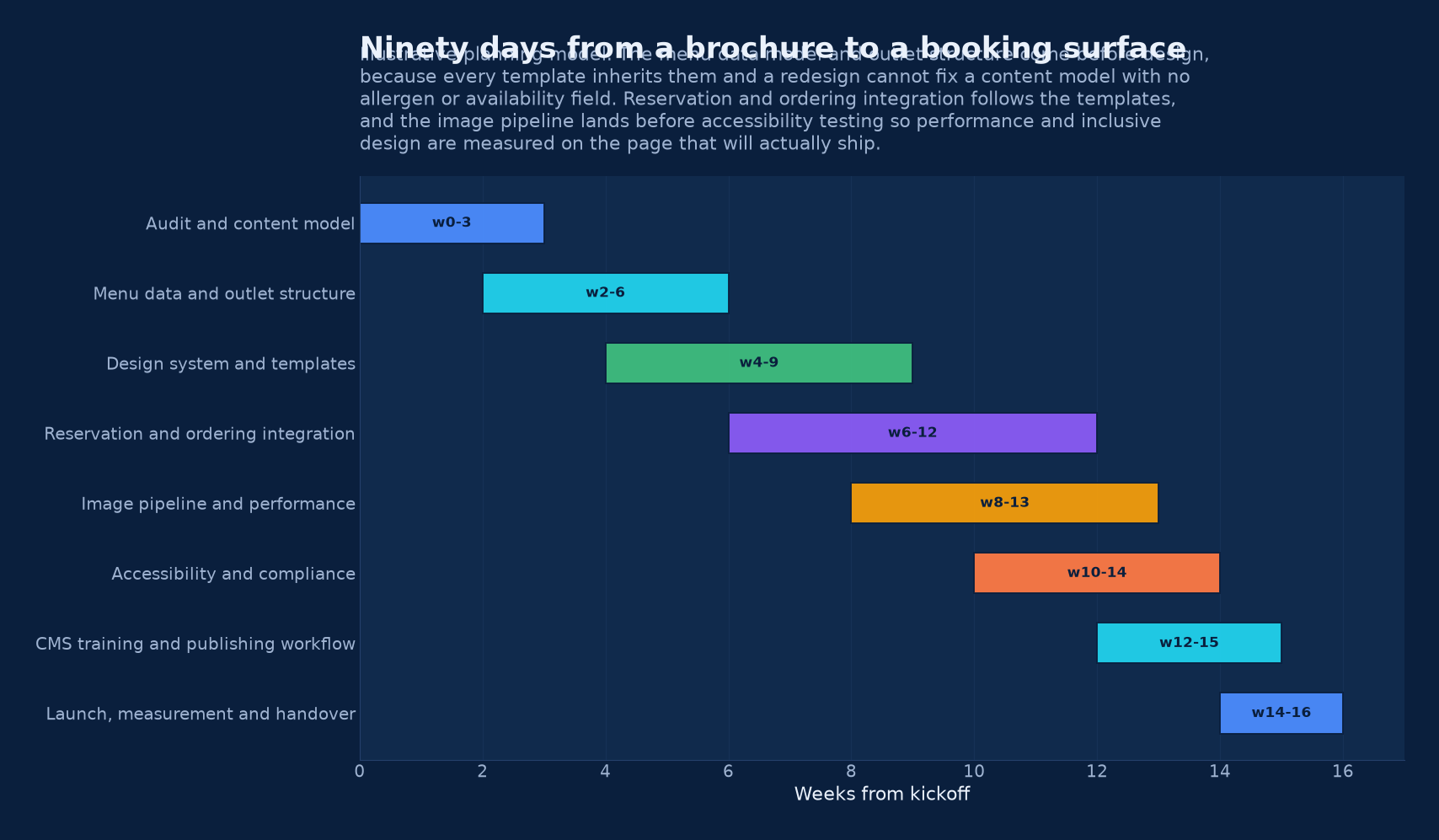
Chart values are an illustrative planning model based on typical UMC engagements and published industry benchmarks. They are not a guarantee of results on any specific project.
| Weeks | Workstream | Deliverable | Decision it enables |
|---|---|---|---|
| Zero to three | Audit and content model | Current-state audit, guest journeys, content model with menu and outlet fields, a platform recommendation | What gets built, on what, and what is deliberately left out |
| Two to six | Menu data and outlet structure | Menu records with allergens and per-outlet variation, outlet pages, hours and locator | Whether one edit can update every channel |
| Four to nine | Design system and templates | Components, templates per page type, photography standards, an accessibility-checked design | What an outlet may change and what it may not |
| Six to twelve | Reservation and ordering integration | Booking widget or API, own-channel order path, aggregator feeds, payments, gift cards | Whether a cover or an order can be completed on the site |
| Eight to thirteen | Image pipeline and performance | Responsive image delivery, a page-weight budget, tag inventory, field monitoring | Whether the site loads fast on the phones guests use |
| Ten to fourteen | Accessibility and compliance | WCAG 2.2 AA audit and fixes, allergen disclosure, privacy and consent, payment scope review | Who the site excludes, and what the legal position is |
| Twelve to fifteen | CMS training and publishing workflow | Role-based editing, approval routes, sold-out toggles, hours exceptions, training per role | Whether the outlet team can keep the site true |
| Fourteen to sixteen | Launch, measurement and handover | Migration and redirects, analytics and funnel events, dashboard, documentation, support model | How the site is measured and who keeps it running |
- What we need: the full menu per outlet with prices, allergens and modifiers, true opening hours including festival exceptions, the outlet list with addresses and phone numbers, existing photography or a shoot plan, access to the booking system, POS and any aggregator accounts, current analytics, and one decision-maker who will settle what an outlet may publish on its own.
- What you keep regardless: the content model, the design system and templates, the image pipeline, the accessibility audit and fixes, the measurement plan, the publishing workflow and the documentation. They are yours.
- What we will tell you plainly in week three: which outlets cannot be published until their hours and menus are true, whether the aggregator economics justify an own-channel order path now or later, and where the constraint is data rather than design – almost always the data.
Restaurant websites by city, and worked examples
Restaurant websites are local by construction: language and script decide the menu, the neighbourhood decides the outlet page, the festive calendar decides the offer rhythm, and delivery coverage decides whether an order path is honest. The engagements below are hospitality, food-service and multi-outlet projects where the site, the booking path and the measurement were built as one programme.
- Get more restaurant customers in Lucknow
- Digital marketing company for restaurants in Lucknow
- Website development company for restaurants in Lucknow
- Services across Indian cities
- Case study: The Fern hotel, Hyderabad
- Case study: Marriott hotel, Hyderabad
- Case study: WordPress development for a green hotel and resort
- Case study: social media advertising for a green hotel and resort
- The restaurants and food service industry hub – all eight disciplines
- Hotels and hospitality: booking-led websites and property systems
- Retail and e-commerce: catalogue, cart and commerce engineering
- Showrooms and dealerships: appointment-led websites and branch pages
- All industry verticals we build programmes for
- All digital marketing services
- All technology services
- All business consulting services
- About Unified Management Consulting
- Contact us about website development for restaurants
Where this page sits in our restaurants programme
Website development is the first discipline of our restaurants and food service programme. The hub page explains how the eight disciplines fit together, each discipline will have its own page as it is published, and the generic service page for every discipline stays listed below alongside the vertical pages. A discipline that is not listed is not published yet – the list is generated from live pages and refreshes automatically as each spoke lands.
- Restaurants – the vertical main page
- SEO for restaurants
- Google Ads for restaurants
- Social media marketing for restaurants
- Guest CRM, reservations and loyalty for restaurants
- Business intelligence for restaurants
- IT support for restaurants
- AI for restaurants
- SEO services – the generic service page
- Google Ads management – the generic service page
- Social media management – the generic service page
- Custom CRM development and integration – the generic service page
- BI dashboards and executive reporting – the generic service page
- Managed IT infrastructure and AMC – the generic service page
- AI agent deployment and automation – the generic service page
Frequently asked questions about website development for restaurants
What should a restaurant website actually do?
Fill tables and take orders. That means a menu held as data with prices, allergens and availability, a reservation path against real capacity, an own-channel order path where delivery matters, one page per outlet with true hours, and photography that loads fast on a phone. Everything else supports those five.
Why does our menu PDF hurt us?
A PDF cannot be searched, filtered, indexed properly, read by a screen reader, updated at four on a Saturday, or turned into an order basket. It also cannot carry allergen information as content, which is increasingly a legal expectation. Menu records render as a page, a basket, a feed and structured data from one edit.
Should we build our own ordering, or stay on the aggregators?
Both, with a plan to shift repeat guests. Aggregators bring discovery and take a large commission plus the guest relationship; an own channel keeps the data, the margin and the loyalty. The website’s job is to make the direct path easier than the alternative for somebody who already knows you, and to report contribution per order by channel so the shift is measured.
How many outlets should have their own page?
All of them. The outlet page is the page a local query is answered from – address, hours, phone, menu, reviews, directions. A single page listing forty outlets ranks for nothing and answers nobody.
Can a photography-heavy site still be fast?
Yes, with an image pipeline rather than a smaller design: responsive sizes generated at upload, modern formats, correct load priority, reserved space to prevent layout shift, deferred video and a budget for third-party tags. Sub-second largest contentful paint on a mid-range phone is achievable on a full-bleed food site.
Do we need a booking engine, or is a phone number enough?
A phone number is a real booking channel and should stay prominent, but it only works during staffed hours and it records nothing. A booking path against real capacity captures demand overnight, reduces no-shows with reminders and deposits, and produces the guest record that every later journey depends on.
What accessibility work is genuinely required?
WCAG 2.2 AA as a target: menus as text rather than images, allergen information reachable in one step, keyboard-operable booking and ordering, semantic structure for screen readers, contrast that survives daylight, and tap targets usable with one hand. It is verifiable work with an audit at the end.
Which platform should a restaurant chain use?
For most chains, a well-built WordPress estate with a structured menu model and scoped editing per outlet; for ordering-led formats, a commerce-first platform or a hybrid with the CMS for content and a service for ordering. Headless suits groups with app, kiosk and web surfaces sharing one content API. The deciding question is who publishes what, not which framework is fashionable.
How do we keep the site accurate across many outlets?
With an operating model: central templates and standards, outlet-level control of availability, hours and local content, an approval route for prices and offers, a live sold-out toggle, and a rule that any outlet may correct a factual error immediately. Then measure publishing latency rather than hoping.
What should we measure?
Reservation completions, order value and count, cost per cover by channel, menu views per outlet, abandonment by step, calls and WhatsApp actions, no-show rate, repeat and direct share, page performance, and contribution per outlet. Sessions and bounce rate explain nothing on their own.
How long does a restaurant website take?
About ninety days to a first launch for a single venue or a small group with the menu data ready, and longer for a chain where outlet data has to be gathered and verified. The variable is almost never the build; it is menu data, photography and decisions about what an outlet may publish.
What does it cost?
It scales with outlet count, whether ordering and payments are included, the booking system integration, photography, and the accessibility and performance work. A single-venue brochure site is a small project; a multi-outlet estate with menu-as-data, ordering, gift cards and a publishing model is an engineering programme with an ongoing maintenance and support arrangement. We quote after the audit and content model, so the price reflects the operating reality rather than a page count.
Start with the audit and the menu content model
Give us three weeks with your full menu per outlet including prices, allergens and modifiers, true opening hours with festival exceptions, the outlet list with addresses and phone numbers, existing photography or a shoot plan, access to your booking system, POS and aggregator accounts, current analytics, and one decision-maker who will settle what an outlet may publish on its own, and we will return a current-state audit with the journeys guests actually take, a content model that holds dishes, allergens, availability and per-outlet variation as data, a platform recommendation with a cost case, a template and design system specification, a reservation and ordering integration plan including the aggregator economics, an image pipeline and page-weight budget, an accessibility and compliance scope, a publishing model saying who may change what, and a measurement plan that reports covers and contribution rather than sessions – including which outlets cannot be published until their data is true. Yours to keep either way.
Contact Unified Management Consulting to arrange a confidential first conversation.