
Paid search is the fastest way to put a restaurant in front of somebody who is deciding where to eat in the next hour, and the fastest way to spend money on somebody who is not. The difference is not the bid. It is whether the account is built around outlets and intents that exist in the real world – a radius that matches the catchment, a landing page that can take a reservation, a conversion defined as a cover rather than a click – and whether the booking system talks back to the ad platform so bidding learns from tables filled instead of forms started.
This page is about that build: account architecture by outlet and intent, local campaigns and Performance Max with local goals, reservation and delivery conversion paths, call and WhatsApp tracking, offline conversion imports, and a reporting chain that ends at cost per cover and contribution per outlet. It is Google Ads management applied to a business with a perishable product, a fixed capacity and a forty-minute decision window.
What an engagement includes, at a glance
| Component | What We Deliver |
|---|---|
| Conversion definition first | What counts as a conversion – a completed reservation, a paid order, a connected call of a stated length, a WhatsApp conversation that reached a booking – agreed with operations before a single campaign is built. |
| Account architecture by outlet and intent | Campaigns scoped to catchments and formats, brand separated from non-brand, each intent landing on the page built for it rather than on a homepage. |
| Local and ‘near me’ campaigns | Radius and location targeting per outlet with overlap rules, business profile assets, call assets reaching the outlet, and Local Services Ads where the category supports them. |
| Performance Max with local goals | Asset groups per outlet cluster, local goals and store-visit signals, exclusions and brand controls, and a clear view of what it is actually buying. |
| Reservation and delivery conversion paths | Booking widgets and order checkouts that fire a real conversion, with capacity, coverage and honest windows on the landing page. |
| Calls, WhatsApp and the conversations that convert | Call tracking per outlet, click-to-WhatsApp with a source, and a rule for what a conversation has to achieve to count. |
| Offline conversion imports | Covers, orders and no-shows pushed back from the booking system and POS so bidding optimises towards revenue rather than towards form starts. |
| Creative, offers and the perishable product | Food creative that carries facts – price, dish, outlet, validity – and an offer discipline that does not train guests to wait for a discount. |
| Measurement, seasonality and governance | Cost per cover by outlet and intent, contribution after commission, festive and daypart budgeting, and who may change a budget at seven on a Saturday. |
What paid search buys a restaurant, and what it cannot
Paid search buys presence at the moment of decision. It cannot buy capacity, it cannot fix a menu that is wrong online, and it cannot make a landing page take a reservation. Restaurant advertisers who treat it as a volume dial end up paying for demand the outlet cannot serve on a Saturday, or for clicks that arrive at a page with no booking path and no hours. The discipline is to decide what paid is for – filling a specific outlet at a specific daypart, launching a new site, defending a brand name, driving own-channel orders – and to refuse campaigns that serve none of those.
| What paid does well | What paid cannot do | What to do instead |
|---|---|---|
| Answer ‘near me’ and cuisine queries tonight | Create demand where there is no catchment | Fix radius and daypart targeting before raising budget |
| Defend a brand name against aggregators | Build a brand that nobody searches for | Pair brand defence with awareness and content over a quarter |
| Fill a quiet daypart with an honest offer | Fill a Saturday peak that is already full | Use capacity-aware scheduling and pause at capacity |
| Launch a new outlet into a cold neighbourhood | Sustain an outlet with a service problem | Fix operations first; paid amplifies whatever exists |
| Drive own-channel orders against aggregator commission | Win price-sensitive guests who will always use the app | Target repeat and brand-aware guests with loyalty value |
| Test a menu, an offer or a creative quickly | Tell you why something failed | Pair each test with a landing page that records the outcome |
| Reach a specific radius around an outlet | Reach people who will travel forty minutes | Model the real catchment per format, not a default radius |
| Produce calls and conversations at scale | Guarantee the call is answered well | Route calls to the outlet with a script and a rota |
| Report cost per click within the hour | Report cost per cover without a join | Import covers and orders from the booking system and POS |
| Amplify a festive window | Replace the review and profile assets that decide the click | Run the review engine and profile hygiene alongside |
- What the local market searches for and what competitors bid on is evidence, not guesswork: market research and competitive analysis gives the auction landscape before budgets are set.
- Whether paid should fund expansion, defend a format or shift guests off aggregators is a strategy decision with a media consequence: business strategy consulting sets it, the account follows.
- No campaign can rescue a landing page that cannot take a booking, so the sibling discipline is a co-requisite: website development for restaurants builds the surfaces paid sends traffic to.
The conversion definition: the decision that has to come first
Everything in a restaurant ad account inherits the conversion definition. If a conversion is a landing-page view, the account will buy views. If it is a completed reservation, the account will buy bookings – and if the booking system then reports a forty per cent no-show rate, the definition needs a further step. This is agreed with the sales floor and the kitchen, not with the media buyer, and it is written down with a value attached to each action so bidding can distinguish a two-top from a twelve-cover private dining enquiry.
| Action | Worth counting as a conversion? | Value to assign | Where it fires | Caveat |
|---|---|---|---|---|
| Completed reservation | Yes – the primary action for dine-in | Expected covers times average check, less no-show probability | Booking confirmation page or webhook | Must distinguish a real booking from an abandoned widget |
| Paid own-channel order | Yes – the primary action for delivery and pickup | Order value less cost of goods and delivery | Order confirmation with payment captured | Exclude failed and refunded payments |
| Connected call over a stated length | Yes, where the phone is a real booking channel | Estimated cover value times a historical conversion rate | Call tracking with a duration threshold | Exclude wrong numbers and supplier calls |
| WhatsApp conversation reaching a booking | Yes, with a rule for what ‘reaching’ means | As for a reservation | Messaging platform plus the booking record | Requires an outcome code, not just a message |
| Reservation started but not completed | As a micro-conversion only | A fraction of a completed booking | Widget event | Never let bidding optimise to this alone |
| Menu view or download | No – it is engagement, not demand | Zero | Analytics event | Useful for diagnosis, dangerous as a target |
| Landing-page view | No | Zero | Analytics | The most common false conversion in the category |
| Newsletter or loyalty signup | Only with a long-window value | Expected lifetime value of a signup, discounted | Signup confirmation | Do not value it as a cover |
| Catering or private dining enquiry | Yes, with a much higher value | Expected event revenue times win rate | Enquiry form with capacity fields | Route to a coordinator, not to the reservation widget |
| No-show and cancellation | As a negative signal to import | A negative adjustment on the original conversion | Booking system outcome | Without it, bidding rewards volume over quality |
- Conversion values have to come from the guest record and the booking outcome, which makes the CRM a media dependency rather than a parallel project.
- Getting a booking outcome back into the ad platform is an engineering task with a schedule, a retry path and an audit log: systems integration between the booking system, the POS and the platforms.
- Booking-to-cover conversion by outlet and daypart is pipeline analytics in restaurant clothing: conversion and pipeline intelligence tells you which outlets deserve budget and which need a rota.
Account architecture by outlet, format and intent
A restaurant account structured by campaign type – one search campaign, one display campaign, one video campaign – cannot answer any question the business asks, because the questions are about outlets, formats and dayparts. The workable structure mirrors the estate: a brand layer, a local non-brand layer scoped per outlet or outlet cluster, an intent layer for cuisine and occasion demand, a delivery layer where own-channel ordering exists, and an awareness layer with a separate budget and a separate expectation. Every campaign carries the outlet and intent it serves in its name, so a report can be read without a lookup table.
| Layer | What it contains | Targeting | Landing page | Budget rule |
|---|---|---|---|---|
| Brand defence | Brand name, brand plus city, brand plus outlet, brand plus cuisine | Exact and phrase on brand terms, all locations served | The nearest outlet page or the outlet locator | Capped, always on, never optimised for growth |
| Local non-brand | ‘Near me’, restaurant near X, cafes in Y, family restaurant, open now | Radius per outlet with overlap rules, daypart scheduling | The outlet page for that catchment | The largest share for a single venue or small group |
| Cuisine and dish intent | Biryani, dim sum, pizza, vegan, Jain, breakfast, rooftop | City or cluster level, matched to outlets that serve it | A dish or cuisine page listing the outlets that serve it | Sized by search volume and outlet coverage |
| Occasion intent | Birthday dinner, anniversary, private dining, group table, corporate lunch | City level, higher-value bids | An occasion or private-dining page with capacity facts | Small budget, high value per conversion |
| Reservation campaigns | Booking-led campaigns with the widget as the conversion | Catchment plus daypart, paused at capacity | A page with a working reservation path and real slots | Bounded by covers the outlet can serve |
| Delivery and own-channel order | Order intent, pickup, coverage-led | Pincode or radius matched to delivery coverage | An order page with a coverage check before the menu | Judged on contribution after delivery cost |
| Performance Max local | Automated inventory across surfaces with local goals | Outlet-level location assets and store-visit signals | Outlet, menu and order pages with feed-like structure | Funded only after conversion data is clean |
| Video and social awareness | Chef, kitchen, dish and outlet stories | City or cluster, interest and lookalike where appropriate | A story page with a bookable next step | Separate budget, measured on branded lift and assistance |
| Retargeting | Menu viewers, booking abandoners, past guests where consented | Sequenced by funnel stage with frequency caps | The page they left, with the next step made obvious | Cheap and bounded; never the growth strategy |
| Local Services Ads | Where the category and market support them | Radius per outlet | A profile-led surface with calls and messages | Judged on cost per qualified call |
- Which page each intent lands on is an architecture decision made with the search programme: website strategy and information architecture and the intent map in SEO for restaurants are the same artefact seen from two sides.
- A landing page that cannot be scanned on a phone in ten seconds wastes the click, so template design is a media cost lever: UX and UI design measured by completion rate.
- Naming and structure discipline is what makes a forty-outlet account reportable at all, and it is decided once, in week one, before campaigns are built.
Local campaigns: radius, daypart and the map pack you are paying to appear beside
Local targeting in food service is not a radius setting. It is a catchment model: how far guests actually travel for this format, which neighbourhoods overlap between two of your own outlets, what happens at lunch versus dinner, and whether a delivery radius matches what the kitchen can send out in forty minutes. Get it wrong and you pay for demand that either cannot arrive or cannibalises another outlet you own.
| Decision | What to base it on | Common default that fails | How it is verified |
|---|---|---|---|
| Radius per outlet | Real catchment by format: five to eight minutes for QSR, wider for destination dining | One radius for every outlet | Postcode of actual guests from the booking and POS record |
| Overlap between own outlets | Cannibalisation rules – nearest outlet wins | Two outlets bidding on the same guest | Attribution by outlet and a check on covers per outlet |
| Daypart scheduling | Service hours plus prep and capacity | Always-on campaigns bidding at three in the afternoon | Conversion by hour against capacity by hour |
| Location assets | Business profile linked, with photos, hours and attributes complete | An unlinked profile so no local asset shows | Asset status per campaign, checked monthly |
| Call assets | The outlet’s number, answered during service | A central number that cannot take a reservation | Call testing per outlet, monthly |
| Delivery coverage | Pincodes actually served, with honest windows | A city-wide campaign for a three-kilometre delivery radius | Coverage check on the order page against campaign geo |
| Competitor terms | A deliberate decision with a margin calculation | Bidding on competitor names by accident or by habit | Cost per cover on competitor terms versus brand terms |
| Exclusions | Areas outside coverage, other outlets’ catchments, irrelevant geographies | No exclusions at all | A quarterly exclusion review |
| Local Services Ads | Where supported, for call and message-led demand | Ignoring them because the category is unfamiliar | Cost per qualified call against search |
| Festive and event geography | Venues, markets, exhibitions and stadium events | National campaigns during a local event | Event calendar reviewed monthly |
- Local campaigns inherit the health of the business profile – hours, categories, photos and reviews decide whether the paid click converts: local SEO and Google Business Profile management is a paid-media dependency.
- Local Services Ads are worth testing in metros where the category is supported, because they buy qualified calls rather than clicks – and a call to an outlet is a cover.
- Almost every local click is a phone, so the landing experience is a mobile experience: mobile design and performance is where a local budget either converts or leaks.
Performance Max for restaurants: what it buys and what it hides
Performance Max is useful in food service and dangerous in exactly the same measure. It reaches surfaces a restaurant would never buy manually – Maps, YouTube, Display, Discover, Gmail – and it optimises towards whatever conversion you give it. Give it a landing-page view and it will find cheap views. Give it a completed reservation with a value, plus local goals and outlet-level asset groups, and it becomes the most efficient way to fill a catchment. The discipline is transparency: brand exclusions, a search themes view, asset groups per outlet cluster, and a monthly reconciliation of what it spent against what arrived.
| Control | What it does | Why a restaurant needs it | How it is checked |
|---|---|---|---|
| Asset groups per outlet cluster | Creative and landing pages scoped to a catchment | A national asset group sends a guest to the wrong outlet | Asset group to outlet mapping reviewed monthly |
| Conversion goals and values | Only real actions, valued by expected cover or order contribution | Bidding towards a proxy produces proxies | Conversion action audit each quarter |
| Brand exclusions | Keep brand traffic in the cheap brand campaign | Performance Max absorbs brand clicks at a higher effective cost | Brand term report inside and outside PMax |
| Search themes and query insight | Steer and diagnose what queries it serves | Without it the campaign is a black box | Query insight reviewed monthly |
| Local goals and store visits | Optimise towards outlet visits where supported | Dine-in demand is a visit, not a form fill | Visit estimates against booking and POS covers |
| Feed-like structure for menus | Dish, price and availability data feeding assets | Generic creative loses to a competitor showing a real dish and price | Feed freshness and coverage |
| Creative sufficiency | Enough images, video and text per asset group | Thin assets mean the system falls back to generic surfaces | Asset strength and coverage per group |
| Budget floor and pacing | Enough spend to exit learning, capped per cluster | A starved campaign never stabilises; an uncapped one eats the month | Daily spend against capacity per outlet |
| Channel mix visibility | Where spend actually went across surfaces | Video and Display spend that nobody would have bought deliberately | Monthly channel breakdown and a keep-or-cut decision |
| Landing page readiness | Pages that load fast and complete a booking or order | A slow page wastes automated traffic at scale | Field performance per landing template |
- Performance Max with local goals and honest conversion values is a genuine capability: Performance Max management covers the controls, exclusions and reconciliation.
- Where dish, price and availability data can feed assets, the same pipeline that serves Merchant Centre and inventory feeds in retail serves a restaurant’s menu assets – and stale data is worse than none.
- Video inventory inside Performance Max is real, so the creative has to be made for it: YouTube and video advertising assets with the dish, the outlet and a next step.
- A landing page that fails Core Web Vitals at scale is an automated traffic leak: performance work belongs in the paid programme’s definition of done.
Reservation and delivery conversion paths
The conversion path is where restaurant paid campaigns are won or lost, and it is almost never a media problem. A reservation path that requires an account, a phone call and a credit card detail for a two-top on a Tuesday will not complete; a delivery path that asks for a pincode after the guest has built a basket will be abandoned. The path has to be short, honest about capacity and coverage, and instrumented at every step so abandonment is a number rather than an impression.
| Step | What has to be true | Typical abandonment cause | Fix |
|---|---|---|---|
| Ad to page | The page matches the query: the outlet, the dish, the offer | A homepage for a dish query | One landing template per intent |
| Page load | Under a second and a half on mobile data with photography | Oversized images and a heavy booking widget | An image pipeline and a tag budget |
| Finding the action | Reserve, order or call visible without scrolling on a phone | The booking button below a full-screen hero | A sticky action bar per outlet |
| Choosing outlet and time | Real slots against real capacity, nearest outlet suggested | A slot offered that the outlet cannot honour | Capacity-aware booking with honest availability |
| Guest details | Name and contact only, with consent stated plainly | A ten-field form for a two-top | Minimum fields, progressive profiling later |
| Order basket | Modifiers, allergens, delivery fee and window visible before payment | A fee or a minimum revealed at checkout | Fees and windows shown at basket |
| Coverage check | Pincode verified before the menu, not after the basket | An undeliverable address discovered at payment | Coverage check as the first step |
| Payment | Hosted or tokenised, with UPI and cards, no redirects that lose the session | A payment gateway timeout on mobile | A resilient gateway with a retry and a fallback |
| Confirmation | Instant, with outlet, time, directions and a calendar entry | A confirmation email that arrives an hour later | On-screen confirmation plus a message on the guest’s channel |
| Reminder | The evening before and two hours ahead | No reminder, so a no-show | Reminder flow with delivery status recorded |
- The booking and ordering surfaces are built by the sibling discipline and instrumented here: website development for restaurants with conversion events wired from day one.
- Own-channel ordering is commerce with a forty-minute promise – baskets, modifiers, payments, refunds, order states – which is e-commerce development applied to food.
- For most restaurants the practical stack is WordPress with a booking or ordering integration: full-stack WordPress development gives editors control and the campaign a fast, cacheable landing surface.
- A form or webhook that stops working silently costs a week of budget before anybody notices, so synthetic checks are part of the media programme: web application maintenance with conversion-path monitoring.
Calls, WhatsApp and the conversations that are the real conversions
In Indian food service a very large share of reservations and orders are still made by phone or by message, which means a campaign that only counts form completions is measuring a minority of its own results. Call tracking per outlet, click-to-WhatsApp with a source parameter, and a rule for what a conversation has to achieve before it counts – a connected call of a stated length, a message that reached a booking – turn the phone into a measurable channel. The operational requirement is unglamorous: somebody has to answer.
| Channel | How it is tracked | What counts | Who answers | Failure mode |
|---|---|---|---|---|
| Click-to-call from the ad | Call asset with a tracked number per outlet | A connected call over the agreed duration | The outlet, during service hours | A central number that cannot book a table |
| Call from the landing page | A tracked number swapped in for the outlet’s | As above, with the landing page recorded | The outlet | Numbers not swapped on a cached page |
| Click-to-WhatsApp | A wa.me link with a source and outlet parameter | A conversation that reaches a booking or an order | A staffed queue with a response target | A personal phone that leaves with the manager |
| Instagram and Facebook DMs | Platform inbox routed to the same queue | As above, with the campaign recorded | Social inbox with an owner | Messages answered publicly and never recorded |
| Reservation platform calls | Platform reporting plus the booking record | A completed reservation | The platform, then the outlet | Double-counting against your own widget |
| Missed calls | Call log with a callback queue | A returned call within the target | A duty manager rota | Missed calls treated as no demand |
| Out-of-hours messages | An assistant or an auto-reply with a morning callback | A captured enquiry with a booking next morning | An assistant, then a human | A demand lost overnight, every night |
| Catering and event calls | A named coordinator line | A qualified enquiry with a date and headcount | Events, not the outlet floor | Large enquiries handled by a busy host |
| Call outcomes | Booked, enquired, wrong number, supplier, complaint | Coded at the end of every call | The person who took the call | Calls counted but never classified |
| Consent and recording | A stated policy, with recording only where lawful and disclosed | Consent recorded per guest | Operations with a policy | Recordings kept with no lawful basis |
- Business messaging has to run on a managed number with routing and retention rather than on personal phones: WhatsApp marketing services with a source parameter per campaign.
- SMS remains the reliable fallback for confirmations and reminders where messaging consent is absent or delivery fails.
- The queue that answers calls and messages needs the same discipline as a helpdesk – a rota, a response target and an outcome code: helpdesk and end-user support practice applied to a restaurant floor.
- Social inboxes are a reservation desk in disguise and should share the queue and the record: organic social management with response targets rather than posting targets.
- Out-of-hours demand is real and nightly, so an assistant that captures, quotes opening hours and books a morning callback pays for itself: AI agents and automation with a human handoff and a logged outcome.
Offline conversion imports: teaching the auction what a cover is
The single highest-leverage technical task in a restaurant ad account is the offline import. A reservation completed on the site is visible to the platform; whether the guest arrived, how many covers they brought, what they spent and whether they came back is not – and that is the data bidding needs. Importing covers, order value and no-shows from the booking system and POS changes what the auction optimises towards, usually within two to four weeks, and it is the difference between a campaign that buys clicks and one that buys tables.
| Import | Source | What it teaches the auction | Cadence | Failure mode |
|---|---|---|---|---|
| Completed reservation with covers | Booking system | Value per booking by party size and daypart | Daily | Bookings imported that never arrived |
| Show and no-show outcome | Booking system or the desk record | Which sources and slots actually turn up | Daily | No-shows never reported, so volume is rewarded |
| Paid own-channel order | Order system or POS | Order value and repeat behaviour by campaign | Daily | Refunded and failed payments counted |
| Bill value per cover | POS | Average check by outlet, daypart and source | Daily or weekly | Bill values that cannot be matched to a booking |
| Connected call outcome | Call tracking plus a coded outcome | Which calls became bookings | Daily | Calls counted with no outcome code |
| Catering and event wins | Events pipeline | High-value conversions that a form cannot express | Weekly | Large deals invisible to bidding |
| Loyalty signup and first repeat | Guest record | Long-window value per acquisition channel | Weekly | Signups valued as covers |
| Cancellation and refund | Booking and order systems | A negative signal against the original conversion | Daily | Cancelled bookings left credited |
| Delivery outcome and time | Delivery partner or own fleet | Whether a promised window was met | Daily | Late deliveries attributed to nobody |
| Guest consent state | Guest record | Which customers may be re-engaged lawfully | On change | Importing identifiers with no lawful basis |
- The import is a scheduled pipeline with retries, idempotency and an audit log – systems integration work that has to survive a booking-system upgrade.
- The identifiers and outcomes should live in one place so media, operations and finance read the same facts: a warehouse with booking, order and spend tables joined on one guest identifier.
- Where AI reads the same pipes – scoring a lead, forecasting covers, valuing a conversion – the access has to be scoped and logged: ERP, CRM and operations integration with least privilege.
- Conversion imports carry personal data across a boundary, so the lawful basis, the retention window and the platform terms are documented and testable – an IT audit and compliance artefact, and a security control on the credential that runs the job.
Cost per cover: the reporting chain that survives a budget meeting
Restaurant paid reporting usually stops at cost per click and cost per conversion, both of which are platform vocabulary. The chain that changes decisions is short and it ends in the units the business runs on: spend per outlet and intent, covers and orders attributed, average check, contribution after food cost and delivery, and cost per cover compared across channels including the aggregators. Once that chain exists, paid stops being a marketing line and becomes a capacity decision – how much demand can we buy for an outlet that has forty seats.
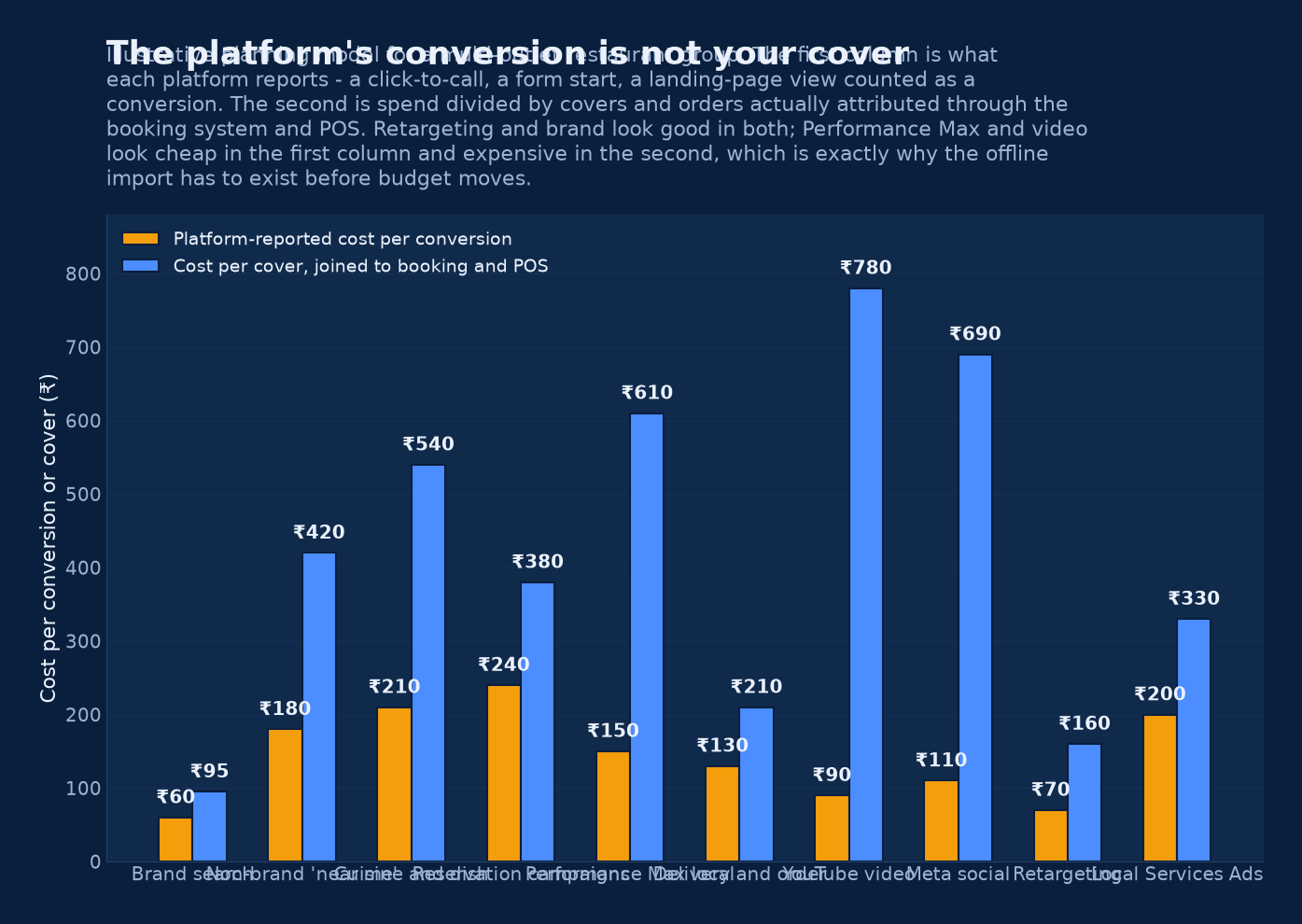
Chart values are an illustrative planning model based on typical UMC engagements and published industry benchmarks. They are not a guarantee of results on any specific project.
| Report | Question it answers | Cut | Refresh | Who reads it |
|---|---|---|---|---|
| Cost per cover by outlet | Which outlets convert paid demand into guests? | Outlet, intent, daypart, month | Daily | Outlet and marketing manager |
| Cost per order and contribution | Is own-channel delivery profitable after cost of goods? | Outlet, pincode, campaign | Daily | Marketing and finance |
| Intent performance | Which query intents produce covers rather than clicks? | Intent, city, outlet cluster | Weekly | Marketing lead |
| Landing page performance | Where does the path lose the guest? | Template, step, device | Weekly | Marketing and product |
| Call and message outcomes | How much demand arrives by phone and is it captured? | Outlet, campaign, hour | Weekly | Outlet manager |
| No-show and cancellation rate | Are we buying bookings that do not arrive? | Source, slot, outlet | Weekly | Outlet manager |
| Channel comparison | How does paid compare with organic, aggregator and walk-in? | Channel, outlet, month | Monthly | Leadership |
| Assistance and branded lift | Is awareness work producing demand it does not claim? | Campaign, city, window | Monthly or per campaign | Marketing lead with leadership |
| Capacity versus demand | Are we buying covers an outlet cannot serve? | Outlet, daypart, date | Daily during peaks | Operations |
| Festive and event windows | Did the window pay for itself against a comparable period? | Window, outlet, offer | Per window | Leadership |
| Budget pacing and forecast | Will we overspend or underspend this month? | Campaign, outlet, month | Weekly | Marketing and finance |
| Executive summary | Is paid filling tables profitably? | Group, city, format, month | Monthly | Leadership |
- One model, several renders: the same joined tables feed an outlet manager’s daily view and a leadership pack, which is executive dashboards and reporting built once.
- Paid and organic are not additive in a naive way, and platform self-reporting overstates direct response: marketing mix modelling and attribution with periodic holdouts is how the split is argued rather than assumed.
- Covers, average check and contribution per outlet are pipeline metrics in restaurant clothing: sales and conversion analytics extended from booking to bill.
- The same chain serves the generic discipline’s standards – conversion tracking, quality score, auction insight – which is Google Ads management with a hospitality conversion definition.
Creative and offer discipline for a perishable product
Restaurant creative has one advantage over most categories and one disadvantage. The advantage is that food is inherently desirable on a screen at the right hour. The disadvantage is that the product is perishable in two senses: a dish runs out, and an offer that is always running trains guests to wait for it. Creative therefore has to carry facts – the dish, the price, the outlet, the validity, the bookable slot – and offers have to be time-boxed, honest and withdrawn when the window closes.
| Element | What works | What fails | How it is tested |
|---|---|---|---|
| Dish-led imagery | The actual dish, plated as it arrives, shot for a phone screen | Stock photography or an empty interior | Click-through and completion rate per asset |
| Price transparency | A price or a price band in the ad where it is stable | A price that differs at the outlet | Complaint and abandonment rates |
| Outlet and locality reference | The neighbourhood named in the copy | A city-wide claim for a single outlet | Conversion by radius and locality |
| Daypart matching | Breakfast creative in the morning, dinner creative from six | One always-on creative for every service | Hourly conversion against hourly spend |
| Offer validity | A stated window and outlet list, withdrawn on expiry | A permanent discount that trains waiting | Redemption rate and margin per offer |
| Call to action | Reserve, order, call – one action per ad | Three actions competing in one asset | Action rate per asset variant |
| Video for kitchen and chef stories | Short, sound-off-legible, with a next step | A brand film with no bookable path | View-through and assisted conversions |
| Creator and user content | Real guests, disclosed partnerships, tracked landing pages | Undisclosed promotion or unverified claims | Cost per cover by creator against brand creative |
| Social proof | Rating, review count and a recent quote, accurately | A rating that contradicts the platform | Consistency check against the source |
| Accessibility of creative | Legible at small sizes, subtitled video, honest contrast | Text baked into an image at eight point | A legibility check on real devices |
- Creative production at chain scale needs templates, shot lists and an approval route, which is brand performance and creative production rather than improvisation per outlet.
- Where awareness and demand are bought across surfaces, the plan and the buying should share the intent map: media planning and buying with the landing surfaces specified.
- Food demand is visual and impulse-led, so Meta and Instagram carry discovery while search carries intent – and both need a tracked landing page per campaign.
- Creator work is a measurable channel when the landing pages are tracked and the disclosure is real: influencer marketing management judged on cost per cover, not on reach.
- The copy that supports a campaign has to exist on the page it lands on – dish explainers, occasion guides, festive menus – which is content marketing strategy feeding paid rather than competing with it.
Budget by format and estate type
There is no restaurant budget template, because there is no restaurant. A single fine-dining venue defends a name and wins proximity; a QSR chain buys volume across hundreds of catchments; a cloud kitchen has no brand to defend and lives or dies on delivery economics; a hotel restaurant competed with its own property’s booking channel. The split below is the planning starting point we would defend per format, and the first question in every engagement is which of these the client actually is.
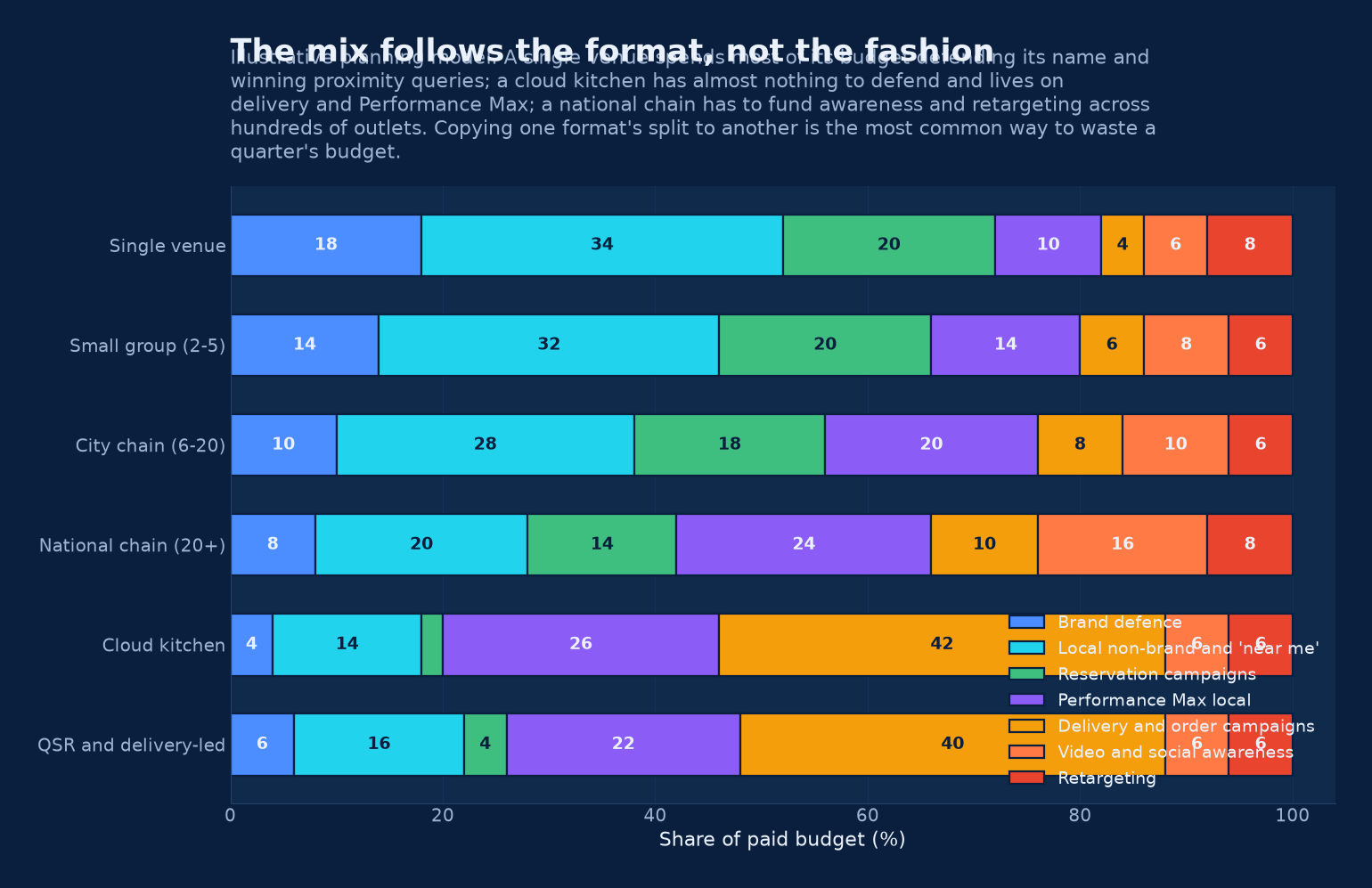
Chart values are an illustrative planning model based on typical UMC engagements and published industry benchmarks. They are not a guarantee of results on any specific project.
| Format | The binding constraint | Where budget goes first | What to refuse to fund |
|---|---|---|---|
| Single fine-dining venue | Capacity and occasion demand | Brand defence, occasion and cuisine intent, retargeting | Volume campaigns for a room with forty seats |
| Casual dining group | Outlet-level catchments and dayparts | Local non-brand per outlet, reservation campaigns, reviews support | One national campaign for twelve different catchments |
| QSR chain | Speed, price perception and location density | Performance Max local, delivery campaigns, daypart scheduling | Long-form storytelling with no offer attached |
| Cloud kitchen | Platform dependence and delivery economics | Own-channel order campaigns, coverage-led local, retargeting | Brand awareness with no order path |
| Cafe and bakery | Daypart fill and repeat visits | Morning and afternoon local campaigns, loyalty-led retargeting | Dinner-intent bids for a venue that closes at eight |
| Hotel or resort restaurant | Property-channel competition and event demand | Non-brand cuisine and occasion intent, event campaigns | Bidding against the property’s own booking channel |
| Franchise network | Owner-level control and brand consistency | A shared structure with scoped local budgets per owner | One central budget that no owner trusts |
| New outlet launch | No reviews, no history, cold catchment | Local non-brand, launch offers, creator and PR support | Expecting organic to carry the first quarter |
- Every paid rupee has to survive a margin test: commission, food cost, delivery cost and discount decide whether an order or a cover was worth buying – cost rationalisation and margin recovery arithmetic applied to a campaign rather than to a cost centre.
- Own-channel ordering also changes when cash arrives – paid at the order rather than settled weekly by a platform – so a channel shift is a working capital decision with a media plan attached.
- Paid cannot outrun the assets that decide the click, so profile hygiene, reviews and outlet pages are funded alongside: search engine optimisation and local profile management are part of the paid budget’s precondition.
- Where answer surfaces increasingly intercept the query before an ad is shown, being quotable is a media cost lever: AI search optimisation reduces dependence on the auction.
- The comparison with other physical-estate verticals is instructive – hotels buy against rate parity and a property page, retail against a catalogue and a cart, showrooms against a test drive – and the discipline of bidding to a joined outcome is identical in all of them.
- A new outlet’s launch budget should be planned with the expansion wave rather than per site: market expansion consulting with a paid launch template per city.
Seasonality, dayparts and the festive calendar
Restaurant demand is not seasonal in the annual sense only – it is seasonal by week, by day and by hour, with festive windows that can double a catchment’s demand in four days. A paid programme that runs flat all year overpays on a Tuesday afternoon and underbids on a Saturday evening. The calendar is therefore a budgeting artefact: daypart schedules, festive windows funded ahead, capacity-aware pausing, and a comparison method that measures a window against the right baseline rather than against the previous month.
| Period | Demand behaviour | Budget action | Measurement |
|---|---|---|---|
| Weekday lunch | Fast, proximity-led, price-aware | Tight radius, daypart schedule, quick-service creative | Covers and average check per outlet |
| Weekday dinner | Smaller, more deliberate, more brand-led | Brand plus occasion intent, retargeting recent visitors | Reservation completions and no-show rate |
| Friday and Saturday evening | Peak capacity, highest competition | Bid up where capacity allows, pause when full | Covers against capacity, turn times |
| Sunday brunch and family | Group demand, occasion-led, longer planning | Family and group creative, set-menu landing pages | Party size and set-menu attachment |
| Late night | Narrow catchment, delivery-weighted | Delivery campaigns with honest windows | Order value and delivery completion |
| Festive windows | Doubled demand, higher competition, offer-sensitive | Fund ahead, cap per outlet, publish offers early | Uplift against the same window last year |
| New year and celebrations | Occasion and private-dining demand | Occasion campaigns with capacity facts | Enquiries converted and event revenue |
| Monsoon and weather events | Delivery spikes, dine-in drops | Shift budget to delivery, pause dine-in where unsafe | Order volume against weather data |
| Lean months | Flat demand, discount pressure | Retargeting and loyalty-led campaigns, protect margin | Repeat rate and contribution per cover |
| Outlet launch | Cold catchment, no reviews | Local non-brand, launch offer, creator and PR support | Covers per week against the ramp plan |
- Demand by daypart and window is predictable, so budget should follow a forecast rather than a habit: predictive analytics and demand forecasting off booking and POS history.
- The lean-month answer is retention rather than discount: lifecycle and retention campaigns and nurture programmes to a consented guest base cost a fraction of acquiring a stranger.
- Those journeys run over email, SMS and WhatsApp from one automation layer with a preference centre, triggered by a visit or an order rather than by a calendar.
- The guest base that retention depends on is built by the CRM – identity across booking, order and visit – which is why paid, CRM and lifecycle are one programme rather than three.
Tracking, consent and the technical estate behind the account
A restaurant paid programme runs on an estate that is usually thinner than it looks: a website on a shared host, a booking widget from a third party, a POS from a vendor, a call-tracking number, a consent banner, and a kitchen printer. Every one of those can break a conversion silently. The technical work is therefore part of the media programme – consent mode configured honestly, tags inventoried and budgeted, uptime monitored, and a rule that any change to the booking widget is tested against the conversion before it ships.
| Component | What can break | Control | How it is verified |
|---|---|---|---|
| Consent mode and tags | Conversions under-reported or over-reported after a consent change | Consent mode configured per region, tags fired only with a basis | A tag audit with consent states tested |
| Conversion pixels and events | A widget update silently removing an event | Synthetic checks on every conversion path | Daily automated booking and order tests |
| Call tracking numbers | A cached page serving an untracked number | Number pool with cache-busting and a per-outlet mapping | Monthly call test per outlet |
| Booking widget | A third-party release changing the flow or the DOM | A staging test before any upgrade, plus a rollback | Release notes reviewed and a test booking made |
| Offline import job | A failed nightly job going unnoticed for a week | Job monitoring with an alert on failure or zero rows | Import log reviewed weekly |
| Site performance | A slow page wasting automated traffic at scale | A page-weight budget and field monitoring | Core Web Vitals per landing template |
| Hosting and peak capacity | A shared host failing on a festive evening | Capacity headroom, caching and a documented restart path | Load testing before peak windows |
| Payment gateway | A timeout losing a paid order | A retry path, a fallback method and error monitoring | Failed-payment rate reported weekly |
| Outlet network and devices | A branch unable to publish or take a booking | Monitored connectivity and managed devices | Uptime per outlet |
| Security and access | A compromised ad account or CMS | MFA, named accounts, least privilege, logged changes | Access review quarterly |
| Backup and recovery | A site rebuild taking days during a festive week | Backups with timed restore tests | Restore evidence per quarter |
| Cost and licence drift | Tag, tracking and platform costs growing quietly | A subscription register with an owner per tool | Monthly cost review per outlet |
- Infrastructure and peak capacity are a cloud question with a hospitality calendar: cloud services sized for a Saturday evening, not for average traffic.
- Tracking, tag and platform costs drift upward with outlet count, which is cloud cost optimisation applied to a marketing stack.
- Publishing and booking happen from an outlet back office, so connectivity and network health are part of the conversion path: network engineering and managed IT services covering the outlets, not only the head office.
- A chain-wide tracking build is real engineering effort, and IT staff augmentation is often how a small internal team ships it across forty outlets without hiring for a peak.
- Ad accounts, tracking credentials and the CMS are high-value targets: security controls with MFA and access review, plus backup and disaster recovery with tested restores, because a site down on a festive evening loses covers no ranking can replace.
- Everything above needs ordinary maintenance – patches, dependency updates, form and webhook monitoring – which is web application maintenance with a named owner.
- The generic discipline’s standards apply unchanged: website development for high-performance digital growth is the surface every rupee of media lands on.
Governance: who may change a budget, and who decides an offer
In a multi-outlet estate the fastest way to waste a paid budget is to leave it ambiguous. If an outlet manager can raise a bid during a service, or a marketing executive can publish an offer the kitchen has not costed, the account becomes a record of local improvisation. Governance is a short document: who owns the account, who may change a budget and within what limit, how an offer is approved and withdrawn, what happens in an emergency, and how a decision is recorded so it can be reviewed.
| Decision | Held centrally | Held at the outlet | Approval route | Evidence |
|---|---|---|---|---|
| Account structure and naming | Set once, changed by request | None | Marketing lead approves structural changes | Change log per campaign |
| Budget by outlet and intent | Allocated monthly against capacity and forecast | May request a shift within a stated limit | Marketing lead above the limit | Budget register with dates |
| Bids and targets | Automated strategies with a target cost per cover | None directly | Marketing lead, with operations informed | Strategy change log |
| Offers and promotions | Group offers, terms and validity | Local offers within a margin band | Finance or marketing approval before publishing | Offer register with margin calculation |
| Creative and claims | Templates, tone and claim rules | Local photography and stories within the template | Marketing approves any published claim | Creative approval log |
| Daypart and capacity pausing | Rules set centrally | May pause an outlet at capacity | Notification rather than approval | Pause log with reason and duration |
| Landing page changes | Templates and conversion paths | Local facts: hours, menu, availability | Central review for template changes | Release record with conversion test |
| Review and complaint response | Policy, tone and escalation rules | The actual response, by the outlet | Escalation within twenty-four hours for negatives | Response time and escalation log |
| Emergency and incidents | Holding language and the escalation path | Immediate pause where an outlet cannot serve | Leadership informed on any reputational incident | Incident record |
| Reporting and review | Definitions, cadence and the model | Outlet commentary and context | A monthly review with operations present | Minutes and actions with owners |
- In a group with several formats and cities, the boundary between central and outlet control is a leadership decision that has to be written down once: unified top-level management setting it, marketing and operations working inside it.
- Where AI begins adjusting bids, drafting ad copy or answering guest messages, the same governance applies to the machine: a readiness assessment first, then AI governance, risk and compliance over what may change without a person.
- Governance is only real if it is auditable – a change log, an approval record and a monthly review produce evidence, in the same spirit as an compliance audit of the estate.
- When something breaks during service, the question is who answers: helpdesk and end-user support with an out-of-hours route is part of the media programme’s operating model.
The ninety-day restaurant Google Ads programme, and what we need from you
The programme below is the shape we run for a restaurant, a cafe group or a multi-outlet chain: three weeks to audit the account and agree the conversion definition, tracking and offline imports built from week one because every bidding decision inherits them, architecture rebuilt by outlet and intent from week three, local and near-me campaigns from week six, Performance Max and delivery campaigns from week eight once conversion data is clean, creative and offer testing from week ten, and measurement, governance and handover at the end.
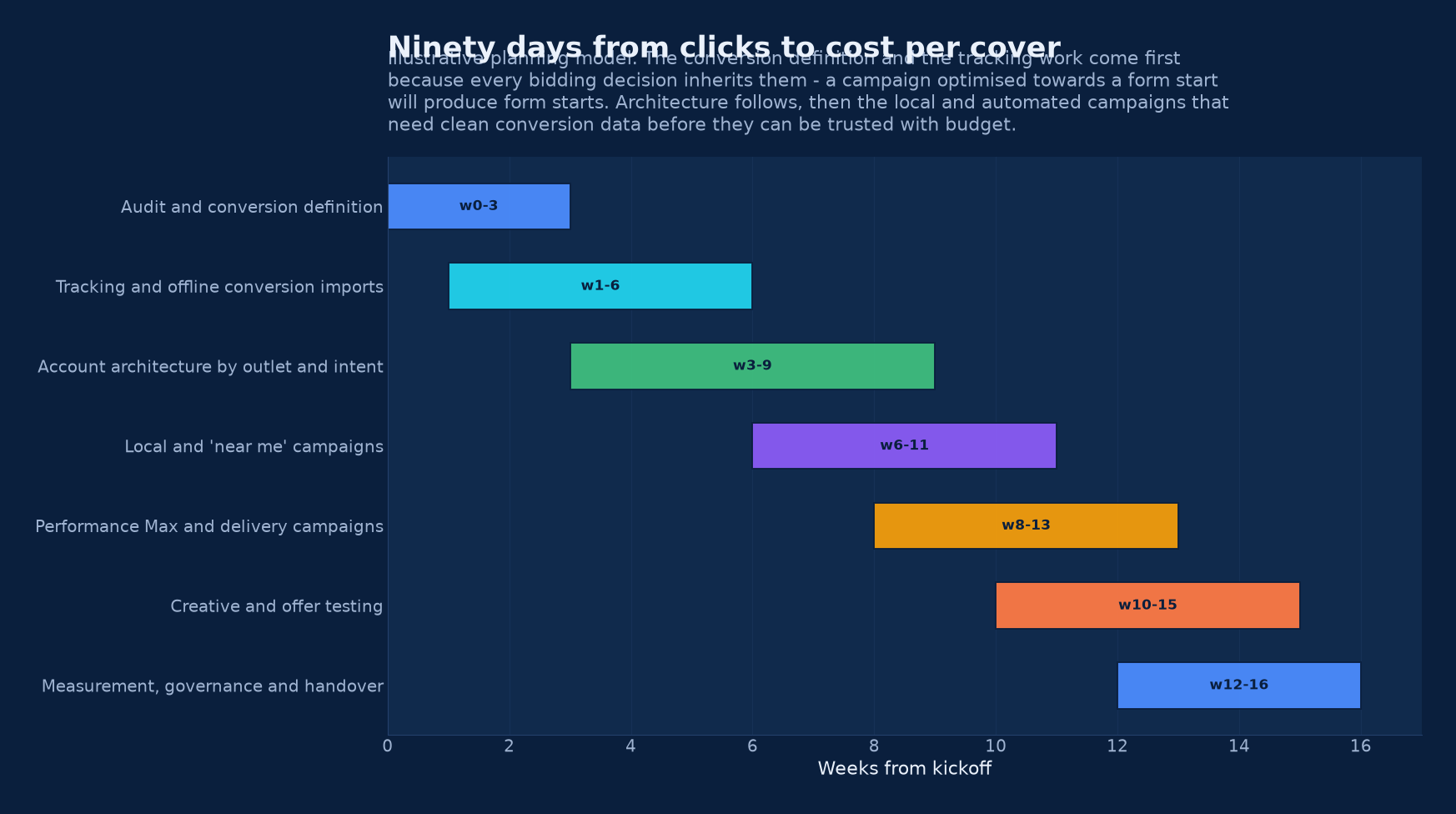
Chart values are an illustrative planning model based on typical UMC engagements and published industry benchmarks. They are not a guarantee of results on any specific project.
| Weeks | Workstream | Deliverable | Decision it enables |
|---|---|---|---|
| Zero to three | Audit and conversion definition | Account and tracking audit, a written conversion definition with values, baseline cost per cover, intent map alignment | What the account will optimise towards and what it will stop buying |
| One to six | Tracking and offline conversion imports | Consent-mode configuration, conversion events on every path, call and WhatsApp tracking, the daily import from booking and POS | Whether bidding can see covers rather than clicks |
| Three to nine | Account architecture by outlet and intent | Brand, local non-brand, cuisine, occasion, reservation, delivery and retargeting layers scoped per outlet or cluster | Which outlet and intent each rupee serves |
| Six to eleven | Local and ‘near me’ campaigns | Catchment radii with overlap rules, daypart schedules, location and call assets, exclusions, Local Services Ads where supported | Whether the paid radius matches the real catchment |
| Eight to thirteen | Performance Max and delivery campaigns | Asset groups per cluster, brand exclusions, local goals, menu and dish assets, coverage-led order campaigns | Whether automation is buying covers or impressions |
| Ten to fifteen | Creative and offer testing | Dish-led creative per daypart, offer tests with validity, creator and video assets, a test register | What creative and offer to scale, and what to stop |
| Twelve to sixteen | Measurement, governance and handover | Cost-per-cover reporting by outlet and intent, channel comparison including aggregators, the governance document, training | Who runs it, on what rules, and how it is reviewed |
- What we need: ad account and analytics access, booking system and POS access with a technical contact, the outlet list with true hours, capacity and delivery coverage, twelve months of spend and covers history, existing creative assets, and one decision-maker who will sign off the conversion definition.
- What you keep regardless: the conversion definition and values, the account architecture, the tracking and import pipeline, the catchment and daypart model, the creative test register, the reporting model and the governance document. They are yours.
- What we will tell you plainly in week three: which campaigns are buying clicks that never become covers, which outlets cannot be advertised until their hours and menus are true, and where the constraint is tracking rather than bidding – almost always the tracking.
Restaurant Google Ads by city, and worked examples
Restaurant paid search is local by construction: catchment and language decide the radius and the copy, the festive calendar decides the budget rhythm, delivery coverage decides which order queries may be answered honestly, and outlet density decides whether campaigns are built per site or per cluster. The engagements below are hospitality, food-service and multi-outlet projects where paid, tracking and measurement were built as one programme.
- Get more restaurant customers in Lucknow
- Digital marketing company for restaurants in Lucknow
- Website development company for restaurants in Lucknow
- Services across Indian cities
- Case study: The Fern hotel, Hyderabad
- Case study: Marriott hotel, Hyderabad
- Case study: WordPress development for a green hotel and resort
- Case study: social media advertising for a green hotel and resort
- The restaurants and food service industry hub – all eight disciplines
- Hotels and hospitality: booking-led paid search and rate parity
- Retail and e-commerce: shopping, Performance Max and retail media
- Showrooms and dealerships: lead generation and local inventory ads
- All industry verticals we build programmes for
- All digital marketing services
- All technology services
- All business consulting services
- About Unified Management Consulting
- Contact us about Google Ads for restaurants
Where this page sits in our restaurants programme
Google Ads is the third discipline of our restaurants and food service programme. The hub page explains how the eight disciplines fit together, each discipline has its own page as it is published, and the generic service page for every discipline stays listed below alongside the vertical pages. A discipline that is not listed is not published yet – the list is generated from live pages and refreshes automatically as each spoke lands.
- Restaurants – the vertical main page
- Website development for restaurants
- SEO for restaurants
- Social media marketing for restaurants
- Guest CRM, reservations and loyalty for restaurants
- Business intelligence for restaurants
- IT support for restaurants
- AI for restaurants
- Website development services – the generic service page
- SEO services – the generic service page
- Social media management – the generic service page
- Custom CRM development and integration – the generic service page
- BI dashboards and executive reporting – the generic service page
- Managed IT infrastructure and AMC – the generic service page
- AI agent deployment and automation – the generic service page
Frequently asked questions about Google Ads for restaurants
What should a restaurant count as a conversion?
A completed reservation, a paid own-channel order, a connected call over an agreed duration, or a WhatsApp conversation that reached a booking – each with a value based on expected covers and average check. Landing-page views, menu downloads and widget starts are diagnostics, not targets, and an account optimised towards them will produce plenty of them.
How much should a restaurant spend on Google Ads?
Enough to exit learning on the campaigns that matter, bounded by the covers an outlet can serve. As a planning rule, budget follows capacity and daypart rather than ambition: a forty-seat venue does not need a national campaign, and a QSR chain with two hundred catchments needs a per-cluster structure. We size it after the audit, against cost per cover.
Does Performance Max work for restaurants?
It works when it is given real conversion values, outlet-level asset groups, brand exclusions and local goals – and it wastes money when it is given a landing-page view as a goal and a national asset group. Fund it after the offline import is running, and reconcile what it reports against what arrived at the outlet every month.
Why is our cost per click rising but our covers flat?
Usually one of four things: the landing page cannot complete a booking, the radius is wider than the real catchment, the conversion being optimised is a proxy rather than a cover, or reviews and profile quality have fallen so the click does not convert. All four are diagnosable in a week.
Should we bid on competitor restaurant names?
Only with a margin calculation. Competitor terms are expensive, convert poorly and can damage a brand if the landing page overreaches. Brand defence – making sure your own name is not won by an aggregator – is nearly always the better first spend.
How do we track reservations that happen by phone?
With call tracking per outlet, a duration threshold, and an outcome code recorded by whoever answers – booked, enquired, wrong number, supplier. Then import the booked outcome as a conversion. Without the outcome code, calls are counted but never valued.
Can we advertise delivery honestly?
Yes, by targeting only the pincodes an outlet actually serves, checking coverage before the menu rather than after the basket, and stating the delivery window and fee in the ad and on the page. A campaign that promises a city it cannot deliver to produces refunds and bad reviews.
How do we stop paying for a full restaurant?
With capacity-aware scheduling: daypart schedules matched to service hours, a pause rule when an outlet is full, and a booking system that stops offering slots it cannot honour. Paid demand that arrives at a full room costs money and a review.
What about festive windows – should we bid more?
Bid more where capacity exists and publish offers early, with a stated validity and an outlet list. Measure the window against the same window last year rather than against the previous month, and cap spend per outlet so one night cannot consume the month.
How do we compare Google Ads with delivery aggregators?
On contribution, not on order count. Aggregator orders carry commission, a platform-owned guest and no repeat data; own-channel orders carry payment processing, a guest record and loyalty. Report both per outlet with cost of goods and delivery included, and shift budget towards whichever earns.
Do we need offline conversion imports if we are small?
A single venue can start with booking-system conversions and connected-call tracking, which captures most of the value. As soon as there are several outlets, dayparts and a no-show problem worth solving, the import becomes the difference between optimising towards clicks and towards covers.
What does restaurant Google Ads management cost?
It scales with outlet count, the state of the tracking estate, whether offline imports and a warehouse join are needed, and the creative volume required. A single venue is a focused engagement; a national chain is an account architecture and governance programme with engineering in it. We quote after the audit, so the price reflects the measurement reality rather than a percentage of spend alone.
Start with the conversion definition and the tracking audit
Give us three weeks with ad account and analytics access, booking system and POS access with a technical contact, the outlet list with true hours, capacity and delivery coverage, twelve months of spend and covers history, your existing creative assets, and one decision-maker who will sign off the conversion definition, and we will return a written conversion definition with a value per action, a tracking and consent audit naming every path that silently under-reports, an account architecture scoped by outlet and intent, a catchment and daypart model with overlap rules, an offline import design that teaches the auction what a cover is, a Performance Max control set with brand exclusions and local goals, a creative and offer test plan, and a reporting model that ends at cost per cover and contribution per outlet – including which campaigns we would stop in week one. Yours to keep either way.
Contact Unified Management Consulting to arrange a confidential first conversation.