
Restaurant social is the closest thing food service has to a shop window that is open all night. It is where a guest decides that a place looks like somewhere they would like to be, where a dish becomes a reason to travel across a city, and – less romantically – where a comment asking ‘is this open on Monday’ either becomes a reservation or becomes somebody else’s customer.
That last part is what most programmes miss. In food service the inbox is a reservation desk, and the response time is the conversion rate. So the work is not only content: it is a production engine an outlet team can sustain, a DM and WhatsApp flow that reaches a bookable slot, a creator programme measured in covers rather than reach, and a review routine per outlet. That is organic social management operated as a commercial channel, with Meta and Instagram advertising amplifying what has already proven itself.
What an engagement includes, at a glance
| Component | What We Deliver |
|---|---|
| Platform choice with a reason per platform | Where your guests actually decide – usually Instagram for discovery, WhatsApp for booking, YouTube for kitchen and chef stories, Facebook for local reach and older cohorts – and what you will deliberately not do. |
| Content pillars and a production engine | Food and dish, chef and kitchen, outlet and space, guest content, offers and events, team, sourcing – each with a job, a measure, a shot list and a template, at a cadence the business can sustain. |
| Outlet-level content in a multi-outlet estate | What is produced centrally and what an outlet supplies, scoped editing rights, a template kit, and training that makes the branch want to participate. |
| Comments, DMs and WhatsApp as a reservation channel | A shared inbox with a response target, a triage tree, a booking path, outcome codes and a record in the guest system – not a personal phone. |
| Creators, food bloggers and guest content | Briefs that survive a creator’s voice, disclosure, usage rights, tracked landing pages and contribution per creator rather than follower count. |
| Reviews and reputation as social proof | A generation routine per outlet, a response workflow with a target, complaint escalation, and a policy that never filters or incentivises dishonestly. |
| Paid amplification by funnel stage | Boosting what already works, retargeting by stage, offer campaigns with validity, and a clear line between discovery spend and demand spend. |
| Claims, rights and reputational governance | Food and allergen claims, pricing and offer accuracy, customer and employee images, music licensing, and a complaints path that takes a dispute offline within minutes. |
| Measurement joined to covers | Enquiries, bookings and orders attributed from social, assisted contribution, cost per cover by platform and outlet, and a report an operations manager will read. |
What restaurant social is actually for
Three jobs, in order of value: discovery – a guest who did not know you now does; trust – a guest who is deciding believes the place is good and honest; and conversion – a guest who wants to come can book in the same session, on the same device, without a phone call to a number nobody answers. Most programmes do the first job well, the second job accidentally and the third job not at all, which is why they are funded as brand activity and cut as marketing spend.
| The job | What it looks like when done | What it looks like when not | How it is measured |
|---|---|---|---|
| Discovery | A dish, an outlet or a chef reaching people within the catchment who would consider it | Followers in cities you do not serve | Reach within catchment, saves, profile visits, branded search lift |
| Trust | Consistent evidence: real food, real space, real guests, answered questions | Stock imagery, unanswered complaints, a rating nobody can reconcile | Sentiment, response rate, review trend, repeat-visit share |
| Conversion | A bookable or orderable path from the post, with the outlet and hours stated | A ‘DM us’ that becomes a queue nobody reads | Enquiries, bookings and orders attributed per post and platform |
| Retention | A reason for a past guest to return – an occasion, a menu change, a remembered preference | The same offer broadcast to strangers and regulars alike | Repeat rate, win-back response, loyalty signups |
| Recruitment and culture | A team people want to work for, shown honestly | A feed with no humans in it | Applications per post, staff turnover |
| Crisis and reputation defence | A documented response path, exercised before it is needed | An argument conducted publicly at eleven at night | Time to first response, resolution rate, escalation count |
| Local relevance | Neighbourhood references, local events, community participation | A national tone with no locality in it | Local engagement share, outlet-level follower growth |
| Menu and offer communication | A change communicated before a guest travels | A dish advertised that ran out last week | Complaint rate per offer, offer redemption |
| Feedback and insight | Themes from comments and reviews routed to operations | Comments read only when something goes wrong | Themes raised, actions taken, repeat complaints |
| Partner and stakeholder confidence | A feed that reassures landlords, lenders and franchisors | An abandoned-looking profile during a funding conversation | Qualitative – but it decides deals |
- What a catchment actually responds to – which dishes, which formats, which creators – is evidence rather than taste: market research and competitive analysis on local demand and competitor positioning.
- Whether social should build a brand, fill a daypart or shift guests off aggregators is a strategy decision that sets the programme’s shape: business strategy consulting first, calendar second.
- The pillars are a content strategy with a production constraint, not a list of ideas: content marketing strategy written against what an outlet team can actually shoot in a week.
Platform choice: where your guests decide, and what you will not do
The honest answer for most Indian restaurants is a short list: Instagram for discovery and desire, WhatsApp for the booking conversation, a business profile and review platforms for the trust check, YouTube when there is a kitchen or a chef story worth ten minutes, and Facebook where the cohort and the locality still use it. Everything else is optional. A programme spread across six platforms with one person producing it publishes consistently and converts rarely; a programme on two platforms with a response target converts.
| Platform | The job it does well | What it needs from you | When to skip it |
|---|---|---|---|
| Discovery, desire, menu and outlet evidence, creator amplification | Vertical video, real photography, a story cadence, a DM queue that answers | Never – it is the primary discovery surface for food | |
| The booking conversation, confirmations, reminders, owner communities | A business number with routing, consent, templates and an outcome code | Never – it is usually the highest-converting channel you own | |
| Google Business Profile and reviews | The trust check before the visit, hours and directions | Complete facts, review generation, prompt responses | Never – it decides the click for local intent |
| YouTube | Chef, kitchen, sourcing and format stories with depth | A real story and production capacity, plus a next step in every video | When there is no story and no capacity – a channel with three videos is worse than none |
| Local reach, older and family cohorts, events, community groups | Outlet pages kept accurate, event listings, a comment queue | Rarely, but it can be folded into the Meta buying rather than run as a content channel | |
| Delivery and review platforms | Order intent and social proof you do not own | Accurate menus, photography, ratings and responses | Never – but treat them as channels with commission, not as social |
| Recruitment, expansion announcements, franchise and investor audiences | A low cadence of real business news | For single venues; useful for groups raising capital or expanding | |
| X and others | Complaint visibility and press | Monitoring rather than publishing | As a publishing channel for most restaurants |
| Owner communities and broadcast lists | Repeat visits, early access, event fills | Consent, a reason to stay and restraint on frequency | Never, once there is a guest base worth keeping |
| Out-of-home and in-venue QR surfaces | Turning a visit into a follow, a review or a signup | A QR that lands somewhere useful, not a homepage | When the destination is a page nobody needs |
- Kitchen and chef stories are the one format where length earns attention, which makes YouTube and video advertising worth funding only when there is a story and a person behind it.
- Every platform is a phone, and food content is judged in a second on a small screen: mobile experience is the design constraint for creative as much as for the booking path.
- Templates, tap targets and legibility are design decisions with a conversion consequence: UX and UI design applied to a 1080-pixel canvas and a story frame.
Content pillars and the production engine behind them
A pillar is a repeatable reason to post with a job attached, and an engine is what makes the pillar survive contact with a service. For a restaurant the engine is small and specific: a shot list per service, a template kit, a same-day editing route for content that expires, a named approver for anything carrying a price or a claim, and a four-week rolling calendar with owners. Without it, a programme produces a burst of beautiful content in month one and silence in month three.
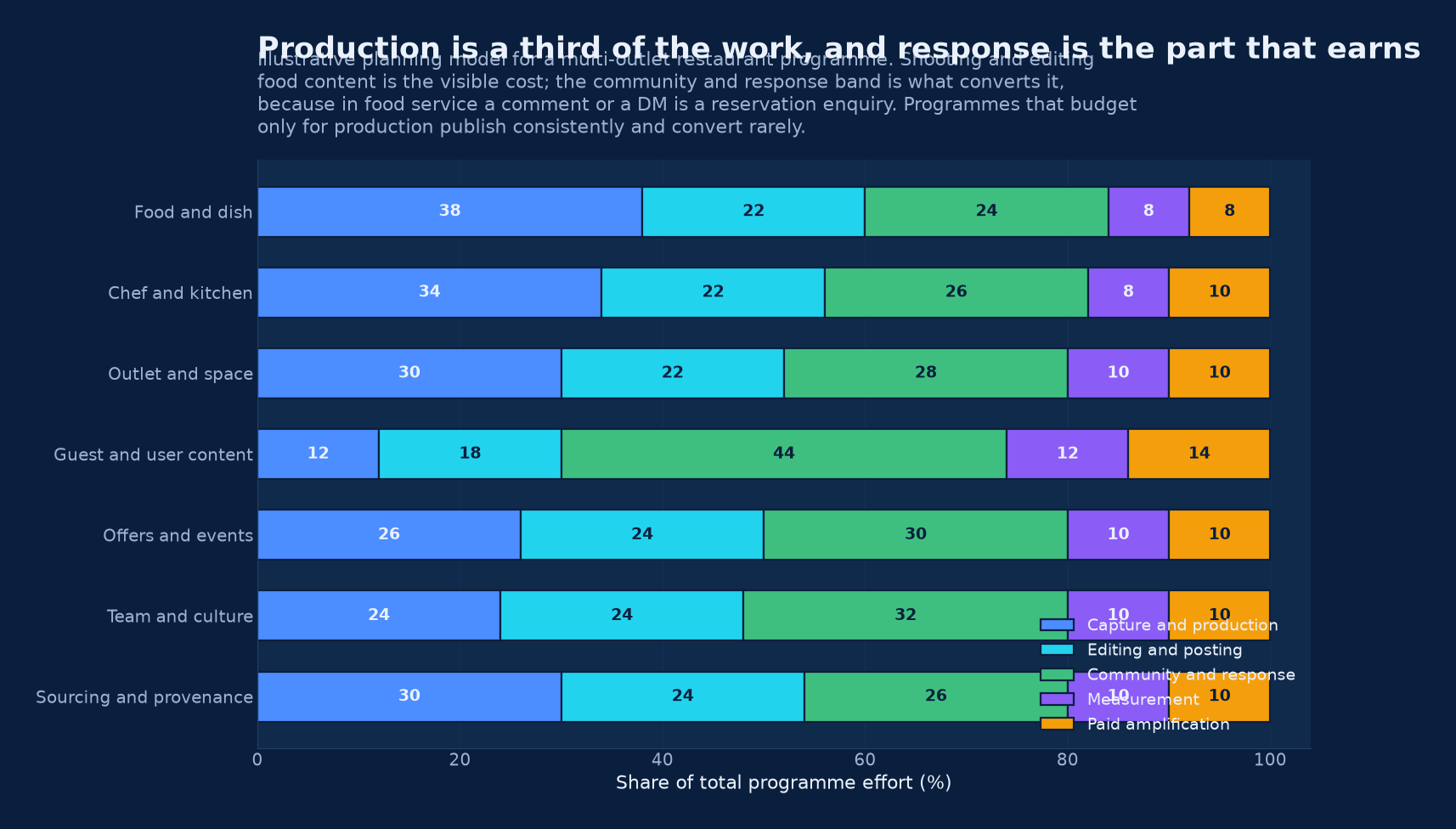
Chart values are an illustrative planning model based on typical UMC engagements and published industry benchmarks. They are not a guarantee of results on any specific project.
| Pillar | The job it does | Cadence that works | Production requirement | Measure |
|---|---|---|---|---|
| Food and dish | Desire and menu education | Three to five per week | Plated as served, natural light, a phone is enough with a shot list | Saves, shares, dish-page visits, enquiries naming the dish |
| Outlet and space | The ‘what will it be like’ question | One to two per week | Real interior at guest height, at service time, not empty and staged | Profile visits, direction requests, bookings from the outlet page |
| Chef and kitchen | Trust, craft and differentiation | Two per month plus stories | A person with a name and a point of view; sound-off-legible video | Watch time, branded search lift, press and creator interest |
| Guest and user content | Social proof at scale | Two to four per week where consent exists | A repost route, a credit rule and a thank-you habit | Repost engagement, review correlation, tagged content volume |
| Offers and events | A reason to come this week | Per window, published ahead | Validity, outlet list and terms stated in the creative | Redemptions per outlet, cost per cover on the window |
| Team and culture | Recruitment and humanity | One to two per month | Consent from staff, no forced fun | Applications, staff sentiment, engagement quality |
| Sourcing and provenance | Differentiation and trust for premium formats | One per month | Named suppliers and verifiable claims | Sentiment, press, premium menu attachment |
| Seasonal and festive | Calendar demand | Per festival, planned a month ahead | Menu facts, hours changes and outlet participation | Uplift against the same window last year |
| Neighbourhood and local | Local relevance and community | Two per month per outlet cluster | Real local references, not stock city imagery | Local engagement share, outlet follower growth |
| Service recovery and answers | Turning a complaint into evidence of fairness | As needed, publicly and briefly | A holding line, an offline route, a resolution update | Time to first response, resolution rate |
- A chain producing content for forty outlets needs templates, shot lists and an approval route – which is brand performance and creative production operated as a service rather than as improvisation.
- The pillar set has to be written against real capacity, and the copy that supports it on the website – dish explainers, occasion guides – is content marketing strategy with the same facts.
- Where production is the bottleneck rather than ideas, adding hands beats adding platforms: IT and creative staff augmentation for a launch or a festive window.
- Every post that carries a bookable claim has to land on a page that works, which makes the sibling discipline a dependency: website development for restaurants and the generic website development standards behind it.
The weekly engine: what a sustainable cadence actually looks like
The cadence question is usually asked as ‘how often should we post’ and answered with a number nobody can sustain. The better question is what the week contains: two services worth of capture, one edit block, one approval pass, a daily response window, and a monthly review of what worked. Written as a week with owners, the calendar stops being an aspiration and becomes a rota – which is the only form of consistency a restaurant can maintain.
| Day | What happens | Who owns it | Output | What breaks if it is skipped |
|---|---|---|---|---|
| Monday | Review last week’s numbers; set this week’s three priorities | Marketing lead | A one-page plan with owners | Content produced without a purpose |
| Tuesday | Capture block: dishes, space, team at a quiet service | Outlet content owner | A labelled asset batch per outlet | Nothing to edit later in the week |
| Wednesday | Edit and template pass; captions and claims checked | Marketing or an editor | A ready queue with scheduled slots | Rushed posts with unverified claims |
| Thursday | Approval: prices, offers, allergens, claims | Named approver | A signed-off queue | A wrong price or an unhonoured offer in public |
| Friday | Publish ahead of the weekend; stories and offers live | Marketing | Weekend content live before demand peaks | The busiest days with the least content |
| Daily | Response window: comments, DMs, reviews, mentions – twice a day minimum | Social inbox owner | Responses inside the target, bookings created | Enquiries lost and complaints escalated publicly |
| Saturday and Sunday | Live capture at service; story coverage; response rota | Outlet team on rota | Real-time content and answered messages | The highest-demand days with nobody watching the inbox |
| Month end | Pillar review: what produced bookings, what produced only likes | Marketing lead with operations | A revised pillar weighting for next month | The same mix repeated regardless of results |
| Quarterly | Template, shot list and rights review | Marketing with legal or compliance | Updated templates and a rights register | Stale formats and unmanaged usage rights |
| Per window | Festive and event plan published ahead | Marketing | Offers with validity and outlet lists | A festival met with generic content |
- The daily response window is the part that converts, and it needs the same discipline as a support queue – a rota, a target and an outcome code: helpdesk and end-user support practice applied to an inbox.
- Scheduling, approval and publishing across outlets is a workflow with permissions, which is what organic social management tooling should be chosen for rather than for its analytics.
- Automated reminders and confirmations belong in one layer with consent checked before each send: marketing automation rather than three tools with three lists.
Outlet-level content in a multi-outlet estate
A chain’s social problem is not creative; it is that the moments happen in outlets and the standards live in head office. The division of labour that works is explicit: head office holds the templates, the claims rules, the approval route and the calendar; outlets supply the moments – a plated dish, a busy service, a new joiner, a local event – captured to a shot list on a phone. Everything in between is a permission and a training question.
| Element | Held centrally | Held at the outlet | Why the split matters |
|---|---|---|---|
| Templates and formats | Story templates, post layouts, offer cards, caption structures | Local content inside the template | Consistency without stifling local character |
| Shot list | Five shots per moment: dish, space, team, guest, detail | The actual capture at service | Staff photograph what is nearest without a list |
| Claims and pricing | Approved language, price and allergen rules | Nothing – an outlet never publishes a price alone | A wrong price is a public commitment the outlet cannot honour |
| Approval route | A named approver per content type | Submission with context | Speed with accountability |
| Publishing rights | Group accounts and brand campaigns | Outlet accounts or tags, within the template | Local relevance without brand drift |
| Response ownership | Policy, tone and escalation rules | The actual reply, by the outlet that knows the guest | A generic reply to a specific complaint makes it worse |
| Photography standards | Light, framing, no number plates, consent rules | Capture and upload to the shared library | Usable assets instead of a folder of unfiled images |
| Rights and consent | A register and a consent form | Capturing consent at the moment | A takedown request with no record of consent |
| Training | A one-hour induction and a quarterly refresher | A named content owner per outlet | Participation rather than compliance |
| Measurement | One model across outlets | Outlet-level view of their own numbers | Comparison that is fair and actionable |
- Who may publish what is a governance decision that has to be taken at group level and written down: unified top-level management setting the boundary, marketing and outlets operating inside it.
- Opening an outlet should include a social launch checklist – handles, photography, opening offers, creator invitations – so a new site does not start from zero: market expansion consulting with the launch on the critical path.
- For most chains the practical publishing surface is a WordPress estate with a shared asset library and scoped rights: full-stack WordPress development gives outlets a place to submit and marketing a place to approve.
- The library, the templates and the schedules need ordinary maintenance – broken links, expired assets, platform API changes – which is web application maintenance with a named owner.
Comments, DMs and WhatsApp: the reservation desk nobody staffed
A restaurant’s social inbox is a sales channel with no rota. Messages arrive at midnight asking whether there is a table for eight on Saturday, whether the kitchen is Jain-friendly, whether delivery reaches a pincode – and in most estates they are answered the next afternoon by whoever remembers. The fix is unromantic: a shared inbox on a business number, a response target, a triage tree, a booking path, an outcome code, and a record written to the guest system so the enquiry is not lost when the shift ends.
| Message type | Response target | The answer that converts | Where it is recorded | Escalation |
|---|---|---|---|---|
| Table availability | Fifteen minutes in trading hours | Yes or no with a bookable slot link, not ‘please call’ | Booking record with a social source | Large parties to the events coordinator |
| Menu and price questions | Thirty minutes | The dish, the price and where it is served | Conversation log with an outcome code | Anything requiring a claim check to marketing |
| Allergen and dietary questions | Fifteen minutes, with care | Accurate flags plus a cross-contamination statement | Conversation log, flagged for the kitchen | Always to the chef, never guessed |
| Delivery coverage | Thirty minutes | Pincode check with an honest window and fee | Order record or a coverage note | Repeated gaps to operations |
| Booking for an occasion | Fifteen minutes | A slot, a set menu option and a deposit route | Booking with an occasion note | Private dining to the coordinator |
| Complaint | Ten minutes, then offline | Acknowledge publicly, take it offline, own it, resolve it, then update briefly | Complaint log with resolution and time | Outlet manager immediately, leadership if reputational |
| Praise | Same day | A human thank-you, and a review request where consent exists | Guest record, with permission noted | None |
| Creator or press enquiry | Two hours | A named contact and a brief, not a form | Partnership log | Marketing lead |
| Supplier or sales spam | None – filtered | A filter rule rather than a reply | Filtered queue reviewed weekly | None |
| Out-of-hours demand | Captured instantly, answered next morning | An assistant that captures and offers a callback | Enquiry record with a morning task | On-call manager for anything urgent |
- Business messaging has to run on a managed number with routing, consent and retention rather than on a personal phone: WhatsApp marketing services plus SMS as the fallback for confirmations.
- Every conversation that becomes a booking has to land in the guest record with a source, or the channel cannot be measured or repeated: a CRM with social as a capture route.
- The routing between inbox, booking system and guest record is an integration, not a habit: systems integration with retries and an audit log.
- Out-of-hours demand is nightly and real, so an assistant that captures, quotes opening hours and books a morning callback pays for itself: AI agents and automation with a human handoff and a logged outcome.
Creators, food bloggers and guest content
Food is the most creator-saturated category in Indian social, which is both an opportunity and a trap. The opportunity is that a trusted local creator can fill a new outlet’s first month better than any media buy. The trap is that most creator spend is measured in reach and impressions, so nobody knows whether it produced covers. The discipline is small: a brief that survives the creator’s voice, disclosure, a usage agreement, a tracked landing page or code, and a contribution figure per creator reviewed against the cost.
| Element | What good looks like | What usually happens | Control |
|---|---|---|---|
| Selection | Local creators whose audience matches the catchment and the format | The largest follower count available | Audience geography and engagement checked before briefing |
| Brief | Facts and constraints, not a script: dish, outlet, hours, offer, claims to avoid | A script that reads as an advert | A one-page brief with an approval step on claims |
| Disclosure | Paid partnership labelled per platform rules | Undisclosed promotion | Disclosure clause in the agreement, checked before publishing |
| Usage rights | Window, territory and surfaces stated, with a fee for extension | Content reused forever because nobody said otherwise | A signed usage schedule per asset |
| Tracking | A landing page, a code or a reserved slot per creator | ‘Mentioned the brand’ as the only evidence | Cost per cover by creator, reported monthly |
| Guest content | A repost route with credit and consent | Reposting without asking | A permission habit and a credit rule |
| Photography at the table | Guests photographing food is free marketing | A policy that annoys guests or blocks them | A house rule that welcomes it and protects other guests |
| Media and music rights | Licensed or platform-cleared audio for business accounts | Trending audio on a commercial account | A rights register per asset |
| Long-term partnerships | A small set of creators who know the menu and the outlets | A different creator every month | A quarterly review of contribution per creator |
| Amplification | Whitelisting or partnership ads on what already performed | Boosting everything equally | Paid spend follows organic proof |
- Creator programmes are a measurable channel with contracts and codes: influencer marketing management judged on contribution per creator rather than on reach.
- Where creator work is amplified with media budget across surfaces, the plan and the buying should share the intent map: media planning and buying with tracked landing pages.
- Kitchen and chef stories are the format where a creator or a brand film earns its length: YouTube and video production with a next step in the description and the end card.
- Amplification happens on Meta and Instagram where the proof already exists, so the organic test precedes the paid spend rather than replacing it.
Reviews: the social proof that decides the click
Before a guest books from a social post, they check the rating. That makes review generation a social discipline rather than a separate reputation project: the ask comes at the moment of satisfaction, through the channel the guest used, with one tap to the right platform, and every review is answered by the outlet that served them. The rules that keep it lawful and credible are absolute – never filter by sentiment, never pay for a rating, never ask only happy tables.
| Element | What good looks like | Failure mode | Measure |
|---|---|---|---|
| Ask timing | At the table after the meal, or on delivery completion | A batch email three days later | Ask rate per outlet per service |
| Ask channel | A QR code or a message with one tap to the platform | A printed card with a long URL | Conversion from ask to review |
| Velocity per outlet | A stated minimum per month, tracked per outlet | Group-level reviews hiding a weak outlet | Reviews per outlet per month |
| Response rate | Every review answered, negative ones within twenty-four hours | Positive answered, complaints ignored | Response rate and median response time |
| Response quality | Specific, human, no visible template | The same thank-you copied on every review | Sampled review of responses |
| Complaint handling | Offline resolution, then a brief public update | A public argument | Resolution rate and time to resolution |
| Theme extraction | Repeated themes routed to operations monthly | Reviews read only in a crisis | Themes raised and actions taken |
| Consistency of facts | Hours, menu and address identical on every platform | A platform showing last year’s hours | Quarterly consistency check |
| Policy | No incentivised, filtered or fabricated reviews, written down | A discount for five stars | Policy acknowledgement and a spot audit |
| Aggregation on site | Outlet-level rating shown with a link to the source | A group average that misrepresents an outlet | Markup validity and currency |
- Reviews are local search assets as much as social ones – velocity and response rate feed the map pack: local SEO and Google Business Profile management with the review engine inside it.
- The sibling discipline owns the profile and citation programme that reviews sit on: SEO for restaurants and the outlet pages that a reviewer’s click lands on.
- The ask and the follow-up are consented messaging triggered by a visit or an order: lifecycle campaigns with a preference centre, not a blast list.
Paid amplification by funnel stage
Organic social produces proof; paid social produces scale. The sequence matters more than the budget: amplify what already performed, retarget people who reached a menu or a booking and did not finish, run offer campaigns with a validity inside a catchment, and keep a separate discovery budget for a launch or a new outlet with an honest expectation attached. What does not work is a permanent boosted-post habit aimed at ‘engagement’, which buys cheap interactions from people who will never visit.
| Stage | Objective worth buying | Audience | Creative requirement | Measure |
|---|---|---|---|---|
| Discovery at launch | Reach and video views inside the catchment | Radius plus interest and lookalikes from actual guests | The outlet, the dish and a date – a reason to come now | Branded search lift, profile visits, assisted bookings |
| Consideration | Traffic to menu, outlet and occasion pages | Engagers, video viewers, site visitors by page depth | Real food, real space, price where it is stable | Menu and outlet page sessions, saves |
| Intent | Reservation and order campaigns with a booking path | Menu viewers, booking abandoners, past guests where consented | A slot, an outlet, an offer with validity | Cost per cover and per order by outlet |
| Local proximity | Local goals and store-visit optimisation where supported | Radius per outlet with overlap rules | Hours, distance, a call or direction action | Visits, calls, direction requests |
| Retargeting sequences | Stage-specific return visits with frequency caps | Sequenced by funnel stage | A new hook per step, never the same creative repeated | Booking rate per step |
| Guest retention | Occasion and win-back campaigns to a consented base | Past guests by recency and preference | A reason to return, not a discount by default | Repeat rate and cost per repeat cover |
| Festive windows | Offer campaigns dayparted to service hours | Catchment plus warm audiences | Offer, validity, outlet list, hours changes | Uplift against the same window last year |
| Delivery and own-channel orders | Order campaigns scoped to coverage | Pincodes actually served | Honest window, fee, minimum, dish imagery | Contribution per order after delivery cost |
| Creator amplification | Partnership ads on creator content that already performed | Creator audience plus your retargeting lists | Disclosure retained, the creator’s voice intact | Cost per cover by creator versus brand creative |
| What to stop | Always-on engagement objectives, national reach for a local outlet | Broad audiences with no catchment constraint | Creative with no next step | Interactions that never become enquiries |
- Paid social and paid search share one measurement chain, one landing model and one conversion definition, so they are planned together: the sibling page Google Ads for restaurants sets the cost-per-cover target this section is judged against.
- Automated inventory across surfaces needs the same controls as any other campaign – brand exclusions, outlet-level asset groups, local goals – which is Performance Max management applied to food creative.
- Where the category and market support them, Local Services Ads buy qualified calls rather than clicks, and a call to an outlet is a cover: worth testing alongside Google Ads management.
- Amplified traffic lands on photography-heavy pages, so a slow template wastes the budget at scale: Core Web Vitals budgets per landing template are part of the paid programme.
- Where an order is the objective, the path is commerce – baskets, modifiers, payments, refunds – which is e-commerce development applied to a forty-minute promise.
Offers, events and the festive calendar
Restaurant demand is calendar-driven in a way most categories are not: festivals, weekends, paydays, school holidays, match days, wedding season and the weather. An offer published after the window has opened is decoration. The discipline is a rolling calendar planned a month ahead, with capacity checked before the offer is announced, validity stated in the creative, and a comparison method that measures the window against the same window last year rather than against last month.
| Window | Demand behaviour | What to publish | Capacity check | Measure |
|---|---|---|---|---|
| Festive weeks | Doubled demand, group bookings, offer sensitivity | Festive menu, hours changes, set-menu pricing, a booking path | Sittings, staff and kitchen capacity per outlet | Uplift versus the same window last year |
| Weekends | Peak covers, highest competition | Availability, wait times, a reservation prompt | Pause paid when full | Covers against capacity, turn time |
| Weekday lunch | Fast, proximity-led, price-aware | Set lunch, express service, distance and timing | Kitchen throughput at lunch | Covers and average check per outlet |
| Weekday dinner lull | The hardest fill | An honest offer with a reason – a menu launch, a pairing, a day | Do not discount a night that is already busy | Incremental covers versus the offer cost |
| New year and celebrations | Occasion and private dining demand | Event menus, capacity, deposit policy, a coordinator contact | Events team availability | Enquiries converted and event revenue |
| Monsoon and weather | Delivery spikes, dine-in drops | Delivery windows, comfort food, honest timing | Rider availability and kitchen load | Order volume against weather |
| Menu launches | A reason to return for a regular guest | The dish, the story, the price, the outlets | Ingredient supply and training | Attachment rate of the new dish |
| Outlet openings | A cold catchment with no reviews | Opening dates, soft-launch offers, creator invitations | Staffing and supply before the announcement | Covers per week against the ramp plan |
| Anniversaries and milestones | Loyalty and community | A thank-you, a story, a guest-first offer | None – it is a relationship moment | Engagement quality and repeat visits |
| Lean months | Flat demand, discount pressure | A consented win-back to past guests rather than a public discount | Protect margin before volume | Repeat rate and contribution per cover |
- Window demand is predictable, so offers should be planned against a forecast rather than a habit: predictive analytics and demand forecasting off booking and POS history.
- The lean-month answer is retention, not discount: nurture programmes and occasion messages to a consented guest base cost a fraction of acquiring a stranger.
- Those journeys run over email, SMS and WhatsApp from one automation layer with a preference centre behind it – marketing automation triggered by a visit or an order.
Claims, rights and reputational governance
A restaurant feed publishes prices, offers, allergen implications, images of real guests and claims about sourcing – which makes it a consumer-facing and legal surface rather than a marketing one. The controls are unexciting and they are what allow the channel to move fast: an approval path for anything carrying a price or a health claim, a rights register for every face and every piece of music, a complaints escalation that goes offline within minutes, and a monitoring rule for out-of-hours. None of it slows production once installed.
| Risk | How it arises | Control | Evidence kept |
|---|---|---|---|
| Price and offer claims | A post states a price or offer an outlet cannot honour | Approval by a named owner; validity and outlet list always shown; removal on expiry | Approval log and published-date record |
| Allergen and dietary claims | A dish described as vegan, Jain or gluten-free without verification | Claims only from the verified allergen record; a cross-contamination statement | Allergen record per dish with a review date |
| Health and nutrition claims | An implied benefit without substantiation | Approved language, substantiation on file, no therapeutic claims | Substantiation note per claim |
| Customer images | A guest published without consent | Consent captured before posting; takedown honoured the same day | Consent record per guest and per asset |
| Employee images | Staff featured without an opt-out route | Consent at onboarding, a right to withdraw, no punitive consequence | Employee consent register |
| Music and third-party rights | Trending audio used on a business account | Licensed or platform-cleared audio only | Rights register per asset |
| Creator contracts | Usage beyond the agreed window, territory or surface | Written scope, disclosure, exclusivity and payment terms | Signed contract and usage log |
| Comparative claims | A competitor named or implied unfavourably | Factual, substantiated attributes only; no disparagement | Substantiation note per claim |
| Complaints and disputes | A public argument with an unhappy guest | Offline within minutes, own it, resolve it, then a brief public update | Complaint log with resolution and time |
| Out-of-hours incidents | A negative post spreading overnight | Monitoring with a threshold, an on-call owner, holding language prepared | Incident record and response times |
| Data and privacy | Guest numbers harvested from DMs into a personal phone | Business channels only, consent recorded, retention applied | Access log and a privacy review |
| Food safety implications | Content that suggests a practice the kitchen does not follow | Operations sign-off on any process or kitchen content | Sign-off record per post |
- Governance is auditable work rather than a policy binder: an IT audit and compliance review of consent, retention and access covers the social estate along with the rest.
- Guest data harvested from inboxes is a security exposure as much as a privacy one, so the controls sit with cybersecurity services – managed numbers, access review, logging.
- Where AI drafts captions, answers DMs or summarises reviews, the same rules apply to the machine: a readiness assessment first, then AI governance, risk and compliance over what may be published without a person.
- In a group or franchise structure the boundary between central and outlet publishing has to be written down once: unified top-level management owning the policy.
Measurement: from engagement to covers
Restaurant social is usually reported on reach and engagement because those are the numbers the platforms provide, and neither survives a budget conversation. The alternative is a short chain with a join: post to conversation or click, click to booking or order with a source, booking to cover, cover to bill, and bill to contribution – with assistance credited where social touched the journey but did not close it. Once that chain exists, a creator can be compared with a campaign, and a pillar can be compared with a daypart.
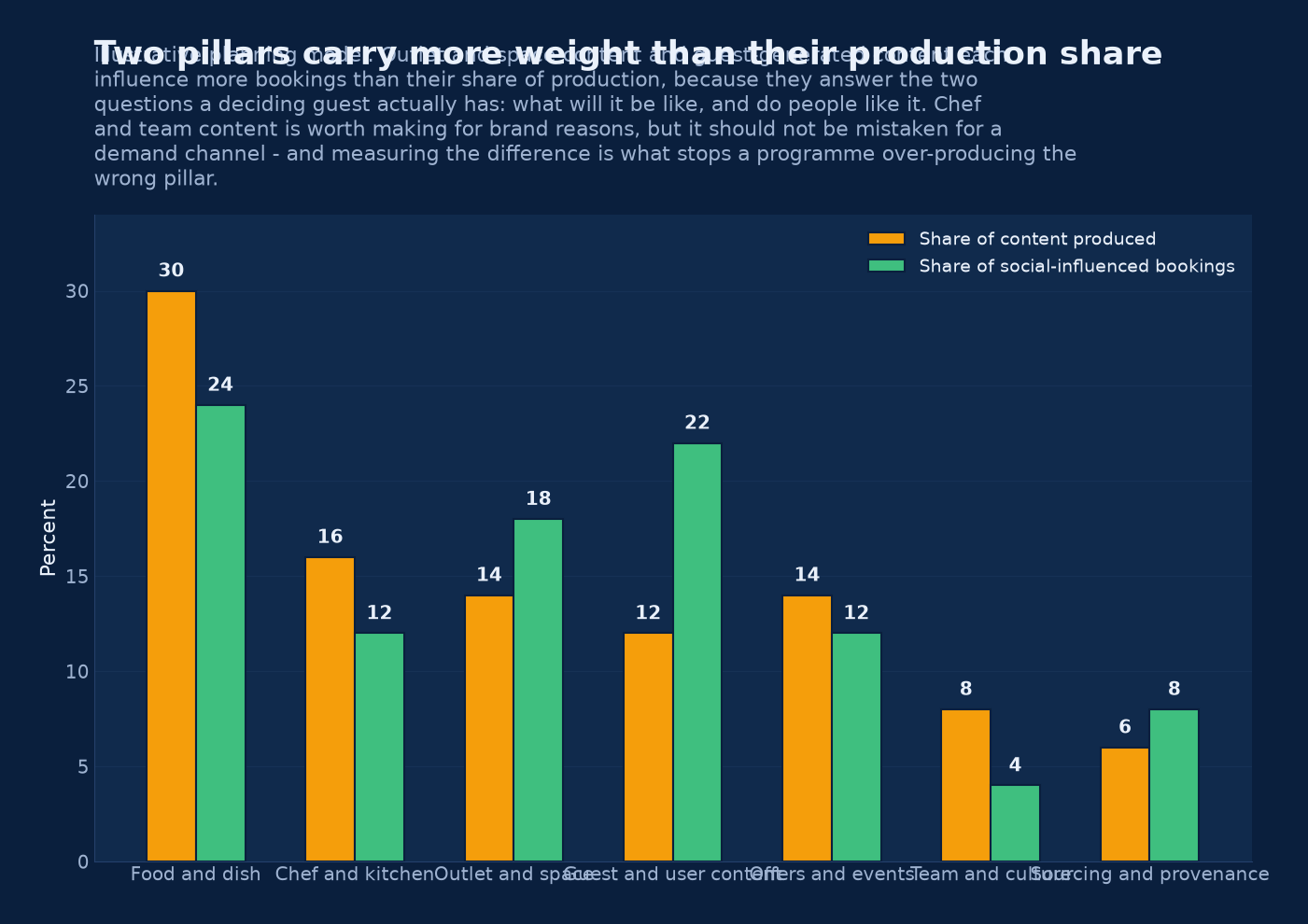
Chart values are an illustrative planning model based on typical UMC engagements and published industry benchmarks. They are not a guarantee of results on any specific project.
| Metric | Definition | Source | Reported to | What it decides |
|---|---|---|---|---|
| Enquiry from social | A DM, comment or click that produced a booking or order with a social source | Booking and order systems plus platforms | Marketing | Which platform produces demand |
| Booking attributed | Reservations carrying a social source | Booking system | Outlet and marketing | Whether content carries a next step |
| Cost per cover | Spend plus production cost divided by attributed covers | Finance plus platforms | Marketing and leadership | Where production effort and budget move |
| Contribution per cover | Average check less food, labour and delivery cost | POS plus finance | Leadership | Whether the covers are worth buying |
| Assisted contribution | Covers where social touched the journey but did not close it | Multi-touch over the guest identifier | Leadership | Whether discovery spend is worth funding |
| Response time and outcome coding | First response and the share of conversations coded | Social inbox plus booking record | Marketing lead | Whether the reservation desk is being operated |
| Review velocity and rating | Reviews requested and received per outlet, rating trend | Platforms | Outlet manager | Whether the trust layer is improving |
| Pillar yield | Bookings influenced per pillar against content produced | Joined model | Marketing lead | What to produce more of and what to stop |
| Creator contribution | Covers and cost per cover by creator | Tracked pages and codes | Marketing | Which partnerships to renew |
| Follower quality | Share of audience inside served catchments | Platform audience data | Marketing | Whether growth is useful or decorative |
| Sentiment and themes | Themes from comments and reviews routed to operations | Inbox plus review platforms | Operations | What to fix in the service, not the feed |
- The join is the whole exercise: one guest identifier from a DM to a paid bill, held where it can be queried – warehouse work with a marketing deadline.
- Two reports from one model: an outlet manager wants yesterday’s enquiries, bookings and response times; a group head wants cost per cover by platform and outlet – executive dashboards built once and rendered twice.
- Social and search are not additive in a simple way, so a blended last-click view misallocates budget: marketing mix modelling and attribution with periodic holdouts is how the split is argued.
- Which pillars and outlets convert is conversion analytics with a creative dimension: conversion and pipeline intelligence applied to bookings rather than deals.
- Social content is also what answer surfaces quote when somebody asks where to eat, so consistency between posts, pages and profiles is a visibility asset: AI search optimisation and search engine optimisation read the same facts.
The technical estate behind a social programme
A social programme looks like a content operation and runs like a small systems estate: a shared inbox with platform APIs that change, a scheduling tool with scoped permissions, an asset library with rights metadata, tracked landing pages, a booking widget, a consent banner, and a guest record that all of it writes to. When any part fails, the failure is invisible – messages stop arriving, links stop tracking, a scheduled post publishes without its offer – so monitoring and maintenance are part of the programme rather than an afterthought.
| Component | What can fail | Control | How it is verified |
|---|---|---|---|
| Shared inbox and platform APIs | A token expires and messages stop arriving | Monitoring on message volume with an alert on a drop | Daily volume check per platform |
| Scheduling and publishing tool | A post publishes without its outlet or offer | Approval step and a post-publish check | Published-content sampling weekly |
| Asset library and rights metadata | An asset reused beyond its licence window | Rights fields with expiry alerts | Quarterly rights audit |
| Tracked landing pages | A link parameter dropped, so attribution is lost | Synthetic checks on every campaign link | Automated link tests per campaign |
| Booking widget | A third-party release breaks the conversion event | A staging test before any upgrade, plus monitoring | Daily test booking |
| Consent and messaging compliance | A message sent with no lawful basis | Consent checked before every send, suppression honoured | Consent coverage report |
| WhatsApp business number | A number tied to a departed employee | Business API ownership held by the company | Ownership and access review |
| Guest record writes | A conversation never reaching the CRM | Queue monitoring with a retry and an exception report | Reconciliation between inbox and CRM weekly |
| Analytics and pixels | Under-reporting after a consent or tag change | A tag inventory with an owner and a change log | Monthly tag audit |
| Site performance | A slow landing page wasting amplified traffic | A page-weight budget and field monitoring | Core Web Vitals per template |
| Security and access | A compromised social account | MFA, named accounts, least privilege, logged changes | Quarterly access review |
| Backup and recovery | A lost asset library or conversation history | Backups with timed restore tests | Restore evidence per quarter |
- Hosting, media delivery and peak capacity are infrastructure questions with a hospitality calendar: cloud services sized for a festive evening rather than for average traffic.
- Tooling, tracking and platform subscriptions drift upward with outlet count, which is cost optimisation applied to a marketing stack.
- Publishing and inbox work happen from an outlet back office, so connectivity is part of the programme: network engineering and managed IT services covering outlets rather than only head office.
- A compromised account or a lost library is a real loss, so the baseline controls apply: security with MFA and access review, plus backup and disaster recovery with tested restores.
- Where the inbox, the booking system and the guest record have to exchange data reliably, that is an integration with retries and an audit log – ERP, CRM and operations integration in a hospitality setting.
- Which page each campaign lands on, and how the paths are named, is architecture rather than taste: website strategy and information architecture decided with the intent map.
- Every offer carries a margin, so a campaign is judged after food, labour and delivery cost – cost rationalisation and margin recovery arithmetic applied to a post.
- Own-channel orders paid at checkout rather than settled weekly by a platform change the cash cycle, which makes a channel shift a working capital decision with a social plan attached.
The ninety-day restaurant social programme, and what we need from you
The programme below is the shape we run for a restaurant, a cafe group or a multi-outlet chain: three weeks to audit the estate and choose platforms honestly, overlapping pillar and calendar design, the production engine and outlet training from week four, the DM and WhatsApp reservation flow from week six, creators and guest content from week eight, the review engine from week ten, paid amplification and measurement from week eleven, and governance and handover at the end.
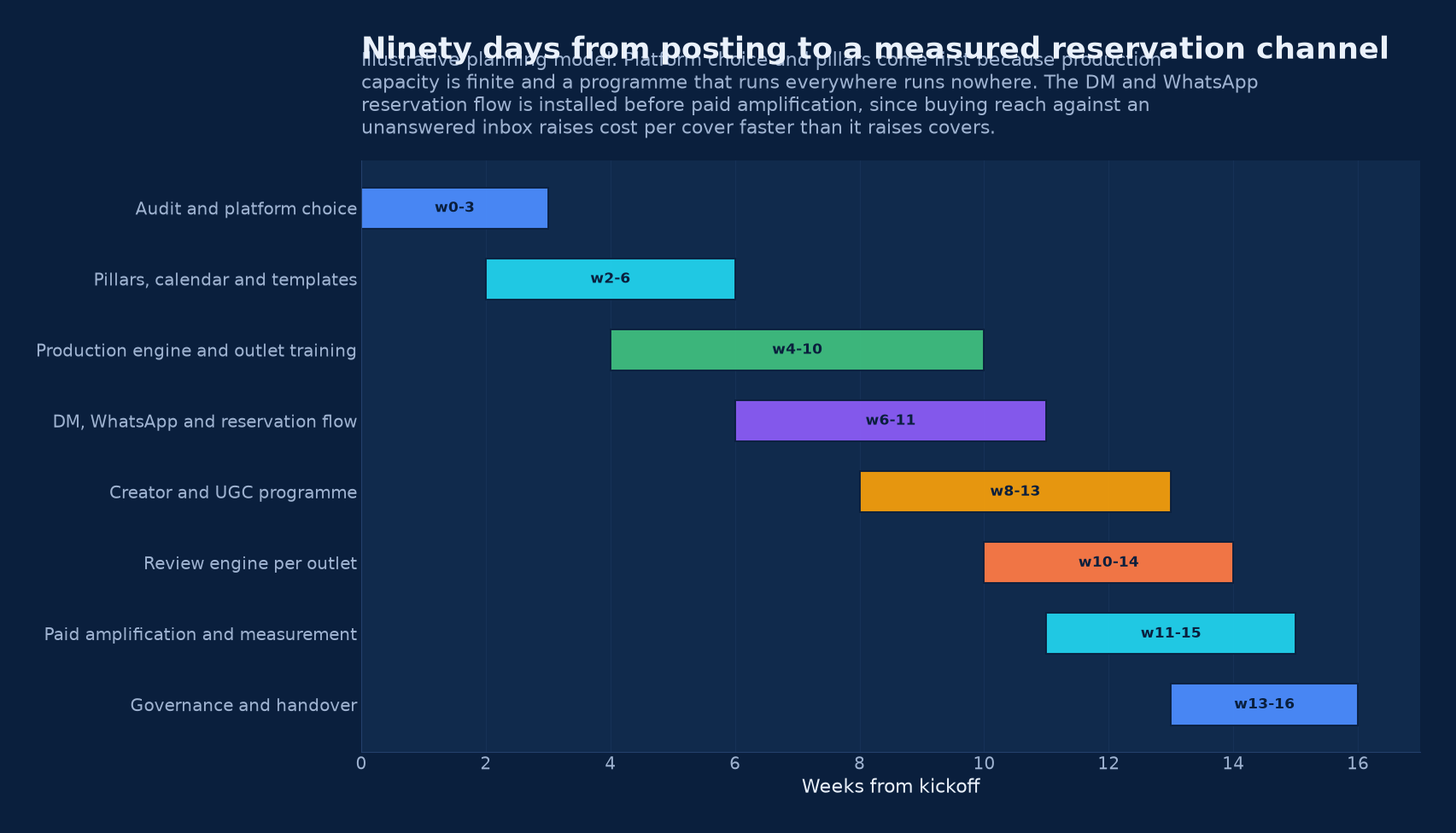
Chart values are an illustrative planning model based on typical UMC engagements and published industry benchmarks. They are not a guarantee of results on any specific project.
| Weeks | Workstream | Deliverable | Decision it enables |
|---|---|---|---|
| Zero to three | Audit and platform choice | Current-state audit, audience and platform map with a reason each, baseline metrics, competitor and creator landscape | Where effort goes, and what is deliberately not done |
| Two to six | Pillars, calendar and templates | Pillar set with a job and a measure each, a four-week rolling calendar, templates, shot lists, a claims rule | What is produced weekly and by whom |
| Four to ten | Production engine and outlet training | Capture routine, editing turnaround, approval route, asset library with rights, training per outlet | Whether outlets participate and how fast content ships |
| Six to eleven | DM, WhatsApp and reservation flow | Shared inbox on a business number, response targets, triage tree, booking path, outcome codes, CRM writes | Whether enquiries are captured rather than admired |
| Eight to thirteen | Creator and UGC programme | Selection criteria, briefs, contracts with usage and disclosure, tracked pages, a contribution review | Which partnerships to renew and at what price |
| Ten to fourteen | Review engine per outlet | Ask timing and channel, response workflow and targets, escalation, monthly theme review | Whether reputation compounds or decays |
| Eleven to fifteen | Paid amplification and measurement | Stage-based campaigns, retargeting sequences, offer campaigns with validity, the joined cost-per-cover report | What to scale, what to stop, and what a cover costs |
| Thirteen to sixteen | Governance and handover | Claims and rights process, complaint escalation, publishing model with scoped rights, documentation, training | Who runs it, on what rules, and how it is reviewed |
- What we need: platform and ad account access, booking system and POS access with a technical contact, the outlet list with a named content owner per outlet, twelve months of covers and spend history, existing creative assets and any rights records, and one decision-maker who will set the response target and the claims rule.
- What you keep regardless: the platform and pillar model, the templates and shot lists, the production and approval workflow, the inbox and reservation flow documentation, the creator contracts and contribution review, the review engine, the measurement model and the governance documentation. They are yours.
- What we will tell you plainly in week three: which platforms to leave, which posting habits to stop, and where the constraint is response discipline rather than content volume – almost always the response.
Restaurant social by city, and worked examples
Restaurant social is local by construction: language and script decide the caption, the neighbourhood decides the references, the festive calendar decides the campaign rhythm, and outlet density decides whether content is produced centrally or per site. The engagements below are hospitality, food-service and multi-outlet projects where content, community and measurement were built as one programme.
- Get more restaurant customers in Lucknow
- Digital marketing company for restaurants in Lucknow
- Website development company for restaurants in Lucknow
- Services across Indian cities
- Case study: social media advertising for a green hotel and resort
- Case study: The Fern hotel, Hyderabad
- Case study: Marriott hotel, Hyderabad
- Case study: WordPress development for a green hotel and resort
- The restaurants and food service industry hub – all eight disciplines
- Hotels and hospitality: booking-led social and reputation management
- Retail and e-commerce: creator commerce and catalogue social
- Showrooms and dealerships: delivery-day content and branch social
- All industry verticals we build programmes for
- All digital marketing services
- All technology services
- All business consulting services
- About Unified Management Consulting
- Contact us about social media marketing for restaurants
Where this page sits in our restaurants programme
Social media marketing is the fourth discipline of our restaurants and food service programme. The hub page explains how the eight disciplines fit together, each discipline has its own page as it is published, and the generic service page for every discipline stays listed below alongside the vertical pages. A discipline that is not listed is not published yet – the list is generated from live pages and refreshes automatically as each spoke lands.
- Restaurants – the vertical main page
- Website development for restaurants
- SEO for restaurants
- Google Ads for restaurants
- Guest CRM, reservations and loyalty for restaurants
- Business intelligence for restaurants
- IT support for restaurants
- AI for restaurants
- Website development services – the generic service page
- SEO services – the generic service page
- Google Ads management – the generic service page
- Custom CRM development and integration – the generic service page
- BI dashboards and executive reporting – the generic service page
- Managed IT infrastructure and AMC – the generic service page
- AI agent deployment and automation – the generic service page
Frequently asked questions about social media marketing for restaurants
What should a restaurant measure on social media?
Enquiries, bookings and orders attributed to social, cost per cover by platform and outlet, contribution after food, labour and delivery cost, response time and outcome coding, review velocity and rating, and assisted contribution for discovery work. Reach, followers and engagement explain whether content is seen, not whether tables were filled.
Which platforms should we be on?
Where your guests decide. For most restaurants that is Instagram for discovery, WhatsApp for the booking conversation, a complete business profile with reviews for the trust check, and YouTube only when there is a chef or kitchen story worth ten minutes. Two platforms operated with a response target beat five operated without one.
How often should we post?
As often as you can produce to your own standard and answer the response – typically four to seven times a week for a single venue, with story coverage at service and weekend content live before Friday evening. Frequency without a pillar produces content nobody can measure or repeat.
Do food influencers actually bring customers?
Some do, and the only way to know is to track them: a landing page, a code or a reserved slot per creator, a usage agreement, disclosure, and a monthly cost-per-cover comparison against your own creative. Judged on reach, every creator looks good; judged on covers, most do not.
How should we handle a negative comment or review?
Respond quickly and briefly in public, take it offline, own it, resolve it, and only then update the public thread. Never argue, never delete a legitimate complaint, and log the resolution. Complaint handling is a reputational asset when it is visibly fair – prospective guests read the responses, not only the ratings.
Can our outlets post for themselves?
Yes, with a division of labour: head office holds templates, claims rules, approvals and the calendar; outlets supply the moments captured to a shot list. Outlets should never publish a price or an offer alone, and any outlet should be able to correct a factual error immediately.
How do we get more reviews without breaking the rules?
Ask at the moment of satisfaction through the channel the guest used – a QR code at the table or a message after delivery – with one tap to the right platform. Never filter by sentiment, never offer a discount for a rating, answer every review, and track velocity per outlet rather than for the group.
Is WhatsApp really a marketing channel for a restaurant?
It is usually the highest-converting channel a restaurant owns, because it is where the booking conversation already happens. Run it on a business number owned by the company, with routing, consent, templates and outcome codes, and it becomes a measurable reservation desk rather than an executive’s personal inbox.
How does social help our local search?
Location-tagged posts, consistent outlet facts, review velocity and branded query volume all support local relevance. The requirement is consistency: the outlet story on social must match the business profile and the website, or all three are weakened.
What about offers – do they train guests to wait for discounts?
They can, which is why offers should be time-boxed, capacity-checked, published ahead of the window, and withdrawn on expiry. For a weekday lull a consented win-back to past guests usually beats a public discount, because it protects margin and does not reset expectations.
Who should answer the DMs?
A named owner on a rota with a response target, using a shared inbox that writes to the guest record – not whoever remembers. Allergen and dietary questions go to the kitchen, complaints go offline within minutes, and large parties go to an events coordinator.
What does a restaurant social programme cost?
It scales with outlet count, production capacity, whether creator work and paid amplification are included, and whether the inbox and review engine are operated for you. A single venue is a focused programme; a chain is a production and governance operation with training in it. We quote after the audit and platform choice, so the price reflects what you will actually sustain.
Start with the platform choice and the reservation flow
Give us three weeks with platform and ad account access, booking system and POS access with a technical contact, the outlet list with a named content owner per outlet, twelve months of covers and spend history, your existing creative assets and any rights records, and one decision-maker who will set the response target and the claims rule, and we will return an audience and platform map with a reason for each choice and a list of what we would not do, a pillar set with a job and a measure each, a four-week rolling calendar with templates and shot lists, a DM and WhatsApp reservation flow with response targets and outcome codes written to the guest record, a creator programme with contracts, disclosure and tracked contribution, a review engine per outlet, and a measurement model that reports cost per cover by platform and outlet – including which platforms to leave. Yours to keep either way.
Contact Unified Management Consulting to arrange a confidential first conversation.