
Most of what a restaurant does is prediction and response: how much to prep, who to roster, what to promote, how to answer a message at midnight, what a review is really saying, whether a till variance is an error or a pattern. Those are exactly the tasks machine learning and language models have become good at, and exactly the tasks a restaurant has no spare capacity to do well by hand. The opportunity is real. So is the graveyard of pilots that produced a dashboard nobody opened.
The difference between the two is sequencing and honesty about prerequisites. A forecasting model needs two years of clean daypart-level history; a guest assistant needs a consent position, a booking path and a human handoff; a review-intelligence system needs a claimed outlet record and a route to operations; a pricing model needs recipe costs and a margin floor somebody owns. So the work starts with an AI readiness assessment that names what you cannot do yet, runs one contained pilot with a human review step, measures it against a baseline, and only then scales – with governance over what the system may decide unattended and ROI measurement that survives a finance review.
What an engagement includes, at a glance
| Component | What We Deliver |
|---|---|
| Use-case selection with a readiness test | Which of the eleven useful restaurant AI applications you can actually run today, ranked by value at stake against data readiness, risk and integration effort – and which to refuse. |
| Data foundations and access | The transaction history, item mapping, consent state and review corpus a model needs, with retention rules and access scoped by role and outlet. |
| Demand forecasting for prep and purchasing | Covers and orders forecast by outlet and daypart with a confidence range, feeding prep volumes, purchase orders and rota – measured against waste and stock-outs. |
| Menu, pricing and promotion optimisation | Dish-level contribution modelling, price elasticity tests with a margin floor, and offer design that protects contribution rather than volume. |
| Guest-facing assistants on DM, WhatsApp and voice | Reservation and enquiry handling with a booking path, allergen escalation, a human handoff rule and an outcome code – never a guess about food safety. |
| Review, sentiment and reputation intelligence | Themes extracted from reviews and comments across outlets and routed to operations, with a response draft a person approves. |
| Content production and marketing operations | Dish descriptions, captions, menu copy and campaign variants produced at scale with a claims check and a brand voice, plus audience and bidding support. |
| Kitchen operations: computer vision, waste and hygiene | Where vision genuinely helps – waste logging, portion checks, hygiene and safety monitoring – and where the environment defeats it. |
| Labour scheduling, fraud detection and back-office automation | Rota generation from a forecast, till and void anomaly detection, invoice and supplier automation, and report drafting with an owner. |
| Governance, monitoring, training and ROI | A human-in-the-loop rule per use case, drift and quality monitoring, staff enablement, and an executive scorecard that reports value against cost per use case. |
What AI is worth doing in a restaurant, and what is not
There is a short list of restaurant problems that AI solves well, and a longer list that vendors claim it solves. The good ones share three properties: the task is repetitive and voluminous, the data already exists in a system of record, and a wrong answer is caught before it reaches a guest or a purchase order. The bad ones involve physical environments, novel judgement, or a data foundation that does not exist – and they consume a year and produce a demonstration.
| Use case | Why it works here | The prerequisite | What to refuse |
|---|---|---|---|
| Demand forecasting for prep and purchasing | Demand is highly patterned by daypart, week and festival, and the cost of error is waste or a stock-out | Two years of clean daypart-level transaction history and an explicit festival calendar | A forecast with no confidence range and no owner for the purchasing decision |
| Guest messaging assistant | Enquiries are repetitive, arrive out of hours, and have a bounded set of correct answers | A consent position, a booking path, an allergen escalation rule and a human handoff | An assistant that answers dietary or allergy questions without a person |
| Review and sentiment intelligence | Text at volume, with themes that operations can act on | Claimed outlets, a consistent outlet record and a route to an operations owner | A sentiment score reported to nobody with no action attached |
| Menu and pricing optimisation | Dish-level contribution and elasticity are computable where recipe costs are real | Recipe costs at current purchase prices, a margin floor, and a change-control route | Automated repricing with no approval and no test |
| Content production at scale | Captions, dish copy and campaign variants are language tasks with a brand voice to match | A claims rule, a style guide, an approval step and an asset library with rights | Publishing generated copy that states a price, an allergen or a health claim unchecked |
| Labour scheduling | Rota design against a forecast is an optimisation problem with clear constraints | A forecast, role-to-cover standards, statutory constraints and manager approval | A rota published without a manager’s sign-off |
| Fraud and till variance detection | Voids, comps and discounts have patterns that anomaly detection finds quickly | Reason codes, user-level data and a review process with an owner | An accusation generated automatically against a named employee |
| Purchasing and supplier automation | Order generation from a forecast plus price-movement alerts is well-defined | Item codes, supplier price feeds and an approval threshold | Auto-sent purchase orders above a value with no human check |
| Kitchen computer vision | Works for narrow, well-lit, fixed-position tasks such as waste logging or a hygiene checklist | Hardware, labelled data, a stable environment and staff acceptance | A general ‘kitchen monitoring’ pilot across formats and lighting conditions |
| Voice ordering and drive-through AI | Viable where the acoustic environment is controlled and a fallback exists | Noise handling, menu integration, an escalation path and a measured error rate | Deployment without a human fallback and an error-rate threshold |
| Answer-surface visibility | Guests increasingly ask a machine where to eat; consistency across your facts decides the answer | One source of truth for menus, hours, outlets and allergens | Generated content published without the underlying facts being verified |
- Which problems deserve a model is a strategy conversation before it is a technology one: business strategy consulting deciding whether the constraint is demand, margin or capacity.
- The external half of the picture – what your catchment buys and what competitors do with pricing and offers – is not in your data: market research and competitive analysis.
- In a group or franchise, who may deploy what, and who owns the guest data a model trains on, is settled at the top: unified top-level business management.
Readiness: the prerequisites nobody budgets for
Almost every restaurant AI failure is a data failure wearing a model’s clothes. Forecasting fails because item names differ between outlets and voids have no reason code. A guest assistant fails because there is no consent record and no booking path to hand off to. Review intelligence fails because half the outlets are unclaimed on the platforms. Readiness assessment is therefore the first deliverable and the cheapest one: it names what can be built now, what needs a quarter of data hygiene first, and what should not be attempted at all.
| Readiness dimension | What is checked | Green | Amber | Red |
|---|---|---|---|---|
| Transaction history | Depth, granularity, item mapping consistency, outlet tagging | Two years at daypart and dish level | One year, or monthly granularity only | Under a year, or item names differ per outlet |
| Data quality | Duplicates, missing fields, reason codes, exception volumes | Documented routines with an owner | Known defects with a fix plan | No routine and no owner |
| System access | Read access to POS, booking, aggregators, CRM, marketing, finance | API or scheduled export for every source | Some sources manual | Key sources inaccessible or vendor-locked |
| Consent and privacy position | Lawful basis per channel, retention rules, access model | Documented, enforced in the send path | Documented but not enforced | No documented position |
| Integration capability | Can a model’s output be written back into an operational system | A working pattern with retries and an audit log | One-off scripts | No integration route at all |
| Human review capacity | Who checks the output, how often, with what authority | A named reviewer with a defined step | A reviewer with no time allocated | Nobody – the output goes straight out |
| Measurement baseline | A current figure for the metric the use case targets | A measured baseline with a defined period | An estimate | No baseline, so no claim is possible |
| Change appetite | Whether the workflow will actually change | An operations owner committed to the change | Interest without an owner | Active resistance with no sponsor |
| Technology estate | Connectivity, devices, cloud capacity, monitoring | A supported estate with monitoring | Supported but unmonitored | Unsupported outlets with shared logins |
| Vendor and model constraints | Data residency, retention, third-party training use, cost per call | Contractual clarity and an acceptable cost model | Unclear terms | Guest data leaving the estate on unclear terms |
| Skills and ownership | Who maintains the model after the project ends | A named internal owner with training | A vendor-dependent arrangement | Nobody – the model becomes unmaintained |
- The formal version of this is a scored assessment with a roadmap attached: AI readiness assessment and roadmap, which is the first thing we run and the document that decides what gets built.
- Readiness is mostly warehouse work – one model, documented definitions, retained history: data warehouse and lakehouse design, described from the reporting side in business intelligence for restaurants.
- Writing a model’s output back into a POS, a purchasing system or a booking platform is integration engineering: enterprise systems integration and AI integration with ERP, CRM and operations.
- Consent, retention, access and vendor terms are audit questions with evidence requirements: IT audit and compliance.
- The estate underneath – connectivity, devices, monitoring, backups – decides whether a model can run at all: IT support for restaurants.
Demand forecasting, prep and purchasing
This is the highest-value use case in a restaurant and the one with the clearest measurement: waste value down, stock-outs down, labour cost per cover down, and gross margin up – all against a baseline you already have. The model is not exotic; it is a forecast at outlet-daypart-dish granularity with an explicit festival calendar and a confidence range, consumed by a prep sheet, a purchase order and a rota. The difficulty is that the output has to be trusted by a chef and a buyer, which means it must be explainable, overridable and right often enough to earn the habit.
| Element | What the model does | What the human does | Measure |
|---|---|---|---|
| Cover and order forecast | Predicts covers and orders by outlet, daypart and window with a confidence range | Overrides for a known event, weather or a local disruption, with a reason logged | Forecast error per outlet and daypart |
| Prep sheet generation | Converts the forecast and the dish mix into prep quantities | Adjusts for experience and confirms before service | Waste value and stock-out incidents |
| Purchase order suggestion | Generates order quantities from the forecast and current stock | Approves above a threshold, substitutes where supply is short | Purchase variance, supplier fill rate, emergency purchases |
| Menu mix prediction | Estimates dish-level demand so prep is per dish, not per cover | Reviews against a new launch or a seasonal change | Dish-level waste and 86 rates |
| Price and promotion sensitivity | Estimates the effect of an offer on volume and contribution | Decides the offer within a margin floor | Incremental contribution per offer |
| Capacity and reservation release | Predicts no-shows and waitlist behaviour to set slot release | Sets the deposit and overbooking policy | Turn-away rate, no-show rate, seat occupancy |
| Labour demand | Converts the forecast into required hours by role | Builds and approves the rota | Labour cost per cover, overtime, understaffed services |
| Delivery zone demand | Predicts order volume by zone and daypart | Decides coverage and dispatch capacity | Cancellation rate, dispatch time, contribution per zone |
| Anomaly detection | Flags a day that deviates from the pattern – a system error or a real event | Investigates and records the cause | Anomalies explained versus unexplained |
| Forecast governance | Retrains on a schedule with version history and drift monitoring | Reviews error trends monthly | Model error drift against the baseline |
- The forecasting discipline itself – model choice, error measurement, festival calendars, retraining – is predictive analytics and demand forecasting, applied here to prep and purchasing rather than to a report.
- The forecast only works on a clean joined history, which is the sibling discipline’s estate: business intelligence for restaurants and the warehouse behind it.
- Forecast output that reaches a supplier or a purchasing system automatically needs a reliable write path with retries and an audit log: AI integration with ERP, CRM and operations services.
- A model that runs nightly needs somewhere to run and headroom for a festival peak: cloud services and migration with a monitored refresh window.
- Where a forecast is wrong during a peak, the outlet needs surge hands rather than a debate: IT and operations staff augmentation planned against the forecast.
Menu, pricing and promotion optimisation
Menu decisions in most restaurants are made by taste and habit, which is fine for the cooking and expensive for the margin. The analytical version places every dish on popularity against contribution using a real recipe cost, estimates what a small price change does to volume, and tests an offer against a control rather than against last month. The human stays in the loop for every decision that a guest will notice – because a model that optimises contribution alone will happily recommend removing the dish that made the restaurant famous.
| Application | What it computes | The human decision | Risk if automated |
|---|---|---|---|
| Dish-level contribution | Contribution per plate from recipe cost at current purchase prices | What to promote, reprice, re-engineer or remove | A star dish removed for low popularity |
| Price elasticity estimation | Volume response to a price change by dish, daypart and outlet | Whether to reprice, by how much, and where | A price rise during a competitive window |
| Menu layout and placement | Which positions and descriptions drive choice | Menu design and copy | Optimising for contribution at the cost of the experience |
| Offer and discount design | Incremental covers and contribution per offer depth | Whether the offer is worth its margin cost | Discounting a night that was already busy |
| Bundle and combo suggestion | Which combinations raise average check without raising waste | What to put on the menu as a set | A bundle that concentrates demand on one station |
| Seasonal menu planning | Dish performance by season against ingredient price seasonality | The seasonal menu composition | Ignoring a dish that defines the brand |
| 86 and availability prediction | Which dishes are likely to run out by service | Prep adjustment or an early menu note | A guest told a dish is unavailable after ordering |
| Allergen and ingredient substitution | Cost and availability of substitutes against a recipe | Whether the substitution is acceptable to the chef | A substitution that changes an allergen profile silently |
| Beverage and pairing recommendation | Attach rate and contribution by pairing suggestion | What staff are prompted to suggest | A prompt that feels like a script to a guest |
| Competitor price monitoring | Public menu prices in the catchment over time | Positioning rather than matching | A price war with no margin floor |
- Every price and offer decision has a margin floor set by the cost work, not by the model: cost rationalisation and margin recovery defines the floor the optimisation respects.
- The dish-level contribution model, recipe costs and the four-quadrant view are built by the sibling discipline: business intelligence for restaurants.
- Menu copy, dish descriptions and offer language are content with a claims rule – generated drafts need the same verification as written ones: content marketing strategy.
- Menu layout, digital menu hierarchy and a prompt that does not feel like a script are design questions: UX and UI design for a printed card and a phone screen alike.
- Competitor pricing and catchment behaviour are external data the estate cannot supply: market research and competitive analysis.
Guest-facing assistants: DMs, WhatsApp, voice and the booking desk
A restaurant’s inbox is a reservation desk that nobody staffs overnight, which makes it the most convincing first AI deployment in the sector: the volume is real, the answers are bounded, the outcome is measurable in bookings, and the risk is containable with one rule – anything about allergens, dietary restriction, a large party or an unhappy guest goes to a human immediately. Done properly it does not replace the person at the desk; it makes sure no enquiry is lost between ten at night and eleven in the morning.
| Enquiry type | What the assistant does | What must go to a human | Recorded outcome |
|---|---|---|---|
| Table availability | Checks real availability, offers a bookable slot, confirms | A party above a stated size, a private dining request | Booking created with a social or assistant source |
| Hours, location and directions | Answers from the verified outlet record | Anything the record cannot answer confidently | A flagged gap in the outlet facts |
| Menu and price questions | Answers from the current menu with the outlet stated | A dish that has changed or an outlet-specific menu | A menu-sync exception |
| Allergen and dietary questions | Escalates immediately with a holding message | Always – no exception, no generated answer | An escalation to the chef with a response time |
| Delivery coverage and timing | Checks the pincode and quotes an honest window | A complaint about a late or wrong order | An order or a coverage gap logged |
| Reservations for occasions | Captures the occasion, offers a set menu, takes a deposit | Anything requiring a bespoke arrangement | A booking with an occasion note |
| Large parties and events | Captures requirements and books a coordinator callback | Always – a human owns the quote | An event pipeline entry |
| Complaints | Acknowledges, apologises, takes it offline, alerts the outlet manager | Always | A complaint record with a resolution target |
| Loyalty and gift card balance | Answers from the ledger with identity verified | A dispute about a balance or a refund | A query logged against the guest record |
| Out-of-hours demand | Captures, confirms and schedules a morning task | Anything urgent | An enquiry with a morning owner |
| Language and script handling | Responds in the guest’s language where supported | A translation the assistant is not confident in | A confidence flag and a human review |
| Handoff | Transfers with the full conversation and the guest’s identity | By rule, not by the guest’s request alone | Handoff rate and time to human response |
- The deployment pattern – a scoped assistant, a handoff rule, logged outcomes, monitoring – is AI agent deployment and automation with a human in the loop by design.
- Business messaging has to run on a company-owned number with routing, consent and retention: WhatsApp marketing services with SMS as a fallback for confirmations.
- Every conversation that becomes a booking has to write to the guest record with a source, or the channel cannot be measured: guest CRM and loyalty for restaurants and CRM development and integration.
- The assistant needs a booking path to hand off to, which is a website and widget question: website development for restaurants with mobile experience for the thirty-second task.
- Escalations arrive as tickets with a rota and a response target, exactly like IT incidents: helpdesk and end-user support practice applied to guest conversations.
- Where the assistant speaks – a phone line or a drive-through – the acoustic environment and the fallback rule decide whether it works at all, and it should be piloted in one outlet with an error-rate threshold before any rollout.
Review, sentiment and reputation intelligence
A multi-outlet restaurant accumulates thousands of reviews, comments and messages a month, and reads almost none of them systematically. Language models are genuinely good at this: extracting themes, attributing them to an outlet and a daypart, tracking sentiment over time, detecting a sudden deterioration before it shows in the rating, and drafting a response that a person approves. The value is not the sentiment score – it is that a recurring complaint about cold food at one outlet on weekend dinners reaches the person who can fix it, with evidence attached.
| Capability | What it produces | Who acts on it | Guardrail |
|---|---|---|---|
| Theme extraction | Recurring themes by outlet, daypart and dish, with example quotes | Outlet manager and operations | Themes reviewed by a person before any action is taken |
| Sentiment trend and alerting | A deterioration detected before the rating moves | Operations lead | An alert threshold tuned to avoid noise |
| Outlet comparison | The same themes ranked across outlets on a consistent basis | Group operations | Volume-adjusted, so a busy outlet is not penalised |
| Response drafting | A draft reply in the brand voice for a person to approve | Outlet or social team | Never auto-published on a complaint or a negative review |
| Complaint routing | A complaint routed to the right owner with a resolution target | Outlet manager | A logged resolution and a time measure |
| Allergen and safety signals | Any mention of illness, allergen reaction or hygiene escalated immediately | Leadership and the outlet | Escalated by rule, never by sentiment score |
| Menu feedback loop | Dish-level praise and criticism joined to sales and waste data | Chef and marketing | A sample check, because review text is not representative |
| Competitor benchmarking | Public themes and ratings for comparable venues in the catchment | Marketing and leadership | Public data only, with no scraping of restricted sources |
| Fake and incentivised review detection | Patterns suggesting fabricated or paid reviews | Marketing lead | A report to the platform, never an accusation published |
| Consistency check | Hours, address, menu and pricing identical across every platform | Marketing operations | A quarterly check with an owner |
| Guest voice into the record | Preferences and occasions mentioned by guests written to the guest record with consent | CRM owner | Consent and retention rules applied, sensitive notes scoped |
- Reviews are social assets as much as data, and the response routine belongs to the sibling discipline: social media marketing for restaurants with organic social management operating the inbox.
- The platforms themselves – Meta and Instagram inboxes, review surfaces, business profiles – are where the text lives, so account ownership and API access are prerequisites.
- Review velocity and response rate also drive local search visibility, so the same work supports the map pack: local SEO and Google Business Profile management and SEO for restaurants.
- Routing a theme to an owner with a target is a workflow change, and it fails without training and adoption work: AI training, enablement and team adoption.
- Publishing a drafted response without approval is a reputational risk with a governance answer: AI governance, risk and compliance setting what may be published unattended.
Content production and marketing operations
Language and image models change the economics of restaurant content: a dish description, a caption set, an occasion guide, a campaign variant and a menu translation used to cost a copywriter’s week and now cost an afternoon with a claims check. The same applies to operations – audience building from the guest record, bid and budget suggestions, creative variants tested against each other, and report drafting. What does not change is that anything stating a price, an allergen, a health claim or an opening hour must be verified by a person before it ships.
| Application | What AI produces | What a person must check | Measure |
|---|---|---|---|
| Dish and menu copy | Descriptions in the brand voice, per outlet and language | Ingredients, allergens, price, availability | Time to publish and correction rate |
| Caption and post variants | Multiple variants per platform with a hook and a next step | Claims, tone, offer validity | Engagement and enquiries per variant |
| Occasion and guide content | Long-form pages for festivals, occasions and neighbourhoods | Facts, outlet participation, hours | Organic sessions and bookings from the page |
| Campaign creative variants | Ad copy and layout variants for testing | Brand compliance, offer terms, disclosure | Cost per cover by variant |
| Audience building | Segments from the guest record – lapsed, high-value, occasion-prone | Consent coverage per segment | Segment performance against a holdout |
| Bid and budget suggestions | Allocation suggestions across campaigns and outlets | The margin floor and capacity constraints | Cost per cover and contribution per outlet |
| Report and narrative drafting | A first draft of the weekly or monthly report | The numbers, and any causal claim | Time to produce the report |
| Menu translation and localisation | Menus and copy in additional languages and scripts | Dish names, allergen terms, cultural fit | Enquiries in the new language |
| Image and video support | Cropping, upscaling, variant formats – not fabricated dishes | That the food shown is the food served | Complaint rate about misleading imagery |
| Influencer and creator briefs | A brief draft with facts, constraints and disclosure | Claims, rights, usage terms | Contribution per creator |
| Email and message journeys | Subject lines, body copy and send-time suggestions | Consent, frequency, offer validity | Journey conversion against a control |
- The content strategy – pillars, occasions, a claims rule, an approval step – is the discipline that makes generated content safe to publish: content marketing strategy services.
- Volume creative production across outlets needs templates and an approval route: brand performance and creative production.
- The paid side consumes the same variants and audiences: Google Ads for restaurants with Google Ads management, Performance Max and Local Services Ads, plus media planning and buying across surfaces.
- Video and creator work have their own production and rights requirements: YouTube and video advertising and influencer marketing management.
- Owned-channel journeys run on marketing automation with lifecycle campaigns, nurture programmes and the email, SMS and WhatsApp channels – consent checked before every send.
- Organic visibility is where generated content earns its keep over time: SEO services and AI search optimisation for the answer surfaces.
- Whether a variant, a segment or a channel actually produced incremental covers is a modelling question with holdouts: marketing mix modelling and attribution.
Kitchen operations: computer vision, waste and hygiene
This is the use case with the widest gap between promise and readiness. A kitchen is hot, greasy, steamy, dimly lit in places, constantly rearranged and staffed by people who reasonably resent being watched. Vision works where the task is narrow, the position is fixed, the lighting is controlled and the output changes a routine rather than judging a person – a waste-logging camera over a bin, a portion check at a plating station, a hygiene checklist verified at opening. It fails where it is sold as general monitoring across formats.
| Application | Where it works | Where it fails | Practical alternative |
|---|---|---|---|
| Waste logging | A fixed station where waste is discarded, with a simple classification | Multiple discard points, mixed waste, poor lighting | A two-tap mobile log at the station, with vision only where volume justifies it |
| Portion and plating checks | A controlled plating station with a reference image | A busy pass with variable angles | Scales, scoops and a photo standard, audited periodically |
| Hygiene and opening checklist | A fixed camera verifying a completed checklist at opening | Continuous monitoring of people | A photographed checklist with a timestamp |
| Food safety and temperature | Sensor logging with anomaly alerts | Vision-based inference about temperature | IoT probes with alert thresholds – more reliable and cheaper |
| Queue and service speed | A camera at the pass measuring ticket-to-plate time | Inferring guest satisfaction from movement | POS timestamps, which you already have |
| Drive-through and voice ordering | A controlled acoustic environment with a fallback | A noisy dining room or a busy street | A kiosk or a handheld with a human nearby |
| Guest counting and occupancy | A door sensor or a camera with a privacy-respecting count | Facial recognition of guests – never appropriate | A counting sensor with no image retention |
| Stock and shelf recognition | A store room with stable shelving | A walk-in freezer with condensation and movement | A counted-cycle routine with a mobile app |
| Staff safety monitoring | A specific hazard – a spill, an open flame, a blocked exit | General behaviour monitoring | A checklist and a physical inspection routine |
| Energy and equipment monitoring | Metered consumption with anomaly alerts | Inferring equipment failure from video | Equipment telemetry and a maintenance schedule |
- The connectivity, devices, mounting and monitoring behind any kitchen installation are IT work with an environment problem: IT support for restaurants and managed IT infrastructure and AMC.
- Sensor and device data has to reach the operational systems, which is an integration with retries and an exception queue: AI integration with ERP, CRM and operations services.
- Segmented networks, device hardening and no image retention beyond the task are security and privacy requirements: cybersecurity services and solutions.
- Anything that monitors staff raises a governance and employment question that must be settled before deployment, not after: AI governance, risk and compliance.
- A handheld waste log used during service has to work on a phone in a hurry: mobile app development and UX and UI design decide whether it is used at all.
Labour scheduling, fraud detection and back-office automation
Three further applications are unglamorous and reliable. Labour scheduling turns a forecast into a draft rota that a manager approves – the value is in the constraint handling, not the prediction. Anomaly detection finds till variance, void patterns and discount abuse that a manual review misses, provided the output is a review prompt and never an accusation. And back-office automation – invoice capture, supplier reconciliation, report drafting, roster notifications – removes the small daily load that keeps a manager from the floor.
| Application | What it does | Human control | Measure |
|---|---|---|---|
| Rota generation | Drafts a rota from the forecast against role standards, statutory limits and availability | A manager approves and adjusts before publication | Labour cost per cover, overtime, understaffed services |
| Shift swap and availability | Matches swap requests against coverage requirements | A manager confirms the swap | Unfilled shifts and swap turnaround |
| Till and void anomaly detection | Flags unusual voids, comps, discounts and refund patterns by user and outlet | An investigation by a named reviewer, never an automatic sanction | Variance value recovered, false-positive rate |
| Payment and settlement anomaly detection | Flags mismatches between gateway, POS and bank | A finance review with an exception queue | Unreconciled items and time to reconcile |
| Invoice and supplier capture | Extracts invoice lines, matches to purchase orders, flags variances | Approval above a threshold | Processing time and price-variance capture |
| Supplier price monitoring | Tracks price movement against recipe costs | A renegotiation decision by purchasing | Price variance recovered |
| Report drafting | Drafts the daily, weekly and monthly operational report | A named owner checks the numbers and any causal claim | Time to produce and correction rate |
| Roster and task notifications | Sends shift reminders, task lists and checklist prompts | Consent and channel preference respected | Acknowledgement rate and lateness |
| Compliance checklist monitoring | Tracks statutory and brand checklists per outlet | An escalation route with an owner | Completion rate and overdue items |
| Knowledge and runbook assistance | Answers staff questions from documented procedures | A fallback to a named person, and no answer on food safety | Time to resolution and escalation rate |
| Recruitment screening support | Summarises applications against a stated role specification | Every shortlisting decision made by a person | Time to hire, and a bias review of the criteria |
- Scheduling depends entirely on the forecast, so the two are built together: predictive analytics and demand forecasting feeding the rota.
- Anomaly detection needs user-level data, reason codes and an access model – all of which are security and governance work first: cybersecurity services and IT audit and compliance.
- Any model that touches an employee record raises a governance question about fairness, transparency and appeal: AI governance, risk and compliance with a documented human-decision rule.
- Surge periods need real people, not only a smarter rota: IT and operations staff augmentation.
- The output of all of this lands in the operational reporting estate: business intelligence for restaurants and executive dashboards.
- Where guest-facing automation writes to a record, the record has to accept it: CRM development and integration with source and outcome fields.
Answer surfaces: being found by a machine that recommends where to eat
A growing share of restaurant discovery now starts with a question asked of a machine rather than typed into a search box – ‘where can I eat Jain food near Gomti Nagar at ten’, ‘which place is good for a first date with parking’. Those systems answer from what they can read and verify: your menu pages, your business profile, your reviews, your structured data and the consistency between them. The work is therefore not prompt engineering; it is making your facts machine-readable, consistent and citable – and being honest that the answer is not fully controllable.
| Requirement | What it means concretely | What breaks it | How it is verified |
|---|---|---|---|
| One source of truth | Menus, hours, addresses, allergens and prices held once and published everywhere | A PDF menu, a third-party listing and a website disagreeing | A quarterly consistency check across surfaces |
| Structured data | Menu, opening hours, location, aggregate rating and organisation markup on every outlet page | Markup missing, invalid, or describing a different outlet | Markup validation per outlet page |
| Machine-readable menus | Dish names, descriptions, prices and allergen flags in the page, not only in an image | A menu as a photograph or a downloadable PDF | Text extraction test per outlet page |
| Outlet page completeness | One page per outlet with directions, hours, parking, service styles and a booking path | A single page for a chain with a list of addresses | A page-per-outlet audit |
| Review and rating consistency | Ratings shown with a source, review velocity per outlet | An unclaimed listing or a stale rating | Claimed-outlet register and a velocity report |
| Allergen and dietary clarity | Vegetarian, Jain, vegan and gluten-free flags stated consistently | A claim made in a caption and not on the menu page | A claims register matched to the menu record |
| Local relevance signals | Neighbourhood references, local content, consistent NAP data | Identical copy across every city | A local-content audit per outlet cluster |
| Speed and accessibility | Fast, readable pages on a phone, with real text rather than images | A heavy template that a crawler cannot render | Field performance and a crawl test |
| Third-party listing accuracy | Aggregators, maps, directories and reservation platforms aligned | A closed outlet still listed as open | A listing audit with an owner |
| Measurement | Branded query volume, direct traffic, referral from answer surfaces, bookings by source | Assuming a listing produced a cover | A source-tagged booking path |
- The discipline of being cited by answer surfaces is its own service: AI search optimisation and AIEO services with measurement attached.
- The technical and content foundations are ordinary SEO with a local dimension: SEO services, local SEO and Google Business Profile management and the sibling SEO for restaurants page.
- Outlet pages, menu markup and a page-per-outlet architecture are a build: website development for restaurants, website strategy and information architecture and full-stack WordPress development.
- A page a crawler cannot render quickly is a page that is not cited: Core Web Vitals and performance and website development services standards.
- The content that these surfaces quote – occasion guides, dish explainers, neighbourhood pages – has to be real and verified: content marketing strategy.
The AI stack: build, buy, integrate
A restaurant does not need an AI platform; it needs a small number of use cases running reliably against systems it already has. That means deciding per use case whether to configure an existing vendor feature, buy a specialist tool, or build against a model API – and then doing the part everybody underestimates: writing the output back into the operational system, adding the human review step, and monitoring quality after deployment. The stack diagram is short; the integration and review layers are where the effort sits.
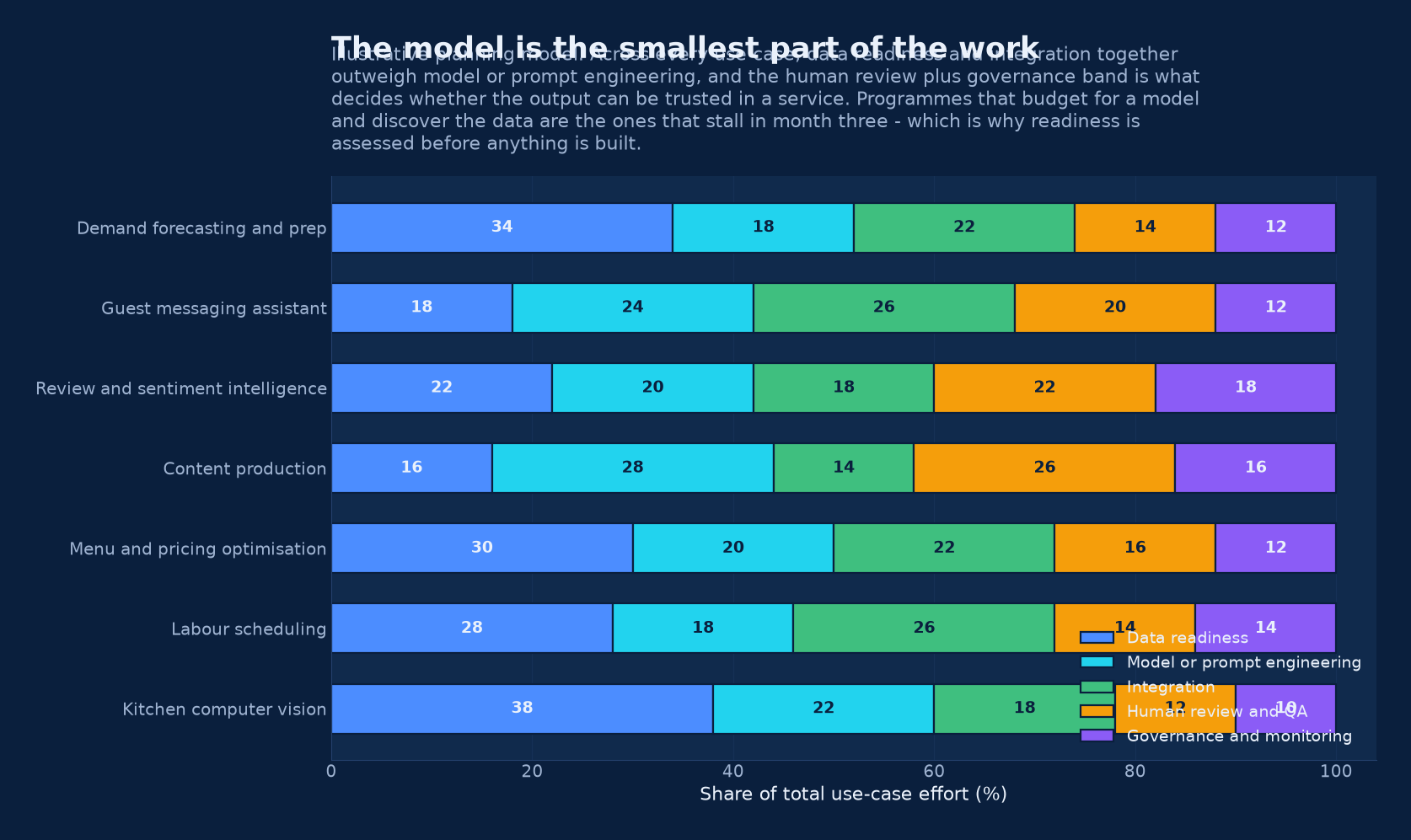
Chart values are an illustrative planning model based on typical UMC engagements and published industry benchmarks. They are not a guarantee of results on any specific project.
| Layer | Options | What decides the choice | Restaurant-specific caution |
|---|---|---|---|
| Vendor feature | POS, booking, aggregator and loyalty vendors increasingly ship forecasting, reports and assistants | Whether it covers your formats and whether the data leaves the estate | A vendor feature that only works for that vendor’s data |
| Specialist tool | Review intelligence, scheduling, waste logging, menu analytics | Depth against integration cost and per-outlet pricing | Another subscription with another login and another export problem |
| Model API build | A guest assistant, content generation, theme extraction against your own data | Control, cost per call, latency, data terms | Guest data leaving the estate on unclear contractual terms |
| Retrieval over your own content | An assistant that answers only from your verified menus, hours and policies | The quality and currency of the source content | An assistant that answers confidently from a stale PDF |
| Data layer | A warehouse with documented definitions, retained history and access control | Whether anything else can be trusted | Training or prompting on data that has not been reconciled |
| Integration layer | Write-back into POS, purchasing, booking, CRM and messaging with retries and an audit log | Whether the output changes an operational process | A model whose output is copied by hand into another system |
| Human review layer | An approval step with a named reviewer, a time budget and an override log | The consequence of a wrong answer | A review step that exists in the design and not in the rota |
| Monitoring layer | Quality sampling, drift detection, cost per call, error rates, guest feedback | Whether degradation is visible before it is reported | No monitoring, so the model decays silently |
| Security and access | Scoped credentials, MFA, least privilege, logged access to guest data | The sensitivity of the data involved | A shared API key in a spreadsheet |
| Cost control | Per-call and per-outlet cost tracking with a budget and an alert | Whether the use case remains economic at volume | A pilot cost that scales linearly with outlets |
| Exit and portability | Data export, model independence, documented prompts and configurations | Whether you can leave without losing the capability | A capability that exists only inside a vendor’s interface |
- Wiring model output into operational systems is the discipline itself: AI integration with ERP, CRM and operations services and enterprise systems integration.
- Deployment patterns – a scoped agent, a handoff rule, monitoring, an override log – are AI agent deployment and automation.
- Where the stack is hosted, how it scales for a festival peak and what a refresh costs are cloud decisions: cloud services and migration with cost optimisation and FinOps over per-call spend.
- Where franchisees or outlet managers need scoped access to a model’s output, that is a portal with role-based access: portal development.
- Own-channel ordering is the most common place a restaurant meets AI-assisted commerce – recommendations, upsell prompts, order status – and it is engineering work: e-commerce development and marketing services.
- Every layer needs an owner between projects, or the estate rots: web application and platform maintenance support.
Governance, risk and the human in the loop
Restaurant AI carries risks that are specific rather than theoretical: a guest with a severe allergy given a wrong answer by an assistant, a price published that an outlet cannot honour, an employee sanctioned on the basis of an anomaly score, a dish shown in generated imagery that is not the dish served, guest data leaving the estate on unclear vendor terms. Each has a control, and the controls are cheap – which is why governance should arrive with the pilot rather than after the incident.
| Risk | Where it arises | Control | Evidence kept |
|---|---|---|---|
| Allergen and dietary misinformation | A guest assistant or generated menu copy | Escalation by rule; generated copy never states an allergen position without the verified record | An escalation log and a claims register |
| Price, offer and hour inaccuracy | Generated content, a menu sync, an assistant answer | Facts served from one source of truth, an approval step for anything with a price | Approval log and a consistency check |
| Fabricated or misleading imagery | Generated images used as though they were the dish | Real photography for food; generated imagery only where it is clearly not a menu claim | An asset register with a source per image |
| Employee fairness | Anomaly detection, scheduling, recruitment screening | A human decision on every personnel matter, a right of explanation, a bias review of criteria | Decision log with the human reviewer named |
| Guest data exposure | Model prompts, vendor tools, third-party APIs | Data minimisation, contractual terms on retention and training use, scoped access | A vendor register with data terms per vendor |
| Consent breach in messaging | An automated journey or assistant sending without a lawful basis | Consent evaluated at send time, suppression honoured everywhere | A suppression audit per period |
| Model degradation and drift | A forecast or classifier that quietly gets worse | Error monitoring against a baseline, scheduled retraining, version history | A drift report with a review date |
| Hallucinated or ungrounded output | An assistant answering beyond its sources | Retrieval over verified content only, a confidence threshold, a fallback to a human | A sampled quality review with a correction log |
| Vendor lock-in and exit | A capability that exists only inside a vendor’s interface | Data export rights, documented prompts and configurations, a stated exit path | Contract terms and an export test |
| Unattended decisions | A model repricing, publishing or sanctioning with no person involved | An explicit list of what may act unattended, with thresholds and an override log | A decision-authority register |
| Security of the AI estate | API keys, service accounts, model endpoints | Scoped credentials, MFA, secret storage, logged access, segmented networks | An access review and a configuration baseline |
| Regulatory and platform compliance | Advertising disclosure, platform automation rules, tax and labour law | A compliance check per use case before deployment | A compliance note per use case |
| Incident response | A wrong answer reaching a guest at scale | A documented plan with a kill switch, a notification route and a review | An incident record and a post-incident change |
- The governance framework – decision authority, human review, monitoring, incident response and the register of what may act unattended – is AI governance, risk and compliance applied to a service business.
- The assessment that precedes it decides which risks are even in scope: AI readiness assessment and roadmap.
- Consent, retention, access and vendor terms are auditable with evidence: IT audit and compliance covering the AI estate.
- Credentials, endpoints, segmentation and access logging are security work: cybersecurity services and solutions plus network engineering for the outlet layer.
- A model whose training data or output is lost is unrecoverable, so backups and tested restores cover prompts, configurations and datasets as well as systems: backup and disaster recovery.
- Who may approve an unattended action across a group or franchise is settled once at the top: unified top-level business management.
ROI measurement and the pilot discipline
An AI programme survives its second quarter only if the first pilot has a number attached. That requires a baseline measured before anything is built, a control or holdout so that a claim of improvement is a claim about the model rather than about the season, a cost figure that includes data work, integration, review time and per-call spend, and a decision rule agreed in advance: scale, iterate or stop. Without those four, every result is an anecdote and every anecdote supports continuation.
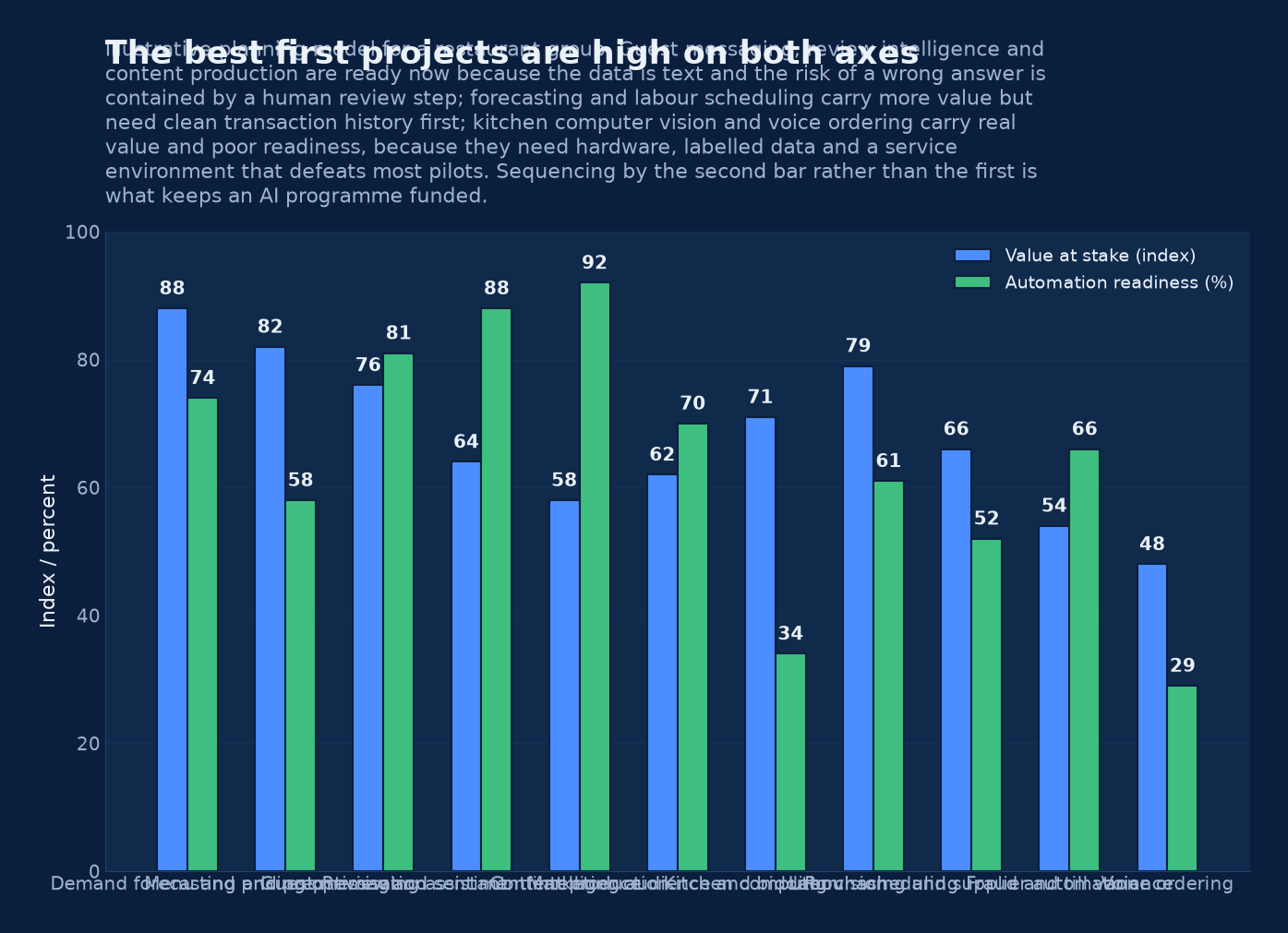
Chart values are an illustrative planning model based on typical UMC engagements and published industry benchmarks. They are not a guarantee of results on any specific project.
| Use case | Baseline to measure first | Value measure | Cost to include | Decision rule |
|---|---|---|---|---|
| Demand forecasting | Current waste value, stock-outs, emergency purchases | Waste value reduction, stock-out reduction, gross margin movement | Data work, model, integration to purchasing, review time | Scale if waste value falls measurably against a control period |
| Guest messaging assistant | Current enquiries lost, response time, bookings by source | Bookings from out-of-hours enquiries, response time, handoff rate | Build, integration to booking and CRM, per-conversation cost, review | Scale if bookings attributable exceed the run cost |
| Review intelligence | Current time to act on a theme, complaint recurrence | Time to route a theme, recurrence of the same complaint, rating trend | Tool or build, integration, operations review time | Continue if themes produce logged actions |
| Content production | Current time and cost per asset | Time to publish, volume, engagement and enquiries per variant | Model cost, claims checking, brand review | Scale where correction rate stays low |
| Menu and pricing | Current dish contribution, price change history | Contribution per cover, dish margin, average check | Recipe cost work, modelling, test design | Iterate – elasticity estimates need several tests |
| Labour scheduling | Current labour cost per cover, overtime, understaffed services | Labour cost per cover, overtime reduction, service quality | Forecast dependency, integration to the rota tool, manager time | Scale if managers keep the draft rather than rebuilding it |
| Fraud and till variance | Current unexplained variance value | Variance recovered, false-positive rate | Data work, review time | Continue only with a low false-positive rate |
| Purchasing automation | Current processing time and price variance capture | Time saved, price variance recovered, emergency purchases avoided | Integration, approval workflow, exception handling | Scale above an approval threshold with a human check |
| Answer-surface visibility | Current branded query volume and referral traffic | Branded queries, referral sessions, bookings by source | Structured data work, content, page performance | Continue as part of the search programme, not separately |
| Voice ordering | Current order error rate and throughput | Error rate, throughput, guest abandonment | Hardware, integration, fallback staffing | Stop unless a single-outlet pilot beats the error threshold |
- The measurement discipline – baseline, holdout, cost per use case, an executive scorecard – is AI ROI measurement and executive scorecard services, which is how the programme survives a finance review.
- Reporting the result to two audiences from one model is the sibling discipline’s work: business intelligence for restaurants and executive dashboards.
- Whether a marketing use case produced incremental covers needs holdouts and a model rather than last-click: marketing mix modelling and attribution.
- Corporate, catering and event demand converted by an assistant behaves like a pipeline and should be measured as one: sales analytics and pipeline intelligence.
- Cost per call, per outlet and per subscription scales differently across channels, and the timing of those costs matters to a seasonal business: cloud cost optimisation and cash flow and working capital recovery.
- Value that shows up as margin rather than volume belongs in the margin work: cost rationalisation and margin recovery.
Training, adoption and the workflow change nobody plans for
The most common reason a working restaurant AI pilot does not scale is that the people who have to use it were told about it rather than trained on it. A chef who does not trust a prep sheet overrides it silently. A manager who has not been shown how to approve a rota rebuilds it from scratch. A host who has not practised an escalation loses the guest. Adoption is therefore a workstream with its own deliverables – role-based training, a changed procedure, a feedback route, and a measure of whether the output is actually used.
| Role | What they need to learn | What changes in their workflow | How adoption is measured |
|---|---|---|---|
| Chef and kitchen lead | How the prep sheet is produced, how to override it with a reason | Prep planned from a sheet rather than from memory | Override rate and the waste result |
| Outlet manager | How to approve a rota, read a daily report, act on a theme alert | A morning review with a defined agenda | Approval turnaround and actions logged |
| Host and service staff | How the assistant hands off, what to do with an escalation | A shared inbox with a response target | Handoff handling time and outcome coding |
| Purchasing and stores | How order suggestions are generated and how to adjust them | Purchase orders reviewed rather than written | Suggestion acceptance rate and emergency purchases |
| Marketing | How variants, audiences and reports are drafted, and what must be checked | An approval step with a claims rule | Correction rate and time to publish |
| Finance | How anomalies and reconciliations are flagged and investigated | An exception queue instead of a monthly surprise | Items resolved and time to reconcile |
| IT and analytics | How models are monitored, retrained and versioned | A monitoring routine with an owner | Drift detected and models retrained on schedule |
| Leadership | How to read the scorecard and what a decision rule means | A quarterly review with scale, iterate or stop decisions | Decisions recorded and acted on |
| New joiners | The procedure as it now exists, not as it used to | Onboarding that includes the tools | Time to competency |
| Franchisees | The group standard, what they may change and what they may not | A documented local operating procedure | Compliance with the standard per outlet |
- Enablement is a formal workstream rather than a handover meeting: AI training, enablement and team adoption services with role-based content and a competency check.
- Adoption fails where the tool is unusable during service, so the interface matters as much as the model: UX and UI design and mobile experience for a kitchen-floor or counter surface.
- Questions from staff about a new tool are support tickets with a rota and a knowledge base: IT helpdesk and end-user support.
- Surge periods and rollouts need additional hands while the habit forms: IT and operations staff augmentation.
- A workflow change that touches how a guest is served is an operating-model decision, not a software one: unified top-level business management sponsoring it.
The ninety-day restaurant AI programme, and what we need from you
The programme below is the shape we run for a restaurant, a cafe group, a cloud kitchen or a franchise estate: three weeks to assess readiness and choose the use cases honestly, data foundations and access from week one, the first pilot with a human review step from week four, integration and workflow change from week six, a second use case with measurement from week nine, governance, monitoring and training from week eleven, and the roadmap and handover at the end. Two use cases in production with a measured result is a success; five demonstrations is not.
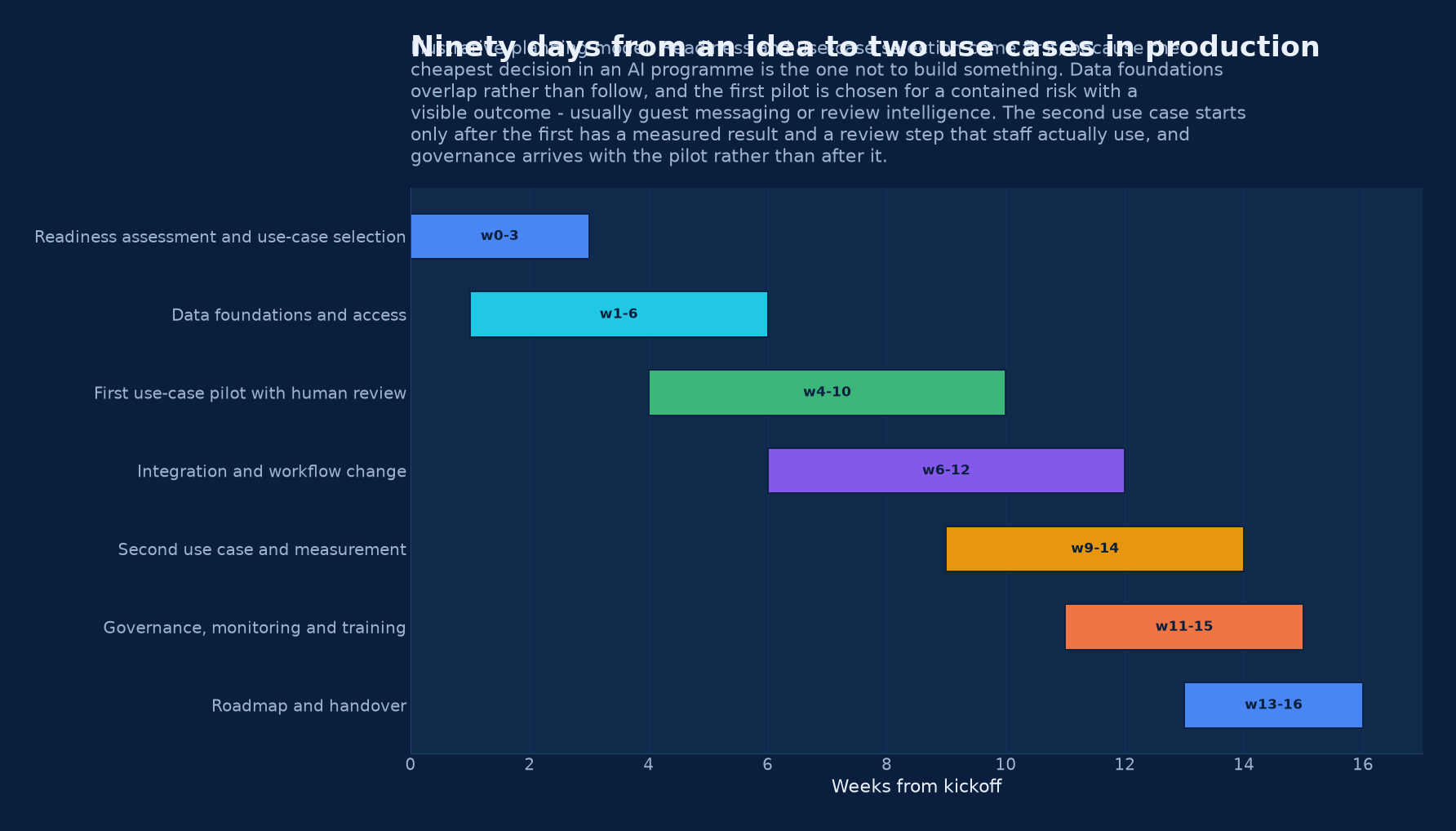
Chart values are an illustrative planning model based on typical UMC engagements and published industry benchmarks. They are not a guarantee of results on any specific project.
| Weeks | Workstream | Deliverable | Decision it enables |
|---|---|---|---|
| Zero to three | Readiness assessment and use-case selection | A scored readiness assessment across data, access, consent, integration, review capacity and measurement, a ranked use-case list with two selected and the rest refused with reasons | What can be built now, what needs data work first, and what not to attempt |
| One to six | Data foundations and access | Source access and exports, item and outlet mapping, consent position, a baseline measurement for each selected use case | Whether a model has anything trustworthy to run on |
| Four to ten | First use-case pilot with human review | A working pilot in one or two outlets, a review step with a named owner, an override log, a quality sampling routine | Whether the output is good enough to change the workflow |
| Six to twelve | Integration and workflow change | Write-back into the operational systems with retries and an audit log, the changed procedure documented, role-based training delivered | Whether the pilot survives contact with a service |
| Nine to fourteen | Second use case and measurement | A second use case deployed, both measured against baseline with a control or holdout, a cost-per-use-case figure including review time and per-call spend | Scale, iterate or stop – per use case, with a number |
| Eleven to fifteen | Governance, monitoring and training | A decision-authority register, drift and quality monitoring, an incident plan with a kill switch, vendor data terms, enablement for every affected role | What may act unattended, and who is accountable |
| Thirteen to sixteen | Roadmap and handover | A twelve-month roadmap with prerequisites and sequencing, internal ownership named, documentation, an executive scorecard | What comes next, who runs it, and how it is reviewed |
- What we need: read access to POS, booking, aggregator, CRM, marketing and finance systems with a technical contact each, two years of transaction history where it exists, the current vendor and subscription list with contracts and data terms, the consent and privacy position as it stands, an operations sponsor per use case who will own the workflow change, a named reviewer with time allocated, and one decision-maker who will approve the decision-authority register and the margin floor.
- What you keep regardless: the readiness assessment and ranked roadmap, the data foundations and mapping work, the documented prompts, configurations and integrations, the review procedures and override logs, the governance register, the measurement model with baselines and holdouts, the training material and the executive scorecard. They are yours.
- Where the group is opening outlets, the data foundations, the device standard and the reporting hooks belong on the expansion critical path so a new site is visible to every model from day one rather than after a quarter: market expansion consulting.
- What we will tell you plainly in week three: which use cases you cannot run yet and why, which vendor claims to ignore, and what the honest cost of the first pilot is including the data work everybody forgets to budget – usually more than the model.
Restaurant AI by city, and worked examples
AI deployment in food service varies with the estate and the city: aggregator density, delivery share, outlet scale, labour cost, connectivity and language mix all change which use case is worth running first. The engagements below are hospitality, food-service and multi-outlet projects where forecasting, guest systems, content operations and measurement were built as one programme with governance attached.
- Get more restaurant customers in Lucknow
- Digital marketing company for restaurants in Lucknow
- Website development company for restaurants in Lucknow
- Services across Indian cities
- Case study: social media advertising for a green hotel and resort
- Case study: The Fern hotel, Hyderabad
- Case study: Marriott hotel, Hyderabad
- Case study: WordPress development for a green hotel and resort
- The restaurants and food service industry hub – all eight disciplines
- Hotels and hospitality: forecasting across rooms, covers and events
- Retail and e-commerce: demand, assortment and recommendation AI
- Showrooms and dealerships: lead scoring, service forecasting and AI assistants
- All industry verticals we build programmes for
- All digital marketing services
- All technology services
- All business consulting services
- About Unified Management Consulting
- Contact us about AI for restaurants
Where this page sits in our restaurants programme
Artificial intelligence is the eighth and final discipline of our restaurants and food service programme. The hub page explains how the eight disciplines fit together, each discipline has its own page as it is published, and the generic service page for every discipline stays listed below alongside the vertical pages. A discipline that is not listed is not published yet – the list is generated from live pages and refreshes automatically as each spoke lands.
- Restaurants – the vertical main page
- Website development for restaurants
- SEO for restaurants
- Google Ads for restaurants
- Social media marketing for restaurants
- Guest CRM, reservations and loyalty for restaurants
- Business intelligence for restaurants
- IT support for restaurants
- Website development services – the generic service page
- SEO services – the generic service page
- Google Ads management – the generic service page
- Social media management – the generic service page
- Custom CRM development and integration – the generic service page
- BI dashboards and executive reporting – the generic service page
- Managed IT infrastructure and AMC – the generic service page
- Get more restaurant customers in Lucknow
- Digital marketing company for restaurants in Lucknow
- Website development company for restaurants in Lucknow
Frequently asked questions about AI for restaurants
Where should a restaurant start with AI?
With a readiness assessment and one contained pilot. The best first candidates are guest messaging assistants, review and sentiment intelligence, and content production, because the data is text, the risk is contained by a human review step and the result is measurable within weeks. Demand forecasting carries more value but needs clean daypart-level history first – so it is usually the second pilot, not the first.
Can AI forecast how much food to prep?
Yes, and it is the highest-value application in the sector: covers and orders forecast by outlet, daypart and dish, converted into a prep sheet and a purchase order, with a confidence range and a chef’s override. It needs two years of clean transaction history, consistent item mapping and an explicit festival calendar. Without those it produces a number nobody trusts and therefore nobody uses.
Is a restaurant chatbot or WhatsApp assistant safe to deploy?
With one rule: anything about allergens, dietary restrictions, a large party or an unhappy guest goes to a human immediately, with no generated answer. Everything else – availability, hours, directions, menu facts, delivery coverage, a balance check – is answerable from a verified source with a booking path attached and an outcome logged.
Will AI replace our staff?
Not in a restaurant, where the work is physical and relational. It removes the load that keeps a manager off the floor – overnight enquiries, report drafting, invoice capture, rota drafting, theme reading – and it changes what staff do with the time. Every personnel decision should stay with a person, and an anomaly score should prompt a review rather than a sanction.
Can AI optimise our menu prices?
It can estimate elasticity and dish-level contribution, and suggest tests – but a margin floor has to be set by a person, every price change approved, and the effect measured against a control. Automated repricing without those controls will optimise contribution and damage the reason guests come.
What about kitchen cameras and computer vision?
Narrow and fixed works; general monitoring does not. A camera over a waste station, a plating reference check or an opening hygiene verification can be worth it where volume justifies the hardware. A hot, steamy, rearranged kitchen with variable lighting defeats most pilots – and anything that watches staff needs a governance and employment position settled before deployment.
Do we need our own data scientists?
Rarely at first. Most restaurant use cases are configured vendor features, specialist tools or a build against a model API with retrieval over your own content. What you do need is one named internal owner per use case who can monitor quality, manage the review step and decide when to retrain or stop – plus the data foundations that make any of it possible.
How do we know an AI pilot actually worked?
A baseline measured before the build, a control or holdout period, a cost figure that includes data work, integration, review time and per-call spend, and a decision rule agreed in advance: scale, iterate or stop. Without a baseline every result is an anecdote, and every anecdote supports continuation.
Is our guest data safe with AI tools?
Only if you decide it is: minimise what leaves the estate, read the vendor’s terms on retention and training use, scope access by role and outlet, store credentials properly, log access, and apply the same consent and retention rules a model’s output triggers as a human send would. Guest dietary and allergy data should never enter a general-purpose prompt.
How does AI affect being found online?
A growing share of discovery starts as a question asked of a machine, which answers from what it can read and verify: your menu pages, business profile, reviews, structured data and the consistency between them. The work is making those facts machine-readable and citable – one source of truth, real text rather than a menu photograph, valid markup, a page per outlet.
What does an AI programme cost for a restaurant?
The pilot is usually cheaper than expected and the data work more expensive. Budget for readiness and data foundations, the model or tool, integration back into your operational systems, a named reviewer’s time, monitoring and per-call or per-outlet running costs. We quote after the readiness assessment, so the price reflects the prerequisites rather than an assumption that they are met.
How long until we see a result?
About ninety days to two use cases in production with a measured result: three weeks of readiness and selection, data foundations to week six, a first pilot with human review to week ten, integration and workflow change to week twelve, a second use case with measurement to week fourteen, and governance, training and handover by week sixteen. A single venue moves faster; a franchise estate takes longer at the governance and rollout steps.
Start with the readiness assessment and one contained pilot
Give us three weeks with read access to your POS, booking, aggregator, CRM, marketing and finance systems plus a technical contact for each, two years of transaction history where it exists, your current vendor and subscription list with contracts and data terms, your consent and privacy position as it stands, an operations sponsor per use case who will own the workflow change, a named reviewer with time allocated, and one decision-maker who will approve the decision-authority register and the margin floor, and we will return a scored readiness assessment, a ranked use-case list naming what to refuse and why, baselines for the two use cases we recommend, a pilot deployed in one or two outlets with a human review step and an override log, integrations that write back into your operational systems, a governance register covering what may act unattended, drift and quality monitoring, role-based training, and an executive scorecard reporting value against cost per use case with a scale, iterate or stop decision attached. Yours to keep either way.
Contact Unified Management Consulting to arrange a confidential first conversation.