
A restaurant meets the same guest many times and remembers almost none of it. The reservation sits in a booking widget, the delivery order in an aggregator’s system, the card payment in the POS, the birthday note in an executive’s phone and the complaint in a review thread. Each is true, none is joined, and the result is a business that pays to acquire the same guest every month while believing it has a loyalty problem.
Guest CRM is the work of making that one record: identity resolved across reservation, order and visit; preferences and dietary notes captured where they are useful and held only as long as they are lawful; loyalty and stored value that a guest can actually see; and journeys that arrive because something happened – a birthday, a ninety-day silence, a no-show, a first visit – rather than because a calendar said so. It is custom CRM development and integration built around a POS and a booking system rather than in competition with them, and it is measured in guest value per channel rather than in list size.
What an engagement includes, at a glance
| Component | What We Deliver |
|---|---|
| One guest record across channels | Identity resolved across reservations, own-channel orders, aggregator orders where shared, walk-ins, gift cards and events – one record per guest, with vehicles of contact attached and duplicates merged with an audit trail. |
| Reservation, waitlist and no-show operations | Bookings against real capacity, deposits and cancellation policy, waitlist recovery, show and no-show outcomes recorded, and a source question at the desk that makes attribution possible. |
| Consent and preference governance | Consent captured per channel with a date and a source, a preference centre a guest can use, retention rules that delete, and suppression honoured everywhere. |
| Loyalty, points and tiers | A mechanic simple enough to explain in one sentence, earnable across channels, with tiers that reward frequency rather than spend alone. |
| Gift cards and stored value | Sale, redemption, partial balances, expiry rules, fraud controls and the accounting treatment – a liability, not revenue. |
| Journeys triggered by events | Occasion, win-back, first-visit follow-up, no-show recovery, feedback and referral – each with a trigger, a channel, a consent check and a measure. |
| Corporate, catering and private dining | A real pipeline with owners, stages and a record of every event, rather than enquiries handled in an inbox. |
| Data quality, access and retention | Deduplication, role-based access by outlet, sensitive dietary data handled carefully, and an audit trail for every export. |
| Measurement that reaches contribution | Repeat rate, guest value by channel, journey conversion, loyalty liability, churn timing and contribution per cover – reported to an outlet manager and to leadership from one model. |
What a guest record is actually for
The commercial case is narrow and testable. A restaurant that recognises a guest can serve them better on the second visit – the table they preferred, the dish they avoid, the occasion they were celebrating – can ask them to come back at the moment they are most likely to, and can stop paying an aggregator or an ad platform to acquire somebody it already owns. Every element of the record has to earn its place against one of those three outcomes. A CRM that holds data for reporting purposes is a cost centre; a CRM that changes what happens at a table is an asset.
| Purpose | What the record enables | What happens without it | How it is measured |
|---|---|---|---|
| Recognition at the visit | A returning guest is known, their preferences and dietary notes are at the host stand | The fortieth visit is treated like the first | Repeat rate, return interval, average check trend |
| Service quality and safety | Allergies and dietary restrictions are known before the order is taken | A guest re-explains a severe allergy to every server, and mistakes happen | Allergy incidents, complaint rate, preference completeness |
| Occasion capture | Birthdays and anniversaries are known and offered, not guessed | A celebration handled by whichever guest mentions it | Occasion bookings, occasion revenue share |
| Win-back with timing | A guest silent for ninety days is identified and approached with a reason | A blanket discount sent to regulars and lapsed guests alike | Win-back response rate, recovered guest value |
- Which segments are worth building the record for – business lunch, family weekend, celebration, delivery – is evidence rather than assumption: market research and competitive analysis on your actual guest mix before the record is designed.
- Whether loyalty should reward frequency, spend or a paid membership is a strategy decision that sets the mechanic, and it should be taken before any tool is shortlisted: business strategy consulting.
- The messages a journey sends are content with a trigger, and they need the same discipline as public content – accurate facts, a reason, restraint: content marketing strategy extended to owned channels.
One guest record across reservations, orders and visits
Identity is the whole difficulty, and it is not solved by buying software. A guest may book on your website with an email, order on an aggregator with a masked number, walk in with nothing, redeem a gift card bought by somebody else, and message you on WhatsApp from a fourth number. The record is built from a resolution rule – exact match on phone or email, probabilistic match on name plus outlet plus interval, and a manual merge queue with an audit trail – and from capture points placed where a guest will actually answer one question without friction.
| Capture point | What is asked | What it resolves | Friction | Consent handling |
|---|---|---|---|---|
| Online reservation | Name, phone, email, party size, occasion, notes | Identity plus occasion plus preference | None – it is the booking form | Purpose stated at the form, per-channel consent |
| Walk-in and waitlist | Phone number for the table or the waitlist | Identity where the guest agrees, plus a first visit | One question at the host stand | Verbal consent recorded, or no record kept |
| Own-channel order | Login or guest checkout with a phone number | Identity, order history, delivery address | Low – it is already a transaction | Account terms plus per-channel consent |
| Aggregator order | Whatever the platform shares – often an order reference and a masked number | Partial: order fact without a resolvable guest | None to you, and none from you either | No direct marketing without a lawful basis |
| Payment and POS | Card or UPI reference against the bill, tip, table, covers | Spend and visit history when joined by check | None | Payment data is not marketing consent |
| QR at the table | A one-question prompt after the meal: rate the visit, join loyalty | Identity plus satisfaction at the moment of experience | One tap, optional | Explicit opt-in with a preference centre link |
| Loyalty signup | Phone, birthday, dietary preferences | Identity plus the fields a journey needs | Low if the reward is immediate | Purpose-specific consent per channel |
| Gift card purchase | Buyer and recipient identity | Two guests – one of them new | None for the buyer | Recipient consent needed before marketing |
| Events and private dining | Enquiry form with company, headcount, menu needs | A corporate contact with a real pipeline value | None | B2B contact consent |
| Wi-Fi and in-venue signups | A captive portal with a stated purpose | Identity for guests who would otherwise be anonymous | One screen | Must not be a condition of service where avoidable |
- The record and the joins are the build: a CRM extended for reservations, dietary notes, loyalty balances and outlet scope – which is custom work rather than configuration, because hospitality fields do not exist in a generic sales CRM.
- POS, booking widget, aggregator feeds and the loyalty store must write to the same guest without a nightly manual export: systems integration with retries, an exception queue and an audit log.
- The deeper question is which system owns guest truth when a POS vendor, a booking platform and a group CRM all claim it: ERP, CRM and operations integration resolves ownership before it moves data.
- A masked aggregator number is a real constraint, so the strategy is to shift share to channels where identity is yours – own-channel ordering, a walk-in QR, a loyalty signup – and to plan for the shortfall rather than assume it away.
Reservation operations: capacity, waitlist, no-shows and the source question
Reservations are the closest thing a restaurant has to a booking system with real inventory, and most are run on intuition: a fixed number per slot, no deposit, no waitlist recovery, and no record of who actually arrived. Making the reservation a transaction with capacity, outcome and source is the single highest-yield change available to a guest programme, because it turns a list of names into the demand data everything else is forecast from.
| Element | What good looks like | Failure mode | Control |
|---|---|---|---|
| Capacity per slot | Tables and covers modelled against turn time and daypart, not one flat number | Overbooking at eight, empty at six-thirty | A capacity model per outlet per daypart, reviewed monthly |
| Booking window | Enough advance to plan, short enough to fill | A thirty-day window with no fill mechanism for tomorrow | Window per format plus a short-notice offer route |
| Deposit and cancellation | Deposits on large parties and peak windows, refunded on arrival | Free cancellation until the slot passes | A stated policy, enforced by the widget and the desk |
| Waitlist | A captured list with position, an SMS or WhatsApp update and a recovery offer | Names on paper that vanish at closing | Waitlist into the record with an outcome per entry |
| No-shows | Recorded as a no-show with a reason where known, and a recovery journey | A reservation marked ‘cancelled’ so nothing can be learned | Outcome codes: seated, no-show, cancelled, walked-in, waiting-lost |
| Source at the desk | One question: how did you hear about us – website, Google, Instagram, friend | No source field, so attribution is guesswork | A required field with a short option list |
| Table and seat preferences | A known preference honoured on the second visit | Preferences recorded and never read | A host-stand view loaded before service |
| Group and event bookings | A separate flow with a coordinator, a menu and a deposit | Large parties handled in the same widget as a table for two | An event pipeline with stages and owners |
| Private dining and buyouts | Quoted with capacity, minimum spend and a contract | Agreed over a phone call with no record | A quote template and a signed confirmation |
| Peak-day handling | Paid held back when the outlet is full; walk-in capacity protected | Paid traffic sending guests to a full restaurant | A capacity signal to the campaigns layer |
- The booking form is the highest-intent page on the estate, so its fields, validation and mobile behaviour are a design problem with a conversion consequence: UX and UI design for a thirty-second task.
- Reservation pages must render fast enough that a guest books rather than calls, and the widget must not be the slowest thing on the page: Core Web Vitals and performance measured per template.
- The booking flow lives on the pages built by the sibling discipline – menu, outlet and occasion pages that carry availability: website development for restaurants and the generic website development standards behind them.
- Where corporate clients, caterers or franchise partners need self-service access to availability and quotes, that is a small authenticated surface rather than an inbox: portal development with role-based access.
Consent, preferences and dietary data
A guest record in food service holds three categories of information that deserve different treatment: contact details, which are ordinary; preferences such as a favourite table or a celebrated occasion, which are useful and low-risk; and dietary and allergy information, which is health-adjacent, sensitive and operationally consequential. The controls are therefore not uniform – consent per channel with a date and a source, a preference centre a guest can use without calling, retention rules that actually delete, and access scoped so that a delivery partner sees an address and not a medical note.
| Data element | Lawful basis and consent | Retention | Who may see it | Control |
|---|---|---|---|---|
| Name and contact | Consent for marketing, legitimate interest for the transaction itself | Active plus a stated period after the last visit | Outlet staff and marketing, role-scoped | Per-channel consent with date and source |
| Reservation and visit history | Part of the service | Financial periods plus the analysis window | Outlet and marketing | Access log on exports |
| Order and delivery history | Part of the service | As above | Outlet, delivery partner for fulfilment only | Field-level scoping |
| Dietary and allergy notes | Explicit consent, kept only while useful | Shorter – reviewed on each visit rather than accumulated | Kitchen and service staff only | Separate field, access-scoped, never exported in bulk |
| Occasion data (birthday, anniversary) | Consent | Active membership period | Marketing and the host stand | Guest may remove it themselves |
| Payment data | Contractual and legal | As required for accounts and chargebacks | Finance only | Never in the marketing record; tokenised |
| Loyalty balance and stored value | Contractual – it is a liability you owe | Until redeemed or lawfully expired | Outlet and finance | Reconciled to accounts, fraud-checked |
| Consent and preference state | The record of the record | Kept as long as the relationship plus an audit period | Marketing operations | Immutable history, not a mutable flag |
| Aggregator-derived data | Whatever the platform’s terms permit | The minimum needed for the order | Operations | No direct marketing without a separate lawful basis |
| Corporate contacts | Legitimate interest in a B2B context | Active relationship plus a defined period | Sales and events | Separate B2B record, not mixed with guests |
| Employee notes about a guest | Rarely appropriate | Deleted on resolution | Named manager | No free-text about a guest outside the notes field |
| Third-party recipient data (gifts, event lists) | Consent from the giver, not the recipient | Until the recipient opts in or out | Marketing | No marketing to the recipient before their own consent |
- Consent, retention, access and export are auditable work: an IT audit and compliance review of the guest estate covers these fields along with logging and access.
- A guest record is an attractive target, so the controls are ordinary security – scoped access, encryption, MFA, logged exports, vendor review: cybersecurity services.
- Where AI scores churn risk, drafts messages or recommends dishes, the sensitive fields enter the model too, which needs an assessment before deployment: an AI readiness assessment followed by AI governance, risk and compliance over what the system may decide without a person.
Loyalty, points and tiers that survive contact with a service
Most restaurant loyalty schemes fail for one of two reasons: the reward is too distant to change behaviour, or the earning is invisible because it happens on a channel the programme cannot see. A workable mechanic is explainable in one sentence, earnable wherever the guest actually transacts, visible immediately, and redeemable without an argument at the counter. Tiers should reward frequency – which is what a restaurant needs – rather than spend alone, which simply rewards the guest who was always going to come.
| Design element | What works | What fails | Measure |
|---|---|---|---|
| Mechanic | One sentence a server can explain while the guest is waiting | Points per rupee with category multipliers and blackout dates | Explained-correctly rate in a mystery check |
| Earning channels | Reservation, walk-in, own-channel order, event, gift card purchase | Only the channels that are easy to instrument | Share of transactions that earn |
| Redemption | Immediate, at the counter, no minimum visit value | A voucher by email valid on weekdays only | Redemption rate and time from earn to redeem |
| Tiers | Frequency-based with a visible next step and a real difference between tiers | Four tiers where three feel identical | Tier distribution and tier migration |
| Expiry | A stated rule with a reminder before expiry | Silent expiry, which reads as theft | Expiry volume and complaints |
| Stored value and gift cards | Balances visible, partial redemption allowed, expiry rules lawful and stated | A printed card with no balance lookup | Outstanding liability, breakage, fraud attempts |
| Referral | Both sides rewarded, capped, and tied to a completed visit | Uncapped referral that becomes a discount farm | Referred guests and their twelve-month value |
| Paid membership | A clear benefit bundle priced against expected frequency – worth modelling carefully | A subscription for a guest who visits twice a year | Member retention and incremental spend |
| Staff incentives | Signups and redemptions measured per outlet, not per individual bribe | A per-signup bounty that produces fake accounts | Signup quality and subsequent visit rate |
| Fraud controls | Velocity limits, duplicate identity checks, refund and reversal handling | An open API that lets a balance be edited at the counter | Fraud loss as a share of loyalty value |
- Loyalty comms are triggered by an event, so they belong in one automation layer with consent checked before every send: marketing automation rather than a spreadsheet and a broadcast tool.
- The journeys themselves – earn reminder, tier progress, expiry warning, referral nudge – are lifecycle and retention campaigns designed against a guest state.
- Where the mechanic needs an explanation over several touches, a short sequence beats one long message: nurture programmes with a defined exit condition.
- Channel choice per journey matters more than volume – WhatsApp for a redemption reminder, SMS for a time-boxed offer, email for a statement and a birthday – and each carries a different cost per contact.
Gift cards, stored value and the accounting that goes with them
Gift cards are the most under-used instrument in Indian food service and the most mis-accounted. Sold at a festive peak they bring cash before the guest arrives, they introduce a new guest through a trusted giver, and they carry a known breakage. They are also a liability until redeemed, they need fraud controls at the counter, and an expiry rule that is not lawful or not stated is a reputation problem rather than a saving.
| Element | Requirement | Common failure | Control |
|---|---|---|---|
| Sale channels | Online, at the counter, corporate bulk orders, event gifting | Only printed cards at one outlet | An online store with instant delivery and a corporate route |
| Delivery | Instant digital delivery to the giver and optionally the recipient | A physical card posted after the occasion passed | Automated delivery with a scheduling option |
| Redemption | Any outlet, any channel, partial balance allowed | Only at the issuing outlet, only in full | A shared balance across the estate |
| Balance visibility | Lookup by card or account, shown at redemption | A counter guess and an argument | A balance API used by POS and site |
| Expiry and breakage | A stated, lawful rule with a reminder before expiry | Silent expiry, or breakage assumed as revenue too early | Policy reviewed with finance; reminder journey |
| Accounting | Recognised as a liability until redemption; breakage per policy | Booked as revenue at sale | Monthly reconciliation to the loyalty ledger |
| Fraud | Velocity limits, bulk-purchase checks, serialisation, refund handling | An unlimited counter top-up with no audit | Transaction monitoring and role-based counter access |
| Refunds and disputes | A stated route, a chargeback process, an audit trail | Ad hoc counter decisions | A policy plus a logged exception queue |
| Corporate gifting | Bulk issue with a single invoice, recipient list handling and consent | A marketing email to a purchased list | Recipient consent rules before any marketing |
| Payment rails | UPI, cards, wallets – and a settlement view per channel | One rail with manual reconciliation | A settlement report matched to the ledger |
- Selling and redeeming stored value online is commerce with a payment flow, an expiry rule and a refund path: e-commerce development applied to a gift card rather than to a basket.
- A gift card sold in December and redeemed in March is cash arriving early, which changes the working capital position of a seasonal business: cash flow and working capital recovery treats it as an instrument rather than as income.
- Breakage, discounting and redemption cost all sit inside contribution, so a stored-value programme is judged after them: cost rationalisation and margin recovery with the loyalty liability on the same sheet.
- SaaS seats, payment fees, message credits and platform subscriptions scale with outlet count and list size, which is cloud and cost optimisation applied to a marketing stack.
Journeys triggered by events, not by a calendar
A journey is a rule with a message attached: when this happens to this guest, send this, on this channel, once, and record the outcome. The restaurant’s useful triggers are few and unambiguous – a first visit, an occasion, a silence, a no-show, a complaint, a gift card redeemed, a tier reached – and every one of them requires a consent check before sending and a frequency cap across journeys so a guest is not contacted four times in a week by four different rules.
| Journey | Trigger | Channel and timing | The message that works | Measure |
|---|---|---|---|---|
| First-visit follow-up | A recorded first visit, dine-in or own-channel order | Twenty-four to forty-eight hours later | A thank-you, a request for feedback, and one thing worth returning for – not a discount | Second-visit rate within sixty days |
| Second-visit nudge | One visit, no return inside the format’s normal interval | At the interval plus a week | A specific reason: a new dish, an event, a quieter daypart | Return rate versus an untouched control |
| Win-back | Ninety days silent for a guest with two or more visits | One message, then one more after three weeks, then stop | An honest acknowledgement plus a real incentive with validity | Recovered guests and their subsequent value |
| Occasion | A birthday or anniversary on record, with consent | Five to seven days ahead | A bookable offer for the occasion, not a generic greeting | Occasion bookings attributed |
| No-show recovery | A reservation marked no-show | Within two hours of the slot | A short apology-free rebooking offer with a deposit note | Rebooking rate |
| Waitlist loss recovery | A guest who left the waitlist unseated | Same evening or next morning | A priority slot next time | Return rate within thirty days |
| Feedback and complaint | A low rating, a negative review or a complaint at the table | Within twenty-four hours | An apology, a specific remedy, an offline route, then a resolution update | Resolution rate, whether the guest returns |
| Loyalty milestone | A tier reached, points near expiry, a reward unlocked | At the event | What they earned, how to use it, by when | Redemption rate |
| Gift card | A purchase, a delivery, a partial balance, a pending expiry | At each event | Balance, outlets, validity, a suggestion for the occasion | Redemption rate, recipient’s first visit |
| Referral | A completed visit by a referred guest | After the visit, not before | Both rewards, capped, with the reason stated | Referred guests per referrer, their value |
| Menu and event announcement | A launch or a festival window | Ahead of the window, dayparted | What changed, which outlets, what it costs, how to book | Uplift against the same window last year |
| Churn-risk hold | A high-value guest whose interval has slipped | At the slip, before the ninety-day rule fires | A personal note from the outlet, not a campaign | Retention of the flagged cohort |
- Journeys are one automation layer with a frequency cap, a preference centre and a consent check before every send: marketing automation configured against guest states rather than against lists.
- The lifecycle design – which states exist, what moves a guest between them, and what each state earns – is the strategy work: lifecycle and retention campaigns.
- Where a journey needs several touches to explain a mechanic, a short sequence with an exit condition beats one long message: nurture programmes.
- Triggers come from the sibling disciplines – a DM that became a booking, a creator code that brought a first visit: social media marketing for restaurants and Google Ads for restaurants both write to the same record.
- An out-of-hours trigger still deserves an instant acknowledgement, which is where an assistant that captures and confirms earns its place: AI agents and automation with a human handoff for anything sensitive.
Corporate, catering and private dining: the pipeline nobody records
A restaurant’s highest-value demand is rarely a walk-in. Corporate lunches, team celebrations, wedding-adjacent events, product launches and catering orders arrive as enquiries that are handled in an inbox, quoted over the phone and forgotten. Treated as a pipeline with stages, an owner and a record, the same enquiries become a forecastable revenue line – and the record produces the contact list that fills a quiet Tuesday in a lean month.
| Stage | What happens | What is recorded | Owner | Measure |
|---|---|---|---|---|
| Enquiry | A form, a call, a message or a walk-in asks about an event or a bulk order | Date, source, company, headcount, date options, budget signal | Events coordinator | Enquiry volume by source |
| Qualification | Capacity, date availability, menu fit, minimum spend | Outlet, date, headcount, format, dietary requirements | Coordinator with the outlet manager | Qualified share |
| Quote | A written quote with a menu, a price per head, terms and a validity date | Quote version, validity, inclusions, deposit terms | Coordinator | Quote turnaround time |
| Confirmation | A signed confirmation and a deposit taken | Contract, deposit, final headcount deadline | Coordinator with finance | Quote-to-confirm rate |
| Pre-event | Final numbers, dietary list, run sheet, staffing and kitchen plan | Final headcount, allergen list, timings, contacts | Outlet manager | No-show and variance against confirmation |
| Delivery | The event or the catering order fulfilled | Actual covers, actual spend, incidents | Outlet manager | Realised value versus quote |
| Follow-up | Feedback, an invoice settled, a next-date conversation | Feedback, next occasion, consent for follow-up | Coordinator | Repeat event rate |
| Catering logistics | Delivery windows, packaging, staffing at the client site | Route, time window, equipment returned | Operations | On-time rate and cost per order |
| Corporate accounts | A standing arrangement – monthly lunches, a wallet, a billing contact | Agreement, billing terms, usage, contacts | Sales | Account value and retention |
| Lost | Declined, postponed or lost to another venue | Reason code, competitor where known | Coordinator | Loss reasons and win-back opportunity |
- Event and catering enquiries behave like a sales pipeline, so they deserve pipeline analytics rather than a spreadsheet: sales analytics and pipeline intelligence with stages, owners and reason codes.
- A corporate portal where a client sees availability, past orders and invoices removes most of the coordinator’s email volume: portal development with role-based access.
- Corporate and catering demand is a route into a new catchment and a new segment, which makes it an expansion question as much as a sales one: market expansion consulting.
- Peak event periods need temporary hands across kitchen, service and coordination: staff augmentation planned against the confirmed calendar rather than hired in a panic.
- How an enquiry is answered, quoted and followed up is the creative of this channel – and it should look like the brand: brand performance and creative production covering proposals, menus and event collateral.
Data quality, access and retention as an operating routine
Guest data decays faster than any other asset in a restaurant: numbers change, addresses move, preferences go stale, a family member’s allergy is recorded against the wrong guest, and outlets capture the same person twice. Quality is therefore a routine with an owner and a cadence, not a one-off clean – and access has to be scoped so that a delivery partner, a franchisee and a marketing intern each see only what they need.
| Routine | Cadence | Owner | What is checked | What happens on failure |
|---|---|---|---|---|
| Duplicate detection | Weekly | CRM administrator | Probable matches on phone, email, name plus outlet plus interval | Merge queue with an audit trail; never a silent auto-merge |
| Field completeness | Weekly | CRM administrator | Share of guests with a phone, an email, a first visit and a source | Capture-point review at the failing outlet |
| Consent coverage | Weekly | Marketing operations | Every sendable segment has a lawful basis and a dated consent | Segment suppressed until fixed |
| Preference centre function | Monthly | Marketing operations | A guest can change and withdraw preferences without calling | Bug raised, sends paused on that channel |
| Retention and deletion | Quarterly | CRM administrator with legal | Records past their retention window are deleted or anonymised | Deletion run with evidence retained |
| Access review | Quarterly | IT or security lead | Who has what role, per outlet; leavers removed | Access revoked and logged |
| Export review | Monthly | Security lead | Every bulk export, by whom and why | Unexplained exports investigated |
| Dietary note review | Quarterly | Outlet manager | Notes older than a defined period reconfirmed with the guest | Stale notes flagged rather than acted on |
| Integration health | Daily, automated | IT or the vendor | POS, booking and aggregator writes landing; exception queue empty | Alert, retry, then manual reconciliation |
| Backup and restore | Quarterly, tested | IT | A restore to a test environment with row counts compared | Restore failure treated as an incident |
| Vendor and data-sharing review | Annually | Leadership with legal | Who receives guest data, on what terms, for how long | Sharing stopped where terms are unclear |
| Data dictionary | Kept current | CRM administrator | Every field has a definition, a source and an owner | Undocumented fields removed from reports |
- A guest record is worth protecting like any other personal data store: cybersecurity services covering scoped access, encryption, MFA, logged exports and vendor review.
- Deletion, retention, access and export evidence is audit work with a report at the end: IT audit and compliance including the guest estate in scope.
- Backups that are never restored are decoration, so the test is the deliverable: backup and disaster recovery with a timed restore and a row-count comparison.
- Reports are only as good as the fields behind them, so a data dictionary and a named field owner belong to the warehouse layer rather than to a dashboard vendor.
Measurement: from list size to contribution per cover
Guest CRM is usually justified with a list size, which is the one number that proves nothing. The numbers that decide budgets are narrower: the share of covers that come from a known guest, the repeat rate and interval by format, the value of a guest by the channel that acquired them, the journey conversion against an untouched control, the outstanding stored-value liability, and the contribution per cover after discount and delivery cost. Everything else is a diagnostic.
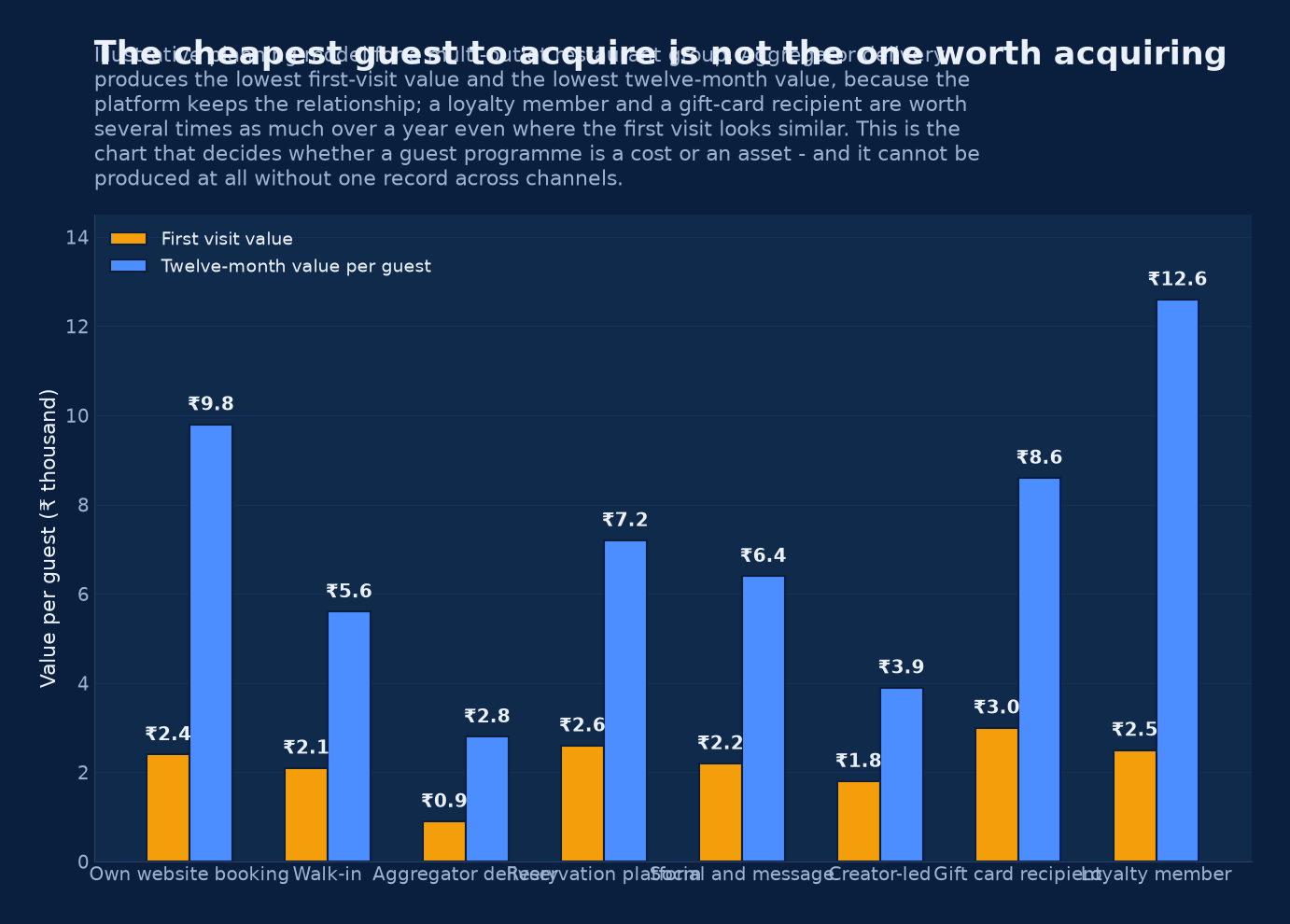
Chart values are an illustrative planning model based on typical UMC engagements and published industry benchmarks. They are not a guarantee of results on any specific project.
| Metric | Definition | Source | Reported to | What it decides |
|---|---|---|---|---|
| Known-guest cover share | Covers attributable to a resolved guest record divided by total covers | POS joined to the record | Leadership | How much of the business is actually visible |
| Repeat rate and interval | Guests returning inside the format’s interval, and the median gap | Visit history | Outlet and marketing | Whether the proposition retains or merely attracts |
| Guest value by channel | First-visit and twelve-month value per acquisition channel | Joined record | Leadership | Where acquisition spend should move |
| Journey conversion | Action rate per journey against an untouched control | Automation plus the record | Marketing | Which journeys to keep, fix or stop |
| Win-back yield | Recovered guests and their subsequent twelve-month value | Record | Marketing | Whether silence is reversible at what cost |
| Loyalty engagement | Share of transactions earning, redemption rate, tier migration | Loyalty ledger | Marketing and outlet | Whether the mechanic changes behaviour |
| Stored-value liability | Outstanding gift card and prepaid balances, plus breakage policy | Ledger reconciled to finance | Finance and leadership | How much of reported revenue is not yet earned |
| Contribution per cover | Average check less food, labour, discount and delivery cost | POS plus finance | Leadership | Whether the covers are worth buying |
| No-show and cancellation rate | Reservations lost, by source and daypart | Booking system | Outlet manager | Whether deposits and reminders are needed |
| Data quality | Duplicate rate, field completeness, consent coverage | CRM | CRM administrator | Whether any other number can be trusted |
| Complaint resolution | Time to resolution and whether the guest returned | Complaint log | Outlet manager | Whether service recovery retains or merely appeases |
- Two reports from one model: an outlet manager wants yesterday’s covers, no-shows, journey sends and complaints; a group head wants known-guest share, guest value by channel and contribution – executive dashboards rendered twice from one source.
- Forecasting covers, demand spikes and win-back timing is a modelling exercise on the joined record: predictive analytics and demand forecasting for rota and purchasing as well as for marketing.
- Owned channels and paid channels are not additive in a naive way, so a blended view misprices loyalty: marketing mix modelling and attribution with holdout groups per journey.
- The join is the work: one guest identifier from a reservation to a paid bill across POS, booking, aggregator and messaging – data warehouse discipline with a marketing deadline attached.
- A guest record also decides how you appear when somebody asks a machine where to eat, because consistent facts across profile, site and messaging are what those systems cite: AI search optimisation and search engine optimisation read the same record.
The record model by format
A fine-dining restaurant, a thirty-outlet QSR chain and a single cloud kitchen need different records, and the difference is not cosmetic – it changes what is captured, who may see it and which journey exists. Fine dining weights preferences, occasions and dietary notes because the relationship is personal; QSR and cloud kitchens weight order history and loyalty mechanics because the relationship is transactional and high-frequency; a cafe sits between the two. Designing one model and forcing it on every format is how programmes become unused.
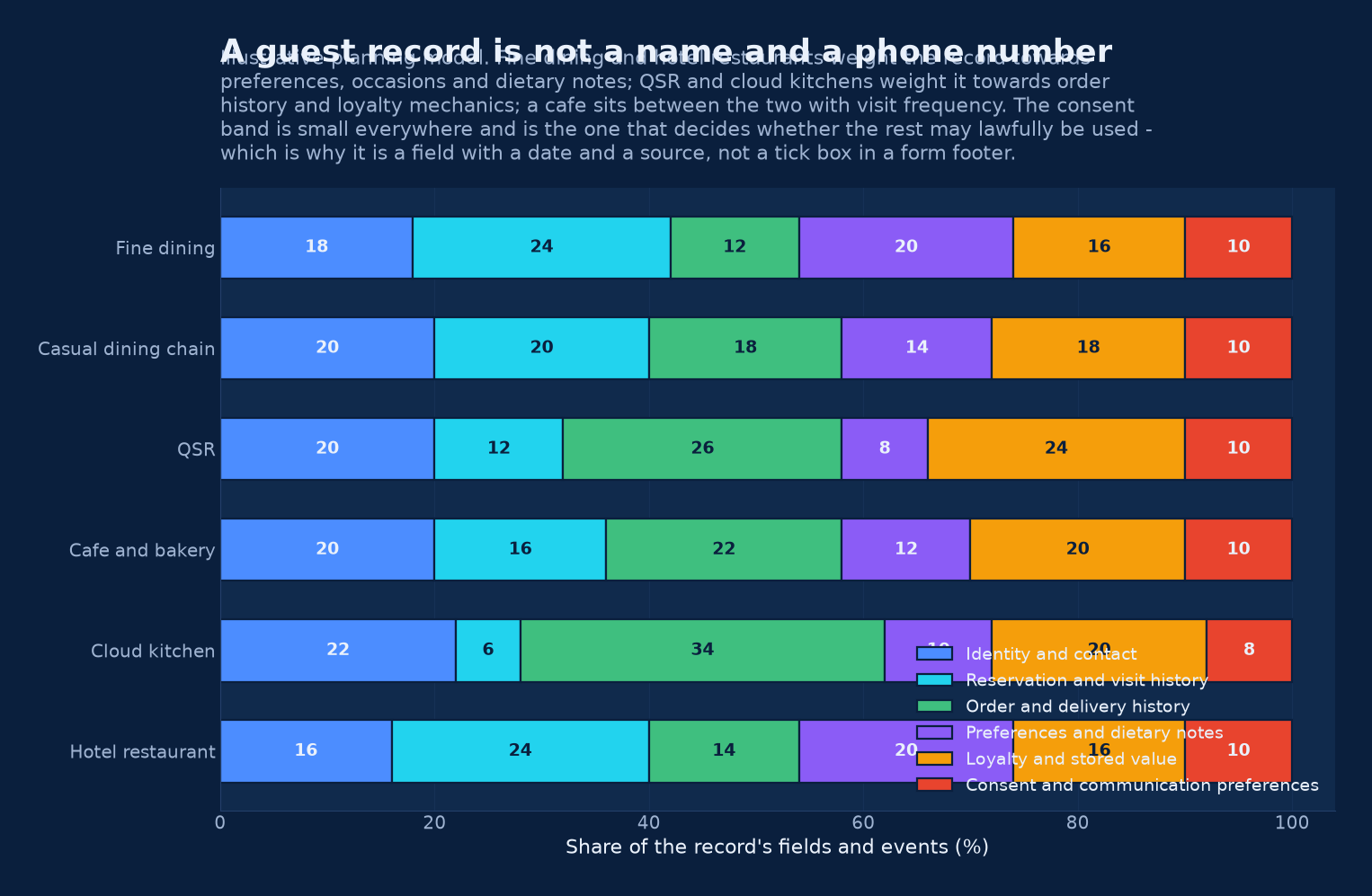
Chart values are an illustrative planning model based on typical UMC engagements and published industry benchmarks. They are not a guarantee of results on any specific project.
| Format | Identity priority | The fields that matter most | Dominant journeys | Loyalty mechanic that fits |
|---|---|---|---|---|
| Fine dining | A named guest with a history | Preferences, dietary notes, occasions, table preference, spend level | Occasion, personal follow-up, chef’s table invitations | Recognition rather than points – a membership or a hosted tier |
| Casual dining chain | A guest across outlets | Visit history per outlet, preferences, loyalty balance | Win-back, occasion, new outlet nearby | Frequency-based points earnable at any outlet |
| QSR | High-frequency transactional identity | Order history, favourite items, app login, delivery addresses | Reorder prompts, streaks, daypart offers | Simple earn-and-burn with visible progress |
| Cafe and bakery | Habitual local visits | Visit cadence, regular order, prepaid balance | Prepaid top-up, new item, quiet-daypart fill | Prepaid wallet plus a stamp mechanic |
| Cloud kitchen | Delivery identity only | Address, order history, platform versus own-channel share | Own-channel shift, repeat order, feedback | Own-channel discount plus a subscription for regulars |
| Hotel restaurant | A guest already known to the property | Stay linkage, in-house status, dietary notes, billing preference | In-stay prompts, post-stay return offers | Property loyalty with restaurant earn and burn |
| Bar and lounge | Late-night, walk-in heavy | Visit cadence, spend level, event interest | Event invitations, guest list access | Event-led with a stored-value wallet |
| Catering and events | A corporate contact plus an event history | Company, headcount, menus served, billing terms | Repeat event, seasonal corporate calendar | Account terms rather than consumer points |
| Franchise outlet | A guest visible to the franchisee within scope | Outlet-scoped history, group-level consent | Group occasions plus outlet-specific offers | Group mechanic with outlet attribution |
| Multi-brand group | One guest across brands | Cross-brand history, shared consent, brand preference | Cross-brand introduction, group occasions | Group wallet usable across brands |
- A hotel restaurant inherits a property record and a stay calendar, so the guest programme is shared rather than separate: the hotels and hospitality vertical runs the same discipline against rooms and covers.
- Retail and e-commerce loyalty differs in one crucial way – the basket is the unit rather than the visit – and the comparison is useful when a restaurant sells merchandise or meal kits: retail and e-commerce.
- A showroom-style appointment business has a much longer cycle and a named consultant, which is the other end of the spectrum from a QSR: showrooms and dealerships shows what a high-touch record looks like.
- In a group or franchise, who owns the guest – the brand or the outlet – has to be settled once and written down: unified top-level management deciding the boundary.
Paid acquisition and the guest record: audiences, exclusions and the shift to own channels
Once a guest record exists, paid media changes character. Instead of buying reach to strangers, you buy to segments with a known relationship: a first-visit audience that has not returned, a win-back cohort with a lapse interval, a lookalike built from guests who actually came rather than from people who clicked. You also exclude the guests who do not need an ad – which is the saving nobody makes – and you use the record to plan the deliberate shift of share away from channels that keep the guest’s identity.
| Use of the record | What it enables | What breaks without it | Measure |
|---|---|---|---|
| Retargeting by funnel stage | Menu viewers, booking abandoners and past guests get different creative and different offers | One broad audience receives the same discount regardless of relationship | Cost per cover by stage |
| Lookalikes from real guests | Expansion audiences seeded from resolved guests who returned | Seed lists of clickers who never visited | Twelve-month value of acquired guests by seed |
| Exclusions | Loyalty members and recent guests excluded from acquisition spend | Paying to acquire people you already serve | Wasted impressions and duplicate acquisition cost |
| Channel-shift planning | The share of covers from identity-owning channels tracked monthly | Aggregator dependence grows unnoticed until commission eats margin | Own-channel share of covers and orders |
| Offer targeting by value | Incentives sized to the guest’s value and lapse, not uniform | A flat discount given to a regular who needed none | Incremental margin per incentive rupee |
| Daypart and capacity signals | Paid paused when an outlet is full, boosted when it is not | Guests sent to a restaurant that turns them away | Turn-away rate from paid sources |
| Local intent capture | Near-me and cuisine searches answered by the outlet page, then joined to the record on arrival | A click that never becomes a guest you recognise | Bookings attributed per outlet |
| Creator and partnership measurement | A code or tracked page per creator, joined to first-visit value | Creator spend judged on reach alone | Cost per cover and twelve-month value by creator |
| Message audiences | Consented segments for WhatsApp, SMS and email journeys | Blast lists with no lawful basis | Consent coverage and unsubscribe rate |
| Test design | Holdout groups per journey and per campaign | Every result claimed as incremental | Measured lift against the holdout |
- Paid search and owned channels share one conversion definition and one guest identifier, so the sibling page sets the target this section is judged against: Google Ads for restaurants and the generic Google Ads management behind it.
- Automated inventory needs the same segmentation discipline – audience signals, outlet asset groups, exclusions, local goals: Performance Max management fed by a guest record rather than by defaults.
- Where the category supports it, Local Services Ads buy qualified calls and a call to an outlet is a cover worth recording.
- Social amplification runs on Meta and Instagram using the record’s segments and exclusions, with creator content whitelisted where it has already performed; organic social management supplies the proof: the restaurant social page explains the production side.
- Kitchen and chef stories are the format that earns a longer watch, so the record’s audience data decides who sees them: YouTube and video advertising plus influencer marketing management with tracked contribution.
- Local intent is won before the click, on a complete profile with reviews and accurate hours: local SEO and Google Business Profile management, with the outlet pages built by SEO for restaurants.
- Where each segment lands, and how paths are named so attribution survives, is architecture rather than taste: website strategy and information architecture.
- Most of this traffic arrives on a phone, and the record’s capture point is a thirty-second task on a small screen: mobile experience and the UX of a booking form decide how much of it becomes a guest.
- The media plan and the buying sit against the same intent map, which keeps creator work, search and social from double-counting a cover: media planning and buying.
- The estate that hosts all of it is usually WordPress with a booking widget and a loyalty store: full-stack WordPress development with scoped roles per outlet.
The technical estate behind a guest record
A guest programme is a distributed system with a hospitality calendar: a POS at every outlet, a booking widget, aggregator feeds, a messaging gateway, a loyalty store, a warehouse, dashboards and an automation layer – all of which must work on a Saturday night when the load is highest and the tolerance for failure is nil. The unglamorous requirements are the ones that decide whether the programme survives its first festive season.
| Component | What can fail | Control | How it is verified |
|---|---|---|---|
| POS integration | A vendor upgrade changes a field and visits stop arriving | A staging test before any upgrade, plus a daily row-count check | Automated reconciliation POS to CRM |
| Booking widget | A release breaks the confirmation email or the source field | Version pinning where possible, a synthetic booking test | Daily test reservation per outlet |
| Aggregator feeds | Terms change and a field disappears | Exception queue with an alert on volume drop | Daily feed volume check |
| Messaging gateway | A template is rejected or a number is throttled | Template approval workflow, fallback channel | Delivery rate monitoring per template |
| Loyalty and stored-value ledger | A balance drifts from the financial ledger | Double-entry discipline, a monthly reconciliation | Finance-signed reconciliation report |
| Automation layer | A journey fires without a consent check | Consent evaluated at send time, not at design time | Weekly suppression audit |
| Warehouse and joins | A deduplication rule merges two different guests | Manual merge queue with an audit trail, no silent auto-merge | Sampled merge review monthly |
| Dashboards | A metric defined differently in two reports | One data dictionary, metrics defined once | Quarterly definition review |
| Hosting and peak load | A festive evening slows the booking path | Autoscaling, a page-weight budget, load testing before peaks | Load test evidence plus field performance |
| Connectivity at outlets | A link drop loses orders and loyalty scans | Redundant links and offline-capable capture | Uptime per outlet and offline queue drains |
| Security and access | An over-privileged account exports the guest list | Least privilege, MFA, logged exports, leaver process | Quarterly access review |
| Backup and recovery | A restore fails when it is needed | Backups with timed restore tests | Restore evidence per quarter |
| Vendor management | A platform’s support terms change or it exits the market | Data export rights in the contract, an exit plan | Annual vendor review |
- Peak capacity, autoscaling and a media-heavy booking path are infrastructure decisions with a hospitality calendar: cloud services and migration sized for a festive Saturday rather than for average traffic.
- Outlets, not just head office, are part of the estate – a link drop loses orders and loyalty scans: network engineering plus managed IT infrastructure covering every site.
- The people operating the record need support with a rota and a response target, otherwise quality decays within a quarter: helpdesk and end-user support.
- Tooling, message credits, seats and platform subscriptions drift upward with outlet count and list size: cloud cost optimisation and FinOps applied to a martech stack.
- The estate needs ordinary maintenance – plugin and platform updates, broken links, expired certificates, API changes – with a named owner: web application maintenance and support.
- Cyber controls are the same as elsewhere in the business, with the guest list as the prize: cybersecurity services and backup and disaster recovery with tested restores.
- Where the record has to exchange data reliably with finance, inventory and HR systems, the integration pattern matters more than the tool: ERP, CRM and operations integration with retries and an audit log.
Multi-outlet and franchise governance
In a group, the guest record raises a question that no tool answers: who owns the guest. If the brand owns them, a franchisee cannot market to their own regulars; if the outlet owns them, the group cannot run a national programme or introduce a guest to a sister brand. The workable answer is layered – the group holds identity, consent and the loyalty mechanic; the outlet holds service notes and local campaigns within the group’s rules – with access scoped by outlet, attribution preserved, and an escalation path for a complaint that crosses the boundary.
| Decision | Group holds | Outlet holds | Why the split matters |
|---|---|---|---|
| Guest identity | The resolved record and the merge rules | Nothing – outlets contribute facts to it | One guest across the estate, no duplicate records |
| Consent | The consent state, its history and the preference centre | Capture at the point of contact | A lawful send anywhere depends on one source of truth |
| Loyalty mechanic | Points, tiers, wallet, expiry rules | Redemption at the counter, honestly | A guest is not penalised for choosing another outlet |
| Service notes and preferences | Nothing beyond policy | Table preference, dietary notes, occasions | Local knowledge is what makes recognition feel real |
| Campaigns | National and brand campaigns | Local campaigns inside the template and the claims rule | Local relevance without brand drift |
| Offers and pricing | Approved offer structures and margin floors | Application within the outlet’s capacity | No outlet discounts itself into a loss |
| Reporting | Group model and definitions | Outlet view of their own numbers | Comparison that is fair and actionable |
| Access | Role definitions and the access review | Named users within their scope | Least privilege with an audit trail |
| Complaints | Escalation policy and reputational threshold | First response and resolution | Speed locally, consistency at group level |
| Franchise and licensing | The standard, the audit and the support model | Delivery of the standard | A franchisee can operate the programme without rebuilding it |
- The ownership boundary is a governance decision taken once at group level and then enforced in the tool: unified top-level business management with marketing and operations inside it.
- Opening an outlet should include a CRM checklist – capture points trained, loyalty enabled, journeys scoped, reporting switched on – so a new site is not invisible for a quarter: market expansion consulting with the guest programme on the critical path.
- Onboarding outlets at speed needs people who know the workflow rather than more documentation: IT and creative staff augmentation for a launch window.
- Where franchisees need a scoped view of their guests and their reporting, that is an authenticated surface with role-based access: portal development.
- The public estate has to carry the same facts as the record – hours, menus, outlets – or the guest experience contradicts itself: the sibling SEO for restaurants page and website development for restaurants keep the two consistent.
The ninety-day guest CRM and loyalty programme, and what we need from you
The programme below is the shape we run for a restaurant, a cafe group or a multi-outlet chain: three weeks to design the record model and the consent position, overlapping identity work from week one because everything inherits it, capture points and outlet workflow from week three, loyalty and stored value from week six, journeys from week eight, the corporate and catering pipeline from week ten, and reporting, governance and handover to the end.
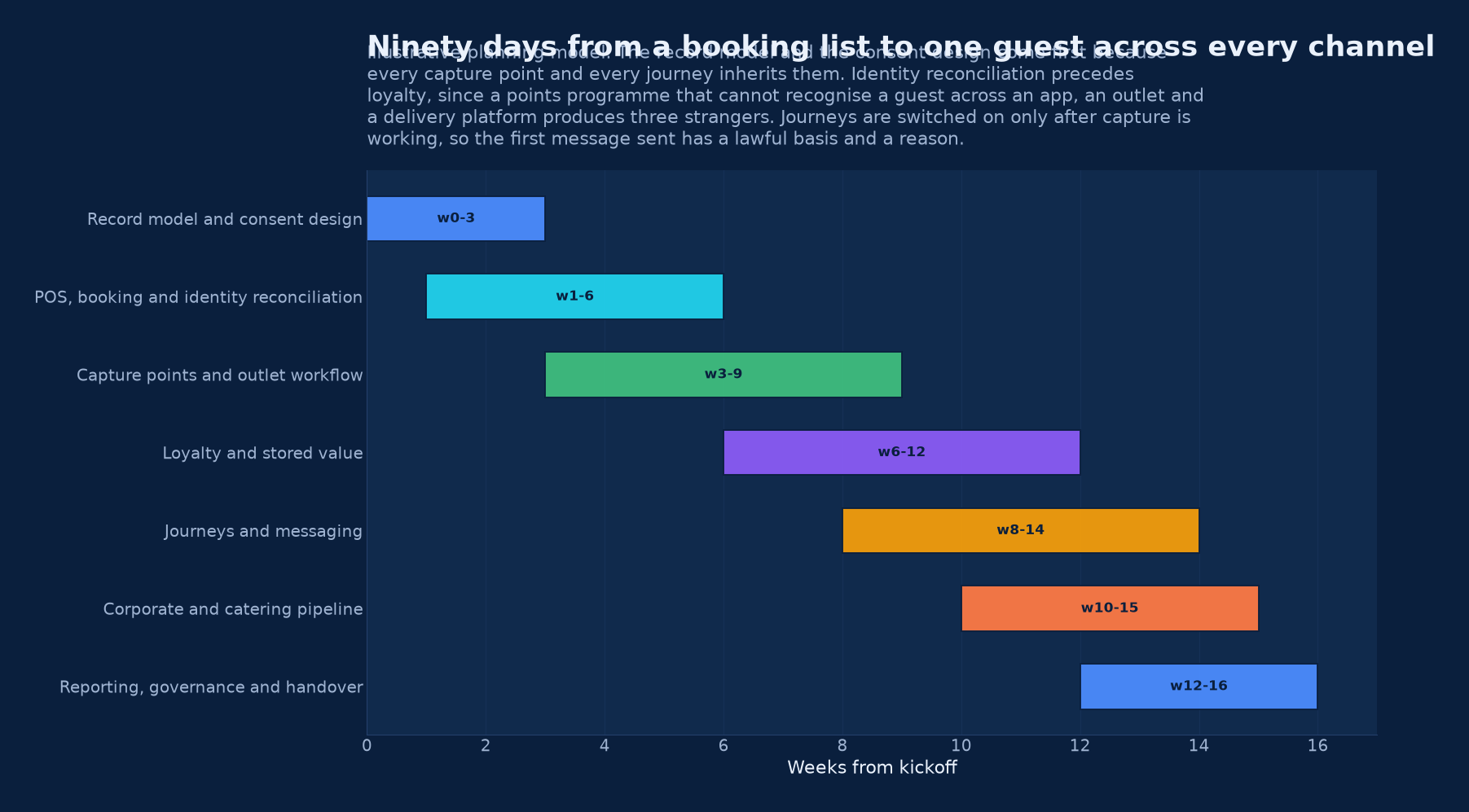
Chart values are an illustrative planning model based on typical UMC engagements and published industry benchmarks. They are not a guarantee of results on any specific project.
| Weeks | Workstream | Deliverable | Decision it enables |
|---|---|---|---|
| Zero to three | Record model and consent design | Field model by format, consent position per channel, retention rules, access model, data dictionary | What is captured, why, for how long and by whom |
| One to six | POS, booking and identity reconciliation | Integration map, resolution and merge rules, exception queue, baseline data quality report | Whether one guest can be recognised across channels |
| Three to nine | Capture points and outlet workflow | Reservation source field, walk-in and waitlist capture, table QR, host-stand view, outlet training | How much of the business becomes visible, and at what friction |
| Six to twelve | Loyalty and stored value | Mechanic, tiers, earn and redeem rules, gift card store, ledger reconciliation, fraud controls | What guests earn, what the group owes, and how it is honoured |
| Eight to fourteen | Journeys and messaging | Trigger map with consent checks, frequency caps, channel choice per journey, templates, holdout groups | Which messages send, to whom, and what they return |
| Ten to fifteen | Corporate and catering pipeline | Stages, owners, quote templates, deposit and confirmation flow, a client portal where useful | Whether event demand becomes forecastable revenue |
| Twelve to sixteen | Reporting, governance and handover | Two dashboards from one model, quality routines with owners, access and export review, documentation, training | Who runs it, on what rules, and how it is reviewed |
- What we need: POS and booking system access with a technical contact, twelve months of transaction and cover history, the outlet list with a named manager per outlet, existing guest data in whatever form it exists, the current loyalty or gift card arrangements and their ledger, aggregator terms where they affect data sharing, and one decision-maker who will settle the consent position and the group-versus-outlet ownership boundary.
- What you keep regardless: the record model and data dictionary, the consent and retention position, the identity resolution and merge rules, the loyalty mechanic and ledger design, the journey trigger map with holdouts, the corporate pipeline design, the dashboards and the governance routines. They are yours.
- What we will tell you plainly in week three: how much of your business is currently invisible, which existing data is not worth migrating, and whether your loyalty mechanic is worth fixing or replacing – usually the second.
Guest CRM by city, and worked examples
Guest programmes are built differently in different cities: delivery-aggregator dependence, outlet density, corporate demand, festive calendars and language preferences all change the record model and the journey set. The engagements below are hospitality, food-service and multi-outlet projects where guest data, loyalty and measurement were built as one programme.
- Get more restaurant customers in Lucknow
- Digital marketing company for restaurants in Lucknow
- Website development company for restaurants in Lucknow
- Services across Indian cities
- Case study: social media advertising for a green hotel and resort
- Case study: The Fern hotel, Hyderabad
- Case study: Marriott hotel, Hyderabad
- Case study: WordPress development for a green hotel and resort
- The restaurants and food service industry hub – all eight disciplines
- Hotels and hospitality: guest records across rooms and covers
- Retail and e-commerce: basket-led loyalty and lifecycle marketing
- Showrooms and dealerships: appointment-led CRM and long cycles
- All industry verticals we build programmes for
- All digital marketing services
- All technology services
- All business consulting services
- About Unified Management Consulting
- Contact us about guest CRM and loyalty for restaurants
Where this page sits in our restaurants programme
Guest CRM and loyalty is the fifth discipline of our restaurants and food service programme. The hub page explains how the eight disciplines fit together, each discipline has its own page as it is published, and the generic service page for every discipline stays listed below alongside the vertical pages. A discipline that is not listed is not published yet – the list is generated from live pages and refreshes automatically as each spoke lands.
- Restaurants – the vertical main page
- Website development for restaurants
- SEO for restaurants
- Google Ads for restaurants
- Social media marketing for restaurants
- Business intelligence for restaurants
- IT support for restaurants
- AI for restaurants
- Website development services – the generic service page
- SEO services – the generic service page
- Google Ads management – the generic service page
- Social media management – the generic service page
- BI dashboards and executive reporting – the generic service page
- Managed IT infrastructure and AMC – the generic service page
- AI agent deployment and automation – the generic service page
Frequently asked questions about guest CRM and loyalty for restaurants
Do we really need a CRM, or is our POS enough?
A POS records transactions; it does not resolve a guest across a reservation, a walk-in, an app order and a gift card. If you cannot answer what share of your covers came from a guest you recognise, or what a guest acquired on a delivery platform is worth a year later, the POS is not enough. The record is the asset; the CRM is where it lives.
Can we get guest data from delivery aggregators?
Only what their terms allow, which is usually an order reference and a masked contact – enough to fulfil, not enough to market to. Treat aggregator orders as transactions with a revenue consequence and plan the deliberate shift of share toward channels where the identity is yours: own-channel ordering, a table QR, a loyalty signup, a reservation.
What loyalty mechanic works for a restaurant?
One a server can explain while the guest waits. Points or stamps earnable wherever the guest actually transacts, visible immediately, redeemable without an argument, with tiers that reward frequency rather than spend alone. Avoid category multipliers, blackout dates and expiry rules nobody communicates.
Are gift cards worth the effort for a restaurant?
Yes, when they are digital, redeemable across outlets, with partial balances allowed and a stated, lawful expiry rule. They bring cash before the guest arrives, introduce a new guest through a trusted giver, and carry measurable breakage. They are also a liability until redeemed, so the accounting matters as much as the store.
How do we capture a walk-in guest without annoying them?
One question with a visible benefit – a phone number for the table or the waitlist, a QR at the table after the meal that asks for a rating and offers loyalty. Never make it a condition of service, and record verbal consent where you rely on it. Friction is what kills capture, not guest reluctance.
What consent do we need to message guests on WhatsApp?
A lawful basis per channel, captured with a date and a source, honoured by a preference centre the guest can use without calling, with suppression applied everywhere and retention rules that actually delete. Payment or booking data is not marketing consent, and a business number must be owned by the company rather than by an employee.
How should dietary and allergy information be handled?
As sensitive and operationally consequential data: a separate field, access scoped to kitchen and service staff, never exported in bulk, reconfirmed periodically rather than accumulated forever, and always accompanied by an honest cross-contamination statement. It is the one part of a guest record where an error has physical consequences.
Can outlets see their own guests?
They should – within scope. An outlet manager needs their guests’ visit history, preferences and complaints to run a service; they do not need the group’s full list or another outlet’s data. Role-based access by outlet, with logged exports, is the standard answer for groups and franchises.
How do we stop duplicate guest records?
A resolution rule – exact match on phone or email, probabilistic match on name plus outlet plus interval – feeding a manual merge queue with an audit trail. Silent automatic merges destroy trust in the record, because two different guests end up sharing one allergy note.
What should a restaurant measure on its guest programme?
Known-guest cover share, repeat rate and interval, guest value by acquisition channel over twelve months, journey conversion against a holdout, win-back yield, loyalty engagement and redemption, outstanding stored-value liability, no-show rate, and contribution per cover. List size proves nothing.
How does a guest record help our advertising?
It turns broad reach into segments: retargeting by funnel stage, lookalikes seeded from guests who returned, exclusions so you stop paying to acquire people you already serve, and daypart signals that pause spend when an outlet is full. Without it every campaign is judged on clicks rather than covers.
How long does it take to build?
About ninety days to a working programme: three weeks for the record model and consent position, identity reconciliation and integrations to week six, capture points and outlet training to week nine, loyalty and stored value to week twelve, journeys to week fourteen, and reporting, governance and handover by week sixteen. A single venue moves faster; a franchise estate takes longer at the governance step.
Start with the record model and the consent position
Give us three weeks with POS and booking system access plus a technical contact, twelve months of transaction and cover history, the outlet list with a named manager per outlet, your existing guest data in whatever form it exists, the current loyalty or gift card arrangements and their ledger, aggregator terms where they affect data sharing, and one decision-maker who will settle the consent position and the group-versus-outlet ownership boundary, and we will return a field model by format with a retention rule per field, a consent position per channel, identity resolution and merge rules with an exception queue, a capture-point plan with friction measured, a loyalty and stored-value design reconciled to finance, a journey trigger map with consent checks and holdout groups, a corporate and catering pipeline, and two dashboards from one model that report known-guest cover share and guest value by channel – including how much of your business is currently invisible. Yours to keep either way.
Contact Unified Management Consulting to arrange a confidential first conversation.