
Restaurant search demand is local, immediate and mostly mobile: somebody nearby, hungry or planning, deciding within the hour or the week, on a phone. That makes it the highest-intent demand a food business can win, and the most unforgiving – a wrong opening hour, a menu with no prices, a review left unanswered for a month, or a listing that disagrees with the website costs covers the same evening.
The work is therefore less about keywords than about facts and pages: one accurate page per outlet, a menu held as data with structured markup, a review engine that generates and answers, citations that agree with the site, and a page for each intent that actually arrives. That is local SEO and Google Business Profile management plus technical and growth SEO applied to an estate whose content changes twice a day, and it is measured in covers per outlet rather than in rankings.
What an engagement includes, at a glance
| Component | What We Deliver |
|---|---|
| The intent map, and a page for each intent | Brand, cuisine and dish, ‘near me’, occasion, locality, delivery, comparison and story – each with the page designed for it, rather than one menu page hoping to catch all eight. |
| Outlet pages and business profile discipline | One page and one profile per outlet, with name, address, phone and hours identical across both and across every citation – the single largest local signal a multi-outlet estate controls. |
| Menu, dish and cuisine architecture | Menu records rendered as indexable pages with prices, allergens and per-outlet scope, plus dish and category pages that answer cuisine-level demand without thinning the site. |
| Reviews: velocity, response and recovery | A generation routine per outlet, a response workflow with an owner and a target, complaint escalation, and a policy that never incentivises or filters dishonestly. |
| Structured data and AI answer surfaces | Restaurant, Menu, OpeningHours, Geo and AggregateRating markup generated from the same records as the page, so search engines and AI assistants quote facts that are true. |
| Aggregators and the visibility you do not own | How delivery platforms, map services and review sites shape your demand, what you can control, and how to convert platform discovery into a direct relationship. |
| Technical: crawl, indexation and performance | Outlet and menu pages indexed deliberately, duplicates controlled, image-heavy templates fast on mobile, and multi-language or multi-city handling done properly. |
| Content, occasions and digital PR | Festive menus, chef and sourcing stories, neighbourhood and occasion pages, and coverage that earns authority without buying it. |
| Measurement and governance | Rankings joined to sessions, calls, bookings and covers per outlet, with a publishing model that says who may change a menu, an hour or a review response. |
What restaurant SEO actually competes for
Restaurant search is not one competition. A brand query is a navigation problem; a ‘near me’ query is a proximity and reputation problem answered largely by a map pack; a dish query is a content problem; a delivery query is a platform problem where you may not own the ranking at all. Treating them as one keyword list produces a site with a lot of pages and very few covers. The useful starting point is to separate the intents, decide which page should win each, and accept that some of them are won off-site.
| Characteristic of the demand | What it means for the programme | Common mistake |
|---|---|---|
| Decisions are made within hours, not weeks | Hours, availability and booking paths matter more than editorial depth | A content calendar with no operational facts kept current |
| Proximity dominates the answer | One accurate page and profile per outlet, with real distances and directions | A single city page trying to rank for every neighbourhood |
| The map pack decides before the website | Business profile completeness, categories, photos and reviews are primary assets | Treating the profile as a directory entry rather than a page |
| Menus are queried by dish, not by restaurant | Dish and cuisine pages with prices and outlet scope | A menu PDF that cannot be indexed or filtered |
| Reputation is read before the click | Review volume, recency and visible responses shape the decision | Reviews collected and never answered |
| Photography sets the expectation | Image-heavy templates that still load fast on mobile data | Beautiful pages that take five seconds to paint |
| Platforms own part of the results page | Aggregator listings and delivery apps appear above you for order intent | Competing on a channel where the platform decides the ranking |
| Seasonality is weekly and festive | Offer, festive and occasion pages published ahead of demand | Content published after the window has passed |
| Multi-outlet estates multiply every problem | Template discipline, per-outlet data and a publishing model | Hand-built pages per outlet that drift apart |
| Answer surfaces quote facts, not prose | Structured data generated from the same records as the page | Markup added by hand and contradicting the visible content |
- Which page should win which query is an architecture decision taken before content is written: website strategy and information architecture with a search brief attached.
- What the local market actually searches for – dish terms, neighbourhood terms, occasion terms – is evidence rather than intuition: market research and competitive analysis on demand and competitor positioning.
- SEO cannot fix a page that has no booking path, so the sibling discipline is a co-requisite: website development for restaurants builds the surfaces this programme ranks.
The intent map: eight queries, eight pages
The map below is the planning artefact we start with. Each intent gets a page type, a template, a content requirement and a conversion path – and each gets a metric that is not a ranking. Where two intents share a page, one of them loses; where an intent has no page, a competitor or an aggregator answers it instead.
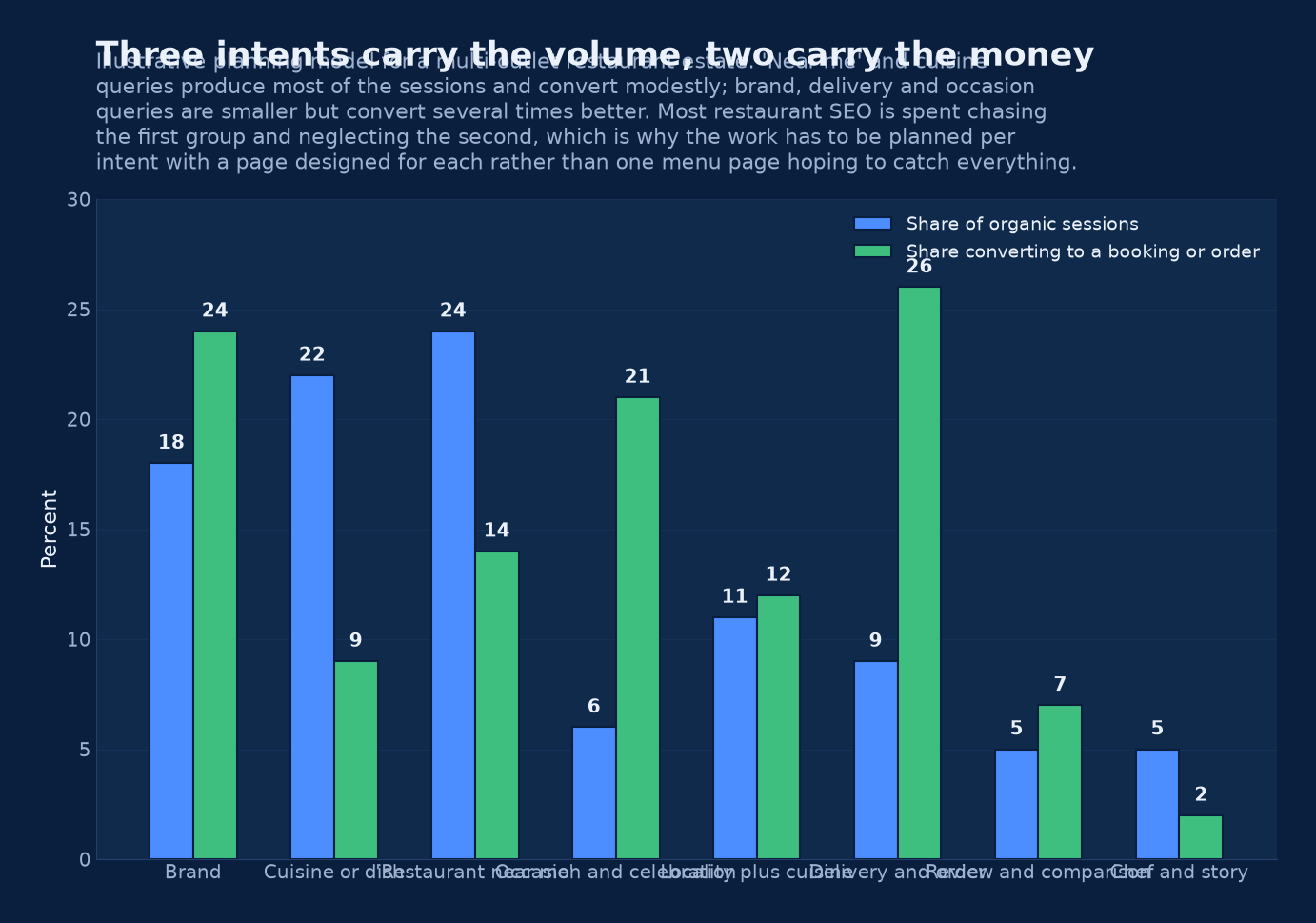
Chart values are an illustrative planning model based on typical UMC engagements and published industry benchmarks. They are not a guarantee of results on any specific project.
| Intent | Example queries | The page that should win | Content requirement | Conversion path |
|---|---|---|---|---|
| Brand | Restaurant name, name plus city, name plus outlet | Homepage and the relevant outlet page | Recognition, hours, address, a bookable next step | Reserve, order, call |
| Cuisine or dish | Biryani near me, dim sum, vegan breakfast, best butter chicken | Dish or cuisine category page listing outlets that serve it | The dish, its price, allergens, and where it is served | Choose an outlet, then reserve or order |
| ‘Near me’ and proximity | Restaurants near me, cafes open now, family restaurant nearby | Outlet page plus the business profile and map listing | Distance, hours today, rating, parking, a photo of the actual space | Directions, call, reserve |
| Occasion and celebration | Birthday dinner, anniversary restaurant, private dining, group table | Occasion or private-dining page | Set menus, price per head, capacity, deposit policy, a coordinator | Enquiry or booking with an occasion note |
| Locality plus cuisine | Restaurants in Gomti Nagar, cafes in Hazratganj, fine dining in Indiranagar | Locality landing page with outlets and dish links | Real local facts, not adjectives; links to outlet and menu pages | Reserve at the nearest outlet |
| Delivery and order | Order food online, restaurant delivery near me, cloud kitchen menu | Order page with a pincode check first | Coverage, honest window, menu with modifiers, payment options | Basket to paid order |
| Review and comparison | Is X restaurant good, X versus Y, X reviews | Outlet page with visible reviews and a response record | Honest aggregate rating, recent reviews, answered complaints | Reserve or order after the trust check |
| Chef, story and press | Chef name, restaurant sourcing, farm to table, awards | Editorial page with authorship and links to outlets | A real story with facts, not a press release | Reserve, or subscribe for events |
- Each page type needs a template with a designed conversion path, which is UX and UI design work measured by completions rather than by taste.
- The pages that answer dish and occasion intent have to be written by somebody who knows the food, at a cadence the business can sustain: content marketing strategy with a local brief.
- Photography-led templates must not lose the mobile user, so performance is part of the template specification: Core Web Vitals budgets per page type.
- Some intents are won by paid rather than organic in the short term – a new outlet or a festive window – and the two should be planned together, which is what Google Ads management does with the same intent map.
Outlet pages and business profile discipline
For a multi-outlet restaurant, the outlet page and its business profile are the ranking asset. The discipline is dull and decisive: one page and one profile per outlet, identical name, address, phone and hours across both and across every citation, categories chosen for what the outlet actually is, photographs of the real space, and attributes – parking, accessibility, dietary options, price range – filled in completely. Incomplete or contradictory profiles are the most common reason a chain’s outlets do not appear for the neighbourhoods they serve.
| Element | Requirement | Failure mode | How it is kept true |
|---|---|---|---|
| One profile per outlet | A verified listing per physical location, no duplicates | Two profiles for one outlet, splitting reviews and authority | A profile register with an owner per outlet |
| Name consistency | The trading name, without keyword stuffing or city suffixes | A name that differs between site, profile and citation | One record generating every surface |
| Address and map pin | Exact address, correct pin, floor and landmark where relevant | A pin in the wrong place sending guests to a mall entrance | Pin verified on the ground per outlet |
| Phone number | The outlet’s number, answered during service hours | A call centre number that cannot take a reservation | Number per outlet, tested monthly |
| Opening hours | Hours per day with festival and special exceptions | Hours that changed last month and were never updated | Hours as data with a scheduled exception calendar |
| Categories | Primary category matching the format, plus accurate secondaries | A cafe categorised as a bar, or a QSR as fine dining | A category standard per format |
| Attributes | Price range, dietary options, parking, accessibility, reservations, delivery | Empty attributes losing a filter-based result | Attribute checklist per outlet, reviewed quarterly |
| Photographs | Real interior, exterior, dishes, team – refreshed periodically | Stock imagery or one photo from opening day | A shot list per outlet with a refresh cycle |
| Menus and links | A menu link to the outlet’s own menu page, plus booking and order links | A PDF menu uploaded to the profile and never updated | Links generated from the site’s outlet page |
| Questions and answers | Seeded with the real questions guests ask, answered promptly | An unanswered question about parking or a minimum order | An FAQ list per outlet, monitored weekly |
| Posts and updates | Offer, event and menu updates published to the profile | A profile that looks abandoned | A publishing calendar shared with the site |
| Review handling | Responses from the outlet, escalated complaints, no incentivised reviews | Reviews accumulating unanswered for months | A response workflow with a named owner per outlet |
- Profile and citation management is a specialist discipline with its own tooling and cadence: local SEO and Google Business Profile management covering every outlet.
- Consistency is auditable rather than aspirational – a quarterly check of name, address, phone and hours across site, profile and citations produces evidence, in the same spirit as an IT audit and compliance review.
- Where hours, menus and outlet facts are held in one place and pushed to the site, the profile and the feeds, drift stops being inevitable: systems integration between the CMS and the listing surfaces.
Menu, dish and cuisine architecture
Dish-level demand is where most restaurant SEO fails, because the menu is treated as a document rather than as a set of answerable questions. A menu held as records can be rendered as an indexable menu page per outlet, as dish and cuisine category pages that link to the outlets serving them, and as structured data that a search engine can quote with a price. The architecture question is how deep to go: too shallow and dish queries land on a generic menu; too deep and a chain of forty outlets publishes four thousand thin pages that dilute each other.
| Page type | What it covers | When it earns its place | Risk if done badly |
|---|---|---|---|
| Menu page per outlet | All courses and dishes with prices, allergens, availability | Always – it is the outlet’s core commercial page | A PDF or image version that cannot be indexed |
| Menu page per daypart | Breakfast, lunch, dinner, brunch, late night | Where the offering genuinely differs by service | Duplicate menus competing with each other |
| Cuisine or category page | A cuisine, a format or a dietary category across outlets | Where there is real demand and several outlets to link | A category page listing one outlet in one city |
| Dish page | A signature dish with its story, price and where it is served | For a small number of genuinely notable dishes | Thousands of thin dish pages with no unique content |
| Set menu and tasting page | Fixed-price menus, tasting menus, thali, platters | Where they drive bookings and occasions | A set menu buried inside a long menu page |
| Offer and festive page | Festive menus, seasonal promotions, holiday hours | Published ahead of each window, retired after | Expired offers left live and indexed |
| Private dining and events | Capacity, menus, deposit, coordination | Where events are a real revenue line | An enquiry form with no capacity facts |
| Catering and bulk orders | Minimums, lead time, menu options, coverage | Where corporate demand exists | Catering handled by the reservation widget |
| Delivery and coverage page | Pincodes served, windows, fees, platforms | Where own-channel delivery operates | A delivery promise the outlet cannot keep |
| Outlet index and locator | All outlets with filters by city, format and feature | Always, for chains | An index that duplicates every outlet page’s content |
- The depth decision is an architecture decision with a maintenance cost attached, and it should be made with the estate’s real publishing capacity in mind – the same content model the website programme installs.
- For most restaurants the practical build is a structured WordPress estate: full-stack WordPress development with menu records, taxonomy and schema generated from the same data.
- Dish and category pages have to be internally linked from outlet pages and vice versa, or authority never reaches them – information architecture and internal linking as one exercise.
- A menu held as records is also the asset an AI answer surface quotes, so the same work serves AI search optimisation without a separate project.
Reviews: velocity, response and the reputation flywheel
Reviews decide the click before the website is ever seen, and they accumulate whether or not anybody manages them. What is manageable is velocity – how often guests are asked, at the moment they are happiest – consistency across outlets, and the response record that a prospective guest reads to judge how a complaint will be handled. A review engine is an operational routine with a named owner per outlet, not a marketing campaign, and the rule that keeps it lawful and credible is that it never filters, incentivises or fabricates.
| Element | What good looks like | Failure mode | Control |
|---|---|---|---|
| Ask timing | At the moment of satisfaction – after the meal, or on delivery completion | A batch email three days later | A trigger from the booking or order system |
| Ask channel | The channel the guest used, with one tap to the right platform | A printed card with a long URL | QR code or message link per outlet |
| Velocity per outlet | A stated minimum per month per outlet, tracked | Group-level reviews hiding a weak outlet | Outlet-level review dashboard |
| Response rate and time | Every review answered, negative ones within twenty-four hours | Positive reviews answered, complaints ignored | A response workflow with an owner and a target |
| Response quality | Specific, human, no templates that read as templates | A copy-pasted thank you on every review | Guidance plus sampled review of responses |
| Complaint escalation | A negative review routed to the outlet manager and resolved offline | A public argument with a guest | Escalation rule and a resolution log |
| Fake and incentivised reviews | None requested, none filtered, suspicious ones reported | Discounts for five stars, or selective asking | A written policy and platform reporting route |
| Aggregation on site | Outlet-level ratings shown with a link to the source | A group average that misrepresents an outlet | Markup generated from real, current data |
| Review content as insight | Themes extracted per outlet: service, wait time, taste, value | Reviews read only when something goes wrong | A monthly theme review feeding operations |
| Consistency across platforms | The same facts on every platform the guest checks | Hours on one platform contradicting the profile | A single source of truth pushed everywhere |
- The ask and the response are messaging operations with consent attached – WhatsApp, SMS and email triggered by a visit or an order, run from marketing automation rather than by hand.
- Reviews are also reputation management on social surfaces, where a comment or DM is a public review in all but name: organic social management with the same response discipline.
- A review that identifies a guest should reach their record so service recovery is possible and the next visit is better – which is a CRM function, not a marketing one.
- Review themes are operational intelligence: repeated complaints about wait time at one outlet are a staffing or capacity signal, and they belong in the dashboard set rather than in a marketing report.
Structured data and the answer surfaces that quote you
Restaurant markup is unusually well specified and unusually well used by search engines, because the facts are commercial: what you serve, what it costs, when you are open, where you are, how guests rate you. Markup generated from the same records that render the page cannot drift; markup added by hand eventually contradicts the visible content and is worse than none. The same data is what an AI answer surface reads when it summarises ‘good places for dinner near X tonight’ – a query that no longer produces a click on your homepage.
| Markup | What it declares | Where it lives | What breaks if it is wrong |
|---|---|---|---|
| Restaurant or LocalBusiness | Name, address, geo, phone, price range, serves cuisine | Every outlet page | A listing that cannot be matched to the site |
| OpeningHoursSpecification | Hours per day plus special opening and closures | Outlet page, generated from the hours record | A guest travelling to a closed outlet |
| Menu, MenuSection, MenuItem | Courses, dishes, descriptions, prices | Menu pages per outlet | Search showing a dish or price that does not exist |
| Offer | Promotions, set menus, validity, eligible outlets | Offer and festive pages | An expired offer circulating in results |
| AggregateRating and Review | Rating value, count, individual reviews where shown | Outlet pages, from real data | A rating that contradicts the platform – a manual action risk |
| Geo and AreaServed | Coordinates and delivery coverage | Outlet and delivery pages | Delivery queries answered for pincodes you do not serve |
| Organization and Brand | The group, its outlets and its logos | Site-wide | Brand queries answered by an aggregator |
| Article and Person | Chef, story and press pages with authorship | Editorial pages | Story queries landing on a third party |
| FAQPage | The questions guests actually ask – parking, minimum order, dress code | Outlet and menu pages, only where the answers are visible | Markup without visible content, which is a spam signal |
| Breadcrumb and WebSite | Navigation structure and sitelinks search | Site-wide | A confusing result presentation and weak internal structure |
- Markup should be generated, validated and monitored like any other output of the content model – part of technical SEO rather than a one-off plugin configuration.
- AI answer surfaces read facts, so structured data plus consistent citations is the optimisation: AI search optimisation and AIEO services is the discipline that measures whether you are quoted at all.
- Where a schema change has to reach hundreds of outlet pages at once, it is a deployment with a test path and a rollback – systems integration and release discipline rather than a manual edit.
- Markup that contradicts the visible page is worse than no markup, so validation belongs in the publishing workflow with an auditable record of what shipped.
Aggregators, platforms and the visibility you do not own
A large share of restaurant demand is answered on surfaces a restaurant does not control: delivery apps, map services, review platforms, listicles and increasingly AI assistants that quote third parties. That is not a reason to ignore them – it is a reason to manage them as channels with their own economics. The listing is an asset; the guest relationship and the margin are the things worth recovering, and the website is how a platform-discovered guest becomes a direct one.
| Surface | What it controls | What you can influence | How to convert it |
|---|---|---|---|
| Delivery aggregators | Order-intent rankings, pricing pressure, guest data | Menu accuracy, photography, ratings, promotion participation | An insert, a loyalty offer and a direct order path for repeat guests |
| Map services | Proximity results, hours, directions, calls | Profile completeness, categories, photos, review responses | A bookable outlet page linked from the profile |
| Review platforms | The trust layer read before any click | Velocity, responses, accuracy of facts | A response record that demonstrates service recovery |
| Reservation platforms | Table inventory and occasion demand | Capacity accuracy, deposit policy, special requests | Guest history captured at the table for a direct relationship |
| Food blogs and listicles | Discovery for occasion and cuisine queries | Press relationships, accurate facts, imagery | A landing page per mention with a bookable path |
| AI answer surfaces | Summaries of ‘best X near Y’ with citations | Structured data, citation consistency, review signals | Being the quoted source rather than the omitted one |
| Social discovery | Impulse demand from food content and creators | Content quality, creator relationships, tagged outlets | A tracked landing page per creator or campaign |
| Local directories and citations | Consistency signals behind local ranking | Accuracy and completeness across the set that matters | Nothing directly – they support the profile |
| Corporate and institutional channels | Bulk and catering demand | A catering page, lead times, minimums, invoicing | A catering enquiry path with a named coordinator |
| Tourism and hotel concierge | Visitor demand with no local knowledge | Listings, partnerships, accurate hours and location facts | A visitor-friendly outlet page with directions |
- The commission and margin question behind aggregator dependence is a commercial decision with a website dependency: cost rationalisation and margin recovery framed around contribution per order by channel.
- Own-channel ordering changes the cash cycle as well as the margin – money at order rather than at settlement – which is a working capital argument that finance will fund.
- Order-intent queries are often won faster with paid than with organic: Performance Max with local goals and Local Services Ads where supported, planned alongside the organic intent map.
- The paid discipline has its own page in this cluster – Google Ads for restaurants – and it shares the same landing surfaces, the same conversion definitions and the same cost-per-cover target.
- Where ordering is built on the site, it is commerce engineering: baskets, modifiers, payments, refunds and order states, which is e-commerce development applied to a forty-minute fulfilment window.
Citations, consistency and the unglamorous NAP problem
Citations are the least exciting work in local search and among the most consequential for a multi-outlet estate, because inconsistency is read as uncertainty. A chain with forty outlets typically carries several hundred listings – directories, food platforms, local guides, old press mentions, a previous owner’s entry – and a meaningful share of them disagree with the website about the name, the address, the phone number or the hours. The repair is a finite project: find them, fix the ones that matter, close the duplicates, and put the rest on a quarterly check.
| Task | What it involves | Why it matters | Cadence |
|---|---|---|---|
| Listing discovery | Search each outlet across the platforms and directories that matter locally | You cannot fix what you have not found | Once, then quarterly |
| Duplicate detection | Two profiles for one outlet, or an old entry from a previous tenant | Duplicates split reviews, ratings and authority | Once, then on any outlet change |
| NAP correction | Name, address and phone identical to the website and the profile | Inconsistency suppresses local ranking and confuses guests | Once, then on any change |
| Hours synchronisation | Regular hours plus festival exceptions across every surface | A wrong hour costs covers and reviews | Weekly check, plus an exception calendar |
| Category standardisation | The same primary and secondary categories per format | Categories decide which queries an outlet can appear for | Once per format, reviewed annually |
| Attribute completion | Price range, dietary options, parking, accessibility, reservations | Empty attributes lose filter-based results | Quarterly |
| Photography refresh | Current interior, exterior and dish imagery per outlet | Stale imagery misrepresents the space | Annually, or after a refurbishment |
| Menu link accuracy | Each listing pointing at that outlet’s live menu page | A PDF on a platform is a menu nobody can update | Monthly |
| Closed and relocated outlets | Marked closed, redirects in place, listings removed | Ghost listings sending guests to an empty unit | On every change |
| Evidence and reporting | A register of listings, their state and the date checked | Consistency has to be provable, not assumed | Quarterly report |
- Citation work is maintenance rather than a project with an end date, and it belongs in the same arrangement that keeps the site correct: web application maintenance covering content fixes, monitoring and the quarterly consistency check.
- The register of listings, their owners and their state is an auditable artefact – the same discipline as an IT audit applied to marketing data.
- Where the facts live once and are pushed to the site, the profile and the citations, the repair becomes a sync problem rather than a manual one: website development with a single source of truth for outlet data.
Technical: crawl, indexation, performance and language
The technical layer on a restaurant estate is mostly about scale and change: hundreds of outlet and menu pages that must be indexed deliberately rather than accidentally, image-heavy templates that must load fast on mobile data, offer pages that must be retired when they expire, and – in a multilingual city – language handling that does not produce duplicate content. None of it is exotic; all of it is routinely neglected until an outlet stops appearing for its own neighbourhood.
| Area | What to control | Restaurant-specific risk | How it is verified |
|---|---|---|---|
| Indexation | Which outlet, menu and offer pages are indexed | Expired offers and duplicate menus left indexed | Coverage report per page type, reviewed monthly |
| Duplicate control | Canonicals across outlet, daypart and locality variants | A lunch menu and a dinner menu competing for one query | Canonical audit per template |
| Crawl budget | Facet and filter pages, pagination, parameter URLs | A menu filter generating thousands of crawlable URLs | Crawl statistics and a robots policy per facet |
| Site speed | Image pipelines, font loading, third-party tags | Photography-led templates failing on mobile data | Field metrics per template with a budget |
| Mobile usability | Tap targets, booking widgets, sticky call and reserve actions | A booking widget that is unusable on a small screen | Device testing on mid-range handsets |
| Structured data validation | Markup generated from records, validated before publishing | Hand-added markup contradicting the page | Validation in the publishing workflow |
| Sitemaps | Per-outlet and per-page-type sitemaps with lastmod | A sitemap that omits new outlets for weeks | Sitemap versus live page count |
| Redirects and closures | Closed outlets redirected to the nearest open one | A closed outlet returning a soft 404 | Redirect register tested quarterly |
| Multi-language and multi-city | Correct hreflang or language attributes, translated menus as text | A translated menu published as an image | Language audit with a native-speaker check |
| Security and trust | HTTPS everywhere, payment scope reduced, forms protected | A booking form collecting more than it needs | A technical audit with the security review |
| Hosting and delivery | Capacity for peak service hours, edge delivery for imagery | A shared host failing on a Saturday evening | Uptime and load testing before festive windows |
| Change management | A staging environment and a rollback path for template changes | A schema or template change breaking four hundred pages | Release records with test evidence |
- Performance on a photography-led site is an engineering discipline with a budget: Core Web Vitals and performance work measured in the field, not only in a lab.
- Delivery of imagery and peak-hour capacity is infrastructure: cloud services sized for a Saturday evening, with cost optimisation so media spend does not drift with traffic.
- A chain-wide template set is a build with a real engineering effort behind it, and IT staff augmentation is often how a small internal team ships it without hiring for a peak.
- The outlet network, the back-office machine and the kitchen printer are part of the same estate: network engineering matters when publishing happens from a basement office, and a site that is only editable from one machine is a single point of failure.
- Most guests arrive on a phone, so mobile is the primary target for every template: mobile experience tested on the devices customers actually carry.
Content, occasions and digital PR: earning the authority
Restaurant content that works is specific and local: what the kitchen does, who does it, where the ingredients come from, what is on this festive week, what a celebration costs per head. Content that does not work is adjective-led filler published to a calendar. The same discipline applies to earning coverage – a chef’s story, a sourcing partnership, a neighbourhood opening – which is public relations with facts attached, and it is what gives a new outlet authority it cannot buy with links.
| Content type | Demand it answers | What makes it earn its place | Owner |
|---|---|---|---|
| Chef and kitchen stories | Brand, story and press queries | A named person, real facts, original photography | Marketing with the chef |
| Sourcing and provenance | Trust and differentiation queries | Named suppliers, verifiable claims | Marketing with operations |
| Festive and seasonal menus | Occasion and seasonal demand ahead of the window | Published early, with prices, outlets and validity | Marketing |
| Occasion guides | Birthday, anniversary, group and corporate demand | Capacity, price per head, a booking path | Marketing with events |
| Neighbourhood and locality pages | Locality plus cuisine queries | Real local facts, links to outlets, no template padding | Marketing with outlet managers |
| Dish explainers | Dish-level queries and menu education | What it is, how it is made, where it is served, what it costs | Chef with marketing |
| Dietary and allergen guides | Vegan, gluten-free, Jain, allergy-aware demand | Accurate flags per dish and a clear cross-contamination statement | Chef, reviewed per recipe change |
| Events and collaborations | Event-led demand and coverage | A date, a bookable path and a reason for press to care | Marketing |
| New outlet launches | Local launch demand and citations | A press note, local listings, photography, opening offers | Marketing with operations |
| Guest stories and reviews | Trust and comparison queries | Real guests, consent, no fabrication | Outlet manager |
- Content production at chain scale needs a system – shot lists, templates, approval and a calendar – which is brand performance and creative production rather than improvisation.
- Where coverage and reach are bought as well as earned, the two should share an intent map: media planning and buying across the group with the landing surfaces built to receive it.
- Creator and food-blogger work is measurable if the landing pages are tracked: influencer marketing management with a page per creator or campaign, amplified on Meta and Instagram and, for kitchen stories, on YouTube.
- Organic social is where a large share of restaurant discovery now begins, and the comment queue is a reservation desk in disguise: social media management with response targets rather than posting targets.
Where local strength comes from at different scales
The signal mix changes with the size of the estate, and so does the plan. A single venue wins or loses on its business profile and its reviews. A city chain’s problem is outlet-page quality and internal authority. A national chain’s problem is citation consistency and duplicate control across hundreds of pages. A cloud kitchen has almost no on-page asset and lives on profile and platform signals. A franchise network adds the hardest problem of all: forty independent owners publishing their own facts.
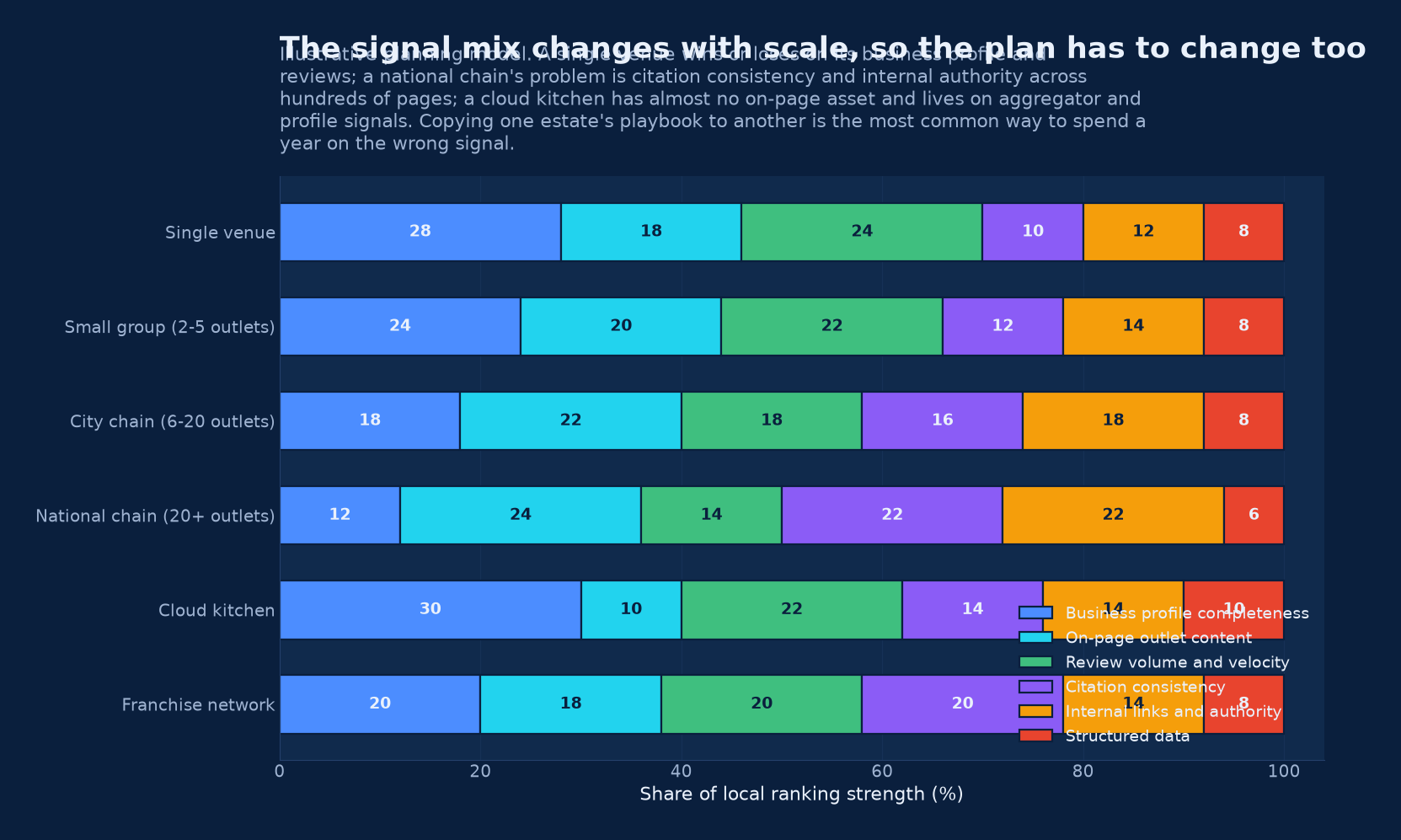
Chart values are an illustrative planning model based on typical UMC engagements and published industry benchmarks. They are not a guarantee of results on any specific project.
| Estate type | The binding constraint | First ninety days | What to stop doing |
|---|---|---|---|
| Single venue | Profile completeness and review velocity | Fix the profile, seed the FAQ, start the review routine, publish an honest menu page | Building a blog nobody reads |
| Small group (2-5) | Consistency between outlets and a shared template | One outlet page template, per-outlet profiles, a review routine per outlet | Hand-built pages that drift apart |
| City chain (6-20) | Internal authority and locality coverage | Locality pages, dish and category architecture, internal linking, citation repair | Publishing thin pages for every suburb |
| National chain (20+) | Citation consistency, duplicates and change control | A listing register, duplicate cleanup, a schema deployment path, a publishing model | Manual edits per outlet |
| Cloud kitchen | Platform dependence and profile signals | Own-channel order page, coverage pages per pincode, review generation on delivery | Competing for dine-in queries it cannot serve |
| Franchise network | Owner-level publishing and brand consistency | A template with scoped rights, mandatory fields, a compliance review per outlet | Letting each owner build a site |
| Multi-format group | Format-level architecture and cannibalisation | One page model per format, clear category boundaries, shared authority | One site trying to be four formats |
| Hotel or resort F&B | Property-page dependence and event demand | Outlet pages distinct from the property, event and occasion pages, schema separation | Burying the restaurant inside the hotel site |
- Which signals to invest in is a strategy decision before it is an SEO decision, because it depends on the growth model: business strategy consulting sets the formats and cities, and the search plan follows.
- Opening outlets changes the constraint each time, so the plan has to be re-cut per expansion wave – market expansion consulting with a local-search readiness checklist per new site.
- In a franchise or group structure, who may publish what is a governance question that no agency can answer: unified top-level management setting the boundary.
- The comparison with other physical-estate verticals is instructive – hotels rank on property pages and rate parity, retail on category and product architecture, showrooms on branch pages and inventory – and the local discipline is the same in all of them.
Measurement: from rankings to covers
Restaurant SEO reporting usually stops at rankings and sessions, which is why it is cut first when budgets tighten. The chain that survives a budget conversation is short: rank and visibility per intent and per outlet, sessions landing on the page built for that intent, calls, booking starts and order starts, completed covers and orders attributed to the outlet, and contribution per outlet. Once the booking system and the POS are joined to the analytics, an SEO programme can be reported in the same units as the rest of the business.
| Metric | Definition | Source | Cut | What it decides |
|---|---|---|---|---|
| Visibility per intent | Ranking and presence in the map pack by intent and locality | Rank tracking plus manual map-pack checks | Intent, city, outlet | Which intents are won and which are lost |
| Profile actions | Calls, direction requests and website clicks from the profile | Business profile performance | Outlet, month | Whether the profile is doing its job |
| Organic sessions by page type | Sessions reaching outlet, menu, dish, offer and editorial pages | Analytics | Page type, outlet | Whether the architecture matches the intent map |
| Booking starts and completions | Reservations initiated and completed from organic sessions | Analytics events plus the booking system | Outlet, intent | Whether traffic becomes covers |
| Order starts and completions | Own-channel orders from organic sessions | Analytics plus the order system | Outlet, pincode | Whether direct ordering is growing |
| Calls and messaging | Click-to-call and WhatsApp actions per outlet | Call tracking and messaging platform | Outlet, page | Whether the phone is still the real booking channel |
| Covers attributed | Guests arriving from an organic source, captured at the desk | Booking system plus a source question | Outlet, month | The number leadership will fund |
| Cost per cover by channel | Spend and effort divided by attributed covers | Finance plus media plus analytics | Channel, outlet | How SEO compares with paid and aggregators |
| Review velocity and rating | Reviews requested, received and rating trend per outlet | Platforms | Outlet, month | Whether the reputation flywheel is running |
| Technical health | Indexation, crawl errors, field performance, markup validity | Search console plus monitoring | Template, page type | Whether a regression has shipped |
| Assistance and branded lift | Branded query growth after content, PR and campaigns | Search volume plus analytics | City, campaign | Whether upper-funnel work is producing demand |
- The join between analytics, the booking system and the POS is the whole exercise: one guest and booking identifier from a search session to a covered table, held where it can be queried – warehouse work with a marketing deadline.
- Two reports from one model: an outlet manager wants yesterday’s covers, calls and review requests; a group head wants visibility, contribution and channel mix – executive dashboards built once and rendered twice.
- Conversion by outlet and intent is pipeline analytics in restaurant clothing: conversion and pipeline intelligence applied to bookings rather than deals.
- Demand is seasonal and predictable, so visibility gains should be planned against it – forecasting festive and weekend enquiry volume tells you when to publish and when to staff.
- Organic and paid are not additive in a naive way; a blended last-click view will misallocate budget between them, which is why paid search and SEO share one measurement chain and one intent map.
Governance in a multi-outlet estate: who publishes, who answers, who decides
A chain’s search presence is only as consistent as its publishing model. If an outlet can change its hours without the profile updating, or answer a review in a tone the brand would not use, or publish an offer the kitchen cannot honour, the SEO programme spends its time correcting facts instead of earning demand. Governance is therefore part of the deliverable: mandatory fields, scoped rights, an approval route for anything carrying a price or a claim, a review response policy with escalation, and a rule that any outlet may correct a factual error immediately.
| Decision | Held centrally | Held at the outlet | Approval route | Evidence kept |
|---|---|---|---|---|
| Opening hours | Format and structure | Actual hours and festival exceptions | Outlet publishes; syncs to profile and citations automatically | Hours change log |
| Menu and prices | Architecture, allergen fields, price bands | Dishes served, local specials, availability | Finance approves price changes above a threshold | Menu and price change log |
| Offers and promotions | Group campaigns and terms | Participation and local offers | Marketing approves anything published | Offer register with validity and outlets |
| Review responses | Policy, tone and escalation rules | The actual response, by the outlet | Negative reviews escalated within twenty-four hours | Response times, escalation and resolution log |
| Photography | Standards and brand assets | Outlet and dish photography to a shot list | Marketing reviews before publishing | Asset library with rights and dates |
| Editorial and stories | Calendar and standards | Local events and community content | Marketing approval for any factual claim | Editorial log |
| Citations and listings | The register and the standard | Reporting a change | Central update pushed everywhere | Listing register with check dates |
| Structured data | Generated from records, centrally controlled | None – outlets never edit markup | Deployment with validation before publishing | Validation results per release |
| New outlet launch | Checklist, templates and launch plan | Local facts, photography, hours | A named owner signs off readiness | Launch checklist per outlet |
| Crisis and complaints | Holding language and escalation path | Immediate factual correction | Leadership informed on any reputational incident | Incident record with resolution |
- Governance over anything published – including AI-drafted menu copy or review responses – has to be designed before the tools arrive: a readiness assessment first, then AI governance, risk and compliance over what may be published automatically.
- Where an assistant answers guest questions from the menu and outlet data, it is a monitored service with an escalation path, not a widget: AI agents and automation operated with the same discipline as the helpdesk queue.
- The estate that carries all of this – the site, the profiles, the booking system, the outlet networks – needs ordinary operational cover: managed IT services with helpdesk support that answers at seven on a Saturday.
- Search presence depends on systems staying available and backed up: security and backup and disaster recovery with tested restores, because a site down on a festive evening loses covers that no ranking can replace.
- Where the menu, POS and booking systems are being joined so AI and analytics can read them, that is ERP, CRM and operations integration work with a search benefit attached.
The handoff: from search demand to a guest record
The last gap in most restaurant SEO programmes is what happens after the cover. A guest who found you through a dish query, booked online and dined on a Friday has produced a record that could bring them back for an anniversary, a festive menu or a quiet Tuesday – and in most estates that record dies in the booking system. Closing the loop is not an SEO task, but an SEO programme that does not hand off to one is paying to acquire the same guest every month.
| Stage | What the search programme produces | What the guest programme needs | The join |
|---|---|---|---|
| Discovery | A session from a dish, locality or near-me query | A consent opportunity that is not a newsletter popup | Consent captured at booking or order, not at first visit |
| Booking | A reservation with an outlet, date and party size | A guest record with contact, occasion and preferences | One guest identifier across outlets and channels |
| Visit | A cover, a table, an order, a bill | Dietary notes, spend, dishes ordered, satisfaction | POS data written back to the guest record |
| After the visit | A review request triggered by the visit | A thank-you, a feedback route and a reason to return | Consent-checked messaging on the guest’s channel |
| Occasion | An occasion page that brought them in | A birthday or anniversary reminder next year | Occasion data stored at booking, used lawfully |
| Win-back | A dormant guest who once searched for you | A ninety-day win-back with a genuine reason | Segment from the guest record, not from analytics |
| Loyalty | Repeat visits from brand queries | Points, tiers, stored value, direct-order incentives | Loyalty identity matched to the guest record |
| Referral | A guest who recommends you to a friend | A referral route with a reward that is paid | Referral attributed to the guest, not to a campaign |
| Feedback loop | Review themes per outlet | Service recovery and menu changes | Themes routed to operations, not only to marketing |
| Measurement | Covers attributed to organic | Lifetime value per guest and per acquisition channel | One model reporting both |
- The record and the journeys are the sibling discipline’s build: a CRM with identity resolution across booking, order and visit, plus lifecycle and retention campaigns that respect consent.
- Journeys run from one layer with a preference centre behind them – marketing automation triggering nurture programmes and occasion messages over email, SMS and WhatsApp.
- The value of a guest acquired organically is only knowable once the record exists, which is why an SEO programme without a CRM handoff cannot report lifetime value – only covers.
The ninety-day restaurant SEO programme, and what we need from you
The programme below is the shape we run for a restaurant, a cafe group or a multi-outlet chain: three weeks to audit the estate and build the intent map, profile and citation repair starting in week one because it is fast and independent of any build, outlet and menu architecture from week three, structured data and technical fixes from week six, the review engine from week eight, content and digital PR from week ten, and measurement and governance handed over at the end. The dependency that decides the timeline is outlet data – true hours, real menus with allergens, and a named owner per outlet.
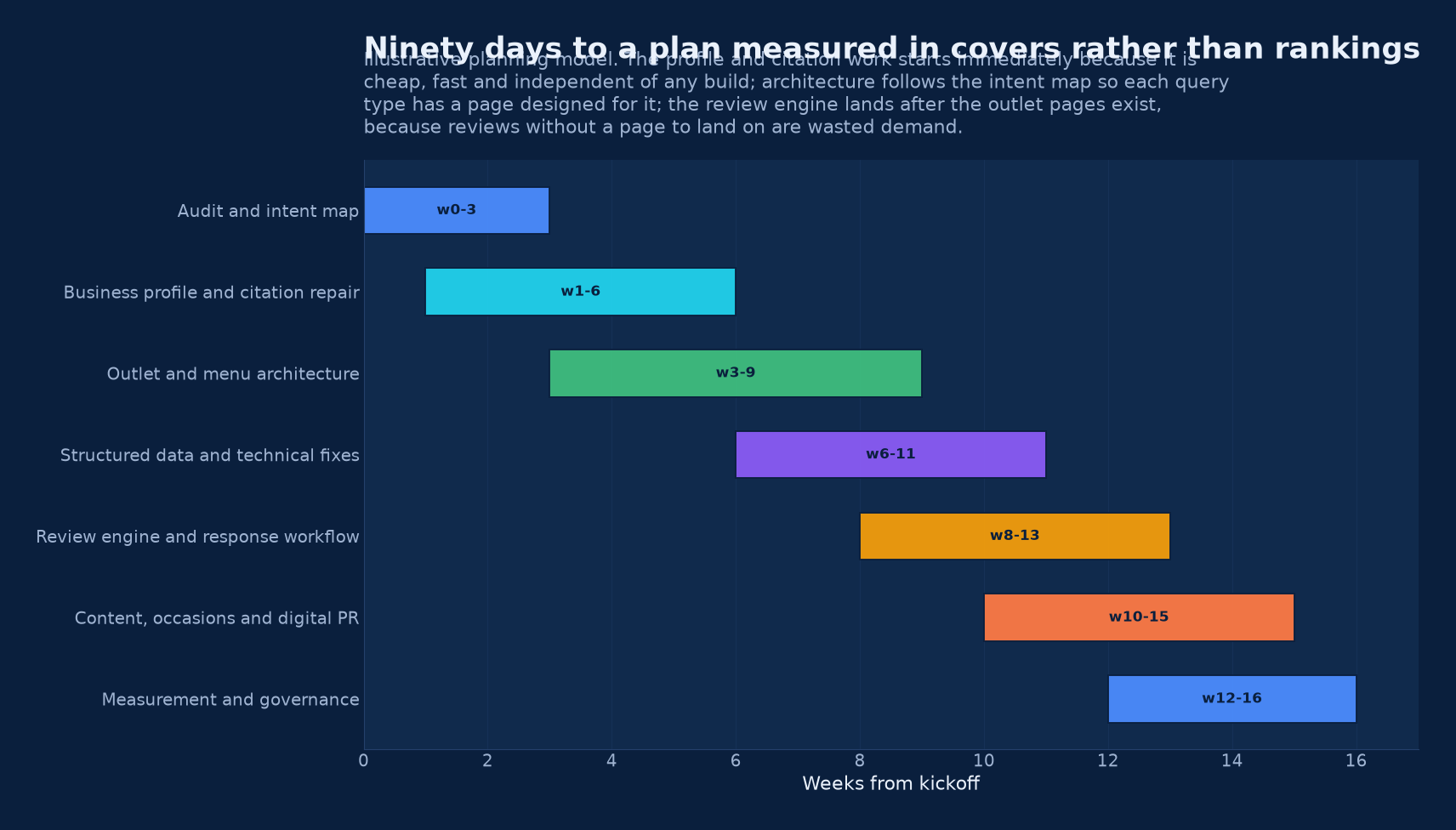
Chart values are an illustrative planning model based on typical UMC engagements and published industry benchmarks. They are not a guarantee of results on any specific project.
| Weeks | Workstream | Deliverable | Decision it enables |
|---|---|---|---|
| Zero to three | Audit and intent map | Technical and local audit, intent map with a page per intent, competitor and demand evidence, baseline metrics | Which intents are worth chasing and which are won off-site |
| One to six | Business profile and citation repair | A profile per outlet verified, a listing register, duplicates closed, NAP and hours corrected, attributes and photos completed | Whether the estate is findable at all |
| Three to nine | Outlet and menu architecture | Outlet page template, menu-as-data pages, dish and category architecture, locality pages, internal linking | Whether each intent has a page designed to win it |
| Six to eleven | Structured data and technical fixes | Generated markup validated per template, indexation and duplicate control, performance budgets, language handling | Whether search and answer surfaces can quote you accurately |
| Eight to thirteen | Review engine and response workflow | Ask timing and channel per outlet, response policy and targets, escalation, a monthly theme review | Whether reputation compounds or decays |
| Ten to fifteen | Content, occasions and digital PR | An occasion and festive calendar, chef and sourcing stories, locality content, launch and press support | Whether authority is earned as well as structured |
| Twelve to sixteen | Measurement and governance | Joined reporting from visibility to covers, a publishing model with scoped rights, documentation and training | Who runs it, on what rules, and how it is reviewed |
- What we need: the outlet list with addresses, phone numbers and true opening hours including festival exceptions, full menus per outlet with prices, allergens and modifiers, business profile access per outlet, booking and POS system access, existing analytics and search console, photography or a shoot plan, and a named owner per outlet.
- What you keep regardless: the intent map, the outlet and menu architecture, the listing register, the markup and validation workflow, the review engine and response policy, the joined measurement model and the governance documentation. They are yours.
- What we will tell you plainly in week three: which outlets cannot be published until their hours and menus are true, which intents the platforms will keep winning whatever we do, and whether the constraint is data accuracy or content capacity – almost always the first.
Restaurant SEO by city, and worked examples
Restaurant search is local by definition: language and script decide the menu, the neighbourhood decides the outlet page, the festive calendar decides the content rhythm, and delivery coverage decides which order queries you may honestly answer. The engagements below are hospitality, food-service and multi-outlet projects where local search, content and measurement were built as one programme.
- Get more restaurant customers in Lucknow
- Digital marketing company for restaurants in Lucknow
- Website development company for restaurants in Lucknow
- Services across Indian cities
- Case study: The Fern hotel, Hyderabad
- Case study: Marriott hotel, Hyderabad
- Case study: WordPress development for a green hotel and resort
- Case study: social media advertising for a green hotel and resort
- The restaurants and food service industry hub – all eight disciplines
- Hotels and hospitality: property pages, rate parity and local search
- Retail and e-commerce: category, product and facet architecture
- Showrooms and dealerships: branch-level local search and inventory pages
- All industry verticals we build programmes for
- All digital marketing services
- All technology services
- All business consulting services
- About Unified Management Consulting
- Contact us about SEO for restaurants
Where this page sits in our restaurants programme
SEO is the second discipline of our restaurants and food service programme. The hub page explains how the eight disciplines fit together, each discipline has its own page as it is published, and the generic service page for every discipline stays listed below alongside the vertical pages. A discipline that is not listed is not published yet – the list is generated from live pages and refreshes automatically as each spoke lands.
- Restaurants – the vertical main page
- Website development for restaurants
- Google Ads for restaurants
- Social media marketing for restaurants
- Guest CRM, reservations and loyalty for restaurants
- Business intelligence for restaurants
- IT support for restaurants
- AI for restaurants
- Website development services – the generic service page
- Google Ads management – the generic service page
- Social media management – the generic service page
- Custom CRM development and integration – the generic service page
- BI dashboards and executive reporting – the generic service page
- Managed IT infrastructure and AMC – the generic service page
- AI agent deployment and automation – the generic service page
Frequently asked questions about SEO for restaurants
What matters most in restaurant SEO?
Accuracy and locality, in that order: one page and one verified business profile per outlet with identical name, address, phone and hours; a menu held as data with prices and allergens; reviews generated and answered per outlet; and markup generated from the same records. Content and links matter, but they cannot rescue wrong facts.
Why do our outlets not appear for their own neighbourhood?
Usually because the neighbourhood has no page, the profile categories are wrong, the pin is misplaced, the citations disagree with the website, or the outlet’s reviews are thin compared with competitors nearby. All five are diagnosable in a week and fixable in a month.
Should every dish have its own page?
No. Most dishes belong on the outlet’s menu page, where they are indexable and structured. Dedicated dish pages earn their place only for a small number of signature items with real search demand and genuine content – otherwise a chain publishes thousands of thin pages that dilute each other.
How do we get more reviews without breaking the rules?
Ask at the moment of satisfaction through the channel the guest used – a QR code at the table or a message after a delivery – with one tap to the right platform. Never filter by sentiment, never offer a discount for a five-star review, and answer every review. Velocity and response rate are the measures.
Do delivery aggregators help or hurt our SEO?
Both. They rank for order intent you will not win organically, and they bring guests who would otherwise not find you. The task is to keep your listings accurate, convert repeat guests to a direct channel with a better offer and loyalty, and report contribution per order by channel so the dependence is measured rather than resented.
How does AI search change restaurant SEO?
Answer surfaces quote facts rather than pages, so being quotable matters more than being clickable: structured data generated from real records, consistent citations across the surfaces they read, current hours and menus, and a review profile they can summarise. A menu published as a PDF is invisible to them.
We have forty outlets. Can we manage this centrally?
Yes, with a template set and a publishing model: mandatory fields, scoped rights per outlet, automatic sync of hours and menus to profiles and citations, a central register of listings, and a quarterly consistency check. What cannot be centralised is the truth of each outlet’s hours, menu and service.
How long until we see results?
Profile and citation repairs can move map-pack visibility within weeks. Architecture and content changes take two to four months to show in rankings and longer in covers, because local demand is seasonal. Review velocity improves the click-through rate almost immediately once responses become visible.
What should we report to leadership?
Visibility per intent and per outlet, profile actions, sessions by page type, booking and order completions, calls, covers attributed per outlet, cost per cover by channel, and review velocity and rating. Rankings alone explain nothing to a general manager.
Is a blog worth it for a restaurant?
Only if it answers real demand: occasion guides, dish explainers, dietary guides, chef and sourcing stories, neighbourhood pages and festive menus published ahead of the window. A blog of adjectives with no booking path costs money and ranks for nothing.
How do we handle a bad review that is unfair?
Respond promptly and courteously in public, state the facts without arguing, take the detail offline, resolve it, and only then update the thread. If it violates platform policy – it is not from a guest, or it contains abuse – report it through the platform route and keep the evidence. Never delete a legitimate complaint and never respond with a template.
What does restaurant SEO cost?
It scales with outlet count, the state of the existing listings, whether menu-as-data and architecture work is needed, and the content cadence you can sustain. A single venue is a focused local project; a national chain is a governance and consistency programme with engineering in it. We quote after the audit and intent map, so the price reflects the estate rather than a keyword count.
Start with the audit, the intent map and the profile repair
Give us three weeks with your outlet list with addresses, phone numbers and true opening hours including festival exceptions, full menus per outlet with prices, allergens and modifiers, business profile access per outlet, booking and POS access, existing analytics and search console, photography or a shoot plan, and a named owner per outlet, and we will return a technical and local audit, an intent map with a page designed for each of the eight intents, a listing register with duplicates closed and hours corrected, an outlet and menu architecture that renders records as pages and markup, a review engine with response targets and escalation, a content and occasion calendar published ahead of demand, and a measurement model that reports covers and cost per cover per outlet – including which intents the platforms will keep winning whatever we do. Yours to keep either way.
Contact Unified Management Consulting to arrange a confidential first conversation.