
An independent practitioner is a one-person brand inside a regulated profession. The name on the door is the asset, the reputation is the marketing, and the advertising latitude is narrower than a clinic’s or a hospital’s – in many markets a doctor may not advertise at all in the conventional sense, which means growth has to come from being findable, being believed, being bookable and being remembered. The competitive reality has also changed: a large share of appointments now begins on an aggregator platform that owns the patient relationship, charges per appointment or per listing, and shows the next doctor in the list one tap away. Building an owned path – a profile that ranks, a website that books, a follow-up system with consent – is the difference between renting patients and having them.
Unified Management Consulting works with solo practitioners, super-speciality consultants, group practices of two to twenty clinicians, telemedicine-only practices and doctors who consult inside hospitals while running their own rooms. Everything here is delivered remotely and written to be geography-neutral, with professional advertising rules, consent requirements and record-keeping obligations handled per market inside the engagement. This is the vertical’s main page; larger providers are covered in clinics and diagnostic centres and hospitals and healthcare groups, and the industries index lists every sector we serve.
What an engagement includes, at a glance
| Component | What We Deliver |
|---|---|
| Personal brand and credibility | Credentials, speciality, interests, publications and the professional story a patient can verify. |
| Local search and profiles | Accurate hours, location, services, photographs and reviews – the ninety-second decision. |
| Owned booking path | A website and number that take the appointment without a platform taking a share. |
| Telemedicine | Remote consultations with consent, prescribing rules and a record that meets requirements. |
| Reviews and reputation | A steady, unincentivised ask, responses that respect confidentiality, recovery before the review. |
| Patient education content | Condition and procedure information that never becomes advice or promotion. |
| Follow-up and recall | Consented reminders, review intervals and continuity that brings the patient back. |
| Practice IT and records | Backups of every record, segmented Wi-Fi, secure access, and support when it fails at 9am. |
What doctors search for, and what it really means
Enquiries from independent practitioners are personal and practical, usually sent between consultations, and they name a symptom of a business problem rather than the problem itself. The mapping below is what we do in week one.
| What gets searched or asked | What is actually happening | What we do about it |
|---|---|---|
| “how to get more patients for my clinic” | The profile loses the comparison on reviews, photos or hours | Profile rebuild, review cadence, honest service information |
| “doctor website design” | A one-page site with a phone number and no booking | A site with credentials, services, prices and real booking |
| “online appointment system for doctors” | Appointments taken on a personal phone and a paper diary | Booking with slots, confirmation, reminders and a shared view |
| “how to get good reviews for my practice” | Reviews arrive rarely and unpredictably | An unincentivised ask process with responses and recovery |
| “am I allowed to advertise as a doctor” | Professional rules unclear, so nothing is done at all | A two-page rules summary of what may and may not be said |
| “telemedicine setup for my practice” | Video calls on a personal app with no record | A consultation flow with consent, notes and secure delivery |
| “practice management software” | Records, billing and reminders in three unrelated tools | One system of record with backups and role-based access |
The fifth row is the one that decides everything else: until the practitioner knows what the professional rules permit in their market, they either do nothing or do something that creates exposure. We start there, in writing.
The practitioner as the brand
In an independent practice the brand is a person, which changes how the work is done. Content cannot be separated from the clinician’s judgement, reviews are about a relationship rather than a facility, and the credibility signals patients look for are specific: qualifications and where they were obtained, the speciality and what it excludes, years of experience, hospital affiliations, publications and conference work, languages spoken, and whether the doctor explains things in a way the patient understood. None of that is advertising in the prohibited sense; it is information a patient is entitled to have, and publishing it accurately is the single most effective thing a practice can do.
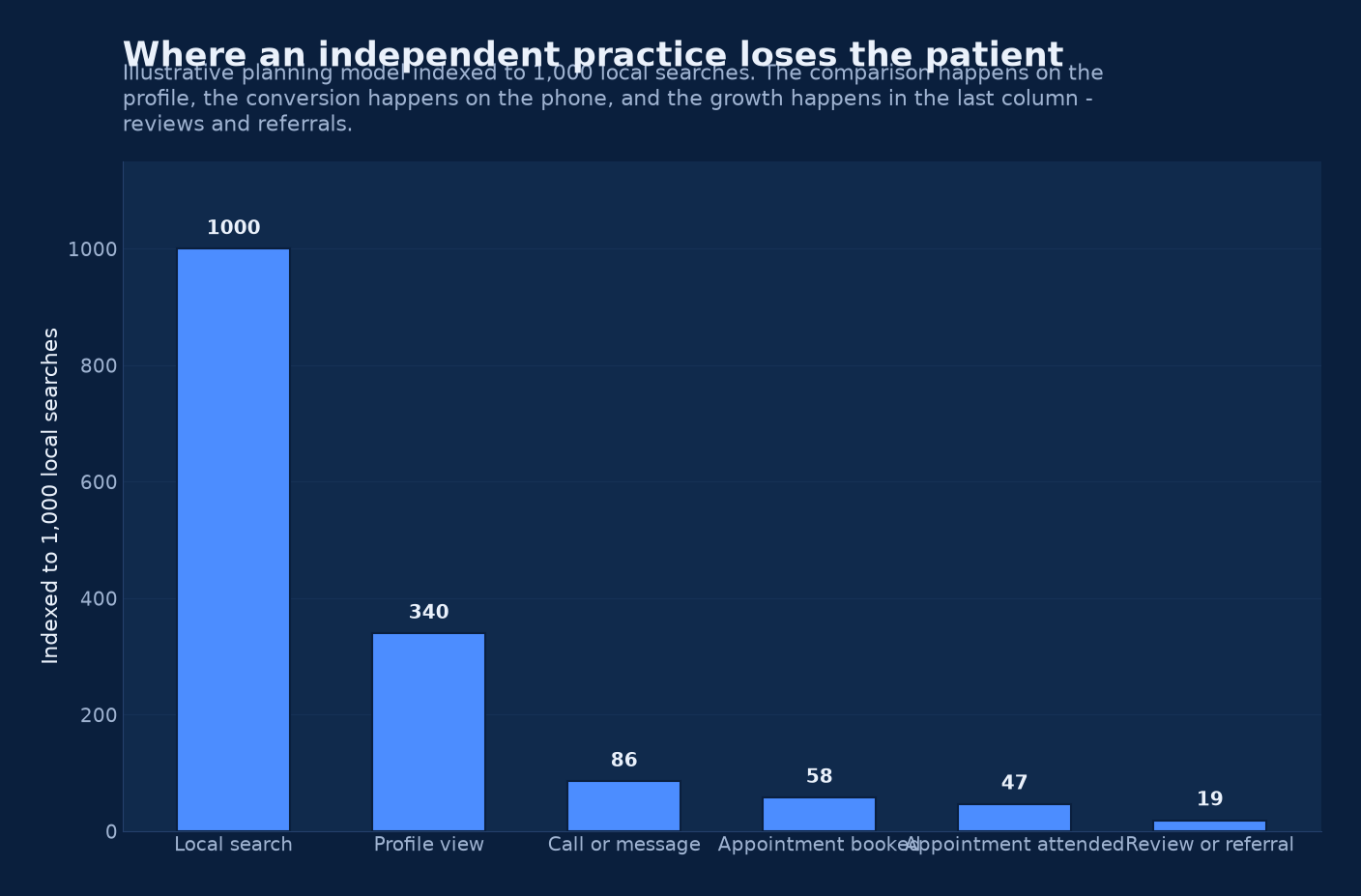
Chart values are an illustrative planning model based on typical UMC engagements and published industry benchmarks. They are not a guarantee of results on any specific project.
| Credibility signal | What good looks like | What undermines it | Where it lives |
|---|---|---|---|
| Qualifications | Degrees, memberships, registration number | Ambiguous titles, unverified claims | Profile and website |
| Speciality scope | What you treat, and what you refer on | Claiming everything, which reads as nothing | Website and profile |
| Experience | Years, case types, volumes stated carefully | Inflated numbers that a colleague would dispute | Website |
| Affiliations | Hospitals, societies, academic posts | Outdated affiliations | Website and profile |
| Publications and talks | Links, dates, plain-language summaries | A list nobody can read | Website |
| Patient-facing explanation | Conditions explained clearly, when to seek help | Jargon or promotional tone | Content and social |
| Reviews | Steady volume, honest responses, themes acted on | Bursts, incentives, arguments in replies | Profiles |
| Professional conduct online | No patient detail, no diagnosis in comments | One careless reply | Everywhere |
brand performance and creative production applies here too, in a restrained form: professional photography, a legible biography, consistent naming across profiles, and a visual identity that does not promise luxury the practice cannot deliver.
Platform dependence and the owned booking path
Aggregator platforms solved a real problem – patients could find and book a doctor – and created another: the platform owns the search result, the patient data, the review and the relationship, and charges for each appointment. A practice that depends on one platform is one policy change away from losing a third of its schedule. The answer is not to leave – listing visibility is genuinely valuable – but to build an owned path that runs alongside it: a profile that ranks in the map pack, a website that takes bookings directly, a number that is answered, and a follow-up system with consent so the second visit does not have to be bought again.
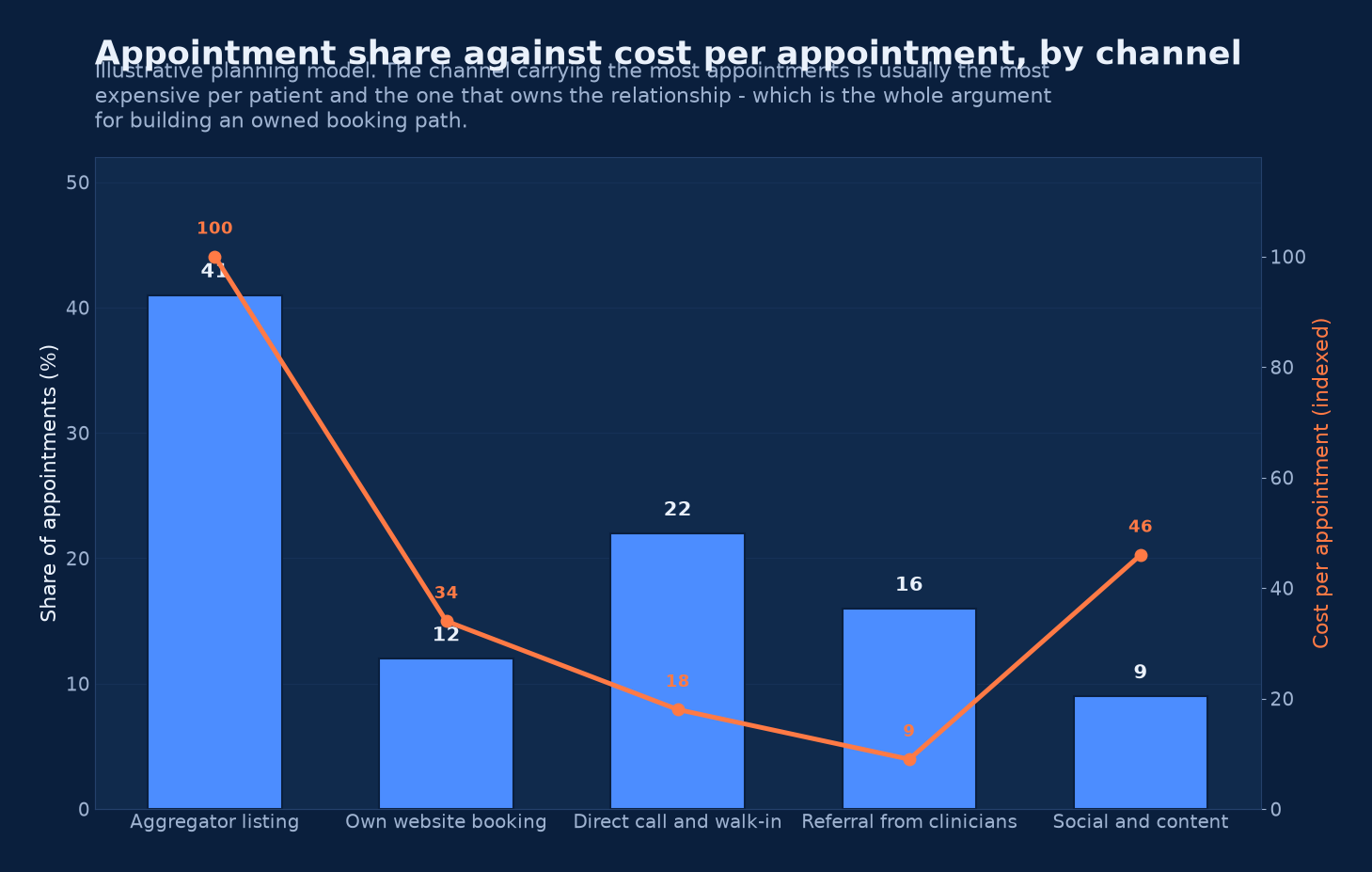
Chart values are an illustrative planning model based on typical UMC engagements and published industry benchmarks. They are not a guarantee of results on any specific project.
| Channel | Who owns the patient | Cost dynamic | How we grow it |
|---|---|---|---|
| Aggregator listing | The platform | Per appointment, per listing, or both | Optimise the listing, then convert repeat patients to direct |
| Own website booking | The practice | Fixed build and maintenance cost | Local search, clear services and prices, two-tap booking |
| Direct call and walk-in | The practice | Front-desk time only | Answered calls, map-pack accuracy, signage |
| Referral from clinicians | Shared, relationship-based | Time and reliability, not media spend | Fast reporting, easy referral route, feedback after the consultation |
| Social and content | The practice | Production time | Education-led content, no diagnosis in public, consistent presence |
The commercial test is simple and we report it monthly: what proportion of appointments arrive through a channel you own, and what does each channel cost per attended appointment. sales and pipeline analytics is the same discipline applied to a referral pipeline, and cost rationalisation and margin recovery applies when platform fees exceed what the appointments contribute.
Local search: the profile is the practice
For an independent practitioner, the map listing functions as the front door: hours, location, phone, services, photographs, rating and reviews are consumed in under a minute, often on a phone, often by a relative doing the research. Accuracy matters more than creativity here, and the most common failures are entirely administrative – wrong hours, a number that is not answered, a category that does not match the speciality, photos of an empty room, and reviews nobody responds to.
| Element | What good looks like | What usually goes wrong | Fix cadence |
|---|---|---|---|
| Name and speciality | Real name, correct primary category, no keyword stuffing | Titles and keywords inside the business name, risking suspension | Once, then quarterly |
| Hours and availability | True consulting hours, including changes and holidays | Hours from the day the practice opened | Before every holiday |
| Services listed | Every service actually offered, in patient language | Left blank or filled with three generic items | Quarterly |
| Photos | Real rooms, real equipment, professional portrait, current | Stock images or a photograph of a door | Monthly additions |
| Phone and booking link | Answered during hours, booking link that works | A personal mobile nobody answers at 6pm | Tested monthly |
| Reviews | Steady, unincentivised, responded to | Asked only from happy patients, or never asked | Weekly ask, weekly responses |
| Location and access | Parking, floor, entrance, accessibility, transport | Patients circling the building | With any change |
| Website link | A site with credentials, services, prices and booking | A social profile in place of a website | Each release |
Delivery runs through local SEO and Google Business Profile management, SEO for condition and procedure queries where permitted, and AI search optimisation because symptom questions are increasingly asked of assistants, which quote whatever is published consistently. accessibility is a requirement rather than an extra: an elderly patient who cannot read the site or use the booking form is precisely the patient a practice needs.
Advertising rules for individual practitioners
Professional codes restrict what a doctor may say, and platform health policy restricts it further. In many markets the permitted set is close to informational: name, qualifications, speciality, address, hours, contact, and the services offered – while prohibited claims include guarantees of cure, comparative superiority, testimonials, before-and-after imagery and inducements. The practical consequence is that a practitioner’s growth comes from information quality, availability and reputation rather than persuasion. We produce a two-page rules summary per market before any content is published, and it stays with the practice.
| Item | Typical status | How we handle it | Who confirms |
|---|---|---|---|
| Name, qualifications, registration | Permitted | Published accurately everywhere | The practitioner |
| Speciality and services offered | Permitted | In patient language, matching what is actually done | The practitioner |
| Address, hours, contact, booking route | Permitted | Kept current, tested monthly | Front desk |
| Consultation fee and package pricing | Usually permitted with transparency | Stated as a range with what it includes | The practitioner |
| Equipment and technique | Permitted with accuracy | Named correctly, no implied outcome | The practitioner |
| Guarantees, cure claims, success rates | Prohibited | Excluded from every asset | Our review plus the practitioner |
| Patient testimonials and thank-you posts | Frequently prohibited | Not used; reviews handled on the platform, not republished | Our review plus the practitioner |
| Before-and-after imagery | Usually prohibited | Not used; process and education content used instead | Our review plus the practitioner |
| Inducements, discounts for reviews, referrals for payment | Prohibited | Never used | Our review |
| Prescription product promotion | Prohibited for prescription medicines | Disease education only, no brand suggestion | Our review plus the practitioner |
The same register governs paid media: Google Ads and local campaigns are used for informational queries and availability, not for outcome claims, and Meta and Instagram carry education and presence rather than promotion of treatment. Where the market permits no advertising at all, the programme is entirely profile, content, booking and reputation – which is most of the work anyway.
Website, booking and telemedicine
A practitioner’s website has four jobs: establish who you are and what you treat, show what it costs and how to book, answer the questions patients ask before they call, and load fast enough on a phone that the patient does not go back to the listing. Telemedicine adds a fifth: a consultation flow with consent, a note, a prescription route that meets market rules, and a record that belongs to the practice rather than to a messaging app.
| Page or flow | What it must do | Failure that costs patients | Our default |
|---|---|---|---|
| Home and biography | Who you are, what you treat, why it is credible | A stock template with a photograph | A biography with qualifications, scope and affiliations |
| Services and conditions | One page per condition or service, in patient language | A bullet list of everything | Substantive pages with when-to-seek-care guidance |
| Fees and what to expect | Consultation fee, follow-up fee, procedure ranges, duration | “Call for fees” | Structured fee page with a review date |
| Book an appointment | Real slots, two taps, confirmation, reminders | A form that emails the doctor | Booking integrated to the practice calendar |
| Telemedicine consultation | Consent, video, notes, prescription, secure follow-up | Video calls on a consumer app with no record | A consultation flow with a record in the practice system |
| Location and access | Map, parking, floor, accessibility, transport | An address in the footer | A location page with photographs |
| Contact and emergencies | What is urgent, where to go, how to reach you | A contact form only | Clear emergency guidance and a working number |
Delivery runs through website development, UX and UI design, Core Web Vitals, portal development where records and results are shared, mobile apps only where a group practice justifies one, and maintenance and support so a fee change or a holiday closure is live the same day.
Patient education content that does not become advice
Education is the practitioner’s most powerful and most delicate channel: it establishes expertise, answers the question the patient was about to search at midnight, and it carries the risk that a general reader mistakes it for personal advice. The line is maintained by form rather than by caution – explain the condition, the options, when to seek care and what a consultation involves; never address the reader’s own case, never suggest a medicine by brand, and always point to a consultation for the individual decision.
| Content type | Purpose | What it must include | What it must never do |
|---|---|---|---|
| Condition explainers | Answer the search and establish scope | Symptoms, when to seek care, what a consultation involves | Diagnose the reader or promise outcomes |
| Procedure information | Reduce anxiety and set expectations | Preparation, duration, recovery, risks stated plainly | Compare superiority with other practitioners |
| Myth and misconception pieces | Correct widespread errors | Sources, plain language, a route to ask | Mock the belief or the patient |
| Prevention and lifestyle | Public health value, reach | Practical steps, realistic framing | Recommend branded products or supplements |
| Q&A from real questions | Efficiency – answer once, reuse | Anonymised, general, no case detail | Reveal any patient information |
| Short video | Trust and recall | Subtitles, one idea per video, credentials visible | Casual claims or treatment promises |
Production runs through content marketing with a clinical author and a review date, YouTube and video marketing for the longer explainers, social media management for distribution, and AI search optimisation so assistants quote the accurate version rather than a forum.
Social presence for clinicians: what works, and what ends careers
Clinicians have more social reach available than any previous generation of doctors and less protection than they think. The content that builds a practice is calm, useful and consistent: one idea per post, a real face, credentials visible, no patient detail, no diagnosis in the comments, no argument with a stranger, no product recommendation, and no posting while on call. The content that damages a practice is one careless reply, one identifiable patient, one promised result, or one argument conducted publicly.
| Practice | Why it works | The rule | Where it appears |
|---|---|---|---|
| Consistent, calm education | Builds recall without persuading | One idea, plain language, credentials visible | Instagram, YouTube, LinkedIn |
| Showing the real practice | Reduces anxiety before the visit | Facility and team, no patient detail | Instagram, profile photos |
| Answering common questions | Efficiency and trust | General answers only, route to consultation | Reels, shorts, Q&A posts |
| Professional networking | Referrals and credibility | Case discussion without identifiers | LinkedIn, societies |
| Comment moderation | Prevents public clinical advice | Never diagnose or advise in comments | Every platform |
| Crisis and complaint handling | Stops escalation | Take it offline, respond once, never argue | Every platform |
| Boundaries | Protects the practitioner | No personal accounts mixed with professional ones | Everywhere |
social media management and brand performance and creative production supply the system – shot lists, templates, a monthly batch and an approval step – so the clinician spends an hour a month rather than an hour a day.
Reviews, reputation and recovery
For an individual practitioner reviews are unusually personal and unusually powerful: they describe a relationship, and the patient reading them is deciding whether to trust a stranger with their body. The process has three parts. Ask genuinely – after a good outcome, at the desk or by message, never incentivised, never filtered to happy patients. Respond properly – thank without disclosing, correct a factual error politely, never identify a patient, never argue. And recover early – a complaint handled the same day usually never becomes a review, and one that does becomes a review with a visible, reasonable response underneath it.
| Situation | What we do | What we never do | Owner |
|---|---|---|---|
| Happy patient | Ask at the right moment, on the channel they use | Offer a discount, filter who is asked | Front desk |
| Negative review, factual error | Correct politely, offer to resolve offline | Disclose anything clinical, argue the detail | The practitioner |
| Negative review, real failure | Acknowledge, apologise, fix, follow up | Delete, dispute without cause, or reply late | The practitioner |
| Complaint before a review | Same-day call from a named person | Wait to see whether it becomes public | Front desk |
| Review mentioning another clinician | Stay out of it | Comment or defend a colleague publicly | The practitioner |
| Review velocity drop | Investigate the cause – usually waiting time or a process change | Buy or incentivise reviews | Front desk with our review |
Reputation work is part of local SEO and social media management, and it feeds the same monthly report as everything else: rating trend, volume, response rate, and the themes patients repeat – which are almost always operational facts about waiting time, communication or billing.
The front desk, WhatsApp and appointment flow
In a small practice the front desk is often one person handling calls, WhatsApp messages, walk-ins, payments and prescription collection, on a personal phone, with no record of what was asked. It is also the conversion point: an unanswered call is a patient who called the next profile in the list. The design is small and specific – a business number rather than a personal one, a shared inbox so the conversation survives staff changes, response targets by urgency, disposition codes so outcomes are countable, a callback rule for missed calls, and an escalation rule for anything that sounds urgent, because a receptionist should never be the person deciding whether chest pain waits.
| Channel | Response target | Handling rule | Recorded outcome |
|---|---|---|---|
| Phone – urgent symptom | Immediate | Escalate to the clinician or emergency guidance, never queue | Escalation logged |
| Phone – appointment | Under three rings | Offer the next two available slots | Booked, callback or lost |
| Missed call | Callback within thirty minutes | Two attempts across two channels | Reached or unreached |
| WhatsApp or message | Under ten minutes in working hours | Administrative answers only; clinical questions routed to the clinician | Question type and outcome |
| Walk-in | Acknowledged within a minute | Registered even if not seen, so follow-up can happen | Seen, booked or referred |
| Report or prescription collection | Same day | Identity check, then secure handover or delivery | Collected and by whom |
| Complaint | Same day, named person | Recovery before it becomes a review | Resolved and follow-up date |
WhatsApp marketing and SMS supply the mechanics with a shared inbox; lifecycle campaigns supply the reminders; and the disposition codes are the part that makes the whole thing measurable rather than anecdotal.
Follow-up, recall and continuity
The second appointment is where a practice’s economics live: the patient already trusts you, the acquisition cost is close to zero, and continuity is what good clinical care requires anyway. Making it systematic needs three things – one patient record across calls, messages, visits and telemedicine; a consent basis recorded with a date and a purpose; and recall rules per condition, from a six-month dental review to a diabetic follow-up interval to a post-procedure check. Most independent practices have none of the three, which is why their schedules depend on new patients forever.
| Component | Design decision | Failure mode | Measurement |
|---|---|---|---|
| One patient record | Phone-first identity with human review for near-matches | Duplicate records and lost history | Duplicate rate |
| Consent | Purpose-specific, dated, withdrawable, captured at the desk | A tick box that proves nothing | Consent coverage of active patients |
| Recall rules | Interval per condition, channel and message content | Recalls sent to patients who moved or were treated elsewhere | Recall compliance |
| Post-consultation follow-up | A message within a day, clinical questions routed | Silence after the visit | Follow-up completion |
| No-show recovery | Same-day rebooking prompt, waitlist fill | An empty slot and no record of why | Recovered slots per week |
| Suppression | Complaints, bereavement, objection, opt-out | A message at the worst possible moment | Suppression coverage |
| Referral loop | Report back to the referring clinician | Referrers never hearing the outcome | Referral feedback rate |
Build and run sit with CRM development and integration at practice scale, marketing automation for the journeys, nurturing programmes for staged treatment plans, and email for reports and summaries. AI governance governs anything automated that touches a patient record – in a small practice that document is two pages, but it must name an owner.
Referral relationships with other clinicians
For many specialities the referral network is the largest and cheapest source of patients, and it is usually managed by memory. Making it a system requires little: a record of who refers what, a fast and reliable route for them to reach you, a report back after every consultation, and a periodic honest conversation about what they need from you. None of that involves payment – referral inducements are prohibited in most markets and are a reputational risk everywhere – so the value exchanged is reliability, speed and information.
| Element | What good looks like | Common failure | Measured by |
|---|---|---|---|
| Referrer record | Who refers, what, how often, what they need | No record at all | Active referrers and volume per referrer |
| Referral route | A number, form or portal that reaches you directly | Referrals sent to the general appointment line | Time from referral to appointment |
| Feedback loop | A report back after the consultation, every time | The referrer never learns the outcome | Feedback completion rate |
| Shared context | Access to previous reports with consent | Repeated investigations | Duplicate test rate |
| Relationship maintenance | Scheduled contact, education, meeting attendance | Contact only when volume drops | Meetings and interactions per quarter |
| Compliance | No inducement, no fee sharing, documented | Informal arrangements that cannot be defended | Zero findings on review |
sales and pipeline analytics is the reporting discipline, applied with the referring clinician as the account and the patient as the case. LinkedIn is the professional channel where that network is maintained in public, within the same rules that govern everything else a clinician posts.
The technology stack of an independent practice
A solo or small practice runs five to nine systems, usually chosen one at a time and rarely connected. The audit below is week one, and it is short enough to complete in a single afternoon – which is exactly why it is so often skipped.
| System | What it holds | What we need from it | Common blocker |
|---|---|---|---|
| Practice management or EMR | Patients, appointments, notes, prescriptions, invoices | Appointment and revenue extracts, a patient identifier | A paper diary plus a personal phone |
| Scheduling and slots | Sessions, room or chair availability, waiting list | Slot supply and utilisation | Sessions never updated after a change |
| Phone, WhatsApp and messaging | Calls, messages, missed enquiries | Volume, answer rate and disposition | Personal devices, no shared record |
| Telemedicine | Consultations, consent, notes, prescriptions | A record inside the practice system | Consumer video apps with no clinical record |
| Billing and payments | Invoices, cards, UPI or wallets, refunds | Revenue per service and per session | Cash unrecorded or recorded separately |
| Records and consent | Clinical records, consent forms, retention | A consent field with a date and purpose | Paper consent in a drawer |
| Profiles and reviews | Listings, hours, photos, ratings, responses | One owner and one update process | Each platform edited differently by different people |
| Infrastructure | Wi-Fi, devices, backups, payment terminal | Uptime, segmentation, verified backups | Records backed up onto the same machine |
Where the practice software cannot export, we build reporting from what the desk already records and name which numbers stay manual. enterprise systems integration applies when a group practice runs several tools that must agree.
Reporting a one-doctor practice can actually read
Most practitioners do not need a dashboard; they need one page, once a week, with six numbers and a note on what changed. Overbuilding reporting is the fastest way to make it ignored. The definitions matter more than the volume: is utilisation measured against available or booked slots, is a reschedule a no-show, does revenue recognise at consultation or at payment, and which channel produced the patient when the desk wrote “walk-in” for somebody who found the practice on a map.
| Metric | Definition that must be fixed | Why it is contested | Refresh |
|---|---|---|---|
| Appointments attended | By session, service and source | Reschedules counted as attendance | Weekly |
| Slot utilisation | Booked and attended over available slots | Blocked sessions counted as utilisation | Weekly |
| No-show rate | By session, service and reminder channel | No definition of a late cancellation | Weekly |
| Revenue per session | Recognised when delivered, packages spread | Cash and card recorded separately | Weekly |
| New versus returning | First visit versus follow-up, by source | Duplicate records counted as new | Monthly |
| Source of patient | Map, referral, platform, direct, social | “Walk-in” recorded for everybody | Monthly |
| Recall compliance | Patients recalled within the interval due | No recall rules exist | Monthly |
| Review trend | Volume, rating, response rate, themes | Reviews checked only when somebody mentions one | Monthly |
BI dashboards and executive reporting delivers the one-page view at practice scale, and predictive analytics and demand forecasting becomes useful for session planning once a year of clean appointment history exists.
Artificial intelligence for a solo or small practice
AI is genuinely useful to an independent practitioner in exactly the places where the work is administrative and repetitive: answering the same thirty questions about hours, fees, location and preparation; drafting follow-up and recall messages for the desk to send; summarising a patient’s history before the consultation; structuring notes for review; and reading review themes. It is not acceptable anywhere near a clinical judgement – no symptom triage, no diagnosis, no treatment suggestion, no prescription decision – and anything that speaks to a patient must escalate to a human for anything clinical or urgent.
| Use case | Value | Risk | Human in the loop |
|---|---|---|---|
| Administrative copilot on WhatsApp and web | Answers instantly, frees the desk | Low | Escalation to a human for anything clinical or urgent |
| Follow-up and recall drafting | Consistent, consent-aware messaging | Low | Desk reviews the send list |
| History summary before consultation | Less reading, better questions | Medium – a missed detail changes the consultation | Clinician verifies |
| Note structuring | Faster documentation, better records | Medium – omission risk | Clinician signs every note |
| Review theme analysis | Operational facts surfaced monthly | Low | Practitioner decides the action |
| Session and demand forecasting | Better rostering for group practices | Low-medium | Practice manager confirms |
| Symptom triage or diagnosis | Potentially high | High – safety and liability | Not deployed |
The practice set is AI readiness assessment, AI agents and automation, AI governance, risk and compliance, enablement for a small team and AI ROI measurement. For a solo practice the governance document can be short, but the escalation rule and the named owner cannot be omitted.
IT support, records and backups
The IT failure that ends practices is not dramatic: it is a laptop that dies with the only copy of ten years of records, a phone that is lost with the patient list on it, a ransomware email opened by a receptionist, or a card payment handled over a shared Wi-Fi network. The controls are small, cheap and specific – automated backups tested on a calendar, records off the machine that created them, role-based access with a leaver process, MFA on everything administrative, a payment path that never touches the guest network, and one named person to call when it fails during clinic hours.
| Area | What we put in place | Why it matters | Evidence produced |
|---|---|---|---|
| Asset register | Every device, subscription and number with an owner | Small practices lose track within a year | Register with criticality |
| Backups and restore tests | Automated, off-machine, tested on a calendar | Clinical records are irreplaceable and legally required | Timed restore records |
| Access control | Role-based, MFA on administrative accounts, leaver process | Staff turnover and shared logins | Access review log |
| Network segmentation | Clinical, staff, guest and payment separated | A guest device must not reach the practice system | Crossing-rules table |
| Payment security | Terminals on their own path, no card data in messages | Card details in a chat thread is a breach | Process review |
| Monitoring and support | Alerts on the systems that stop clinic, named responder | A 9am outage costs the morning’s appointments | Alert catalogue and response times |
| Records retention | Retention schedule per record type and market | Keeping everything forever is also a risk | Retention schedule |
The practices are managed IT and AMC, helpdesk and end-user support, backup and disaster recovery, cybersecurity, network engineering, IT audit and compliance readiness and cloud services where the practice system is hosted. Clinics and diagnostic centres covers the same ground at multi-clinician scale.
Group practices, multi-location and hospital-affiliated consulting
Two to twenty clinicians sharing a brand is a different problem from one clinician with a room: the brand must survive several personalities, the profiles must be consistent across locations, the booking must route to the right clinician, and the reporting must show contribution per clinician and per location without turning into an internal league table that damages the culture. Doctors who consult inside hospitals while running their own rooms add a third complication: two listings, two sets of hours and one reputation, which must not contradict each other.
| Situation | What changes | What we standardise | What stays individual |
|---|---|---|---|
| Solo practice | Everything is personal and fast | Rules summary, profile accuracy, backups | Voice and content topics |
| Group practice | Several clinicians, one brand | Brand system, booking routing, reporting definitions, consent policy | Clinician profiles and speciality content |
| Multi-location | Per-location local search | Templates, review standards, reporting | Hours, photos, services per location |
| Hospital-affiliated consulting | Two listings, one reputation | Consistent credentials, hours and contact routing | Consulting-room identity and schedule |
| Telemedicine-only | No physical profile to rely on | Consent, records, prescribing rules, booking | Speciality scope and content |
market expansion consulting applies to a second location, market research and competitive analysis to whether the speciality is underserved there, and business strategy consulting to whether the group should grow clinicians, locations or services.
How an engagement runs: the first sixty days
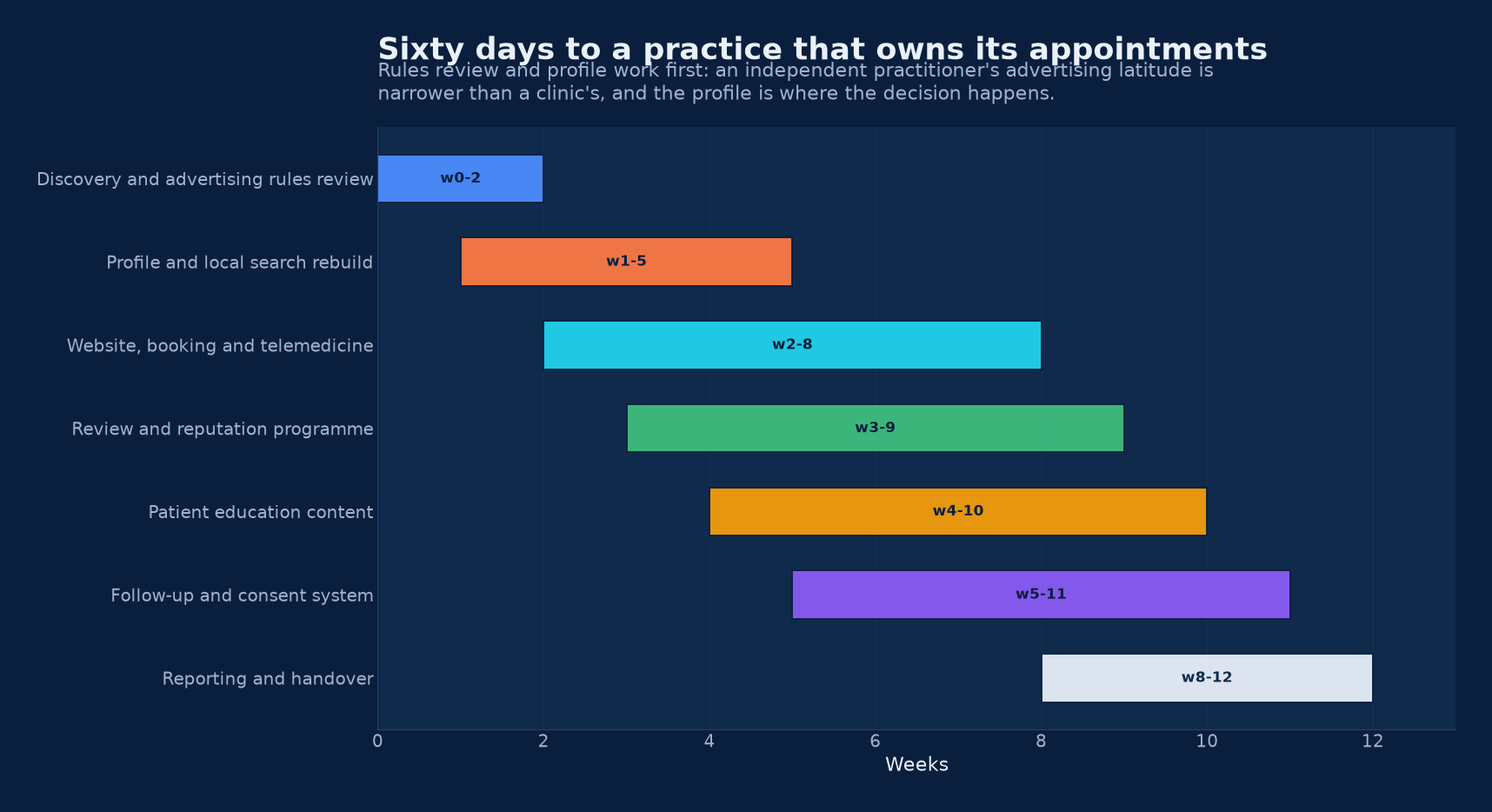
Chart values are an illustrative planning model based on typical UMC engagements and published industry benchmarks. They are not a guarantee of results on any specific project.
Weeks one and two are discovery and the advertising rules review: what the professional code and platform policy permit in this market, the profile audit against the three nearest competitors, the systems audit, and a two-page verdict including what we would not do. Profile and local search rebuild runs to week five. The website, booking and telemedicine flow land by week eight. The review and reputation programme starts at week three and never stops. Patient education content runs from week four to ten. The follow-up and consent system builds from week five to eleven, reporting is live by week twelve, and handover closes the programme.
| Deliverable | Week | What the practice keeps |
|---|---|---|
| Advertising rules summary | 2 | What may and may not be said, in this market |
| Profile audit and competitor comparison | 2 | The three things losing you patients right now |
| Profile and local search rebuild | 5 | Accurate listings, photos, services, hours |
| Website with booking and fees | 8 | A path that takes the appointment directly |
| Telemedicine consultation flow | 8 | Consent, notes, prescriptions, records |
| Review and reputation programme | 9 | Ask process, response standards, recovery flow |
| Education content library | 10 | Explainers with review dates and an owner |
| Follow-up, consent and recall | 11 | One patient record, consent register, recall rules |
| One-page weekly report | 12 | Six numbers and what changed |
| Handover and training | 12 | Runbooks, recordings, named owner per task |
Pricing and engagement models
| Model | Best for | What it includes | Commercial shape |
|---|---|---|---|
| Assessment only | A practitioner who wants the truth before spending | Rules summary, profile audit, systems audit, written verdict | Fixed fee, two weeks |
| Practice build | A solo or group practice fixing the fundamentals | Profiles, website, booking, telemedicine, reviews, follow-up, reporting | Fixed fee, sixty-day core |
| Managed retainer | A practice that wants it run | Local upkeep, content, review responses, reporting, IT hours | Monthly, small scope, quarterly review |
| Group programme | Two to twenty clinicians across locations | Brand system, per-location profiles, booking routing, consolidated reporting | Fixed fee by location plus a monthly run cost |
Every model separates the assessment from the build so a practitioner can stop after the verdict and keep the rules summary, the profile audit and the systems list – which on their own are usually worth the fee.
Compliance, consent and claims
The compliance surface for an independent practitioner is smaller than a hospital’s and more personal: every claim is attributed to a named professional, every record is their legal responsibility, and one public reply can become a professional conduct question. The register is short and it is reviewed twice a year.
| Area | What we check | Where it shows up | Owner |
|---|---|---|---|
| Professional advertising rules | Permitted information versus prohibited claims | Website, profiles, social, advertising | The practitioner with our review |
| Clinical claims | No guarantees, no comparative superiority, no outcome promises | Content, captions, ads | Our review plus the practitioner |
| Patient confidentiality | No identifiers, no case detail, no thank-you posts with names | Social, reviews, content | The practitioner |
| Consent and data | Purpose-specific consent, retention, patient rights | CRM, messaging, telemedicine, Wi-Fi | Named data owner |
| Records and retention | Storage, retention period, secure disposal | Practice system and backups | The practitioner |
| Telemedicine rules | Registration, prescribing limits, jurisdiction, consent | Remote consultation flow | The practitioner with our review |
| Referral conduct | No inducements, no fee sharing | Referrer relationships | The practitioner |
| Emergencies and scope | Clear signposting for urgent symptoms | Website, messaging, copilot | The practitioner |
AI governance covers anything automated that touches a patient, and IT audit and compliance readiness produces the evidence a regulator, insurer or hospital affiliation asks for.
How we measure success
| Outcome | Metric | Baseline source | Review cadence |
|---|---|---|---|
| More attended appointments | Attended appointments by session and source | Scheduling and desk records | Weekly during build |
| Owned-channel share | Share of appointments not from a paid platform | Source tracking | Monthly |
| Fewer lost enquiries | Answer rate, callback completion, first-response time | Desk dispositions | Weekly |
| Better utilisation | Slot utilisation, no-show rate | Scheduling | Weekly |
| Stronger local presence | Map-pack visibility, profile actions, rating trend | Search and profile data | Monthly |
| Continuity | Recall compliance, follow-up completion, returning share | CRM | Monthly |
| Referral network | Active referrers, feedback completion | Referral log | Monthly |
| Reliable systems | Downtime minutes, restore test results | Monitoring | Monthly |
| Honest spend | Cost per attended appointment by channel | Finance and campaign data | Quarterly |
We report the misses, including the weeks when the phone was not answered, because a practitioner who cannot see their own loss points cannot fix them.
Proof: healthcare work we have delivered
Our published healthcare engagements are institution-scale, but the practitioner-level disciplines are the same ones – local presence, credible content, appointment conversion, consent-based follow-up and reporting a busy clinician will actually read.
Related Services
Healthcare case studies:
- Apollo Hospitals – digital engagement
- Medicity Hospitals – digital engagement
- Global Hospitals – digital engagement
- Medical tourism company – international patient programme
- A renowned medical company in Africa
- Clinics and diagnostic centres – the multi-service version of this page
Practitioner work is confidential by nature – a doctor’s patient volume is not published – so we share method, numbers and constraints under a non-disclosure agreement.
Every capability a practice can draw on, by family
| Family | Capabilities | Typical practice use |
|---|---|---|
| Demand capture | local SEO and profiles, SEO, AI search optimisation, content marketing | Map pack, condition pages, assistant answers |
| Paid media | Google Ads, local campaigns, LinkedIn, media planning | Informational queries and availability, within the rules |
| Brand and reputation | brand performance and creative production, social media management, Instagram, YouTube | Professional photography, education content, review responses |
| Build | website development, UX and UI, accessibility, performance, portals, apps, maintenance | Biography, services, fees, booking, telemedicine |
| Patient data | CRM development and integration, lifecycle campaigns, WhatsApp, SMS, email, automation | Consent, recall, reminders, follow-up |
| Intelligence | dashboards, forecasting, referral pipelines | The one-page weekly view, session planning |
| Consulting | strategy, market research, expansion, cost and margin | Second location cases, group formation, fee structure |
| Infrastructure | managed IT, helpdesk, backup and DR, cybersecurity, networks, audit, cloud | Records backups, segmentation, payment security |
| Artificial intelligence | readiness, agents, governance, enablement, ROI | Administrative copilot, note structuring, review themes |
Local teams: doctors in Lucknow and across India
These pages are written to be geography-neutral because the work is delivered remotely. For practitioners who want a provider in their own market, the local pages carry regional detail, including appointment-focused programmes and speciality-specific work.
- Digital marketing company for doctors in Lucknow
- Website development company for doctors in Lucknow
- Get more doctor appointments in Lucknow
- Digital marketing company for clinics in Lucknow
- Get more dental clinic patients in Lucknow
- Get more diagnostic centre patients in Lucknow
- Digital marketing and IT services across Indian cities
- Contact us
Related industry verticals
Individual practitioners, clinics, hospitals and pharmaceutical companies are four of the nine verticals. Each is a complete programme of hub page and discipline spokes linked to the generic service practices, and each starts from the same economics-first method.
Frequently asked questions about marketing for doctors and independent practices
Am I allowed to advertise as a doctor?
In most markets only in an informational sense – name, qualifications, speciality, address, hours, services and fees. Guarantees, comparative claims, testimonials and before-and-after imagery are typically prohibited. We write the rules summary for your market first.
Do I need a website if I am already on a booking platform?
Yes, and the reason is commercial rather than aesthetic: the platform owns the listing, the patient data and the relationship, and charges per appointment. An owned path reduces that dependence over time.
How do I get reviews without breaking the rules?
By asking genuine patients at the right moment, on the channel they use, with no incentive and no filtering – then responding properly to whatever arrives, never disclosing anything clinical.
Can you set up telemedicine for my practice?
Yes: a consultation flow with consent capture, notes in your practice system, a prescription route that meets market rules, and secure follow-up – not video calls on a consumer app with no record.
I am not comfortable on camera. Does that matter?
No. Written explainers, diagrams, a good biography and consistent profile information do most of the work. Video is optional and we batch it if you want it.
How much time will this take from me?
About two hours in week one, one hour a month for content approval, and nothing for the profile, reporting or IT work. If a programme needs more of a clinician’s time than that, it is the wrong programme.
Who answers the WhatsApp messages?
Your desk, with an administrative copilot handling hours, fees, location and preparation, and a hard escalation rule for anything clinical or urgent. We do not deploy anything that gives clinical advice.
Can you handle my records and backups?
Yes – automated backups off the machine, tested restores, role-based access, MFA on administrative accounts and a retention schedule. This is the part most practices discover too late.
What if I consult at a hospital and run my own rooms?
Then both listings must agree: consistent credentials, hours, contact routing and one reputation. We manage both and keep them from contradicting each other.
Is a group practice programme different?
Yes – brand system across clinicians, booking that routes correctly, per-location profiles, consolidated reporting, and care taken that contribution reporting does not become a destructive internal league table.
How quickly will I see more appointments?
Profile and desk fixes usually move enquiries within weeks because the demand already exists. Recall and owned-channel share take a quarter, since they depend on patients returning.
Do you work outside India?
Yes. Programmes are delivered remotely and written geography-neutral, with professional advertising rules, telemedicine regulation and consent requirements handled per market.
What if my problem is not marketing?
Then the verdict says so. Common alternatives are session design, fee structure, waiting time or platform dependence – and we would rather name that in week two than advertise around it for a year.
Start with the rules summary and the profile audit
Give us two weeks with your profiles, your schedule and one afternoon of your time, and we will return the advertising rules summary for your market, the profile audit against your three nearest competitors, the systems and backups check, and a written verdict including what we would not do – yours to keep either way.
Contact Unified Management Consulting to arrange a confidential first conversation.